EP0920237A2 - Multifunktionelle Vorrichtung und Kommunikationsverfahren - Google Patents
Multifunktionelle Vorrichtung und Kommunikationsverfahren Download PDFInfo
- Publication number
- EP0920237A2 EP0920237A2 EP98309780A EP98309780A EP0920237A2 EP 0920237 A2 EP0920237 A2 EP 0920237A2 EP 98309780 A EP98309780 A EP 98309780A EP 98309780 A EP98309780 A EP 98309780A EP 0920237 A2 EP0920237 A2 EP 0920237A2
- Authority
- EP
- European Patent Office
- Prior art keywords
- data
- transferring
- digital network
- integrated service
- computer
- Prior art date
- Legal status (The legal status is an assumption and is not a legal conclusion. Google has not performed a legal analysis and makes no representation as to the accuracy of the status listed.)
- Withdrawn
Links
Images

Classifications
-
- H—ELECTRICITY
- H04—ELECTRIC COMMUNICATION TECHNIQUE
- H04Q—SELECTING
- H04Q11/00—Selecting arrangements for multiplex systems
- H04Q11/04—Selecting arrangements for multiplex systems for time-division multiplexing
- H04Q11/0428—Integrated services digital network, i.e. systems for transmission of different types of digitised signals, e.g. speech, data, telecentral, television signals
- H04Q11/0435—Details
- H04Q11/0471—Terminal access circuits
-
- H—ELECTRICITY
- H04—ELECTRIC COMMUNICATION TECHNIQUE
- H04L—TRANSMISSION OF DIGITAL INFORMATION, e.g. TELEGRAPHIC COMMUNICATION
- H04L12/00—Data switching networks
- H04L12/28—Data switching networks characterised by path configuration, e.g. LAN [Local Area Networks] or WAN [Wide Area Networks]
- H04L12/46—Interconnection of networks
-
- H—ELECTRICITY
- H04—ELECTRIC COMMUNICATION TECHNIQUE
- H04M—TELEPHONIC COMMUNICATION
- H04M11/00—Telephonic communication systems specially adapted for combination with other electrical systems
-
- H—ELECTRICITY
- H04—ELECTRIC COMMUNICATION TECHNIQUE
- H04Q—SELECTING
- H04Q2213/00—Indexing scheme relating to selecting arrangements in general and for multiplex systems
- H04Q2213/13034—A/D conversion, code compression/expansion
-
- H—ELECTRICITY
- H04—ELECTRIC COMMUNICATION TECHNIQUE
- H04Q—SELECTING
- H04Q2213/00—Indexing scheme relating to selecting arrangements in general and for multiplex systems
- H04Q2213/13093—Personal computer, PC
-
- H—ELECTRICITY
- H04—ELECTRIC COMMUNICATION TECHNIQUE
- H04Q—SELECTING
- H04Q2213/00—Indexing scheme relating to selecting arrangements in general and for multiplex systems
- H04Q2213/13103—Memory
-
- H—ELECTRICITY
- H04—ELECTRIC COMMUNICATION TECHNIQUE
- H04Q—SELECTING
- H04Q2213/00—Indexing scheme relating to selecting arrangements in general and for multiplex systems
- H04Q2213/13106—Microprocessor, CPU
-
- H—ELECTRICITY
- H04—ELECTRIC COMMUNICATION TECHNIQUE
- H04Q—SELECTING
- H04Q2213/00—Indexing scheme relating to selecting arrangements in general and for multiplex systems
- H04Q2213/13176—Common channel signaling, CCS7
-
- H—ELECTRICITY
- H04—ELECTRIC COMMUNICATION TECHNIQUE
- H04Q—SELECTING
- H04Q2213/00—Indexing scheme relating to selecting arrangements in general and for multiplex systems
- H04Q2213/13179—Fax, still picture
-
- H—ELECTRICITY
- H04—ELECTRIC COMMUNICATION TECHNIQUE
- H04Q—SELECTING
- H04Q2213/00—Indexing scheme relating to selecting arrangements in general and for multiplex systems
- H04Q2213/13199—Modem, modulation
-
- H—ELECTRICITY
- H04—ELECTRIC COMMUNICATION TECHNIQUE
- H04Q—SELECTING
- H04Q2213/00—Indexing scheme relating to selecting arrangements in general and for multiplex systems
- H04Q2213/13204—Protocols
-
- H—ELECTRICITY
- H04—ELECTRIC COMMUNICATION TECHNIQUE
- H04Q—SELECTING
- H04Q2213/00—Indexing scheme relating to selecting arrangements in general and for multiplex systems
- H04Q2213/13205—Primary rate access, PRI
-
- H—ELECTRICITY
- H04—ELECTRIC COMMUNICATION TECHNIQUE
- H04Q—SELECTING
- H04Q2213/00—Indexing scheme relating to selecting arrangements in general and for multiplex systems
- H04Q2213/13209—ISDN
-
- H—ELECTRICITY
- H04—ELECTRIC COMMUNICATION TECHNIQUE
- H04Q—SELECTING
- H04Q2213/00—Indexing scheme relating to selecting arrangements in general and for multiplex systems
- H04Q2213/13299—Bus
-
- H—ELECTRICITY
- H04—ELECTRIC COMMUNICATION TECHNIQUE
- H04Q—SELECTING
- H04Q2213/00—Indexing scheme relating to selecting arrangements in general and for multiplex systems
- H04Q2213/13362—Asynchronous systems
Definitions
- the present invention relates to a multifunctional apparatus, and more particularly to a multifunctional apparatus for transferring and receiving facsimile data and communication data by using an integrated service digital network, which transfers and receives the facsimile data using G3 and G3C protocols and which is connected to a computer so as to print and scan data provided from the computer.
- a multifunctional apparatus as is well known is an assembly of a printer, a scanner, a facsimile device, and a copier and referred to as a peripheral which is combined with a computer.
- the multifunctional apparatus comprises multiple functions such as printing, scanning, facsimile data transferring and copying.
- the multifunctional apparatus is connected to a computer by means of a serial port or a parallel port of the computer.
- the multifunctional apparatus has functions for printing data, scanning a document and storing document data in a memory of the computer, and transferring facsimile data.
- the multifunctional apparatus scans the document to be transferred and transfers the document data, or after a document has been written using a word processor, document data can be transferred by means of an application program supporting a facsimile transmission.
- a user must use an internal or external modem to communicate with another use by means of a computer, that is, when the multifunctional apparatus is connected to the computer to transfer and receive data to/from a communication network, there is a disadvantage in that the computer is provided with a modem.
- a first aspect of the present invention provides a multifunctional apparatus for transferring and receiving facsimile data and communication data by using an integrated service digital network, the apparatus comprising:
- the first transferring rate is about 64 kbps at which the data are transferred and received through the integrated service digital network.
- the second transferring rate is about 768 kbps at which the serial data are transferred in the ISAC.
- the present invention provides a multifunctional apparatus for transferring and receiving not only facsimile data but which also provides for data exchange with an internet service provider.
- a second aspect of the present invention provides A communication method for a multifunctional apparatus that transfers and receives facsimile data and communication data via an integrated service digital network, the method comprising the steps of:
- ISDN integrated service digital network
- the public service telephone network conventionally provides one analog channel for a user while the ISDN provides two digital channels for the user.
- the two channels can be used to support a telephone call and to transfer and receive communication data by using a personal computer and a facsimile device, simultaneously, that is, transmission and reception of data and a telephone call can be performed through the ISDN without using various types of communication lines.
- the ISDN uses digital signals, there is an advantage in that transmission and reception of the data can be performed at high data rates with greater noise immunity and a reduced loss of the data.
- An ISDN generally has two or three channels, that is, the ISDN has a D-channel for transferring and receiving control signals, a B-channel for transferring and receiving substantial data, and a H channel having six B-channels.
- Services for connecting with the ISDN can be generally divided into two types, for example, a primary rate interface (hereinafter, referred to as PRI) and a basic rate interface (hereinafter, referred to as BRI).
- PRI primary rate interface
- BRI basic rate interface
- the PRI is a first group connecting service and mainly available to an internet service provider and companies for reselling a line.
- the European PRI is generally divided into thirty B-channels and one D-channel and a North American PRI is divided into twenty three B-channels and one D-channel.
- the BRI is a basic connecting service and mainly available to personal subscribers.
- the BRI includes two B-channel and one D-channel.
- the B-channels respectively have a transmission rate of 64 kbps.
- the transmission and reception of data and voice communication can be performed simultaneously by utilising the two B-channel and the one D-channel.
- two telephones can be connected to the BRI.
- Another service such as a facsimile service can be applied to the ISDN.
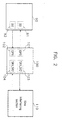
- Figure 1 is a block diagram showing a multifunctional apparatus having a facsimile transferring function according to an embodiment of the present invention, which is connected to the ISDN.
- a CPU 10 substantially controls the multifunctional apparatus by executing appropriate software.
- a memory 20 stores program data, protocol data, data relating a transmission and reception of character data.
- the CPU 10 can access and store the above data in the memory 20.
- a scanning means 30 scans a document and converts the document into corresponding image data in digital form.
- the scanning means 30 provides the image data to the CPU 10.
- a modem 70 is controlled by the CPU 10 to modulate data output -from the CPU 10 into analog data or to demodulate analog data into digital data.
- a printing means 40 prints facsimile data received through the ISDN under the control of the CPU 10.
- a computer interfacing means 50 connects the multifunctional apparatus with a computer using serial or parallel connections.
- the serial connection is an asynchronous communication using an RS-232C COM port as a serial port.
- the parallel connection is utilised for transferring data to a printer or plotter.
- a pixel converting means 60 converts the image data received from the scanning means 30 into data adapted for transmission.
- a CODEC 80 converts the analog signals modulated by the modem 70 into digital signals capable of being transferred through the ISDN or converts digital signals received through the ISDN into analog signals capable of being analysed by the modem 70.
- a serial input/output device 90 converts the data received from the computer or the scanning means into a form suitable for the B-channel of the ISDN, that is, the serial input/output device 90 converts the data received via an internal bus into serial data and transfers the serial data to an ISDN subscriber access controller 100 (hereinafter, referred to as ISAC). Moreover, the serial input/output device 90 converts serial data received from the ISAC 100 into a parallel data and transfers the parallel data via the internal bus to the CPU 10.
- ISAC ISDN subscriber access controller
- the ISAC 100 performs line coding and line activating/inactivating class 1 ISDN D-channel functions and a line access procedure on the D-channel. Furthermore, the ISAC 100 selects and sets a channel and detects a pathway corresponding to a dialling and the nature of a reception side or receiving device, for example, a facsimile device or a multifunctional apparatus. The ISAC 100 continually monitors communications with the receiving device and transfers and receives the data through the line interfacing section 110 for the ISDN.
- a class one protocol requires an eight pin type of modular connector which is a physical layer and used as a socket, a wave shaping of transferred signal on a subscribers line, time division multiplexing access to the B and D-channels relating the subscribers line, and an adaptive control of the D-channel in a connection of bus.
- Class two provides a multiple link access to support a data link layer via the bus and to establish a plurality of data link connections on a physical layer. It is referred to as the link access protocol on the D-channel. Since the link access protocol on the D-channel is based on a high level data link control, a signal can be reliably transferred through the D-channel.
- Class three provides a series of call signals on the D-channel so that the communication is performed over a network through the B or D-channel.
- a channel is selected and set during the setting of call signal and a pathway relating a response for a dialling is set. Then, the nature of the reception side device is detected and the possibility of establishing communication is identified.
- selecting and setting of a communication channel and identification of a reception side terminal is performed through the D-channel and the establishment of call using an X.25 is performed through the selected channel.
- the ISDN line interfacing section 110 interfaces signals of the ISDN so that digital data are transferred and received within specified physical and electrical regulations.
- a connection to the internet can be established and supported through a local area network and/or a public line network.
- the connection to the internet through the public line network can be established through the public switched telephone network and/or through the integrated service digital network.
- a computer is connected to an internet service provider by dialling a telephone number of the internet service provider through a program for dialling. At that time, the computer performs the dialling by using a modem.
- the computer transfers dialling information to a computer interfacing means 50 through a parallel port.
- the CPU 10 controls an ISAC 100 to perform classes one, two, and three protocols of the D-channel according to the dialling information.
- the CPU 10 also controls the ISDN line interfacing section 110 so that the multifunctional apparatus is connected to the internet service provider through the ISDN.
- a user drives an application program to transfer and receive the data to/from the internet service provider.
- the data is transferred to and received from the internet service provider through a different pathway to the dialling information, that is, when the multifunctional apparatus is connected to the internet service provider through the B-channel by the protocol of the D-channel, the data are transferred and received through the B-channel between the multifunctional apparatus and the internet service provider.
- Commands for searching information on the internet are transferred from the computer to the multifunctional apparatus through the computer interfacing means 50. Then, the commands are controlled by the CPU 10 to be transferred to the serial input/output device 90 through the internal bus.
- the serial input/output device 90 converts the commands into serial data. Then, the serial input/output device 90 transfers the serial data through a data upstream terminal 92 thereof to an input/output module data port one 102.
- the transmission rate is about 768 kbps which is the same as the transmission rate of internal serial data in the ISAC 100.
- the ISAC 100 changes the transmission rate of 768 kbps of the serial data to a transmission rate of 64 kbps. Then, the ISAC 100 outputs the data through transmission connectors SX1 and SX2 103 and transfers the data to the internet service provider through the ISDN line interfacing means 110.
- the data from the internet service provider is received by the ISAC 100 through reception connectors SR1 and SR2 104 at the transmission rate of 64 kbps and converted by the ISAC 100 into serial data having a transmission rate of 768 kbps.
- the serial data are transferred to a data downstream 91 of the serial input/output device 90 through an input/output module data port 0 of the ISAC 100.
- the serial input/output device 90 informs the CPU 10 through an interrupt connector of the reception of the serial data.
- the CPU 10 receiving an interrupt request transfers the data to the computer interfacing means 50 through the data bus.
- the computer interfacing means 50 transfers the data to the computer.
- the calling information such as the dialling information and the internet service information are transferred and received in parallel.
- the calling information is data on the D-channel and the internet service information is data on the B-channel. Accordingly, the calling information and the internet service information respectively have different pathways from each other.
- the facsimile data input through the scanning means 30 are input to the serial input/output device 90 under the control of the CPU 10 and transferred to a reception side facsimile device through the B-channel of the ISDN in the same manner as that of transferring data to the internet service provider, that is, the facsimile data are transferred and received through the B-channel at a transmission rate of 64 kbps.
- the reception side facsimile device must be a facsimile device supporting G3C, G3F, and G4 type protocols which are used for connecting with the ISDN.
- the calling information such as the dialling information is directly transferred to the ISAC 100 because of information on the D-channel.
- the CPU 10 controls the ISAC 100 to identify the protocols such as classes one, two and three on the D-channel. Furthermore, the CPU 10 controls the multifunctional apparatus to be connected with the reception side facsimile device through the ISDN. The facsimile data are transferred and received the serial input/output device 90 and the ISDN line interfacing means 110.
- the received facsimile data are transferred to the printing means 40 through the pixel converting means 60 according to the CPU 10.
- the printing means 40 prints the facsimile data.
- the multifunctional apparatus since the multifunctional apparatus according to an embodiment of the present invention has a printing function, scanning function, facsimile data transferring function, and a communicating function, there is an advantage in that a separate communication device is not required to support a communication with another communication apparatus by using a computer.
- the multifunctional apparatus supports not only the present protocol such as G3 but also protocols such as G3C and G3F so as to transfer and receive the facsimile data thorough the ISDN.
- the multifunctional apparatus supports a higher transmission rates than an analog type of a modem, the communicating cost can be reduced.
Landscapes
- Engineering & Computer Science (AREA)
- Computer Networks & Wireless Communication (AREA)
- Signal Processing (AREA)
- Facsimiles In General (AREA)
- Facsimile Transmission Control (AREA)
- Telephonic Communication Services (AREA)
- Communication Control (AREA)
Applications Claiming Priority (2)
| Application Number | Priority Date | Filing Date | Title |
|---|---|---|---|
| KR9763643 | 1997-11-28 | ||
| KR1019970063643A KR100288690B1 (ko) | 1997-11-28 | 1997-11-28 | 종합정보통신망에 연결하여 팩스데이터 송/수신 및 데이터통신이 가능한 복합기 |
Publications (2)
| Publication Number | Publication Date |
|---|---|
| EP0920237A2 true EP0920237A2 (de) | 1999-06-02 |
| EP0920237A3 EP0920237A3 (de) | 2001-08-29 |
Family
ID=19525819
Family Applications (1)
| Application Number | Title | Priority Date | Filing Date |
|---|---|---|---|
| EP98309780A Withdrawn EP0920237A3 (de) | 1997-11-28 | 1998-11-30 | Multifunktionelle Vorrichtung und Kommunikationsverfahren |
Country Status (4)
| Country | Link |
|---|---|
| US (1) | US6486970B1 (de) |
| EP (1) | EP0920237A3 (de) |
| JP (1) | JP3035530B2 (de) |
| KR (1) | KR100288690B1 (de) |
Cited By (1)
| Publication number | Priority date | Publication date | Assignee | Title |
|---|---|---|---|---|
| US6486970B1 (en) * | 1997-11-28 | 2002-11-26 | Samsung Electronics Co., Ltd. | Multifunctional apparatus for transferring and receiving facsimile data and communication data by using an integrated service digital network |
Families Citing this family (6)
| Publication number | Priority date | Publication date | Assignee | Title |
|---|---|---|---|---|
| US6122482A (en) * | 1995-02-22 | 2000-09-19 | Global Communications, Inc. | Satellite broadcast receiving and distribution system |
| JP2001268034A (ja) * | 2000-03-21 | 2001-09-28 | Nec Commun Syst Ltd | 多方向多重通信システムおよびそのチャネルアサイン方法 |
| JP2006195871A (ja) * | 2005-01-17 | 2006-07-27 | Ricoh Co Ltd | 通信装置、電子機器、及び画像形成装置 |
| KR100675847B1 (ko) * | 2005-05-24 | 2007-02-02 | 삼성전자주식회사 | 어드레스들마다 설정된 수행가능기능을 참조하여화상데이터 전달을 제어하는 네트워크 인터페이스장치 및그의 화상데이터 전달제어방법 |
| JP6128802B2 (ja) * | 2012-11-07 | 2017-05-17 | キヤノン株式会社 | ファクシミリ装置及びその制御方法とプログラム |
| JP2014099705A (ja) * | 2012-11-13 | 2014-05-29 | Canon Inc | 通信装置及びその制御方法、並びにプログラム |
Family Cites Families (22)
| Publication number | Priority date | Publication date | Assignee | Title |
|---|---|---|---|---|
| US4755992A (en) * | 1986-06-06 | 1988-07-05 | Racal Data Communications Inc. | Transparent packet access over d-channel of ISDN |
| JP2781227B2 (ja) * | 1989-06-30 | 1998-07-30 | 株式会社リコー | グループ4ファクシミリ通信アダプタ装置 |
| JP2781240B2 (ja) * | 1990-01-18 | 1998-07-30 | 株式会社リコー | Isdnファクシミリ装置 |
| JPH0417458A (ja) * | 1990-05-11 | 1992-01-22 | Ricoh Co Ltd | Isdn端末装置の伝送制御方法 |
| DE69129792T3 (de) * | 1990-11-27 | 2007-06-28 | Canon K.K. | Nebenstellenanlage |
| EP0503207B1 (de) * | 1991-03-13 | 1997-06-18 | International Business Machines Corporation | Anpassungseinrichtung und Verfahren zur wirksamen Verbindung von Datenverarbeitungseinrichtungen und Netzwerken |
| JPH04287478A (ja) * | 1991-03-15 | 1992-10-13 | Canon Inc | ファクシミリ装置及び電話機 |
| JPH05145681A (ja) * | 1991-11-18 | 1993-06-11 | Matsushita Graphic Commun Syst Inc | 画像通信装置 |
| DE4226332A1 (de) * | 1992-08-08 | 1994-02-10 | Sel Alcatel Ag | Verfahren und Vorrichtung zum schnellen Datenaustausch |
| JP3432531B2 (ja) * | 1992-08-11 | 2003-08-04 | 株式会社東芝 | 電子交換機 |
| US5495485A (en) * | 1993-08-31 | 1996-02-27 | Canon Inc. | Transmission of analog and digital information across a single line |
| JPH07131521A (ja) * | 1993-11-04 | 1995-05-19 | Nec Corp | ディジタル通信方式 |
| JPH07154527A (ja) * | 1993-11-30 | 1995-06-16 | Matsushita Electric Ind Co Ltd | ファクシミリ装置 |
| WO1995019089A1 (en) * | 1994-01-10 | 1995-07-13 | Exfax Technologies Pty. Ltd. | Facsimile accessory device |
| US5673258A (en) * | 1994-03-06 | 1997-09-30 | Dtm Data Telemark Gmbh | Method and apparatus for the enlargement of the reach of the transmission channel between functional groups of an ISDN-user interface |
| KR950028401A (ko) * | 1994-03-10 | 1995-10-18 | 김광호 | 통합통신 팩시밀리 시스템 및 제어방법 |
| US5541930A (en) * | 1995-01-10 | 1996-07-30 | Klingman; Edwin E. | Byte aligned communication system for transferring data from one memory to another memory over an ISDN |
| US5872639A (en) * | 1995-02-15 | 1999-02-16 | Nec Corporation | Multi-function facsimile apparatus connectible to computers and communication lines |
| DE19505271C1 (de) * | 1995-02-16 | 1996-01-18 | Siemens Ag | Kommunikationssystem |
| US5721729A (en) * | 1996-01-24 | 1998-02-24 | Klingman; Edwin E. | Universal input call processing system |
| DE19637302A1 (de) * | 1996-09-13 | 1998-04-02 | Dtm Data Telemark Gmbh | Verfahren und Vorrichtung zur Vergrößerung der Reichweite des Übertragungsweges zwischen Funktionseinheiten des ISDN-Teilnehmeranschlusses mit einer minimierten Bandbreite |
| KR100288690B1 (ko) * | 1997-11-28 | 2001-05-02 | 윤종용 | 종합정보통신망에 연결하여 팩스데이터 송/수신 및 데이터통신이 가능한 복합기 |
-
1997
- 1997-11-28 KR KR1019970063643A patent/KR100288690B1/ko not_active Expired - Fee Related
-
1998
- 1998-11-27 JP JP10337556A patent/JP3035530B2/ja not_active Expired - Fee Related
- 1998-11-30 EP EP98309780A patent/EP0920237A3/de not_active Withdrawn
- 1998-11-30 US US09/201,147 patent/US6486970B1/en not_active Expired - Fee Related
Cited By (1)
| Publication number | Priority date | Publication date | Assignee | Title |
|---|---|---|---|---|
| US6486970B1 (en) * | 1997-11-28 | 2002-11-26 | Samsung Electronics Co., Ltd. | Multifunctional apparatus for transferring and receiving facsimile data and communication data by using an integrated service digital network |
Also Published As
| Publication number | Publication date |
|---|---|
| KR19990042738A (ko) | 1999-06-15 |
| EP0920237A3 (de) | 2001-08-29 |
| US6486970B1 (en) | 2002-11-26 |
| JP3035530B2 (ja) | 2000-04-24 |
| JPH11239242A (ja) | 1999-08-31 |
| KR100288690B1 (ko) | 2001-05-02 |
Similar Documents
| Publication | Publication Date | Title |
|---|---|---|
| JP3820064B2 (ja) | ディジタルネットワークシステム,ディジタルネットワークスイッチ,isdnシステムの処理装置,およびディジタルネットワークにおけるサブチャネル確立方法 | |
| US6643283B2 (en) | Communication network | |
| EP0398680A2 (de) | ISDN-Faksimilevorrichtung, betreibbar als gemeinsamer Terminaladapter für mehrere nicht-ISDN-Faksmilevorrichtungen | |
| HK179196A (en) | Facsimile service | |
| US5752199A (en) | Method and apparatus for sending faxes over analog cellular | |
| US6157846A (en) | Method of and apparatus for providing an interface between an analog facsimile device and a wireless network | |
| US5495485A (en) | Transmission of analog and digital information across a single line | |
| US6486970B1 (en) | Multifunctional apparatus for transferring and receiving facsimile data and communication data by using an integrated service digital network | |
| US6711175B1 (en) | Procedure for scanning or disconnecting a module line in a V5.2 access node | |
| US6424708B1 (en) | Method for concentrating subscribers in a telephone network | |
| KR100288711B1 (ko) | 외부출력장치가 연동되는 종합정보통신망 팩시밀리 시스템 | |
| US6771752B1 (en) | Communication apparatus capable of communication with single partner using a plurality of communication channels, and control method thereof | |
| KR100265041B1 (ko) | 복합 기능을 실행하는 종합정보통신망에 연동되는 단말장치 및방법 | |
| US6496282B1 (en) | Method and apparatus for establishing synchronous fax communication through ISDN | |
| KR200231660Y1 (ko) | 종합정보통신망에 연동되는 팩시밀리의 작동 상태를 관리하는 장치 | |
| US5920402A (en) | Use of compression to improve the sending of faxes over analog cellular | |
| KR100257819B1 (ko) | 종합정보통신망에 이중 접근을 지원하는 이중접근제어부를구비한 복합기 및 그 제어 방법 | |
| US6707909B1 (en) | Connection apparatus for connecting a digital or analog subscriber line of communication network to communication device | |
| KR100268349B1 (ko) | 프로토콜 분석 시스템 | |
| JPH0669189B2 (ja) | 複数メデイア通信処理方式 | |
| KR100214340B1 (ko) | *팩시밀리를 공중회선 교환망과 종합정보 통신망에 접속하는 회로와 방법, 공중회선 교환망과 종합정보 통신망에 접속가능하는 팩시밀리 | |
| KR20000008073A (ko) | 종합정보통신망에 연동되어 두개의 비 채널을 사용하는 장치 | |
| KR20000019763A (ko) | 종합정보통신망 복합기에서 무정전 시 전화기능을 사용하는 장치 | |
| KR19990011673A (ko) | 단말장치를 내장한 팩시밀리장치 | |
| KR19990031581A (ko) | 인터페이스장치를 내장한 팩시밀리장치 |
Legal Events
| Date | Code | Title | Description |
|---|---|---|---|
| PUAI | Public reference made under article 153(3) epc to a published international application that has entered the european phase |
Free format text: ORIGINAL CODE: 0009012 |
|
| 17P | Request for examination filed |
Effective date: 19981130 |
|
| AK | Designated contracting states |
Kind code of ref document: A2 Designated state(s): AT BE CH CY DE DK ES FI FR GB GR IE IT LI LU MC NL PT SE |
|
| AX | Request for extension of the european patent |
Free format text: AL;LT;LV;MK;RO;SI |
|
| PUAL | Search report despatched |
Free format text: ORIGINAL CODE: 0009013 |
|
| AK | Designated contracting states |
Kind code of ref document: A3 Designated state(s): AT BE CH CY DE DK ES FI FR GB GR IE IT LI LU MC NL PT SE |
|
| AX | Request for extension of the european patent |
Free format text: AL;LT;LV;MK;RO;SI |
|
| AKX | Designation fees paid |
Free format text: DE GB IT |
|
| 17Q | First examination report despatched |
Effective date: 20021120 |
|
| STAA | Information on the status of an ep patent application or granted ep patent |
Free format text: STATUS: THE APPLICATION IS DEEMED TO BE WITHDRAWN |
|
| 18D | Application deemed to be withdrawn |
Effective date: 20030531 |