EP0920927A2 - Procédé et système pour supprimer la formation de calamine dans un laminoir finisseur à chaud - Google Patents
Procédé et système pour supprimer la formation de calamine dans un laminoir finisseur à chaud Download PDFInfo
- Publication number
- EP0920927A2 EP0920927A2 EP98122465A EP98122465A EP0920927A2 EP 0920927 A2 EP0920927 A2 EP 0920927A2 EP 98122465 A EP98122465 A EP 98122465A EP 98122465 A EP98122465 A EP 98122465A EP 0920927 A2 EP0920927 A2 EP 0920927A2
- Authority
- EP
- European Patent Office
- Prior art keywords
- finishing mill
- molten glass
- scale
- finishing
- glass film
- Prior art date
- Legal status (The legal status is an assumption and is not a legal conclusion. Google has not performed a legal analysis and makes no representation as to the accuracy of the status listed.)
- Withdrawn
Links
- 230000015572 biosynthetic process Effects 0.000 title claims description 46
- 238000000034 method Methods 0.000 title claims description 17
- 239000000463 material Substances 0.000 claims abstract description 200
- 239000006060 molten glass Substances 0.000 claims abstract description 121
- 238000005096 rolling process Methods 0.000 claims abstract description 63
- 239000011248 coating agent Substances 0.000 claims abstract description 47
- 238000000576 coating method Methods 0.000 claims abstract description 47
- 239000011521 glass Substances 0.000 claims abstract description 37
- XLYOFNOQVPJJNP-UHFFFAOYSA-N water Substances O XLYOFNOQVPJJNP-UHFFFAOYSA-N 0.000 description 10
- 230000007423 decrease Effects 0.000 description 5
- 230000003247 decreasing effect Effects 0.000 description 5
- 230000001050 lubricating effect Effects 0.000 description 4
- 238000002844 melting Methods 0.000 description 4
- 230000008018 melting Effects 0.000 description 4
- 239000000047 product Substances 0.000 description 4
- XEEYBQQBJWHFJM-UHFFFAOYSA-N Iron Chemical compound [Fe] XEEYBQQBJWHFJM-UHFFFAOYSA-N 0.000 description 2
- 230000000903 blocking effect Effects 0.000 description 2
- 239000013589 supplement Substances 0.000 description 2
- 230000002411 adverse Effects 0.000 description 1
- 230000004075 alteration Effects 0.000 description 1
- QVGXLLKOCUKJST-UHFFFAOYSA-N atomic oxygen Chemical compound [O] QVGXLLKOCUKJST-UHFFFAOYSA-N 0.000 description 1
- 239000007795 chemical reaction product Substances 0.000 description 1
- 230000007547 defect Effects 0.000 description 1
- 239000007789 gas Substances 0.000 description 1
- 230000002401 inhibitory effect Effects 0.000 description 1
- 239000012212 insulator Substances 0.000 description 1
- 229910052742 iron Inorganic materials 0.000 description 1
- 238000012986 modification Methods 0.000 description 1
- 230000004048 modification Effects 0.000 description 1
- 230000003647 oxidation Effects 0.000 description 1
- 238000007254 oxidation reaction Methods 0.000 description 1
- 239000001301 oxygen Substances 0.000 description 1
- 229910052760 oxygen Inorganic materials 0.000 description 1
- 230000002093 peripheral effect Effects 0.000 description 1
- 239000000843 powder Substances 0.000 description 1
- 230000001737 promoting effect Effects 0.000 description 1
- 239000007921 spray Substances 0.000 description 1
Images
Classifications
-
- B—PERFORMING OPERATIONS; TRANSPORTING
- B21—MECHANICAL METAL-WORKING WITHOUT ESSENTIALLY REMOVING MATERIAL; PUNCHING METAL
- B21B—ROLLING OF METAL
- B21B45/00—Devices for surface or other treatment of work, specially combined with or arranged in, or specially adapted for use in connection with, metal-rolling mills
-
- B—PERFORMING OPERATIONS; TRANSPORTING
- B21—MECHANICAL METAL-WORKING WITHOUT ESSENTIALLY REMOVING MATERIAL; PUNCHING METAL
- B21B—ROLLING OF METAL
- B21B1/00—Metal-rolling methods or mills for making semi-finished products of solid or profiled cross-section; Sequence of operations in milling trains; Layout of rolling-mill plant, e.g. grouping of stands; Succession of passes or of sectional pass alternations
- B21B1/22—Metal-rolling methods or mills for making semi-finished products of solid or profiled cross-section; Sequence of operations in milling trains; Layout of rolling-mill plant, e.g. grouping of stands; Succession of passes or of sectional pass alternations for rolling plates, strips, bands or sheets of indefinite length
- B21B1/24—Metal-rolling methods or mills for making semi-finished products of solid or profiled cross-section; Sequence of operations in milling trains; Layout of rolling-mill plant, e.g. grouping of stands; Succession of passes or of sectional pass alternations for rolling plates, strips, bands or sheets of indefinite length in a continuous or semi-continuous process
- B21B1/26—Metal-rolling methods or mills for making semi-finished products of solid or profiled cross-section; Sequence of operations in milling trains; Layout of rolling-mill plant, e.g. grouping of stands; Succession of passes or of sectional pass alternations for rolling plates, strips, bands or sheets of indefinite length in a continuous or semi-continuous process by hot-rolling, e.g. Steckel hot mill
Definitions
- the present invention relates to a method and a system for suppressing the formation of scale in a hot finishing mill system during rolling of a strip material.
- a film of the reaction product i.e., scale
- This scale may exert an adverse influence, such as oxidation, on the strip material, and should be removed.
- the customary practice for removing scale formed on a strip material has been to spray a jet of pressurized water on the surface of the strip material.
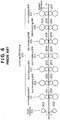
- Fig. 6 is a schematic view of a scale removing device of a conventional hot finishing mill system.
- a plurality of finishing mills i.e., 1st to 7th finishing mills 101, 102, 103, 104, 105, 106 and 107, are located in a row along the direction of transport of a rolled material S downstream of a roughing mill (not shown) in the direction of transport.
- the finishing mills 101, 102, 103, 104, 105, 106 and 107 have a pair of (i.e., upper and lower) work rollers 201, 202, 203, 204, 205, 206 and 207, respectively.
- a finishing mill group 100 is constructed in this manner.
- a scale breaker 301 is provided for removing scale formed on the rolled material S.
- the scale breaker 301 has jet nozzles 302 above and below the rolled material S. These jet nozzles 302 direct jets of water at a high pressure of, say, 200 kgf/cm 2 , to the upper and lower surfaces of the rolled material S to remove the scale.
- the rolled material S transported after rough rolling from a slab by a roughing mill is conveyed to the entry side of the finishing mill group 100 where scale formed on the surfaces of he rolled material S is removed by the scale breaker 301 before finish rolling.
- water pressurized at, say, 200 kgf/cm 2 is directed through the upper and lower jet nozzles 302 to the upper and lower surfaces of the conveyed rolled material S to remove the adhering scale.
- the descaled rolled material S is carried to the finishing mill group 100 for rolling by the work rollers 201, 202, 203, 204, 205, 206 and 207 of the 1st to 7th finishing mills 101, 102, 103, 104, 105, 106 and 107, whereby it is sequentially finish rolled to predetermined thicknesses.
- Fig. 3 is a graph illustrative of the relationship of a rolling load and the thickness of scale during descaling and finish rolling of the rolled material S.
- the circle ⁇ signifies the rolling load of the scale removing device of the aforementioned conventional hot finishing mill system
- the two-dot chain line represents the thickness of scale
- A designates the time of scale removal by the scale breaker 301
- B, C, D, E, F, G and H represent the times of finish rolling by the 1st to 7th finishing mills 101, 102, 103, 104, 105, 106 and 107, respectively.
- This graph shows that the scale thickness of the rolled material S decreases rapidly at the time A of scale removal by the scale breaker 301, and also decreases at the times B, C, D, E, F, G and H of finish rolling. Also, repeated rolling is found to thin the scale.
- the rolled material S has to be transported at a low speed, with the result that the rolled material S takes a relatively long time until its engagement into the work rolls 201, 202, 203, 204, 205, 206 and 207, thus promoting the formation of scale.
- the thickness of the scale on the rolled material S after rolling exceeds a limit of 5 ⁇ m.
- this scale is imprinted into the surface of the rolled material S, causing defects. This markedly deteriorates the quality of the rolled material S.
- the present invention aims to solve this problem. Its primary object is to provide a method and a system for suppressing the formation of scale in a hot finishing mill system while improving the quality of the finished product, by inhibiting the formation of scale on a rolled material reliably.
- a second aspect of the invention there is provided the method for suppressing the formation of scale in the hot finishing mill system accordance with the first aspect of the invention, wherein the molten glass film is subsequently removed at a delivery side of the most downstream finishing mill.
- a system for suppressing the formation of scale in a hot finishing mill system comprising:
- molten glass film removing means for removing the molten glass film formed on the upper and lower surfaces of the strip material is located at the delivery side of the finishing mill or the finishing mill group.
- a system for suppressing the formation of scale in a hot finishing mill system comprising:
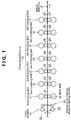
- Fig. 1 is a schematic view of a scale formation suppressing system for performing a method for suppressing the formation of scale in a hot finishing mill system according to a first embodiment of the present invention.
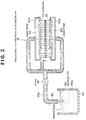
- Fig. 2 is a schematic sectional view of a molten glass coating material application apparatus.
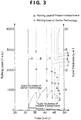
- Fig. 3 is a graph showing the relationship of a rolling load and the thickness of scale during finish rolling by a scale formation suppressing system of a hot finishing mill system according to the present invention.
- a plurality of finishing mills i.e., a 1st finishing mill 11, a 2nd finishing mill 12, a 3rd finishing mill 13, a 4th finishing mill 14, a 5th finishing mill 15, a 6th finishing mill 17, and a 7th finishing mill are arranged in a row along the direction of transport of a rolled material S downstream of a roughing mill (not shown) in the direction of transport.
- the finishing mills 11 to 17 have a pair of (i.e., upper and lower) work rollers 21, 22, 23, 24, 25, 26 and 27, respectively.
- a finishing mill group 10 is thus constructed in this manner.
- a scale breaker 31 is provided for removing scale formed on the rolled material S.
- the scale breaker 31 has a pair of (i.e., upper and lower) jet nozzles 32 above and below the rolled material S. These jet nozzles 32 direct jets of water at a high pressure of, say, 200 kgf/cm 2 , to the upper and lower surfaces of the rolled material S to remove the scale.
- a molten glass coating material application device 41 for delivering molten glass in the form of a jet to the upper and lower surfaces of the rolled material S to form a molten glass film thereon.
- a molten glass coating material application device 41 as shown in Fig. 2, an upper head 42 and a lower head 43 are disposed above and below the rolled material S, respectively.
- heads 42 and 43 slit-like jet nozzles 44 and 45, respectively, are formed opposite and relatively close to the rolled material S.
- a melting tank 46 storing molten glass is installed adjacent the heads 42 and 43 and a heater 47 is mounted to its underside.
- the melting tank 46 is connected to the heads 42 and 43 via a supply pipe 49 having a pump 48 midway.
- the upper head 42, the lower head 43, the melting tank 46, and the supply pipe 49 also included respective heat insulators 42a, 43a, 46a and 49a.
- the rolled material S is to be finish rolled by the hot finishing mill system of the embodiment shown in Fig. 1
- the rolled material S transported after rough rolling from a slab by a roughing mill, not shown, is conveyed to the entry side of the finishing mill group 10, where scale formed on the surfaces of the rolled material S is removed by the scale breaker 31 before finish rolling.
- water pressurized at, say, 200 kgf/cm 2 is jetted through the upper and lower jet nozzles 32 to the upper and lower surfaces of the conveyed rolled material S to remove the adhering scale.
- the molten glass coating material jet type of application device 41 jets molten glass to the upper and lower surfaces of the rolled material S to form a molten glass film thereon.
- molten glass is prepared and heated in the melting tank 46 by the heater 47.
- the molten glass is supplied to the upper head 42 and the lower head 43 through the supply pipe 49 upon actuation of the pump 48, and delivered to the upper and lower surfaces of the rolled material S by the jet nozzles 44, 45.
- a molten glass film is formed on the upper and lower surfaces of the rolled material S, whereby contact between air and the rolled material S is blocked in order to prevent the formation of scale.
- the descaled, molten glass-coated, rolled material S is transported to the finishing mill group 10 for rolling by the work rollers 21, 22, 23, 24, 25, 26 and 27 of the respective finishing mills 11, 12, 13, 14, 15, 16 and 17. At this time, the rolled material S is kept out of contact with air because of the molten glass film formed on its surfaces.
- the rolled material S is sequentially finish rolled to predetermined thicknesses without scale formation.
- the molten glass film formed on the surfaces of the rolled material S is effective as a satisfactory lubricating material, and can decrease the rolling load in the finishing mills 11 to 17.
- Fig. 3 is a graph showing the relationship of rolling load and the thickness of scale during scale removal and finish rolling of the rolled material S.
- the triangle ⁇ signifies the rolling load of the finishing mill of the hot finishing mill system of the aforementioned embodiment
- the solid line represents the thickness of scale
- A designates the time of scale removal by the scale breaker 31
- B, C, D, E, F, G and H represent the times of finish rolling by the 1st to 7th finishing mills 11, 12, 13, 14, 15, 16 and 17, respectively.
- This graph shows that the scale thickness of the rolled material S decreases rapidly at the time A of scale removal by the scale breaker 31, and also decreases at the times B, C, D, E, F, G and H of finish rolling. Also, repeated rolling is found to thin the scale.
- the scale of the rolled material S is mostly removed at the time A of scale removal by the scale breaker 31, and the thickness of scale until the time B of finish rolling by the first finishing mill 11 remains almost unchanged (0.5 ⁇ m) relative to that at the time A of scale removal.
- Such formation of the molten glass film on the rolled material S immediately after removal of its scale can block its contact with air during finish rolling, and can finish roll it to predetermined plate thicknesses sequentially without scale formation. Furthermore, the molten glass film formed on the surfaces of the rolled material S acts as a good lubricating material, thus decreasing the rolling load in the finishing mills 11 to 17.
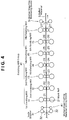
- Fig. 4 is a schematic view of a scale formation suppressing system of a hot finishing mill system according to a second embodiment of the present invention.
- Members having the same functions as explained in the foregoing embodiment of Fig. 1 are assigned the same reference numerals, and overlapping explanations will be omitted.
- a finishing mill group 10 is composed of a plurality of finishing mills, i.e., 1st to 7th finishing mills, 11 to 17, arranged in a row along the direction of transport of a rolled material S. These finishing mills 11 to 17 have a pair of (i.e., upper and lower) work rollers 21 to 27, respectively.
- a scale breaker 31 is provided on the entry side of this finishing mill group 10.
- the scale breaker 31 has a pair of (i.e., upper and lower) jet nozzles 32.
- a molten glass coating material delivery device 41 is provided for jetting molten glass at upper and lower surfaces of the rolled material S to form a molten glass film.
- a molten glass film removing device 51 is located thereat for removing the molten glass film formed on the upper and lower surfaces of the rolled material S.
- This molten glass film removing device 51 has a pair of (i.e., upper and lower) jet nozzles, which direct jets of high pressure water toward and to the upper and lower surfaces of the rolled material S to remove the molten glass film remaining on these upper and lower surfaces.
- the descaled, molten glass-coated, rolled material S is carried to the finishing mill group 10 for rolling by the respective finishing mills 11 to 17.
- the rolled material S is kept out of contact with air because of the molten glass film formed on its surfaces.
- the rolled material S is sequentially finish rolled to predetermined thicknesses without scale formation.
- the molten glass film removing device 51 next removes the remaining film by jetting high pressure water at the upper and lower surfaces of the rolled material S through the upper and lower jet nozzles.
- a molten glass film is formed immediately after scale of the rolled material S is removed.
- the rolled material S is blocked from contact with air during finish rolling, and can be finish rolled sequentially to predetermined thicknesses without scale formation. Removal of the molten glass film remaining on the upper and lower surfaces of the rolled material S, which has been finish rolled to a predetermined plate thickness, brings the rolled material S to a commercial stage.
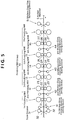
- Fig. 5 depicts the outline of a scale formation suppressing system of a hot finishing mill system according to a third embodiment of the present invention.
- Members having the same functions as explained in the foregoing embodiments are assigned the same reference numerals, and overlapping explanations will be omitted.
- a finishing mill group 10 is comprises of a plurality of finishing mills, i.e., 1st to 7th finishing mills, 11 to 17, arranged in a row along the direction of transport of a rolled material S. These finishing mills 11 to 17 have a pair of (i.e., upper and lower) work rollers 21 to 27, respectively.
- a scale breaker 31 is provided on an entry side of this finishing mill group 10.
- the scale breaker 31 has a pair of (i.e., upper and lower) jet nozzles 32.
- a first molten glass coating material jet type of delivery device 41 is provided at the entry side of the finishing mill group 10 (the 1st finishing mill 11) and at a delivery side of the scale breaker 31 .
- a molten glass film removing device 51 is also provided at the delivery side of the finishing mill group 10 (the 7th finishing mill 17).
- 2nd, 3rd and 4th molten glass coating material application devices 42, 43 and 44 are provided for jetting molten glass at the upper and lower surfaces of the rolled material S to form a molten glass film.
- the descaled, molten glass-coated, rolled material S is carried to the finishing mill group 10 for rolling by the 1st finishing mill 11. At this time, the rolled material S is kept out of contact with air because of the molten glass film formed on its surfaces. Thus, the rolled material S is finish rolled to a predetermined thickness without scale formation.
- the molten glass film formed on the surfaces of the rolled material S is slightly thinned.
- molten glass is again applied as a jet through the jet nozzles of the 2nd molten glass coating material jetting device 42 to the upper and lower surfaces of the rolled material S.
- the rolled material S with the supplemented molten glass film is further rolled by the 2nd and 3rd finishing mills 12, 13, whereafter the molten glass film on the upper and lower surfaces of the rolled material S is further supplemented with molten glass by the 3rd molten glass coating material jetting device 43.
- the rolled material S with the supplemented molten glass film is further rolled by the 4th and 5th finishing mills 14, 15, whereafter the molten glass film on the upper and lower surfaces of the rolled material S is supplemented yet again with molten glass by the 4th molten glass coating material jetting device 44.
- the rolled material S is finish rolled by the 6th and 7th finishing mills 16, 17 to a predetermined plate thickness.
- the molten glass film removing device 51 then removes this remaining film by jetting high pressure water at the upper and lower surfaces of the rolled material S through the upper and lower jet nozzles.
- a molten glass film is formed immediately after scale of the rolled material S is removed.
- the rolled material S is blocked from contact with air during finish rolling, and can be finish rolled sequentially to predetermined thicknesses without scale formation.
- molten glass is repeatedly jetted to the upper and lower surfaces of the rolled material S after rolling by the finishing mill, to supplement the molten glass film with additional molten glass.
- the molten glass film on the rolled material S can be kept at a constant thickness, so that contact between the rolled material S and air can be reliably prevented. Removal of the molten glass film remaining on the upper and lower surfaces of the rolled material S, which has been finish rolled to the predetermined plate thickness, can bring the rolled material S to a commercial stage.
- molten glass was used as a coating material jetted by the glass coating material jetting means of the present invention to form a molten glass film.
- powdered glass may be used as the coating material. This material would be applied at the upper and lower surfaces of the rolled material S and thereafter heated at a high temperature, whereby the glass powder is melted to form a molten glass film.
- the rolled material can be finish rolled to the predetermined plate thickness without scale formation.
- the molten glass film formed on the surfaces of the rolled material is used as a satisfactory lubricating material. Therefor, the rolling load by the respective finishing mills can be decreased. Consequently, scale which would otherwise form on the rolled material is reliably suppressed, and the quality of the resulting product is improved.
- the method for suppressing the formation of scale in the hot finishing mill system in accordance with the first aspect of the invention wherein the molten glass film is removed at a delivery side of the most downstream finishing mill.
- the strip material can be easily commercialized.
- a system for suppressing the formation of scale in a hot finishing mill system comprising: a finishing mill for finish rolling a strip material, or a finishing mill group comprised of a plurality of finishing mills arranged in a row; scale removing means provided at an entry side of the finishing mill or the finishing mill group; and, glass coating material jet type delivery means for jetting a glass coating material to upper and lower surfaces of the strip material to form a molten glass film, the glass coating material delivery means being located at the entry side of the finishing mill or the finishing mill group and at a delivery side of the scale removing means.
- the molten glass film is formed immediately after scale of the strip material is removed.
- the strap material is blocked from contact with air during finish rolling, and can be finish rolled to a predetermined thickness without scale formation. Furthermore, the molten glass film formed on the surfaces of the strip material is used as a satisfactory lubricating material. Thus, the rolling load by the respective finishing mills can be decreased. Consequently, scale formation on the rolled material can be reliably suppressed, and the quality of the resulting product improved.
- the system for suppressing the formation of scale in the hot finishing mill system in accordance with the third aspect of the invention, wherein molten glass film removing means for removing the molten glass film formed on the upper and lower surfaces of the strip material is provided at the delivery side of the finishing mill or the finishing mill group.
- the strip material can be commercialized by removing, after finish rolling, the molten glass film that has been formed immediately after removal of scale from the strip material.
- a system for suppressing the formation of scale in a hot finishing mill system comprising: a finishing mill group including a plurality of finishing mills configured in a row for finish rolling a strip material; scale removing means provided at the entry side of the finishing mill group; first glass coating material jet type of application means for jetting a glass coating material to upper and lower surfaces of the strip material to form a molten glass film, the first glass coating material application means being located at the entry side of the finishing mill group and including one of the plurality of finishing mills at a delivery side of the scale removing means; second glass coating material jet type of application means for jetting a glass coating material at upper and lower surfaces of the strip material to form a molten glass film, the second glass coating material application means being provided at the delivery side of any of or all of the other finishing mills of the plurality of finishing mills of the other finishing mill group; and molten glass film removing means for removing the molten glass film formed on the upper and lower surfaces of the strip
- the strip material is blocked from contact with air during finish rolling, and can be finish rolled to a predetermined thickness without scale formation.
- molten glass is repeatedly applied after rolling by the finishing mill to supplement the previously applied molten glass film with additional molten glass.
- the molten glass film on the strip material can be kept at a predetermined constant thickness, so that contact between the strip material and air can be reliably prevented.
- the strip material can be commercialized. Since scale formation on the rolled material can thus be reliably suppressed, the quality of the resulting product can be substantially improved.
Landscapes
- Engineering & Computer Science (AREA)
- Mechanical Engineering (AREA)
- Metal Rolling (AREA)
- Preventing Corrosion Or Incrustation Of Metals (AREA)
Applications Claiming Priority (2)
| Application Number | Priority Date | Filing Date | Title |
|---|---|---|---|
| JP9335234A JPH11169905A (ja) | 1997-12-05 | 1997-12-05 | 熱間仕上圧延機のスケール生成抑制方法及び装置 |
| JP33523497 | 1997-12-05 |
Publications (2)
| Publication Number | Publication Date |
|---|---|
| EP0920927A2 true EP0920927A2 (fr) | 1999-06-09 |
| EP0920927A3 EP0920927A3 (fr) | 2000-09-20 |
Family
ID=18286255
Family Applications (1)
| Application Number | Title | Priority Date | Filing Date |
|---|---|---|---|
| EP98122465A Withdrawn EP0920927A3 (fr) | 1997-12-05 | 1998-11-26 | Procédé et système pour supprimer la formation de calamine dans un laminoir finisseur à chaud |
Country Status (6)
| Country | Link |
|---|---|
| US (1) | US6055835A (fr) |
| EP (1) | EP0920927A3 (fr) |
| JP (1) | JPH11169905A (fr) |
| CN (1) | CN1218723A (fr) |
| AU (1) | AU718145B2 (fr) |
| CA (1) | CA2255389C (fr) |
Families Citing this family (1)
| Publication number | Priority date | Publication date | Assignee | Title |
|---|---|---|---|---|
| KR102170939B1 (ko) * | 2018-11-27 | 2020-10-29 | 주식회사 포스코 | 압연소재 처리설비 및 처리방법 |
Family Cites Families (7)
| Publication number | Priority date | Publication date | Assignee | Title |
|---|---|---|---|---|
| US3191251A (en) * | 1962-08-16 | 1965-06-29 | Olsson Erik Allan | Process for treating continuously cast material |
| JPS5339935A (en) * | 1976-09-24 | 1978-04-12 | Nippon Steel Corp | Method of and device for applying scale reforming agent to hot rolled steel band |
| JPS572828A (en) * | 1980-06-10 | 1982-01-08 | Nippon Steel Corp | Manufacture of steel product with superior suitability to pickling |
| JPS6013407B2 (ja) * | 1980-06-10 | 1985-04-06 | 新日本製鐵株式会社 | 酸洗性の優れた鋼材の製造方法 |
| JPS60162506A (ja) * | 1984-02-02 | 1985-08-24 | Nippon Steel Corp | 熱延鋼板製造方法 |
| JPH0790246B2 (ja) * | 1985-10-30 | 1995-10-04 | 新日本製鐵株式会社 | 鋳片の直接圧延方法 |
| JPH07278662A (ja) * | 1994-04-07 | 1995-10-24 | Nippon Steel Corp | 表面特性および酸洗性に優れた熱延鋼板の製造方法 |
-
1997
- 1997-12-05 JP JP9335234A patent/JPH11169905A/ja not_active Withdrawn
-
1998
- 1998-11-24 AU AU94093/98A patent/AU718145B2/en not_active Ceased
- 1998-11-26 EP EP98122465A patent/EP0920927A3/fr not_active Withdrawn
- 1998-12-01 US US09/201,783 patent/US6055835A/en not_active Expired - Fee Related
- 1998-12-04 CA CA002255389A patent/CA2255389C/fr not_active Expired - Fee Related
- 1998-12-04 CN CN98122767A patent/CN1218723A/zh active Pending
Also Published As
| Publication number | Publication date |
|---|---|
| JPH11169905A (ja) | 1999-06-29 |
| AU9409398A (en) | 1999-06-24 |
| EP0920927A3 (fr) | 2000-09-20 |
| CN1218723A (zh) | 1999-06-09 |
| US6055835A (en) | 2000-05-02 |
| CA2255389C (fr) | 2002-04-30 |
| CA2255389A1 (fr) | 1999-06-05 |
| AU718145B2 (en) | 2000-04-06 |
Similar Documents
| Publication | Publication Date | Title |
|---|---|---|
| EP0664340A2 (fr) | Procédé continu pour la fabrication de produits en acier inoxydable aux dimensions finales | |
| JP2002172415A (ja) | 厚鋼板冷却方法およびその装置 | |
| CA2255248C (fr) | Methode et systeme de suppression de la couche d'oxyde de surface pendant le laminage de finition a chaud | |
| US6055835A (en) | Method and system for suppressing formation of scale in hot finishing mill system | |
| CN107695097A (zh) | 一种用于高端装备制造的冷轧钢板制备设备 | |
| JP2003181522A (ja) | 表面性状の優れた鋼板の製造方法及びその装置 | |
| JPS61286004A (ja) | シ−トバ−の圧着装置 | |
| CA2255243C (fr) | Methode et systeme servant a empecher la formation de defauts causes par le tartre pendant le laminage de finition a chaud | |
| CN107803402A (zh) | 一种用于高端装备制造的冷轧钢板制备方法 | |
| CN1553833A (zh) | 在微型滚轧机辊道炉膛加热炉之前的板坯清理 | |
| JPH06262243A (ja) | 鋼板の熱間圧延におけるスケール生成防止方法 | |
| JP2003071513A (ja) | 熱延鋼板の冷却方法 | |
| JP3802754B2 (ja) | 厚鋼板圧延設備 | |
| JP3882465B2 (ja) | 表面性状の良好な熱延鋼板の製造方法 | |
| JP2689845B2 (ja) | 熱延鋼材の脱スケーリング方法 | |
| JP3858807B2 (ja) | 冷間タンデム圧延機 | |
| KR100360089B1 (ko) | 열간사상압연기의스케일생성억제장치및방법 | |
| RU2365442C1 (ru) | Способ защиты поверхности горячекатаного раската от окисления в процессе прокатки | |
| JP4000099B2 (ja) | 厚板材軽圧下矯正機のバックアップロール摩耗防止方法 | |
| JP2007203306A (ja) | 圧延ロールの冷却装置及び冷却方法ならびに圧延ライン | |
| JP3238353B2 (ja) | スケール除去方法およびその装置 | |
| JP2698522B2 (ja) | 鋼材の熱間圧延方法 | |
| JP2002316206A (ja) | 表面性状の優れた形鋼と該形鋼用の鋼材およびそれらの製造方法と製造装置 | |
| JPS6247086B2 (fr) | ||
| JPH0890051A (ja) | 熱間圧延鋼材のデスケーリング方法 |
Legal Events
| Date | Code | Title | Description |
|---|---|---|---|
| PUAI | Public reference made under article 153(3) epc to a published international application that has entered the european phase |
Free format text: ORIGINAL CODE: 0009012 |
|
| 17P | Request for examination filed |
Effective date: 19981223 |
|
| AK | Designated contracting states |
Kind code of ref document: A2 Designated state(s): DE ES FR SE |
|
| AX | Request for extension of the european patent |
Free format text: AL;LT;LV;MK;RO;SI |
|
| RIN1 | Information on inventor provided before grant (corrected) |
Inventor name: SHIN, SOO-CHUL Inventor name: CHOI, YEO-JOO Inventor name: MIN, KYUNG-ZOON Inventor name: KAYA, AKIRA MITSUBISHI HEAVY INDUSTRIES, LTD. Inventor name: FUKUMORI, JUNSOU MITSUBISHI HEAVY INDUSTRIES, LTD Inventor name: KAWAMIZU, TSUTOMU MITSUBISHI HEAVY INDUSTRIES LTD. |
|
| PUAL | Search report despatched |
Free format text: ORIGINAL CODE: 0009013 |
|
| AK | Designated contracting states |
Kind code of ref document: A3 Designated state(s): AT BE CH CY DE DK ES FI FR GB GR IE IT LI LU MC NL PT SE |
|
| AX | Request for extension of the european patent |
Free format text: AL;LT;LV;MK;RO;SI |
|
| RIC1 | Information provided on ipc code assigned before grant |
Free format text: 7B 21B 45/00 A, 7B 21B 1/26 B, 7C 21D 1/68 B |
|
| AKX | Designation fees paid |
Free format text: DE ES FR SE |
|
| 17Q | First examination report despatched |
Effective date: 20010503 |
|
| GRAH | Despatch of communication of intention to grant a patent |
Free format text: ORIGINAL CODE: EPIDOS IGRA |
|
| STAA | Information on the status of an ep patent application or granted ep patent |
Free format text: STATUS: THE APPLICATION IS DEEMED TO BE WITHDRAWN |
|
| 18D | Application deemed to be withdrawn |
Effective date: 20030920 |