EP0923534B1 - Procede de preparation d'amines phenethyliques racemiques - Google Patents
Procede de preparation d'amines phenethyliques racemiques Download PDFInfo
- Publication number
- EP0923534B1 EP0923534B1 EP97932809A EP97932809A EP0923534B1 EP 0923534 B1 EP0923534 B1 EP 0923534B1 EP 97932809 A EP97932809 A EP 97932809A EP 97932809 A EP97932809 A EP 97932809A EP 0923534 B1 EP0923534 B1 EP 0923534B1
- Authority
- EP
- European Patent Office
- Prior art keywords
- carbon atoms
- stage
- formula
- und
- nitro
- Prior art date
- Legal status (The legal status is an assumption and is not a legal conclusion. Google has not performed a legal analysis and makes no representation as to the accuracy of the status listed.)
- Expired - Lifetime
Links
- BHHGXPLMPWCGHP-UHFFFAOYSA-N Phenethylamine Chemical class NCCC1=CC=CC=C1 BHHGXPLMPWCGHP-UHFFFAOYSA-N 0.000 title claims description 41
- 238000004519 manufacturing process Methods 0.000 title description 4
- PXGOKWXKJXAPGV-UHFFFAOYSA-N Fluorine Chemical compound FF PXGOKWXKJXAPGV-UHFFFAOYSA-N 0.000 claims description 50
- 125000004432 carbon atom Chemical group C* 0.000 claims description 44
- 238000000034 method Methods 0.000 claims description 43
- 229910052739 hydrogen Inorganic materials 0.000 claims description 28
- 239000001257 hydrogen Substances 0.000 claims description 28
- XLYOFNOQVPJJNP-UHFFFAOYSA-N water Substances O XLYOFNOQVPJJNP-UHFFFAOYSA-N 0.000 claims description 28
- 239000000460 chlorine Substances 0.000 claims description 27
- 229910052801 chlorine Inorganic materials 0.000 claims description 27
- ZAMOUSCENKQFHK-UHFFFAOYSA-N Chlorine atom Chemical compound [Cl] ZAMOUSCENKQFHK-UHFFFAOYSA-N 0.000 claims description 26
- 229910052731 fluorine Inorganic materials 0.000 claims description 26
- 239000011737 fluorine Substances 0.000 claims description 26
- 150000008062 acetophenones Chemical class 0.000 claims description 23
- 125000005843 halogen group Chemical group 0.000 claims description 20
- 125000000217 alkyl group Chemical group 0.000 claims description 13
- 239000002262 Schiff base Substances 0.000 claims description 12
- 150000004753 Schiff bases Chemical class 0.000 claims description 12
- 239000002253 acid Substances 0.000 claims description 12
- 238000006243 chemical reaction Methods 0.000 claims description 10
- 125000003545 alkoxy group Chemical group 0.000 claims description 9
- 125000004644 alkyl sulfinyl group Chemical group 0.000 claims description 9
- 125000004390 alkyl sulfonyl group Chemical group 0.000 claims description 9
- 125000004414 alkyl thio group Chemical group 0.000 claims description 9
- 125000004093 cyano group Chemical group *C#N 0.000 claims description 9
- 125000004663 dialkyl amino group Chemical group 0.000 claims description 9
- 125000004438 haloalkoxy group Chemical group 0.000 claims description 9
- 125000001188 haloalkyl group Chemical group 0.000 claims description 9
- 125000000449 nitro group Chemical group [O-][N+](*)=O 0.000 claims description 9
- 239000007789 gas Substances 0.000 claims description 8
- 230000002378 acidificating effect Effects 0.000 claims description 7
- 150000007513 acids Chemical class 0.000 claims description 6
- 239000003054 catalyst Substances 0.000 claims description 6
- 229910000000 metal hydroxide Inorganic materials 0.000 claims description 6
- 150000004692 metal hydroxides Chemical class 0.000 claims description 6
- 230000006340 racemization Effects 0.000 claims description 6
- 239000003153 chemical reaction reagent Substances 0.000 claims description 5
- 239000003085 diluting agent Substances 0.000 claims description 5
- PINPOEWMCLFRRB-LURJTMIESA-N (1s)-1-(4-chlorophenyl)ethanamine Chemical compound C[C@H](N)C1=CC=C(Cl)C=C1 PINPOEWMCLFRRB-LURJTMIESA-N 0.000 claims description 4
- BUZYGTVTZYSBCU-UHFFFAOYSA-N 1-(4-chlorophenyl)ethanone Chemical compound CC(=O)C1=CC=C(Cl)C=C1 BUZYGTVTZYSBCU-UHFFFAOYSA-N 0.000 claims description 4
- WKBOTKDWSSQWDR-UHFFFAOYSA-N Bromine atom Chemical compound [Br] WKBOTKDWSSQWDR-UHFFFAOYSA-N 0.000 claims description 4
- 239000012298 atmosphere Substances 0.000 claims description 4
- GDTBXPJZTBHREO-UHFFFAOYSA-N bromine Substances BrBr GDTBXPJZTBHREO-UHFFFAOYSA-N 0.000 claims description 4
- 229910052794 bromium Inorganic materials 0.000 claims description 4
- 229940117803 phenethylamine Drugs 0.000 claims description 4
- 229910052736 halogen Inorganic materials 0.000 claims description 3
- 150000002367 halogens Chemical class 0.000 claims description 3
- 125000001997 phenyl group Chemical group [H]C1=C([H])C([H])=C(*)C([H])=C1[H] 0.000 claims description 3
- 239000007858 starting material Substances 0.000 claims description 3
- 229910000272 alkali metal oxide Inorganic materials 0.000 claims description 2
- 150000001340 alkali metals Chemical class 0.000 claims description 2
- 229910001860 alkaline earth metal hydroxide Inorganic materials 0.000 claims description 2
- 150000007522 mineralic acids Chemical class 0.000 claims description 2
- 150000007524 organic acids Chemical class 0.000 claims description 2
- 235000005985 organic acids Nutrition 0.000 claims description 2
- 229920000642 polymer Polymers 0.000 claims description 2
- 238000002360 preparation method Methods 0.000 claims description 2
- 125000004435 hydrogen atom Chemical class [H]* 0.000 claims 3
- -1 Chlor, Cyano, Nitro, Methyl Chemical group 0.000 description 94
- UFHFLCQGNIYNRP-UHFFFAOYSA-N Hydrogen Chemical compound [H][H] UFHFLCQGNIYNRP-UHFFFAOYSA-N 0.000 description 45
- 125000004170 methylsulfonyl group Chemical group [H]C([H])([H])S(*)(=O)=O 0.000 description 44
- YMWUJEATGCHHMB-UHFFFAOYSA-N Dichloromethane Chemical compound ClCCl YMWUJEATGCHHMB-UHFFFAOYSA-N 0.000 description 36
- 239000000203 mixture Substances 0.000 description 27
- 239000000126 substance Substances 0.000 description 22
- HEMHJVSKTPXQMS-UHFFFAOYSA-M Sodium hydroxide Chemical compound [OH-].[Na+] HEMHJVSKTPXQMS-UHFFFAOYSA-M 0.000 description 21
- KWYUFKZDYYNOTN-UHFFFAOYSA-M Potassium hydroxide Chemical compound [OH-].[K+] KWYUFKZDYYNOTN-UHFFFAOYSA-M 0.000 description 18
- QAOWNCQODCNURD-UHFFFAOYSA-N Sulfuric acid Chemical compound OS(O)(=O)=O QAOWNCQODCNURD-UHFFFAOYSA-N 0.000 description 14
- YXFVVABEGXRONW-UHFFFAOYSA-N Toluene Chemical compound CC1=CC=CC=C1 YXFVVABEGXRONW-UHFFFAOYSA-N 0.000 description 12
- 239000011541 reaction mixture Substances 0.000 description 12
- 239000000243 solution Substances 0.000 description 11
- 238000010992 reflux Methods 0.000 description 10
- 239000000047 product Substances 0.000 description 8
- 238000004587 chromatography analysis Methods 0.000 description 7
- 239000012074 organic phase Substances 0.000 description 7
- 238000003756 stirring Methods 0.000 description 7
- QTBSBXVTEAMEQO-UHFFFAOYSA-N Acetic acid Chemical compound CC(O)=O QTBSBXVTEAMEQO-UHFFFAOYSA-N 0.000 description 6
- 239000008346 aqueous phase Substances 0.000 description 6
- PINPOEWMCLFRRB-UHFFFAOYSA-N 1-(4-chlorophenyl)ethanamine Chemical compound CC(N)C1=CC=C(Cl)C=C1 PINPOEWMCLFRRB-UHFFFAOYSA-N 0.000 description 5
- VEXZGXHMUGYJMC-UHFFFAOYSA-N Hydrochloric acid Chemical compound Cl VEXZGXHMUGYJMC-UHFFFAOYSA-N 0.000 description 5
- PMZURENOXWZQFD-UHFFFAOYSA-L Sodium Sulfate Chemical compound [Na+].[Na+].[O-]S([O-])(=O)=O PMZURENOXWZQFD-UHFFFAOYSA-L 0.000 description 5
- FPCJKVGGYOAWIZ-UHFFFAOYSA-N butan-1-ol;titanium Chemical compound [Ti].CCCCO.CCCCO.CCCCO.CCCCO FPCJKVGGYOAWIZ-UHFFFAOYSA-N 0.000 description 5
- 125000001495 ethyl group Chemical group [H]C([H])([H])C([H])([H])* 0.000 description 5
- 150000002431 hydrogen Chemical class 0.000 description 5
- 229910052938 sodium sulfate Inorganic materials 0.000 description 5
- 235000011152 sodium sulphate Nutrition 0.000 description 5
- QECIQGDYIYKWPI-NSHDSACASA-N 1-(4-chlorophenyl)-n-[(1s)-1-(4-chlorophenyl)ethyl]ethanimine Chemical compound N([C@@H](C)C=1C=CC(Cl)=CC=1)=C(C)C1=CC=C(Cl)C=C1 QECIQGDYIYKWPI-NSHDSACASA-N 0.000 description 4
- LFQSCWFLJHTTHZ-UHFFFAOYSA-N Ethanol Chemical compound CCO LFQSCWFLJHTTHZ-UHFFFAOYSA-N 0.000 description 4
- AFVFQIVMOAPDHO-UHFFFAOYSA-N Methanesulfonic acid Chemical compound CS(O)(=O)=O AFVFQIVMOAPDHO-UHFFFAOYSA-N 0.000 description 4
- NBIIXXVUZAFLBC-UHFFFAOYSA-N Phosphoric acid Chemical compound OP(O)(O)=O NBIIXXVUZAFLBC-UHFFFAOYSA-N 0.000 description 4
- DTQVDTLACAAQTR-UHFFFAOYSA-N Trifluoroacetic acid Chemical compound OC(=O)C(F)(F)F DTQVDTLACAAQTR-UHFFFAOYSA-N 0.000 description 4
- 125000002147 dimethylamino group Chemical group [H]C([H])([H])N(*)C([H])([H])[H] 0.000 description 4
- 125000001449 isopropyl group Chemical group [H]C([H])([H])C([H])(*)C([H])([H])[H] 0.000 description 4
- BDAGIHXWWSANSR-UHFFFAOYSA-N methanoic acid Natural products OC=O BDAGIHXWWSANSR-UHFFFAOYSA-N 0.000 description 4
- LPNYRYFBWFDTMA-UHFFFAOYSA-N potassium tert-butoxide Chemical compound [K+].CC(C)(C)[O-] LPNYRYFBWFDTMA-UHFFFAOYSA-N 0.000 description 4
- 125000002023 trifluoromethyl group Chemical group FC(F)(F)* 0.000 description 4
- JIAARYAFYJHUJI-UHFFFAOYSA-L zinc dichloride Chemical compound [Cl-].[Cl-].[Zn+2] JIAARYAFYJHUJI-UHFFFAOYSA-L 0.000 description 4
- PINPOEWMCLFRRB-ZCFIWIBFSA-N (1r)-1-(4-chlorophenyl)ethanamine Chemical compound C[C@@H](N)C1=CC=C(Cl)C=C1 PINPOEWMCLFRRB-ZCFIWIBFSA-N 0.000 description 3
- HBAQYPYDRFILMT-UHFFFAOYSA-N 8-[3-(1-cyclopropylpyrazol-4-yl)-1H-pyrazolo[4,3-d]pyrimidin-5-yl]-3-methyl-3,8-diazabicyclo[3.2.1]octan-2-one Chemical class C1(CC1)N1N=CC(=C1)C1=NNC2=C1N=C(N=C2)N1C2C(N(CC1CC2)C)=O HBAQYPYDRFILMT-UHFFFAOYSA-N 0.000 description 3
- UHOVQNZJYSORNB-UHFFFAOYSA-N Benzene Chemical compound C1=CC=CC=C1 UHOVQNZJYSORNB-UHFFFAOYSA-N 0.000 description 3
- ZMANZCXQSJIPKH-UHFFFAOYSA-N Triethylamine Chemical compound CCN(CC)CC ZMANZCXQSJIPKH-UHFFFAOYSA-N 0.000 description 3
- JFDZBHWFFUWGJE-UHFFFAOYSA-N benzonitrile Chemical compound N#CC1=CC=CC=C1 JFDZBHWFFUWGJE-UHFFFAOYSA-N 0.000 description 3
- 239000000706 filtrate Substances 0.000 description 3
- 125000004440 haloalkylsulfinyl group Chemical group 0.000 description 3
- 125000004441 haloalkylsulfonyl group Chemical group 0.000 description 3
- 125000004995 haloalkylthio group Chemical group 0.000 description 3
- VLKZOEOYAKHREP-UHFFFAOYSA-N n-Hexane Chemical compound CCCCCC VLKZOEOYAKHREP-UHFFFAOYSA-N 0.000 description 3
- 125000001424 substituent group Chemical group 0.000 description 3
- QECIQGDYIYKWPI-LLVKDONJSA-N 1-(4-chlorophenyl)-n-[(1r)-1-(4-chlorophenyl)ethyl]ethanimine Chemical compound N([C@H](C)C=1C=CC(Cl)=CC=1)=C(C)C1=CC=C(Cl)C=C1 QECIQGDYIYKWPI-LLVKDONJSA-N 0.000 description 2
- LBLYYCQCTBFVLH-UHFFFAOYSA-N 2-Methylbenzenesulfonic acid Chemical compound CC1=CC=CC=C1S(O)(=O)=O LBLYYCQCTBFVLH-UHFFFAOYSA-N 0.000 description 2
- OSWFIVFLDKOXQC-UHFFFAOYSA-N 4-(3-methoxyphenyl)aniline Chemical compound COC1=CC=CC(C=2C=CC(N)=CC=2)=C1 OSWFIVFLDKOXQC-UHFFFAOYSA-N 0.000 description 2
- KWOLFJPFCHCOCG-UHFFFAOYSA-N Acetophenone Chemical compound CC(=O)C1=CC=CC=C1 KWOLFJPFCHCOCG-UHFFFAOYSA-N 0.000 description 2
- XKRFYHLGVUSROY-UHFFFAOYSA-N Argon Chemical compound [Ar] XKRFYHLGVUSROY-UHFFFAOYSA-N 0.000 description 2
- IJGRMHOSHXDMSA-UHFFFAOYSA-N Atomic nitrogen Chemical compound N#N IJGRMHOSHXDMSA-UHFFFAOYSA-N 0.000 description 2
- 0 CC(C*N)c1c(*)c(*)*(*)c(*)c1* Chemical compound CC(C*N)c1c(*)c(*)*(*)c(*)c1* 0.000 description 2
- HEDRZPFGACZZDS-UHFFFAOYSA-N Chloroform Chemical compound ClC(Cl)Cl HEDRZPFGACZZDS-UHFFFAOYSA-N 0.000 description 2
- RTZKZFJDLAIYFH-UHFFFAOYSA-N Diethyl ether Chemical compound CCOCC RTZKZFJDLAIYFH-UHFFFAOYSA-N 0.000 description 2
- IAZDPXIOMUYVGZ-UHFFFAOYSA-N Dimethylsulphoxide Chemical compound CS(C)=O IAZDPXIOMUYVGZ-UHFFFAOYSA-N 0.000 description 2
- IMNFDUFMRHMDMM-UHFFFAOYSA-N N-Heptane Chemical compound CCCCCCC IMNFDUFMRHMDMM-UHFFFAOYSA-N 0.000 description 2
- FZNCGRZWXLXZSZ-CIQUZCHMSA-N Voglibose Chemical compound OCC(CO)N[C@H]1C[C@](O)(CO)[C@@H](O)[C@H](O)[C@H]1O FZNCGRZWXLXZSZ-CIQUZCHMSA-N 0.000 description 2
- 229910000147 aluminium phosphate Inorganic materials 0.000 description 2
- ILAHWRKJUDSMFH-UHFFFAOYSA-N boron tribromide Chemical compound BrB(Br)Br ILAHWRKJUDSMFH-UHFFFAOYSA-N 0.000 description 2
- WTEOIRVLGSZEPR-UHFFFAOYSA-N boron trifluoride Chemical compound FB(F)F WTEOIRVLGSZEPR-UHFFFAOYSA-N 0.000 description 2
- CODNYICXDISAEA-UHFFFAOYSA-N bromine monochloride Chemical compound BrCl CODNYICXDISAEA-UHFFFAOYSA-N 0.000 description 2
- MVPPADPHJFYWMZ-UHFFFAOYSA-N chlorobenzene Chemical compound ClC1=CC=CC=C1 MVPPADPHJFYWMZ-UHFFFAOYSA-N 0.000 description 2
- NEHMKBQYUWJMIP-UHFFFAOYSA-N chloromethane Chemical compound ClC NEHMKBQYUWJMIP-UHFFFAOYSA-N 0.000 description 2
- 238000004140 cleaning Methods 0.000 description 2
- 230000000052 comparative effect Effects 0.000 description 2
- NNBZCPXTIHJBJL-UHFFFAOYSA-N decalin Chemical compound C1CCCC2CCCCC21 NNBZCPXTIHJBJL-UHFFFAOYSA-N 0.000 description 2
- 125000004786 difluoromethoxy group Chemical group [H]C(F)(F)O* 0.000 description 2
- 235000019253 formic acid Nutrition 0.000 description 2
- 239000012535 impurity Substances 0.000 description 2
- 239000011261 inert gas Substances 0.000 description 2
- 239000000543 intermediate Substances 0.000 description 2
- 150000002500 ions Chemical class 0.000 description 2
- 238000002955 isolation Methods 0.000 description 2
- 229940098779 methanesulfonic acid Drugs 0.000 description 2
- UAEPNZWRGJTJPN-UHFFFAOYSA-N methylcyclohexane Chemical compound CC1CCCCC1 UAEPNZWRGJTJPN-UHFFFAOYSA-N 0.000 description 2
- MBBMKEQQQWSERU-CYBMUJFWSA-N n-[(1r)-1-(4-chlorophenyl)ethyl]-1-phenylethanimine Chemical compound N([C@H](C)C=1C=CC(Cl)=CC=1)=C(C)C1=CC=CC=C1 MBBMKEQQQWSERU-CYBMUJFWSA-N 0.000 description 2
- 125000004123 n-propyl group Chemical group [H]C([H])([H])C([H])([H])C([H])([H])* 0.000 description 2
- 239000003960 organic solvent Substances 0.000 description 2
- 125000003854 p-chlorophenyl group Chemical group [H]C1=C([H])C(*)=C([H])C([H])=C1Cl 0.000 description 2
- 230000001681 protective effect Effects 0.000 description 2
- VZGDMQKNWNREIO-UHFFFAOYSA-N tetrachloromethane Chemical compound ClC(Cl)(Cl)Cl VZGDMQKNWNREIO-UHFFFAOYSA-N 0.000 description 2
- ITMCEJHCFYSIIV-UHFFFAOYSA-N triflic acid Chemical compound OS(=O)(=O)C(F)(F)F ITMCEJHCFYSIIV-UHFFFAOYSA-N 0.000 description 2
- 125000005034 trifluormethylthio group Chemical group FC(S*)(F)F 0.000 description 2
- 125000000876 trifluoromethoxy group Chemical group FC(F)(F)O* 0.000 description 2
- 239000011592 zinc chloride Substances 0.000 description 2
- 235000005074 zinc chloride Nutrition 0.000 description 2
- UOCLXMDMGBRAIB-UHFFFAOYSA-N 1,1,1-trichloroethane Chemical compound CC(Cl)(Cl)Cl UOCLXMDMGBRAIB-UHFFFAOYSA-N 0.000 description 1
- SCYULBFZEHDVBN-UHFFFAOYSA-N 1,1-Dichloroethane Chemical compound CC(Cl)Cl SCYULBFZEHDVBN-UHFFFAOYSA-N 0.000 description 1
- OCJBOOLMMGQPQU-UHFFFAOYSA-N 1,4-dichlorobenzene Chemical compound ClC1=CC=C(Cl)C=C1 OCJBOOLMMGQPQU-UHFFFAOYSA-N 0.000 description 1
- 229910015900 BF3 Inorganic materials 0.000 description 1
- XDTMQSROBMDMFD-UHFFFAOYSA-N Cyclohexane Chemical compound C1CCCCC1 XDTMQSROBMDMFD-UHFFFAOYSA-N 0.000 description 1
- 229910021578 Iron(III) chloride Inorganic materials 0.000 description 1
- 239000002841 Lewis acid Substances 0.000 description 1
- CTQNGGLPUBDAKN-UHFFFAOYSA-N O-Xylene Chemical compound CC1=CC=CC=C1C CTQNGGLPUBDAKN-UHFFFAOYSA-N 0.000 description 1
- VYPSYNLAJGMNEJ-UHFFFAOYSA-N Silicium dioxide Chemical compound O=[Si]=O VYPSYNLAJGMNEJ-UHFFFAOYSA-N 0.000 description 1
- 239000004480 active ingredient Substances 0.000 description 1
- 125000002723 alicyclic group Chemical group 0.000 description 1
- 125000001931 aliphatic group Chemical group 0.000 description 1
- VSCWAEJMTAWNJL-UHFFFAOYSA-K aluminium trichloride Chemical compound Cl[Al](Cl)Cl VSCWAEJMTAWNJL-UHFFFAOYSA-K 0.000 description 1
- VMPVEPPRYRXYNP-UHFFFAOYSA-I antimony(5+);pentachloride Chemical compound Cl[Sb](Cl)(Cl)(Cl)Cl VMPVEPPRYRXYNP-UHFFFAOYSA-I 0.000 description 1
- 239000011260 aqueous acid Substances 0.000 description 1
- 239000007864 aqueous solution Substances 0.000 description 1
- 229910052786 argon Inorganic materials 0.000 description 1
- 239000012300 argon atmosphere Substances 0.000 description 1
- 150000004945 aromatic hydrocarbons Chemical class 0.000 description 1
- 239000011230 binding agent Substances 0.000 description 1
- 238000009835 boiling Methods 0.000 description 1
- AXCZMVOFGPJBDE-UHFFFAOYSA-L calcium dihydroxide Chemical compound [OH-].[OH-].[Ca+2] AXCZMVOFGPJBDE-UHFFFAOYSA-L 0.000 description 1
- 239000000920 calcium hydroxide Substances 0.000 description 1
- 229910001861 calcium hydroxide Inorganic materials 0.000 description 1
- 239000007795 chemical reaction product Substances 0.000 description 1
- 239000013078 crystal Substances 0.000 description 1
- 238000002425 crystallisation Methods 0.000 description 1
- 230000008025 crystallization Effects 0.000 description 1
- 229940117389 dichlorobenzene Drugs 0.000 description 1
- 238000004821 distillation Methods 0.000 description 1
- 239000003814 drug Substances 0.000 description 1
- 238000000605 extraction Methods 0.000 description 1
- 230000002349 favourable effect Effects 0.000 description 1
- 238000001914 filtration Methods 0.000 description 1
- 230000000855 fungicidal effect Effects 0.000 description 1
- 150000008282 halocarbons Chemical class 0.000 description 1
- 230000002363 herbicidal effect Effects 0.000 description 1
- IXCSERBJSXMMFS-UHFFFAOYSA-N hydrogen chloride Substances Cl.Cl IXCSERBJSXMMFS-UHFFFAOYSA-N 0.000 description 1
- 229910000041 hydrogen chloride Inorganic materials 0.000 description 1
- 230000000749 insecticidal effect Effects 0.000 description 1
- RBTARNINKXHZNM-UHFFFAOYSA-K iron trichloride Chemical compound Cl[Fe](Cl)Cl RBTARNINKXHZNM-UHFFFAOYSA-K 0.000 description 1
- 150000007517 lewis acids Chemical class 0.000 description 1
- VTHJTEIRLNZDEV-UHFFFAOYSA-L magnesium dihydroxide Chemical compound [OH-].[OH-].[Mg+2] VTHJTEIRLNZDEV-UHFFFAOYSA-L 0.000 description 1
- 239000000347 magnesium hydroxide Substances 0.000 description 1
- 229910001862 magnesium hydroxide Inorganic materials 0.000 description 1
- 229940050176 methyl chloride Drugs 0.000 description 1
- GYNNXHKOJHMOHS-UHFFFAOYSA-N methyl-cycloheptane Natural products CC1CCCCCC1 GYNNXHKOJHMOHS-UHFFFAOYSA-N 0.000 description 1
- 150000002825 nitriles Chemical class 0.000 description 1
- 229910052757 nitrogen Inorganic materials 0.000 description 1
- 239000003208 petroleum Substances 0.000 description 1
- 238000001953 recrystallisation Methods 0.000 description 1
- 239000000741 silica gel Substances 0.000 description 1
- 229910002027 silica gel Inorganic materials 0.000 description 1
- 239000002002 slurry Substances 0.000 description 1
- 239000002904 solvent Substances 0.000 description 1
- 238000003786 synthesis reaction Methods 0.000 description 1
- XJDNKRIXUMDJCW-UHFFFAOYSA-J titanium tetrachloride Chemical compound Cl[Ti](Cl)(Cl)Cl XJDNKRIXUMDJCW-UHFFFAOYSA-J 0.000 description 1
- PXXNTAGJWPJAGM-UHFFFAOYSA-N vertaline Natural products C1C2C=3C=C(OC)C(OC)=CC=3OC(C=C3)=CC=C3CCC(=O)OC1CC1N2CCCC1 PXXNTAGJWPJAGM-UHFFFAOYSA-N 0.000 description 1
- 239000008096 xylene Substances 0.000 description 1
Classifications
-
- C—CHEMISTRY; METALLURGY
- C07—ORGANIC CHEMISTRY
- C07C—ACYCLIC OR CARBOCYCLIC COMPOUNDS
- C07C209/00—Preparation of compounds containing amino groups bound to a carbon skeleton
-
- C—CHEMISTRY; METALLURGY
- C07—ORGANIC CHEMISTRY
- C07C—ACYCLIC OR CARBOCYCLIC COMPOUNDS
- C07C209/00—Preparation of compounds containing amino groups bound to a carbon skeleton
- C07C209/68—Preparation of compounds containing amino groups bound to a carbon skeleton from amines, by reactions not involving amino groups, e.g. reduction of unsaturated amines, aromatisation, or substitution of the carbon skeleton
Definitions
- the present invention relates to a new process for the production of known phenethylamines by racemization of optically active phenethylamines.
- racemic phenethylamines are produced by optically active phenethylamines with acetophenone derivatives then implements the resulting optically active Schiff bases racemized with the help of potassium tert-butoxide and the resulting racemic Schiff bases splits with acids (cf. JP-A 07-188 120 and Derwent Abstract No. 95-290 356/38).
- a disadvantage of this method is that that the yields of the desired racemates are not always satisfactory. It is also unfavorable that the expensive potassium tert-butoxide for racemization is required.
- the chirality center is located in the above formulas and continue to be marked with (*).
- racemic phenethylamines of formula (I) by the process of the invention in higher Have the yield produced as according to the most similar method described above, in the optically active Schiff bases with the help of potassium tert-butanolate be racemized.
- optically active phenethylamines of the formula (I *) in the treatment with water-containing metal hydroxides to a considerable extent be decomposed Contrary to expectations, this is not the case.
- the method according to the invention is characterized by a number of advantages out. It enables the production of racemic phenethylamines from undesired enantiomers inevitably occurring in the resolution of racemates in very high yield. It is also favorable that both (R) and (S) -enantiomers can be racemized equally well and that the substituents are widely variable on the phenyl ring. Another advantage is that the Racemization with the help of inexpensive metal hydroxides succeeds. Finally also prepares the implementation and isolation of the desired substances no difficulties.
- optically active phenethylamines are general by the formula (I *) Are defined.
- the chirality center can be either the (R) or the (S) configuration.
- optically active phenethylamines of the formula (I *) are known or can be produce by known methods (cf. DE-A 43 32 738).
- Formula (II) provides a general definition of the acetophenone derivatives required as reaction components when carrying out the process according to the invention.
- those acetophenone derivatives are used in which the substituents R 1 , R 2 , R 3 , R 4 and R 5 have the same meaning as the corresponding substituents in the optically active phenethylamines of the formula (I *).
- acetophenone derivatives of the formula (II) are known or can be prepared according to known ones Create methods.
- aliphatic, alicyclic or aromatic hydrocarbons can be used, such as petroleum ether, hexane, heptane, cyclohexane, methylcyclohexane, benzene, Toluene, xylene or decalin, halogenated hydrocarbons, such as chlorobenzene, dichlorobenzene, Dichloromethane, chloroform, carbon tetrachloride, dichloroethane or trichloroethane; Nitriles, such as n- or i-butyronitrile or benzonitrile.
- the catalysts used in carrying out the first stage of the invention Process all acid reaction accelerators customary for such reactions in question.
- Inorganic or organic are preferably usable Protonic or Lewis acids and also polymeric acids, e.g. Hydrogen chloride, Sulfuric acid, phosphoric acid, formic acid, acetic acid, trifluoroacetic acid, Methanesulfonic acid, trifluoromethanesulfonic acid, toluenesulfonic acid, boron trifluoride (also as etherate), boron tribromide, aluminum trichloride, titanium tetrachloride, Tetrabutyl orthotitanate, zinc chloride, ferric chloride, antimony pentachloride, acid Ion exchangers, acidic clays and acidic silica gel.
- Protonic or Lewis acids e.g. Hydrogen chloride, Sulfuric acid, phosphoric acid, formic acid, acetic acid, trifluoroacetic acid, Methan
- reaction temperatures can be carried out when carrying out the first stage of The method according to the invention can be varied over a wide range. in the generally one works at temperatures between 20 ° C and 200 ° C, preferably between 20 ° C and 150 ° C.
- Both in the implementation of the first as well as the second and third stages of The process according to the invention is generally carried out under atmospheric pressure. But it is also possible, under increased or reduced pressure, in generally between 0.1 and 10 bar.
- the procedure is generally such that the starting substances are dissolved in a diluent which is not very miscible with water, then catalyst is added and the mixture is heated to boiling.
- the water formed in the reaction is generally distilled off azeotropically and, if appropriate, collected in a water separator.
- the reaction products are generally isolated by first filtering the reaction mixture and then concentrating it under reduced pressure.
- the product obtained is generally sufficiently pure for further reactions.
- impurities still present can also be freed from customary cleaning methods, such as, for example, chromatography or recrystallization.
- Racemization reagents come when performing the second stage of the process according to the invention all conventional metal hydroxides into consideration a water content between 0.1 and 50 wt .-%, preferably between 0.1 and 30% by weight.
- Alkali metal or alkaline earth metal hydroxides are preferably usable, such as sodium hydroxide, potassium hydroxide, calcium hydroxide or magnesium hydroxide.
- the water content can optionally be added be adjusted by water.
- reaction temperatures can also be carried out when carrying out the second stage of the inventive method can be varied over a wide range. in the generally one works at temperatures between 50 ° C and 250 ° C, preferably between 80 ° C and 180 ° C.
- inert gas atmosphere preferably inert gases such as nitrogen or argon.
- the acids for cleaving the Schiff bases of the formula (III) come from Carrying out the third stage of the method according to the invention all usual inorganic or organic acids or acidic polymers, each in Presence of water, in question.
- Hydrochloric acid can preferably be used, Sulfuric acid, phosphoric acid, formic acid, acetic acid, trifluoroacetic acid, Methanesulfonic acid, trifluoromethanesulfonic acid, toluenesulfonic acid or acidic ion exchanger.
- reaction temperatures can also be carried out in the third stage of the inventive method can be varied over a wide range. in the generally one works at temperatures between 20 ° C and 150 ° C, preferably between 20 ° C and 120 ° C.
- the aqueous phase remaining after the extraction is in generally worked up in such a way that first by adding alkaline aqueous solution, the resulting mixture with a water extracted little miscible organic solvent, the organic phase dries and concentrated under reduced pressure.
- the resulting product can be after usual methods, such as distillation, crystallization or chromatography, of existing impurities are freed.
- racemic phenethylamines obtainable by the process according to the invention of the formula (I) can either directly or after previous resolution can be used as intermediates for further syntheses.
- (R) -phenethyl mines of the formula (I) are valuable intermediates for the preparation of pharmaceuticals or of active ingredients with insecticidal, fungicidal or herbicidal properties (cf. EP-A 0 519 211, EP-A 0 453 137, EP-A 0 283 879, EP-A 0 264 217 and EP-A 0 341 475).
- the (R) -enantiomer can be obtained from racemic 1- (4-chlorophenyl) ethylamine by adding a solution of the racemate in ethanol and a solution of (S) - (-) - N-phenylcarbamate-lactic acid in ethanol at temperatures between 60 ° C and 70 ° C, sucks off the resulting crystal slurry and treated with aqueous sodium hydroxide solution in the presence of methylene chloride (cf. EP-A 0 341 475).
- the fungicidally active mixture of diastereomers can be made from N- (R) - [1- (4-chlorophenyl) -ethyl] - (IR) -2,2-dichloro-1-ethyl-3t-methyl- 1r-cyclopropane-carboxamide and N- (R) - [1- (4-chlorophenyl) ethyl] - (1S) -2,2-dichloro-1-ethyl-3t-methyl-1r-cyclopropane-carboxamide Formulas and by preparing a 1: 1 mixture of (1R) -2,2-dichloro-1-ethyl-3t-methyl-1r-cyclopropane-carboxylic acid chloride and (1S) -2,2-dichloro-1-ethyl-3t -methyl-1r-cyclopropane-carboxylic acid
- the aqueous phase is cooled with concentrated, aqueous sodium hydroxide solution made alkaline.
- the resulting mixture is three times with dichloromethane extracted.
- the combined organic phases are over sodium sulfate dried and then concentrated under reduced pressure. 39.4 g of one are obtained Product which according to gas chromatographic analysis to 96.3% from racemic 1- (4-chlorophenyl) ethylamine exists. The yield is calculated then 84% of theory.
- aqueous phase is cooled with concentrated, aqueous sodium hydroxide solution made alkaline.
- the resulting mixture is three times with dichloromethane extracted
- the combined organic phases are over sodium sulfate dried and then concentrated under reduced pressure. 38.1 g are obtained of a product that according to gas chromatographic analysis to 95.7% racemic 1- (4-chlorophenyl) ethylamine. The yield is calculated then 82% of theory.
- the aqueous phase is cooled with 10% aqueous sodium hydroxide solution made alkaline.
- the resulting mixture is three times with dichloromethane extracted.
- the combined organic phases are dried over sodium sulfate and then concentrated under reduced pressure. 2.1 g of one are obtained Product which according to gas chromatographic analysis to 61.64% from racemic 1- (4-chlorophenyl) ethylamine exists. The yield is calculated then 36% of theory.
Landscapes
- Chemical & Material Sciences (AREA)
- Organic Chemistry (AREA)
- Chemical Kinetics & Catalysis (AREA)
- Organic Low-Molecular-Weight Compounds And Preparation Thereof (AREA)
Claims (8)
- Procédé de production de phénéthylamines racémiques de formuledans laquelle
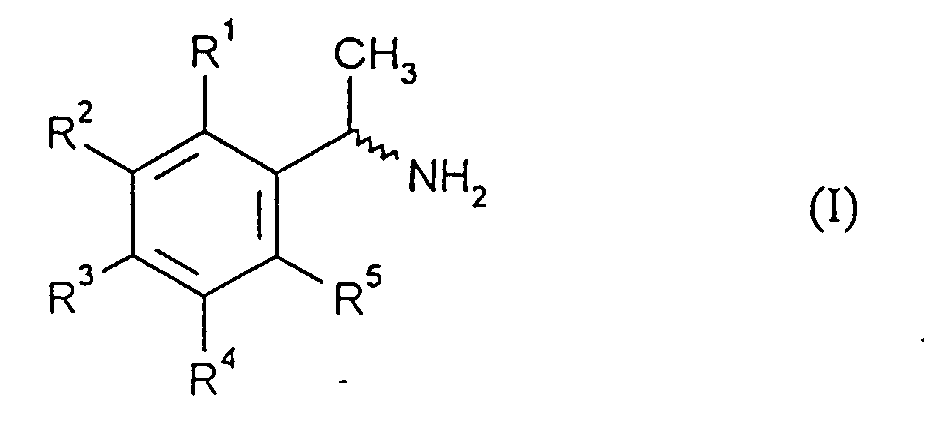
R1, R2, R3, R4 et R5 représentent, indépendamment les uns des autres, l'hydrogène, un halogène, un groupe cyano, nitro, alkyle, alkoxy, alkylthio, alkylsulfinyle, alkylsulfonyle, dialkylamino, halogénalkyle, halogénalkoxy, halogénalkylthio, halogénalkylsulfinyle ou halogénalkylsulfonyle,
caractérisé en ce quea) on fait réagir dans une première étape des phénéthylamines optiquement actives de formuledans laquelle
R1, R2, R3, R4 et R5 ont les définitions indiquées ci-dessus,
avec des dérivés d'acétophénone de formuledans laquelle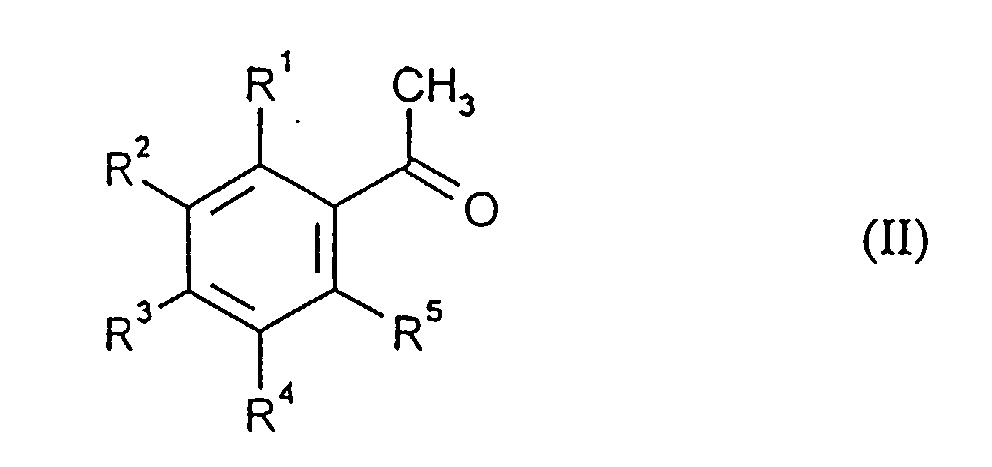
R1, R2, R3, R4 et R5 ont les définitions indiquées ci-dessus,
la phénéthylamine optiquement active et le dérivé d'acétophénone utilisés étant substitués chacun de façon identique dans la partie phényle,
le cas échéant en présence d'un diluant et en la présence éventuelle d'un catalyseur,b) on fait ensuite réagir dans une deuxième étape les bases de Schiff optiquement actives produites de formuledans laquelle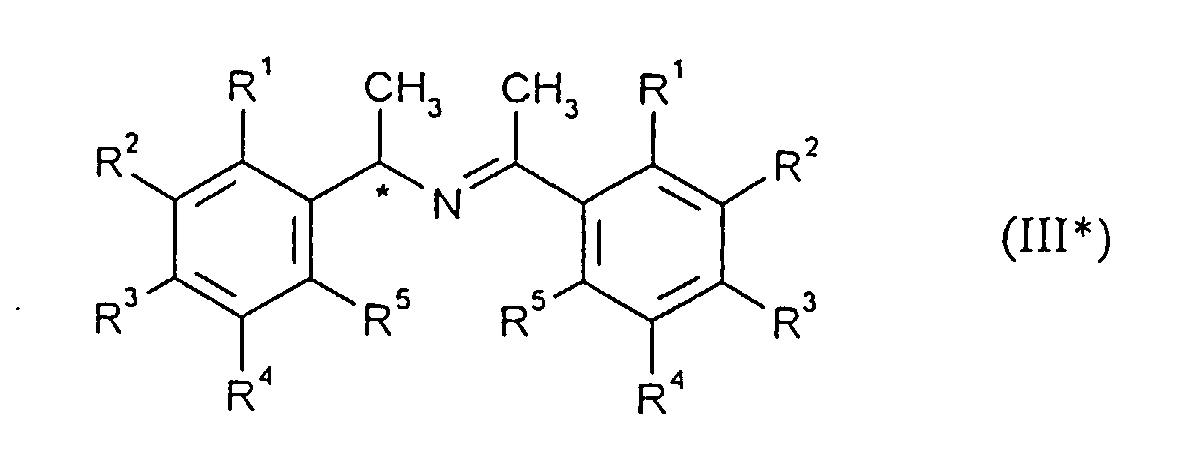
R1, R2, R3, R4 et R5 ont les définitions indiquées ci-dessus,
avec des hydroxydes de métaux qui présentent une teneur en eau comprise entre 0,1 et 50 % en poids, éventuellement sous atmosphère de gaz protecteur, etc) on fait réagir dans une troisième étape les bases de Schiff racémiques obtenues de formuledans laquelle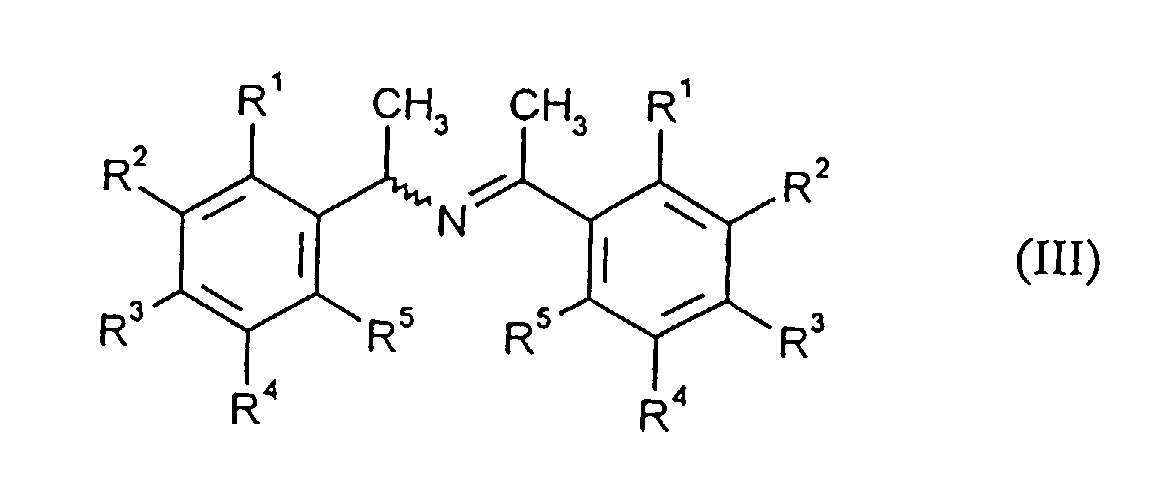
R1, R2, R3, R4 et R5 ont les définitions indiquées ci-dessus,
avec des acides en présence d'eau. - Procédé suivant la revendication 1, caractérisé en ce qu'on utilise comme composés de départ des phénéthylamines optiquement actives de formule (I*), dans lesquelles
R1, R2, R3, R4 et R5 représentent, indépendamment les uns des autres, l'hydrogène, le fluor, le chlore, le brome, un groupe cyano, nitro, alkyle ayant 1 à 4 atomes de carbone, alkoxy ayant 1 ou 2 atomes de carbone, alkylthio ayant 1 ou 2 atomes de carbone, alkylsulfinyle ayant 1 ou 2 atomes de carbone, alkylsulfonyle ayant 1 ou 2 atomes de carbone, dialkylamino ayant 1 ou 2 atomes de carbone dans chacune des chaínes alkyle, halogénalkyle ayant 1 ou 2 atomes de carbone et 1 à 5 atomes d'halogènes, halogénalkoxy ayant 1 ou 2 atomes de carbone et 1 à 5 atomes d'halogènes, halogénalkylthio ayant 1 ou 2 atomes de carbone et 1 à 5 atomes d'halogènes, halogénalkylsulfinyle ayant 1 ou 2 atomes de carbone et 1 à 5 atomes d'halogènes ou halogénalkylsulfonyle ayant 1 ou 2 atomes de carbone et 1 à 5 atomes d'halogènes. - Procédé suivant la revendication 1, caractérisé en ce qu'on utilise dans la conduite de la première étape des dérivés d'acétophénone de formule (II) comme composants réactionnels, dans lesquels
R1, R2, R3, R4 et R5 représentent, indépendamment les uns des autres, l'hydrogène, le fluor, le chlore, le brome, un groupe cyano, nitro, alkyle ayant 1 à 4 atomes de carbone, alkoxy ayant 1 ou 2 atomes de carbone, alkylthio ayant 1 ou 2 atomes de carbone, alkylsulfinyle ayant 1 ou 2 atomes de carbone, alkylsulfonyle ayant 1 ou 2 atomes de carbone, dialkylamino ayant 1 ou 2 atomes de carbone dans chacune des chaínes alkyle, halogénalkyle ayant 1 ou 2 atomes de carbone et 1 à 5 atomes d'halogènes, halogénalkoxy ayant 1 ou 2 atomes de carbone et 1 à 5 atomes d'halogènes, halogénalkylthio ayant 1 ou 2 atomes de carbone et 1 à 5 atomes d'halogènes, halogénalkylsulfinyle ayant 1 ou 2 atomes de carbone et 1 à 5 atomes d'halogènes ou halogénalkylsulfonyle ayant 1 ou 2 atomes de carbone et 1 à 5 atomes d'halogènes. - Procédé suivant la revendication 1, caractérisé en ce qu'on fait réagir, dans la conduite de la première étape, la (S)-1-(4-chlorophényl)-éthylamine avec la 4-chloracétophénone.
- Procédé suivant la revendication 1, caractérisé en ce qu'on opère dans la conduite de la première étape en présence d'un catalyseur acide.
- Procédé suivant la revendication 1, caractérisé en ce qu'on utilise comme réactifs de racémisation dans la conduite de la deuxième étape, des hydroxydes de métaux alcalins ou de métaux alcalino-terreux ayant une teneur en eau comprise entre 0,1 et 30 % en poids.
- Procédé suivant la revendication 1, caractérisé en ce qu'on utilise comme acides dans la conduite de la troisième étape des acides inorganiques ou organiques ou des polymères acides, dans chaque cas en présence d'eau.
- Procédé suivant la revendication 1, caractérisé en ce qu'on opère à des températures comprises entre 20°C et 200°C dans la conduite de la première étape, à des températures comprises entre 50°C et 250°C dans la conduite de la deuxième étape et à des températures comprises entre 20°C et 150°C dans la conduite de la troisième étape.
Applications Claiming Priority (3)
| Application Number | Priority Date | Filing Date | Title |
|---|---|---|---|
| DE19629692 | 1996-07-23 | ||
| DE19629692A DE19629692A1 (de) | 1996-07-23 | 1996-07-23 | Verfahren zur Herstellung von racemischen Phenethylaminen |
| PCT/EP1997/003691 WO1998003465A1 (fr) | 1996-07-23 | 1997-07-11 | Procede de preparation d'amines phenethyliques racemiques |
Publications (2)
| Publication Number | Publication Date |
|---|---|
| EP0923534A1 EP0923534A1 (fr) | 1999-06-23 |
| EP0923534B1 true EP0923534B1 (fr) | 2000-10-04 |
Family
ID=7800598
Family Applications (1)
| Application Number | Title | Priority Date | Filing Date |
|---|---|---|---|
| EP97932809A Expired - Lifetime EP0923534B1 (fr) | 1996-07-23 | 1997-07-11 | Procede de preparation d'amines phenethyliques racemiques |
Country Status (12)
| Country | Link |
|---|---|
| US (1) | US6046351A (fr) |
| EP (1) | EP0923534B1 (fr) |
| JP (1) | JP2000514813A (fr) |
| KR (1) | KR20000067873A (fr) |
| CN (1) | CN1226228A (fr) |
| AU (1) | AU3622397A (fr) |
| BR (1) | BR9710391A (fr) |
| DE (2) | DE19629692A1 (fr) |
| DK (1) | DK0923534T3 (fr) |
| ES (1) | ES2150267T3 (fr) |
| IL (1) | IL127970A (fr) |
| WO (1) | WO1998003465A1 (fr) |
Families Citing this family (5)
| Publication number | Priority date | Publication date | Assignee | Title |
|---|---|---|---|---|
| DE19905837A1 (de) * | 1999-02-12 | 2000-08-17 | Basf Ag | Verfahren zur Racemisierung von optisch aktiven Aminen |
| DE19956786A1 (de) | 1999-11-25 | 2001-05-31 | Basf Ag | Verfahren zur Herstellung optisch aktiver Amine |
| CN101402561B (zh) * | 2008-11-17 | 2011-07-20 | 浙江天新药业有限公司 | L-萘普生的一种消旋方法 |
| CN111500651B (zh) * | 2020-04-10 | 2023-07-28 | 宁波酶赛生物工程有限公司 | 一种苯乙胺的制备方法 |
| CN114804989B (zh) * | 2022-05-06 | 2023-12-26 | 华中科技大学 | 卡巴拉汀关键手性中间体的纯化方法与外消旋化回收利用 |
Family Cites Families (8)
| Publication number | Priority date | Publication date | Assignee | Title |
|---|---|---|---|---|
| US4895849A (en) * | 1986-10-08 | 1990-01-23 | Ube Industries, Ltd. | Aralkylaminopyrimidine compounds which are useful as for producing thereof and insecticides |
| DE3815728A1 (de) * | 1988-05-07 | 1989-11-16 | Bayer Ag | Stereoisomere von n-(r)-(1-aryl-ethyl)-1-alkyl-2,2-dichlor- cyclopropancarbonsaeureamiden |
| EP0453137A3 (en) * | 1990-04-14 | 1992-09-23 | Nihon Nohyaku Co., Ltd. | Aminopyrimidine derivatives, a process for production thereof, and uses thereof |
| DE4038356A1 (de) * | 1990-12-01 | 1992-06-04 | Bayer Ag | Verfahren zur racemisierung von optisch aktiven l-aryl-alkylaminen |
| EP0519211A1 (fr) * | 1991-05-17 | 1992-12-23 | Hoechst Schering AgrEvo GmbH | 4-Aminopyrimidines substituées, procédé pour leur préparation et leur utilisation comme parasiticide |
| DE4332738A1 (de) * | 1993-09-25 | 1995-03-30 | Basf Ag | Racematspaltung primärer und sekundärer Amine durch Enzym-katalysierte Acylierung |
| JP3252579B2 (ja) * | 1993-12-28 | 2002-02-04 | 東レ株式会社 | 光学活性1−(ハロゲノフェニル)エチルアミン類のラセミ化法 |
| JPH0827073A (ja) * | 1994-07-22 | 1996-01-30 | Ajinomoto Co Inc | 光学活性αーアリールアルキルアミンのラセミ化方法 |
-
1996
- 1996-07-23 DE DE19629692A patent/DE19629692A1/de not_active Withdrawn
-
1997
- 1997-07-11 CN CN97196707A patent/CN1226228A/zh active Pending
- 1997-07-11 ES ES97932809T patent/ES2150267T3/es not_active Expired - Lifetime
- 1997-07-11 US US09/230,232 patent/US6046351A/en not_active Expired - Fee Related
- 1997-07-11 EP EP97932809A patent/EP0923534B1/fr not_active Expired - Lifetime
- 1997-07-11 KR KR1019997000258A patent/KR20000067873A/ko not_active Ceased
- 1997-07-11 AU AU36223/97A patent/AU3622397A/en not_active Abandoned
- 1997-07-11 BR BR9710391A patent/BR9710391A/pt not_active IP Right Cessation
- 1997-07-11 JP JP10506503A patent/JP2000514813A/ja active Pending
- 1997-07-11 DE DE59702432T patent/DE59702432D1/de not_active Expired - Fee Related
- 1997-07-11 DK DK97932809T patent/DK0923534T3/da active
- 1997-07-11 IL IL12797097A patent/IL127970A/xx not_active IP Right Cessation
- 1997-07-11 WO PCT/EP1997/003691 patent/WO1998003465A1/fr not_active Ceased
Also Published As
| Publication number | Publication date |
|---|---|
| JP2000514813A (ja) | 2000-11-07 |
| EP0923534A1 (fr) | 1999-06-23 |
| IL127970A0 (en) | 1999-11-30 |
| US6046351A (en) | 2000-04-04 |
| ES2150267T3 (es) | 2000-11-16 |
| AU3622397A (en) | 1998-02-10 |
| IL127970A (en) | 2001-08-26 |
| DE19629692A1 (de) | 1998-01-29 |
| WO1998003465A1 (fr) | 1998-01-29 |
| DK0923534T3 (da) | 2000-12-18 |
| BR9710391A (pt) | 1999-08-17 |
| KR20000067873A (ko) | 2000-11-25 |
| DE59702432D1 (de) | 2000-11-09 |
| CN1226228A (zh) | 1999-08-18 |
Similar Documents
| Publication | Publication Date | Title |
|---|---|---|
| DE69716767T2 (de) | Verfahren zur herstellung von tolterodin | |
| EP0365915B1 (fr) | 2-Aminothiazoles substitués | |
| EP0380712B1 (fr) | Procédé de préparation de dérivés de l'acide 2,6-dichlorodiphénylaminoacétique | |
| DE19629692A1 (de) | Verfahren zur Herstellung von racemischen Phenethylaminen | |
| DE69900892T2 (de) | Verfahren zur Herstellung von Racemisch Sertralin | |
| DE69722538T2 (de) | Verfahren zur Herstellung von optisch aktiver Azetidin-2-Carbonsäure | |
| CH647500A5 (de) | Verfahren zur herstellung von 2',6'-dialkyl-n-(alkoxymethyl)-2-chloracetaniliden. | |
| CH629776A5 (de) | Verfahren zur herstellung neuer phenylazacycloalkane. | |
| EP1598331B1 (fr) | Procédé pour la préparation de l' anhydride phtalique | |
| EP0865500B1 (fr) | Procede de production d'amines optiquement actives | |
| DE602004010929T2 (de) | Verfahren zur herstellung von n-substituierten phthalimiden | |
| DE60005613T2 (de) | Verfahren zur Herstellung von Dimethylcyanamid | |
| EP0048372B1 (fr) | Procédé de préparation du pyrazole | |
| DE3877648T2 (de) | Verfahren zur herstellung von naproxen. | |
| EP1232151A1 (fr) | Procede de preparation de benzofuranonoximes | |
| EP0046193B1 (fr) | Hydroxy-1 pyrazole et son procédé de préparation | |
| DE69215235T2 (de) | Verfahren zur herstellung eines keton enantiomers | |
| EP0757981B1 (fr) | Procédé pour la préparation de dérivés d'amino racémiques | |
| DE102004033313A1 (de) | Verfahren zur Herstellung von Enantiomeren 3-hydroxy-3-phenyl-propylaminen | |
| DE3607993A1 (de) | Verfahren zur herstellung von diaziridinen und produkte daraus | |
| AT360991B (de) | Verfahren zur herstellung neuer 1-alkyl-4- phenylpiperidinderivate und von deren salzen und optisch aktiven verbindungen | |
| EP0743299B1 (fr) | Procédé pour la préparation de sels d'acides sulfoniques de 2-fluorocyclopropylamine | |
| DE60000890T2 (de) | Verfahren zur Herstellung von 1,1,1-Trifluoro-2-aminoalkane | |
| EP0317888B1 (fr) | Composés nitroalkyl fluorés ainsi qu'un procédé pour la préparation de composés nitroalkyl fluorés | |
| DE10218862A1 (de) | Verfahren zur Chlorierung tertiärer Alkohole |
Legal Events
| Date | Code | Title | Description |
|---|---|---|---|
| PUAI | Public reference made under article 153(3) epc to a published international application that has entered the european phase |
Free format text: ORIGINAL CODE: 0009012 |
|
| 17P | Request for examination filed |
Effective date: 19990223 |
|
| AK | Designated contracting states |
Kind code of ref document: A1 Designated state(s): BE CH DE DK ES FR GB IT LI NL |
|
| GRAG | Despatch of communication of intention to grant |
Free format text: ORIGINAL CODE: EPIDOS AGRA |
|
| GRAG | Despatch of communication of intention to grant |
Free format text: ORIGINAL CODE: EPIDOS AGRA |
|
| GRAH | Despatch of communication of intention to grant a patent |
Free format text: ORIGINAL CODE: EPIDOS IGRA |
|
| 17Q | First examination report despatched |
Effective date: 20000303 |
|
| GRAH | Despatch of communication of intention to grant a patent |
Free format text: ORIGINAL CODE: EPIDOS IGRA |
|
| GRAA | (expected) grant |
Free format text: ORIGINAL CODE: 0009210 |
|
| AK | Designated contracting states |
Kind code of ref document: B1 Designated state(s): BE CH DE DK ES FR GB IT LI NL |
|
| REG | Reference to a national code |
Ref country code: CH Ref legal event code: NV Representative=s name: E. BLUM & CO. PATENTANWAELTE Ref country code: CH Ref legal event code: EP |
|
| GBT | Gb: translation of ep patent filed (gb section 77(6)(a)/1977) |
Effective date: 20001005 |
|
| REF | Corresponds to: |
Ref document number: 59702432 Country of ref document: DE Date of ref document: 20001109 |
|
| REG | Reference to a national code |
Ref country code: ES Ref legal event code: FG2A Ref document number: 2150267 Country of ref document: ES Kind code of ref document: T3 |
|
| ET | Fr: translation filed | ||
| ITF | It: translation for a ep patent filed | ||
| REG | Reference to a national code |
Ref country code: DK Ref legal event code: T3 |
|
| PGFP | Annual fee paid to national office [announced via postgrant information from national office to epo] |
Ref country code: DK Payment date: 20010723 Year of fee payment: 5 |
|
| PLBE | No opposition filed within time limit |
Free format text: ORIGINAL CODE: 0009261 |
|
| STAA | Information on the status of an ep patent application or granted ep patent |
Free format text: STATUS: NO OPPOSITION FILED WITHIN TIME LIMIT |
|
| 26N | No opposition filed | ||
| REG | Reference to a national code |
Ref country code: GB Ref legal event code: IF02 |
|
| PG25 | Lapsed in a contracting state [announced via postgrant information from national office to epo] |
Ref country code: DK Free format text: LAPSE BECAUSE OF NON-PAYMENT OF DUE FEES Effective date: 20020731 |
|
| REG | Reference to a national code |
Ref country code: DK Ref legal event code: EBP |
|
| PGFP | Annual fee paid to national office [announced via postgrant information from national office to epo] |
Ref country code: DE Payment date: 20030618 Year of fee payment: 7 |
|
| PGFP | Annual fee paid to national office [announced via postgrant information from national office to epo] |
Ref country code: NL Payment date: 20030630 Year of fee payment: 7 |
|
| PGFP | Annual fee paid to national office [announced via postgrant information from national office to epo] |
Ref country code: ES Payment date: 20030708 Year of fee payment: 7 |
|
| PGFP | Annual fee paid to national office [announced via postgrant information from national office to epo] |
Ref country code: GB Payment date: 20030709 Year of fee payment: 7 |
|
| PGFP | Annual fee paid to national office [announced via postgrant information from national office to epo] |
Ref country code: CH Payment date: 20030725 Year of fee payment: 7 |
|
| PGFP | Annual fee paid to national office [announced via postgrant information from national office to epo] |
Ref country code: FR Payment date: 20030728 Year of fee payment: 7 |
|
| PGFP | Annual fee paid to national office [announced via postgrant information from national office to epo] |
Ref country code: BE Payment date: 20030731 Year of fee payment: 7 |
|
| PG25 | Lapsed in a contracting state [announced via postgrant information from national office to epo] |
Ref country code: GB Free format text: LAPSE BECAUSE OF NON-PAYMENT OF DUE FEES Effective date: 20040711 |
|
| PG25 | Lapsed in a contracting state [announced via postgrant information from national office to epo] |
Ref country code: ES Free format text: LAPSE BECAUSE OF NON-PAYMENT OF DUE FEES Effective date: 20040712 |
|
| PG25 | Lapsed in a contracting state [announced via postgrant information from national office to epo] |
Ref country code: LI Free format text: LAPSE BECAUSE OF NON-PAYMENT OF DUE FEES Effective date: 20040731 Ref country code: CH Free format text: LAPSE BECAUSE OF NON-PAYMENT OF DUE FEES Effective date: 20040731 Ref country code: BE Free format text: LAPSE BECAUSE OF NON-PAYMENT OF DUE FEES Effective date: 20040731 |
|
| BERE | Be: lapsed |
Owner name: *BAYER A.G. Effective date: 20040731 |
|
| PG25 | Lapsed in a contracting state [announced via postgrant information from national office to epo] |
Ref country code: NL Free format text: LAPSE BECAUSE OF NON-PAYMENT OF DUE FEES Effective date: 20050201 Ref country code: DE Free format text: LAPSE BECAUSE OF NON-PAYMENT OF DUE FEES Effective date: 20050201 |
|
| GBPC | Gb: european patent ceased through non-payment of renewal fee |
Effective date: 20040711 |
|
| REG | Reference to a national code |
Ref country code: CH Ref legal event code: PL |
|
| PG25 | Lapsed in a contracting state [announced via postgrant information from national office to epo] |
Ref country code: FR Free format text: LAPSE BECAUSE OF NON-PAYMENT OF DUE FEES Effective date: 20050331 |
|
| NLV4 | Nl: lapsed or anulled due to non-payment of the annual fee |
Effective date: 20050201 |
|
| REG | Reference to a national code |
Ref country code: FR Ref legal event code: ST |
|
| PG25 | Lapsed in a contracting state [announced via postgrant information from national office to epo] |
Ref country code: IT Free format text: LAPSE BECAUSE OF NON-PAYMENT OF DUE FEES;WARNING: LAPSES OF ITALIAN PATENTS WITH EFFECTIVE DATE BEFORE 2007 MAY HAVE OCCURRED AT ANY TIME BEFORE 2007. THE CORRECT EFFECTIVE DATE MAY BE DIFFERENT FROM THE ONE RECORDED. Effective date: 20050711 |
|
| REG | Reference to a national code |
Ref country code: ES Ref legal event code: FD2A Effective date: 20040712 |
|
| BERE | Be: lapsed |
Owner name: *BAYER A.G. Effective date: 20040731 |