EP0923628B1 - Composition de carburant comprenant des composes oxygenes pour moteurs diesel - Google Patents
Composition de carburant comprenant des composes oxygenes pour moteurs diesel Download PDFInfo
- Publication number
- EP0923628B1 EP0923628B1 EP98929517A EP98929517A EP0923628B1 EP 0923628 B1 EP0923628 B1 EP 0923628B1 EP 98929517 A EP98929517 A EP 98929517A EP 98929517 A EP98929517 A EP 98929517A EP 0923628 B1 EP0923628 B1 EP 0923628B1
- Authority
- EP
- European Patent Office
- Prior art keywords
- carbon atoms
- fuel composition
- composition according
- formula
- atoms
- Prior art date
- Legal status (The legal status is an assumption and is not a legal conclusion. Google has not performed a legal analysis and makes no representation as to the accuracy of the status listed.)
- Expired - Lifetime
Links
Classifications
-
- C—CHEMISTRY; METALLURGY
- C10—PETROLEUM, GAS OR COKE INDUSTRIES; TECHNICAL GASES CONTAINING CARBON MONOXIDE; FUELS; LUBRICANTS; PEAT
- C10L—FUELS NOT OTHERWISE PROVIDED FOR; NATURAL GAS; SYNTHETIC NATURAL GAS OBTAINED BY PROCESSES NOT COVERED BY SUBCLASSES C10G OR C10K; LIQUIFIED PETROLEUM GAS; USE OF ADDITIVES TO FUELS OR FIRES; FIRE-LIGHTERS
- C10L1/00—Liquid carbonaceous fuels
- C10L1/10—Liquid carbonaceous fuels containing additives
- C10L1/14—Organic compounds
- C10L1/18—Organic compounds containing oxygen
- C10L1/185—Ethers; Acetals; Ketals; Aldehydes; Ketones
- C10L1/1852—Ethers; Acetals; Ketals; Orthoesters
-
- C—CHEMISTRY; METALLURGY
- C10—PETROLEUM, GAS OR COKE INDUSTRIES; TECHNICAL GASES CONTAINING CARBON MONOXIDE; FUELS; LUBRICANTS; PEAT
- C10L—FUELS NOT OTHERWISE PROVIDED FOR; NATURAL GAS; SYNTHETIC NATURAL GAS OBTAINED BY PROCESSES NOT COVERED BY SUBCLASSES C10G OR C10K; LIQUIFIED PETROLEUM GAS; USE OF ADDITIVES TO FUELS OR FIRES; FIRE-LIGHTERS
- C10L1/00—Liquid carbonaceous fuels
- C10L1/02—Liquid carbonaceous fuels essentially based on components consisting of carbon, hydrogen, and oxygen only
- C10L1/026—Liquid carbonaceous fuels essentially based on components consisting of carbon, hydrogen, and oxygen only for compression ignition
-
- C—CHEMISTRY; METALLURGY
- C10—PETROLEUM, GAS OR COKE INDUSTRIES; TECHNICAL GASES CONTAINING CARBON MONOXIDE; FUELS; LUBRICANTS; PEAT
- C10L—FUELS NOT OTHERWISE PROVIDED FOR; NATURAL GAS; SYNTHETIC NATURAL GAS OBTAINED BY PROCESSES NOT COVERED BY SUBCLASSES C10G OR C10K; LIQUIFIED PETROLEUM GAS; USE OF ADDITIVES TO FUELS OR FIRES; FIRE-LIGHTERS
- C10L1/00—Liquid carbonaceous fuels
- C10L1/10—Liquid carbonaceous fuels containing additives
- C10L1/14—Organic compounds
- C10L1/18—Organic compounds containing oxygen
- C10L1/185—Ethers; Acetals; Ketals; Aldehydes; Ketones
- C10L1/1852—Ethers; Acetals; Ketals; Orthoesters
- C10L1/1855—Cyclic ethers, e.g. epoxides, lactides, lactones
-
- C—CHEMISTRY; METALLURGY
- C10—PETROLEUM, GAS OR COKE INDUSTRIES; TECHNICAL GASES CONTAINING CARBON MONOXIDE; FUELS; LUBRICANTS; PEAT
- C10L—FUELS NOT OTHERWISE PROVIDED FOR; NATURAL GAS; SYNTHETIC NATURAL GAS OBTAINED BY PROCESSES NOT COVERED BY SUBCLASSES C10G OR C10K; LIQUIFIED PETROLEUM GAS; USE OF ADDITIVES TO FUELS OR FIRES; FIRE-LIGHTERS
- C10L1/00—Liquid carbonaceous fuels
- C10L1/10—Liquid carbonaceous fuels containing additives
- C10L1/14—Organic compounds
- C10L1/18—Organic compounds containing oxygen
- C10L1/192—Macromolecular compounds
- C10L1/198—Macromolecular compounds obtained otherwise than by reactions involving only carbon-to-carbon unsaturated bonds homo- or copolymers of compounds having one or more unsaturated aliphatic radicals, each having only one carbon to carbon double bond, and at least one being terminated by an acyloxy radical of a saturated carboxylic acid, of carbonic acid
- C10L1/1985—Macromolecular compounds obtained otherwise than by reactions involving only carbon-to-carbon unsaturated bonds homo- or copolymers of compounds having one or more unsaturated aliphatic radicals, each having only one carbon to carbon double bond, and at least one being terminated by an acyloxy radical of a saturated carboxylic acid, of carbonic acid polyethers, e.g. di- polygylcols and derivatives; ethers - esters
Definitions
- the present invention relates to a new fuel composition
- a new fuel composition comprising oxygenated compounds improving fuel combustion, especially compounds that can improve the cetane number of bases fuels such as middle distillates used in the composition of diesel for diesel engines.
- a fuel base generally consists of a physical mixture of several middle or cut distillates petroleum products from the refining of crude oils from from all walks of the world. These oil cuts are from a large number of separations by distillation atmospheric or vacuum and chemical transformations of some of these cuts distilled by hydrodesulfurization and or catalytic cracking. By an appropriate mixture of these different refined cuts, we get a wide variety fuel bases with physico-chemical properties relatively different. Finally, diesel fuels or diesel fuels usable in combustion engines are prepared by a complex mixture of these bases. However, to obtain fuels meeting the specifications legal requirements, refiners must develop increasingly complicated formulations which favor crude oils highly concentrated in distillates and fuel bases with a high cetane number.
- additives i.e. the compounds introduced at low levels in refined cuts
- nitrates or peroxides organic which are known to have limited effectiveness in fuel bases or diesel fuel with naturally a low cetane number.
- organic peroxides are irreversibly broken down into function of time which leads to a degradation of characteristics of diesel stored both in quality and in cetane number.
- Refiners have long sought others sources of compounds that can improve the index of cetane from fuel bases and gas oils, in particular among oxygenated compounds such as ethers, polyethers or acetals. Addition of compounds oxygenated in diesel, reduces emissions of pollutants, in particular particle emissions (EP 14 992).
- US patent 5308365 claims the addition of 1 to 30% by weight of dialkylated and trialkylated derivatives of glycerin, obtained by adding an olefin such as isobutene on glycerol, in a diesel having a range of use between 160 ° C and 370 ° C and a sulfur content less than or equal to 500 ppm.
- Patent JP 0725 8661 claims a formulation comprising 20 to 94% of a diesel cut having a distillation range between 130 ° C and 400 ° C, 5 to 40% of a hydrocracked diesel cut commonly called LCO and 1 to 40 % of a monoether of formula R 1 OR 2 in which R 1 and R 2 are alkyl chains of 3 to 12 carbon atoms.
- Patent JP 0701 8271 claims gas oils containing glycol ethers of formula R 1 - (OA) n -R 2 in which R 1 is an alkyl chain of 1 to 10 carbon atoms, R 2 represents the hydrogen atom or an alkyl chain comprising from 1 to 10 carbon atoms, A is of ethylene or trimethylene structure optionally substituted and n is an integer varying from 1 to 10.
- Patent JP 0634 0886 claims the addition to a diesel of 0.05% to 20% by weight of a compound of general formula R 1 -O- (EO) n - (PO) m -R 2 in which R 1 and R 2 represent separately the hydrogen atom or an alkyl chain comprising from 1 to 20 carbon atoms, EO and PO respectively representing the oxyethylene and oxyisopropylene groups, and, m and n are whole numbers between 0 and 15.
- patent FR 2,544,738 claims, as a component of diesel fuels, acetals of formula C 4 H 9 -O-CR 1 R 2 -OC 4 H 9 , R 1 and R 2 which may be hydrogen or one, alkyl group.
- the present invention relates to the use of a new family of oxygenated compounds in fuels Diesel, which increase the cetane number, provide greater flexibility in the formulation of Diesel fuels for a lower cost and allow in besides limiting aromatic and sulfur compounds responsible for the emission of particles.
- this fuel composition contains 60 to 99.95% by weight at least one fuel base and from 0.05 to 40% by weight of trialkoxyalkane of formula (I).
- fuel base any petroleum cut after refining, either by distillation or by treatment of these distilled cups.
- R 2 , R 3 , R 4 and R ' 4 are the hydrogen atom.
- R 1 , R ' 1 and R'' 1 are identical and are chosen from alkyl groups comprising from 1 to 4 carbon atoms.
- trialkoxyalkane compounds thus obtained from the invention are chosen from the group consisting of trimethoxypropane, triethoxypropane, tripropoxypropane, tributoxypropane.
- R 1 , R ' 1 and R'' 1 comprise from 1 to 4 carbons and at least one oxygen atom.
- R 1 is an alkyl group comprising from 1 to 4 carbon atoms and R ' 1 and R'' 1 are linked and constitute a chain of 2 to 3 carbons so as to form with the two oxygen atoms a heterocycle of 5 to 6 atoms.
- R ' 1 and R'' 1 are linked and constitute a chain of 2 to 3 carbons so as to form with the two oxygen atoms a heterocycle of 5 to 6 atoms.
- 2- (2-hydroxyethyl) ethoxy-1,3-dioxolane is preferred.
- R 4 is an alkyl group of 1 to 4 carbon atoms
- R 2 , R 3 and R ' 4 are hydrogen atoms
- R 1 , R ' 1 and R''1 are alkyl groups comprising from 1 to 5 carbon atoms.
- R 2 or R 3 is an alkyl group comprising 1 to 4 carbon atoms
- R 4 , R ' 4 and, R 2 or R 3 are atoms of hydrogen
- R 1 , R ' 1 and R'' 1 are alkyl groups comprising from 1 to 5 carbon atoms.
- the 1,1,3-triethoxy-2-methylpropane and 1,3,3-triethoxybutane are preferred.
- R 3 and R 4 are hydrogen atoms
- R 2 and R ' 4 are linked to form a saturated ring comprising from 5 to 6 atoms carbon
- R 1 , R ' 1 and R'' 1 are alkyl groups comprising from 1 to 5 carbon atoms.
- 1,1,3-triethoxycyclohexane is preferred.
- the basics fuels are chosen from refined cuts distilling between 170 and 370 ° C containing at most 50% by weight aromatics, and less than 0.2% by weight of compounds sulfur.
- the cetane number of 1,1,3-triethoxypropane prepared according to example 1 was measured according to standard ASTM D613, in a 20% mixture in two gas oils whose characteristics are indicated below:
- a compound having a cetane number higher than 70, and a boiling point of at least 160 ° C and a very low solubility in water can be considered as an ideal component usable in a diesel.
- Ethylene ether glycol 135 miscible 38 Ethyl, ethylene glycol butyl ether 140 # 4 51 Diethylene glycol ethyl ether 202 miscible 54
Landscapes
- Chemical & Material Sciences (AREA)
- Oil, Petroleum & Natural Gas (AREA)
- Engineering & Computer Science (AREA)
- Chemical Kinetics & Catalysis (AREA)
- General Chemical & Material Sciences (AREA)
- Organic Chemistry (AREA)
- Health & Medical Sciences (AREA)
- Emergency Medicine (AREA)
- Liquid Carbonaceous Fuels (AREA)
- Organic Low-Molecular-Weight Compounds And Preparation Thereof (AREA)
- Solid Fuels And Fuel-Associated Substances (AREA)
Description

- X correspond à un groupement hydrocarboné divalent CnH2n dont n est égal à 1, 2 ou 3, chaque atome d'hydrogène étant éventuellement substitué par un reste hydrocarboné,
- R1, R'1 et R"1 sont des groupements alkyls linéaires ou ramifiés, identiques ou différents comprenant de 1 à 10 atomes de carbone et éventuellement au moins un atome d'oxygène, deux des groupements R1, R'1 et R''1 étant éventuellement reliés pour former un hétérocycle de 5 à 6 atomes;
- et R2 étant un atome d'hydrogène ou un radical alkyl linéaire comprenant de 1 à 4 atomes de carbone, R2 pouvant même former par liaison avec un reste hydrocarboné de X un cycle comprenant de 5 à 6 atomes de carbone.

- R1, R'1 et R''1 sont des groupements alkyls linéaires ou ramifiés, identiques ou différents comprenant de 1 à 10 atomes de carbone et éventuellement au moins un atome d'oxygène, deux des groupements R1, R'1 et R''1 étant éventuellement reliés pour former un hétérocycle de 5 à 6 atomes;
- R2, R3, R4 et R'4 sont des groupements identiques ou différents représentant l'hydrogène ou un radical alkyl linéaire comprenant de 1 à 4 atomes de carbone, R2 pouvant même former par liaison avec R4 ou R'4 un cycle comprenant de 5 à 6 atomes de carbone.

| MELANGE | COMPOSITION | IC Mélange | 1,1,3-triéthoxypropane |
| A | 80% gazole A 20% 1,1,3-triéthoxypropane | 55,6 | 78 |
| B | 80% gazole B 20% 1,1,3-triéthoxypropane | 59,8 | 83 |
| Composé | Température d'ébullition (°C) | Solubilité dans l'eau (%) | Indice de cétane |
| 1,1,3 tri-éthoxypropane | 180 | <1 | 80 |
| Ethyléther de l'étnylèneglycol | 135 | miscible | 38 |
| Ethyl, butyléther de l'éthylèneglycol | 140 | #4 | 51 |
| Ethyléther du diéthylèneglycol | 202 | miscible | 54 |
| Butyléther du diéthylèneglycol | 230 | miscible | 59 |
| Méthyl, butyléther du diéthylèneglycol | 196 | #10 | 55 |
| Diméthyléther du diéthylèneglycol | 162 | miscible | 61 |
| Diéthyléther du diéthylèneglycol | 177 | miscible | 95 |
| Diethylacétal du formaldéhyde | 89 | miscible | 57 |
| Dibutylacétal du formaldéhyde | 177 | <5 | 65 |
Claims (15)
- Composition de carburant comprenant de 60 à 99,95 % en poids d'au moins une base carburant et de 0,05 à 40 % en poids d'au moins un trialcoxyalcane de formule générale (I) ci-après :dans laquelle :
 X correspond à un groupement hydrocarboné divalent CnH2n dont n est égal à 1, 2 ou 3, chaque atome d'hydrogène étant éventuellement substitué par un reste hydrocarboné ;R1, R'1 et R"1 sont des groupements alkyles linéaires ou ramifiés, identiques ou différents comprenant de 1 à 10 atomes de carbone et éventuellement au moins un atome d'oxygène, deux des groupements R1, R'1 et R"1 étant éventuellement reliés pour former un hétérocycle de 5 à 6 atomes ; etR2 étant un atome d'hydrogène ou un radical alkyle linéaire comprenant de 1 à 4 atomes de carbone, R2 pouvant même former par liaison avec un reste hydrocarboné de X un cycle comprenant de 5 à 6 atomes de carbone.
 - Composition de carburant selon la revendication 1, caractérisée en ce que le trialcoxyalcane est choisi parmi les trialcoxypropanes de formule (II) ci-après :dans laquelle :
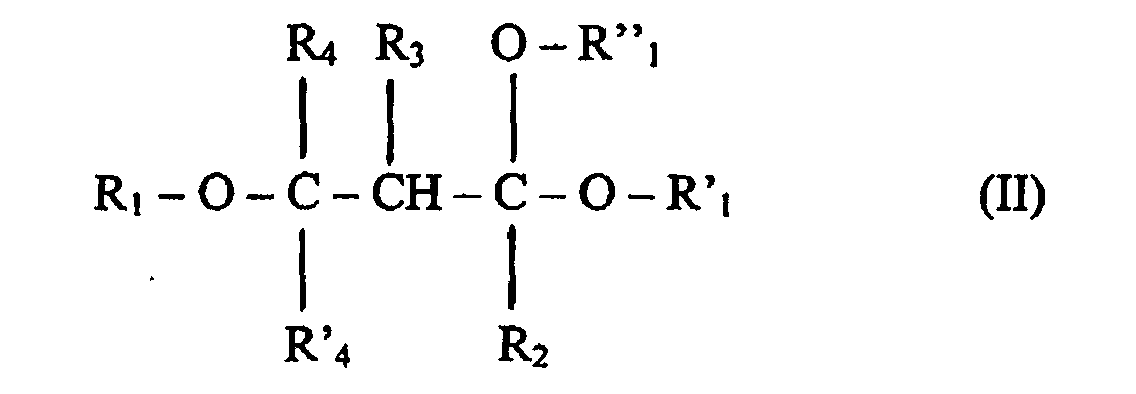 R1, R'1 et R"1 sont des groupements alkyles linéaires ou ramifiés, identiques ou différents comprenant de 1 à 10 atomes de carbone et éventuellement au moins un atome d'oxygène, deux des groupements R1, R'1 et R"1 étant éventuellement reliés pour former un hétérocycle de 5 à 6 atomes ;R2, R3, R4 et R'4 sont des groupements identiques ou différents représentant l'hydrogène ou un radical alkyle linéaire comprenant de 1 à 4 atomes de carbone, R2 pouvant même former par liaison avec R4 ou R'4 un cycle comprenant de 5 à 6 atomes de carbone.
 - Composition de carburant selon la revendication 2, caractérisée en ce que R2, R3, R4 et R'4 dans la formule (II) correspondent à un atome d'hydrogène.
- Composition de carburant selon l'une des revendications 2 et 3, caractérisée en ce que R1, R'1 et R"1 sont identiques et sont choisis parmi les groupements alkyles comprenant de 1 à 4 atomes de carbone.
- Composition de carburant selon les revendications 2 à 4, caractérisée en ce que les composés de formules (II) sont choisis dans le groupe constitué par le triméthoxypropane, le triéthoxypropane, le tripropoxypropane, le tributoxypropane.
- Composition de carburant selon les revendications 2 et 3, caractérisée en ce que R1 ,R'1 et R"1 comprennent de 1 à 4 carbones et au moins un atome d'oxygène.
- Composition de carburant selon les revendications 2, 3 et 6, caractérisée en ce que les composés de formule (II) sont choisis dans le groupe constitué par le tri(méthoxyéthoxy)propane et le tri(éthoxyéthoxy)propane.
- Composition de carburant selon les revendications 2 et 3, caractérisée en ce que R1 est un groupement alkyle comprenant de 1 à 4 atomes de carbone et R'1 et R"1 sont reliés et constituent un chaínon de 2 à 3 carbones, de façon à former avec les deux atomes d'oxygène un hétérocycle de 5 à 6 atomes.
- Composition de carburant selon les revendications 2, 3 et 8, caractérisée en ce que le composé de formule (II) est le 2- (2-hydroxyéthyl)éthoxy-1,3-dioxolane.
- Composition de carburant selon la revendication 2, caractérisée en ce que dans la formule (II), R4 est un groupement alkyle comprenant de 1 à 4 atomes de carbone, et, R2, R3 et R'4 sont des atomes d'hydrogène, et R1, R'1 et R"1 sont des groupements alkyles comprenant de 1 à 5 atomes de carbone.
- Composition de carburant selon les revendications 2 et 10 caractérisée en ce que les composés de formule (II) sont choisis dans le groupe constitué par le 1,1,3-triméthoxybutane, le 1,1,3-triéthoxybutane, le 1,1,3-tripropoxybutane et le 1,1,3-tributoxybutane.
- Composition de carburant selon la revendication 2 caractérisée en ce que dans la formule (II), R2 ou R3 est un groupement alkyle comprenant 1 à 4 atomes de carbone, R4, R'4 et, R2 ou R3, sont des atomes d'hydrogène, et R1, R'1 et R''1 sont des groupements alkyls comprenant de 1 à 5 atomes de carbone.
- Composition de carburant selon les revendications 2 et 12 caractérisée en ce que les composés de formule (II) sont choisis dans le groupe constitué par le 1,1,3-triéthoxy-2-méthylpropane et le 1,3,3-triéthoxybutane.
- Composition de carburant selon la revendication 2 caractérisée en ce que dans la formule (II), R3 et R4 sont des atomes d'hydrogène, R2 et R'4 sont reliés pour former un cycle saturé comprenant de 5 à 6 atomes de carbone, R1, R'1 et R''1 sont des groupements alkyles comprenant de 1 à 5 atomes de carbone.
- Composition de carburant selon les revendications 2 et 14 caractérisée en ce que le composé de formule (II) est le 1,1,3-triéthoxycyclohexane.
Applications Claiming Priority (3)
| Application Number | Priority Date | Filing Date | Title |
|---|---|---|---|
| FR9707119 | 1997-06-09 | ||
| FR9707119A FR2764301B1 (fr) | 1997-06-09 | 1997-06-09 | Composition de carburant comprenant des composes oxygenes pour moteurs diesel |
| PCT/FR1998/001168 WO1998056879A1 (fr) | 1997-06-09 | 1998-06-08 | Composition de carburant comprenant des composes oxygenes pour moteurs diesel |
Publications (2)
| Publication Number | Publication Date |
|---|---|
| EP0923628A1 EP0923628A1 (fr) | 1999-06-23 |
| EP0923628B1 true EP0923628B1 (fr) | 2003-01-15 |
Family
ID=9507765
Family Applications (1)
| Application Number | Title | Priority Date | Filing Date |
|---|---|---|---|
| EP98929517A Expired - Lifetime EP0923628B1 (fr) | 1997-06-09 | 1998-06-08 | Composition de carburant comprenant des composes oxygenes pour moteurs diesel |
Country Status (10)
| Country | Link |
|---|---|
| US (1) | US6113661A (fr) |
| EP (1) | EP0923628B1 (fr) |
| JP (1) | JP2000516991A (fr) |
| AT (1) | ATE231179T1 (fr) |
| DE (1) | DE69810746T2 (fr) |
| DK (1) | DK0923628T3 (fr) |
| ES (1) | ES2189188T3 (fr) |
| FR (1) | FR2764301B1 (fr) |
| NO (1) | NO990578L (fr) |
| WO (1) | WO1998056879A1 (fr) |
Families Citing this family (16)
| Publication number | Priority date | Publication date | Assignee | Title |
|---|---|---|---|---|
| FR2764301B1 (fr) * | 1997-06-09 | 1999-07-30 | Elf Antar France | Composition de carburant comprenant des composes oxygenes pour moteurs diesel |
| US6843813B1 (en) * | 2000-06-07 | 2005-01-18 | Hugh Frederick Collins | Rejuvenation and/or cleaning of catalysts |
| GB2368594A (en) * | 2000-08-17 | 2002-05-08 | Shell Int Research | Fuel compositions with reduced soot emissions |
| US6514299B1 (en) * | 2000-11-09 | 2003-02-04 | Millennium Fuels Usa, Llc | Fuel additive and method therefor |
| EP1427797B1 (fr) * | 2001-09-18 | 2007-10-17 | Southwest Research Institute | Carburants pour moteurs a allumage par compression de melange homogene |
| FR2833607B1 (fr) * | 2001-12-19 | 2005-02-04 | Inst Francais Du Petrole | Compositions de carburants diesel contenant des acetals de glycerol |
| DE112004001621D2 (de) * | 2003-06-24 | 2006-05-11 | Michiel Arjaan Kousemaker | Verfahren zur Herstellung eines Oxygenates als Additiv in Kraftstoffen, insbesondere in Dieselkraftstoffen, Ottokraftstoffen und Rapsmethylester |
| US20090090048A1 (en) * | 2007-10-05 | 2009-04-09 | Board Of Trustees Of Michigan State University | Fuel compositions with mono- or di- butyl succinate and method of use thereof |
| CA2729659C (fr) * | 2008-07-16 | 2015-11-24 | Michio Ikura | Conversion du glycerol en composes oxygenes de type naphta |
| DE102009055928A1 (de) * | 2009-11-27 | 2011-06-01 | Technische Universität Dortmund | Verfahren zur kontinuierlichen Herstellung von Glycerintertiärbutylethern |
| US8734541B2 (en) | 2010-06-22 | 2014-05-27 | Shell Oil Company | Diesel fuel formulation |
| EP2514804A1 (fr) * | 2011-04-19 | 2012-10-24 | Top-Biofuel GmbH & Co. KG | Utilisation de 1,1-dialkoxyalkanes pour l'augmentation du pouvoir antidétonant de l'essence |
| US8679202B2 (en) | 2011-05-27 | 2014-03-25 | Seachange Group Llc | Glycerol containing fuel mixture for direct injection engines |
| FI20110300A0 (fi) | 2011-09-11 | 2011-09-11 | Neste Oil Oyj | Bensiinikoostumukset ja menetelmä niiden valmistamiseksi |
| CA2948363C (fr) | 2014-05-15 | 2024-01-02 | Seachange Group Llc | Melanges de carburants a base de biodiesel et d'emulsion de glycerol |
| CN114958451B (zh) * | 2022-06-15 | 2023-03-28 | 浙江吉利控股集团有限公司 | 一种汽油甲醇灵活燃料互溶防腐剂 |
Family Cites Families (16)
| Publication number | Priority date | Publication date | Assignee | Title |
|---|---|---|---|---|
| FR868233A (fr) * | 1940-12-20 | 1941-12-24 | Carburants pour moteurs à combustion interne à injection | |
| US2842432A (en) * | 1953-12-07 | 1958-07-08 | Texas Co | Supplementary fuel mixture for cold starting diesel engines |
| US2897068A (en) * | 1955-07-21 | 1959-07-28 | Gulf Research Development Co | Motor fuel |
| BR8000889A (pt) * | 1979-02-21 | 1980-10-21 | Basf Ag | Composicoes carburantes para motores diesel |
| DE2911411C2 (de) * | 1979-03-23 | 1983-10-20 | Chemische Werke Hüls AG, 4370 Marl | Verwendung vov 1,1-Di-n-ethoxiethan als Dieselkraftstoff |
| ZW27980A1 (en) * | 1979-12-11 | 1981-07-22 | Aeci Ltd | Fuels for internal combustion engines |
| US4395267A (en) * | 1980-03-26 | 1983-07-26 | Texaco, Inc. | Novel method of extending a hydrocarbon fuel heavier than gasoline |
| DE3231498A1 (de) * | 1982-08-25 | 1984-03-01 | Basf Ag, 6700 Ludwigshafen | Verfahren zur herstellung von harten, bruchfesten katalysatoren aus zeolith-pulver |
| US5268008A (en) * | 1982-12-27 | 1993-12-07 | Union Oil Company Of California | Hydrocarbon fuel composition |
| FR2544738B1 (fr) * | 1983-04-21 | 1986-02-28 | Inst Francais Du Petrole | Nouveaux constituants de carburants pour moteurs automobile ou diesel |
| IT1177380B (it) * | 1984-12-11 | 1987-08-26 | Anic Spa | Estensori di gasolio per autotrazione e loro metodo di produzione |
| US5262550A (en) * | 1992-04-30 | 1993-11-16 | Arco Chemical Technology, L.P. | Epoxidation process using titanium-rich silicalite catalysts |
| JP3200149B2 (ja) * | 1992-05-08 | 2001-08-20 | 三菱レイヨン株式会社 | メタクリル酸合成用触媒の製造法 |
| US5308365A (en) * | 1993-08-31 | 1994-05-03 | Arco Chemical Technology, L.P. | Diesel fuel |
| FR2764301B1 (fr) * | 1997-06-09 | 1999-07-30 | Elf Antar France | Composition de carburant comprenant des composes oxygenes pour moteurs diesel |
| US5746785A (en) * | 1997-07-07 | 1998-05-05 | Southwest Research Institute | Diesel fuel having improved qualities and method of forming |
-
1997
- 1997-06-09 FR FR9707119A patent/FR2764301B1/fr not_active Expired - Fee Related
-
1998
- 1998-06-08 US US09/147,658 patent/US6113661A/en not_active Expired - Fee Related
- 1998-06-08 ES ES98929517T patent/ES2189188T3/es not_active Expired - Lifetime
- 1998-06-08 WO PCT/FR1998/001168 patent/WO1998056879A1/fr not_active Ceased
- 1998-06-08 EP EP98929517A patent/EP0923628B1/fr not_active Expired - Lifetime
- 1998-06-08 DK DK98929517T patent/DK0923628T3/da active
- 1998-06-08 JP JP11501763A patent/JP2000516991A/ja not_active Ceased
- 1998-06-08 AT AT98929517T patent/ATE231179T1/de not_active IP Right Cessation
- 1998-06-08 DE DE69810746T patent/DE69810746T2/de not_active Expired - Fee Related
-
1999
- 1999-02-08 NO NO990578A patent/NO990578L/no not_active Application Discontinuation
Also Published As
| Publication number | Publication date |
|---|---|
| EP0923628A1 (fr) | 1999-06-23 |
| NO990578L (no) | 1999-04-06 |
| ATE231179T1 (de) | 2003-02-15 |
| ES2189188T3 (es) | 2003-07-01 |
| US6113661A (en) | 2000-09-05 |
| FR2764301A1 (fr) | 1998-12-11 |
| WO1998056879A1 (fr) | 1998-12-17 |
| DE69810746T2 (de) | 2003-11-20 |
| JP2000516991A (ja) | 2000-12-19 |
| DE69810746D1 (de) | 2003-02-20 |
| DK0923628T3 (da) | 2003-05-05 |
| FR2764301B1 (fr) | 1999-07-30 |
| NO990578D0 (no) | 1999-02-08 |
Similar Documents
| Publication | Publication Date | Title |
|---|---|---|
| EP0923628A1 (fr) | Composition de carburant comprenant des composes oxygenes pour moteurs diesel | |
| BE1019610A5 (fr) | Additifs pour carburant pour maintenir une performance optimale de l'injecteur. | |
| BE1018579A5 (fr) | Additifs pour carburant pour maintenir une performance optimale de l'injecteur. | |
| EP0674689B1 (fr) | Composition de distillat moyen de petrole renfermant un agent limitant la vitesse de sedimentation des paraffines | |
| EP2303997B1 (fr) | Essence aviation pour moteurs a pistons d'aéronefs, son procédé de préparation | |
| EP1971668A1 (fr) | Essence aviation sans plomb | |
| FR2676062A1 (fr) | Polymere amino-substitues et leur utilisation comme additifs de modification des proprietes a froid de distillats moyens d'hydrocarbures. | |
| WO2005093015A1 (fr) | Procédé de fabrication de biocarburants ; transformation de triglycérides en au moins deux familles de biocarburants monoesters d'acides gras et éthers et/ou acétals solubles du glycérol | |
| EP2732012A1 (fr) | Compositions d'additifs ameliorant la stabilite et les performances moteur des gazoles | |
| EP2435541B1 (fr) | Compositions d'essence | |
| EP0058605B1 (fr) | Microémulsion de l'eau dans un combustible liquide | |
| WO2004037952A1 (fr) | Nouveau carburant a indice d'octane eleve et a teneur abaissee en plomb | |
| FR2910019A1 (fr) | Procedes pour ameliorer la compatibilite a basse temperature de modificateurs de frottement du type amide dans des carburants, et modificateurs de frottement du type amide | |
| EP1971669A2 (fr) | Composant ameliorant de cetane pour carburants diesels et carburants diesel le contenant | |
| EP4330354A1 (fr) | Composition de carburant riche en composés aromatiques, en paraffines et en éthanol, et son utilisation notamment dans des véhicules de compétition | |
| EP4544005B1 (fr) | Composition de carburant à faible impact en émissions de co2, et son utilisation notamment dans des véhicules neufs | |
| CA2429289A1 (fr) | Composes contenant essentiellement des hydrocarbures et pouvant servir de combustibles possedant des proprietes lubrifiantes superieures | |
| EP4363533B1 (fr) | Composition de carburant riche en composés aromatiques, en paraffines et en éther, et son utilisation dans des véhicules automobiles | |
| FR2723102A1 (fr) | Compositions de carburant contenant au moins un derive du fulvene, et leur utilisation | |
| FR2544738A1 (fr) | Nouveaux constituants de carburants pour moteurs automobile ou diesel | |
| BE1022388B1 (fr) | Additifs pour carburant pour traiter les depots internes d'injecteurs de carburant | |
| EP4065671B1 (fr) | Utilisation de composés alkyl phénol comme additifs de détergence pour essences | |
| FR2846003A1 (fr) | Nouveau carburant a indice d'octane eleve et a teneur abaissee en plomb | |
| WO2023218148A1 (fr) | Composition de carburant à faible impact en émissions de co2 et son utilisation notamment dans des véhicules neufs | |
| WO2024189291A1 (fr) | Carburant pour moteur a compression |
Legal Events
| Date | Code | Title | Description |
|---|---|---|---|
| PUAI | Public reference made under article 153(3) epc to a published international application that has entered the european phase |
Free format text: ORIGINAL CODE: 0009012 |
|
| 17P | Request for examination filed |
Effective date: 19990217 |
|
| AK | Designated contracting states |
Kind code of ref document: A1 Designated state(s): AT BE CH DE DK ES FI FR GB GR IE IT LI LU NL PT SE |
|
| 17Q | First examination report despatched |
Effective date: 20010704 |
|
| GRAG | Despatch of communication of intention to grant |
Free format text: ORIGINAL CODE: EPIDOS AGRA |
|
| GRAG | Despatch of communication of intention to grant |
Free format text: ORIGINAL CODE: EPIDOS AGRA |
|
| GRAH | Despatch of communication of intention to grant a patent |
Free format text: ORIGINAL CODE: EPIDOS IGRA |
|
| RAP1 | Party data changed (applicant data changed or rights of an application transferred) |
Owner name: TOTALFINAELF FRANCE |
|
| GRAH | Despatch of communication of intention to grant a patent |
Free format text: ORIGINAL CODE: EPIDOS IGRA |
|
| GRAA | (expected) grant |
Free format text: ORIGINAL CODE: 0009210 |
|
| AK | Designated contracting states |
Kind code of ref document: B1 Designated state(s): AT BE CH DE DK ES FI FR GB GR IE IT LI LU NL PT SE |
|
| REG | Reference to a national code |
Ref country code: GB Ref legal event code: FG4D Free format text: NOT ENGLISH Ref country code: CH Ref legal event code: EP |
|
| REG | Reference to a national code |
Ref country code: CH Ref legal event code: NV Representative=s name: PATMED AG |
|
| REG | Reference to a national code |
Ref country code: IE Ref legal event code: FG4D Free format text: FRENCH |
|
| REF | Corresponds to: |
Ref document number: 69810746 Country of ref document: DE Date of ref document: 20030220 Kind code of ref document: P |
|
| GBT | Gb: translation of ep patent filed (gb section 77(6)(a)/1977) |
Effective date: 20030220 |
|
| REG | Reference to a national code |
Ref country code: SE Ref legal event code: TRGR |
|
| REG | Reference to a national code |
Ref country code: GR Ref legal event code: EP Ref document number: 20030400981 Country of ref document: GR |
|
| REG | Reference to a national code |
Ref country code: DK Ref legal event code: T3 |
|
| PG25 | Lapsed in a contracting state [announced via postgrant information from national office to epo] |
Ref country code: LU Free format text: LAPSE BECAUSE OF NON-PAYMENT OF DUE FEES Effective date: 20030608 |
|
| REG | Reference to a national code |
Ref country code: ES Ref legal event code: FG2A Ref document number: 2189188 Country of ref document: ES Kind code of ref document: T3 |
|
| PLBE | No opposition filed within time limit |
Free format text: ORIGINAL CODE: 0009261 |
|
| STAA | Information on the status of an ep patent application or granted ep patent |
Free format text: STATUS: NO OPPOSITION FILED WITHIN TIME LIMIT |
|
| 26N | No opposition filed |
Effective date: 20031016 |
|
| PGFP | Annual fee paid to national office [announced via postgrant information from national office to epo] |
Ref country code: AT Payment date: 20050524 Year of fee payment: 8 |
|
| PGFP | Annual fee paid to national office [announced via postgrant information from national office to epo] |
Ref country code: FI Payment date: 20050525 Year of fee payment: 8 |
|
| PGFP | Annual fee paid to national office [announced via postgrant information from national office to epo] |
Ref country code: DK Payment date: 20050526 Year of fee payment: 8 Ref country code: CH Payment date: 20050526 Year of fee payment: 8 |
|
| PGFP | Annual fee paid to national office [announced via postgrant information from national office to epo] |
Ref country code: SE Payment date: 20050527 Year of fee payment: 8 |
|
| PGFP | Annual fee paid to national office [announced via postgrant information from national office to epo] |
Ref country code: PT Payment date: 20050530 Year of fee payment: 8 Ref country code: NL Payment date: 20050530 Year of fee payment: 8 |
|
| PGFP | Annual fee paid to national office [announced via postgrant information from national office to epo] |
Ref country code: IE Payment date: 20050609 Year of fee payment: 8 |
|
| PGFP | Annual fee paid to national office [announced via postgrant information from national office to epo] |
Ref country code: GR Payment date: 20050610 Year of fee payment: 8 |
|
| PG25 | Lapsed in a contracting state [announced via postgrant information from national office to epo] |
Ref country code: IE Free format text: LAPSE BECAUSE OF NON-PAYMENT OF DUE FEES Effective date: 20060608 Ref country code: FI Free format text: LAPSE BECAUSE OF NON-PAYMENT OF DUE FEES Effective date: 20060608 Ref country code: AT Free format text: LAPSE BECAUSE OF NON-PAYMENT OF DUE FEES Effective date: 20060608 |
|
| PG25 | Lapsed in a contracting state [announced via postgrant information from national office to epo] |
Ref country code: SE Free format text: LAPSE BECAUSE OF NON-PAYMENT OF DUE FEES Effective date: 20060609 |
|
| PG25 | Lapsed in a contracting state [announced via postgrant information from national office to epo] |
Ref country code: LI Free format text: LAPSE BECAUSE OF NON-PAYMENT OF DUE FEES Effective date: 20060630 Ref country code: DK Free format text: LAPSE BECAUSE OF NON-PAYMENT OF DUE FEES Effective date: 20060630 Ref country code: CH Free format text: LAPSE BECAUSE OF NON-PAYMENT OF DUE FEES Effective date: 20060630 |
|
| PG25 | Lapsed in a contracting state [announced via postgrant information from national office to epo] |
Ref country code: PT Free format text: LAPSE BECAUSE OF NON-PAYMENT OF DUE FEES Effective date: 20061211 |
|
| PG25 | Lapsed in a contracting state [announced via postgrant information from national office to epo] |
Ref country code: NL Free format text: LAPSE BECAUSE OF NON-PAYMENT OF DUE FEES Effective date: 20070101 |
|
| REG | Reference to a national code |
Ref country code: DK Ref legal event code: EBP |
|
| REG | Reference to a national code |
Ref country code: PT Ref legal event code: MM4A Free format text: LAPSE DUE TO NON-PAYMENT OF FEES Effective date: 20061211 |
|
| REG | Reference to a national code |
Ref country code: CH Ref legal event code: PL |
|
| EUG | Se: european patent has lapsed | ||
| NLV4 | Nl: lapsed or anulled due to non-payment of the annual fee |
Effective date: 20070101 |
|
| REG | Reference to a national code |
Ref country code: IE Ref legal event code: MM4A |
|
| PGFP | Annual fee paid to national office [announced via postgrant information from national office to epo] |
Ref country code: ES Payment date: 20080606 Year of fee payment: 11 |
|
| PGFP | Annual fee paid to national office [announced via postgrant information from national office to epo] |
Ref country code: BE Payment date: 20080528 Year of fee payment: 11 Ref country code: IT Payment date: 20080614 Year of fee payment: 11 |
|
| PG25 | Lapsed in a contracting state [announced via postgrant information from national office to epo] |
Ref country code: GR Free format text: LAPSE BECAUSE OF NON-PAYMENT OF DUE FEES Effective date: 20070104 |
|
| PGFP | Annual fee paid to national office [announced via postgrant information from national office to epo] |
Ref country code: DE Payment date: 20080617 Year of fee payment: 11 |
|
| PGFP | Annual fee paid to national office [announced via postgrant information from national office to epo] |
Ref country code: FR Payment date: 20080626 Year of fee payment: 11 |
|
| PGFP | Annual fee paid to national office [announced via postgrant information from national office to epo] |
Ref country code: GB Payment date: 20080527 Year of fee payment: 11 |
|
| BERE | Be: lapsed |
Owner name: *TOTALFINAELF FRANCE Effective date: 20090630 |
|
| GBPC | Gb: european patent ceased through non-payment of renewal fee |
Effective date: 20090608 |
|
| REG | Reference to a national code |
Ref country code: FR Ref legal event code: ST Effective date: 20100226 |
|
| PG25 | Lapsed in a contracting state [announced via postgrant information from national office to epo] |
Ref country code: FR Free format text: LAPSE BECAUSE OF NON-PAYMENT OF DUE FEES Effective date: 20090630 |
|
| PG25 | Lapsed in a contracting state [announced via postgrant information from national office to epo] |
Ref country code: GB Free format text: LAPSE BECAUSE OF NON-PAYMENT OF DUE FEES Effective date: 20090608 |
|
| PG25 | Lapsed in a contracting state [announced via postgrant information from national office to epo] |
Ref country code: DE Free format text: LAPSE BECAUSE OF NON-PAYMENT OF DUE FEES Effective date: 20100101 Ref country code: BE Free format text: LAPSE BECAUSE OF NON-PAYMENT OF DUE FEES Effective date: 20090630 |
|
| REG | Reference to a national code |
Ref country code: ES Ref legal event code: FD2A Effective date: 20090609 |
|
| PG25 | Lapsed in a contracting state [announced via postgrant information from national office to epo] |
Ref country code: ES Free format text: LAPSE BECAUSE OF NON-PAYMENT OF DUE FEES Effective date: 20090609 |
|
| PG25 | Lapsed in a contracting state [announced via postgrant information from national office to epo] |
Ref country code: IT Free format text: LAPSE BECAUSE OF NON-PAYMENT OF DUE FEES Effective date: 20090608 |