EP0923992A2 - Zyklonabscheidevorrichtung - Google Patents
Zyklonabscheidevorrichtung Download PDFInfo
- Publication number
- EP0923992A2 EP0923992A2 EP98310373A EP98310373A EP0923992A2 EP 0923992 A2 EP0923992 A2 EP 0923992A2 EP 98310373 A EP98310373 A EP 98310373A EP 98310373 A EP98310373 A EP 98310373A EP 0923992 A2 EP0923992 A2 EP 0923992A2
- Authority
- EP
- European Patent Office
- Prior art keywords
- cyclone
- separating apparatus
- cyclonic separating
- entry
- airflow
- Prior art date
- Legal status (The legal status is an assumption and is not a legal conclusion. Google has not performed a legal analysis and makes no representation as to the accuracy of the status listed.)
- Granted
Links
- 239000012530 fluid Substances 0.000 claims abstract description 12
- 238000000926 separation method Methods 0.000 claims abstract description 9
- 238000011144 upstream manufacturing Methods 0.000 claims description 14
- 239000000428 dust Substances 0.000 description 12
- 239000002245 particle Substances 0.000 description 12
- 238000012423 maintenance Methods 0.000 description 3
- 230000009467 reduction Effects 0.000 description 3
- 230000008901 benefit Effects 0.000 description 2
- 238000010276 construction Methods 0.000 description 2
- 239000000463 material Substances 0.000 description 2
- JTJMJGYZQZDUJJ-UHFFFAOYSA-N phencyclidine Chemical class C1CCCCN1C1(C=2C=CC=CC=2)CCCCC1 JTJMJGYZQZDUJJ-UHFFFAOYSA-N 0.000 description 2
- 229920003023 plastic Polymers 0.000 description 2
- 239000004033 plastic Substances 0.000 description 2
- 230000001154 acute effect Effects 0.000 description 1
- 230000004075 alteration Effects 0.000 description 1
- 230000008859 change Effects 0.000 description 1
- 230000001419 dependent effect Effects 0.000 description 1
- 238000012986 modification Methods 0.000 description 1
- 230000004048 modification Effects 0.000 description 1
- 238000000465 moulding Methods 0.000 description 1
- 238000007789 sealing Methods 0.000 description 1
Images

Classifications
-
- A—HUMAN NECESSITIES
- A47—FURNITURE; DOMESTIC ARTICLES OR APPLIANCES; COFFEE MILLS; SPICE MILLS; SUCTION CLEANERS IN GENERAL
- A47L—DOMESTIC WASHING OR CLEANING; SUCTION CLEANERS IN GENERAL
- A47L9/00—Details or accessories of suction cleaners, e.g. mechanical means for controlling the suction or for effecting pulsating action; Storing devices specially adapted to suction cleaners or parts thereof; Carrying-vehicles specially adapted for suction cleaners
- A47L9/10—Filters; Dust separators; Dust removal; Automatic exchange of filters
- A47L9/16—Arrangement or disposition of cyclones or other devices with centrifugal action
- A47L9/1616—Multiple arrangement thereof
- A47L9/1625—Multiple arrangement thereof for series flow
- A47L9/1633—Concentric cyclones
-
- A—HUMAN NECESSITIES
- A47—FURNITURE; DOMESTIC ARTICLES OR APPLIANCES; COFFEE MILLS; SPICE MILLS; SUCTION CLEANERS IN GENERAL
- A47L—DOMESTIC WASHING OR CLEANING; SUCTION CLEANERS IN GENERAL
- A47L9/00—Details or accessories of suction cleaners, e.g. mechanical means for controlling the suction or for effecting pulsating action; Storing devices specially adapted to suction cleaners or parts thereof; Carrying-vehicles specially adapted for suction cleaners
- A47L9/10—Filters; Dust separators; Dust removal; Automatic exchange of filters
- A47L9/16—Arrangement or disposition of cyclones or other devices with centrifugal action
- A47L9/165—Construction of inlets
-
- B—PERFORMING OPERATIONS; TRANSPORTING
- B04—CENTRIFUGAL APPARATUS OR MACHINES FOR CARRYING-OUT PHYSICAL OR CHEMICAL PROCESSES
- B04C—APPARATUS USING FREE VORTEX FLOW, e.g. CYCLONES
- B04C5/00—Apparatus in which the axial direction of the vortex is reversed
- B04C5/02—Construction of inlets by which the vortex flow is generated, e.g. tangential admission, the fluid flow being forced to follow a downward path by spirally wound bulkheads, or with slightly downwardly-directed tangential admission
- B04C5/04—Tangential inlets
Definitions
- the invention relates to cyclonic separating apparatus, particularly but not exclusively to cyclonic vacuum cleaners.
- An object of the invention is provide cyclonic separating apparatus which is capable of maintaining a minimum cross-sectional area of fluid flow whilst minimising its overall dimensions. It is a further object of the present invention to provide a vacuum cleaner which is more compact than other vacuum cleaners. A further object is to provide cyclonic separating apparatus having increased efficiency and/or which has fewer losses than similar known separating apparatus. A still further object is to provide cyclonic separating apparatus in which the particles entrained in the fluid flow entering the cyclone are closer to the cyclone wall than in known apparatus.
- the invention provides cyclonic separating apparatus as claimed in claim 1. Further and advantageous features are set out in the subsidiary claims.
- the invention also provides a vacuum cleaner as set out in claim 11.
- Providing two or more points of entry to the interior of the cyclone surface effectively spreads the inlet over a greater proportion of the circumference of the cyclone surface . If two points of entry are provided, the radial dimension necessary to achieve the minimum cross-sectional area of the airflow can be reduced by one half without affecting the axial dimension of the points of entry. If ten points of entry are provided, the necessary radial dimension is only one tenth of that previously required. The previously necessary transfer port can be dispensed with and a substantial reduction in the width of the machine can be achieved.
- the fluid flow entering the cyclonic separating apparatus is much closer to the cyclone wall than in known arrangements and is also less turbulent than that entering similar apparatus having only one point of entry.
- the points of entry are equispaced about the longitudinal axis of the cyclone. This axi-symmetrical arrangement stabilises the flow in the cyclone and improves the separation efficiency.
- Each point of entry consists of a longitudinal slot for directing fluid into the cyclone in a tangential manner.
- a vane is provided for smoothly directing fluid through each slot.
- This type of arrangement is easily constructed by moulding in a plastics material and is thus economical and maintenance free.
- the arrangement dispenses with the need for a scroll-type transfer port when the apparatus forms part of a vacuum cleaner having two cyclonic separators, thereby reducing the length of the airflow path between the separators and reducing power losses due to friction.
- the airflow entering the cyclone is also more axi-symmetric than in separators having a single tangential entry.
- Figure 1 illustrates schematically known cyclonic separating apparatus of the type suitable for use in cyclonic vacuum cleaners.
- the separating apparatus is illustrated for reasons of clarity.
- a motor or fan unit capable of drawing an airflow from the dirty air inlet, through the separating apparatus, to the clean air outlet will be provided, normally downstream of the separating apparatus but upstream of the clean air outlet.
- the motor or fan unit will normally be positioned within the airflow path so as to make use of the airflow to cool the motor.
- the known separating apparatus 10 incorporates an outer cyclone 12 and an inner cyclone 14.
- the constructional details are set out below.
- the cyclonic separating apparatus 10 comprises an upper annular plate 16.
- a cylindrical vortex finder 18 in the form of a cylindrical tube extends through the annular plate 16 so as to project both into the interior of the cyclonic separating apparatus 10 and upwards beyond the annular plate 16.
- the cylindrical vortex finder 18 includes at its upper end means for connecting the cyclonic separating apparatus 10 to the downstream airflow path of the apparatus, although the connecting means are not shown for reasons of clarity.
- the cylindrical vortex finder 18 projects into the cyclonic separating apparatus 10 to a distance equal to approximately 0.9 times the external diameter of the annular plate 16.
- the inner cyclone 14 Depending from the annular plate 16 is the inner cyclone 14.
- the inner cyclone 14 consists of an upper cylindrical portion 14a and a frusto-conical portion 14b.
- the upper cylindrical portion 14a terminates at a level above the lower end of the cylindrical vortex finder 18.
- the frusto-conical portion 14b of the inner cyclone 14 tapers downwardly and terminates in a cone opening 20.
- the diameter of the cone opening 20 is no greater than the diameter of the cylindrical vortex finder 18.
- the shroud 24 Located radially outwardly of the inner cyclone 14 is a shroud 24.
- the shroud 24 has an outer annular flange 24a, a frusto-conical portion 24b, a perforated cylindrical portion 24c and an inner annular flange 24d.
- the inner annular flange 24d is sealed in an airtight manner to the frusto-conical portion 14b of the inner cyclone 14.
- the perforated cylindrical portion 24c extends upwardly towards the annular plate 16 from the outer edge of the inner annular flange 24d.
- the frusto-conical portion 24b lies substantially parallel to but spaced from the frusto-conical portion 14b of the inner cyclone 14 so that an annular passageway is formed between the two frusto-conical portions 14b and 24b.
- the outer annular flange 24a extends between the upper edge of the frusto-conical portion 24b of the shroud 24 and terminates in register with the outer edge of the annular plate 16.
- a cylindrical bin 26 depends from the annular plate 16.
- the cylindrical bin 26 is sealed in an airtight manner to the outer edge of the annular plate 16.
- the outer annular flange 24a of the shroud also seals in an airtight manner against the wall of the cylindrical bin 26.
- An annular chamber 22 is thereby created radially outwardly of the frusto-conical portion 14b of the shroud 14 and is bounded on the other three sides by the cylindrical bin 26, the outer annular flange 24a of the shroud 24 and an annular sealing flange 23.
- the annular passageway between the two frusto-conical portions 14b and 24b forms an inlet to the annular chamber 22.
- a transfer port 27 extending beyond the cylindrical bin 26 provides an outlet from the annular chamber 22.
- the transfer port 27 provides a tangential air inlet in the wall of the upper cylindrical portion 14a so that air entering the inner cyclone 14 flows tangentially to the wall of the upper cylindrical portion 14a.
- the transfer port 27 must have a sufficiently large cross sectional area to ensure that the free flow of air within the apparatus 10 is not hindered.
- the base 28 of the cylindrical bin 26 is formed integrally with the cylindrical bin 26 or can be removable to allow emptying.
- Surfaces 30 extend between a portion of the cylindrical bin 26 near the base 28 and a portion of the frusto-conical portion 14b of the inner cyclone 14 a little above the cone opening 20.
- the surfaces 30 divide the interior of the cylindrical bin so as to form a first dust collecting area 32 for the first or outer cyclone 12 and a second dust collecting area 34 for the second or inner cyclone 14.
- An upstream tangential air inlet 40 is arranged in the wall of the cylindrical bin 26 immediately below the outer annular flange 24a of the shroud 24.
- the upstream tangential air inlet 40 provides an inlet to the outer cyclone 12 to allow the introduction of the airflow between the wall of the cylindrical bin 26 and the frusto-conical portion 24b of the shroud 24.
- the upstream tangential air inlet 40 has a lower edge 42 which is located upwardly of the upper edge of the perforated cylindrical portion 24c of the shroud 24.
- the cross-sectional area of the upstream tangential air inlet immediately upstream of the cyclonic separating apparatus is substantially 800mm 2 or another suitable value, depending upon the specific characteristics of the machine in which the apparatus is used.
- the air then passes along the annular passageway between the frusto-conical portion 24b of the shroud 24 and the frusto-conical portion 14b of the inner cyclone 14. It passes into the annular chamber 22 and from there along the transfer port 27 to the tangential air inlet to the inner cyclone 14 and the helical motion of the accelerating airflow down the frusto-conical portion 14b causes very high speeds to be attained and dirt and dust particles to be separated from the airflow. As the air passes through the cone opening 20 into the second dust collecting area 34, further dirt and dust particles still entrained in the airflow are separated and collected whilst clean air travels back through the cone opening 20 and exits the cyclonic separating apparatus 10 via the cylindrical vortex finder 18.
- the dimensions of the cyclonic separating apparatus 10 cannot be reduced to any great extent, particularly the diameter of the apparatus in the region of the upper end of the inner cyclone 14.
- the transfer port 27 forms the only inlet to the inner cyclone 14 and therefore the cross-sectional area of the airflow path at this point and immediately upstream thereof must be maintained at or above a specific minimum value, for example between 500mm 2 and 1000mm 2 . If the diameter of the cyclonic separating apparatus 10 were reduced at this point, an unacceptable elongation of the apparatus 10 in the direction of the longitudinal axis thereof would be necessary.
- the length of the airflow path between the outer cyclone 12 and the inner cyclone 14 is considerable. Air moving upwardly along the annular passageway between the frusto-conical portion 24b of the shroud 24 and the frusto-conical portion 14b of the inner cyclone 14 enters the annular chamber 22 and is then forced to circulate around the annular chamber 22 before entering the inner cyclone 14 via the transfer port 27. The friction losses due to the passage of air around the annular chamber 22 can be substantial.
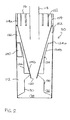
- Figure 2 is a schematic sectional side view of cyclonic separating apparatus 110 similar to that shown in Figure 1, from which a comparison of the invention and the prior art can be made. Many of the components of the apparatus 110 shown in Figure 2 are essentially the same as the corresponding components shown in Figure 1. The essential differences are described below.
- the upper cylindrical portion 114a of the inner cyclone 114 has, in the embodiment of the invention, a plurality of points of entry 152 spaced about the longitudinal axis of the apparatus 110 so as to allow air passing along the annular passageway between the frusto-conical portion 124b of the shroud 124 and the frusto-conical portion 114b of the inner cyclone 114 to pass directly into the inner cyclone 114 in a tangential manner.
- the details of the arrangement of the upper cylindrical portion 114a will be described further below.
- the ability to pass the air directly from the annular passageway to the inner cyclone 114 removes the need for a scroll-type inlet or transfer port which forms part of the airflow path of the apparatus illustrated in Figure 1. Not only does the omission of the inlet allow the radial dimension of the apparatus to be reduced and simplify the construction of the apparatus as a whole, but reducing the length of the airflow path may reduce power losses due to friction.
- dirty air enters the outer cyclone 112 via the tangential air inlet 140.
- the dirty air spirals around the outer wall of the cylindrical bin 126 and moves downwardly in a helical manner causing separation of dirt and debris from the airflow due to centrifugal forces.
- the air then moves inwardly and upwardly across the surfaces 130 and passes through the perforations in the perforated cylindrical portion 124c of the shroud 124. A substantial amount of dirt and debris is left in the first dust collecting area 132.
- the airflow then passes along the annular passageway between the frusto-conical portion 124b and the frusto-conical portion 114b. It enters the cylindrical passageway 122 formed between inner cyclone 114 and the upper portion of the cylindrical bin 126.
- the air is then immediately directed, by means of vanes 154, through a plurality of longitudinal slots 152 in the upper cylindrical portion 114a of the inner cyclone 114 and is directed in a tangential manner into the inner cyclone 114.
- the air then spirals down the inner surface of the inner cyclone 114 and the helical motion of the airflow causes very high speeds to be attained and dirt and dust particles to be separated.
- the cylindrical bin 126 can be made removable to allow the first and second dust collecting areas 132,134 to be emptied.
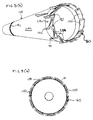
- Figures 3a and 3b are perspective and plans views, respectively, of the inner cyclone 114 forming part of the apparatus 110 illustrated in Figure 2.
- the inner cyclone 114 has an upper cylindrical portion 114a and a frusto-conical portion 114b, the frusto-conical portion 114b incorporating a circular groove 114c for receiving, in a snap-fit manner, the inner edge of the inner annular flange 124d of the shroud 124 illustrated in Figure 2.
- the upper cylindrical portion 114a incorporates a plurality of helically offset panel portions 150 equispaced about the upper cylindrical portion 114a.
- ten panel portions 150 are illustrated.
- the number of panel portions 150 can be varied to suit requirements. For example, as few as four or as many as twenty four panel portions could be provided.
- Each panel portion 150 is arranged such that its leading edge is radially spaced further away from the longitudinal axis of the inner cyclone 114 than its trailing edge. Thus, each panel portion 150 lies along a substantially helical path.
- a longitudinal slot 152 is formed between the trailing edge of a first panel portion and the leading edge of the subsequent panel portion 150, seen in the direction of the airflow.
- the combined area of the longitudinal slots 152 is no less than the specified minimum diameter of the airflow path of the apparatus 110.
- the specified minimum airflow cross-sectional area is 800mm 2
- each longitudinal slot 152 must have an effective cross-sectional area of at least 80mm 2 .
- each panel portion 150 are shaped so as to minimise losses due to friction when an airflow passes across the panel portions 150.
- the preferred cross-sectional shape of each panel portion is generally aerofoil shaped.
- the leading edge of each panel portion 150 is generally rounded and the trailing edge of each panel portion 150 is generally tapered.
- each vane 154 Located on the radially external face of each panel portion 150 is an arcuate vane 154.
- Each vane 154 has a lower portion 154a which begins generally in register with the intersection between the frusto-conical portion 114b and the upper cylindrical portion 114a of the inner cyclone 114.
- the lower portion 154a extends generally parallel to the longitudinal axis of the inner cyclone 114 and then merges with an arcuate upper portion 154b which extends from the lower portion 154a towards the trailing edge of the relevant panel portion 150.
- Each vane 154 extends radially outwardly from the outer surface of the respective panel portion 150 towards the upper portion of the cylindrical bin 126, which is located radially outwardly of the inner cyclone 114.
- the vanes 154 extend sufficiently far radially outwardly to make contact with the cylindrical bin 126 and, preferably, the vanes 154 abut against the cylindrical bin 126 in an airtight manner.
- contact with the cylindrical bin 126 is not essential. Indeed, the vanes 154 can be omitted altogether if desired.
- Location means 160 can be provided in the form of a blind recess located in one of the panel portions 150 for ensuring that the inner cyclone 114 is orientated correctly with regard to the remainder of the apparatus 110. However, the location means 160 do not form part of the invention currently under discussion.
- the entire inner cyclone 114 as illustrated in Figures 3a and 3b can easily be moulded from a plastics material without undue difficulty.
- the inner cyclone 114 can therefore replace the inner cyclone 14 illustrated in Figure 1 with the resultant advantages of reduced losses, reduced dimensions and simplicity of construction.
- the air passing along the annular passageway between the frusto-conical portions 114b and 124b is immediately directed by means of the vanes 154 through the longitudinal slots 152 and onto the inner surface of the inner cyclone 114.
- the flow in the inner cyclone 114 is also less turbulent because of the axi-symmetrical arrangement of the inlet ports and this increases the separation efficiency of the cyclone.
- a further advantage of the arrangement shown in Figures 2 and 3 is the fact that all of the air entering the inner cyclone 114 is relatively close to the cyclone wall on entry. Since the time required to separate a particle from the airflow will be dependent on the initial distance of that particle from the wall, separation of particles from the airflow will be more rapid when using the apparatus of the invention than other apparatus in which at least some of the airflow enters the cyclone spaced further from the wall.
- the vortex finder could be considerably shorter and need not project above the annular plate.
- the base of the cylindrical bin cold be made conical or frusto-conical and other relative dimensions could be altered without departing from the scope of the invention.
- vanes directing air into the longitudinal slots need not be included.
- the principles of the invention can be applied to cyclonic separators for use in areas other than vacuum cleaners and, indeed, for use in separating particulates from flows of fluids other than air.
Landscapes
- Engineering & Computer Science (AREA)
- Mechanical Engineering (AREA)
- Physics & Mathematics (AREA)
- Fluid Mechanics (AREA)
- Cyclones (AREA)
- Filters For Electric Vacuum Cleaners (AREA)
Applications Claiming Priority (2)
| Application Number | Priority Date | Filing Date | Title |
|---|---|---|---|
| GB9726659 | 1997-12-17 | ||
| GBGB9726659.7A GB9726659D0 (en) | 1997-12-17 | 1997-12-17 | Cyclonic separating apparatus |
Publications (3)
| Publication Number | Publication Date |
|---|---|
| EP0923992A2 true EP0923992A2 (de) | 1999-06-23 |
| EP0923992A3 EP0923992A3 (de) | 2000-02-02 |
| EP0923992B1 EP0923992B1 (de) | 2003-07-02 |
Family
ID=10823760
Family Applications (1)
| Application Number | Title | Priority Date | Filing Date |
|---|---|---|---|
| EP98310373A Expired - Lifetime EP0923992B1 (de) | 1997-12-17 | 1998-12-17 | Zyklonabscheidevorrichtung |
Country Status (5)
| Country | Link |
|---|---|
| EP (1) | EP0923992B1 (de) |
| AT (1) | ATE244072T1 (de) |
| DE (1) | DE69816009T2 (de) |
| ES (1) | ES2201416T3 (de) |
| GB (1) | GB9726659D0 (de) |
Cited By (16)
| Publication number | Priority date | Publication date | Assignee | Title |
|---|---|---|---|---|
| GB2362341A (en) * | 2000-05-16 | 2001-11-21 | Samsung Kwangju Electronics Co | An upright cyclone vacuum cleaner |
| FR2810528A1 (fr) * | 2000-06-24 | 2001-12-28 | Samsung Kwangju Electronics Co | Aspirateur balai comportant un collecteur de poussiere de type cyclone |
| GB2374032A (en) * | 2000-06-24 | 2002-10-09 | Samsung Kwangju Electronics Co | An upright vacuum cleaner with a cyclonic dust collecting apparatus |
| WO2003033164A1 (en) * | 2001-10-19 | 2003-04-24 | Rapid Granulator Ab | Cyclone |
| EP1674026A3 (de) * | 2004-12-22 | 2007-06-27 | Samsung Gwangju Electronics Co., Ltd. | Staubsammelvorrichtung für einen Staubsauger |
| GB2435626A (en) * | 2006-02-24 | 2007-09-05 | Samsung Kwangju Electronics Co | Cyclonic dust-collecting appratus for a vacuum cleaner |
| EP1842475A1 (de) * | 2006-04-06 | 2007-10-10 | Suzhou Kingclean Floorcare Co., Ltd. | Zweite Sortiervorrichtung für einen Staubsauger |
| US7722693B2 (en) | 2006-02-24 | 2010-05-25 | Samsung Gwangju Electronics Co., Ltd | Cyclone dust collecting apparatus for vacuum cleaner |
| US7744667B2 (en) | 2007-02-05 | 2010-06-29 | Samsung Gwangju Electronics Co., Ltd. | Cyclone separating apparatus for a vacuum cleaner |
| US7771499B2 (en) | 2006-12-28 | 2010-08-10 | Samsung Gwangju Electronics Co., Ltd. | Multi-cyclone dust separating apparatus of a vacuum cleaner |
| US7794515B2 (en) | 2007-02-14 | 2010-09-14 | Samsung Gwangju Electronics Co., Ltd. | Cyclone separating apparatus for vacuum cleaner |
| US7803205B2 (en) | 2007-02-05 | 2010-09-28 | Samsung Gwangju Electronics Co., Ltd. | Multi-cyclone dust separating apparatus having a filter assembly |
| US8176597B2 (en) | 2005-07-12 | 2012-05-15 | Bissell Homecare, Inc. | Vacuum cleaner with cyclonic dirt separation |
| US9392919B2 (en) | 2012-07-13 | 2016-07-19 | Bissell Homecare, Inc. | Cyclonic separator for a vacuum cleaner |
| CN110822478A (zh) * | 2019-11-08 | 2020-02-21 | 哈尔滨工程大学 | 一种旋流角可调的变几何旋流器 |
| WO2026028086A1 (en) * | 2024-07-31 | 2026-02-05 | Covidien Lp | Fluid separators for surgical plume evacuation systems |
Families Citing this family (14)
| Publication number | Priority date | Publication date | Assignee | Title |
|---|---|---|---|---|
| US20140237768A1 (en) | 2013-02-28 | 2014-08-28 | G.B.D. Corp. | Surface cleaning apparatus |
| US10258210B2 (en) | 2016-12-27 | 2019-04-16 | Omachron Intellectual Property Inc. | Multistage cyclone and surface cleaning apparatus having same |
| US10405709B2 (en) | 2016-12-27 | 2019-09-10 | Omachron Intellectual Property Inc. | Multistage cyclone and surface cleaning apparatus having same |
| US10299643B2 (en) | 2016-12-27 | 2019-05-28 | Omachron Intellectual Property Inc. | Multistage cyclone and surface cleaning apparatus having same |
| US10827891B2 (en) | 2016-12-27 | 2020-11-10 | Omachron Intellectual Property Inc. | Multistage cyclone and surface cleaning apparatus having same |
| US10016106B1 (en) | 2016-12-27 | 2018-07-10 | Omachron Intellectual Property Inc. | Multistage cyclone and surface cleaning apparatus having same |
| US11285495B2 (en) | 2016-12-27 | 2022-03-29 | Omachron Intellectual Property Inc. | Multistage cyclone and surface cleaning apparatus having same |
| US10271704B2 (en) | 2016-12-27 | 2019-04-30 | Omachron Intellectual Property Inc. | Multistage cyclone and surface cleaning apparatus having same |
| US11745190B2 (en) | 2019-01-23 | 2023-09-05 | Omachron Intellectual Property Inc. | Surface cleaning apparatus |
| US11213182B2 (en) | 2017-09-15 | 2022-01-04 | Omachron Intellectual Property Inc. | Surface cleaning apparatus |
| DE102018208306A1 (de) * | 2018-05-25 | 2019-11-28 | Bayerische Motoren Werke Aktiengesellschaft | Einlassstruktur für einen Speichertopf |
| US11246462B2 (en) | 2019-11-18 | 2022-02-15 | Omachron Intellectual Property Inc. | Multi-inlet cyclone |
| US11751740B2 (en) | 2019-11-18 | 2023-09-12 | Omachron Intellectual Property Inc. | Multi-inlet cyclone |
| EP3932276A1 (de) | 2020-06-29 | 2022-01-05 | Koninklijke Philips N.V. | Staubsauger |
Family Cites Families (3)
| Publication number | Priority date | Publication date | Assignee | Title |
|---|---|---|---|---|
| US3925044A (en) * | 1971-03-19 | 1975-12-09 | Rockwell International Corp | Air filter |
| US3969096A (en) * | 1974-10-16 | 1976-07-13 | E. I. Du Pont De Nemours And Company | Cyclone separator having multiple-vaned gas inlets |
| CA2061469C (en) * | 1992-02-19 | 1996-11-19 | Norman V. Soler | Cyclonic back-pack vacuum cleaner |
-
1997
- 1997-12-17 GB GBGB9726659.7A patent/GB9726659D0/en not_active Ceased
-
1998
- 1998-12-17 EP EP98310373A patent/EP0923992B1/de not_active Expired - Lifetime
- 1998-12-17 AT AT98310373T patent/ATE244072T1/de not_active IP Right Cessation
- 1998-12-17 ES ES98310373T patent/ES2201416T3/es not_active Expired - Lifetime
- 1998-12-17 DE DE69816009T patent/DE69816009T2/de not_active Expired - Lifetime
Cited By (27)
| Publication number | Priority date | Publication date | Assignee | Title |
|---|---|---|---|---|
| GB2362341A (en) * | 2000-05-16 | 2001-11-21 | Samsung Kwangju Electronics Co | An upright cyclone vacuum cleaner |
| GB2362341B (en) * | 2000-05-16 | 2002-12-04 | Samsung Kwangju Electronics Co | Upright-type vacuum cleaner |
| US6546593B2 (en) | 2000-05-16 | 2003-04-15 | Samsung Kwangju Electronics Co., Ltd. | Upright type vacuum cleaner having a cyclone type dust collector |
| GB2374032B (en) * | 2000-06-24 | 2003-03-19 | Samsung Kwangju Electronics Co | Upright type vacuum cleaner having a cyclone-type dust collector |
| GB2363744A (en) * | 2000-06-24 | 2002-01-09 | Samsung Kwangju Electronics Co | An upright cyclone vacuum cleaner |
| GB2374032A (en) * | 2000-06-24 | 2002-10-09 | Samsung Kwangju Electronics Co | An upright vacuum cleaner with a cyclonic dust collecting apparatus |
| GB2363744B (en) * | 2000-06-24 | 2002-11-13 | Samsung Kwangju Electronics Co | Upright type vacuum cleaner having a cyclone-type dust collector |
| FR2810528A1 (fr) * | 2000-06-24 | 2001-12-28 | Samsung Kwangju Electronics Co | Aspirateur balai comportant un collecteur de poussiere de type cyclone |
| US6502278B2 (en) | 2000-06-24 | 2003-01-07 | Jang-Keun Oh | Upright type vacuum cleaner having a cyclone type dust collector |
| WO2003033164A1 (en) * | 2001-10-19 | 2003-04-24 | Rapid Granulator Ab | Cyclone |
| EP1674026A3 (de) * | 2004-12-22 | 2007-06-27 | Samsung Gwangju Electronics Co., Ltd. | Staubsammelvorrichtung für einen Staubsauger |
| US8176597B2 (en) | 2005-07-12 | 2012-05-15 | Bissell Homecare, Inc. | Vacuum cleaner with cyclonic dirt separation |
| GB2435626A (en) * | 2006-02-24 | 2007-09-05 | Samsung Kwangju Electronics Co | Cyclonic dust-collecting appratus for a vacuum cleaner |
| GB2435626B (en) * | 2006-02-24 | 2008-08-27 | Samsung Kwangju Electronics Co | Cyclonic dust-collecting apparatus for a vacuum cleaner |
| US7678166B2 (en) | 2006-02-24 | 2010-03-16 | Samsung Gwanju Electronics Co., Ltd. | Cyclone dust collecting apparatus for vacuum cleaner |
| US7722693B2 (en) | 2006-02-24 | 2010-05-25 | Samsung Gwangju Electronics Co., Ltd | Cyclone dust collecting apparatus for vacuum cleaner |
| EP1842475A1 (de) * | 2006-04-06 | 2007-10-10 | Suzhou Kingclean Floorcare Co., Ltd. | Zweite Sortiervorrichtung für einen Staubsauger |
| US7771499B2 (en) | 2006-12-28 | 2010-08-10 | Samsung Gwangju Electronics Co., Ltd. | Multi-cyclone dust separating apparatus of a vacuum cleaner |
| US7803205B2 (en) | 2007-02-05 | 2010-09-28 | Samsung Gwangju Electronics Co., Ltd. | Multi-cyclone dust separating apparatus having a filter assembly |
| US7744667B2 (en) | 2007-02-05 | 2010-06-29 | Samsung Gwangju Electronics Co., Ltd. | Cyclone separating apparatus for a vacuum cleaner |
| US7794515B2 (en) | 2007-02-14 | 2010-09-14 | Samsung Gwangju Electronics Co., Ltd. | Cyclone separating apparatus for vacuum cleaner |
| US9392919B2 (en) | 2012-07-13 | 2016-07-19 | Bissell Homecare, Inc. | Cyclonic separator for a vacuum cleaner |
| US10986968B2 (en) | 2012-07-13 | 2021-04-27 | Bissell Inc. | Vacuum cleaner |
| US11700986B2 (en) | 2012-07-13 | 2023-07-18 | Bissell Inc. | Vacuum cleaner |
| CN110822478A (zh) * | 2019-11-08 | 2020-02-21 | 哈尔滨工程大学 | 一种旋流角可调的变几何旋流器 |
| CN110822478B (zh) * | 2019-11-08 | 2020-11-03 | 哈尔滨工程大学 | 一种旋流角可调的变几何旋流器 |
| WO2026028086A1 (en) * | 2024-07-31 | 2026-02-05 | Covidien Lp | Fluid separators for surgical plume evacuation systems |
Also Published As
| Publication number | Publication date |
|---|---|
| EP0923992A3 (de) | 2000-02-02 |
| DE69816009T2 (de) | 2004-03-18 |
| ES2201416T3 (es) | 2004-03-16 |
| DE69816009D1 (de) | 2003-08-07 |
| EP0923992B1 (de) | 2003-07-02 |
| ATE244072T1 (de) | 2003-07-15 |
| GB9726659D0 (en) | 1998-02-18 |
Similar Documents
| Publication | Publication Date | Title |
|---|---|---|
| EP0923992B1 (de) | Zyklonabscheidevorrichtung | |
| EP1124640B1 (de) | Zyklonabscheidevorrichtung | |
| US7513924B2 (en) | Cyclonic separating apparatus | |
| US6141826A (en) | Center air feed for cyclonic separator | |
| CA1096814A (en) | Side outlets for vortex finders | |
| CN1250150C (zh) | 旋风分离设备 | |
| US6261330B1 (en) | Apparatus for separating particles from a fluid flow | |
| EP1162910B1 (de) | Staubsauger mit zyklon.staubsammelvorrichtung | |
| US6896720B1 (en) | Cleaning apparatus | |
| CN101384328B (zh) | 离心式分离器 | |
| EP1059993B1 (de) | Reinigungsvorrichtung | |
| EP1842475B1 (de) | Zweite Sortiervorrichtung für einen Staubsauger | |
| WO2009104959A1 (en) | Gas cleaner for at least partially separating entrained components from a contaminated gas flow | |
| GB2376197A (en) | Grille assembly for a cyclone dust collecting apparatus | |
| HU219928B (hu) | Készülék szilárd vagy folyékony részecskék gázáramból való leválasztására | |
| WO2011096475A1 (ja) | サイクロン分離装置並びに電気掃除機 | |
| US3745752A (en) | Fluid inlet structure for cyclone collectors | |
| JP2023539122A (ja) | コンパクトディスクスタック型サイクロン分離器 | |
| US20040139709A1 (en) | Dynamic transfer chamber separator | |
| CN112043202A (zh) | 一种旋风分离器及清洁设备 | |
| KR20190111026A (ko) | 진공청소기를 위한 분리 시스템 및 분리 시스템을 포함하는 진공청소기 | |
| GB2326360A (en) | cyclonic separating apparatus | |
| CN111787840A (zh) | 集尘装置以及电动吸尘器 | |
| WO2019198776A1 (ja) | 集塵装置および電気掃除機 | |
| JP4743245B2 (ja) | 集塵装置およびこの集塵装置を備えた電気掃除機 |
Legal Events
| Date | Code | Title | Description |
|---|---|---|---|
| PUAI | Public reference made under article 153(3) epc to a published international application that has entered the european phase |
Free format text: ORIGINAL CODE: 0009012 |
|
| AK | Designated contracting states |
Kind code of ref document: A2 Designated state(s): AT BE CH CY DE DK ES FI FR GB GR IE IT LI LU MC NL PT SE |
|
| AX | Request for extension of the european patent |
Free format text: AL;LT;LV;MK;RO;SI |
|
| PUAL | Search report despatched |
Free format text: ORIGINAL CODE: 0009013 |
|
| AK | Designated contracting states |
Kind code of ref document: A3 Designated state(s): AT BE CH CY DE DK ES FI FR GB GR IE IT LI LU MC NL PT SE |
|
| AX | Request for extension of the european patent |
Free format text: AL;LT;LV;MK;RO;SI |
|
| 17P | Request for examination filed |
Effective date: 20000613 |
|
| AKX | Designation fees paid |
Free format text: AT BE CH CY DE DK ES FI FR GB GR IE IT LI LU MC NL PT SE |
|
| 17Q | First examination report despatched |
Effective date: 20020115 |
|
| GRAH | Despatch of communication of intention to grant a patent |
Free format text: ORIGINAL CODE: EPIDOS IGRA |
|
| GRAH | Despatch of communication of intention to grant a patent |
Free format text: ORIGINAL CODE: EPIDOS IGRA |
|
| GRAA | (expected) grant |
Free format text: ORIGINAL CODE: 0009210 |
|
| AK | Designated contracting states |
Designated state(s): AT BE CH CY DE DK ES FI FR GB GR IE IT LI LU MC NL PT SE |
|
| PG25 | Lapsed in a contracting state [announced via postgrant information from national office to epo] |
Ref country code: LI Free format text: LAPSE BECAUSE OF FAILURE TO SUBMIT A TRANSLATION OF THE DESCRIPTION OR TO PAY THE FEE WITHIN THE PRESCRIBED TIME-LIMIT Effective date: 20030702 Ref country code: FI Free format text: LAPSE BECAUSE OF FAILURE TO SUBMIT A TRANSLATION OF THE DESCRIPTION OR TO PAY THE FEE WITHIN THE PRESCRIBED TIME-LIMIT Effective date: 20030702 Ref country code: CH Free format text: LAPSE BECAUSE OF FAILURE TO SUBMIT A TRANSLATION OF THE DESCRIPTION OR TO PAY THE FEE WITHIN THE PRESCRIBED TIME-LIMIT Effective date: 20030702 Ref country code: AT Free format text: LAPSE BECAUSE OF FAILURE TO SUBMIT A TRANSLATION OF THE DESCRIPTION OR TO PAY THE FEE WITHIN THE PRESCRIBED TIME-LIMIT Effective date: 20030702 |
|
| REG | Reference to a national code |
Ref country code: GB Ref legal event code: FG4D |
|
| RIN1 | Information on inventor provided before grant (corrected) |
Inventor name: DYSON, JAMES |
|
| REG | Reference to a national code |
Ref country code: CH Ref legal event code: EP |
|
| REG | Reference to a national code |
Ref country code: IE Ref legal event code: FG4D |
|
| REF | Corresponds to: |
Ref document number: 69816009 Country of ref document: DE Date of ref document: 20030807 Kind code of ref document: P |
|
| PG25 | Lapsed in a contracting state [announced via postgrant information from national office to epo] |
Ref country code: SE Free format text: LAPSE BECAUSE OF FAILURE TO SUBMIT A TRANSLATION OF THE DESCRIPTION OR TO PAY THE FEE WITHIN THE PRESCRIBED TIME-LIMIT Effective date: 20031002 Ref country code: PT Free format text: LAPSE BECAUSE OF FAILURE TO SUBMIT A TRANSLATION OF THE DESCRIPTION OR TO PAY THE FEE WITHIN THE PRESCRIBED TIME-LIMIT Effective date: 20031002 Ref country code: GR Free format text: LAPSE BECAUSE OF FAILURE TO SUBMIT A TRANSLATION OF THE DESCRIPTION OR TO PAY THE FEE WITHIN THE PRESCRIBED TIME-LIMIT Effective date: 20031002 Ref country code: DK Free format text: LAPSE BECAUSE OF FAILURE TO SUBMIT A TRANSLATION OF THE DESCRIPTION OR TO PAY THE FEE WITHIN THE PRESCRIBED TIME-LIMIT Effective date: 20031002 |
|
| PG25 | Lapsed in a contracting state [announced via postgrant information from national office to epo] |
Ref country code: LU Free format text: LAPSE BECAUSE OF NON-PAYMENT OF DUE FEES Effective date: 20031217 Ref country code: CY Free format text: LAPSE BECAUSE OF FAILURE TO SUBMIT A TRANSLATION OF THE DESCRIPTION OR TO PAY THE FEE WITHIN THE PRESCRIBED TIME-LIMIT Effective date: 20031217 |
|
| PG25 | Lapsed in a contracting state [announced via postgrant information from national office to epo] |
Ref country code: MC Free format text: LAPSE BECAUSE OF NON-PAYMENT OF DUE FEES Effective date: 20031231 |
|
| REG | Reference to a national code |
Ref country code: CH Ref legal event code: PL |
|
| REG | Reference to a national code |
Ref country code: ES Ref legal event code: FG2A Ref document number: 2201416 Country of ref document: ES Kind code of ref document: T3 |
|
| ET | Fr: translation filed | ||
| PLBE | No opposition filed within time limit |
Free format text: ORIGINAL CODE: 0009261 |
|
| STAA | Information on the status of an ep patent application or granted ep patent |
Free format text: STATUS: NO OPPOSITION FILED WITHIN TIME LIMIT |
|
| 26N | No opposition filed |
Effective date: 20040405 |
|
| NLT1 | Nl: modifications of names registered in virtue of documents presented to the patent office pursuant to art. 16 a, paragraph 1 |
Owner name: DYSON TECHNOLOGY LIMITED |
|
| REG | Reference to a national code |
Ref country code: FR Ref legal event code: CD Ref country code: FR Ref legal event code: CA |
|
| PGFP | Annual fee paid to national office [announced via postgrant information from national office to epo] |
Ref country code: IT Payment date: 20071228 Year of fee payment: 10 |
|
| PGFP | Annual fee paid to national office [announced via postgrant information from national office to epo] |
Ref country code: BE Payment date: 20071231 Year of fee payment: 10 |
|
| BERE | Be: lapsed |
Owner name: *DYSON TECHNOLOGY LTD Effective date: 20081231 |
|
| PGFP | Annual fee paid to national office [announced via postgrant information from national office to epo] |
Ref country code: IE Payment date: 20071224 Year of fee payment: 10 |
|
| REG | Reference to a national code |
Ref country code: IE Ref legal event code: MM4A |
|
| PG25 | Lapsed in a contracting state [announced via postgrant information from national office to epo] |
Ref country code: BE Free format text: LAPSE BECAUSE OF NON-PAYMENT OF DUE FEES Effective date: 20081231 |
|
| PG25 | Lapsed in a contracting state [announced via postgrant information from national office to epo] |
Ref country code: IE Free format text: LAPSE BECAUSE OF NON-PAYMENT OF DUE FEES Effective date: 20081217 |
|
| PGFP | Annual fee paid to national office [announced via postgrant information from national office to epo] |
Ref country code: ES Payment date: 20091228 Year of fee payment: 12 |
|
| PGFP | Annual fee paid to national office [announced via postgrant information from national office to epo] |
Ref country code: NL Payment date: 20091224 Year of fee payment: 12 |
|
| REG | Reference to a national code |
Ref country code: NL Ref legal event code: V1 Effective date: 20110701 |
|
| PG25 | Lapsed in a contracting state [announced via postgrant information from national office to epo] |
Ref country code: NL Free format text: LAPSE BECAUSE OF NON-PAYMENT OF DUE FEES Effective date: 20110701 |
|
| REG | Reference to a national code |
Ref country code: ES Ref legal event code: FD2A Effective date: 20120305 |
|
| PG25 | Lapsed in a contracting state [announced via postgrant information from national office to epo] |
Ref country code: ES Free format text: LAPSE BECAUSE OF NON-PAYMENT OF DUE FEES Effective date: 20101218 |
|
| PG25 | Lapsed in a contracting state [announced via postgrant information from national office to epo] |
Ref country code: IT Free format text: LAPSE BECAUSE OF NON-PAYMENT OF DUE FEES Effective date: 20081217 |
|
| REG | Reference to a national code |
Ref country code: FR Ref legal event code: PLFP Year of fee payment: 18 |
|
| REG | Reference to a national code |
Ref country code: FR Ref legal event code: PLFP Year of fee payment: 19 |
|
| REG | Reference to a national code |
Ref country code: FR Ref legal event code: PLFP Year of fee payment: 20 |
|
| PGFP | Annual fee paid to national office [announced via postgrant information from national office to epo] |
Ref country code: FR Payment date: 20171227 Year of fee payment: 20 |
|
| PGFP | Annual fee paid to national office [announced via postgrant information from national office to epo] |
Ref country code: GB Payment date: 20171027 Year of fee payment: 20 |
|
| PGFP | Annual fee paid to national office [announced via postgrant information from national office to epo] |
Ref country code: DE Payment date: 20171229 Year of fee payment: 20 |
|
| REG | Reference to a national code |
Ref country code: DE Ref legal event code: R071 Ref document number: 69816009 Country of ref document: DE |
|
| REG | Reference to a national code |
Ref country code: GB Ref legal event code: PE20 Expiry date: 20181216 |
|
| PG25 | Lapsed in a contracting state [announced via postgrant information from national office to epo] |
Ref country code: GB Free format text: LAPSE BECAUSE OF EXPIRATION OF PROTECTION Effective date: 20181216 |