EP0924196A1 - Verfahren zur Alkylierung von Alkyl- oder Benzylcyanderivaten in Gegenwart von Trialkylaminen oder -phosphinen - Google Patents
Verfahren zur Alkylierung von Alkyl- oder Benzylcyanderivaten in Gegenwart von Trialkylaminen oder -phosphinen Download PDFInfo
- Publication number
- EP0924196A1 EP0924196A1 EP98123418A EP98123418A EP0924196A1 EP 0924196 A1 EP0924196 A1 EP 0924196A1 EP 98123418 A EP98123418 A EP 98123418A EP 98123418 A EP98123418 A EP 98123418A EP 0924196 A1 EP0924196 A1 EP 0924196A1
- Authority
- EP
- European Patent Office
- Prior art keywords
- alkyl
- formula
- phenyl
- compound
- mol
- Prior art date
- Legal status (The legal status is an assumption and is not a legal conclusion. Google has not performed a legal analysis and makes no representation as to the accuracy of the status listed.)
- Granted
Links
Classifications
-
- C—CHEMISTRY; METALLURGY
- C07—ORGANIC CHEMISTRY
- C07D—HETEROCYCLIC COMPOUNDS
- C07D211/00—Heterocyclic compounds containing hydrogenated pyridine rings, not condensed with other rings
- C07D211/04—Heterocyclic compounds containing hydrogenated pyridine rings, not condensed with other rings with only hydrogen or carbon atoms directly attached to the ring nitrogen atom
- C07D211/06—Heterocyclic compounds containing hydrogenated pyridine rings, not condensed with other rings with only hydrogen or carbon atoms directly attached to the ring nitrogen atom having no double bonds between ring members or between ring members and non-ring members
- C07D211/36—Heterocyclic compounds containing hydrogenated pyridine rings, not condensed with other rings with only hydrogen or carbon atoms directly attached to the ring nitrogen atom having no double bonds between ring members or between ring members and non-ring members with hetero atoms or with carbon atoms having three bonds to hetero atoms with at the most one bond to halogen, e.g. ester or nitrile radicals, directly attached to ring carbon atoms
- C07D211/60—Carbon atoms having three bonds to hetero atoms with at the most one bond to halogen, e.g. ester or nitrile radicals
- C07D211/62—Carbon atoms having three bonds to hetero atoms with at the most one bond to halogen, e.g. ester or nitrile radicals attached in position 4
- C07D211/64—Carbon atoms having three bonds to hetero atoms with at the most one bond to halogen, e.g. ester or nitrile radicals attached in position 4 having an aryl radical as the second substituent in position 4
-
- C—CHEMISTRY; METALLURGY
- C07—ORGANIC CHEMISTRY
- C07C—ACYCLIC OR CARBOCYCLIC COMPOUNDS
- C07C253/00—Preparation of carboxylic acid nitriles
- C07C253/30—Preparation of carboxylic acid nitriles by reactions not involving the formation of cyano groups
Definitions
- European patent application EP 0 671 379 describes a process for the methylation of described organic compounds in the presence of trialkylamines and dimethyl carbonate.
- the yield of ⁇ , ⁇ -dimethylbenzyl cyanide is 29%.
- disadvantage involves increased formation of ether products, the formation and emission of Hydrogen and ammonia together with the alkylating agent.
- the strong Bases can only be produced in an ecologically and economically complex manner.
- the object of the present invention is to find a method by which compounds of Formula II can be alkylated in high yields and purity.
- Dimethylbenzyl cyanide or 1-methyl-4-phenyl-piperidine-4-carbonitrile is particularly preferred manufactured.
- the reaction temperature is from 20 ° C to 100 ° C, preferably from 30 ° C to 40 ° C.
- the reaction time is generally from 2 to 10 hours.
- the alkylating agent is gaseous, as is the case with methyl chloride (chloromethane), it can also be used with a Overpressure of up to 5 bar can be worked.
- the alkylation reaction with dialkyl sulfate methyl sulfuric acid formed during the reaction by optionally further adding Alkali hydroxide bound.
- the compound of the formula I is isolated the mixture is mixed with water and the resulting phases are then separated The compound of formula I is then obtained from the organic phase. If it appears necessary, the organic phase can be a cleaning process such as one Distilled under reduced pressure or crystallization from a solvent become.
- Preferred basic agents are alkali metal hydroxides, e.g. B. sodium hydroxide, potassium hydroxide, Lithium hydroxide, particularly preferred is sodium hydroxide.
- Preferred solvents are, for example: (C 5 -C 7 ) aliphatic and (C 6 -C 8 ) cycloaliphatic hydrocarbons such as pentane, 2-methylbutane, hexane, 2,2-dimethylbutane, 2-methylpentane, 3-methylpentane, heptane, cyclohexane, methylcyclohexane, 1 , 2-dimethylcyclohexane, 1,3-dimethylcyclohexane; aromatic hydrocarbons such as toluene, xylenes, ethylbenzene, isopropylbenzene; aromatic and aliphatic halogenated hydrocarbons such as chlorobenzene, dichloromethane, dichloropropane, 1,2-dichloroethane; Polyethers such as ethylene glycol dibutyl ether, diethylene glycol ethyl tert-butyl ether, polyethylene glycol dibut
- Preferred compounds of the formula V and / or VI are (C 3 -C 24 ) trioctylamine or (C 3 -C 24 ) trioctylphosphine.
- Particularly preferred compounds of the formula V and / or formula VI are trioctylamine, trioctylphosphine and triethylamine.
- Preferred alkylating agents are (C 1 -C 6 ) alkyl halides such as alkyl chloride, alkyl bromide, alkyl fluoride or alkyl iodide, in particular methyl chloride, ethyl chloride or propyl chloride; (C 1 -C 6 ) dialkyl sulfates such as dimethyl, diethyl, dipropyl, dibutyl, dipentyl or dihexyl sulfate or di (2-chloroethyl) methylamine.
- alkyl halides such as alkyl chloride, alkyl bromide, alkyl fluoride or alkyl iodide, in particular methyl chloride, ethyl chloride or propyl chloride
- dialkyl sulfates such as dimethyl, diethyl, dipropyl, dibutyl, dipentyl or dihexyl sulfate or di (2-chloro
- halogen means fluorine, chlorine, bromine or iodine.
- alkyl or alkenyl are understood to mean hydrocarbon radicals whose carbon chain is straight-chain or are branched. Cyclic alkyl radicals are, for example, 3- to 6-membered monocycles such as cyclopropyl, Cyclobutyl, cyclopentyl or cyclohexyl. Furthermore, the alkenyl radical can have more than one double bond, thus also contain 2, 3 or 4 double bonds.
- Preferred quaternary ammonium or phosphonium compounds of the formulas VII and VIII are Methyltrioctylammonium chloride, methyltrioctylammonium hydroxide, methyltricaprylammonium chloride, Methyl tricaprylammonium hydroxide, ethyl trioctylammonium chloride, ethyl triocrylphosphonium chloride and hexadecyltributylphosphonium bromide, especially methyltrioctylammonium chloride.
- the starting substances for the alkylation reaction according to the invention are known from the literature Process can be produced, for example by cyanolysis of the corresponding halogen compounds.
- the process products are sought compounds for the production of a variety of Derived products, e.g. for the production of antiallergic drugs such as 4- [4- [4- (hydroxydiphenyl) -1-piperidinyl] -1-hydroxybutyl] - ⁇ , ⁇ -dimethylphenylacetic acid (US 4,254,129).
- antiallergic drugs such as 4- [4- [4- (hydroxydiphenyl) -1-piperidinyl] -1-hydroxybutyl] - ⁇ , ⁇ -dimethylphenylacetic acid (US 4,254,129).
- the product was separated from the catalyst (trioctylamine, methyltrioctylammonium chloride) and organic impurities by initially acidic, then alkaline extraction.
- the toluene was then distilled off from the organic phase under reduced pressure.
- the distillation residue was then further purified by distillation in a high vacuum at a pressure of less than 1 mbar.
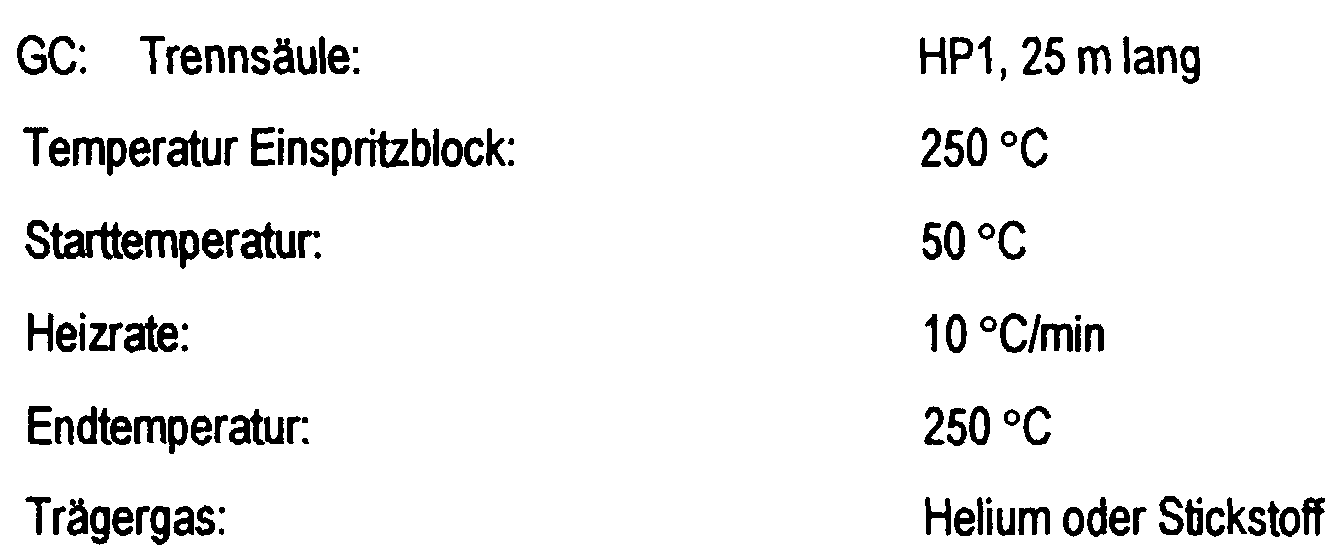
- the distillate obtained was 180 g of 1-methyl-4-phenylpiperidine-4-carbonitrile with a content of more than 99% (determined by gas chromatography (GC) ). This corresponds to a yield of 90% of theory based on the benzyl cyanide used.
Landscapes
- Chemical & Material Sciences (AREA)
- Organic Chemistry (AREA)
- Chemical Kinetics & Catalysis (AREA)
- Organic Low-Molecular-Weight Compounds And Preparation Thereof (AREA)
- Low-Molecular Organic Synthesis Reactions Using Catalysts (AREA)
- Hydrogenated Pyridines (AREA)
- Pharmaceuticals Containing Other Organic And Inorganic Compounds (AREA)
- Nitrogen And Oxygen Or Sulfur-Condensed Heterocyclic Ring Systems (AREA)
Abstract
Description

für
- 1. Phenyl oder
- 2. Phenyl, welches ein-, zwei- oder dreifach substituiert ist durch
- 2.1. (C1-C6)-Alkyl, worin die Alkylkette gerade oder verzweigt ist,
- 2.2. (C3-C6)-Cycloalkyl,
- 2.3. -OH,
- 2.4. (C1-C6)-Alkyl-C(O)-O-,
- 2.5. (C1-C6)-Alkyl-O-,
- 2.6. (C1-C6)-Alkyl-O-(C1-C4)-Alkyl-O-,
- 2.7. Halogen,
- 2.8. -CF3,
- 2.9. -CN,
- 2.10. -NO2,
- 2.11. HO-C(O)-,
- 2.12. (C1-C6)-Alkyl-O-C(O)-,
- 2.13. Methylendioxo,
- 2.14. R5-(R6)N-C(O)-, worin R5 und R6 gleich oder verschieden sind und für Wasserstoffatom oder (C1-C6)-Alkyl- stehen, oder
- 2.15. R5-(R6)N-, worin R5 und R6 gleich oder verschieden sind und für Wasserstoffatom oder (C1-C6)-Alkyl stehen, steht

- Z
- für N-, O- oder S-Atom steht und n 1 oder 2 ist, oder wenn Z für N-oder
S-Atom steht, Z unsubstituiert oder durch R substituiert ist, worin
R (C1-C6)-Alkyl, Benzyl oder Phenyl bedeutet, - R3 für
- 1. Phenyl oder
2. Phenyl, welches ein-, zwei- oder dreifach substituiert ist durch- 2.1. (C1-C6)-Alkyl, worin die Alkylkette gerade oder verzweigt ist,
- 2.2. (C3-C6)-Cycloalkyl,
- 2.3. -OH,
- 2.4. (C1-C6)-Alkyl-C(O)-O-,
- 2.5. (C1-C6)-Alkyl-O-,
- 2.6. (C1-C6)-Alkyl-O-(C1-C4)-Alkyl-O-,
- 2.7. Halogen,
- 2.8. -CF3,
- 2.9. -CN,
- 2.10. -NO2,
- 2.11. HO-C(O)-,
- 2.12. (C1-C6)-Alkyl-O-C(O)-,
- 2.13. Methylendioxo,
- 2.14. R5-(R6)N-C(O)-, worin R5 und R6 gleich oder verschieden sind und für Wasserstoffatom oder (C1-C6)-Alkyl- stehen, oder
- 2.15. R5-(R6)N-, worin R5 und R6 gleich oder verschieden sind und für Wasserstoffatom oder (C1-C6)-Alkyl stehen, steht

- R3
- dieselbe Bedeutung wie in Formel I hat und
- R4
- Wasserstoffatom bedeutet oder dieselbe Bedeutung wie R2 in Formel I hat,
- wobei R1 dieselbe Bedeutung wie in Formel I hat und
- X für Halogen steht oder 2 Reste von R1 an dem Rest SO4 gebunden sind oder
mit einem Alkylierungsmittel der Formel IIIa,
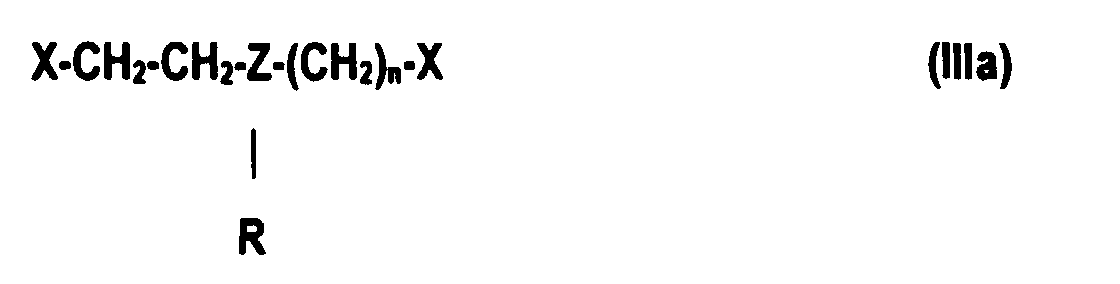
in Gegenwart von einem basischen Mittel und mindestens einer Verbindung der Formel V und/oder VI

- R7, R8, R9, R10, R11 und R12 unabhängig voneinander gleich oder
- verschieden sind und für (C1-C30)-Alkyl oder Phenyl stehen, umsetzt
- R1 für
- 1. (C1-C6)-Alkyl,
2. (C1-C6)-Alkyl, zweifach substituiert durch -O-CH3 oder
3. (C1-C6)-Alkyl, einfach substituiert durch R5-(R6)-N-, worin R5 und R6 gleich oder verschieden sind und Wasserstoffatom oder (C1-C3)-Alkyl bedeuten, steht, - R2
- dieselbe Bedeutung wie R1 hat oder für Phenyl steht oder
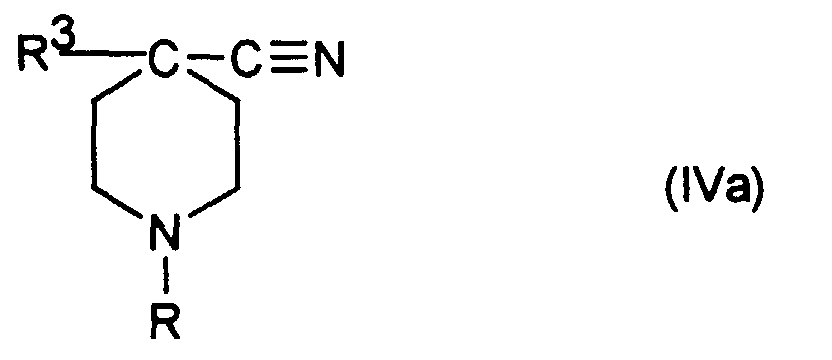
- R3
- für Phenyl, unsubstituiert oder einfach substituiert durch (C1-C3)-Alkyl-O-, steht
- R1
- für (C1-C3)-Alkyl, (C1-C3)-Alkyl, zweifach substituiert durch -O-CH3 oder -CH(CH3)-CH2-N-(CH3)-CH3 steht,
- R2
- dieselbe Bedeutung wie R1 hat oder für Phenyl steht oder
- R3
- für Phenyl, unsubstituiert oder einfach substituiert durch -O-CH3, steht
Vorzugsweise verwendet man auf 100 Gewichtsprozent (Gew.%) der Verbindung der Formel II von 0,5 Gew.% bis 5 Gew.%, insbesondere 1 Gew.% bis 2 Gew.% der Verbindung der Formeln V und/oder VI.
(C5-C7)-aliphatische und (C6-C8)-cycloaliphatische Kohlenwasserstoffe wie Pentan, 2-Methylbutan, Hexan, 2,2-Dimethylbutan, 2-Methylpentan, 3-Methylpentan, Heptan, Cyclohexan, Methylcyclohexan, 1,2-Dimethylcyclohexan, 1,3-Dimethylcyclohexan; aromatische Kohlenwasserstoffe wie Toluol, Xylole, Ethylbenzol, Isopropylbenzol; aromatische und aliphatische Halogenkohlenwasserstoffe wie Chlorbenzol, Dichlormethan, Dichlorpropan, 1,2-Dichlorethan; Polyether wie Ethylenglykoldibutylether, Diethylenglykolethyl-tert.-butylether, Polyethylenglykoldibutylether, Polypropylenglykoldibutylether, Polyethylenglykoldimethylether, Polyethylenglykoldiethylether, Polypropylenglykoldiethylether, Polypropylenglykolmethylether; heterocyclische Kohlenwasserstoffe wie N-Methylpyrrolidon, Pyridin; Ether wie Tetrahydrofuran, Dibutylether, Methyl-tert.-butylether sowie Dimethylcarbonat und Dimethylsulfoxid.
- Trimethylamin, Dimethylethylamin, Triethylamin, Tri-n-propylamin, Triisopropylamin, Tributylamin, Trioctylamin, Tricyclohexylamin, Trihexadecylamin, Diphenylmethylamin, Dimethylbenzylamin, Dibenzylmethylamin, Tribenzylamin, Triphenylamin,
- Trimethylphosphin, Triethylphosphin, Tri-n-propylphosphin, Tributylphosphin, Triisopropylphosphin, Trioctylphosphin, Triphenylphosphin.
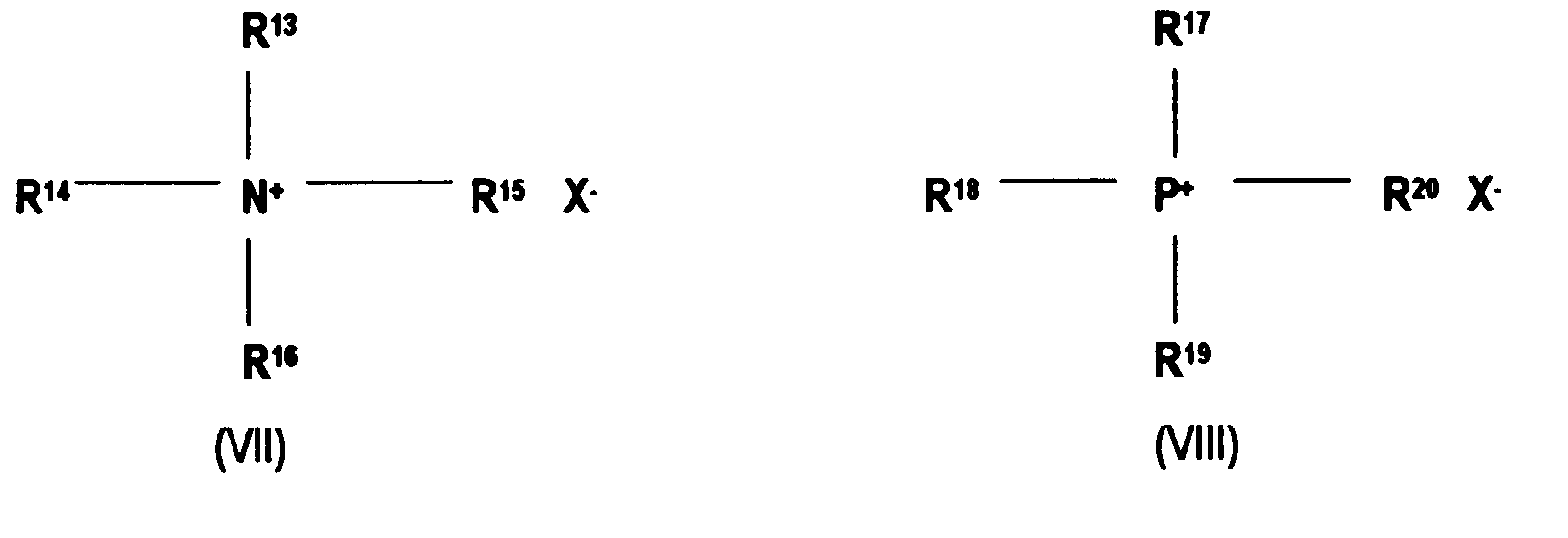
- R13 bis R20
- gleich oder verschieden sind und unabhängig voneinander für
- a) (C1-C20)-Alkyl, geradkettig oder verzweigt,
- b) Benzyl oder
- c) Phenyl stehen und X für Anion steht.


Claims (14)
- Verfahren zur Gewinnung der Verbindung der Formel Iwobei R1 für
 R2 dieselbe Bedeutung wie R1 hat oder1. (C1-C20)-Alkyl,2. (C1-C20)-Alkyl, welches ein-, zwei- oder dreifach substituiert ist durch2.1. (C3-C6)-Cycloalkyl,2.2. -OH,2.3. (C1-C6)-Alkyl-C(O)-O-,2.4. (C1-C6)-Alkyl-O-,2.5. (C1-C6)-Alkyl-O-(C1-C4)-Alkyl-O-,2.6. Halogen,2.7. -CF3,2.8. -CN,2.9. -NO2,2.10. HO-C(O)-,2.11. (C1-C6)-Alkyl-O-C(O)-,2.12. Methylendioxo,2.13. R5-(R6)N-C(O)-, worin R5 und R6 gleich oder verschieden sind und Wasserstoffatom oder (C1-C6)-Alkyl bedeuten,2.14. R5-(R8)N-, worin R5 und R6 gleich oder verschieden sind und Wasserstoffatom oder (C1-C6)-Alkyl bedeuten, oder2.15. Phenyl, welches unsubstituiert oder ein-, zwei- oder dreifach unabhängig voneinander substituiert ist durch (C1-C6)-Alkyl oder wie unter 2.1. bis 2.14. beschrieben substituiert ist,3. (C2-C20)-Alkenyl oder4. (C2-C20)-Alkenyl, welches ein-, zwei- oder dreifach unabhängig voneinander wie unter 2.1. bis 2.15. beschrieben substituiert ist, steht,
füroder R1 und R2 zusammen mit dem Kohlenstoffatom an das sie gebunden sind und den Resten R3 und -CN eine Verbindung der Formel IV bilden,1. Phenyl oder2. Phenyl, ein-, zwei- oder dreifach substituiert durch2.1. (C1-C6)-Alkyl, worin die Alkylkette gerade oder verzweigt ist,2.2. (C3-C6)-Cycloalkyl,2.3. -OH,2.4. (C1-C6)-Alkyl-C(O)-O-,2.5. (C1-C6)-Alkyl-O-,2.6. (C1-C6)-Alkyl-O-(C1-C4)-Alkyl-O-,2.7. Halogen,2.8. -CF3,2.9. -CN,2.10. -NO2,2.11. HO-C(O)-,2.12. (C1-C6)-Alkyl-O-C(O)-,2.13. Methylendioxo,2.14. R5-(R6)N-C(O)-, worin R5 und R6 gleich oder verschieden sind und Wasserstoffatom oder (C1-C6)-Alkyl bedeuten, oder2.15. R5-(R6)N-, worin R5 und R6 gleich oder verschieden sind und Wasserstoffatom oder (C1-C6)-Alkyl bedeuten, stehtwobei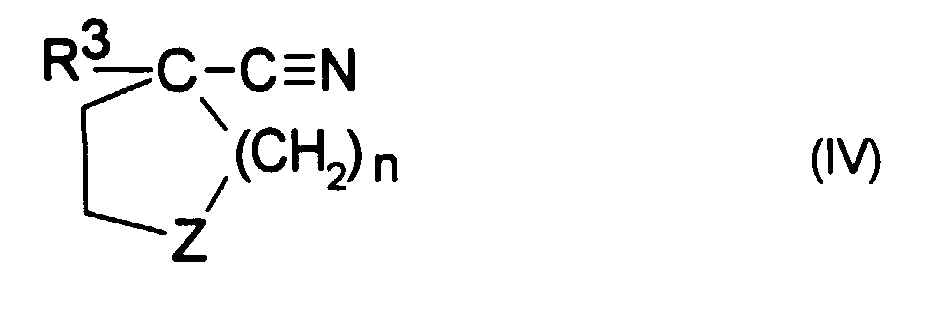
- Z
- für N-, O- oder S-Atom steht und n 1 oder 2 ist, oder wenn Z für N- oder S-Atom steht, Z unsubstituiert oder durch R substituiert ist, worin R (C1-C6)-Alkyl, Benzyl oder Phenyl bedeutet,
- R3 für
- 1. Phenyl oder
2. Phenyl, ein-, zwei- oder dreifach substituiert durch- 2.1. (C1-C6)-Alkyl, worin die Alkylkette gerade oder verzweigt ist,
- 2.2. (C3-C6)-Cycloalkyl,
- 2.3. -OH,
- 2.4. (C1-C6)-Alkyl-C(O)-O-,
- 2.5. (C1-C6)-Alkyl-O-,
- 2.6. (C1-C6)-Alkyl-O-(C1-C4)-Alkyl-O-,
- 2.7. Halogen,
- 2.8. -CF3,
- 2.9. -CN,
- 2.10. -NO2,
- 2.11. HO-C(O)-,
- 2.12. (C1-C6)-Alkyl-O-C(O)-,
- 2.13. Methylendioxo,
- 2.14. R5-(R6)N-C(O)-, worin R5 und R6 gleich oder verschieden sind und Wasserstoffatom oder (C1-C6)-Alkyl bedeuten, oder
- 2.15. R5-(R6)N-, worin R5 und R6 gleich oder verschieden sind und Wasserstoffatom oder (C1-C6)-Alkyl bedeuten, steht,
wobei
- R3
- dieselbe Bedeutung wie in Formel I hat und
- R4
- Wasserstoffatom bedeutet oder dieselbe Bedeutung wie R2 in Formel I hat,
oder 2 Reste von R1 an den Rest SO4 gebunden sind oder mit einem Alkylierungsmittel der Formel IIIa,worin Z, X, R und n die obengenannte Bedeutung haben,
in Gegenwart von einem basischen Mittel und mindestens einer Verbindung der Formel V und/oder Formel VIwobei R7, R8, R9, R10, R11 und R12 unabhängig voneinander gleich oderverschieden sind und für (C1-C30)-Alkyl oder Phenyl stehen, umsetzt.
 - Verfahren gemäß Anspruch 1, dadurch gekennzeichnet, daß eine Verbindung der Formel I hergestellt wird, worin
- R1 für
- 1. (C1-C6)-Alkyl,
2. (C1-C6)-Alkyl, zweifach substituiert durch -O-CH3 oder
3. (C1-C6)-Alkyl, einfach substituiert durch R5-(R6)-N-, worin R5 und R6 gleich oder verschieden sind und Wasserstoffatom oder (C1-C3)-Alkyl bedeuten, steht, - R2
- dieselbe Bedeutung wie R1 hat oder für Phenyl steht oder
worin R (C1-C6)-Alkyl, Benzyl oder Phenyl bedeutet, und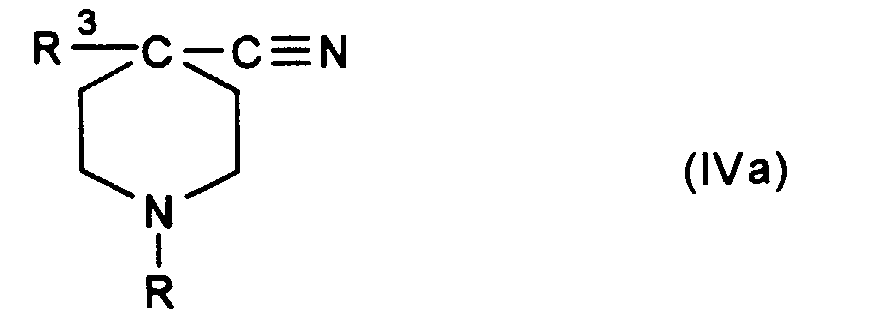
- R3
- für Phenyl unsubstituiert oder einfach substituiert durch (C1-C3)-Alkyl-O- steht.
- Verfahren gemäß Anspruch 1, dadurch gekennzeichnet, daß die Verbindungen der Formel I hergestellt wird, worin
- R1
- für (C1-C3)-Alkyl, (C1-C3)-Alkyl, zweifach substituiert durch -O-CH3 oder -CH(CH3)-CH2-N-(CH3)-CH3 steht,
- R2
- dieselbe Bedeutung wie R1 hat oder für Phenyl steht oder
- R3
- für Phenyl, unsubstituiert oder einfach substituiert durch -O-CH3, steht
- Verfahren gemäß Anspruch 1, dadurch gekennzeichnet, daß man Dimethylbenzylcyanid oder 1-Methyl-4-phenyl-piperidin-4-carbonitril herstellt.
- Verfahren gemäß einem oder mehreren der Ansprüche 1 bis 4, dadurch gekennzeichnet, daß man als Verbindung der Formel V und/oder VI eine Verbindung aus der Gruppe Trimethylamin, Dimethylethylamin, Triethylamin, Tri-n-propylamin, Triisopropylamin, Tributylamin, Trioctylamin, Tricyclohexylamin, Trihexadecylamin, Diphenylmethylamin, Dimethylbenzylamin, Dibenzylmethylamin, Tribenzylamin, Triphenylamin, Trimethylphosphin, Triethylphosphin, Tri-n-propylphosphin, Tributylphosphin, Trioctylphosphin, Triisopropylphosphin und Triphenylphosphin einsetzt, bevorzugt Trioctylamin, Trioctylphosphin und Triethylamin.
- Verfahren gemäß einem oder mehreren der Ansprüche 1 bis 5, dadurch gekennzeichnet, daß man als basische Mittel Natriumhydroxid, Kaliumhydroxid, Lithiumhydroxid, insbesondere Natriumhydroxid einsetzt.
- Verfahren gemäß einem oder mehreren der Ansprüche 1 bis 6, dadurch gekennzeichnet, daß man als Alkylierungsmittel (C1-C6)-Alkylhalogenide wie Alkylchlorid, Alkylbromid, Alkylfluorid oder Alkyljodid, insbesondere Methylchlorid, Ethylchlorid oder Propylchlorid; (C1-C6)-Dialkylsulfat wie Dimethyl-, Diethyl-, Dipropyl-, Dibutyl-, Dipentyl- oder Dihexylsulfat oder Di-(2-Chlorethyl)-methylamin einsetzt.
- Verfahren gemäß einem oder mehreren der Ansprüche 1 bis 7, dadurch gekennzeichnet, daß man auf 1 Mol der Verbindung der Formel II von 2,1 Mol bis 2,4 Mol, insbesondere von 2,15 Mol bis 2,25 Mol, des Alkylierungsmittels der Formel III einsetzt und auf 1 Mol der Verbindung der Formel II von 2,5 Mol bis 4 Mol, insbesondere von 2,8 Mol bis 3,2 Mol, des basischen Mittels einsetzt.
- Verfahren gemäß einem oder mehreren der Ansprüche 1 bis 8, dadurch gekennzeichnet, daß man auf 100 Gewichtsprozent (Gew.%) der Verbindung der Formel II von 0,5 Gew.% bis 5 Gew.%, insbesondere von 1 Gew.% bis 2 Gew.%, der Verbindung der Formel V und/oder Formel VI einsetzt.
- Verfahren gemäß einem oder mehreren der Ansprüche 1 bis 9, dadurch gekennzeichnet, daß man die Alkylierung bei Temperaturen von 20 °C bis 100 °C, bevorzugt von 30 °C bis 40 °C, durchführt.
- Verfahren gemäß einem oder mehreren der Ansprüche 1 bis 10, dadurch gekennzeichnet, daß man zusätzlich eine Verbindung der Formeln VII und/oder VIIIwobei R13 bis R20 gleich oder verschieden sind und unabhängig voneinander für
 a) (C1-C20)-Alkyl, geradkettig oder verzweigt,b) Benzyl oderc) Phenyl stehen
und X- für Anion steht, einsetzt. - Verfahren gemäß Anspruch 11, dadurch gekennzeichnet, daß man als Verbindung der Formeln VII und/oder VIII Methyltrioctylammoniumchlorid, Methyl-trioctylammoniumhydroxid, Methyl-tricaprylammoniumchlorid, Methyl-tricaprylammoniumhydroxid, Ethyl-trioctylammoniumchlorid, Ethyl-trioctylphosphoniumchlorid und Hexadecyltributylphosphoniumbromid, insbesondere Methyltrioctylammoniumchlorid, einsetzt.
- Verfahren gemäß Anspruch 11 oder 12, dadurch gekennzeichnet, daß man auf 100 Mol der Verbindung der Formel II von 10 Mol bis 300 Mol der Verbindung der Formeln VII und/oder VIII einsetzt, insbesondere von 100 Mol bis 300 Mol einsetzt.
- Verfahren gemäß einem oder mehreren der Ansprüche 1 bis 13, dadurch gekennzeichnet, daß die Verbindung der Formel II in einem Lösungsmittel aus der Gruppe (C5-C7)-aliphatische und (C6-C8)-cycloaliphatische Kohlenwasserstoffe wie Pentan, 2-Methylbutan, Hexan, 2,2-Dimethylbutan, 2-Methylpentan, 3-Methylpentan, Heptan, Cyclohexan, Methylcyclohexan, 1,2-Dimethylcyclohexan, 1,3-Dimethylcyclohexan; aromatische Kohlenwasserstoffe wie Toluol, Xylole, Ethylbenzol, Isopropylbenxol; aromatische und aliphatische Halogenkohlenwasserstoffe wie Chlorbenzol, Dichlormethan, Dichlorpropan, 1,2-Dichlorethan; Polyether wie Ethylenglykoldibutylether, Diethylenglykolethyl-tert.-butylether, Polyethylenglykoldibutylether, Polypropylenglykoldibutylether, Polyethylenglykoldimethylether, Polyethylenglykoldiethylether, Polypropylenglykoldiethylether, Polypropylenglykolmethylether; heterocyclische Kohlenwasserstoffe wie N-Methylpyrrolidon, Pyridin; Ether wie Tetrahydrofuran, Dibutylether, Methyl-tert.-butylether sowie Dimethylcarbonat und Dimethylsulfoxid gelöst wird.
Applications Claiming Priority (4)
| Application Number | Priority Date | Filing Date | Title |
|---|---|---|---|
| DE19756091 | 1997-12-17 | ||
| DE1997156091 DE19756091A1 (de) | 1997-12-17 | 1997-12-17 | Verfahren zur Alkylierung von Alkyl- oder Benzylcyanderivaten in Gegenwart von Trialkylaminen oder -phosphinen |
| DE19803408 | 1998-01-29 | ||
| DE1998103408 DE19803408A1 (de) | 1998-01-29 | 1998-01-29 | Verfahren zur Alkylierung von Alkyl- oder Benzylcyanderivaten in Gegenwart von Trialkylaminen oder -phosphinen |
Publications (2)
| Publication Number | Publication Date |
|---|---|
| EP0924196A1 true EP0924196A1 (de) | 1999-06-23 |
| EP0924196B1 EP0924196B1 (de) | 2003-06-18 |
Family
ID=26042529
Family Applications (1)
| Application Number | Title | Priority Date | Filing Date |
|---|---|---|---|
| EP98123418A Expired - Lifetime EP0924196B1 (de) | 1997-12-17 | 1998-12-09 | Verfahren zur Alkylierung von Alkyl- oder Benzylcyanderivaten in Gegenwart von Trialkylaminen oder -phosphinen |
Country Status (22)
| Country | Link |
|---|---|
| US (1) | US6143896A (de) |
| EP (1) | EP0924196B1 (de) |
| JP (2) | JP4410329B2 (de) |
| KR (1) | KR100589305B1 (de) |
| CN (1) | CN1119322C (de) |
| AR (1) | AR016435A1 (de) |
| AT (1) | ATE243191T1 (de) |
| AU (1) | AU740310B2 (de) |
| BR (1) | BR9805350B1 (de) |
| CA (1) | CA2256941C (de) |
| CZ (1) | CZ293875B6 (de) |
| DE (1) | DE59808753D1 (de) |
| DK (1) | DK0924196T3 (de) |
| ES (1) | ES2200260T3 (de) |
| HU (1) | HU221417B1 (de) |
| ID (1) | ID21458A (de) |
| NO (1) | NO317334B1 (de) |
| NZ (1) | NZ333375A (de) |
| PL (1) | PL194500B1 (de) |
| PT (1) | PT924196E (de) |
| TR (1) | TR199802607A2 (de) |
| UA (1) | UA64711C2 (de) |
Cited By (2)
| Publication number | Priority date | Publication date | Assignee | Title |
|---|---|---|---|---|
| WO2010112482A1 (en) | 2009-04-01 | 2010-10-07 | Lek Pharmaceuticals D.D. | A process for dimethylation of active methylene groups |
| EP2277875A3 (de) * | 2004-01-30 | 2011-04-20 | Euro-Celtique S.A. | Verfahren zur Herstellung von 4-Tetrazolyl-4-phenylpiperidine Derivate |
Families Citing this family (3)
| Publication number | Priority date | Publication date | Assignee | Title |
|---|---|---|---|---|
| CN109694334B (zh) * | 2017-10-23 | 2022-07-22 | 西华大学 | 双取代氰基乙酸酯化合物的无溶剂制备方法 |
| CN109694335B (zh) * | 2017-10-23 | 2021-12-17 | 西华大学 | 双取代对硝基苯乙腈衍生物的无溶剂制备方法 |
| CN109694333A (zh) * | 2017-10-23 | 2019-04-30 | 西华大学 | 双取代丙二腈衍生物的无溶剂制备方法 |
Citations (3)
| Publication number | Priority date | Publication date | Assignee | Title |
|---|---|---|---|---|
| US3668255A (en) * | 1967-10-31 | 1972-06-06 | Rhodia | Process for alkylation of aliphatic ketones and product |
| DE2206778A1 (de) * | 1972-02-12 | 1973-08-16 | Bayer Ag | Verfahren zur herstellung von bisalkylierten organischen verbindungen |
| EP0671379A1 (de) * | 1994-03-07 | 1995-09-13 | Basf Aktiengesellschaft | Verfahren zur Methylierung organischer Verbindungen |
Family Cites Families (5)
| Publication number | Priority date | Publication date | Assignee | Title |
|---|---|---|---|---|
| JPS5163145A (en) * | 1974-11-26 | 1976-06-01 | Sumitomo Chemical Co | 33 mechiru 22 * 44 harogenofueniru * buchironitoriruno seizoho |
| US4254129A (en) * | 1979-04-10 | 1981-03-03 | Richardson-Merrell Inc. | Piperidine derivatives |
| JPS57185252A (en) * | 1981-05-07 | 1982-11-15 | Nippon Tokushu Kagaku Kogyo Kk | Production of phenylacetonitrile derivative |
| US4377531A (en) * | 1981-10-07 | 1983-03-22 | American Cyanamid Company | Method for the alkylation of phenylacetonitriles |
| JPH06234668A (ja) * | 1993-02-10 | 1994-08-23 | Nippon Steel Corp | 9,9−ジアルキルフルオレンの製造方法 |
-
1998
- 1998-12-09 PT PT98123418T patent/PT924196E/pt unknown
- 1998-12-09 DK DK98123418T patent/DK0924196T3/da active
- 1998-12-09 EP EP98123418A patent/EP0924196B1/de not_active Expired - Lifetime
- 1998-12-09 AT AT98123418T patent/ATE243191T1/de active
- 1998-12-09 ES ES98123418T patent/ES2200260T3/es not_active Expired - Lifetime
- 1998-12-09 DE DE59808753T patent/DE59808753D1/de not_active Expired - Lifetime
- 1998-12-15 ID IDP981630A patent/ID21458A/id unknown
- 1998-12-15 NZ NZ333375A patent/NZ333375A/xx not_active IP Right Cessation
- 1998-12-15 UA UA98126635A patent/UA64711C2/uk unknown
- 1998-12-15 CZ CZ19984148A patent/CZ293875B6/cs not_active IP Right Cessation
- 1998-12-15 TR TR1998/02607A patent/TR199802607A2/xx unknown
- 1998-12-15 AR ARP980106374A patent/AR016435A1/es active IP Right Grant
- 1998-12-15 HU HU9802909A patent/HU221417B1/hu unknown
- 1998-12-16 CA CA002256941A patent/CA2256941C/en not_active Expired - Lifetime
- 1998-12-16 US US09/212,585 patent/US6143896A/en not_active Expired - Lifetime
- 1998-12-16 NO NO19985895A patent/NO317334B1/no not_active IP Right Cessation
- 1998-12-16 AU AU97142/98A patent/AU740310B2/en not_active Expired
- 1998-12-16 BR BRPI9805350-7A patent/BR9805350B1/pt not_active IP Right Cessation
- 1998-12-17 CN CN98125573A patent/CN1119322C/zh not_active Expired - Lifetime
- 1998-12-17 JP JP35886898A patent/JP4410329B2/ja not_active Expired - Fee Related
- 1998-12-17 KR KR1019980055570A patent/KR100589305B1/ko not_active Expired - Lifetime
- 1998-12-17 PL PL330376A patent/PL194500B1/pl unknown
-
2009
- 2009-09-17 JP JP2009215412A patent/JP4976472B2/ja not_active Expired - Lifetime
Patent Citations (3)
| Publication number | Priority date | Publication date | Assignee | Title |
|---|---|---|---|---|
| US3668255A (en) * | 1967-10-31 | 1972-06-06 | Rhodia | Process for alkylation of aliphatic ketones and product |
| DE2206778A1 (de) * | 1972-02-12 | 1973-08-16 | Bayer Ag | Verfahren zur herstellung von bisalkylierten organischen verbindungen |
| EP0671379A1 (de) * | 1994-03-07 | 1995-09-13 | Basf Aktiengesellschaft | Verfahren zur Methylierung organischer Verbindungen |
Cited By (2)
| Publication number | Priority date | Publication date | Assignee | Title |
|---|---|---|---|---|
| EP2277875A3 (de) * | 2004-01-30 | 2011-04-20 | Euro-Celtique S.A. | Verfahren zur Herstellung von 4-Tetrazolyl-4-phenylpiperidine Derivate |
| WO2010112482A1 (en) | 2009-04-01 | 2010-10-07 | Lek Pharmaceuticals D.D. | A process for dimethylation of active methylene groups |
Also Published As
Similar Documents
| Publication | Publication Date | Title |
|---|---|---|
| DE60313213T2 (de) | Selektive reaktion von hexafluorpropylenoxid mit perfluoracylfluoriden | |
| EP2459512B1 (de) | Verfahren zur herstellung von 2,2-difluorethylamin | |
| EP2739602B1 (de) | Verfahren zur herstellung von kernhalogenierten n,n-dialkylbenzylaminen | |
| EP1436300B1 (de) | Verfahren zur metallierung von aromaten durch lithiumorganische verbindungen | |
| EP0924196B1 (de) | Verfahren zur Alkylierung von Alkyl- oder Benzylcyanderivaten in Gegenwart von Trialkylaminen oder -phosphinen | |
| EP2509937B1 (de) | Verfahren zur herstellung von 2,2-difluorethylamin sowie seiner salze ausgehend von difluoracetonitril | |
| EP1247792B1 (de) | Verfahren zur Herstellung von halogensubstituierten Dibenzylalkoholen | |
| EP0934246B1 (de) | Verfahren zur herstellung von alpha-alkoxy-alpha-trifluormethyl-arylessigsäureestern und -arylessigsäuren | |
| DE112007003065B4 (de) | Verfahren zur Herstellung von Fluoralkanester | |
| DE19756091A1 (de) | Verfahren zur Alkylierung von Alkyl- oder Benzylcyanderivaten in Gegenwart von Trialkylaminen oder -phosphinen | |
| DE19803408A1 (de) | Verfahren zur Alkylierung von Alkyl- oder Benzylcyanderivaten in Gegenwart von Trialkylaminen oder -phosphinen | |
| DE2512498C2 (de) | Verfahren zur herstellung von sulfonsaeurefluoriden | |
| EP0829466B1 (de) | Verfahren zur Herstellung von Cyclopentanolen | |
| EP0421225B1 (de) | Verfahren zur Herstellung von alpha-Chlor-phosphoryliden | |
| DE2412800C3 (de) | Verfahren zur Herstellung von halogenhaltigen tertiären Phosphinoxiden | |
| WO2009141300A1 (de) | Verfahren zur herstellung von magnesiumamiden | |
| DE69209258T2 (de) | Verfahren zur Herstellung von Dichlormethylpyridinen | |
| WO2018036848A1 (de) | Vinylierung mit acetylen in gegenwart von wasser | |
| DE1906361C (de) | Verfahren zur Cyclooligomerisation von Butadien mittels Katalysatoren aus Koordinationskomplexverbindungen des Nickels mit einem durch Butadien verdrangbaren Kohlenwasserstoff Liganden | |
| WO1999052853A1 (de) | Verfahren zur herstellung von dibenzylcarbonaten | |
| DE1302056B (de) | Verfahren zur Herstellung von Hydroxylaminderivaten | |
| DE2808226A1 (de) | Verfahren zur herstellung von omega- isocyan-carbonsaeureestern | |
| DE102013104346A1 (de) | Verfahren zur herstellung von arylschwefelpentafluoriden | |
| EP0755913A1 (de) | Verfahren zur Herstellung von 2,4-Dibrom-4- und -3-fluorbutancarbonsäure und deren Derivaten |
Legal Events
| Date | Code | Title | Description |
|---|---|---|---|
| PUAI | Public reference made under article 153(3) epc to a published international application that has entered the european phase |
Free format text: ORIGINAL CODE: 0009012 |
|
| AK | Designated contracting states |
Kind code of ref document: A1 Designated state(s): AT BE CH CY DE DK ES FI FR GB GR IE IT LI LU NL PT SE |
|
| AX | Request for extension of the european patent |
Free format text: AL;LT;LV;MK;RO;SI |
|
| 17P | Request for examination filed |
Effective date: 19991223 |
|
| AKX | Designation fees paid |
Free format text: AT BE CH CY DE DK ES FI FR GB GR IE IT LI LU NL PT SE |
|
| RAP1 | Party data changed (applicant data changed or rights of an application transferred) |
Owner name: AVENTIS PHARMA DEUTSCHLAND GMBH |
|
| 17Q | First examination report despatched |
Effective date: 20020312 |
|
| GRAH | Despatch of communication of intention to grant a patent |
Free format text: ORIGINAL CODE: EPIDOS IGRA |
|
| GRAH | Despatch of communication of intention to grant a patent |
Free format text: ORIGINAL CODE: EPIDOS IGRA |
|
| GRAA | (expected) grant |
Free format text: ORIGINAL CODE: 0009210 |
|
| AK | Designated contracting states |
Designated state(s): AT BE CH CY DE DK ES FI FR GB GR IE IT LI LU NL PT SE |
|
| REG | Reference to a national code |
Ref country code: GB Ref legal event code: FG4D Free format text: NOT ENGLISH |
|
| REG | Reference to a national code |
Ref country code: CH Ref legal event code: EP |
|
| REG | Reference to a national code |
Ref country code: IE Ref legal event code: FG4D Free format text: GERMAN |
|
| REF | Corresponds to: |
Ref document number: 59808753 Country of ref document: DE Date of ref document: 20030724 Kind code of ref document: P |
|
| REG | Reference to a national code |
Ref country code: GR Ref legal event code: EP Ref document number: 20030403149 Country of ref document: GR |
|
| REG | Reference to a national code |
Ref country code: DK Ref legal event code: T3 |
|
| REG | Reference to a national code |
Ref country code: SE Ref legal event code: TRGR |
|
| GBT | Gb: translation of ep patent filed (gb section 77(6)(a)/1977) |
Effective date: 20031007 |
|
| REG | Reference to a national code |
Ref country code: ES Ref legal event code: FG2A Ref document number: 2200260 Country of ref document: ES Kind code of ref document: T3 |
|
| ET | Fr: translation filed | ||
| PLBE | No opposition filed within time limit |
Free format text: ORIGINAL CODE: 0009261 |
|
| STAA | Information on the status of an ep patent application or granted ep patent |
Free format text: STATUS: NO OPPOSITION FILED WITHIN TIME LIMIT |
|
| 26N | No opposition filed |
Effective date: 20040319 |
|
| REG | Reference to a national code |
Ref country code: CH Ref legal event code: PFA Owner name: SANOFI-AVENTIS DEUTSCHLAND GMBH Free format text: AVENTIS PHARMA DEUTSCHLAND GMBH#BRUENINGSTRASSE 50#65929 FRANKFURT AM MAIN (DE) -TRANSFER TO- SANOFI-AVENTIS DEUTSCHLAND GMBH##65926 FRANKFURT AM MAIN (DE) |
|
| NLT1 | Nl: modifications of names registered in virtue of documents presented to the patent office pursuant to art. 16 a, paragraph 1 |
Owner name: SANOFI-AVENTIS DEUTSCHLAND GMBH |
|
| REG | Reference to a national code |
Ref country code: FR Ref legal event code: CD |
|
| REG | Reference to a national code |
Ref country code: FR Ref legal event code: PLFP Year of fee payment: 18 |
|
| REG | Reference to a national code |
Ref country code: FR Ref legal event code: PLFP Year of fee payment: 19 |
|
| REG | Reference to a national code |
Ref country code: FR Ref legal event code: PLFP Year of fee payment: 20 |
|
| PGFP | Annual fee paid to national office [announced via postgrant information from national office to epo] |
Ref country code: LU Payment date: 20171128 Year of fee payment: 20 |
|
| PGFP | Annual fee paid to national office [announced via postgrant information from national office to epo] |
Ref country code: FR Payment date: 20171113 Year of fee payment: 20 Ref country code: DE Payment date: 20171206 Year of fee payment: 20 Ref country code: FI Payment date: 20171211 Year of fee payment: 20 Ref country code: DK Payment date: 20171212 Year of fee payment: 20 Ref country code: NL Payment date: 20171213 Year of fee payment: 20 |
|
| PGFP | Annual fee paid to national office [announced via postgrant information from national office to epo] |
Ref country code: CH Payment date: 20171212 Year of fee payment: 20 Ref country code: GB Payment date: 20171206 Year of fee payment: 20 Ref country code: IE Payment date: 20171211 Year of fee payment: 20 Ref country code: AT Payment date: 20171128 Year of fee payment: 20 Ref country code: PT Payment date: 20171211 Year of fee payment: 20 Ref country code: BE Payment date: 20171024 Year of fee payment: 20 Ref country code: SE Payment date: 20171213 Year of fee payment: 20 Ref country code: GR Payment date: 20171113 Year of fee payment: 20 |
|
| PGFP | Annual fee paid to national office [announced via postgrant information from national office to epo] |
Ref country code: CY Payment date: 20171116 Year of fee payment: 20 Ref country code: ES Payment date: 20180102 Year of fee payment: 20 |
|
| PGFP | Annual fee paid to national office [announced via postgrant information from national office to epo] |
Ref country code: IT Payment date: 20171221 Year of fee payment: 20 |
|
| REG | Reference to a national code |
Ref country code: DE Ref legal event code: R071 Ref document number: 59808753 Country of ref document: DE |
|
| REG | Reference to a national code |
Ref country code: DK Ref legal event code: EUP Effective date: 20181209 |
|
| REG | Reference to a national code |
Ref country code: NL Ref legal event code: MK Effective date: 20181208 |
|
| REG | Reference to a national code |
Ref country code: CH Ref legal event code: PL |
|
| REG | Reference to a national code |
Ref country code: GB Ref legal event code: PE20 Expiry date: 20181208 |
|
| REG | Reference to a national code |
Ref country code: AT Ref legal event code: MK07 Ref document number: 243191 Country of ref document: AT Kind code of ref document: T Effective date: 20181209 |
|
| REG | Reference to a national code |
Ref country code: BE Ref legal event code: MK Effective date: 20181209 |
|
| REG | Reference to a national code |
Ref country code: IE Ref legal event code: MK9A |
|
| REG | Reference to a national code |
Ref country code: SE Ref legal event code: EUG |
|
| PG25 | Lapsed in a contracting state [announced via postgrant information from national office to epo] |
Ref country code: GB Free format text: LAPSE BECAUSE OF EXPIRATION OF PROTECTION Effective date: 20181208 |
|
| PG25 | Lapsed in a contracting state [announced via postgrant information from national office to epo] |
Ref country code: IE Free format text: LAPSE BECAUSE OF EXPIRATION OF PROTECTION Effective date: 20181209 |
|
| REG | Reference to a national code |
Ref country code: ES Ref legal event code: FD2A Effective date: 20200804 |
|
| PG25 | Lapsed in a contracting state [announced via postgrant information from national office to epo] |
Ref country code: ES Free format text: LAPSE BECAUSE OF EXPIRATION OF PROTECTION Effective date: 20181210 |