EP0924332A1 - Procédé pour froisser - Google Patents
Procédé pour froisser Download PDFInfo
- Publication number
- EP0924332A1 EP0924332A1 EP98102731A EP98102731A EP0924332A1 EP 0924332 A1 EP0924332 A1 EP 0924332A1 EP 98102731 A EP98102731 A EP 98102731A EP 98102731 A EP98102731 A EP 98102731A EP 0924332 A1 EP0924332 A1 EP 0924332A1
- Authority
- EP
- European Patent Office
- Prior art keywords
- pleats
- continuous
- pleated
- random
- garment
- Prior art date
- Legal status (The legal status is an assumption and is not a legal conclusion. Google has not performed a legal analysis and makes no representation as to the accuracy of the status listed.)
- Ceased
Links
Images

Classifications
-
- D—TEXTILES; PAPER
- D06—TREATMENT OF TEXTILES OR THE LIKE; LAUNDERING; FLEXIBLE MATERIALS NOT OTHERWISE PROVIDED FOR
- D06J—PLEATING, KILTING OR GOFFERING TEXTILE FABRICS OR WEARING APPAREL
- D06J1/00—Pleating, kilting or goffering textile fabrics or wearing apparel
-
- A—HUMAN NECESSITIES
- A41—WEARING APPAREL
- A41D—OUTERWEAR; PROTECTIVE GARMENTS; ACCESSORIES
- A41D1/00—Garments
-
- A—HUMAN NECESSITIES
- A41—WEARING APPAREL
- A41H—APPLIANCES OR METHODS FOR MAKING CLOTHES, e.g. FOR DRESS-MAKING OR FOR TAILORING, NOT OTHERWISE PROVIDED FOR
- A41H43/00—Other methods, machines or appliances
-
- D—TEXTILES; PAPER
- D06—TREATMENT OF TEXTILES OR THE LIKE; LAUNDERING; FLEXIBLE MATERIALS NOT OTHERWISE PROVIDED FOR
- D06J—PLEATING, KILTING OR GOFFERING TEXTILE FABRICS OR WEARING APPAREL
- D06J1/00—Pleating, kilting or goffering textile fabrics or wearing apparel
- D06J1/12—Forms of pleats or the like
Definitions
- the present invention relates to a "crunch process” which is a method of randomly pleating garments to produce pleated garments, such as pleated blouses, pleated skirts, pleated dresses, pleated slacks, etc., having a "crunched up" appearance.
- pleated garments such as pleated blouses
- processes of forming pleats on skirts, dresses, blouses, slacks, and the like are generally called "pleating.”
- pleated garments take on a particular visual effect and provide a specific aesthetic impression
- the pleats further impart garment flexibility, which makes the wearer feel comfortable, even if the normal size of the garment is too small for the wearer.
- the pleated garment such as pleated skirts, pleated dresses, pleated blouses and pleated slacks, are usually manufactured in the following steps:
- pleats come in various designs and patterns. For example, there are simple pleats, and complex pleats, such as tapered-side pleats, accordion pleats, pattern-matching pleats, and so on. To date, however, most pleated garments, while producing a particular aesthetic impression, have pleat patterns that are monotonous and, thus, uninteresting.
- Another object of the present invention is to provide a method of pleating unfinished garments to produce pleated garments having a crunched-up look.
- a crunch process in accordance with one embodiment of the present invention is achieved by forming in a first direction a first set of pleats in an unfinished garment, and forming, either before or after the first set of pleats is formed, a set of non-continuous pleats in a random or pseudo-random manner in a second direction of the garment.
- both sets of pleats are formed in a random manner so that they are both comprised of non-continuous pleats.
- the two sets of formed pleats are perpendicular to one another.
- the two sets of formed pleats are not perpendicular to one another.
- each set of pleats is comprised of a plurality of adjacent pleats
- each set of non-continuous pleats is comprised of a plurality of random, non-continuous, adjacent pleats.
- each non-continuous pleat includes pleated parts and non-pleated parts, and each of the pleated parts is random or pseudo-random in length.
- the crunch process is achieved by cutting material to produce parts of at least one shape and size, sewing the parts together to produce an unfinished garment, and forming in the unfinished garment a non-continuous pleat that extends across the garment and that includes pleated portions and non-pleated portions.
- each of the pleated portions and/or non-pleated portions of the non-continuous pleat is random or pseudo-random in length.
- a second non-continuous pleat is formed in the unfinished garment in a different direction as that of the first pleat, and the second non-continuous pleat includes pleated portions and non-pleated portions.
- a pleated garment is comprised of sewn parts of at least one predetermined shape and size, wherein the sewn parts includes a plurality of adjacent, non-continuous pleats that extends in a first direction across the sewn parts, each of the non-continuous pleats including pleated portions and non-pleated portions of random or pseudo-random lend ad a second plurality of adjacent pleats that extends across the sewn parts in a second direction different from the first direction.
- Fig. 1 is a flow chart illustrating the crunch process of the present invention
- Figs. 2A and 2B are schematic illustrations of the parts of a blouse and Fig. 2C is a schematic illustration of a sewn blouse for purposes of the explanation of the crunch process of the present invention
- Figs. 3A and 3B are schematic illustrations of a blouse having pleats thereon during different stages of the process of the present invention
- Fig. 4 is a black and white photocopy of a picture of a portion of a blouse pleated in accordance with the present invention
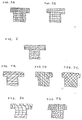
- Figs. 5A and 5B represent different pleat patterns that may be produced in accordance with the present invention.
- Fig. 6 is a further pleat pattern that may be produced in accordance with the present invention.
- Figs. 7A - 7C illustrate additional various directions of pleats that are formed by the process of the present invention.
- Figs. 8A and 8B schematically illustrate yet other types of pleat patterns that may be formed in accordance with the present invention.
- FIG. 1 is a flow chart of the basic steps of the crunch process of the present invention.
- selected cloth is cut into several parts having various shapes and sizes (step 10).
- cloth, or other material is cut to produce a front part 30 and a back part 32, such as shown in FIGS. 2A and 2B.
- the cut parts are sewn together (in step 12) in any manner known, for example, by use of a sewing machine, to produce the unfinished blouse 34, as shown in FIG. 2C.
- the unfinished blouse is pleated between two pieces of paper a first time in step 14 and pleated again a second time in step 16 to produce the finished garment.
- the process of pleating an unfinished garment in accordance with the present invention, (i.e., steps 14 and 16) is discussed in detail below. It is understood that since the processes of cutting and sewing parts together are well known in the art, further description thereof is omitted herein.
- the sewn (unfinished) garment is fed through a pleating device (step 14 of FIG. 1) which imparts a series of parallel folds or pleats in the fabric extending across the width of the fabric.
- FIG 3A is a schematic illustration of the garment having horizontal pleats therein, and it is seen that the horizontal pleats extend along the entire width of the garment.
- This first pleating step may be carried out by any known means.
- the pleated garment then, and in accordance with the present invention, is fed vertically (i.e., in the direction perpendicular to the direction in which the garment previously was fed) through a pleating device, such pleating device being either the same pleating device that made the first set of pleats (but adjusted, as will be understood) or a different pleating device.
- the pleating device imparts a series of non-continuous parallel folds (pleats) in the fabric extending across the length of the fabric.
- the non-continuous pleats include pleated portions and non-pleated portions, ad it can be said that such pleats, while not continuous, extend along the entire length (from top to bottom) of the garment.
- non-continuous pleating is accomplished in a random or pseudo-random manner in which the vertical pleats appear to be randomly formed, such as schematically shown in FIG. 3B.
- a pleating device usually by means of adjacent, and usually equidistantly spaced, pleating rods (or slats or equivalent thereof), forms a series of parallel, uniform pleats, such pleats being formed as the garment is fed through the device.
- each pleat (of the series of pleats) is formed for a particular distance (or length of time, during the process), and then the respective pleat is not formed for a particular length of the garment (or time), then a pleat is formed for a particular length of garment thereafter, and then not formed, and so on.
- the length of material of each pleated part is randomly determined and the length of each non-pleated part thereof also is randomly determined (to be further discussed).
- FIG. 4 is a black and white photograph of a portion of a pleated blouse that was pleated in accordance with the crunch process of the present invention.
- each pleated portion and each non-pleated portion of each vertical, non-continuous pleat is random in length.
- Such random length may be determined by, for example, a computer system (or microcontroller, etc.) that is attached to the pleating device, wherein the computer (by means of appropriate software) randomly selects the length of each pleated and non-pleated section of each vertical pleat and, thereafter, controls the pleating device to pleat or not pleat the garment accordingly.
- the computer by means of appropriate software
- selected pleating members are controlled to pleat the fabric while other pleating members are controlled to not pleat the fabric at each given instance in time.
- the pleating process of the present invention also may produce vertical, non-continuous pleats that are comprised of pleated sections and non-pleated sections of pseudo-random length.
- a non-intelligent mechanical device such as a "keyed" rotating wheel or roller which has a number of tracks thereon, each track corresponding to a respective vertical, non-continuous pleat to be formed.
- indentations, pins, recessed portions, etc. on each track provide the pseudo-random length of the pleated and non-pleated portions of the respective non-continuous pleat.
- this construction is merely one example of how pleated and non-pleated portions are established to have pseudo-random lengths. Therefore, it should be understood that the exact nature of the pleating device used in carrying out the invention disclosed herein is not important so long as the device or method used produces random or random-like pleats in the fabric.
- FIGS. 5A and 5B disclose alternative pleat patterns that may be formed by the process of the present invention.
- FIG. 5A discloses a pleat pattern having continuous horizontal pleats and non-continuous, vertical pleats, wherein each vertical pleat includes pleated portions of the same random length, and non-pleated portions of the same random length. That is, the lengths of the pleated and non-pleated portions are the same throughout a given vertical pleat, but are different with respect to lengths of the pleated and non-pleated parts of the other (e.g., adjacent) vertical pleats.
- FIG. 5A discloses a pleat pattern having continuous horizontal pleats and non-continuous, vertical pleats, wherein each vertical pleat includes pleated portions of the same random length, and non-pleated portions of the same random length. That is, the lengths of the pleated and non-pleated portions are the same throughout a given vertical pleat, but are different with respect to lengths of the pleated and non-pleated parts of the other (e.g
- each of the pleated portions and non-pleated portions of a given vertical pleat is of random length, and the lengths of the pleated and non-pleated portions of all of the other vertical pleats are of the same length as the corresponding pleated and non-pleated portions in said given vertical pleat.
- the process of the present invention may provide for the random selection of the pleated portions only, thus providing non-pleated portions of each non-continuous pleat to be of pre-determined length.
- the horizontal pleats are non-continuous and randomly or "pseudo randomly" formed, while the vertical pleats are "standard” and continuous throughout the length of the garment. This variation of the above discussed process is performed by rotating the garment 90 degrees with respect to the direction of the pleats, as previously discussed.
- the crunch process provides for the random pleating of the garment in both the vertical and horizontal directions.
- each horizontal pleat includes pleated and non-pleated portions of random length and, similarly, each vertical pleat includes pleated and non-pleated portions of random length.
- the vertical and horizontal pleats may be formed in an identical manner, wherein after the garment is pleated a first time, the garment is rotated 90 degrees upon feeding it through the pleating device to form the other set of non-continuous pleats.
- the lengths of the pleated and non-pleated portions of a given vertical or horizontal pleat may be different, or the same, in length, and/or correspond to lengths of pleated and non-pleated portions of other pleats (see, for example, FIGS. 3B, 5A and 5B).
- each of the embodiments discussed above discloses a crunch process which forms horizontal and vertical pleats in a garment.
- the present invention is not limited to pleat patterns with both horizontal and vertical pleats and may provide a pleated garment having only one set of pleats, either in the horizontal or vertical direction, or in another direction, and this one set of pleats includes adjacent pleats with pleated portions and non-pleated portions of random length.
- the two sets of pleats are not perpendicular to one another, such as shown in FIGS. 7A and 7B (non-continuous aspect not shown).
- One set of pleats is either a horizontal pleat (FIG. 7A) or a vertical pleat (FIG. 7B), and the other set of pleats is neither a vertical nor horizontal pleat, but instead is formed in some other direction.
- Such pleats may be formed at a 45 degree angle with respect to the first pleat (as shown), or at any other desired angle (e.g., 20 degrees, 30 degrees, 60 degrees, etc.).
- FIG. 7C illustrates a further variation of this embodiment wherein neither set is a vertical or horizontal pleat.
- the present discussion is directed to the formation of one or two sets of pleats in a garment, the present invention is not limited solely thereto and may be widely applied to the formation of three or more sets of pleats in a garment, wherein at least one of those pleats is formed in a non-continuous, random manner.
Landscapes
- Engineering & Computer Science (AREA)
- Textile Engineering (AREA)
- Treatment Of Fiber Materials (AREA)
Priority Applications (1)
| Application Number | Priority Date | Filing Date | Title |
|---|---|---|---|
| DE29808083U DE29808083U1 (de) | 1997-12-16 | 1998-02-17 | Kleidungsstück mit Plisseefalten |
Applications Claiming Priority (2)
| Application Number | Priority Date | Filing Date | Title |
|---|---|---|---|
| US99171897A | 1997-12-16 | 1997-12-16 | |
| US991718 | 1997-12-16 |
Publications (1)
| Publication Number | Publication Date |
|---|---|
| EP0924332A1 true EP0924332A1 (fr) | 1999-06-23 |
Family
ID=25537489
Family Applications (1)
| Application Number | Title | Priority Date | Filing Date |
|---|---|---|---|
| EP98102731A Ceased EP0924332A1 (fr) | 1997-12-16 | 1998-02-17 | Procédé pour froisser |
Country Status (1)
| Country | Link |
|---|---|
| EP (1) | EP0924332A1 (fr) |
Cited By (4)
| Publication number | Priority date | Publication date | Assignee | Title |
|---|---|---|---|---|
| RU2178028C2 (ru) * | 1999-03-02 | 2002-01-10 | Омский государственный институт сервиса | Способ формирования складок на ткани плательно-костюмного ассортимента |
| WO2004040056A1 (fr) * | 2002-10-31 | 2004-05-13 | Damap S.R.L. | Methode de traitement de vetements de tissu et vetements obtenus au moyen de cette methode |
| CN101967762A (zh) * | 2010-08-19 | 2011-02-09 | 上海印西邺国际贸易有限公司 | 一种缝合网格布的成型方法 |
| WO2018234794A1 (fr) * | 2017-06-20 | 2018-12-27 | Petit Pli Limited | Plissage de vêtement |
Citations (7)
| Publication number | Priority date | Publication date | Assignee | Title |
|---|---|---|---|---|
| US3823452A (en) * | 1972-12-13 | 1974-07-16 | L Harrow | Method of forming pleated fabric |
| DE3118380A1 (de) * | 1981-05-09 | 1982-11-25 | Kurt 6842 Bürstadt Kleber | "verfahren zur herstellung von dauerfixierten faltenmustern in stoffzuschnitten" |
| EP0353167A1 (fr) * | 1988-07-28 | 1990-01-31 | CORBIERE S.A., Société dite: | Procédé pour la réalisation d'étoffes plissées et nouveaux tissus plissés |
| JPH02269866A (ja) * | 1989-04-07 | 1990-11-05 | Miyake Design Jimusho:Kk | プリーツ製品の加工方法 |
| EP0529766A1 (fr) * | 1991-08-22 | 1993-03-03 | Kabushiki Kaisha Miyake Design Jimusho | Procédé pour le plissage de vêtements et vêtements plissés |
| JPH06248571A (ja) * | 1993-02-19 | 1994-09-06 | Miyake Design Jimusho:Kk | プリ−ツ製品の加工方法 |
| JPH083864A (ja) * | 1994-06-09 | 1996-01-09 | Mochida Shoko Kk | プリーツ製品の加工方法 |
-
1998
- 1998-02-17 EP EP98102731A patent/EP0924332A1/fr not_active Ceased
Patent Citations (7)
| Publication number | Priority date | Publication date | Assignee | Title |
|---|---|---|---|---|
| US3823452A (en) * | 1972-12-13 | 1974-07-16 | L Harrow | Method of forming pleated fabric |
| DE3118380A1 (de) * | 1981-05-09 | 1982-11-25 | Kurt 6842 Bürstadt Kleber | "verfahren zur herstellung von dauerfixierten faltenmustern in stoffzuschnitten" |
| EP0353167A1 (fr) * | 1988-07-28 | 1990-01-31 | CORBIERE S.A., Société dite: | Procédé pour la réalisation d'étoffes plissées et nouveaux tissus plissés |
| JPH02269866A (ja) * | 1989-04-07 | 1990-11-05 | Miyake Design Jimusho:Kk | プリーツ製品の加工方法 |
| EP0529766A1 (fr) * | 1991-08-22 | 1993-03-03 | Kabushiki Kaisha Miyake Design Jimusho | Procédé pour le plissage de vêtements et vêtements plissés |
| JPH06248571A (ja) * | 1993-02-19 | 1994-09-06 | Miyake Design Jimusho:Kk | プリ−ツ製品の加工方法 |
| JPH083864A (ja) * | 1994-06-09 | 1996-01-09 | Mochida Shoko Kk | プリーツ製品の加工方法 |
Non-Patent Citations (3)
| Title |
|---|
| PATENT ABSTRACTS OF JAPAN vol. 015, no. 034 (C - 0799) 28 January 1991 (1991-01-28) * |
| PATENT ABSTRACTS OF JAPAN vol. 018, no. 647 (C - 1283) 8 December 1994 (1994-12-08) * |
| PATENT ABSTRACTS OF JAPAN vol. 096, no. 005 31 May 1996 (1996-05-31) * |
Cited By (10)
| Publication number | Priority date | Publication date | Assignee | Title |
|---|---|---|---|---|
| RU2178028C2 (ru) * | 1999-03-02 | 2002-01-10 | Омский государственный институт сервиса | Способ формирования складок на ткани плательно-костюмного ассортимента |
| WO2004040056A1 (fr) * | 2002-10-31 | 2004-05-13 | Damap S.R.L. | Methode de traitement de vetements de tissu et vetements obtenus au moyen de cette methode |
| CN101967762A (zh) * | 2010-08-19 | 2011-02-09 | 上海印西邺国际贸易有限公司 | 一种缝合网格布的成型方法 |
| CN101967762B (zh) * | 2010-08-19 | 2012-02-01 | 上海印西邺国际贸易有限公司 | 一种缝合网格布的成型方法 |
| WO2018234794A1 (fr) * | 2017-06-20 | 2018-12-27 | Petit Pli Limited | Plissage de vêtement |
| GB2566250A (en) * | 2017-06-20 | 2019-03-13 | Petit Pli Ltd | Garment pleating |
| CN111247285A (zh) * | 2017-06-20 | 2020-06-05 | 珀蒂特普利有限公司 | 服装打褶 |
| CN111247285B (zh) * | 2017-06-20 | 2022-05-03 | 珀蒂特普利有限公司 | 服装打褶 |
| US11530511B2 (en) * | 2017-06-20 | 2022-12-20 | Petit Pli Limited | Garment pleating |
| AU2018288004B2 (en) * | 2017-06-20 | 2023-07-20 | Petit Pli Limited | Garment pleating |
Similar Documents
| Publication | Publication Date | Title |
|---|---|---|
| US5175888A (en) | Outerwear garment with display feature | |
| US4244996A (en) | Patchwork fabric configuration and process | |
| EP0924332A1 (fr) | Procédé pour froisser | |
| CN1070236A (zh) | 打褶服装和服装打褶的方法 | |
| CA1108351A (fr) | Articles vestimentaires faits de panneaux assembles en helice | |
| JPS63145461A (ja) | 衣服等に用いられる混成布地の製造方法 | |
| JPS62282068A (ja) | プリ−ツ布地及びその製造方法 | |
| US4067278A (en) | Method of decorating a fabric and the decorated fabric | |
| JP5559919B1 (ja) | 曲線状プリーツ製品および曲線状プリーツ製品の製造方法 | |
| US3525104A (en) | Method of creating design material for making garments and trim | |
| US2030026A (en) | Garment manufacture | |
| US4586198A (en) | Garments employing superimposed, diagonally-oriented panels with folded-back end portions | |
| JPH02269866A (ja) | プリーツ製品の加工方法 | |
| JP3256721B2 (ja) | プリーツを施した布製品の形成方法 | |
| CA2067543C (fr) | Methode destinee a plisser des vetements | |
| JP2504932B2 (ja) | プリ−ツ製品の加工方法 | |
| JP2002115172A (ja) | プリーツを施した布製品 | |
| JP3099360U (ja) | 衣類 | |
| HU221067B1 (hu) | Eljárás zseb készítésére kötött ruházaton | |
| JP2696148B2 (ja) | ニット製品の製造方法 | |
| SU1676579A1 (ru) | Способ изготовлени одежды | |
| JP3101041U (ja) | プリーツスカート及びその型紙 | |
| JP2533455B2 (ja) | 柄模様を有するスカラップカ―テンの製造方法、及び柄模様を有するスカラップカ―テン | |
| PL178683B1 (pl) | Dziany płat odzieży | |
| JP4257136B2 (ja) | プリーツスカート及びその製造方法並びにその型紙 |
Legal Events
| Date | Code | Title | Description |
|---|---|---|---|
| PUAI | Public reference made under article 153(3) epc to a published international application that has entered the european phase |
Free format text: ORIGINAL CODE: 0009012 |
|
| AK | Designated contracting states |
Kind code of ref document: A1 Designated state(s): DE ES FR GB IT PT |
|
| AX | Request for extension of the european patent |
Free format text: AL;LT;LV;MK;RO;SI |
|
| AKX | Designation fees paid |
Free format text: DE ES FR GB IT PT |
|
| STAA | Information on the status of an ep patent application or granted ep patent |
Free format text: STATUS: THE APPLICATION HAS BEEN REFUSED |
|
| 18R | Application refused |
Effective date: 20000120 |