EP0924693A1 - Medium d' enregistrement à performance améliorée pour un élément d' enregistrement comprenant une couche de réflection d' argent - Google Patents
Medium d' enregistrement à performance améliorée pour un élément d' enregistrement comprenant une couche de réflection d' argent Download PDFInfo
- Publication number
- EP0924693A1 EP0924693A1 EP19980204102 EP98204102A EP0924693A1 EP 0924693 A1 EP0924693 A1 EP 0924693A1 EP 19980204102 EP19980204102 EP 19980204102 EP 98204102 A EP98204102 A EP 98204102A EP 0924693 A1 EP0924693 A1 EP 0924693A1
- Authority
- EP
- European Patent Office
- Prior art keywords
- recording layer
- interlayer
- optical disk
- disk
- layer
- Prior art date
- Legal status (The legal status is an assumption and is not a legal conclusion. Google has not performed a legal analysis and makes no representation as to the accuracy of the status listed.)
- Withdrawn
Links
- BQCADISMDOOEFD-UHFFFAOYSA-N Silver Chemical compound [Ag] BQCADISMDOOEFD-UHFFFAOYSA-N 0.000 title description 18
- 229910052709 silver Inorganic materials 0.000 title description 12
- 239000004332 silver Substances 0.000 title description 12
- 238000010438 heat treatment Methods 0.000 claims abstract description 29
- 230000003287 optical effect Effects 0.000 claims abstract description 20
- 239000000758 substrate Substances 0.000 claims abstract description 20
- 238000002310 reflectometry Methods 0.000 claims abstract description 18
- 239000010410 layer Substances 0.000 claims description 69
- 239000011229 interlayer Substances 0.000 claims description 33
- 239000000463 material Substances 0.000 claims description 25
- 239000000975 dye Substances 0.000 claims description 14
- 229910052737 gold Inorganic materials 0.000 claims description 13
- 229910052751 metal Inorganic materials 0.000 claims description 12
- 239000002184 metal Substances 0.000 claims description 12
- 229910052763 palladium Inorganic materials 0.000 claims description 10
- 229910052759 nickel Inorganic materials 0.000 claims description 8
- 229910045601 alloy Inorganic materials 0.000 claims description 5
- 239000000956 alloy Substances 0.000 claims description 5
- 229910052718 tin Inorganic materials 0.000 claims description 5
- 229910052732 germanium Inorganic materials 0.000 claims description 4
- 229910052738 indium Inorganic materials 0.000 claims description 4
- VMGAPWLDMVPYIA-HIDZBRGKSA-N n'-amino-n-iminomethanimidamide Chemical compound N\N=C\N=N VMGAPWLDMVPYIA-HIDZBRGKSA-N 0.000 claims description 3
- 239000001007 phthalocyanine dye Substances 0.000 claims description 3
- BOLDJAUMGUJJKM-LSDHHAIUSA-N renifolin D Natural products CC(=C)[C@@H]1Cc2c(O)c(O)ccc2[C@H]1CC(=O)c3ccc(O)cc3O BOLDJAUMGUJJKM-LSDHHAIUSA-N 0.000 claims description 3
- ANRHNWWPFJCPAZ-UHFFFAOYSA-M thionine Chemical compound [Cl-].C1=CC(N)=CC2=[S+]C3=CC(N)=CC=C3N=C21 ANRHNWWPFJCPAZ-UHFFFAOYSA-M 0.000 claims description 3
- 239000000434 metal complex dye Substances 0.000 claims description 2
- 230000032683 aging Effects 0.000 description 17
- 238000000034 method Methods 0.000 description 16
- 239000010931 gold Substances 0.000 description 14
- 230000006872 improvement Effects 0.000 description 11
- 238000001514 detection method Methods 0.000 description 8
- PCHJSUWPFVWCPO-UHFFFAOYSA-N gold Chemical compound [Au] PCHJSUWPFVWCPO-UHFFFAOYSA-N 0.000 description 8
- 239000004922 lacquer Substances 0.000 description 8
- 238000009826 distribution Methods 0.000 description 5
- 239000004417 polycarbonate Substances 0.000 description 5
- 229920000515 polycarbonate Polymers 0.000 description 5
- 238000001816 cooling Methods 0.000 description 4
- 238000000151 deposition Methods 0.000 description 4
- 230000007774 longterm Effects 0.000 description 4
- 230000000737 periodic effect Effects 0.000 description 4
- 229910007991 Si-N Inorganic materials 0.000 description 3
- 229910006294 Si—N Inorganic materials 0.000 description 3
- 230000007423 decrease Effects 0.000 description 3
- 150000002739 metals Chemical class 0.000 description 3
- 230000004048 modification Effects 0.000 description 3
- 238000012986 modification Methods 0.000 description 3
- 230000001681 protective effect Effects 0.000 description 3
- 239000011241 protective layer Substances 0.000 description 3
- 229910001316 Ag alloy Inorganic materials 0.000 description 2
- XKRFYHLGVUSROY-UHFFFAOYSA-N Argon Chemical compound [Ar] XKRFYHLGVUSROY-UHFFFAOYSA-N 0.000 description 2
- 230000010748 Photoabsorption Effects 0.000 description 2
- 239000012298 atmosphere Substances 0.000 description 2
- 230000008901 benefit Effects 0.000 description 2
- 230000008859 change Effects 0.000 description 2
- 229910052802 copper Inorganic materials 0.000 description 2
- 239000010949 copper Substances 0.000 description 2
- 238000000354 decomposition reaction Methods 0.000 description 2
- 230000003993 interaction Effects 0.000 description 2
- 239000000203 mixture Substances 0.000 description 2
- 102220054627 rs45495192 Human genes 0.000 description 2
- 238000004528 spin coating Methods 0.000 description 2
- 239000010409 thin film Substances 0.000 description 2
- 230000007704 transition Effects 0.000 description 2
- 229910017937 Ag-Ni Inorganic materials 0.000 description 1
- 229910017944 Ag—Cu Inorganic materials 0.000 description 1
- 229910017984 Ag—Ni Inorganic materials 0.000 description 1
- 229930091051 Arenine Natural products 0.000 description 1
- 229910001020 Au alloy Inorganic materials 0.000 description 1
- RYGMFSIKBFXOCR-UHFFFAOYSA-N Copper Chemical compound [Cu] RYGMFSIKBFXOCR-UHFFFAOYSA-N 0.000 description 1
- 238000007792 addition Methods 0.000 description 1
- 238000005275 alloying Methods 0.000 description 1
- 229910052782 aluminium Inorganic materials 0.000 description 1
- XAGFODPZIPBFFR-UHFFFAOYSA-N aluminium Chemical compound [Al] XAGFODPZIPBFFR-UHFFFAOYSA-N 0.000 description 1
- 229910052786 argon Inorganic materials 0.000 description 1
- 239000012300 argon atmosphere Substances 0.000 description 1
- QVGXLLKOCUKJST-UHFFFAOYSA-N atomic oxygen Chemical compound [O] QVGXLLKOCUKJST-UHFFFAOYSA-N 0.000 description 1
- 230000015556 catabolic process Effects 0.000 description 1
- 229910052804 chromium Inorganic materials 0.000 description 1
- 238000005260 corrosion Methods 0.000 description 1
- 230000007797 corrosion Effects 0.000 description 1
- 238000006731 degradation reaction Methods 0.000 description 1
- 230000008021 deposition Effects 0.000 description 1
- 239000003989 dielectric material Substances 0.000 description 1
- 230000007613 environmental effect Effects 0.000 description 1
- 239000010408 film Substances 0.000 description 1
- 239000007789 gas Substances 0.000 description 1
- 230000009477 glass transition Effects 0.000 description 1
- 239000003353 gold alloy Substances 0.000 description 1
- 238000011534 incubation Methods 0.000 description 1
- 238000004519 manufacturing process Methods 0.000 description 1
- 239000012299 nitrogen atmosphere Substances 0.000 description 1
- 229910000510 noble metal Inorganic materials 0.000 description 1
- 230000003647 oxidation Effects 0.000 description 1
- 238000007254 oxidation reaction Methods 0.000 description 1
- 229910052760 oxygen Inorganic materials 0.000 description 1
- 239000001301 oxygen Substances 0.000 description 1
- 239000004033 plastic Substances 0.000 description 1
- 230000008569 process Effects 0.000 description 1
- 238000004544 sputter deposition Methods 0.000 description 1
- 238000003860 storage Methods 0.000 description 1
Images


Classifications
-
- G—PHYSICS
- G11—INFORMATION STORAGE
- G11B—INFORMATION STORAGE BASED ON RELATIVE MOVEMENT BETWEEN RECORD CARRIER AND TRANSDUCER
- G11B7/00—Recording or reproducing by optical means, e.g. recording using a thermal beam of optical radiation by modifying optical properties or the physical structure, reproducing using an optical beam at lower power by sensing optical properties; Record carriers therefor
- G11B7/24—Record carriers characterised by shape, structure or physical properties, or by the selection of the material
- G11B7/241—Record carriers characterised by shape, structure or physical properties, or by the selection of the material characterised by the selection of the material
- G11B7/252—Record carriers characterised by shape, structure or physical properties, or by the selection of the material characterised by the selection of the material of layers other than recording layers
- G11B7/258—Record carriers characterised by shape, structure or physical properties, or by the selection of the material characterised by the selection of the material of layers other than recording layers of reflective layers
- G11B7/259—Record carriers characterised by shape, structure or physical properties, or by the selection of the material characterised by the selection of the material of layers other than recording layers of reflective layers based on silver
-
- G—PHYSICS
- G11—INFORMATION STORAGE
- G11B—INFORMATION STORAGE BASED ON RELATIVE MOVEMENT BETWEEN RECORD CARRIER AND TRANSDUCER
- G11B7/00—Recording or reproducing by optical means, e.g. recording using a thermal beam of optical radiation by modifying optical properties or the physical structure, reproducing using an optical beam at lower power by sensing optical properties; Record carriers therefor
- G11B7/24—Record carriers characterised by shape, structure or physical properties, or by the selection of the material
- G11B7/241—Record carriers characterised by shape, structure or physical properties, or by the selection of the material characterised by the selection of the material
- G11B7/242—Record carriers characterised by shape, structure or physical properties, or by the selection of the material characterised by the selection of the material of recording layers
- G11B7/244—Record carriers characterised by shape, structure or physical properties, or by the selection of the material characterised by the selection of the material of recording layers comprising organic materials only
- G11B7/246—Record carriers characterised by shape, structure or physical properties, or by the selection of the material characterised by the selection of the material of recording layers comprising organic materials only containing dyes
-
- G—PHYSICS
- G11—INFORMATION STORAGE
- G11B—INFORMATION STORAGE BASED ON RELATIVE MOVEMENT BETWEEN RECORD CARRIER AND TRANSDUCER
- G11B7/00—Recording or reproducing by optical means, e.g. recording using a thermal beam of optical radiation by modifying optical properties or the physical structure, reproducing using an optical beam at lower power by sensing optical properties; Record carriers therefor
- G11B7/24—Record carriers characterised by shape, structure or physical properties, or by the selection of the material
- G11B7/241—Record carriers characterised by shape, structure or physical properties, or by the selection of the material characterised by the selection of the material
- G11B7/252—Record carriers characterised by shape, structure or physical properties, or by the selection of the material characterised by the selection of the material of layers other than recording layers
- G11B7/257—Record carriers characterised by shape, structure or physical properties, or by the selection of the material characterised by the selection of the material of layers other than recording layers of layers having properties involved in recording or reproduction, e.g. optical interference layers or sensitising layers or dielectric layers, which are protecting the recording layers
- G11B7/2578—Record carriers characterised by shape, structure or physical properties, or by the selection of the material characterised by the selection of the material of layers other than recording layers of layers having properties involved in recording or reproduction, e.g. optical interference layers or sensitising layers or dielectric layers, which are protecting the recording layers consisting essentially of inorganic materials
-
- G—PHYSICS
- G11—INFORMATION STORAGE
- G11B—INFORMATION STORAGE BASED ON RELATIVE MOVEMENT BETWEEN RECORD CARRIER AND TRANSDUCER
- G11B7/00—Recording or reproducing by optical means, e.g. recording using a thermal beam of optical radiation by modifying optical properties or the physical structure, reproducing using an optical beam at lower power by sensing optical properties; Record carriers therefor
- G11B7/24—Record carriers characterised by shape, structure or physical properties, or by the selection of the material
- G11B7/26—Apparatus or processes specially adapted for the manufacture of record carriers
-
- G—PHYSICS
- G11—INFORMATION STORAGE
- G11B—INFORMATION STORAGE BASED ON RELATIVE MOVEMENT BETWEEN RECORD CARRIER AND TRANSDUCER
- G11B7/00—Recording or reproducing by optical means, e.g. recording using a thermal beam of optical radiation by modifying optical properties or the physical structure, reproducing using an optical beam at lower power by sensing optical properties; Record carriers therefor
- G11B7/24—Record carriers characterised by shape, structure or physical properties, or by the selection of the material
- G11B7/241—Record carriers characterised by shape, structure or physical properties, or by the selection of the material characterised by the selection of the material
- G11B7/252—Record carriers characterised by shape, structure or physical properties, or by the selection of the material characterised by the selection of the material of layers other than recording layers
- G11B7/257—Record carriers characterised by shape, structure or physical properties, or by the selection of the material characterised by the selection of the material of layers other than recording layers of layers having properties involved in recording or reproduction, e.g. optical interference layers or sensitising layers or dielectric layers, which are protecting the recording layers
- G11B2007/25705—Record carriers characterised by shape, structure or physical properties, or by the selection of the material characterised by the selection of the material of layers other than recording layers of layers having properties involved in recording or reproduction, e.g. optical interference layers or sensitising layers or dielectric layers, which are protecting the recording layers consisting essentially of inorganic materials
- G11B2007/25706—Record carriers characterised by shape, structure or physical properties, or by the selection of the material characterised by the selection of the material of layers other than recording layers of layers having properties involved in recording or reproduction, e.g. optical interference layers or sensitising layers or dielectric layers, which are protecting the recording layers consisting essentially of inorganic materials containing transition metal elements (Zn, Fe, Co, Ni, Pt)
-
- G—PHYSICS
- G11—INFORMATION STORAGE
- G11B—INFORMATION STORAGE BASED ON RELATIVE MOVEMENT BETWEEN RECORD CARRIER AND TRANSDUCER
- G11B7/00—Recording or reproducing by optical means, e.g. recording using a thermal beam of optical radiation by modifying optical properties or the physical structure, reproducing using an optical beam at lower power by sensing optical properties; Record carriers therefor
- G11B7/24—Record carriers characterised by shape, structure or physical properties, or by the selection of the material
- G11B7/241—Record carriers characterised by shape, structure or physical properties, or by the selection of the material characterised by the selection of the material
- G11B7/252—Record carriers characterised by shape, structure or physical properties, or by the selection of the material characterised by the selection of the material of layers other than recording layers
- G11B7/257—Record carriers characterised by shape, structure or physical properties, or by the selection of the material characterised by the selection of the material of layers other than recording layers of layers having properties involved in recording or reproduction, e.g. optical interference layers or sensitising layers or dielectric layers, which are protecting the recording layers
- G11B2007/25705—Record carriers characterised by shape, structure or physical properties, or by the selection of the material characterised by the selection of the material of layers other than recording layers of layers having properties involved in recording or reproduction, e.g. optical interference layers or sensitising layers or dielectric layers, which are protecting the recording layers consisting essentially of inorganic materials
- G11B2007/25708—Record carriers characterised by shape, structure or physical properties, or by the selection of the material characterised by the selection of the material of layers other than recording layers of layers having properties involved in recording or reproduction, e.g. optical interference layers or sensitising layers or dielectric layers, which are protecting the recording layers consisting essentially of inorganic materials containing group 13 elements (B, Al, Ga)
-
- G—PHYSICS
- G11—INFORMATION STORAGE
- G11B—INFORMATION STORAGE BASED ON RELATIVE MOVEMENT BETWEEN RECORD CARRIER AND TRANSDUCER
- G11B7/00—Recording or reproducing by optical means, e.g. recording using a thermal beam of optical radiation by modifying optical properties or the physical structure, reproducing using an optical beam at lower power by sensing optical properties; Record carriers therefor
- G11B7/24—Record carriers characterised by shape, structure or physical properties, or by the selection of the material
- G11B7/241—Record carriers characterised by shape, structure or physical properties, or by the selection of the material characterised by the selection of the material
- G11B7/252—Record carriers characterised by shape, structure or physical properties, or by the selection of the material characterised by the selection of the material of layers other than recording layers
- G11B7/257—Record carriers characterised by shape, structure or physical properties, or by the selection of the material characterised by the selection of the material of layers other than recording layers of layers having properties involved in recording or reproduction, e.g. optical interference layers or sensitising layers or dielectric layers, which are protecting the recording layers
- G11B2007/25705—Record carriers characterised by shape, structure or physical properties, or by the selection of the material characterised by the selection of the material of layers other than recording layers of layers having properties involved in recording or reproduction, e.g. optical interference layers or sensitising layers or dielectric layers, which are protecting the recording layers consisting essentially of inorganic materials
- G11B2007/2571—Record carriers characterised by shape, structure or physical properties, or by the selection of the material characterised by the selection of the material of layers other than recording layers of layers having properties involved in recording or reproduction, e.g. optical interference layers or sensitising layers or dielectric layers, which are protecting the recording layers consisting essentially of inorganic materials containing group 14 elements except carbon (Si, Ge, Sn, Pb)
-
- G—PHYSICS
- G11—INFORMATION STORAGE
- G11B—INFORMATION STORAGE BASED ON RELATIVE MOVEMENT BETWEEN RECORD CARRIER AND TRANSDUCER
- G11B7/00—Recording or reproducing by optical means, e.g. recording using a thermal beam of optical radiation by modifying optical properties or the physical structure, reproducing using an optical beam at lower power by sensing optical properties; Record carriers therefor
- G11B7/24—Record carriers characterised by shape, structure or physical properties, or by the selection of the material
- G11B7/241—Record carriers characterised by shape, structure or physical properties, or by the selection of the material characterised by the selection of the material
- G11B7/252—Record carriers characterised by shape, structure or physical properties, or by the selection of the material characterised by the selection of the material of layers other than recording layers
- G11B7/257—Record carriers characterised by shape, structure or physical properties, or by the selection of the material characterised by the selection of the material of layers other than recording layers of layers having properties involved in recording or reproduction, e.g. optical interference layers or sensitising layers or dielectric layers, which are protecting the recording layers
- G11B2007/25705—Record carriers characterised by shape, structure or physical properties, or by the selection of the material characterised by the selection of the material of layers other than recording layers of layers having properties involved in recording or reproduction, e.g. optical interference layers or sensitising layers or dielectric layers, which are protecting the recording layers consisting essentially of inorganic materials
- G11B2007/25711—Record carriers characterised by shape, structure or physical properties, or by the selection of the material characterised by the selection of the material of layers other than recording layers of layers having properties involved in recording or reproduction, e.g. optical interference layers or sensitising layers or dielectric layers, which are protecting the recording layers consisting essentially of inorganic materials containing carbon
-
- G—PHYSICS
- G11—INFORMATION STORAGE
- G11B—INFORMATION STORAGE BASED ON RELATIVE MOVEMENT BETWEEN RECORD CARRIER AND TRANSDUCER
- G11B7/00—Recording or reproducing by optical means, e.g. recording using a thermal beam of optical radiation by modifying optical properties or the physical structure, reproducing using an optical beam at lower power by sensing optical properties; Record carriers therefor
- G11B7/24—Record carriers characterised by shape, structure or physical properties, or by the selection of the material
- G11B7/241—Record carriers characterised by shape, structure or physical properties, or by the selection of the material characterised by the selection of the material
- G11B7/252—Record carriers characterised by shape, structure or physical properties, or by the selection of the material characterised by the selection of the material of layers other than recording layers
- G11B7/257—Record carriers characterised by shape, structure or physical properties, or by the selection of the material characterised by the selection of the material of layers other than recording layers of layers having properties involved in recording or reproduction, e.g. optical interference layers or sensitising layers or dielectric layers, which are protecting the recording layers
- G11B2007/25705—Record carriers characterised by shape, structure or physical properties, or by the selection of the material characterised by the selection of the material of layers other than recording layers of layers having properties involved in recording or reproduction, e.g. optical interference layers or sensitising layers or dielectric layers, which are protecting the recording layers consisting essentially of inorganic materials
- G11B2007/25713—Record carriers characterised by shape, structure or physical properties, or by the selection of the material characterised by the selection of the material of layers other than recording layers of layers having properties involved in recording or reproduction, e.g. optical interference layers or sensitising layers or dielectric layers, which are protecting the recording layers consisting essentially of inorganic materials containing nitrogen
-
- G—PHYSICS
- G11—INFORMATION STORAGE
- G11B—INFORMATION STORAGE BASED ON RELATIVE MOVEMENT BETWEEN RECORD CARRIER AND TRANSDUCER
- G11B7/00—Recording or reproducing by optical means, e.g. recording using a thermal beam of optical radiation by modifying optical properties or the physical structure, reproducing using an optical beam at lower power by sensing optical properties; Record carriers therefor
- G11B7/24—Record carriers characterised by shape, structure or physical properties, or by the selection of the material
- G11B7/241—Record carriers characterised by shape, structure or physical properties, or by the selection of the material characterised by the selection of the material
- G11B7/242—Record carriers characterised by shape, structure or physical properties, or by the selection of the material characterised by the selection of the material of recording layers
- G11B7/244—Record carriers characterised by shape, structure or physical properties, or by the selection of the material characterised by the selection of the material of recording layers comprising organic materials only
- G11B7/246—Record carriers characterised by shape, structure or physical properties, or by the selection of the material characterised by the selection of the material of recording layers comprising organic materials only containing dyes
- G11B7/2467—Record carriers characterised by shape, structure or physical properties, or by the selection of the material characterised by the selection of the material of recording layers comprising organic materials only containing dyes azo-dyes
-
- G—PHYSICS
- G11—INFORMATION STORAGE
- G11B—INFORMATION STORAGE BASED ON RELATIVE MOVEMENT BETWEEN RECORD CARRIER AND TRANSDUCER
- G11B7/00—Recording or reproducing by optical means, e.g. recording using a thermal beam of optical radiation by modifying optical properties or the physical structure, reproducing using an optical beam at lower power by sensing optical properties; Record carriers therefor
- G11B7/24—Record carriers characterised by shape, structure or physical properties, or by the selection of the material
- G11B7/241—Record carriers characterised by shape, structure or physical properties, or by the selection of the material characterised by the selection of the material
- G11B7/242—Record carriers characterised by shape, structure or physical properties, or by the selection of the material characterised by the selection of the material of recording layers
- G11B7/244—Record carriers characterised by shape, structure or physical properties, or by the selection of the material characterised by the selection of the material of recording layers comprising organic materials only
- G11B7/246—Record carriers characterised by shape, structure or physical properties, or by the selection of the material characterised by the selection of the material of recording layers comprising organic materials only containing dyes
- G11B7/247—Record carriers characterised by shape, structure or physical properties, or by the selection of the material characterised by the selection of the material of recording layers comprising organic materials only containing dyes methine or polymethine dyes
- G11B7/2472—Record carriers characterised by shape, structure or physical properties, or by the selection of the material characterised by the selection of the material of recording layers comprising organic materials only containing dyes methine or polymethine dyes cyanine
-
- G—PHYSICS
- G11—INFORMATION STORAGE
- G11B—INFORMATION STORAGE BASED ON RELATIVE MOVEMENT BETWEEN RECORD CARRIER AND TRANSDUCER
- G11B7/00—Recording or reproducing by optical means, e.g. recording using a thermal beam of optical radiation by modifying optical properties or the physical structure, reproducing using an optical beam at lower power by sensing optical properties; Record carriers therefor
- G11B7/24—Record carriers characterised by shape, structure or physical properties, or by the selection of the material
- G11B7/241—Record carriers characterised by shape, structure or physical properties, or by the selection of the material characterised by the selection of the material
- G11B7/242—Record carriers characterised by shape, structure or physical properties, or by the selection of the material characterised by the selection of the material of recording layers
- G11B7/244—Record carriers characterised by shape, structure or physical properties, or by the selection of the material characterised by the selection of the material of recording layers comprising organic materials only
- G11B7/246—Record carriers characterised by shape, structure or physical properties, or by the selection of the material characterised by the selection of the material of recording layers comprising organic materials only containing dyes
- G11B7/248—Record carriers characterised by shape, structure or physical properties, or by the selection of the material characterised by the selection of the material of recording layers comprising organic materials only containing dyes porphines; azaporphines, e.g. phthalocyanines
-
- G—PHYSICS
- G11—INFORMATION STORAGE
- G11B—INFORMATION STORAGE BASED ON RELATIVE MOVEMENT BETWEEN RECORD CARRIER AND TRANSDUCER
- G11B7/00—Recording or reproducing by optical means, e.g. recording using a thermal beam of optical radiation by modifying optical properties or the physical structure, reproducing using an optical beam at lower power by sensing optical properties; Record carriers therefor
- G11B7/24—Record carriers characterised by shape, structure or physical properties, or by the selection of the material
- G11B7/241—Record carriers characterised by shape, structure or physical properties, or by the selection of the material characterised by the selection of the material
- G11B7/242—Record carriers characterised by shape, structure or physical properties, or by the selection of the material characterised by the selection of the material of recording layers
- G11B7/244—Record carriers characterised by shape, structure or physical properties, or by the selection of the material characterised by the selection of the material of recording layers comprising organic materials only
- G11B7/249—Record carriers characterised by shape, structure or physical properties, or by the selection of the material characterised by the selection of the material of recording layers comprising organic materials only containing organometallic compounds
-
- G—PHYSICS
- G11—INFORMATION STORAGE
- G11B—INFORMATION STORAGE BASED ON RELATIVE MOVEMENT BETWEEN RECORD CARRIER AND TRANSDUCER
- G11B7/00—Recording or reproducing by optical means, e.g. recording using a thermal beam of optical radiation by modifying optical properties or the physical structure, reproducing using an optical beam at lower power by sensing optical properties; Record carriers therefor
- G11B7/24—Record carriers characterised by shape, structure or physical properties, or by the selection of the material
- G11B7/241—Record carriers characterised by shape, structure or physical properties, or by the selection of the material characterised by the selection of the material
- G11B7/252—Record carriers characterised by shape, structure or physical properties, or by the selection of the material characterised by the selection of the material of layers other than recording layers
- G11B7/253—Record carriers characterised by shape, structure or physical properties, or by the selection of the material characterised by the selection of the material of layers other than recording layers of substrates
- G11B7/2533—Record carriers characterised by shape, structure or physical properties, or by the selection of the material characterised by the selection of the material of layers other than recording layers of substrates comprising resins
- G11B7/2534—Record carriers characterised by shape, structure or physical properties, or by the selection of the material characterised by the selection of the material of layers other than recording layers of substrates comprising resins polycarbonates [PC]
-
- G—PHYSICS
- G11—INFORMATION STORAGE
- G11B—INFORMATION STORAGE BASED ON RELATIVE MOVEMENT BETWEEN RECORD CARRIER AND TRANSDUCER
- G11B7/00—Recording or reproducing by optical means, e.g. recording using a thermal beam of optical radiation by modifying optical properties or the physical structure, reproducing using an optical beam at lower power by sensing optical properties; Record carriers therefor
- G11B7/24—Record carriers characterised by shape, structure or physical properties, or by the selection of the material
- G11B7/241—Record carriers characterised by shape, structure or physical properties, or by the selection of the material characterised by the selection of the material
- G11B7/252—Record carriers characterised by shape, structure or physical properties, or by the selection of the material characterised by the selection of the material of layers other than recording layers
- G11B7/254—Record carriers characterised by shape, structure or physical properties, or by the selection of the material characterised by the selection of the material of layers other than recording layers of protective topcoat layers
- G11B7/2542—Record carriers characterised by shape, structure or physical properties, or by the selection of the material characterised by the selection of the material of layers other than recording layers of protective topcoat layers consisting essentially of organic resins
-
- Y—GENERAL TAGGING OF NEW TECHNOLOGICAL DEVELOPMENTS; GENERAL TAGGING OF CROSS-SECTIONAL TECHNOLOGIES SPANNING OVER SEVERAL SECTIONS OF THE IPC; TECHNICAL SUBJECTS COVERED BY FORMER USPC CROSS-REFERENCE ART COLLECTIONS [XRACs] AND DIGESTS
- Y10—TECHNICAL SUBJECTS COVERED BY FORMER USPC
- Y10S—TECHNICAL SUBJECTS COVERED BY FORMER USPC CROSS-REFERENCE ART COLLECTIONS [XRACs] AND DIGESTS
- Y10S428/00—Stock material or miscellaneous articles
- Y10S428/913—Material designed to be responsive to temperature, light, moisture
-
- Y—GENERAL TAGGING OF NEW TECHNOLOGICAL DEVELOPMENTS; GENERAL TAGGING OF CROSS-SECTIONAL TECHNOLOGIES SPANNING OVER SEVERAL SECTIONS OF THE IPC; TECHNICAL SUBJECTS COVERED BY FORMER USPC CROSS-REFERENCE ART COLLECTIONS [XRACs] AND DIGESTS
- Y10—TECHNICAL SUBJECTS COVERED BY FORMER USPC
- Y10S—TECHNICAL SUBJECTS COVERED BY FORMER USPC CROSS-REFERENCE ART COLLECTIONS [XRACs] AND DIGESTS
- Y10S430/00—Radiation imagery chemistry: process, composition, or product thereof
- Y10S430/146—Laser beam
-
- Y—GENERAL TAGGING OF NEW TECHNOLOGICAL DEVELOPMENTS; GENERAL TAGGING OF CROSS-SECTIONAL TECHNOLOGIES SPANNING OVER SEVERAL SECTIONS OF THE IPC; TECHNICAL SUBJECTS COVERED BY FORMER USPC CROSS-REFERENCE ART COLLECTIONS [XRACs] AND DIGESTS
- Y10—TECHNICAL SUBJECTS COVERED BY FORMER USPC
- Y10T—TECHNICAL SUBJECTS COVERED BY FORMER US CLASSIFICATION
- Y10T428/00—Stock material or miscellaneous articles
- Y10T428/21—Circular sheet or circular blank
-
- Y—GENERAL TAGGING OF NEW TECHNOLOGICAL DEVELOPMENTS; GENERAL TAGGING OF CROSS-SECTIONAL TECHNOLOGIES SPANNING OVER SEVERAL SECTIONS OF THE IPC; TECHNICAL SUBJECTS COVERED BY FORMER USPC CROSS-REFERENCE ART COLLECTIONS [XRACs] AND DIGESTS
- Y10—TECHNICAL SUBJECTS COVERED BY FORMER USPC
- Y10T—TECHNICAL SUBJECTS COVERED BY FORMER US CLASSIFICATION
- Y10T428/00—Stock material or miscellaneous articles
- Y10T428/31504—Composite [nonstructural laminate]
- Y10T428/31678—Of metal
Definitions
- the present invention relates to optical recording elements and methods of forming such elements with improved performance.
- Optical disks are becoming more and more prevalent for the use of recording information.
- One form of optical recording disks is called a CD-R or a recordable compact disk.
- the Photo CD is an example of this CD-R media.
- this type of disk has a transparent substrate, a recording layer formed on a substrate, and a reflective layer on the recording layer.
- the recording layer is essentially a photo absorption material made of mixture of some organic dye materials and is formed by spin coating.
- the recording materials used for CD-R applications have been described in US-A-4,940,618; US-A-5,604,004; US-A-5,294,471; European Patent Application 0353393; and Canadian Patent 2,005,520. Commercial useful materials of the type described in these references have stringent requirements.
- the Photo CD Since the Photo CD is a consumer product, it must be capable of withstanding extreme environment.
- the stability of the disk mainly depends on the nature of the recording layer and the reflector layer and their mutual interaction; and the protective overcoat.
- the above applications disclose phthalocyanine dye, metallized formazan dye and cyanine dye having excellent light stability.
- the reflecting layer is usually selected to be gold or a gold alloy because of its nobleness and high reflectivity.
- the CD-R specifications require that it has a high reflectivity of more than 60% similar to the compact disks.
- writing laser light passes through the plastic substrate and is focused on the dye recording layer which is heated to the decomposition temperature of the dye material. While the surface of the substrate is also heated to near the glass transition temperature of the substrate material. Then a small part of the dye material is decomposed and decomposition gas is generated in the photo-absorption layer. It causes the deformation of the recording layer as well as the dye/substrate interface. In those areas having the deformations or pits, the reflectivity is lower than in those areas not having the deformation which has passed through the recording layer is reflected back by the reflective layer and further enhances the process of forming the mark. Marks are formed either as a pit or as a change in the optical properties of the recording layer. In any event, the combination of some or all of these changes forms marks which can then be read back by the focused read laser beam.
- the record thus consists of marks of relatively low reflectivity on a background of relatively high reflectivity in relation to the read beam.
- Thin layer of gold is normally used as a main reflection material in the reflective layer. It is a noble metal with a very high stability and does not introduce problems into the recording stability. When other metals which have a high reflectivity such as aluminum, silver and copper are used instead of gold, they have a problem in that they are reactive and can form oxides or other corrosive layers. The recording stability of these types of disks varies over time and degrades. However, materials such as silver are much less expensive than gold, and it would be highly desirable to use them. Also silver reflector has about 5-7% higher reflectivity than gold.
- Jitter of a recorded feature is related to its ability of being detected without error during read back. Transitions from nominally identical recorded feature will not be read back precisely at the same time because of the slight variation in feature length and shape and system noise. This gives rise to a spread in detection time. A detection time window can read all these features if the distribution is so narrow as to lie completely within the time window. On the other hand, if the distribution is broad such that some of the transitions occur outside the window, they will result in a decoding error. Jitter is a measure of the overall noise and is the square root of the variance of the distribution of detection time commonly modeled as a Gaussian curve. The distribution of detection time may not be exactly centered in the timing window which will increase the probability of a decoding error even for a narrow distribution.
- the window margin is a derived parameter involving jitters and peak shifts of all recorded features.
- the WM can be viewed as a figure of merit in that the discs with higher Wm has a greater probability of successful read back than the one with lower Wm. Also the disc with higher WM is expected to be read back by a wider variety of readers than the one with lower WM that is otherwise similar.
- the media produced in accordance with the present invention have improved performance in, window margin, jitter, nonlinearity and reflectivity.
- the disk prepared according to the present invention has improved data stability.
- Silver metal is relatively inexpensive than gold and the disk can be manufactured at a substantially reduced cost.
- FIG. 1 is a structure of a writable storage disk made in accordance with the invention. It includes a substrate 10 which is made of polycarbonate and a dye recording layer 20. The recording layer is deposited using a spin coating technique. On the recording layer 20 is provided a reflecting layer 30 which is formed of silver. The thickness of the reflecting layer generally is between 60 to 80 nm.
- FIG. 2 is a structure similar to FIG. 1 but it has additional layer between the dye recording layer and the silver metal reflector of a metallic interlayer 25 consisting Pd, Au, Ni and Sn or a transparent dielectric interlayer consisting of Ge-C-H, Si-N and InSnSb-O and alloys.
- Thin films of silver reflector and other metals were deposited by sputter deposition using DC magnetron gun and metal targets in an argon atmosphere.
- Thin films of Ge-C-H were deposited by sputter depositing Ge target in Ar and CH 4 atmosphere and Si-N films were prepared by sputter depositing Si target in Ar and N 2 atmosphere.
- InSnSb-O were prepared by sputter depositing InSnSb target in an atmosphere with a mixtures of argon and oxygen. Then the UV-curable lacquer overcoat was spin coated on the reflecting layer.
- These disks were tested for reflectivity (R top ), window margin (WM), jitters and other relevant parameters using Kodak PCD 600 6X writer/reader at 2.4 m/sec.
- R top is reflectivity measured by PCD-600 as the reflectivity of the unwritten land.
- R top is substantially lower than the true reflectivity because of birefringence, groove structure of the disk and the influence of the neighboring marks and tracks
- Heat treatment can be accomplished by any number of well known techniques. For example, a plurality of discs can be mounted on a spindle, and that spindle and discs can be placed in an air oven. The temperature of the air oven is preselected and the discs are heat treated for a predetermined period of time. Thereafter, the spindle and discs are removed from the oven and are cooled in air until they reach room temperature. Benefits are generally improved at more elevated temperatures and longer periods of time. For example, it has been found that, at temperature of 70°C or greater for time periods of 6 hours or more, significant improvements are made. The temperature and the time of heat treating are limited by the plasterizing of polycarbonate substrates so that the geometry of the disc and the groove structure in the disc, are not significantly altered.
- the discs were tested using an automated tester including a Kodak PCD 600 writer/reader.
- the recording and read back were performed at the constant linear velocity of 2.4 m/s.
- the following parameters were determined: reflectivity (R top ), optimum recording power (ORP), written contrasts; and nonlinearity NL (maximum difference of peak shifts among all features) Wm and jitter.
- R top reflectivity
- ORP optimum recording power
- Wm and jitter nonlinearity NL (maximum difference of peak shifts among all features) Wm and jitter.
- the CD recording scheme there are 18 features - nine of them are made by laser exposures and are called marks and the rest nine are features created by not exposing to laser beam and are called lands. Their exposure times are expressed in multiples of detection window width (115.7 ns).
- the 3T, 4T, 5T ??.11T marks are made by exposing to laser beam for 3 detection widths, 4 detection widths, 5 detection widths, and so on.
- the marks are correspondingly designated as 3M, 4M, 5M....11M with 3M being the smallest and 11M being the largest of the marks.
- S3M, S4M, etc. are the jitters of the corresponding marks.
- S3L, S4L, etc. are the jitters of the corresponding lands between marks.
- the contrasts (C 3 and C 11 ) and jitters (S3M, S11M and S3L, S11L) presented in the examples are of the smallest and largest features.
- the above control disk then was subjected to treatment consisting of heating to 85°C in air oven for 16 hours followed by normal cooling in air.
- the disk performance was then determined by writing a new band adjacent to original band.
- the disk performance after the heat treatment is included in column 3 of the Table 1.
- the improvement in disk performance is a function of heating temperature and time. Longer time is required if the heat treatment is done at a low temperature, while shorter time is required if the heat treatment is done at high temperature.
- the temperature and the time of heat treating are limited by the plasterizing of polycarbonate substrates so that the geometry of the disc and the groove structure in the disc, are not significantly altered.
- Heat temperatures can be selected from 50° to 120°C and the time of treatment can vary from 1 to 24 hours.
- FIG. 3 shows the improvement in the window margin of the disks as a function of heating temperature. These disks were subjected to heating at respective temperatures for 16 hours in dry air oven. It is evident that because of the heat treatment there occur significant improvements window margin. Similarly, improvement in R top , contrasts , NL, and jitters were observed.
- FIG. 4 shows comparison of jitter of a disk before and after heat treatment.
- the performance of the disk was measured just after the deposition.
- the jitters of mark and land are shown in FIG. 4.
- the performance of this disks was then determined by writing/reading another band adjacent to original band.
- the jitters of this heat treated disk are included in FIG. 4. It is clear that because of the modification effected by the present invention there occurs significant decrease in the jitters of mark and land.
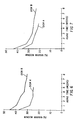
- FIG. 5 shows the window margin as a function of accelerated aging time for four disks, A, B, C, and D using Ag reflector.
- Disk A is a control disk which did not undergo heat treatment.
- Disks B, C and D were subjected to a treatment consisting of heating at 70°, 85° and 95° C, respectively, in air ovens for 16 hours followed by normal cooling in air. These disks then were subjected to accelerated aging test at 80° C/85% RH and their performance was measured after periodic intervals. The data for all disks are shown in FIG. 5. It shows that disks B, C, and D have much improved stability as compared to disk A. Thus recording elements made in accordance with the present invention have significantly superior data stability than the control disk.
- FIG. 6 shows the window margin as a function of accelerated aging time for two disks A and B using Ag reflector and 0.5 nm Pd interlayer. Disk A is control disk which did not go any treatment.
- Disk B is similar in structure as of Disk A but was subjected to a treatment consisting of heating at 85°C, in air ovens for 24 hours followed by normal cooling in air. Both disks A and B then were subjected to accelerating aging tests at 80° C/85% RH and performance was measured after periodic intervals. As seen from FIG. 6, at the zero aging time, it is clear that because of the modification effected by the present invention there occur significant improvements in Wm. Similarly the WM of the heat treated disk B is significantly higher than that of control disk A, for an accelerated aging time of six weeks, indicating that disks B has much improved stability as compared to disk A. Thus, recording elements made in accordance with the present invention have significantly superior stability than the control disk.
- FIG. 7 shows the WM as a function of accelerated aging time for two disks using 3 nm Sn interlayer.
- Disk A is a control disk and disk B was subjected to a heat treatment for 16 hours at 85° C. After measuring their performance, both disks A and B then were subjected to accelerating aging tests at 80° C/85% RH and performance was measured after periodic intervals. Again disk B shows much higher recording stability than the disk A.
- the recording elements made in accordance with the present invention have significantly superior performance with respect to WM, R top , NL, and jitters, and much improved recording stability.
- stable alloys of silver metal reflector such as Ag-Pd, Ag-Cu, and Ag-Ni can be used instead of pure silver.
- the alloying additions of 2-5% Pd, Cu, or Ni into Ag metal were found to increase the environmental stability of the silver reflector.
- stability of the disk structure can further be improved by protecting silver metal or silver alloys from corrosion/oxidation using a thin protective layer of metal, such as Pd, Cr, Ni etc. or a thin layer of dielectric, such as Ge-C-H, Si-N and InSnSb-O on the reflector layer before overcoating the disk with an UV-curable lacquer.
- the optical disk further including an overcoat UV curable lacquer protective layer.
- the optical disk further including a dielectric overcoat layer on the reflective layer to protect the reflective layer and an overcoat UV curable lacquer layer on the dielectric overcoat layer.
- the optical disk wherein the substrate includes a polycarbonate material.
- a method of making an optical disk comprising the steps of:
- the method further providing an interlayer on the recording layer and the reflecting layer on the interlayer.
- the interlayer is a thin metallic interlayer formed on the recording layer at the interface between the reflective layer and the recording layer wherein the thin metal interlayer includes materials selected from the group consisting of Pd, Ni, Sn, Au, In, Te, Si, Ge, and alloys thereof.
- the thin metal interlayer includes materials selected from the group consisting of Pd, Ni, and Au.
- the thin metal interlayer is Pd, Ni, Sn, In, Te, Si, Ge, or alloys thereof in a range between 0.2 nm to 3 nm and when it is Au, it is a range of 0.2 nm to 30 nm.
- the interlayer is a thin metallic interlayer which includes materials selected from the group includes Au formed on the recording layer at the interface between the reflective layer and the recording layer and selected to have a thickness in a range between 0.2 nm to 30 nm.
- the recording layer includes a photosensitive material selected so as to form a mark when illuminated by laser light at a particular wavelength.
- the photosensitive material is a phthalocyanine dye.
- the method further including an overcoat UV curable lacquer protective layer.
- the method further including a dielectric overcoat layer on the reflective layer to protect the reflective layer and an overcoat UV curable lacquer layer on the dielectric overcoat layer.
- the substrate includes a polycarbonate material.
Landscapes
- Chemical & Material Sciences (AREA)
- Inorganic Chemistry (AREA)
- Engineering & Computer Science (AREA)
- Manufacturing & Machinery (AREA)
- Optical Record Carriers And Manufacture Thereof (AREA)
- Thermal Transfer Or Thermal Recording In General (AREA)
- Manufacturing Optical Record Carriers (AREA)
Applications Claiming Priority (2)
| Application Number | Priority Date | Filing Date | Title |
|---|---|---|---|
| US991028 | 1992-12-15 | ||
| US08/991,028 US6007887A (en) | 1997-12-15 | 1997-12-15 | Performance recording media for recordable element using silver reflector |
Publications (1)
| Publication Number | Publication Date |
|---|---|
| EP0924693A1 true EP0924693A1 (fr) | 1999-06-23 |
Family
ID=25536775
Family Applications (1)
| Application Number | Title | Priority Date | Filing Date |
|---|---|---|---|
| EP19980204102 Withdrawn EP0924693A1 (fr) | 1997-12-15 | 1998-12-03 | Medium d' enregistrement à performance améliorée pour un élément d' enregistrement comprenant une couche de réflection d' argent |
Country Status (3)
| Country | Link |
|---|---|
| US (1) | US6007887A (fr) |
| EP (1) | EP0924693A1 (fr) |
| JP (1) | JPH11273151A (fr) |
Cited By (2)
| Publication number | Priority date | Publication date | Assignee | Title |
|---|---|---|---|---|
| WO2001043128A1 (fr) * | 1999-12-08 | 2001-06-14 | Dainippon Ink And Chemicals, Inc. | Disque optique et composition de sechage sous ultraviolet destinee a un disque optique |
| WO2004100140A1 (fr) * | 2003-05-07 | 2004-11-18 | Koninklijke Philips Electronics N.V. | Support de donnees optique inscriptible une seule fois pour enregistrement haute vitesse |
Families Citing this family (14)
| Publication number | Priority date | Publication date | Assignee | Title |
|---|---|---|---|---|
| US6790503B2 (en) * | 1998-06-22 | 2004-09-14 | Target Technology Company, Llc | Metal alloys for the reflective or the semi-reflective layer of an optical storage medium |
| US6905750B2 (en) * | 1998-06-22 | 2005-06-14 | Target Technology Company, Llc | Metal alloys for the reflective or the semi-reflective layer of an optical storage medium |
| US7314657B2 (en) * | 2000-07-21 | 2008-01-01 | Target Technology Company, Llc | Metal alloys for the reflective or the semi-reflective layer of an optical storage medium |
| US7384677B2 (en) * | 1998-06-22 | 2008-06-10 | Target Technology Company, Llc | Metal alloys for the reflective or semi-reflective layer of an optical storage medium |
| US7045187B2 (en) * | 1998-06-22 | 2006-05-16 | Nee Han H | Metal alloys for the reflective or the semi-reflective layer of an optical storage medium |
| US6764735B2 (en) | 1998-06-22 | 2004-07-20 | Target Technology Company, Llc | Metal alloys for the reflective or the semi-reflective layer of an optical storage medium |
| US6852384B2 (en) * | 1998-06-22 | 2005-02-08 | Han H. Nee | Metal alloys for the reflective or the semi-reflective layer of an optical storage medium |
| US7374805B2 (en) * | 2000-07-21 | 2008-05-20 | Target Technology Company, Llc | Metal alloys for the reflective or the semi-reflective layer of an optical storage medium |
| US7316837B2 (en) * | 2000-07-21 | 2008-01-08 | Target Technology Company, Llc | Metal alloys for the reflective or the semi-reflective layer of an optical storage medium |
| US7314659B2 (en) * | 2000-07-21 | 2008-01-01 | Target Technology Company, Llc | Metal alloys for the reflective or semi-reflective layer of an optical storage medium |
| US7572517B2 (en) * | 2002-07-08 | 2009-08-11 | Target Technology Company, Llc | Reflective or semi-reflective metal alloy coatings |
| WO2004094135A1 (fr) * | 2003-04-18 | 2004-11-04 | Target Technology Company, Llc | Alliages metalliques pour la couche reflechissante ou semi-reflechissante d'un support de memorisation optique |
| US20070014963A1 (en) * | 2005-07-12 | 2007-01-18 | Nee Han H | Metal alloys for the reflective layer of an optical storage medium |
| KR100628431B1 (ko) | 2006-01-18 | 2006-09-26 | 주식회사 와이투스틸 | 실버 리플렉터 제조장치 및 티타늄 칼라 스테인레스제조장치, 리플렉터 |
Citations (5)
| Publication number | Priority date | Publication date | Assignee | Title |
|---|---|---|---|---|
| EP0195532A1 (fr) * | 1985-02-22 | 1986-09-24 | Asahi Kasei Kogyo Kabushiki Kaisha | Milieu d'enregistrement d'informations |
| US4940618A (en) * | 1988-07-30 | 1990-07-10 | Taiyo Yuden Company, Ltd. | Optical information recording medium |
| DE4033695A1 (de) * | 1989-11-24 | 1991-05-29 | Pioneer Electronic Corp | Optische draw-platte |
| JPH03296739A (ja) * | 1990-04-17 | 1991-12-27 | Asahi Chem Ind Co Ltd | 新色素記録材料 |
| EP0594516A2 (fr) * | 1992-10-19 | 1994-04-27 | Eastman Kodak Company | Couches réfléchissantes fabriquées en alliage hautement stable à base d'argent pour disque compact inscriptible |
Family Cites Families (5)
| Publication number | Priority date | Publication date | Assignee | Title |
|---|---|---|---|---|
| US5090009A (en) * | 1988-07-30 | 1992-02-18 | Taiyo Yuden Co., Ltd. | Optical information recording medium |
| US5449587A (en) * | 1988-12-15 | 1995-09-12 | Mitsui Toatsu Chemicals, Incorporated | Compact disk-write once type optical recording media |
| CA2110233C (fr) * | 1992-12-02 | 1999-01-12 | Mitsui Toatsu Chemicals, Incorporated | Support d'enregistrement optique d'informations et compose pour film d'enregistrement optique d'informations |
| US5294471A (en) * | 1993-02-01 | 1994-03-15 | Eastman Kodak Company | Optical information recording medium using metallized formazan dyes |
| JP2791944B2 (ja) * | 1995-02-27 | 1998-08-27 | ティーディーケイ株式会社 | ホルマザン金属錯体系色素を用いた光記録媒体および光安定化方法 |
-
1997
- 1997-12-15 US US08/991,028 patent/US6007887A/en not_active Expired - Lifetime
-
1998
- 1998-12-03 EP EP19980204102 patent/EP0924693A1/fr not_active Withdrawn
- 1998-12-14 JP JP10354998A patent/JPH11273151A/ja active Pending
Patent Citations (5)
| Publication number | Priority date | Publication date | Assignee | Title |
|---|---|---|---|---|
| EP0195532A1 (fr) * | 1985-02-22 | 1986-09-24 | Asahi Kasei Kogyo Kabushiki Kaisha | Milieu d'enregistrement d'informations |
| US4940618A (en) * | 1988-07-30 | 1990-07-10 | Taiyo Yuden Company, Ltd. | Optical information recording medium |
| DE4033695A1 (de) * | 1989-11-24 | 1991-05-29 | Pioneer Electronic Corp | Optische draw-platte |
| JPH03296739A (ja) * | 1990-04-17 | 1991-12-27 | Asahi Chem Ind Co Ltd | 新色素記録材料 |
| EP0594516A2 (fr) * | 1992-10-19 | 1994-04-27 | Eastman Kodak Company | Couches réfléchissantes fabriquées en alliage hautement stable à base d'argent pour disque compact inscriptible |
Non-Patent Citations (1)
| Title |
|---|
| DATABASE WPI Section Ch Week 9207, Derwent World Patents Index; Class A89, AN 92-053223, XP002096603 * |
Cited By (5)
| Publication number | Priority date | Publication date | Assignee | Title |
|---|---|---|---|---|
| WO2001043128A1 (fr) * | 1999-12-08 | 2001-06-14 | Dainippon Ink And Chemicals, Inc. | Disque optique et composition de sechage sous ultraviolet destinee a un disque optique |
| US6645596B1 (en) | 1999-12-08 | 2003-11-11 | Dainippon Ink And Chemicals, Inc. | Optical disk and ultraviolet-curing composition for optical disk |
| EP1152405A4 (fr) * | 1999-12-08 | 2004-06-02 | Dainippon Ink & Chemicals | Disque optique et composition de sechage sous ultraviolet destinee a un disque optique |
| WO2004100140A1 (fr) * | 2003-05-07 | 2004-11-18 | Koninklijke Philips Electronics N.V. | Support de donnees optique inscriptible une seule fois pour enregistrement haute vitesse |
| US8129012B2 (en) | 2003-05-07 | 2012-03-06 | Koninklijke Philips Electronics N.V. | Write-once optical record carrier for high-speed recording |
Also Published As
| Publication number | Publication date |
|---|---|
| JPH11273151A (ja) | 1999-10-08 |
| US6007887A (en) | 1999-12-28 |
Similar Documents
| Publication | Publication Date | Title |
|---|---|---|
| US6007887A (en) | Performance recording media for recordable element using silver reflector | |
| EP0594516B1 (fr) | Couches réfléchissantes fabriquées en alliage hautement stable à base d'argent pour disque compact inscriptible | |
| EP1351230B1 (fr) | Support d'enregistrement optique et méthode d'enregistrement optique d'informations sur ledit support | |
| EP0536406B1 (fr) | Support d'enregistrement optique et procede de fabrication associe | |
| EP1394786B1 (fr) | Support d'enregistrement optique et procédé d'enregistrement des données optiques sur lemême | |
| JPH07105575A (ja) | 光記録媒体 | |
| US5334433A (en) | Optical recording medium | |
| EP0097929B1 (fr) | Milieu enregistreur optique d'information pour laser semi-conducteur | |
| EP1310953B1 (fr) | Elément d' enregistrement à base de changement de phase pour l' application à l' écriture unique | |
| EP1626400A1 (fr) | Support d'enregistrement optique | |
| EP1403860B1 (fr) | Disque optique à haute densité du type lecture seul | |
| EP1367577A1 (fr) | Support d'enregistrement optique et méthode d'enregistrement en utilisant le même | |
| EP0836179B1 (fr) | Médium d'enregistrement optique | |
| KR20000075827A (ko) | 상변화형 광 기록 매체 및 그 제조 방법 및 그 기록 방법 | |
| EP1283522B1 (fr) | Support d'enregistrement à changement de phase pour worm | |
| US5882760A (en) | Recordable optical disks with metallic interlayer | |
| JPH1112734A (ja) | 金属薄膜ならびにそれを用いた光記録媒体 | |
| US5733623A (en) | Recording media for recordable element | |
| EP0747895A2 (fr) | Elément d'enregistrement optique utilisant des matériaux à basse absorption | |
| JPH11134715A (ja) | 光記録媒体 | |
| EP0836180B1 (fr) | Support d'enregistrement optique ayant une couche d'enregistrement métallique | |
| US6020041A (en) | Performance recording media for recordable element using gold reflector | |
| US5879773A (en) | Recordable optical disks with dielectric interlayer | |
| US5843553A (en) | High performance media for optical recording | |
| US6168901B1 (en) | Recordable optical element using low absorption materials |
Legal Events
| Date | Code | Title | Description |
|---|---|---|---|
| PUAI | Public reference made under article 153(3) epc to a published international application that has entered the european phase |
Free format text: ORIGINAL CODE: 0009012 |
|
| AK | Designated contracting states |
Kind code of ref document: A1 Designated state(s): DE FR GB |
|
| AX | Request for extension of the european patent |
Free format text: AL;LT;LV;MK;RO;SI |
|
| 17P | Request for examination filed |
Effective date: 19991126 |
|
| AKX | Designation fees paid |
Free format text: DE FR GB |
|
| 17Q | First examination report despatched |
Effective date: 20060717 |
|
| STAA | Information on the status of an ep patent application or granted ep patent |
Free format text: STATUS: THE APPLICATION IS DEEMED TO BE WITHDRAWN |
|
| 18D | Application deemed to be withdrawn |
Effective date: 20060701 |