EP0924739A2 - Rückwand für eine Plasmaanzeige, Verfahren und Teile zur Herstellung derselben - Google Patents
Rückwand für eine Plasmaanzeige, Verfahren und Teile zur Herstellung derselben Download PDFInfo
- Publication number
- EP0924739A2 EP0924739A2 EP98310307A EP98310307A EP0924739A2 EP 0924739 A2 EP0924739 A2 EP 0924739A2 EP 98310307 A EP98310307 A EP 98310307A EP 98310307 A EP98310307 A EP 98310307A EP 0924739 A2 EP0924739 A2 EP 0924739A2
- Authority
- EP
- European Patent Office
- Prior art keywords
- embossing
- strips
- tape
- green
- glass
- Prior art date
- Legal status (The legal status is an assumption and is not a legal conclusion. Google has not performed a legal analysis and makes no representation as to the accuracy of the status listed.)
- Granted
Links
Images


Classifications
-
- H—ELECTRICITY
- H01—ELECTRIC ELEMENTS
- H01J—ELECTRIC DISCHARGE TUBES OR DISCHARGE LAMPS
- H01J9/00—Apparatus or processes specially adapted for the manufacture, installation, removal, maintenance of electric discharge tubes, discharge lamps, or parts thereof; Recovery of material from discharge tubes or lamps
- H01J9/24—Manufacture or joining of vessels, leading-in conductors or bases
-
- H—ELECTRICITY
- H01—ELECTRIC ELEMENTS
- H01J—ELECTRIC DISCHARGE TUBES OR DISCHARGE LAMPS
- H01J9/00—Apparatus or processes specially adapted for the manufacture, installation, removal, maintenance of electric discharge tubes, discharge lamps, or parts thereof; Recovery of material from discharge tubes or lamps
- H01J9/02—Manufacture of electrodes or electrode systems
-
- C—CHEMISTRY; METALLURGY
- C03—GLASS; MINERAL OR SLAG WOOL
- C03C—CHEMICAL COMPOSITION OF GLASSES, GLAZES OR VITREOUS ENAMELS; SURFACE TREATMENT OF GLASS; SURFACE TREATMENT OF FIBRES OR FILAMENTS MADE FROM GLASS, MINERALS OR SLAGS; JOINING GLASS TO GLASS OR OTHER MATERIALS
- C03C10/00—Devitrified glass ceramics, i.e. glass ceramics having a crystalline phase dispersed in a glassy phase and constituting at least 50% by weight of the total composition
- C03C10/0009—Devitrified glass ceramics, i.e. glass ceramics having a crystalline phase dispersed in a glassy phase and constituting at least 50% by weight of the total composition containing silica as main constituent
-
- C—CHEMISTRY; METALLURGY
- C03—GLASS; MINERAL OR SLAG WOOL
- C03C—CHEMICAL COMPOSITION OF GLASSES, GLAZES OR VITREOUS ENAMELS; SURFACE TREATMENT OF GLASS; SURFACE TREATMENT OF FIBRES OR FILAMENTS MADE FROM GLASS, MINERALS OR SLAGS; JOINING GLASS TO GLASS OR OTHER MATERIALS
- C03C14/00—Glass compositions containing a non-glass component, e.g. compositions containing fibres, filaments, whiskers, platelets, or the like, dispersed in a glass matrix
- C03C14/004—Glass compositions containing a non-glass component, e.g. compositions containing fibres, filaments, whiskers, platelets, or the like, dispersed in a glass matrix the non-glass component being in the form of particles or flakes
-
- C—CHEMISTRY; METALLURGY
- C03—GLASS; MINERAL OR SLAG WOOL
- C03C—CHEMICAL COMPOSITION OF GLASSES, GLAZES OR VITREOUS ENAMELS; SURFACE TREATMENT OF GLASS; SURFACE TREATMENT OF FIBRES OR FILAMENTS MADE FROM GLASS, MINERALS OR SLAGS; JOINING GLASS TO GLASS OR OTHER MATERIALS
- C03C3/00—Glass compositions
- C03C3/04—Glass compositions containing silica
- C03C3/062—Glass compositions containing silica with less than 40% silica by weight
- C03C3/064—Glass compositions containing silica with less than 40% silica by weight containing boron
-
- H—ELECTRICITY
- H01—ELECTRIC ELEMENTS
- H01J—ELECTRIC DISCHARGE TUBES OR DISCHARGE LAMPS
- H01J11/00—Gas-filled discharge tubes with alternating current induction of the discharge, e.g. alternating current plasma display panels [AC-PDP]; Gas-filled discharge tubes without any main electrode inside the vessel; Gas-filled discharge tubes with at least one main electrode outside the vessel
- H01J11/20—Constructional details
- H01J11/34—Vessels, containers or parts thereof, e.g. substrates
-
- H—ELECTRICITY
- H01—ELECTRIC ELEMENTS
- H01J—ELECTRIC DISCHARGE TUBES OR DISCHARGE LAMPS
- H01J11/00—Gas-filled discharge tubes with alternating current induction of the discharge, e.g. alternating current plasma display panels [AC-PDP]; Gas-filled discharge tubes without any main electrode inside the vessel; Gas-filled discharge tubes with at least one main electrode outside the vessel
- H01J11/20—Constructional details
- H01J11/34—Vessels, containers or parts thereof, e.g. substrates
- H01J11/36—Spacers, barriers, ribs, partitions or the like
-
- H—ELECTRICITY
- H01—ELECTRIC ELEMENTS
- H01J—ELECTRIC DISCHARGE TUBES OR DISCHARGE LAMPS
- H01J9/00—Apparatus or processes specially adapted for the manufacture, installation, removal, maintenance of electric discharge tubes, discharge lamps, or parts thereof; Recovery of material from discharge tubes or lamps
- H01J9/20—Manufacture of screens on or from which an image or pattern is formed, picked up, converted or stored; Applying coatings to the vessel
-
- H—ELECTRICITY
- H01—ELECTRIC ELEMENTS
- H01J—ELECTRIC DISCHARGE TUBES OR DISCHARGE LAMPS
- H01J2211/00—Plasma display panels with alternate current induction of the discharge, e.g. AC-PDPs
- H01J2211/20—Constructional details
- H01J2211/34—Vessels, containers or parts thereof, e.g. substrates
- H01J2211/36—Spacers, barriers, ribs, partitions or the like
Definitions
- the present invention relates to: a method for forming a back-panel display; a back panel for a plasma display; an embossing die; a green ceramic tape; and a conductor paste.
- An embodiment of the invention relates to a plasma display in which the back panel is made of a metal core having layers of a dielectric material thereon and metal electrodes on and between the dielectric layers.
- a typical plasma display includes a front panel and a back panel both made of sheet glass (e.g. conventional float-glass). Electrical connections and mechanical structures are formed on one of both of the panels.
- the back panel may have a ribbed structure formed on it such that the space between the ribs defines a pixel in a direct current (DC) display or column of pixels in an alternating current (AC) display.
- the ribs prevent optical cross-talk, that is to say, color from one pixel leaking into an adjacent pixel. Fabrication of these ribbed structures, called barrier ribs, poses a challenge both in the materials and manufacturing techniques that are used.
- Plasma displays operate by selectively exciting an array of glow discharges in a confined rarefied noble gas.
- Full color displays are made by generating a glow discharge in a mixture of gases, such as He-Xe or Ne-Xe gas mixture to produce ultraviolet light.
- the ultraviolet light excites phosphors in the pixel cell, as defined by the barrier ribs, to produce light of desired color at the pixel position.
- a typical plasma display back panel comprises a glass substrate having a plurality of substantially parallel, spaced first electrodes on a surface thereof.
- a thin layer of a dielectric material such as a glass, covers the electrodes.
- Barrier ribs are formed on the surface of the glass substrate between the first electrodes. The barrier ribs project from the surface of the substrate at a distance greater than the thickness of the first electrodes.
- Red, green and blue (R-G-B) phosphor layers overlie alternating columns of the first electrodes in the spaces between the barriers and also overlie the walls of the barriers.
- a front transparent glass substrate, the front panel overlies the rear panel and may rest on the barrier ribs so as to be spaced from the rear glass substrate by the barrier ribs.
- the barrier ribs are walls which define troughs or channels on the back panel.
- Alternating current (AC) plasma displays typically have barriers that form the separators for the column pixels, and hence, have continuous vertical ribs on the back plate.
- direct current (DC) plasma displays typically have ribbed barriers which isolate each pixel from all of its neighbors.
- the rib structure has a rectangular lattice-like layout. In either case, the desired resolution for the display device and its size determine the size of the ribbed barriers.
- the ribs are 0.1 to 0.2 mm in height, 0.03 to 0.2 mm wide and on a 0.1 to 1.0 mm pitch.
- barrier ribs may be formed separately from the back plate and attached using an adhesive or, as set forth in U.S. Patent No. 5,674,634, entitled "INSULATOR COMPOSITION, GREEN TAPE, AND METHOD FOR FORMING PLASMA DISPLAY APPARATUS BARRIER RIB" to Wang et al., the barriers may be formed on the back plate by laminating a ceramic green tape to the back plate, sandblasting the green tape to form the channels between the barriers and then firing the back plate in a kiln to convert the green tape barriers into ceramic barriers.
- the front panel includes an array of substantially parallel, spaced second electrodes on its inner surface. These second electrodes extend substantially orthogonally to the first electrodes.
- a layer of MgO covers the dielectric layer. Voltages applied to the electrodes in the proper manner excite, maintain and extinguish a plasma in the gas within the region formed by the barriers. Addressing of individual pixels is done using external circuitry at the periphery of the panel. Barrier structures are typically used to confine the discharge to the addressed pixel, eliminating both electrical and optical cross talk between adjacent pixel elements. The columns of pixels are separated by the barriers, and the first electrodes are arranged beneath the gaps between the barriers. In a DC plasma display, the electrodes are not covered with glass or MgO, and the barrier structures are typically crossed, providing a box-like structure at each pixel element.
- the structure described above provides a plasma display having satisfactory operating conditions, it does not solve certain problems.
- One problem arises from the fact that the materials used to form the back panel are desirably mutually compatible and compatible with the glass plate used for the front panel.
- the thermal expansion coefficient of the ceramic formed from the green tape should match the thermal expansion coefficient of the back panel and the thermal expansion coefficient of the composite back panel should match that of the front panel glass. This is to prevent the breaking of the seal which secures the back panel to the front panel during its operation.
- An embodiment of the present invention provides a plasma display device of the type having a transparent glass front panel and a composite back plate including a metal substrate and a ceramic barrier rib structure, wherein the materials used to form the back panel are chosen so that the back plate has a thermal coefficient of expansion compatible with that of the front panel.
- channels are formed on the inner surface of the front or back panel by embossing a green tape which has been laminated onto a substrate and then cofiring the laminated panel.
- the metal substrate is coated with a lead-based glaze having a relatively low melting point before the green tape is laminated to the substrate to ensure good mechanical contact between the green tape and the metal substrate.
- the ribs are embossed into the green tape using a die and pressure is applied in pulses to the die during the embossing process.
- the die that is used to emboss the green tape is formed by stacking together alternate strips of material to form an inverse of the desire barrier shape.
- conductive traces are applied to the green tape, prior to embossing, by screen printing a conductive paste onto the green tape, which conductive paste is cofired with the embossed back panel.
- driver circuits for the plasma display device are formed by laminating green tape separately from the formation of the back panel and then attached to the back panel before the back panel is fired.
- the back panel comprises a core plate of a metal and layers of a dielectric material extending over, and bonded to the core plate.
- the dielectric layers On the surfaces of the dielectric layers and between the dielectric layers are metal strips forming the various electrodes.
- This back panel is made by forming thin green tape layers of a dielectric material and coating the surfaces of at least some of the green tape layers with metal strips or conductive ink which form the electrodes. The green tape layers are placed on the surface of the core plate and the assembly is laminated, embossed to form barrier ribs and then fired at a temperature at which the green tape layers fuse together and bond to the core plate.
- An illustrative plasma display according to the present invention includes a front panel made from glass, such as a float glass which has a thermal expansion coefficient of about 8.5 x 10 -6 /°C, it is desirable that the back panel have a thermal coefficient of expansion compatible with that of the front panel. This prevents disrupting the seal between the back panel and the front panel during the operation of the display.
- a back panel which comprises a metal core plate having layers of ceramic material bonded thereto, novel materials and a novel materials processing system are used to ensure that the back panel is compatible with the glass font panel.
- Fig. 1 shows the various steps used to form a back panel according to the present invention.
- the components of the back panel are a metal core 110, ceramic green tapes 112, conductor inks 114 and phosphor inks 116.
- the other component of the plasma display is the float-glass front panel 117.
- the metal core 110 of the back panel may be formed from metallic titanium.
- the ceramic green tape 112 is made as described below with reference to Fig. 2.
- the preparation of the conductor inks is also described below.
- the phosphor inks may be any of a number of commonly available preparations, such as those used to apply red, green and blue phosphors to cathode ray tubes (CRTs).
- step 111 is the preparation of the metallic substrate.
- the titanium core is coated with a bonding glaze.
- This glaze inhibits oxidation of the titanium and aids in forming a mechanical bond between the titanium and the ceramic in the fired back panel.
- the titanium substrate is coated with a predetermined amount of a lead-based glaze having a relatively low melting point.
- a lead-based glaze having a relatively low melting point.
- the glaze is a glass powder suspended in an organic liquid at a known concentration. The glaze is sprayed onto the titanium substrate such that a known amount of the glass powder is applied to the substrate, for example, 10 mg/inch 2 .
- the coated substrate is then pre-flowed in a furnace at a controlled temperature, for example, having a peak firing temperature of 550°C.
- the green tape is prepared. This step involves cutting the cast tape into blanks that will be laminated and embossed to form the back plate structure. These blanks are also punched to form vias in this step.
- step 118 prints the electrodes and fills vias on the green tapes using a conductive fill paste, the composition of which is described below.
- the electrodes and conductive traces may be printed on several layers of the green tape, as described below, and interconnected using the filled. These electrodes and vias allow the ceramic structure formed from the fired green tape to include the electrical connections between the pixel cells and driving electronics, mounted, for example, along the edges of the display.
- step 120 is to stack the various green tape layers on the titanium core.
- vias are formed through at least some of the green tape layers, it is desirable to precisely align the various green tape layers before they are laminated.
- the stacked layers are laminated and bonded to the titanium substrate.
- the ceramic green tape may be laminated using a pressure of approximately 40 Kg/cm 2 and a lamination temperature of approximately 90° C.
- the green tape is embossed to form the barrier ribs.
- the barrier ribs are formed after the green tape is attached to the metallic core using a die which has a shape that is the inverse of the desired shape of the back plate.
- the embossing step is described below with reference to an exemplary embossing tool, shown in Figure 3A.
- the combination of the metallic core and shaped green tape are co-fired at a peak temperature of approximately 900° C. After the co-fired back panel has cooled, the phosphor stripes are printed between the column barrier ribs and the back panel is baked to affix the phosphors.
- the application of the phosphors and the baking used to affix them may be any of a number of conventional processes commonly used to affix phosphors, for example, to CRT screens.
- the front panel is affixed to the back panel that was painted and baked in step 126.
- the front panel may be attached by applying a frit material around the border of the back panel at which the front panel is to be attached, placing the front panel onto the back panel and firing the combined front and back panels to cause the frit material to melt and seal the front panel to the back panel.
- the thermal coefficient of expansion (TCE) of the metal core plate should be matched to that of the front panel. It is desirable to use soda-lime float glass (TCE about 8.5x10 -6 /°C) for the front panel because of its low cost.
- a metal with this TCE, or other arbitrary value can generally be synthesized by laminating of different metals, e.g., Cu-Mo-Cu.
- the outer metal has a TCE that is different from the TCE of the inner metal, and the laminate takes on a TCE value intermediate between the two. The exact value depends on the relative thickness and other properties of the different layers. However, it is more convenient to chose an existing metal or alloy that meets the TCE requirement.
- Titanium which has a TCE of 8.5 x 10 -6 /°C. Titanium is a rugged material, with the highest strength to weight ratio of any metal or metal alloy. Titanium is an abundant metal, readily available in vary large sheet form, moreover, it is relatively inexpensive.
- the ceramic green tape is a chief inventory component of the back panel.
- green tape fabrication beings with inorganic raw materials, such as MgO, Al 2 O 3 , SiO 2 , B 2 O 3 , P 2 O 5 , PbO, ZnO, TiO 2 and various alkali, alkaline or heavy metal oxides or materials formed from them.
- the ingredients are mixed in a batch in proportions to achieve the desired properties. This batch is melted at 1400°-1700°C, and is quenched.
- the resulting glass is ground to form a powder.
- the glass powder is combined with organic binders, solvents, surfactants, and other modifier additives to form a slurry.
- the slurry is spread on a flat surface by a doctor blade process
- the process of forming large sheets of ceramic tape is referred to as "casting".
- the cast tape formed by this process, including the glass powder, is easily stored in rolls.
- the ingredients that constitute the tape are selected to provide desired tape properties.
- these tape properties include, the ability to be formed in large area casting, the ability to be embossed or scribed to form barrier ribs and the ability to maintain barrier shape during firing.
- Ceramic green tapes are commonly cast in sizes of one to two meters wide and several meters in length.
- the organic binders may be formulated to provide high tear strength for handling during manufacturing. It is also desirable to ensure uniform tape thickness and homogeneity throughout the cast.
- the organic components may also be selected to promote uniform lamination at nominal pressures (10-10,000 Kg/cm 2 ).
- the barrier ribs may be formed on the back panel by a single embossing step while the ceramic tape is in the green state, i.e., prior to firing.
- Proper embossing depends on a combination of plastic and visco-elastic flow properties of the laminate. These flow properties are controlled principally by the organic resins blended into the slurry used to prepare the tape, and on the particle size and distribution of the inorganic ceramic powders used in the slurry.
- the ceramic tape composition described below provides desired melting and crystallization properties while also providing desirable properties in the final ceramic layers, including a thermal coefficient of expansion which matches that of the metallic core.
- the ceramic powder combination desirably has a crystallization temperature just lightly above the softening point (750-850°C for the green tape composition described below with reference to Table 1). This allows the material to become more dense at the softening point, and to flow sufficiently to develop a smooth surface. The rapid crystallization, however, causes the glass to maintain the shape and form of the barriers that were fabricated when the tape was embossed in its green state.
- the thermal coefficient of expansion (TCE) of the final ceramic is controlled by combining materials with TCEs above and below the desired value. The ratio of these constituent materials is adjusted to obtain the desired TCE. Control of TCE is important to minimize stresses in the final panel and assure panel flatness after cooling.
- a formulation, in percent weight, which produces a green ceramic tape having a thermal coefficient of expansion compatible with that of the titanium core and the float glass front panel and having the other desired properties for a ceramic tape is shown in Table 1.
- Glass 1 92% - 95% Forsterite 5% - 8%
- An illustrative formulation for the solid components of the ceramic green tape includes 94% Glass 1 and 6 % Forsterite.
- Glass 1 is a magnesium aluminosilicate glass with boron trioxide and phosphorous pentoxide added as nucleating agents and is melted separately at 1725°C for approximately an hour and rapidly quenched to form glass which is subsequently ground to a powder using the standard comminution processes.
- the general formulation for the Glass 1 is shown in Table 2: Al 2 O 3 5.00 - 30.00 MgO 30.00 - 55.00 P 2 O 5 0.01 - 4.00 B 2 O 3 0.01 - 4.00 SiO 2 0.01 - 40.00
- Glass 1 An illustrative specific formulation of Glass 1 is shown in Table 3 by percent weight. Al 2 O 3 16.81 MgO 42.01 P 2 O 5 0.84 B 2 O 3 0.84 SiO 2 39.50
- the glass composition set forth in table 1 is mixed with organic solvents in the proportion, by percent weight, shown in Table 4.
- Glass composition (Table 1) 70.30 Solvent 1 13.80 Resin 1 15.90
- the process for forming the ceramic green tape is shown in Fig. 2.
- This process begins with the raw materials.
- Glass 1 is prepared by mixing (step 214) a batch, melting (step 216) the batch at the temperatures and for the times described above, quenching (step 218) the molten mixture to form a glass and grinding the glass to form a powder.
- Glass 1 is ground to have a particle size of between 8 to 12 microns.
- the filler material, Forsterite is ground to have a particle size of approximately 6.5 microns.
- the ground glasses and fillers are combined in a 250 ml beaker with the organics in the proportions shown in Table 4 to form a slurry.
- the glass powder mixture is thoroughly mixed first with Solvent 1 and then with Resin 1.
- the slurry mixture is then milled, also in step 222, by placing the slurry in a one liter milling jar containing 150 ml 3/8" ZrO 2 rollers and placing the jar on a roll mill for at least two hours.
- the slurry is then strained into a container to remove the rollers and de-aired for one minute while stirring. Incomplete de-airing results in pinholes or small bubbles in the cast tape. Excessive de-airing results in the removal of too much of the solvent, which results in a slurry that is too viscous.
- This slurry is formed into sheets at step 224 using a doctor blade process.
- the first step in this process is to measure the viscosity of the de-aired slurry. A typical viscosity is between 700 and 1100 cps.
- a 3-mil mylar sheet is prepared by applying a silicon release agent to the top surface of the sheet.
- the doctor blade is adjusted to obtain the desired thickness of the tape. A blade opening of 15 mils is used to obtain a green tape thickness of 8 mils.
- the slurry is then poured into the tape caster. Initially, the mylar is pulled at a speed of 20 cm/min until the slurry appears at the output area of the tape caster. Then the pull speed is increased to 90 cm/min.
- the doctor blade and the tape casting head may periodically need to be reground or replaced.
- the sheets are dried for at least 30 minutes before being removed from the tape caster.
- the cast tape is viewed on a light box for imperfections and the thickness and density of the tape are measured at several points along the cast tape.
- the green tape is punched to prepare blanks which may have conductor paste and fill paste applied to them to form electrodes, vias and interconnecting circuitry, at step 118 of Fig. 1, before being laminated, at step 120, to the metal core.
- composition of a suitable conductor paste is set forth in Tables 7 and 8 as a percent weight formulation and the composition of a suitable fill paste is set forth in Table 9 also as a percent weight formulation.
- PAS glass is 50 % PbO, 40 % SiO 2 and 10 % Al 2 O 3 , all by weight. In the composition, the PAS glass is first made and ground into a powder before being used in the conductor paste.
- the inventors have determined that a laminate made using the green tape formulation set forth in Table 4 exhibits a good thermal expansion coefficient match to the titanium metal.
- the ceramic produced when the green tape and metal core are cofired has a dielectric constant of approximately 7. It also exhibits rheological properties, when in the green state, which enable groove formation suitable for the preparation of barrier ribs.
- Typical barrier ribs of up to 400 microns in height may be formed on the green tape, as described below with reference to Figs. 3A and 3B, resulting in barrier ribs having a height of approximately 274 microns on the co-fired back plate.
- a black background beneath the red, green and blue phosphors enhances contrast in displayed images.
- This aspect of display technology may be implemented in a relatively straightforward manner by adding a black coloring agent, such as cobalt oxide (CoO) into the formulation of the top layer of the tape or by spraying or screen painting a paste of the black coloring agent onto the top layer of the tape either before or after the co-firing of the panel at step 124 (shown in Fig. 1) but before the application of the phosphors at step 126.
- a black coloring agent such as cobalt oxide (CoO)
- step 122 of Figure 1 after the green tape has been laminated to attach it to the metal core, it is embossed to form the barrier ribs.
- Fig, 3A is an isometric drawing of an embossing tool or die which may be used to form barrier ribs in the laminated green tape structure.
- the die is a "negative" of the desired barrier structure in the green tape.
- the die shown in Fig. 3A is made by stacking together sheet metal strips which alternate in width and thickness. The thickness of the different strips determines the die pitch and the difference in the width of the strips defines the rib height.
- a die of this type may be fabricated from any material which can be formed into strips, including stainless or tool steel, plastics or ceramics.
- the illustrative die includes alternating thick strips 310 and thin strips 312.
- the thick strips 310 define the channels between the barrier ribs in the finished panel.
- the thick strips 310 are wider than the thin strips 312 to allow the barrier ribs to form between the thick strips.
- These wider strips desirably have smooth surfaces to help the green ceramic material to flow and release easily during the embossing process.
- the edge regions of the wider strips e.g. the region 320
- the two sets of metal strips having the same length but different thickness and width may be prepared, for example, using electro discharge machining (EDM) to achieve the desired smoothness.
- EDM electro discharge machining
- the strips are stacked alternately, one strip at a time from each set.
- the strips are desirably accurately positioned, for example, using a flat metal plate 314 and/or metal rails 318.
- the stack is then compressed from its sides to ensure good packing and uniform pitch.
- the stack may be secured in the compressed dimension by any of several known methods, such as welding, soldering, gluing or packing into a mandrel 316. Because the thickness tolerance of the metal strips is additive throughout the stack, a compressible metal (e.g. annealed copper) may be used for the thin strips of smaller width. The compressibility of these metal strips compensates for thickness tolerances.
- a compressible metal e.g. annealed copper
- the wider strips may be machined to modify their edges either before or after they are stacked to achieve angles that readily release the green tape during the embossing process.
- the edges may be modified by any of a number of known techniques such as glass bead blasting, sand blasting and lathe machining.
- a die prepared as described above has several advantages over a conventional die, machined from a single piece of metal. It may be made very large and, thus, accommodate large-screen plasma displays; it may also be easily repaired or modified resulting in a longer lifetime than single-piece dies.
- the die is pressed against the green tape, preferably after the green tape has been laminated to the metallic core in order to form the barrier ribs.
- the metal core forms a rigid substrate.
- the inventors have determined that the presence of this rigid substrate significantly enhances perpendicular flow of the green ceramic material, allowing it to more readily take the shape of the embossing tool.
- the inventors have also determined that it is advantageous for the pressing operation to be pulsed, that is to say, repeatedly pressing the die against the laminated green tape at relatively high pressure, separated by relaxation periods of zero pressure, all at a constant temperature. The application of high pressure forces the green tape into the voids between the thick bars of the die to form the barrier ribs.
- the relaxation periods cause the particles of the green tape to move apart, allowing the organic material to flow back between them, decreasing the viscosity of the green tape.
- the maximum pressure applied to the laminated green tape structure is decreased which decreases deformation and wear on the die.
- Barrier rib aspect ratios as high as 10 to 1 may be readily achieved using the pulsed embossing technique described above.
- Fig. 3B shows an illustrative barrier rib structure that may be achieved using the embossing technique described above.
- the structure includes an embossed green tape structure 350 which includes the barrier ribs 352 and a column electrode 360.
- the green tape structure is laminated to the metallic core 370.
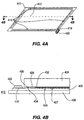
- Fig. 4A is an isometric view of an example of a plasma display panel according to the present invention.
- the exemplary panel includes a back panel 410, front panel 412, microstrip multi-layer low-temperature cofired ceramic (LTCC) display driver circuits 416, interface circuit 418 and a connection cable 420.
- LTCC microstrip multi-layer low-temperature cofired ceramic
- Fig.4B is a cut-away side plan view taken along a line taken along a row of the display (line 4B-4B shown in Fig. 4A).
- the panel includes a back panel 410 which includes a titanium core 370, and a laminated, embossed and cofired ceramic structure 350 that forms the barrier ribs 352 for the display as well as the substrate 416 on which the electronics 422 that control the display are mounted.
- Embedded in the ceramic structure 350 are the column electrodes 360 which extend into the drawing shown in Fig. 4B.
- each electrode on the surface of the embossed ceramic back panel is the phosphor (not shown) which is excited in order to emit colored light (red, green or blue).
- the front panel 424 Above the back panel 410 is the front panel 424.
- the front panel includes a row electrode 432 which is connected to the circuitry 422 and 416 by a solder bead 430 which forms an electrical connection 434 to the circuitry 416 using conductors that are painted onto the ceramic back plate at step 118 of Fig. 1.
- the front panel is bonded to the back panel by a frit seal 428.
- the front panel is bonded to the back panel using a frit material which is applied to the periphery of one or both panels.
- the panels are supported together and heated to a sufficiently high temperature to melt the frit material.
- the panels are then cooled, whereupon the frit solidifies and forms a gas-tight seal.
- the frit sealing temperature is typically in the range of 350° to 450° C.
Landscapes
- Engineering & Computer Science (AREA)
- Chemical & Material Sciences (AREA)
- Materials Engineering (AREA)
- Organic Chemistry (AREA)
- Life Sciences & Earth Sciences (AREA)
- Chemical Kinetics & Catalysis (AREA)
- General Chemical & Material Sciences (AREA)
- Geochemistry & Mineralogy (AREA)
- Manufacturing & Machinery (AREA)
- Dispersion Chemistry (AREA)
- Ceramic Engineering (AREA)
- Crystallography & Structural Chemistry (AREA)
- Physics & Mathematics (AREA)
- Plasma & Fusion (AREA)
- Gas-Filled Discharge Tubes (AREA)
- Glass Compositions (AREA)
- Transforming Electric Information Into Light Information (AREA)
Applications Claiming Priority (4)
| Application Number | Priority Date | Filing Date | Title |
|---|---|---|---|
| US88501 | 1993-07-07 | ||
| US6822297P | 1997-12-19 | 1997-12-19 | |
| US68222P | 1997-12-19 | ||
| US09/088,501 US6168490B1 (en) | 1997-12-19 | 1998-06-01 | Back panel for a plasma display device |
Publications (3)
| Publication Number | Publication Date |
|---|---|
| EP0924739A2 true EP0924739A2 (de) | 1999-06-23 |
| EP0924739A3 EP0924739A3 (de) | 1999-11-17 |
| EP0924739B1 EP0924739B1 (de) | 2004-05-19 |
Family
ID=26748716
Family Applications (1)
| Application Number | Title | Priority Date | Filing Date |
|---|---|---|---|
| EP98310307A Expired - Lifetime EP0924739B1 (de) | 1997-12-19 | 1998-12-16 | Verfahren zur Herstellung einer Rückwand für eine Plasmaanzeige |
Country Status (6)
| Country | Link |
|---|---|
| US (1) | US6168490B1 (de) |
| EP (1) | EP0924739B1 (de) |
| JP (2) | JP3222429B2 (de) |
| KR (1) | KR100304888B1 (de) |
| CA (1) | CA2256240A1 (de) |
| DE (1) | DE69823970T2 (de) |
Cited By (2)
| Publication number | Priority date | Publication date | Assignee | Title |
|---|---|---|---|---|
| EP1220263A1 (de) * | 2000-12-30 | 2002-07-03 | Lg Electronics Inc. | Verfahren zur Herstellung einer Rückplatte für eine Plasmaanzeigetafel |
| WO2015089188A1 (en) * | 2013-12-11 | 2015-06-18 | Heraeus Precious Metals North America Conshohocken Llc | Acrylic resin-containing organic vehicle for electroconductive paste |
Families Citing this family (12)
| Publication number | Priority date | Publication date | Assignee | Title |
|---|---|---|---|---|
| US6140767A (en) * | 1997-04-25 | 2000-10-31 | Sarnoff Corporation | Plasma display having specific substrate and barrier ribs |
| US6140759A (en) * | 1998-07-17 | 2000-10-31 | Sarnoff Corporation | Embossed plasma display back panel |
| JP2001302280A (ja) * | 2000-04-19 | 2001-10-31 | Sumitomo Chem Co Ltd | ガラスペースト配合用無機粉末およびそれを用いるガラスペースト |
| US6551720B2 (en) | 2000-05-02 | 2003-04-22 | Sarnoff Corporation | Materials to fabricate a high resolution plasma display back panel |
| KR100400372B1 (ko) | 2001-04-02 | 2003-10-08 | 엘지전자 주식회사 | 플라즈마 디스플레이 패널의 하판 제조방법 |
| US20060284556A1 (en) * | 2003-11-12 | 2006-12-21 | Tremel James D | Electronic devices and a method for encapsulating electronic devices |
| US20050238803A1 (en) * | 2003-11-12 | 2005-10-27 | Tremel James D | Method for adhering getter material to a surface for use in electronic devices |
| US20060283546A1 (en) * | 2003-11-12 | 2006-12-21 | Tremel James D | Method for encapsulating electronic devices and a sealing assembly for the electronic devices |
| US20050288166A1 (en) * | 2004-06-24 | 2005-12-29 | Jun-Kyu Cha | Lead-free black ceramic composition for filter and filter formed using the same |
| KR100738650B1 (ko) | 2005-04-19 | 2007-07-11 | 한국과학기술원 | 플라즈마 디스플레이 패널용 격벽의 제조방법 |
| KR100778411B1 (ko) * | 2005-11-22 | 2007-11-21 | 삼성에스디아이 주식회사 | 플라즈마 디스플레이 패널과 그 제조 방법 |
| US8173995B2 (en) | 2005-12-23 | 2012-05-08 | E. I. Du Pont De Nemours And Company | Electronic device including an organic active layer and process for forming the electronic device |
Family Cites Families (15)
| Publication number | Priority date | Publication date | Assignee | Title |
|---|---|---|---|---|
| US1898251A (en) | 1929-01-03 | 1933-02-21 | Kopp Nicholas | Mold for making pressed glass articles |
| US1925096A (en) | 1930-08-14 | 1933-09-05 | Rudolph M Hunter | Glass mold |
| CA991332A (en) | 1971-11-08 | 1976-06-15 | Owens-Illinois | Process for applying and bonding conductor material to substrate |
| CA1129560A (en) | 1978-09-01 | 1982-08-10 | E. I. Du Pont De Nemours And Company | Thick film silver conductor compositions for fine line electrodes |
| US5675212A (en) | 1992-04-10 | 1997-10-07 | Candescent Technologies Corporation | Spacer structures for use in flat panel displays and methods for forming same |
| JP2507418B2 (ja) * | 1986-05-02 | 1996-06-12 | 旭硝子株式会社 | 回路基板用組成物 |
| JPS6437534A (en) | 1987-08-04 | 1989-02-08 | Alps Electric Co Ltd | Liquid crystal display element |
| US4963114A (en) | 1987-11-25 | 1990-10-16 | Bell Communications Research, Inc. | Process for fabrication of high resolution flat panel plasma displays |
| US5212121A (en) * | 1990-06-13 | 1993-05-18 | Mitsui Mining Company, Limited | Raw batches for ceramic substrates, substrates produced from the raw batches, and production process of the substrates |
| US5242623A (en) | 1991-08-13 | 1993-09-07 | E. I. Du Pont De Nemours And Company | Screen-printable thick film paste composition |
| US5674634A (en) * | 1994-12-05 | 1997-10-07 | E. I. Du Pont De Nemours And Company | Insulator composition, green tape, and method for forming plasma display apparatus barrier-rib |
| EP0805785B1 (de) | 1995-01-27 | 2002-09-25 | Sarnoff Corporation | Gläser mit niedrigem dielektrischem verlust |
| WO1997016383A1 (en) | 1995-11-03 | 1997-05-09 | Sarnoff Corporation | Multilayer co-fired ceramic compositions and ceramic-on-metal circuit board |
| JP2000504281A (ja) | 1996-01-26 | 2000-04-11 | ミネソタ マイニング アンド マニュファクチャリング カンパニー | 積層ラミネート成形型およびその製法 |
| KR100377066B1 (ko) | 1996-01-30 | 2003-06-18 | 사르노프 코포레이션 | 플라즈마디스플레이와그제조방법 |
-
1998
- 1998-06-01 US US09/088,501 patent/US6168490B1/en not_active Expired - Lifetime
- 1998-12-11 KR KR1019980054538A patent/KR100304888B1/ko not_active Expired - Fee Related
- 1998-12-16 CA CA002256240A patent/CA2256240A1/en not_active Abandoned
- 1998-12-16 EP EP98310307A patent/EP0924739B1/de not_active Expired - Lifetime
- 1998-12-16 DE DE69823970T patent/DE69823970T2/de not_active Expired - Lifetime
- 1998-12-21 JP JP36354098A patent/JP3222429B2/ja not_active Expired - Fee Related
-
2001
- 2001-06-15 JP JP2001181963A patent/JP2001357789A/ja active Pending
Cited By (3)
| Publication number | Priority date | Publication date | Assignee | Title |
|---|---|---|---|---|
| EP1220263A1 (de) * | 2000-12-30 | 2002-07-03 | Lg Electronics Inc. | Verfahren zur Herstellung einer Rückplatte für eine Plasmaanzeigetafel |
| US6890232B2 (en) | 2000-12-30 | 2005-05-10 | Lg Electronics Inc. | Method of fabricating rear plate in plasma display panel |
| WO2015089188A1 (en) * | 2013-12-11 | 2015-06-18 | Heraeus Precious Metals North America Conshohocken Llc | Acrylic resin-containing organic vehicle for electroconductive paste |
Also Published As
| Publication number | Publication date |
|---|---|
| CA2256240A1 (en) | 1999-06-19 |
| KR19990063008A (ko) | 1999-07-26 |
| EP0924739A3 (de) | 1999-11-17 |
| EP0924739B1 (de) | 2004-05-19 |
| JP3222429B2 (ja) | 2001-10-29 |
| DE69823970T2 (de) | 2005-05-25 |
| JPH11288662A (ja) | 1999-10-19 |
| JP2001357789A (ja) | 2001-12-26 |
| KR100304888B1 (ko) | 2001-09-24 |
| DE69823970D1 (de) | 2004-06-24 |
| US6168490B1 (en) | 2001-01-02 |
Similar Documents
| Publication | Publication Date | Title |
|---|---|---|
| US6140767A (en) | Plasma display having specific substrate and barrier ribs | |
| KR100662132B1 (ko) | 엠보싱된 플라즈마 디스플레이 백 패널 | |
| US6551720B2 (en) | Materials to fabricate a high resolution plasma display back panel | |
| EP0924739B1 (de) | Verfahren zur Herstellung einer Rückwand für eine Plasmaanzeige | |
| US5747931A (en) | Plasma display and method of making same | |
| KR100377066B1 (ko) | 플라즈마디스플레이와그제조방법 | |
| JP2000133144A (ja) | プラズマディスプレイパネル用基板およびその製造方法 | |
| KR100554248B1 (ko) | 유리 세라믹 조성물 및 후막 유리 페이스트 조성물 | |
| EP0978135A1 (de) | Plasma anzeigevorrichtung | |
| EP0893813A2 (de) | Zusammensetzung und Verfahren zur Herstellung von Barriere-Zwischenträgern für Plasmaanzeigen | |
| EP1248279B1 (de) | Verfahren zur Herstellung eines unteren Substrats einer Plasma-Anzeigetafel | |
| MXPA98010844A (en) | Back panel for a pla exhibitor device | |
| US6286204B1 (en) | Method for fabricating double sided ceramic circuit boards using a titanium support substrate | |
| JP3539078B2 (ja) | プラズマディスプレイパネル用背面基板の製造方法 | |
| CA1044300A (en) | Gaseous breakdown display device and process for producing same | |
| KR20050032261A (ko) | 플라즈마 디스플레이 패널 후면 기판의 그린시트 조성물및 이를 이용한 격벽 형성 방법 | |
| JPH0770288B2 (ja) | 気体放電型パネル |
Legal Events
| Date | Code | Title | Description |
|---|---|---|---|
| PUAI | Public reference made under article 153(3) epc to a published international application that has entered the european phase |
Free format text: ORIGINAL CODE: 0009012 |
|
| AK | Designated contracting states |
Kind code of ref document: A2 Designated state(s): DE FR GB IT NL |
|
| AX | Request for extension of the european patent |
Free format text: AL;LT;LV;MK;RO;SI |
|
| RIN1 | Information on inventor provided before grant (corrected) |
Inventor name: PRABHU, ASHOK NARAYAN Inventor name: QUINN, ROBERT L. Inventor name: SREERAM, ATTIGANAL NARAYANASWAMY Inventor name: PALIT, KALIPADA Inventor name: HOZER, LESZEK |
|
| PUAL | Search report despatched |
Free format text: ORIGINAL CODE: 0009013 |
|
| RIC1 | Information provided on ipc code assigned before grant |
Free format text: 6H 01J 9/20 A, 6H 01J 17/49 B, 6C 03C 27/04 B, 6C 03C 8/14 B, 6C 03B 11/06 B, 6H 01B 1/22 B, 6H 01B 1/16 B |
|
| AK | Designated contracting states |
Kind code of ref document: A3 Designated state(s): AT BE CH CY DE DK ES FI FR GB GR IE IT LI LU MC NL PT SE |
|
| AX | Request for extension of the european patent |
Free format text: AL;LT;LV;MK;RO;SI |
|
| RAP1 | Party data changed (applicant data changed or rights of an application transferred) |
Owner name: LG ELECTRONICS INC. Owner name: SARNOFF CORPORATION |
|
| RAP1 | Party data changed (applicant data changed or rights of an application transferred) |
Owner name: LG ELECTRONICS, INC. Owner name: SARNOFF CORPORATION |
|
| 17P | Request for examination filed |
Effective date: 20000505 |
|
| AKX | Designation fees paid |
Free format text: DE FR GB IT NL |
|
| 17Q | First examination report despatched |
Effective date: 20020731 |
|
| RTI1 | Title (correction) |
Free format text: METHOD OF FORMING A BACK-PANEL FOR A PLASMA DISPLAY |
|
| GRAP | Despatch of communication of intention to grant a patent |
Free format text: ORIGINAL CODE: EPIDOSNIGR1 |
|
| GRAS | Grant fee paid |
Free format text: ORIGINAL CODE: EPIDOSNIGR3 |
|
| GRAA | (expected) grant |
Free format text: ORIGINAL CODE: 0009210 |
|
| AK | Designated contracting states |
Kind code of ref document: B1 Designated state(s): DE FR GB IT NL |
|
| PG25 | Lapsed in a contracting state [announced via postgrant information from national office to epo] |
Ref country code: NL Free format text: LAPSE BECAUSE OF FAILURE TO SUBMIT A TRANSLATION OF THE DESCRIPTION OR TO PAY THE FEE WITHIN THE PRESCRIBED TIME-LIMIT Effective date: 20040519 |
|
| REG | Reference to a national code |
Ref country code: GB Ref legal event code: FG4D |
|
| REF | Corresponds to: |
Ref document number: 69823970 Country of ref document: DE Date of ref document: 20040624 Kind code of ref document: P |
|
| NLV1 | Nl: lapsed or annulled due to failure to fulfill the requirements of art. 29p and 29m of the patents act | ||
| ET | Fr: translation filed | ||
| PLBE | No opposition filed within time limit |
Free format text: ORIGINAL CODE: 0009261 |
|
| STAA | Information on the status of an ep patent application or granted ep patent |
Free format text: STATUS: NO OPPOSITION FILED WITHIN TIME LIMIT |
|
| 26N | No opposition filed |
Effective date: 20050222 |
|
| PGFP | Annual fee paid to national office [announced via postgrant information from national office to epo] |
Ref country code: DE Payment date: 20131230 Year of fee payment: 16 Ref country code: GB Payment date: 20131227 Year of fee payment: 16 |
|
| PGFP | Annual fee paid to national office [announced via postgrant information from national office to epo] |
Ref country code: FR Payment date: 20131217 Year of fee payment: 16 Ref country code: IT Payment date: 20131228 Year of fee payment: 16 |
|
| REG | Reference to a national code |
Ref country code: DE Ref legal event code: R119 Ref document number: 69823970 Country of ref document: DE |
|
| GBPC | Gb: european patent ceased through non-payment of renewal fee |
Effective date: 20141216 |
|
| REG | Reference to a national code |
Ref country code: FR Ref legal event code: ST Effective date: 20150831 |
|
| PG25 | Lapsed in a contracting state [announced via postgrant information from national office to epo] |
Ref country code: DE Free format text: LAPSE BECAUSE OF NON-PAYMENT OF DUE FEES Effective date: 20150701 Ref country code: GB Free format text: LAPSE BECAUSE OF NON-PAYMENT OF DUE FEES Effective date: 20141216 |
|
| PG25 | Lapsed in a contracting state [announced via postgrant information from national office to epo] |
Ref country code: FR Free format text: LAPSE BECAUSE OF NON-PAYMENT OF DUE FEES Effective date: 20141231 |
|
| PG25 | Lapsed in a contracting state [announced via postgrant information from national office to epo] |
Ref country code: IT Free format text: LAPSE BECAUSE OF NON-PAYMENT OF DUE FEES Effective date: 20141216 |