EP0924834A2 - Source d'énergie, en particulier pour un télephone mobile dans un véhicule motorisé - Google Patents
Source d'énergie, en particulier pour un télephone mobile dans un véhicule motorisé Download PDFInfo
- Publication number
- EP0924834A2 EP0924834A2 EP98122637A EP98122637A EP0924834A2 EP 0924834 A2 EP0924834 A2 EP 0924834A2 EP 98122637 A EP98122637 A EP 98122637A EP 98122637 A EP98122637 A EP 98122637A EP 0924834 A2 EP0924834 A2 EP 0924834A2
- Authority
- EP
- European Patent Office
- Prior art keywords
- voltage
- circuit
- supply device
- power supply
- converter
- Prior art date
- Legal status (The legal status is an assumption and is not a legal conclusion. Google has not performed a legal analysis and makes no representation as to the accuracy of the status listed.)
- Withdrawn
Links
Images

Classifications
-
- H—ELECTRICITY
- H02—GENERATION; CONVERSION OR DISTRIBUTION OF ELECTRIC POWER
- H02J—ELECTRIC POWER NETWORKS; CIRCUIT ARRANGEMENTS OR SYSTEMS FOR SUPPLYING OR DISTRIBUTING ELECTRIC POWER; SYSTEMS FOR STORING ELECTRIC ENERGY
- H02J9/00—Circuit arrangements for emergency or stand-by power supply, e.g. for emergency lighting
- H02J9/04—Circuit arrangements for emergency or stand-by power supply, e.g. for emergency lighting in which the distribution system is disconnected from the normal source and connected to a standby source
- H02J9/06—Circuit arrangements for emergency or stand-by power supply, e.g. for emergency lighting in which the distribution system is disconnected from the normal source and connected to a standby source with automatic change-over, e.g. UPS systems
- H02J9/061—Circuit arrangements for emergency or stand-by power supply, e.g. for emergency lighting in which the distribution system is disconnected from the normal source and connected to a standby source with automatic change-over, e.g. UPS systems for DC powered loads
Definitions
- the invention relates to a voltage supply device, in particular for a radio telephone in a motor vehicle.
- a radio telephone that is permanently installed in a motor vehicle is usually supplied with power from the electrical system. So it’s like that On-board electrical system connected that the operating current for the radio telephone ever according to the operating state of the electrical system from the motor vehicle battery or is supplied by the generator.
- the supply voltage or supply voltages for the radio telephone that is to say for the transmitting radio-frequency amplifier and the rest of the telephone electronics a corresponding one Power supply or a voltage adjustment circuit, at which the vehicle electrical system voltage of about 10 V to 16 V at a Nominal voltage of 12 V is present.
- the radio telephone is at least still ready for a certain tent is to make an emergency call.
- the object of the invention is a voltage supply device for a radiotelephone, especially in one Motor vehicle to provide, which makes it possible even in the event of a failure Call the main voltage source for at least a certain time to be able to.
- a switch is separated from the rest of the circuit so that it does not Contributes to the power supply.
- a voltage monitoring circuit is provided, which monitors the voltage supplied by the main voltage source and if they fail, that is if they fall below a predetermined value Value causes the auxiliary voltage source to supply voltage is connected.
- the voltage adjustment circuit a first voltage converter that has a first supply voltage outputs at its output, and a second voltage converter comprises a second supply voltage that is less than is the first supply voltage, being to simplify the circuit the output of the first voltage converter with the input of the second voltage converter is connected.
- auxiliary voltage source supplied voltage used to turn it into a first derive first, relatively high supply voltage, which in particular serves to supply the transmitting high-frequency amplifier and from the preferably a second, relatively low supply voltage for the other telephone electronics is derived.
- the first voltage converter has a circuit in addition to a filter circuit to increase voltage.
- the auxiliary voltage source intended for emergencies also batteries with relative To be able to use a lower output voltage is the auxiliary voltage source via the controllable switch with the input of the voltage adjustment circuit connectable.
- primary cells have the advantage that they have a high energy density, that is, they take up little space and are mechanically very robust in comparison with a vehicle battery, usually a lead accumulator, so that they can also be used in the event of an emergency, for example in the event of a dangerous one Vehicle impact in an accident, not be damaged and thus have a high level of operational reliability.
- primary cells such as LiMnO 2 batteries, have a low self-discharge, so that they remain operational for years.
- the auxiliary voltage source via the controllable Switch with one input of the second voltage converter the voltage adjustment circuit is connectable.
- This configuration is particularly useful if an emergency battery as an auxiliary voltage source is used which has a relatively high voltage, for example a Open circuit voltage of 18 V supplies, because the auxiliary voltage source with this Arrangement in emergency mode not additionally by the first voltage converter is charged.
- the circuit for increasing the voltage when switched on Radio telephone or with the ignition switched on depending on the Main voltage source voltage is controllable. That way achieve that the circuit for increasing the voltage already before activation of the auxiliary voltage source is activated while the Main voltage source still supplies a voltage, but its value is lower than the minimum value of the first supply voltage.
- a decrease in the voltage supplied by the main voltage source occurs, for example, even if the main voltage source is destroyed or at least from the electrical system and thus also from the entrance of the Voltage adjustment circuit is separated.
- the circuit for Voltage increase that occurs when the radio telephone is operated by means of the auxiliary voltage source is required to prevent an interruption of the Power supply for the radio telephone.
- the voltage supply device works particularly reliably, if the voltage boost circuit is connected to the output of the has the first voltage converter connected control input to the Supply voltage independent of the one at the input Keep voltage at a stabilized level.
- the second voltage converter a first, constantly working circuit for voltage reduction and in parallel a second circuit for voltage reduction comprises, which can be switched on and off, the first circuit the voltage drop is a linear regulator and the second circuit a DC-DC converter to lower the voltage which is always on when the ignition is on and / or the radio telephone is switched on.
- the voltage supply takes place solely via a preferably as Integrated transistor circuit designed linear regulator, while at the radio telephone is switched on and / or the ignition is switched on Power supply for the telephone electronics through a DC-DC converter is ensured that even with a increased energy consumption has a low power loss and a constant supply voltage for the telephone electronics guaranteed.
- the seamless switchover from the main to can be particularly advantageous realize the auxiliary voltage source when the voltage monitoring circuit has a first and second comparator circuit which a voltage signal corresponding to the voltage of the main voltage source compare with a reference voltage signal, the first comparator circuit a switch-on signal for a circuit for increasing the voltage delivers the voltage adjustment circuit in a first voltage converter, when the voltage of the main voltage source falls below a first value, and the second comparator group that Switch control signal delivers when the voltage of the main voltage source falls below a second value.
- the switch control signal only outputs when the voltage is below a minimum voltage, preferably among the smallest when starting the vehicle engine expected voltage drops.
- the switch control signal is output by the second comparator circuit via a gate circuit which normally enables relaying of the switch control signal and which in particular for maintenance purposes by means of an input signal is lockable. This means that the auxiliary voltage source can be switched on, prevent unnecessary strain on the vehicle battery is not connected for service purposes.
- the switch-on signal from the first comparator circuit can be output via a further gate circuit, which is only then the world derivation of the switch-on signal enables when the ignition and / or the radio telephone is switched on.
- the auxiliary voltage source together with the voltage adjustment circuit and the voltage monitoring circuit is housed in a housing with the radio telephone. In this way can be ensured with a high probability that even after a serious accident of the vehicle the radio telephone to the extent of in the Auxiliary voltage source stored energy still for a certain time is ready for operation, so that the vehicle occupants or one automatic emergency call provided in the vehicle for this purpose an emergency call can be called.
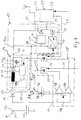
- Each of the voltage supply devices for a radio telephone in a motor vehicle shown in FIGS. 1 and 2 comprises a vehicle battery 10 as the main voltage source, in particular the starter battery of the vehicle electrical system N, which is connected to a connection terminal 11 of the vehicle battery 10.
- the voltage U B present at the connection terminal 11 and supplied by the generator of the vehicle electrical system or the vehicle battery 10 is applied on the one hand to an input 12 of a voltage adjustment circuit 13 and on the other hand to a first input 14 of a voltage monitoring circuit 15.
- the voltage adaptation circuit 13 has a first voltage converter 16 connected to the input 12 for increasing the voltage, the output 17 of which is connected to an input 18 of a second voltage converter 19 for reducing the voltage and to a first output 20 of the voltage adaptation circuit 13.
- the first voltage converter 16 supplies a first supply voltage U 12 , which is 12 V, for example, and which serves as a supply voltage for a transmission radio-frequency amplifier 21 of a radio telephone 22.
- the second voltage converter 19 derives a second supply voltage U 5 from the first supply voltage U 12 , which is supplied to the remaining telephone electronics 24 via a second output 23 of the voltage adaptation circuit 13.
- the second supply voltage U 5 is, for example, 3 V or 5 V.
- the value of the supply voltage U 5 depends on the circuit technology used. In the event that the telephone electronics 24 require a supply voltage of 3 V, while the voltage adjustment circuit 13 supplies a second supply voltage U 5 of 5 V at the second output 23, a further voltage reduction circuit can be provided in the telephone electronics 24.
- an emergency battery 26 is provided as the auxiliary voltage source, which can be connected to the voltage adjustment circuit 13 via a controllable switch 27, so that the voltage U N supplied by the emergency battery 26 can be applied to the voltage adjustment circuit 13.
- the controllable switch 27 is controlled by a switch control signal in its switch-on and switch-off function, which is output via a first output 28 of the voltage monitoring circuit 15 when the voltage U B drops below a predetermined value, for example below 4 V or below 5 V, so that the power supply for the radio telephone 22 is taken over by the emergency battery 26.
- the emergency battery 26 is via the switch 27 and a line 27 'with the same input 12 of the voltage adjustment circuit 13 connectable, to which the vehicle battery 10 is also connected is.
- This circuit can be used especially for emergency batteries Use 26 whose output voltage is less than the nominal voltage of the electrical system.
- an emergency battery 26 with a relatively high voltage for example with an open circuit voltage of 18 V used under load at most to 10 V
- the emergency battery 26 can also the switch 27 can be connected to a line 27 ′′ which is connected directly to the Input 18 of the second voltage converter 19 is routed, as in FIG. 2 shown.
- the voltage supply device makes it possible thus continue to use the radio telephone 22 even in the event of an accident, in which the connection between radio telephone 22 and vehicle battery 10 or electrical system N is interrupted. It will make the occupants one in enables an accident involving a motor vehicle or an automatic emergency call, make an emergency call. To ensure in this case that the connection between the emergency battery 26 and the radiotelephone 22 is not also interrupted, the emergency battery 26 is common with the voltage monitoring circuit 15 and the voltage adjustment circuit 13 in a housing receiving the radio telephone 22 29 housed.
- the first voltage converter 16 as shown in FIG. 3, has a series circuit consisting of a coil 30 and a diode 31, for example a Schottky diode, between the input 12 and its output 17.
- a diode 31 for example a Schottky diode
- its input 12 and its output 17 are each connected to ground via a capacitor 32, 33.
- the coil 30 thus forms, together with the capacitors 32, 33, a low-pass filter which simultaneously smoothes and stabilizes the first supply voltage U 12 present at the output 17.
- the filtering action of the low-pass filter formed from coil 30 and capacitors 32, 33 also prevents, in reverse, together with the diodes 31, 34, that interference pulses and voltage peaks from the transmitting high-frequency amplifier 21 can get into the electrical system N.
- the coil 30 and the capacitors 32, 33 serve as energy stores, which enable or support the uninterrupted maintenance of the supply voltage U 12 when the voltage supply is switched to the emergency battery 26.
- the coil 30 cooperates with a switching regulator 35, the first supply voltage U 12 at the output of the first voltage converter via a feedback line 36 16 is supplied.
- the switching regulator 35 is connected to the capacitor 33 via a line 37.
- An output 38 of the switching regulator 35 is connected to the connection point between the coil 30 and the diode 31 in order to periodically pull the connection point between the coil 30 and the diode 31 to ground during the step-up operation.
- the operation of the switching regulator 35 or of the circuit for increasing the voltage which is constructed from the coil 30 and the switching regulator 35 is controlled in a manner to be described in more detail by the voltage monitoring circuit 15 as a function of the voltage U B of the motor vehicle battery 10.
- the second voltage converter 19, which is used to derive a second, lower supply voltage U 5 from the first supply voltage U 12 , has a linear regulator 40, the input of which is connected to the input 18 of the voltage converter 19 and the output of which is via a diode 41 to the second output 23 the voltage adjustment circuit 13 is connected.
- the linear regulator 40 is preferably an integrated transistor circuit.
- a DC-DC converter 42 is connected between the input 18 and the output 23 and forms a second circuit for voltage reduction.
- this DC-DC converter 42 is connected via a further diode 43, in particular a Schottky diode, to the second output 23 of the voltage adjustment circuit 13, so that the telephone electronics 24 of the radio telephone 22 have the second supply voltage U 5 either via the linear regulator 40 or the DC-DC converter 42 is supplied.
- a further diode 43 in particular a Schottky diode
- the voltage monitoring circuit 15 has a first and a second comparison circuit 44, 45, the output signals of which are sent to a first or second AND gate 46, 47, each forming a gate circuit.
- the comparator circuits 44, 45 to which the voltage U B itself is applied as the voltage signal corresponding to the voltage U B of the vehicle battery, compare this with a reference voltage U ref which is present at the respective other inputs of the comparator circuits.
- the first comparator circuit 44 outputs a switch-on signal which is only forwarded via the gate circuit 46 to the switching regulator 35 of the circuit 30, 35 for increasing the voltage in the first voltage converter 16 , if a release signal is supplied via a line 48 from the telephone electronics 24, which indicates that the radio telephone 22 and / or the ignition of the motor vehicle are switched on. If neither the radio telephone 22 nor the ignition of the motor vehicle is switched on, only the second supply voltage U 12 is required, which, however, is lower than the first predetermined voltage value U 10 and which also falls below this value of the motor vehicle battery voltage U B continuously operating linear regulator 40 of the second voltage converter 19 can be readily provided. Operation of the circuit 30, 35 to increase the voltage is thus not necessary and is prevented with the aid of the blocked AND gate 46.
- the DC-DC converter 42 is also only put into operation when the radio telephone 22 or the ignition of the motor vehicle are switched on. Otherwise, the second supply voltage U 5 is provided solely by the linear regulator 40.
- the voltage U B drops below a second predetermined value, which preferably corresponds to the lowest voltage to be expected when the engine is started and which can be, for example, 4 V or 5 V, this will decrease of the voltage U B is detected by the second comparator circuit 45, which emits a corresponding switch control signal via the output 28 to the associated AND gate 47.
- a second predetermined value which preferably corresponds to the lowest voltage to be expected when the engine is started and which can be, for example, 4 V or 5 V
- this will decrease of the voltage U B is detected by the second comparator circuit 45, which emits a corresponding switch control signal via the output 28 to the associated AND gate 47.
- an enable signal is applied to the AND gate 47 via the line 49, so that the controllable switch 27 is closed, with the result that the power supply for the radio telephone 22 is switched seamlessly to the emergency battery 26 when the voltage U B is removed.
- the diode 34 blocks the flow of current from the emergency battery 26 to the electrical system N and to the vehicle battery 10.
- the power supply device according to the invention for a radio telephone 22 enables four different operating modes.
- the controllable switch is 27 opened while the voltage monitoring circuit keeps the circuit for increasing the voltage in the first voltage converter 16 inactive. Due to its filter function, the voltage converter 16 thus supplies a smoothed and stabilized first supply voltage U 12 , which is fed to the radio-frequency amplifier 21 of the radio telephone 22 and the second voltage converter 19, which derives the second supply voltage U 5 for the rest of the telephone electronics 24.
- the voltage U B of the vehicle battery 10 drops below a value U 10 of, for example, 10 V or, as assumed here, 11 V, this drop is detected by the first comparator circuit 44 of the voltage monitoring circuit 15, which then switches on a switch-on signal for the switching regulator 35 or the circuit 30 , 35 of the voltage increase via the open AND gate 46 when the ignition is switched on.
- the voltage at the output 17 of the voltage converter 16 is kept at the required value, for example 12 V, with the aid of the coil and the switching regulator 35.
- the second supply voltage U 5 is derived from the first supply voltage U 12 by the voltage converter 19 in the same way as in normal operation.
- the voltage U B drops below the second predetermined value, for example 4 or 5 V, which is detected by the second comparator circuit 45 of the voltage monitoring circuit 15.
- the voltage monitoring circuit 15 then supplies the switch control signal for the switch 27 via the output 28 in the manner described, which then closes and connects the emergency battery 26 for the voltage supply of the radio telephone 22, so that the voltage U N as a supply voltage for the voltage adaptation circuit 13 is connected to its input 12 ( Figure 1) or at the input 18 of the second voltage converter ( Figure 2).
- the voltage U N as shown in FIG. 1, is present at the input 12 of the voltage adjustment circuit 13, the input voltage of, for example, 5 V is now, for the supply of the high-frequency amplifier, by the circuit comprising the coil 30 and the switching regulator 35, as in the second operating mode 21 required voltage of, for example, 12 V increased. If an emergency battery 26 with a relatively high voltage U N is used , however, as shown in FIG. 2, the emergency battery 26 can also be applied directly to the input 18 of the second voltage converter 19.
- the voltage U N is used here both as the first supply voltage U 12 and as a supply voltage for deriving the second supply voltage U 5 by means of the second voltage converter 19 used.
- the release signal is on the Line 49 switched off, so that the vehicle battery 10 is disconnected without further notice or can be removed without the emergency battery 26 is switched on.
- the invention was, for example, based on a voltage supply device for a radio telephone in a motor vehicle with a Electrical system nominal voltage of 12 V is described.
- the individual only as an example serving voltage values can, however, depending on the present Main supply voltage and circuit technology different be and therefore be changed accordingly.
- the voltage device according to the invention for other safety-relevant Use facilities that also after a failure Main voltage source with relatively high voltage for a certain tent are to be kept ready for operation. Should an auxiliary voltage source be included low voltage are used, this is convenient connected to the same input as the main voltage source.
Landscapes
- Business, Economics & Management (AREA)
- Emergency Management (AREA)
- Engineering & Computer Science (AREA)
- Power Engineering (AREA)
- Stand-By Power Supply Arrangements (AREA)
- Control Of Charge By Means Of Generators (AREA)
- Fittings On The Vehicle Exterior For Carrying Loads, And Devices For Holding Or Mounting Articles (AREA)
- Mobile Radio Communication Systems (AREA)
Applications Claiming Priority (2)
| Application Number | Priority Date | Filing Date | Title |
|---|---|---|---|
| DE19757362A DE19757362A1 (de) | 1997-12-22 | 1997-12-22 | Spannungsversorgungsvorrichtung, insbesondere für ein Funktelefon in einem Kraftfahrzeug |
| DE19757362 | 1997-12-22 |
Publications (2)
| Publication Number | Publication Date |
|---|---|
| EP0924834A2 true EP0924834A2 (fr) | 1999-06-23 |
| EP0924834A3 EP0924834A3 (fr) | 2000-11-02 |
Family
ID=7853073
Family Applications (1)
| Application Number | Title | Priority Date | Filing Date |
|---|---|---|---|
| EP98122637A Withdrawn EP0924834A3 (fr) | 1997-12-22 | 1998-11-27 | Source d'énergie, en particulier pour un télephone mobile dans un véhicule motorisé |
Country Status (4)
| Country | Link |
|---|---|
| US (1) | US6330463B1 (fr) |
| EP (1) | EP0924834A3 (fr) |
| JP (1) | JPH11266549A (fr) |
| DE (1) | DE19757362A1 (fr) |
Cited By (1)
| Publication number | Priority date | Publication date | Assignee | Title |
|---|---|---|---|---|
| WO2007068405A1 (fr) | 2005-12-12 | 2007-06-21 | Knorr-Bremse Systeme für Nutzfahrzeuge GmbH | Alimentation de tension de courte duree |
Families Citing this family (23)
| Publication number | Priority date | Publication date | Assignee | Title |
|---|---|---|---|---|
| US6721580B1 (en) * | 2000-10-27 | 2004-04-13 | Cisco Technology, Inc. | Ensuring emergency availability of communications devices |
| DE10120142B4 (de) * | 2001-04-25 | 2010-12-30 | Nxp B.V. | Detektorschaltung zur Detektion von Spannungs-Spikes |
| US6993316B2 (en) * | 2001-06-05 | 2006-01-31 | Xm Sattellite Radio, Inc. | Method and apparatus for backup power in a communication system |
| DE10133098C1 (de) | 2001-07-11 | 2003-03-20 | Webasto Thermosysteme Gmbh | Zusatzfunktionsvorrichtung für ein Kraftfahrzeug und Verfahren zum Betreiben derselben |
| DE10163222B4 (de) * | 2001-12-21 | 2007-07-26 | Volkswagen Ag | Kraftfahrzeug-Bordnetz und Verfahren zur Überwachung der Funktionsfähigkeit desselben |
| US7248152B2 (en) * | 2005-01-14 | 2007-07-24 | Xm Satellite Radio, Inc. | Automatic on/off switch for vehicle power outlets |
| US20080062589A1 (en) * | 2006-09-08 | 2008-03-13 | Artificial Muscle, Inc. | High-voltage power supplies |
| EP2206013A4 (fr) * | 2007-05-31 | 2011-07-20 | Artificial Muscle Inc | Systèmes optiques employant des matériaux éléctroactifs compatibles |
| US7952261B2 (en) * | 2007-06-29 | 2011-05-31 | Bayer Materialscience Ag | Electroactive polymer transducers for sensory feedback applications |
| EP2239793A1 (fr) | 2009-04-11 | 2010-10-13 | Bayer MaterialScience AG | Montage de film polymère électrique commutable et son utilisation |
| DE102009056233A1 (de) | 2009-11-28 | 2011-06-01 | Volkswagen Ag | Verfahren zum Betreiben einer Steuervorrichtung eines Fahrzeugs |
| US8145149B2 (en) * | 2010-06-17 | 2012-03-27 | R2 Semiconductor, Inc | Operating a voltage regulator at a switching frequency selected to reduce spurious signals |
| US8812061B2 (en) * | 2010-12-10 | 2014-08-19 | Johnson Controls Technology Company | Battery backup systems and methods for vehicle phone systems |
| WO2012118916A2 (fr) | 2011-03-01 | 2012-09-07 | Bayer Materialscience Ag | Procédés de fabrication automatisés pour la production de dispositifs et de films polymères déformables |
| JP2014517331A (ja) | 2011-03-22 | 2014-07-17 | バイエル・インテレクチュアル・プロパティ・ゲゼルシャフト・ミット・ベシュレンクテル・ハフツング | 電場応答性高分子アクチュエータレンチキュラシステム |
| JP6019614B2 (ja) * | 2012-02-28 | 2016-11-02 | オムロン株式会社 | 蓄電制御装置、蓄電制御装置の制御方法、プログラム、および蓄電システム |
| US9876160B2 (en) | 2012-03-21 | 2018-01-23 | Parker-Hannifin Corporation | Roll-to-roll manufacturing processes for producing self-healing electroactive polymer devices |
| KR20150031285A (ko) | 2012-06-18 | 2015-03-23 | 바이엘 인텔렉쳐 프로퍼티 게엠베하 | 연신 공정을 위한 연신 프레임 |
| US9590193B2 (en) | 2012-10-24 | 2017-03-07 | Parker-Hannifin Corporation | Polymer diode |
| WO2015040673A1 (fr) | 2013-09-17 | 2015-03-26 | 三菱電機株式会社 | Dispositif d'accumulation d'électricité dans un véhicule |
| DE102017221313B4 (de) * | 2017-11-28 | 2024-06-27 | Audi Ag | Elektrisches System für ein Kraftfahrzeug und Kraftfahrzeug mit einem solchen elektrischen System |
| KR102794394B1 (ko) * | 2018-06-28 | 2025-04-10 | 스냅 인코포레이티드 | 조절된 전원들 |
| US11670952B2 (en) * | 2019-10-18 | 2023-06-06 | Fca Us Llc | Voltage estimation for automotive battery charging system control |
Family Cites Families (21)
| Publication number | Priority date | Publication date | Assignee | Title |
|---|---|---|---|---|
| JPS6182541A (ja) * | 1984-09-28 | 1986-04-26 | Aisin Seiki Co Ltd | 自動車電話装置 |
| DE3626601A1 (de) * | 1986-08-06 | 1988-02-18 | Bosch Gmbh Robert | Sicherheitseinrichtung fuer fahrzeuginsassen |
| JPH0650825B2 (ja) * | 1988-01-29 | 1994-06-29 | 日本電気株式会社 | 無線電話装置 |
| DE3805810A1 (de) * | 1988-02-24 | 1989-09-07 | Amend Volker | Kommunikationssystem fuer fahrzeuge |
| US5208494A (en) | 1989-03-10 | 1993-05-04 | Nokia Mobile Phones Ltd. | Method for the elimination of transients from the operating voltage of TDMA system |
| US5036532A (en) * | 1989-08-03 | 1991-07-30 | Motorola, Inc. | Portable telephone with power source/mode change during calls |
| EP0435317A3 (en) * | 1989-12-28 | 1992-06-17 | Kabushiki Kaisha Toshiba | Personal computer for performing charge and switching control of different types of battery packs |
| DE4004816A1 (de) * | 1990-02-16 | 1991-09-19 | Grundig Emv | Unfallwarnsystem in kraftfahrzeugen zur erhoehung der verkehrssicherheit |
| US5241284A (en) | 1990-02-16 | 1993-08-31 | Nokia Mobile Phones Ltd. | Circuit arrangement for connecting RF amplifier and supply voltage filter |
| JP3058923B2 (ja) * | 1991-01-11 | 2000-07-04 | 株式会社東芝 | 無線電話装置アダプタ |
| US5382893A (en) * | 1991-05-16 | 1995-01-17 | Compaq Computer Corporation | Maximum power regulated battery charger |
| DE4218852A1 (de) * | 1992-06-09 | 1993-12-16 | Bosch Gmbh Robert | Stromversorgungsschaltung für ein Funkgerät |
| CH692230A5 (de) * | 1992-10-16 | 2002-03-28 | Invertomatic Sa | Stromversorgungsanlage zur unterbrechungsfreien Speisung einer Last von einem Netz. |
| JP2959657B2 (ja) * | 1993-05-13 | 1999-10-06 | キヤノン株式会社 | 電子機器 |
| FI94685C (fi) | 1993-11-22 | 1995-10-10 | Nokia Mobile Phones Ltd | Avainnettu kytkintyyppinen virtalähde aikajakoisiin radiopuhelinjärjestelmiin |
| EP0660520B1 (fr) * | 1993-11-30 | 2004-05-26 | Siliconix Incorporated | Alimentation multiple en puissance et procédé pour sélectionner une source parmi plusieurs sources d'alimentation |
| JP3610595B2 (ja) * | 1994-07-20 | 2005-01-12 | 松下電器産業株式会社 | コードレス電話装置 |
| EP0715480B1 (fr) * | 1994-11-29 | 2005-09-14 | Nec Corporation | Radiotéléphone mobile possédant une fonction de prévention contre le vol |
| US5610805A (en) * | 1995-01-10 | 1997-03-11 | Cambridge Continuous Power | Uninterruptible power supply with a back-up battery coupled across the a.c. input |
| FI101109B (fi) | 1995-04-12 | 1998-04-15 | Nokia Mobile Phones Ltd | Menetelmä elektronisen laitteen tehonkulutuksen pienentämiseksi |
| DE19650176A1 (de) * | 1996-12-04 | 1997-06-05 | Fiedler Holger Dipl Ing Tu | Vorrichtung in Fahrzeugen zum automatischen Benachrichtigen von hilfeleistenden Personen bei Lebensgefahr |
-
1997
- 1997-12-22 DE DE19757362A patent/DE19757362A1/de not_active Ceased
-
1998
- 1998-11-27 EP EP98122637A patent/EP0924834A3/fr not_active Withdrawn
- 1998-12-17 US US09/215,595 patent/US6330463B1/en not_active Expired - Fee Related
- 1998-12-21 JP JP10362916A patent/JPH11266549A/ja active Pending
Cited By (2)
| Publication number | Priority date | Publication date | Assignee | Title |
|---|---|---|---|---|
| WO2007068405A1 (fr) | 2005-12-12 | 2007-06-21 | Knorr-Bremse Systeme für Nutzfahrzeuge GmbH | Alimentation de tension de courte duree |
| US7888817B2 (en) | 2005-12-12 | 2011-02-15 | Knorr-Bremse Systeme Fuer Nutzfahrzeuge Gmbh | Temporary voltage supply |
Also Published As
| Publication number | Publication date |
|---|---|
| JPH11266549A (ja) | 1999-09-28 |
| EP0924834A3 (fr) | 2000-11-02 |
| DE19757362A1 (de) | 1999-06-24 |
| US6330463B1 (en) | 2001-12-11 |
Similar Documents
| Publication | Publication Date | Title |
|---|---|---|
| EP0924834A2 (fr) | Source d'énergie, en particulier pour un télephone mobile dans un véhicule motorisé | |
| EP3818605B1 (fr) | Réseau de bord pour un véhicule ainsi que véhicule | |
| DE68922121T2 (de) | Tragbares und in einem Fahrzeug befestigtes Funktelefon. | |
| DE10304764B3 (de) | Zwei-Spannungs-Bordnetz | |
| EP3027472B1 (fr) | Protection contre les surtensions pour un réseau de bord à multiples tensions | |
| DE10014243B4 (de) | Zwei-Batteriensystem | |
| EP2783442B1 (fr) | Réseau de bord et procédé pour faire fonctionner un réseau de bord | |
| DE102011109709B4 (de) | Verfahren und System zur Spannungsversorgung eines Bordnetzes eines Fahrzeugs | |
| EP3146605B1 (fr) | Procédé permettant de faire fonctionner un réseau de bord d'un véhicule automobile et véhicule automobile | |
| DE102007017187B4 (de) | Bordnetz für ein Kraftfahrzeug und Verfahren zum Betreiben eines Bordnetzes eines Kraftfahrzeugs | |
| EP3137342B1 (fr) | Dispositif d'alimentation d'au moins un dissipateur | |
| DE102008031270B4 (de) | Steuergerät zur Absicherung eines Ausfalls einer Schaltvorrichtung bei Spannungswandlern in Kraftfahrzeugen | |
| WO1998002950A1 (fr) | Dispositif d'alimentation en courant dans un vehicule automobile | |
| EP3320204B1 (fr) | Intégration d'une commande de courant de démarrage et d'un sectionneur de réseau de bord | |
| DE2644643C2 (de) | Spannungsregler für Generatoren in Kraftfahrzeugen | |
| DE10160266A1 (de) | Verfahren und Anordnung zur Ruhestromversorgung eines Fahrzeugs mit einem Mehrspannungsbordnetz | |
| DE102011087015B4 (de) | Energieversorgungssystem, Luft- oder Raumfahrzeug und Verfahren | |
| EP2009764B1 (fr) | Dispositif d'alimentation en courant continue | |
| DE102017222557B4 (de) | Mehrspannungsbatterievorrichtung und Bordnetz für ein Kraftfahrzeug | |
| WO2024068065A1 (fr) | Agencement de convertisseur de tension cc, véhicule électrique et procédé de fonctionnement d'un agencement de convertisseur de tension cc | |
| EP2314861A1 (fr) | Réseau de bord pour un véhicule automobile | |
| EP3747687A1 (fr) | Système d'accumulation d'énergie électrique et son procédé de fonctionnement | |
| DE10324250B4 (de) | Spannungsversorgungssystem für sicherheitsrelevante elektrische Verbraucher | |
| WO2015010951A1 (fr) | Procédé permettant d'accoupler au moins une source d'énergie secondaire à un réseau d'alimentation en énergie, en particulier un réseau de bord d'un véhicule | |
| DE102012200823A1 (de) | Bordnetz mit Gleichspannungswandler, Steuereinrichtung und zugehöriges Betriebsverfahren |
Legal Events
| Date | Code | Title | Description |
|---|---|---|---|
| PUAI | Public reference made under article 153(3) epc to a published international application that has entered the european phase |
Free format text: ORIGINAL CODE: 0009012 |
|
| AK | Designated contracting states |
Kind code of ref document: A2 Designated state(s): DE FR GB IT |
|
| AX | Request for extension of the european patent |
Free format text: AL;LT;LV;MK;RO;SI |
|
| PUAL | Search report despatched |
Free format text: ORIGINAL CODE: 0009013 |
|
| AK | Designated contracting states |
Kind code of ref document: A3 Designated state(s): AT BE CH CY DE DK ES FI FR GB GR IE IT LI LU MC NL PT SE |
|
| AX | Request for extension of the european patent |
Free format text: AL;LT;LV;MK;RO;SI |
|
| RIC1 | Information provided on ipc code assigned before grant |
Free format text: 7H 02J 7/00 A, 7H 02J 9/06 B |
|
| 17P | Request for examination filed |
Effective date: 20010213 |
|
| AKX | Designation fees paid |
Free format text: DE FR GB IT |
|
| RAP1 | Party data changed (applicant data changed or rights of an application transferred) |
Owner name: NOKIA CORPORATION |
|
| STAA | Information on the status of an ep patent application or granted ep patent |
Free format text: STATUS: THE APPLICATION IS DEEMED TO BE WITHDRAWN |
|
| 18D | Application deemed to be withdrawn |
Effective date: 20040601 |