EP0926751A2 - Procédé de fabrication de matériaux plaqués avec des alliages au plomb et bandes composites fabriquées par un tel procédé - Google Patents
Procédé de fabrication de matériaux plaqués avec des alliages au plomb et bandes composites fabriquées par un tel procédé Download PDFInfo
- Publication number
- EP0926751A2 EP0926751A2 EP98310380A EP98310380A EP0926751A2 EP 0926751 A2 EP0926751 A2 EP 0926751A2 EP 98310380 A EP98310380 A EP 98310380A EP 98310380 A EP98310380 A EP 98310380A EP 0926751 A2 EP0926751 A2 EP 0926751A2
- Authority
- EP
- European Patent Office
- Prior art keywords
- strip
- lead
- strips
- thickness
- bonding
- Prior art date
- Legal status (The legal status is an assumption and is not a legal conclusion. Google has not performed a legal analysis and makes no representation as to the accuracy of the status listed.)
- Withdrawn
Links
Images



Classifications
-
- B—PERFORMING OPERATIONS; TRANSPORTING
- B23—MACHINE TOOLS; METAL-WORKING NOT OTHERWISE PROVIDED FOR
- B23K—SOLDERING OR UNSOLDERING; WELDING; CLADDING OR PLATING BY SOLDERING OR WELDING; CUTTING BY APPLYING HEAT LOCALLY, e.g. FLAME CUTTING; WORKING BY LASER BEAM
- B23K20/00—Non-electric welding by applying impact or other pressure, with or without the application of heat, e.g. cladding or plating
- B23K20/04—Non-electric welding by applying impact or other pressure, with or without the application of heat, e.g. cladding or plating by means of a rolling mill
-
- B—PERFORMING OPERATIONS; TRANSPORTING
- B23—MACHINE TOOLS; METAL-WORKING NOT OTHERWISE PROVIDED FOR
- B23K—SOLDERING OR UNSOLDERING; WELDING; CLADDING OR PLATING BY SOLDERING OR WELDING; CUTTING BY APPLYING HEAT LOCALLY, e.g. FLAME CUTTING; WORKING BY LASER BEAM
- B23K35/00—Rods, electrodes, materials, or media, for use in soldering, welding, or cutting
- B23K35/001—Interlayers, transition pieces for metallurgical bonding of workpieces
-
- B—PERFORMING OPERATIONS; TRANSPORTING
- B32—LAYERED PRODUCTS
- B32B—LAYERED PRODUCTS, i.e. PRODUCTS BUILT-UP OF STRATA OF FLAT OR NON-FLAT, e.g. CELLULAR OR HONEYCOMB, FORM
- B32B15/00—Layered products comprising a layer of metal
- B32B15/01—Layered products comprising a layer of metal all layers being exclusively metallic
-
- C—CHEMISTRY; METALLURGY
- C22—METALLURGY; FERROUS OR NON-FERROUS ALLOYS; TREATMENT OF ALLOYS OR NON-FERROUS METALS
- C22C—ALLOYS
- C22C11/00—Alloys based on lead
- C22C11/06—Alloys based on lead with tin as the next major constituent
-
- H—ELECTRICITY
- H01—ELECTRIC ELEMENTS
- H01M—PROCESSES OR MEANS, e.g. BATTERIES, FOR THE DIRECT CONVERSION OF CHEMICAL ENERGY INTO ELECTRICAL ENERGY
- H01M4/00—Electrodes
- H01M4/02—Electrodes composed of, or comprising, active material
- H01M4/64—Carriers or collectors
- H01M4/66—Selection of materials
- H01M4/68—Selection of materials for use in lead-acid accumulators
- H01M4/685—Lead alloys
-
- H—ELECTRICITY
- H01—ELECTRIC ELEMENTS
- H01M—PROCESSES OR MEANS, e.g. BATTERIES, FOR THE DIRECT CONVERSION OF CHEMICAL ENERGY INTO ELECTRICAL ENERGY
- H01M4/00—Electrodes
- H01M4/02—Electrodes composed of, or comprising, active material
- H01M4/64—Carriers or collectors
- H01M4/82—Multi-step processes for manufacturing carriers for lead-acid accumulators
-
- H—ELECTRICITY
- H01—ELECTRIC ELEMENTS
- H01M—PROCESSES OR MEANS, e.g. BATTERIES, FOR THE DIRECT CONVERSION OF CHEMICAL ENERGY INTO ELECTRICAL ENERGY
- H01M4/00—Electrodes
- H01M4/02—Electrodes composed of, or comprising, active material
- H01M2004/026—Electrodes composed of, or comprising, active material characterised by the polarity
- H01M2004/029—Bipolar electrodes
-
- H—ELECTRICITY
- H01—ELECTRIC ELEMENTS
- H01M—PROCESSES OR MEANS, e.g. BATTERIES, FOR THE DIRECT CONVERSION OF CHEMICAL ENERGY INTO ELECTRICAL ENERGY
- H01M4/00—Electrodes
- H01M4/02—Electrodes composed of, or comprising, active material
- H01M4/64—Carriers or collectors
- H01M4/70—Carriers or collectors characterised by shape or form
-
- Y—GENERAL TAGGING OF NEW TECHNOLOGICAL DEVELOPMENTS; GENERAL TAGGING OF CROSS-SECTIONAL TECHNOLOGIES SPANNING OVER SEVERAL SECTIONS OF THE IPC; TECHNICAL SUBJECTS COVERED BY FORMER USPC CROSS-REFERENCE ART COLLECTIONS [XRACs] AND DIGESTS
- Y02—TECHNOLOGIES OR APPLICATIONS FOR MITIGATION OR ADAPTATION AGAINST CLIMATE CHANGE
- Y02E—REDUCTION OF GREENHOUSE GAS [GHG] EMISSIONS, RELATED TO ENERGY GENERATION, TRANSMISSION OR DISTRIBUTION
- Y02E60/00—Enabling technologies; Technologies with a potential or indirect contribution to GHG emissions mitigation
- Y02E60/10—Energy storage using batteries
-
- Y—GENERAL TAGGING OF NEW TECHNOLOGICAL DEVELOPMENTS; GENERAL TAGGING OF CROSS-SECTIONAL TECHNOLOGIES SPANNING OVER SEVERAL SECTIONS OF THE IPC; TECHNICAL SUBJECTS COVERED BY FORMER USPC CROSS-REFERENCE ART COLLECTIONS [XRACs] AND DIGESTS
- Y10—TECHNICAL SUBJECTS COVERED BY FORMER USPC
- Y10T—TECHNICAL SUBJECTS COVERED BY FORMER US CLASSIFICATION
- Y10T428/00—Stock material or miscellaneous articles
- Y10T428/12—All metal or with adjacent metals
- Y10T428/12493—Composite; i.e., plural, adjacent, spatially distinct metal components [e.g., layers, joint, etc.]
- Y10T428/12701—Pb-base component
Definitions
- This invention relates generally to the solid phase bonding of metals, that is, the bonding of metals without the formation of any liquid phase material at the interface of the metals being bonded. and more particularly to methods for solid phase bonding one or more layers of a lead alloy and a core layer of other metal having a selected attribute of stiffness.
- Composites formed of a core of titanium, austenitic stainless steel, low carbon steel, copper, aluminum or other material having suitable ductility and which can provide desired attributes of stiffness and corrosion resistance to the composite, and outer layers of lead alloys are particularly useful for various applications including batteries, ducting, x-ray shielding, chemical plants and sound attenuation.
- One application of particular interest is that of battery plates for lead-acid batteries.
- Electric and hybrid vehicles i.e., vehicles having auxiliary power sources such as gasoline engines
- auxiliary power sources such as gasoline engines
- these applications at present, there are a number of power sources at various stages of development and use. These include lead/acid batteries, nickel-cadmium batteries. nickel-iron batteries, alkaline batteries and sodium-sulfur batteries. Of all the power sources being developed the lead/acid batteries are considered the most reliable and are the most widely accepted.
- Conventional lead/acid batteries are, at present, the most widely used electrical power source for the automotive industry (cars. vans, buses and trucks), for off-road vehicles such as fork trucks, and for recreational vehicles such as golf carts.
- lead/acid batteries include low cost, high voltage per cell and good capacity life.
- the disadvantages of such batteries are their bulky size and heavy weight. Batteries may constitute a significant portion, as much as 20 to 30%, of the total weight of the vehicles. This limits the range and the usefulness of vehicles, both electric and hybrid. using such batteries.
- a bi-polar design for lead/acid batteries is considered a solution to overcome the size and weight limitations of conventional lead/acid batteries.
- the battery is made up of stacks of bi-polar plates.
- Each plate consists of positive and negative lead active surfaces on opposite sides of a separator core material.
- the core material provides separation between the two surfaces of opposite polarity, rigidity to the composite plate and/or serves as a corrosion barrier to the battery acid. such as sulfuric acid.
- the bi-polar design incorporates grids on the lead surfaces on which active materials, such as lead oxide, are pasted. Ions discharged at the anode travel through the material and collect at the cathode at the opposite surface.
- the bi-polar battery thus operates in a sealed gas mode where oxygen produced at the positive side of each plate diffuses to the negative side of the adjacent plate where it is reduced.
- Yet another object of the invention is a provision of a method for bonding one or more layers of lead alloy directly to a layer of commercially pure titanium, austenitic stainless steel, low carbon steel, copper, aluminum, alloys thereof or other metal having suitable ductility and which can provide desired attributes of stiffness and corrosion resistance to the resulting composite for any of various applications.
- a core layer of titanium, stainless steel, copper, low carbon steel, aluminum, alloys thereof or other suitable metal is prepared for roll bonding by chemical and mechanical cleaning.
- the outer layers of lead or lead alloys are prepared for roll bonding by vapor degreasing or chemical cleaning.
- the cleaned core material is sandwiched between two or more outer layers of cleaned lead or lead alloys.
- the sandwiched package is passed between a pair of bonding rolls in a conventional roll bonding mill.
- the sandwiched package is rolled in one pass with sufficient force to reduce the package thickness by over approximately 40%, preferably by about 55% and with the outer lead or lead alloys and the core material reduced in thickness simultaneously in about the same proportion.
- a solid state bond is thus created in the roll bonded material between the interfaces of the core material and the lead or lead alloys.
- the solid state bond in the composite material may be further strengthened with a room temperature aging cycle or an elevated temperature annealing cycle.
- the roll bonded material is then edge trimmed, if needed, to remove edge cracks and then continuously rolled to the desired finish gauge.
- the finish rolled material is then edge trimmed, if needed, and then corrugated in a conventional corrugation mill.
- the corrugated material is sheared to size and then used to make bi-polar battery plates.
- the differences in physical properties between the core layer and the outer lead or lead alloy layers, particularly yield strength, are minimized by softening the core material, as by annealing, and by strengthening the lead or lead alloy layers by the addition of a minor amount of for example, calcium or antimony, more specifically, less than 1% by weight.
- the amount of tension applied to the several layers going into the roll mill may be adjusted to control the specific thickness ratios of the several layers to one another.
- conventional lubrication of the bonding rolls is eschewed with the bonding rolls being maintained in a dry condition.
- the core material can comprise titanium, aluminum, copper, stainless steel, low carbon steel, alloys thereof or other metals with sufficient ductility.
- the layers sandwiching the core comprise lead or lead alloys.
- each of the layers is deformed in a single pass through a conventional bonding mill, preferably in approximately the same percentage so that the ratio of cross sectional area of each of the layers going into the bonding mill is approximately the same as the cross sectional area of each of the layers of the composite. It has been found that to achieve a satisfactory bond the package thickness should be reduced by at least approximately 40% and preferably between approximately 50-60%.
- This deformation creates an interface between contiguous layers of virgin or nascent exposed metal which promotes the creation of at least a mechanical, solid phase bond between the respective layers.
- the amount of reduction achieved for each layer can be controlled by the tension placed on each layer. That is, when passing through the rolling mill the several layers are subjected not only to the pressure from the top and bottom rolls engaging the outer layers but they can also be subjected to front and back tension, both positive and negative, placed on each layer, for example, by means of brakes supplied to the supply rolls for positive tension, positive drives for negative tension and the like. Generally, by increasing positive front tension on a layer, i.e., increasing the force needed to ply out the layer from the supply, less reduction is obtained.
- the lead layer needs to be strengthened in order to apply tension to it.
- This may be done by the addition of a minor amount of calcium or antimony, i.e., less than approximately 1% by weight, without having any noticeable negative impact on the electrical and corrosion characteristics of the lead layer. It has been found that as little as 0.06% by weight of calcium, for example, improves the yield strength sufficiently that tension can be applied to the lead layers.
- the difference between the mechanical properties of the core and lead layers is minimized by strengthening the lead layers and by fully annealing the core material.
- deformation of the core layer can be increased by softening the material and by decreasing tension on the core layer while deformation of the lead layer can be diminished by strengthening the lead layer and by applying tension to it to achieve equalized deformation of the several layers, i.e., within approximately +/- 10%.
- the input thickness of each layer of the sandwich can be selected in approximately the same cross sectional area ratio of the desired roll bonded composite.
- lubrication is employed on the bonding rolls to create a film for separation between the outer surfaces of the metal layers and the bonding rolls. According to the invention, however, it is preferred to eschew such lubrication and to maintain the bonding rolls free of lubricants and in a dry condition.
- the core material is prepared for roll bonding by chemical and mechanical cleaning.
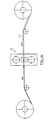
- the outer layers of lead alloys are prepared for roll bonding by conventional vapor degreasing or chemical cleaning. As seen in Fig. 1, the cleaned core material 2 is sandwiched between outer layers 4, 6, 8 of cleaned lead alloys. Three outer layers are shown but the particular number is a matter of choice with two, four or more layers being acceptable. Further, the invention also applies to bi-clad composite, i.e., a lead alloy on only one face of the core or base metal.
- the sandwiched package formed by the several layers is preferably directed to bonding mill 12 through a conventional pressure board 14 disposed adjacent to the bonding mill for centering the layers and is rolled in one pass with sufficient force to reduce the package thickness at least approximately 40% and preferably by about 50-60%.
- the tension in the layers By controlling the tension in the layers, the amount of reduction of the outer lead alloys 4, 6, 8 and the core material can be controlled. In general, it is usually preferred to obtain essentially the same percentage of reduction in thickness in each of the layers to form a composite having the same proportion of layers 2, 4, 6 and 8 before and after bonding.
- a typical composite 16, with a solid state bond created in the roll bonded material between the interfaces, is shown schematically in Fig. 2. The bond between the lead layers and the core created by such bonding is sufficient to pass conventional bonding tests. Further, it has been found that the strength of the bond between the lead alloy layers and the core layer can be increased by ovemight, or longer, room temperature aging.
- Fig. 1a shows a single pass through rolling mill 20; however, in practice, the composite is subjected to multiple passes to obtain the desired finish gauge.
- care is taken to minimize the generation of heat so that the outer lead alloy layers do not soften excessively and start to stick to the rolls. Maintaining the rolling speed to less than approximately 20fpm and the use of lubrication on the rolls are useful in this respect.
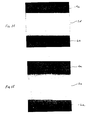
- An example of a two outer layer 4, 6 composite rolled to finish gauge is shown in Fig. 3.
- the finished rolled material is then edge trimmed, if desired, and then may be corrugated in a conventional corrugating mill and sheared to size to form a corrugated article such as plate 20 of Figs 4, 5; plate 22 of Figs 6, 7 and plate 24 of Figs. 8, 9.
- the configurations of plates 20, 22, 24 are useful for making bi-polar lead-acid battery plates.
- the corrugated die may be designed, if desired. in such a way as to leave a picture frame of uncorrugated area on either all four sides, as shown in Fig. 6, or just two edges of the corrugated area as shown in Fig. 8.
- a continuous strip 2a of fully annealed CP (commercially pure) titanium (Grade 50A) having a nominal thickness of 0.021 of an inch was thoroughly cleaned and scratch brushed.
- Two continuous strips 4a, 6a of fully age hardened lead alloy, each of nominal chemical composition of lead - 0.06% calcium-1.5% tin, and each having a nominal thickness of 0.015 of an inch were cleaned by vapor degreasing.
- the cleaned and brushed CP titanium was sandwiched between top and bottom layers of lead alloy and then rolled on a conventional roll bonding mill having essentially dry bonding rolls in one pass with sufficient force to reduce the sandwich package thickness from about 0.051 of an inch to about 0.023 of an inch, i.e., a reduction of about 54% and using minimal tension on the separate layers.
- a sample of the roll bonded composite material thus produced is shown in Fig. 10, a micro-photograph of a cross section of the roll bonded tri-clad composite comprising lead alloy 4a/CP titanium 2a/lead alloy 6a where a solid state bond between the interfaces of the titanium core material and the lead alloys is shown to have been established.
- the tri-clad material was then cold rolled on a convention rolling mill in multiple passes to the desired final gauge of 0.008 of an inch as shown in Fig. 11.
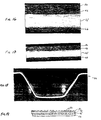
- Fig. 12 shows a cross sectional micro-photograph of the tri-clad lead alloy 4a/304ss 2b/lead alloy 6a showing the establishment of a continuous solid state bond at the lead and the stainless steel interfaces.
- Example 13 shows a cross sectional micro-photograph of the tri-clad lead alloy 4a/1008LCS 2c/lead alloy 6a showing the establishment of a continuous solid state bond at the lead and the 1008LCS interfaces.
- Fig. 14 shows a cross sectional micro-photograph of the tri-clad lead alloy 4a /CDA101 copper 2d/lead alloy 6a showing the establishment of a continuous solid state bond at the lead and the CDA101 copper interfaces.
- Fig. 15 shows a cross sectional micro-photograph of the tri-clad lead alloy 4a/1100 aluminum 2e/lead alloy 6a showing the establishment of a continuous solid state bond at the lead and the 1100 aluminum interfaces.
- a continuous strip of fully annealed 1100 aluminum having a nominal thickness of 0.050 of an inch was thoroughly cleaned and scratch brushed.
- Three continuous strips of lead alloys were prepared for roll bonding by vapor degreasing; the first strip 8a had a nominal chemical composition of lead-0.06% calcium-01.5% tin and a nominal thickness of 0.020 of an inch; the second strip 6b had a nominal chemical composition of lead-0.0 6 % calcium-1.5% tin and a nominal thickness of 0.015 of an inch; and the third strip 4b had a nominal chemical composition of lead-0.06% calcium-3.0% tin-0.04% silver and a nominal thickness of 0.015 of an inch.
- Fig. 16 shows a cross section of the quad-clad lead alloy 8a/lead alloy 4a/aluminum 2f/lead alloy 6b and the establishment of a continuous solid state bond at the lead and the aluminum interfaces.
- the roll bonded quad-clad material of Example VI was edge trimmed on a conventional slitter to remove edge cracks and then rolled in a conventional cluster Sendzimir type finish rolling mill, in multiple passes to thicknesses of 0.020 of an inch, 0.015 of an inch and 0.010 of an inch, respectively. No thermal treatment was applied either after roll bonding or in-between rolling passes.
- Fig. 19 is a cross section of a panel formed from the Fig. 17 material after layer 8a has been etched to form a grid of pockets, as indicated at 8b.
- suitable material e.g., lead oxide paste, is applied to pockets 8b in a known manner.
- Example II This example was carried out in the same manner as Example I except that the core layer used was fully annealed CP (commercially pure) titanium (Grade 35 A) having a nominal thickness of 0.016 of an inch. In the bonding operation the initial sandwich thickness of 0.076 of an inch was reduced to a roll bonded thickness of about 0.032 of an inch. Table I shows parameters used for the roll bonding operation. Top Core Bottom Components Lead Titanium Lead Input Thickness, Inch 0.03 0.016 0.03 Roll Bonded Thickness, Inch 0.012 0.008 0.012 Per cent Reduction 60 50 60 Back tension, PSIG 22 18 22
- Example VI This example was carried out in the same manner as Example VI except that the core layer used was fully annealed IF (interstitial free) low carbon steel LCS AISI 1006 having a nominal thickness of 0.042 of an inch.
- LCS AISI 1006 having a nominal thickness of 0.042 of an inch.
- the initial sandwich thickness of 0.092 of an inch was reduced to a roll bonded thickness of about 0.039 of an inch.
- Table II shows processing parameters used for the roll bonding operation.
- Example III This example was carried out in the same manner as Example VI except that the core layer used was fully annealed 3003 aluminum having a nominal thickness of 0.050 of an inch. In the roll bonding operation the initial sandwich thickness of 0.100 of an inch was reduced to a roll bonded thickness of about 0.049 of an inch. Table III shows processing parameters used for the roll bonding operation. Top Upper Middle Core Bottom Components Lead Lead 3003 Lead Input Thickness. Inch 0.02 0.015 0.05 0.015 Roll Bonded Thickness, Inch 0.01 0.007 0.024 0.008 Per cent reduction 50 53 52 47 Back tension, PSIG 20 25 18
Landscapes
- Chemical & Material Sciences (AREA)
- Engineering & Computer Science (AREA)
- Mechanical Engineering (AREA)
- General Chemical & Material Sciences (AREA)
- Chemical Kinetics & Catalysis (AREA)
- Electrochemistry (AREA)
- Materials Engineering (AREA)
- Metallurgy (AREA)
- Organic Chemistry (AREA)
- Pressure Welding/Diffusion-Bonding (AREA)
- Cell Electrode Carriers And Collectors (AREA)
- Secondary Cells (AREA)
- Battery Electrode And Active Subsutance (AREA)
Applications Claiming Priority (2)
| Application Number | Priority Date | Filing Date | Title |
|---|---|---|---|
| US6996897P | 1997-12-18 | 1997-12-18 | |
| US69968P | 1997-12-18 |
Publications (2)
| Publication Number | Publication Date |
|---|---|
| EP0926751A2 true EP0926751A2 (fr) | 1999-06-30 |
| EP0926751A3 EP0926751A3 (fr) | 1999-12-08 |
Family
ID=22092312
Family Applications (1)
| Application Number | Title | Priority Date | Filing Date |
|---|---|---|---|
| EP98310380A Withdrawn EP0926751A3 (fr) | 1997-12-18 | 1998-12-17 | Procédé de fabrication de matériaux plaqués avec des alliages au plomb et bandes composites fabriquées par un tel procédé |
Country Status (3)
| Country | Link |
|---|---|
| US (2) | US6096145A (fr) |
| EP (1) | EP0926751A3 (fr) |
| JP (1) | JPH11250917A (fr) |
Families Citing this family (12)
| Publication number | Priority date | Publication date | Assignee | Title |
|---|---|---|---|---|
| US6777126B1 (en) * | 1999-11-16 | 2004-08-17 | Gencell Corporation | Fuel cell bipolar separator plate and current collector assembly and method of manufacture |
| KR100627043B1 (ko) * | 2000-06-07 | 2006-09-22 | 삼성테크윈 주식회사 | 이차 전지의 집전체 제조 장치와, 이를 이용한 집전체제조 방법 |
| JP2003031224A (ja) * | 2001-04-10 | 2003-01-31 | Toyo Kohan Co Ltd | 二次電池用の軽量集電体 |
| US8387228B2 (en) | 2004-06-10 | 2013-03-05 | Ati Properties, Inc. | Clad alloy substrates and method for making same |
| JP4983023B2 (ja) * | 2006-01-12 | 2012-07-25 | パナソニック株式会社 | 鉛蓄電池用エキスパンド格子体の製造方法および鉛蓄電池用エキスパンド格子体の製造装置 |
| US20070272430A1 (en) * | 2006-05-26 | 2007-11-29 | Tuffile Charles D | Asymmetric communication cable shielding |
| FR2957280B1 (fr) * | 2010-03-12 | 2012-07-13 | Centre Nat Rech Scient | Procede de fabrication d'un complexe metallique |
| CN103736729B (zh) * | 2014-01-22 | 2015-07-29 | 太原科技大学 | 一种轧制制备金属复合板带的方法 |
| DE102015110361B4 (de) * | 2015-06-26 | 2019-12-24 | Thyssenkrupp Ag | Verfahren zum Herstellen eines Werkstoffverbundes in einer Walzanlage und Verwendung der Walzanlage |
| CN106950896B (zh) * | 2017-05-19 | 2019-05-31 | 河北工业大学 | 基于Labview与WiFi的锂电池极片轧机设备无线监控调试平台 |
| CN208539000U (zh) * | 2018-03-15 | 2019-02-22 | 宁德时代新能源科技股份有限公司 | 二次电池集流体的焊接装置及加工设备 |
| JP7171216B2 (ja) * | 2018-04-10 | 2022-11-15 | 東洋鋼鈑株式会社 | 圧延接合体及び圧延接合体の製造方法 |
Family Cites Families (13)
| Publication number | Priority date | Publication date | Assignee | Title |
|---|---|---|---|---|
| GB745511A (en) * | 1951-01-05 | 1956-02-29 | Metals & Controls Corp | Method for the solid-phase bonding of metals |
| US3882648A (en) * | 1972-11-17 | 1975-05-13 | Texas Instruments Inc | Method for improving the stainless steel surface finish on a composite metal laminate |
| US4467954A (en) * | 1981-10-05 | 1984-08-28 | Olin Corporation | Process for obtaining a composite article |
| JPS60143398U (ja) * | 1984-03-05 | 1985-09-24 | 三菱電線工業株式会社 | 遮蔽材 |
| WO1986003343A1 (fr) * | 1984-11-19 | 1986-06-05 | Revere Copper And Brass Incorporated | Bande laminee d'alliage de plomb pour grilles d'accumulateurs; cellules electrochimiques utilisant celle-ci |
| JPS61124064A (ja) * | 1984-11-20 | 1986-06-11 | Matsushita Electric Ind Co Ltd | 鉛蓄電池用格子体及びその製造法 |
| KR900003984B1 (ko) * | 1985-02-26 | 1990-06-07 | 마쓰시다덴기산교 가부시기가이샤 | 납축전지용 그리드 및 그 제조법 |
| US4629516A (en) * | 1985-04-01 | 1986-12-16 | Asarco Incorporated | Process for strengthening lead-antimony alloys |
| US4939051A (en) * | 1986-06-05 | 1990-07-03 | Matsushita Electric Industrial Co., Ltd. | Grid for use in lead acid batteries and process for producing same |
| JPS63149140A (ja) * | 1986-12-15 | 1988-06-21 | 大同メタル工業株式会社 | 複合摺動体 |
| US5339873A (en) * | 1993-06-10 | 1994-08-23 | Derafe, Ltd. | Cored battery plates for lead/acid batteries |
| AU7513594A (en) * | 1994-07-22 | 1996-02-22 | Bipolar Power Corporation | Battery plates with lightweight cores |
| EP0795918A3 (fr) * | 1996-03-12 | 2000-08-23 | Lucent Technologies Inc. | Batterie au plomb-acide avec structure d'électrode et procédé de sa fabrication |
-
1998
- 1998-08-31 US US09/143,553 patent/US6096145A/en not_active Expired - Lifetime
- 1998-12-17 EP EP98310380A patent/EP0926751A3/fr not_active Withdrawn
- 1998-12-17 JP JP10359572A patent/JPH11250917A/ja active Pending
-
2000
- 2000-05-11 US US09/568,829 patent/US6475675B1/en not_active Expired - Fee Related
Also Published As
| Publication number | Publication date |
|---|---|
| US6475675B1 (en) | 2002-11-05 |
| US6096145A (en) | 2000-08-01 |
| EP0926751A3 (fr) | 1999-12-08 |
| JPH11250917A (ja) | 1999-09-17 |
Similar Documents
| Publication | Publication Date | Title |
|---|---|---|
| US6096145A (en) | Method of making clad materials using lead alloys and composite strips made by such method | |
| US4939051A (en) | Grid for use in lead acid batteries and process for producing same | |
| US4805277A (en) | Process for producing a grid for use in lead acid batteries | |
| WO2011139331A1 (fr) | Accumulateur au plomb-acide à longue durée de vie possédant des grilles de cœur en titane et son procédé de fabrication | |
| CN106058135A (zh) | 电池负极引线材料用包层材料、电池负极引线材料用包层材料的制造方法和电池 | |
| CN113102503A (zh) | 一种三明治结构的钛铝复合超薄板材的制备方法 | |
| CN113617840B (zh) | 一种多金属多层梯度复合材料的制备方法 | |
| EP0795917A2 (fr) | Batterie au plomp-acide avec structure d'électrode résistant à la corrosion et procédé pour sa fabrication | |
| KR20190114814A (ko) | 리튬 이온 전지 집전체용 압연 동박 및 리튬 이온 전지 | |
| JP3742340B2 (ja) | アルミニウム複合材料の製造方法 | |
| US6699620B2 (en) | Lead alloy surface coating for positive lead-acid battery grids and methods of use | |
| JP3521106B2 (ja) | 鉛蓄電池の電極製造方法 | |
| EP0252189B1 (fr) | Procédé de fabrication d'une grille pour accumulateurs au plomb | |
| JP4612483B2 (ja) | アルミニウム合金−チタン溝付き複合板の製造方法 | |
| CN1053133C (zh) | 一种铝-钛-铝钎焊料三层轧制复合板 | |
| US20250140775A1 (en) | Method for increasing mechanical strength of lithium metal and 3d anode current collector of anode electrode | |
| US4551219A (en) | Flush edge protected metal laminates | |
| JPS62501318A (ja) | 蓄電池グリッド用積層鉛合金ストリップおよびこれを利用した電気化学的電池 | |
| EP1615277B1 (fr) | Accumulateur au plomb, et procede de production d'un corps en treillis pour accumulateur au plomb | |
| CN221125987U (zh) | 一种锂电池负极和锂电池 | |
| JPH09115524A (ja) | 鉛蓄電池の極板格子及びその製造方法 | |
| JPH0661631B2 (ja) | チタン面肌荒れのないチタンクラッド鋼板の製造方法及びクラッド用分離剤 | |
| EP1278257A2 (fr) | Grille positive recouverte de batterie au plomb et méthode de formation | |
| JPH0465755B2 (fr) | ||
| JPH10128529A (ja) | アルミニウムハニカムパネルの製造方法 |
Legal Events
| Date | Code | Title | Description |
|---|---|---|---|
| PUAI | Public reference made under article 153(3) epc to a published international application that has entered the european phase |
Free format text: ORIGINAL CODE: 0009012 |
|
| AK | Designated contracting states |
Kind code of ref document: A2 Designated state(s): DE FR GB IT NL |
|
| AX | Request for extension of the european patent |
Free format text: AL;LT;LV;MK;RO;SI |
|
| PUAL | Search report despatched |
Free format text: ORIGINAL CODE: 0009013 |
|
| AK | Designated contracting states |
Kind code of ref document: A3 Designated state(s): AT BE CH CY DE DK ES FI FR GB GR IE IT LI LU MC NL PT SE |
|
| AX | Request for extension of the european patent |
Free format text: AL;LT;LV;MK;RO;SI |
|
| 17P | Request for examination filed |
Effective date: 20000427 |
|
| AKX | Designation fees paid |
Free format text: DE FR GB IT NL |
|
| 17Q | First examination report despatched |
Effective date: 20030502 |
|
| RAP1 | Party data changed (applicant data changed or rights of an application transferred) |
Owner name: ENGINEERED MATERIALS SOLUTIONS, INC. |
|
| GRAP | Despatch of communication of intention to grant a patent |
Free format text: ORIGINAL CODE: EPIDOSNIGR1 |
|
| STAA | Information on the status of an ep patent application or granted ep patent |
Free format text: STATUS: THE APPLICATION IS DEEMED TO BE WITHDRAWN |
|
| 18D | Application deemed to be withdrawn |
Effective date: 20051011 |