EP0927559A2 - Verfahren zum herstellen medizinischer Ballonkatheter - Google Patents
Verfahren zum herstellen medizinischer Ballonkatheter Download PDFInfo
- Publication number
- EP0927559A2 EP0927559A2 EP98310685A EP98310685A EP0927559A2 EP 0927559 A2 EP0927559 A2 EP 0927559A2 EP 98310685 A EP98310685 A EP 98310685A EP 98310685 A EP98310685 A EP 98310685A EP 0927559 A2 EP0927559 A2 EP 0927559A2
- Authority
- EP
- European Patent Office
- Prior art keywords
- parison
- mold
- diameter
- balloon
- temperature
- Prior art date
- Legal status (The legal status is an assumption and is not a legal conclusion. Google has not performed a legal analysis and makes no representation as to the accuracy of the status listed.)
- Withdrawn
Links
Images


Classifications
-
- A—HUMAN NECESSITIES
- A61—MEDICAL OR VETERINARY SCIENCE; HYGIENE
- A61M—DEVICES FOR INTRODUCING MEDIA INTO, OR ONTO, THE BODY; DEVICES FOR TRANSDUCING BODY MEDIA OR FOR TAKING MEDIA FROM THE BODY; DEVICES FOR PRODUCING OR ENDING SLEEP OR STUPOR
- A61M25/00—Catheters; Hollow probes
- A61M25/10—Balloon catheters
- A61M25/1027—Making of balloon catheters
- A61M25/1029—Production methods of the balloon members, e.g. blow-moulding, extruding, deposition or by wrapping a plurality of layers of balloon material around a mandril
-
- B—PERFORMING OPERATIONS; TRANSPORTING
- B29—WORKING OF PLASTICS; WORKING OF SUBSTANCES IN A PLASTIC STATE IN GENERAL
- B29C—SHAPING OR JOINING OF PLASTICS; SHAPING OF MATERIAL IN A PLASTIC STATE, NOT OTHERWISE PROVIDED FOR; AFTER-TREATMENT OF THE SHAPED PRODUCTS, e.g. REPAIRING
- B29C49/00—Blow-moulding, i.e. blowing a preform or parison to a desired shape within a mould; Apparatus therefor
- B29C49/18—Blow-moulding, i.e. blowing a preform or parison to a desired shape within a mould; Apparatus therefor using several blowing steps
-
- A—HUMAN NECESSITIES
- A61—MEDICAL OR VETERINARY SCIENCE; HYGIENE
- A61M—DEVICES FOR INTRODUCING MEDIA INTO, OR ONTO, THE BODY; DEVICES FOR TRANSDUCING BODY MEDIA OR FOR TAKING MEDIA FROM THE BODY; DEVICES FOR PRODUCING OR ENDING SLEEP OR STUPOR
- A61M25/00—Catheters; Hollow probes
- A61M25/10—Balloon catheters
- A61M25/1027—Making of balloon catheters
- A61M25/1034—Joining of shaft and balloon
-
- B—PERFORMING OPERATIONS; TRANSPORTING
- B29—WORKING OF PLASTICS; WORKING OF SUBSTANCES IN A PLASTIC STATE IN GENERAL
- B29C—SHAPING OR JOINING OF PLASTICS; SHAPING OF MATERIAL IN A PLASTIC STATE, NOT OTHERWISE PROVIDED FOR; AFTER-TREATMENT OF THE SHAPED PRODUCTS, e.g. REPAIRING
- B29C49/00—Blow-moulding, i.e. blowing a preform or parison to a desired shape within a mould; Apparatus therefor
- B29C49/42—Component parts, details or accessories; Auxiliary operations
- B29C49/46—Component parts, details or accessories; Auxiliary operations characterised by using particular environment or blow fluids other than air
- B29C2049/4602—Blowing fluids
- B29C2049/465—Blowing fluids being incompressible
-
- B—PERFORMING OPERATIONS; TRANSPORTING
- B29—WORKING OF PLASTICS; WORKING OF SUBSTANCES IN A PLASTIC STATE IN GENERAL
- B29C—SHAPING OR JOINING OF PLASTICS; SHAPING OF MATERIAL IN A PLASTIC STATE, NOT OTHERWISE PROVIDED FOR; AFTER-TREATMENT OF THE SHAPED PRODUCTS, e.g. REPAIRING
- B29C49/00—Blow-moulding, i.e. blowing a preform or parison to a desired shape within a mould; Apparatus therefor
- B29C49/42—Component parts, details or accessories; Auxiliary operations
- B29C49/78—Measuring, controlling or regulating
- B29C49/786—Temperature
- B29C2049/7861—Temperature of the preform
- B29C2049/7862—Temperature of the preform characterised by temperature values or ranges
-
- B—PERFORMING OPERATIONS; TRANSPORTING
- B29—WORKING OF PLASTICS; WORKING OF SUBSTANCES IN A PLASTIC STATE IN GENERAL
- B29C—SHAPING OR JOINING OF PLASTICS; SHAPING OF MATERIAL IN A PLASTIC STATE, NOT OTHERWISE PROVIDED FOR; AFTER-TREATMENT OF THE SHAPED PRODUCTS, e.g. REPAIRING
- B29C49/00—Blow-moulding, i.e. blowing a preform or parison to a desired shape within a mould; Apparatus therefor
- B29C49/42—Component parts, details or accessories; Auxiliary operations
- B29C49/78—Measuring, controlling or regulating
- B29C49/786—Temperature
- B29C2049/7864—Temperature of the mould
- B29C2049/78645—Temperature of the mould characterised by temperature values or ranges
-
- B—PERFORMING OPERATIONS; TRANSPORTING
- B29—WORKING OF PLASTICS; WORKING OF SUBSTANCES IN A PLASTIC STATE IN GENERAL
- B29C—SHAPING OR JOINING OF PLASTICS; SHAPING OF MATERIAL IN A PLASTIC STATE, NOT OTHERWISE PROVIDED FOR; AFTER-TREATMENT OF THE SHAPED PRODUCTS, e.g. REPAIRING
- B29C2949/00—Indexing scheme relating to blow-moulding
- B29C2949/07—Preforms or parisons characterised by their configuration
- B29C2949/079—Auxiliary parts or inserts
- B29C2949/08—Preforms made of several individual parts, e.g. by welding or gluing parts together
-
- B—PERFORMING OPERATIONS; TRANSPORTING
- B29—WORKING OF PLASTICS; WORKING OF SUBSTANCES IN A PLASTIC STATE IN GENERAL
- B29C—SHAPING OR JOINING OF PLASTICS; SHAPING OF MATERIAL IN A PLASTIC STATE, NOT OTHERWISE PROVIDED FOR; AFTER-TREATMENT OF THE SHAPED PRODUCTS, e.g. REPAIRING
- B29C49/00—Blow-moulding, i.e. blowing a preform or parison to a desired shape within a mould; Apparatus therefor
- B29C49/08—Biaxial stretching during blow-moulding
- B29C49/10—Biaxial stretching during blow-moulding using mechanical means for prestretching
-
- B—PERFORMING OPERATIONS; TRANSPORTING
- B29—WORKING OF PLASTICS; WORKING OF SUBSTANCES IN A PLASTIC STATE IN GENERAL
- B29C—SHAPING OR JOINING OF PLASTICS; SHAPING OF MATERIAL IN A PLASTIC STATE, NOT OTHERWISE PROVIDED FOR; AFTER-TREATMENT OF THE SHAPED PRODUCTS, e.g. REPAIRING
- B29C49/00—Blow-moulding, i.e. blowing a preform or parison to a desired shape within a mould; Apparatus therefor
- B29C49/42—Component parts, details or accessories; Auxiliary operations
- B29C49/64—Heating or cooling preforms, parisons or blown articles
- B29C49/6409—Thermal conditioning of preforms
- B29C49/6418—Heating of preforms
- B29C49/64195—Heated by the mould
-
- B—PERFORMING OPERATIONS; TRANSPORTING
- B29—WORKING OF PLASTICS; WORKING OF SUBSTANCES IN A PLASTIC STATE IN GENERAL
- B29C—SHAPING OR JOINING OF PLASTICS; SHAPING OF MATERIAL IN A PLASTIC STATE, NOT OTHERWISE PROVIDED FOR; AFTER-TREATMENT OF THE SHAPED PRODUCTS, e.g. REPAIRING
- B29C49/00—Blow-moulding, i.e. blowing a preform or parison to a desired shape within a mould; Apparatus therefor
- B29C49/42—Component parts, details or accessories; Auxiliary operations
- B29C49/64—Heating or cooling preforms, parisons or blown articles
- B29C49/6604—Thermal conditioning of the blown article
- B29C49/6605—Heating the article, e.g. for hot fill
-
- B—PERFORMING OPERATIONS; TRANSPORTING
- B29—WORKING OF PLASTICS; WORKING OF SUBSTANCES IN A PLASTIC STATE IN GENERAL
- B29K—INDEXING SCHEME ASSOCIATED WITH SUBCLASSES B29B, B29C OR B29D, RELATING TO MOULDING MATERIALS OR TO MATERIALS FOR MOULDS, REINFORCEMENTS, FILLERS OR PREFORMED PARTS, e.g. INSERTS
- B29K2077/00—Use of PA, i.e. polyamides, e.g. polyesteramides or derivatives thereof, as moulding material
-
- B—PERFORMING OPERATIONS; TRANSPORTING
- B29—WORKING OF PLASTICS; WORKING OF SUBSTANCES IN A PLASTIC STATE IN GENERAL
- B29K—INDEXING SCHEME ASSOCIATED WITH SUBCLASSES B29B, B29C OR B29D, RELATING TO MOULDING MATERIALS OR TO MATERIALS FOR MOULDS, REINFORCEMENTS, FILLERS OR PREFORMED PARTS, e.g. INSERTS
- B29K2105/00—Condition, form or state of moulded material or of the material to be shaped
- B29K2105/25—Solid
- B29K2105/253—Preform
- B29K2105/258—Tubular
-
- B—PERFORMING OPERATIONS; TRANSPORTING
- B29—WORKING OF PLASTICS; WORKING OF SUBSTANCES IN A PLASTIC STATE IN GENERAL
- B29L—INDEXING SCHEME ASSOCIATED WITH SUBCLASS B29C, RELATING TO PARTICULAR ARTICLES
- B29L2031/00—Other particular articles
- B29L2031/753—Medical equipment; Accessories therefor
- B29L2031/7542—Catheters
Definitions
- This invention relates to balloon catheters which are especially useful in medical dilatation procedures.
- Balloon catheters have been found to be useful for the relief of arterial stenosis as in percutaneous transluminal angioplasty (PTA) and percutaneous transluminal coronary angioplasty (PTCA) procedures and in many other medical applications involving not only insertion into blood vessels but also involving insertion into a variety of body cavities.
- Balloons can be made from a variety of commercially available materials which are generally of the thermoplastic polymeric type. Included among the known materials are polyolefins, polyvinyl chloride, polyethylene terephthalate, polyamides, polyetheramides and the like. Balloons made from such materials exhibit the properties of the materials from which they are made.
- toughness, flexibility, tensile strength, and elasticity are properties which can be produced in balloons from off-the-shelf polymeric materials.
- polyamides were thoroughly characterized in their structure and properties and disclosed in various patents of the DuPont company in the late 1930s and early 1940s.
- One such property is their ability to make high strength, thin-walled balloon structures by blowing and stretching a tube in a mold to produce biaxial orientation of the material as disclosed in U.S. patent 2,307,817 issued to Austin.
- the same balloon materials have been used to make balloons for medical catheters as disclosed in U.S. Patent Re. 32,983 issued to Levy or U.S. Patent 5,055,024 issued to Jackowski et al.
- a catheter balloon is made by forming a tubular parison made of a drawable polymer, heating the parison at a temperature in the range from the second-order transition temperature to the first-order transition temperature of the polymer used, and then stretching it in the direction of its axis and then inflating it radially while heated. The stretched and inflated parison is then cooled below the second-order transition temperature of the polymer, and then deflated.
- the resulting balloon has a cylindrical portion of a substantially uniform desired diameter and desired wall thickness but tapered portions of wall thicknesses which are thicker than desired thicknesses at the front and rear of the cylindrical portion and at the connecting portions at the front and the rear of the tapered portions.
- the balloon is subjected to a redrawing operation in the tapered portions of the balloon to reduce their wall thicknesses to desired thicknesses by stretching the tapered portions in the direction of the axis of the balloon.
- the disclosed method of redrawing requires additional processing steps which are undesirable in a mass-production balloon. It is therefore an object of the invention to form the balloon in a single molding process in which the cylindrical portion of the balloon, the tapered portions of the balloon and the connecting portions of the balloon are all formed in a single molding operation which makes the balloon ready for attachment to the catheter.
- the present invention provides a method for making a medical balloon catheter comprising the steps of: providing a parison made of a biaxial orientable polyamide or polyetheramide material, the parison having a first portion of a length of tubing having a first outer diameter and a second portion of the parison having a second, smaller outer diameter; providing a mold having a generally cylindrical shape having a first, distal portion having a first mold diameter, a second, intermediate portion having a second mold diameter and a third, proximal portion having a third mold diameter, the first mold diameter being smaller than the first outer diameter of the parison and larger than the second, smaller outer diameter portion of the parison; placing the parison in the mold such that a portion of the second, smaller diameter portion of the parison resides within the first, distal portion of the mold and a portion of the first portion of the length of the parison resides within the intermediate and proximal mold portions; applying a first pressure into the parison of the mold; heating the pressur
- the starting material is in the form of a parison which can be made from a length of extruded tubing made of a biaxial orientable polyamide or polyetheramide material.
- the tubing can be a nylon or polyether block amide material having 6 to 12 carbons in the repeating unit.
- the parison can be made by longitudinally stretching a portion of the tubing such that the diameter of the tubing is necked-down in diameter in that portion of the tubing when compared with the rest of the tubing.
- the necked-down diameter can be about 40-85% of the diameter of the rest of the tubing.
- the parison is placed into a mold having several sections.
- the first section is a generally cylindrical section forming a distal attachment portion of the balloon.
- a second, intermediate portion of the mold also has a generally cylindrical configuration but has a larger diameter which forms the central portion of the balloon.
- a third generally cylindrical section of the mold forms the proximal attachment portion of the balloon. This third or proximal section is larger than the first cylindrical section in order to allow the balloon to conform to the shape of the catheter which generally has a larger outer diameter at the proximal attachment point.
- the intermediate portion of the mold is, of course, larger than either the first, distal section or the third, proximal section of the mold.
- the mold also includes smooth, tapering transitions between the cylindrical sections of the mold with the preferred form being a conical taper or cone which would be provided at each transition.
- the parison is sized so that the full diameter of the tubing is larger in outer diameter than the inner diameter of the first, distal portion of the mold but is smaller in outer diameter than the inner diameter of the third, proximal portion of the mold.
- the relation between the size of the intermediate portion of the mold and the parison is such that the parison can be oriented to a hoop strength in the range of about 103 MPa-241 MPa (15,000-35,000 psi) -- typically the mold being 5 to 8 times larger in internal diameter than the interior diameter of the parison.
- the parison is placed into the mold such that a portion of the necked-down portion of the tubing resides within the first, distal portion of the mold and a portion of the full diameter tubing resides within the intermediate and proximal mold portions.
- the parison includes a relatively abrupt transition between the original diameter and the necked-down diameter so that the parison can be inserted into the mold until the transition rests against the opening to the first, distal section of the mold.
- the ends of the parison extend out of the mold such that they can be clamped and such that a pressurized fluid can be admitted into the parison. Once the parison is secured in the mold, a first pressure is applied into the tubing.
- a pressure in the range of about 2-3.1 MPA (300-450 psi) is generally sufficient.
- the tubing is then heated in the mold to a temperature above a glass transition temperature of the material. Although the heating temperature will depend on the material, a temperature in the range of about 104.4-140.6°C (220-285°F) will generally suffice.
- the tubing is then longitudinally stretched at a controlled velocity and distance which thins out the material thickness in the parison to the point where it will radially expand at the temperature and pressure in the parison.
- the material of the parison is thus biaxially oriented.
- the dwell time should be at least 5 seconds after the desired temperature set point has been reached.
- the longitudinal stretching then commences for a preset rate and distance. Preferably both ends of the parison are stretched simultaneously to about the same distance.
- the rate of stretching may be varied to maintain a uniform position and stretch of the portion of the parison within the mold. Typically, the thinner portion of the parison will be stretched at a slightly higher rate.
- the total amount of stretch will depend on the material characteristics and the desired strength and wall thickness for the balloon. Typically a stretch of about 4-7 times the length of the balloon may be applied.
- a second, higher pressure is then applied into the biaxially oriented tubing in order to complete the formation of the balloon by pressing the tubing against the tapering cone sections of the mold or against any other small details which are to be applied by the mold.
- this pressure is about 15-40% higher than the pressure at which the parison was initially expanded and stretched.
- the balloon so formed can also be annealed in the mold at the same time as the high pressure forming to increase crystallinity and reduce internal stresses within the material. The parison is therefore kept in contact with the mold for a period of time and under conditions which will increase the crystallinity of the material.
- the balloon is then cooled while still under pressure in the mold to a temperature below the glass transition temperature of the material. It can then be removed from the mold.
- the balloon can then be attached by attaching the cooled tubing to a distal end of a catheter body. Since the distal attachment portion of the balloon is smaller in inside diameter than the inside diameter of the proximal attachment portion of the balloon, the balloon can be attached to a catheter that includes a tapered or stepped distal end without further shaping or modification of the balloon attachment portions.
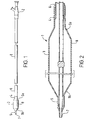
- Fig. 1 is a side view of a balloon catheter made according to the present invention.
- Fig. 2 is a side sectional view of the distal end of the catheter of Fig. 1.
- Fig. 3 is an exploded side sectional view of a mold assembly for making a balloon according to the invention.
- Fig. 4 is a partial side view of a parison for making a balloon according to the present invention.
- Fig. 5 is a flow chart of the method of the present invention.
- the balloon catheter 1 made according to the present invention has a conventional appearance with a hub 2 at a proximal end of the catheter 1 and a balloon 3 at a distal end of the catheter 1.
- the balloon 3 has a proximal end 4 by which the balloon 3 is attached at a proximal end to a tube 6 of the catheter 1.
- the balloon 3 also has a distal end 5 by which the balloon 3 is attached to a second tube 7 of the catheter 1.
- the balloon 3 is also shown with a central, cylindrical portion 8 and proximal and distal cone portions 9a and 9b.
- the attachment of the balloon 3 to the catheter 1 can be made by adhesive, thermal bonding or other conventional methods.
- the starting shape is in the form of a parison 10 made from a length of extruded tubing made of a biaxial orientable polyamide or polyetheramide material.
- the parison 10 is made by longitudinally stretching a portion of the tubing such that the tubing has a portion 11 with a necked-down diameter and a full diameter in another portion 12 of the tubing.
- the necked-down diameter portion 11 can be about 40-85% of the full diameter portion 12 of the tubing.
- the parison 10 preferably includes a relatively abrupt transition 13 between the original diameter portion 12 and the necked-down diameter.
- the parison 10 is placed into a mold 20 having several sections.
- the first section 22 is a generally cylindrical section having a bore 23 therethrough forming the distal attachment portion 5 of the balloon 3.
- a second, intermediate portion 24 of the mold 20 also has a generally cylindrical configuration but has a larger diameter bore 25 which forms the central portion 8 of the balloon 3.
- a third generally cylindrical portion 26 of the mold 20 has a bore 27 therethrough which forms the proximal attachment portion 4 of the balloon 3.
- the bore 27 of the third or proximal portion 26 is larger than the bore 23 of the first cylindrical portion 22 in order to allow the balloon 3 to conform to the shape of the catheter 1 which generally has a larger outer diameter at the proximal attachment 4.
- the intermediate portion 24 of the mold 20 has a larger bore 25 than either the bore 23 of the first, distal portion 22 or the bore 27 of the third, proximal portion 26 of the mold 20.
- the mold also includes smooth, tapering transitions 28a, 28b between the cylindrical sections 22, 24, 26 of the mold 20 with the preferred form being a conical taper or cone which would be provided at each transition 28a, 28b.
- the parison 10 is sized so that the full diameter portion 12 is larger in outer diameter than the bore 23 of the first, distal portion 22 of the mold 20 but is smaller in outer diameter than the bore 27 in the third, proximal portion 26 of the mold 20.
- the full diameter portion 12 is about 10 to 50% smaller than the bore 27 in the proximal portion 26 and the necked-down portion is about 10 to 50% smaller than the bore 23 of the first, distal portion 22 in order to ensure proper centering of the parison 10 within the mold 20.
- the relation between the size of the intermediate portion 24 of the mold 20 and the parison 10 is such that the parison 10 can be oriented to a hoop strength in the range of about 103 MPA-241 MPa (15,000-35,000 psi) -- typically the bore 25 of the mold 20 being 5 to 8 times larger in internal diameter than the internal diameter of the full diameter portion 12 of the parison 10.
- the mold 20 is assembled by inserting the intermediate portion 24 centrally into a housing 29 and also inserting the distal portion 22 and proximal portion 26 into the housing 29 such that the three mold sections 22, 24, 26 are in abutting relation.
- extruded thin wall tubing 30 is stretched 35 to form a parison 10.
- This stretching can be performed on the tubing at room temperature or after the tubing has been heated.
- the resulting parison 10 is inserted 40 into the mold 20 such that a portion of the necked-down portion 11 of the parison 10 resides within the bore 23 of the first, distal portion 22 of the mold 20 and a portion of the full diameter 12 resides within the bores 25, 27 of the intermediate and proximal mold portions 24, 26 until the transition 13 rests against the opening of the bore 23 to the first, distal portion 22 of the mold 20.
- the ends of the parison 10 then extend out of the mold 20 such that they can be clamped 45 and lightly tensioned 50 such that a pressurized fluid can be admitted into the parison 10.
- a first pressure (P1) is applied 55 into the parison 10.
- a pressure in the range of about 2-3.1 MPA (300-450 psi) is generally sufficient.
- the parison 10 is then heated in the mold 20 to a preset temperature (T1) 60 above a glass transition temperature of the material such that the parison 10 is both heated to T1 and pressurized within the mold 20 at the first pressure P1.
- the heating temperature T1 will depend on the material, a temperature in the range of about 104.4-140.6°C (220-285°F) will generally suffice.
- the preset temperature T1 Once the preset temperature T1 has been reached, the parison 10 is then longitudinally stretched 70 to cause the biaxial orientation of the material.
- the longitudinal stretching 70 causes the parison 10 to simultaneously expand as the wall of the parison 10 becomes thinned-out and less resistant to radial expansion.
- the stretching 70 commences it is desirable to have a short dwell time 65 at the preset temperature T1 in order to ensure that the parison 10 has reached substantial temperature uniformity at the preset temperature T1.
- the dwell time 65 should be at least 5 seconds and preferably 10 seconds after the desired temperature set point T1 has been reached.
- the longitudinal stretching 70 then commences for a preset rate and distance. Preferably both ends of the parison 10 are stretched simultaneously to about the same distance.
- the rate of stretching 70 may be varied to maintain a uniform position and stretch of the portion of the parison 10 within the mold 20. Typically, the thinner portion 11 of the parison 10 will be stretched at a slightly higher rate.
- the total amount of stretch applied in the longitudinal stretch 70 will depend on the material characteristics and the desired strength and wall thickness for the balloon. Typically a longitudinal stretch 70 of about 4-7 times the length of the balloon 3 may be applied. It will be appreciated that during the longitudinal stretch 70, the portion 11 of the parison 10 which was initially stretched from the tubing 30 will be pulled out of the mold 20 and will not be incorporated into the balloon 3.
- the stretch portion 11 of the parison 10 merely constitutes a secure handle from which to draw the balloon and could conceivably be formed in shapes other than drawn tubing.
- a second, higher pressure (P2) is then applied 80 into the biaxially oriented parison in order to complete the formation of the balloon 3 by pressing the parison against the tapering cone sections 28a, 28b of the mold 20.
- this pressure is about 15-40% higher than the pressure at which the parison 10 was initially expanded and stretched.
- the balloon 3 so formed can be annealed in the mold 20 as pressure P2 is applied to reduce internal stresses within the material by heating the fully blown parison to a temperature T2 75 which is typically higher than the molding temperature T1 and which is sufficient to increase crystallinity and reduce stresses within the material.
- this temperature T2 will be in the range of about 121.1° to 154.4°C (250°F to 310°F) depending on the material being used and the expansion temperature T1 which was selected.
- the dwell time 85 required will depend on the temperature of the mold 20 and the requirements of the material being used.
- a dwell time of at least 5 seconds and preferably 10 seconds is applied after pressure P2 has been reached.
- the parison, now in the shape of balloon 3, is then cooled 90 while still under pressure in the mold 20 to a temperature below the glass transition temperature of the material.
- the balloon 3 is then removed from the mold 20.
- the balloon 3 can then be attached 95 by removing the excess portions of the parison at the ends of the balloon and then bonding it to a distal end of a catheter body.
- the balloon 3 can be attached to a catheter 1 that includes a tapered or stepped distal end without further shaping or modification of the balloon attachment portions 4, 5. Also, depending on the tolerances required in the method for bonding the balloon to the catheter, the diameter of the ends can be adjusted by inserting a mandrel of the precise diameter required into an end of the balloon and heating just the end portion briefly to ensure the correct size of the portion to be bonded.
- the balloon 3 can be folded and heat set on the catheter 1 at about human body temperature of 37°C to ensure that the balloon 3 is dimensionally stabilized for use at that temperature. It will be appreciated that many of these steps may be performed by automated or semi-automated equipment as is well known by those skilled in the art such that the process can be completed at a low per unit cost.
- the following examples further describe the method of the invention:
- a balloon of 3.0 mm rated diameter and 20 mm rated length was made by the method of the invention.
- a parison was made from extruded tubing of a polyether block amide copolymer sold under the trade name Pebax® 7233 (Atochem North America, Inc., Philadelphia Pa.).
- the tubing had an internal diameter of 0.425 mm (.017 inches) and an outer diameter of 1.025 mm (.041 inches). A portion of the tubing was drawn to a diameter of about 50% of the initial tubing diameter.
- the resulting parison was placed into a mold having a nominal bore at the distal portion of the mold of 0.8375 mm (0.0335 inch), at the intermediate portion of the mold of 2.95 mm (0.1181 inch) and at the proximal end of the mold of 1.075 mm (0.0430 inch).
- the balloon was then removed from the mold.
- the balloons made by this method had an average double wall thickness of about 1.50 mils, an average burst pressure of about 2.3 MPA (340 psi) and reached their rated inflation diameter at about 827 kPa (120 psi).
Landscapes
- Health & Medical Sciences (AREA)
- Engineering & Computer Science (AREA)
- Heart & Thoracic Surgery (AREA)
- Manufacturing & Machinery (AREA)
- Life Sciences & Earth Sciences (AREA)
- Pulmonology (AREA)
- Child & Adolescent Psychology (AREA)
- Biophysics (AREA)
- Mechanical Engineering (AREA)
- Anesthesiology (AREA)
- Biomedical Technology (AREA)
- Hematology (AREA)
- Animal Behavior & Ethology (AREA)
- General Health & Medical Sciences (AREA)
- Public Health (AREA)
- Veterinary Medicine (AREA)
- Media Introduction/Drainage Providing Device (AREA)
Applications Claiming Priority (2)
| Application Number | Priority Date | Filing Date | Title |
|---|---|---|---|
| US2676 | 1998-01-05 | ||
| US09/002,676 US5948345A (en) | 1998-01-05 | 1998-01-05 | Method for making medical balloon catheter |
Publications (2)
| Publication Number | Publication Date |
|---|---|
| EP0927559A2 true EP0927559A2 (de) | 1999-07-07 |
| EP0927559A3 EP0927559A3 (de) | 1999-12-01 |
Family
ID=21701928
Family Applications (1)
| Application Number | Title | Priority Date | Filing Date |
|---|---|---|---|
| EP98310685A Withdrawn EP0927559A3 (de) | 1998-01-05 | 1998-12-23 | Verfahren zum herstellen medizinischer Ballonkatheter |
Country Status (2)
| Country | Link |
|---|---|
| US (1) | US5948345A (de) |
| EP (1) | EP0927559A3 (de) |
Cited By (5)
| Publication number | Priority date | Publication date | Assignee | Title |
|---|---|---|---|---|
| WO2000027461A1 (en) * | 1998-11-09 | 2000-05-18 | Datascope Investment Corp. | Intra-aortic balloon catheter having an ultra-thin stretch blow molded balloon membrane |
| CN102186509A (zh) * | 2008-09-03 | 2011-09-14 | 波士顿科学国际有限公司 | 多层医用球囊 |
| WO2015136232A1 (en) * | 2014-03-08 | 2015-09-17 | Smiths Medical International Limited | Tracheostomy tube assemblies, inner cannulae and methods of manufacture |
| EP2825363A4 (de) * | 2012-03-14 | 2015-10-14 | Access Scient Llc | Flexibler medizinischer artikel und verfahren zur herstellung davon |
| US9981113B2 (en) | 2012-03-14 | 2018-05-29 | Access Scientific, Llc | Flexible medical article and method of making the same |
Families Citing this family (34)
| Publication number | Priority date | Publication date | Assignee | Title |
|---|---|---|---|---|
| US6554795B2 (en) | 1997-03-06 | 2003-04-29 | Medtronic Ave, Inc. | Balloon catheter and method of manufacture |
| US6287506B1 (en) * | 1998-07-09 | 2001-09-11 | Schneider (Usa) Inc. | Method for reducing dilation balloon cone stiffness |
| EP0987042A3 (de) | 1998-09-15 | 2000-11-02 | Medtronic, Inc. | Auslegung und Methode zur Hersellung eines röntgendichten Markierungsbandes für einen PCTA-Ballon |
| US6395208B1 (en) * | 1999-01-25 | 2002-05-28 | Atrium Medical Corporation | Method of making an expandable fluoropolymer device |
| US6955661B1 (en) | 1999-01-25 | 2005-10-18 | Atrium Medical Corporation | Expandable fluoropolymer device for delivery of therapeutic agents and method of making |
| US7637886B2 (en) | 1999-01-25 | 2009-12-29 | Atrium Medical Corporation | Expandable fluoropolymer device and method of making |
| US6561788B1 (en) * | 2000-05-31 | 2003-05-13 | Advanced Cardiovascular Systems, Inc. | Modular mold designs |
| US6835059B2 (en) * | 2001-03-06 | 2004-12-28 | Advanced Cardiovascular Systems, Inc. | Adjustable length mold assemblies |
| US6858083B2 (en) | 2002-06-05 | 2005-02-22 | Scimed Lifesystems, Inc. | Apparatus and method for closed-loop control of RF generator for welding polymeric catheter components |
| US6835189B2 (en) * | 2002-10-15 | 2004-12-28 | Scimed Life Systems, Inc. | Controlled deployment balloon |
| US6945957B2 (en) | 2002-12-30 | 2005-09-20 | Scimed Life Systems, Inc. | Valve treatment catheter and methods |
| US7306616B2 (en) * | 2003-05-05 | 2007-12-11 | Boston Scientific Scimed, Inc. | Balloon catheter and method of making same |
| US7727442B2 (en) * | 2003-07-10 | 2010-06-01 | Boston Scientific Scimed, Inc. | Medical device tubing with discrete orientation regions |
| US20050137619A1 (en) * | 2003-12-19 | 2005-06-23 | Scott Schewe | Molds and related methods and articles |
| US7016394B2 (en) * | 2004-04-23 | 2006-03-21 | Ucar Carbon Company Inc. | Male-female electrode joint |
| US20050228428A1 (en) * | 2004-04-07 | 2005-10-13 | Afsar Ali | Balloon catheters and methods for manufacturing balloons for balloon catheters |
| US7892478B2 (en) * | 2004-04-19 | 2011-02-22 | Boston Scientific Scimed, Inc. | Catheter balloon mold form and molding process |
| US20060134357A1 (en) * | 2004-12-16 | 2006-06-22 | Medtronic Vascular, Inc. | Polymer blends for medical balloons |
| US20060175739A1 (en) * | 2005-02-08 | 2006-08-10 | Medtronic Vascular, Inc. | Hybrid balloon mold and method of using the mold to form a balloon that is used to manufacture a medical dilatation catheter |
| KR100689238B1 (ko) * | 2005-06-17 | 2007-03-02 | 이근호 | 발룬 카테테르 제조장치 및 그 방법 |
| US8876763B2 (en) | 2005-11-01 | 2014-11-04 | Boston Scientific Scimed, Inc. | Composite balloon |
| US20070142772A1 (en) * | 2005-12-16 | 2007-06-21 | Medtronic Vascular, Inc. | Dual-Layer Medical Balloon |
| US8043673B2 (en) | 2006-03-02 | 2011-10-25 | Boston Scientific Scimed, Inc. | Method to make tube-in-tube balloon |
| US20070205539A1 (en) * | 2006-03-03 | 2007-09-06 | Boston Scientific Scimed, Inc. | Balloon mold design |
| US9180279B2 (en) | 2006-08-07 | 2015-11-10 | W. L. Gore & Associates, Inc. | Inflatable imbibed polymer devices |
| US20080140173A1 (en) * | 2006-08-07 | 2008-06-12 | Sherif Eskaros | Non-shortening wrapped balloon |
| US8177829B2 (en) * | 2006-08-23 | 2012-05-15 | Boston Scientific Scimed, Inc. | Auxiliary balloon catheter |
| CN101815476A (zh) * | 2007-08-27 | 2010-08-25 | 脊柱诊察公司 | 用于进入和察看脊柱的囊袋套管系统及相关方法 |
| US8864786B2 (en) * | 2009-04-09 | 2014-10-21 | Medtronic Vascular, Inc. | Dual-layer medical balloon and process of making |
| US9554840B2 (en) | 2011-04-08 | 2017-01-31 | Kyphon SÀRL | Low cost low profile inflatable bone tamp |
| US10052413B2 (en) | 2013-03-14 | 2018-08-21 | Medtronic Vascular, Inc. | Medical device and plasticized nylon |
| JP2016533218A (ja) | 2013-10-15 | 2016-10-27 | ボストン サイエンティフィック サイムド,インコーポレイテッドBoston Scientific Scimed,Inc. | 耐高圧引裂性バルーン |
| CN106178231A (zh) * | 2016-08-03 | 2016-12-07 | 武汉福脉医疗科技有限公司 | 医用双层耐高压球囊及其制备方法 |
| US12186508B2 (en) | 2021-04-14 | 2025-01-07 | The Board Of Trustees Of The University Of Arkansas | Patient specific medical balloon forming machine and system |
Family Cites Families (28)
| Publication number | Priority date | Publication date | Assignee | Title |
|---|---|---|---|---|
| US2307817A (en) * | 1940-09-26 | 1943-01-12 | Du Pont | Polymeric product and process |
| US4522867A (en) * | 1983-08-23 | 1985-06-11 | Phillips Petroleum Company | Biaxially oriented polyamide film |
| US4721654A (en) * | 1984-04-20 | 1988-01-26 | Monsanto Company | Hollow, molecularly oriented copolyamide article |
| US4970274A (en) * | 1988-09-30 | 1990-11-13 | Allied-Signal Inc. | Nylon compositions with superior film properties and impact strength |
| AU608817B2 (en) * | 1987-02-27 | 1991-04-18 | Terumo Kabushiki Kaisha | Catheter equipped with expansible member and production thereof |
| US4935190A (en) * | 1987-07-10 | 1990-06-19 | William G. Whitney | Method of making balloon retention catheter |
| US4963313A (en) * | 1987-11-30 | 1990-10-16 | Boston Scientific Corporation | Balloon catheter |
| US5304197A (en) * | 1988-10-04 | 1994-04-19 | Cordis Corporation | Balloons for medical devices and fabrication thereof |
| US5223205A (en) * | 1988-10-04 | 1993-06-29 | Cordis Corporation | Method for manufacturing balloons for medical devices |
| US4906244A (en) * | 1988-10-04 | 1990-03-06 | Cordis Corporation | Balloons for medical devices and fabrication thereof |
| US5017325A (en) * | 1988-10-04 | 1991-05-21 | Cordis Corporation | Stretch-blow molding method for manufacturing balloons for medical devices |
| US5356591A (en) * | 1988-10-04 | 1994-10-18 | Cordis Corporation | Tailoring expansion properties of balloons for medical devices |
| US4938676A (en) * | 1988-10-04 | 1990-07-03 | Cordis Corporation | Apparatus for manufacturing balloons for medical devices |
| US5108415A (en) * | 1988-10-04 | 1992-04-28 | Cordis Corporation | Balloons for medical devices and fabrication thereof |
| US5055024A (en) * | 1988-10-04 | 1991-10-08 | Cordis Corporation | Apparatus for manufacturing balloons for medical devices |
| US5156612A (en) * | 1988-10-04 | 1992-10-20 | Cordis Corporation | Balloons for medical devices and fabrication thereof |
| US5236659A (en) * | 1988-10-04 | 1993-08-17 | Cordis Corporation | Tailoring expansion properties of balloons for medical devices |
| US5087394A (en) * | 1989-11-09 | 1992-02-11 | Scimed Life Systems, Inc. | Method for forming an inflatable balloon for use in a catheter |
| JP2555298B2 (ja) * | 1990-11-10 | 1996-11-20 | テルモ株式会社 | カテーテル用バルーン、カテーテル用バルーンの製造方法およびバルーンカテーテル |
| US5330428A (en) * | 1991-05-14 | 1994-07-19 | Scimed Life Systems, Inc. | Dilatation catheter having a random copolymer balloon |
| JPH05192408A (ja) * | 1991-09-06 | 1993-08-03 | C R Bard Inc | 膨張バルーン製造方法 |
| JP3053029B2 (ja) * | 1991-10-08 | 2000-06-19 | テルモ株式会社 | 血管拡張用カテーテルバルーン |
| US5348538A (en) * | 1992-09-29 | 1994-09-20 | Scimed Life Systems, Inc. | Shrinking balloon catheter having nonlinear or hybrid compliance curve |
| US5500180A (en) * | 1992-09-30 | 1996-03-19 | C. R. Bard, Inc. | Method of making a distensible dilatation balloon using a block copolymer |
| WO1995022367A1 (en) * | 1994-02-17 | 1995-08-24 | Scimed Life Systems, Inc. | Process improvements for preparing catheter balloons |
| ATE189402T1 (de) * | 1994-03-02 | 2000-02-15 | Scimed Life Systems Inc | Blockcopolymerelastomer ballon für katheter |
| US5645789A (en) * | 1995-07-20 | 1997-07-08 | Navius Corporation | Distensible pet balloon and method of manufacture |
| EP0861104B1 (de) * | 1995-11-08 | 2000-12-27 | SciMed Life Systems, Inc. | Verfahren zur ballonherstellung durch kaltziehen/einhalsen |
-
1998
- 1998-01-05 US US09/002,676 patent/US5948345A/en not_active Expired - Lifetime
- 1998-12-23 EP EP98310685A patent/EP0927559A3/de not_active Withdrawn
Cited By (9)
| Publication number | Priority date | Publication date | Assignee | Title |
|---|---|---|---|---|
| WO2000027461A1 (en) * | 1998-11-09 | 2000-05-18 | Datascope Investment Corp. | Intra-aortic balloon catheter having an ultra-thin stretch blow molded balloon membrane |
| CN102186509A (zh) * | 2008-09-03 | 2011-09-14 | 波士顿科学国际有限公司 | 多层医用球囊 |
| CN102186509B (zh) * | 2008-09-03 | 2014-07-16 | 波士顿科学国际有限公司 | 多层医用球囊 |
| EP2825363A4 (de) * | 2012-03-14 | 2015-10-14 | Access Scient Llc | Flexibler medizinischer artikel und verfahren zur herstellung davon |
| US9981113B2 (en) | 2012-03-14 | 2018-05-29 | Access Scientific, Llc | Flexible medical article and method of making the same |
| US10675446B2 (en) | 2012-03-14 | 2020-06-09 | Asspv, Llc | Flexible medical article and method of making the same |
| US10792470B2 (en) | 2012-03-14 | 2020-10-06 | Smiths Medical Asd, Inc. | Flexible medical article and method of making the same |
| US11697001B2 (en) | 2012-03-14 | 2023-07-11 | Smiths Medical Asd, Inc. | Flexible medical article and method of making the same |
| WO2015136232A1 (en) * | 2014-03-08 | 2015-09-17 | Smiths Medical International Limited | Tracheostomy tube assemblies, inner cannulae and methods of manufacture |
Also Published As
| Publication number | Publication date |
|---|---|
| US5948345A (en) | 1999-09-07 |
| EP0927559A3 (de) | 1999-12-01 |
Similar Documents
| Publication | Publication Date | Title |
|---|---|---|
| US5948345A (en) | Method for making medical balloon catheter | |
| US6004289A (en) | Multiple layer high strength balloon for dilatation catheter | |
| US5334146A (en) | Catheter balloon having varying wall thickness | |
| US5163989A (en) | Method for forming a balloon mold and the use of such mold | |
| US5264260A (en) | Dilatation balloon fabricated from low molecular weight polymers | |
| US5087394A (en) | Method for forming an inflatable balloon for use in a catheter | |
| US5358486A (en) | Multiple layer high strength balloon for dilatation catheter | |
| US5304340A (en) | Method of increasing the tensile strength of a dilatation balloon | |
| US6620128B1 (en) | Balloon blowing process with metered volumetric inflation | |
| US4963313A (en) | Balloon catheter | |
| US5643279A (en) | Method of catheter balloon manufacture and use | |
| US9056190B2 (en) | Balloon catheter tapered shaft having high strength and flexibility and method of making same | |
| US4938676A (en) | Apparatus for manufacturing balloons for medical devices | |
| EP0135990B1 (de) | Ballon und seine Herstellung | |
| EP0274411A2 (de) | Dünnwandiger verstärkter Ballon und Verfahren zu seiner Herstellung | |
| US5017325A (en) | Stretch-blow molding method for manufacturing balloons for medical devices | |
| EP0745395B1 (de) | Regelbarer Membranballon aus Peekmaterial | |
| US20010052660A1 (en) | Method for reducing dilation balloon cone stiffness | |
| JP2003010338A (ja) | 多層高強度バルーンの製造方法 | |
| US6176698B1 (en) | Thin cone balloons through a unique mold design | |
| US8535597B2 (en) | Balloon mold design | |
| JP4752657B2 (ja) | カテーテル用バルーンおよびその製造方法 | |
| US20020171180A1 (en) | Method of making a catheter balloon | |
| JP2003326589A (ja) | バルーンの製造方法及びこれを用いたカテーテルバルーンの製造方法 | |
| IE56820B1 (en) | Balloon and manufacture thereof |
Legal Events
| Date | Code | Title | Description |
|---|---|---|---|
| PUAI | Public reference made under article 153(3) epc to a published international application that has entered the european phase |
Free format text: ORIGINAL CODE: 0009012 |
|
| AK | Designated contracting states |
Kind code of ref document: A2 Designated state(s): DE FR GB IE NL |
|
| AX | Request for extension of the european patent |
Free format text: AL;LT;LV;MK;RO;SI |
|
| PUAL | Search report despatched |
Free format text: ORIGINAL CODE: 0009013 |
|
| AK | Designated contracting states |
Kind code of ref document: A3 Designated state(s): AT BE CH CY DE DK ES FI FR GB GR IE IT LI LU MC NL PT SE |
|
| AX | Request for extension of the european patent |
Free format text: AL;LT;LV;MK;RO;SI |
|
| 17P | Request for examination filed |
Effective date: 20000526 |
|
| AKX | Designation fees paid |
Free format text: DE FR GB IE NL |
|
| 17Q | First examination report despatched |
Effective date: 20030912 |
|
| RAP1 | Party data changed (applicant data changed or rights of an application transferred) |
Owner name: MEDTRONIC, INC. |
|
| GRAP | Despatch of communication of intention to grant a patent |
Free format text: ORIGINAL CODE: EPIDOSNIGR1 |
|
| STAA | Information on the status of an ep patent application or granted ep patent |
Free format text: STATUS: THE APPLICATION IS DEEMED TO BE WITHDRAWN |
|
| 18D | Application deemed to be withdrawn |
Effective date: 20050402 |