EP0928078B1 - Systeme et procede de telecommunications mobiles - Google Patents
Systeme et procede de telecommunications mobiles Download PDFInfo
- Publication number
- EP0928078B1 EP0928078B1 EP19980932552 EP98932552A EP0928078B1 EP 0928078 B1 EP0928078 B1 EP 0928078B1 EP 19980932552 EP19980932552 EP 19980932552 EP 98932552 A EP98932552 A EP 98932552A EP 0928078 B1 EP0928078 B1 EP 0928078B1
- Authority
- EP
- European Patent Office
- Prior art keywords
- cell
- frequency
- mobile station
- station
- mobile
- Prior art date
- Legal status (The legal status is an assumption and is not a legal conclusion. Google has not performed a legal analysis and makes no representation as to the accuracy of the status listed.)
- Expired - Lifetime
Links
Images




Classifications
-
- H—ELECTRICITY
- H04—ELECTRIC COMMUNICATION TECHNIQUE
- H04W—WIRELESS COMMUNICATION NETWORKS
- H04W36/00—Hand-off or reselection arrangements
- H04W36/16—Performing reselection for specific purposes
- H04W36/18—Performing reselection for specific purposes for allowing seamless reselection, e.g. soft reselection
-
- H—ELECTRICITY
- H04—ELECTRIC COMMUNICATION TECHNIQUE
- H04W—WIRELESS COMMUNICATION NETWORKS
- H04W36/00—Hand-off or reselection arrangements
- H04W36/24—Reselection being triggered by specific parameters
- H04W36/32—Reselection being triggered by specific parameters by location or mobility data, e.g. speed data
- H04W36/322—Reselection being triggered by specific parameters by location or mobility data, e.g. speed data by location data
Definitions
- the present invention relates to a mobile station apparatus and a base station apparatus for performing data transmission of a CDMA (Code Division Multiple Access) system and a communication method using these apparatus.
- CDMA Code Division Multiple Access
- a CDMA system is planning to be used as a radio access system.
- a spreading code peculiar to each radio cell radio base station
- a radio signal forward link
- a spreading code peculiar to each mobile station is used with respect to a radio signal (reverse link), which each mobile station transmits.
- a soft handover system is adopted as a handover system, which is used when the mobile station moves between cells.
- the soft handover system combines radio signals from the base station of the mobile source cell and the base station of the mobile destination cell.
- the mobile station In order to execute such a handover, the mobile station need to perform a peripheral cell search for searching the base station of the mobile destination cell.
- Each base station always transmits a radio channel, which is called perch channel.
- the perch channel is transmitted from each cell (base station) using an inherent spreading code.
- each station notifies the mobile station of the spreading code, which is used in the peripheral cells, of the self-station as broadcast information.
- the mobile station periodically detects a link quality (reception SIR (signal interference ratio) of the radio channel (perch channel of the peripheral cell) using the notified spreading code.
- the mobile station periodically detects reception Eb/I0 (a ratio of energy of a received signal per one bit to interference, a heat control power spectrum density ratio). Then, the mobile station notifies the network side of the detection result.
- the network can determine to which cell the mobile station is moving.
- FIG. 1 is a view showing an outline structure of a conventional mobile communication system, particularly the structure relating to the handover.
- the mobile communication system mainly comprises a mobile station, radio base stations and a control station.
- a mobile station M mainly comprises a radio receiving and transmitting section 11, a message decoder 12, a spreading code storing section 13, a reception quality detecting section 14, a peripheral cell control section 15, and a message generator 16.
- the radio receiving and transmitting section 11 receives and transmits a radio signal between the mobile station M and the radio base station.
- the message decoder 12 decodes control information contained in the signal received by the radio receiving and transmitting section 11.
- the spreading code storing section 13 stores spreading codes of an object to be subjected to the peripheral cell search designated from the network side, that is, the spreading codes used in the peripheral cells.
- the reception quality detecting section 14 detects the link quality of the signal received by the radio receiving and transmitting section 11.
- the peripheral cell search control section 15 sets the spreading codes stored in the spreading code storing section 13 to be used in the peripheral cells with respect to the reception quality detecting section 14, sequentially. Then, the peripheral cell search control section 15 manages the reception quality detecting cycle, and the number of times of detection, and provides an averaging processing to the detection result.
- the message generator 16 generates a message, including control information, to the network.
- the radio base stations B mainly comprise a plurality of radio receiving and transmitting sections 17, a wire receiving and transmitting section 18, and a radio control section 19.
- the radio receiving and transmitting sections 17 receive and transmit the radio signals between the mobile station and the radio base station.
- the wire receiving and transmitting section 18 receives and transmits control signals, that is, a mobile station control signal and a radio base station control signal between the control station and the radio base stations B via radio.
- the radio control section 19 controls the radio receiving and transmitting sections 17 in accordance with a designation from the control station.
- a plurality of radio base stations Ba, Bb, and Bc thus structured is provided.
- the control section C mainly comprises a station site storing section 20, a peripheral cell information generator 21, a wire receiving and transmitting section 22, a message decoder 23, a mobile direction determination section 24, a handover control section 25, and a message generator 26.
- the station site storing section 20 stores the inherent spreading code, which is used by the radio base station under the control of the self-station.
- the peripheral cell information generator 21 generates peripheral cell information for each radio cell based on station site information stored in the station site storing section 20.
- the wire receiving and transmitting section 22 receives and transmits control signals, which are received and transmitted from/to the radio base stations Ba, Bb, and Bc.
- the message decoder 23 decodes control information from the mobile station.
- the mobile direction determination section 24 determines a mobile destination cell of the mobile station based on a peripheral cell search result report from the mobile station and information from the station site storing section 20.
- the handover control section 25 designates the execution of the handover to the mobile station M and the radio base stations B when it is determined that the handover is needed based on information from the mobile direction determination section 24.
- the message generator 26 generates a message including control information on the mobile station M and the radio base stations B.
- the spreading code which each radio base station uses as a reverse link is set in advance, and information on the spread code setting is managed by the station site storing section of the control station.
- the radio control section 19 of the radio base station Ba uses a predetermined spreading code Ca as a forward link, and the mobile station M uses a spreading code Cm peculiar to the mobile station as a reverse link.
- the mobile station M is in a cell a area.
- the mobile station M receives a peripheral cell spreading code notice from the radio base station Ba offering a service of the cell a , so that the spreading codes used in the peripheral cells are stored in the spreading code storing section 13 (ST1).
- the peripheral cell search control section 15 sets a cell search execution cycle ⁇ t in a timer T (ST2). Then, when the timer counts up (ST3), the spreading codes, which are used by the peripheral cells stored in the spreading code storing section 13, are sequentially set in the reception quality detecting section 14.
- the reception quality detecting section 14 detects the reception quality from the peripheral cells of the radio base station Ba (ST4).
- the peripheral cell search result is reported to the network.
- the mobile direction determination section 24 of the control station C first determines the mobile direction based on the peripheral cell reception quality report from the mobile station M (ST5) to determine whether or not the cell movement is needed. If it is determined that the cell movement is not needed (ST6), control information is not transmitted to the mobile station. For this reason, the reception quality from the periphery cell is detected again (ST4).
- the following operation is executed. More specifically, the start of the forward link transmission to the mobile station M and that of the reverse link reception from the mobile station M are designated to the radio base station Bb offering a service of the cell b . This operation is called soft handover designation.
- the mobile station M is moved to the cell b through the soft handover state (ST8). Thereafter, the control station notifies the mobile station of the spreading code used in the peripheral cells of the cell b .
- the handover is executed by performing the peripheral cell search in the mobile station and by reporting the result to the network.
- the CDMA system can cover the whole service area using only a single frequency since the same frequency can be used between the adjacent cells.
- the CDMA system there is an upper limitation since the number of users, which can be contained by use of one frequency, is determined by an amount of interference.
- a plurality of frequencies must be used.
- the frequency suitable for an amount of traffic, which is required in each area is preferably used. Therefore, in the service area, the handover must be realized after the frequency to be used in each area can be freely set.
- the mobile communication system is predicated on the point that the same frequency is used in the entire service area. If the mobile communication system is used in the service area having a different frequency, there occurs a problem in which the handover cannot be satisfactorily performed between the cells each having a different frequency.
- Patents EP 0 566 551 A2 discloses that the mobile unit assists in making handover decisions by monitoring the signal strength of control channels transmitted by base stations in neighboring cells.
- three types of handover are introduced.
- a first form called an intemal handover occurs when the network decides to keep the mobile station connected to its current base station but to switch transmissions from the mobile station to another frequency.
- a second form of the handover is the transfer of a mobile station to another base station without a frequency change.
- a third type of handover that can be effected is a frequency change upon changing base stations.
- Document EP 0 933 955 A1 provides a CPU in each base station monitoring the channel occupancy of each of a plurality of radio frequencies allocated to the base station.
- the CPU switches the radio frequency as a candidate to be used by a predetermined base station of mobile stations that are present in the cell formed by the base station and set in the standby state to a radio frequency whose channel occupancy is in predetermined state.
- Document WO 97/44983 provides forward link spatial diversity by transmitting the forward link signal twice from two different antennas separated by a distance sufficient to provide independence in fading with respect to the remote unit.
- An object of the present invention is to provide a mobile communication system capable of satisfactorily performing a handover even in service areas each having a different frequency, and to provide a mobile communication method.
- the above object can be achieved by changing the using frequency in advance when a mobile direction of a mobile station M is determined in a network side (control station) and it is further determined whether or not the mobile station M moves out of the same frequency area, and when the mobile station M moves out of the same frequency area.
- the structure for a first frequency to a second frequency in a mobile station apparatus to execute data receiving and transmitting of a CDMA system when a radio cell search is performed from a first radio cell communicating at the first frequency to a second radio cell communicating at the second frequency different from said first frequency.
- the structure for changing a first frequency to a second frequency in a mobile station apparatus to execute data receiving and transmitting of a CDMA system before a cell movement is performed from a first radio cell communicating at the first frequency to a second radio cell communicating at the second frequency different from the first frequency.
- the structure for changing a first frequency to a second frequency in a mobile station apparatus to execute data receiving and transmitting of a CDMA system before a cell movement is performed from a first radio cell communicating at the first frequency to a second radio cell communicating at the second frequency different from the first frequency.
- a handover can be executed between cells each using a different frequency.
- the structure in which the frequency change is performed when a radio cell of a mobile destination is the first radio cell contacting the second radio cell there is used the structure in which it is determined whether or not the mobile station apparatus moves out of the frequency area when a radio cell of a mobile destination is a first radio cell for setting the first frequency contacting a second radio cell for setting the second frequency.
- the frequency change is performed when the cell of the mobile destination is a boundary cell between the first and second radio cells.
- the first frequency can be surely changed in advance to the second frequency set by the second radio cell, and the handover between the cells each having a different frequency can be stably executed.
- the structure for changing for changing a first frequency to a second frequency different from the first frequency in a mobile station apparatus to execute data receiving and transmitting of a CDMA system when it is determined in a frequency area where communications are performed at the first frequency whether or not the mobile station apparatus moves out of said frequency area and when the mobile station apparatus moves out of the frequency area.
- a communication terminal apparatus used in the mobile communication system such as a mobile station apparatus and a base station apparatus are included in the present invention.
- the frequency is switched by the mobile station in advance.
- This can provide a mobile communication system, which can execute a handover between cells each having a different using frequency.
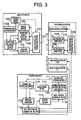
- FIG. 3 is a block diagram showing an outline structure of the mobile communication system according to one embodiment of the present invention.
- the mobile communication system comprises a mobile station M, radio base stations Ba, Bb, Bc, and a control station C.
- a radio receiving and transmitting section 101 receives and transmits radio signals from/to the radio base stations.
- a message decoder 102 decodes control information included in the signals received by the radio receiving and transmitting section 101.
- a spreading code storing section 103 stores spreading codes of an object to be subjected to the peripheral cell search designated from the network side, that is, the spreading codes used in the peripheral cells.
- a frequency changing section 104 changes a frequency to be set in the radio receiving and transmitting section 101 by a designation from the control station C.
- a reception quality detecting section 105 detects a link quality (reception level) of the signal received by the radio receiving and transmitting section 101.
- a peripheral cell search control section 106 sets the spreading codes stored in the spreading code storing section 103 to be used in the peripheral cells with respect to the reception quality detecting section 105, sequentially. Then, the peripheral cell search control section 106 manages the reception quality detecting cycle, and the number of times of detection, and provides an averaging processing to the detection result.
- a message generator 107 generates a message including control information to the network.
- a radio receiving and transmitting sections 108 receive and transmit radio signals between the radio base stations and the mobile station M.
- a wire receiving and transmitting section 109 receives and transmits control signals, that is, a mobile station control signal and a radio base station control signal between the control station C and the radio base stations via radio.
- a radio control section 110 controls the radio receiving and transmitting sections 108 in accordance with a designation from the control station C. Note that the radio receiving and transmitting sections 108 of the radio base stations can set a different frequency, respectively. In this embodiment, frequencies f1 and f2 are used in the radio base stations Ba and Bb, and only frequency f1 is used in the radio base station Bc.
- a station site storing section 111 stores an inherent spreading code, which the radio base station under the control of the self-station uses.
- a peripheral cell information generator 112 generates peripheral cell information for each cell based on station site information stored in the station site storing section 111.
- a wire receiving and transmitting section 113 receives and transmits control signals, which are received and transmitted from/to the radio base stations.
- a message decoder 114 decodes control information from the mobile station M.
- a mobile direction determination section 115 determines a mobile destination cell of the mobile station M based on a peripheral cell search result report from the mobile station M and information from the station site storing section 111.
- a determination section 116 for an outer area of the same frequency determines whether or not the mobile station M moves out of the same frequency area based on mobile destination cell information from the mobile direction determination section 115 and information from the station site storing section 111.
- a handover control section 117 designates the execution of the handover to the mobile station M and the radio base stations.
- the handover control section 117 designates the following execution. More specifically, the handover control section 117 designates the execution of the frequency change (hard handover in the cell) to the mobile station M and the radio base stations.
- a message generator 118 generates a message including control information on the mobile station M and the radio base stations.
- FIG. 4 is a sequence view showing an operation of the mobile communication system according to one embodiment of the present invention.
- FIG. 5 is a view showing the relationship between a mobile path of the mobile station M and the cell (radio base station) according to one embodiment of the present invention. The following will explain a case in which a mobile station M2 uses frequency f2 (first frequency) in a high traffic area shown in FIG. 5,and changes the frequency to frequency f1 (second frequency) in moving to the low traffic area during communications.
- frequency f2 first frequency
- f1 second frequency
- the spreading code which each radio base station uses as a forward link is set in advance.
- Information of the setting is managed by the station site storing section 111 of the control station.
- the peripheral cell information generator 112 generates peripheral cell information of each cell based on the station site information stored in the station site information storing section 111.
- the radio control section 110 of the radio base station Ba uses a predetermined spreading code Ca as a forward code.
- the mobile station M uses a spreading code Cm peculiar to the mobile station as a reverse link.
- the message such as control information generated by the message generator 107 of the mobile section M is sent to the radio receiving and transmitting section 108 of the base stations B from the radio receiving and transmitting section 101 of the mobile station M, and further sent to the wire receiving and transmitting section 113 of the control station C through the wire receiving and transmitting section 109. Then, the message is decoded by the message decoder 114 of the control station C.
- the message such as control information generated by the message generator 118 of the mobile control station C is sent to the wire receiving and transmitting section 109 of the base stations B from the wire receiving and transmitting section 113 of the control station C, and further sent to the radio receiving and transmitting section 101 of the mobile station M through the radio receiving and transmitting section 108. Then, the message is decoded by the message decoder 102 of the mobile station M, and sent to the spreading code storing section 103 and the frequency changing section 104.
- the mobile station M is in the cell a area, which is a first radio cell in which two frequencies f1 and f2, including the first frequency f2, are set by the radio receiving and transmitting section 108.
- the mobile station M receives a peripheral cell spreading code notice from the radio base station Ba offering a service of the cell a .
- the spreading codes used in the peripheral cells are stored to the spreading code storing section 103 (ST11).
- the peripheral cell search control section 106 sets a cell search execution cycle ⁇ t in a timer T (ST12). Then, when the timer counts up (ST13), the spreading codes, which are used by the peripheral cells stored in the spreading code storing section 103, are sequentially set in the reception quality detecting section 105.
- the reception quality detecting section 105 detects the reception quality such as a reception level from the peripheral cells of the radio base station Ba (ST14).
- the peripheral cell search result is reported to the network.
- the mobile direction determination section 115 determines the mobile direction of the mobile station M based on the peripheral cell search result report from the mobile station M (ST15). As one example of the determination methods, the mobile direction determination section 115 selects the highest reception quality from the reception quality levels L1, L2, ..., Ln sent from the respective cells Z1, Z2, ... Zn included in the peripheral cell reception quality report from the mobile station M, and determines the selected highest reception quality as the mobile direction. In other words, if the reception quality level Lk of the cell Zk is the highest, it is determined that the mobile destination cell is Zk.
- the mobile direction determination section 115 determines whether or not the cell movement is needed. As one example of the determination methods, the mobile station M compares a level difference between the reception quality levels L0 and Lk, which have been sent from the cell Z0 during communications, with a threshold value ⁇ LT for determination of the cell movement. If the comparison result is ]L0-Lk]>LT, it is determined that the cell movement is needed. If the comparison result is ]LO-Lk] ⁇ LT, it is determined that the cell movement is not needed.
- the determination section 116 for an outer area of the same frequency determines whether or not the mobile destination cell Zk, which has been determined by the mobile direction determination section 115, is a boundary of the area where the frequency f2 is used. This determination is executed based on information on setting the frequency used in each cell, whereby determining whether or not the cell moves out of the same frequency area, that is the area where the frequency f2 can be used (ST17, ST18). Moreover, it is determined whether or not the frequency change is needed in the control station C based on the above determination result.
- the determination whether or not the cell moves out of the same frequency area is performed when the radio cell search is executed to a cell c , which is the second radio cell in which only frequency f1 is set, from the cell a , which is the first radio cell, or the cell b . Also, the above determination may be performed before the cell movement from the first cell a or the cell b to the second radio cell c .
- the above determination may be performed based on the designation from the mobile direction determination section 115 when the radio cell of the mobile destination is the first radio cell contacting the second radio cell.
- the frequency f2 can be surely changed to the frequency f1 set by the second radio cell in advance, the handover between the cells each having a different frequency can be stably executed.
- the peripheral cell reception quality is reported in the process where the mobile station M moves from the cell a to the cell b in FIG. 5.
- the network can recognize that the mobile station M is moving to the cell b , which is the boundary cell of the area (in the same frequency area) using f2.
- the control station C designates the receiving and transmitting using the frequency f1 to the radio base station Ba. Thereafter, the control station C designates the frequency change to the mobile station M (cell a of FIG. 5). The mobile station M changes the frequency based on the designation (ST19).
- the mobile station M executes the peripheral cell search using the frequency f1. This can detect a mobile designation cell c .
- the network control station C
- the network can designate the soft handover from the cell b to the cell c based on the peripheral cell reception quality report from the mobile station M by the handover control section 117. Therefore, the above designation results in the soft handover state in the mobile station M (ST20).
- the mobile direction determination section 115 of the control station C determines whether or not the cell movement is needed based on the peripheral cell reception quality report from the mobile station M. If it is determined that the cell movement is needed, that is, the mobile station M is moving to the cell c from the cell b , the control station C designates as follows. More specifically, the control station C designates the start of the forward link transmission to the mobile station M and that of the reverse link reception from the mobile station M with respect to the radio base station Bc offering a service of cell c . Also, the control station C designates the start of the reception of the forward link from the radio base station Bb with respect to the mobile station M. Then, the control station C notifies the mobile station M of the spreading code used in the peripheral cells of the cell c after the mobile station M moves to the cell c .
- the network detects that the mobile station is moving to the outer area of the same frequency.
- the control station C designates the frequency change to the mobile station M in advance.
- the mobile station is moving in the area where the same frequency can be used or the area where the same frequency cannot be used is determined in the network side. Then, the using frequency is changed in advance in the mobile station. As a result, even in a case where the frequency used in each region of the service area differs, the handover can be satisfactorily executed between the cells each using a different frequency.
- the present invention can be suitably used in a digital radio communication system using a CDMA. Therefore, even in a case where the frequency used in each region of the service area differs, a handover can be satisfactorily executed.
Landscapes
- Engineering & Computer Science (AREA)
- Computer Networks & Wireless Communication (AREA)
- Signal Processing (AREA)
- Mobile Radio Communication Systems (AREA)
Abstract
Claims (3)
- Système à accès multiple par répartition de code (CDMA), comprenant une pluralité de stations de base et de stations mobiles conçues pour communiquer avec les stations de base,
dans ledit système, la qualité des signaux reçus à partir de différentes stations de base périphériques est surveillée dans une station mobile et ces informations sont fournies à une station de commande qui, sur la base de telles informations détermine si la direction de déplacement de la station mobile se fait d'une première cellule (cellule a) par l'intermédiaire d'une seconde cellule (cellule b) vers une troisième cellule (cellule c), dans la première cellule, la station mobile est sous la commande d'une station de base à mode en double fréquence (Ba) avec laquelle ladite station mobile communique avec une première fréquence (f2) en réponse à la direction de déplacement déterminée, la fréquence de la station mobile passe de la première fréquence (f2) de la seconde fréquence (f1) déjà dans la première cellule, où ladite première fréquence et ladite seconde fréquence sont différentes, dans la seconde cellule (cellule b), la seconde station de base (Bb) de la seconde cellule est conçue pour modifier la fréquence en la seconde fréquence (f1) afin de communiquer avec la station mobile et un transfert sans interruption de ladite station mobile est exécutée à la limite de la seconde cellule et de la troisième cellule. - Système selon la revendication 1, comprenant un moyen de mémorisation d'emplacement de station qui mémorise une fréquence utilisée par chaque station de base et compare la fréquence utilisée par chaque station de base mémorisée dans ledit moyen de mémorisation d'emplacement à la première fréquence qui est utilisée dans la communication en cours pour déterminer si la première fréquence peut ou non être utilisée dans d'autres cellules sous la commande de stations de base existant dans la direction de déplacement.
- Procédé de communication radio utilisé dans le système selon la revendication 1 ou 2, comprenant les étapes consistant à :surveiller dans une station mobile la qualité des signaux reçus à partir des différentes stations de base périphériques et à fournir ces informations à une station de commande,déterminer si la direction de déplacement de ladite station mobile se fait depuis une première cellule (cellule a) par l'intermédiaire d'une seconde cellule (cellule b) vers une troisième cellule (cellule c), dans laquelle première cellule la station mobile est sous la commande d'une station de base à mode en double fréquence (Ba) avec laquelle ladite station mobile communique avec une première fréquence (f2),faire passer la fréquence de la station mobile de la première fréquence (f2) à la seconde fréquence (f1) déjà dans la première cellule en réponse à la direction de déplacement déterminée,faire passer la fréquence de la seconde station de base (Bb) de la seconde cellule de la première fréquence (f2) à la seconde fréquence (f1) afin de communiquer avec la station mobile dans la seconde cellule (cellule b),exécuter un transfert sans interruption de ladite station mobile à la limite de la seconde cellule et de la troisième cellule.
Applications Claiming Priority (3)
| Application Number | Priority Date | Filing Date | Title |
|---|---|---|---|
| JP20963997A JP2945357B2 (ja) | 1997-07-19 | 1997-07-19 | Cdma方式の移動局装置及び制御局装置 |
| JP20963997 | 1997-07-19 | ||
| PCT/JP1998/003201 WO1999004513A1 (fr) | 1997-07-19 | 1998-07-16 | Systeme et procede de telecommunications mobiles |
Publications (3)
| Publication Number | Publication Date |
|---|---|
| EP0928078A1 EP0928078A1 (fr) | 1999-07-07 |
| EP0928078A4 EP0928078A4 (fr) | 2003-03-26 |
| EP0928078B1 true EP0928078B1 (fr) | 2005-03-16 |
Family
ID=16576128
Family Applications (1)
| Application Number | Title | Priority Date | Filing Date |
|---|---|---|---|
| EP19980932552 Expired - Lifetime EP0928078B1 (fr) | 1997-07-19 | 1998-07-16 | Systeme et procede de telecommunications mobiles |
Country Status (8)
| Country | Link |
|---|---|
| US (1) | US6633556B1 (fr) |
| EP (1) | EP0928078B1 (fr) |
| JP (1) | JP2945357B2 (fr) |
| CN (1) | CN1234930A (fr) |
| AU (1) | AU8243398A (fr) |
| DE (1) | DE69829352T2 (fr) |
| ES (1) | ES2239396T3 (fr) |
| WO (1) | WO1999004513A1 (fr) |
Families Citing this family (10)
| Publication number | Priority date | Publication date | Assignee | Title |
|---|---|---|---|---|
| SE514264C2 (sv) * | 1999-05-07 | 2001-01-29 | Ericsson Telefon Ab L M | Ett kommunikationssystem |
| JP2001086035A (ja) * | 1999-09-14 | 2001-03-30 | Nec Corp | Cdmaにおけるセルサーチ方法 |
| CN1185890C (zh) * | 1999-09-30 | 2005-01-19 | 富士通株式会社 | 移动通信系统 |
| EP1225782A4 (fr) * | 1999-10-29 | 2002-11-27 | Fujitsu Ltd | Technique de commande de transfert d'un systeme amcr, station de base utilisee a cet effet et unite de commande de station de base |
| KR20010068446A (ko) * | 2000-01-05 | 2001-07-23 | 정용주 | 씨디엠에이 무선사설교환기/키폰시스템의 가입자 로밍제어 방법 |
| KR100592597B1 (ko) * | 2001-01-10 | 2006-06-26 | 한국전자통신연구원 | 압축 모드 및 인접 기지국 간 공통 주파수를 이용한핸드오버 방법 |
| US7593367B2 (en) * | 2002-06-14 | 2009-09-22 | Qualcomm Incorporated | Frequency scan for CDMA acquisition |
| JP5049463B2 (ja) | 2004-12-14 | 2012-10-17 | 富士通株式会社 | 無線通信システム及び基地局及び移動局及び無線通信方法 |
| US20060146758A1 (en) * | 2004-12-30 | 2006-07-06 | Harris John M | Method to facilitate dynamic allocation of spreading code resources |
| JP5510474B2 (ja) * | 2012-02-06 | 2014-06-04 | 富士通株式会社 | 基地局及び移動局及び無線通信システム及び無線通信方法 |
Family Cites Families (14)
| Publication number | Priority date | Publication date | Assignee | Title |
|---|---|---|---|---|
| US5295153A (en) * | 1992-04-13 | 1994-03-15 | Telefonaktiebolaget L M Ericsson | CDMA frequency allocation |
| EP0917308A1 (fr) * | 1992-04-17 | 1999-05-19 | TELEFONAKTIEBOLAGET L M ERICSSON (publ) | Changement de cellule assisté par le mobile avec accès multiple par division de codes |
| DE69423810T2 (de) | 1993-05-12 | 2000-10-12 | Ntt Mobile Communications Network Inc., Tokio/Tokyo | Verfahren zum Weiterreichen und Mobilstation für Spreizspektrum Kommunikationssystem |
| JP3080205B2 (ja) | 1993-05-12 | 2000-08-21 | 株式会社エヌ・ティ・ティ・ドコモ | スペクトラム拡散移動通信の通信中チャネル切替方法 |
| JPH0750870A (ja) | 1993-08-04 | 1995-02-21 | Sony Corp | 通信端末装置 |
| KR970008949B1 (en) * | 1994-11-16 | 1997-06-03 | Korea Electronics Telecomm | Method and system for providing a frequency handoff in communication in a cdma cellular telephone system |
| JP3274337B2 (ja) | 1995-12-27 | 2002-04-15 | 株式会社東芝 | Cdmaセルラ無線システム |
| JP2803720B2 (ja) * | 1996-04-10 | 1998-09-24 | 日本電気株式会社 | Cdma移動通信システム用ハンドオフ制御方式 |
| US5926470A (en) * | 1996-05-22 | 1999-07-20 | Qualcomm Incorporated | Method and apparatus for providing diversity in hard handoff for a CDMA system |
| US5848063A (en) * | 1996-05-23 | 1998-12-08 | Qualcomm Incorporated | Method and apparatus for hard handoff in a CDMA system |
| JP3370865B2 (ja) | 1996-10-28 | 2003-01-27 | 株式会社エヌ・ティ・ティ・ドコモ | ソフトハンドオーバ方法及び移動局 |
| US6628630B1 (en) * | 1997-04-15 | 2003-09-30 | Matsushita Electric Industrial Co., Ltd. | Spread spectrum communication method |
| JPH10322760A (ja) | 1997-05-21 | 1998-12-04 | Toshiba Corp | セルラ無線システム |
| WO1998054916A1 (fr) | 1997-05-30 | 1998-12-03 | Motorola Inc. | Procede et appareil permettant de realiser un transfert de station mobile dans un systeme de communication a acces multiple par difference de code |
-
1997
- 1997-07-19 JP JP20963997A patent/JP2945357B2/ja not_active Expired - Fee Related
-
1998
- 1998-07-16 US US09/147,832 patent/US6633556B1/en not_active Expired - Fee Related
- 1998-07-16 WO PCT/JP1998/003201 patent/WO1999004513A1/fr not_active Ceased
- 1998-07-16 CN CN98801016A patent/CN1234930A/zh active Pending
- 1998-07-16 DE DE1998629352 patent/DE69829352T2/de not_active Expired - Fee Related
- 1998-07-16 AU AU82433/98A patent/AU8243398A/en not_active Abandoned
- 1998-07-16 ES ES98932552T patent/ES2239396T3/es not_active Expired - Lifetime
- 1998-07-16 EP EP19980932552 patent/EP0928078B1/fr not_active Expired - Lifetime
Also Published As
| Publication number | Publication date |
|---|---|
| AU8243398A (en) | 1999-02-10 |
| ES2239396T3 (es) | 2005-09-16 |
| CN1234930A (zh) | 1999-11-10 |
| EP0928078A1 (fr) | 1999-07-07 |
| DE69829352D1 (de) | 2005-04-21 |
| WO1999004513A1 (fr) | 1999-01-28 |
| JP2945357B2 (ja) | 1999-09-06 |
| JPH1141645A (ja) | 1999-02-12 |
| EP0928078A4 (fr) | 2003-03-26 |
| US6633556B1 (en) | 2003-10-14 |
| DE69829352T2 (de) | 2005-08-18 |
Similar Documents
| Publication | Publication Date | Title |
|---|---|---|
| RU2197792C2 (ru) | Способ надежной межсистемной передачи обслуживания в системе мдкр и устройство для его осуществления | |
| US6304755B1 (en) | Method and apparatus for performing mobile assisted hard handoff between communication systems | |
| CN1586089B (zh) | 基于宽带码分多址覆盖的切换触发的方法 | |
| KR100495687B1 (ko) | 이동 통신 시스템에서 파일럿 인접 리스트를 합성하는 방법 및 장치 | |
| EP0884918B1 (fr) | Réseau de communication cellulaire avec commutation douce et appareils correspondants | |
| EP0903053B1 (fr) | Procede et appareil pour le transfert au repos dans un systeme de communication a access multiples | |
| JP4250666B2 (ja) | シームレスハンドオフシステムおよび方法 | |
| US7236788B2 (en) | Soft hand-off in cellular mobile communications networks | |
| KR100314485B1 (ko) | 씨디엠에이 이동 통신 시스템 및 서비스 영역 보완 방법 | |
| KR20000015938A (ko) | 셀룰러 통신 시스템에서 원뿔형 침묵 영역을 식별하는 방법 및장치 | |
| JP2003522443A (ja) | ホットスポットに到達範囲を調整した追加の周波数を配置して干渉を低減する方法 | |
| KR20070055633A (ko) | 소프트-핸드오프 영역들을 조작하기 위하여 활성세트를관리하는 안테나 적응방법 | |
| EP0928078B1 (fr) | Systeme et procede de telecommunications mobiles | |
| EP1153523B1 (fr) | Procedes et systemes permettant de commander les transferts par transmission successive et les transferts progressifs dans des systemes de radiocommunication | |
| KR100525319B1 (ko) | Cdma 시스템을 위한 하드 핸드오프에서 다이버시티를 제공하기 위한 방법 및 장치 | |
| EP1091612A1 (fr) | Méthode pour réduire les transferts dans un système de radio mobile | |
| KR100491518B1 (ko) | Cdma시스템에서 하드 핸드오프를 위한 방법 및 장치 | |
| HK1140352A (en) | Method and apparatus for performing mobile assisted hard handoff between communication systems | |
| HK1023894B (en) | Method and apparatus for performing mobile assisted hard handoff between communication systems | |
| HK1020473B (en) | Method and apparatus for performing idle handoff in a multiple access communication system | |
| KR20020039859A (ko) | 이동 통신 시스템의 에스에스디티(ssdt)를 이용한핸드 오프 방법 | |
| HK1020402B (en) | Method and apparatus for reliable intersystem handoff in a cdma system |
Legal Events
| Date | Code | Title | Description |
|---|---|---|---|
| PUAI | Public reference made under article 153(3) epc to a published international application that has entered the european phase |
Free format text: ORIGINAL CODE: 0009012 |
|
| 17P | Request for examination filed |
Effective date: 19990315 |
|
| AK | Designated contracting states |
Kind code of ref document: A1 Designated state(s): DE ES FI FR GB IT SE |
|
| A4 | Supplementary search report drawn up and despatched |
Effective date: 20030210 |
|
| RIC1 | Information provided on ipc code assigned before grant |
Ipc: 7H 04Q 7/38 B Ipc: 7H 04B 7/26 A |
|
| 17Q | First examination report despatched |
Effective date: 20030415 |
|
| GRAP | Despatch of communication of intention to grant a patent |
Free format text: ORIGINAL CODE: EPIDOSNIGR1 |
|
| GRAS | Grant fee paid |
Free format text: ORIGINAL CODE: EPIDOSNIGR3 |
|
| GRAA | (expected) grant |
Free format text: ORIGINAL CODE: 0009210 |
|
| AK | Designated contracting states |
Kind code of ref document: B1 Designated state(s): DE ES FI FR GB IT SE |
|
| REG | Reference to a national code |
Ref country code: GB Ref legal event code: FG4D |
|
| REF | Corresponds to: |
Ref document number: 69829352 Country of ref document: DE Date of ref document: 20050421 Kind code of ref document: P |
|
| REG | Reference to a national code |
Ref country code: SE Ref legal event code: TRGR |
|
| REG | Reference to a national code |
Ref country code: ES Ref legal event code: FG2A Ref document number: 2239396 Country of ref document: ES Kind code of ref document: T3 |
|
| ET | Fr: translation filed | ||
| PLBE | No opposition filed within time limit |
Free format text: ORIGINAL CODE: 0009261 |
|
| STAA | Information on the status of an ep patent application or granted ep patent |
Free format text: STATUS: NO OPPOSITION FILED WITHIN TIME LIMIT |
|
| 26N | No opposition filed |
Effective date: 20051219 |
|
| PGFP | Annual fee paid to national office [announced via postgrant information from national office to epo] |
Ref country code: GB Payment date: 20060712 Year of fee payment: 9 |
|
| PGFP | Annual fee paid to national office [announced via postgrant information from national office to epo] |
Ref country code: FI Payment date: 20060713 Year of fee payment: 9 Ref country code: DE Payment date: 20060713 Year of fee payment: 9 |
|
| PGFP | Annual fee paid to national office [announced via postgrant information from national office to epo] |
Ref country code: FR Payment date: 20060719 Year of fee payment: 9 |
|
| PGFP | Annual fee paid to national office [announced via postgrant information from national office to epo] |
Ref country code: ES Payment date: 20060724 Year of fee payment: 9 |
|
| PGFP | Annual fee paid to national office [announced via postgrant information from national office to epo] |
Ref country code: IT Payment date: 20060731 Year of fee payment: 9 |
|
| PGFP | Annual fee paid to national office [announced via postgrant information from national office to epo] |
Ref country code: SE Payment date: 20060705 Year of fee payment: 9 |
|
| EUG | Se: european patent has lapsed | ||
| GBPC | Gb: european patent ceased through non-payment of renewal fee |
Effective date: 20070716 |
|
| PG25 | Lapsed in a contracting state [announced via postgrant information from national office to epo] |
Ref country code: SE Free format text: LAPSE BECAUSE OF NON-PAYMENT OF DUE FEES Effective date: 20070717 Ref country code: DE Free format text: LAPSE BECAUSE OF NON-PAYMENT OF DUE FEES Effective date: 20080201 |
|
| PG25 | Lapsed in a contracting state [announced via postgrant information from national office to epo] |
Ref country code: GB Free format text: LAPSE BECAUSE OF NON-PAYMENT OF DUE FEES Effective date: 20070716 Ref country code: FI Free format text: LAPSE BECAUSE OF NON-PAYMENT OF DUE FEES Effective date: 20070716 |
|
| REG | Reference to a national code |
Ref country code: FR Ref legal event code: ST Effective date: 20080331 |
|
| PG25 | Lapsed in a contracting state [announced via postgrant information from national office to epo] |
Ref country code: FR Free format text: LAPSE BECAUSE OF NON-PAYMENT OF DUE FEES Effective date: 20070731 |
|
| REG | Reference to a national code |
Ref country code: ES Ref legal event code: FD2A Effective date: 20070717 |
|
| PG25 | Lapsed in a contracting state [announced via postgrant information from national office to epo] |
Ref country code: ES Free format text: LAPSE BECAUSE OF NON-PAYMENT OF DUE FEES Effective date: 20070717 |
|
| PG25 | Lapsed in a contracting state [announced via postgrant information from national office to epo] |
Ref country code: IT Free format text: LAPSE BECAUSE OF NON-PAYMENT OF DUE FEES Effective date: 20070716 |