EP0928099A2 - Erhöhte Funktionalität für Holladay-Halbtonrasterung - Google Patents
Erhöhte Funktionalität für Holladay-Halbtonrasterung Download PDFInfo
- Publication number
- EP0928099A2 EP0928099A2 EP99300022A EP99300022A EP0928099A2 EP 0928099 A2 EP0928099 A2 EP 0928099A2 EP 99300022 A EP99300022 A EP 99300022A EP 99300022 A EP99300022 A EP 99300022A EP 0928099 A2 EP0928099 A2 EP 0928099A2
- Authority
- EP
- European Patent Office
- Prior art keywords
- row
- array
- pixel
- dots
- addressing
- Prior art date
- Legal status (The legal status is an assumption and is not a legal conclusion. Google has not performed a legal analysis and makes no representation as to the accuracy of the status listed.)
- Withdrawn
Links
- 230000007246 mechanism Effects 0.000 abstract 1
- 239000011449 brick Substances 0.000 description 28
- 238000003491 array Methods 0.000 description 4
- 238000000926 separation method Methods 0.000 description 4
- 230000001351 cycling effect Effects 0.000 description 2
- 230000004044 response Effects 0.000 description 2
- 230000000295 complement effect Effects 0.000 description 1
- 238000000034 method Methods 0.000 description 1
- 238000012216 screening Methods 0.000 description 1
- 230000000007 visual effect Effects 0.000 description 1
Images



Classifications
-
- H—ELECTRICITY
- H04—ELECTRIC COMMUNICATION TECHNIQUE
- H04N—PICTORIAL COMMUNICATION, e.g. TELEVISION
- H04N1/00—Scanning, transmission or reproduction of documents or the like, e.g. facsimile transmission; Details thereof
- H04N1/40—Picture signal circuits
- H04N1/405—Halftoning, i.e. converting the picture signal of a continuous-tone original into a corresponding signal showing only two levels
- H04N1/4055—Halftoning, i.e. converting the picture signal of a continuous-tone original into a corresponding signal showing only two levels producing a clustered dots or a size modulated halftone pattern
- H04N1/4058—Halftoning, i.e. converting the picture signal of a continuous-tone original into a corresponding signal showing only two levels producing a clustered dots or a size modulated halftone pattern with details for producing a halftone screen at an oblique angle
Definitions
- a circuit for storing halftone screen arrays which can be clocked and arranged so that a number of dots can be generated from a single Holladay brick of threshold values, the arrangement allowing a change of phase, shift and counting direction between scans.
- the simplest halftone screen can be thought of as a set of threshold values stored in a memory of a printer. As a stream of multi-bit pixels is received, each is compared to its associated value in the screen, and printed either as a ONE or a ZERO. A number of types (single centered, multi-centered and stochastic) and sizes of halftone screens are required to optimally print various kinds of graphics, pictures and text. Larger screens can provide a greater number of color levels, at the expense of needing more storage. Also, in a four (or more) color printer, each separation is normally oriented at a different angle, and therefore must have its own screen. The storage of the resultant number of screens becomes a problem, and a means for reducing the memory requirement would be a significant improvement.
- a large improvement would be to reduce the memory requirement by modifying the system so that one brick could be used to generate more than one halftone screen.
- a half-tone circuit comprises:
- a half-tone circuit comprises:
- a normal halftoning circuit is conceptually arranged in the form of several circular shift registers, and continually compares each current pixel to an appropriate threshold to generate an output bit.
- each successive scan line of video is compared to the next line in the brick.
- This invention is based on the realization that a single brick can be used to generate two or more halftone dots by varying the direction of readout from the right or left, by using a variable number of pixel shifts between scan lines and by varying the starting pixel for each scan line. In this way, a number of screens which can have complementary alignment angles and/or differing phase relationships can be made from one brick.
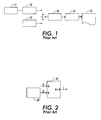
- FIG. 1 shows a system in which a halftone generator 10 can be used.
- a contone original 11 can be scanned by any commercial raster input scanner (RIS) 12 to produce a raster of pixels, each of a number of bits.
- the image could also be stored in an image buffer memory 13. In either case the image is transmitted as a series of pixels, one scan line at a time, to a halftone generator 10 where each group of neighboring pixels is converted into one halftone dot.
- the resultant series of dots are printed by a raster output scanner (ROS) printer 14 of any commercial kind onto paper as a halftone output 15, or in the alternative, is displayed on a terminal.
- ROS raster output scanner
- a halftone pattern generator 20 supplies a threshold value to the comparator 21 at the same time as each video pixel arrives, the two are compared, and a ONE or ZERO is output depending on whether the pixel is greater than the reference.
- Figure 3 is one embodiment of the halftone pattern generator 10 of Figure 2 shown in more detail.
- the array 30 is shown as a 5 by 10 value array of threshold values arranged into rows and columns in a memory of any kind.
- the scan counter 31 will select one row and the pixel counter 32 will select one column of the array as the output threshold.
- the row counter will cycle to the next row.
- the row counter also can initially be set to any scan line by the set line to set the phase of the dot pattern. Also, responsive to the up/down signal, the counter can count in either direction.
- the pixel counter 32 cycles through the columns in response to the pixel clock, right or left in response to the left/right signal.
- the pixel counter will receive a control signal to indicate a shift of a number of pixels and the direction of the shift.
- the counter will make the correct number of shifts, and then wait for the beginning of the next scan to start selecting pixels again. In this way, the direction of vertical and horizontal cycling, and the amount and direction of shifts, is fully controllable.
- the counter can also be set to a particular starting pixel before the beginning of a scan by the set signal.
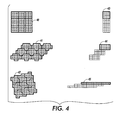
- Figure 4 shows several forms of bricks and how they can be used to generate various sizes and patterns of dots.
- the top row there is a 4 by 4 pixel brick 43 having 16 thresholds to provide 17 levels of color (0 to 16). Since there is no shift, each resulting visual dot pattern 40 is produced directly below the one above or directly to the right or left of the others in the row.
- the brick 44 has 3 rows and 6 columns to produce 19 levels of color. Since there is a shift of three pixels from the bottom of the first brick to the top of the next, and since the brick is 3 rows high, the angle along dot centers of the resultant dots 41 is 45 degrees as shown.
- the final example at the bottom is a 1 by 17 brick 45 which can produce 18 levels of color. Since the height is 1 and the shift is 4, an angle of 14 degrees is produced between resulting dots 42.
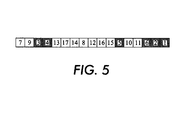
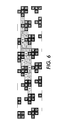
- Figures 5, 6 and 7 show how the single line brick of Figure 5 can be used to produce two screens, shown in Figures 6 and 7.
- Figure 5 shows a brick having one line of 17 threshold values. It is assumed that the video that is being compared to these reference values is between 6 and 7. Therefore values from 1 to 6 will be printed in black and all others will be printed in white, as shown.
- Figure 7 shows how the same brick can also produce the mirror image of Figure 6 by counting from pixel to pixel right to left (instead of left to right) and by shifting 13 to the left between scans (instead of 4 to the left). The result is now a dot to dot angle of 76 degrees. The two sets of dots can now be used for two separations in a four color printer, both being produced from the same brick to reduce memory requirements.
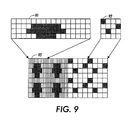
- Figure 8 shows how the same system can be used for stochastic dots.
- the original stochastic array 81 is shown as the first 9 black dots in an array that may be 128 by 128. Since these arrays are so large, there would be a great saving in memory if the same array could be used for the other three separations as well.
- This can be done by first using the original array counting from left to right.
- the mirror array 82 can be produced simply by counting from right to left.
- the phase-shifted array 83 can be produced by using the same brick and counting from left to right, but starting at a different row and column.
- a mirrored and phase-shifted array 84 can be made by producing the phase shifted array, but counting right to left. The four separations can now be printed to produce the over-laid result 85.
- the clock into the pixel counter 32 would be a 4x clock and when the stochastic dot is to be printed, responsive to the 4 to 1 reduction signal, the counter will only count up once for every 4 input clocks so that each pixel is output for each of 4 clock periods.
- the prior art uses a constant clock and would need four times as much memory to store the stochastic dot.
- a 4x clock and the non-redundant stochastic dot can be used.
Landscapes
- Engineering & Computer Science (AREA)
- Multimedia (AREA)
- Signal Processing (AREA)
- Facsimile Image Signal Circuits (AREA)
- Image Input (AREA)
- Image Processing (AREA)
Applications Claiming Priority (2)
| Application Number | Priority Date | Filing Date | Title |
|---|---|---|---|
| US4102 | 1998-01-07 | ||
| US09/004,102 US6262811B1 (en) | 1998-01-07 | 1998-01-07 | Increased functionality for holladay halftoning |
Publications (2)
| Publication Number | Publication Date |
|---|---|
| EP0928099A2 true EP0928099A2 (de) | 1999-07-07 |
| EP0928099A3 EP0928099A3 (de) | 2000-07-12 |
Family
ID=21709148
Family Applications (1)
| Application Number | Title | Priority Date | Filing Date |
|---|---|---|---|
| EP99300022A Withdrawn EP0928099A3 (de) | 1998-01-07 | 1999-01-04 | Erhöhte Funktionalität für Holladay-Halbtonrasterung |
Country Status (3)
| Country | Link |
|---|---|
| US (1) | US6262811B1 (de) |
| EP (1) | EP0928099A3 (de) |
| JP (1) | JPH11250245A (de) |
Families Citing this family (6)
| Publication number | Priority date | Publication date | Assignee | Title |
|---|---|---|---|---|
| JP3156691B2 (ja) * | 1999-01-27 | 2001-04-16 | 日本電気株式会社 | パターンマッチングを用いた符号化方法および符号化装置 |
| US7480070B2 (en) * | 2001-11-20 | 2009-01-20 | Electronics For Imaging, Inc. | Spot color pattern system |
| US7277201B2 (en) * | 2003-05-28 | 2007-10-02 | Xerox Corporation | Systems and methods for designing digital anamorphic line screens |
| US7125094B2 (en) * | 2003-12-19 | 2006-10-24 | Xerox Corporation | Systems and methods for compensating for streaks in images |
| US20060077468A1 (en) * | 2004-10-12 | 2006-04-13 | Xerox Corporation | System and method for smart color halftoning |
| JP4979509B2 (ja) * | 2007-08-10 | 2012-07-18 | キヤノン株式会社 | データ変換装置、該装置を備えた記録装置及びデータ変換方法 |
Family Cites Families (7)
| Publication number | Priority date | Publication date | Assignee | Title |
|---|---|---|---|---|
| US4122496A (en) * | 1977-02-23 | 1978-10-24 | International Business Machines Corporation | Apparatus and method for digital halftone reproduction |
| US4507685A (en) * | 1982-06-25 | 1985-03-26 | Canon Kabushiki Kaisha | Image recording device |
| US4736254A (en) * | 1984-11-22 | 1988-04-05 | Matsushita Electric Industrial Co., Ltd. | Method and apparatus for generating pseudo-halftone dots by comparing gray scale values of an original with dither threshold values stored in cells of a matrix array divided into imaginary matrices of elemental areas each containing one cell |
| US4924301A (en) * | 1988-11-08 | 1990-05-08 | Seecolor Corporation | Apparatus and methods for digital halftoning |
| JP2618107B2 (ja) * | 1991-03-12 | 1997-06-11 | 三田工業株式会社 | マトリクスアドレス生成装置およびそのアドレス生成装置を含む多値化階調処理装置 |
| JPH10173923A (ja) * | 1996-12-16 | 1998-06-26 | Oki Data:Kk | 網点型ディザパタ−ンの生成装置並びにその方法 |
| US5898505A (en) * | 1997-01-24 | 1999-04-27 | Hewlett-Packard Company | Resolution enhancement procedure and apparatus for a color laser printer |
-
1998
- 1998-01-07 US US09/004,102 patent/US6262811B1/en not_active Expired - Lifetime
-
1999
- 1999-01-04 EP EP99300022A patent/EP0928099A3/de not_active Withdrawn
- 1999-01-05 JP JP11000357A patent/JPH11250245A/ja not_active Withdrawn
Also Published As
| Publication number | Publication date |
|---|---|
| US6262811B1 (en) | 2001-07-17 |
| EP0928099A3 (de) | 2000-07-12 |
| JPH11250245A (ja) | 1999-09-17 |
Similar Documents
| Publication | Publication Date | Title |
|---|---|---|
| EP0717551B1 (de) | Bildverarbeitungsgerät | |
| US4476464A (en) | Arrangement for reducing the display size of characters stored in a character store | |
| US5604605A (en) | Method and device for intralinearly halftoning digitized grey value images | |
| US5339171A (en) | Image processing apparatus especially suitable for producing smooth-edged output multi-level tone data having fewer levels than input multi-level tone data | |
| US4980757A (en) | Image processing apparatus for gradation processing of an image signal to output a pulse width modulated signal | |
| US5623316A (en) | On-screen display apparatus and on-screen display method | |
| US6081349A (en) | Image processing device, image processing system, and method for generating screens for image processing | |
| US6084560A (en) | Image display for dither halftoning | |
| US5745249A (en) | Pipelined architecture for patterned halftone generation | |
| EP0740459B1 (de) | Bildverarbeitungsverfahren und -gerät | |
| US6262811B1 (en) | Increased functionality for holladay halftoning | |
| US5396607A (en) | Matrix address generator and multivalue gradation processor having the same | |
| KR100376951B1 (ko) | 화소밀도변환및오차확산기능을갖는화상데이타처리장치 | |
| US6208430B1 (en) | Increased functionality for Holladay halftoning | |
| US5926582A (en) | Method and system for converting multi-gradated image data into binary image data | |
| EP0967780A2 (de) | Bilddrucker | |
| EP0454088B1 (de) | Bildverarbeitungsvorrichtung | |
| US20030020935A1 (en) | Image processing method and apparatus | |
| JP2642406B2 (ja) | 像形成装置 | |
| US7920293B2 (en) | System and method for patterned encoded halftoning | |
| US7768673B2 (en) | Generating multi-bit halftone dither patterns with distinct foreground and background gray scale levels | |
| US6956676B2 (en) | Methods and systems for providing halftone screens | |
| JPH09294208A (ja) | 画像処理方法及び装置 | |
| US5245446A (en) | Image processing system | |
| JP2675984B2 (ja) | 画像処理装置 |
Legal Events
| Date | Code | Title | Description |
|---|---|---|---|
| PUAI | Public reference made under article 153(3) epc to a published international application that has entered the european phase |
Free format text: ORIGINAL CODE: 0009012 |
|
| AK | Designated contracting states |
Kind code of ref document: A2 Designated state(s): DE FR GB |
|
| AX | Request for extension of the european patent |
Free format text: AL;LT;LV;MK;RO;SI |
|
| PUAL | Search report despatched |
Free format text: ORIGINAL CODE: 0009013 |
|
| AK | Designated contracting states |
Kind code of ref document: A3 Designated state(s): AT BE CH CY DE DK ES FI FR GB GR IE IT LI LU MC NL PT SE |
|
| AX | Request for extension of the european patent |
Free format text: AL;LT;LV;MK;RO;SI |
|
| 17P | Request for examination filed |
Effective date: 20010112 |
|
| AKX | Designation fees paid |
Free format text: DE FR GB |
|
| STAA | Information on the status of an ep patent application or granted ep patent |
Free format text: STATUS: THE APPLICATION IS DEEMED TO BE WITHDRAWN |
|
| 18D | Application deemed to be withdrawn |
Effective date: 20040803 |
|
| RIN1 | Information on inventor provided before grant (corrected) |
Inventor name: CHANG, CHAN Inventor name: HEMBROCK, GWENDOLYN Inventor name: HAINS, CHARLES M |