EP0929560B1 - Ferrocenyles chiraux - Google Patents
Ferrocenyles chiraux Download PDFInfo
- Publication number
- EP0929560B1 EP0929560B1 EP97912121A EP97912121A EP0929560B1 EP 0929560 B1 EP0929560 B1 EP 0929560B1 EP 97912121 A EP97912121 A EP 97912121A EP 97912121 A EP97912121 A EP 97912121A EP 0929560 B1 EP0929560 B1 EP 0929560B1
- Authority
- EP
- European Patent Office
- Prior art keywords
- alkyl
- phenyl
- substituted
- alkoxy
- cycloalkyl
- Prior art date
- Legal status (The legal status is an assumption and is not a legal conclusion. Google has not performed a legal analysis and makes no representation as to the accuracy of the status listed.)
- Expired - Lifetime
Links
- 0 *C1=CC=CC1 Chemical compound *C1=CC=CC1 0.000 description 11
- WQBNLLINNVFTTF-UHFFFAOYSA-N BC1=CC=CC1 Chemical compound BC1=CC=CC1 WQBNLLINNVFTTF-UHFFFAOYSA-N 0.000 description 1
- KXQWWOAXEFJALO-UHFFFAOYSA-N C(CC1)CCC1SC1C=CC=C1 Chemical compound C(CC1)CCC1SC1C=CC=C1 KXQWWOAXEFJALO-UHFFFAOYSA-N 0.000 description 1
- UOSJSJXRAHWNNE-UHFFFAOYSA-N C=C(C=C1)C=C1S Chemical compound C=C(C=C1)C=C1S UOSJSJXRAHWNNE-UHFFFAOYSA-N 0.000 description 1
- HRTOQFBQOFIFEE-UHFFFAOYSA-N CC(C)(COC1=O)C1=O Chemical compound CC(C)(COC1=O)C1=O HRTOQFBQOFIFEE-UHFFFAOYSA-N 0.000 description 1
- NFWSQSCIDYBUOU-UHFFFAOYSA-N CC1=CC=CC1 Chemical compound CC1=CC=CC1 NFWSQSCIDYBUOU-UHFFFAOYSA-N 0.000 description 1
Classifications
-
- C—CHEMISTRY; METALLURGY
- C07—ORGANIC CHEMISTRY
- C07F—ACYCLIC, CARBOCYCLIC OR HETEROCYCLIC COMPOUNDS CONTAINING ELEMENTS OTHER THAN CARBON, HYDROGEN, HALOGEN, OXYGEN, NITROGEN, SULFUR, SELENIUM OR TELLURIUM
- C07F17/00—Metallocenes
- C07F17/02—Metallocenes of metals of Groups 8, 9 or 10 of the Periodic Table
-
- B—PERFORMING OPERATIONS; TRANSPORTING
- B01—PHYSICAL OR CHEMICAL PROCESSES OR APPARATUS IN GENERAL
- B01J—CHEMICAL OR PHYSICAL PROCESSES, e.g. CATALYSIS OR COLLOID CHEMISTRY; THEIR RELEVANT APPARATUS
- B01J31/00—Catalysts comprising hydrides, coordination complexes or organic compounds
- B01J31/16—Catalysts comprising hydrides, coordination complexes or organic compounds containing coordination complexes
- B01J31/18—Catalysts comprising hydrides, coordination complexes or organic compounds containing coordination complexes containing nitrogen, phosphorus, arsenic or antimony as complexing atoms, e.g. in pyridine ligands, or in resonance therewith, e.g. in isocyanide ligands C=N-R or as complexed central atoms
- B01J31/1805—Catalysts comprising hydrides, coordination complexes or organic compounds containing coordination complexes containing nitrogen, phosphorus, arsenic or antimony as complexing atoms, e.g. in pyridine ligands, or in resonance therewith, e.g. in isocyanide ligands C=N-R or as complexed central atoms the ligands containing nitrogen
-
- B—PERFORMING OPERATIONS; TRANSPORTING
- B01—PHYSICAL OR CHEMICAL PROCESSES OR APPARATUS IN GENERAL
- B01J—CHEMICAL OR PHYSICAL PROCESSES, e.g. CATALYSIS OR COLLOID CHEMISTRY; THEIR RELEVANT APPARATUS
- B01J31/00—Catalysts comprising hydrides, coordination complexes or organic compounds
- B01J31/16—Catalysts comprising hydrides, coordination complexes or organic compounds containing coordination complexes
- B01J31/22—Organic complexes
- B01J31/2282—Unsaturated compounds used as ligands
- B01J31/2295—Cyclic compounds, e.g. cyclopentadienyls
-
- B—PERFORMING OPERATIONS; TRANSPORTING
- B01—PHYSICAL OR CHEMICAL PROCESSES OR APPARATUS IN GENERAL
- B01J—CHEMICAL OR PHYSICAL PROCESSES, e.g. CATALYSIS OR COLLOID CHEMISTRY; THEIR RELEVANT APPARATUS
- B01J31/00—Catalysts comprising hydrides, coordination complexes or organic compounds
- B01J31/16—Catalysts comprising hydrides, coordination complexes or organic compounds containing coordination complexes
- B01J31/24—Phosphines, i.e. phosphorus bonded to only carbon atoms, or to both carbon and hydrogen atoms, including e.g. sp2-hybridised phosphorus compounds such as phosphabenzene, phosphole or anionic phospholide ligands
- B01J31/2404—Cyclic ligands, including e.g. non-condensed polycyclic ligands, the phosphine-P atom being a ring member or a substituent on the ring
- B01J31/2409—Cyclic ligands, including e.g. non-condensed polycyclic ligands, the phosphine-P atom being a ring member or a substituent on the ring with more than one complexing phosphine-P atom
-
- C—CHEMISTRY; METALLURGY
- C07—ORGANIC CHEMISTRY
- C07B—GENERAL METHODS OF ORGANIC CHEMISTRY; APPARATUS THEREFOR
- C07B53/00—Asymmetric syntheses
-
- C—CHEMISTRY; METALLURGY
- C07—ORGANIC CHEMISTRY
- C07D—HETEROCYCLIC COMPOUNDS
- C07D307/00—Heterocyclic compounds containing five-membered rings having one oxygen atom as the only ring hetero atom
- C07D307/02—Heterocyclic compounds containing five-membered rings having one oxygen atom as the only ring hetero atom not condensed with other rings
- C07D307/26—Heterocyclic compounds containing five-membered rings having one oxygen atom as the only ring hetero atom not condensed with other rings having one double bond between ring members or between a ring member and a non-ring member
- C07D307/30—Heterocyclic compounds containing five-membered rings having one oxygen atom as the only ring hetero atom not condensed with other rings having one double bond between ring members or between a ring member and a non-ring member with hetero atoms or with carbon atoms having three bonds to hetero atoms with at the most one bond to halogen, e.g. ester or nitrile radicals, directly attached to ring carbon atoms
- C07D307/32—Oxygen atoms
- C07D307/33—Oxygen atoms in position 2, the oxygen atom being in its keto or unsubstituted enol form
-
- B—PERFORMING OPERATIONS; TRANSPORTING
- B01—PHYSICAL OR CHEMICAL PROCESSES OR APPARATUS IN GENERAL
- B01J—CHEMICAL OR PHYSICAL PROCESSES, e.g. CATALYSIS OR COLLOID CHEMISTRY; THEIR RELEVANT APPARATUS
- B01J2231/00—Catalytic reactions performed with catalysts classified in B01J31/00
- B01J2231/60—Reduction reactions, e.g. hydrogenation
- B01J2231/64—Reductions in general of organic substrates, e.g. hydride reductions or hydrogenations
- B01J2231/641—Hydrogenation of organic substrates, i.e. H2 or H-transfer hydrogenations, e.g. Fischer-Tropsch processes
- B01J2231/643—Hydrogenation of organic substrates, i.e. H2 or H-transfer hydrogenations, e.g. Fischer-Tropsch processes of R2C=O or R2C=NR (R= C, H)
-
- B—PERFORMING OPERATIONS; TRANSPORTING
- B01—PHYSICAL OR CHEMICAL PROCESSES OR APPARATUS IN GENERAL
- B01J—CHEMICAL OR PHYSICAL PROCESSES, e.g. CATALYSIS OR COLLOID CHEMISTRY; THEIR RELEVANT APPARATUS
- B01J2231/00—Catalytic reactions performed with catalysts classified in B01J31/00
- B01J2231/60—Reduction reactions, e.g. hydrogenation
- B01J2231/64—Reductions in general of organic substrates, e.g. hydride reductions or hydrogenations
- B01J2231/641—Hydrogenation of organic substrates, i.e. H2 or H-transfer hydrogenations, e.g. Fischer-Tropsch processes
- B01J2231/645—Hydrogenation of organic substrates, i.e. H2 or H-transfer hydrogenations, e.g. Fischer-Tropsch processes of C=C or C-C triple bonds
-
- B—PERFORMING OPERATIONS; TRANSPORTING
- B01—PHYSICAL OR CHEMICAL PROCESSES OR APPARATUS IN GENERAL
- B01J—CHEMICAL OR PHYSICAL PROCESSES, e.g. CATALYSIS OR COLLOID CHEMISTRY; THEIR RELEVANT APPARATUS
- B01J2531/00—Additional information regarding catalytic systems classified in B01J31/00
- B01J2531/10—Complexes comprising metals of Group I (IA or IB) as the central metal
- B01J2531/18—Gold
-
- B—PERFORMING OPERATIONS; TRANSPORTING
- B01—PHYSICAL OR CHEMICAL PROCESSES OR APPARATUS IN GENERAL
- B01J—CHEMICAL OR PHYSICAL PROCESSES, e.g. CATALYSIS OR COLLOID CHEMISTRY; THEIR RELEVANT APPARATUS
- B01J2531/00—Additional information regarding catalytic systems classified in B01J31/00
- B01J2531/80—Complexes comprising metals of Group VIII as the central metal
- B01J2531/82—Metals of the platinum group
- B01J2531/821—Ruthenium
-
- B—PERFORMING OPERATIONS; TRANSPORTING
- B01—PHYSICAL OR CHEMICAL PROCESSES OR APPARATUS IN GENERAL
- B01J—CHEMICAL OR PHYSICAL PROCESSES, e.g. CATALYSIS OR COLLOID CHEMISTRY; THEIR RELEVANT APPARATUS
- B01J2531/00—Additional information regarding catalytic systems classified in B01J31/00
- B01J2531/80—Complexes comprising metals of Group VIII as the central metal
- B01J2531/82—Metals of the platinum group
- B01J2531/822—Rhodium
-
- B—PERFORMING OPERATIONS; TRANSPORTING
- B01—PHYSICAL OR CHEMICAL PROCESSES OR APPARATUS IN GENERAL
- B01J—CHEMICAL OR PHYSICAL PROCESSES, e.g. CATALYSIS OR COLLOID CHEMISTRY; THEIR RELEVANT APPARATUS
- B01J2531/00—Additional information regarding catalytic systems classified in B01J31/00
- B01J2531/80—Complexes comprising metals of Group VIII as the central metal
- B01J2531/82—Metals of the platinum group
- B01J2531/824—Palladium
-
- B—PERFORMING OPERATIONS; TRANSPORTING
- B01—PHYSICAL OR CHEMICAL PROCESSES OR APPARATUS IN GENERAL
- B01J—CHEMICAL OR PHYSICAL PROCESSES, e.g. CATALYSIS OR COLLOID CHEMISTRY; THEIR RELEVANT APPARATUS
- B01J2531/00—Additional information regarding catalytic systems classified in B01J31/00
- B01J2531/80—Complexes comprising metals of Group VIII as the central metal
- B01J2531/82—Metals of the platinum group
- B01J2531/827—Iridium
-
- B—PERFORMING OPERATIONS; TRANSPORTING
- B01—PHYSICAL OR CHEMICAL PROCESSES OR APPARATUS IN GENERAL
- B01J—CHEMICAL OR PHYSICAL PROCESSES, e.g. CATALYSIS OR COLLOID CHEMISTRY; THEIR RELEVANT APPARATUS
- B01J2531/00—Additional information regarding catalytic systems classified in B01J31/00
- B01J2531/80—Complexes comprising metals of Group VIII as the central metal
- B01J2531/84—Metals of the iron group
- B01J2531/847—Nickel
Definitions
- the invention relates to chiral ferrocenes substituted in the 1- and 1'-positions by two different radicals and also substituted in the 2-position, according to the general formula (I), to processes for their preparation and to the use thereof as ligands in catalysis.
- Metal complexes having chiral ferrocenyl ligands are known as catalysts for a number of reactions (e.g. enantioselective hydrogenation, hydrosilylation, formation of C-C bonds).
- the task of the chiral ligands is firstly so to adjust the electronic environment on the metal that a catalytic cycle becomes possible and secondly to transfer the chiral information to the substrate. Hitherto there has been no model that makes it possible to predict which chiral ligand will be best (especially in respect of enantioselectivity) for the catalytic reaction of a substrate. It is therefore advantageous if the electronic and steric properties of a ligand can be coordinated within a wide range both roughly and precisely.
- diphosphine ligands described hitherto contain two identical phosphines. That applies also to the chiral ferrocenyl ligands described by T. Hayashi et al. which have already been used successfully in a large number of catalytic reactions. Those ligands correspond, for example, to the following formula: and are described in T.Hayashi, Ferrocenes (Ed.: A. Togni and T. Hayashi), VCH Publishers New York (1995) 105-142.
- Examples of chiral ferrocenyl ligands having at least one sulfur radical are: C.K. Lai, A.A. Naiini and C.H. Brubaker, Inorg. Chim. Acta, 164 (1989) 205-10. C.H. Wang and C.H. Brubaker, J. Mol. Catal., 75 (1992) 221-33. Y. Nishibayashi, K. Segawa, J.D. Singh, S. Fukuzawa, K Ohe and S. Uemura, Organometallics, 15 (1996) 370-9.
- a synthesis method is described hereinbelow that for the first time makes it possible to prepare chiral ferrocenyl ligands selectively having two different radicals in the 1,1'-position.
- the two different radicals are two different phosphine radicals or sulfur radicals or a sulfur radical and a phosphine radical. This makes it possible to adjust the electronic and steric properties of the chiral ferrocenyls according to the invention and of their metal complexes within a very wide range.
- the invention relates to compounds of the formula wherein
- Preferred compounds of formula (I) are those in which R a is -P(R 10 R 11 ) and R b is -P(R' 10 R' 11 ), at least one substituent R 10 , R' 10 , R 11 or R' 11 having a chemical structure that is different from the other substituents; especially preferably R 10 and R' 10 and also R 11 and R' 11 have a different chemical structure from one another.
- R 1 as alkyl are methyl, ethyl, n-propyl and isopropyl, n-butyl, isobutyl and tert-butyl, pentyl, hexyl, heptyl and octyl.
- Linear alkyl is preferred. It contains preferably from 1 to 4 carbon atoms. Methyl and ethyl are preferred, with methyl being especially preferred.
- R 1 as cycloalkyl preferably contains from 5 to 8, especially 5 or 6, ring carbon atoms.
- cycloalkyl are cyclopentyl, cyclohexyl, cycloheptyl, cyclooctyl, cyclodecyl and cyclododecyl. Cyclopentyl and cyclohexyl are preferred, with cyclohexyl being especially preferred.
- R 1 contains as substituted phenyl preferably 1 or 2 substituents.
- Alkyl substituents may be, for example, methyl, ethyl, n-propyl and isopropyl, n-butyl, isobutyl and tert-butyl, with methyl and ethyl being preferred.
- Alkoxy substituents may be, for example, methoxy, ethoxy, n-propoxy and isopropoxy, n-butoxy, isobutoxy and tert-butoxy, with methoxy and ethoxy being preferred.
- R 1 is preferably phenyl or phenyl substituted by 1 or 2 C 1 -C 4 alkyl or C 1 -C 4 alkoxy substituents.
- R 10 , R 11 and R 12 , and R' 10 , R' 11 and R' 12 , as alkyl may be linear or branched and contain preferably from 1 to 8, especially from 1 to 4, carbon atoms.
- alkyl are methyl, ethyl, n-propyl and isopropyl, n-butyl, isobutyl and tert-butyl, pentyl, hexyl, heptyl, octyl, nonyl, decyl, undecyl and dodecyl.
- Methyl, ethyl, n-propyl and isopropyl, n-butyl, isobutyl and tert-butyl are preferred.
- R 10 and R 11 , and R' 10 and R' 11 are identical, as alkyl they are especially isopropyl or tert-butyl.
- R 10 , R 11 and R 12 , and R' 10 , R' 11 and R' 12 , as substituted alkyl are derived from the above-mentioned alkyl, with alkyl having from 1 to 3 carbon atoms being especially preferred. Phenyl is preferred as substituent. Examples of that alkyl are benzyl, 1- and 2-ethylphenyl and n-propylphenyl and isopropylphenyl.
- R 10 , R 11 and R 12 , and R' 10 , R' 11 and R' 12 , as cycloalkyl preferably contain from 5 to 8, especially 5 or 6, ring carbon atoms.
- Examples of cycloalkyl are cyclopentyl, cyclohexyl, cycloheptyl, cyclooctyl, cyclodecyl and cyclododecyl. Cyclopentyl and cyclohexyl are preferred, with cyclohexyl being especially preferred.
- the cycloalkyl may be substituted, for example by from 1 to 3 alkyl or alkoxy substituents. Examples of such substituents have been given above. Methyl and ethyl and methoxy and ethoxy are preferred. Examples of substituted cycloalkyl are methyl- and methoxycyclopentyl and -cychhexyl.
- R 10 , R 11 and R 12 , and R' 10 , R' 11 and R' 12 , as substituted phenyl preferably contain 1 or 2 substituents. When the phenyl contains 2 or 3 substituents, those substituents may be identical or different.
- substituents alkyl and alkoxy have been given above; preferred alkyl and alkoxy substituents for phenyl are methyl, ethyl and also methoxy and ethoxy.
- the phenyl substituent is halogen, it is preferably -F, -Cl or -Br.
- the phenyl substituent is C 1 -C 5 fluoroalkyl
- it is wholly or partially fluorinated C 1 -C 5 alkyl.
- Examples thereof are the position isomers of mono- to deca-fluoropentyl, mono- to octa-fluorobutyl, mono- to hexa-fluoropropyl, mono- to tetra-fluoroethyl and mono- and difluoromethyl.
- the partially fluorinated alkyl radicals those of the formulae -CF 2 H and -CF 2 (C 1 -C 4 alkyl) are especially preferred.
- a perfluorinated alkyl is especially preferred.
- fluoro-substituted alkyl groups are preferably bonded in the 3-, 4- and 5-positions.
- R 10 and R 11 together are C 4 -C 8 alkylene, C 4 -C 8 alkylene substituted by C 1 -C 4 alkyl or by phenyl, or annelated C 4 -C 8 alkylene, they are preferably a radical of formula IV, IVa, IVb or IVc
- R 4 , R 5 and R 6 may be linear or branched alkyl that preferably contains from 1 to 8, especially from 1 to 4, carbon atoms. Examples of alkyl have been given above. Preferred alkyl is methyl, ethyl, n-propyl, n-butyl and tert-butyl. Especially preferably the substituent -SiR 4 R 5 R 6 is trimethylsilyl.
- M is preferably H, Li, Na or K.
- R 7 and R 8 contain as alkyl preferably from 1 to 6, especially from 1 to 4, carbon atoms.
- the alkyl is preferably linear. Preferred examples are methyl, ethyl, n-propyl and n-butyl.
- R 9 as alkyl is preferably methyl.
- X - as an anion of an acid is preferably Cl - , Br - or the anion of a carboxylic acid, for example formate, acetate, trichloroacetate or trifluoroacetate, or BF 4 - , PF 6 - or SO 4 2- .
- R 10 , R 11 and R 12 , and R' 10 , R' 11 and R' 12 , as substituted phenyl are 2-methyl-, 3-methyl-, 4-methyl-, 2- or 4-ethyl-, 2- or 4-isopropyl-, 2- or 4-tert-buryl-, 2-methoxy-, 3-methoxy-, 4-methoxy-, 2- or 4-ethoxy-, 4-trimethylsilyl-, 2- or 4-fluoro-, 2,4-difluoro-, 2- or 4-chloro-, 2,4-dichioro-, 2,4-dimethyl-, 3,5-dimethyl-, 2-methoxy-4-methyl-, 3,5-dimethyl-4-methoxy-, 3,5-dimethyl-4-(dimethylamino)-, 2- or 4-amino-, 2- or 4-methylamino-, 2- or 4-(dimethylamino)-, 2- or 4-SO 3 H-, 2- or 4-SO 3 Na-, 2- or 4-[ + NH
- R 10 , R 11 and R 12 , and R' 10 , R' 11 and R' 12 are cyclohexyl, n-butyl, sec-butyl, tert-butyl, phenyl, 2- or 4-methylphen-1-yl, 2- or 4-methoxyphen-1-yl, 2- or 4-(dimethylamino)phen-1-yl, 3,5-dimethyl-4-(dimethylamino)phen-1-yl and 3,5-dimethyl-4-methoxyphen-1-yl, with cyclohexyl, phenyl, 4-methylphen-1-yl and n- and tert-butyl being especially preferred.
- R 13 and R 14 may be as defined hereinbefore by way of example for alkyl and substituted phenyl.
- R 13 and R 14 are H, C 1 -C 4 alkyl or phenyl.
- R 15 and R 16 may be linear or branched C 1 -C 18 alkyl analogously to the definitions given hereinbefore by way of example.
- R 15 and R 16 as substituted alkyl may be C 1 -C 18 alkyl substituted by halogen, -OH, C 1 -C 8 alkoxy, aryloxy (such as phenyloxy or substituted phenyloxy), -SH, C 1 -C 8 alkylthio, arylthio (such as thiophenyl), -NH 2 , primary or secondary C 1 -C 8 amine or by aryl(such as phenyl or naphthyl).
- R 15 and R 16 as alkyl interrupted by one or more hetero atoms, arylenes or carbocycles may be alkyl comprising groups such as -(CH 2 CH 2 O)-, -(CH 2 CH 2 CH 2 O)-, -(CH 2 CH 2 S)-, -(CH 2 CH 2 CH 2 S)-, -(CH 2 CH 2 NH)-, -(CH 2 NHCH 2 )-, -(CH 2 N(C 1 -C 8 alkyl)CH 2 )-, -(CH 2 (C 6 H 4 ))- or -(CH 2 (C 6 H 10 ))-.
- R 15 and R 16 as cyclic amine may be unsubstituted or substituted cyclic amines having a ring size of from 4 to 10, especially 5 or 6, atoms.
- Substituents are, for example, C 1 -C 8 alkyl or C 1 -C 8 alkylamine.
- the ring may contain further hetero atoms, for example -O-, -S-, -NH- or -Nalkyl-.
- Y is the group -OR 13 or -NR 15 R 16 .
- -NR 15 R 16 is -N(CH 3 ) 2 , -N(C 2 H 5 ) 2 , -N(n-C 3 H 7 ) 2 , -N(iso-C 3 H 7 ) 2 , -N(n-C 4 H 9 ) 2 , pyrrolidyl, piperidyl, -N(CH 3 )CH 2 C 3 F 7 , -N(CH 3 )C 2 H 4 OH, -N(CH 3 )C 2 H 4 OCH 3 , -N(CH 3 )CH(CH 2 OH) 2 , -N(CH 3 )CH(CH 2 OH) 2 , -N(CH 3 )C 2 H 4 N(CH 3 ) 2 , -N(CH 3 )C 2 H 4 N(CH 3 ) 2 , -N(CH 3 )C 2 H 4 N(CH 3 )
- R 2 and R 3 as alkyl may be linear or branched. Examples of C 1 - to C 8 -alkyl have been given above; additionally there may be mentioned the various isomers of nonyl, decyl, undecyl and dodecyl. R 2 and R 3 may also be bonded to one another and may form a cyclic alkyl group. Examples are pyrrolidine or piperidine.
- R 2 and R 3 are each independently of the other methyl or ethyl; especially preferably they are both methyl.
- An example of an amine complexing agent for U is N,N,N,N-tetramethylethylenediamine.
- alkyl-lithium is to be understood as being preferably tert-butyl-, sec-butyl- or n-butyl-lithium.
- Halogenating agents are known in the general prior art for many reactions. For example, a number are mentioned in Gmelin, Handbuch der Anorganischen Chemie (Handbook of Inorganic Chemistry), Ferroorganic Compounds Part A Ferrocene 7, Eighth Edition, Springer Verlag 1980, pages 128-136.
- the halogenating agent is selected from the group consisting of Cl 2 , hexachloroethane, 1,2-dichlorotetrafluoroethane, toluene-4-sulfonyl chloride, Br 2 , 1,2-dibromotetrachloroethane, 1,2-dibromotetrafluoroethane, toluene-4-sulfonyl bromide, 2,3-dimethyl-2,3-dibromobutane, I 2 , 1,2-diiodotetrafluoroethane, perfluoropropyl iodide, perfluoroethyl iodide, toluene-4-sulfonyl iodide and perfluoromethyl iodide.
- alkyl-lithium is added to the compounds of formula (III) in an inert organic solvent and allowed to react and then in a second step an organic solution of a compound of formula CIP(R 10 R 11 ) (Va) or of formula R 12 SSR 12 (Vb) is added, yielding compounds of formula wherein R 10 , R 11 and R 12 have the definitions and preferred meanings given above.
- the substitution by the halogen atom takes place predominantly on the cyclopentadienyl ring that carries the second substituent (alkylamine).
- the process is preferably carried out by adding alkyl-lithium at a temperature of from -90 to +30°C.
- the compounds of formula (Va) or (Vb) are preferably added at a temperature of from -90 to +30°C.
- the compounds of formula (Ia) are obtainable by adding alkyl-lithium to compounds of formula (VIa), in an inert organic solvent, analogously to the above preparation process for the preparation of compounds of formula (Via), causing the mixture to react and subsequently in a second step adding an organic solution of a compound of formula CIP(R' 10 R' 11 ) (Vd), wherein R' 10 and R' 11 have the definitions and preferred meanings given above, and optionally converting the radical -NR 2 R 3 into the radical -Y.
- the compounds of formula (Ib) are obtainable by adding alkyl-lithium to compounds of formula (VIa), in an inert organic solvent, analogously to the above preparation process for the preparation of compounds of formula (VIb), causing the mixture to react and subsequently reacting it with an organic solution of a compound of formula R' 12 SSR' 12 (Vc), wherein R' 12 has the definitions and preferred meanings given above, and optionally converting the radical -NR 2 R 3 into the radical -Y.
- the compounds of formulae (Ic) and (Id) are obtainable by adding alkyl-lithium to compounds of formula (VIb), in an inert organic solvent, analogously to the above preparation process for the preparation of compounds of formula (Via) or (VIb), causing the mixture to react and subsequently reacting it with an organic solution of a compound of formula CIP(R' 10 R' 11 ) (Vd) or of formula R' 12 SSR' 12 (Vc), wherein R 10 , R 11 and R' 12 have the definitions and preferred meanings given above, and optionally converting the radical -NR 2 R 3 into the radical -Y.
- the compounds of formula (I), (Vla) or (VIb) may be obtained in the form of racemates, pure enantiomers or mixtures of enantiomers. If the synthesis is carried out using enantiomerically pure compounds of formula (II) as starting materials, there are formed very preferentially only one of the two possible diastereoisomers of the compounds of formula (III) and consequently also of the compounds of formulae (Via) and (VIb) and (I).
- racemates or optically active mixtures are used as starting materials, they can be separated into the stereoisomers by means of known methods, with chromatographic methods or crystallisation generally being preferred.
- Isolation and purification of the compounds is carried out in accordance with methods known per se , for example distillation, extraction, crystallisation and/or chromatographic methods.
- the general reaction conditions are known to the person skilled in the art and may be generalized from the following Examples.
- the compounds of formula (I) wherein R b is -CH 2 -O-P(R 10 R 11 ) can be prepared starting from a compound of formula (Via) or (VIb) by converting the halogen radical into a radical -CHO and subsequent reduction with a reducing agent, such as LiAlH 4 , to form the alcohol, which is reacted with a chlorophosphine of formula CIP(R 10 R 11 ).
- a reducing agent such as LiAlH 4
- the group NR 2 R 3 can be converted into the various groups defined for Y in accordance with the following scheme.
- a further aspect of this invention is constituted by transition metal complexes with ferrocenyl ligands of formula (I) and especially (Ia), (Ib), (Ic) or (Id).
- d 8 -Transition metals such as Rh, Ir, Ru, Pd, Ni and Au, are preferred, with Rh, Pd, Ni and Ir being especially preferred.
- the transition metal complexes according to the invention can be used as catalysts, for example in hydrogenations, transfer hydrogenations and hydrosilylations of double bonds (C-C, C-O or C-N), allylic substitutions, hydroformylations or cross-coupling reactions.
- the individual, preferably enantioselective, catalytic reactions are known from the literature, for example, also with diphosphine ligands, and the catalysts according to the invention make it possible to vary the catalyst properties in a hitherto unknown manner by means of the two different ferrocenyl radicals.
- the widely differentiated electronic and steric environments that are thus possible on the transition metal make it possible to increase the stereo-selectivity, activity and/or productivity.
- a further aspect of this invention is accordingly the use of transition metal complexes containing a compound of formula (I), and especially (Ia), (Ib), (Ic) or (Id), in enantioselective catalysis, especially rhodium or iridium complexes, in the catalytic hydrogenation of carbon/carbon or carbon/heteroatom double bonds.
- transition metal complexes are analogous to those described in the literature and known to the person skilled in the art.
- the transition metal complexes are frequently prepared in situ , that is to say in the reaction medium in question.
- a ligand substitution by the ferrocenyls according to the invention is effected on the transition metal.
- the dark-brown, cloudy reaction mixture is then cooled to from -72 to -78°C using a dry ice/isopropanol bath and, with stirring, 7.9 ml (66 mmol) of 1,2-dibromotetrafluoroethane are slowly added dropwise in such a manner that the temperature of the mixture does not exceed -74°C.
- the mixture is stirred for a further 1 hour with cooling and then for a further 2 hours without cooling.
- 50 ml of ice-water are added to the resulting orange suspension and extraction is carried out by shaking with 25 ml of ethyl acetate several times.
- the organic phases are collected, washed with water, dried with Na 2 SO 4 and concentrated using a rotary evaporator.
- optical purity can be verified by means of 1 H-NMR by the formation of a complex of (4) with di- ⁇ -chloro-[(R)-dimethyl( ⁇ -methylbenzyl)aminato-C2-N]dipalladium(II) (J. Chem. Soc., Dalton Trans., (1979) 2019 ): no trace of the other enantiomer is observed.
- (17) is prepared analogously to (11) starting from 0.48 mmol of (4) and 0.64 mmol of dibenzyl disulfide (duration of the reaction 12 hours).
- the crude product is extracted in water/ethyl acetate and purified by chromatography (eluant: ethyl acetate). Yield: 70% (orange, almost solid oil)
- Compound (18): (18) is prepared analogously to (17). Purification by chromatography (eluant: hexane/ethyl acetate 1:1) yields the product in a yield of 86% (orange, almost solid oil).
Landscapes
- Chemical & Material Sciences (AREA)
- Organic Chemistry (AREA)
- Inorganic Chemistry (AREA)
- Engineering & Computer Science (AREA)
- Materials Engineering (AREA)
- Chemical Kinetics & Catalysis (AREA)
- Organic Low-Molecular-Weight Compounds And Preparation Thereof (AREA)
- Catalysts (AREA)
- Crystals, And After-Treatments Of Crystals (AREA)
- Soft Magnetic Materials (AREA)
- Low-Molecular Organic Synthesis Reactions Using Catalysts (AREA)
Claims (15)
- Composé de formuledans laquelle
 R1 est un groupe alkyle en C1-C8, cycloalkyle en C5-C12, phényle ou phényle substitué par 1 à 3 substituants choisis parmi les groupes alkyle en C1-C4 et alcoxy en C1-C4;Ra est -P(R10R11) ou -SR12;Rb est -P(R'10R'11), -SR'12, -CH=NR12, -CH2-NH-R12 ou -CH2-O-P(R10R11); R10 et R11, sont chacun, indépendamment l'un de l'autre, des groupes alkyle en C1-C12, alkyle en C1-C12 substitué par un groupe alcoxy en C1-C4, par un groupe cycloalkyle en C5-C12 ou par un groupe phényle, cycloalkyle en C5-C12, phényle, cycloalkyle en C5-C12 substitué par un groupe alkyle en C1-C4ou par un groupe alcoxy en C1-C4, ou un groupe phényle substitué par un à trois substituants choisis parmi les groupes alkyle en C1-C4, alcoxy en C1C4, -SiR4R5R6, halogène, -SO3M, -CO2M, -PO3M, -NR7R8, -[+NR7R8R9]X- et fluoroalkyle en C1-C5 ; ouR10 et R11 représentent ensemble un groupe alkylène en C4-C8, alkylène en C4-C8 substitué par un groupe alkyle en C1-C4 ou par un groupe phényle, ou alkylène cyclique en C4-C8 ;R'10 et R'11 sont chacun, indépendamment l'un de l'autre, tels que définis pour R10 et R11, à condition que -P(R10R11) ne soit pas identique à -P(R'10R'11);R12 est H ou un groupe alkyle en C1-C12, alkyle en C1-C12 substitué par un groupe alcoxy en C1-C4, un groupe cycloalkyle en C5-C12 ou par un groupe phényle, cycloalkyle en C5-C12, phényle, cycloalkyle en C5-C12 substitué par un groupe alkyle en C1-C4 ou par un groupe alcoxy en C1-C4, ou phényle substitué par un à trois substituants choisis parmi les groupes alkyle en C1-C4, alcoxy en C1-C4, SiR4R5R6, halogène, -SO3M, -CO2M, -PO3M, -NR7R8, -[+NR7R8R9]X- et fluoroalkyle en C1-C5 ;R'12 est tel que défini pour R12, à condition que -SR12 ne soit pas identique à -SR'12 ;R4, R5 et R6 sont chacun, indépendamment les uns des autres, des groupes alkyle en C1-C12 ou phényle ;R7 et R8 sont chacun. indépendamment l'un de l'autre, H, un groupe alkyle en C1-C12 ou phényle, ouR7 et R8 représentent ensemble un groupe tétraméthylène, pentaméthylène ou 3-oxa-1,5-pentylène ;R9 est H ou un groupe alkyle en C1-C4 ;M est H ou un métal alcalin ;X- est l'anion d'un acide ;Y est -OR13, -SR14 ou -NR15R16;R13 est H ou un groupe alkyle en C1-C18, -C(O)-(alkyle en C1-8), phényle ou phényle substitué par un à trois substituants choisis parmi les groupes alkyle en C1-C4, alcoxy en C1-C4, -SiR4R5R6, halogène, -SO3M, -CO2M, -PO3M, -NR7R8, -[+NR7R8R9]X- et fluoroalkyle en C1-C5;R14 est H ou un groupe alkyle en C1-18, phényle ou phényle substitué par un à trois substituants choisis parmi les groupes alkyle en C1-C4, alcoxy en C1C4, SiR4R5R6, halogène, -SO3M, -CO2M, -PO3M, -NR7R8, -[+NR7R8R9]X- et fluoroalkyle en C1-C5 ; etR15 et R16 sont chacun, indépendamment l'un de l'autre, un groupe alkyle en C1-C18 qui peut être substitué et/ou interrompu par un ou plusieurs hétéroatomes, arylènes ou carbocycles ; ou-NR15R16 est une amine cyclique, à condition que R1 ne soit pas -CH3 et que Y ne soit pas -N(CH3)2, lorsque Ra est -P(C6H5)2 et Rb est -P[C(CH3)3]2 ou lorsque Ra est -P[C(CH3)3]2 et Rb est -P[C(CH3)3]2.
 - Composé de formule (I) selon la revendication 1 qui répond à l'une des formules (Ia), (Ib), (Ic) ou (Id)
 dans lesquelles R1, Y, R10, R'10, R11, R'11, R12 et R'12 ont les mêmes définitions que dans la revendication 1.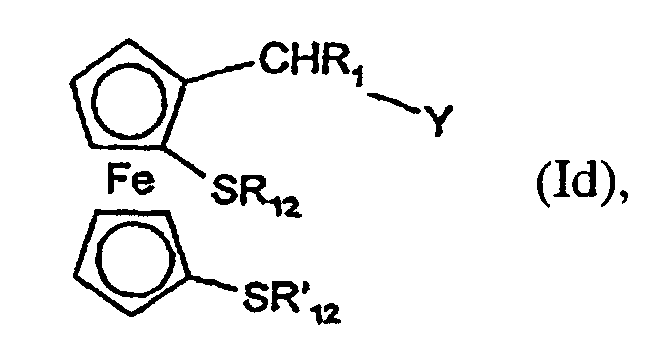
- Composé de formule (I) selon la revendication 1, dans lequel R10 et R11, sont chacun, indépendamment l'un de l'autre, des groupes alkyle en C1-C12, alkyle en C1-C12 substitué par un groupe alcoxy en C1-C4, par un groupe cycloalkyle en C5-C12 ou par un groupe phényle, cycloalkyle en C5-C12, phényle, cycloalkyle en C5-C12 substitué par un groupe alkyle en C1-C4 ou par un groupe alcoxy en C1-C4, ou un groupe phényle substitué par un à trois substituants choisis parmi les groupes alkyle en C1-C4, alcoxy en C1C4, -SiR4R5R6, halogène, -SO3M, -CO2M, -PO3M, -NR7R8, -[+NR7R8R9]X- et fluoroalkyle en C1-C5 ; ou le groupe -P(R10R11) est un radical de formule IV, IVa, IVb ou IVcoù R4 à R9, M et X ont les mêmes définitions que dans la revendication 1.

- Composé de formule (I) selon la revendication 1, dans lequel R10, R'10, R11, R'11, R12 et R'12 sont chacun, indépendamment les uns des autres, un groupe cycloalkyle comportant 5 à 8 atomes de carbone.
- Composé de formule (I) selon la revendication 1, dans lequel R10, R'10, R11, R'11, R12 et R'12 sont chacun, indépendamment les uns des autres, un groupe phényle non substitué ou phényle substitué par 1 ou 2 substituants.
- Composé de formule (I) selon la revendication 1, dans lequel R10, R'10, R11, R'11, R12 et R'12 sont chacun, indépendamment les uns des autres, des groupes 2-méthyl-, 3-méthyl-, 4-méthyl-, 2- ou 4-éthyl-, 2- ou 4-isopropyl-, 2- ou 4-tert-butyl-, 2-méthoxy-, 3-méthoxy-, 4-méthoxy-, 2- ou 4-éthoxy-, 4-triméthylsilyl-, 2- ou 4-fluoro-, 2,4-difluoro-, 2- ou 4-chloro-, 2,4-dichloro-, 2,4-diméthyl-, 3,5-diméthyl-, 2-méthoxy-4-méthyl-, 3,5-diméthyl-4-méthoxy-, 3,5-diméthyl-4-(diméthylamino)-, 2- ou 4-amino-, 2-ou 4-méthylamino-, 2- ou 4-(diméthylamino)-, 2- ou 4-SO3H-, 2- ou 4-SO3Na-, 2- ou 4-[+NH3Cl-]-, 3,4,5-triméthyl-, 2,4,6-triméthyl-, 4-trifluorométhyl- ou 3,5-di(trifluorométhyl)phén-1-yle.
- Composé de formule (I) selon la revendication 1, dans lequel R10, R'10, R11, R'11, R12 et R'12 sont chacun, indépendamment les uns des autres, des groupes cyclohexyle, n-butyle, isobutyle, tert-butyle, phényle, 2-ou 4-méthylphén-1-yle, 2- ou 4-méthoxyphén-1-yle, 2- ou 4-(diméthylamino)phén-1-yle, 3,5-diméthyl-4-(diméthylamino)phén-1-yle ou 3,5-diméthyl-4-méthoxyphén-1-yle.
- Composé de formule (I) selon la revendication 1, dans lequel Y est -OR13 ou -NR15R16 et R13, R15 et R16 ont les mêmes définitions que dans la revendication 1.
- Composé de formule (I) selon la revendication 1, dans lequel Y est -OR13 ou -NR15R16 où R13 est H ou un groupe alkyle en C1-C4 ou phényle et R15 et R16 sont chacun, indépendamment l'un de l'autre, des groupes alkyle en C1-C18.
- Composé de formule (VIb)dans laquelle
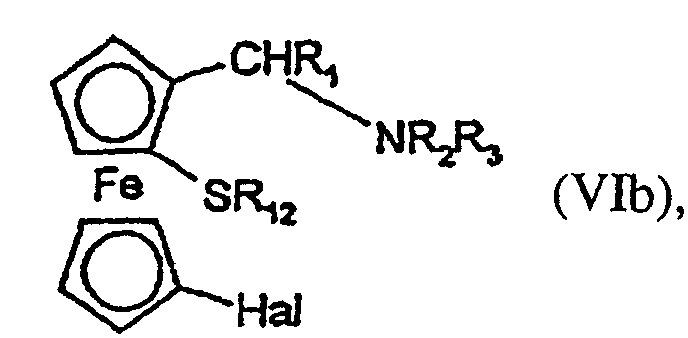 R1 est un groupe alkyle en C1-C8, cycloalkyle en C5-C12, phényle ou phényle substitué par 1 à 3 substituants choisis parmi les groupes alkyle en C1-C4 et alcoxy en C1-C4;R2 et R3 sont chacun, indépendamment l'un de l'autre, un atome d'hydrogène ou un groupe alkyle en C1-C12;R12 est H ou un groupe alkyle C1-C12, alkyle C1-C12 substitué par un groupe alcoxy en C1-C4, un groupe cycloalkyle en C5-C12 ou par un groupe phényle, cycloalkyle en C5-C12, phényle, cycloalkyle en C5-C12 substitué par un groupe alkyle en C1-C4 ou par un groupe alcoxy en C1-C4, ou phényle substitué par un à trois substituants choisis parmi les groupes alkyle en C1-C4, alcoxy en C1-C4, -SiR4R5R6, halogène, -SO3M, -CO2M, -PO3M, -NR7R8, -[+NR7R8R9]X- et fluoroalkyle en C1-C5;R4, R5 et R6 sont chacun, indépendamment les uns des autres, des groupes alkyle en C1-C12 ou phényle ;R7 et R8 sont chacun, indépendamment l'un de l'autre, H ou un groupe alkyle en C1-C12 ou phényle, ouR7 et R8 représentent ensemble un groupe tétraméthylène, pentaméthylène ou 3-oxa-1,5-pentylène,R9 est H ou un groupe alkyle en C1-C4 ;M est H ou un métal alcalin ;X- est l'anion d'un acide ; etHal est F, Cl, Br ou I.
 - Procédé de préparation d'un composé de formule (Ia), (Ib), (Ic) ou (Id) selon la revendication 2, dans lequel(a) dans un solvant organique inerte, on ajoute un alkyllithium à un composé de formuleoù
 R1 est un groupe alkyle en C1-C8, cycloalkyle en C5-C12, phényle ou phényle substitué par 1 à 3 substituants choisis parmi les groupes alkyle en C1-C4 et alcoxy en C1-C4;R2 et R3 sont chacun, indépendamment l'un de l'autre, un atome d'hydrogène ou un groupe alkyle en C1-C12;Hal est F, Cl, Br ou I ;R10 et R11 sont chacun, indépendamment l'un de l'autre, des groupes alkyle en C1-C12, alkyle en C1-C12 substitué par un groupe alcoxy en C1-C4, par un groupe cycloalkyle en C5-C12 ou par un groupe phényle, cycloalkyle en C5-C12, phényle, cycloalkyle en C5-C12 substitué par un groupe alkyle en C1-C4 ou par un groupe alcoxy en C1-C4, ou un groupe phényle substitué par un à trois substituants choisis parmi les groupes alkyle en C1-C4, alcoxy en C1-C4, -SiR4R5R6, halogène, -SO3M, -CO2M, -PO3M, -NR7R8, -[+NR7R8R9]X- et fluoroalkyle en C1-C5 ; ouR10 et R11 représentent ensemble un groupe alkylène en C4-C8, alkylène en C4-C8 substitué par un groupe alkyle en C1-C4 ou par un groupe phényle, ou alkylène cyclique en C4-C8 ;R12 est H ou un groupe alkyle en C1-C12, alkyle en C1-C12 substitué par un groupe alcoxy en C1-C4, par un groupe cycloalkyle en C5-C12 ou par un groupe phényle, cycloalkyle en C5-C12, phényle, cycloalkyle en C5-C12 substitué par un groupe alkyle en C1-C4 ou par un groupe alcoxy en C1-C4, ou un groupe phényle substitué par un à trois substituants choisis parmi les groupes alkyle en C1-C4, alcoxy en C1-C4, -SiR4R5R6, halogène, -SO3M, -CO2M, -PO3M, -NR7R8, -[+NR7R8R9]X- et fluoroalkyle en C1-C5 ;R4, R5 et R6 sont chacun, indépendamment les uns des autres, des groupes alkyle en C1-C12 ou phényle ;R7 et R8 sont chacun, indépendamment l'un de l'autre, H ou un groupe alkyle en C1-C12 ou phényle, ouR7 et R8 représentent ensemble un groupe tétraméthylène, pentaméthylène ou 3-oxa-1,5-pentylène ;R9 est H ou un groupe alkyle en C1-C4 ;M est H ou un métal alcalin ;X- est l'anion d'un acide ;et on fait réagir le mélange ; puis(b) on fait réagir soit le composé de formule (VIa), soit le composé de formule (VIb), avec un composé de formule R'12SSR'12 (Vc) ou ClP(R'10R'11) (Vd), où R'10 et R'11 sont chacun, indépendamment l'un de l'autre, tels que définis pour R10 et R11, à condition que -P(R10R11) ne soit pas identique à -P(R'10R'11), et R'12 est tel que défini pour R12, à condition que R12 ne soit pas identique à R'12 ;
et, le cas échéant, on transforme le radical -NR2R3 en radical -Y,où Y est -OR13, -SR14 ou -NR15R16;R13 est H ou un groupe alkyle en C1-C18, -C(O)-(alkyle en C1-8), phényle ou phényle substitué par un à trois substituants choisis parmi les groupes alkyle en C1-C4, alcoxy en C1-C4, -SiR4R5R6, halogène, -SO3M, -CO2M, -PO3M, -NR7R8, -[+NR7R8R9]X- et fluoroalkyle en C1-C5 ;R14 est H ou un groupe alkyle en C1-C18, phényle ou phényle substitué par un à trois substituants choisis parmi les groupes alkyle en C1-C4, alcoxy en C1-C4, -SiR4R5R6, halogène, -SO3M, -CO2M, -PO3M, -NR7R8, -[+NR7R8R9]X- et fluoroalkyle en C1-C5; etR15 et R16 sont chacun, indépendamment l'un de l'autre, un groupe alkyle en C1-C18 qui peut être substitué et/ou interrompu par un ou plusieurs hétéroatomes, arylènes ou carbocycles ; ou -NR15R16 est une amine cyclique. - Complexe de métal de transition contenant, comme ligand, un composé de formule (I) selon la revendication 1.
- Complexe de métal de transition selon la revendication 12, dans lequel le métal de transition est choisi dans le groupe Rh, Ir, Ru, Pd, Ni et Au.
- Utilisation d'un composé de formule (I) selon la revendication 1 comme ligand pour des métaux de transition en catalyse énantiosélective.
- Utilisation selon la revendication 14 comme ligand pour le rhodium ou l'iridium dans l'hydrogénation catalytique de doubles liaisons carbone/carbone ou carbone/hétéroatome.
Applications Claiming Priority (5)
| Application Number | Priority Date | Filing Date | Title |
|---|---|---|---|
| CH244196 | 1996-10-07 | ||
| CH244096 | 1996-10-07 | ||
| CH244096 | 1996-10-07 | ||
| CH244196 | 1996-10-07 | ||
| PCT/EP1997/005480 WO1998015565A1 (fr) | 1996-10-07 | 1997-10-06 | Ferrocenyles chiraux |
Publications (2)
| Publication Number | Publication Date |
|---|---|
| EP0929560A1 EP0929560A1 (fr) | 1999-07-21 |
| EP0929560B1 true EP0929560B1 (fr) | 2002-01-02 |
Family
ID=25690448
Family Applications (1)
| Application Number | Title | Priority Date | Filing Date |
|---|---|---|---|
| EP97912121A Expired - Lifetime EP0929560B1 (fr) | 1996-10-07 | 1997-10-06 | Ferrocenyles chiraux |
Country Status (13)
| Country | Link |
|---|---|
| US (1) | US6133464A (fr) |
| EP (1) | EP0929560B1 (fr) |
| JP (1) | JP4043051B2 (fr) |
| AT (1) | ATE211479T1 (fr) |
| AU (1) | AU4944197A (fr) |
| BR (1) | BR9712273A (fr) |
| CA (1) | CA2263715C (fr) |
| CZ (1) | CZ292412B6 (fr) |
| DE (1) | DE69709883T2 (fr) |
| ES (1) | ES2170942T3 (fr) |
| HU (1) | HU222691B1 (fr) |
| IL (1) | IL129329A (fr) |
| WO (1) | WO1998015565A1 (fr) |
Families Citing this family (12)
| Publication number | Priority date | Publication date | Assignee | Title |
|---|---|---|---|---|
| EP1006199A1 (fr) | 1998-12-03 | 2000-06-07 | Kreatech Biotechnology B.V. | Procédé pour la production des réticulations à des points sélectionnés entre les brins d'acides nucléiques et leur utilisation |
| US6562989B2 (en) * | 2000-08-07 | 2003-05-13 | Yale University | Catalyst for aromatic C—O, C—N, and C—C bond formation |
| US20040030199A1 (en) * | 2002-01-29 | 2004-02-12 | Maughon Robert R. | Process for reducing alpha-haloketones to secondary alpha-haloalcohols |
| US6620954B1 (en) * | 2002-03-25 | 2003-09-16 | Eastman Chemical Company | Phosphinometallocenylamides as novel ligands for asymmetric catalysis |
| GB0400720D0 (en) | 2004-01-14 | 2004-02-18 | Stylacats Ltd | Novel ferrocene-based phosphorus chiral phosphines |
| GB0400717D0 (en) * | 2004-01-14 | 2004-02-18 | Stylacats Ltd | Ferrocene derivatives |
| GB0400719D0 (en) * | 2004-01-14 | 2004-02-18 | Stylacats Ltd | Ligands for use in homogeneous catalysis |
| DE102010001364B4 (de) * | 2010-01-29 | 2014-10-16 | Technische Universität Chemnitz | Neue P,O-Ferrocene, deren Herstellung und Verwendung in katalytischen Reaktionen |
| JP6455893B2 (ja) * | 2013-03-11 | 2019-01-23 | ラトガース,ザ ステート ユニバーシティ オブ ニュー ジャージー | 不斉転換のための有機金属の触媒作用 |
| CN103772441B (zh) * | 2013-12-26 | 2016-08-17 | 浙江中山化工集团股份有限公司 | 一种(s)-1-二茂铁基乙基二甲胺转化为(r)-1-二茂铁基乙基二甲胺的合成方法 |
| US9308527B2 (en) * | 2014-03-17 | 2016-04-12 | Eastman Chemical Company | Phosphorous compounds useful as ligands and compositions and methods regarding them |
| CN104761518B (zh) * | 2014-12-01 | 2017-05-24 | 青岛科技大学 | 一种离子液体条件下不对称氢化合成d‑泛内酯的方法 |
Family Cites Families (8)
| Publication number | Priority date | Publication date | Assignee | Title |
|---|---|---|---|---|
| EP0496699B1 (fr) * | 1991-01-25 | 1995-04-26 | Ciba-Geigy Ag | Disphosphines contenant des groupes silane, diphosphines immobilisées et leur utilisation comme catalyseurs d'hydrogenation |
| DE59205529D1 (de) * | 1991-01-25 | 1996-04-11 | Ciba Geigy Ag | Silangruppen enthaltende Diphosphine, immobilisierte Diophoshine und deren Verwendung als Hydrierkatalysatoren |
| SG42936A1 (en) * | 1992-04-02 | 1997-10-17 | Ciba Geigy Ag | Ferrocenyl diphosphines as ligands for homogeneous catalysts |
| DE59410267D1 (de) * | 1993-02-26 | 2003-05-15 | Syngenta Participations Ag | Ferrocenyldiphosphine als Liganden für homogene Katalysatoren |
| EP0646590B1 (fr) * | 1993-10-01 | 1999-08-25 | Novartis AG | Ferrocényldiphosphines substituées par un groupe fluoroalkyle comme ligands pour des catalyseurs homogènes |
| EP0729969B1 (fr) * | 1995-02-24 | 2000-08-16 | Novartis AG | Ligandes ferrocène-disphosphine silylée, support inorganique ou à base de polymères organiques les contenant et leurs complexes métalliques et procédé de préparation et utilisation |
| CZ291280B6 (cs) * | 1995-04-11 | 2003-01-15 | Syngenta Participations Ag | Ferroceny a způsoby jejich přípravy |
| HRP960295A2 (en) * | 1995-07-06 | 1997-08-31 | Ciba Geigy Ag | Process for the hydrogenation of imines in the presence of immobilized iridium-diphosphine catalysts |
-
1997
- 1997-10-06 US US09/254,527 patent/US6133464A/en not_active Expired - Fee Related
- 1997-10-06 CA CA002263715A patent/CA2263715C/fr not_active Expired - Fee Related
- 1997-10-06 ES ES97912121T patent/ES2170942T3/es not_active Expired - Lifetime
- 1997-10-06 HU HU9904186A patent/HU222691B1/hu not_active IP Right Cessation
- 1997-10-06 WO PCT/EP1997/005480 patent/WO1998015565A1/fr not_active Ceased
- 1997-10-06 AT AT97912121T patent/ATE211479T1/de not_active IP Right Cessation
- 1997-10-06 IL IL12932997A patent/IL129329A/xx not_active IP Right Cessation
- 1997-10-06 AU AU49441/97A patent/AU4944197A/en not_active Abandoned
- 1997-10-06 EP EP97912121A patent/EP0929560B1/fr not_active Expired - Lifetime
- 1997-10-06 BR BR9712273-4A patent/BR9712273A/pt not_active Application Discontinuation
- 1997-10-06 CZ CZ19991178A patent/CZ292412B6/cs not_active IP Right Cessation
- 1997-10-06 DE DE69709883T patent/DE69709883T2/de not_active Expired - Lifetime
- 1997-10-06 JP JP51716698A patent/JP4043051B2/ja not_active Expired - Fee Related
Also Published As
| Publication number | Publication date |
|---|---|
| AU4944197A (en) | 1998-05-05 |
| IL129329A0 (en) | 2000-02-17 |
| EP0929560A1 (fr) | 1999-07-21 |
| WO1998015565A1 (fr) | 1998-04-16 |
| HUP9904186A2 (hu) | 2000-04-28 |
| ATE211479T1 (de) | 2002-01-15 |
| CZ292412B6 (cs) | 2003-09-17 |
| CA2263715A1 (fr) | 1998-04-16 |
| HU222691B1 (hu) | 2003-09-29 |
| JP2001501638A (ja) | 2001-02-06 |
| JP4043051B2 (ja) | 2008-02-06 |
| DE69709883T2 (de) | 2002-08-29 |
| BR9712273A (pt) | 1999-08-31 |
| CZ117899A3 (cs) | 1999-07-14 |
| CA2263715C (fr) | 2007-05-01 |
| HUP9904186A3 (en) | 2001-11-28 |
| IL129329A (en) | 2003-05-29 |
| ES2170942T3 (es) | 2002-08-16 |
| DE69709883D1 (de) | 2002-02-28 |
| US6133464A (en) | 2000-10-17 |
Similar Documents
| Publication | Publication Date | Title |
|---|---|---|
| US8563739B2 (en) | Ruthenium complexes having hybrid amine ligands, their preparation and use | |
| EP0820460B1 (fr) | Ferrocenes dihalogenes et leurs procedes de fabrication | |
| JP3625866B2 (ja) | フルオロアルキル置換フェロセニルジホスフィン | |
| JPH07149777A (ja) | 光学活性リン化合物 | |
| US5508438A (en) | Phosphorus compounds | |
| EP0929560B1 (fr) | Ferrocenyles chiraux | |
| Hayashi et al. | New chiral chelating phosphine complexes containing tricarbonyl (η6-arene) chromium for highly enantioselective allylic alkylation | |
| US5430191A (en) | Phosphorus compounds | |
| EP1622920B1 (fr) | Utilisation de ferrocenyldiphosphines substituees en tant que ligands pour catalyseurs d'hydrogenation homogene | |
| CN100577673C (zh) | 用于均相、对映选择性氢化催化剂的二茂铁基配体 | |
| US20090082581A1 (en) | Ferrocenyl ligands, production and use thereof | |
| EP2041150B1 (fr) | Ligands diphosphiniques | |
| US6987202B2 (en) | Phosphine compounds, transition metal complexes with the compounds contained as ligands therein, and asymmetric synthesis catalysts containing the complexes | |
| CN101610842A (zh) | 用于不对称氢化反应中的二(二茂铁基膦)二茂铁配体 | |
| JP2005523939A (ja) | フェロセニル配位子及び前記配位子の製造方法 | |
| US7589196B2 (en) | Amine-substituted biphenyldiphosphines | |
| KR100534190B1 (ko) | 키랄 페로세닐 | |
| JP4465110B2 (ja) | 光学活性ホスホランもしくはジホスホラン又はそれからなる金属錯体 | |
| JP5406524B2 (ja) | ジホスフィン類及び金属錯体 | |
| EP1334976B1 (fr) | Nouvelles phosphines complexes de métaux de transition contenant ces phosphines comme ligands et catalyseurs pour la synthèse asymétrique contenant ces complexes |
Legal Events
| Date | Code | Title | Description |
|---|---|---|---|
| PUAI | Public reference made under article 153(3) epc to a published international application that has entered the european phase |
Free format text: ORIGINAL CODE: 0009012 |
|
| 17P | Request for examination filed |
Effective date: 19990210 |
|
| AK | Designated contracting states |
Kind code of ref document: A1 Designated state(s): AT BE CH DE DK ES FI FR GB GR IE IT LI LU NL PT SE |
|
| 17Q | First examination report despatched |
Effective date: 20000616 |
|
| GRAG | Despatch of communication of intention to grant |
Free format text: ORIGINAL CODE: EPIDOS AGRA |
|
| GRAG | Despatch of communication of intention to grant |
Free format text: ORIGINAL CODE: EPIDOS AGRA |
|
| GRAH | Despatch of communication of intention to grant a patent |
Free format text: ORIGINAL CODE: EPIDOS IGRA |
|
| RAP1 | Party data changed (applicant data changed or rights of an application transferred) |
Owner name: NOVARTIS AG |
|
| RAP1 | Party data changed (applicant data changed or rights of an application transferred) |
Owner name: SYNGENTA PARTICIPATIONS AG |
|
| GRAH | Despatch of communication of intention to grant a patent |
Free format text: ORIGINAL CODE: EPIDOS IGRA |
|
| GRAA | (expected) grant |
Free format text: ORIGINAL CODE: 0009210 |
|
| REG | Reference to a national code |
Ref country code: GB Ref legal event code: IF02 |
|
| AK | Designated contracting states |
Kind code of ref document: B1 Designated state(s): AT BE CH DE DK ES FI FR GB GR IE IT LI LU NL PT SE |
|
| PG25 | Lapsed in a contracting state [announced via postgrant information from national office to epo] |
Ref country code: GR Free format text: LAPSE BECAUSE OF FAILURE TO SUBMIT A TRANSLATION OF THE DESCRIPTION OR TO PAY THE FEE WITHIN THE PRESCRIBED TIME-LIMIT Effective date: 20020102 Ref country code: FI Free format text: LAPSE BECAUSE OF FAILURE TO SUBMIT A TRANSLATION OF THE DESCRIPTION OR TO PAY THE FEE WITHIN THE PRESCRIBED TIME-LIMIT Effective date: 20020102 |
|
| REF | Corresponds to: |
Ref document number: 211479 Country of ref document: AT Date of ref document: 20020115 Kind code of ref document: T |
|
| REG | Reference to a national code |
Ref country code: CH Ref legal event code: EP |
|
| REG | Reference to a national code |
Ref country code: IE Ref legal event code: FG4D |
|
| REF | Corresponds to: |
Ref document number: 69709883 Country of ref document: DE Date of ref document: 20020228 |
|
| PG25 | Lapsed in a contracting state [announced via postgrant information from national office to epo] |
Ref country code: SE Free format text: LAPSE BECAUSE OF FAILURE TO SUBMIT A TRANSLATION OF THE DESCRIPTION OR TO PAY THE FEE WITHIN THE PRESCRIBED TIME-LIMIT Effective date: 20020402 Ref country code: PT Free format text: LAPSE BECAUSE OF FAILURE TO SUBMIT A TRANSLATION OF THE DESCRIPTION OR TO PAY THE FEE WITHIN THE PRESCRIBED TIME-LIMIT Effective date: 20020402 Ref country code: DK Free format text: LAPSE BECAUSE OF FAILURE TO SUBMIT A TRANSLATION OF THE DESCRIPTION OR TO PAY THE FEE WITHIN THE PRESCRIBED TIME-LIMIT Effective date: 20020402 |
|
| ET | Fr: translation filed | ||
| REG | Reference to a national code |
Ref country code: ES Ref legal event code: FG2A Ref document number: 2170942 Country of ref document: ES Kind code of ref document: T3 |
|
| PG25 | Lapsed in a contracting state [announced via postgrant information from national office to epo] |
Ref country code: LU Free format text: LAPSE BECAUSE OF NON-PAYMENT OF DUE FEES Effective date: 20021006 |
|
| PG25 | Lapsed in a contracting state [announced via postgrant information from national office to epo] |
Ref country code: IE Free format text: LAPSE BECAUSE OF NON-PAYMENT OF DUE FEES Effective date: 20021007 |
|
| PLBE | No opposition filed within time limit |
Free format text: ORIGINAL CODE: 0009261 |
|
| STAA | Information on the status of an ep patent application or granted ep patent |
Free format text: STATUS: NO OPPOSITION FILED WITHIN TIME LIMIT |
|
| 26N | No opposition filed | ||
| REG | Reference to a national code |
Ref country code: CH Ref legal event code: NV Representative=s name: SOLVIAS AG |
|
| REG | Reference to a national code |
Ref country code: IE Ref legal event code: MM4A |
|
| REG | Reference to a national code |
Ref country code: CH Ref legal event code: PCAR Free format text: SOLVIAS AG;KLYBECKSTRASSE 191;4057 BASEL (CH) |
|
| PGFP | Annual fee paid to national office [announced via postgrant information from national office to epo] |
Ref country code: ES Payment date: 20091023 Year of fee payment: 13 Ref country code: DE Payment date: 20091026 Year of fee payment: 13 Ref country code: CH Payment date: 20091026 Year of fee payment: 13 Ref country code: AT Payment date: 20091015 Year of fee payment: 13 |
|
| PGFP | Annual fee paid to national office [announced via postgrant information from national office to epo] |
Ref country code: NL Payment date: 20091016 Year of fee payment: 13 |
|
| PGFP | Annual fee paid to national office [announced via postgrant information from national office to epo] |
Ref country code: IT Payment date: 20091028 Year of fee payment: 13 Ref country code: GB Payment date: 20091022 Year of fee payment: 13 Ref country code: FR Payment date: 20091110 Year of fee payment: 13 |
|
| PGFP | Annual fee paid to national office [announced via postgrant information from national office to epo] |
Ref country code: BE Payment date: 20091130 Year of fee payment: 13 |
|
| BERE | Be: lapsed |
Owner name: *SYNGENTA PARTICIPATIONS A.G. Effective date: 20101031 |
|
| REG | Reference to a national code |
Ref country code: NL Ref legal event code: V1 Effective date: 20110501 |
|
| REG | Reference to a national code |
Ref country code: CH Ref legal event code: PL |
|
| GBPC | Gb: european patent ceased through non-payment of renewal fee |
Effective date: 20101006 |
|
| PG25 | Lapsed in a contracting state [announced via postgrant information from national office to epo] |
Ref country code: LI Free format text: LAPSE BECAUSE OF NON-PAYMENT OF DUE FEES Effective date: 20101031 Ref country code: CH Free format text: LAPSE BECAUSE OF NON-PAYMENT OF DUE FEES Effective date: 20101031 Ref country code: FR Free format text: LAPSE BECAUSE OF NON-PAYMENT OF DUE FEES Effective date: 20101102 |
|
| REG | Reference to a national code |
Ref country code: FR Ref legal event code: ST Effective date: 20110630 |
|
| REG | Reference to a national code |
Ref country code: DE Ref legal event code: R119 Ref document number: 69709883 Country of ref document: DE Effective date: 20110502 |
|
| PG25 | Lapsed in a contracting state [announced via postgrant information from national office to epo] |
Ref country code: GB Free format text: LAPSE BECAUSE OF NON-PAYMENT OF DUE FEES Effective date: 20101006 Ref country code: BE Free format text: LAPSE BECAUSE OF NON-PAYMENT OF DUE FEES Effective date: 20101031 Ref country code: AT Free format text: LAPSE BECAUSE OF NON-PAYMENT OF DUE FEES Effective date: 20101006 Ref country code: NL Free format text: LAPSE BECAUSE OF NON-PAYMENT OF DUE FEES Effective date: 20110501 |
|
| REG | Reference to a national code |
Ref country code: ES Ref legal event code: FD2A Effective date: 20111121 |
|
| PG25 | Lapsed in a contracting state [announced via postgrant information from national office to epo] |
Ref country code: IT Free format text: LAPSE BECAUSE OF NON-PAYMENT OF DUE FEES Effective date: 20101006 |
|
| PG25 | Lapsed in a contracting state [announced via postgrant information from national office to epo] |
Ref country code: ES Free format text: LAPSE BECAUSE OF NON-PAYMENT OF DUE FEES Effective date: 20101007 |
|
| PG25 | Lapsed in a contracting state [announced via postgrant information from national office to epo] |
Ref country code: DE Free format text: LAPSE BECAUSE OF NON-PAYMENT OF DUE FEES Effective date: 20110502 |