EP0930285A1 - Verfahren zur Herstellung von Buten-1 - Google Patents
Verfahren zur Herstellung von Buten-1 Download PDFInfo
- Publication number
- EP0930285A1 EP0930285A1 EP98403303A EP98403303A EP0930285A1 EP 0930285 A1 EP0930285 A1 EP 0930285A1 EP 98403303 A EP98403303 A EP 98403303A EP 98403303 A EP98403303 A EP 98403303A EP 0930285 A1 EP0930285 A1 EP 0930285A1
- Authority
- EP
- European Patent Office
- Prior art keywords
- zone
- distillation
- hydro
- isomerization
- butene
- Prior art date
- Legal status (The legal status is an assumption and is not a legal conclusion. Google has not performed a legal analysis and makes no representation as to the accuracy of the status listed.)
- Withdrawn
Links
- VXNZUUAINFGPBY-UHFFFAOYSA-N 1-Butene Chemical compound CCC=C VXNZUUAINFGPBY-UHFFFAOYSA-N 0.000 title claims abstract description 101
- 238000004519 manufacturing process Methods 0.000 title description 2
- 238000004821 distillation Methods 0.000 claims abstract description 95
- 238000006317 isomerization reaction Methods 0.000 claims abstract description 84
- 238000000034 method Methods 0.000 claims abstract description 39
- IAQRGUVFOMOMEM-UHFFFAOYSA-N but-2-ene Chemical class CC=CC IAQRGUVFOMOMEM-UHFFFAOYSA-N 0.000 claims abstract description 38
- 239000007788 liquid Substances 0.000 claims abstract description 4
- 239000003054 catalyst Substances 0.000 claims description 30
- VQTUBCCKSQIDNK-UHFFFAOYSA-N Isobutene Chemical compound CC(C)=C VQTUBCCKSQIDNK-UHFFFAOYSA-N 0.000 claims description 26
- NNPPMTNAJDCUHE-UHFFFAOYSA-N isobutane Chemical compound CC(C)C NNPPMTNAJDCUHE-UHFFFAOYSA-N 0.000 claims description 20
- KAKZBPTYRLMSJV-UHFFFAOYSA-N Butadiene Chemical compound C=CC=C KAKZBPTYRLMSJV-UHFFFAOYSA-N 0.000 claims description 16
- PXHVJJICTQNCMI-UHFFFAOYSA-N Nickel Chemical compound [Ni] PXHVJJICTQNCMI-UHFFFAOYSA-N 0.000 claims description 10
- 239000001282 iso-butane Substances 0.000 claims description 10
- 238000010992 reflux Methods 0.000 claims description 8
- 229910052759 nickel Inorganic materials 0.000 claims description 5
- 229910052751 metal Inorganic materials 0.000 claims description 4
- 239000002184 metal Substances 0.000 claims description 4
- 238000005070 sampling Methods 0.000 claims description 4
- 229910000510 noble metal Inorganic materials 0.000 claims description 3
- 230000008030 elimination Effects 0.000 claims 3
- 238000003379 elimination reaction Methods 0.000 claims 3
- 238000009434 installation Methods 0.000 abstract 1
- 239000001257 hydrogen Substances 0.000 description 22
- 229910052739 hydrogen Inorganic materials 0.000 description 22
- UFHFLCQGNIYNRP-UHFFFAOYSA-N Hydrogen Chemical compound [H][H] UFHFLCQGNIYNRP-UHFFFAOYSA-N 0.000 description 19
- 238000006243 chemical reaction Methods 0.000 description 13
- IJDNQMDRQITEOD-UHFFFAOYSA-N n-butane Chemical class CCCC IJDNQMDRQITEOD-UHFFFAOYSA-N 0.000 description 13
- 238000005984 hydrogenation reaction Methods 0.000 description 10
- 239000000203 mixture Substances 0.000 description 10
- 235000013844 butane Nutrition 0.000 description 8
- 229930195733 hydrocarbon Natural products 0.000 description 7
- 150000002430 hydrocarbons Chemical class 0.000 description 6
- 150000001875 compounds Chemical class 0.000 description 5
- 239000000470 constituent Substances 0.000 description 5
- OKTJSMMVPCPJKN-UHFFFAOYSA-N Carbon Chemical compound [C] OKTJSMMVPCPJKN-UHFFFAOYSA-N 0.000 description 4
- KDLHZDBZIXYQEI-UHFFFAOYSA-N Palladium Chemical compound [Pd] KDLHZDBZIXYQEI-UHFFFAOYSA-N 0.000 description 4
- VYPSYNLAJGMNEJ-UHFFFAOYSA-N Silicium dioxide Chemical compound O=[Si]=O VYPSYNLAJGMNEJ-UHFFFAOYSA-N 0.000 description 4
- 238000006266 etherification reaction Methods 0.000 description 4
- 125000000383 tetramethylene group Chemical group [H]C([H])([*:1])C([H])([H])C([H])([H])C([H])([H])[*:2] 0.000 description 4
- 238000011282 treatment Methods 0.000 description 4
- 230000015572 biosynthetic process Effects 0.000 description 3
- 125000004432 carbon atom Chemical group C* 0.000 description 3
- XNMQEEKYCVKGBD-UHFFFAOYSA-N dimethylacetylene Natural products CC#CC XNMQEEKYCVKGBD-UHFFFAOYSA-N 0.000 description 3
- 150000002431 hydrogen Chemical class 0.000 description 3
- 238000000926 separation method Methods 0.000 description 3
- 238000004088 simulation Methods 0.000 description 3
- DURPTKYDGMDSBL-UHFFFAOYSA-N 1-butoxybutane Chemical compound CCCCOCCCC DURPTKYDGMDSBL-UHFFFAOYSA-N 0.000 description 2
- NINIDFKCEFEMDL-UHFFFAOYSA-N Sulfur Chemical compound [S] NINIDFKCEFEMDL-UHFFFAOYSA-N 0.000 description 2
- PNEYBMLMFCGWSK-UHFFFAOYSA-N aluminium oxide Inorganic materials [O-2].[O-2].[O-2].[Al+3].[Al+3] PNEYBMLMFCGWSK-UHFFFAOYSA-N 0.000 description 2
- 238000009835 boiling Methods 0.000 description 2
- 229910052799 carbon Inorganic materials 0.000 description 2
- 230000003197 catalytic effect Effects 0.000 description 2
- 239000007789 gas Substances 0.000 description 2
- 238000012856 packing Methods 0.000 description 2
- 229910052763 palladium Inorganic materials 0.000 description 2
- BASFCYQUMIYNBI-UHFFFAOYSA-N platinum Chemical compound [Pt] BASFCYQUMIYNBI-UHFFFAOYSA-N 0.000 description 2
- 239000000377 silicon dioxide Substances 0.000 description 2
- 229910052717 sulfur Inorganic materials 0.000 description 2
- 239000011593 sulfur Substances 0.000 description 2
- 238000003786 synthesis reaction Methods 0.000 description 2
- 230000009466 transformation Effects 0.000 description 2
- DNIAPMSPPWPWGF-GSVOUGTGSA-N (R)-(-)-Propylene glycol Chemical compound C[C@@H](O)CO DNIAPMSPPWPWGF-GSVOUGTGSA-N 0.000 description 1
- 239000004215 Carbon black (E152) Substances 0.000 description 1
- LFQSCWFLJHTTHZ-UHFFFAOYSA-N Ethanol Chemical compound CCO LFQSCWFLJHTTHZ-UHFFFAOYSA-N 0.000 description 1
- VGGSQFUCUMXWEO-UHFFFAOYSA-N Ethene Chemical compound C=C VGGSQFUCUMXWEO-UHFFFAOYSA-N 0.000 description 1
- 239000005977 Ethylene Substances 0.000 description 1
- KJTLSVCANCCWHF-UHFFFAOYSA-N Ruthenium Chemical compound [Ru] KJTLSVCANCCWHF-UHFFFAOYSA-N 0.000 description 1
- 239000003377 acid catalyst Substances 0.000 description 1
- 150000001298 alcohols Chemical class 0.000 description 1
- 229910000287 alkaline earth metal oxide Inorganic materials 0.000 description 1
- 125000004429 atom Chemical group 0.000 description 1
- 238000004523 catalytic cracking Methods 0.000 description 1
- 239000004568 cement Substances 0.000 description 1
- 239000003153 chemical reaction reagent Substances 0.000 description 1
- 239000000571 coke Substances 0.000 description 1
- 229920001577 copolymer Polymers 0.000 description 1
- 238000005336 cracking Methods 0.000 description 1
- 230000009849 deactivation Effects 0.000 description 1
- 125000001495 ethyl group Chemical group [H]C([H])([H])C([H])([H])* 0.000 description 1
- 238000011066 ex-situ storage Methods 0.000 description 1
- 238000000605 extraction Methods 0.000 description 1
- 239000012530 fluid Substances 0.000 description 1
- 238000011065 in-situ storage Methods 0.000 description 1
- 229910052741 iridium Inorganic materials 0.000 description 1
- GKOZUEZYRPOHIO-UHFFFAOYSA-N iridium atom Chemical compound [Ir] GKOZUEZYRPOHIO-UHFFFAOYSA-N 0.000 description 1
- 229920000092 linear low density polyethylene Polymers 0.000 description 1
- 125000002496 methyl group Chemical group [H]C([H])([H])* 0.000 description 1
- 229910052762 osmium Inorganic materials 0.000 description 1
- SYQBFIAQOQZEGI-UHFFFAOYSA-N osmium atom Chemical compound [Os] SYQBFIAQOQZEGI-UHFFFAOYSA-N 0.000 description 1
- 229910052697 platinum Inorganic materials 0.000 description 1
- 238000002203 pretreatment Methods 0.000 description 1
- 238000000746 purification Methods 0.000 description 1
- 229910001404 rare earth metal oxide Inorganic materials 0.000 description 1
- 230000008929 regeneration Effects 0.000 description 1
- 238000011069 regeneration method Methods 0.000 description 1
- 229910052703 rhodium Inorganic materials 0.000 description 1
- 239000010948 rhodium Substances 0.000 description 1
- MHOVAHRLVXNVSD-UHFFFAOYSA-N rhodium atom Chemical compound [Rh] MHOVAHRLVXNVSD-UHFFFAOYSA-N 0.000 description 1
- 229910052707 ruthenium Inorganic materials 0.000 description 1
- 238000004230 steam cracking Methods 0.000 description 1
- 239000000126 substance Substances 0.000 description 1
- IAQRGUVFOMOMEM-ONEGZZNKSA-N trans-but-2-ene Chemical compound C\C=C\C IAQRGUVFOMOMEM-ONEGZZNKSA-N 0.000 description 1
- 239000010457 zeolite Substances 0.000 description 1
Images

Classifications
-
- C—CHEMISTRY; METALLURGY
- C07—ORGANIC CHEMISTRY
- C07C—ACYCLIC OR CARBOCYCLIC COMPOUNDS
- C07C11/00—Aliphatic unsaturated hydrocarbons
- C07C11/02—Alkenes
- C07C11/08—Alkenes with four carbon atoms
-
- C—CHEMISTRY; METALLURGY
- C07—ORGANIC CHEMISTRY
- C07C—ACYCLIC OR CARBOCYCLIC COMPOUNDS
- C07C5/00—Preparation of hydrocarbons from hydrocarbons containing the same number of carbon atoms
- C07C5/22—Preparation of hydrocarbons from hydrocarbons containing the same number of carbon atoms by isomerisation
- C07C5/23—Rearrangement of carbon-to-carbon unsaturated bonds
- C07C5/25—Migration of carbon-to-carbon double bonds
- C07C5/2506—Catalytic processes
- C07C5/2556—Catalytic processes with metals
-
- C—CHEMISTRY; METALLURGY
- C07—ORGANIC CHEMISTRY
- C07C—ACYCLIC OR CARBOCYCLIC COMPOUNDS
- C07C7/00—Purification; Separation; Use of additives
- C07C7/04—Purification; Separation; Use of additives by distillation
-
- C—CHEMISTRY; METALLURGY
- C07—ORGANIC CHEMISTRY
- C07C—ACYCLIC OR CARBOCYCLIC COMPOUNDS
- C07C2523/00—Catalysts comprising metals or metal oxides or hydroxides, not provided for in group C07C2521/00
- C07C2523/38—Catalysts comprising metals or metal oxides or hydroxides, not provided for in group C07C2521/00 of noble metals
- C07C2523/40—Catalysts comprising metals or metal oxides or hydroxides, not provided for in group C07C2521/00 of noble metals of the platinum group metals
-
- C—CHEMISTRY; METALLURGY
- C07—ORGANIC CHEMISTRY
- C07C—ACYCLIC OR CARBOCYCLIC COMPOUNDS
- C07C2523/00—Catalysts comprising metals or metal oxides or hydroxides, not provided for in group C07C2521/00
- C07C2523/70—Catalysts comprising metals or metal oxides or hydroxides, not provided for in group C07C2521/00 of the iron group metals or copper
- C07C2523/74—Iron group metals
- C07C2523/755—Nickel
Definitions
- the present invention relates to the field of the production of 1-butene.
- the 1-butene is an important compound for the synthesis of copolymers, for example with ethylene for linear low density polyethylenes, or for oxide synthesis butene.
- the FR-B-2 527 201 patent describes a multi-step process using a 4-atom hydrocarbon feedstock carbon. After having undergone several treatments including an etherification reaction with an aliphatic alcohol, then several treatments for separation of the different constituents of the mixture, the 1-butene is recovered as the top fraction of a distillation column, the tail fraction consisting of the other compounds and 1-butene not recovered. This tail fraction is then sent to an isomerization zone, where it is partially transformed into isobutene.
- Patent EP-B-0 129 900 describes a process to produce 1-butene by isomerization from a mixture of hydrocarbons containing 2-butenes. This document raises an important problem which is the duration life of the isomerization catalyst and therefore of the regeneration of this catalyst.
- the type of catalyst used is an acid catalyst and the operating conditions of the reaction require a reaction temperature of the order of 250 ° C to 400 ° C. On the other hand this process generates isobutene, which is difficult to separate from 1-butene, even if it compound is only present in trace amounts.
- the present invention relates to a multi-step process for obtaining of 1-butene from a charge comprising hydrocarbons with 4 atoms of carbon per molecule of which at least one of the isomers of 2-butene (2-butene is present in the cis and trans forms), this process comprising at least one step of distillation and at least one hydro-isomerization step, these steps also being able to to be confused.
- the catalyst used is very selective for the isomerization reaction compared to the hydrogenation reactions.
- the amount of hydrogen required for the reaction hydro-isomerization is very low.
- the losses due to the hydrogenation of butenes are therefore very weak and it is not essential to add a means to separate the hydrogen from the effluent leaving the hydro-isomerization reactor.
- the invention relates to a process for obtaining 1-butene in which a charge containing at least one of the 2-butene isomers is sent to a zone distillation associated with a hydro-isomerization zone.
- the invention also relates to a device for implementing the method according to the invention.
- the load treated by the process according to the invention can be a cut containing hydrocarbons with 4 carbon atoms, at least one of the isomers of 2-butene. It can come, for example, from a steam cracking, a catalytic cracking fluid bed (FCC) or skeletal isomerization.
- FCC catalytic cracking fluid bed
- the charge generally contains butadiene, butanes (n-butane and isobutane), butenes (isobutene, 1-butene and 2-butenes, cis and trans forms).
- This feed can be introduced into the distillation zone of the process according to the invention without pre-treatment.
- some uses require high 1-butene purity. For these, it is therefore necessary to separate 1-butene from products whose boiling point is near or below the boiling point of 1-butene. These products are generally butadiene, isobutane and isobutene.
- the effluent from the selective hydrogenation reactor does not then contains more than butanes (n-butane and isobutane), butenes (isobutene, 1-butene and 2-butenes, cis and trans forms), as well as traces of butadiene.
- Isobutene is usually removed by extraction or by using it as reagent of a reaction.
- Isobutene can for example be oligomerized, for example according to a process called "Polynaphta" developed by the applicant., It can also react with certain alcohols according to etherification reactions to give for example methyl tertio butyl ether (MTBE) or ethyl tertio butyl ether (ETBE).
- MTBE methyl tertio butyl ether
- ETBE ethyl tertio butyl ether
- Butadiene and isobutene removal treatments can be performed on the feed before it is introduced into the process distillation zone according to the invention or on the column head effluent of the process according to the invention. Of preferably, they will be carried out before the load is introduced into the distillation. Isobutane is generally eliminated in the process head effluent according to the invention.
- the invention relates to a process for obtaining 1-butene in which a charge containing at least one of the 2-butene isomers is sent to a zone distillation associated with a hydro-isomerization zone.
- the charge of the area of distillation is introduced to at least one level of the distillation column, the charge of the hydro-isomerization zone is sampled at least at one level of the zone distillation and it represents at least part of the liquid flowing in the zone of distillation.
- This level of the distillation zone can also be the bottom of the distillation.
- the effluent from the hydro-isomerization zone is at least partially reintroduced at least one reintroduction level in the distillation zone.
- the top fraction of the effluent from the distillation zone contains at least less than 1-butene.
- the distillation zone generally comprises at least one column provided with at least minus a distillation intern selected from the group consisting of simple plates, multi-weir trays, bulk packings and structured packings, as well that is known to those skilled in the art, for example such that the overall efficiency total is at least equal to five theoretical stages.
- a distillation intern selected from the group consisting of simple plates, multi-weir trays, bulk packings and structured packings, as well that is known to those skilled in the art, for example such that the overall efficiency total is at least equal to five theoretical stages.
- the distillation zone is associated with a hydro-isomerization zone in which at least part of the 2-butenes present in the charge are converted into 1-butene.
- This hydro-isomerization zone can be external to the distillation zone or incorporated into the distillation zone, it can also be partly external to the distillation zone distillation and partly incorporated in the distillation zone.
- the hydro-isomerization zone of the process according to the invention can be defined as a zone where a reaction is carried out in the presence of a hydro-isomerization catalyst and a gas stream comprising hydrogen.
- the hydro-isomerization zone generally comprises at least one bed hydro-isomerization catalyst containing a hydro-isomerization catalyst.
- the reaction zone comprises from 1 to 6 catalytic beds.
- the hydro-isomerization zone at least partially performs the hydro-isomerization of the 2-butenes in 1-butene.
- the hydro-isomerization reaction zone can be at least partially external to the distillation zone. It then comprises at least one reactor, preferably a single reactor. According to this embodiment, the method according to the invention makes it possible to isomerize 2-butenes into 1-butene outside the distillation zone, possibly in pressure and / or temperature conditions different from those used in the column.
- the charge of the distillation zone can be introduced at any level of the distillation column, for example at several levels of introduction, but of preferably at one level of the distillation column. We would not go outside the framework of the present invention by introducing into the distillation zone several charges of different compositions at several levels of introduction.
- Each level of the column can be defined by a pressure-temperature pair and to each level corresponds a composition of the mixture of the various constituents.
- mixtures rich in 1-butene are located in the upper levels of the column (top of the column), mixtures rich in 2-butenes are found in the lower levels of the column (bottom of the column).
- the charge of the hydro-isomerization zone is taken from at least one level of sampling of the distillation zone, preferably at a single level thereof.
- the sampling from the distillation column is usually done at a level where the value of the ratio of the amount of 2-butenes to the amount of 1-butene is greater than its value at thermodynamic equilibrium at the entrance to the reaction zone.
- the distillation column is usually taken at a level located below the level of introduction of the charge into said distillation column, plus in particular, the sample can be taken from the bottom of the distillation column.
- the sampling of the distillation column carried out at the bottom of the distillation may only be partially introduced into the hydro-isomerization zone. Usually, another part of this fraction is also evacuated. Else part, when the hydro-isomerization zone is entirely external to the distillation, the sample from the distillation zone can be treated before being introduced into the hydro-isomerization zone. This treatment can for example be a separation of the various constituents of the mixture, purification of the effluent, reaction other than hydro-isomerization.
- the hydro-isomerization reaction is carried out in the presence of hydrogen with a supported catalyst generally comprising at least one metal chosen from the group formed by nickel and the noble metals of group VIII such as ruthenium, rhodium, palladium, osmium, iridium and platinum.
- This catalyst can be used as which or preferably deposited on a support.
- a supported catalyst comprising palladium.
- the noble metal content of the catalyst is usually about 0.01 to 2% by mass.
- This catalyst is usually treated with a sulfur-containing compound and then with hydrogen before use in the hydro-isomerization zone.
- the metal is advantageously found in reduced form, at least for 50% of its total mass.
- the proportion of nickel relative to the total mass of the catalyst is approximately 5 to 70%, and preferably approximately 10 to 70%.
- a catalyst is generally used such that the average size of the nickel crystallites is less than 10 nm, preferably less than 8 nm, even more preferably less than 6 nm.
- the catalyst is generally sulfurized in situ or ex situ, so that sulfur is chemisorbed on at least part of the metal.
- the support is generally chosen from the group formed by alumina, silica-aluminas, silica, zeolites, activated carbon, clays, aluminous cements, rare earth oxides and alkaline earth oxides, alone or in mixtures.
- a support based on alumina or silica is preferably used, with a specific surface of approximately 1 to 300 m 2 / g, preferably approximately 5 to 100 m 2 / g.
- hydrogen can come from all sources producing hydrogen at least 50% by volume of purity, preferably at least 80% by volume of purity and even more preferably at least 90% by volume of purity.
- the distillation head temperature is about 0 to 200 ° C and the distillation bottom temperature is generally about 5 at 250 ° C.
- the hydro-isomerization reaction is carried out under conditions which are most generally intermediate between those established at the top and at the bottom of the distillation zone, at a temperature of approximately 0 to 250 ° C., and preferably of approximately 50 at 200 ° C.
- the liquid subjected to hydro-isomerization is fed by a gas flow comprising, preferably for the most part, hydrogen.
- the catalyst is placed in any catalytic bed according to any technology known to those skilled in the art in operating conditions (temperature, pressure etc.) independent or not, of preferably independent of the operating conditions of the distillation zone.
- the absolute pressure required for this hydro-isomerization step is generally around 1 to 70 bar, preferably around 2 to 30 bar.
- the operating temperature of the hydro-isomerization zone is generally around 0 to 250 ° C, preferably around 50 to 200 ° C.
- the space velocity (defined as the volume of feedstock by the volume of catalyst and per hour and denoted VVH) within said hydro-isomerization zone, calculated relative to the catalyst, is generally around 0.1 to 150 h -1 and more particularly from approximately 4 to 50 h -1 and even more preferably from approximately 10 to 30 h -1 .
- the corresponding hydrogen flow rate is such that the molar ratio H 2 / hydrocarbons entering the hydro-isomerization zone is preferably at least equal to 10 -5 . This ratio is most often from approximately 10 -5 to approximately 3 and very frequently from approximately 10 -4 to approximately 1.
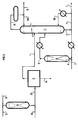
- FIG. 1 represents a simple embodiment of the method according to the invention.
- the feed to be treated is introduced via line 1 into a distillation zone C.
- the column bottom effluent is discharged from the distillation zone via line 2.
- a part of the flow which circulates in line 2 is evacuated from the device by line 7.
- the other part of the flow circulating in line 2 is heated by means of a heat exchanger heat before supplying the charge supply line 4 in the hydro-isomerization zone A.
- Line 4 is also supplied via line 3 by a flow containing at less hydrogen.
- the hydro-isomerization effluent is discharged from the hydro-isomerization zone R by line 5, it is cooled by a heat exchanger, then introduced to new in distillation zone C.
- the column head effluent from the distillation is evacuated via line 6.
- FIG. 2 represents another simple embodiment of the method according to the invention.
- the load to be treated is introduced via line 1 into a zone of distillation C.
- line 8 a sample is taken at an intermediate level of the distillation column C.
- Line 8 feeds the hydro-isomerization zone R ', this zone hydro-isomerization R 'being also fed by a stream containing hydrogen via line 3.
- the hydro-isomerization effluent is discharged from the hydro-isomerization zone R 'and reintroduced into the distillation zone C by line 9.
- the effluent from column bottom is discharged from distillation zone C via line 7.
- the overhead effluent column from distillation zone C is evacuated from the device by line 6.
- FIG. 3 represents an embodiment in which the load of the area of distillation undergoes several reactions beforehand.
- the charge to be treated is introduced via line 10 into a hydrogenation zone selective H, this selective hydrogenation zone H being supplied with hydrogen by the line 11.
- the effluent from zone H is discharged via line 12, line 13 supplies the line 12 in a charge containing an alcohol.
- the load is sent to the area of etherification associated with a separation zone E by line 12.
- the product of etherification reaction E is evacuated via line 14 and the unreacted compounds are sent via line 1 to distillation zone C.
- the column bottom effluent is evacuated from the distillation zone by line 2. Part of the flow which circulates in the line 2 is evacuated from the device by line 7.
- the other part of the flow which circulates in the line 2 is heated by means of a heat exchanger before supplying line 4 of charge adduction in the hydro-isomerization zone R.
- Line 4 is also supplied by line 3 with a stream containing at least hydrogen.
- the effluent hydro-isomerization is evacuated from the hydro-isomerization zone R by line 5, it is cooled by a heat exchanger, then it is introduced again into the distillation C.
- the column head effluent from the distillation zone is discharged through the line 6.
- the unit includes a distillation zone and a hydro-isomerization zone.
- the hydro-isomerization zone is external to the distillation column, the distillation includes 130 theoretical plates, numbered from top to bottom.
- Food is carried out at level 80, the hydro-isomerization reactor is supplied by a racking located at the level of plate 130 of the distillation column and the hydro-isomerization effluent is reinjected at the level of tray No. 100.
- the reactor contains 7 tonnes of catalyst.
- the operating conditions are as follows: a rate of reflux of the column (reflux / distillate) of 17, an absolute pressure at the top of the column of 6.2 bar, a pressure absolute at the bottom of the column of 7 bar, a temperature of the column supply: 61.6 ° C, a column head temperature of 51.7 ° C, a bottom temperature of column of 64.6 ° C, a reactor temperature of 75 ° C, an absolute pressure of the 7 bar reactor, total flow (including charge flow and flow hydrogen) in the hydro-isomerization reactor of 250 kmol / h.
- This table is used to calculate the yield of 1-butene at the top of the column: 105.1% by mass, and the hydrogenation yield, that is to say the ratio of butanes in the effluents (head and bottom of the column) / butanes in the feed which is 100.32% by mass.
- the quantity of hydrogen in the effluents of column head and bottom is zero.
- the unit includes a distillation zone and a hydro-isomerization zone.
- the hydro-isomerization zone is external to the distillation column, the distillation includes 130 theoretical plates, numbered from top to bottom.
- Food is carried out at level 80, the hydro-isomerization reactor is supplied by a racking located at the level of plate 130 of the distillation column and the hydro-isomerization effluent is reinjected at the level of tray No. 100.
- the reactor contains 7 tonnes of catalyst.
- the operating conditions are as follows: a rate of reflux of the column (reflux / distillate) of 30, an absolute pressure at the top of the column of 6.2 bar, a pressure absolute at the bottom of the column of 7 bar, a temperature of the column supply: 62.5 ° C, a column head temperature of 53.4 ° C, a bottom temperature of column of 65.8 ° C, a hydroisomerization reactor temperature of 75 ° C, a absolute pressure of the reactor of 10 bar, a flow in the reactor (including the flow of the hydrogen charge and flow) of 2000 kmole / h.
- This table is used to calculate the yield of 1-butene at the top of the column: 168.2% by mass, and the hydrogenation yield, that is to say the ratio of butanes in the effluents (head and bottom of the column) / butanes in the feed which is 100.7% by mass.
Landscapes
- Chemical & Material Sciences (AREA)
- Organic Chemistry (AREA)
- Chemical Kinetics & Catalysis (AREA)
- Engineering & Computer Science (AREA)
- Analytical Chemistry (AREA)
- Oil, Petroleum & Natural Gas (AREA)
- Water Supply & Treatment (AREA)
- Organic Low-Molecular-Weight Compounds And Preparation Thereof (AREA)
- Low-Molecular Organic Synthesis Reactions Using Catalysts (AREA)
Applications Claiming Priority (2)
| Application Number | Priority Date | Filing Date | Title |
|---|---|---|---|
| FR9800397A FR2773558B1 (fr) | 1998-01-14 | 1998-01-14 | Procede pour l'obtention de 1-butene |
| FR9800397 | 1998-01-14 |
Publications (1)
| Publication Number | Publication Date |
|---|---|
| EP0930285A1 true EP0930285A1 (de) | 1999-07-21 |
Family
ID=9521822
Family Applications (1)
| Application Number | Title | Priority Date | Filing Date |
|---|---|---|---|
| EP98403303A Withdrawn EP0930285A1 (de) | 1998-01-14 | 1998-12-24 | Verfahren zur Herstellung von Buten-1 |
Country Status (5)
| Country | Link |
|---|---|
| US (1) | US6242662B1 (de) |
| EP (1) | EP0930285A1 (de) |
| JP (1) | JPH11269101A (de) |
| CA (1) | CA2257454A1 (de) |
| FR (1) | FR2773558B1 (de) |
Cited By (1)
| Publication number | Priority date | Publication date | Assignee | Title |
|---|---|---|---|---|
| EP1251919A4 (de) * | 1999-12-11 | 2003-05-07 | Tung Elizabeth | Neue dimensionen der reaktivdestillationstechnologie |
Families Citing this family (12)
| Publication number | Priority date | Publication date | Assignee | Title |
|---|---|---|---|---|
| DE10311139A1 (de) | 2003-03-14 | 2004-09-23 | Basf Ag | Verfahren zur Herstellung von 1-Buten |
| US7227047B2 (en) * | 2003-08-22 | 2007-06-05 | Exxonmobil Chemical Patents Inc. | Butadiene and isobutylene removal from olefinic streams |
| DE102005014177A1 (de) * | 2005-03-29 | 2006-10-05 | Basf Ag | Verfahren zur Gewinnung eines Stromes von Kohlenwasserstoffen, enthaltend 5 bis 12 Kohlenstoffatome pro Molekül, mit erhöhtem Anteil an linearen alpha-Olefinen |
| DE102005014178A1 (de) * | 2005-03-29 | 2006-10-05 | Basf Ag | Verfahren zur Gewinnung eines Stromes von Kohlenwasserstoffen, enthaltend 4 bis 12 Kohlenstoffatome pro Molekül, mit erhöhtem Anteil an linearen alpha-Olefinen |
| DE102005062700A1 (de) * | 2005-12-28 | 2007-07-05 | Oxeno Olefinchemie Gmbh | Verfahren zur Herstellung von 1-Buten aus technischen Mischungen von C4-Kohlenwasserstoffen |
| RU2304134C1 (ru) * | 2006-06-13 | 2007-08-10 | Олег Станиславович Павлов | Способ получения чистого 1-бутена |
| KR100905655B1 (ko) | 2007-05-30 | 2009-06-30 | 에스케이에너지 주식회사 | 변형된 메조포로스 물질의 제조 방법 및 이를 이용한2-부텐의 선택적 이성화 반응 |
| AU2008331448B2 (en) * | 2007-12-05 | 2013-12-19 | Braskem S.A. | Integrated process for the production of ethylene-butylene copolymer, an ethylene-butylene copolymer and the use of ethylene and 1-butylene, as comonomer, sourced from renewable natural raw materials |
| CN101492338B (zh) * | 2008-01-23 | 2013-06-05 | 中国石油化工股份有限公司 | 丁烯-2临氢异构制丁烯-1的方法 |
| KR101357973B1 (ko) * | 2008-04-04 | 2014-02-03 | 루머스 테크놀로지 인코포레이티드 | 선형 알파 올레핀 생산을 위한 시스템 및 공정 |
| US8178736B2 (en) * | 2009-08-07 | 2012-05-15 | Lummus Technology Inc. | Process and system for the production of isoprene |
| US10550048B2 (en) * | 2017-01-20 | 2020-02-04 | Saudi Arabian Oil Company | Multiple-stage catalyst system for self-metathesis with controlled isomerization and cracking |
Citations (2)
| Publication number | Priority date | Publication date | Assignee | Title |
|---|---|---|---|---|
| FR2528033A1 (fr) * | 1982-06-08 | 1983-12-09 | Exxon Research Engineering Co | Procede de traitement d'une charge d'isobutylene |
| EP0129900A2 (de) * | 1983-06-25 | 1985-01-02 | BASF Aktiengesellschaft | Verfahren zur Gewinnung von 1-Buten aus 2-Butene enthaltenden C4-Kohlenwasserstoffgemischen |
Family Cites Families (3)
| Publication number | Priority date | Publication date | Assignee | Title |
|---|---|---|---|---|
| JPS57131729A (en) * | 1981-02-09 | 1982-08-14 | Nippon Oil Co Ltd | Selective preparation of 1-butene by hydroisomerization of 2-butene |
| SU1595829A1 (ru) * | 1988-03-09 | 1990-09-30 | Грозненский филиал Охтинского научно-производственного объединения "Пластполимер" | Способ получени бутена-1 |
| US5087780A (en) * | 1988-10-31 | 1992-02-11 | Chemical Research & Licensing Company | Hydroisomerization process |
-
1998
- 1998-01-14 FR FR9800397A patent/FR2773558B1/fr not_active Expired - Fee Related
- 1998-12-24 EP EP98403303A patent/EP0930285A1/de not_active Withdrawn
-
1999
- 1999-01-12 CA CA002257454A patent/CA2257454A1/fr not_active Abandoned
- 1999-01-14 US US09/229,958 patent/US6242662B1/en not_active Expired - Lifetime
- 1999-01-14 JP JP11007116A patent/JPH11269101A/ja not_active Withdrawn
Patent Citations (2)
| Publication number | Priority date | Publication date | Assignee | Title |
|---|---|---|---|---|
| FR2528033A1 (fr) * | 1982-06-08 | 1983-12-09 | Exxon Research Engineering Co | Procede de traitement d'une charge d'isobutylene |
| EP0129900A2 (de) * | 1983-06-25 | 1985-01-02 | BASF Aktiengesellschaft | Verfahren zur Gewinnung von 1-Buten aus 2-Butene enthaltenden C4-Kohlenwasserstoffgemischen |
Cited By (1)
| Publication number | Priority date | Publication date | Assignee | Title |
|---|---|---|---|---|
| EP1251919A4 (de) * | 1999-12-11 | 2003-05-07 | Tung Elizabeth | Neue dimensionen der reaktivdestillationstechnologie |
Also Published As
| Publication number | Publication date |
|---|---|
| US6242662B1 (en) | 2001-06-05 |
| JPH11269101A (ja) | 1999-10-05 |
| FR2773558B1 (fr) | 2000-02-18 |
| CA2257454A1 (fr) | 1999-07-14 |
| FR2773558A1 (fr) | 1999-07-16 |
Similar Documents
| Publication | Publication Date | Title |
|---|---|---|
| EP0781829B1 (de) | Verfahren und Vorrichtung zur selektiven Hydrierung durch katalytische Distillation | |
| KR100937080B1 (ko) | 부텐의 이중 결합 수소이성화 | |
| CN1088095C (zh) | C4烯烃馏分转化成聚异丁烯和丙烯的方法与设备 | |
| CA2530951C (fr) | Production de propylene mettant en oeuvre la dimerisation de l'ethylene en butene-1, l'hydro-isomerisation en butene-2 et la metathese par l'ethylene | |
| JP6290411B2 (ja) | 高耐被毒性オレフィン二重結合異性化触媒 | |
| FR2479185A1 (fr) | Procede pour separer le 1,3-butadiene d'un melange d'hydrocarbures | |
| FR2773558A1 (fr) | Procede pour l'obtention de 1-butene | |
| EP0850904B1 (de) | Verfahren zur Herstellung von sehr reinem Isobuten, dass ein Reaktivdistillation Hydroisomerisierung, eine Distillation und eine Kohlenstoffgerüstisomerisierung kombiniert | |
| JP5385606B2 (ja) | ブテンの二重結合ヒドロ異性化法 | |
| EP2488612A1 (de) | Verfahren zur destillatherstellung aus einem kohlenwasserstoff mit alkoholkondensation | |
| EP0850903B1 (de) | Verfahren zur Herstellung von sehr reinem Isobuten, das eine Hydroisomerisierung in Reaktivdistillation und eine Kohlenstoffgerüstisomerisierung kombiniert | |
| EP0922018B1 (de) | Verfahren zur herstellung von hochreinem isobuten aus einem c4-schnitt der isobuten und buten-1 enthält | |
| FR2942796A1 (fr) | Procede de conversion directe d'une charge comprenant des olefines a quatre et/ou cinq atomes de carbone pour la production de propylene | |
| EP0288362B1 (de) | Verfahren zur Isomerisierung von Buten-1 zu Butenen-2 in einem Butadien und Schwefelverbindungen enthaltenden C4 Kohlenwasserstoffschnitt | |
| FR2528033A1 (fr) | Procede de traitement d'une charge d'isobutylene | |
| FR2761681A1 (fr) | Procede de production d'alpha olefine, d'olefine tertiaire et/ou d'ether a partir de coupe hydrocarbonee insaturee | |
| TW201406716A (zh) | 更爲節能的c5氫化方法 | |
| EP1110931B1 (de) | Verfahren und Vorrichtung zur Alkylierung von Isobutan mittels leichten Olefinen | |
| EP1110933B1 (de) | Verfahren zur selektiven Herstellung von Propen aus Kohlenwasserstoffschnitten mit vier Kohlenstoffatomen | |
| JP4523791B2 (ja) | 2−ブテン製造方法 | |
| EP2488610A1 (de) | Verfahren zur destillatherstellung durch katalytische oligomerisation von olefinen in gegenwart von methanol- und/oder dimethylether | |
| KR20180047941A (ko) | 폴리이소부텐 원료 전처리 방법 | |
| EP4453141A1 (de) | Einheit zur herstellung und trennung von aromaten mit rückgewinnung eines extrakts und/oder raffinats aus einem flüssig-flüssig-extraktionsverfahren | |
| FR2884513A1 (fr) | Procede de purification d'une coupe olefinique |
Legal Events
| Date | Code | Title | Description |
|---|---|---|---|
| PUAI | Public reference made under article 153(3) epc to a published international application that has entered the european phase |
Free format text: ORIGINAL CODE: 0009012 |
|
| AK | Designated contracting states |
Kind code of ref document: A1 Designated state(s): BE DE GB NL |
|
| AX | Request for extension of the european patent |
Free format text: AL;LT;LV;MK;RO;SI |
|
| 17P | Request for examination filed |
Effective date: 20000121 |
|
| AKX | Designation fees paid |
Free format text: BE DE GB NL |
|
| 17Q | First examination report despatched |
Effective date: 20000908 |
|
| STAA | Information on the status of an ep patent application or granted ep patent |
Free format text: STATUS: THE APPLICATION HAS BEEN WITHDRAWN |
|
| 18W | Application withdrawn |
Withdrawal date: 20010104 |