EP0930592A2 - Selektiver Funkrufempfänger - Google Patents
Selektiver Funkrufempfänger Download PDFInfo
- Publication number
- EP0930592A2 EP0930592A2 EP99100334A EP99100334A EP0930592A2 EP 0930592 A2 EP0930592 A2 EP 0930592A2 EP 99100334 A EP99100334 A EP 99100334A EP 99100334 A EP99100334 A EP 99100334A EP 0930592 A2 EP0930592 A2 EP 0930592A2
- Authority
- EP
- European Patent Office
- Prior art keywords
- notification
- schedule
- notification means
- time
- section
- Prior art date
- Legal status (The legal status is an assumption and is not a legal conclusion. Google has not performed a legal analysis and makes no representation as to the accuracy of the status listed.)
- Granted
Links
Images


Classifications
-
- G—PHYSICS
- G08—SIGNALLING
- G08B—SIGNALLING SYSTEMS, e.g. PERSONAL CALLING SYSTEMS; ORDER TELEGRAPHS; ALARM SYSTEMS
- G08B3/00—Audible signalling systems, e.g. audible personal calling systems
- G08B3/10—Audible signalling systems, e.g. audible personal calling systems using electric transmission; using electromagnetic transmission
- G08B3/1008—Personal calling arrangements or devices, i.e. paging systems
- G08B3/1016—Personal calling arrangements or devices, i.e. paging systems using wireless transmission
- G08B3/1025—Paging receivers with audible signalling details
Definitions
- the present invention relates to a radio selective calling receiver and, more particularly, to a radio selective calling receiver that can use a schedule function.
- This radio selective calling receiver includes a schedule storage means for storing schedule time zones and notification means corresponding to the time zones.
- the receiver compares the reception time of a received call signal with the time zones stored in the schedule storage means, and selects a notification means corresponding to the time zone including the reception time from the schedule storage means. The receiver then performs notification by using the selected notification means.
- the user sets schedule time zones and notification means corresponding to the time zones in the schedule storage means in accordance with his/her schedule every time he/she sets it. That is, in the conventional radio selective calling receiver, the user inputs schedule time zones and notification means corresponding to the time zones and stores them in the schedule storage means every time he/she sets his/her schedule.
- the user inputs schedule data together with icons indicating the contents of the respective schedule data, thereby allowing the user to determine the contents of each schedule data with a quick glimpse at the corresponding icon.
- the user must set icons as well as schedule time zones and notification means corresponding to the time zones every time he/she sets his schedule. This operation is troublesome for the user.
- the present invention has been made to solve this problem, and has as its object to provide a radio selective calling receiver that can simplify schedule input operation.
- a radio selective calling receiver comprising a plurality of notification means for notifying reception of a call signal to the receiver, schedule means for allowing to input schedule time zones and icons indicating contents of schedule events in the respective time zones, schedule storage means for storing the schedule time zones and icons, which are input by using the schedule means, in correspondence with each other, notification function storage means for storing notification means, of the plurality of notification means, which is selected and set in correspondence with each icon indicating the contents of the schedule, and notification control means for, when receiving the call signal, identifying an icon indicating the contents of the schedule event in the time zone including the reception time on the basis of the schedule time zones stored in the schedule storage means and the reception time of the call signal, selecting a notification means corresponding to the icon from the notification means stored in the notification function storage means, and performing notification by using the selected notification means.
- Fig. 1 shows a radio selective calling receiver according to an embodiment of the present invention.
- a radio selective calling receiver 100 is comprised of an antenna 1, a radio section 2, a control section 3, a nonvolatile memory (ID-ROM) 4, a display section 5, a switch circuit 6, a notification means switching section 7, a vibrator motor 8, a speaker 9, a light-emitting diode (LED) 10, a comparing section 11, a schedule function section 12, a storage section 13, a timepiece section 14, and the like.
- ID-ROM nonvolatile memory
- LED light-emitting diode
- the antenna 1 is used to receive radio signals.
- the radio section 2 is a circuit for modulating the radio signal received by the antenna 1.
- the control section 3 is, for example, a microcomputer for storing reception times and controlling the respective components of the radio selective calling receiver 100.
- the ID-ROM 4 is a memory storing the selective call number of this receiver.
- the display section 5 is a display circuit for displaying a message and time.
- the switch circuit 6 is a circuit for sounding reset, display ON/OFF, time correction, a read of a stored message, and the like.
- the notification means switching section 7 is a circuit for selecting one of the following notification means: the vibrator motor 8, the speaker 9, and the LED 10.
- the vibrator motor 8 is a notification means (mechanical vibration notification means) for performing notification by means of vibrations.
- the speaker 9 is a notification means (sounding notification means) for performing notification by means of sounds.
- the LED 10 is a notification means (optical notification means) for performing notification by means of light.
- the schedule function section 12 is a circuit block for allowing the user to input schedule data.
- the storage section 13 is a memory circuit for storing schedule time zones and icons indicating the contents of the schedule events corresponding to the respective time zones, which are input as schedule data, in a table T1; default notification means (to be described later), in a table T2; and notification means selected/set in correspondence with the icons indicating the contents of the respective schedule events, in a table T3.
- the comparing section 11 is a circuit for comparing the reception time of a call signal with the time zones stored in the table T1.
- the timepiece section 14 is a circuit for generating real time data.
- the control section 3, the notification means switching section 7, and the comparing section 11 constitute the timepiece section 14.
- schedule function section 12 may be incorporated in the radio selective calling receiver 100 or in an externally connected electronic notebook 200 or the like.
- the notification means selected and set in advance from a plurality of notification means (8, 9, 10) are stored in the table T3 of the storage section 13 in correspondence with the respective icons indicating the contents of the schedule.
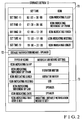
- Fig. 2 shows examples of data stored in the tables T1, T2, and T3 of the storage section 13.
- schedule time zones and icons indicating the contents of schedule events corresponding to the respective time zones are stored in the table T1.
- an icon indicating a sleep is stored in correspondence with a schedule time zone "00:00 - 06;00".
- an icon indicting movement by train is stored in correspondence with a schedule time zone "07:00 - 09:00".
- an icon indicating a lunch is stored in correspondence with a schedule time zone "12:00 - 13:00".
- an icon indicating a meeting is stored in correspondence with a schedule time zone "15:00 - 17:00”.
- an icon indicating a sleep is stored in correspondence with a schedule time zone "19:00 - 20:00".
- the speaker 9 as the above default notification means is stored in the table T2.
- This default notification means is set in advance as default data in correspondence with an icon for which no notification means has been set. That is, the speaker 9 as this default notification means is always assigned to an icon for which no notification means has been set by the user.
- the LED 10 is stored in correspondence with the icon indicating a sleep, and the vibrator motor 8 is stored in correspondence with the icon indicating movement by train.
- the vibrator motor 8 is stored in correspondence with the icon indicating a lunch
- the LED 10 is stored in correspondence with the icon indicating a meeting.
- the speaker 9 is stored in correspondence with the icon indicating movement by car and the icon indicating a date. Note that no notification means is set for the icon indicating that the user is out. In this case, the default notification means is assigned, as described above. These notification means corresponding to the respective icons are set in advance in the table T3 except for the default notification means.
- the radio signal received by the antenna 1 is demodulated by the radio section 2.
- the control section 3 compares the self-selective call number stored in the ID-ROM 4 with the selective call number contained in this demodulated data. If they coincide with each other, the time at which the radio signal (call signal) is received is stored in the control section 3.
- the comparing section 11 reads out the reception time stored in the control section 3, and determines a specific time zone, stored in the table T1 of the storage section 13, to which the reception time corresponds.
- the control section 3 reads out an icon corresponding to the time zone determined by the comparing section 11 from the table T1, and selects a notification means corresponding to this icon from the table T3.
- the control section 3 sends a notification means selection signal indicating the selected notification means to the notification means switching section 7.
- the notification means switching section 7 notifies the user of the reception of the call by using the vibrator motor 8, the speaker 9, or the LED 10 which is the notification means corresponding to the received notification means selection signal. At this time, if a message is contained in the received radio signal, the message is displayed on the display section 5.
- the schedule function section 12 is a function incorporated in the radio selective calling receiver 100. If the radio selective calling receiver 100 can be connected to the electronic notebook 200, and the schedule function is implemented upon this connection, the schedule function section 12 is a function incorporated in the electronic notebook.
- the schedule function section 12 is incorporated in the radio selective calling receiver 100, it suffices if the user only sets schedule time zones by using the schedule function section 12, and operates icons indicating the contents of the schedule. Since the notification means in the set time zones are stored in advance in the table T3 of the storage section 13 in correspondence with the icons, they need not be input.
- the schedule function section 12 is incorporated in the electronic notebook 200, when the radio selective calling receiver 100 is connected to the electronic notebook 200, the schedule time zones and the icons indicating the contents of the schedule which are set by the schedule function section 12 are read out from the electronic notebook 200 and stored in the table T1 of the storage section 13. In this case as well, since the notification means in the set time zones are stored in advance in the table T3 of the storage section 13 in correspondence with the icons, they need not be input.
- Icons and notification means can be set in the table T3 by using the switch circuit 6. More specifically, the user selects/determines notification means corresponding to the respective icons by using the switch circuit 6 while checking the icons set by the schedule function section 12 and displayed by the control section 3 on the display section 5.
- the control section 3 stores the selected/determined notification means in the table T3 of the storage section 13 in correspondence with the respective icons.
- Fig. 3 shows notification means control processing in the radio selective calling receiver 100. The operation of the radio selective calling receiver 100 will be described below with reference to Fig. 3.
- the control section 3 Upon reception of a radio signal containing the self-radio selective call number (step S100), the control section 3 stores the reception time (step S101). The control section 3 then loads the stored reception time (step S102) and set time 1 ⁇ (step S103), and checks whether the reception time falls within set time 1 ⁇ (step S104). If the reception time falls within set time 1 ⁇ , the control section 3 recognizes the icon corresponding to set time 1 ⁇ in the table T1, i.e., the icon indicating a sleep (step S105). The control section 3 controls the notification means switching section 7 in accordance with this recognition result to perform notification by using the LED 10 as the notification means set in the table T3 in correspondence with the icon indicating a sleep (step S106).
- step S104 If it is determined in step S104 that the reception time falls outside set time 1 ⁇ , the control section 3 loads set time 2 ⁇ (step S107), and checks whether the reception time falls within set time 2 ⁇ (step S108). If the reception time falls within set time 2 ⁇ , the control section 3 recognizes the icon corresponding to set time 2 ⁇ in the table T1, i.e., the icon indicating movement by train (step S109). The control section 3 also controls the notification means switching section 7 in accordance with this recognition result to perform notification by using the vibrator motor 8 as the notification means set in the table T3 in correspondence with the icon indicating movement by train (step S110).
- step S108 It is determined in step S108 that the reception time falls outside set time 2 ⁇ , the control section 3 loads set time 3 ⁇ (step S111), and checks whether the reception time falls within set time 3 ⁇ (step S112). If the reception time falls within set time 3 ⁇ , the control section 3 recognizes the icon corresponding to set time 3 ⁇ in the table T1, i.e., the icon indicating a meal (step S113). The control section 3 controls the notification means switching section 7 in accordance with this recognition result to perform notification by using the speaker 9 as the notification means set in the table T3 in correspondence with the icon indicating a lunch. (step S114).
- step S112 If it is determined in step S112 that the reception time falls outside set time 3 ⁇ , the control section 3 loads set time 4 ⁇ (step S115), and checks whether the reception time falls within set time 4 ⁇ (step S116). If the reception time falls within set time 4 ⁇ , the control section 3 recognizes the icon corresponding to set time 4 ⁇ in the table T1, i.e., the icon indicating a meeting (step S117). The control section 3 controls the notification means switching section 7 to perform notification by using the LED 10 as the notification means set in the table T3 in correspondence with the icon indicating a meeting (step S118).
- step S116 If it is determined in step S116 that the reception time falls outside set time 4 ⁇ , the control section 3 loads set time 5 ⁇ (step S119), and checks whether the reception time falls within set time 5 ⁇ (step S120). If the reception time falls within set time 5 ⁇ , the control section 3 recognizes the icon corresponding to set time 5 ⁇ in the table T1, i.e., the icon indicating a lunch (step S121). The control section 3 controls the notification means switching section 7 in accordance with this recognition result to perform notification by using the vibrator motor 8 as the notification means set in the table T3 in correspondence with the icon indicating a meeting (step S122).
- step S120 If it is determined in step S120 that the reception time falls outside 5 ⁇ , the control section 3 performs notification by using the default notification means in the table T2, i.e., the speaker 9 (step S123).
- the vibrator motor 8, the speaker 9, the LED 10, or the like is set as a notification means in correspondence with each icon indicating the contents of a schedule, and the icons and the notification means set in correspondence with the respective icons are stored in the storage section 13 in advance.
- the speaker 9 as the default notification means is automatically effected.
- schedule data for example, the user selects schedule time zones and icons corresponding to the contents of the schedule.
- the control section 3 To perform notification by using a notification means, the control section 3 identifies the notification means set in advance in correspondence with each icon on the basis of the reception time of a radio signal containing the self-radio selective call number, the current time, the schedule event set in the time zone including the current time, and the icon indicating the contents of the schedule event selected when the schedule event is set in this time zone. The control section 3 then performs notification by using this identified notification means. With this operation, the user need not set any notification means in schedule input operation. This simplifies the schedule input operation performed by the user.
- notification means corresponding to the contents of a schedule can be controlled easily and automatically.
- the user can recognize the reception of a call more reliably even during a quiet meeting or in a place with large noise in the process of movement without annoying anyone.
- notification means are automatically set by only operating icons indicating the contents of a schedule, thereby omitting notification means setting operation. This can eliminate trouble to the user in setting notification means, and allows more reliable recognition of the reception of a call by means of an automatically set notification means.
- the three types of notification means i.e., the vibrator motor 8, the speaker 9, and the LED 10, have been exemplified as notification means.
- the types of notification means are not limited to these three types.
- an icon indicating the contents of a schedule event in a time zone including the reception time is read out from the schedule storage means, and a notification means corresponding to this icon is selected from the notification means stored in the notification function storage means. Notification is then performed by using the selected notification means.
- the user may only input schedule time zones and icons indicating the contents of schedule events in the respective time zones. The user need not set any notification means in schedule input operation. This simplifies the schedule input operation performed by the user.
Landscapes
- Physics & Mathematics (AREA)
- Engineering & Computer Science (AREA)
- Computer Networks & Wireless Communication (AREA)
- Electromagnetism (AREA)
- General Physics & Mathematics (AREA)
- Mobile Radio Communication Systems (AREA)
- Electric Clocks (AREA)
- Telephone Function (AREA)
Applications Claiming Priority (2)
| Application Number | Priority Date | Filing Date | Title |
|---|---|---|---|
| JP2033398 | 1998-01-14 | ||
| JP02033398A JP3148174B2 (ja) | 1998-01-14 | 1998-01-14 | 無線選択呼出受信機 |
Publications (3)
| Publication Number | Publication Date |
|---|---|
| EP0930592A2 true EP0930592A2 (de) | 1999-07-21 |
| EP0930592A3 EP0930592A3 (de) | 1999-12-29 |
| EP0930592B1 EP0930592B1 (de) | 2002-11-27 |
Family
ID=12024221
Family Applications (1)
| Application Number | Title | Priority Date | Filing Date |
|---|---|---|---|
| EP99100334A Expired - Lifetime EP0930592B1 (de) | 1998-01-14 | 1999-01-13 | Selektiver Funkrufempfänger |
Country Status (8)
| Country | Link |
|---|---|
| US (1) | US6272319B1 (de) |
| EP (1) | EP0930592B1 (de) |
| JP (1) | JP3148174B2 (de) |
| CN (1) | CN1104151C (de) |
| AU (1) | AU760051B2 (de) |
| DE (1) | DE69904092T2 (de) |
| SG (1) | SG88746A1 (de) |
| TW (1) | TW427096B (de) |
Cited By (1)
| Publication number | Priority date | Publication date | Assignee | Title |
|---|---|---|---|---|
| EP1220521A3 (de) * | 2000-12-27 | 2004-01-28 | Samsung Electronics Co., Ltd. | Tragbares Kommunikationsgerät und Betriebsverfahren desselben entsprechend der Tagesordnung des Benutzers |
Families Citing this family (24)
| Publication number | Priority date | Publication date | Assignee | Title |
|---|---|---|---|---|
| JP2000013832A (ja) * | 1998-06-24 | 2000-01-14 | Matsushita Electric Ind Co Ltd | 無線呼出受信機およびメッセージ消去方法 |
| KR20020055951A (ko) * | 2000-12-29 | 2002-07-10 | 엘지전자 주식회사 | 이동통신 단말기의 사전 모드예약 설정방법 |
| JP3538176B2 (ja) * | 2001-11-28 | 2004-06-14 | 株式会社東芝 | 電子機器およびその制御方法 |
| JP2005518114A (ja) | 2002-02-14 | 2005-06-16 | アバイア テクノロジー コーポレーション | 存在追跡および名前空間相互接続の技術 |
| KR20030073328A (ko) * | 2002-03-11 | 2003-09-19 | 에스케이텔레텍주식회사 | 지정시간동안 벨소리/진동모드를 실행하지 않는 방법과이를 구현하는 휴대전화기 |
| US7023980B2 (en) | 2002-12-04 | 2006-04-04 | Avaya Technology Corp. | Outbound dialing decision criteria based |
| US7620170B2 (en) * | 2002-12-31 | 2009-11-17 | At&T Intellectual Property I, L.P. | Computer telephony integration (CTI) complete customer contact center |
| US7573999B2 (en) * | 2002-12-31 | 2009-08-11 | At&T Intellectual Property I, L.P. | Computer telephony integration (CTI) complete healthcare contact center |
| US7474741B2 (en) * | 2003-01-20 | 2009-01-06 | Avaya Inc. | Messaging advise in presence-aware networks |
| US7248688B2 (en) | 2003-01-27 | 2007-07-24 | Bellsouth Intellectual Property Corporation | Virtual physician office systems and methods |
| US20040259536A1 (en) * | 2003-06-20 | 2004-12-23 | Keskar Dhananjay V. | Method, apparatus and system for enabling context aware notification in mobile devices |
| US9398152B2 (en) | 2004-02-25 | 2016-07-19 | Avaya Inc. | Using business rules for determining presence |
| US20050276407A1 (en) * | 2004-06-09 | 2005-12-15 | Avaya Technology Corp. | Telephony device ring determination by scheduler |
| US7769154B1 (en) | 2004-06-09 | 2010-08-03 | Avaya Inc. | Aggregated perceived presence |
| JP5025721B2 (ja) * | 2006-04-06 | 2012-09-12 | イマージョン コーポレイション | 触覚効果強化のためのシステムおよび方法 |
| CN101132572A (zh) | 2006-08-23 | 2008-02-27 | 联想(北京)有限公司 | 自动切换情景模式的方法和便携式终端 |
| US7573996B1 (en) | 2006-10-03 | 2009-08-11 | Avaya Inc. | Presence based callback |
| WO2008085487A1 (en) * | 2006-12-27 | 2008-07-17 | Immersion Corporation | Virtual detents through vibrotactile feedback |
| US8150003B1 (en) | 2007-01-23 | 2012-04-03 | Avaya Inc. | Caller initiated undivert from voicemail |
| US8167813B2 (en) * | 2007-05-17 | 2012-05-01 | Immersion Medical, Inc. | Systems and methods for locating a blood vessel |
| US8156809B2 (en) * | 2008-03-27 | 2012-04-17 | Immersion Corporation | Systems and methods for resonance detection |
| CN101714079B (zh) * | 2008-10-07 | 2013-06-12 | 华硕电脑股份有限公司 | 计算机系统转移关于通知区的通知图标的方法及装置 |
| US8301581B2 (en) | 2009-09-24 | 2012-10-30 | Avaya Inc. | Group compositing algorithms for presence |
| US9547366B2 (en) | 2013-03-14 | 2017-01-17 | Immersion Corporation | Systems and methods for haptic and gesture-driven paper simulation |
Family Cites Families (21)
| Publication number | Priority date | Publication date | Assignee | Title |
|---|---|---|---|---|
| JPS57204645A (en) * | 1981-06-10 | 1982-12-15 | Nec Corp | Receiver for individual selective call |
| US5185604A (en) * | 1985-11-27 | 1993-02-09 | Seiko Corp. And Seiko Epson Corp. | Message indicating icon mechanism |
| US5168271A (en) * | 1985-11-27 | 1992-12-01 | Seiko Corp. | Paging and time keeping system with transmission of time slot identification used for synchronization |
| US4872005A (en) * | 1988-01-04 | 1989-10-03 | Motorola, Inc. | Paging receiver capable of reminding a user of an important message event |
| JPH03127523A (ja) | 1989-10-12 | 1991-05-30 | Nec Corp | 無線呼出し受信機 |
| JPH04135235A (ja) | 1990-09-27 | 1992-05-08 | Shimadzu Corp | プログラム部品合成システム |
| JP2701579B2 (ja) | 1991-04-26 | 1998-01-21 | 日本電気株式会社 | 時間的報知手段変化機能付き無線選択呼出受信機 |
| JP3127523B2 (ja) | 1991-10-31 | 2001-01-29 | 株式会社日立製作所 | 通信制御装置およびデータ送信方法 |
| US5426424A (en) * | 1992-05-08 | 1995-06-20 | Motorola, Inc. | Selective call receiver with database capability |
| JP2778391B2 (ja) | 1992-11-12 | 1998-07-23 | 日本電気株式会社 | 表示器付き無線選択呼出受信機 |
| FI92782C (fi) | 1993-02-09 | 1994-12-27 | Nokia Mobile Phones Ltd | Matkapuhelimien asetusten ryhmittely |
| JP3456027B2 (ja) | 1994-09-27 | 2003-10-14 | カシオ計算機株式会社 | スケジュール管理装置 |
| CA2165277C (en) * | 1994-12-29 | 1999-09-21 | William Frank Zancho | Method and apparatus for personal attribute selection and management using prediction |
| JPH08284152A (ja) | 1995-04-12 | 1996-10-29 | Sumikin Kozai Kogyo Kk | ソイルセメント地中連続壁用補強鋼材 |
| JP3108985B2 (ja) | 1995-04-20 | 2000-11-13 | カシオ計算機株式会社 | データ処理装置 |
| JP2872078B2 (ja) | 1995-05-16 | 1999-03-17 | 静岡日本電気株式会社 | 表示機能付き無線選択呼出受信機 |
| JP3849153B2 (ja) | 1995-06-02 | 2006-11-22 | カシオ計算機株式会社 | スケジュール入力装置及びスケジュール入力方法 |
| JP2953999B2 (ja) * | 1995-08-15 | 1999-09-27 | 静岡日本電気株式会社 | 無線選択呼出受信機 |
| WO1997016932A1 (en) | 1995-11-03 | 1997-05-09 | Elonex Technologies, Inc. | Selective notification method for portable electronic devices |
| JP3039619B2 (ja) * | 1996-06-28 | 2000-05-08 | 静岡日本電気株式会社 | 無線選択呼出受信機及びそのメッセージ表示方法 |
| GB2323245A (en) | 1997-03-14 | 1998-09-16 | Nokia Mobile Phones Ltd | Mobile phone |
-
1998
- 1998-01-14 JP JP02033398A patent/JP3148174B2/ja not_active Expired - Lifetime
-
1999
- 1999-01-08 TW TW088100251A patent/TW427096B/zh not_active IP Right Cessation
- 1999-01-11 US US09/228,260 patent/US6272319B1/en not_active Expired - Lifetime
- 1999-01-12 SG SG9900044A patent/SG88746A1/en unknown
- 1999-01-13 EP EP99100334A patent/EP0930592B1/de not_active Expired - Lifetime
- 1999-01-13 DE DE69904092T patent/DE69904092T2/de not_active Expired - Lifetime
- 1999-01-13 AU AU11310/99A patent/AU760051B2/en not_active Ceased
- 1999-01-14 CN CN99100438.8A patent/CN1104151C/zh not_active Expired - Fee Related
Cited By (2)
| Publication number | Priority date | Publication date | Assignee | Title |
|---|---|---|---|---|
| EP1220521A3 (de) * | 2000-12-27 | 2004-01-28 | Samsung Electronics Co., Ltd. | Tragbares Kommunikationsgerät und Betriebsverfahren desselben entsprechend der Tagesordnung des Benutzers |
| US7092925B2 (en) | 2000-12-27 | 2006-08-15 | Samsung Electronics Co., Ltd. | Intelligent portable communications device and operation method for the same according to user's schedule |
Also Published As
| Publication number | Publication date |
|---|---|
| EP0930592B1 (de) | 2002-11-27 |
| CN1228003A (zh) | 1999-09-08 |
| AU1131099A (en) | 1999-08-05 |
| AU760051B2 (en) | 2003-05-08 |
| JP3148174B2 (ja) | 2001-03-19 |
| JPH11205837A (ja) | 1999-07-30 |
| EP0930592A3 (de) | 1999-12-29 |
| SG88746A1 (en) | 2002-05-21 |
| DE69904092T2 (de) | 2003-09-11 |
| DE69904092D1 (de) | 2003-01-09 |
| US6272319B1 (en) | 2001-08-07 |
| CN1104151C (zh) | 2003-03-26 |
| TW427096B (en) | 2001-03-21 |
Similar Documents
| Publication | Publication Date | Title |
|---|---|---|
| EP0930592B1 (de) | Selektiver Funkrufempfänger | |
| US6489977B2 (en) | Received information display method | |
| CA2061532C (en) | Selective pager receiver | |
| EP0709812B1 (de) | Signalisierempfänger mit auswählbarem Alarm | |
| JP3508840B2 (ja) | 携帯電話機 | |
| GB2303228A (en) | Pager with alarm | |
| US6161026A (en) | Method of selecting menu and wireless selective call receiver to which the method is applied | |
| EP0631262B1 (de) | Rufempfänger mit anwählbaren Anzeigemitteln | |
| JP2953999B2 (ja) | 無線選択呼出受信機 | |
| US6297726B1 (en) | Radio paging receiver | |
| US6215413B1 (en) | User selectable receiver addresses for wireless communication systems | |
| US6070055A (en) | Radio Selective calling receiver with display and limited function menu | |
| JPH07162926A (ja) | 表示機能付無線選択呼出受信機およびその制御方法 | |
| US5963143A (en) | Display of timer for programming mode of a radio selective calling receiver | |
| US6124801A (en) | Radio selective calling receiver and calling method | |
| US7026914B1 (en) | Selective calling receiver and method of switching alert operation thereof | |
| EP0766408A2 (de) | Personenrufempfänger mit Überprüfungsmöglichkeit der ausserhalb des Kommunikationsdeckungsbereichs verbrauchten Zeit | |
| JP3280494B2 (ja) | 受信機 | |
| JP2936647B2 (ja) | 表示付無線選択呼出受信機 | |
| WO1993016565A1 (en) | Selective call receiver having user selectable addresses and functions | |
| JP3217701B2 (ja) | 無線選択呼出受信機 | |
| US6529117B1 (en) | Radio selective call receiver in which message non-reception period is managed | |
| US6556130B1 (en) | Radio selective calling receiver | |
| GB2302196A (en) | Radio pager receiver | |
| JPH0661920A (ja) | 表示付無線選択呼出受信機 |
Legal Events
| Date | Code | Title | Description |
|---|---|---|---|
| PUAI | Public reference made under article 153(3) epc to a published international application that has entered the european phase |
Free format text: ORIGINAL CODE: 0009012 |
|
| AK | Designated contracting states |
Kind code of ref document: A2 Designated state(s): DE FR GB |
|
| AX | Request for extension of the european patent |
Free format text: AL;LT;LV;MK;RO;SI |
|
| PUAL | Search report despatched |
Free format text: ORIGINAL CODE: 0009013 |
|
| AK | Designated contracting states |
Kind code of ref document: A3 Designated state(s): AT BE CH CY DE DK ES FI FR GB GR IE IT LI LU MC NL PT SE |
|
| AX | Request for extension of the european patent |
Free format text: AL;LT;LV;MK;RO;SI |
|
| RIC1 | Information provided on ipc code assigned before grant |
Free format text: 6G 08B 5/22 A, 6H 04M 1/72 B |
|
| 17P | Request for examination filed |
Effective date: 19991201 |
|
| AKX | Designation fees paid |
Free format text: DE FR GB |
|
| GRAG | Despatch of communication of intention to grant |
Free format text: ORIGINAL CODE: EPIDOS AGRA |
|
| 17Q | First examination report despatched |
Effective date: 20011129 |
|
| GRAG | Despatch of communication of intention to grant |
Free format text: ORIGINAL CODE: EPIDOS AGRA |
|
| GRAG | Despatch of communication of intention to grant |
Free format text: ORIGINAL CODE: EPIDOS AGRA |
|
| GRAH | Despatch of communication of intention to grant a patent |
Free format text: ORIGINAL CODE: EPIDOS IGRA |
|
| GRAH | Despatch of communication of intention to grant a patent |
Free format text: ORIGINAL CODE: EPIDOS IGRA |
|
| GRAA | (expected) grant |
Free format text: ORIGINAL CODE: 0009210 |
|
| AK | Designated contracting states |
Kind code of ref document: B1 Designated state(s): DE FR GB |
|
| REG | Reference to a national code |
Ref country code: GB Ref legal event code: FG4D |
|
| REF | Corresponds to: |
Ref document number: 69904092 Country of ref document: DE Date of ref document: 20030109 |
|
| ET | Fr: translation filed | ||
| PLBE | No opposition filed within time limit |
Free format text: ORIGINAL CODE: 0009261 |
|
| STAA | Information on the status of an ep patent application or granted ep patent |
Free format text: STATUS: NO OPPOSITION FILED WITHIN TIME LIMIT |
|
| 26N | No opposition filed |
Effective date: 20030828 |
|
| REG | Reference to a national code |
Ref country code: GB Ref legal event code: 732E Free format text: REGISTERED BETWEEN 20141023 AND 20141029 |
|
| REG | Reference to a national code |
Ref country code: FR Ref legal event code: TP Owner name: LENOVO INNOVATIONS LIMITED (HONG KONG), HK Effective date: 20141119 |
|
| REG | Reference to a national code |
Ref country code: FR Ref legal event code: PLFP Year of fee payment: 18 |
|
| PGFP | Annual fee paid to national office [announced via postgrant information from national office to epo] |
Ref country code: FR Payment date: 20151208 Year of fee payment: 18 |
|
| PGFP | Annual fee paid to national office [announced via postgrant information from national office to epo] |
Ref country code: DE Payment date: 20170110 Year of fee payment: 19 |
|
| PGFP | Annual fee paid to national office [announced via postgrant information from national office to epo] |
Ref country code: GB Payment date: 20170111 Year of fee payment: 19 |
|
| REG | Reference to a national code |
Ref country code: FR Ref legal event code: ST Effective date: 20170929 |
|
| PG25 | Lapsed in a contracting state [announced via postgrant information from national office to epo] |
Ref country code: FR Free format text: LAPSE BECAUSE OF NON-PAYMENT OF DUE FEES Effective date: 20170131 |
|
| REG | Reference to a national code |
Ref country code: DE Ref legal event code: R082 Ref document number: 69904092 Country of ref document: DE Representative=s name: VOSSIUS & PARTNER PATENTANWAELTE RECHTSANWAELT, DE Ref country code: DE Ref legal event code: R081 Ref document number: 69904092 Country of ref document: DE Owner name: LENOVO INNOVATIONS LIMITED, HK Free format text: FORMER OWNER: NEC CORP., TOKYO, JP |
|
| REG | Reference to a national code |
Ref country code: DE Ref legal event code: R119 Ref document number: 69904092 Country of ref document: DE |
|
| GBPC | Gb: european patent ceased through non-payment of renewal fee |
Effective date: 20180113 |
|
| PG25 | Lapsed in a contracting state [announced via postgrant information from national office to epo] |
Ref country code: DE Free format text: LAPSE BECAUSE OF NON-PAYMENT OF DUE FEES Effective date: 20180801 |
|
| PG25 | Lapsed in a contracting state [announced via postgrant information from national office to epo] |
Ref country code: GB Free format text: LAPSE BECAUSE OF NON-PAYMENT OF DUE FEES Effective date: 20180113 |