EP0930829B1 - A method of reducing the content of phytate in cereals - Google Patents
A method of reducing the content of phytate in cereals Download PDFInfo
- Publication number
- EP0930829B1 EP0930829B1 EP97942354A EP97942354A EP0930829B1 EP 0930829 B1 EP0930829 B1 EP 0930829B1 EP 97942354 A EP97942354 A EP 97942354A EP 97942354 A EP97942354 A EP 97942354A EP 0930829 B1 EP0930829 B1 EP 0930829B1
- Authority
- EP
- European Patent Office
- Prior art keywords
- steeping
- water
- cereal grains
- wet
- grains
- Prior art date
- Legal status (The legal status is an assumption and is not a legal conclusion. Google has not performed a legal analysis and makes no representation as to the accuracy of the status listed.)
- Expired - Lifetime
Links
- 235000013339 cereals Nutrition 0.000 title claims abstract description 69
- 238000000034 method Methods 0.000 title claims abstract description 44
- IMQLKJBTEOYOSI-GPIVLXJGSA-N Inositol-hexakisphosphate Chemical compound OP(O)(=O)O[C@H]1[C@H](OP(O)(O)=O)[C@@H](OP(O)(O)=O)[C@H](OP(O)(O)=O)[C@H](OP(O)(O)=O)[C@@H]1OP(O)(O)=O IMQLKJBTEOYOSI-GPIVLXJGSA-N 0.000 title claims abstract description 41
- 235000002949 phytic acid Nutrition 0.000 title claims abstract description 41
- XLYOFNOQVPJJNP-UHFFFAOYSA-N water Substances O XLYOFNOQVPJJNP-UHFFFAOYSA-N 0.000 claims abstract description 63
- 239000004464 cereal grain Substances 0.000 claims abstract description 48
- IMQLKJBTEOYOSI-UHFFFAOYSA-N Phytic acid Natural products OP(O)(=O)OC1C(OP(O)(O)=O)C(OP(O)(O)=O)C(OP(O)(O)=O)C(OP(O)(O)=O)C1OP(O)(O)=O IMQLKJBTEOYOSI-UHFFFAOYSA-N 0.000 claims abstract description 44
- 239000000203 mixture Substances 0.000 claims abstract description 10
- 229940068041 phytic acid Drugs 0.000 claims abstract description 7
- 239000000467 phytic acid Substances 0.000 claims abstract description 7
- 150000003839 salts Chemical class 0.000 claims abstract 2
- JVTAAEKCZFNVCJ-UHFFFAOYSA-N lactic acid Chemical compound CC(O)C(O)=O JVTAAEKCZFNVCJ-UHFFFAOYSA-N 0.000 claims description 36
- 239000004310 lactic acid Substances 0.000 claims description 18
- 235000014655 lactic acid Nutrition 0.000 claims description 18
- 235000007319 Avena orientalis Nutrition 0.000 claims description 14
- 244000075850 Avena orientalis Species 0.000 claims description 14
- 238000001035 drying Methods 0.000 claims description 14
- 240000005979 Hordeum vulgare Species 0.000 claims description 13
- 235000007340 Hordeum vulgare Nutrition 0.000 claims description 13
- 241000894006 Bacteria Species 0.000 claims description 11
- 108010011619 6-Phytase Proteins 0.000 claims description 9
- 235000021307 Triticum Nutrition 0.000 claims description 9
- 239000000243 solution Substances 0.000 claims description 9
- 240000008042 Zea mays Species 0.000 claims description 8
- 235000016383 Zea mays subsp huehuetenangensis Nutrition 0.000 claims description 8
- 235000002017 Zea mays subsp mays Nutrition 0.000 claims description 8
- 235000009973 maize Nutrition 0.000 claims description 8
- 244000062793 Sorghum vulgare Species 0.000 claims description 7
- 235000019713 millet Nutrition 0.000 claims description 7
- 229940085127 phytase Drugs 0.000 claims description 7
- 238000011282 treatment Methods 0.000 claims description 7
- 240000007594 Oryza sativa Species 0.000 claims description 6
- 235000007164 Oryza sativa Nutrition 0.000 claims description 6
- KRKNYBCHXYNGOX-UHFFFAOYSA-N citric acid Chemical compound OC(=O)CC(O)(C(O)=O)CC(O)=O KRKNYBCHXYNGOX-UHFFFAOYSA-N 0.000 claims description 6
- 235000009566 rice Nutrition 0.000 claims description 6
- 239000005862 Whey Substances 0.000 claims description 4
- 102000007544 Whey Proteins Human genes 0.000 claims description 4
- 108010046377 Whey Proteins Proteins 0.000 claims description 4
- 235000015203 fruit juice Nutrition 0.000 claims description 3
- 240000006394 Sorghum bicolor Species 0.000 claims description 2
- 235000011684 Sorghum saccharatum Nutrition 0.000 claims description 2
- 239000008351 acetate buffer Substances 0.000 claims description 2
- 239000002253 acid Substances 0.000 claims description 2
- 239000000872 buffer Substances 0.000 claims description 2
- 150000007524 organic acids Chemical class 0.000 claims description 2
- 244000098338 Triticum aestivum Species 0.000 claims 1
- 235000013312 flour Nutrition 0.000 abstract description 5
- 235000020985 whole grains Nutrition 0.000 abstract description 2
- 229910019142 PO4 Inorganic materials 0.000 description 19
- 235000021317 phosphate Nutrition 0.000 description 19
- 239000000047 product Substances 0.000 description 18
- 239000010452 phosphate Substances 0.000 description 15
- NBIIXXVUZAFLBC-UHFFFAOYSA-K phosphate Chemical compound [O-]P([O-])([O-])=O NBIIXXVUZAFLBC-UHFFFAOYSA-K 0.000 description 14
- MMWCIQZXVOZEGG-XJTPDSDZSA-N D-myo-Inositol 1,4,5-trisphosphate Chemical compound O[C@@H]1[C@H](O)[C@@H](OP(O)(O)=O)[C@H](OP(O)(O)=O)[C@@H](O)[C@@H]1OP(O)(O)=O MMWCIQZXVOZEGG-XJTPDSDZSA-N 0.000 description 12
- 239000002994 raw material Substances 0.000 description 12
- 238000010335 hydrothermal treatment Methods 0.000 description 11
- 229960000367 inositol Drugs 0.000 description 10
- CDAISMWEOUEBRE-UHFFFAOYSA-N scyllo-inosotol Natural products OC1C(O)C(O)C(O)C(O)C1O CDAISMWEOUEBRE-UHFFFAOYSA-N 0.000 description 10
- CDAISMWEOUEBRE-GPIVLXJGSA-N inositol Chemical compound O[C@H]1[C@H](O)[C@@H](O)[C@H](O)[C@H](O)[C@@H]1O CDAISMWEOUEBRE-GPIVLXJGSA-N 0.000 description 9
- 241000209140 Triticum Species 0.000 description 8
- 229910052500 inorganic mineral Inorganic materials 0.000 description 8
- 239000011707 mineral Substances 0.000 description 8
- 235000010755 mineral Nutrition 0.000 description 8
- 230000000694 effects Effects 0.000 description 5
- XEEYBQQBJWHFJM-UHFFFAOYSA-N Iron Chemical compound [Fe] XEEYBQQBJWHFJM-UHFFFAOYSA-N 0.000 description 4
- 229920002472 Starch Polymers 0.000 description 4
- 238000010586 diagram Methods 0.000 description 4
- 235000019698 starch Nutrition 0.000 description 4
- 239000008107 starch Substances 0.000 description 4
- OYPRJOBELJOOCE-UHFFFAOYSA-N Calcium Chemical compound [Ca] OYPRJOBELJOOCE-UHFFFAOYSA-N 0.000 description 3
- 241001465754 Metazoa Species 0.000 description 3
- OAICVXFJPJFONN-UHFFFAOYSA-N Phosphorus Chemical compound [P] OAICVXFJPJFONN-UHFFFAOYSA-N 0.000 description 3
- 239000011575 calcium Substances 0.000 description 3
- 229910052791 calcium Inorganic materials 0.000 description 3
- 239000012467 final product Substances 0.000 description 3
- 235000011868 grain product Nutrition 0.000 description 3
- 230000002906 microbiologic effect Effects 0.000 description 3
- 235000013336 milk Nutrition 0.000 description 3
- 239000008267 milk Substances 0.000 description 3
- 210000004080 milk Anatomy 0.000 description 3
- 150000003013 phosphoric acid derivatives Chemical class 0.000 description 3
- 239000011574 phosphorus Substances 0.000 description 3
- 229910052698 phosphorus Inorganic materials 0.000 description 3
- 235000021395 porridge Nutrition 0.000 description 3
- 239000011573 trace mineral Substances 0.000 description 3
- 235000013619 trace mineral Nutrition 0.000 description 3
- 241000193755 Bacillus cereus Species 0.000 description 2
- 241000282414 Homo sapiens Species 0.000 description 2
- 241000589516 Pseudomonas Species 0.000 description 2
- 240000004808 Saccharomyces cerevisiae Species 0.000 description 2
- HCHKCACWOHOZIP-UHFFFAOYSA-N Zinc Chemical compound [Zn] HCHKCACWOHOZIP-UHFFFAOYSA-N 0.000 description 2
- 238000010521 absorption reaction Methods 0.000 description 2
- 238000004458 analytical method Methods 0.000 description 2
- 235000008429 bread Nutrition 0.000 description 2
- 230000003247 decreasing effect Effects 0.000 description 2
- JARKCYVAAOWBJS-UHFFFAOYSA-N hexanal Chemical compound CCCCCC=O JARKCYVAAOWBJS-UHFFFAOYSA-N 0.000 description 2
- 210000000936 intestine Anatomy 0.000 description 2
- 238000004255 ion exchange chromatography Methods 0.000 description 2
- 229910052742 iron Inorganic materials 0.000 description 2
- BDAGIHXWWSANSR-UHFFFAOYSA-N methanoic acid Natural products OC=O BDAGIHXWWSANSR-UHFFFAOYSA-N 0.000 description 2
- 230000003647 oxidation Effects 0.000 description 2
- 238000007254 oxidation reaction Methods 0.000 description 2
- 230000002035 prolonged effect Effects 0.000 description 2
- 239000006228 supernatant Substances 0.000 description 2
- VDZOOKBUILJEDG-UHFFFAOYSA-M tetrabutylammonium hydroxide Chemical compound [OH-].CCCC[N+](CCCC)(CCCC)CCCC VDZOOKBUILJEDG-UHFFFAOYSA-M 0.000 description 2
- 239000011701 zinc Substances 0.000 description 2
- 229910052725 zinc Inorganic materials 0.000 description 2
- OSWFIVFLDKOXQC-UHFFFAOYSA-N 4-(3-methoxyphenyl)aniline Chemical compound COC1=CC=CC(C=2C=CC(N)=CC=2)=C1 OSWFIVFLDKOXQC-UHFFFAOYSA-N 0.000 description 1
- UHPMCKVQTMMPCG-UHFFFAOYSA-N 5,8-dihydroxy-2-methoxy-6-methyl-7-(2-oxopropyl)naphthalene-1,4-dione Chemical compound CC1=C(CC(C)=O)C(O)=C2C(=O)C(OC)=CC(=O)C2=C1O UHPMCKVQTMMPCG-UHFFFAOYSA-N 0.000 description 1
- 241000228212 Aspergillus Species 0.000 description 1
- 241000223218 Fusarium Species 0.000 description 1
- SQUHHTBVTRBESD-UHFFFAOYSA-N Hexa-Ac-myo-Inositol Natural products CC(=O)OC1C(OC(C)=O)C(OC(C)=O)C(OC(C)=O)C(OC(C)=O)C1OC(C)=O SQUHHTBVTRBESD-UHFFFAOYSA-N 0.000 description 1
- 102000003820 Lipoxygenases Human genes 0.000 description 1
- 108090000128 Lipoxygenases Proteins 0.000 description 1
- FYYHWMGAXLPEAU-UHFFFAOYSA-N Magnesium Chemical compound [Mg] FYYHWMGAXLPEAU-UHFFFAOYSA-N 0.000 description 1
- OKKJLVBELUTLKV-UHFFFAOYSA-N Methanol Chemical compound OC OKKJLVBELUTLKV-UHFFFAOYSA-N 0.000 description 1
- 241000228143 Penicillium Species 0.000 description 1
- YDHWWBZFRZWVHO-UHFFFAOYSA-H [oxido-[oxido(phosphonatooxy)phosphoryl]oxyphosphoryl] phosphate Chemical compound [O-]P([O-])(=O)OP([O-])(=O)OP([O-])(=O)OP([O-])([O-])=O YDHWWBZFRZWVHO-UHFFFAOYSA-H 0.000 description 1
- 241001148470 aerobic bacillus Species 0.000 description 1
- 239000007900 aqueous suspension Substances 0.000 description 1
- 230000015556 catabolic process Effects 0.000 description 1
- 238000005119 centrifugation Methods 0.000 description 1
- 230000007012 clinical effect Effects 0.000 description 1
- 238000006731 degradation reaction Methods 0.000 description 1
- 235000021186 dishes Nutrition 0.000 description 1
- 230000002550 fecal effect Effects 0.000 description 1
- 235000013305 food Nutrition 0.000 description 1
- 235000019253 formic acid Nutrition 0.000 description 1
- 210000001035 gastrointestinal tract Anatomy 0.000 description 1
- 238000010438 heat treatment Methods 0.000 description 1
- 238000004128 high performance liquid chromatography Methods 0.000 description 1
- 239000010903 husk Substances 0.000 description 1
- 230000007062 hydrolysis Effects 0.000 description 1
- 238000006460 hydrolysis reaction Methods 0.000 description 1
- 230000003301 hydrolyzing effect Effects 0.000 description 1
- 230000001976 improved effect Effects 0.000 description 1
- 150000002500 ions Chemical class 0.000 description 1
- 239000011777 magnesium Substances 0.000 description 1
- 229910052749 magnesium Inorganic materials 0.000 description 1
- 238000004890 malting Methods 0.000 description 1
- 229910052751 metal Inorganic materials 0.000 description 1
- 239000002184 metal Substances 0.000 description 1
- 150000002739 metals Chemical class 0.000 description 1
- -1 myo-inositol phosphates Chemical class 0.000 description 1
- 235000015097 nutrients Nutrition 0.000 description 1
- 150000002978 peroxides Chemical class 0.000 description 1
- 238000005498 polishing Methods 0.000 description 1
- 239000000843 powder Substances 0.000 description 1
- 208000007442 rickets Diseases 0.000 description 1
- 239000001226 triphosphate Substances 0.000 description 1
- 235000011178 triphosphate Nutrition 0.000 description 1
- 125000002264 triphosphate group Chemical class [H]OP(=O)(O[H])OP(=O)(O[H])OP(=O)(O[H])O* 0.000 description 1
- 229940088594 vitamin Drugs 0.000 description 1
- 239000011782 vitamin Substances 0.000 description 1
- 235000013343 vitamin Nutrition 0.000 description 1
- 229930003231 vitamin Natural products 0.000 description 1
Images


Classifications
-
- A—HUMAN NECESSITIES
- A23—FOODS OR FOODSTUFFS; TREATMENT THEREOF, NOT COVERED BY OTHER CLASSES
- A23B—PRESERVATION OF FOODS, FOODSTUFFS OR NON-ALCOHOLIC BEVERAGES; CHEMICAL RIPENING OF FRUIT OR VEGETABLES
- A23B9/00—Preservation of edible seeds, e.g. cereals
-
- A—HUMAN NECESSITIES
- A23—FOODS OR FOODSTUFFS; TREATMENT THEREOF, NOT COVERED BY OTHER CLASSES
- A23B—PRESERVATION OF FOODS, FOODSTUFFS OR NON-ALCOHOLIC BEVERAGES; CHEMICAL RIPENING OF FRUIT OR VEGETABLES
- A23B9/00—Preservation of edible seeds, e.g. cereals
- A23B9/02—Preserving by heating
-
- A—HUMAN NECESSITIES
- A23—FOODS OR FOODSTUFFS; TREATMENT THEREOF, NOT COVERED BY OTHER CLASSES
- A23B—PRESERVATION OF FOODS, FOODSTUFFS OR NON-ALCOHOLIC BEVERAGES; CHEMICAL RIPENING OF FRUIT OR VEGETABLES
- A23B9/00—Preservation of edible seeds, e.g. cereals
- A23B9/08—Drying; Subsequent reconstitution
-
- A—HUMAN NECESSITIES
- A23—FOODS OR FOODSTUFFS; TREATMENT THEREOF, NOT COVERED BY OTHER CLASSES
- A23L—FOODS, FOODSTUFFS OR NON-ALCOHOLIC BEVERAGES, NOT OTHERWISE PROVIDED FOR; PREPARATION OR TREATMENT THEREOF
- A23L5/00—Preparation or treatment of foods or foodstuffs, in general; Food or foodstuffs obtained thereby; Materials therefor
- A23L5/20—Removal of unwanted matter, e.g. deodorisation or detoxification
- A23L5/21—Removal of unwanted matter, e.g. deodorisation or detoxification by heating without chemical treatment, e.g. steam treatment, cooking
-
- A—HUMAN NECESSITIES
- A23—FOODS OR FOODSTUFFS; TREATMENT THEREOF, NOT COVERED BY OTHER CLASSES
- A23L—FOODS, FOODSTUFFS OR NON-ALCOHOLIC BEVERAGES, NOT OTHERWISE PROVIDED FOR; PREPARATION OR TREATMENT THEREOF
- A23L5/00—Preparation or treatment of foods or foodstuffs, in general; Food or foodstuffs obtained thereby; Materials therefor
- A23L5/20—Removal of unwanted matter, e.g. deodorisation or detoxification
- A23L5/25—Removal of unwanted matter, e.g. deodorisation or detoxification using enzymes
-
- A—HUMAN NECESSITIES
- A23—FOODS OR FOODSTUFFS; TREATMENT THEREOF, NOT COVERED BY OTHER CLASSES
- A23L—FOODS, FOODSTUFFS OR NON-ALCOHOLIC BEVERAGES, NOT OTHERWISE PROVIDED FOR; PREPARATION OR TREATMENT THEREOF
- A23L7/00—Cereal-derived products; Malt products; Preparation or treatment thereof
- A23L7/10—Cereal-derived products
- A23L7/104—Fermentation of farinaceous cereal or cereal material; Addition of enzymes or microorganisms
- A23L7/107—Addition or treatment with enzymes not combined with fermentation with microorganisms
-
- A—HUMAN NECESSITIES
- A23—FOODS OR FOODSTUFFS; TREATMENT THEREOF, NOT COVERED BY OTHER CLASSES
- A23L—FOODS, FOODSTUFFS OR NON-ALCOHOLIC BEVERAGES, NOT OTHERWISE PROVIDED FOR; PREPARATION OR TREATMENT THEREOF
- A23L7/00—Cereal-derived products; Malt products; Preparation or treatment thereof
- A23L7/10—Cereal-derived products
- A23L7/197—Treatment of whole grains not provided for in groups A23L7/117 - A23L7/196
Definitions
- the present invention relates to a method of reducing the content of phytate emanating from phytic acid, and high degree of phytase, in intact grains of cereals, in particular grains of cereals like wheat, rye, rye wheat, barley, oats, but also cereals like maize, rice, millet, sorghum etc. thereby making it possible to simply, cheaply and effectively preparing a product of intact cereal grains having a high quality, having a high microbiological quality, having a good shelf life and having a good bioavailability of minerals and of myo-inositol, having a suitable degree of gelatinization of starch and having a high sensoric and rheologic quality.
- the invention also relates to cereal products processed according to the present invention.
- a product of this type is very well suited for preparing all kinds of cereal products like bread, porridge, flakes, milk cereal drinks etc.
- the product is also well suited as animal feedstuff.
- Phytate myo -inositol hexaphosphate emanating from phytic acid is present in all kinds of cereals and corresponds to 50-85 % of the total content of phosphorus in the grains.
- the cereal grains have a high degree of valuable minerals and trace elements, which are, however, bound by phytate, and this negatively affects the possibility of the intestine of human beings and animals to absorb said valuable minerals and trace elements, for instance iron, zinc, calcium, magnesium and other minerals, in particular divalent metals.
- the grains also contain the enzyme phytase which is capable of hydrolysing the phytate to free myo -inositol. Thereby said minerals and trace elements are released so as to be able to become absorbed in the intestine.
- Such free myo-inositol also is important for a satisfactory growth of children and also has clinical effect at certain conditions of illness.
- phytate It is known that the content of phytate can be reduced in flour in that said flour is mixed with water. This depends on the influence of the enzyme phytase which is naturally present in cereals and which reduces phytate (myo-inositol hexaphosphate) by hydrolysis into free myo-inositol and organic phosphates.
- Phytase is inactive in dry cereals but is activated when the moisture content is increased.
- Optimum conditions for phytase in wheat is said to be 50-60°C and pH 4.5 - 5.5.
- Phytase in rye is said to have high activity under corresponding conditions.
- SE 505 893 discloses a malting process of eat grains for increasing the bio-availability of minerals in the grains.
- a flour-water mixture which is dried provides a product which is very susceptible to oxidation and which has therefore a restricted shelf-life (the product turns rancid).
- the basis of the invention has been the problem of suggesting a method according to which whole cereal grains can be treated so that the content of phytate therein is strongly reduced and so that a product is obtained comprising whole intact cereal grains having a high quality, having a high microbiological quality and a good stability against oxidation and a good shelf life, having a good bioavailability of minerals and myo-inositol, having a suitable degree of gelatinization of starch and a high sensoric and rheologic quality.
- this is made in that the cereal grains are treated, in two or more process steps, with water or a water solution having a predetermined temperature, which process is named wet steeping, and whereafter eventual excess of water is drained and the grains are heat treated at a predetermined temperature, named dry steeping. After a desired number of processes including wet steeping + dry steeping the product is subjected to final drying.
- the wet steeping preferably is performed by means of water the pH value of which has been set to pH 4 - 7, and the temperature of which is 35-60°C.
- the wet steeping is performed for a period of time of 0.5 - 10 hours.
- the cereal grains are preferably steeped to a final water content of 25 - 60%. Finally the cereal grains are dried at a temperature of between 40 and 110 °C.
- the invention is also applicable for treatment of cereal grains in such a way that the grains obtain a high content of phytase making a degradation of phytate possible in the digestive tract.
- Such treatment is possible by choosing a lower steeping temperature, and in that the cereal grains, during the final drying step, after the hydrothermal treatment, are dried slowly and at a relatively low temperature.
- figure 1 shows a principle flow diagram of hydrothermal treatment of cereal grains.
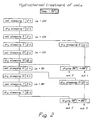
- Figure 2 shows a flow diagram of hydrothermal treatment of oats at a temperature of 50°C, corresponding to the following example 25.
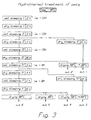
- Figure 3 correspondingly shows a practical example of hydrothermal treatment of oats at a temperature of 40°C, as described in the following example 26.
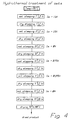
- Figure 4 correspondingly shows a practical example of hydrothermal treatment of oats, in which example the temperature was throughout 35°C.
- Figure 5 correspondingly shows a steeping diagram relating to millet, at a throughout temperature of 50°C
- figure 6 shows a steeping diagram relating to the cereals type maize at a temperature, throughout, of 50°C.
- whole intact cereal grains are, in a first wet steeping step, mixed with water to a water content of the cereal grains of 25-45%, pH is adjusted to 4 - 7, and the entire batch is heated to 35 - 60°C and is kept at said temperature for 0.5 - 10 hours. Thereafter eventual excess of water is drained and a dry steeping is performed for a period of 0.5 - 20 hours at a temperature of 35 - 60°C.
- One or more further combined cycles including wet steeping + dry steeping follow at which the water content is slightly higher than during the first wet steeping step, for instance 35 - 60%, and in which the dry steeping can be performed at the same temperature as that of the wet steeping step, that is at 35 - 60°C.
- the drying of the intact cereal grains is performed at a temperature of 40 - 110°C, preferably for such long time that the cereal grains get a moisture content of less than 10%, whereupon the grains are cooled.
- the cereal grains can be used as whole grains, or they can be treated as required for the forthcoming use thereof, for instance by surface polishing for removal of hull or husk, eventually by cutting and by grinding into flour thereof.
- the setting of pH at the wet steeping steps preferably is made by adding some organic acid or some buffer, for instance lactic acid, whey, citric acid or an acetate buffer, or by an addition of a naturally acid containing product, for instance fruit juice, or by an addition of a lactic acid producing bacteria.
- some organic acid or some buffer for instance lactic acid, whey, citric acid or an acetate buffer
- a naturally acid containing product for instance fruit juice
- the water used for the wet steeping can be added as plain water, as a water solution, as whey or fruit juice, or as steam.
- pressures for increasing the water content of the cereal grains to be treated different pressures can be used, for instance atmospheric pressure, over pressure and sub pressure.
- the cycle including the combination of wet steeping and dry steeping can be repeated any desired number of times, as marked with the flow lines of the figure.
- the content of phytate of the cereal grains is reduced.
- Various types of cereals react with different speeds. For instance, for wheat, rye, rye-wheat, barley, millet, maize and rice it can be sufficient to perform two successive cycles including wet steeping + dry steeping. Oats may require several steeping cycles.
- a first example was treated cereal grains of the kind barley (cultivar Blenheim), in that the grains were mixed with water to a water content of 30 - 55%.
- the pH of the steeping water was adjusted, by an addition of lactic acid, to a concentration of the water of 0.80%.
- the mixture of barley and water was heated to 48°C and was kept at atmospheric pressure for 1 hour.
- the water was drained and the content of grains was kept at a temperature of 48°C for 5 hours.
- a second wet steeping was performed with the same amount of water and at the temperature 50°C for 1 hour.
- a dry steeping was performed at 50°C for 15 hours, and the still intact grains were thereafter dried at 50°C for 8 hours, during 2 hours of which the temperature was increased to 80°C and thereupon for another 6 hours maintaining the temperature at 80°C. Finally the grains were cooled to room temperature.
- IP with a hanging index will be used as the unit for ⁇ mol/g dry matter content of phosphate in the grains.
- the content of phosphate of the type IP 6 and of the type IP 5 are the most important contents as concerns the reduction of total amount of phytate in the grains of cereals, and it has been shown that an eventual increase of other phosphates is not of any noticeable importance. To this end only the percentual reduction of the phosphate IP 6 is given in the following tables as "Red. IP 6 (%)". In the tables there is given, for practical reasons, the degree of acidity as percentage lactic acid in the water during the wet steeping step as "I.a. (%)".
- Test 2 (%) Test 2 55 55 0.6 2.92 2.07 0.47 1.86 87 Test 3 55 65 0.8 1.64 1.84 0.77 3.22 77 Test 4 45 55 0.8 2.37 1.74 0.41 1.70 88 Test 5 48 50 0.8 1.73 0.79 0.15 0.66 95 Test 6 48 48 0.84 1.84 1.02 0.27 1.29 91 Test 7 55 55 0.00 1.44 0.97 0.62 5.51 60 Test 8 55 55 0.1 1.66 1.30 0.68 4.84 65 Test 9 55 65 0.4 1.11 1.46 0.80 4.94 64 Test 10 55 55 0.4 1.95 1.70 0.44 2.28 84 Test 11 50 60 0.6 2.28 2.05 0.52 2.53 82 Test 12 54 65 0.4 1.14 1.58 0.97 6.05 56 Test 13 55 65 0.4 1.28 1.43 0.84 4.53 67
- the content of myo -inositol phosphate in the cereal grains was determined in that the grains (0.5 g) were ground and extracted in 20 ml 0.5 M HCl for 3 hours. The extract was centrifuged, the supernatant was decanted, was freezed over a night, was thawed and was centrifuged twice. After the second centrifugation a 15 ml sample of the supernatant was evaporated to dryness and was solved in 0.025 M HCl. The myo -inositol phosphates were separated from the raw extract by ion exchange chromatography. For analysis of the steeping water a sample of 20 ml water was added directly to the ion exchange chromatography column.
- inositol hexa-, penta-, tetra- and triphosphates were determined by ion pair C18 reversing phase HPLC using formic acid/metanol and tetrabutylammonium hydroxide in the movable phase.
- the pH during the steeping was measured by extracting a sample, grinding and suspending the sample and thereafter measuring the pH in the water suspension thereby obtained.
- cereal grains were mixed with water to a water content of 31 - 58%, the pH was adjusted to pH 4.2 - 6.6, the mixture was heated to 45 - 55 °C and was wet steeped for a period of 0.5 - 1 hour at 45 - 55°C. Thereafter the water was drained and a dry steeping was performed for a period of 1 - 5 hours.
- a repeated wet steeping was performed at 45 - 55 °C, also in this case for a period of 0.5 - 1 hour, whereupon the water was drained from cereal grains and a dry steeping was performed for a period of 1.- 20 hours at 45 - 55 °C, whereupon the cereal grains were finally dried.
- Several tests were made for studying the reduction of phytate, which tests are made account for in the following table.
- IP 4 IP 5 IP 6 Red. IP 6 (%) Raw material 0.08 0.06 0.43 15.67 -- Output 1 0.91 1.22 2.36 12.45 20 Output 2 0.76 1.03 2.31 12.89 18 Output 3 1.20 1.60 2.45 8.86 43 Output 4 1.00 1.51 2.15 8.15 48 Output 5 1.03 1.42 2.09 9.38 40 Output 6 1.12 1.58 2.41 8.96 43
- the test was performed in a two stage cycle comprising wet + dry + wet + dry steeping at a temperature of 50°C and at a pH value of 4.2 - 4.8.
- a steeping scheme relating to the above mentioned test is shown in figure 5.
- the test was performed in a two stage cycle comprising wet + dry + wet + dry steeping at a temperature of 50°C and at a pH value of 4.2 - 4.5. It was shown that an acceptably good result was obtained by hydrothermal treatment of maize. A steeping scheme concerning the above mentioned test is shown in figure 6.
- the product thereby obtained which has a reduced content of phytate (phytic acid), can be used as foodstuff, or as a raw material for several combined foodstuffs, either in the form of a cut product or in the form of a ground product. In the following is given some examples of the use thereof.
- whole or cut cereal grains treated according to the invention preferably as a 20% admixture of hydrothermally treated grains in flour for baking of bread.
- Suitable products in which the cereal grains treated according to the invention can be used are complete cereal compositions for children or adults like porridge and milk cereal drink compositions which can contain
- flakes can be made for use in porridge or in müsli.
- degree of gelatinization of starch can be varied by a succeeding water-heat treatment.
- the product is also very suitable as animal feedstuff.
- the final product, Hydrothermally Treated Cereals Grains, according to the above examples, were analysed with respect to the total amount of bacteria (heterotrophic aerobic bacteria) mesophilic and thermophilic lactic acid bacteria, coliforms, fecal coliforms, aerobic spore forming bacteria, Bacillus cereus , mesophilic and thermophilic anaerobic spore forming bacteria, Pseudomonas spp, yeasts, moulds, and in particular Aspergillus, Penicillium and Fusarium .
- bacteria heterotrophic aerobic bacteria
- Bacillus cereus mesophilic and thermophilic anaerobic spore forming bacteria
- Pseudomonas spp yeasts, moulds
- Aspergillus Penicillium and Fusarium
- the total amount of bacteria varied in several taken samples before drying between ⁇ 50 and 5x10 3 CFU/g, whereby the mean value was 750 CFU/g.
- the amount of bacteria was between ⁇ 5 and 500 CFU/g, with the mean value 70 CFU/g.
- Anaerobic spore forming bacteria and Bacillus cereus could not be found in any sample. Mould was present only sporadically. Lactic acid bacteria and aerobic spore forming bacteria were found in an amount of ⁇ 50 to 100 CFU/g. In the raw material there was 10 4 - 10 7 CFU/g. coliforms, Pseudomonas spp. and yeasts, however, could not be found after the process according to the invention.
- the shelf life of the final product according to the invention was investigated in that the product was analysed as concerns the peroxide value, hexanal and by organoleptic tests by a test panel. It was found that the shelf life, after the product had been stored for 6 months, was at least 25 - 35% better than that of cereals of the same type which had been heat treated in conventional way. This means that the shelf life of a product prepared in accordance with the invention is very good. This may seem surprising considering the fact that the fat content as such is not affected by the process. A theory is that lipoxygenase present in the cereal grains is inactivated. In the process, and this normally happens at 50-60°C and at pH 4- 5.
- the pH value should be between pH 4 and pH 7, preferably between pH 4.5 and 5.5
- the temperature during the wet steeping should preferably be between 35 and 55°C and during the dry steeping between 35 and 55°C
- the wet steeping should be performed at a period of between 0.5 and 10 hours, preferably between 1 and 2 hours, and that the dry steeping should be performed at a period of between 0.5 and 20 hours, preferably between 5 and 15 hours.
Landscapes
- Life Sciences & Earth Sciences (AREA)
- Engineering & Computer Science (AREA)
- Food Science & Technology (AREA)
- Polymers & Plastics (AREA)
- Chemical & Material Sciences (AREA)
- Health & Medical Sciences (AREA)
- Nutrition Science (AREA)
- Microbiology (AREA)
- Wood Science & Technology (AREA)
- Zoology (AREA)
- Biotechnology (AREA)
- Cereal-Derived Products (AREA)
- Organic Low-Molecular-Weight Compounds And Preparation Thereof (AREA)
Applications Claiming Priority (3)
| Application Number | Priority Date | Filing Date | Title |
|---|---|---|---|
| SE9603407A SE507355C2 (sv) | 1996-09-18 | 1996-09-18 | Förfarande för reducering av halten fytat i korn av spannmål |
| SE9603407 | 1996-09-18 | ||
| PCT/SE1997/001569 WO1998011788A1 (en) | 1996-09-18 | 1997-09-17 | A method of reducing the content of phytate and high degree of phytase in cereals and cereal products having a reduced content of phytate |
Publications (2)
| Publication Number | Publication Date |
|---|---|
| EP0930829A1 EP0930829A1 (en) | 1999-07-28 |
| EP0930829B1 true EP0930829B1 (en) | 2003-11-19 |
Family
ID=20403935
Family Applications (1)
| Application Number | Title | Priority Date | Filing Date |
|---|---|---|---|
| EP97942354A Expired - Lifetime EP0930829B1 (en) | 1996-09-18 | 1997-09-17 | A method of reducing the content of phytate in cereals |
Country Status (8)
| Country | Link |
|---|---|
| US (1) | US6139892A (da) |
| EP (1) | EP0930829B1 (da) |
| AT (1) | ATE254407T1 (da) |
| AU (1) | AU4407197A (da) |
| DE (1) | DE69726303D1 (da) |
| DK (1) | DK0930829T3 (da) |
| SE (1) | SE507355C2 (da) |
| WO (1) | WO1998011788A1 (da) |
Families Citing this family (28)
| Publication number | Priority date | Publication date | Assignee | Title |
|---|---|---|---|---|
| US6451572B1 (en) * | 1998-06-25 | 2002-09-17 | Cornell Research Foundation, Inc. | Overexpression of phytase genes in yeast systems |
| FI109964B (fi) * | 1998-11-02 | 2002-11-15 | Lp Tutkimuskeskus Oy | Menetelmä ja laite viljajyvien käsittelemiseksi |
| AU4056700A (en) | 1999-03-31 | 2000-10-16 | Cornell Research Foundation Inc. | Phosphatases with improved phytase activity |
| HK1044691B (en) * | 1999-05-31 | 2006-12-22 | Société des Produits Nestlé S.A. | Cereal products having low phytic acid content |
| US6841370B1 (en) | 1999-11-18 | 2005-01-11 | Cornell Research Foundation, Inc. | Site-directed mutagenesis of Escherichia coli phytase |
| US20020094357A1 (en) * | 2001-01-12 | 2002-07-18 | Biozyme Sytems Inc. | Hydrolysate assisted phytic acid reduction and feed modification method |
| AU2002356880A1 (en) | 2001-10-31 | 2003-05-12 | Phytex, Llc | Phytase-containing animal food and method |
| US20030091716A1 (en) * | 2001-11-09 | 2003-05-15 | Simpey Kuramoto | Stable homogeneous drink composition including particulate cereal product |
| US6623954B1 (en) * | 2002-05-28 | 2003-09-23 | Neose Technologies, Inc. | Process for removal of phosphorous from a dairy stream |
| WO2004024885A2 (en) | 2002-09-13 | 2004-03-25 | Cornell Research Foundation, Inc. | Using mutations to improve aspergillus phytases |
| US20040053602A1 (en) * | 2002-09-18 | 2004-03-18 | Wurzburg Francis L. | Low-cost interoperable wireless multi-application and messaging service |
| US20040219649A1 (en) | 2003-03-10 | 2004-11-04 | Novozymes A/S | Alcohol product processes |
| JP2005326911A (ja) | 2004-05-12 | 2005-11-24 | Hitachi Ltd | San管理方法 |
| US7118776B2 (en) * | 2005-03-10 | 2006-10-10 | Solae, Llc | Phytase-treated acid stable soy protein products |
| US7919297B2 (en) * | 2006-02-21 | 2011-04-05 | Cornell Research Foundation, Inc. | Mutants of Aspergillus niger PhyA phytase and Aspergillus fumigatus phytase |
| WO2008017066A2 (en) * | 2006-08-03 | 2008-02-07 | Cornell Research Foundation, Inc. | Phytases with improved thermal stability |
| US8192734B2 (en) | 2007-07-09 | 2012-06-05 | Cornell University | Compositions and methods for bone strengthening |
| WO2010120471A2 (en) | 2009-04-17 | 2010-10-21 | Danisco Us Inc. | Compositions and methods for grain processing without ph adjustment |
| CA2849320A1 (en) * | 2011-10-12 | 2013-04-18 | R.D. Legault Seeds, Ltd. | Process for making fortified animal feed |
| CA2908810C (en) | 2013-04-12 | 2018-02-27 | Process Partners, Inc. | Method of processing a grain product |
| AU2015274405B2 (en) * | 2014-06-12 | 2019-08-15 | Boortmalt Nv | Removal of phytate |
| EP3257381A1 (en) * | 2016-06-16 | 2017-12-20 | Clariant International Ltd | Use of bacterial 3-phytase for feed or food products |
| US12501904B2 (en) | 2017-03-06 | 2025-12-23 | Corn Products Development, Inc. | Method of preparing thermally inhibited grain |
| WO2019149585A1 (en) * | 2018-02-05 | 2019-08-08 | Koninklijke Philips N.V. | Cooking apparatus for reducing a content of phytic acid and phytate contained in foodstuff |
| EP3563694A1 (en) * | 2018-05-01 | 2019-11-06 | Koninklijke Philips N.V. | Cooking apparatus for reducing a content of phytic acid and phytate contained in foodstuff |
| EP3571931A1 (en) * | 2018-05-24 | 2019-11-27 | Van Gorp, Jacoba Sebastiaan Maria | Process for the production of animal feed |
| WO2021239206A1 (en) | 2020-05-25 | 2021-12-02 | N.V. Nutricia | Process for lowering phytic acid in cereals |
| CN120304519A (zh) * | 2025-06-13 | 2025-07-15 | 中国农业大学 | 一种利用过热蒸汽去除谷物中植酸的方法 |
Family Cites Families (6)
| Publication number | Priority date | Publication date | Assignee | Title |
|---|---|---|---|---|
| US4375431A (en) * | 1981-12-28 | 1983-03-01 | A. E. Staley Manufacturing Company | Aluminum treated proteins |
| DE380343T1 (de) * | 1989-01-25 | 1991-03-21 | Alko Ltd., Helsinki | Verfahren zur herstellung von phytatfreien oder phytatarmen isolaten und konzentraten von sojaproteinen. |
| US5248765A (en) * | 1991-12-20 | 1993-09-28 | Abbott Laboratories | Separation of phytate from plant protein and dietary fiber using alumina |
| SE505893C2 (sv) * | 1992-05-11 | 1997-10-20 | Marie Larsson | Förfarande för framställning av ett havremjöl med hög mineraltillgänglighet utgående från hela havrekorn |
| PT619369E (pt) * | 1993-04-05 | 2003-11-28 | Aveve Nv | Hidrolise de fitato e composicao enzimatica para a hidrolise de fitato |
| FR2729971B1 (fr) * | 1995-01-31 | 1997-06-06 | Roquette Freres | Composition nutritive resultant de la trempe du mais et son procede d'obtention |
-
1996
- 1996-09-18 SE SE9603407A patent/SE507355C2/sv not_active IP Right Cessation
-
1997
- 1997-09-17 US US09/254,678 patent/US6139892A/en not_active Expired - Fee Related
- 1997-09-17 DK DK97942354T patent/DK0930829T3/da active
- 1997-09-17 AU AU44071/97A patent/AU4407197A/en not_active Abandoned
- 1997-09-17 EP EP97942354A patent/EP0930829B1/en not_active Expired - Lifetime
- 1997-09-17 DE DE69726303T patent/DE69726303D1/de not_active Expired - Lifetime
- 1997-09-17 WO PCT/SE1997/001569 patent/WO1998011788A1/en not_active Ceased
- 1997-09-17 AT AT97942354T patent/ATE254407T1/de not_active IP Right Cessation
Also Published As
| Publication number | Publication date |
|---|---|
| WO1998011788A1 (en) | 1998-03-26 |
| SE507355C2 (sv) | 1998-05-18 |
| DK0930829T3 (da) | 2004-01-05 |
| SE9603407L (sv) | 1998-03-19 |
| ATE254407T1 (de) | 2003-12-15 |
| AU4407197A (en) | 1998-04-14 |
| SE9603407D0 (sv) | 1996-09-18 |
| DE69726303D1 (de) | 2003-12-24 |
| US6139892A (en) | 2000-10-31 |
| EP0930829A1 (en) | 1999-07-28 |
Similar Documents
| Publication | Publication Date | Title |
|---|---|---|
| EP0930829B1 (en) | A method of reducing the content of phytate in cereals | |
| Sandberg | The effect of food processing on phytate hydrolysis and availability of iron and zinc | |
| Svanberg et al. | Fermentation and nutrient availability | |
| Sandberg | Bioavailability of minerals in legumes | |
| EP1309249B1 (en) | Soy protein product and process for its manufacture | |
| Onweluzo et al. | Fermentation of millet (Pennisetum americanum) and pigeon pea (Cajanus cajan) seeds for flour production: Effects on composition and selected functional properties | |
| Baranwal | Malting: An indigenous technology used for improving the nutritional quality of grains-A review | |
| Jalgaonkar et al. | Effect of thermal treatments on the storage life of pearl millet (Pennisetum glaucum) flour | |
| Frontela et al. | Phytic acid and inositol phosphates in raw flours and infant cereals: The effect of processing | |
| EP4129076B1 (en) | Method for manufacturing plant-based cheese-like food | |
| Abou-Zeid | Review of Egyptian cereal-based fermented product (Kishk) | |
| EP1264882A2 (en) | Cereal grains with high total dietary fiber and/or resistant starch content and their preparation thereof | |
| Sandberg | In vitro and in vivo degradation of phytate | |
| Chude et al. | Functional and rheological profile of LAB–fermented Bambara groundnut (Vigna subterranean (L)) flour | |
| Ganguly et al. | Cereal-based fermented foods for enhanced nutritional attributes and better gut health | |
| US20030059416A1 (en) | Animal feed | |
| Hassan et al. | Physico-chemical and sensory properties of tarhana prepared from different cereals and dairy ingredients | |
| Olaleye et al. | Quality assessment of weaning food from blends of sorghum, mung beans and orange fleshed sweet potato blends | |
| Folasade et al. | Effect of sesame seed addition on the chemical and sensory qualities of sorghum based kunun-zaki drink | |
| Jurkovic et al. | Effect of thermal processing on the nutritive value of wheat germ protein | |
| Vandarkuzhali et al. | Effect of fermentation and dehydration on the nutritional and functional properties of horse gram (Macrotyloma uniflorum) flour | |
| Himabindu et al. | Development of nutritious cookies by incorporating kodo and little millet flour | |
| Orekoya et al. | Fermentation and Exrusion Effects on the In Vitro Proteinand Starch Digestibility of Unripe Plantain and Pigeon Pea Blends | |
| MUSTAFA et al. | THE IMPACT OF PROCESSING ON SOME NUTRITIONAL PROPERTIES OF READY-TO-EAT MEALS MADE FROM COMPOSITE FLOUR | |
| US20240196943A1 (en) | Method and system for processing seed kernels in food applications |
Legal Events
| Date | Code | Title | Description |
|---|---|---|---|
| PUAI | Public reference made under article 153(3) epc to a published international application that has entered the european phase |
Free format text: ORIGINAL CODE: 0009012 |
|
| 17P | Request for examination filed |
Effective date: 19990310 |
|
| AK | Designated contracting states |
Kind code of ref document: A1 Designated state(s): AT BE CH DE DK ES FI FR GB IE IT LI NL PT |
|
| 17Q | First examination report despatched |
Effective date: 20020715 |
|
| RTI1 | Title (correction) |
Free format text: A METHOD OF REDUCING THE CONTENT OF PHYTATE IN CEREALS |
|
| GRAH | Despatch of communication of intention to grant a patent |
Free format text: ORIGINAL CODE: EPIDOS IGRA |
|
| GRAS | Grant fee paid |
Free format text: ORIGINAL CODE: EPIDOSNIGR3 |
|
| GRAA | (expected) grant |
Free format text: ORIGINAL CODE: 0009210 |
|
| AK | Designated contracting states |
Kind code of ref document: B1 Designated state(s): AT BE CH DE DK ES FI FR GB IE IT LI NL PT |
|
| PG25 | Lapsed in a contracting state [announced via postgrant information from national office to epo] |
Ref country code: NL Free format text: LAPSE BECAUSE OF FAILURE TO SUBMIT A TRANSLATION OF THE DESCRIPTION OR TO PAY THE FEE WITHIN THE PRESCRIBED TIME-LIMIT Effective date: 20031119 Ref country code: LI Free format text: LAPSE BECAUSE OF FAILURE TO SUBMIT A TRANSLATION OF THE DESCRIPTION OR TO PAY THE FEE WITHIN THE PRESCRIBED TIME-LIMIT Effective date: 20031119 Ref country code: IT Free format text: LAPSE BECAUSE OF FAILURE TO SUBMIT A TRANSLATION OF THE DESCRIPTION OR TO PAY THE FEE WITHIN THE PRESCRIBED TIME-LIMIT;WARNING: LAPSES OF ITALIAN PATENTS WITH EFFECTIVE DATE BEFORE 2007 MAY HAVE OCCURRED AT ANY TIME BEFORE 2007. THE CORRECT EFFECTIVE DATE MAY BE DIFFERENT FROM THE ONE RECORDED. Effective date: 20031119 Ref country code: FR Free format text: LAPSE BECAUSE OF FAILURE TO SUBMIT A TRANSLATION OF THE DESCRIPTION OR TO PAY THE FEE WITHIN THE PRESCRIBED TIME-LIMIT Effective date: 20031119 Ref country code: CH Free format text: LAPSE BECAUSE OF FAILURE TO SUBMIT A TRANSLATION OF THE DESCRIPTION OR TO PAY THE FEE WITHIN THE PRESCRIBED TIME-LIMIT Effective date: 20031119 Ref country code: BE Free format text: LAPSE BECAUSE OF FAILURE TO SUBMIT A TRANSLATION OF THE DESCRIPTION OR TO PAY THE FEE WITHIN THE PRESCRIBED TIME-LIMIT Effective date: 20031119 Ref country code: AT Free format text: LAPSE BECAUSE OF FAILURE TO SUBMIT A TRANSLATION OF THE DESCRIPTION OR TO PAY THE FEE WITHIN THE PRESCRIBED TIME-LIMIT Effective date: 20031119 |
|
| REG | Reference to a national code |
Ref country code: GB Ref legal event code: FG4D |
|
| REG | Reference to a national code |
Ref country code: CH Ref legal event code: EP |
|
| REF | Corresponds to: |
Ref document number: 69726303 Country of ref document: DE Date of ref document: 20031224 Kind code of ref document: P |
|
| REG | Reference to a national code |
Ref country code: DK Ref legal event code: T3 |
|
| REG | Reference to a national code |
Ref country code: IE Ref legal event code: FG4D |
|
| PG25 | Lapsed in a contracting state [announced via postgrant information from national office to epo] |
Ref country code: DE Free format text: LAPSE BECAUSE OF FAILURE TO SUBMIT A TRANSLATION OF THE DESCRIPTION OR TO PAY THE FEE WITHIN THE PRESCRIBED TIME-LIMIT Effective date: 20040220 |
|
| PG25 | Lapsed in a contracting state [announced via postgrant information from national office to epo] |
Ref country code: ES Free format text: LAPSE BECAUSE OF FAILURE TO SUBMIT A TRANSLATION OF THE DESCRIPTION OR TO PAY THE FEE WITHIN THE PRESCRIBED TIME-LIMIT Effective date: 20040302 |
|
| NLV1 | Nl: lapsed or annulled due to failure to fulfill the requirements of art. 29p and 29m of the patents act | ||
| REG | Reference to a national code |
Ref country code: CH Ref legal event code: PL |
|
| PG25 | Lapsed in a contracting state [announced via postgrant information from national office to epo] |
Ref country code: IE Free format text: LAPSE BECAUSE OF NON-PAYMENT OF DUE FEES Effective date: 20040917 Ref country code: GB Free format text: LAPSE BECAUSE OF NON-PAYMENT OF DUE FEES Effective date: 20040917 |
|
| PLBE | No opposition filed within time limit |
Free format text: ORIGINAL CODE: 0009261 |
|
| STAA | Information on the status of an ep patent application or granted ep patent |
Free format text: STATUS: NO OPPOSITION FILED WITHIN TIME LIMIT |
|
| 26N | No opposition filed |
Effective date: 20040820 |
|
| EN | Fr: translation not filed | ||
| GBPC | Gb: european patent ceased through non-payment of renewal fee |
Effective date: 20040917 |
|
| REG | Reference to a national code |
Ref country code: IE Ref legal event code: MM4A |
|
| PG25 | Lapsed in a contracting state [announced via postgrant information from national office to epo] |
Ref country code: PT Free format text: LAPSE BECAUSE OF NON-PAYMENT OF DUE FEES Effective date: 20040419 |
|
| PGFP | Annual fee paid to national office [announced via postgrant information from national office to epo] |
Ref country code: DK Payment date: 20110923 Year of fee payment: 15 |
|
| PGFP | Annual fee paid to national office [announced via postgrant information from national office to epo] |
Ref country code: FI Payment date: 20120917 Year of fee payment: 16 |
|
| PG25 | Lapsed in a contracting state [announced via postgrant information from national office to epo] |
Ref country code: FI Free format text: LAPSE BECAUSE OF NON-PAYMENT OF DUE FEES Effective date: 20130917 |
|
| REG | Reference to a national code |
Ref country code: DK Ref legal event code: EBP Effective date: 20130930 |
|
| PG25 | Lapsed in a contracting state [announced via postgrant information from national office to epo] |
Ref country code: DK Free format text: LAPSE BECAUSE OF NON-PAYMENT OF DUE FEES Effective date: 20130930 |