EP0932444B1 - Use of modified starch as an agent for forming a thermoreversible gel - Google Patents
Use of modified starch as an agent for forming a thermoreversible gel Download PDFInfo
- Publication number
- EP0932444B1 EP0932444B1 EP97943217A EP97943217A EP0932444B1 EP 0932444 B1 EP0932444 B1 EP 0932444B1 EP 97943217 A EP97943217 A EP 97943217A EP 97943217 A EP97943217 A EP 97943217A EP 0932444 B1 EP0932444 B1 EP 0932444B1
- Authority
- EP
- European Patent Office
- Prior art keywords
- starch
- gel
- enzyme
- modified
- modified starch
- Prior art date
- Legal status (The legal status is an assumption and is not a legal conclusion. Google has not performed a legal analysis and makes no representation as to the accuracy of the status listed.)
- Expired - Lifetime
Links
- 229920000881 Modified starch Polymers 0.000 title claims abstract description 22
- 235000019426 modified starch Nutrition 0.000 title claims abstract description 22
- 239000004368 Modified starch Substances 0.000 title claims abstract description 20
- 239000003795 chemical substances by application Substances 0.000 title claims abstract description 5
- 229920002472 Starch Polymers 0.000 claims abstract description 58
- 235000019698 starch Nutrition 0.000 claims abstract description 56
- 239000008107 starch Substances 0.000 claims abstract description 51
- 102000004190 Enzymes Human genes 0.000 claims abstract description 22
- 108090000790 Enzymes Proteins 0.000 claims abstract description 22
- 230000000694 effects Effects 0.000 claims abstract description 15
- 229920000856 Amylose Polymers 0.000 claims abstract description 11
- 239000007864 aqueous solution Substances 0.000 claims abstract description 8
- 108010043797 4-alpha-glucanotransferase Proteins 0.000 claims abstract description 6
- 239000000126 substance Substances 0.000 claims abstract description 5
- 239000012736 aqueous medium Substances 0.000 claims abstract description 3
- 229920001592 potato starch Polymers 0.000 claims description 21
- 230000002255 enzymatic effect Effects 0.000 claims description 8
- 229920002261 Corn starch Polymers 0.000 claims description 2
- 235000019759 Maize starch Nutrition 0.000 claims description 2
- 240000003183 Manihot esculenta Species 0.000 claims description 2
- 235000016735 Manihot esculenta subsp esculenta Nutrition 0.000 claims description 2
- 239000000853 adhesive Substances 0.000 claims description 2
- 230000001070 adhesive effect Effects 0.000 claims description 2
- 239000002537 cosmetic Substances 0.000 claims description 2
- 239000003599 detergent Substances 0.000 claims description 2
- 238000005553 drilling Methods 0.000 claims description 2
- 239000012530 fluid Substances 0.000 claims description 2
- -1 pharmaceutics Substances 0.000 claims description 2
- 229940100486 rice starch Drugs 0.000 claims description 2
- 229940100445 wheat starch Drugs 0.000 claims description 2
- 102000004357 Transferases Human genes 0.000 abstract description 2
- 108090000992 Transferases Proteins 0.000 abstract description 2
- 108010055629 Glucosyltransferases Proteins 0.000 description 35
- 102000000340 Glucosyltransferases Human genes 0.000 description 35
- 239000000499 gel Substances 0.000 description 18
- 229940088598 enzyme Drugs 0.000 description 16
- 238000006243 chemical reaction Methods 0.000 description 14
- 239000000243 solution Substances 0.000 description 14
- 239000000463 material Substances 0.000 description 11
- QKNYBSVHEMOAJP-UHFFFAOYSA-N 2-amino-2-(hydroxymethyl)propane-1,3-diol;hydron;chloride Chemical compound Cl.OCC(N)(CO)CO QKNYBSVHEMOAJP-UHFFFAOYSA-N 0.000 description 8
- FAPWRFPIFSIZLT-UHFFFAOYSA-M Sodium chloride Chemical compound [Na+].[Cl-] FAPWRFPIFSIZLT-UHFFFAOYSA-M 0.000 description 8
- 239000007858 starting material Substances 0.000 description 8
- 229920000945 Amylopectin Polymers 0.000 description 7
- 239000000047 product Substances 0.000 description 7
- 230000001603 reducing effect Effects 0.000 description 7
- 239000000725 suspension Substances 0.000 description 7
- 229920002245 Dextrose equivalent Polymers 0.000 description 6
- BFNBIHQBYMNNAN-UHFFFAOYSA-N ammonium sulfate Chemical compound N.N.OS(O)(=O)=O BFNBIHQBYMNNAN-UHFFFAOYSA-N 0.000 description 5
- 229910052921 ammonium sulfate Inorganic materials 0.000 description 5
- 238000005119 centrifugation Methods 0.000 description 5
- 238000000034 method Methods 0.000 description 5
- 230000004048 modification Effects 0.000 description 5
- 238000012986 modification Methods 0.000 description 5
- LFQSCWFLJHTTHZ-UHFFFAOYSA-N Ethanol Chemical compound CCO LFQSCWFLJHTTHZ-UHFFFAOYSA-N 0.000 description 4
- 241000589499 Thermus thermophilus Species 0.000 description 4
- 230000015572 biosynthetic process Effects 0.000 description 4
- 230000007071 enzymatic hydrolysis Effects 0.000 description 4
- 238000006047 enzymatic hydrolysis reaction Methods 0.000 description 4
- 102000004169 proteins and genes Human genes 0.000 description 4
- 108090000623 proteins and genes Proteins 0.000 description 4
- 239000011780 sodium chloride Substances 0.000 description 4
- ZCYVEMRRCGMTRW-UHFFFAOYSA-N 7553-56-2 Chemical compound [I] ZCYVEMRRCGMTRW-UHFFFAOYSA-N 0.000 description 3
- HEMHJVSKTPXQMS-UHFFFAOYSA-M Sodium hydroxide Chemical compound [OH-].[Na+] HEMHJVSKTPXQMS-UHFFFAOYSA-M 0.000 description 3
- 239000012505 Superdex™ Substances 0.000 description 3
- 238000000862 absorption spectrum Methods 0.000 description 3
- 102000023732 binding proteins Human genes 0.000 description 3
- 108091008324 binding proteins Proteins 0.000 description 3
- 210000004027 cell Anatomy 0.000 description 3
- 238000001816 cooling Methods 0.000 description 3
- 229910052740 iodine Inorganic materials 0.000 description 3
- 239000011630 iodine Substances 0.000 description 3
- 230000008569 process Effects 0.000 description 3
- 238000000746 purification Methods 0.000 description 3
- 239000011541 reaction mixture Substances 0.000 description 3
- 230000009467 reduction Effects 0.000 description 3
- 239000006228 supernatant Substances 0.000 description 3
- WQZGKKKJIJFFOK-GASJEMHNSA-N Glucose Natural products OC[C@H]1OC(O)[C@H](O)[C@@H](O)[C@@H]1O WQZGKKKJIJFFOK-GASJEMHNSA-N 0.000 description 2
- 108010028688 Isoamylase Proteins 0.000 description 2
- TWRXJAOTZQYOKJ-UHFFFAOYSA-L Magnesium chloride Chemical compound [Mg+2].[Cl-].[Cl-] TWRXJAOTZQYOKJ-UHFFFAOYSA-L 0.000 description 2
- 244000061456 Solanum tuberosum Species 0.000 description 2
- 235000002595 Solanum tuberosum Nutrition 0.000 description 2
- 239000002253 acid Substances 0.000 description 2
- 230000009471 action Effects 0.000 description 2
- 102000004139 alpha-Amylases Human genes 0.000 description 2
- 108090000637 alpha-Amylases Proteins 0.000 description 2
- 229940024171 alpha-amylase Drugs 0.000 description 2
- 239000007900 aqueous suspension Substances 0.000 description 2
- 230000008859 change Effects 0.000 description 2
- 238000010828 elution Methods 0.000 description 2
- 239000000284 extract Substances 0.000 description 2
- 235000013373 food additive Nutrition 0.000 description 2
- 239000002778 food additive Substances 0.000 description 2
- 238000002523 gelfiltration Methods 0.000 description 2
- 239000008103 glucose Substances 0.000 description 2
- 238000010438 heat treatment Methods 0.000 description 2
- 238000011534 incubation Methods 0.000 description 2
- 229920001542 oligosaccharide Polymers 0.000 description 2
- 150000002482 oligosaccharides Chemical class 0.000 description 2
- 230000003647 oxidation Effects 0.000 description 2
- 238000007254 oxidation reaction Methods 0.000 description 2
- 239000008188 pellet Substances 0.000 description 2
- 239000000843 powder Substances 0.000 description 2
- 239000007966 viscous suspension Substances 0.000 description 2
- XLYOFNOQVPJJNP-UHFFFAOYSA-N water Substances O XLYOFNOQVPJJNP-UHFFFAOYSA-N 0.000 description 2
- HNSDLXPSAYFUHK-UHFFFAOYSA-N 1,4-bis(2-ethylhexyl) sulfosuccinate Chemical compound CCCCC(CC)COC(=O)CC(S(O)(=O)=O)C(=O)OCC(CC)CCCC HNSDLXPSAYFUHK-UHFFFAOYSA-N 0.000 description 1
- DBTMGCOVALSLOR-UHFFFAOYSA-N 32-alpha-galactosyl-3-alpha-galactosyl-galactose Natural products OC1C(O)C(O)C(CO)OC1OC1C(O)C(OC2C(C(CO)OC(O)C2O)O)OC(CO)C1O DBTMGCOVALSLOR-UHFFFAOYSA-N 0.000 description 1
- NLXLAEXVIDQMFP-UHFFFAOYSA-N Ammonia chloride Chemical compound [NH4+].[Cl-] NLXLAEXVIDQMFP-UHFFFAOYSA-N 0.000 description 1
- 241000894006 Bacteria Species 0.000 description 1
- JPVYNHNXODAKFH-UHFFFAOYSA-N Cu2+ Chemical compound [Cu+2] JPVYNHNXODAKFH-UHFFFAOYSA-N 0.000 description 1
- RXVWSYJTUUKTEA-UHFFFAOYSA-N D-maltotriose Natural products OC1C(O)C(OC(C(O)CO)C(O)C(O)C=O)OC(CO)C1OC1C(O)C(O)C(O)C(CO)O1 RXVWSYJTUUKTEA-UHFFFAOYSA-N 0.000 description 1
- 102000016911 Deoxyribonucleases Human genes 0.000 description 1
- 108010053770 Deoxyribonucleases Proteins 0.000 description 1
- 241000588724 Escherichia coli Species 0.000 description 1
- 241000186394 Eubacterium Species 0.000 description 1
- 241000206602 Eukaryota Species 0.000 description 1
- 210000000712 G cell Anatomy 0.000 description 1
- 125000001429 N-terminal alpha-amino-acid group Chemical group 0.000 description 1
- 229930006000 Sucrose Natural products 0.000 description 1
- CZMRCDWAGMRECN-UGDNZRGBSA-N Sucrose Chemical compound O[C@H]1[C@H](O)[C@@H](CO)O[C@@]1(CO)O[C@@H]1[C@H](O)[C@@H](O)[C@H](O)[C@@H](CO)O1 CZMRCDWAGMRECN-UGDNZRGBSA-N 0.000 description 1
- 241000204666 Thermotoga maritima Species 0.000 description 1
- 241000868182 Thermus thermophilus HB8 Species 0.000 description 1
- 238000010521 absorption reaction Methods 0.000 description 1
- 238000005903 acid hydrolysis reaction Methods 0.000 description 1
- 150000007513 acids Chemical class 0.000 description 1
- 125000000217 alkyl group Chemical group 0.000 description 1
- 238000004458 analytical method Methods 0.000 description 1
- 238000005571 anion exchange chromatography Methods 0.000 description 1
- 239000002518 antifoaming agent Substances 0.000 description 1
- 230000001580 bacterial effect Effects 0.000 description 1
- 229940041514 candida albicans extract Drugs 0.000 description 1
- 230000015556 catabolic process Effects 0.000 description 1
- 238000012512 characterization method Methods 0.000 description 1
- 229910001431 copper ion Inorganic materials 0.000 description 1
- 238000009295 crossflow filtration Methods 0.000 description 1
- 230000003247 decreasing effect Effects 0.000 description 1
- 238000009795 derivation Methods 0.000 description 1
- 238000000502 dialysis Methods 0.000 description 1
- ZPWVASYFFYYZEW-UHFFFAOYSA-L dipotassium hydrogen phosphate Chemical compound [K+].[K+].OP([O-])([O-])=O ZPWVASYFFYYZEW-UHFFFAOYSA-L 0.000 description 1
- 229910000396 dipotassium phosphate Inorganic materials 0.000 description 1
- 238000001035 drying Methods 0.000 description 1
- 239000003480 eluent Substances 0.000 description 1
- 238000002474 experimental method Methods 0.000 description 1
- 238000000855 fermentation Methods 0.000 description 1
- 230000004151 fermentation Effects 0.000 description 1
- 238000005187 foaming Methods 0.000 description 1
- 238000001641 gel filtration chromatography Methods 0.000 description 1
- 125000002791 glucosyl group Chemical group C1([C@H](O)[C@@H](O)[C@H](O)[C@H](O1)CO)* 0.000 description 1
- 239000008187 granular material Substances 0.000 description 1
- 239000001963 growth medium Substances 0.000 description 1
- 238000004128 high performance liquid chromatography Methods 0.000 description 1
- 230000003301 hydrolyzing effect Effects 0.000 description 1
- 229910001629 magnesium chloride Inorganic materials 0.000 description 1
- VZCYOOQTPOCHFL-UPHRSURJSA-N maleic acid Chemical compound OC(=O)\C=C/C(O)=O VZCYOOQTPOCHFL-UPHRSURJSA-N 0.000 description 1
- FYGDTMLNYKFZSV-UHFFFAOYSA-N mannotriose Natural products OC1C(O)C(O)C(CO)OC1OC1C(CO)OC(OC2C(OC(O)C(O)C2O)CO)C(O)C1O FYGDTMLNYKFZSV-UHFFFAOYSA-N 0.000 description 1
- 239000000178 monomer Substances 0.000 description 1
- 229920001282 polysaccharide Polymers 0.000 description 1
- 238000002360 preparation method Methods 0.000 description 1
- 230000008707 rearrangement Effects 0.000 description 1
- 239000000523 sample Substances 0.000 description 1
- 238000000926 separation method Methods 0.000 description 1
- 239000001509 sodium citrate Substances 0.000 description 1
- NLJMYIDDQXHKNR-UHFFFAOYSA-K sodium citrate Chemical compound O.O.[Na+].[Na+].[Na+].[O-]C(=O)CC(O)(CC([O-])=O)C([O-])=O NLJMYIDDQXHKNR-UHFFFAOYSA-K 0.000 description 1
- AJPJDKMHJJGVTQ-UHFFFAOYSA-M sodium dihydrogen phosphate Chemical compound [Na+].OP(O)([O-])=O AJPJDKMHJJGVTQ-UHFFFAOYSA-M 0.000 description 1
- 229910000162 sodium phosphate Inorganic materials 0.000 description 1
- 238000003756 stirring Methods 0.000 description 1
- 239000005720 sucrose Substances 0.000 description 1
- 239000002562 thickening agent Substances 0.000 description 1
- VZCYOOQTPOCHFL-UHFFFAOYSA-N trans-butenedioic acid Natural products OC(=O)C=CC(O)=O VZCYOOQTPOCHFL-UHFFFAOYSA-N 0.000 description 1
- 238000011282 treatment Methods 0.000 description 1
- 238000005406 washing Methods 0.000 description 1
- 239000012138 yeast extract Substances 0.000 description 1
- FYGDTMLNYKFZSV-BYLHFPJWSA-N β-1,4-galactotrioside Chemical compound O[C@@H]1[C@@H](O)[C@H](O)[C@@H](CO)O[C@H]1O[C@@H]1[C@H](CO)O[C@@H](O[C@@H]2[C@@H](O[C@@H](O)[C@H](O)[C@H]2O)CO)[C@H](O)[C@H]1O FYGDTMLNYKFZSV-BYLHFPJWSA-N 0.000 description 1
Images




Classifications
-
- B—PERFORMING OPERATIONS; TRANSPORTING
- B01—PHYSICAL OR CHEMICAL PROCESSES OR APPARATUS IN GENERAL
- B01J—CHEMICAL OR PHYSICAL PROCESSES, e.g. CATALYSIS OR COLLOID CHEMISTRY; THEIR RELEVANT APPARATUS
- B01J13/00—Colloid chemistry, e.g. the production of colloidal materials or their solutions, not otherwise provided for; Making microcapsules or microballoons
- B01J13/0052—Preparation of gels
- B01J13/0065—Preparation of gels containing an organic phase
Definitions
- the invention relates to the use of a starch modified in a specific way as an agent for forming a thermoreversible gel.
- starch It is known to modify starch in many different ways. Depending on the modification carried out, there are obtained starch products suitable for divergent uses. Many of the known starch modifications lead to obtaining relatively viscous solutions which are therefore difficult to manage. In other cases a low viscosity can indeed be obtained, but then the molecular weight has substantially decreased, so that many typical starch characteristics are lost.
- a non-retrogradable starch solution can be obtained by using starches in which no amylose is present. To this end, amylopectin and amylose can be separated from any type of starch, but these procedures are laborious. Amylose-free starches may also be recovered from special crops in which no amylose is formed. These crops must then be grown for the purpose. Non-retrograding starches can also be obtained by chemical derivation, but this causes the introduction of foreign groups, which affects the properties of the starch. Finally, retrogradation can also be prevented by increasing the dextrose equivalent (DE) of the starch solution by means of enzymatic hydrolysis, but then the polymeric character of the starch deteriorates and is sometimes lost completely.
- DE dextrose equivalent
- starch derivatives are capable of forming starch gels which offer different possibilities of use, but so far starch gels can only be obtained at rather high concentrations of at least 10%, as is known from Carbohydrate Polymers 231 (1993), 243-248.
- US patent 3,962,465 discloses a food additive, such as a thickener, in the form of a gel or dry hydrolyzate.
- the preparation of the food additive comprises hydrolyzing starch with a bacterial alpha-amylase.
- the modified starch to be used according to the invention is also characterized by a low viscosity in aqueous solution, so that the product is easy to manage and to process and such aqueous solution is suitable for many uses.
- modified starch to be . used according to the invention is substantially identical with the starting material as regards the average molecular weight, the reducing power (DE) and the branching percentage.
- the polymeric properties are thus maintained, while, furthermore, there is no increase in oxidation-sensitive places (DE remains practically unchanged).
- a modified starch obtainable by treating amylose-containing starch in aqueous medium with an enzyme from the group of ⁇ -1,4- ⁇ -1,4-glucosyl transferases (EC 2.4.1.25) or an enzyme the activity of which corresponds to that of enzymes from the group just mentioned - all these enzymes will be briefly referred to below as glucosyl transferase - is used as an agent for forming a thermoreversible gel.
- the typical and relevant activity of glucosyl transferases is that they are capable of breaking an ⁇ -1,4 bond between two glucose units to subsequently make a novel ⁇ -1,4 bond.
- the invention is further characterized by the use of modified starch as defined above in the form of an aqueous solution which, as stated, has a relatively low viscosity.
- starch comprises both native starch and non-substituted starch derivatives. By the latter are meant starches obtained by partially breaking down native starch through acid and/or enzymatic hydrolysis to obtain a DE of not more than 5, because otherwise the polymeric character of the starch is lost.
- the starch for use in the conversion with glucosyl transferase must, as stated, contain amylose, preferably in an amount of at least 5 wt.%.
- the starting starch must also contain amylopectin which, however, is always naturally present in starch.
- Amylose- and amylopectin-containing native starches such as potato starch, maize starch, wheat starch, rice starch and tapioca starch, as well as non-substituted derivatives thereof may therefore be used as starting starch.
- the glucosyl transferases to be used can be obtained from different organisms. From the literature it is known that these enzymes occur in representatives of the Eukarya and the Bacteria. It is further known that glucosyl transferases are also present in representatives of the Archae. There is preferably used a glucosyl transferase which is resistant to a rather high temperature, e.g. a temperature of about 70°C. Examples thereof are glucosyl transferases from Thermus thermophilus , Thermotoga maritima and from thermophilic representatives of the Archae.
- non-thermostable glucosyl transferases from, e.g., the potato or Escherichia coli , respectively D-enzyme and amylomaltase, are useful in the performance of the invention.
- the enzyme must be purified of enzymatic components which may cause undesirable damage to or breakdown of the starch molecule.
- the enzyme must be essentially free of contaminating ⁇ -amylase activity. To those skilled in the art it is known how to carry out such a purification.
- the enzymatic conversion with glucosyl transferase can be carried out both with gelatinized starch and with starch that is still in granular form, but then in a swollen state, or, in other words, that is only partially gelatinized.
- the glucosyl transferase can be added to the already gelatinized starch solution, after it has cooled to, e.g., the desired reaction temperature.
- the glucosyl transferase can be added to the starch suspension at any desirable moment.
- the reaction conditions for carrying out the enzymatic conversion depend on the glucosyl transferase used and can be easily determined by those skilled in the art. In practice, this is usually done at or near a pH at which the enzyme has optimum activity. According as more enzyme is used, the conversion proceeds more rapidly and also a higher temperature enhances the contemplated enzymatic conversion. Of course, when the temperature is chosen, the thermal stability of the glucosyl transferase used must be considered. When a rather thermostable enzyme is used, the enzymatic conversion is preferably carried out at a temperature within the range of 60-75°C. The progress of the conversion can be followed by means of the reduction of the viscosity. After the desired viscosity reduction has been reached, the conversion can be broken down. Preferably, however, the conversion is continued until no further viscosity reduction occurs.
- the enzyme may be deactivated, if desired, by heating the reaction mixture. When there is started from a starch suspension, this may then also be converted to a solution. If desired, the enzyme which may or may not be deactivated can also be separated from the reaction mixture by techniques known to those skilled in the art, such as dialysis. In fact, for specific uses the presence of glucosyl transferase cannot be allowed. If desired, the starch solution obtained may be concentrated or the dry modified starch may be recovered as a powder. Also, washing treatments may be carried out according to need, such as with cold water and with solutions having increasing concentrations of ethanol, after which drying can take place.
- thermoreversible gel An aqueous solution of a starch modified with glucosyl transferase has the property upon cooling to form a gel which, by increasing the temperature, passes again into a solution.
- This is therefore a thermoreversible gel, and the invention is exactly directed to the use of a modified starch that can be obtained in the manner described, as a thermoreversible gel.
- This thermoreversible behaviour already occurs at a low concentration of, e.g., about 3 wt.% modified starch, so that when this thermoreversible behaviour according to the invention is uttilized, a small amount of the modified starch will already be enough.
- an aqueous solution of a starch modified with glucosyl transferase has a low viscosity.
- an aqueous solution of about 10 wt.% has a substantially lower viscosity than a 10 wt.% solution of non-modified starch.
- the product is very easy to process.
- the average molecular weight, the reducing power (DE) and the branching percentage have remained practically unchanged with respect to the starting material. From this it can be derived that a mutual rearrangement between the different types of starch molecules has taken place without increase in oxidation-sensitive places or parts having reducing activity. Finally, it turns out that little or no retrogradation occurs, so that the product in question is very stable.
- thermoreversible gel A starch modified by enzymatic conversion in the indicated manner is suitable for many uses in which the property to form a thermoreversible gel can be useful or important, such as in foodstuffs, cosmetics, pharmaceutics, detergents, adhesives and drilling fluids. These uses are known per se to those skilled in the art, so that they need not be discussed here in more detail.
- the stability of the modified starch and the fact that the contemplated thermoreversible activity can already be obtained at a low concentration of, e.g., only about 3 wt.% are important advantages. Which amount gives optimum activity in a specific case can be easily determined by those skilled in the art by way of experiment.
- thermostable glucosyl transferase (Purification of the thermostable glucosyl transferase from Thermus thermophilus )
- the activity of the glucosyl transferase was determined by determining from maltotriose at 70°C and pH 6.5 in 50 mM maleate buffer the amount of glucose formed. The activity was expressed in ⁇ mol glucose per minute per milligram protein (units per mg).
- the glucosyl transferase thus obtained has a maximum activity at a temperature of 75°C and at pH 6.5.
- the molecular weight lies between 43 and 54 kDa and the enzyme is active as a monomer.
- the first 35 N terminal amino acids were determined. The sequence was determined as: MELPRAFGLL LHPTSLPGPY GVGVLGQEAR DFLRF (1 letter code).
- a suspension of potato starch (20 wt.% amylose; 80 wt.% amylopectin; this also applies to the following examples, unless otherwise indicated) in 50 mM sodium citrate pH 6.5 (10 wt.% dry substance) was gelatinized in a jet-cooker at 150°C.
- the resulting viscous suspension was cooled down to 70°C and the pH was readjusted to 6.5.
- 1 mg of a purified glucosyl transferase as obtained in Example 1 was added to 8 1 of the suspension. Then the solution was incubated for some hours, until the viscosity had reached a constant value (Fig. 1).
- the viscosity change was followed via registration of the voltage required to keep constant the number of revolutions of the stirring motor.
- Potato starch was gelatinized by incubating a 5% starch suspension for 10 min at 100°C. The resulting viscous suspension was cooled down to 30°C and 40 ⁇ g potato D-enzyme were added to 5 ml of the suspension. The reaction mixture was incubated for 48 hours at 30°C.
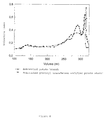
- iodine absorption spectra of the products formed in Examples 2, 3 and 4 were identical with each other, but with respect to the starting material (potato starch) the absorption maximum had shifted from 620 nm to 540 nm (Fig. 3). A comparison was also made with the iodine absorption spectrum of amylose-free potato starch (amylopectin).
- the branching percentage (the ratio between the number of ⁇ -1,6 bonds and the number of ⁇ -1,4 bonds determined by means of the enzyme isoamylase which breaks the ⁇ -1,6 bonds, so that an additional reducing group is formed; the increase in the number of reducing groups by the action of isoamylase is a measure for the number of ⁇ -1,6 bonds or branching. points) and the reducing power had only slightly changed in relation to the starting material (branching percentage: 2.86% versus 2.77% for the starting material; reducing content: 0.00293 versus 0.00288 for the starting material). The side chain length distribution had indeed changed in relation to the starting material, as can be observed after debranching (Figs. 5 and 6). Fig.
- FIG. 5 shows the elution profile of debranched potato starch (A) and debranched glucosyl transferase modified potato starch (B).
- the oligosaccharides were separated on a Dionex HPLC and detected by means of a Pulsed Amperometric Detector. The numbers above the peaks indicate the length of the oligosaccharides.
- Fig. 6 shows the elution pattern of debranched potato starch and debranched glucosyl transferase modified potato starch which was separated on a gel filtration column (Superdex 200).
- Example 2 The solution obtained in Example 2 was cooled to 4°C and further incubated, until a white gel had been formed. This material was successively washed with water and with 25%, 50%, 75% and 100% ethanol. The material thus obtained was dried in the air and ground to obtain a powder having an average size of ca. 200 ⁇ m. There were obtained ca. 500 g potato starch modified with glucosyl transferase.
- Example 6 With material obtained according to Example 6 there was prepared a 5% aqueous suspension, which was heated at 90°C, until a clear solution was obtained. This solution was cooled. in a rheometer to 4°C and G' (G") was followed with time (for G' and G" see “Inleiding in de Reologie” 1991, ISBN 90 201 2557 5, pp. 177-189). After G' was constant, the temperature was increased to 70°C, and then cooling was effected again to 4°C. This process was repeated three times. As control a 3% potato starch solution was taken. Fig.
- Part 7 is a hypothetical representation of the established change in the viscosity (G') of glucosyl transferase modified potato starch (Part A) and of potato starch (Part B) after three cycles of heating and cooling. Part A clearly shows the behaviour of thermoreversible gel.
Landscapes
- Chemical & Material Sciences (AREA)
- Organic Chemistry (AREA)
- Dispersion Chemistry (AREA)
- Chemical Kinetics & Catalysis (AREA)
- Polysaccharides And Polysaccharide Derivatives (AREA)
- Preparation Of Compounds By Using Micro-Organisms (AREA)
- Jellies, Jams, And Syrups (AREA)
- Compositions Of Macromolecular Compounds (AREA)
Applications Claiming Priority (3)
| Application Number | Priority Date | Filing Date | Title |
|---|---|---|---|
| NL1004214 | 1996-10-07 | ||
| NL1004214A NL1004214C2 (nl) | 1996-10-07 | 1996-10-07 | Toepassing van gemodificeerd zetmeel als middel voor het vormen van een thermoreversibele gel. |
| PCT/NL1997/000552 WO1998015347A1 (en) | 1996-10-07 | 1997-10-06 | Use of modified starch as an agent for forming a thermoreversible gel |
Publications (2)
| Publication Number | Publication Date |
|---|---|
| EP0932444A1 EP0932444A1 (en) | 1999-08-04 |
| EP0932444B1 true EP0932444B1 (en) | 2002-01-23 |
Family
ID=19763633
Family Applications (1)
| Application Number | Title | Priority Date | Filing Date |
|---|---|---|---|
| EP97943217A Expired - Lifetime EP0932444B1 (en) | 1996-10-07 | 1997-10-06 | Use of modified starch as an agent for forming a thermoreversible gel |
Country Status (12)
| Country | Link |
|---|---|
| US (1) | US6864063B2 (da) |
| EP (1) | EP0932444B1 (da) |
| JP (1) | JP4195511B2 (da) |
| AT (1) | ATE212249T1 (da) |
| AU (1) | AU4474097A (da) |
| CA (1) | CA2267118C (da) |
| DE (1) | DE69710087T2 (da) |
| DK (1) | DK0932444T3 (da) |
| NL (1) | NL1004214C2 (da) |
| PL (1) | PL187354B1 (da) |
| RU (1) | RU2193585C2 (da) |
| WO (1) | WO1998015347A1 (da) |
Cited By (7)
| Publication number | Priority date | Publication date | Assignee | Title |
|---|---|---|---|---|
| WO2008071744A3 (en) * | 2006-12-13 | 2008-08-28 | Dsm Ip Assets Bv | Cream substitute |
| WO2009080838A3 (en) * | 2008-04-02 | 2009-12-17 | Dsm Ip Assets B.V. | Gum confections |
| WO2012080150A1 (en) | 2010-12-13 | 2012-06-21 | Dsm Ip Assets B.V. | Spreadable gels |
| WO2016114657A1 (en) | 2015-01-13 | 2016-07-21 | Coöperatie Avebe U.A. | Spreadable cheese from curd. |
| WO2021126057A1 (en) | 2019-12-18 | 2021-06-24 | Sveriges Stärkelseproducenter, förening u.p.a. | Converted starch and food comprising said converted starch |
| WO2022182236A1 (en) | 2021-02-24 | 2022-09-01 | Coöperatie Koninklijke Avebe U.A. | Methods for preparing a stabilized drinking yoghurt. |
| WO2024205412A1 (en) | 2023-03-31 | 2024-10-03 | Coöperatie Koninklijke Avebe U.A. | Textured vegetable protein |
Families Citing this family (31)
| Publication number | Priority date | Publication date | Assignee | Title |
|---|---|---|---|---|
| EP1145646A1 (en) * | 2000-04-14 | 2001-10-17 | Coöperatieve Verkoop- en Productievereniging, van Aardappelmeel en Derivaten AVEBE B.A. | Reversible gel formation |
| WO2002010427A1 (en) * | 2000-07-28 | 2002-02-07 | Novozymes A/S | Method for producing maltose syrup by using a hexosyltransferase |
| NL1018426C2 (nl) * | 2001-06-29 | 2003-01-07 | Tno | Preventie van retrogradatie van zetmeel. |
| DE60331745D1 (de) | 2002-06-17 | 2010-04-29 | Nec Corp | Biologisch abbaubares harz, biologisch abbaubare harzzusammensetzung, biologisch abbaubarer formkörper und verfahren zur herstellung von biologisch abbaubarem harz |
| EP1743693B1 (en) | 2005-07-12 | 2017-03-29 | Coöperatie Avebe U.A. | Emulsifier |
| US7674897B2 (en) | 2005-09-09 | 2010-03-09 | Tate & Lyle Ingredients Americas, Inc. | Production of crystalline short chain amylose |
| US8993039B2 (en) | 2006-01-25 | 2015-03-31 | Tate & Lyle Ingredients Americas Llc | Fiber-containing carbohydrate composition |
| US8057840B2 (en) | 2006-01-25 | 2011-11-15 | Tate & Lyle Ingredients Americas Llc | Food products comprising a slowly digestible or digestion resistant carbohydrate composition |
| US7608436B2 (en) | 2006-01-25 | 2009-10-27 | Tate & Lyle Ingredients Americas, Inc. | Process for producing saccharide oligomers |
| MX2009008090A (es) | 2007-02-01 | 2009-08-12 | Dsm Ip Assets Bv | Metodo para producir tarta con fosfolipasa a. |
| KR100868329B1 (ko) * | 2007-02-01 | 2008-11-12 | 씨제이제일제당 (주) | 효소를 이용한 고분지 아밀로오스 및 아밀로펙틴클러스터의 제조방법 |
| PL2276348T3 (pl) * | 2008-04-17 | 2013-06-28 | Cooperatie Avebe U A | Niskotłuszczowa emulsja typu woda-w-oleju |
| US8030297B2 (en) * | 2008-05-14 | 2011-10-04 | Otonomy, Inc. | Controlled release corticosteroid compositions and methods for the treatment of OTIC disorders |
| CN102118975B (zh) * | 2008-08-05 | 2015-02-04 | 帝斯曼知识产权资产管理有限公司 | 淀粉组合物及生产烘焙产品的方法 |
| EP2172489A1 (en) * | 2008-09-15 | 2010-04-07 | Nederlandse Organisatie voor toegepast- natuurwetenschappelijk onderzoek TNO | Method for altering starch using a microbial branching enzyme |
| DK2406372T3 (da) | 2009-03-10 | 2017-11-27 | Dsm Ip Assets Bv | Prægastrisk esterase og derivater deraf |
| WO2010124975A1 (en) | 2009-04-28 | 2010-11-04 | Dsm Ip Assets B.V. | Method of preparing an egg composition |
| EP2248907A1 (en) * | 2009-05-08 | 2010-11-10 | Rijksuniversiteit Groningen | Gluco-oligosaccharides comprising (alpha 1-->4) and (alpha 1-->6) glycosidic bonds, use thereof, and methods for providing them |
| AU2010253755B2 (en) | 2009-05-29 | 2015-08-27 | Acco Brands Usa Llc | Security apparatus including attachment device |
| EP2433995A1 (en) * | 2010-09-28 | 2012-03-28 | Coöperatie Avebe U.A. | Adhesive composition |
| EP2486799A1 (en) | 2011-02-14 | 2012-08-15 | DSM IP Assets B.V. | Method to produce cake with lipolytic enzyme and alpha-amylase |
| WO2016049591A1 (en) * | 2014-09-25 | 2016-03-31 | Aladdin Foods, Llc | Formulations for use in food products |
| ES2772818T3 (es) | 2016-04-18 | 2020-07-08 | Cooperatie Avebe U A | Queso fresco unido a suero de leche estable al calor y rellenos para productos de pastelería |
| AU2017302381B2 (en) * | 2016-07-29 | 2020-03-05 | Coöperatie Avebe U.A. | Protein-fortified food product |
| CN108676177B (zh) * | 2018-04-23 | 2020-11-06 | 江南大学 | 一种以纳米淀粉粒子为骨架的智能水凝胶加工方法 |
| US11540549B2 (en) | 2019-11-28 | 2023-01-03 | Tate & Lyle Solutions Usa Llc | High-fiber, low-sugar soluble dietary fibers, products including them and methods for using them |
| EP3981797A1 (en) | 2020-10-12 | 2022-04-13 | Bostik SA | Starch-based aqueous adhesive composition |
| CN113813888B (zh) * | 2021-09-07 | 2023-05-23 | 山东大学深圳研究院 | 基于竞争反应实现溶胶-凝胶-溶胶自主转变的方法 |
| DK4104680T3 (da) | 2021-10-19 | 2025-09-29 | Dsm Ip Assets Bv | Kageblanding |
| CN114277071B (zh) * | 2021-12-31 | 2023-08-25 | 江南大学 | 一种凝胶增强型的热可逆淀粉的制备方法 |
| CN117265868B (zh) * | 2023-10-10 | 2024-06-18 | 佛山市魔晶科技发展有限公司 | 一种耐高温留香珠及其制备方法 |
Family Cites Families (11)
| Publication number | Priority date | Publication date | Assignee | Title |
|---|---|---|---|---|
| US3455783A (en) * | 1966-03-11 | 1969-07-15 | American Home Prod | Control of enzyme activity in nonfluid gels |
| US3986890A (en) | 1972-02-21 | 1976-10-19 | Akademie Der Wissenschaften Der Ddr | Method of producing starch hydrolysis products for use as food additives |
| US3962465A (en) * | 1973-08-27 | 1976-06-08 | Akademie Der Wissenschaften Der Ddr | Method of producing starch hydrolysis products for use as a food additives |
| US4626288A (en) | 1985-01-10 | 1986-12-02 | National Starch And Chemical Corporation | Starch derivatives forming reversible gels |
| US5747297A (en) * | 1987-02-26 | 1998-05-05 | Bio Polymers Pty. Ltd. | Industrial pharmaceutical and cosmetics applications for cultured plant cell gums |
| EP0355908B1 (en) * | 1988-08-17 | 1996-12-18 | Unilever N.V. | Liquid based composition comprising gelling polysaccharide capable of forming a reversible gel and a method for preparing such composition |
| US4971723A (en) | 1988-10-14 | 1990-11-20 | National Starch And Chemical Investment Holding Corporation | Partially debranched starches and enzymatic process for preparing the starches |
| WO1990015544A1 (en) * | 1989-06-22 | 1990-12-27 | Fmc Corporation | Thickened and gelled systems based on starch and glucomannan |
| US5686132A (en) | 1994-04-01 | 1997-11-11 | Ezaki Glico Co., Ltd. | Glucans having a cycle structure, and processes for preparing the same |
| NL9401090A (nl) * | 1994-06-29 | 1996-02-01 | Avebe Coop Verkoop Prod | Werkwijze voor het oppervlaktelijmen of strijken van papier. |
| WO1996003057A1 (en) * | 1994-07-22 | 1996-02-08 | Societe Des Produits Nestle S.A. | Food grade texture agent comprising particles of high-amylose starch and process for its preparation. |
-
1996
- 1996-10-07 NL NL1004214A patent/NL1004214C2/nl not_active IP Right Cessation
-
1997
- 1997-10-06 AU AU44740/97A patent/AU4474097A/en not_active Abandoned
- 1997-10-06 CA CA002267118A patent/CA2267118C/en not_active Expired - Lifetime
- 1997-10-06 AT AT97943217T patent/ATE212249T1/de active
- 1997-10-06 PL PL97332627A patent/PL187354B1/pl unknown
- 1997-10-06 WO PCT/NL1997/000552 patent/WO1998015347A1/en not_active Ceased
- 1997-10-06 EP EP97943217A patent/EP0932444B1/en not_active Expired - Lifetime
- 1997-10-06 JP JP51741098A patent/JP4195511B2/ja not_active Expired - Fee Related
- 1997-10-06 RU RU99109031/04A patent/RU2193585C2/ru active
- 1997-10-06 DK DK97943217T patent/DK0932444T3/da active
- 1997-10-06 DE DE69710087T patent/DE69710087T2/de not_active Expired - Lifetime
-
2002
- 2002-04-03 US US10/115,347 patent/US6864063B2/en not_active Expired - Lifetime
Cited By (15)
| Publication number | Priority date | Publication date | Assignee | Title |
|---|---|---|---|---|
| US10080373B2 (en) | 2006-12-13 | 2018-09-25 | Coöperatie Avebe U.A. | Cream substitute |
| EA017026B1 (ru) * | 2006-12-13 | 2012-09-28 | ДСМ АйПи АССЕТС Б.В. | Пищевой продукт, содержащий заменитель сливок и/или жира, и способ его изготовления |
| CN101557715B (zh) * | 2006-12-13 | 2012-12-12 | 帝斯曼知识产权资产管理有限公司 | 奶油替代物 |
| WO2008071744A3 (en) * | 2006-12-13 | 2008-08-28 | Dsm Ip Assets Bv | Cream substitute |
| EA018763B1 (ru) * | 2008-04-02 | 2013-10-30 | ДСМ АйПи АССЕТС Б.В. | Крахмальная композиция, ее применение и жевательный пищевой продукт |
| WO2009080838A3 (en) * | 2008-04-02 | 2009-12-17 | Dsm Ip Assets B.V. | Gum confections |
| CN102046019A (zh) * | 2008-04-02 | 2011-05-04 | 帝斯曼知识产权资产管理有限公司 | 胶质糖果 |
| AU2009203054B2 (en) * | 2008-04-02 | 2013-09-05 | Dsm Ip Assets B.V. | Gum confections |
| CN103260429A (zh) * | 2010-12-13 | 2013-08-21 | 帝斯曼知识产权资产管理有限公司 | 可涂抹凝胶 |
| WO2012080150A1 (en) | 2010-12-13 | 2012-06-21 | Dsm Ip Assets B.V. | Spreadable gels |
| WO2016114657A1 (en) | 2015-01-13 | 2016-07-21 | Coöperatie Avebe U.A. | Spreadable cheese from curd. |
| WO2021126057A1 (en) | 2019-12-18 | 2021-06-24 | Sveriges Stärkelseproducenter, förening u.p.a. | Converted starch and food comprising said converted starch |
| US12600802B2 (en) | 2019-12-18 | 2026-04-14 | Sveriges Stärkelseproducenter, förening u.p.a. | Converted starch and food comprising said converted starch |
| WO2022182236A1 (en) | 2021-02-24 | 2022-09-01 | Coöperatie Koninklijke Avebe U.A. | Methods for preparing a stabilized drinking yoghurt. |
| WO2024205412A1 (en) | 2023-03-31 | 2024-10-03 | Coöperatie Koninklijke Avebe U.A. | Textured vegetable protein |
Also Published As
| Publication number | Publication date |
|---|---|
| EP0932444A1 (en) | 1999-08-04 |
| AU4474097A (en) | 1998-05-05 |
| PL332627A1 (en) | 1999-09-27 |
| ATE212249T1 (de) | 2002-02-15 |
| JP4195511B2 (ja) | 2008-12-10 |
| CA2267118C (en) | 2005-08-16 |
| WO1998015347A1 (en) | 1998-04-16 |
| NL1004214C2 (nl) | 1998-04-10 |
| CA2267118A1 (en) | 1998-04-16 |
| JP2001501670A (ja) | 2001-02-06 |
| US20030007984A1 (en) | 2003-01-09 |
| RU2193585C2 (ru) | 2002-11-27 |
| DE69710087T2 (de) | 2002-08-01 |
| PL187354B1 (pl) | 2004-06-30 |
| DE69710087D1 (de) | 2002-03-14 |
| US6864063B2 (en) | 2005-03-08 |
| DK0932444T3 (da) | 2002-04-02 |
Similar Documents
| Publication | Publication Date | Title |
|---|---|---|
| EP0932444B1 (en) | Use of modified starch as an agent for forming a thermoreversible gel | |
| EP0710674B1 (en) | Method for producing a glucan having cyclic structure | |
| JP3957684B2 (ja) | グルカンの製造法およびその調製法 | |
| AU766960B2 (en) | Method for producing resistant starch | |
| Gawande et al. | Purification and properties of a novel raw starch degrading-cyclodextrin glycosyltransferase from Klebsiella pneumoniae AS-22 | |
| JP2010516289A (ja) | 高度分枝状アミロースおよびアミロペクチン・クラスターを酵素的に調製する方法 | |
| US3729380A (en) | Process for producing low molecular amylose on a commercial basis | |
| AU2002307701A1 (en) | Production method and preparation method of glucans | |
| JPH0485301A (ja) | アミロース粒子とその製造方法 | |
| EP2428578B1 (en) | Glucuronic acid-containing glucan, process for production of same, and use of same | |
| Lopez-Munguia et al. | Production and purification of alternansucrase, a glucosyltransferase from Leuconostoc mesenteroides NRRL B-1355, for the synthesis of oligoalternans | |
| JPH08311103A (ja) | 環状構造を有するグルカンおよびその製造方法 | |
| EP1316614B1 (fr) | Procédé continu de modification de l'amidon et de ses dérivés par enzymes de branchement | |
| Matioli et al. | Characterization of cyclodextrin glycosyltransferase from Bacillus firmus strain no. 37 | |
| CN110099928A (zh) | 消化速度缓慢的高分子葡聚糖 | |
| DE69521450T2 (de) | Glukane mit cyclischer Struktur und Verfahren zu deren Herstellung | |
| JP2004504852A (ja) | ヘキソシルトランスフェラーゼを使用するマルトースシロップの製造方法 | |
| US5405449A (en) | Process for preparing chain-extended starch | |
| Yim et al. | Production of branched cyclodextrins by reverse reaction of microbial debranching enzymes | |
| JP2009270012A (ja) | ジメチルスルホキシド中でのアミロース合成 | |
| JPH01171493A (ja) | パノースを含むでん粉糖の製造方法 |
Legal Events
| Date | Code | Title | Description |
|---|---|---|---|
| PUAI | Public reference made under article 153(3) epc to a published international application that has entered the european phase |
Free format text: ORIGINAL CODE: 0009012 |
|
| 17P | Request for examination filed |
Effective date: 19990420 |
|
| AK | Designated contracting states |
Kind code of ref document: A1 Designated state(s): AT DE DK FR GB NL SE |
|
| 17Q | First examination report despatched |
Effective date: 19991115 |
|
| GRAG | Despatch of communication of intention to grant |
Free format text: ORIGINAL CODE: EPIDOS AGRA |
|
| GRAG | Despatch of communication of intention to grant |
Free format text: ORIGINAL CODE: EPIDOS AGRA |
|
| GRAH | Despatch of communication of intention to grant a patent |
Free format text: ORIGINAL CODE: EPIDOS IGRA |
|
| GRAH | Despatch of communication of intention to grant a patent |
Free format text: ORIGINAL CODE: EPIDOS IGRA |
|
| GRAG | Despatch of communication of intention to grant |
Free format text: ORIGINAL CODE: EPIDOS AGRA |
|
| GRAA | (expected) grant |
Free format text: ORIGINAL CODE: 0009210 |
|
| REG | Reference to a national code |
Ref country code: GB Ref legal event code: IF02 |
|
| AK | Designated contracting states |
Kind code of ref document: B1 Designated state(s): AT DE DK FR GB NL SE |
|
| PG25 | Lapsed in a contracting state [announced via postgrant information from national office to epo] |
Ref country code: NL Free format text: LAPSE BECAUSE OF FAILURE TO SUBMIT A TRANSLATION OF THE DESCRIPTION OR TO PAY THE FEE WITHIN THE PRESCRIBED TIME-LIMIT Effective date: 20020123 |
|
| REF | Corresponds to: |
Ref document number: 212249 Country of ref document: AT Date of ref document: 20020215 Kind code of ref document: T |
|
| REF | Corresponds to: |
Ref document number: 69710087 Country of ref document: DE Date of ref document: 20020314 |
|
| REG | Reference to a national code |
Ref country code: DK Ref legal event code: T3 |
|
| ET | Fr: translation filed | ||
| NLV1 | Nl: lapsed or annulled due to failure to fulfill the requirements of art. 29p and 29m of the patents act | ||
| PLBE | No opposition filed within time limit |
Free format text: ORIGINAL CODE: 0009261 |
|
| STAA | Information on the status of an ep patent application or granted ep patent |
Free format text: STATUS: NO OPPOSITION FILED WITHIN TIME LIMIT |
|
| 26N | No opposition filed | ||
| REG | Reference to a national code |
Ref country code: FR Ref legal event code: CD Ref country code: FR Ref legal event code: CA |
|
| REG | Reference to a national code |
Ref country code: FR Ref legal event code: PLFP Year of fee payment: 19 |
|
| REG | Reference to a national code |
Ref country code: FR Ref legal event code: PLFP Year of fee payment: 20 |
|
| PGFP | Annual fee paid to national office [announced via postgrant information from national office to epo] |
Ref country code: GB Payment date: 20161020 Year of fee payment: 20 Ref country code: DE Payment date: 20161020 Year of fee payment: 20 Ref country code: DK Payment date: 20161019 Year of fee payment: 20 Ref country code: FR Payment date: 20161020 Year of fee payment: 20 |
|
| PGFP | Annual fee paid to national office [announced via postgrant information from national office to epo] |
Ref country code: AT Payment date: 20161020 Year of fee payment: 20 Ref country code: SE Payment date: 20161019 Year of fee payment: 20 |
|
| REG | Reference to a national code |
Ref country code: DE Ref legal event code: R071 Ref document number: 69710087 Country of ref document: DE |
|
| REG | Reference to a national code |
Ref country code: DK Ref legal event code: EUP Effective date: 20171006 |
|
| REG | Reference to a national code |
Ref country code: GB Ref legal event code: PE20 Expiry date: 20171005 |
|
| REG | Reference to a national code |
Ref country code: AT Ref legal event code: MK07 Ref document number: 212249 Country of ref document: AT Kind code of ref document: T Effective date: 20171006 |
|
| PG25 | Lapsed in a contracting state [announced via postgrant information from national office to epo] |
Ref country code: GB Free format text: LAPSE BECAUSE OF EXPIRATION OF PROTECTION Effective date: 20171005 |