EP0933378B1 - Quinolinone-Glykosid, Herstellungsverfahren, und antiallergische Mittel - Google Patents
Quinolinone-Glykosid, Herstellungsverfahren, und antiallergische Mittel Download PDFInfo
- Publication number
- EP0933378B1 EP0933378B1 EP99100388A EP99100388A EP0933378B1 EP 0933378 B1 EP0933378 B1 EP 0933378B1 EP 99100388 A EP99100388 A EP 99100388A EP 99100388 A EP99100388 A EP 99100388A EP 0933378 B1 EP0933378 B1 EP 0933378B1
- Authority
- EP
- European Patent Office
- Prior art keywords
- group
- quinolinone
- methyl
- dimethoxy
- protected
- Prior art date
- Legal status (The legal status is an assumption and is not a legal conclusion. Google has not performed a legal analysis and makes no representation as to the accuracy of the status listed.)
- Expired - Lifetime
Links
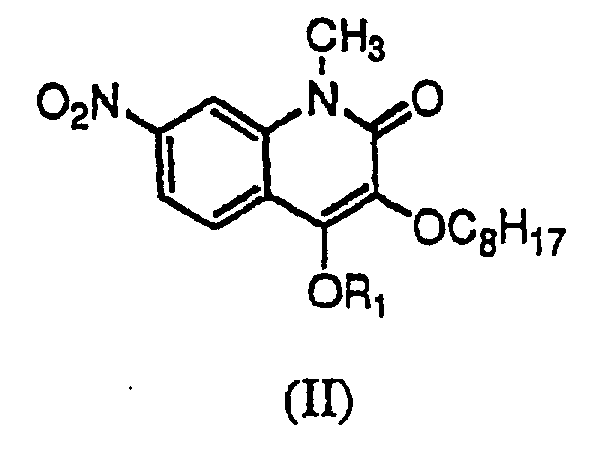
- 0 CN(c(cc(cc1)[N+]([O-])=O)c1C(O*)=C1*)C1=O Chemical compound CN(c(cc(cc1)[N+]([O-])=O)c1C(O*)=C1*)C1=O 0.000 description 9
Classifications
-
- C—CHEMISTRY; METALLURGY
- C07—ORGANIC CHEMISTRY
- C07D—HETEROCYCLIC COMPOUNDS
- C07D221/00—Heterocyclic compounds containing six-membered rings having one nitrogen atom as the only ring hetero atom, not provided for by groups C07D211/00 - C07D219/00
- C07D221/02—Heterocyclic compounds containing six-membered rings having one nitrogen atom as the only ring hetero atom, not provided for by groups C07D211/00 - C07D219/00 condensed with carbocyclic rings or ring systems
-
- C—CHEMISTRY; METALLURGY
- C07—ORGANIC CHEMISTRY
- C07H—SUGARS; DERIVATIVES THEREOF; NUCLEOSIDES; NUCLEOTIDES; NUCLEIC ACIDS
- C07H17/00—Compounds containing heterocyclic radicals directly attached to hetero atoms of saccharide radicals
- C07H17/02—Heterocyclic radicals containing only nitrogen as ring hetero atoms
-
- A—HUMAN NECESSITIES
- A61—MEDICAL OR VETERINARY SCIENCE; HYGIENE
- A61P—SPECIFIC THERAPEUTIC ACTIVITY OF CHEMICAL COMPOUNDS OR MEDICINAL PREPARATIONS
- A61P37/00—Drugs for immunological or allergic disorders
- A61P37/08—Antiallergic agents
-
- C—CHEMISTRY; METALLURGY
- C07—ORGANIC CHEMISTRY
- C07H—SUGARS; DERIVATIVES THEREOF; NUCLEOSIDES; NUCLEOTIDES; NUCLEIC ACIDS
- C07H15/00—Compounds containing hydrocarbon or substituted hydrocarbon radicals directly attached to hetero atoms of saccharide radicals
- C07H15/26—Acyclic or carbocyclic radicals, substituted by hetero rings
Definitions
- the present invention relates to glycosides of quinolinone derivatives or physiologically acceptable salts of such glycosides; processes for producing them; and medicines, and in particular anti-allergic agents, comprising one of them as an active ingredient.
- glycosides represented by general formula (I) in which the glycosidic linkage is formed at a hydroxyl group of 7-(3,5-dimethoxy-4-hydroxycinnamoyl)amino-4-hydroxy-1-methyl-3-octyloxy-2(1H)-quinolinone, represented by general formula (VI), which is the aglycone moiety of the glycosides represented by general formula (I), and physiologically acceptable salts of such glycosides; glycosides represented by general formula (II) or (III), in which the glycosidic linkage is formed at a hydroxyl group portion of a quinolinone derivative, and physiologically acceptable salts of such glycosides; and processes for producing glycosides represented by general formulae (I), (II), (III) and (V).
- Glycosides represented by general formula (I) are useful as medicines, and particularly as agents for treating or alleviating allergic diseases.
- quinolinone glycoside expressed by general formula (II) or (III), which is an important intermediate produced when synthesizing a quinolinone glycoside to which the present invention relates and which is expressed by general formula (I), has also been hitherto known.
- An object of the present invention is to provide: novel quinolinone glycosides which are useful as medicines; processes for producing the quinolinone glycosides; intermediates for synthesis; and medicines, and particularly anti-allergic agents, which comprise the quinolinone glycoside as an active ingredient.
- the present inventors carried out diligent research in order to achieve the above object, and as a result, by synthesizing various glycosides in which the glycosidic linkage is formed at a hydroxyl group of a quinolinone derivative according to Japanese Patent Application, First Publication (Kokai), No. Hei 9-255659, and by examining the pharmacological action of each of them, the present inventors found such glycosides useful as medicines, and particularly as anti-allergic agents, and achieved the present invention.
- the present invention includes:
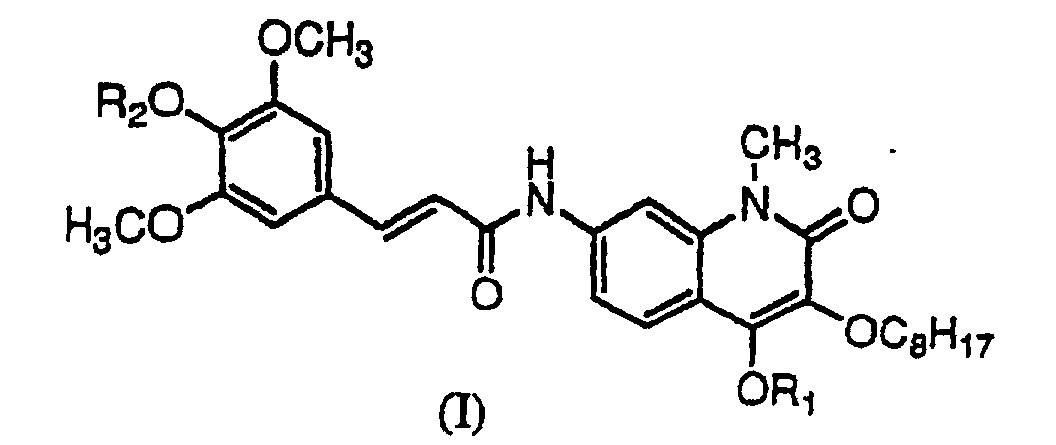
- the present invention includes quinolinone glycosides expressed by general formula (I) and their physiologically acceptable salts, wherein, each of R 1 and R 2 is a hydrogen atom or a glycosyl group selected from the group consisting of a glucuronyl group, a glucosyl group, a galactosyl group and a mannosyl group, and at least one of R 1 and R 2 is a glycosyl 5 group in which a hydroxyl group in the glycosyl group is protected or unprotected.
- each of R 1 and R 2 is a hydrogen atom or a glycosyl group selected from the group consisting of a glucuronyl group, a glucosyl group, a galactosyl group and a mannosyl group
- at least one of R 1 and R 2 is a glycosyl 5 group in which a hydroxyl group in the glycosyl group is protected or unprotected.
- a hexose which can be a material for a glycosyl group in any one of the quinolinone glycosides expressed by general formula (I), nitroquinolinone glycosides expressed by general 10 formula (II) and aminoquinolinone glycosides expressed by general formula (III) according to the present invention is glucuronic acid, glucose, galactose or mannose, in which a hydroxyl group in any of these glycosides may or may not be protected with a protecting group.
- the quinolinone glycoside represented by general formula (I), (II) or (III) according to the present invention is a 20 compound in which the glycosidic linkage is formed with one of these hexoses at the hydroxyl group at 4-position of a quinolinone derivative and/or at a hydroxyl group in a sinapinoyl group.
- the quinolinone 25 glycosides of the present invention include compounds having either type of linkage.
- protecting group used in the present invention for a hydroxyl group in the glycosyl group one which is generally used as a protecting group for a saccharide can be used, and, for example, an acyl group, a benzyl group or the like is suitable.
- acyl groups are: an alkanoyl group such 5 as an acetyl group, a propionyl group, a butyryl group and an isobutyryl group; an aroyl group such as a benzoyl group and a benzoyl group having a substituent group (for example, p-methoxybenzoyl group, p-methylbenzoyl group, p-chlorobenzoyl group and p-nitrobenzoyl group); and a alkoxycarbonyl group 10 (for example, a methoxycarbonyl group and an ethoxycarbonyl group).
- An acyl group having a carbon number of 2 to 7 is particularly preferable.
- the nitroquinolinone glycosides expressed by general formula (II) according to the present invention are 15 quinolinone glycosides in which, in the formula, R 1 is a glycosyl group selected from the group consisting of a glucuronyl group, a glucosyl group, a galactosyl group and a mannosyl group, in which a hydroxyl group in the glycosyl group is protected or unprotected.
- Physiologically 20 acceptable salts of the nitroquinolinone glycosides are also included in the present invention.
- Quinolinone glycosides having a glycosyl group derived from either a D-form or an L-form stereoisomer of hexose are included in the quinolinone glycosides of the present invention.
- compounds 25 having either an ⁇ - or a ⁇ - glycosidic linkage are included in the quinolinone glycosides of the present invention.
- a protecting group for a hydroxyl group in the glycosyl group the above-described protecting group for a saccharide can be used, and an acyl group having a carbon number of 2 to 7 is particularly preferable.
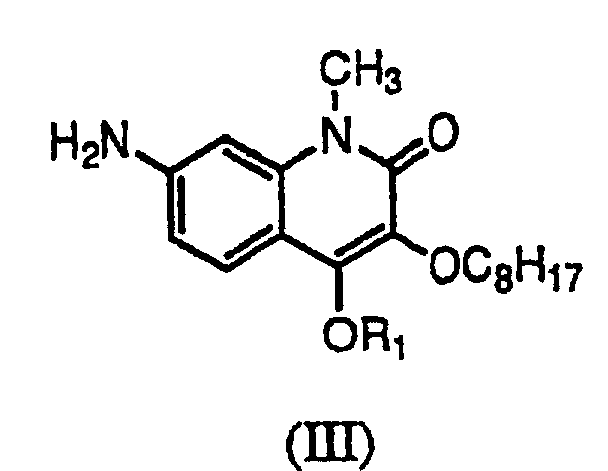
- amincquinolinone glycosides expressed by general formula (III) are quinolinone glycosides in which, in the formula, R 1 is a glycosyl group selected from the group consisting of a glucuronyl group, a glucosyl group, a galactosyl group and a mannosyl group, in which a hydroxyl group is protected or unprotected.
- Physiologically acceptable salts of the aminoquinolinone glycosides are also included in the present invention. These compounds can be obtained by reducing the nitro group in the nitroquinolinone glycoside expressed general formula (II).
- Quinolinone glycosides having as R 1 a glycosyl group derived from either a D-form or an L-form stereoisomer of hexose are included in the quinolinone glycosides of the present invention.
- compounds having either an ⁇ -or a ⁇ - glycosidic linkage are included in the quinolinone glycosides of the present invention.
- a protecting group for a hydroxyl group in the glycosyl group the above-described protecting group for a saccharide can be used, and an acyl group having a carbon number of 2 to 7 is particularly preferable.
- Sinapic acid glycosides expressed by general formula (V) according to the present invention are sinapic acid glycosides in which R 2 is a glycosyl group selected from the group consisting of a glucuronyl group, a glucosyl group, a galactosyl group and a mannosyl group, in which a hydroxyl group in the glycosyl group is protected or unprotected, and R 3 is a hydrogen atom, an alkyl group, an aryl group or an aralkyl group.
- Physiologically acceptable salts of the sinapic acid glycosides are also included in the present invention.
- Sinapic acid glycosides having as R 2 a glycosyl group derived from either a D-form or an L-form stereoisomer of hexose are included in the sinapic acid glycosides of the present invention.
- compounds having either an ⁇ -or a ⁇ - glycosidic linkage are included in the sinapic acid glycosides of the present invention.
- a protecting group for a hydroxyl group in the glycosyl group the above-described protecting group for a saccharide can be used, and an acyl group having a carbon number of 2 to 7 is particularly preferable.
- R 3 is an hydrogen atom, an alkyl group, an aryl group or an aralkyl group.
- alkyl group examples are a methyl group, an ethyl group, a propyl group, a butyl group and an alkyl group having a substituent group, such as a trichloroethyl group.
- aryl group a phenyl group is preferable.
- aralkyl group examples are a benzyl group and a benzyl group having a substituent group, such as p-hydroxybenzyl group and p-methylbenzyl group; a benzyl group is particularly preferable.
- Sinapic acid derivatives represented by general formula (VII) are glycosides or their physiologically acceptable salts, in which, in the formula, R 2 is a hydrogen atom or a glycosyl group selected from the group consisting of a glucuronyl group, a glucosyl group, a galactosyl group and a mannosyl group, in which a hydroxyl group is protected or unprotected, and R 4 is a hydroxyl group or a halogen atom.
- R 2 is a hydrogen atom or a glycosyl group selected from the group consisting of a glucuronyl group, a glucosyl group, a galactosyl group and a mannosyl group, in which a hydroxyl group is protected or unprotected
- R 4 is a hydroxyl group or a halogen atom.
- Sinapic acid derivatives having as R 2 a glycosyl group derived from either a D-form or an L-form stereoisomer of hexose are included in the sinapic acid derivatives of the present invention.
- compounds having either an ⁇ -or a ⁇ - glycosidic linkage are included in the sinapic acid derivatives of the present invention.
- a protecting group for a hydroxyl group in the glycosyl group the above-described protecting group for a saccharide can be used, and an acyl group having a carbon number of 2 to 7 is particularly preferable.
- R 4 is a hydroxyl group or a halogen atom. Examples of the halogen atom are a chlorine atom, a bromine atom and a iodine atom, among which the chlorine atom is particularly preferable.
- glycoside expressed by general formula (I) can be produced in line with the following reaction path.
- R 1 and R 2 explained for general formulae (I), (II), (III) and (IV) individually are also applied to R 1 and R 2 in the general formulae (I), (II), (III) and (IV) in the above reaction path.
- R 4 ' represents an acyl group or an benzyl group as a protecting group for a hydroxyl group in the hexose.
- glycosylation reaction of the hydroxyl group at 4-position of a quinolinone derivative (IV), which may be prepared by the process disclosed in the Japanese Patent Application, First Publication (Kokai), No. Hei 9-255659 by the present inventors, is conducted.
- This glycosylation process can be implemented in the presence of a basic substance by reacting the quinolinone derivative (IV) with a halide of a hexose in which hydroxyl groups are protected.
- alkaline metal hydrides such as sodium hydride and potassium hydride
- alkaline earth metal hydride such as calcium hydride
- amines such as DBN (1,5-diazabicyclo[4.3.0]non-5-ene), DBU (1,8-diazabicyclo[5.4.0]undec-7-ene) and DABCO (1,4-diazabicyclo[2.2.2]octane).
- Preferable solvents for the reaction are: ether-type solvents such as diethyl ether, tetrahydrofuran and dioxane; and amide-type solvents such as N,N-dimethylformamide, N,N-dimethylacetamide and 1-methyl-2-pyrrolidinone.
- ether-type solvents such as diethyl ether, tetrahydrofuran and dioxane
- amide-type solvents such as N,N-dimethylformamide, N,N-dimethylacetamide and 1-methyl-2-pyrrolidinone.
- the reaction may proceed at a temperature in the range of -10°C to 50°C, a temperature in the range of 20°C to 40°C is preferable.
- the reaction is normally completed in 1 to 12 hours so as to yield the nitroquinolinone glycoside of general formula (II), although the period of time varies depending on the basic substance used, the reaction temperature and the solvent.
- a deprotection reaction is additionally conducted by a deacylation reaction or debenzylation reaction for the hexose portion of the compound of general formula (II).
- the deacylation reaction and the debenzylation reaction may be known conventional ones. That is, in the case of the deacylation, the reaction takes place with a base, as a deacylation agent, such as hydroxides (such as sodium hydroxide, potassium hydroxide and lithium hydroxide) and metal alkoxide (such as sodium methoxide, potassium methoxide sodium ethoxide and potassium ethoxide).
- Preferable solvents for this reaction are: lower alcohols such as methanol, ethanol and propanol; ether-type solvents such as diethyl ether, tetrahydrofuran, dimethoxyethane and dioxane; and amide-type solvents such as N,N-dimethylformamide, N,N-dimethylacetamide and 1-methyl-2-pyrrolidinone.
- the reaction temperature is preferably in the range of -10°C to 50°C, and more preferably in the range of 0°C to 30°C, although the temperature varies depending on the reaction reagent and reaction solvent used.
- the reaction time is normally 1 to 5 hours.
- the reaction is conducted by way of a hydrogenolysis reaction using a metallic catalyst under a hydrogen gas atmosphere.
- metallic catalyst are palladium, platinum and rhodium.
- a palladium catalyst is particularly preferable.
- the amount of catalyst used may be 1 to 10% by weight, with respect to the compound expressed by general formula (II).
- the reaction may proceed under atmospheric pressure, although the reaction may be conducted under a pressurized hydrogen gas atmosphere.
- Preferable solvents for the reaction are: alcohol-type solvents such as methanol, ethanol, propanol and butanol; ether-type solvents such as diethyl ether, tetrahydrofuran and dioxane; and acetate ester-type solvents such as methyl acetate, ethyl acetate and propyl acetate.
- alcohol-type solvents such as methanol, ethanol, propanol and butanol
- ether-type solvents such as diethyl ether, tetrahydrofuran and dioxane
- acetate ester-type solvents such as methyl acetate, ethyl acetate and propyl acetate.
- the aminoquinolinone glycoside expressed by general formula (III) is obtained.
- This reduction reaction may be conducted via hydrogenation reduction under a hydrogen gas atmosphere similar to that described for debenzylation.
- the reduction reaction may be conducted by a reaction with a metallic catalyst such as tin and zinc.
- the reduction reaction by reaction with a metallic catalyst can be implemented by allowing a reaction with a metallic catalyst, preferably tin or zinc, to occur in an organic solvent.
- organic solvents used are: alcohol-type solvents such as methanol, ethanol, propanol, isopropanol and butanol; ether-type solvents such as diethyl ether, tetrahydrofuran and dioxane; amide-type solvents such as N,N-dimethylformamide, N,N-dimethylacetamide and 1-methyl-2-pyrrolidinone; organic acids such as formic acid, acetic acid and propionic acid.
- alcohol-type solvents such as methanol, ethanol, propanol, isopropanol and butanol
- ether-type solvents such as diethyl ether, tetrahydrofuran and dioxane
- amide-type solvents such as N,N-dimethylformamide, N,N-dimethylacetamide and 1-methyl-2-pyrrolidinone
- organic acids such as formic acid, acetic acid and propionic acid.
- One of these solvents
- reaction temperature is normally in the range of 0°C to 10°C, and preferably in the range of 30°C to 80°C, although the temperature varies depending on the metal and reaction solvent used.
- reaction time is normally 1 to 5 hours.
- glycosidation of the sinapic acid derivative will be explained.
- This reaction is conducted after protecting a carboxyl group in the sinapic acid portion with an ester group.
- the ester group may be one conventionally used such as a methyl ester group, an ethyl ester group and a propyl ester group.
- the ester group may be a substituted alkyl group such as a 2,2,2-trichloroethyl ester group.
- the glycosidation reaction is conducted in an organic solvent in the presence of a basic substance by reacting the sinapic acid ester with a halide of a hexose.
- alkaline metal hydrides such as sodium hydride and potassium hydride
- alkaline earth metal hydride such as calcium hydride
- amines such as DBN (1,5-diazabicyclo[4.3.0]non-5-ene), DBU (1,8-diazabicyclo[5.4.0]undec-7-ene) and DABCO (1,4-diazabicyclo[2.2.2]octane).
- Preferable organic solvents used in which the reaction takes place are: ether-type solvents such as diethyl ether, tetrahydrofuran and dioxane; and amide-type solvents such as N,N-dimethylformamide, N,N-dimethylacetamide and 1-methyl-2-pyrrolidinone.
- ether-type solvents such as diethyl ether, tetrahydrofuran and dioxane
- amide-type solvents such as N,N-dimethylformamide, N,N-dimethylacetamide and 1-methyl-2-pyrrolidinone.
- the reaction may proceed at a temperature in the range of -10°C to 50°C, a temperature in the range of 20°C to 40°C is preferable.
- the reaction is normally completed in 1 to 12 hours, although the period of time varies depending on the temperature and the basic substance and solvent used.
- the elimination reaction is performed by a reaction with a zinc powder in acetic acid.
- a reaction temperature is in the range of 20°C to 50°C.
- the reaction is normally completed in 1 to 5 hours.
- carboxyl groups in the sinapic acid glycoside obtained are reacted with thionyl chloride, for example, or the like, to yield an acid halide.
- an amidation reaction between the thus-obtained acid halide of sinapic acid glycoside and the aminoquinolinone glycoside expressed by general formula (III) is conducted.
- An organic solvent is used for the reaction.
- Preferable solvents used are, for example, halogen-type solvents such as methylene chloride and chloroform; ether-type solvents such as diethyl ether, tetrahydrofuran, dimethoxyethane and dioxane; and acetate ester-type solvents such as methyl acetate, ethyl acetate and propyl acetate.
- a basic substance may be added as a substance which promotes the reaction.
- Preferable basic substances are amines such as triethylamine, pyridine and collidine.
- the reaction may proceed at a temperature in the range of -10°C to 50°C, a preferable temperature is in the range of 0°C to 30°C.
- the reaction is normally completed in 1 to 5 hours.
- the amidation reaction can be conducted by a dehydration condensation between a simply deesterified sinapic acid glycoside, not necessarily obtained via an acid halide of the sinapic acid glycoside, and the aminoquinolinone glycoside represented by general formula (III).
- the quinolinone derivative which is disclosed in the Japanese Patent Application, First Publication (Kokai), No. Hei 9-255659 and which is expressed by general formula (VI), that is, 7-(3,5-dimethoxy-4-hydroxycinnamoyl)amino-4-hydroxy-1-methyl-3-octyloxy-2(1H)-quinolinone, may be glycosylated by a direct reaction with a glycosyl halide which has a halogen group at 1-position and in which hydroxyl groups are protected.
- glycosyl halide selected from the group consisting of glucuronic acid, glucose, galactose and mannose, which has a halogen group at 1-position and in which hydroxyl groups are protected, the reaction solvent, the reaction reagent, the reaction conditions and the like to be employed for this glycosylation reaction are similar to those described above.
- the protecting group may be eliminated in a manner similar to that described above.
- glycosyloxyquinolinone derivatives represented by the formula (I) of the present invention.
- physiologically acceptable salts means nontoxic alkali addition salts of, for example, the compounds cited above, which include sodium salts, potassium salts, magnesium salts, calcium salts ammonium salts, nontoxic amine salts and the like.
- glycosyloxyquinolinone derivatives represented by the formula (II) of the present invention 7-nitro-3-octyloxy-4-(6-O-methyl-2,3,4-triacetyl- ⁇ -D-glcuropyranosyloxy)-1-methyl-2(1H)-quinolinone, 7-nitro-3-octyloxy-4-(tetra-O-acetyl- ⁇ -D-glucopyranosyloxy)-1-methyl-2(1H)-quinolinone, 7-nitro-3-octyloxy-4-(tetra-O-acetyl- ⁇ -D-galactopyranosyloxy)-1-methyl-2(1H)-quinolinone, 7-nitro-3-octyloxy-4-(tetra-O-acetyl- ⁇ -D-mannopyranosyloxy)-1-methyl-2(1H)-quinolinone, 7-nitro-3-octyloxy-4-(t
- glycosyloxyquinolinone derivatives represented by the formula (III) of the present invention.
- 7-amino-3-octyloxy-4-(6-O-methyl-2,3,4-triacetyl- ⁇ -D-glcuropyranosyloxy)-1-methyl-2(1H)-quinolinone 7-amino-3-octyloxy-4-(tetra-O-acetyl- ⁇ -D-glucopyranosyloxy)-1-methyl-2(1H)-quinolinone
- glycosyloxycinnamic acid derivatives represented by the formula (VII) of the present invention.
- 3,5-dimethoxy-4-(6-O-methyl-2,3,4-triacetyl- ⁇ -D-glcuropyranosyloxy) cinnamoyl chloride 3,5-dimethoxy-4-(6-0-methyl-2,3,4-triacetyl- ⁇ -D-glcuropyranosyloxy)cinnamoyl bromide
- 3,5-dimethoxy-4-(tetra-O-acetyl- ⁇ -D-glucopyranosyloxy)cinnamoyl chloride 3,5-dimethoxy-4-(tetra-O-acetyl- ⁇ -D-glucopyranosyloxy)c
- glycosyloxyquinolinone derivatives and physiologically acceptable salts of the present invention have a function to inhibit both immediate and delayed type allergic reactions and low toxicity as will be described later in examples, they are useful as antiallergic agents for the treatment or prevention of various allergic diseases.
- allergic diseases means allergic diseases resulting from excess activation of the biological immune mechanism caused by extrinsic or intrinsic antigens, which include immediate type asthma, delayed type asthma, bronchial asthma, pediatric asthma, atopic dermatitis, allergic dermatitis, urticaria, eczema, allergic conjunctivitis, allergic rhinitis, hay fever, food allergy, allergic gastroenteritis, allergic colitis, contact dermatitis, autoimmune disease and the like.
- the antiallergic agent which comprises the compound of the present invention as an active ingredient can be administered orally (internal use or inhalation) or parenterally (for example, intravenous injection, subcutaneous injection, percutaneous absorption, rectal administration or the like).
- a pharmaceutical agent can be made into various dosage forms according to the purpose, such as tablets, capsules, granules, fine subtilaes, powders, troches, sublingual tablets, suppositories, ointments, injections, emulsions, suspensions, medicated syrups and the like.
- dosage forms can be prepared in accordance with known techniques making use of pharmaceutically acceptable carriers which are commonly used in this type of drugs, such as excipients, bonding agents, disintegrators, lubricants, preservatives, anti-oxidative agents, isotonic agents, buffering agents, coating agents, sweetening agents, dissolving agents, bases, dispersing agents, stabilizing agents, coloring agents and the like.
- pharmaceutically acceptable carriers such as excipients, bonding agents, disintegrators, lubricants, preservatives, anti-oxidative agents, isotonic agents, buffering agents, coating agents, sweetening agents, dissolving agents, bases, dispersing agents, stabilizing agents, coloring agents and the like.
- starch and derivatives of starch such as dextrin, carboxymethyl starch and the like
- cellulose and derivatives of cellulose such as methylcellulose, hydroxypropylmethylcellulose and the like
- sugars such as lactose, sucrose, glucose and the like
- silicic acid and silicates such as naturally occurring aluminum silicate, magnesium silicate and the like
- carbonates such as calcium carbonate, magnesium carbonate, sodium hydrogencarbonate and the like
- bonding agents the following can be listed: starch and starch derivatives (such as alpha starches, dextrin and the like), cellulose and derivatives of cellulose (such as ethyl cellulose, sodium carboxymethyl cellulose, hydroxypropylmethyl cellulose and the like), gum arabic, traganth, gelatin, sugars (such as glucose, sucrose and the like), ethanol, polyvinyl alcohols and the like.
- starch and starch derivatives such as alpha starches, dextrin and the like
- cellulose and derivatives of cellulose such as ethyl cellulose, sodium carboxymethyl cellulose, hydroxypropylmethyl cellulose and the like
- gum arabic such as ethyl cellulose, sodium carboxymethyl cellulose, hydroxypropylmethyl cellulose and the like
- gum arabic such as ethyl cellulose, sodium carboxymethyl cellulose, hydroxypropylmethyl cellulose and the like
- sugars such as glucose, sucrose and the like
- ethanol polyvin
- starch and starch derivatives such as carboxymethyl starch, hydroxypropyl starch and the like
- cellulose and cellulose derivatives such as sodium carboxymethyl cellulose, crystal cellulose, hydroxypropylmethyl cellulose and the like
- carbonates such as calcium carbonate, calcium hydrogencarbonate and the like
- traganth such as traganth, gelatins, agar and the like.
- stearic acid As lubricants, the following can be listed: stearic acid, calcium stearate, magnesium stearate, talc, silicic acid and its salts (such as light silicic anhydrides, naturally occurring aluminum silicates and the like), titanium oxide, calcium hydrogen phosphate, dry aluminum hydroxide gel, macrogol and the like.
- p-hydroxybenzoates such as sodium sulfites, sodium pyrosulfites and the like
- phosphates such as sodium phosphates, calcium polyphosphates, sodium polyphosphates, sodium metaphosphate and the like
- alcohols such as chlorobutanol, benzyl alcohol and the like
- benzalkonium chloride benzethonium chloride, phenol, cresol, chlorocresol, dihydroacetic acid, sodium dihydroacetate, glycerin sorbic acid, sugars and the like.
- sulfites such as sodium sulfite, sodium hydrogen sulfite and the like
- rongalite erythorbic acid
- L-ascorbic acid L-ascorbic acid
- cysteine thioglycerol
- butylhydroxyanisol butylhydroxytoluene
- propylgallic acid ascorbyl palmitate, dl-a-tocopherol and the like.
- sodium chloride sodium nitrate, potassium nitrate, dextrin, glycerin, glucose and the like.
- buffering agents the following can be listed: sodium carbonate, hydrochloric acid, boric acid, phosphates (such as sodium hydrogenphosphate) and the like.
- cellulose derivatives such as hydroxypropyl cellulose, cellulose acetate phthalate, hydroxypropylmethyl cellulose phthalate and the like
- shellac polyvinylpyrrolidone
- polyvinylpyridines such as poly-2-vinylpyridine, poly-2-vinyl-5-ethylpyridine and the like
- polyvinylacetyl diethylaminoacetate polyvinyl alcohol phthalate, methacrylate, methacrylate copolymers and the like.
- sugars such as glucose, sucrose, lactose and the like
- sodium saccharin sodium saccharin
- sugar alcohols sodium saccharin
- dissolving agents the following can be listed: ethylenediamine, nicotinamide, sodium saccharin, citric acid, citrates, sodium benzoic acid, soaps, polyvinylpyrrolidone, polysolvates, sorbitan fatty acid esters, glycerin, propylene glycol, benzyl alcohols and the like.
- fats such as lard and the like
- vegetable oils such as olive oil, sesame oil and the like
- animal oil lanolin acid
- petrolatums such as olive oil, sesame oil and the like
- lanolin acid such as olive oil, sesame oil and the like
- petrolatums such as olive oil, sesame oil and the like
- paraffin such as paraffin
- wax such as wax
- resins such as paraffin
- bentonite such as glycerin
- glycol oils such as stearyl alcohol, cetanol
- higher alcohols such as stearyl alcohol, cetanol
- dispersing agents the following can be listed: gum arabic, traganth, cellulose derivatives (such as methyl cellulose and the like), stearic acid polyesters, sorbitan sesquioleate, aluminum monostearate, sodium alginate, polysolvates, sorbitan fatty acid esters and the like.
- sulfites such as sodium hydrogen sulfite and the like
- nitrogen such as sodium hydrogen sulfite and the like
- carbon dioxide such as carbon dioxide
- the content of the compound of the present invention in these pharmaceutical preparations varies depending on the dosage forms, it may be contained preferably in a concentration of from 0.01 to 100% by weight.
- Dose of the antiallergic agent of the present invention can be varied over a broad range depending on each warm-blooded animal including human and the like, to be treated, extent of each disease, doctor's judgement and the like. In general, however, it may be administered in a dose of from 0.01 to 50 mg, preferably from 0.01 to 10 mg, as the active ingredient per day per kg body weight in the case of oral administration or in a dose of from 0.01 to 10 mg, preferably from 0.01 to 5 mg, as the active ingredient per day per kg body weight in the case of parenteral administration.
- the daily dose described above may be used in one portion or in divided portions and changed optionally in accordance with the extent of diseases and doctor's judgement.
- Methyl 1-bromo-2,3,4-tribenzoylglucuronate was used instead of Methyl 1-bromo-2,3,4-triacetylglucuronate, the title compound (6) was obtained.
- Methyl 1-bromo-2,3,4-tribenzylglucuronate was used instead of Methyl 1-bromo-2,3,4-triacetylglucuronate, the title compound (35) was obtained.
- Methyl 1-bromo-2,3,4-tribenzylglucuronate was used instead of Methyl 1-bromo-2,3,4-triacetylglucuronate, the title compound (36) was obtained.
- glycosyloxyquinolinone derivatives As shown in table 1, the inhibition (%) of glycosyloxyquinolinone derivatives was 40 to 54 percent, it was demonstrated that glycosyloxyquinolinone derivatives have equivalent anti-allergic activity to Tranilast®.
- the results of these examples clearly showed that the compounds of the present invention, glycosyloxyquinolinone derivatives, were useful anti-allergic agent for immediate type asthma, hay fever and atopic dermatitis etc.
- the asthma is typical allergic disease and we carried out this pharmacological test by experimental asthmatic model in guinea pigs in order to confirm that the compounds of the present invention, compound 14, 16, 20, 26 and 32, suppress immediate and delayed type asthmatic response.
- the method of the pharmacological test will be explained.
- OVA ovalbumine
- glycosyloxyquinolinone derivatives were equivalent or superior anti-asthmatic activity to Prednisolone. Therefore it is confirmed that glycosyloxyquinolinone derivatives have exceedingly high activity to inhibit against the immediate and delayed type asthma.
- the compound of the present invention 50 mg lactose 950 mg 1000 mg
- the compound of the present invention 100 mg lactose 900 mg 1000 mg
- the compound of the present invention 300 mg lactose 2000 mg starch 670 mg gelatin 30 mg 3000 mg
- the compound of the present invention was mixed with the equivalent amount of starch and pulverized in a mortar. This was further mixed with lactose and the remaining portion of starch. Separately from this, 30 mg of gelatin was mixed with 1 ml of purified water, solubilized by heating, cooled and then, with stirring, mixed with 1 ml of ethanol to prepare a gelatin solution. Thereafter, the mixture prepared above was mixed with the gelatin solution, and the resulting mixture was kneaded, granulated and then dried to obtain granules of compound 14.
- the compound of the present invention 5 mg lactose 62 mg starch 30 mg talc 2 mg magnesium stearate 1 mg 100 mg / tablet
- the compound of the present invention 20 mg 6 % hydroxypropylcellulose/lactose 75 mg stearate/talc 2 mg potato starch 3 mg 100 mg / tablet
- the compound of the present invention 25 mg lactose 122 mg carboxymethylstarch 50 mg talc 2 mg magnesium stearate 1 mg 200 mg/tablet
- a 5 mg of sodium salt of compound 14 was dissolved in normal saline solution, total volume of the resulting solution was adjusted to 10 ml by gradually adding normal saline solution for injection use and then the thus prepared solution was sealed in an ampoule aseptically.
- novel glycosyloxyquinolinone derivative which is effective as medicine, a simple method for preparing the same, the nitro glycosyloxyquinolinone derivatives, amino glycosyloxyquinolinone derivatives and sinapinic acid derivatives effective as an intermediate in said method.
- novel glycosyloxyquinolinone derivative and its physiologically acceptable salt are excellent antiallergic agents which have low toxicity and are useful for the treatment or prevention of immediate type and delayed type allergic diseases, particularly an excellent antiallergic agent which is highly effective on delayed type allergy that cannot be treated effectively with the prior art antiallergic agents.
Landscapes
- Chemical & Material Sciences (AREA)
- Organic Chemistry (AREA)
- Health & Medical Sciences (AREA)
- Life Sciences & Earth Sciences (AREA)
- Engineering & Computer Science (AREA)
- General Health & Medical Sciences (AREA)
- Biochemistry (AREA)
- Biotechnology (AREA)
- Genetics & Genomics (AREA)
- Molecular Biology (AREA)
- Immunology (AREA)
- Pharmacology & Pharmacy (AREA)
- Pulmonology (AREA)
- Chemical Kinetics & Catalysis (AREA)
- General Chemical & Material Sciences (AREA)
- Medicinal Chemistry (AREA)
- Nuclear Medicine, Radiotherapy & Molecular Imaging (AREA)
- Bioinformatics & Cheminformatics (AREA)
- Animal Behavior & Ethology (AREA)
- Public Health (AREA)
- Veterinary Medicine (AREA)
- Saccharide Compounds (AREA)
- Pharmaceuticals Containing Other Organic And Inorganic Compounds (AREA)
- Medicines That Contain Protein Lipid Enzymes And Other Medicines (AREA)
Claims (25)
- Chinolinonglycosid oder ein physiologisch annehmbares Salz davon der allgemeinen Formel (I):worin R1 und R2 jeweils für ein Wasserstoffatom oder eine Glucosylgruppe, ausgewählt aus der Gruppe bestehend aus einer Glucuronylgruppe, einer Glucosylgruppe, einer Galactosylgruppe und einer Mannosylgruppe, steht, und mindestens eine der Gruppierung R1 und R2 eine Glycosylgruppe ist, deren Hydroxylgruppe ungeschützt ist oder mit einer Acylgruppe mit einer Kohlenstoffanzahl von 2 bis 7 oder einer Benzylgruppe geschützt ist.

- Chinolinonglycosid oder ein physiologisch annehmbares Salz davon nach Anspruch 1, dadurch gekennzeichnet, dass R1 und R2 jeweils für ein Wasserstoffatom oder eine Glycosylgruppe stehen, wie in Anspruch 1 definiert, wobei mindestens eine der Gruppierungen R1 und R2 eine Glycosylgruppe ist, bei der keine Hydroxylgruppe geschützt ist.
- Chinolinonglycosid oder ein physiologisch annehmbares Salz davon nach Anspruch 1, dadurch gekennzeichnet, dass R1 und R2 jeweils für ein Wasserstoffatom oder eine Glycosylgruppe, wie in Anspruch 1 definiert, stehen und dass mindestens eine der Gruppierungen R1 und R2 eine Glycosylgruppe ist, deren Hydroxylgruppe mit einer Acylgruppe mit einer Kohlenstoffzahl von 2 bis 7 oder einer Benzylgruppe geschützt ist.
- Chinolinonglycosid oder ein physiologisch annehmbares Salz davon nach Anspruch 2, dadurch gekennzeichnet, dass R1 und R2 jeweils für ein Wasserstoffatom oder eine Glucuronylgruppe, bei der keine Hydroxylgruppe geschützt ist, stehen.
- Chinolinonglycosid oder ein physiologisch annehmbares Salz davon nach Anspruch 2, dadurch gekennzeichnet, dass R1 und R2 jeweils für ein Wasserstoffatom oder eine Glucosylgruppe, bei der keine Hydroxylgruppe geschützt ist, stehen.
- Chinolinonglycosid oder ein physiologisch annehmbares Salz davon nach Anspruch 2, dadurch gekennzeichnet, dass R1 und R2 jeweils für ein Wasserstoffatom oder eine Galactosylgruppe, bei der keine Hydroxylgruppe geschützt ist, stehen.
- Chinolinonglycosid oder ein physiologisch annehmbares Salz davon nach Anspruch 2, dadurch gekennzeichnet, dass R1 und R2 jeweils für ein Wasserstoffatom oder eine Mannosylgruppe, bei der keine Hydroxylgruppe geschützt ist, stehen.
- Chinolinonglycosid oder ein physiologisch annehmbares Salz davon nach Anspruch 4, dadurch gekennzeichnet, dass R1 und R2 jeweils für eine Glucuronylgruppe, bei der keine Hydroxylgruppe geschützt ist, stehen.
- Chinolinonglycosid oder ein physiologisch annehmbares Salz davon nach Anspruch 4, dadurch gekennzeichnet, dass R1 für ein Wasserstoffatom und R2 für eine Glucuronylgruppe, bei der keine Hydroxylgruppe geschützt ist, steht.
- Chinolinonglycosid oder ein physiologisch annehmbares Salz davon nach Anspruch 4, dadurch gekennzeichnet, dass R1 für eine Glucuronylgruppe, bei der keine Hydroxylgruppe geschützt ist, und R2 für ein Wasserstoffatom steht.
- Arzneimittel, umfassend als Wirkstoff ein Chinolinonglycosid oder ein physiologisch annehmbares Salz davon nach einem der Ansprüche 2 und 4 bis 10.
- Antiallergisches Mittel, umfassend als Wirkstoff ein Chinolinonglycosid oder ein physiologisch annehmbares Salz davon nach einem der Ansprüche 2 und 4 bis 10.
- Chinolinonglycosid oder ein physiologisch annehmbares Salz davon der allgemeinen Formel (II):worin R1 für eine Glycosylgruppe, wie in Anspruch 1 definiert, steht, bei der die Hydroxylgruppe ungeschützt ist oder mit einer Acylgruppe mit einer Kohlenstoffzahl von 2 bis 7 oder einer Benzylgruppe geschützt ist.
- Chinolinonglycosid oder ein physiologisch annehmbares Salz davon der allgemeinen Formel (III):worin R1 für eine Glycosylgruppe, wie in Anspruch 1 definiert, steht, bei der die Hydroxylgruppe ungeschützt oder mit einer Acylgruppe mit einer Kohlenstoffzahl von 2 bis 7 oder einer Benzylgruppe geschützt ist.
- Chinolinonglycosid oder ein physiologisch annehmbares Salz davon nach Anspruch 13, dadurch gekennzeichnet, dass R1 für eine Glucuronylgruppe, bei der die Hydroxylgruppe geschützt oder ungeschützt ist, steht.
- Chinolinonglycosid oder ein physiologisch annehmbares Salz davon nach Anspruch 14, dadurch gekennzeichnet, dass R1 für eine Glucuronylgruppe, bei der die Hydroxylgruppe geschützt ist oder nicht geschützt ist, steht.
- Verfahren zur Herstellung eines Chinolinonglycosids der allgemeinen Formel (II):worin R1 eine Glycosylgruppe, wie in Anspruch 1 definiert ist, bei der eine Hydroxylgruppe ungeschützt ist oder mit einer Acylgruppe mit einer Kohlenstoffzahl von 2 bis 7 oder einer Benzylgruppe geschützt ist,

umfassend die Stufen:Umsetzung eines Chinolinonderivats der allgemeinen Formel (IV):mit einer basischen Substanz; und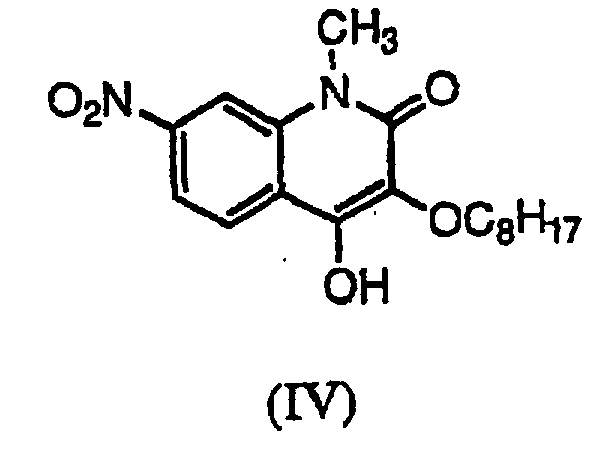 anschließende Durchführung einer Glycosylierungsreaktion mit einem Glycosylhalogenid, erhalten durch Substitution eines Wasserstoffatoms in 1-Position einer Hexose, ausgewählt aus der Gruppe, bestehend aus Glucuronsäure, Glucose, Galactose und Mannose, durch ein Halogenatom, und bei dem eine Hydroxylgruppe mit einer Acylgruppe mit einer Kohlenstoffzahl von 2 bis 7 oder einer Benzylgruppe geschützt ist.
 - Verfahren zur Herstellung eines Chinolinonglycosids nach Anspruch 17, dadurch gekennzeichnet, dass die basische Substanz mindestens eine Substanz, ausgewählt aus der Gruppe, bestehend aus Alkalimetallhydriden, Erdalkalimetallhydriden und Aminen, ist.
- Verfahren zur Herstellung eines Chinolinonglycosids der allgemeinen Formel (III):worin R1 für eine Glycosylgruppe, wie in Anspruch 1 definiert, steht, bei der eine Hydroxylgruppe ungeschützt ist oder mit einer Acylgruppe mit einer Kohlenstoffzahl von 2 bis 7 oder einer Benzylgruppe geschützt ist,

umfassend die Stufe der Reduktion eines Chinolinonglycosids der allgemeinen Formel (II):worin R1 für eine Glycosylgruppe, wie in Anspruch 1 definiert, steht, bei der eine Hydroxylgruppe ungeschützt ist oder mit einer Acylgruppe mit einer Kohlenstoffzahl von 2 bis 7 oder einer Benzylgruppe geschützt ist, in Gegenwart von Wasserstoff und/oder eines Metallkatalysators.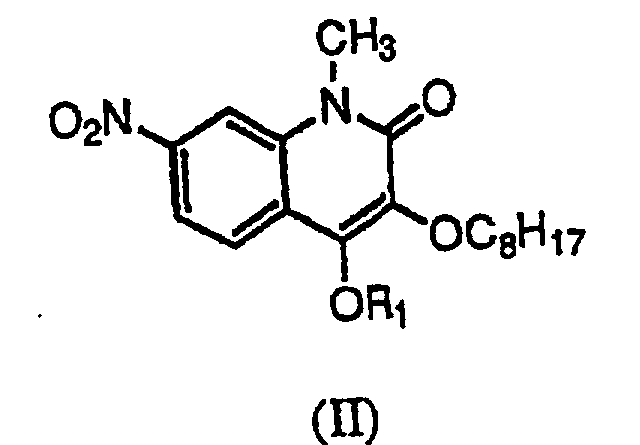
- Verfahren zur Herstellung eines Chinolinonglycosids der allgemeinen Formel (I):worin R1 und R2 jeweils für ein Wasserstoffatom oder eine Glycosylgruppe, wie in Anspruch 1 definiert, stehen und mindestens eine der Gruppierungen R1 und R2 eine Glycosylgruppe ist, bei der eine Hydroxylgruppe ungeschützt ist oder mit einer Acylgruppe mit einer Kohlenstoffzahl von 2 bis 7 oder einer Benzylgruppe geschützt ist,

umfassend die Stufe der Durchführung einer Amidierung zwischen einem Chinolinonglycosid der allgemeinen Formel (III):worin R1 für eine Glycosylgruppe, wie in Anspruch 1 definiert, steht, bei der eine Hydroxylgruppe ungeschützt ist oder mit einer Acylgruppe mit einer Kohlenstoffzahl von 2 bis 7 oder einer Benzylgruppe substituiert ist, und einem Sinapinsäurederivat der allgemeinen Formel (VII):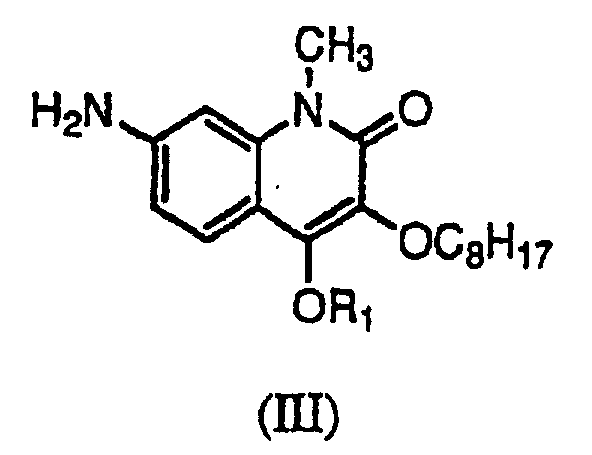 worin R2 für ein Wasserstoffatom oder eine Glycosylgruppe, wie in Anspruch 1 definiert, steht, bei der eine Hydroxylgruppe geschützt ist oder ungeschützt ist und R4 für eine Hydroxylgruppe oder ein Halogenatom steht.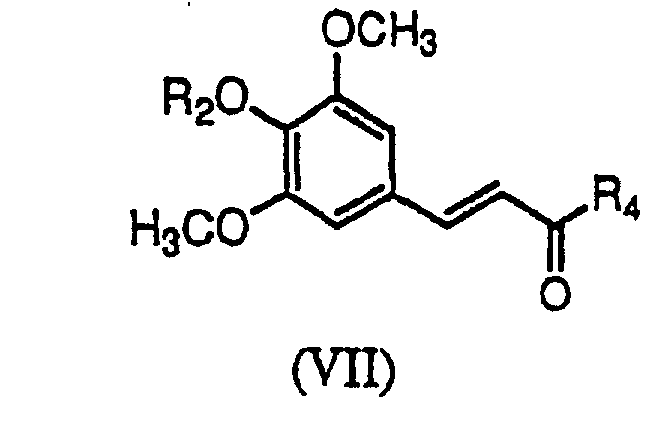
- Verfahren zur Herstellung eines Chinolinonglycosids der allgemeinen Formel (I):worin R1 und R2 jeweils für ein Wasserstoffatom oder eine Glycosylgruppe, wie in Anspruch 1 definiert, stehen und mindestens eine der Gruppierungen R1 und R2 eine Glycosylgruppe ist, bei der eine Hydroxylgruppe ungeschützt ist oder mit einer Acylgrupe mit einer Kohlenstoffzahl von 2 bis 7 oder einer Benzylgruppe geschützt ist,

umfassend die Stufen:Umsetzung eines Chinolinonderivats der allgemeinen Formel (VI):mit einer basischen Substanz; und anschließende Durchführung einer Glycosylierungsreaktion mit einem Glycosylhalogenid, erhalten durch Substitution eines Wasserstoffatoms in 1-Position einer Glycose, ausgewählt aus der Gruppe, bestehend aus Glucuronsäure, Glucose, Galactose und Mannose, durch ein Halogenatom, und bei dem eine Hydroxylgruppe mit einer Acylgruppe mit einer Kohlenstoffzahl von 2 bis 7 oder einer Benzylgruppe geschützt ist.
 - Verfahren zur Herstellung eines Chinolinonglycosids der allgemeinen Formel (I), bei der keine Hydroxylgruppe der Glycosylgruppe geschützt ist, umfassend die Stufe der Eliminierung einer Schutzgruppe in einer Glycosylgruppe in einem Chinolinonglycosid der allgemeinen Formel (I), bei dem eine Hydroxylgruppe in der Glycosylgruppe geschützt istwobei R1 und R2 jeweils für ein Wasserstoffatom oder eine Glycosylgruppe, wie in Anspruch 1 definiert, stehen und mindestens eine der Gruppierungen R1 und R2 eine Glycosylgruppe ist, bei der eine Hydroxylgruppe ungeschützt oder mit einer Acylgruppe mit einer Kohlenstoffzahl von 2 bis 7 oder einer Benzylgruppe geschützt ist.
- Verfahren zur Herstellung eines Sinapinsäureglycosids der allgemeinen Formel (V):worin R1 für eine Glycosylgruppe, wie in Anspruch 1 definiert, steht, bei der eine Hydroxylgruppe in der Glycosylgruppe ungeschützt ist oder mit einer Acylgruppe mit einer Kohlenstoffzahl von 2 bis 7 oder einer Benzylgruppe geschützt ist, und R3 aus der Gruppe, bestehend aus einem Wasserstoffatom, einer Alkylgruppe, einer Arylgruppe und einer Aralkylgruppe, wobei die Alkylgruppe eine Substituentengruppe haben kann, ausgewählt ist,
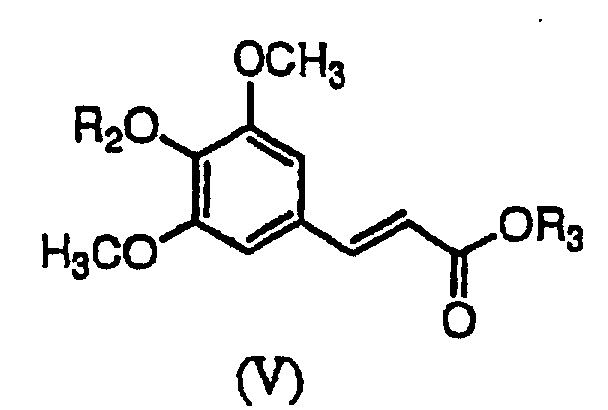
umfassend die Stufen:Umsetzung eines Sinapinsäureesters mit einer basischen Substanz; und anschließende Durchführung einer Glycosylierungsreaktion mit einem Glycosylhalogenid, erhalten durch Substitution eines Wasserstoffatoms in 1-Position einer Hexose, ausgewählt aus der Gruppe, bestehend aus Glucuronsäure, Glucose, Galactose und Mannose, durch ein Halogen-atom, und bei dem eine Hydroxylgruppe mit einer Acylgruppe mit einer Kohlenstoffzahl von 2 bis 7 oder einer Benzylgruppe geschützt ist. - Sinapinsäureglycosid der allgemeinen Formel (V):worin R2 für eine Glycosylgruppe, wie in Anspruch 1 definiert, steht, bei der eine Hydroxylgruppe in der Glycosylgruppe ungeschützt ist oder mit einer Acylgruppe mit einer Kohlenstoffzahl von 2 bis 7 oder einer Benzylgruppe geschützt ist, und R3 aus einer Gruppe, bestehend aus einem Wasserstoffatom, einer Alkylgruppe, einer Arylgruppe und einer Aralkylgruppe, wobei die Alkylgruppe eine Substituentengruppe haben kann, ausgewählt ist, mit der Maßgabe, dass das Sinapinsäureglycosid nicht 3,5-Dimethoxy-4-(tetra-O-acetyl-β-D-glucopyranosyloxy)zimtsäure oder Ethyl-[3,5-dimethoxy-4-(tetra-O-acetyl-β-D-glucopyranosyloxy)]cinnamat ist.

- Verwendung eines Chinolinonglycosids oder eines physiologisch annehmbaren Salzes davon nach einem der Ansprüche 2 und 4 bis 10 zur Herstellung eines antiallergischen Mittels.
Applications Claiming Priority (2)
| Application Number | Priority Date | Filing Date | Title |
|---|---|---|---|
| JP746298 | 1998-01-19 | ||
| JP746298 | 1998-01-19 |
Publications (2)
| Publication Number | Publication Date |
|---|---|
| EP0933378A1 EP0933378A1 (de) | 1999-08-04 |
| EP0933378B1 true EP0933378B1 (de) | 2003-04-09 |
Family
ID=11666493
Family Applications (1)
| Application Number | Title | Priority Date | Filing Date |
|---|---|---|---|
| EP99100388A Expired - Lifetime EP0933378B1 (de) | 1998-01-19 | 1999-01-18 | Quinolinone-Glykosid, Herstellungsverfahren, und antiallergische Mittel |
Country Status (9)
| Country | Link |
|---|---|
| US (1) | US6242425B1 (de) |
| EP (1) | EP0933378B1 (de) |
| KR (1) | KR100571487B1 (de) |
| CN (1) | CN1185245C (de) |
| AT (1) | ATE236917T1 (de) |
| AU (1) | AU741474B2 (de) |
| CA (1) | CA2259784C (de) |
| DE (1) | DE69906608T2 (de) |
| TW (1) | TW505634B (de) |
Families Citing this family (4)
| Publication number | Priority date | Publication date | Assignee | Title |
|---|---|---|---|---|
| CN1176654C (zh) * | 1999-09-10 | 2004-11-24 | 大日本油墨化学工业株式会社 | 喹啉酮衍生物制剂及其制法 |
| US6706733B2 (en) | 2001-05-08 | 2004-03-16 | Dainippon Ink And Chemicals, Inc. | Quinolinone derivative formulation and its production method |
| KR100908418B1 (ko) * | 2001-06-20 | 2009-07-21 | 액티버스 파마 컴퍼니 리미티드 | 퀴놀리논 유도체 의약 조성물 및 그의 제조 방법 |
| US7921005B2 (en) * | 2006-12-28 | 2011-04-05 | 3M Innovative Properties Company | Method for selecting conductors of an overhead power transmission line |
Family Cites Families (4)
| Publication number | Priority date | Publication date | Assignee | Title |
|---|---|---|---|---|
| US4187309A (en) | 1977-06-20 | 1980-02-05 | Sandoz, Inc. | 4-Hydroxy-2-quinolinone-3-carboxylic acids and salts thereof |
| DE69400352T2 (de) | 1993-09-28 | 1997-01-09 | Dainippon Ink & Chemicals | 3- oder 4-Glykosyloxybenzopyranderivat und dieses enthaltende antiallergisches Mittel |
| JP3831953B2 (ja) * | 1994-05-23 | 2006-10-11 | 大日本インキ化学工業株式会社 | 7−グリコシロキシベンゾピラン誘導体及びそれを有効成分とする抗アレルギー剤 |
| JP2943725B2 (ja) | 1996-01-17 | 1999-08-30 | 大日本インキ化学工業株式会社 | キノリノン誘導体及びそれを有効成分とする抗アレルギー剤 |
-
1999
- 1999-01-12 TW TW088100394A patent/TW505634B/zh not_active IP Right Cessation
- 1999-01-14 US US09/231,492 patent/US6242425B1/en not_active Expired - Fee Related
- 1999-01-18 DE DE69906608T patent/DE69906608T2/de not_active Expired - Fee Related
- 1999-01-18 AT AT99100388T patent/ATE236917T1/de not_active IP Right Cessation
- 1999-01-18 AU AU12139/99A patent/AU741474B2/en not_active Ceased
- 1999-01-18 EP EP99100388A patent/EP0933378B1/de not_active Expired - Lifetime
- 1999-01-19 CA CA002259784A patent/CA2259784C/en not_active Expired - Fee Related
- 1999-01-19 KR KR1019990002058A patent/KR100571487B1/ko not_active Expired - Fee Related
- 1999-01-19 CN CNB991009606A patent/CN1185245C/zh not_active Expired - Fee Related
Also Published As
| Publication number | Publication date |
|---|---|
| ATE236917T1 (de) | 2003-04-15 |
| CN1228436A (zh) | 1999-09-15 |
| AU1213999A (en) | 1999-08-05 |
| DE69906608T2 (de) | 2003-11-06 |
| AU741474B2 (en) | 2001-11-29 |
| KR100571487B1 (ko) | 2006-04-14 |
| DE69906608D1 (de) | 2003-05-15 |
| KR19990068087A (ko) | 1999-08-25 |
| CN1185245C (zh) | 2005-01-19 |
| CA2259784A1 (en) | 1999-07-19 |
| US6242425B1 (en) | 2001-06-05 |
| TW505634B (en) | 2002-10-11 |
| CA2259784C (en) | 2005-02-22 |
| EP0933378A1 (de) | 1999-08-04 |
Similar Documents
| Publication | Publication Date | Title |
|---|---|---|
| EP0186103B1 (de) | Homodisaccharide hypoglycemische Mittel | |
| JP2000500483A (ja) | 6―o―メチルエリスロマイシンd及びその製造方法 | |
| JPH07500826A (ja) | 免疫刺激性スワインソニン類似体 | |
| EP0933378B1 (de) | Quinolinone-Glykosid, Herstellungsverfahren, und antiallergische Mittel | |
| US5525595A (en) | 3- or 4-glycosyloxybenzopyran derivative and antiallergic agent containing the derivative as active ingredient | |
| CA2135850C (en) | Esculetin derivatives, and method for manufacture thereof, use thereof, and pharmaceutical composition | |
| US6114352A (en) | Quinolinone derivative and anti-allergic agent with said quinolinone derivative as the active ingredient | |
| EP0684255B1 (de) | 7-Glykosyloxybenzopyranderivat und dieses enthaltendes antiallergisches Mittel | |
| US5643885A (en) | Etoposide derivatives, process for preparing them, their use as a medicinal product and their use for the preparation of a medicinal product intended for anti-cancer treatment | |
| WO2000002559A1 (en) | Synthesis of aryl glucuronide of 2-hydroxy-n-(5-nitro-2-thiazolyl) benzamide, and pharmaceutical compositions comprising same | |
| JPH11269191A (ja) | キノリノン配糖体、製造方法及び抗アレルギ―剤 | |
| JP3775514B2 (ja) | 4−グリコシロキシベンゾピラン誘導体及びそれを有効成分とする抗アレルギー剤 | |
| JP3775513B2 (ja) | 3−グリコシロキシベンゾピラン誘導体及びそれを有効成分とする抗アレルギー剤 | |
| JP2008526946A (ja) | 抗炎症活性デクラジノシル−マクロライド | |
| US6670391B2 (en) | Benzopyran derivative and antiallergic agent | |
| Reist et al. | Neighboring group participation in carbohydrates. Synthesis of 2, 3-diamino-2, 3-dideoxy-L-ribose | |
| JPH0118904B2 (de) | ||
| JPH01156945A (ja) | 新規アミノシクリトールの製造法 | |
| JPH08259556A (ja) | 4,7−ジヒドロキシベンゾピラン誘導体及びそれを有効成分とする抗アレルギー剤 |
Legal Events
| Date | Code | Title | Description |
|---|---|---|---|
| PUAI | Public reference made under article 153(3) epc to a published international application that has entered the european phase |
Free format text: ORIGINAL CODE: 0009012 |
|
| AK | Designated contracting states |
Kind code of ref document: A1 Designated state(s): AT CH DE FR GB IT LI |
|
| AX | Request for extension of the european patent |
Free format text: AL;LT;LV;MK;RO;SI |
|
| 17P | Request for examination filed |
Effective date: 19990802 |
|
| AKX | Designation fees paid |
Free format text: AT CH DE FR GB IT LI |
|
| 17Q | First examination report despatched |
Effective date: 20010330 |
|
| GRAG | Despatch of communication of intention to grant |
Free format text: ORIGINAL CODE: EPIDOS AGRA |
|
| GRAG | Despatch of communication of intention to grant |
Free format text: ORIGINAL CODE: EPIDOS AGRA |
|
| GRAH | Despatch of communication of intention to grant a patent |
Free format text: ORIGINAL CODE: EPIDOS IGRA |
|
| GRAH | Despatch of communication of intention to grant a patent |
Free format text: ORIGINAL CODE: EPIDOS IGRA |
|
| GRAA | (expected) grant |
Free format text: ORIGINAL CODE: 0009210 |
|
| AK | Designated contracting states |
Designated state(s): AT CH DE FR GB IT LI |
|
| REG | Reference to a national code |
Ref country code: GB Ref legal event code: FG4D |
|
| REG | Reference to a national code |
Ref country code: CH Ref legal event code: NV Representative=s name: SERVOPATENT GMBH Ref country code: CH Ref legal event code: EP |
|
| ET | Fr: translation filed | ||
| PLBE | No opposition filed within time limit |
Free format text: ORIGINAL CODE: 0009261 |
|
| STAA | Information on the status of an ep patent application or granted ep patent |
Free format text: STATUS: NO OPPOSITION FILED WITHIN TIME LIMIT |
|
| 26N | No opposition filed |
Effective date: 20040112 |
|
| PG25 | Lapsed in a contracting state [announced via postgrant information from national office to epo] |
Ref country code: IT Free format text: LAPSE BECAUSE OF NON-PAYMENT OF DUE FEES Effective date: 20050118 |
|
| PGFP | Annual fee paid to national office [announced via postgrant information from national office to epo] |
Ref country code: DE Payment date: 20061205 Year of fee payment: 9 |
|
| PGFP | Annual fee paid to national office [announced via postgrant information from national office to epo] |
Ref country code: CH Payment date: 20061212 Year of fee payment: 9 |
|
| PGFP | Annual fee paid to national office [announced via postgrant information from national office to epo] |
Ref country code: GB Payment date: 20070117 Year of fee payment: 9 |
|
| PGFP | Annual fee paid to national office [announced via postgrant information from national office to epo] |
Ref country code: AT Payment date: 20070129 Year of fee payment: 9 |
|
| REG | Reference to a national code |
Ref country code: CH Ref legal event code: PFA Owner name: DAINIPPON INK AND CHEMICALS, INC. Free format text: DAINIPPON INK AND CHEMICALS, INC.#35-58, SAKASHITA 3-CHOME#ITABASHI-KU TOKYO (JP) -TRANSFER TO- DAINIPPON INK AND CHEMICALS, INC.#35-58, SAKASHITA 3-CHOME#ITABASHI-KU TOKYO (JP) |
|
| PGFP | Annual fee paid to national office [announced via postgrant information from national office to epo] |
Ref country code: FR Payment date: 20061228 Year of fee payment: 9 |
|
| REG | Reference to a national code |
Ref country code: CH Ref legal event code: PL |
|
| GBPC | Gb: european patent ceased through non-payment of renewal fee |
Effective date: 20080118 |
|
| PG25 | Lapsed in a contracting state [announced via postgrant information from national office to epo] |
Ref country code: LI Free format text: LAPSE BECAUSE OF NON-PAYMENT OF DUE FEES Effective date: 20080131 Ref country code: DE Free format text: LAPSE BECAUSE OF NON-PAYMENT OF DUE FEES Effective date: 20080801 Ref country code: CH Free format text: LAPSE BECAUSE OF NON-PAYMENT OF DUE FEES Effective date: 20080131 |
|
| PG25 | Lapsed in a contracting state [announced via postgrant information from national office to epo] |
Ref country code: AT Free format text: LAPSE BECAUSE OF NON-PAYMENT OF DUE FEES Effective date: 20080118 |
|
| REG | Reference to a national code |
Ref country code: FR Ref legal event code: ST Effective date: 20081029 |
|
| PG25 | Lapsed in a contracting state [announced via postgrant information from national office to epo] |
Ref country code: GB Free format text: LAPSE BECAUSE OF NON-PAYMENT OF DUE FEES Effective date: 20080118 |
|
| PG25 | Lapsed in a contracting state [announced via postgrant information from national office to epo] |
Ref country code: FR Free format text: LAPSE BECAUSE OF NON-PAYMENT OF DUE FEES Effective date: 20080131 |