EP0934246B1 - Procede de production d'esters et d'acides alpha-alcoxy-alpha-trifluoromethyl-aryl acetiques - Google Patents
Procede de production d'esters et d'acides alpha-alcoxy-alpha-trifluoromethyl-aryl acetiques Download PDFInfo
- Publication number
- EP0934246B1 EP0934246B1 EP97909373A EP97909373A EP0934246B1 EP 0934246 B1 EP0934246 B1 EP 0934246B1 EP 97909373 A EP97909373 A EP 97909373A EP 97909373 A EP97909373 A EP 97909373A EP 0934246 B1 EP0934246 B1 EP 0934246B1
- Authority
- EP
- European Patent Office
- Prior art keywords
- formula
- trifluoromethyl
- alkoxy
- arylacetic
- reaction
- Prior art date
- Legal status (The legal status is an assumption and is not a legal conclusion. Google has not performed a legal analysis and makes no representation as to the accuracy of the status listed.)
- Expired - Lifetime
Links
- 235000011054 acetic acid Nutrition 0.000 title abstract description 5
- QTBSBXVTEAMEQO-UHFFFAOYSA-N Acetic acid Chemical compound CC(O)=O QTBSBXVTEAMEQO-UHFFFAOYSA-N 0.000 title abstract 2
- 238000004519 manufacturing process Methods 0.000 title description 3
- 239000002253 acid Substances 0.000 claims abstract description 22
- LFQSCWFLJHTTHZ-UHFFFAOYSA-N Ethanol Chemical compound CCO LFQSCWFLJHTTHZ-UHFFFAOYSA-N 0.000 claims abstract description 20
- 239000002904 solvent Substances 0.000 claims abstract description 18
- 150000002148 esters Chemical class 0.000 claims abstract description 15
- 239000011541 reaction mixture Substances 0.000 claims abstract description 15
- KRHYYFGTRYWZRS-UHFFFAOYSA-M Fluoride anion Chemical compound [F-] KRHYYFGTRYWZRS-UHFFFAOYSA-M 0.000 claims abstract description 10
- UQEAIHBTYFGYIE-UHFFFAOYSA-N hexamethyldisiloxane Chemical compound C[Si](C)(C)O[Si](C)(C)C UQEAIHBTYFGYIE-UHFFFAOYSA-N 0.000 claims abstract description 7
- 238000006243 chemical reaction Methods 0.000 claims description 22
- -1 C3-C7-cycloalkyl Chemical group 0.000 claims description 21
- 238000000034 method Methods 0.000 claims description 20
- 229930194542 Keto Natural products 0.000 claims description 11
- MWKJTNBSKNUMFN-UHFFFAOYSA-N trifluoromethyltrimethylsilane Chemical compound C[Si](C)(C)C(F)(F)F MWKJTNBSKNUMFN-UHFFFAOYSA-N 0.000 claims description 11
- 239000003054 catalyst Substances 0.000 claims description 10
- 239000002168 alkylating agent Substances 0.000 claims description 9
- 229940100198 alkylating agent Drugs 0.000 claims description 9
- 150000002222 fluorine compounds Chemical class 0.000 claims description 8
- 125000002496 methyl group Chemical group [H]C([H])([H])* 0.000 claims description 7
- 238000002360 preparation method Methods 0.000 claims description 7
- 150000007513 acids Chemical class 0.000 claims description 6
- 238000004821 distillation Methods 0.000 claims description 6
- 125000004178 (C1-C4) alkyl group Chemical group 0.000 claims description 5
- 150000001298 alcohols Chemical class 0.000 claims description 5
- 239000003513 alkali Substances 0.000 claims description 5
- 229910052783 alkali metal Inorganic materials 0.000 claims description 5
- 150000001340 alkali metals Chemical class 0.000 claims description 5
- 125000000449 nitro group Chemical group [O-][N+](*)=O 0.000 claims description 5
- 150000003839 salts Chemical class 0.000 claims description 5
- 125000001424 substituent group Chemical group 0.000 claims description 5
- 125000006656 (C2-C4) alkenyl group Chemical group 0.000 claims description 4
- 125000000041 C6-C10 aryl group Chemical group 0.000 claims description 4
- 125000001931 aliphatic group Chemical group 0.000 claims description 4
- 150000008044 alkali metal hydroxides Chemical class 0.000 claims description 4
- 238000005804 alkylation reaction Methods 0.000 claims description 4
- 230000007062 hydrolysis Effects 0.000 claims description 4
- 238000006460 hydrolysis reaction Methods 0.000 claims description 4
- 125000001997 phenyl group Chemical group [H]C1=C([H])C([H])=C(*)C([H])=C1[H] 0.000 claims description 4
- XLYOFNOQVPJJNP-UHFFFAOYSA-N water Substances O XLYOFNOQVPJJNP-UHFFFAOYSA-N 0.000 claims description 4
- WKBOTKDWSSQWDR-UHFFFAOYSA-N Bromine atom Chemical compound [Br] WKBOTKDWSSQWDR-UHFFFAOYSA-N 0.000 claims description 3
- 125000000882 C2-C6 alkenyl group Chemical group 0.000 claims description 3
- ZAMOUSCENKQFHK-UHFFFAOYSA-N Chlorine atom Chemical compound [Cl] ZAMOUSCENKQFHK-UHFFFAOYSA-N 0.000 claims description 3
- PXGOKWXKJXAPGV-UHFFFAOYSA-N Fluorine Chemical compound FF PXGOKWXKJXAPGV-UHFFFAOYSA-N 0.000 claims description 3
- 230000029936 alkylation Effects 0.000 claims description 3
- GDTBXPJZTBHREO-UHFFFAOYSA-N bromine Substances BrBr GDTBXPJZTBHREO-UHFFFAOYSA-N 0.000 claims description 3
- 229910052794 bromium Inorganic materials 0.000 claims description 3
- 239000003795 chemical substances by application Substances 0.000 claims description 3
- 239000000460 chlorine Substances 0.000 claims description 3
- 229910052801 chlorine Inorganic materials 0.000 claims description 3
- 238000003776 cleavage reaction Methods 0.000 claims description 3
- 125000001495 ethyl group Chemical group [H]C([H])([H])C([H])([H])* 0.000 claims description 3
- 229910052731 fluorine Inorganic materials 0.000 claims description 3
- 239000011737 fluorine Substances 0.000 claims description 3
- 229910052736 halogen Inorganic materials 0.000 claims description 3
- 150000002367 halogens Chemical class 0.000 claims description 3
- 150000002500 ions Chemical class 0.000 claims description 3
- 230000007017 scission Effects 0.000 claims description 3
- 125000000229 (C1-C4)alkoxy group Chemical group 0.000 claims description 2
- 125000004169 (C1-C6) alkyl group Chemical group 0.000 claims description 2
- 229910000288 alkali metal carbonate Inorganic materials 0.000 claims description 2
- 150000008041 alkali metal carbonates Chemical class 0.000 claims description 2
- 239000000010 aprotic solvent Substances 0.000 claims description 2
- 125000001309 chloro group Chemical group Cl* 0.000 claims description 2
- 125000000113 cyclohexyl group Chemical group [H]C1([H])C([H])([H])C([H])([H])C([H])(*)C([H])([H])C1([H])[H] 0.000 claims description 2
- 125000001511 cyclopentyl group Chemical group [H]C1([H])C([H])([H])C([H])([H])C([H])(*)C1([H])[H] 0.000 claims description 2
- 125000001449 isopropyl group Chemical group [H]C([H])([H])C([H])(*)C([H])([H])[H] 0.000 claims description 2
- 230000001035 methylating effect Effects 0.000 claims description 2
- IARSSOVWSJAVSZ-UHFFFAOYSA-N tris(dimethylamino)sulfanium Chemical compound CN(C)[S+](N(C)C)N(C)C IARSSOVWSJAVSZ-UHFFFAOYSA-N 0.000 claims description 2
- 125000000391 vinyl group Chemical group [H]C([*])=C([H])[H] 0.000 claims description 2
- 150000004703 alkoxides Chemical class 0.000 claims 4
- 238000000605 extraction Methods 0.000 claims 1
- 125000002887 hydroxy group Chemical group [H]O* 0.000 claims 1
- 238000006386 neutralization reaction Methods 0.000 claims 1
- 235000010233 benzoic acid Nutrition 0.000 abstract description 8
- 239000003153 chemical reaction reagent Substances 0.000 abstract description 3
- 230000035484 reaction time Effects 0.000 abstract description 3
- 230000015572 biosynthetic process Effects 0.000 abstract description 2
- 150000001559 benzoic acids Chemical class 0.000 abstract 1
- OKKJLVBELUTLKV-UHFFFAOYSA-N Methanol Chemical compound OC OKKJLVBELUTLKV-UHFFFAOYSA-N 0.000 description 18
- WPYMKLBDIGXBTP-UHFFFAOYSA-N benzoic acid Chemical compound OC(=O)C1=CC=CC=C1 WPYMKLBDIGXBTP-UHFFFAOYSA-N 0.000 description 14
- HEMHJVSKTPXQMS-UHFFFAOYSA-M Sodium hydroxide Chemical compound [OH-].[Na+] HEMHJVSKTPXQMS-UHFFFAOYSA-M 0.000 description 9
- WYURNTSHIVDZCO-UHFFFAOYSA-N Tetrahydrofuran Chemical compound C1CCOC1 WYURNTSHIVDZCO-UHFFFAOYSA-N 0.000 description 8
- FPGGTKZVZWFYPV-UHFFFAOYSA-M tetrabutylammonium fluoride Chemical compound [F-].CCCC[N+](CCCC)(CCCC)CCCC FPGGTKZVZWFYPV-UHFFFAOYSA-M 0.000 description 8
- 239000005711 Benzoic acid Substances 0.000 description 7
- YMWUJEATGCHHMB-UHFFFAOYSA-N Dichloromethane Chemical compound ClCCl YMWUJEATGCHHMB-UHFFFAOYSA-N 0.000 description 6
- BZLVMXJERCGZMT-UHFFFAOYSA-N Methyl tert-butyl ether Chemical compound COC(C)(C)C BZLVMXJERCGZMT-UHFFFAOYSA-N 0.000 description 6
- WQDUMFSSJAZKTM-UHFFFAOYSA-N Sodium methoxide Chemical compound [Na+].[O-]C WQDUMFSSJAZKTM-UHFFFAOYSA-N 0.000 description 6
- YXFVVABEGXRONW-UHFFFAOYSA-N Toluene Chemical compound CC1=CC=CC=C1 YXFVVABEGXRONW-UHFFFAOYSA-N 0.000 description 6
- 150000002440 hydroxy compounds Chemical class 0.000 description 6
- NROKBHXJSPEDAR-UHFFFAOYSA-M potassium fluoride Chemical compound [F-].[K+] NROKBHXJSPEDAR-UHFFFAOYSA-M 0.000 description 6
- 239000000243 solution Substances 0.000 description 6
- KZJRKRQSDZGHEC-UHFFFAOYSA-N 2,2,2-trifluoro-1-phenylethanone Chemical compound FC(F)(F)C(=O)C1=CC=CC=C1 KZJRKRQSDZGHEC-UHFFFAOYSA-N 0.000 description 5
- VEXZGXHMUGYJMC-UHFFFAOYSA-N Hydrochloric acid Chemical compound Cl VEXZGXHMUGYJMC-UHFFFAOYSA-N 0.000 description 4
- XJHCXCQVJFPJIK-UHFFFAOYSA-M caesium fluoride Chemical compound [F-].[Cs+] XJHCXCQVJFPJIK-UHFFFAOYSA-M 0.000 description 4
- 150000003983 crown ethers Chemical class 0.000 description 4
- VAYGXNSJCAHWJZ-UHFFFAOYSA-N dimethyl sulfate Chemical compound COS(=O)(=O)OC VAYGXNSJCAHWJZ-UHFFFAOYSA-N 0.000 description 4
- 238000007127 saponification reaction Methods 0.000 description 4
- YLQBMQCUIZJEEH-UHFFFAOYSA-N tetrahydrofuran Natural products C=1C=COC=1 YLQBMQCUIZJEEH-UHFFFAOYSA-N 0.000 description 4
- WEVYAHXRMPXWCK-UHFFFAOYSA-N Acetonitrile Chemical compound CC#N WEVYAHXRMPXWCK-UHFFFAOYSA-N 0.000 description 3
- ZMXDDKWLCZADIW-UHFFFAOYSA-N N,N-Dimethylformamide Chemical compound CN(C)C=O ZMXDDKWLCZADIW-UHFFFAOYSA-N 0.000 description 3
- KWYUFKZDYYNOTN-UHFFFAOYSA-M Potassium hydroxide Chemical compound [OH-].[K+] KWYUFKZDYYNOTN-UHFFFAOYSA-M 0.000 description 3
- 150000001408 amides Chemical class 0.000 description 3
- 239000007864 aqueous solution Substances 0.000 description 3
- 125000003118 aryl group Chemical group 0.000 description 3
- KXZJHVJKXJLBKO-UHFFFAOYSA-N chembl1408157 Chemical compound N=1C2=CC=CC=C2C(C(=O)O)=CC=1C1=CC=C(O)C=C1 KXZJHVJKXJLBKO-UHFFFAOYSA-N 0.000 description 3
- 150000001875 compounds Chemical class 0.000 description 3
- 239000000203 mixture Substances 0.000 description 3
- VLKZOEOYAKHREP-UHFFFAOYSA-N n-Hexane Chemical compound CCCCCC VLKZOEOYAKHREP-UHFFFAOYSA-N 0.000 description 3
- 239000011698 potassium fluoride Substances 0.000 description 3
- 235000003270 potassium fluoride Nutrition 0.000 description 3
- 125000000171 (C1-C6) haloalkyl group Chemical group 0.000 description 2
- ZQXCQTAELHSNAT-UHFFFAOYSA-N 1-chloro-3-nitro-5-(trifluoromethyl)benzene Chemical compound [O-][N+](=O)C1=CC(Cl)=CC(C(F)(F)F)=C1 ZQXCQTAELHSNAT-UHFFFAOYSA-N 0.000 description 2
- IJGRMHOSHXDMSA-UHFFFAOYSA-N Atomic nitrogen Chemical compound N#N IJGRMHOSHXDMSA-UHFFFAOYSA-N 0.000 description 2
- 0 CC1(*)C=CC([N+](*)[O-])=CC=C1 Chemical compound CC1(*)C=CC([N+](*)[O-])=CC=C1 0.000 description 2
- HEDRZPFGACZZDS-UHFFFAOYSA-N Chloroform Chemical compound ClC(Cl)Cl HEDRZPFGACZZDS-UHFFFAOYSA-N 0.000 description 2
- RTZKZFJDLAIYFH-UHFFFAOYSA-N Diethyl ether Chemical compound CCOCC RTZKZFJDLAIYFH-UHFFFAOYSA-N 0.000 description 2
- XTHFKEDIFFGKHM-UHFFFAOYSA-N Dimethoxyethane Chemical compound COCCOC XTHFKEDIFFGKHM-UHFFFAOYSA-N 0.000 description 2
- UFHFLCQGNIYNRP-UHFFFAOYSA-N Hydrogen Chemical compound [H][H] UFHFLCQGNIYNRP-UHFFFAOYSA-N 0.000 description 2
- BLRPTPMANUNPDV-UHFFFAOYSA-N Silane Chemical compound [SiH4] BLRPTPMANUNPDV-UHFFFAOYSA-N 0.000 description 2
- PMZURENOXWZQFD-UHFFFAOYSA-L Sodium Sulfate Chemical compound [Na+].[Na+].[O-]S([O-])(=O)=O PMZURENOXWZQFD-UHFFFAOYSA-L 0.000 description 2
- DKGAVHZHDRPRBM-UHFFFAOYSA-N Tert-Butanol Chemical compound CC(C)(C)O DKGAVHZHDRPRBM-UHFFFAOYSA-N 0.000 description 2
- 229910001854 alkali hydroxide Inorganic materials 0.000 description 2
- GZUXJHMPEANEGY-UHFFFAOYSA-N bromomethane Chemical compound BrC GZUXJHMPEANEGY-UHFFFAOYSA-N 0.000 description 2
- NEHMKBQYUWJMIP-UHFFFAOYSA-N chloromethane Chemical compound ClC NEHMKBQYUWJMIP-UHFFFAOYSA-N 0.000 description 2
- 125000000468 ketone group Chemical group 0.000 description 2
- BDAGIHXWWSANSR-UHFFFAOYSA-N methanoic acid Natural products OC=O BDAGIHXWWSANSR-UHFFFAOYSA-N 0.000 description 2
- RGACWXDYKJJHSQ-UHFFFAOYSA-N methyl 3,3,3-trifluoro-2-methoxy-2-phenylpropanoate Chemical compound COC(=O)C(OC)(C(F)(F)F)C1=CC=CC=C1 RGACWXDYKJJHSQ-UHFFFAOYSA-N 0.000 description 2
- JJYKJUXBWFATTE-UHFFFAOYSA-N mosher's acid Chemical compound COC(C(O)=O)(C(F)(F)F)C1=CC=CC=C1 JJYKJUXBWFATTE-UHFFFAOYSA-N 0.000 description 2
- 150000002825 nitriles Chemical class 0.000 description 2
- 239000012074 organic phase Substances 0.000 description 2
- BWHMMNNQKKPAPP-UHFFFAOYSA-L potassium carbonate Chemical compound [K+].[K+].[O-]C([O-])=O BWHMMNNQKKPAPP-UHFFFAOYSA-L 0.000 description 2
- 229910000077 silane Inorganic materials 0.000 description 2
- 229910052938 sodium sulfate Inorganic materials 0.000 description 2
- 235000011152 sodium sulphate Nutrition 0.000 description 2
- 239000007787 solid Substances 0.000 description 2
- 238000000859 sublimation Methods 0.000 description 2
- 230000008022 sublimation Effects 0.000 description 2
- 231100000331 toxic Toxicity 0.000 description 2
- 230000002588 toxic effect Effects 0.000 description 2
- 125000004765 (C1-C4) haloalkyl group Chemical group 0.000 description 1
- XEZNGIUYQVAUSS-UHFFFAOYSA-N 18-crown-6 Chemical compound C1COCCOCCOCCOCCOCCO1 XEZNGIUYQVAUSS-UHFFFAOYSA-N 0.000 description 1
- VXDPCJPQYLKGFL-UHFFFAOYSA-N 2-methoxy-2-[2-(trifluoromethyl)phenyl]acetic acid Chemical compound COC(C(O)=O)C1=CC=CC=C1C(F)(F)F VXDPCJPQYLKGFL-UHFFFAOYSA-N 0.000 description 1
- OSWFIVFLDKOXQC-UHFFFAOYSA-N 4-(3-methoxyphenyl)aniline Chemical compound COC1=CC=CC(C=2C=CC(N)=CC=2)=C1 OSWFIVFLDKOXQC-UHFFFAOYSA-N 0.000 description 1
- 239000004215 Carbon black (E152) Substances 0.000 description 1
- MHAJPDPJQMAIIY-UHFFFAOYSA-N Hydrogen peroxide Chemical compound OO MHAJPDPJQMAIIY-UHFFFAOYSA-N 0.000 description 1
- XOBKSJJDNFUZPF-UHFFFAOYSA-N Methoxyethane Chemical compound CCOC XOBKSJJDNFUZPF-UHFFFAOYSA-N 0.000 description 1
- SECXISVLQFMRJM-UHFFFAOYSA-N N-Methylpyrrolidone Chemical compound CN1CCCC1=O SECXISVLQFMRJM-UHFFFAOYSA-N 0.000 description 1
- BPQQTUXANYXVAA-UHFFFAOYSA-N Orthosilicate Chemical compound [O-][Si]([O-])([O-])[O-] BPQQTUXANYXVAA-UHFFFAOYSA-N 0.000 description 1
- LCGVUDOBYANSEU-UHFFFAOYSA-N [dimethyl(2,2,2-trifluoroethyl)silyl]oxy-dimethyl-(2,2,2-trifluoroethyl)silane Chemical compound FC(F)(F)C[Si](C)(C)O[Si](C)(C)CC(F)(F)F LCGVUDOBYANSEU-UHFFFAOYSA-N 0.000 description 1
- 230000002378 acidificating effect Effects 0.000 description 1
- 150000001348 alkyl chlorides Chemical class 0.000 description 1
- 125000000217 alkyl group Chemical group 0.000 description 1
- 150000001412 amines Chemical class 0.000 description 1
- 239000008346 aqueous phase Substances 0.000 description 1
- 150000004945 aromatic hydrocarbons Chemical class 0.000 description 1
- 239000002585 base Substances 0.000 description 1
- 150000001558 benzoic acid derivatives Chemical class 0.000 description 1
- 125000001797 benzyl group Chemical group [H]C1=C([H])C([H])=C(C([H])=C1[H])C([H])([H])* 0.000 description 1
- 238000009835 boiling Methods 0.000 description 1
- 125000004122 cyclic group Chemical group 0.000 description 1
- 125000000753 cycloalkyl group Chemical group 0.000 description 1
- 239000003085 diluting agent Substances 0.000 description 1
- 150000002170 ethers Chemical class 0.000 description 1
- 239000012021 ethylating agents Substances 0.000 description 1
- 235000019253 formic acid Nutrition 0.000 description 1
- GNNILMDCYQGMRH-UHFFFAOYSA-N formyl benzoate Chemical class O=COC(=O)C1=CC=CC=C1 GNNILMDCYQGMRH-UHFFFAOYSA-N 0.000 description 1
- 230000036571 hydration Effects 0.000 description 1
- 238000006703 hydration reaction Methods 0.000 description 1
- 229930195733 hydrocarbon Natural products 0.000 description 1
- 150000002430 hydrocarbons Chemical class 0.000 description 1
- 239000001257 hydrogen Substances 0.000 description 1
- 229910052739 hydrogen Inorganic materials 0.000 description 1
- 229910000040 hydrogen fluoride Inorganic materials 0.000 description 1
- 239000012442 inert solvent Substances 0.000 description 1
- 229910052500 inorganic mineral Chemical class 0.000 description 1
- HVTICUPFWKNHNG-UHFFFAOYSA-N iodoethane Chemical compound CCI HVTICUPFWKNHNG-UHFFFAOYSA-N 0.000 description 1
- INQOMBQAUSQDDS-UHFFFAOYSA-N iodomethane Chemical compound IC INQOMBQAUSQDDS-UHFFFAOYSA-N 0.000 description 1
- 238000002955 isolation Methods 0.000 description 1
- 229940102396 methyl bromide Drugs 0.000 description 1
- 229940050176 methyl chloride Drugs 0.000 description 1
- 239000011707 mineral Chemical class 0.000 description 1
- 235000010755 mineral Nutrition 0.000 description 1
- BDRTVPCFKSUHCJ-UHFFFAOYSA-N molecular hydrogen;potassium Chemical compound [K].[H][H] BDRTVPCFKSUHCJ-UHFFFAOYSA-N 0.000 description 1
- 229910052757 nitrogen Inorganic materials 0.000 description 1
- 238000005580 one pot reaction Methods 0.000 description 1
- 230000003287 optical effect Effects 0.000 description 1
- 125000000962 organic group Chemical group 0.000 description 1
- 229920000570 polyether Polymers 0.000 description 1
- 230000008092 positive effect Effects 0.000 description 1
- 229910000027 potassium carbonate Inorganic materials 0.000 description 1
- LPNYRYFBWFDTMA-UHFFFAOYSA-N potassium tert-butoxide Chemical compound [K+].CC(C)(C)[O-] LPNYRYFBWFDTMA-UHFFFAOYSA-N 0.000 description 1
- 239000000376 reactant Substances 0.000 description 1
- QDRKDTQENPPHOJ-UHFFFAOYSA-N sodium ethoxide Chemical compound [Na+].CC[O-] QDRKDTQENPPHOJ-UHFFFAOYSA-N 0.000 description 1
- SNOOUWRIMMFWNE-UHFFFAOYSA-M sodium;6-[(3,4,5-trimethoxybenzoyl)amino]hexanoate Chemical compound [Na+].COC1=CC(C(=O)NCCCCCC([O-])=O)=CC(OC)=C1OC SNOOUWRIMMFWNE-UHFFFAOYSA-M 0.000 description 1
- 238000003786 synthesis reaction Methods 0.000 description 1
- QSUJAUYJBJRLKV-UHFFFAOYSA-M tetraethylazanium;fluoride Chemical class [F-].CC[N+](CC)(CC)CC QSUJAUYJBJRLKV-UHFFFAOYSA-M 0.000 description 1
- 125000003698 tetramethyl group Chemical group [H]C([H])([H])* 0.000 description 1
- GEPYJHDOGKHEMZ-UHFFFAOYSA-M tetraphenylphosphanium;fluoride Chemical class [F-].C1=CC=CC=C1[P+](C=1C=CC=CC=1)(C=1C=CC=CC=1)C1=CC=CC=C1 GEPYJHDOGKHEMZ-UHFFFAOYSA-M 0.000 description 1
- 125000003866 trichloromethyl group Chemical group ClC(Cl)(Cl)* 0.000 description 1
- PNQBEPDZQUOCNY-UHFFFAOYSA-N trifluoroacetyl chloride Chemical compound FC(F)(F)C(Cl)=O PNQBEPDZQUOCNY-UHFFFAOYSA-N 0.000 description 1
- GBXQPDCOMJJCMJ-UHFFFAOYSA-M trimethyl-[6-(trimethylazaniumyl)hexyl]azanium;bromide Chemical compound [Br-].C[N+](C)(C)CCCCCC[N+](C)(C)C GBXQPDCOMJJCMJ-UHFFFAOYSA-M 0.000 description 1
- VIYXXANHGYSBLY-UHFFFAOYSA-N trimethylsilyl 2,2,2-trifluoroacetate Chemical class C[Si](C)(C)OC(=O)C(F)(F)F VIYXXANHGYSBLY-UHFFFAOYSA-N 0.000 description 1
Classifications
-
- C—CHEMISTRY; METALLURGY
- C07—ORGANIC CHEMISTRY
- C07C—ACYCLIC OR CARBOCYCLIC COMPOUNDS
- C07C59/00—Compounds having carboxyl groups bound to acyclic carbon atoms and containing any of the groups OH, O—metal, —CHO, keto, ether, groups, groups, or groups
- C07C59/40—Unsaturated compounds
- C07C59/58—Unsaturated compounds containing ether groups, groups, groups, or groups
- C07C59/64—Unsaturated compounds containing ether groups, groups, groups, or groups containing six-membered aromatic rings
-
- C—CHEMISTRY; METALLURGY
- C07—ORGANIC CHEMISTRY
- C07C—ACYCLIC OR CARBOCYCLIC COMPOUNDS
- C07C67/00—Preparation of carboxylic acid esters
- C07C67/30—Preparation of carboxylic acid esters by modifying the acid moiety of the ester, such modification not being an introduction of an ester group
- C07C67/31—Preparation of carboxylic acid esters by modifying the acid moiety of the ester, such modification not being an introduction of an ester group by introduction of functional groups containing oxygen only in singly bound form
Definitions
- the present invention relates to an advantageous process for the preparation of ⁇ -alkoxy- ⁇ -trifluoromethyl-arylacetic acid esters and aryl acetic acids from aryl ketoesters.
- ⁇ -Alkoxy- ⁇ -trifluoromethyl-arylacetic acids for example ⁇ -methoxy- ⁇ -trifluoromethyl-phenylacetic acid, the so-called Mosher acid, are important reagents for determining the optical purity of chiral amines (see Synlett 1991 , 643).
- a disadvantage in both cases is the poor accessibility of trifluoroacetophenone, in the production of which gaseous trifluoroacetyl chloride (boiling point: + 2 ° C.) has to be handled, and that trifluoroacetophenone can only be obtained in moderate yields. Furthermore, toxic sodium cyanide must be handled, which means special effort, also for disposal. Finally, saponification occurs as a secondary component of benzoic acid, which is difficult to separate because of its sublimation ability, which is why only products containing benzoic acid can generally be obtained in this way.
- R is C 1 -C 6 -haloalkyl it can be, for example, alkyl groups which are straight-chain or branched and which contain 1 to 5 identical or different substituents from the group fluorine, chlorine and bromine.
- R preferably represents straight-chain or branched C 1 -C 4 alkyl, C 2 -C 4 alkenyl, cyclopentyl, cyclohexyl, phenyl or C 1 -C 4 haloalkyl which contains 1 to 5 fluorine and / or chlorine atoms.
- R particularly preferably represents methyl or ethyl.
- R ' can be straight-chain or branched and, for example, for methyl, ethyl or Stand isopropyl. It is preferably methyl.
- X preferably represents the same or different substituents from the group Methyl, chlorine, bromine, ethenyl, phenyl and nitro.
- n is preferably zero, 1 or 2, in particular zero.
- Keto esters of the formula (II) which can be used in the process according to the invention are e.g. commercially available or can be produced in a known manner or analogously.
- Trifluoromethyl-trimethylsilane is commercially available.
- the molar ratio of the keto ester of the formula (II) to trifluoromethyl-trimethylsilane can e.g. 1: 1 to 1: 2. It is preferably 1: 1 to 1: 1.5.
- Suitable solvents for this reaction are, for example, aprotic solvents, such as ethers, alkyl chlorides, amides (also cyclic), nitriles and aromatic hydrocarbons.
- aprotic solvents such as ethers, alkyl chlorides, amides (also cyclic), nitriles and aromatic hydrocarbons.
- Tetrahydrofuran, polyethers of the formula CH 3 O- (CH 2 -CH 2 -O) m -CH 3 with m 1 to 4, methylene chloride, chloroform, dimethylformamide, N-methylpyrrolidone, acetonitrile and toluene are preferred.
- the reaction is preferably carried out using largely anhydrous solvents and reactants carried out.
- Fluorides are e.g. Alkali fluorides, alkali bifluorides, quaternary onium fluorides, chiral Fluoride and tris (dimethylamino) sulfonium difluorotrimethyl silicate can be used.
- individual compounds may be mentioned: potassium fluoride, cesium fluoride, potassium hydrogen bifluoride, Tetrabutylammonium fluoride, hydrogen bifluoride, dihydrogen trifluoride, Tetramethyl and tetraethylammonium fluorides, tetraalkyl and tetraphenylphosphonium fluorides and N-benzylcinchonium fluoride.
- the fluoride catalyst can, as far as organic fluorides are concerned, if necessary Contain water of hydration.
- crown ethers can be used, e.g. 18-crown-6 or its adduct with potassium fluoride.
- the amount of crown ethers can be, for example from 1 to 20 mol%, based on the fluoride catalyst.
- the use of Crown ethers are generally not an advantage.
- Potassium fluoride, cesium fluoride or tetrabutylammonium fluoride are preferably used, -hydrogen fluoride or -dihydrogen trifluoride.
- the fluoride catalyst is soluble in a solvent suitable for the reaction, it can also be used in dissolved form, for example a solution of tetrabutylammonium fluoride x 3H 2 O in tetrahydrofuran.
- the amount of the fluoride catalyst can e.g. 0.05 to 30 mol%, preferably 0.1 up to 20 mol%, based on the keto ester of the formula (II).
- the reaction of the keto ester of formula (II) with trifluoromethyl-trimethylsilane can e.g. at -40 to 120 ° C, preferably at 0 to 80 ° C.
- the Pressure is not critical. It can be at normal pressure, elevated pressure or reduced pressure can be worked. One works preferably at normal pressure or in a closed vessel at which the reaction temperature of itself disfiguring pressure.
- the reaction of the keto ester of formula (II) with trifluoromethyl trimethylsilane can you e.g. perform so that the solvent, the keto ester and Submitted catalyst and metered the silane or that the solvent, the Ketoester and the silane submitted and metered the catalyst. Others too Implementation options for this implementation are possible.
- the solvent can, if desired, be removed e.g. by distillation. However, it is preferred to obtain the trimethylsilyl ether obtained of formula (III) in the form of the fully reacted reaction mixture with an alcoholate or an alkaline alcohol.
- Aliphatic C 1 -C 4 alcoholates of alkali metals such as sodium methylate, sodium ethylate and potassium t-butoxide, are suitable as alcoholates.
- the alcoholates are preferably used dissolved in the corresponding alcohol, for example sodium methylate dissolved in methanol.
- alkaline alcohols are aliphatic C 1 -C 4 alcohols which have been made alkaline with alkali metal hydroxides and / or alkali metal carbonates. Examples include: mixtures of sodium hydroxide and methanol and mixtures of potassium carbonate and ethanol.
- the alcoholates and the alkaline alcohols are preferably in water-free form used.
- An alkali alcoholate is preferred used, in which the alcoholate residue is identical to the OR 'group in keto esters of formula (II) used.
- the amounts of alcoholates or alkaline alcohols can e.g. so can be chosen so that, based on the trimethylsilyl ether of the formula (III), 1 up to 5 equivalent% alcoholate or% alkaline equivalents in the alkaline Alcohol is used. This amount is preferably 1 up to 1.5 equivalent% or% alkaline equivalents
- the reaction with the alcoholate or the alkaline alcohol can e.g. at temperatures in the range from -20 to + 120 ° C, preferably in the range from 0 to 80 ° C are carried out.
- the pressure is not critical here either. It can at Normal pressure, increased pressure or reduced pressure can be worked. Preferably you work at normal pressure or in a closed vessel with the under reaction temperature of self-adjusting pressure.
- the reaction can be carried out with the alcoholate or with the alkali Perform alcohol advantageously so that the alcoholate as a solution in an alcohol or the alkaline alcohol to the fully reacted Reaction mixture of the previous reaction stage metered. Other forms of implementation this reaction is possible.
- solvents present remove, e.g. by peeling in a vacuum. But you can also do the whole Use the reaction mixture for further reaction.
- alkylating agent e.g. alkylating agents known per se use, for example methylating agents such as dimethyl sulfate, methyl iodide, Methyl bromide, methyl chloride or toluenesulfonic acid methyl ester or ethylating agent such as ethyl iodide or toluenesulfonic acid ethyl ester.
- alkylating agent e.g. alkylating agents known per se use, for example methylating agents such as dimethyl sulfate, methyl iodide, Methyl bromide, methyl chloride or toluenesulfonic acid methyl ester or ethylating agent such as ethyl iodide or toluenesulfonic acid ethyl ester.
- methylating agents such as dimethyl sulfate, methyl iodide, Methyl bromide,
- the temperature can be, for example, between 0 and 100.degree amount, preferably it is 5 to 80 ° C. If at reaction temperature uses gaseous alkylating agent, it is necessary under pressure to work, for example at up to 10 bar. Otherwise the pressure is not critical. It can then be operated at normal pressure, reduced pressure or increased pressure become. Dimethyl sulfate is particularly preferably used as the alkylating agent and works at normal pressure.
- an inert solvent can be added, e.g. an ether such as methyl tert-butyl ether or a hydrocarbon such as toluene or hexane.
- the implementation can e.g. perform so that the salt of the hydroxy compound of formula (IV), optionally in the form of in the preparation resulting fully reacted reaction mixture and optionally solvent submitted and metered the alkylating agent. There are other forms of This reaction can be carried out. Sales of a salt of a hydroxy compound of formula (IV) can optionally be completed by Base added. For example, those described above are suitable for this Alcoholates and aqueous solutions of alkali hydroxides.
- ⁇ -alkoxy- ⁇ -trifluoromethyl-arylacetic acids of the formula (V) can also be prepared in which R ', X and n have the meaning given for formula (I).
- ⁇ -alkoxy- ⁇ -trifluoromethyl-arylacetic acid ester of the formula (I) is first prepared as described above, and this is converted into an acid of the formula (V) by hydrolysis or cleavage with an acid.
- Alkaline or acidic aqueous solutions can be used for the hydrolysis e.g. aqueous solutions of alkali hydroxides or mineral acids.
- Man can work according to the usual methods of ester saponification.
- a diluent e.g. an alcohol like methanol.
- Cleavage with an acid can e.g. with formic acid according to the in Org. Synth. Coll. Vol. III, 33 (1955) described method can be made
- the process according to the invention allows the production of ⁇ -alkoxy- ⁇ -trifluoromethyl-arylacetic acid esters and aryl acetic acids in a very convenient way.
- the reaction times are short, the required reagents are easily accessible Dealing with toxic sodium cyanide is not necessary, the secondary component Benzoic acid, which is difficult to separate, cannot be produced, and that The yields and purities of the products are greatly improved.
- the esters of Formula (I) are from keot esters of formula (II), for example, in yields of well over 85% of theory and the acids of formula (V) from the esters of Formula (I), for example, is accessible in yields of well over 90% of theory.
- the esters of the formula (I) without intermediate isolation of the Prepare compounds of formulas (III) and (IV) in a one-pot process can, which means only a small outlay on equipment.
Landscapes
- Chemical & Material Sciences (AREA)
- Organic Chemistry (AREA)
- Organic Low-Molecular-Weight Compounds And Preparation Thereof (AREA)
Abstract
Claims (8)
- Procédé de préparation d'esters d'acides α-alcoxy-α-trifluorométhylarylacétiques de formule (I)où

- R
- représente alkyle en C1-C6, alcényle en C2-C6, cycloalkyle en C3-C7, aryle en C6-C10 ou halogénoalkyle en C1-C6,
- R'
- représente alkyle en C1-C4,
- X
- représente des substituants identiques ou différents du groupe de halogène, alkyle en C1-C4, alcényle en C2-C4, aryle en C6-C10 ou alcoxy en C1-C4 et nitro
- n
- représente 0 ou un nombre entier de 1 à 3,
où
R, X et n ont la signification indiquée au sujet de la formule (I),
en présence d'un solvant et d'un fluorure au moins faiblement soluble dans le mélange réactionnel comme catalyseur, avec le trifluorométhyltriméthylsilane, on obtient ainsi un triméthylsilyléther de formule (III)où
R, X et n ont la signification indiquée au sujet de la formule (I),
on fait réagir celui-ci avec un alcoolate ou avec un alcool rendu alcalin, on obtient ainsi un composé hydroxylé de formule (IV) correspondantoù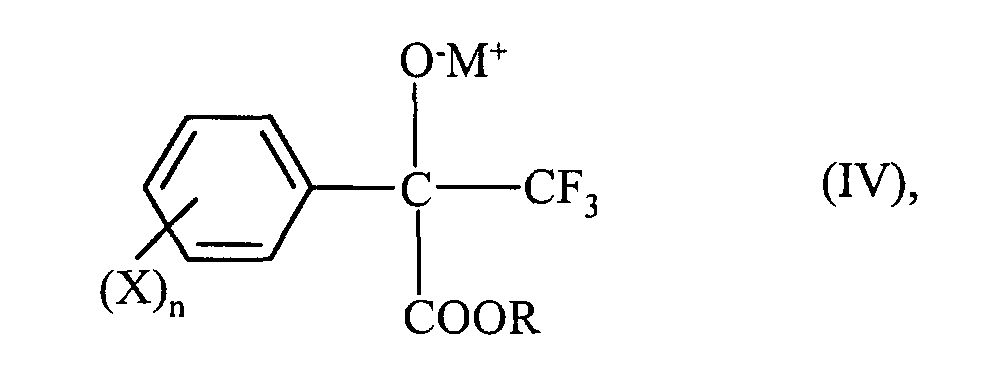
R, X et n ont la signification indiquée au sujet de la formule (I) et M+ représente l'ion d'un métal alcalin,
et on fait réagir celui-ci avec un agent d'alkylation qui convertit le groupe OH en un groupe OR'. - Procédé selon la revendication 1, caractérisé en ce que, dans les formules,
- R
- représente alkyle en C1-C4 linéaire ou ramifié, alkylène en C2-C4, cyclopentyle, cyclohexyle, phényle ou halogénoalkyle en C1-C4 avec 1 à 5 atomes de fluor ou de chlore,
- R'
- représente méthyle, éthyle ou isopropyle,
- X
- représente des substituants identiques ou différents du groupe de méthyle, chlore, brome, éthényle, phényle et nitro,
- n
- représente 0, 1 ou 2.
- Procédé selon les revendications 1 et 2, caractérisé en ce que le rapport molaire du composé cétonique de formule (II) au trifluorométhyl-triméthylsilane est de 1 : 1 à 1 : 2, on utilise comme solvant pour la réaction du composé cétonique de formule (II) avec le trifluorométhyl-triméthylsilane un solvant aprotique, on utilise comme catalyseur fluorure, 0,05 à 30 mol%, par rapport au cétoester de formule (II), de fluorures alcalins, de bifluorures alcalins, de fluorures d'onium quaternaire, de fluorures chiraux ou de difluorotriméthyl-silicate de tris(diméthylamino)-sulfonium et on conduit la réaction du cétoester de formule (II) avec le trifluorométhyltriméthylsilane à -40 à +120°C.
- Procédé selon les revendications 1 à 3, caractérisé en ce que l'on utilise comme alcoolates des alcoolates en C1-C4 aliphatiques de métaux alcalins ou comme alcools rendus alcalins des alcools en C1-C4 aliphatiques qui ont été rendus alcalins avec des hydroxydes alcalins et/ou des carbonates alcalins, on utilise les alcoolates ou les alcools rendus alcalins en une quantité de 1 à 5 équivalents%, par rapport au triméthylsilyléther de formule (III), et on conduit la réaction avec l'alcoolate ou l'alcool rendu alcalin à 0 à 80°C.
- Procédé selon les revendications 1 à 4, caractérisé en ce que l'on utilise comme agent d'alkylation des agents de méthylation ou des agents d'éthylation connus en soi en une quantité de 1 à 5 équivalents, par rapport au sel d'un composé hydroxylé de formule (IV), et on conduit l'alkylation à des températures de 0 à 100°C.
- Procédé selon les revendications 1 à 5, caractérisé en ce que, pour l'obtention de l'ester d'acide α-alcoxy-α-trifluorométhyl-arylacétique de formule (I) préparé, on isole le mélange réactionnel présent après l'alkylation par distillation ou par extraction sur l'eau, neutralisation avec un acide, extraction avec un solvant approprié et retrait de l'agent d'extraction.
- Procédé selon les revendications 1 à 6, caractérisé en ce que l'on purifie encore par distillation l'ester d'acide α-alcoxy-α-trifluorométhyl-arylacétique de formule (I) isolé à partir du mélange réactionnel d'alkylation.
- Procédé de préparation d'acides α-alcoxy-α-trifluorométhylarylacétiques de formule (V)où
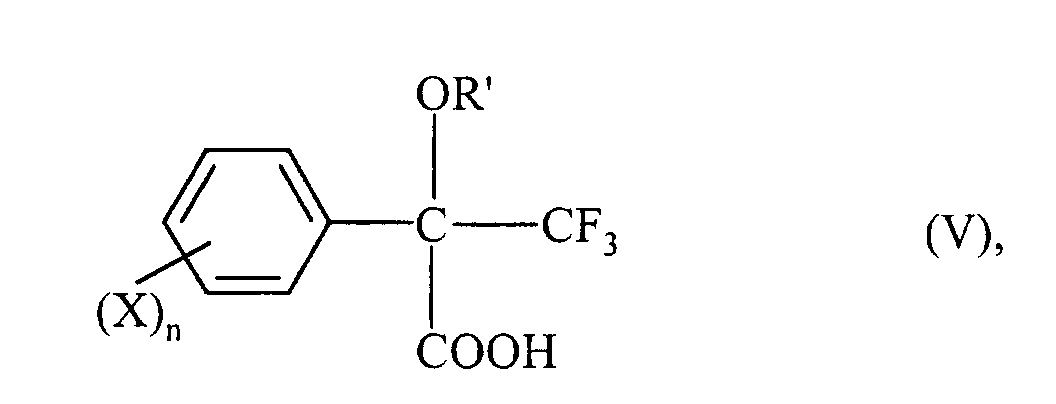
R', X et n ont la signification indiquée au sujet de la formule (I) dans la revendication 1, caractérisé en ce que l'on prépare d'abord des esters d'acides α-alcoxy-α-trifluorométhyl-arylacétiques de formule (I) selon les revendications 1 à 8 et on les convertit en un acide α-alcoxy-α-trifluorométhyl-arylacétique de formule (V) par hydrolyse ou clivage avec un acide.
Applications Claiming Priority (3)
| Application Number | Priority Date | Filing Date | Title |
|---|---|---|---|
| DE19643592 | 1996-10-22 | ||
| DE19643592A DE19643592A1 (de) | 1996-10-22 | 1996-10-22 | Verfahren zur Herstellung von alpha-Alkoxy-alpha-trifluormethyl-arylessigsäureestern und -arylessigsäuren |
| PCT/EP1997/005565 WO1998017622A1 (fr) | 1996-10-22 | 1997-10-09 | PROCEDE DE PRODUCTION D'ESTERS ET D'ACIDES α-ALCOXY-α-TRIFLUOROMETHYL-ARYL ACETIQUES |
Publications (2)
| Publication Number | Publication Date |
|---|---|
| EP0934246A1 EP0934246A1 (fr) | 1999-08-11 |
| EP0934246B1 true EP0934246B1 (fr) | 2001-05-16 |
Family
ID=7809462
Family Applications (1)
| Application Number | Title | Priority Date | Filing Date |
|---|---|---|---|
| EP97909373A Expired - Lifetime EP0934246B1 (fr) | 1996-10-22 | 1997-10-09 | Procede de production d'esters et d'acides alpha-alcoxy-alpha-trifluoromethyl-aryl acetiques |
Country Status (13)
| Country | Link |
|---|---|
| US (1) | US6162943A (fr) |
| EP (1) | EP0934246B1 (fr) |
| JP (1) | JP2001502344A (fr) |
| KR (1) | KR20000052684A (fr) |
| AU (1) | AU4708297A (fr) |
| CA (1) | CA2269133A1 (fr) |
| CZ (1) | CZ142699A3 (fr) |
| DE (2) | DE19643592A1 (fr) |
| ES (1) | ES2157066T3 (fr) |
| HU (1) | HUP0000237A3 (fr) |
| PL (1) | PL332853A1 (fr) |
| PT (1) | PT934246E (fr) |
| WO (1) | WO1998017622A1 (fr) |
Families Citing this family (8)
| Publication number | Priority date | Publication date | Assignee | Title |
|---|---|---|---|---|
| US6614587B1 (en) * | 2001-02-28 | 2003-09-02 | Avanex Corporation | Control methods for a metro optical amplifier |
| DK1633703T3 (en) * | 2003-05-30 | 2019-04-15 | Perkinelmer Las Inc | Isotope-labeled chemically stable reagents and methods for their synthesis |
| US20070117497A1 (en) * | 2005-11-22 | 2007-05-24 | Cabot Microelectronics Corporation | Friction reducing aid for CMP |
| CN103664637B (zh) | 2007-06-29 | 2016-02-03 | 奥克塞拉有限公司 | 用于治疗眼科疾病和紊乱的炔基苯基衍生化合物 |
| TW200922548A (en) | 2007-10-05 | 2009-06-01 | Acucela Inc | Alkoxy compounds for disease treatment |
| CL2008003120A1 (es) | 2007-11-01 | 2009-10-09 | Acucela Inc | Compuestos derivados de fenilalquil-, fenilalquenil-, fenilalquinil- amina, feniltioalquilamina, fenilaminoalquilamina, fenilalcoxiamina y fenilalquilguanidina; composicion farmaceutica; y uso de los compuestos para tratar un trastorno o enfermedad oftalmologica tal como retinopatia, maculopatia, retinitis pigmentosa, uveitis, entre otras. |
| EP2448569B1 (fr) * | 2009-07-02 | 2021-10-27 | Acucela, Inc. | Pharmacologie de modulateurs du cycle visuel |
| HK1210969A1 (en) | 2012-01-20 | 2016-05-13 | 奥克塞拉有限公司 | Substituted heterocyclic compounds for disease treatment |
-
1996
- 1996-10-22 DE DE19643592A patent/DE19643592A1/de not_active Withdrawn
-
1997
- 1997-10-09 AU AU47082/97A patent/AU4708297A/en not_active Abandoned
- 1997-10-09 KR KR1019990703470A patent/KR20000052684A/ko not_active Withdrawn
- 1997-10-09 HU HU0000237A patent/HUP0000237A3/hu unknown
- 1997-10-09 US US09/284,689 patent/US6162943A/en not_active Expired - Fee Related
- 1997-10-09 PL PL97332853A patent/PL332853A1/xx unknown
- 1997-10-09 EP EP97909373A patent/EP0934246B1/fr not_active Expired - Lifetime
- 1997-10-09 ES ES97909373T patent/ES2157066T3/es not_active Expired - Lifetime
- 1997-10-09 PT PT97909373T patent/PT934246E/pt unknown
- 1997-10-09 CA CA002269133A patent/CA2269133A1/fr not_active Abandoned
- 1997-10-09 WO PCT/EP1997/005565 patent/WO1998017622A1/fr not_active Ceased
- 1997-10-09 JP JP10518899A patent/JP2001502344A/ja active Pending
- 1997-10-09 DE DE59703568T patent/DE59703568D1/de not_active Expired - Fee Related
- 1997-10-09 CZ CZ991426A patent/CZ142699A3/cs unknown
Also Published As
| Publication number | Publication date |
|---|---|
| DE19643592A1 (de) | 1998-04-23 |
| PL332853A1 (en) | 1999-10-25 |
| JP2001502344A (ja) | 2001-02-20 |
| CZ142699A3 (cs) | 1999-07-14 |
| CA2269133A1 (fr) | 1998-04-30 |
| HUP0000237A2 (hu) | 2000-06-28 |
| ES2157066T3 (es) | 2001-08-01 |
| WO1998017622A1 (fr) | 1998-04-30 |
| PT934246E (pt) | 2001-10-30 |
| AU4708297A (en) | 1998-05-15 |
| HUP0000237A3 (en) | 2001-02-28 |
| EP0934246A1 (fr) | 1999-08-11 |
| DE59703568D1 (de) | 2001-06-21 |
| US6162943A (en) | 2000-12-19 |
| KR20000052684A (ko) | 2000-08-25 |
Similar Documents
| Publication | Publication Date | Title |
|---|---|---|
| EP1247792B1 (fr) | Procédé de préparation d'alcools dibenzyliques halogengés | |
| DE19643592A1 (de) | Verfahren zur Herstellung von alpha-Alkoxy-alpha-trifluormethyl-arylessigsäureestern und -arylessigsäuren | |
| EP0206147B1 (fr) | Procédé pour la préparation de 4,4'-dinitro-dibenzyls | |
| EP1309538B1 (fr) | Procede de production d'acides benzoiques substitues par trifluoroethoxy | |
| EP0679627B1 (fr) | Procédé pour la préparation d'éthers halogénés | |
| EP0537534B1 (fr) | Procédé de préparation d'esters alkyliques d'acides N-(hydroxyalkyl)-carbamiques | |
| EP1077210B1 (fr) | Procédé de préparation de 4,6-dichloro-5-fluopyrimidine et son utilisation comme agent biocide | |
| EP0048914A1 (fr) | Procédé de préparation d'alcool 3-bromo-4-fluorobenzylique, produits intermédiaires et procédé de préparation de ces produits intermédiaires | |
| EP0302331B1 (fr) | Esters de carbinols arylbisperfluoralkyles, procédé pour leur fabrication et pour les carbinols arylbisperfluoralkyles en question | |
| EP0089485B1 (fr) | Procédé pour préparer des esters de l'acide 5-chloro-1H-tétrazolo-1-carboxylique, ainsi que procédé pour préparer les esters de l'acide dichloroisonitrile-carboxylique nécessaires | |
| EP0057281A1 (fr) | Procédé de préparation d'esters d'acides alpha-hydroxyméthylènearylacétiques | |
| EP0508943B1 (fr) | Procédé de préparation d'esters halogénés d'acides carboxyliques | |
| EP0187216B1 (fr) | Procédé de préparation de 3,3-diméthyl-5-hexène-2-ones halogénées | |
| DE2128327C3 (de) | Verfahren zur Herstellung von 1-Hydroxy-cyclopropan-l-carbonsäuren | |
| DE3880072T2 (de) | N-phenyl-2,2,6,6-tetrahalogencyclohexanimin und verfahren zur herstellung von derivaten des 2,2,6,6-tetrahalogencyclohexanimins und von derivaten des 2,6-dihalogenanilins. | |
| EP0122479A1 (fr) | 3-Chloro-1,1-dialkoxy-acétones et procédé de leur préparation | |
| EP0287004A2 (fr) | Procédé pour la fabrication d'esters de l'acide trifluoracrylique | |
| EP0007008A1 (fr) | Procédé pour la préparation d'acrylates d'halogénure de butényle | |
| EP0504107B1 (fr) | Procédé de préparation d'esters chlorés d'acides carboxyliques | |
| DE69633025T2 (de) | Verfahren zur herstellung von katecholderivaten | |
| EP0446925B1 (fr) | Procédé pour la préparation de dérivés de l'acide bêta-résorcylique | |
| EP0238569B1 (fr) | Procede de fabrication d'acides carboxyliques de cycloalcanes | |
| EP0125533A1 (fr) | Procédé de préparation d'esters de l'acide tartronique | |
| EP1215188B1 (fr) | Procédé pour la préparation de composés carbonyls par clivage d'acides hydroxycarboxyliques | |
| EP0632027A1 (fr) | 6-(Carbonyloxyméthylène)-quinolines |
Legal Events
| Date | Code | Title | Description |
|---|---|---|---|
| PUAI | Public reference made under article 153(3) epc to a published international application that has entered the european phase |
Free format text: ORIGINAL CODE: 0009012 |
|
| 17P | Request for examination filed |
Effective date: 19990525 |
|
| AK | Designated contracting states |
Kind code of ref document: A1 Designated state(s): BE CH DE ES FR GB IE IT LI NL PT |
|
| RTI1 | Title (correction) |
Free format text: METHOD FOR PRODUCING ALPHA-ALKOXY-ALPHA-TRIFLUOROMETHYL-ARYL ACETIC ACID ESTERS AND -ARYL ACETIC ACIDS |
|
| 17Q | First examination report despatched |
Effective date: 19991122 |
|
| GRAG | Despatch of communication of intention to grant |
Free format text: ORIGINAL CODE: EPIDOS AGRA |
|
| GRAG | Despatch of communication of intention to grant |
Free format text: ORIGINAL CODE: EPIDOS AGRA |
|
| GRAG | Despatch of communication of intention to grant |
Free format text: ORIGINAL CODE: EPIDOS AGRA |
|
| GRAH | Despatch of communication of intention to grant a patent |
Free format text: ORIGINAL CODE: EPIDOS IGRA |
|
| GRAH | Despatch of communication of intention to grant a patent |
Free format text: ORIGINAL CODE: EPIDOS IGRA |
|
| GRAA | (expected) grant |
Free format text: ORIGINAL CODE: 0009210 |
|
| AK | Designated contracting states |
Kind code of ref document: B1 Designated state(s): BE CH DE ES FR GB IE IT LI NL PT |
|
| REG | Reference to a national code |
Ref country code: CH Ref legal event code: NV Representative=s name: E. BLUM & CO. PATENTANWAELTE Ref country code: CH Ref legal event code: EP |
|
| GBT | Gb: translation of ep patent filed (gb section 77(6)(a)/1977) |
Effective date: 20010516 |
|
| REG | Reference to a national code |
Ref country code: IE Ref legal event code: FG4D Free format text: GERMAN |
|
| REF | Corresponds to: |
Ref document number: 59703568 Country of ref document: DE Date of ref document: 20010621 |
|
| ITF | It: translation for a ep patent filed | ||
| REG | Reference to a national code |
Ref country code: ES Ref legal event code: FG2A Ref document number: 2157066 Country of ref document: ES Kind code of ref document: T3 |
|
| PGFP | Annual fee paid to national office [announced via postgrant information from national office to epo] |
Ref country code: DE Payment date: 20010914 Year of fee payment: 5 |
|
| PGFP | Annual fee paid to national office [announced via postgrant information from national office to epo] |
Ref country code: IE Payment date: 20010920 Year of fee payment: 5 |
|
| PGFP | Annual fee paid to national office [announced via postgrant information from national office to epo] |
Ref country code: PT Payment date: 20010925 Year of fee payment: 5 |
|
| PGFP | Annual fee paid to national office [announced via postgrant information from national office to epo] |
Ref country code: ES Payment date: 20011005 Year of fee payment: 5 |
|
| PGFP | Annual fee paid to national office [announced via postgrant information from national office to epo] |
Ref country code: CH Payment date: 20011008 Year of fee payment: 5 |
|
| PGFP | Annual fee paid to national office [announced via postgrant information from national office to epo] |
Ref country code: GB Payment date: 20011010 Year of fee payment: 5 |
|
| ET | Fr: translation filed | ||
| PGFP | Annual fee paid to national office [announced via postgrant information from national office to epo] |
Ref country code: FR Payment date: 20011018 Year of fee payment: 5 |
|
| PGFP | Annual fee paid to national office [announced via postgrant information from national office to epo] |
Ref country code: NL Payment date: 20011031 Year of fee payment: 5 |
|
| PGFP | Annual fee paid to national office [announced via postgrant information from national office to epo] |
Ref country code: BE Payment date: 20011114 Year of fee payment: 5 |
|
| REG | Reference to a national code |
Ref country code: GB Ref legal event code: IF02 |
|
| PLBE | No opposition filed within time limit |
Free format text: ORIGINAL CODE: 0009261 |
|
| STAA | Information on the status of an ep patent application or granted ep patent |
Free format text: STATUS: NO OPPOSITION FILED WITHIN TIME LIMIT |
|
| 26N | No opposition filed | ||
| PG25 | Lapsed in a contracting state [announced via postgrant information from national office to epo] |
Ref country code: IE Free format text: LAPSE BECAUSE OF NON-PAYMENT OF DUE FEES Effective date: 20021009 Ref country code: GB Free format text: LAPSE BECAUSE OF NON-PAYMENT OF DUE FEES Effective date: 20021009 |
|
| PG25 | Lapsed in a contracting state [announced via postgrant information from national office to epo] |
Ref country code: ES Free format text: LAPSE BECAUSE OF NON-PAYMENT OF DUE FEES Effective date: 20021010 |
|
| PG25 | Lapsed in a contracting state [announced via postgrant information from national office to epo] |
Ref country code: LI Free format text: LAPSE BECAUSE OF NON-PAYMENT OF DUE FEES Effective date: 20021031 Ref country code: CH Free format text: LAPSE BECAUSE OF NON-PAYMENT OF DUE FEES Effective date: 20021031 Ref country code: BE Free format text: LAPSE BECAUSE OF NON-PAYMENT OF DUE FEES Effective date: 20021031 |
|
| BERE | Be: lapsed |
Owner name: *BAYER A.G. Effective date: 20021031 |
|
| PG25 | Lapsed in a contracting state [announced via postgrant information from national office to epo] |
Ref country code: PT Free format text: LAPSE BECAUSE OF NON-PAYMENT OF DUE FEES Effective date: 20030430 |
|
| PG25 | Lapsed in a contracting state [announced via postgrant information from national office to epo] |
Ref country code: NL Free format text: LAPSE BECAUSE OF NON-PAYMENT OF DUE FEES Effective date: 20030501 Ref country code: DE Free format text: LAPSE BECAUSE OF NON-PAYMENT OF DUE FEES Effective date: 20030501 |
|
| GBPC | Gb: european patent ceased through non-payment of renewal fee |
Effective date: 20021009 |
|
| REG | Reference to a national code |
Ref country code: CH Ref legal event code: PL |
|
| PG25 | Lapsed in a contracting state [announced via postgrant information from national office to epo] |
Ref country code: FR Free format text: LAPSE BECAUSE OF NON-PAYMENT OF DUE FEES Effective date: 20030630 |
|
| NLV4 | Nl: lapsed or anulled due to non-payment of the annual fee |
Effective date: 20030501 |
|
| REG | Reference to a national code |
Ref country code: IE Ref legal event code: MM4A |
|
| REG | Reference to a national code |
Ref country code: FR Ref legal event code: ST |
|
| REG | Reference to a national code |
Ref country code: ES Ref legal event code: FD2A Effective date: 20031112 |
|
| PG25 | Lapsed in a contracting state [announced via postgrant information from national office to epo] |
Ref country code: IT Free format text: LAPSE BECAUSE OF NON-PAYMENT OF DUE FEES;WARNING: LAPSES OF ITALIAN PATENTS WITH EFFECTIVE DATE BEFORE 2007 MAY HAVE OCCURRED AT ANY TIME BEFORE 2007. THE CORRECT EFFECTIVE DATE MAY BE DIFFERENT FROM THE ONE RECORDED. Effective date: 20051009 |