EP0935996B1 - A composition of matter, comprising an inorganic porous material and a method for preparing the same - Google Patents
A composition of matter, comprising an inorganic porous material and a method for preparing the same Download PDFInfo
- Publication number
- EP0935996B1 EP0935996B1 EP99103070A EP99103070A EP0935996B1 EP 0935996 B1 EP0935996 B1 EP 0935996B1 EP 99103070 A EP99103070 A EP 99103070A EP 99103070 A EP99103070 A EP 99103070A EP 0935996 B1 EP0935996 B1 EP 0935996B1
- Authority
- EP
- European Patent Office
- Prior art keywords
- inorganic
- group
- mixtures
- process according
- composition
- Prior art date
- Legal status (The legal status is an assumption and is not a legal conclusion. Google has not performed a legal analysis and makes no representation as to the accuracy of the status listed.)
- Expired - Lifetime
Links
Images


Classifications
-
- C—CHEMISTRY; METALLURGY
- C01—INORGANIC CHEMISTRY
- C01B—NON-METALLIC ELEMENTS; COMPOUNDS THEREOF; METALLOIDS OR COMPOUNDS THEREOF NOT COVERED BY SUBCLASS C01C
- C01B37/00—Compounds having molecular sieve properties but not having base-exchange properties
- C01B37/02—Crystalline silica-polymorphs, e.g. silicalites dealuminated aluminosilicate zeolites
-
- B—PERFORMING OPERATIONS; TRANSPORTING
- B01—PHYSICAL OR CHEMICAL PROCESSES OR APPARATUS IN GENERAL
- B01J—CHEMICAL OR PHYSICAL PROCESSES, e.g. CATALYSIS OR COLLOID CHEMISTRY; THEIR RELEVANT APPARATUS
- B01J20/00—Solid sorbent compositions or filter aid compositions; Sorbents for chromatography; Processes for preparing, regenerating or reactivating thereof
- B01J20/02—Solid sorbent compositions or filter aid compositions; Sorbents for chromatography; Processes for preparing, regenerating or reactivating thereof comprising inorganic material
-
- B—PERFORMING OPERATIONS; TRANSPORTING
- B01—PHYSICAL OR CHEMICAL PROCESSES OR APPARATUS IN GENERAL
- B01J—CHEMICAL OR PHYSICAL PROCESSES, e.g. CATALYSIS OR COLLOID CHEMISTRY; THEIR RELEVANT APPARATUS
- B01J20/00—Solid sorbent compositions or filter aid compositions; Sorbents for chromatography; Processes for preparing, regenerating or reactivating thereof
- B01J20/02—Solid sorbent compositions or filter aid compositions; Sorbents for chromatography; Processes for preparing, regenerating or reactivating thereof comprising inorganic material
- B01J20/06—Solid sorbent compositions or filter aid compositions; Sorbents for chromatography; Processes for preparing, regenerating or reactivating thereof comprising inorganic material comprising oxides or hydroxides of metals not provided for in group B01J20/04
-
- B—PERFORMING OPERATIONS; TRANSPORTING
- B01—PHYSICAL OR CHEMICAL PROCESSES OR APPARATUS IN GENERAL
- B01J—CHEMICAL OR PHYSICAL PROCESSES, e.g. CATALYSIS OR COLLOID CHEMISTRY; THEIR RELEVANT APPARATUS
- B01J20/00—Solid sorbent compositions or filter aid compositions; Sorbents for chromatography; Processes for preparing, regenerating or reactivating thereof
- B01J20/02—Solid sorbent compositions or filter aid compositions; Sorbents for chromatography; Processes for preparing, regenerating or reactivating thereof comprising inorganic material
- B01J20/10—Solid sorbent compositions or filter aid compositions; Sorbents for chromatography; Processes for preparing, regenerating or reactivating thereof comprising inorganic material comprising silica or silicate
- B01J20/103—Solid sorbent compositions or filter aid compositions; Sorbents for chromatography; Processes for preparing, regenerating or reactivating thereof comprising inorganic material comprising silica or silicate comprising silica
-
- B—PERFORMING OPERATIONS; TRANSPORTING
- B01—PHYSICAL OR CHEMICAL PROCESSES OR APPARATUS IN GENERAL
- B01J—CHEMICAL OR PHYSICAL PROCESSES, e.g. CATALYSIS OR COLLOID CHEMISTRY; THEIR RELEVANT APPARATUS
- B01J20/00—Solid sorbent compositions or filter aid compositions; Sorbents for chromatography; Processes for preparing, regenerating or reactivating thereof
- B01J20/30—Processes for preparing, regenerating, or reactivating
- B01J20/32—Impregnating or coating ; Solid sorbent compositions obtained from processes involving impregnating or coating
- B01J20/3202—Impregnating or coating ; Solid sorbent compositions obtained from processes involving impregnating or coating characterised by the carrier, support or substrate used for impregnation or coating
- B01J20/3204—Inorganic carriers, supports or substrates
-
- B—PERFORMING OPERATIONS; TRANSPORTING
- B01—PHYSICAL OR CHEMICAL PROCESSES OR APPARATUS IN GENERAL
- B01J—CHEMICAL OR PHYSICAL PROCESSES, e.g. CATALYSIS OR COLLOID CHEMISTRY; THEIR RELEVANT APPARATUS
- B01J20/00—Solid sorbent compositions or filter aid compositions; Sorbents for chromatography; Processes for preparing, regenerating or reactivating thereof
- B01J20/30—Processes for preparing, regenerating, or reactivating
- B01J20/32—Impregnating or coating ; Solid sorbent compositions obtained from processes involving impregnating or coating
- B01J20/3231—Impregnating or coating ; Solid sorbent compositions obtained from processes involving impregnating or coating characterised by the coating or impregnating layer
- B01J20/3234—Inorganic material layers
- B01J20/3236—Inorganic material layers containing metal, other than zeolites, e.g. oxides, hydroxides, sulphides or salts
-
- B—PERFORMING OPERATIONS; TRANSPORTING
- B01—PHYSICAL OR CHEMICAL PROCESSES OR APPARATUS IN GENERAL
- B01J—CHEMICAL OR PHYSICAL PROCESSES, e.g. CATALYSIS OR COLLOID CHEMISTRY; THEIR RELEVANT APPARATUS
- B01J29/00—Catalysts comprising molecular sieves
- B01J29/03—Catalysts comprising molecular sieves not having base-exchange properties
- B01J29/0308—Mesoporous materials not having base exchange properties, e.g. Si-MCM-41
-
- B—PERFORMING OPERATIONS; TRANSPORTING
- B01—PHYSICAL OR CHEMICAL PROCESSES OR APPARATUS IN GENERAL
- B01J—CHEMICAL OR PHYSICAL PROCESSES, e.g. CATALYSIS OR COLLOID CHEMISTRY; THEIR RELEVANT APPARATUS
- B01J29/00—Catalysts comprising molecular sieves
- B01J29/03—Catalysts comprising molecular sieves not having base-exchange properties
- B01J29/0308—Mesoporous materials not having base exchange properties, e.g. Si-MCM-41
- B01J29/0316—Mesoporous materials not having base exchange properties, e.g. Si-MCM-41 containing iron group metals, noble metals or copper
- B01J29/0325—Noble metals
-
- B—PERFORMING OPERATIONS; TRANSPORTING
- B01—PHYSICAL OR CHEMICAL PROCESSES OR APPARATUS IN GENERAL
- B01J—CHEMICAL OR PHYSICAL PROCESSES, e.g. CATALYSIS OR COLLOID CHEMISTRY; THEIR RELEVANT APPARATUS
- B01J29/00—Catalysts comprising molecular sieves
- B01J29/04—Catalysts comprising molecular sieves having base-exchange properties, e.g. crystalline zeolites
- B01J29/041—Mesoporous materials having base exchange properties, e.g. Si/Al-MCM-41
-
- B—PERFORMING OPERATIONS; TRANSPORTING
- B01—PHYSICAL OR CHEMICAL PROCESSES OR APPARATUS IN GENERAL
- B01J—CHEMICAL OR PHYSICAL PROCESSES, e.g. CATALYSIS OR COLLOID CHEMISTRY; THEIR RELEVANT APPARATUS
- B01J35/00—Catalysts, in general, characterised by their form or physical properties
- B01J35/60—Catalysts, in general, characterised by their form or physical properties characterised by their surface properties or porosity
-
- B—PERFORMING OPERATIONS; TRANSPORTING
- B01—PHYSICAL OR CHEMICAL PROCESSES OR APPARATUS IN GENERAL
- B01J—CHEMICAL OR PHYSICAL PROCESSES, e.g. CATALYSIS OR COLLOID CHEMISTRY; THEIR RELEVANT APPARATUS
- B01J35/00—Catalysts, in general, characterised by their form or physical properties
- B01J35/60—Catalysts, in general, characterised by their form or physical properties characterised by their surface properties or porosity
- B01J35/64—Pore diameter
- B01J35/647—2-50 nm
-
- B—PERFORMING OPERATIONS; TRANSPORTING
- B01—PHYSICAL OR CHEMICAL PROCESSES OR APPARATUS IN GENERAL
- B01J—CHEMICAL OR PHYSICAL PROCESSES, e.g. CATALYSIS OR COLLOID CHEMISTRY; THEIR RELEVANT APPARATUS
- B01J2235/00—Indexing scheme associated with group B01J35/00, related to the analysis techniques used to determine the catalysts form or properties
-
- B—PERFORMING OPERATIONS; TRANSPORTING
- B01—PHYSICAL OR CHEMICAL PROCESSES OR APPARATUS IN GENERAL
- B01J—CHEMICAL OR PHYSICAL PROCESSES, e.g. CATALYSIS OR COLLOID CHEMISTRY; THEIR RELEVANT APPARATUS
- B01J2235/00—Indexing scheme associated with group B01J35/00, related to the analysis techniques used to determine the catalysts form or properties
- B01J2235/05—Nuclear magnetic resonance [NMR]
-
- B—PERFORMING OPERATIONS; TRANSPORTING
- B01—PHYSICAL OR CHEMICAL PROCESSES OR APPARATUS IN GENERAL
- B01J—CHEMICAL OR PHYSICAL PROCESSES, e.g. CATALYSIS OR COLLOID CHEMISTRY; THEIR RELEVANT APPARATUS
- B01J2235/00—Indexing scheme associated with group B01J35/00, related to the analysis techniques used to determine the catalysts form or properties
- B01J2235/10—Infrared [IR]
-
- B—PERFORMING OPERATIONS; TRANSPORTING
- B01—PHYSICAL OR CHEMICAL PROCESSES OR APPARATUS IN GENERAL
- B01J—CHEMICAL OR PHYSICAL PROCESSES, e.g. CATALYSIS OR COLLOID CHEMISTRY; THEIR RELEVANT APPARATUS
- B01J29/00—Catalysts comprising molecular sieves
- B01J29/03—Catalysts comprising molecular sieves not having base-exchange properties
- B01J29/0308—Mesoporous materials not having base exchange properties, e.g. Si-MCM-41
- B01J29/0316—Mesoporous materials not having base exchange properties, e.g. Si-MCM-41 containing iron group metals, noble metals or copper
-
- B—PERFORMING OPERATIONS; TRANSPORTING
- B01—PHYSICAL OR CHEMICAL PROCESSES OR APPARATUS IN GENERAL
- B01J—CHEMICAL OR PHYSICAL PROCESSES, e.g. CATALYSIS OR COLLOID CHEMISTRY; THEIR RELEVANT APPARATUS
- B01J29/00—Catalysts comprising molecular sieves
- B01J29/03—Catalysts comprising molecular sieves not having base-exchange properties
- B01J29/0308—Mesoporous materials not having base exchange properties, e.g. Si-MCM-41
- B01J29/0341—Mesoporous materials not having base exchange properties, e.g. Si-MCM-41 containing arsenic, antimony, bismuth, vanadium, niobium, tantalum, polonium, chromium, molybdenum, tungsten, manganese, technetium or rhenium
-
- B—PERFORMING OPERATIONS; TRANSPORTING
- B01—PHYSICAL OR CHEMICAL PROCESSES OR APPARATUS IN GENERAL
- B01J—CHEMICAL OR PHYSICAL PROCESSES, e.g. CATALYSIS OR COLLOID CHEMISTRY; THEIR RELEVANT APPARATUS
- B01J35/00—Catalysts, in general, characterised by their form or physical properties
- B01J35/30—Catalysts, in general, characterised by their form or physical properties characterised by their physical properties
Definitions
- the invention relates to a process for preparing thermally and hydrothermally stable synthetic material having a high void volume attributable to tortuous mesopore-sized channels having a mean diameter between about 15 ⁇ and about 100 ⁇ and a narrow size distribution of less than or equal to about 30 ⁇ , so as to provide an excellent starting material for incorporation of active materials and the like.
- Amorphous silica-aluminas are commercially used catalysts in many processes due to their acidity.
- the two most common methods for preparing amorphous silica-alumina are the controlled deposition of an alumina salt on a silica surface, and the co-precipitation of silica and alumina species from solution.
- the silica surface is prepared from a silica gel, and alumina salt is hydrolyzed and precipitated by addition of aqueous ammonia.
- the first method controlled deposition of alumina on silica gel, leads to the generation of tetrahedrally coordinated aluminum, due to the controlled incorporation of the hydrolyzed aluminum atoms into the silica structure.
- this method is not desirable because the porosity of the silica gel collapses upon thermal treatment, for example during calcination, thereby making the aluminum atoms inaccessible to hydrocarbon molecules or other materials to be treated, thereby diminishing the practical value of such composition for commercial processes.
- the second method leads undesirably to a large amount of octahedrally coordinated aluminum.
- the document WO-9639357-A describes a method to design and to synthesize a semi-crystalline inorganic oxide compositions with well defined mesoporosity by means of a lattice spacing of 3 to 10 nm, a framework that confines pores between about 2 and 10 nm, whereby it contains a specific surface area of 300 to 1200 square meters per gram.
- the disclosure shows a preparation of the synthesis of semi-crystalline inorganic oxide compositions using a hydrolysable component.
- the formation of the mesoporous network is accomplished by a hydrogen-bonding interaction between non-ionic surfactant and neutral inorganic precursors followed by hydrolysis and subsequent condensation under temperature reaction conditions.
- the template in the method for forming the condensed reaction product, can either be removed by air drying and calcinations in air or inert gas or by solvent extraction and calcined thereafter.
- the resultant composition can be used as absorbent, molecular sieves or catalyst etc..
- the catalyst can subsequently be impregnated with catalytically active elements such as Al, Ag, Cu, Cr, Pt, Pd, Ti, V, Zr or mixtures thereof.
- alkylpolyethylene oxides alkyl-phenyl polyethylene oxides, polyethylene oxide (PEO) - polypropylene oxide (PPO) molecules; and a X-shaped tetronic molecule.
- PEO polyethylene oxide
- PPO polypropylene oxide
- Tanev et. al. describes a neutral templating route to mesoporous molecular sieves that is based on hydrogen bonding and self-assembly between neutral primary amine micelles and inorganic precursors.
- the thickness of the pore walls improves the thermal and hydrothermal stability of the mesopore framework.
- the obtained samples of composition offer a specific surface areas of 1000 and 1150 m 2 /g and a pore size of 2,4 and 2,7 nm.
- the neutral templating method offer the complete displacement of the templates from the mesoporous framework by ethanol extraction.
- the document GB-A-2 309 967 shows a process for preparing an inorganic porous material, having wall portions defining mesopore-sized channels having a mean diameter of between 1,5 nm to about 10 nm and a narrow diameter of less than or equal 3 nm, whereby the material having a void volume obtained by the mesopore-sized channels of at least about 0,1 m 3 /g; a inflection points at the P/P 0 values in the range of 0.05 to 0.8.
- the writing disclosure that the material provide a short range order structure.
- the method for preparing the said material compromising the steps of forming a solution of a hydrolyzable inorganic compound with tensoactive organic molecules; inducing growth and condensation of a solid composition comprising an inorganic composition in intimate contact with said organic molecules; and extracting said organic molecules with a solvent so as to provide an inorganic porous sold composition, wherein the hydrolyzable inorganic compound is selected from the group consisting of chlorides, alkoxides, nitrates, hydroxides, sulphates and mixtures thereof; wherein the solution is prepared using a precursor of said hydrolyzable inorganic compound, wherein said precursor is selected from the group consisting of colloidal silica, alumina sols, suspension of pseudo-bentonite, titania, zirconia, oxide hydrosols and mixtures thereof.
- the tensoactive organic molecules comprise a non-ionic surfactant selected from the group consisting of ethoxylated alcohols, ethoxylated alkylphenols, amine oxides, ethoxylated amines and mixtures thereof, and the non-ionic surfactant shows a molar ratio of surfactant to inorganic species to the inorganic compound of between about 0.05 and about 20.
- the writing disclose a process with steps of depositing aluminum on an inorganic porous material so that the final inorganic porous material provide at least about 60% wt. of an aluminum tetrahedrally coordinated, wherein the inorganic composition silica is chosen preferably.
- the document US-A-5 238 676 shows catalyst synthesis and composition having a uniform hexagonal honeycomb microstructure with uniform pores with a cell diameter greater than 1,3 nm and in the mesoporous range of 2-10 nm.
- the document describes an metallosilicate MCM-41 which is synthesized with Bronsted acid active sites by incorporating a tetrahedrally coordinate trivalent element like Al, Ga, B or Fe within the silicate framework.
- the document WO-93-02160-A describes a catalyst for hydrocracking/ hydroisomerization comprising a mesoporus crystalline material with a metal component used for catalytic activities, whereby the metal component may exceed 25 % it still offer a high surface area of 200 m 2 /g.
- the hydrogenating component can be exchanged onto the support material, impregnated into it or physically admixed with it.
- a composition of matter which comprises an inorganic porous material having wall portions defining mesopore-sized channels having a mean diameter of between about 15 ⁇ and about 100 ⁇ and a narrow diameter distribution of less than or equal to about 30 ⁇ , said material having a void volume from said mesopore-sized channels of at least about 0.1cc/g and a surface area of at least about 500 m 2 /g and having a number of hydroxyl groups of at least about 1.5 mmol of hydroxyl groups per gram of material, and exhibiting thermal and hydrothermal stability at temperatures up to about 500°C.
- a process for preparing an inorganic porous material in accordance with the present invention comprising the steps of forming a solution of a hydrolyzable inorganic compound with a non-ionic tensoactive organic molecule; inducing growth and condensation of a solid composition comprising an inorganic composition in intimate contact with said organic molecule; and extracting said organic molecule with a solvent so as to provide a porous solid composition having a porous structure and having a number of hydroxyl groups of at least about 1.5 mmol of hydroxyl groups per gram of material, wherein said material maintains said porous structure upon thermal and hydrothermal treatments at temperatures of up to about 500°C.
- solvent extraction and calcination can be used, if desired, to control the number of hydroxyl groups present in the resulting inorganic porous material.
- an active material such as an active metal or non-metal, absorbent or adsorbent agents, and the like, may readily be deposited directly upon the inorganic porous material to provide a wide variety of catalysts useful in various applications in accordance with the present invention.
- the invention relates to a synthetic material which advantageously possesses high void volume generated by mesoporous channels with a narrow size distribution and which further exhibits enhanced stability under thermal and hydrothermal treatment conditions.
- This material is ideally suited, for example, as a support for catalytic components for various processes.
- a support to effectively disperse active catalytic components is associated to density of anchoring sites.
- the anchoring sites are surface hydroxyl groups.
- the highest density of hydroxyl groups in silica supports is observed in silica gels with a density of between 2 and 3 hydroxyl groups per nm 2 .
- This material is not thermally or hydrothermally stable, and upon these treatments the material usually collapses, rendering the active sites inaccessible to the reactant molecules.
- silica sources such as pyrogenic or precipitated silicas, are conventionally used to disperse catalytic components due to superior thermal and hydrothermal stability.
- the hydroxyl concentration in these materials is substantially lower than in silica gels, hampering the ability of these silica forms to disperse active materials.
- synthetic material is provided with a hydroxyl group concentration similar to that of silica gel and with the thermal and hydrothermal stability of other silica forms such as pyrogenic or precipitated silicas.
- a synthetic intermediate material having a high void volume, preferably at least about 0.1 cc/g and more preferably at least about 0.2 cc/g, wherein the void volume is attributable to or generated from tortuous channels defined in the material.
- the channels preferably have a mean diameter between about 15 ⁇ and about 100 ⁇ and a narrow size distribution less than or equal to about 30 ⁇ .
- the surface area of these channels is high, preferably at least 500 m 2 /g of material and more preferably at least about 800 m 2 /g, and it is covered by a high concentration of hydroxyl groups, preferably at least about 1.5 mmol of hydroxyl groups per gram of material.
- the synthetic material of the present invention allows the synthetic material of the present invention to be used in treating a feedstock having a fraction of large-hydrocarbon molecules. During such treatment, larger molecules are upgraded, converted or otherwise treated in sites within the mesoporous channels. In a different process, a component of the feedstock may also be separated by selective adsorption into the mesoporous channels of the synthetic material.
- the synthetic material according to the disclosure also advantageously exhibits enhanced stability in the presence of steam and/or high temperatures, for example up to at least about 500°C, making the material excellently suited for use in processes involving thermal and hydrothermal steps. It is believed that the enhanced stability of material of the present disclosure results from well structured and ⁇ relatively thick walls of the material that define the mesoporous tortuous channels.
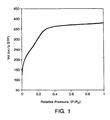
- the narrow size distribution of mesoporous channels in the synthetic material is exhibited, for example, by a nitrogen adsorption isotherm having sharp inflection points at P/P 0 values of between about 0.05 and about 0.8, and a relatively flat isotherm above P/P 0 of 0.8, indicating mesopore pore size distribution of between about 15 ⁇ and about 100 ⁇ .
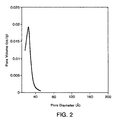
- This feature of the present invention is further exhibited by a plot of the derivative of N 2 adsorption volume as a function of pore diameter which shows a narrow band of pore sizes preferably centered around a pore size of less than or equal to about 40 ⁇ (See Example 1 below, Figure 2).
- the material has a short range order structure, which has enhanced resistance to breakdown when subjected to thermal and hydrothermal treatments.
- the preferred short range order in the synthetic material of the present invention is exhibited, for example, by a high energy electron diffraction pattern (EDP) containing only diffuse halos at d-spacing larger than 20 ⁇ . One or more halos may be exhibited.
- EDP electron diffraction pattern
- This short range order is indicative of material having structural features (believed to be the tortuous channels) that repeat themselves substantially throughout the material, but in correlations where the feature extends only a few times (up to about five times, while in the case of crystalline materials features can repeat themselves thousands, or at the very least hundreds of times).
- This material is referred to as a material having a repeat value of less than or equal to about 5.
- the concentration of surface hydroxyl groups is exhibited by physical methods such as the signal intensity between 0 and 5 ppm on a 1 H MAS NMR spectrum or by chemical methods such as titration with a selective reagent such as trimethylchlorosilane.
- a process for preparing the synthetic material of the present invention serves to provide a synthetic material preferably having short range order and tortuous mesoporous channels formed therein wherein the channels are defined by walls believed to have a thickness sufficient to enhance resistance of the synthetic material to use in thermal and hydrothermal processes.
- conventionally prepared materials either possess very wide mesopore size distributions (between 50 ⁇ and 1000 ⁇ ) or possess poor thermal and hydrothermal stability in same rendering the conventionally prepared materials undesirable for many processes, especially those involving treatment of feedstocks having large organic molecule fractions.
- an inorganic porous material is prepared by forming a solution of a hydrolyzable inorganic compound with non-ionic tensoactive organic molecules.
- the solution is thoroughly mixed, and then treated so as to induce the formation of a solid material comprising an inorganic composition in intimate contact with the non-ionic surfactant or tensoactive organic molecules.
- Solids may be formed by gelation of the hydrolyzable inorganic compounds at pH values near the isoelectric point of the inorganic species in solution, and further condensation of the gel to form a solid material by aging of the gel at low temperatures, between about 0°C and 40°C, and/or by thermal treatment at temperatures between about 40°C and 120°C.
- the solid material so obtained is then preferably separated from remaining liquid of the solution, for example by centrifugation, washed with water, and dried at room temperature.
- the washed and dried solid is then treated through solvent extraction so as to extract the non-ionic surfactant from the inorganic composition so as to provide an inorganic material with a high void volume of at least about 0.1 cc/g generated by or attributable to the tortuous channels, and having a mean diameter between about 15 ⁇ and about 100 ⁇ and a narrow size distribution of less than or equal to about 30 ⁇ .
- the material formed in accordance with the process of the present invention preferably has a short range order structure indicating a material which is an intermediate case between crystalline (long-range) and disordered materials.
- the conditions inducing the growth and condensation of the hydrolyzable compound are controlled so as to form chain-like polymeric inorganic species that favor attractive interactions (by hydrogen bonding and/or Van der Waals forces) with the polar groups of the non-ionic surfactant.
- This may suitably be carried out by providing and maintaining a pH of the solution which is equal to or within about ⁇ 2 pH numbers of the isoelectric point mean value of the inorganic species or combination of inorganic species in solution.
- the condensation step is relatively slow, and the hydrolyzable species tend to polymerize into linear molecules that are occasionally cross-linked. These molecular chains entangle and form additional branches.
- chain-like species are pervious to the non-ionic surfactant, facilitating the establishment of attractive interactions.
- the polymerization rate is fast, leading to the formation of more highly branched clusters that are not penetrable, and cannot easily interact with the non-ionic surfactant.
- the hydrolyzed groups of the inorganic species in solution contain for the most part hydroxyl groups, favoring attractive interactions with the electron donor groups of the non-ionic surfactant by H bonding.
- the pH of the solution may be adjusted according to the invention by adding acid to the solution, preferably hydrochloric acid (HCl), although other acids may also be used.
- acid preferably hydrochloric acid (HCl)
- HCl hydrochloric acid
- the hydrolyzable inorganic compound may suitably be selected from the group consisting of chlorides, alkoxides, nitrates, hydroxides, sulphates, and mixtures thereof, among others, preferably nitrates, hydroxides and mixtures thereof.
- the inorganic species in solution can be prepared by dissolution of an oxide with an appropriate acid or base.
- precursors to the oxides may be used, such as colloidal silica, alumina sols, suspensions of pseudo-bentonite, titania or zirconia and/or hydrosols of any oxide, among others.
- the non-ionic surfactant or tensoactive organic molecules to be used according to the present invention may suitably be selected from the group consisting of ethoxylated alcohols, ethoxylated alkylphenols, amine oxides, ethoxylated amines and mixtures thereof.
- the non-ionic surfactant may suitably be mixed in solution with the inorganic compound so as to provide a molar ratio of ionic surfactant to inorganic species of between about 0.05 and about 20.
- Any metal oxide or mixture of oxides can be prepared with the method of the present invention, as long as the appropriate pH value is selected.
- An indication of this value is given by the isoelectric point of the respective solid oxides or hydroxides, some of which are summarized in Table 1, and with an extensive compilation given by G.A. Parks, Chemistry Reviews, Vol. 65, pages 177 to 198, 1965.
- the solid porous inorganic material obtained in accordance with the invention has a high void volume, at least about 0.1 cc/g, attributable to tortuous channels with a mean diameter between about 15 ⁇ and about 100 ⁇ and a narrow size distribution of less than or equal to about 30 ⁇ , and having stability for use in thermal and hydrothermal treatments and processes.
- the material is preferably also a short range order material as discussed above.
- the non-ionic surfactant is extracted and removed from intimate contact with the inorganic material, thereby vacating mesopore-sized tortuous channels having the desired mean diameter between about 15 ⁇ and about 100 ⁇ , and distributed in a narrow size distribution no more than 30 ⁇ wide that render accessible a high concentration of surface hydroxyl groups, which concentration can be controlled, if desired, through calcination.
- Calcining is preferably carried out, if desired, at a temperature of between about 200°C and about 800°C, for a period of at least about 1 hour.
- a temperature of between about 200°C and about 800°C, for a period of at least about 1 hour.
- different materials may require different calcination times and temperatures for a proper control of the hydroxyl group concentration.
- the total volume of mesopore void volume formed in the final product depends upon the size and concentration of the non-ionic surfactant in the starting solution. Further, the actual size of mesopore-sized channels depends upon the size or molecular weight of the organic molecules. Thus, the amount and size of organic molecule to be used in solution may be selected so as to provide the desired mesopore total void volume and mesoporous channel size.
- the amount and size of the mesoporous-sized void volume can also be selectively controlled by adding organic water-insoluble compounds to the mixture of the inorganic species and the non-ionic surfactant. These water-insoluble compounds combine with the hydrophobic tail of the surfactant, and increase the size of the micelle around which the inorganic species condense, thus increasing the size and volume of resulting mesopore-sized channels in the material of the present invention.
- Suitable organic water-insoluble compounds according to the invention may be selected from the group consisting of p-xylene, trimethylbenzene, triethylbenzene, dimethyladamantane and mixtures thereof.
- the total surface area can be controlled, which, in return, contributes to adjust the concentration of surface hydroxyl groups per gram of material.
- the material of the present invention may also be combined with other materials, such as diluents to control the amount of conversion in a given process.
- materials such as aluminas, silicas, silica-aluminas, magnesias, titanias, zirconias, carbons and their precursors, clays and mixtures thereof.
- precursors to the above mentioned materials can be used, such as colloidal silica, alumina sols, suspensions of pseudo-bohemite, titania, or zirconia, and hydrosols of any above mentioned oxides, among others.
- These materials may be combined with the material of the present invention during preparation or in a post-synthesis process. Also, these materials may be provided in part in colloidal form so as to facilitate extrusion of desired components.
- the material is useful as a catalyst for conversion of organic compounds, especially large hydrocarbons with molecular sizes of about 15 ⁇ or more. It is particularly useful for catalyzing reactions that occur in the presence of acidic sites, in which the large hydrocarbon molecule is converted into products of lower molecular weight or into more valuable isomers. Examples of such reactions are involved in processes such as cracking, hydrocracking and isomerization. In such processes the material presents various advantages over conventional catalysts.
- the large mesopore size and void volume allow large hydrocarbon molecules to easily access the catalytically active sites located on the material, thereby minimizing diffusional constraints.
- the improved diffusion through channels also allows the primary products from the transformation and or conversion of the large hydrocarbon molecule to exit the material before secondary reactions can take place, thereby retarding or even avoiding the formation of undesirable secondary products such as coke which could eventually plug the channels or deactivate catalytic sites on the material.
- metals as catalytic components, especially noble metals such as platinum, rhodium, rhenium, palladium or iridium, or Group VIII metals such as nickel, iron or cobalt, or Group VI metals such as chromium, molybdenum or tungsten, or mixtures thereof.
- Additional active materials which may suitably be deposited on the support material include Group IVB metals such as titanium, zirconium and mixtures thereof, Group VB metals such as vanadium, niobium, tantalum and mixtures thereof, and rare earth metals individually or in mixtures.
- active metals such as the foregoing may suitably be incorporated through impregnation with solutions of the desired metal.
- metals may be present in their metallic state, or as oxides, sulfides or mixtures thereof. These metals could for example provide the material of the present disclosure with desired catalytic properties for processes such as hydrotreatment, hydroisomerization, hydrocracking, hydrogenation and/or reforming, to convert large hydrocarbon molecules into more valuable products.
- the material is particularly useful when the desired application involves metals as catalytic components dispersed on silica.
- surface hydroxyl groups of silica are present in high concentrations and act as anchoring sites that allow the effective dispersion of large amounts of metals as catalytic components.
- conventional forms of silica which have been found to be poor supports for metals precisely due to low concentration of surface hydroxyl groups.
- active metals and the like can be dispersed over the support of the present invention to provide for metal dispersion of at least about 15%, preferably at least about 20%, and further advantageously to provide for a total metal area of at least about 0.10 m 2 /g, preferably at least about 0.25 m 2 /g.
- the material may also be advantageously used as a sorbent for the selective separation of one or more components in a feed.
- the narrow size distribution of mesopore-sized channels and the large void volume allow for separation of components in the feed by size exclusion of molecules.
- the walls of the material of the present disclosure provide for sites that can be modified through incorporation of molecules that contain specific functional groups with affinity toward specific components in the mixture, allowing their separation from the feed. Examples include the incorporation of amines to preferentially adsorb acidic components in a feed, or chelating agents that separate metal contaminations off a stream. Also, these sites on the walls of the material can be used to incorporate compounds that can control the hydrophilicity of the environment within the pores or channels, advantageously allowing the separation of polar from non-polar components in a feed.
- the material is useful in the treatment of any hydrocarbon molecule, it is particularly advantageous when used for the treatment of large molecules that are too big to fit into the channels of more conventional catalysts and/or sorbents.
- the material is especially suited for the treatment of high boiling point hydrocarbon fractions in crude oils such as atmospheric and vacuum gas oils, high boiling point products from processes such as catalytic cracking, thermal cracking, lube production and the like and non-distillable fractions from crude oil or from conversion processes such as residual feeds.
- the material could also be utilized with feeds of non-petroleum origin.
- the inorganic composition of the present invention is to be used as a starting material for the incorporation of active materials such as aluminum, for example in the form of alumina and the like, so as to provide an amorphous silica-alumina which is useful in many commercial processes.
- active materials such as aluminum, for example in the form of alumina and the like, so as to provide an amorphous silica-alumina which is useful in many commercial processes.
- This material is acidic due to the electron interaction between neighboring Al and Si atoms. It is desirable to maximize the number of acid sites on such a composition, and this can be accomplished by maximizing the amount of aluminum or other active material which is tetrahedrally coordinated with the silicon and bridging oxygen atoms.
- the amount of aluminum or other active material which is tetrahedrally coordinated with the silicon and bridging oxygen atoms is enhanced by providing the maximum possible number of hydroxyl groups in the walls of the starting material. This can be accomplished in accordance with the present invention, particularly by extracting the non-ionic surfactant using a solvent as set forth above, without calcination until after active metals are deposited on the material. Alternatively, the number of hydroxyl groups can be controlled or directed, if desired, through calcination after the extraction step.
- An inorganic composition can be prepared in accordance with the present invention which has substantially the same amount of hydroxyl groups as silica gel, with the added advantage that the material of the present invention is both thermally and hydrothermally stable, in contrast to a silica gel composition, the porosity of which collapses when subjected to calcination. It is believed that the superior thermal and hydrothermal stability of the material of the present invention, compared to conventional silica gel forms, and despite both having substantially the same amount of surface hydroxyl groups, is the result of differences in the detailed structure of their walls. Evidence of this includes the longer relaxation times (T1) for Q 3 and Q 4 species in 29 Si solid state NMR experiments, for the material of the present invention, compared to amorphous silica gels.
- active materials such as aluminum, for example alumina salt and the like, can be provided on the inorganic composition of the present invention, for example through controlled deposition, so as to advantageously provide a final inorganic porous material, with active material deposited thereon, which can be used as a catalyst for a wide variety of commercial processes such as those involved in oil refining, and the petrochemical and fine chemical industries.
- silica and aluminum may be provided so as to form a ratio of Si/Al suited to a desirable application. Generally, it is preferred that the Si/Al ratio be less than or equal to about 500.
- the silica composition of the present invention having a high number of hydroxyl groups can be used to provide a composition including aluminum wherein at least about 60% wt. of the aluminum is tetrahedrally coordinated to the silicon and bridging oxygen atoms as desired.
- a composition according to the present invention including tetrahedrally coordinated aluminum exhibits a nuclearmagnetic resonance spectrum having essentially a single band centered at about 50 ppm.
- suitable solvent for use in extraction includes methanol, ethanol, propanol, water, 2-methoxy-ethanol, 2-ethoxy-ethanol and mixtures thereof, especially mixtures of an alcohol and water, and solvent extraction is preferably carried out by exposing the material to a flow of the solvent at a temperature of between ambient or room temperature and about 100°C in a soxlet or a press filter.
- active materials may be deposited upon the intermediate product porous material, especially on silica based material, so as to provide effective and stable catalyst for a wide variety of different processes.
- Suitable active materials which can be deposited on the intermediate product material include active metals such as aluminum and the like as discussed above, as well as other active materials which may serve as nitrile absorbers such as those described in U.S. Patent Application Serial No. 08/529,759, and CO 2 adsorbents such as those described in U.S. Patent No. 5,087,597.
- An acid solution of non-ionic surfactant was formed by mixing 17.7 g of water, 9.1 g of HCl (37% wt) and 1.1 g para-nonyl phenol ethoxylated with fifteen moles of ethylene oxide per mole of alkylphenol (C9H19-Ph-O-(CH2-CH2-O) 14-CH2-CH2-OH, where Ph is phenyl group).
- TEOS tetraethylorthosilicate
- the surfactant was then extracted from the product by flowing through the solid a boiling mixture of ethanol in a soxlet system for 6 hours.
- the final product was dried at 80°C under reduced pressure.
- the total removal of the surfactant in the material was verified by infrared spectroscopy and thermogravimetric analysis.
- the mesopore size distribution of the calcined material was determined from its equilibrium N 2 adsorption isotherm, according to ASTM Standard Practice D 4641.
- the N 2 adsorption isotherm for the calcined material is shown in Figure 1.
- the isotherm has an inflection point at P/P 0 equal to 0.18, corresponding to the filling of pores 25 ⁇ in average diameter. Beyond P/P 0 values of 0.80, the N 2 adsorption isotherm is essentially flat, indicating that the material does not contain pores larger than 100 ⁇ in diameter.
- the well defined edge in the adsorption isotherm around its inflection point indicates that the material has a narrow size distribution of mesopores.
- the volume associated to pores 15 ⁇ to 100 ⁇ in diameter is equal to 0.43 cc/g, as determined from equilibrium N, adsorption capacity at relative P/P o pressures between 0.05 and 0.8.
- the total surface area of the material measured from the N 2 adsorption isotherm, and according to the B.E.T. model, is equal to 1055 m 2 /g.
- the surface hydroxyl group concentration, measured from the signal intensity between 0 and 5 ppm on a 1 H MAS NMR spectrum is equal to 4.47 mmol/g, and the material is indeed a material in accordance with the present invention.
- the product of this example was treated in a flow of air for 18 hours at 500°C.
- the material maintained its original porous structure; that is, a halo in the EDP with 0.0334 ⁇ -1 radius, indicative of short range order with a d-spacing of 30 ⁇ , a void volume of 0.36 cc/g, as determined from the equilibrium N 2 adsorption capacity at a relative P/P 0 pressure between 0.05 and 0.8, a narrow pore size distribution between 15 ⁇ and 35 ⁇ , centered around 25 ⁇ , as shown by a well defined inflection point at P/P 0 equal to 0.21 in the N 2 adsorption isotherm, and a surface area of 900 m 2 /g, as determined from the N 2 adsorption isotherm, according to the B.E.T. model.
- the product of this example was treated in a flow of 100% steam for 3 hours at 823 K.
- the material maintained its original properties; that is, a void volume of 0.3 cc/g, as determined from the equilibrium N 2 adsorption capacity at relative P/P 0 pressures between 0.05 and 0.8, a narrow pore size distribution between 15 ⁇ and 25 ⁇ , centered around 20 ⁇ , as shown by a well defined inflection point at P/P 0 equal to 0.18 in the N 2 adsorption isotherm, a surface area of 850 m 2 /g, as determined from the N 2 isotherm, according to the B.E.T. model, and a halo in the EDP with a 0.0334 ⁇ -1 radius, indicative of short range order with a d-spacing of 30 ⁇ .
- This example described the use of a source of silicate different that TEOS.
- An acid solution of non-ionic surfactant was formed by mixing 21.7 g of water, 9.1 g of HCl (37wt%), 0.53 g of para-nonyl phenol ethoxylated with fifteen moles of ethylene oxide per mole of alkylphenol (C 9 H 19 -Ph-O-(CH 2 -CH 2 -O)14-CH2--CH 2 -OH, where Ph is a phenyl group).
- This solution was placed in a sealed 60 mL Teflon-wall reactor, where it was kept at 20°C for 6 hours, and then heated to 80°C for 6 more hours. After this treatment a white solid was formed. This product was separated from the liquid by filtration, and washed with water several times. The surfactant was then extracted from the product by flowing through the solid a warm mixture of water/alcohol in a press filter. The final product was dried at 80°C under reduced pressure. The total removal of the surfactant in the material was verified by infrared spectroscopy and thermogravimetric analysis.
- the mesopore size distribution of the extracted material was determined from its equilibrium N 2 adsorption isotherm, according to ASTM Standard Practice D4641.
- the isotherm has an inflection point at P/P 0 equal to 0.20, corresponding to the filling of pores 22 ⁇ in average diameter.
- the volume associated to pores 15 ⁇ to 100 ⁇ in diameter is equal to 0.6 cc/g.
- the total surface area of the material, measured from the N 2 adsorption isotherm, and according to the B.E.T. model, is equal to 955 m 2 /g.
- the surface hydroxyl group concentration, measured from the signal intensity between 0 and 5 ppm on a 1 H MAS NMR spectrum is equal to 4.06 mmol/g.
- the product of this example was treated in a flow of air for 18 hours at 400°C.
- the material maintained its original porous structure; that is a void volume of 0.6 cc/g, as determined from the equilibrium N 2 adsorption capacity at a relative P/P 0 pressure between 0.05 and 0.8, a narrow pore size distribution between 15 ⁇ and 35 ⁇ , centered around 22 ⁇ , as shown by a well defined inflection point at P/P 0 equal to 0.20 in the N 2 adsorption isotherm, and a surface area of 955 m 2 /g, as determined from the N 2 adsorption isotherm, according to the B.E.T. model.
- This example demonstrates the properties of several samples of catalyst material prepared in accordance with the present invention and including controlled deposit of active materials.
- the pH of the solution was adjusted to 4.5 with the addition of NH 4 OH, and the resulting mixture was stirred for one hour to facilitate the incorporation of Al species on the surface of the material.
- the resulting product was filtered, washed with water and dried at 80°C for 16 hours.
- the sample was then calcined in a flow of air for 16 hours at 500°C.
- the amount of Al to be incorporated was adjusted by varying the concentration of the Al(NO 3 ) 3 solution that was put in contact with the solid.
- the textural properties and Si/Al ratio of the resulting materials (identified as F1 to F3) are summarized below in Table 3. All of the samples, after calcination, have a pore volume equal to 0.4 cc/g, BET surface areas higher than 800 m 2 /g, and narrow pore size distributions, centered around 22 ⁇
- Table 3 also presents the textural properties and Si/Al ratio of a conventional silica-alumina material.
- This material identified as B1
- This material has a pore volume of 0.37 c/g, a BET surface area of 117 m 2 /g, and a broad pore size distribution, centered around 126 ⁇ .
- the process of the present invention clearly provides a greater concentration of aluminum in a tetrahedrally coordinated configuration, as desired. This larger fraction is believed to be responsible for the higher catalytic activity in hydrocarbon conversion, observed for the material of the present invention.
- the catalytic properties for hydrocarbon cracking and alcohol de-hydration reactions for the materials of the present invention (F1 to F3), are compared to those of conventional silica-alumina material (B1).
- the generation of acidity in the material of the present invention can also be tested using pyridine adsorption.
- the infrared spectrum resulting from this test for two of the samples prepared in accordance with the present invention (F1 and F3) is shown in Figure 4.
- the presence of bands at 1456, 1543 and 1623 cm -1 are clear indications that the pyridine is interacting with both Bronsted and Lewis acid sites in the materials, thereby indicating that the material is in fact highly acidic.
- This example demonstrates the ability of the intermediate material to disperse active catalytic phases, and in particular noble metals.
- a sample of material prepared as described in Example 2 above, and identified as F4 was employed as a support for Pt and Pd dispersed particles.
- the material was impregnated with the required amount of a solution of hexachloroplatinic acid (H 2 PtCl 6 ) at a pH of 3 to achieve nominal contents of 0.5 wt% and 1.0 wt%.
- the metal was impregnated with an aqueous solution of palladium chloride (PdCl 2 ) to achieve a nominal Pd content of 0.5 wt%.
- Pt was also impregnated on a conventional silica support, identified as B2, with a total pore volume of 0.74 cc/g and a BET surface area of 137 m 2 /g, employing the same procedure previously described, in order to achieve a nominal Pt content of 0.5 wt%.
- the metal dispersions were determined from H 2 chemisorption experiments. The results of these tests are summarized in Table 6. For the case of Pt, the total metal area and the metal dispersion achieved when employing the intermediate material of the present invention as a support is substantially higher than the levels achieved with a conventional SiO 2 support. In the case of Pd, the total metal area and metal dispersion achieved when employing the intermediate material of the present invention as a support are also very high. These results indicate the ability of the material to effectively disperse high loadings of metal particles, making it ideally suited for catalytic applications. Support ID Dispersed Metal Metal loading (wt%) Metal disp. (%) Total metal area (m 2 /g) F4 Pt 0.5 22 0.27 F4 Pt 1.0 22 0.55 F4 Pd 1.0 70 3.10 B2 Pt 0.5 2 0.02
Landscapes
- Chemical & Material Sciences (AREA)
- Organic Chemistry (AREA)
- Chemical Kinetics & Catalysis (AREA)
- Inorganic Chemistry (AREA)
- Materials Engineering (AREA)
- Engineering & Computer Science (AREA)
- Analytical Chemistry (AREA)
- Dispersion Chemistry (AREA)
- Geology (AREA)
- Crystallography & Structural Chemistry (AREA)
- Life Sciences & Earth Sciences (AREA)
- General Life Sciences & Earth Sciences (AREA)
- Catalysts (AREA)
- Solid-Sorbent Or Filter-Aiding Compositions (AREA)
- Silicates, Zeolites, And Molecular Sieves (AREA)
Priority Applications (1)
| Application Number | Priority Date | Filing Date | Title |
|---|---|---|---|
| DE29924407U DE29924407U1 (de) | 1998-02-17 | 1999-02-17 | Eine Stoffverbindung aus anorganischem porösem Material |
Applications Claiming Priority (2)
| Application Number | Priority Date | Filing Date | Title |
|---|---|---|---|
| US24069 | 1998-02-17 | ||
| US09/024,069 US6106802A (en) | 1997-01-31 | 1998-02-17 | Stable synthetic material and method for preparing same |
Publications (3)
| Publication Number | Publication Date |
|---|---|
| EP0935996A2 EP0935996A2 (en) | 1999-08-18 |
| EP0935996A3 EP0935996A3 (en) | 2000-01-19 |
| EP0935996B1 true EP0935996B1 (en) | 2003-05-07 |
Family
ID=21818707
Family Applications (1)
| Application Number | Title | Priority Date | Filing Date |
|---|---|---|---|
| EP99103070A Expired - Lifetime EP0935996B1 (en) | 1998-02-17 | 1999-02-17 | A composition of matter, comprising an inorganic porous material and a method for preparing the same |
Country Status (6)
| Country | Link |
|---|---|
| US (3) | US6106802A (pt) |
| EP (1) | EP0935996B1 (pt) |
| JP (1) | JP3306387B2 (pt) |
| BR (1) | BR9900580A (pt) |
| DE (1) | DE69907530T2 (pt) |
| ZA (1) | ZA991258B (pt) |
Families Citing this family (37)
| Publication number | Priority date | Publication date | Assignee | Title |
|---|---|---|---|---|
| US6106802A (en) * | 1997-01-31 | 2000-08-22 | Intevep, S.A. | Stable synthetic material and method for preparing same |
| US6383366B1 (en) * | 1998-02-13 | 2002-05-07 | Exxon Research And Engineering Company | Wax hydroisomerization process |
| DE19841142A1 (de) * | 1998-09-09 | 2000-03-23 | Degussa | Kieselsäuren und Metallsilikate mit regelmäßiger Mesoporenstruktur |
| RU2160156C1 (ru) * | 1999-12-28 | 2000-12-10 | Закрытое акционерное общество "Катализаторная компания" | Высококремнеземистый носитель, катализатор для гетерогенных реакций и способ его получения |
| US6607705B2 (en) * | 2000-04-13 | 2003-08-19 | Board Of Trustees Of Michigan State University | Process for the preparation of molecular sieve silicas |
| US6585952B1 (en) * | 2000-05-25 | 2003-07-01 | Board Of Trustees Operating Michigan State University | Ultrastable hexagonal, cubic and wormhole aluminosilicate mesostructures |
| JP4889865B2 (ja) * | 2001-01-31 | 2012-03-07 | 住友化学株式会社 | チタン含有珪素酸化物触媒の製造方法 |
| WO2003037511A1 (en) * | 2001-11-01 | 2003-05-08 | Silicycle Inc. | Method of preparing highly ordered mesoporous molecular sieves |
| DE10163697A1 (de) * | 2001-12-21 | 2003-07-03 | Studiengesellschaft Kohle Mbh | Reversible Speicherung von Wasserstoff mit Hilfe von dotierten Alkalimetallaluminiumhydriden |
| EP1332795A1 (en) * | 2002-02-01 | 2003-08-06 | Centre National De La Recherche Scientifique (Cnrs) | New porous silicate materials and their uses as catalytic systems for diesel improvement |
| US6872680B2 (en) * | 2002-03-20 | 2005-03-29 | Exxonmobil Chemical Patents Inc. | Molecular sieve catalyst composition, its making and use in conversion processes |
| US20040005352A1 (en) * | 2002-04-16 | 2004-01-08 | Lopez Gabriel P. | Biologically functionalized porous microspheres |
| EP1410844A1 (en) * | 2002-10-15 | 2004-04-21 | Centre National De La Recherche Scientifique (Cnrs) | Silicon-based porous catalytic system for oligomerising light olefins |
| US7589041B2 (en) | 2004-04-23 | 2009-09-15 | Massachusetts Institute Of Technology | Mesostructured zeolitic materials, and methods of making and using the same |
| JP4749093B2 (ja) * | 2005-09-06 | 2011-08-17 | 旭化成株式会社 | NOx浄化用触媒の担体 |
| FR2909012B1 (fr) * | 2006-11-23 | 2009-05-08 | Inst Francais Du Petrole | Catalyseur a base d'un materiau a porosite hierarchisee comprenant du silicium et procede d'hydrocraquage/ hydroconversion et d'hydrotraitement de charges hydrocarbonees. |
| ES2319007B1 (es) * | 2006-12-07 | 2010-02-16 | Rive Technology, Inc. | Metodos para fabricar materiales zeoliticos mesoestructurados. |
| US20120123138A1 (en) * | 2007-08-30 | 2012-05-17 | Solvay (Societe Anonyme) | Catalyst support and process for the preparation thereof |
| US8206498B2 (en) * | 2007-10-25 | 2012-06-26 | Rive Technology, Inc. | Methods of recovery of pore-forming agents for mesostructured materials |
| FR2931706B1 (fr) * | 2008-05-28 | 2010-12-24 | Inst Francais Du Petrole | Catalyseur a base d'un materiau cristallise comprenant du silicium a porosite hierarchisee et organisee et procede ameliore de traitement de charges hydrocarbonees |
| WO2010083488A2 (en) | 2009-01-19 | 2010-07-22 | Rive Technologies, Inc. | Introduction of mesoporosity in low si/ai zeolites |
| US8524625B2 (en) * | 2009-01-19 | 2013-09-03 | Rive Technology, Inc. | Compositions and methods for improving the hydrothermal stability of mesostructured zeolites by rare earth ion exchange |
| US8685875B2 (en) | 2009-10-20 | 2014-04-01 | Rive Technology, Inc. | Methods for enhancing the mesoporosity of zeolite-containing materials |
| US20110171121A1 (en) * | 2010-01-08 | 2011-07-14 | Rive Technology, Inc. | Compositions and methods for making stabilized mesoporous materials |
| KR101305182B1 (ko) * | 2010-11-30 | 2013-09-12 | 현대자동차주식회사 | 귀금속을 활용한 고성능 촉매 |
| AU2012240093B2 (en) | 2011-04-08 | 2015-06-11 | W. R. Grace & Co.-Conn. | Mesoporous framework-modified zeolites |
| US9376324B2 (en) | 2012-01-13 | 2016-06-28 | Rive Technology, Inc. | Introduction of mesoporosity into zeolite materials with sequential acid, surfactant, and base treatment |
| CA2850979A1 (en) | 2012-01-13 | 2013-07-18 | Rive Technology, Inc. | Introduction of mesoporosity into low silica zeolites |
| US8765660B1 (en) | 2013-03-08 | 2014-07-01 | Rive Technology, Inc. | Separation of surfactants from polar solids |
| US9662640B2 (en) | 2013-12-27 | 2017-05-30 | Rive Technology, Inc. | Introducing mesoporosity into zeolite materials with a modified acid pre-treatment step |
| US10227539B2 (en) | 2014-06-09 | 2019-03-12 | Exxonmobil Research And Engineering Company | Noble metal hydrogenation catalysts and aromatic saturation methods |
| CN107001056B (zh) | 2014-12-11 | 2019-04-02 | 瑞弗科技有限公司 | 以减少的处理制备介孔沸石 |
| US10626019B2 (en) | 2014-12-30 | 2020-04-21 | W. R. Grace & Co.-Conn. | Methods for preparing zeolites with surfactant-templated mesoporosity and tunable aluminum content |
| JP2017072571A (ja) * | 2015-10-10 | 2017-04-13 | 株式会社マキノ | 分析対象液中の特定物質の分析方法及びその分析システム |
| SG11201811669UA (en) * | 2016-06-30 | 2019-01-30 | Exxonmobil Res & Eng Co | Noble metal hydrogenation catalysts and aromatic saturation methods |
| WO2019054399A1 (ja) * | 2017-09-14 | 2019-03-21 | 住友化学株式会社 | メソ多孔質調湿材、メソ多孔質調湿材の製造方法、及び調湿装置 |
| WO2025249509A1 (ja) * | 2024-05-29 | 2025-12-04 | 三菱ケミカル株式会社 | 白金族元素担持シリカ |
Family Cites Families (18)
| Publication number | Priority date | Publication date | Assignee | Title |
|---|---|---|---|---|
| JPS6021802A (ja) * | 1983-07-15 | 1985-02-04 | Daido Sanso Kk | 均一な細孔を有する金属酸化物、その製造方法およびその金属酸化物からなる触媒用担体 |
| US5238676A (en) * | 1990-01-25 | 1993-08-24 | Mobil Oil Corporation | Method for modifying synthetic mesoporous crystalline materials |
| US5156829A (en) * | 1990-01-25 | 1992-10-20 | Mobil Oil Corporation | Method for stabilizing synthetic mesoporous crystalline material |
| US5260501A (en) * | 1991-06-21 | 1993-11-09 | Mobil Oil Corporation | Catalytic oligomerization process using modified mesoporous crystalline material |
| US5143879A (en) * | 1991-07-18 | 1992-09-01 | Mobil Oil Corporation | Method to recover organic templates from freshly synthesized molecular sieves |
| CA2113896C (en) * | 1991-07-24 | 2004-02-24 | Minas Robert Apelian | Production of hydrocracked lubricants |
| DE4407326A1 (de) * | 1994-03-04 | 1995-09-21 | Basf Ag | Mesoporöse Molekularsiebe |
| EP0766646B1 (en) * | 1994-05-10 | 1998-04-15 | Shell Internationale Researchmaatschappij B.V. | Process for preparing a large pore molecular sieve |
| US5712402A (en) * | 1994-08-22 | 1998-01-27 | Board Of Trustees Operating Michigan State University | Catalytic applications of mesoporous metallosilicate molecular sieves and methods for their preparation |
| US5538710A (en) * | 1994-12-14 | 1996-07-23 | Energy Mines And Resources-Canada | Synthesis of mesoporous catalytic materials |
| JP3322115B2 (ja) * | 1995-02-08 | 2002-09-09 | 株式会社豊田中央研究所 | シリカ多孔体の製造方法 |
| US5622684A (en) * | 1995-06-06 | 1997-04-22 | Board Of Trustees Operating Michigan State University | Porous inorganic oxide materials prepared by non-ionic surfactant templating route |
| US5840271A (en) * | 1996-02-09 | 1998-11-24 | Intevep, S.A. | Synthetic material with high void volume associated with mesoporous tortuous channels having a narrow size distribution |
| US5863515A (en) * | 1996-02-20 | 1999-01-26 | California Institute Of Technology | Mesoporous alumina and process for its preparation |
| US5849258A (en) * | 1996-06-06 | 1998-12-15 | Intevep, S.A. | Material with microporous crystalline walls defining a narrow size distribution of mesopores, and process for preparing same |
| US6106802A (en) * | 1997-01-31 | 2000-08-22 | Intevep, S.A. | Stable synthetic material and method for preparing same |
| US5942208A (en) * | 1997-06-20 | 1999-08-24 | Yu Kong Limited | Mesoporous molecular sieve substance and method for preparing the same |
| US5883035A (en) * | 1997-11-05 | 1999-03-16 | Engelhard Corporation | Mesoporous silicoaluminate products and production thereof by controlled acid extraction of aluminum from calcium bentonite clay |
-
1998
- 1998-02-17 US US09/024,069 patent/US6106802A/en not_active Expired - Lifetime
-
1999
- 1999-02-17 ZA ZA9901258A patent/ZA991258B/xx unknown
- 1999-02-17 JP JP03920299A patent/JP3306387B2/ja not_active Expired - Fee Related
- 1999-02-17 BR BR9900580-8A patent/BR9900580A/pt not_active Application Discontinuation
- 1999-02-17 EP EP99103070A patent/EP0935996B1/en not_active Expired - Lifetime
- 1999-02-17 DE DE69907530T patent/DE69907530T2/de not_active Expired - Lifetime
- 1999-07-29 US US09/363,173 patent/US6299855B1/en not_active Expired - Lifetime
-
2000
- 2000-05-09 US US09/568,521 patent/US6485702B1/en not_active Expired - Lifetime
Non-Patent Citations (2)
| Title |
|---|
| KRESGE ET AL.: "Ordered mesoporous molecular sieves synthesized by a liquid-crystal template mechanism", NATURE, vol. 359, 22 October 1992 (1992-10-22), pages 710 - 712 * |
| LANDMESSER ET AL.: "Interior surface hydroxyl groups inordered mesoporous silicates", SOLID STATE IONICS, vol. 101-103, 1997, pages 271 - 277 * |
Also Published As
| Publication number | Publication date |
|---|---|
| US6106802A (en) | 2000-08-22 |
| US6485702B1 (en) | 2002-11-26 |
| ZA991258B (en) | 1999-08-18 |
| US6299855B1 (en) | 2001-10-09 |
| BR9900580A (pt) | 2000-01-04 |
| DE69907530T2 (de) | 2004-03-18 |
| DE69907530D1 (de) | 2003-06-12 |
| EP0935996A2 (en) | 1999-08-18 |
| JP3306387B2 (ja) | 2002-07-24 |
| EP0935996A3 (en) | 2000-01-19 |
| JPH11278827A (ja) | 1999-10-12 |
Similar Documents
| Publication | Publication Date | Title |
|---|---|---|
| EP0935996B1 (en) | A composition of matter, comprising an inorganic porous material and a method for preparing the same | |
| US7442290B2 (en) | Mesoporous aluminum oxide, preparation and use thereof | |
| US5840271A (en) | Synthetic material with high void volume associated with mesoporous tortuous channels having a narrow size distribution | |
| Méndez et al. | Mesoporous catalysts based on Keggin-type heteropolyacids supported on MCM-41 and their application in thiophene hydrodesulfurization | |
| US5849258A (en) | Material with microporous crystalline walls defining a narrow size distribution of mesopores, and process for preparing same | |
| US6930217B2 (en) | Catalyst containing microporous zeolite in mesoporous support and method for making same | |
| EP1214272B1 (en) | Inorganic oxides with mesoporosity or combined meso-and microporosity and process for the preparation thereof | |
| Nowak et al. | Epoxidation of cyclohexene on Nb-containing meso-and macroporous materials | |
| Balakrishnan et al. | Preparation of Pt/alumina catalysts by the sol-gel method | |
| US20090186953A1 (en) | Oxide mixture | |
| Klimova et al. | New NiMo catalysts supported on Al-containing SBA-16 for 4, 6-DMDBT hydrodesulfurization: effect of the alumination method | |
| US20110257006A1 (en) | Method for preparing a structured porous material comprising nanoparticles of metal 0 imbedded in the walls thereof | |
| KR101230625B1 (ko) | 메조포러스 실리카 구조체를 이용한 피셔-트롭시 공정용 촉매 | |
| JPH05254827A (ja) | 合成メソポーラス結晶性物質の改変方法 | |
| Kruk et al. | Structural and surface properties of siliceous and titanium-modified HMS molecular sieves | |
| EP0748652A1 (en) | Mesoporous alumina gel and process for its preparation | |
| Zepeda et al. | Synthesis and characterization of Ga-modified Ti-HMS oxide materials with varying Ga content | |
| CN116528978A (zh) | 包含1-30重量%结晶碱式碳酸铝铵的二氧化硅-氧化铝组合物及其制备方法 | |
| US7560408B2 (en) | Catalytically active amorphous porous solid and process for its preparation | |
| Sadou et al. | Facile preparation of supported copper-modified SBA-15 catalysts for efficient benzaldehyde hydrogenation | |
| US6235258B1 (en) | High surface area silica solid | |
| Vít et al. | Synthesis and properties of mesoporous silica–alumina with narrow pore size distribution obtained without use of pore-regulating agents | |
| Huang et al. | Synthesis and characterization of thermally stable MCM-41/γ-Al2O3 composite materials | |
| Hamad et al. | Synthesis and characterization of MSU molecular sieve catalysts obtained by direct incorporation of platinum and 12-tungstophosphoric acid H3PW12O40 | |
| DE29924407U1 (de) | Eine Stoffverbindung aus anorganischem porösem Material |
Legal Events
| Date | Code | Title | Description |
|---|---|---|---|
| PUAI | Public reference made under article 153(3) epc to a published international application that has entered the european phase |
Free format text: ORIGINAL CODE: 0009012 |
|
| AK | Designated contracting states |
Kind code of ref document: A2 Designated state(s): DE FR GB NL |
|
| AX | Request for extension of the european patent |
Free format text: AL;LT;LV;MK;RO;SI |
|
| PUAL | Search report despatched |
Free format text: ORIGINAL CODE: 0009013 |
|
| RIC1 | Information provided on ipc code assigned before grant |
Free format text: 7B 01J 35/10 A, 7B 01J 29/03 B, 7C 01B 37/00 B, 7C 01B 37/02 B, 7B 01J 29/04 B |
|
| AK | Designated contracting states |
Kind code of ref document: A3 Designated state(s): AT BE CH CY DE DK ES FI FR GB GR IE IT LI LU MC NL PT SE |
|
| AX | Request for extension of the european patent |
Free format text: AL;LT;LV;MK;RO;SI |
|
| 17P | Request for examination filed |
Effective date: 20000525 |
|
| AKX | Designation fees paid |
Free format text: DE FR GB NL |
|
| 17Q | First examination report despatched |
Effective date: 20010404 |
|
| GRAH | Despatch of communication of intention to grant a patent |
Free format text: ORIGINAL CODE: EPIDOS IGRA |
|
| GRAH | Despatch of communication of intention to grant a patent |
Free format text: ORIGINAL CODE: EPIDOS IGRA |
|
| GRAH | Despatch of communication of intention to grant a patent |
Free format text: ORIGINAL CODE: EPIDOS IGRA |
|
| GRAA | (expected) grant |
Free format text: ORIGINAL CODE: 0009210 |
|
| AK | Designated contracting states |
Designated state(s): DE FR GB NL |
|
| REG | Reference to a national code |
Ref country code: GB Ref legal event code: FG4D |
|
| REF | Corresponds to: |
Ref document number: 69907530 Country of ref document: DE Date of ref document: 20030612 Kind code of ref document: P |
|
| ET | Fr: translation filed | ||
| PLBE | No opposition filed within time limit |
Free format text: ORIGINAL CODE: 0009261 |
|
| STAA | Information on the status of an ep patent application or granted ep patent |
Free format text: STATUS: NO OPPOSITION FILED WITHIN TIME LIMIT |
|
| 26N | No opposition filed |
Effective date: 20040210 |
|
| REG | Reference to a national code |
Ref country code: FR Ref legal event code: PLFP Year of fee payment: 18 |
|
| PGFP | Annual fee paid to national office [announced via postgrant information from national office to epo] |
Ref country code: NL Payment date: 20160819 Year of fee payment: 18 |
|
| PGFP | Annual fee paid to national office [announced via postgrant information from national office to epo] |
Ref country code: DE Payment date: 20160831 Year of fee payment: 18 Ref country code: GB Payment date: 20160818 Year of fee payment: 18 |
|
| PGFP | Annual fee paid to national office [announced via postgrant information from national office to epo] |
Ref country code: FR Payment date: 20160819 Year of fee payment: 18 |
|
| REG | Reference to a national code |
Ref country code: DE Ref legal event code: R119 Ref document number: 69907530 Country of ref document: DE |
|
| REG | Reference to a national code |
Ref country code: NL Ref legal event code: MM Effective date: 20170301 |
|
| GBPC | Gb: european patent ceased through non-payment of renewal fee |
Effective date: 20170217 |
|
| PG25 | Lapsed in a contracting state [announced via postgrant information from national office to epo] |
Ref country code: NL Free format text: LAPSE BECAUSE OF NON-PAYMENT OF DUE FEES Effective date: 20170301 |
|
| REG | Reference to a national code |
Ref country code: FR Ref legal event code: ST Effective date: 20171031 |
|
| PG25 | Lapsed in a contracting state [announced via postgrant information from national office to epo] |
Ref country code: FR Free format text: LAPSE BECAUSE OF NON-PAYMENT OF DUE FEES Effective date: 20170228 Ref country code: DE Free format text: LAPSE BECAUSE OF NON-PAYMENT OF DUE FEES Effective date: 20170901 |
|
| PG25 | Lapsed in a contracting state [announced via postgrant information from national office to epo] |
Ref country code: GB Free format text: LAPSE BECAUSE OF NON-PAYMENT OF DUE FEES Effective date: 20170217 |