EP0936224B1 - Polymères à chaines latérales de polysaccharides et leurs applications - Google Patents
Polymères à chaines latérales de polysaccharides et leurs applications Download PDFInfo
- Publication number
- EP0936224B1 EP0936224B1 EP99101800A EP99101800A EP0936224B1 EP 0936224 B1 EP0936224 B1 EP 0936224B1 EP 99101800 A EP99101800 A EP 99101800A EP 99101800 A EP99101800 A EP 99101800A EP 0936224 B1 EP0936224 B1 EP 0936224B1
- Authority
- EP
- European Patent Office
- Prior art keywords
- polymer
- polysaccharide
- soil
- article
- pendant
- Prior art date
- Legal status (The legal status is an assumption and is not a legal conclusion. Google has not performed a legal analysis and makes no representation as to the accuracy of the status listed.)
- Expired - Lifetime
Links
Classifications
-
- C—CHEMISTRY; METALLURGY
- C11—ANIMAL OR VEGETABLE OILS, FATS, FATTY SUBSTANCES OR WAXES; FATTY ACIDS THEREFROM; DETERGENTS; CANDLES
- C11D—DETERGENT COMPOSITIONS; USE OF SINGLE SUBSTANCES AS DETERGENTS; SOAP OR SOAP-MAKING; RESIN SOAPS; RECOVERY OF GLYCEROL
- C11D3/00—Other compounding ingredients of detergent compositions covered in group C11D1/00
- C11D3/0005—Other compounding ingredients characterised by their effect
- C11D3/0036—Soil deposition preventing compositions; Antiredeposition agents
-
- C—CHEMISTRY; METALLURGY
- C08—ORGANIC MACROMOLECULAR COMPOUNDS; THEIR PREPARATION OR CHEMICAL WORKING-UP; COMPOSITIONS BASED THEREON
- C08F—MACROMOLECULAR COMPOUNDS OBTAINED BY REACTIONS ONLY INVOLVING CARBON-TO-CARBON UNSATURATED BONDS
- C08F20/00—Homopolymers and copolymers of compounds having one or more unsaturated aliphatic radicals, each having only one carbon-to-carbon double bond, and only one being terminated by only one carboxyl radical or a salt, anhydride, ester, amide, imide or nitrile thereof
- C08F20/02—Monocarboxylic acids having less than ten carbon atoms, Derivatives thereof
- C08F20/10—Esters
- C08F20/26—Esters containing oxygen in addition to the carboxy oxygen
- C08F20/30—Esters containing oxygen in addition to the carboxy oxygen containing aromatic rings in the alcohol moiety
-
- C—CHEMISTRY; METALLURGY
- C08—ORGANIC MACROMOLECULAR COMPOUNDS; THEIR PREPARATION OR CHEMICAL WORKING-UP; COMPOSITIONS BASED THEREON
- C08F—MACROMOLECULAR COMPOUNDS OBTAINED BY REACTIONS ONLY INVOLVING CARBON-TO-CARBON UNSATURATED BONDS
- C08F290/00—Macromolecular compounds obtained by polymerising monomers on to polymers modified by introduction of aliphatic unsaturated end or side groups
- C08F290/08—Macromolecular compounds obtained by polymerising monomers on to polymers modified by introduction of aliphatic unsaturated end or side groups on to polymers modified by introduction of unsaturated side groups
- C08F290/10—Polymers provided for in subclass C08B
-
- C—CHEMISTRY; METALLURGY
- C11—ANIMAL OR VEGETABLE OILS, FATS, FATTY SUBSTANCES OR WAXES; FATTY ACIDS THEREFROM; DETERGENTS; CANDLES
- C11D—DETERGENT COMPOSITIONS; USE OF SINGLE SUBSTANCES AS DETERGENTS; SOAP OR SOAP-MAKING; RESIN SOAPS; RECOVERY OF GLYCEROL
- C11D3/00—Other compounding ingredients of detergent compositions covered in group C11D1/00
- C11D3/0005—Other compounding ingredients characterised by their effect
- C11D3/001—Softening compositions
-
- C—CHEMISTRY; METALLURGY
- C11—ANIMAL OR VEGETABLE OILS, FATS, FATTY SUBSTANCES OR WAXES; FATTY ACIDS THEREFROM; DETERGENTS; CANDLES
- C11D—DETERGENT COMPOSITIONS; USE OF SINGLE SUBSTANCES AS DETERGENTS; SOAP OR SOAP-MAKING; RESIN SOAPS; RECOVERY OF GLYCEROL
- C11D3/00—Other compounding ingredients of detergent compositions covered in group C11D1/00
- C11D3/16—Organic compounds
- C11D3/37—Polymers
- C11D3/3788—Graft polymers
Definitions
- the present invention relates to a water-soluble or water-dispersible polymer having pendant polysaccharide moieties.
- the invention also provides a method for cleaning an article and a method of providing soil resistance to an article using the polymers having pendant polysaccharide moieties.
- the primary objective of a cleaning composition is to remove soil from an article.
- the cleaning composition is a laundry detergent and the article to be cleaned is not highly stained, surfactants, builders and enzymes formulated into most detergents are adequate to completely remove soil from the article.
- surfactants, builders and enzymes formulated into most detergents are adequate to completely remove soil from the article.
- other products such as bleach or laundry boosters are used in addition to the detergent.
- washing with hotter water, using longer wash cycles, pre-soaking the soiled article in an aqueous solution containing detergent, or using a spot pretreater are helpful for removing soil.
- surfactants, builders, enzymes, bleach, or laundry boosters are not always completely effective in removing soil from an article.
- Spot pretreaters are useful, but they need to be applied to the stained area prior to washing requiring an inconvenient additional step in the washing process.
- certain soils are particularly difficult to remove from certain types of articles. For example, oil based soils are particularly difficult to remove from synthetic fabrics, and ground in clay or particulate stains are particularly difficult to remove from cotton fabrics.
- removing soil can be made more difficult when soil which is suspended in the washing process redeposits onto the article.
- Soils commonly found on stained articles include oil and oily particulate stains such as frying oils or grease, sauces like tomato or spaghetti sauce, tea or coffee stains; non-saponifiable oil stains such as used motor oil or petroleum oils; grass stains; enzyme sensitive stains such as fats or proteins; and mineral stains such as clays.
- oil and oily particulate stains such as frying oils or grease, sauces like tomato or spaghetti sauce, tea or coffee stains
- non-saponifiable oil stains such as used motor oil or petroleum oils
- grass stains such as used motor oil or petroleum oils
- enzyme sensitive stains such as fats or proteins
- mineral stains such as clays.
- One proposed solution for cleaning of an article is to add a "soil removal agent" to a cleaning composition to increase soil removal from the article during cleaning.
- Another proposed solution involves protecting an article with a "soil resistant agent” so that soil is not deposited as easily on the article in comparison to another article not protected by the soil resistant agent.
- the soil resistant agent may also act to protect the article by making soil on an article easier to remove in comparison to another article which was not protected by the soil resistance agent before being soiled.
- Another proposed solution involves adding an agent which inhibits soil which has been removed from an article during cleaning from depositing onto the same or different article.
- US-A- 5,580,941 describes using a water-soluble, acid-group containing graft copolymer in detergent formulations.
- the graft copolymer is obtained by copolymerizing a monomer mixture in the presence of a sugar.
- the monomer mixture contains a monoethylenically unsaturated C 3 to C 10 monocarboxylic acid, or salt thereof with a monovalent cation, and a monoethylenically unsaturated monomer comprising a monosulfonic acid group, monoethylenically unsaturated sulfuric acid ester, vinylphosphonic acid or salt thereof with a monovalent cation.
- copolymers are capable of forming cations which may complex with anionic surfactants under certain wash conditions and cause a decrease in cleaning performance.
- the cationic copolymers may also undesirably promote fabric greying over multiple washing cycles.
- EP-A- 753 570 describes a soil removal and soil resistant detergent composition containing a vinyl amide polymer which is prepared from 5 to 100 weight percent of a vinyl amide monomer and from 0 to 95 weight percent of a vinyl ester monomer. While the detergent compositions are effective for removing soil from hydrophobic articles such as polyester, such compositions are not as effective for cleaning hydrophilic substrates such as cotton.
- WPI/Derwent 73, 6431U [05] @ JP-A-48002932 discloses curable hydrophilic polymers by reacting part of the epoxide groups in an unsaturated glycidyl ester copolymer with a monosaccharide containing secondary amino groups including N-methylglucamine.
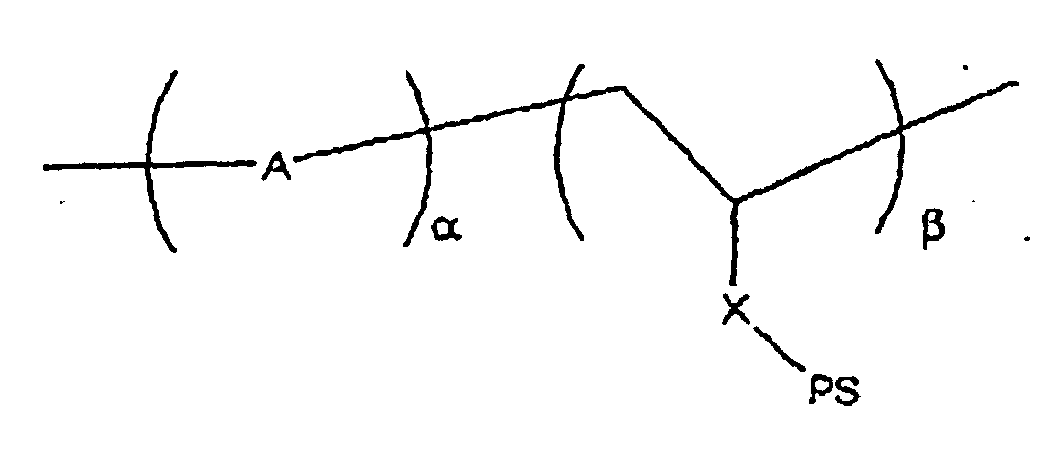
- the present invention provides a water-soluble or water-dispersible polymer having pendant polysaccharide moieties, said polymer is prepared by reacting a functionalized polysaccharide moiety having the structure with at least one ethylenically unsaturated monomer to form a polysaccharide monomer which is polymerized to form a polymer having pendant polysaccharide moieties, said polymer having the structure wherein PS is a polysaccharide; A is a comonomer repeating unit; I is 1; X is a linking group which is formed by reacting a functional group Y on the polysaccharide with a functional group on the ethylenically unsaturated monomer, X is covalently or ionically bonded to the polysaccharide and to a repeating unit which is derived from an ethylenically unsaturated monomer, and X is selected from the group consisting of amine, amide, im
- the invention provides a water-soluble or water dispersible polymer having pendant polysaccaride moieties which is prepared by reacting the functionalized polysaccharide moiety with at least one ethylenically unsaturated monomer to form a polysaccharide monomer which is then polymerized or copolymerized with a comonomer to form the polymer having pendant polysaccharide moieties.
- N-methyl glucamine is reacted with 3-isopropenyl- ⁇ , ⁇ -dimethylbenzyl isocyanate (m-TMI) to form m-TMI-glucamine wherein the linking group X is a urea group.
- m-TMI-glucamine is polymerized to form a polymer having pendant polysaccharide moieties.
- the invention provides a water-soluble or water dispersible polymer having pendant polysaccaride moieties which is prepared by reacting the functionalized polysaccharide moiety with a polymer or copolymer prepared by reacting at least one ethylenically unsaturated monomer and optionally a comonomer.
- maleic anhydride is polymerized with styrene to produce a styrene-maleic anhydride copolymer.
- N-methyl glucamine is reacted with the styrene-maleic anhydride copolymer to form N-methyl glucamide derivative of styrene-maleic anhydride copolymer.
- the invention provides a method of cleaning which involves preparing a cleaning composition comprising the polymer having pendant polysaccharide moieties, contacting the cleaning solution with one or more articles, wherein at least one of the articles contains soil, and removing at least a portion of the soil from the article containing soil.
- the invention provides a method of imparting soil resistance to an article which involves preparing a cleaning composition comprising the polymer having pendant polysaccharide moieties, and contacting the cleaning composition with the article to provide soil resistance to the article.
- the polymers having pendant polysaccharide moieties when used in a cleaning process, remove soil from articles, inhibit soil deposition on articles, and provide soil resistance to articles.
- cleaning compositions containing the polymers having pendant polysaccharide moieties are laundry detergents, prespotters, dishwashing detergents, and hard surface cleaners.
- the polymers having pendant polysaccharide moieties are sufficiently hydrophobic to absorb to an article such as cloth in a washing process yet retain enough hydrophilic character to decrease the hydrophobic nature of an article such as polyester.
- the water-soluble or water-dispersible polymer having pendant polysaccharide moieties has the structure
- PS is a polysaccharide
- A is a repeating unit prepared from a comonomer which is optional
- ⁇ is from 0 to 90 mole percent, preferably from 0 to 75 mole percent, and most preferably from 60 to 40 mole percent
- ⁇ is from 10 to 100 mole percent, preferably from 25 to 100 mole percent, and most preferably from 40 to 60 mole percent
- X is a linking group.
- the water-soluble or water-dispersible polymer having pendant polysaccaride moieties is prepared by reacting a functionalized polysaccharide moiety with an ethylenically unsaturated monomer.
- the functionalized polysaccharide moiety has the structure
- the polysaccaride moiety includes saccharides, oligosacchrides and polysaccharides.
- Suitable saccharides are, for example, starches, hydrolyzed starches, sugars, lactose, maltose, maltodextrins, corn syrup solids, cellulose, hydrolyzed cellulose, dextran, hydrolyzed dextran, guar gum, hydrolyzed guar gum, locust bean gum and hydrolyed locust bean gum.
- Suitable starches include, for example, corn, potato, tapioca, and rice.
- a preferred saccharide is glucose.
- the linking group X is formed by reacting a functional group Y on the polysaccharide with a suitable functional group on the ethylenically unsaturated monomer or polymer.
- suitable functional group means that the functional group on the ethylenically unsaturated monomer or polymer must be capable of reacting with the functional group Y to form the linking group X.
- the linking group X can be any group that covalently or ionically bonds the polysaccharide to the ethylenically unsaturated monomer which can be polymerized to form the polymer of the invention.
- the linking group X can be any group that covalently or ionically bonds a polymer capable of reacting with the functional group Y on the polysaccharide to form the polymer of the invention.
- the linking group X may be selected from an amine, amide, imide, urea, or salt thereof. Any combination of linking groups may be used in the polymers having pendant polysaccaride moieties of the invention.
- X is an amide having the formula -C(O) ⁇ NR ⁇ wherein R is H or a C 1 to C 20 alkyl group, most preferably R is H or methyl.
- the functionalized polysaccharide moiety is selected from N-methyl glucamine, N-methyl lactamine, or N-methyl oligosaccharide.
- I is 1; R 1 is H or is represented by the structure In the structure for R 1 , R 3 is selected from H, C 1 -C 25 alkyl, C 1 -C 25 alkaryl, C 6 -C 25 aryl, -(CH 2 -CHR 5 -O)--, or combinations thereof, and R 5 is selected from H, methyl, ethyl, or benzyl.
- R 2 is H or is represented by the structure In the structure for R 2 , R 4 is selected from H, C 1 -C 25 alkyl, C 1 -C 25 alkaryl, C 6 -C 25 aryl, -(CH 2 -CHR 5 -O)--, or combinations thereof, and R 5 is selected from H, methyl, ethyl, or benzyl.
- the sum of m + n is from 0 to 100.
- the functionalized polysaccharide moiety is prepared by reductive amination with or without a solvent.
- the reductive amination reaction is conducted in water without a cosolvent and involves mixing a saccharide with an amine in water, and then contacting the mixture with pressurized hydrogen in the presence of a Group VIIIB metal catalyst and under conditions effective to produce an amino saccharide.
- Methods for preparing the functionalized polysaccharide are disclosed in US-A- 5,654,198.
- the ethylenically unsaturated monomer must have a functionality which is capable of reacting with the functionalized polysaccharide to form the linking group X.
- the ethylenically unsaturated monomer is selected from anhydrides, vinyl esters, alkyl esters of acrylic and methacrylic acid, substituted or unsubstituted mono and dialkyl esters of unsaturated dicarboxylic acids, unsaturated carboxylic acids, vinyl aromatics, unsubstituted or substituted acrylamides, cyclic monomers, monomers containing alkoxylated side chains, sulfonated monomers, and vinyl amide monomers.
- a combination of ethylenically unsaturated monomers may also be used.
- Suitable anhydride monomers are, for example, maleic anhydride and itaconic anhydride.
- Suitable vinyl esters are, for example, vinyl acetate, vinyl formate, vinyl propionate, vinyl butyrate, vinyl isobutyrate, vinyl valerate, vinyl 2-ethyl-hexanoate, etc.
- Suitable alkyl esters of acrylic and methacrylic acid are, for example, methyl acrylate, methyl methacrylate, ethyl acrylate, ethyl methacrylate, butyl acrylate, etc.
- Suitable substituted or unsubstituted mono and dialkyl esters of unsaturated dicarboxylic acids are, for example, substituted and unsubstituted mono and dibutyl, mono and diethyl maleate esters as well as the corresponding fumarates.
- Suitable unsaturated carboxylic acids are, for example, crotonic acid, acrylic acid, methacrylic acid, fumaric acid, maleic acid, itaconic acid, citraconic acid, and their alkyl esters etc.
- Suitable vinyl aromatic monomers are, for example, 3-isopropenyl- ⁇ , ⁇ -dimethylbenzyl isocyanate, and halogenated styrenes.
- Suitable acrylamide based monomers are, for example, acrylamide, N, N dimethylacrylamide, N-octyl acrylamide, N-methylol acrylamide, dimethylaminoethylacrylate etc.
- Suitable cyclic monomers are, for example, vinyl pyrrolidone, vinyl imidazolidone, vinyl pyridine etc.
- Suitable sulfonated monomers are, for example, 2-acrylamido-2-methyl propane sulfonic acid, sodium methallyl sufonate, sodium vinyl sulfonate, sulfonated sytrene etc.
- Suitable vinyl amidemonomers are, for example, N-vinyl formamide, N-vinyl acetamide etc.
- the ethylenically unsaturated monomer is preferably selected from maleic anhydride, itaconic anhydride, acrylic acid, methacrylic acid, and 3-lsopropenyl- ⁇ , ⁇ -dimethylbenzyl isocyanate.
- the ethylenically unsaturated monomer may be used in conjunction with a comonomer.
- the comonomer has a double bond which is capable of undergoing free radical initiation.
- the comonomer is distinguished from the ethylenically unsaturated monomer in that the comonomer does not necessarily contain a functional group which is capable of reacting with the functionalized polysaccharide to form the linking group X.
- the comonomer may contain a functional group which is capable of reacting with the functionalized polysaccharide but is not reacted with the polysaccharide.
- the comonomer is selected, for example, from vinyl esters, ⁇ -olefins, alkyl esters of acrylic and methacrylic acid, substituted or unsubstituted mono and dialkyl esters of unsaturated dicarboxylic acids, unsaturated carboxylic acids, vinyl aromatics, unsubstituted or substituted acrylamides, sulfonated monomers, and vinyl amide monomers.
- a combination of comonomers may also be used.
- Suitable ⁇ -olefin based monomers are, for example, C 4 to C 20 based alkyl monomers such as 1-octene, butylene, 1 dodecene etc.
- the comonomer may have C 1 -C 25 alkyl side chains and/or alkoxylated side chains.
- the side chains are linked to the comonomer by means of ester or amide linkages.
- Suitable side chains include, for example, polyethylene glycol, polypropylene glycol and alcohol ethoxylates.
- Preferred comonomers include ethylene, styrene, acrylic acid and methacrylic acid.
- the water-soluble or water dispersible polymer having pendant polysaccaride moieties is prepared by reacting the functionalized polysaccharide moiety with at least one ethylenically unsaturated monomer to form a polysaccharide monomer which is then polymerized or copolymerized with a comonomer to form the polymer having pendant polysaccharide moieties.
- N-methyl glucamine is reacted with 3-isopropenyl- ⁇ , ⁇ -dimethylbenzyl isocyanate (m-TMI) to form m-TMI-glucamine wherein the linking group X is a urea group which is formed by the reaction of the functional group Y, the amine on the N-methyl glucamine and the isocyanate group of the m-TMI monomer.
- m-TMI-glucamine is polymerized to form a polymer having pendant polysaccharide moieties.
- a water-soluble or water dispersible polymer having pendant polysaccaride moieties is prepared by reacting the functionalized polysaccharide moiety with a polymer or copolymer prepared by reacting at least one ethylenically unsaturated monomer and optionally a comonomer.
- maleic anhydride which is an ethylenically unsaturated monomer is polymerized with styrene which is a comonomer to produce a styrene-maleic anhydride copolymer.
- N-methyl glucamine is reacted with the styrene-maleic anhydride copolymer to form N-methyl glucamide derivative of styrene-maleic anhydride copolymer. Some of the N-methyl glucamine may form the acid salt of the carboxylic acid which is generated as a byproduct of this reaction.
- the linking group X is an amide or an amine salt of the carboxylic acid.
- glucamine is reacted with the styrene-maleic anhydride copolymer to form a polymer having pendant polysaccharide moieties.
- the linking group X is an imide.
- a water-soluble or water dispersible polymer having pendant polysaccaride moieties is prepared by reacting the functionalized polysaccharide moiety with a modified polymer or copolymer prepared by reacting at least one ethylenically unsaturated monomer and optionally a comonomer.
- modified polymer or copolymer means that the polymer or copolymer is altered to introduce a functional group capable of reacting with the functionalized polysaccharide.
- vinyl acetate is homopolymerized or copolymerized to polyvinyl acetate which is hydrolyzed to polyvinyl alcohol which is reacted with gluconic acid to form a polymer having pendant polysaccharide moieties.
- the linking group X is an ester group.
- N-vinyl formamide is homopolymerized or copolymerized to poly(N-vinyl formamide) which is hydrolyzed to polyvinyl amine which is reacted with gluconic acid to form a polymer having pendant polysaccharide moieties.
- the linking group X is an amide.
- N-vinyl formamide is homopolymerized or copolymerized to poly(N-vinyl formamide) which is hydrolyzed to polyvinyl amine which is reacted with glucose and hydrogenated to form a polymer having pendant polysaccharide moieties.
- the linking group X is an amine.
- the water-soluble or water-dispersible polymers having pendant polysaccharide moieties may be prepared by any number of conventional means well known to those skilled in the art such as bulk, emulsion, suspension, precipitation, or solution polymerization.
- the polymers are prepared by solution polymerization in an aqueous medium in the presence of a free radical initiator.
- a free radical initiator Essentially any type of free radical initiator can be used to initiate the free radical polymerization.
- free radical initiators which are commonly used include the various persulfates, percarbonates, perborates, peroxides, azo compounds, and alkyl perketals.
- free radical initiators are potassium persulfate, ammonium persulfate, sodium persulfate, benzoyl peroxide, hydrogen peroxide, di-t-butyl peroxide, dicumyl peroxide, caproyl peroxide, 2,4-dichlorobenzoyl perooxide, decanoyl peroxide, lauryl peroxide, cumene hydroperoxide, p-menthane hydroperoxide, t-butyl hydroperoxide, acetyl acetone peroxide, dicetyl peroxydicarbonate, t-butyl peroxyacetate, t-butyl peroxymaleic acid, t-butyl peroxybenzoate, acetyl cyclohexyl sulfonyl per
- the amount of free radical initiator employed will vary with the desired molecular weight of the polymer being synthesized. Higher molecular weights are achieved by utilizing smaller quantities of the initiator and lower molecular weights are attained by employing larger quantities of the initiator. However, as a general rule from 0.005 to 10 weight percent, preferably from 0.1 to 4 weight percent, based on total weight of monomer of the initiator will be included in the reaction mixture.
- the polymerization will typically be conducted at a temperature which is within the range of 30°C to 90°C. It is generally preferred for the polymerization to be carried out at a temperature which is with the range of 50°C to 85°C.
- the polymer having pendant polysaccharide moieties may be used in any cleaning composition.
- cleaning means to remove soil from an article, inhibit soil deposition in a cleaning or washing process, or provide soil resistance to an article or combinations thereof.
- Articles which may be cleaned using the polymers having pendant polysaccharide moieties of the present invention are articles which come into contact with soil and which are capable of being cleaned in a cleaning process. Examples of articles which may be cleaned using the polymer having pendant polysaccharide moieties include fabrics, such as clothing, linens, carpets, or upholstery; hard surfaces such as countertops, windows, floors, dishes, glasses or tiles; or automobiles.
- the cleaning composition may be a solid or liquid composition. If the cleaning composition is solid, the cleaning composition may be in any of the usual physical forms, such as for example, powders, beads, flakes, bars, tablets, noodles, pastes, and slurries. If the cleaning composition is liquid, the cleaning composition preferably disperses or solubilizes the polymer having pendant polysaccharide moieties so that it is easily contacted with the article.
- the cleaning composition may be aqueous or nonaqueous.
- the polymer having pendant polysaccharide moieties may be dissolved or dispersed in water, in one or more solvents or inert diluents.
- the cleaning composition is aqueous.
- the cleaning composition preferably contains the polymer having pendant polysaccharide moieties in an amount of from 1 to 60 weight percent, more preferably from 2 to 20 weight percent, based on the total weight of the cleaning composition.
- the cleaning compositions prepared using the polymers having pendant polysaccharide moieties may contain any additional components which are used in cleaning compositions.
- additional components are well known to those skilled in the art and include one or more surfactants, builders, ion exchangers, alkalies, anticorrosion materials, antiredeposition materials, optical brighteners, fragrances, dyes, chelating agents, enzymes, whiteners, brighteners, antistatic agents, sudsing control agents, solvents, hydrotropes, bleaching agents, perfumes, bleach precursors, water, buffering agents, soil removal agents, soil release agents, softening agent, opacifiers, inert diluents, buffering agents, corrosion inhibitors, graying inhibitors, anti-redeposition agents, stabilizers, opacifiers, fillers, builders, phosphate co-builder, and phosphate-replacer builder. Combinations of such additional components may also be used.
- cleaning compositions prepared using the polymers having pendant polysaccharide moieties contain at least one surfactant.
- Suitable surfactants include nonionic, anionic, cationic, and amphoteric surfactants.
- the surfactants usable in the composition may also be soaps.
- Anionic surfactants include, for example, from C 8 to C 12 alkylbenzenesulfonates, from C 12 to C 16 alkanesulfonates, from C 12 to C 16 alkylsulfates, from C 12 to C 16 alkylsulfosuccinates or from C 12 to C 16 sulfated ethoxylated alkanols.
- Nonionic surfactants include, for example, from C 6 to C 12 alkylphenol ethoxylates, from C 12 to C 20 alkanol alkoxylates, and block copolymers of ethylene oxide and propylene oxide.
- the end groups of polyalkylene oxides can be blocked, whereby the free OH groups of the polyalkylene oxides can be etherified, esterified, acetalized and/or aminated.
- Another modification consists of reacting the free OH groups of the polyalkylene oxides with isocyanates.
- the nonionic surfactants also include C 4 to C 18 alkyl glucosides as well as the alkoxylated products obtainable therefrom by alkoxylation, particularly those obtainable by reaction of alkyl glucosides with ethylene oxide.
- Cationic surfactants contain hydrophilic functional groups where the charge of the functional groups are positive when dissolved or dispersed in an aqueous solution.
- Typical cationic surfactants include, for example, amine compounds, oxygen containing amines, and quaternary amine salts.
- Amphoteric surfactants contain both acidic and basic hydrophilic groups.
- Amphoteric surfactants are preferably derivatives of secondary and tertiary amines, derivatives of quaternary ammonium, quaternary phosphonium or tertiary sulfonium compounds.
- the cationic atom in the quaternary compound can be part of a heterocyclic ring.
- the amphoteric surfactant preferably contains at least one aliphatic group, containing 3 to 18 carbon atoms. At least one aliphatic group preferably contains an anionic water-solubilizing group such as a carboxy, sulfonate, or phosphono.
- anionic surfactants such as linear alkyl sulfonates (LAS) are preferred for use in solid cleaning compositions containing the polymers having pendant polysaccharide moieties.
- Nonionic and anionic surfactant mixtures such as alcohol ethoxylates and LAS are preferred in liquid cleaning compositions containing the polymers having pendant polysaccharide moieties.
- the surfactants are optionally present in an amount of from 0 to 50 weight percent, preferably from 2 to 45 weight percent, and more preferably from 5 to 40 weight percent of the cleaning composition.
- builders which may be present in the cleaning composition include, for example, phosphates, such as pyrophophates, polyphosphates, or sodium tripolyphosphate. Further examples are zeolites, sodium carbonate, poly(carboxylic acids), nitrotriacetic acid, citric acid, tartaric acid, the salts of the aforesaid acids and the monomeric, oligomeric, or polymeric phosphonates. Combinations of builders may also be used. The builders are optionally present in an amount of from 0 to 85 weight percent, preferably from 5 to 50 weight percent based on the total weight of the cleaning composition.
- Liquid cleaning compositions containing the polymers having pendant polysaccharide moieties can contain up to 80 weight percent water or solvents or combinations thereof.
- Typical solvents which may be used include oxygen containing solvents such as alcohols, esters, glycol, and glycol ethers.
- Alcohols that may be used in the cleaning compositions include, for example, methanol, ethanol, isopropanol, and tertiary butanol.
- Esters which may be used include, for example, amyl acetate, butyl acetate, ethyl acetate, and esters of glycols.
- Glycols and glycol ethers that are useful as solvents include, for example, ethylene glycol, propylene glycol, and oligomers of ethylene or propylene glycol.
- Solid cleaning compositions containing the polymers having pendant polysaccharide moieties preferably contain up to 60 weight percent of one or more solid inert diluents such as sodium sulfate, sodium chloride, sodium borate, or selected polymers such as polyethylene glycol or propylene glycol.
- solid inert diluents such as sodium sulfate, sodium chloride, sodium borate, or selected polymers such as polyethylene glycol or propylene glycol.
- the cleaning composition may contain 0 to 50 weight percent of one or more buffering agents.
- Buffering agents include, for example, one or more alkali metal salts such as silicates, carbonates, or sulfates. Buffering agents also include, for example, organic alkalis such as triethanolamine, monoethanolamine, and triisopropanolamine.
- Fabric softening agents typically include quaternary ammonium salts such as ditallowdimethyl-ammonium chloride.
- bleaching agents used in an amount of up to 30 weight percent
- corrosion inhibitors such as silicates used in an amount of up to 25 weight percent
- dye deposition inhibiting agents used in an amount up to 20 weight percent
- graying inhibitors used in an amount of up to 5 weight percent.
- Suitable bleaching agents are, for example, perborates, percarbonates, or chlorine-generating substances such as chloroisocyanurates.
- Suitable silicates used as corrosion inhibitors are, for example, sodium silicate, sodium disilicate, and sodium metasilicate.
- Suitable dye deposition inhibiting agents are, for example, polyvinyl pyrrolidone.
- graying inhibitors are, for example, carboxymethylcellulose, methylcellulose, hydroxypropylmethylcellulose, and graft copolymers of vinyl acetate and polyalkylene oxides having a molecular weight of 1,000 to 15,000.
- the cleaning composition containing the polymer having pendant polysaccharide moieties is contacted with one or more articles, where at least one article contains soil. Contacting can be carried out, for example, by immersing the articles in the cleaning composition and agitating the articles in the cleaning composition containing the polymer. Contacting can also be accomplished by wiping, spraying, or padding the cleaning composition on the articles.
- the polymer having pendant polysaccharide moieties is incorporated in a detergent formulation.
- the polymers having pendant polysaccharide moieties are preferably present in an amount of from 0.1 to 25 weight percent, more preferably from 0.5 to 10 weight percent, and most preferably from 1 to 5 weight percent, based on the total weight of the detergent formulation.
- the detergent formulation is a laundry detergent
- the polymers having pendant polysaccharide moieties function to reduce the amount of oily soil that can adhere to the cloth. Subsequent washing of the cloth will remove more soil as a result of the reduced interactions between the soil and the cloth.
- the polymers having pendant polysaccharide moieties are incorporated into a prespotter formulation for direct application to a soiled fabric or carpet.
- the polymers aid in removal of soil from fabric even if the fabric is washed in a laundry detergent which does not contain the polymers.
- the polymers having pendant polysaccharide moieties are preferably present in an amount of from 0.5 to 75 weight percent, more preferably from 1 to 15 weight percent, and most preferably from 2 to 10 weight percent, based on the total weight of the prespotter formulation.
- the polymers having pendant polysaccharide moieties are incorporated into a fabric softening composition.
- the polymers aid in release of soil during fabric softening.
- Styrene-maleic anhydride copolymer resin which is commercially available as SMA 1000 from Elf Atochem, 120 grams, and 120 grams of N-methyl glucamine (Gluc) were added to 1200 grams of water and stirred to form a mixture. The mixture was heated to 95°C and the temperature was maintained for six hours to form a polymer. As the reaction proceeded, the reaction mixture which initially appeared as a white opaque slurry became a clear yellow solution. The percent solids of the polymer was determined to be approximately 17%.
- Example 1 The polymer prepared in Example 1 was evaluated for soil release in a TERG-O-TOMETER test. Three cotton swatches were washed to remove the original textile finish. The initial L, a, and b values for each of the swatches was measured using a Minolta colorimeter. The swatches in each TERG-O-TOMETER were washed using 0.5 g/L of AATCC detergent (American Association of Textile Chemists and Colorists, available from Textile Innovators, Windsor, North Carolina), 18 weight percent polymer based on weight of detergent, 110 ppm hardness water based on MgCI and CaCl, 33.89°C (93°F) and stirred at 80 rpm.
- AATCC detergent American Association of Textile Chemists and Colorists, available from Textile Innovators, Windsor, North Carolina
- the stained swatches were washed using 0.5 g/L of AATCC detergent, 18 weight percent polymer based on weight of detergent, 110 ppm hardness water based on MgCI and CaCl, 33.89°C (93°F) and stirred at 80 rpm. A 20 minute wash and a 3 minute rinse were used. Each of the swatches was dried in a print drier or a standard clothes drier. The L, a and b values for each of the swatches was measured.
- ⁇ E [(L 1 -L 2 ) 2 + (a 1 -a 2 ) 2 + (b 1 -b 2 ) 2 ] 0.5
- the soil release test results for each of the swatches is summarized in Table I. Polymer % soil release Ave % soil release No polymer 52.6 59.3 53.4 48.3 No polymer 60.7 53.4 56.7 56.0 Example 1 54.8 62.8 60.0 62.3 Example 1 66.0 68.5 66.3 64.5
- Example 1 The polymer having pendant polysaccharide moieties as prepared in Example 1 was evaluated for compatibility in WISK which is a commercially available liquid detergent.
- the polymer in an amount of 1 weight percent was added to the liquid detergent.
- the polymer was very compatible in the liquid detergent at room temperature.
- An accelerated aging test was conducted wherein the compatibility of the polymer was determined over one month at 40°C. The test results are summarized in Table II. Polymer Compatibility at 40°C for 1 month Example 1 1 phase
- Example 1 The polymer prepared in Example 1 was evaluated for soil release in a TERG-O-TOMETER test. Three polyester swatches were washed to remove the original textile finish. The initial L, a, and b values for each of the swatches was measured using a Minolta colorimeter. The swatches in each TERG-O-TOMETER were washed using 0.5 g/L of AATCC detergent, 18 weight percent polymer based on weight of detergent, 110 ppm hardness water based on MgCI and CaCl, 33.89°C (93°F) and stirred at 80 rpm. A 20 minute wash and a 3 minute rinse were used.
- Each of the swatches was dried in a print drier or a standard clothes drier and then stained with spaghetti sauce (RAGU traditional). The stains were allowed to set for three hours. The L, a, and b values for each of the stained swatches was measured.
- the stained swatches were washed using 0.5 g/L of AATCC detergent, 110 ppm hardness water based on MgCI and CaCl, 33.89°C (93°F) and stirred at 80 rpm.
- the wash water did not contain any polymer.
- a 20 minute wash and a 3 minute rinse were used.
- Each of the swatches was dried in a print drier or a standard clothes drier.
- the L, a, and b values for each of the swatches was measured. The test results are summarized in Table III.
- Styrene-maleic anhydride resin which is commercially available as SMA 1000 from Elf Atochem, 10 grams, and 15 grams of N-methyl glucamine were added to 70 grams of water and stirred to form a mixture. The mixture was heated to 95°C and the temperature was maintained for six hours to form a polymer. As the reaction proceeded, the reaction mixture which initially appeared as a white opaque slurry became a clear yellow solution. The percent solids of the polymer was determined to be approximately 27.5%.
- the molecular weight of the ethylene-maleic anhydride copolymer was determined as follows. A sample of linear ethylene-maleic anhydride polymer was obtained from Zeeland Chemicals and hydrolyzed prior to measuring the molecular weight. 5.0 grams of the polymer were stirred with 100.0 grams of water and 2.4 grams of 50% sodium hydroxide. The reaction temperature was raised to 60C for 6 hours. A clear solution of the hydrolyzed polymer (ethylene-maleic acid sodium salt) was obtained.
- the molecular weight of this hydrolyzed polymer was then determined by gel permeation chromatography under the following conditions.
- the column bank used were TSK PWxl columns, specifically G4000PWxl, G3000PWxl, and G2500PWxl columns available from Toso-Haas Progel.
- the mobile phase consisted of 0.05M sodium phosphate monobasic and 0.05M sodium phosphate dibasic. This mobile phase was also used as the diluent in the preparation of the standards and the polymer sample, both of which were diluted to one percent total solids content.
- the detector used was a differential refractometer operated at 30 degrees Celsius.
- the polymer was compared to a calibration curve of the following four standards: PAA35K, PAA85K, 130K, and 165K which are pure sodium polyacrylate standards available from American Polymer Standards Corporation.
- the injection volume was 50 microliters with a run time of 45 minutes.
- the ethylene-maleic anhydride copolymer was determined to have a weight average molecular weight of 50,000.
- the ethylene-maleic anhydride copolymer, 10 grams, and 15.7 grams of N-methyl glucamine were added to 50 grams of water and stirred to form a mixture.
- the mixture was heated to 50°C and the temperature was maintained for seven hours to form a polymer.
- the reaction mixture which initially appeared as a white opaque slurry became a clear solution.
- the percent solids of the polymer was determined to be approximately 18.2.
- Styrene-maleic anhydride resin which is commercially available as SMA 1000 from Elf Atochem, 10.0 grams, and 8.0 grams of N-methyl glucamine, and 2.0 grams of Jeffamine XTJ 505, which is available from Huntsman Corp., were added to 50 grams of water and stirred to form a mixture. The mixture was heated to 95°C and the temperature was maintained for six hours to form a polymer. As the reaction proceeded, the reaction mixture which initially appeared as a white opaque slurry became a slightly opaque low viscosity solution. The percent solids of the polymer was determined to be approximately 37.1.
- Styrene-maleic anhydride resin which is commercially available as SMA 1000 from Elf Atochem, 10.0 grams, and 6.0 grams of N-methyl glucamine, and 4.0 grams of Jeffamine XTJ 505 were added to 100 grams of water and stirred to form a mixture. The mixture was heated to 90°C and the temperature was maintained for six hours to form a polymer. As the reaction proceeded, the reaction mixture which initially appeared as a white opaque slurry became a white slightly opaque low viscosity solution. The percent solids of the polymer was determined to be approximately 18.
- the polymers prepared in Examples 5, 6, 7 and 8 were evaluated for soil release in a TERG-O-TOMETER test according to the procedure set forth in Example 2.
- the results of the soil release tests are summarized in Table V. Polymer Ave % soil release None 37.7 SRP4 43.7 Example 1 44.9 Example 5 31.0 Example 6 54.7 Example 7 52.2
- the results in Table 5 show that the polymers prepared in Examples 5, 6, 7 and 8 exhibit excellent soil release properties due to the higher values which show better soil release or the greater percentage of stain removed.
- the soil release properties of the polymers having pendant polysaccharide moieties prepared in Examples 6 and 7 are significantly better than the commercial polyester soil release agents such as SRP4 available from Rhone Poulenc.
- the polymer prepared in Examples 1 was added to an ironing aid prepared from polyacrylic acid and dihydroxyethyl urea crosslinker and evaluated as to whether it improves the soil resistance of the ironing aid.
- Three swatches were ironed with an ironing aid containing a mixture of 4 weight percent, based on the weight of the total ironing aid, of ALCOSPERSE-602A, a sodium polyacrylate industry standard which is commercially available from Alco Chemical located in Chattanooga, TN, and 12 weight percent, based on the weight of ALCOSPERSE-602A, of dihydroxy ethyl urea.
- the swatches were stained and washed using 0.9 g/L of AATCC detergent, 110 ppm hardness water, 33.89°C (93°F) and stirred at 80 rpm.
- the wash cycle had a 10 minute wash and a 5 minute rinse.
- the polymers prepared in Examples 1 and 6 were evaluated in a prespotter test. Two grams of each of the polymers was applied and spread over a dust-sebum stain on cotton swatches and polyester swatches. The stains were allowed to set overnight. Two control swatches were also prepared which did not contain any polymer. Each of the swatches were washed in 0.9 g/L of AATCC detergent, 110 ppm hardness water, at 33.89°C (93°F) and stirred at 80 rpm. The wash cycle had a 10 minute wash and a 5 minute rinse.
- Example 6 The L, a, and b values for each of the swatches prior to treating with the polymers and after washing were measured and the ⁇ E values were calculated by the method set forth in Example 2. The test results are summarized in Table VIII. Polymer ⁇ E for dust-sebum on cotton None 7.9 Example 1 13.9 Example 6 9.6
- N-methyl glucamine 64 grams, was dissolved in 336 grams of tap water and added to a reaction vessel.
- 3-Isopropenyl- ⁇ , ⁇ -dimethylbenzyl isocyanate available from Cytec Industries (m-TMI) 72 grams, was added to the reaction vessel and the mixture was stirred vigorously at ambient temperature for about 16 hours to form a reaction product.
- the reaction product was filtered and the aqueous solution was analyzed IR and NMR. The analysis indicated that the TMI-N-methyl glucamine had been synthesized.
- the TMI-N-methyl glucamine can be copolymerized by methods known to those skilled in the art.
Landscapes
- Chemical & Material Sciences (AREA)
- Organic Chemistry (AREA)
- Chemical Kinetics & Catalysis (AREA)
- Wood Science & Technology (AREA)
- Life Sciences & Earth Sciences (AREA)
- Engineering & Computer Science (AREA)
- Oil, Petroleum & Natural Gas (AREA)
- Polymers & Plastics (AREA)
- Medicinal Chemistry (AREA)
- Health & Medical Sciences (AREA)
- Detergent Compositions (AREA)
- Compositions Of Macromolecular Compounds (AREA)
- Addition Polymer Or Copolymer, Post-Treatments, Or Chemical Modifications (AREA)
- Treatments For Attaching Organic Compounds To Fibrous Goods (AREA)
Claims (7)
- Polymère hydrosoluble ou dispersable dans l'eau, comprenant des groupements polysaccharidiques appendus, ledit polymère étant préparé en faisant réagir un groupement polysaccharidique fonctionnalisé de structureavec au moins un monomère à insaturation éthylénique pour former un monomère polysaccharidique qui est polymérisé pour former un polymère comprenant des groupements polysaccharidiques appendus, de structure
 structures dans lesquelles PS représente un polysaccharide ; A représente un motif répété comonomère ; 1 est égal à 1 ; X représente un groupe de liaison qui est formé en faisant réagir un groupe fonctionnel Y sur le polysaccharide avec un groupe fonctionnel sur le monomère à insaturation éthylénique, X est lié par covalence ou ioniquement au polysaccharide et à un motif répété qui est dérivé d'un monomère à insaturation éthylénique, et X est choisi dans le groupe consistant en une amine, un amide, un imide, l'urée et leurs sels ; α a une valeur de 0 à 90% en mole, β a une valeur de 10 à 100% en mole ; R1 représente H ou est représenté par la structure
 et R2 représente H ou est représenté par la structure
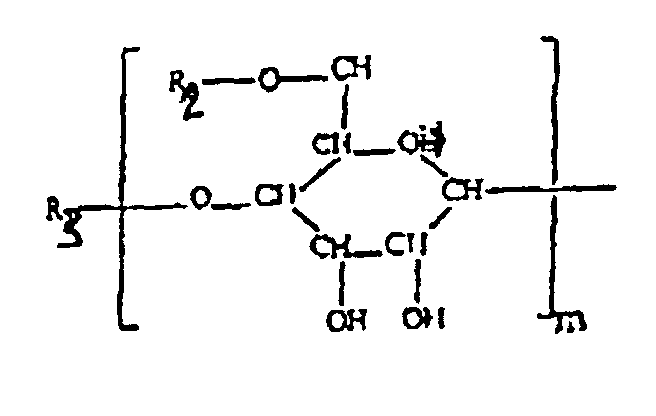 structures dans lesquelles R3 et R4 sont choisis indépendamment dans le groupe consistant en H, des groupes alkyle en C1 à C25, alkaryl en C1 à C25, aryle en C6 à C25, -(CH2-CHR5-O)- et leurs associations, R5 est choisi dans le groupe consistant en H, les groupes méthyle, éthyle et benzyle ; la somme m + n a une valeur de 0 à 100.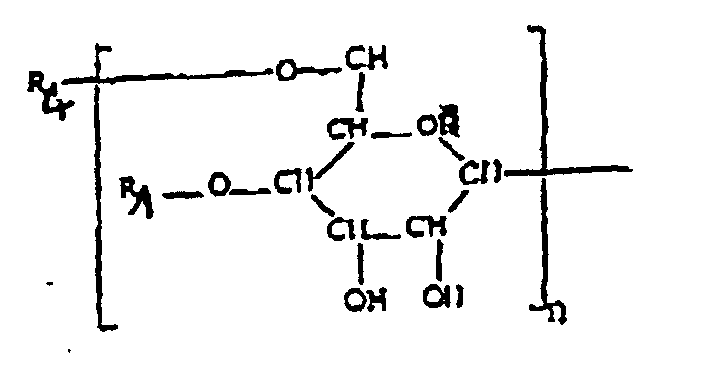
- Polymère hydrosoluble ou dispersable dans l'eau comprenant des groupements polysaccharidiques appendus, ledit polymère étant préparé en faisant réagir des acrylamides fonctionnalisés non substitués ou substitués des monomères contenant des chaínes latérales alkoxylées, des monomères sulfonés, des monomères amide vinylique et leurs associations.
- Polymère suivant la revendication 1, dans lequel le comonomère est choisi dans le groupe consistant en des esters vinyliques, des α-oléfines, des esters alkyliques d'acide acrylique et d'acide méthacrylique, des esters mono-dialkyliques, substitués ou non substitués, d'acides dicarboxyliques insaturés, des acides carboxyliques insaturés, des comonomères vinyl-aromatiques, des acrylamides substitués ou non substitués, des monomères sulfonés, des monomères vinyl-amides et leurs associations.
- Polymère suivant la revendication 1, dans lequel le polysaccharide fonctionnalisé est préparé à partir d'un saccharide qui est choisi dans le groupe consistant en des amidons, des amidons hydrolysés, le lactose, le maltose, les maltodextrines, le sirop de glucose déshydraté, la cellulose, la cellulose hydrolysée, le dextrane, le dextrane hydrolysé, la gomme guar, la gomme guar hydrolysée, la gomme de caroube, la gomme de caroube hydrolysée et leurs associations.
- Procédé de nettoyage, comprenant la préparation d'une composition nettoyante comprenant le polymère comportant des groupements polysaccharidiques appendus suivant la revendication 1, la mise en contact de la composition nettoyante avec un ou plusieurs articles, au moins un des articles portant des salissures, et l'élimination d'au moins une partie des salissures de l'article portant des salissures.
- Procédé pour conférer à un article une résistance aux salissures, comprenant la préparation d'une composition nettoyante dotée du polymère comportant des groupements polysaccharidiques appendus suivant la revendication 1, et la mise en contact de la composition nettoyante avec un article pour conférer à cet article une résistance aux salissures.
- Procédé pour conférer un assouplissement d'étoffe à un article, comprenant la préparation d'une composition d'assouplissement d'étoffe renfermant le polymère comportant des groupements polysaccharidiques appendus suivant la revendication 1, et la mise en contact de la composition d'assouplissement d'étoffe avec un article pour conférer un assouplissement d'étoffe à l'article.
Applications Claiming Priority (2)
| Application Number | Priority Date | Filing Date | Title |
|---|---|---|---|
| US09/025,002 US5977275A (en) | 1998-02-17 | 1998-02-17 | Polymers having pendant polysaccharide moieties and uses thereof |
| US25002 | 1998-02-17 |
Publications (2)
| Publication Number | Publication Date |
|---|---|
| EP0936224A1 EP0936224A1 (fr) | 1999-08-18 |
| EP0936224B1 true EP0936224B1 (fr) | 2003-07-02 |
Family
ID=21823504
Family Applications (1)
| Application Number | Title | Priority Date | Filing Date |
|---|---|---|---|
| EP99101800A Expired - Lifetime EP0936224B1 (fr) | 1998-02-17 | 1999-02-17 | Polymères à chaines latérales de polysaccharides et leurs applications |
Country Status (6)
| Country | Link |
|---|---|
| US (1) | US5977275A (fr) |
| EP (1) | EP0936224B1 (fr) |
| JP (1) | JP3222852B2 (fr) |
| AU (1) | AU762887B2 (fr) |
| CA (1) | CA2262119A1 (fr) |
| DE (1) | DE69909151T2 (fr) |
Cited By (2)
| Publication number | Priority date | Publication date | Assignee | Title |
|---|---|---|---|---|
| US9351910B2 (en) | 2011-08-24 | 2016-05-31 | Conopco, Inc. | Benefit agent delivery particles comprising dextran |
| CN106661515A (zh) * | 2014-09-15 | 2017-05-10 | 宝洁公司 | 包含聚醚胺和聚合酸的盐的洗涤剂组合物 |
Families Citing this family (37)
| Publication number | Priority date | Publication date | Assignee | Title |
|---|---|---|---|---|
| US5962400A (en) * | 1998-12-22 | 1999-10-05 | National Starch And Chemical Investment Holding Corporation | Amino acid copolymers having pendent polysaccharide moieties and uses thereof |
| US6207594B1 (en) * | 1999-01-11 | 2001-03-27 | Trichromatic Carpet Inc. | Polyamide substrate having stain resistance, composition and method |
| GB0117767D0 (en) | 2001-07-20 | 2001-09-12 | Unilever Plc | Polymers and their synthesis |
| GB0117768D0 (en) | 2001-07-20 | 2001-09-12 | Unilever Plc | Use of polymers in fabrics cleaning |
| WO2003011998A1 (fr) * | 2001-07-31 | 2003-02-13 | Asahi Glass Company, Limited | Agents resistant aux taches, compositions de revetement contenant ceux-ci et articles revetus |
| GB0229806D0 (en) | 2002-12-20 | 2003-01-29 | Unilever Plc | Fabric care composition |
| GB0301022D0 (en) * | 2003-01-16 | 2003-02-19 | Unilever Plc | Detergent compositions |
| GB0301020D0 (en) * | 2003-01-16 | 2003-02-19 | Unilever Plc | Detergent composition |
| US9321873B2 (en) | 2005-07-21 | 2016-04-26 | Akzo Nobel N.V. | Hybrid copolymer compositions for personal care applications |
| NO20073821L (no) | 2006-07-21 | 2008-01-22 | Akzo Nobel Chemicals Int Bv | Podede kopolymerer med lav molekylvekt |
| US8674021B2 (en) | 2006-07-21 | 2014-03-18 | Akzo Nobel N.V. | Sulfonated graft copolymers |
| PT2582761E (pt) * | 2010-06-17 | 2015-06-19 | Basf Se | Composições de agente ligante aquoso |
| WO2012022034A1 (fr) | 2010-08-18 | 2012-02-23 | Unilever Plc | Améliorations apportées à des compositions de traitement des tissus comprenant des agents améliorants cibles |
| AU2010363642B2 (en) * | 2010-11-10 | 2014-07-24 | Colgate-Palmolive Company | Fabric conditioners containing soil releasing polymer |
| US8679366B2 (en) | 2011-08-05 | 2014-03-25 | Ecolab Usa Inc. | Cleaning composition containing a polysaccharide graft polymer composition and methods of controlling hard water scale |
| US8853144B2 (en) | 2011-08-05 | 2014-10-07 | Ecolab Usa Inc. | Cleaning composition containing a polysaccharide graft polymer composition and methods of improving drainage |
| US8636918B2 (en) | 2011-08-05 | 2014-01-28 | Ecolab Usa Inc. | Cleaning composition containing a polysaccharide hybrid polymer composition and methods of controlling hard water scale |
| US8841246B2 (en) | 2011-08-05 | 2014-09-23 | Ecolab Usa Inc. | Cleaning composition containing a polysaccharide hybrid polymer composition and methods of improving drainage |
| PH12014500306A1 (en) * | 2011-08-24 | 2014-03-31 | Unilever Nv | Improvements relating to targeted benefit agents and substrate treatment compositions |
| MX2014005094A (es) | 2011-11-04 | 2014-08-08 | Akzo Nobel Chemicals Int Bv | Copolimeros de dendrita hibridos, composiciones de los mismos y metodos para producirlos. |
| JP2014532792A (ja) | 2011-11-04 | 2014-12-08 | アクゾ ノーベル ケミカルズ インターナショナル ベスローテン フエンノートシャップAkzo Nobel Chemicals International B.V. | グラフト樹状コポリマー及びそれを製造する方法 |
| US8945314B2 (en) | 2012-07-30 | 2015-02-03 | Ecolab Usa Inc. | Biodegradable stability binding agent for a solid detergent |
| EP2880144B1 (fr) * | 2012-08-03 | 2024-05-01 | Ecolab USA Inc. | Agent de liaison de stabilité biodégradable pour un détergent solide |
| US9365805B2 (en) | 2014-05-15 | 2016-06-14 | Ecolab Usa Inc. | Bio-based pot and pan pre-soak |
| DE102014012020A1 (de) * | 2014-08-13 | 2016-02-18 | Clariant International Ltd. | VOC-arme Amine als oberflächenaktiver Bestandteil in Dispersionen |
| US9631163B2 (en) | 2014-09-25 | 2017-04-25 | The Procter & Gamble Company | Liquid laundry detergent composition |
| JP6396583B2 (ja) | 2014-09-25 | 2018-09-26 | ザ プロクター アンド ギャンブル カンパニー | ポリエーテルアミンを含有する洗浄組成物 |
| US9752101B2 (en) | 2014-09-25 | 2017-09-05 | The Procter & Gamble Company | Liquid laundry detergent composition |
| DE102016223588A1 (de) | 2016-11-28 | 2018-05-30 | Clariant International Ltd | Copolymere und deren verwendung in reinigungsmittel-zusammensetzungen |
| DE102016223586A1 (de) | 2016-11-28 | 2018-05-30 | Clariant International Ltd | Copolymere und deren verwendung in reinigungsmittel-zusammensetzungen |
| DE102016223584A1 (de) | 2016-11-28 | 2018-05-30 | Clariant International Ltd | Copolymer enthaltende waschmittelzusammensetzungen |
| DE102016223590A1 (de) | 2016-11-28 | 2018-05-30 | Clariant International Ltd | Copolymer enthaltende reinigungsmittelzusammensetzungen |
| DE102016223585A1 (de) | 2016-11-28 | 2018-05-30 | Clariant International Ltd | Copolymere und deren verwendung in waschmittel-zusammensetzungen |
| US10897045B2 (en) * | 2018-04-11 | 2021-01-19 | Ut-Battelle, Llc | Crosslinked functional binders and their use in silicon-containing anodes of lithium-ion batteries |
| US20240376292A1 (en) * | 2021-04-06 | 2024-11-14 | Carbonet Nanotechnologies Inc. | Compositions and methods for removing boron from aqueous solutions |
| CN114262413B (zh) * | 2021-12-31 | 2023-12-29 | 江苏富淼科技股份有限公司 | 一种印染皂洗助剂及其制备方法 |
| CN114989344B (zh) * | 2022-06-14 | 2023-09-19 | 万华化学集团股份有限公司 | 一种偏氟乙烯共聚物及其制备方法和在锂离子电池中的应用 |
Family Cites Families (2)
| Publication number | Priority date | Publication date | Assignee | Title |
|---|---|---|---|---|
| IT1230862B (it) * | 1989-06-06 | 1991-11-08 | Ausidet Spa | Copolimeri idrosolubili dell'anidride maleica. |
| US5654198A (en) * | 1995-06-05 | 1997-08-05 | National Starch And Chemical Investment Holding Corporation | Detectable water-treatment polymers and methods for monitoring the concentration thereof |
-
1998
- 1998-02-17 US US09/025,002 patent/US5977275A/en not_active Expired - Lifetime
-
1999
- 1999-02-09 AU AU15492/99A patent/AU762887B2/en not_active Ceased
- 1999-02-16 CA CA002262119A patent/CA2262119A1/fr not_active Abandoned
- 1999-02-17 EP EP99101800A patent/EP0936224B1/fr not_active Expired - Lifetime
- 1999-02-17 DE DE69909151T patent/DE69909151T2/de not_active Expired - Fee Related
- 1999-02-17 JP JP03803499A patent/JP3222852B2/ja not_active Expired - Fee Related
Cited By (3)
| Publication number | Priority date | Publication date | Assignee | Title |
|---|---|---|---|---|
| US9351910B2 (en) | 2011-08-24 | 2016-05-31 | Conopco, Inc. | Benefit agent delivery particles comprising dextran |
| CN106661515A (zh) * | 2014-09-15 | 2017-05-10 | 宝洁公司 | 包含聚醚胺和聚合酸的盐的洗涤剂组合物 |
| CN106661515B (zh) * | 2014-09-15 | 2019-08-13 | 宝洁公司 | 包含聚醚胺和聚合酸的盐的洗涤剂组合物 |
Also Published As
| Publication number | Publication date |
|---|---|
| JPH11322840A (ja) | 1999-11-26 |
| CA2262119A1 (fr) | 1999-08-17 |
| DE69909151D1 (de) | 2003-08-07 |
| JP3222852B2 (ja) | 2001-10-29 |
| EP0936224A1 (fr) | 1999-08-18 |
| US5977275A (en) | 1999-11-02 |
| AU762887B2 (en) | 2003-07-10 |
| AU1549299A (en) | 1999-09-02 |
| DE69909151T2 (de) | 2004-04-29 |
Similar Documents
| Publication | Publication Date | Title |
|---|---|---|
| AU762887B2 (en) | Polymers having pendant polysaccharide moieties and uses thereof | |
| US6211299B1 (en) | In situ solvent free method for making anhydride based graft copolymers | |
| CA1269013A (fr) | Detergents renfermant de copolymeres de greffe de poly(oxydes d'alcoylene) et d'acetate de vinyle, agents antiredeposition | |
| US6160110A (en) | Amino acid copolymers having pendent polysaccharide moieties and uses thereof | |
| EP0523950B1 (fr) | Utilisation des copolymères de l'acide acrylique et l'acrylate d'éthyle dans des détergents liquides pour l'amélioration de l'enlèvement des taches | |
| JPH01185398A (ja) | 洗剤組成物 | |
| AU5355599A (en) | Polymer compositions and a method of promoting soil release from fabrics using said polymer compositions | |
| CA2544053C (fr) | Copolymeres hydrosolubles de monomeres d'oxyde de polyalkylene insatures et de monomeres dipolaires contenant au moins un atome d'azote | |
| JP4461025B2 (ja) | モノエチレン系不飽和ジカルボン酸無水物、ビニル芳香族化合物及びヘテロ原子を含有する別のモノエチレン系不飽和モノマーの部分的にエステル化されたコポリマー | |
| EP3347446B1 (fr) | Composition stable de blanchisserie ou de nettoyage, procédé pour la préparer, et procédé d'utilisation | |
| KR19980029347A (ko) | 폴리카복시산염 중합체 첨가제 조성물, 이를 함유하는 세제 조성물 및 이를 이용한 세정방법 | |
| AU718027B2 (en) | Washing composition and use of polymer to clean and provide soil resistance to an article | |
| EP0945501B1 (fr) | Détergents lessives contenant les copolymères de styrène-anhydride greffés avec polyéthylèneglycol | |
| EP1020485B1 (fr) | Copolymères polyéther-hydroxycarboxylate | |
| AU1549099A (en) | Ethylene-maleic anhydride derivatives and their uses | |
| US5789369A (en) | Modified polyacrylic acid polymers for anti-redeposition performance | |
| WO2013014150A1 (fr) | Compositions de détergent à lessive dotées de propriétés de détachage | |
| MXPA99011877A (en) | Copolymers of poly hidroxicarboxylate |
Legal Events
| Date | Code | Title | Description |
|---|---|---|---|
| PUAI | Public reference made under article 153(3) epc to a published international application that has entered the european phase |
Free format text: ORIGINAL CODE: 0009012 |
|
| AK | Designated contracting states |
Kind code of ref document: A1 Designated state(s): AT BE CH CY DE DK ES FI FR GB GR IE IT LI LU MC NL PT SE |
|
| AX | Request for extension of the european patent |
Free format text: AL;LT;LV;MK;RO;SI |
|
| 17P | Request for examination filed |
Effective date: 20000203 |
|
| AKX | Designation fees paid |
Free format text: CH DE ES FR GB LI NL SE |
|
| 17Q | First examination report despatched |
Effective date: 20000831 |
|
| GRAH | Despatch of communication of intention to grant a patent |
Free format text: ORIGINAL CODE: EPIDOS IGRA |
|
| GRAH | Despatch of communication of intention to grant a patent |
Free format text: ORIGINAL CODE: EPIDOS IGRA |
|
| GRAA | (expected) grant |
Free format text: ORIGINAL CODE: 0009210 |
|
| AK | Designated contracting states |
Designated state(s): CH DE ES FR GB LI NL SE |
|
| PG25 | Lapsed in a contracting state [announced via postgrant information from national office to epo] |
Ref country code: NL Free format text: LAPSE BECAUSE OF FAILURE TO SUBMIT A TRANSLATION OF THE DESCRIPTION OR TO PAY THE FEE WITHIN THE PRESCRIBED TIME-LIMIT Effective date: 20030702 Ref country code: LI Free format text: LAPSE BECAUSE OF FAILURE TO SUBMIT A TRANSLATION OF THE DESCRIPTION OR TO PAY THE FEE WITHIN THE PRESCRIBED TIME-LIMIT Effective date: 20030702 Ref country code: CH Free format text: LAPSE BECAUSE OF FAILURE TO SUBMIT A TRANSLATION OF THE DESCRIPTION OR TO PAY THE FEE WITHIN THE PRESCRIBED TIME-LIMIT Effective date: 20030702 |
|
| REG | Reference to a national code |
Ref country code: GB Ref legal event code: FG4D |
|
| REG | Reference to a national code |
Ref country code: CH Ref legal event code: EP |
|
| REF | Corresponds to: |
Ref document number: 69909151 Country of ref document: DE Date of ref document: 20030807 Kind code of ref document: P |
|
| PG25 | Lapsed in a contracting state [announced via postgrant information from national office to epo] |
Ref country code: SE Free format text: LAPSE BECAUSE OF FAILURE TO SUBMIT A TRANSLATION OF THE DESCRIPTION OR TO PAY THE FEE WITHIN THE PRESCRIBED TIME-LIMIT Effective date: 20031002 |
|
| PG25 | Lapsed in a contracting state [announced via postgrant information from national office to epo] |
Ref country code: ES Free format text: LAPSE BECAUSE OF FAILURE TO SUBMIT A TRANSLATION OF THE DESCRIPTION OR TO PAY THE FEE WITHIN THE PRESCRIBED TIME-LIMIT Effective date: 20031013 |
|
| NLV1 | Nl: lapsed or annulled due to failure to fulfill the requirements of art. 29p and 29m of the patents act | ||
| REG | Reference to a national code |
Ref country code: CH Ref legal event code: PL |
|
| PG25 | Lapsed in a contracting state [announced via postgrant information from national office to epo] |
Ref country code: GB Free format text: LAPSE BECAUSE OF NON-PAYMENT OF DUE FEES Effective date: 20040217 |
|
| ET | Fr: translation filed | ||
| PLBE | No opposition filed within time limit |
Free format text: ORIGINAL CODE: 0009261 |
|
| 26N | No opposition filed |
Effective date: 20040405 |
|
| PG25 | Lapsed in a contracting state [announced via postgrant information from national office to epo] |
Ref country code: DE Free format text: LAPSE BECAUSE OF NON-PAYMENT OF DUE FEES Effective date: 20040901 |
|
| GBPC | Gb: european patent ceased through non-payment of renewal fee |
Effective date: 20040217 |
|
| PG25 | Lapsed in a contracting state [announced via postgrant information from national office to epo] |
Ref country code: FR Free format text: LAPSE BECAUSE OF NON-PAYMENT OF DUE FEES Effective date: 20041029 |
|
| REG | Reference to a national code |
Ref country code: FR Ref legal event code: ST |