EP0936261A2 - Wärmehärtbare Beschichtungsmasse - Google Patents
Wärmehärtbare Beschichtungsmasse Download PDFInfo
- Publication number
- EP0936261A2 EP0936261A2 EP99100926A EP99100926A EP0936261A2 EP 0936261 A2 EP0936261 A2 EP 0936261A2 EP 99100926 A EP99100926 A EP 99100926A EP 99100926 A EP99100926 A EP 99100926A EP 0936261 A2 EP0936261 A2 EP 0936261A2
- Authority
- EP
- European Patent Office
- Prior art keywords
- branched
- alkyl linear
- coating compositions
- bisphenol
- acid
- Prior art date
- Legal status (The legal status is an assumption and is not a legal conclusion. Google has not performed a legal analysis and makes no representation as to the accuracy of the status listed.)
- Granted
Links
Classifications
-
- C—CHEMISTRY; METALLURGY
- C09—DYES; PAINTS; POLISHES; NATURAL RESINS; ADHESIVES; COMPOSITIONS NOT OTHERWISE PROVIDED FOR; APPLICATIONS OF MATERIALS NOT OTHERWISE PROVIDED FOR
- C09D—COATING COMPOSITIONS, e.g. PAINTS, VARNISHES OR LACQUERS; FILLING PASTES; CHEMICAL PAINT OR INK REMOVERS; INKS; CORRECTING FLUIDS; WOODSTAINS; PASTES OR SOLIDS FOR COLOURING OR PRINTING; USE OF MATERIALS THEREFOR
- C09D167/00—Coating compositions based on polyesters obtained by reactions forming a carboxylic ester link in the main chain; Coating compositions based on derivatives of such polymers
-
- C—CHEMISTRY; METALLURGY
- C09—DYES; PAINTS; POLISHES; NATURAL RESINS; ADHESIVES; COMPOSITIONS NOT OTHERWISE PROVIDED FOR; APPLICATIONS OF MATERIALS NOT OTHERWISE PROVIDED FOR
- C09D—COATING COMPOSITIONS, e.g. PAINTS, VARNISHES OR LACQUERS; FILLING PASTES; CHEMICAL PAINT OR INK REMOVERS; INKS; CORRECTING FLUIDS; WOODSTAINS; PASTES OR SOLIDS FOR COLOURING OR PRINTING; USE OF MATERIALS THEREFOR
- C09D163/00—Coating compositions based on epoxy resins; Coating compositions based on derivatives of epoxy resins
-
- C—CHEMISTRY; METALLURGY
- C08—ORGANIC MACROMOLECULAR COMPOUNDS; THEIR PREPARATION OR CHEMICAL WORKING-UP; COMPOSITIONS BASED THEREON
- C08K—Use of inorganic or non-macromolecular organic substances as compounding ingredients
- C08K3/00—Use of inorganic substances as compounding ingredients
- C08K3/01—Use of inorganic substances as compounding ingredients characterized by their specific function
- C08K3/014—Stabilisers against oxidation, heat, light or ozone
-
- C—CHEMISTRY; METALLURGY
- C08—ORGANIC MACROMOLECULAR COMPOUNDS; THEIR PREPARATION OR CHEMICAL WORKING-UP; COMPOSITIONS BASED THEREON
- C08K—Use of inorganic or non-macromolecular organic substances as compounding ingredients
- C08K5/00—Use of organic ingredients
- C08K5/04—Oxygen-containing compounds
- C08K5/07—Aldehydes; Ketones
- C08K5/08—Quinones
-
- C—CHEMISTRY; METALLURGY
- C09—DYES; PAINTS; POLISHES; NATURAL RESINS; ADHESIVES; COMPOSITIONS NOT OTHERWISE PROVIDED FOR; APPLICATIONS OF MATERIALS NOT OTHERWISE PROVIDED FOR
- C09D—COATING COMPOSITIONS, e.g. PAINTS, VARNISHES OR LACQUERS; FILLING PASTES; CHEMICAL PAINT OR INK REMOVERS; INKS; CORRECTING FLUIDS; WOODSTAINS; PASTES OR SOLIDS FOR COLOURING OR PRINTING; USE OF MATERIALS THEREFOR
- C09D5/00—Coating compositions, e.g. paints, varnishes or lacquers, characterised by their physical nature or the effects produced; Filling pastes
- C09D5/03—Powdery paints
- C09D5/031—Powdery paints characterised by particle size or shape
Definitions
- thermosetting coating compositions also called powder coatings, consisting of a carboxyl-functional polyester, and an epoxy resin and a special stabilizer.
- Powder coatings based on carboxyl-functional polyesters and epoxy resins based on bisphenol A and epichlorohydrin have excellent mechanical properties Properties, but only little weather stability and are therefore for use in Not suitable for outdoor use.
- a disadvantage of powder coatings that act as binders carboxyl-functional polyesters and epoxy resins Based on bisphenol A and epichlorohydrin is included further the lower resistance to yellowing in direct gas and / or oil heated furnaces compared to electrically heated oven.
- direct gas and / or Oil-heated ovens are the coated parts during of the hardening process in direct contact with the combustion gases of the gas and / or oil heated Burner.
- the aim of the present invention is to overcome this disadvantage the lower stability of powder coatings, the as binders carboxyl functional polyesters and Epoxy resins based on bisphenol A and epichlorohydrin contained in directly gas and / or oil heated ovens to eliminate and a corresponding powder coating and propose a process for its manufacture.
- Compounds I - X are especially hydroquinone, Toluhydroquinone and Mono.tert.-butylhydroquinone prefers.
- Suitable carboxyl-functional polyesters can according to the condensation process known for polyesters (Esterification and / or transesterification) according to the status of Technology. Also suitable catalysts, such as. Dibutyltin oxide or titanium tetrabutylate, can be used if necessary.
- Carboxyl-functional copolyesters contain acid components mainly aromatic polybasic Carboxylic acids, e.g. Terephthalic acid, isophthalic acid, Phthalic acid, pyromellitic acid, trimellitic acid, 3,6-dichlorophthalic acid, tetrachlorophthalic acid and - where available - their anhydride, chloride or Esters. Usually they contain at least 50 mol% Terephthalic acid and / or isophthalic acid, preferred 80 mol%. The rest of the acids (difference to 100 mol%) consists of aliphatic and / or cycloaliphatic polybasic acids, e.g.
- 1,4-cyclohexanedicarboxylic acid Tetrahydrophthalic acid, hexahydroendomethylene terephthalic acid, Hexachlorophthalic acid, azelaic acid, Sebacic acid, decanedicarboxylic acid, adipic acid, Dodecanedicarboxylic acid, succinic acid, maleic acid or dimeric fatty acids.
- Hydroxy carboxylic acids and / or lactones e.g. 12-hydroxystearic acid, Epsilon-caprolactone or hydroxypivalic acid ester of Neopentyl glycol can also be used.
- Monocarboxylic acids such as e.g. Benzoic acid, tertiary butylbenzoic acid, hexahydrobenzoic acid and saturated aliphatic monocarboxylic acids, for use.
- Suitable alcohol components are aliphatic Called diols, e.g. Ethylene glycol, 1,3-propanediol, 1,2-propanediol, 1,2-butanediol, 1,3-butanediol, 1,4-butanediol, 2,2-dimethyl-propanediol-1,3 (neopentylglycol), 2,5-hexanediol, 1,6-hexanediol, 2,2- [bis (4-hydroxycyclohexyl)] propane, 1,4-dimethylolcyclohexane, Diethylene glycol, dipropylene glycol and 2,2-bis [4- (2-hydroxy)] phenylpropane.
- Ethylene glycol 1,3-propanediol, 1,2-propanediol, 1,2-butanediol, 1,3-butanediol, 1,4-butanedio
- polyols are also used, e.g. Glycerol, Hexanetriol, pentaeryltritol, sorbitol, trimethylolethane, Trimethylolpropane and tris (2-hydroxy) isocyanurate.
- Epoxy compounds can also be used instead of diols or polyols can be used.
- The is preferably Proportion of neopentyl glycol and / or propylene glycol in the alcohol component at least 50 mol%, based on total acids.
- the epoxy resins based on bisphenol A and Epichlorohydrin are e.g. Diglycidyl ether of bisphenol A and its higher addition products.
- Epoxy resins such as Grilonit-Harz® from EMS-Chemie AG, Epikote-Harze® from Shell, Araldit-Harze® from Ciba and DER Resins® from Dow Chem. Corp.
- these resins usually have an average molecular weight between 300 and 4000 and an epoxide equivalent weight between 150 and 2000 (g / equiv.).
- the equivalent ratio of epoxide equivalents to Carboxylic acid equivalents range from 0.6 to 1.2, preferably 0.8 to 1.2.
- the proportion of the compounds according to the general formulas I - X is based on the total mass between 0.001% by weight and 10% by weight, preferably between 0.01 and 5% by weight.
- the invention further relates to a method for Manufacture of powder coatings.
- the usual pigments and / or fillers and / or additives be used for the production of powder coatings.
- Powder coatings are preferably produced in the melt by extruding them all together Formulation ingredients at temperatures between 60 to 140 ° C. The extrudate is then cooled, ground and to a grain size smaller than Sieved 90 ⁇ m. Other procedures are also fundamentally suitable for the production of powder coatings, such as e.g. Mix the formulation ingredients in solution and subsequent precipitation or distillative Removal of solvents.
- the application of the powder coatings according to the invention takes place according to the usual methods for powder coatings, e.g. by means of electrostatic spray devices (Corona or Tribo) or according to the fluidized bed method.
- the yellowing resistance test is carried out in the laboratory such that in an electric furnace with powder coating coated sheets are hardened using a mixture consisting of sodium nitrite and 30% acetic acid, serves as a supplier of nitrous gases. Subsequently the color changes of the powder coating film compared to a powder coating film that only in Electric oven has been cured with no nitrous gases a LAB system.
- the powder coatings are electrostatic (corona or Tribo) on aluminum sheets (Q-panel AL-36 5005 H 14/08 (0.8mm)) applied and at a baking temperature of 180 ° C and a burn-in time of 30 min in the UT 6060 electric furnace from Haereus, which was about to begin brought in the coated aluminum sheets be, with a mixture of 0.5 g of sodium nitrite and 1.25 g of a 30% acetic acid was loaded, hardened.
- the Layer thickness is approx. 60 ⁇ m.
- Table 1 shows the yellowing properties.
Landscapes
- Chemical & Material Sciences (AREA)
- Organic Chemistry (AREA)
- Life Sciences & Earth Sciences (AREA)
- Engineering & Computer Science (AREA)
- Materials Engineering (AREA)
- Wood Science & Technology (AREA)
- Chemical Kinetics & Catalysis (AREA)
- Health & Medical Sciences (AREA)
- Medicinal Chemistry (AREA)
- Polymers & Plastics (AREA)
- Paints Or Removers (AREA)
- Application Of Or Painting With Fluid Materials (AREA)
Abstract
Description
einem carboxylfunktionellem Polyester, und einem Epoxidharz und einem speziellen Stabilisator.

- I:
- R1=OH,R2=OR7,R3,R4,R5,R6,R7=H oder C1-C10-Alkyl linear und/oder verzweigt
- II: mit
- R1=OH,R4=OR7,R2,R3,R5,R6,R7=H oder C1-C10-Alkyl
linear und/oder verzweigt

- III: mit
- R1=OH,R2=OR9,R3,R4,R5,R6,R7,R8,R9=H oder C1-C10-Alkyl linear und/oder verzweigt
- IV: mit
- R1=OH,R4=OR9,R2,R3,R5,R6,R7,R8,R9=H oder C1-C10-Alkyl linear und/oder verzweigt
- V: mit
- R1=OH,R8=OR9,R2,R3,R4,R5,R6,R7,R9=H oder C1-C10-Alkyl linear und/oder verzweigt
- VI: mit
- R2=OH,R6=OR9,R2,R3,R4,R5,R7,R8,R9=H oder
C1-C10-Alkyl linear und/oder verzweigt
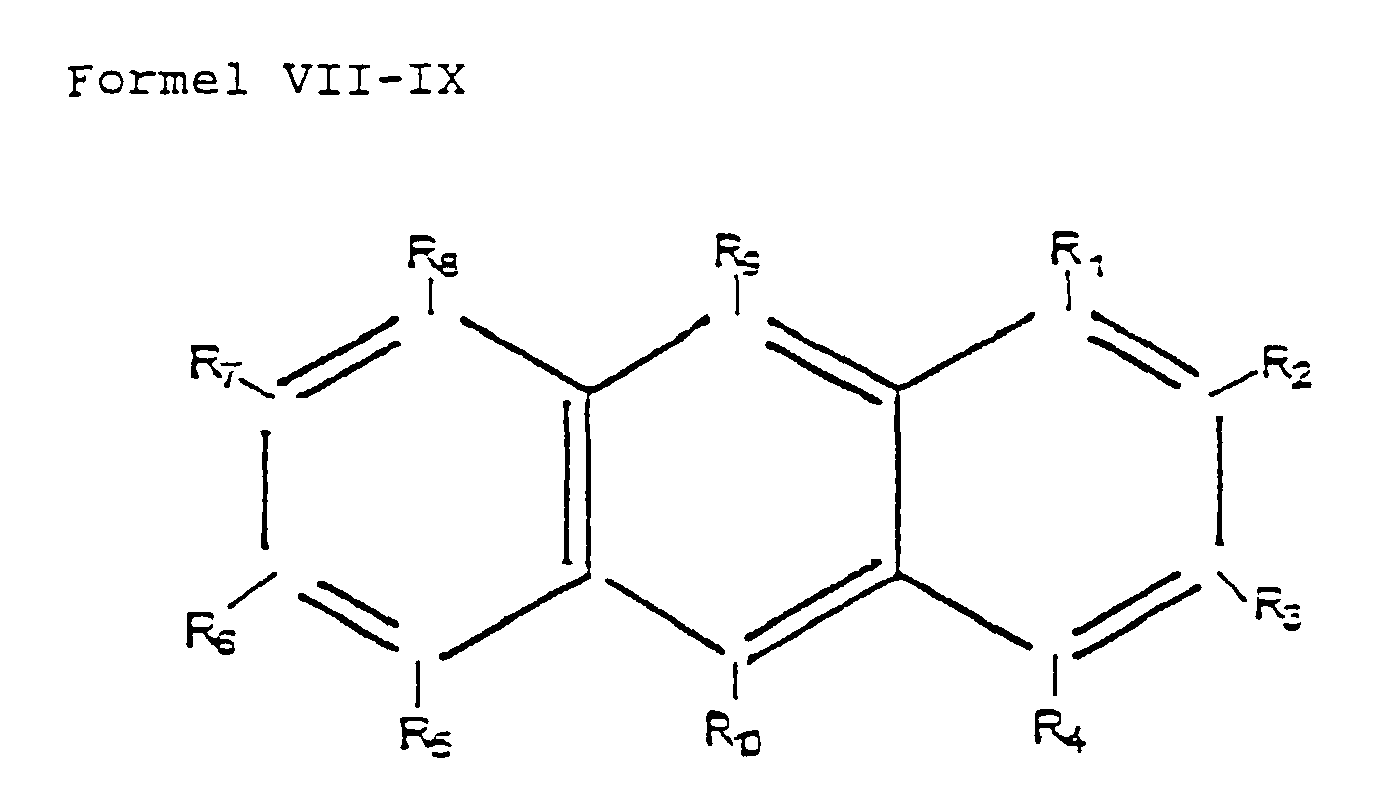
- VII: mit
- R1=OH,R4=OR11,R2,R3,R5,R6,R7,R8,R9,R10,R11=H oder C1-C10-Alkyl linear und/oder verzweigt
- VIII:mit
- R2=OH,R6=OR11,R1,R3,R4,R5,R7,R8,R10,R11=H oder C1-C10-Alkyl linear und/oder verzweigt
- IX: mit
- R9=OH,R10=OR11,R1,R2,R3,R4,R5,R6,R7,R8,R11=H oder
C1,-C10-Alkyl linear und/oder verzweigt

- X: mit
- R9=OH,R10=OR11,R1,R2,R3,R4,R5,R6,R7,R8,R11=H oder C1-C10-Alkyl linear und/oder verzweigt
| Weissgrad nach Berger/ Elektroofen | Weissgrad nach Berger/ Elektroofen und nitrose Gase | Farbdifferenz delta E Elektroofen und nitrose Gase/Elektroofen | |
| Vergleichsbeispiel | 85 | 64 | 4.0 |
| Beispiel 1 | 85 | 78 | 1.6 |
Claims (6)
- Wärmehärtende Beschichtungsmasse bestehend ausund gegebenenfalls Pigmente und/oder Füllstoffe und/oder Hitzestabilsatoren, bevorzugt Phosphite und/oder Triboadditive und/oder weitere Additive, wie z.B. Verlauf- und Entgasungsmittel.(A) einem carboxylfunktionellem Polyester, hergestellt durch eine Kondensationsreaktion aus aliphatischen und/oder cycloaliphatischen Polyolen mit aliphatischen und/oder cycloaliphatischen und/oder aromatischen Polycarbonsäure und Anhydriden, wobei der Polyester einen Tg im Bereich von 30 °C bis 80 °C und eine Säurezahl von etwa 20 bis 100 [mg KOH/g] aufweist, und(B) einem Epoxidharz auf Basis von Bisphenol A und Epichlorhydrin, wobei das Equivalentverhältnis von Epoxidequivalenten zu Carbonsäureequivalenten im Bereich von 0.6 bis 1.2 liegt, und(C) mindestens einer Verbindung der nachfolgenden allgemeinen Formeln (I) - (X)

- I: mit
- R1=OH,R2=OR7,R3,R4,R5,R6,R7=H oder C1-C10-Alkyl linear und/oder verzweigt
- II: mit
- R1=OH,R4=OR7,R2,R3,R5,R6,R7=H oder C1-C10-Alkyl
linear und/oder verzweigt
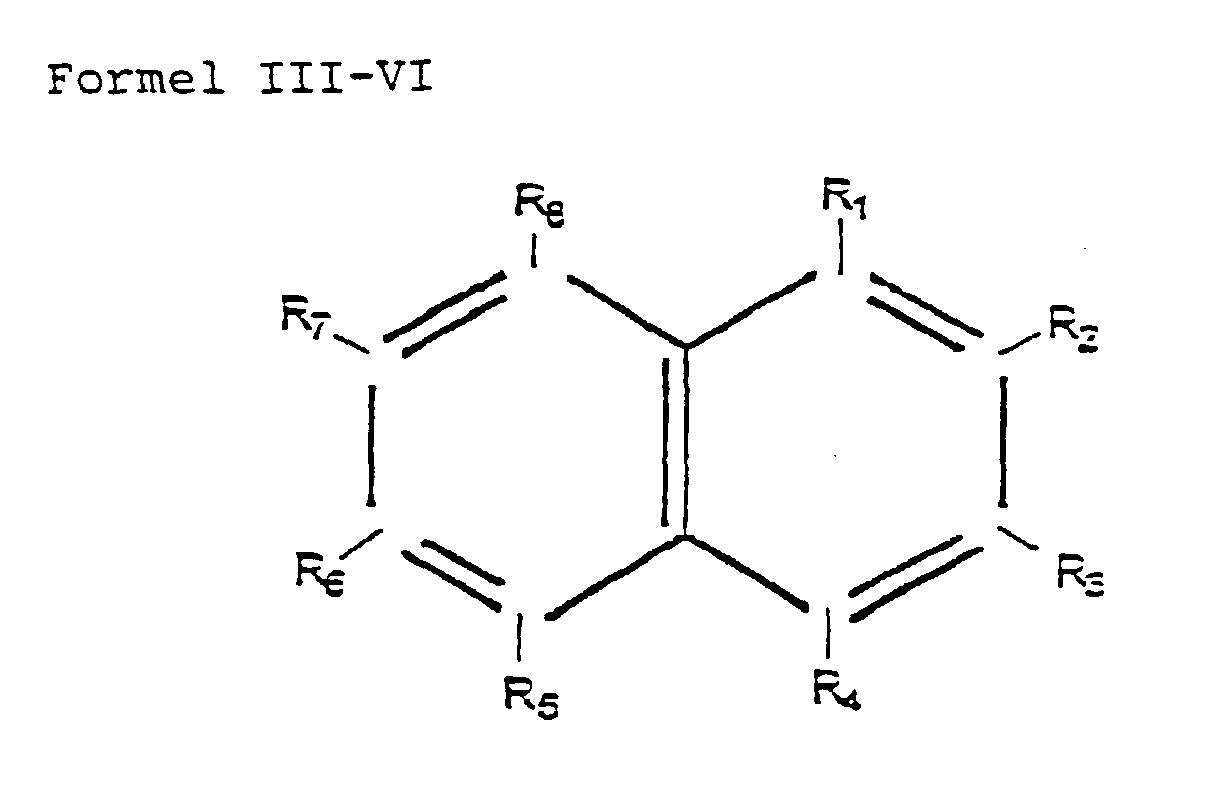
- III: mit
- R1=OH,R2=OR9,R3,R4,R5,R6,R7,R8,R9=H oder C1-C10-Alkyl linear und/oder verzweigt
- IV: mit
- R1=OH,R4=OR9,R2,R3,R5,R6,R7,R8,R9=H oder C1-C10-Alkyl linear und/oder verzweigt
- V: mit
- R1=OH,R8=OR9,R2,R3,R4,R5,R6,R7,R9=H oder C1-C10-Alkyl linear und/oder verzweigt
- VI: mit
- R2=OH,R6=OR9,R2,R3,R4,R5,R7,R8,R9=H oder
C1-C10-Alkyl linear und/oder verzweigt
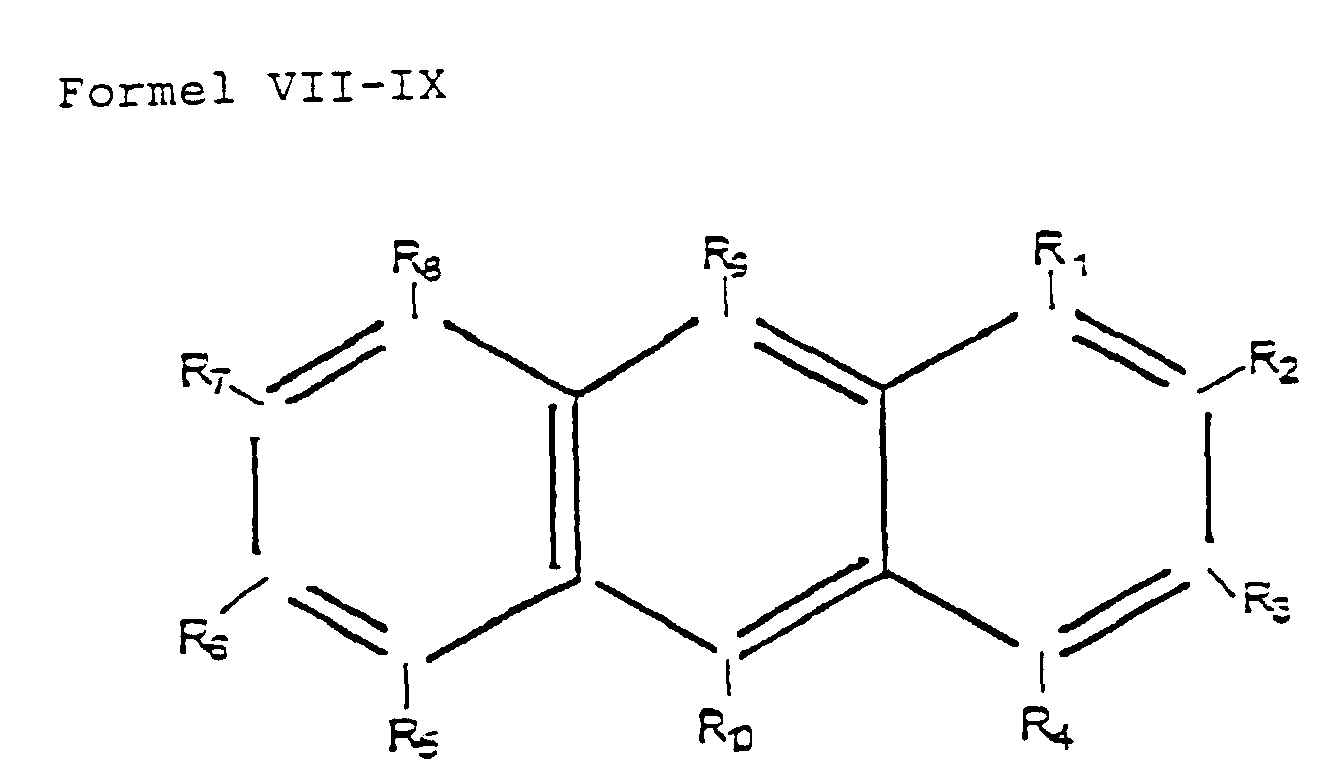
- VII: mit
- R1=OH,R4=OR11,R2,R3,R5,R6,R7,R8,R9,R10,R11=H oder C1-C10-Alkyl linear und/oder verzweigt
- VIII:mit
- R2=OH,R6=OR11,R1,R3,R4,R5,R7,R8,R10,R11=H oder C1-C10-Alkyl linear und/oder verzweigt
- IX: mit
- R9=OH,R10=OR11,R1,R2,R3,R4,R5,R6,R7,R8,R11=H oder
C1,-C10-Alkyl linear und/oder verzweigt
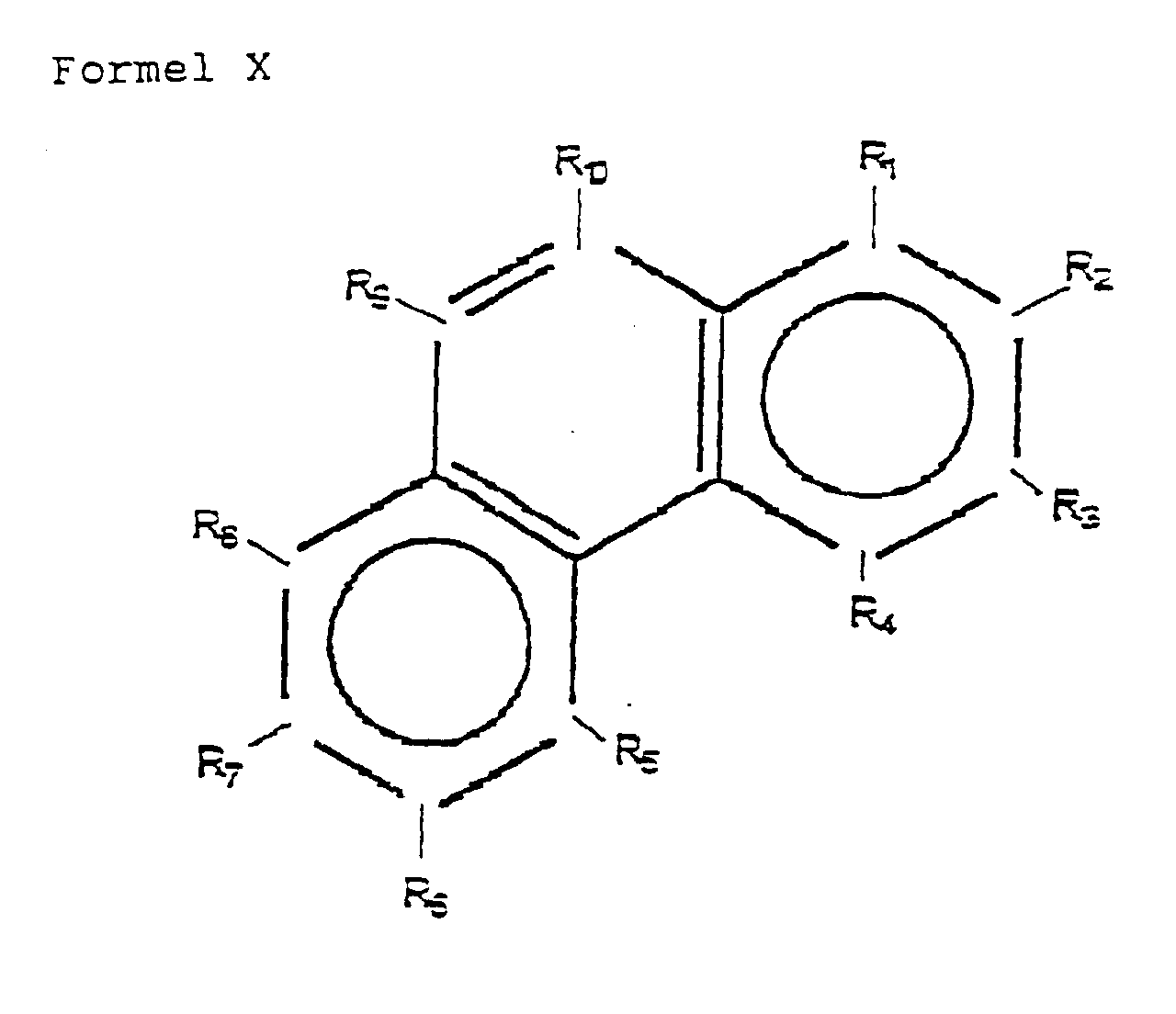
- X: mit
- R9=OH,R10=OR11,R1,R2,R3,R4,R5,R6,R7,R8,R11=H oder C1-C10-Alkyl linear und/oder verzweigt
- Wärmehärtbare Beschichtungsmassen nach Anspruch 1,
dadurch gekennzeichnet, dass der Anteil der Verbindungen (I) bis (X), bezogen auf die Gesamtmasse zwischen 0.001 Gew.-% und 10 Gew.-% bevorzugt zwischen 0.01 und 5 Gew.-% beträgt. - Wärmehärtbare Beschichtungsmassen nach Anspruch 1 oder 2,
dadurch gekennzeichnet, dass von den Verbindungen (I) bis (X) Hydrochinon, Toluhydrochinon, Trimethylhydrochinon und Mono-tert.-Butylhydrochinon bevorzugt sind. - Wärmehärtbare Beschichtungsmassen nach einem der Ansprüche 1 bis 3,
dadurch gekennzeichnet, daß das Epoxidharz auf Basis Bisphenol A und Epichlorhydrin ein höheres Addukt des Diglycidylethers von Bisphenol A ist mit einem durchschnittlichen Molekulargewicht zwischen 300 und 4000 und einem Epoxidezivalentgewicht zwischen 150 und 2000 [g/Equiv.]. - Verfahren zu Herstellung von Pulverlacken, mit carboxylfunktionellem Polyester und einem Epoxidharz auf Basis von Bisphenol A und Epichlorhydrin,
dadurch gekennzeichnet,
daß man in der Schmelze durch gemeinsame Extrusion sämtlicher Formulierungsbestandteile der Beschichtungsmassen nach mindestens einem der Ansprüche 1 bis 4 sowie zusätzlich übliche Pigmente und/oder Füllstoffe und/oder Additive bei Temperaturen zwischen 60 und 140 °C ein Extrudat herstellt, dieses anschliessend abkühlt, mahlt und auf eine Korngrösse von < 90 µm absiebt. - Verwendung der Beschichtungsmassen nach einem der Ansprüche 1 bis 4 als Schutzschichten.
Applications Claiming Priority (2)
| Application Number | Priority Date | Filing Date | Title |
|---|---|---|---|
| DE19806284 | 1998-02-16 | ||
| DE19806284A DE19806284C2 (de) | 1998-02-16 | 1998-02-16 | Wärmehärtbare Beschichtungsmassen, Verfahren zur Herstellung und deren Verwendung |
Publications (3)
| Publication Number | Publication Date |
|---|---|
| EP0936261A2 true EP0936261A2 (de) | 1999-08-18 |
| EP0936261A3 EP0936261A3 (de) | 2002-03-13 |
| EP0936261B1 EP0936261B1 (de) | 2004-09-22 |
Family
ID=7857853
Family Applications (1)
| Application Number | Title | Priority Date | Filing Date |
|---|---|---|---|
| EP99100926A Expired - Lifetime EP0936261B1 (de) | 1998-02-16 | 1999-01-20 | Wärmehärtbare Beschichtungsmasse |
Country Status (8)
| Country | Link |
|---|---|
| US (1) | US6191195B1 (de) |
| EP (1) | EP0936261B1 (de) |
| JP (1) | JPH11279451A (de) |
| KR (1) | KR100604968B1 (de) |
| CA (1) | CA2260660A1 (de) |
| DE (2) | DE19806284C2 (de) |
| ES (1) | ES2226211T3 (de) |
| TW (1) | TW509713B (de) |
Cited By (3)
| Publication number | Priority date | Publication date | Assignee | Title |
|---|---|---|---|---|
| EP1253174A1 (de) * | 2001-04-25 | 2002-10-30 | Mitsubishi Gas Chemical Company, Inc. | Verfahren zur Herstellung von Pulverbeschichtungsstoff aus Polyester |
| US7192994B2 (en) | 2001-04-25 | 2007-03-20 | Mitsubishi Gas Chemical Co., Inc. | Method of producing polyester powdery coating material |
| CN104475738A (zh) * | 2015-01-07 | 2015-04-01 | 王文姣 | 一种汽车变速器换挡机构支座及其制造方法 |
Families Citing this family (3)
| Publication number | Priority date | Publication date | Assignee | Title |
|---|---|---|---|---|
| KR20170016014A (ko) * | 2003-04-11 | 2017-02-10 | 가부시키가이샤 니콘 | 액침 리소그래피에 의한 광학기기의 세정방법 |
| CN110408311B (zh) * | 2019-07-22 | 2021-08-17 | 佛山市艾瑞博装饰材料有限公司 | 一种耐候型粉末涂料及其制备方法 |
| CN121693544A (zh) * | 2023-08-23 | 2026-03-17 | Weg涂料有限公司 | 高脱气粉末漆料和获得高脱气粉末漆料的方法 |
Family Cites Families (7)
| Publication number | Priority date | Publication date | Assignee | Title |
|---|---|---|---|---|
| JPS53111335A (en) * | 1977-03-11 | 1978-09-28 | Dainippon Ink & Chem Inc | Powder coating resin composition |
| JPH02232249A (ja) * | 1989-03-03 | 1990-09-14 | Kansai Paint Co Ltd | 樹脂組成物、硬化性組成物及び塗料組成物 |
| DE3936973A1 (de) | 1989-03-11 | 1991-05-08 | Hoechst Ag | Haertbare, pulverfoermige mischungen |
| DE4401438C2 (de) * | 1994-01-19 | 1997-09-18 | Inventa Ag | Wärmehärtbares Beschichtungssystem, dessen Herstellung und Verwendung |
| EP0816442A3 (de) * | 1996-06-25 | 1998-06-17 | Ciba SC Holding AG | Stabilisatoren für Pulverlacke |
| ATE193045T1 (de) * | 1996-10-30 | 2000-06-15 | Inventa Ag | Wärmehärtbare beschichtungsmassen |
| AU721485B2 (en) * | 1996-10-30 | 2000-07-06 | Ems-Patent Ag | Heat curable coating compounds |
-
1998
- 1998-02-16 DE DE19806284A patent/DE19806284C2/de not_active Expired - Fee Related
-
1999
- 1999-01-20 ES ES99100926T patent/ES2226211T3/es not_active Expired - Lifetime
- 1999-01-20 EP EP99100926A patent/EP0936261B1/de not_active Expired - Lifetime
- 1999-01-20 DE DE59910546T patent/DE59910546D1/de not_active Expired - Lifetime
- 1999-02-02 CA CA002260660A patent/CA2260660A1/en not_active Abandoned
- 1999-02-04 TW TW088101695A patent/TW509713B/zh not_active IP Right Cessation
- 1999-02-10 US US09/247,345 patent/US6191195B1/en not_active Expired - Fee Related
- 1999-02-12 KR KR1019990004958A patent/KR100604968B1/ko not_active Expired - Fee Related
- 1999-02-15 JP JP11035542A patent/JPH11279451A/ja active Pending
Cited By (3)
| Publication number | Priority date | Publication date | Assignee | Title |
|---|---|---|---|---|
| EP1253174A1 (de) * | 2001-04-25 | 2002-10-30 | Mitsubishi Gas Chemical Company, Inc. | Verfahren zur Herstellung von Pulverbeschichtungsstoff aus Polyester |
| US7192994B2 (en) | 2001-04-25 | 2007-03-20 | Mitsubishi Gas Chemical Co., Inc. | Method of producing polyester powdery coating material |
| CN104475738A (zh) * | 2015-01-07 | 2015-04-01 | 王文姣 | 一种汽车变速器换挡机构支座及其制造方法 |
Also Published As
| Publication number | Publication date |
|---|---|
| JPH11279451A (ja) | 1999-10-12 |
| DE19806284C2 (de) | 2000-02-24 |
| KR19990072623A (ko) | 1999-09-27 |
| EP0936261A3 (de) | 2002-03-13 |
| TW509713B (en) | 2002-11-11 |
| US6191195B1 (en) | 2001-02-20 |
| HK1022326A1 (en) | 2000-08-04 |
| CA2260660A1 (en) | 1999-08-16 |
| EP0936261B1 (de) | 2004-09-22 |
| ES2226211T3 (es) | 2005-03-16 |
| DE19806284A1 (de) | 1999-08-19 |
| DE59910546D1 (de) | 2004-10-28 |
| KR100604968B1 (ko) | 2006-07-26 |
Similar Documents
| Publication | Publication Date | Title |
|---|---|---|
| DE69222753T2 (de) | Cycloaliphatische Polyester mit Carboxylendgruppen zur Darstellung von Pulverlacken | |
| DE2618729C2 (de) | ||
| DE69025635T2 (de) | Pulverfarbe und Polyesterharz für Pulverfarben | |
| EP0506617B1 (de) | Vernetzungsmittel für Pulverlacke auf Basis von Polyestern | |
| EP0698645B1 (de) | Wärmehärtbare Beschichtungsmassen | |
| DE2621656A1 (de) | Haertbare pulverfoermige ueberzugsmittel | |
| WO2008068068A1 (de) | Lagerstabile pulverlackzusammensetzungen basierend auf säuregruppenhaltigen polyestern, ihre herstellung und ihre verwendung für trübungsarme und flexible pulverlacke | |
| DE2328012A1 (de) | Pulverfoermige ueberzugsmittel | |
| EP0649890B1 (de) | Wärmehärtbares Beschichtungs-System | |
| EP0664325B1 (de) | Wärmehärtbares Beschichtungssystem | |
| DE69016222T2 (de) | Pulverbeschichtungszusammensetzung. | |
| EP0936261B1 (de) | Wärmehärtbare Beschichtungsmasse | |
| WO2011158102A1 (en) | Continuous process for the production of polyester resins suitable as binders for compatible thermosetting paints ans paints based on said polyester resins | |
| DE2232084B2 (de) | Pulverförmige überzugsmittel | |
| EP1121394B1 (de) | Hitzehärtbare pulverbeschichtungssysteme | |
| US5880223A (en) | Non-blooming polyester coating powder | |
| EP0839884B1 (de) | Wärmehärtbare Beschichtungsmassen | |
| EP2072585A1 (de) | Mattierungsmittel für Pulverlacke, wärmehärtbare Beschichtungsmasse sowie deren Verwendungszwecke | |
| DE2922377C2 (de) | Pulverförmige Überzugsmittel und Anstrichmittel | |
| EP0256988B1 (de) | Gesättigte imidgruppenhaltige Polyester mit endständigen Carboxylgruppen | |
| EP0855433B1 (de) | Polyester Pulverbeschichtungszusammensetzung ohne Schleierbildung | |
| EP0318798A2 (de) | Verfahren zur Herstellung von Polyestern und ihre Verwendung als Bindemittel oder Bindemittelkomponente in Pulverlacken | |
| AT411687B (de) | Pulverbeschichtungssysteme, verfahren zu ihrer herstellung, ihre verwendung zur herstellung von überzügen, polyesterharz hiefür | |
| HK1022326B (en) | Heat-curable coating compositions | |
| MXPA98000080A (en) | Noflorescen polyester coating powder |
Legal Events
| Date | Code | Title | Description |
|---|---|---|---|
| PUAI | Public reference made under article 153(3) epc to a published international application that has entered the european phase |
Free format text: ORIGINAL CODE: 0009012 |
|
| AK | Designated contracting states |
Kind code of ref document: A2 Designated state(s): AT BE CH CY DE DK ES FI FR GB GR IE IT LI LU MC NL PT SE Kind code of ref document: A2 Designated state(s): BE DE ES FR GB IT SE |
|
| AX | Request for extension of the european patent |
Free format text: AL;LT;LV;MK;RO;SI |
|
| PUAL | Search report despatched |
Free format text: ORIGINAL CODE: 0009013 |
|
| AK | Designated contracting states |
Kind code of ref document: A3 Designated state(s): AT BE CH CY DE DK ES FI FR GB GR IE IT LI LU MC NL PT SE |
|
| AX | Request for extension of the european patent |
Free format text: AL;LT;LV;MK;RO;SI |
|
| RIC1 | Information provided on ipc code assigned before grant |
Free format text: 7C 09D 167/00 A, 7C 09D 163/00 B, 7C 09D 5/03 B, 7C 08K 5/13 B |
|
| 17P | Request for examination filed |
Effective date: 20020424 |
|
| AKX | Designation fees paid |
Free format text: BE DE ES FR GB IT SE |
|
| 17Q | First examination report despatched |
Effective date: 20021031 |
|
| GRAP | Despatch of communication of intention to grant a patent |
Free format text: ORIGINAL CODE: EPIDOSNIGR1 |
|
| GRAS | Grant fee paid |
Free format text: ORIGINAL CODE: EPIDOSNIGR3 |
|
| GRAA | (expected) grant |
Free format text: ORIGINAL CODE: 0009210 |
|
| AK | Designated contracting states |
Kind code of ref document: B1 Designated state(s): BE DE ES FR GB IT SE |
|
| REG | Reference to a national code |
Ref country code: GB Ref legal event code: FG4D Free format text: NOT ENGLISH |
|
| REG | Reference to a national code |
Ref country code: SE Ref legal event code: TRGR |
|
| GBT | Gb: translation of ep patent filed (gb section 77(6)(a)/1977) |
Effective date: 20040922 |
|
| REG | Reference to a national code |
Ref country code: IE Ref legal event code: FG4D Free format text: GERMAN |
|
| REF | Corresponds to: |
Ref document number: 59910546 Country of ref document: DE Date of ref document: 20041028 Kind code of ref document: P |
|
| REG | Reference to a national code |
Ref country code: ES Ref legal event code: FG2A Ref document number: 2226211 Country of ref document: ES Kind code of ref document: T3 |
|
| REG | Reference to a national code |
Ref country code: HK Ref legal event code: GR Ref document number: 1022326 Country of ref document: HK |
|
| REG | Reference to a national code |
Ref country code: IE Ref legal event code: FD4D |
|
| ET | Fr: translation filed | ||
| PLBE | No opposition filed within time limit |
Free format text: ORIGINAL CODE: 0009261 |
|
| STAA | Information on the status of an ep patent application or granted ep patent |
Free format text: STATUS: NO OPPOSITION FILED WITHIN TIME LIMIT |
|
| 26N | No opposition filed |
Effective date: 20050623 |
|
| REG | Reference to a national code |
Ref country code: GB Ref legal event code: 732E |
|
| REG | Reference to a national code |
Ref country code: ES Ref legal event code: PC2A |
|
| REG | Reference to a national code |
Ref country code: FR Ref legal event code: TP |
|
| BECA | Be: change of holder's address |
Owner name: *EMS-PATENT A.G.REICHENAUERSTRASSE, CH-7013 DOMAT/ Effective date: 20070711 |
|
| BECH | Be: change of holder |
Owner name: *EMS-PATENT A.G. Effective date: 20070711 |
|
| PGFP | Annual fee paid to national office [announced via postgrant information from national office to epo] |
Ref country code: BE Payment date: 20080304 Year of fee payment: 10 |
|
| PGFP | Annual fee paid to national office [announced via postgrant information from national office to epo] |
Ref country code: SE Payment date: 20090114 Year of fee payment: 11 |
|
| PG25 | Lapsed in a contracting state [announced via postgrant information from national office to epo] |
Ref country code: BE Free format text: LAPSE BECAUSE OF NON-PAYMENT OF DUE FEES Effective date: 20090131 |
|
| EUG | Se: european patent has lapsed | ||
| PGFP | Annual fee paid to national office [announced via postgrant information from national office to epo] |
Ref country code: FR Payment date: 20110202 Year of fee payment: 13 Ref country code: IT Payment date: 20110126 Year of fee payment: 13 Ref country code: DE Payment date: 20110121 Year of fee payment: 13 |
|
| PGFP | Annual fee paid to national office [announced via postgrant information from national office to epo] |
Ref country code: GB Payment date: 20110120 Year of fee payment: 13 Ref country code: ES Payment date: 20110125 Year of fee payment: 13 |
|
| GBPC | Gb: european patent ceased through non-payment of renewal fee |
Effective date: 20120120 |
|
| PG25 | Lapsed in a contracting state [announced via postgrant information from national office to epo] |
Ref country code: SE Free format text: LAPSE BECAUSE OF NON-PAYMENT OF DUE FEES Effective date: 20100121 |
|
| REG | Reference to a national code |
Ref country code: FR Ref legal event code: ST Effective date: 20120928 |
|
| PG25 | Lapsed in a contracting state [announced via postgrant information from national office to epo] |
Ref country code: GB Free format text: LAPSE BECAUSE OF NON-PAYMENT OF DUE FEES Effective date: 20120120 Ref country code: DE Free format text: LAPSE BECAUSE OF NON-PAYMENT OF DUE FEES Effective date: 20120801 |
|
| REG | Reference to a national code |
Ref country code: DE Ref legal event code: R119 Ref document number: 59910546 Country of ref document: DE Effective date: 20120801 |
|
| PG25 | Lapsed in a contracting state [announced via postgrant information from national office to epo] |
Ref country code: IT Free format text: LAPSE BECAUSE OF NON-PAYMENT OF DUE FEES Effective date: 20120120 |
|
| PG25 | Lapsed in a contracting state [announced via postgrant information from national office to epo] |
Ref country code: FR Free format text: LAPSE BECAUSE OF NON-PAYMENT OF DUE FEES Effective date: 20120131 |
|
| REG | Reference to a national code |
Ref country code: ES Ref legal event code: FD2A Effective date: 20130708 |
|
| PG25 | Lapsed in a contracting state [announced via postgrant information from national office to epo] |
Ref country code: ES Free format text: LAPSE BECAUSE OF NON-PAYMENT OF DUE FEES Effective date: 20120121 |