EP0936311A2 - Procédé pour rénover des routes et composition de mortier - Google Patents
Procédé pour rénover des routes et composition de mortier Download PDFInfo
- Publication number
- EP0936311A2 EP0936311A2 EP99300940A EP99300940A EP0936311A2 EP 0936311 A2 EP0936311 A2 EP 0936311A2 EP 99300940 A EP99300940 A EP 99300940A EP 99300940 A EP99300940 A EP 99300940A EP 0936311 A2 EP0936311 A2 EP 0936311A2
- Authority
- EP
- European Patent Office
- Prior art keywords
- composition
- component
- polyol
- aggregate
- jointing
- Prior art date
- Legal status (The legal status is an assumption and is not a legal conclusion. Google has not performed a legal analysis and makes no representation as to the accuracy of the status listed.)
- Withdrawn
Links
- 239000000203 mixture Substances 0.000 title claims abstract description 95
- 238000000034 method Methods 0.000 title claims abstract description 23
- 239000004570 mortar (masonry) Substances 0.000 title claims description 19
- 238000009419 refurbishment Methods 0.000 title abstract description 5
- 229920005862 polyol Polymers 0.000 claims abstract description 34
- 150000003077 polyols Chemical class 0.000 claims abstract description 32
- 239000004575 stone Substances 0.000 claims abstract description 22
- 229920002635 polyurethane Polymers 0.000 claims abstract description 19
- 239000004814 polyurethane Substances 0.000 claims abstract description 19
- 239000010438 granite Substances 0.000 claims abstract description 17
- 239000004576 sand Substances 0.000 claims abstract description 13
- 125000005442 diisocyanate group Chemical group 0.000 claims abstract 2
- 239000012948 isocyanate Substances 0.000 claims description 20
- 150000002513 isocyanates Chemical class 0.000 claims description 20
- 150000001875 compounds Chemical class 0.000 claims description 18
- 239000004721 Polyphenylene oxide Substances 0.000 claims description 14
- 229920000570 polyether Polymers 0.000 claims description 14
- 239000002245 particle Substances 0.000 claims description 9
- PNEYBMLMFCGWSK-UHFFFAOYSA-N aluminium oxide Inorganic materials [O-2].[O-2].[O-2].[Al+3].[Al+3] PNEYBMLMFCGWSK-UHFFFAOYSA-N 0.000 claims description 8
- 238000002156 mixing Methods 0.000 claims description 8
- 239000000945 filler Substances 0.000 claims description 7
- UPMLOUAZCHDJJD-UHFFFAOYSA-N 4,4'-Diphenylmethane Diisocyanate Chemical compound C1=CC(N=C=O)=CC=C1CC1=CC=C(N=C=O)C=C1 UPMLOUAZCHDJJD-UHFFFAOYSA-N 0.000 claims description 5
- 239000004359 castor oil Substances 0.000 claims description 5
- 235000019438 castor oil Nutrition 0.000 claims description 5
- 239000000839 emulsion Substances 0.000 claims description 5
- ZEMPKEQAKRGZGQ-XOQCFJPHSA-N glycerol triricinoleate Natural products CCCCCC[C@@H](O)CC=CCCCCCCCC(=O)OC[C@@H](COC(=O)CCCCCCCC=CC[C@@H](O)CCCCCC)OC(=O)CCCCCCCC=CC[C@H](O)CCCCCC ZEMPKEQAKRGZGQ-XOQCFJPHSA-N 0.000 claims description 5
- XSTXAVWGXDQKEL-UHFFFAOYSA-N Trichloroethylene Chemical compound ClC=C(Cl)Cl XSTXAVWGXDQKEL-UHFFFAOYSA-N 0.000 claims description 3
- 150000002009 diols Chemical class 0.000 claims description 3
- 239000000428 dust Substances 0.000 claims description 3
- 229920001971 elastomer Polymers 0.000 claims description 3
- PGYPOBZJRVSMDS-UHFFFAOYSA-N loperamide hydrochloride Chemical compound Cl.C=1C=CC=CC=1C(C=1C=CC=CC=1)(C(=O)N(C)C)CCN(CC1)CCC1(O)C1=CC=C(Cl)C=C1 PGYPOBZJRVSMDS-UHFFFAOYSA-N 0.000 claims description 3
- 239000003921 oil Substances 0.000 claims description 3
- 238000011049 filling Methods 0.000 claims description 2
- VYPSYNLAJGMNEJ-UHFFFAOYSA-N Silicium dioxide Chemical compound O=[Si]=O VYPSYNLAJGMNEJ-UHFFFAOYSA-N 0.000 description 9
- 239000004567 concrete Substances 0.000 description 7
- 238000009472 formulation Methods 0.000 description 7
- 238000001723 curing Methods 0.000 description 5
- 239000000654 additive Substances 0.000 description 3
- 239000003054 catalyst Substances 0.000 description 3
- 239000003795 chemical substances by application Substances 0.000 description 3
- 239000006260 foam Substances 0.000 description 3
- 239000002808 molecular sieve Substances 0.000 description 3
- -1 phenyl mercury salt Chemical class 0.000 description 3
- 239000011435 rock Substances 0.000 description 3
- URGAHOPLAPQHLN-UHFFFAOYSA-N sodium aluminosilicate Chemical compound [Na+].[Al+3].[O-][Si]([O-])=O.[O-][Si]([O-])=O URGAHOPLAPQHLN-UHFFFAOYSA-N 0.000 description 3
- VTYYLEPIZMXCLO-UHFFFAOYSA-L Calcium carbonate Chemical compound [Ca+2].[O-]C([O-])=O VTYYLEPIZMXCLO-UHFFFAOYSA-L 0.000 description 2
- FBPFZTCFMRRESA-FSIIMWSLSA-N D-Glucitol Natural products OC[C@H](O)[C@H](O)[C@@H](O)[C@H](O)CO FBPFZTCFMRRESA-FSIIMWSLSA-N 0.000 description 2
- 241001510071 Pyrrhocoridae Species 0.000 description 2
- 229920013701 VORANOL™ Polymers 0.000 description 2
- 239000003963 antioxidant agent Substances 0.000 description 2
- 239000010426 asphalt Substances 0.000 description 2
- 229910001570 bauxite Inorganic materials 0.000 description 2
- BRPQOXSCLDDYGP-UHFFFAOYSA-N calcium oxide Chemical compound [O-2].[Ca+2] BRPQOXSCLDDYGP-UHFFFAOYSA-N 0.000 description 2
- 239000000292 calcium oxide Substances 0.000 description 2
- ODINCKMPIJJUCX-UHFFFAOYSA-N calcium oxide Inorganic materials [Ca]=O ODINCKMPIJJUCX-UHFFFAOYSA-N 0.000 description 2
- 229910052500 inorganic mineral Inorganic materials 0.000 description 2
- NLYAJNPCOHFWQQ-UHFFFAOYSA-N kaolin Chemical compound O.O.O=[Al]O[Si](=O)O[Si](=O)O[Al]=O NLYAJNPCOHFWQQ-UHFFFAOYSA-N 0.000 description 2
- 239000000463 material Substances 0.000 description 2
- 239000011707 mineral Substances 0.000 description 2
- 235000019198 oils Nutrition 0.000 description 2
- 229940096825 phenylmercury Drugs 0.000 description 2
- 239000000049 pigment Substances 0.000 description 2
- 239000002243 precursor Substances 0.000 description 2
- 230000002035 prolonged effect Effects 0.000 description 2
- 239000000600 sorbitol Substances 0.000 description 2
- 239000003381 stabilizer Substances 0.000 description 2
- 230000009974 thixotropic effect Effects 0.000 description 2
- XLYOFNOQVPJJNP-UHFFFAOYSA-N water Substances O XLYOFNOQVPJJNP-UHFFFAOYSA-N 0.000 description 2
- PISLZQACAJMAIO-UHFFFAOYSA-N 2,4-diethyl-6-methylbenzene-1,3-diamine Chemical compound CCC1=CC(C)=C(N)C(CC)=C1N PISLZQACAJMAIO-UHFFFAOYSA-N 0.000 description 1
- 235000008733 Citrus aurantifolia Nutrition 0.000 description 1
- 235000019738 Limestone Nutrition 0.000 description 1
- 235000004431 Linum usitatissimum Nutrition 0.000 description 1
- 240000006240 Linum usitatissimum Species 0.000 description 1
- 229920001730 Moisture cure polyurethane Polymers 0.000 description 1
- CTQNGGLPUBDAKN-UHFFFAOYSA-N O-Xylene Chemical compound CC1=CC=CC=C1C CTQNGGLPUBDAKN-UHFFFAOYSA-N 0.000 description 1
- 235000011941 Tilia x europaea Nutrition 0.000 description 1
- 230000006750 UV protection Effects 0.000 description 1
- 238000010521 absorption reaction Methods 0.000 description 1
- NIXOWILDQLNWCW-UHFFFAOYSA-N acrylic acid group Chemical group C(C=C)(=O)O NIXOWILDQLNWCW-UHFFFAOYSA-N 0.000 description 1
- 230000000996 additive effect Effects 0.000 description 1
- 239000002518 antifoaming agent Substances 0.000 description 1
- 230000003078 antioxidant effect Effects 0.000 description 1
- RSOILICUEWXSLA-UHFFFAOYSA-N bis(1,2,2,6,6-pentamethylpiperidin-4-yl) decanedioate Chemical compound C1C(C)(C)N(C)C(C)(C)CC1OC(=O)CCCCCCCCC(=O)OC1CC(C)(C)N(C)C(C)(C)C1 RSOILICUEWXSLA-UHFFFAOYSA-N 0.000 description 1
- 229910000019 calcium carbonate Inorganic materials 0.000 description 1
- 239000004568 cement Substances 0.000 description 1
- 238000006243 chemical reaction Methods 0.000 description 1
- 239000002274 desiccant Substances 0.000 description 1
- 235000004426 flaxseed Nutrition 0.000 description 1
- 239000012634 fragment Substances 0.000 description 1
- 238000013038 hand mixing Methods 0.000 description 1
- 239000004571 lime Substances 0.000 description 1
- 239000006028 limestone Substances 0.000 description 1
- 239000000944 linseed oil Substances 0.000 description 1
- 235000021388 linseed oil Nutrition 0.000 description 1
- 238000011068 loading method Methods 0.000 description 1
- 230000007774 longterm Effects 0.000 description 1
- 239000013521 mastic Substances 0.000 description 1
- 238000012986 modification Methods 0.000 description 1
- 230000004048 modification Effects 0.000 description 1
- MBAUOPQYSQVYJV-UHFFFAOYSA-N octyl 3-[4-hydroxy-3,5-di(propan-2-yl)phenyl]propanoate Chemical compound OC1=C(C=C(C=C1C(C)C)CCC(=O)OCCCCCCCC)C(C)C MBAUOPQYSQVYJV-UHFFFAOYSA-N 0.000 description 1
- 238000012856 packing Methods 0.000 description 1
- 229920000728 polyester Polymers 0.000 description 1
- 239000000843 powder Substances 0.000 description 1
- 230000001737 promoting effect Effects 0.000 description 1
- 230000001681 protective effect Effects 0.000 description 1
- 239000010499 rapseed oil Substances 0.000 description 1
- 239000000377 silicon dioxide Substances 0.000 description 1
- 229920003002 synthetic resin Polymers 0.000 description 1
- 239000000057 synthetic resin Substances 0.000 description 1
- 239000012463 white pigment Substances 0.000 description 1
- 239000008096 xylene Substances 0.000 description 1
Images
Classifications
-
- C—CHEMISTRY; METALLURGY
- C04—CEMENTS; CONCRETE; ARTIFICIAL STONE; CERAMICS; REFRACTORIES
- C04B—LIME, MAGNESIA; SLAG; CEMENTS; COMPOSITIONS THEREOF, e.g. MORTARS, CONCRETE OR LIKE BUILDING MATERIALS; ARTIFICIAL STONE; CERAMICS; REFRACTORIES; TREATMENT OF NATURAL STONE
- C04B26/00—Compositions of mortars, concrete or artificial stone, containing only organic binders, e.g. polymer or resin concrete
- C04B26/02—Macromolecular compounds
- C04B26/10—Macromolecular compounds obtained otherwise than by reactions only involving carbon-to-carbon unsaturated bonds
- C04B26/16—Polyurethanes
-
- C—CHEMISTRY; METALLURGY
- C04—CEMENTS; CONCRETE; ARTIFICIAL STONE; CERAMICS; REFRACTORIES
- C04B—LIME, MAGNESIA; SLAG; CEMENTS; COMPOSITIONS THEREOF, e.g. MORTARS, CONCRETE OR LIKE BUILDING MATERIALS; ARTIFICIAL STONE; CERAMICS; REFRACTORIES; TREATMENT OF NATURAL STONE
- C04B41/00—After-treatment of mortars, concrete, artificial stone or ceramics; Treatment of natural stone
- C04B41/45—Coating or impregnating, e.g. injection in masonry, partial coating of green or fired ceramics, organic coating compositions for adhering together two concrete elements
- C04B41/46—Coating or impregnating, e.g. injection in masonry, partial coating of green or fired ceramics, organic coating compositions for adhering together two concrete elements with organic materials
- C04B41/48—Macromolecular compounds
- C04B41/488—Other macromolecular compounds obtained otherwise than by reactions only involving unsaturated carbon-to-carbon bonds
- C04B41/4884—Polyurethanes; Polyisocyanates
-
- E—FIXED CONSTRUCTIONS
- E01—CONSTRUCTION OF ROADS, RAILWAYS, OR BRIDGES
- E01C—CONSTRUCTION OF, OR SURFACES FOR, ROADS, SPORTS GROUNDS, OR THE LIKE; MACHINES OR AUXILIARY TOOLS FOR CONSTRUCTION OR REPAIR
- E01C5/00—Pavings made of prefabricated single units
- E01C5/003—Pavings made of prefabricated single units characterised by material or composition used for beds or joints; characterised by the way of laying
Definitions
- This invention relates to a method of refurbishing road surfaces and to a mortar composition for use in the method.
- Road surfaces comprising stone blocks, such as cobbles, slabs or stone sets are refurbished by excavating the stone blocks, providing or reinstating a suitable foundation such as a concrete footing, and replacing the stone blocks.
- the blocks may be seated and jointed with a conventional lime-sand mortar, which may include a synthetic resin or natural oil such as linseed for weather proofing.
- the stone blocks may be covered after re-setting with a Macadam, bitumen or asphalt surfacing.
- the stone blocks are commonly granite sets, or other igneous or metamorphic rock such as basalt (whinstone). Unmetamorphosed sedimentary rocks such as sand or limestone are subject to weathering, and tend to crumble under heavy and prolonged traffic loads.
- Such known refurbishment methods either without bedding and jointing, or using conventional lime-sand mortar tend to provide only poor support of the stone blocks, making accurate alignment of the block, with the surrounding road surface difficult, which leads to an uneven finished road surface; provide poor energy absorbing capabilities, and have low weather and UV resistance, especially at the top level of the joint.
- With slow mortar setting times it is also usually necessary to close each road section for more than one day, and conventional mortars have poor long-term adhesion to the concrete footing and tend to crush and fragment under prolonged traffic loading stress.
- An object of the invention is to provide a method of road refurbishment which ameliorates these conditions and to provide a mortar composition with improved bedding, weathering and energy absorption properties.
- a method of refurbishing a road surface comprises a method of refurbishing a road surface comprising locating a plurality of stone blocks on a foundation, with gaps between each stone block and adjacent stone blocks, and filling the gaps between adjacent blocks with a jointing composition.
- a top jointing composition is used to fill the gaps to the intended road surface level, to provide weather resistance.
- a bedding composition may be laid before locating the stone blocks or setts.
- a mortar composition for use in the method of the invention comprising a polyol component and an isocyanate component, which are mixed immediately prior to use to form a polyurethane composition on curing.
- the composition preferably contains additional aggregates or fillers such as crushed rock, sand, or the like.
- a mortar composition according to the invention is preferably used for each phase of the process, that is the bedding composition, the jointing composition and the top jointing composition may each be a composition according to the invention, but differing in their exact formulations.
- the bedding composition may advantageously comprise a major proportion of a natural, or synthetic oil, such as linseed oil, rape oil, etc.
- the aggregate component of the bedding composition may include rubber crumb or other elastic or resilient particles, and/or lime as calcium oxide and may comprise a particulate mineral such as bauxite, or other aluminium oxide material, but preferably includes crushed granite.
- the particle size may range from dust up to 6mm.
- the polyol may comprise castor oil as a polyhydroxyl component for co-reaction with the isocyanate component, or may comprise another synthetic polyester or polyether based polyol which is formulated to be mixed with the isocyanate component.
- the jointing compound may simply consist of the polyol and isocyanate components, and dry sand or washed and dried gravel with a particle size up to 10mm as a bulk aggregate.
- the formulation of the polyol component may include small (sometimes trace) quantities of additives such as catalysts, foam suppressing agents, flow promoting agents, thixotropic additives, and/or molecular sieves, for use in the bedding compound.
- additives such as catalysts, foam suppressing agents, flow promoting agents, thixotropic additives, and/or molecular sieves
- the polyol component of the top jointing compound may in addition to the above contain pigments, a filler such as china clay, UV stabilisers, and/or antioxidants.
- the chemically active component of the polyol component of the composition according to the invention may comprise a polyether polyol, or a mixture of polyether triol and polyether diol. Sorbitol polyether may also be present.
- the jointing compound may be applied, after laying the stone blocks or setts, on established traditional bedding or freshly bedded setts after a bedding composition has cured with cleaned out gaps between them.
- the top of the setts which are preferably granite, may be coated using a foam roller with a wax emulsion which is allowed to dry to protect the visible face of the setts from the application of the polyurethane aggregate.
- the polyurethane jointing compound may be mixed with crushed granite aggregate in a Dane mixer at a ratio of 10-15% polyurethane to 85-90% aggregate. The mix may then be poured out onto the granite sett surface and swept into the gaps by brush and tamped down firmly to within 1 to 2cm of the top.
- top jointing compound if any, may be poured into the upper parts of the gaps after setting of the jointing compound.
- Preferred top jointing compounds tend to gel rapidly and thus should be poured immediately after hand mixing, or using mechanical metering and dispensing apparatus, continuous mixing and pouring of the top jointing composition may be employed.
- the wax emulsion may be removed by water jet to return the upper surface to its natural appearance.
- jointing compound may simply be applied to fill the gaps up to the road surface level.
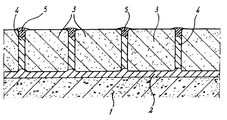
- a part of a refurbished roadway comprises a concrete footing 1, which has earlier been freshly cast and has then been allowed to dry.
- This may be a standard concrete formulation, or a proprietary formulation, such as Tarmac Topmix Limited's TOPROC (Trade Mark).
- the footing 1 may comprise older concrete which has been scabbled or cleaned and treated with a primer, e.g. a moisture cure polyurethane primer, such as Hyperlast Limited's DURELAST (Trade Mark) which comprises 60% polyurethane in xylene.
- the next step in the refurbishment procedure comprises spreading a layer 2 of a bedding composition over the surface of the concrete footing 1.
- a layer 2 of a bedding composition is set out below.
- a plurality of stone blocks 3 is then disposed on the bedding layer 2, the blocks each being spaced with a gap between each block and all the adjacent blocks.
- the blocks are preferably granite setts, but other stone materials may be used including whinstone and millstone grit, in the form of cobbles or flags.
- the bedding layer 2 allows setting of the blocks 3 in the layer and provides a support and cushioning layer between the blocks 3 and the footing 1.
- the bedding composition is then allowed to cure sufficiently to withstand foot traffic, and then a jointing composition 4 is applied into the gaps between the blocks 3.
- This application may be in the form of a dry powder mixture which is brushed into the gaps after application of a protective wax emulsion using a foam roller to the tops of the setts.
- the gaps are filled with the jointing composition to within a short distance of the upper faces of the stone blocks 3, and is then allowed to set.
- the composition may be premixed in a Dane mixer.
- a top jointing composition 5 is applied to provide weather resistance. This is carried out by mixing the two components and pouring this into the tops of the joints above the set jointing component up to the road surface level. This composition tends to gel rapidly and thus is either hand mixed and poured immediately or by a continuous mechanical mixing and dispensing device. After curing of the top jointing composition, the wax emulsion is removed by water jet to return the top surface of the setts to its natural appearance.
- composition 1 (Bedding Composition)
- a) Polyol component parts by weight Castor oil 70.75 Polyether polyol (f 4-5) 23.6 Molecular sieve 2.8 Antifoaming agent 0.2 Catalyst (phenyl mercury salt) 0.2 Acrylic flow agent 0.2 Silica Thixotropic additive 2.25
- lsocyanate component Polymeric methylene diphenyl diisocyanate (e.g. Suprasec 5001, by ICI) - 100%
- Aggregates Sand (Chelford 30) 240 Crushed granite 160 Rubber crumb 60 Calcium oxide 20
- bauxite or other aluminium oxide mineral may be used.
- the polyol is mixed with the isocyanate in a ratio of 100 parts of polyol to 60 parts of isocyanate to form a polyurethane precursor in a mixer. Curing begins on admixture.
- the aggregates are added to the polyurethane precursor in the weight ratio of from 1 part polyurethane to 5 parts aggregate to 1 part polyurethane to 20 parts aggregate.
- Composition 2 (Jointing Composition) a) Polyol component - as Composition 1 b) Isocyanate component - as Composition 1 c) Aggregates Dry sand (90 mesh) or Mixture of sharp-angle aggregates, e.g. Alumina and/or crushed granite 5-8mm particle size 100%
- the components are mixed in the weight ratios:- Polyol 100 lsocyanate 50 Aggregate 450
- an aggregate which imparts high compressive strength to the finished polyurethane aggregate composition.
- the preferred aggregates should generally comprise sharp or low angle particles, rather than rounded particles. This allows better packing in the bedding and joints to prevent movement during vibration during service.
- composition 3 Jointing Compound (Second Example) Polyol component - as Composition 1 100 parts Isocyanate component - Suprasec 2050 60 parts Aggregate - Crushed red granite (dust to 5mm) 960 parts Composition 4 (Top Jointing Composition) a) Polyol component parts by weight Polyether triol (Caradol Ed 56-07) 23.92 Polyether diol (Voranol P400) 29.24 Sorbitol polyether (Voranol RN490) 2.90 Molecular sieve (drying agent) 4.89 Catalyst (phenyl mercury salt) 0.40 Black pigment stainer 0.97 White pigment stainer 0.49 China clay filler 33.23 Precipitated CaCO 3 2.45 UV Stabiliser (Tinuvin 292) 0.98 Antioxidant (I
- the polyol component is mixed with the isocyanate component in a weight ratio of 3.4/1.
- composition 5 Topic Jointing Composition - 2 nd Example
- the components are mixed in the ratio by weight:- Polyol 3.4 parts Isocyanate 1 part Aggregate 17.6 parts
- This alternative top jointing composition is used for lower cost applications.
- the polyurethane used for the bedding compound is preferably between 80 Shore A and 75 Shore D hardness at 20°C, and there is preferably from 5-25% polyurethane in the composition.
- the hardness should be between 80 Shore A to 60 Shore D at 20°C, and again there is preferably from 5-25% polyurethane in the composition.
- the polyurethane for the top jointing compound may be from 70-95 Shore A, and preferably comprises at least 20% of the compound, where aggregate is added.
- Foundations other than concrete have been found to be suitable, such as bituminous mastic, or hardened sand cement. Setts may be laid on a pre-existing base if this is in sufficiently good condition.
Landscapes
- Chemical & Material Sciences (AREA)
- Engineering & Computer Science (AREA)
- Ceramic Engineering (AREA)
- Structural Engineering (AREA)
- Chemical Kinetics & Catalysis (AREA)
- Materials Engineering (AREA)
- Organic Chemistry (AREA)
- Architecture (AREA)
- Civil Engineering (AREA)
- Polyurethanes Or Polyureas (AREA)
- Road Paving Structures (AREA)
Applications Claiming Priority (2)
| Application Number | Priority Date | Filing Date | Title |
|---|---|---|---|
| GB9803174 | 1998-02-14 | ||
| GBGB9803174.3A GB9803174D0 (en) | 1998-02-14 | 1998-02-14 | Road refurbishment method and mortar composition |
Publications (2)
| Publication Number | Publication Date |
|---|---|
| EP0936311A2 true EP0936311A2 (fr) | 1999-08-18 |
| EP0936311A3 EP0936311A3 (fr) | 2001-08-08 |
Family
ID=10827005
Family Applications (1)
| Application Number | Title | Priority Date | Filing Date |
|---|---|---|---|
| EP99300940A Withdrawn EP0936311A3 (fr) | 1998-02-14 | 1999-02-09 | Procédé pour rénover des routes et composition de mortier |
Country Status (2)
| Country | Link |
|---|---|
| EP (1) | EP0936311A3 (fr) |
| GB (1) | GB9803174D0 (fr) |
Cited By (9)
| Publication number | Priority date | Publication date | Assignee | Title |
|---|---|---|---|---|
| FR2801912A1 (fr) * | 1999-12-02 | 2001-06-08 | Screg | Chaussee pavee et son procede de realisation |
| EP1106735A3 (fr) * | 1999-11-30 | 2002-11-06 | Südramol GmbH & Co. | Procédé pour la construction d'un revêtement routier résistant au carburant |
| WO2003037817A1 (fr) * | 2001-11-02 | 2003-05-08 | John Thomas Liddy | Sable ameliore pour pavage |
| WO2003050157A1 (fr) * | 2001-12-12 | 2003-06-19 | National University Of Singapore | Mastic de polyurethanne resistant a la chaleur et a l'eau chaude |
| FR2877353A1 (fr) * | 2004-12-10 | 2006-05-05 | Art Bloc Sarl | Procede de realisation de revetements de sols decoratifs en granit exposes aux circulations, pietonne et automobile |
| JP2021070965A (ja) * | 2019-10-30 | 2021-05-06 | 太平洋プレコン工業株式会社 | 舗装方法および舗装構造 |
| CN113045261A (zh) * | 2021-03-08 | 2021-06-29 | 东北林业大学 | 一种高韧性早强聚氨酯混凝土及其制备方法 |
| CN114685093A (zh) * | 2022-04-27 | 2022-07-01 | 长沙标朗住工科技有限公司 | 一种补墙膏及其制备方法和应用 |
| CN116835920A (zh) * | 2023-06-30 | 2023-10-03 | 中国铁道科学研究院集团有限公司铁道建筑研究所 | 一种韧性材料、制备方法及纵连板的防胀板方法 |
Family Cites Families (4)
| Publication number | Priority date | Publication date | Assignee | Title |
|---|---|---|---|---|
| BE612784A (fr) * | 1960-01-19 | 1900-01-01 | ||
| NL276989A (fr) * | 1961-04-12 | |||
| DE3244413A1 (de) * | 1982-12-01 | 1984-07-12 | Rhein-Lippe Straßen- und Tiefbau GmbH, 4300 Essen | Verfahren zum erstellen oder erneuern der strassendecke von stahlbetonbruecken |
| GB8420530D0 (en) * | 1984-08-13 | 1984-09-19 | Macpherson Ind Coatings Ltd | Polyurethane adhesive compositions |
-
1998
- 1998-02-14 GB GBGB9803174.3A patent/GB9803174D0/en not_active Ceased
-
1999
- 1999-02-09 EP EP99300940A patent/EP0936311A3/fr not_active Withdrawn
Non-Patent Citations (1)
| Title |
|---|
| None |
Cited By (11)
| Publication number | Priority date | Publication date | Assignee | Title |
|---|---|---|---|---|
| EP1106735A3 (fr) * | 1999-11-30 | 2002-11-06 | Südramol GmbH & Co. | Procédé pour la construction d'un revêtement routier résistant au carburant |
| FR2801912A1 (fr) * | 1999-12-02 | 2001-06-08 | Screg | Chaussee pavee et son procede de realisation |
| WO2003037817A1 (fr) * | 2001-11-02 | 2003-05-08 | John Thomas Liddy | Sable ameliore pour pavage |
| US6824602B2 (en) | 2001-11-02 | 2004-11-30 | Paul Andrew Darby | Block paving sand |
| WO2003050157A1 (fr) * | 2001-12-12 | 2003-06-19 | National University Of Singapore | Mastic de polyurethanne resistant a la chaleur et a l'eau chaude |
| FR2877353A1 (fr) * | 2004-12-10 | 2006-05-05 | Art Bloc Sarl | Procede de realisation de revetements de sols decoratifs en granit exposes aux circulations, pietonne et automobile |
| JP2021070965A (ja) * | 2019-10-30 | 2021-05-06 | 太平洋プレコン工業株式会社 | 舗装方法および舗装構造 |
| CN113045261A (zh) * | 2021-03-08 | 2021-06-29 | 东北林业大学 | 一种高韧性早强聚氨酯混凝土及其制备方法 |
| CN114685093A (zh) * | 2022-04-27 | 2022-07-01 | 长沙标朗住工科技有限公司 | 一种补墙膏及其制备方法和应用 |
| CN114685093B (zh) * | 2022-04-27 | 2023-06-27 | 长沙标朗住工科技有限公司 | 一种补墙膏及其制备方法和应用 |
| CN116835920A (zh) * | 2023-06-30 | 2023-10-03 | 中国铁道科学研究院集团有限公司铁道建筑研究所 | 一种韧性材料、制备方法及纵连板的防胀板方法 |
Also Published As
| Publication number | Publication date |
|---|---|
| GB9803174D0 (en) | 1998-04-08 |
| EP0936311A3 (fr) | 2001-08-08 |
Similar Documents
| Publication | Publication Date | Title |
|---|---|---|
| KR101901619B1 (ko) | 1액형 바이오바인더를 이용한 투수포장재 시공방법 및 이에 의해 만들어진 투수포장 | |
| EP0814198B1 (fr) | Procede de construction de pavage | |
| US8470437B2 (en) | Porous cement road surface made from polymer modified cement and a construction method thereof | |
| US4915539A (en) | Wear resistant pavement structure | |
| KR101954232B1 (ko) | 재생아스팔트 순환골재, sis, sbs 및 개선된 골재 입도의 미분말 골재를 포함하여 방수성능을 향상시킨 포장식 다짐구스방수아스팔트 콘크리트 조성물 및 이의 시공방법 | |
| EP0750595A1 (fr) | Composition pour revetement routier et procede | |
| CA2788644C (fr) | Materiau et procede de revetement routier | |
| CA2289495A1 (fr) | Composition destine a des paves flexibles utilisable a une temperature ordinaire | |
| AU2012344079B2 (en) | Repair method for road surfacings, in particular for open-pored asphalts | |
| US9221996B2 (en) | Process for repairing road surfacing systems, in particular for open-pore asphalts | |
| KR100884208B1 (ko) | 친환경 자연토 지반 포장방법 | |
| JPH07300358A (ja) | 舗装用水硬性グラウト材料およびグラウト | |
| KR102207040B1 (ko) | Ldpe를 포함하는 불투수성 방수아스팔트 콘크리트 조성물 및 이의 시공방법 | |
| MX2011004784A (es) | Reciclado de pavimentos. | |
| JP2909929B2 (ja) | ブロック舗装の構築方法 | |
| KR101041207B1 (ko) | 고강도 생황토 습식 콘크리트 조성물, 조성물 제조방법 및 이를 이용한 황톳길 포장공법 | |
| KR100993100B1 (ko) | 폴리머 시멘트 콘크리트의 다짐시공 방법 및 이에 사용하는 폴리머 시멘트 콘크리트 | |
| JPWO1997013923A1 (ja) | ブロック舗装の構築方法 | |
| RU2651733C1 (ru) | Вяжущее для пролива конструктивных слоев транспортного сооружения и способ его использования для устройства транспортного сооружения | |
| JPS58122960A (ja) | 硬化性舗装用瀝青混合物 | |
| JPH1018567A (ja) | 防滑性耐久床材 | |
| CA2207074C (fr) | Procede de construction de pavage | |
| JPH09125308A (ja) | 弾性ブロック舗装路、その施工方法、舗装路用のクッション砂層混合物およびその製造方法 | |
| KR20010067731A (ko) | 생명수를 저장하는 탄성체 투수콘크리트 포장방법 | |
| US20220074146A1 (en) | Paving Block with Improved Illumination |
Legal Events
| Date | Code | Title | Description |
|---|---|---|---|
| PUAI | Public reference made under article 153(3) epc to a published international application that has entered the european phase |
Free format text: ORIGINAL CODE: 0009012 |
|
| AK | Designated contracting states |
Kind code of ref document: A2 Designated state(s): AT BE CH CY DE DK ES FI FR GB GR IE IT LI LU MC NL PT SE |
|
| AX | Request for extension of the european patent |
Free format text: AL;LT;LV;MK;RO;SI |
|
| PUAL | Search report despatched |
Free format text: ORIGINAL CODE: 0009013 |
|
| AK | Designated contracting states |
Kind code of ref document: A3 Designated state(s): AT BE CH CY DE DK ES FI FR GB GR IE IT LI LU MC NL PT SE |
|
| AX | Request for extension of the european patent |
Free format text: AL;LT;LV;MK;RO;SI |
|
| AKX | Designation fees paid | ||
| REG | Reference to a national code |
Ref country code: DE Ref legal event code: 8566 |
|
| STAA | Information on the status of an ep patent application or granted ep patent |
Free format text: STATUS: THE APPLICATION IS DEEMED TO BE WITHDRAWN |
|
| 18D | Application deemed to be withdrawn |
Effective date: 20020209 |