EP0936635A1 - Verfahren zur Herstellung von magnetischer Flüssigkeit - Google Patents
Verfahren zur Herstellung von magnetischer Flüssigkeit Download PDFInfo
- Publication number
- EP0936635A1 EP0936635A1 EP98102780A EP98102780A EP0936635A1 EP 0936635 A1 EP0936635 A1 EP 0936635A1 EP 98102780 A EP98102780 A EP 98102780A EP 98102780 A EP98102780 A EP 98102780A EP 0936635 A1 EP0936635 A1 EP 0936635A1
- Authority
- EP
- European Patent Office
- Prior art keywords
- surfactant
- slurry
- ferrofluid
- magnetic
- particles
- Prior art date
- Legal status (The legal status is an assumption and is not a legal conclusion. Google has not performed a legal analysis and makes no representation as to the accuracy of the status listed.)
- Withdrawn
Links
- 239000011554 ferrofluid Substances 0.000 title claims abstract description 82
- 238000000034 method Methods 0.000 title claims description 60
- 238000004519 manufacturing process Methods 0.000 title description 8
- 239000004094 surface-active agent Substances 0.000 claims abstract description 93
- 239000002245 particle Substances 0.000 claims abstract description 50
- 230000005415 magnetization Effects 0.000 claims abstract description 41
- UQSXHKLRYXJYBZ-UHFFFAOYSA-N Iron oxide Chemical compound [Fe]=O UQSXHKLRYXJYBZ-UHFFFAOYSA-N 0.000 claims abstract description 37
- 229910003145 α-Fe2O3 Inorganic materials 0.000 claims abstract description 37
- 239000002002 slurry Substances 0.000 claims abstract description 36
- 230000009286 beneficial effect Effects 0.000 claims abstract description 34
- 230000005291 magnetic effect Effects 0.000 claims abstract description 32
- XEEYBQQBJWHFJM-UHFFFAOYSA-N Iron Chemical compound [Fe] XEEYBQQBJWHFJM-UHFFFAOYSA-N 0.000 claims abstract description 24
- 239000003795 chemical substances by application Substances 0.000 claims abstract description 24
- 239000007788 liquid Substances 0.000 claims abstract description 20
- XLYOFNOQVPJJNP-UHFFFAOYSA-N water Substances O XLYOFNOQVPJJNP-UHFFFAOYSA-N 0.000 claims abstract description 15
- 239000006249 magnetic particle Substances 0.000 claims abstract description 13
- 239000000696 magnetic material Substances 0.000 claims abstract description 9
- 229910052742 iron Inorganic materials 0.000 claims abstract description 8
- 239000000843 powder Substances 0.000 claims abstract description 7
- 238000000227 grinding Methods 0.000 claims description 71
- 239000003921 oil Substances 0.000 claims description 37
- 229930195733 hydrocarbon Natural products 0.000 claims description 29
- 150000002430 hydrocarbons Chemical group 0.000 claims description 29
- 239000004215 Carbon black (E152) Substances 0.000 claims description 28
- 239000000084 colloidal system Substances 0.000 claims description 26
- IMNFDUFMRHMDMM-UHFFFAOYSA-N N-Heptane Chemical compound CCCCCCC IMNFDUFMRHMDMM-UHFFFAOYSA-N 0.000 claims description 24
- 239000002904 solvent Substances 0.000 claims description 16
- YXFVVABEGXRONW-UHFFFAOYSA-N Toluene Chemical compound CC1=CC=CC=C1 YXFVVABEGXRONW-UHFFFAOYSA-N 0.000 claims description 6
- WRIDQFICGBMAFQ-UHFFFAOYSA-N (E)-8-Octadecenoic acid Natural products CCCCCCCCCC=CCCCCCCC(O)=O WRIDQFICGBMAFQ-UHFFFAOYSA-N 0.000 claims description 5
- LQJBNNIYVWPHFW-UHFFFAOYSA-N 20:1omega9c fatty acid Natural products CCCCCCCCCCC=CCCCCCCCC(O)=O LQJBNNIYVWPHFW-UHFFFAOYSA-N 0.000 claims description 5
- QSBYPNXLFMSGKH-UHFFFAOYSA-N 9-Heptadecensaeure Natural products CCCCCCCC=CCCCCCCCC(O)=O QSBYPNXLFMSGKH-UHFFFAOYSA-N 0.000 claims description 5
- 239000005642 Oleic acid Substances 0.000 claims description 5
- ZQPPMHVWECSIRJ-UHFFFAOYSA-N Oleic acid Natural products CCCCCCCCC=CCCCCCCCC(O)=O ZQPPMHVWECSIRJ-UHFFFAOYSA-N 0.000 claims description 5
- QXJSBBXBKPUZAA-UHFFFAOYSA-N isooleic acid Natural products CCCCCCCC=CCCCCCCCCC(O)=O QXJSBBXBKPUZAA-UHFFFAOYSA-N 0.000 claims description 5
- ZQPPMHVWECSIRJ-KTKRTIGZSA-N oleic acid group Chemical group C(CCCCCCC\C=C/CCCCCCCC)(=O)O ZQPPMHVWECSIRJ-KTKRTIGZSA-N 0.000 claims description 5
- NBVXSUQYWXRMNV-UHFFFAOYSA-N fluoromethane Chemical compound FC NBVXSUQYWXRMNV-UHFFFAOYSA-N 0.000 claims description 4
- FALRKNHUBBKYCC-UHFFFAOYSA-N 2-(chloromethyl)pyridine-3-carbonitrile Chemical compound ClCC1=NC=CC=C1C#N FALRKNHUBBKYCC-UHFFFAOYSA-N 0.000 claims description 3
- 150000001412 amines Chemical class 0.000 claims description 3
- 239000010696 ester oil Substances 0.000 claims description 3
- 238000001704 evaporation Methods 0.000 claims description 3
- 239000012266 salt solution Substances 0.000 claims description 3
- 229920002545 silicone oil Polymers 0.000 claims description 3
- 229940014800 succinic anhydride Drugs 0.000 claims description 3
- CTQNGGLPUBDAKN-UHFFFAOYSA-N O-Xylene Chemical compound CC1=CC=CC=C1C CTQNGGLPUBDAKN-UHFFFAOYSA-N 0.000 claims description 2
- 238000000975 co-precipitation Methods 0.000 claims description 2
- 150000002505 iron Chemical class 0.000 claims description 2
- 239000008096 xylene Substances 0.000 claims description 2
- 229910000831 Steel Inorganic materials 0.000 claims 2
- 239000010959 steel Substances 0.000 claims 2
- 238000012545 processing Methods 0.000 abstract description 35
- UCNNJGDEJXIUCC-UHFFFAOYSA-L hydroxy(oxo)iron;iron Chemical compound [Fe].O[Fe]=O.O[Fe]=O UCNNJGDEJXIUCC-UHFFFAOYSA-L 0.000 abstract description 2
- 239000002199 base oil Substances 0.000 description 55
- 230000008569 process Effects 0.000 description 24
- 229910000975 Carbon steel Inorganic materials 0.000 description 23
- 239000010962 carbon steel Substances 0.000 description 23
- 229940024194 amprol Drugs 0.000 description 20
- PJBQYZZKGNOKNJ-UHFFFAOYSA-M hydron;5-[(2-methylpyridin-1-ium-1-yl)methyl]-2-propylpyrimidin-4-amine;dichloride Chemical compound Cl.[Cl-].NC1=NC(CCC)=NC=C1C[N+]1=CC=CC=C1C PJBQYZZKGNOKNJ-UHFFFAOYSA-M 0.000 description 20
- 239000000203 mixture Substances 0.000 description 19
- 239000000463 material Substances 0.000 description 15
- 239000000126 substance Substances 0.000 description 11
- 150000008064 anhydrides Chemical class 0.000 description 9
- JEIPFZHSYJVQDO-UHFFFAOYSA-N iron(III) oxide Inorganic materials O=[Fe]O[Fe]=O JEIPFZHSYJVQDO-UHFFFAOYSA-N 0.000 description 9
- 229920000098 polyolefin Polymers 0.000 description 9
- 239000000919 ceramic Substances 0.000 description 7
- 239000000969 carrier Substances 0.000 description 5
- 238000006243 chemical reaction Methods 0.000 description 5
- 150000002194 fatty esters Chemical class 0.000 description 5
- 239000012530 fluid Substances 0.000 description 5
- 239000002243 precursor Substances 0.000 description 5
- 239000011553 magnetic fluid Substances 0.000 description 4
- 239000000725 suspension Substances 0.000 description 4
- -1 alkenyl succinimide Chemical compound 0.000 description 3
- 230000015572 biosynthetic process Effects 0.000 description 3
- 238000001816 cooling Methods 0.000 description 3
- KZNICNPSHKQLFF-UHFFFAOYSA-N dihydromaleimide Natural products O=C1CCC(=O)N1 KZNICNPSHKQLFF-UHFFFAOYSA-N 0.000 description 3
- 150000002148 esters Chemical class 0.000 description 3
- SZVJSHCCFOBDDC-UHFFFAOYSA-N iron(II,III) oxide Inorganic materials O=[Fe]O[Fe]O[Fe]=O SZVJSHCCFOBDDC-UHFFFAOYSA-N 0.000 description 3
- 229960002317 succinimide Drugs 0.000 description 3
- OYPRJOBELJOOCE-UHFFFAOYSA-N Calcium Chemical compound [Ca] OYPRJOBELJOOCE-UHFFFAOYSA-N 0.000 description 2
- 238000013019 agitation Methods 0.000 description 2
- 239000012736 aqueous medium Substances 0.000 description 2
- 239000012298 atmosphere Substances 0.000 description 2
- 230000008901 benefit Effects 0.000 description 2
- 229910052791 calcium Inorganic materials 0.000 description 2
- 239000011575 calcium Substances 0.000 description 2
- 238000001246 colloidal dispersion Methods 0.000 description 2
- 238000010586 diagram Methods 0.000 description 2
- 230000008020 evaporation Effects 0.000 description 2
- 238000002474 experimental method Methods 0.000 description 2
- 230000005294 ferromagnetic effect Effects 0.000 description 2
- 230000033001 locomotion Effects 0.000 description 2
- 230000007246 mechanism Effects 0.000 description 2
- 229920013636 polyphenyl ether polymer Polymers 0.000 description 2
- 229920001296 polysiloxane Polymers 0.000 description 2
- 238000002360 preparation method Methods 0.000 description 2
- 239000002699 waste material Substances 0.000 description 2
- 229920000089 Cyclic olefin copolymer Polymers 0.000 description 1
- 240000007817 Olea europaea Species 0.000 description 1
- 238000002441 X-ray diffraction Methods 0.000 description 1
- 239000002253 acid Substances 0.000 description 1
- 230000009471 action Effects 0.000 description 1
- 150000001335 aliphatic alkanes Chemical class 0.000 description 1
- 229910045601 alloy Inorganic materials 0.000 description 1
- 239000000956 alloy Substances 0.000 description 1
- 229910052782 aluminium Inorganic materials 0.000 description 1
- XAGFODPZIPBFFR-UHFFFAOYSA-N aluminium Chemical compound [Al] XAGFODPZIPBFFR-UHFFFAOYSA-N 0.000 description 1
- 238000013459 approach Methods 0.000 description 1
- JXLHNMVSKXFWAO-UHFFFAOYSA-N azane;7-fluoro-2,1,3-benzoxadiazole-4-sulfonic acid Chemical compound N.OS(=O)(=O)C1=CC=C(F)C2=NON=C12 JXLHNMVSKXFWAO-UHFFFAOYSA-N 0.000 description 1
- 238000000498 ball milling Methods 0.000 description 1
- 238000010923 batch production Methods 0.000 description 1
- 230000033228 biological regulation Effects 0.000 description 1
- 239000003093 cationic surfactant Substances 0.000 description 1
- 238000009388 chemical precipitation Methods 0.000 description 1
- 239000002894 chemical waste Substances 0.000 description 1
- 239000000470 constituent Substances 0.000 description 1
- 238000010924 continuous production Methods 0.000 description 1
- 238000007796 conventional method Methods 0.000 description 1
- 230000007423 decrease Effects 0.000 description 1
- 239000008367 deionised water Substances 0.000 description 1
- 229910021641 deionized water Inorganic materials 0.000 description 1
- KPUWHANPEXNPJT-UHFFFAOYSA-N disiloxane Chemical class [SiH3]O[SiH3] KPUWHANPEXNPJT-UHFFFAOYSA-N 0.000 description 1
- 239000002270 dispersing agent Substances 0.000 description 1
- 239000006185 dispersion Substances 0.000 description 1
- 238000001035 drying Methods 0.000 description 1
- 229910001651 emery Inorganic materials 0.000 description 1
- 230000007613 environmental effect Effects 0.000 description 1
- 125000000816 ethylene group Chemical group [H]C([H])([*:1])C([H])([H])[*:2] 0.000 description 1
- 239000004744 fabric Substances 0.000 description 1
- 239000003302 ferromagnetic material Substances 0.000 description 1
- 150000002334 glycols Chemical class 0.000 description 1
- 238000010438 heat treatment Methods 0.000 description 1
- 230000005389 magnetism Effects 0.000 description 1
- 229910052751 metal Inorganic materials 0.000 description 1
- 239000002184 metal Substances 0.000 description 1
- 239000013528 metallic particle Substances 0.000 description 1
- 239000011268 mixed slurry Substances 0.000 description 1
- 238000012986 modification Methods 0.000 description 1
- 230000004048 modification Effects 0.000 description 1
- 230000007935 neutral effect Effects 0.000 description 1
- 239000012457 nonaqueous media Substances 0.000 description 1
- 239000002736 nonionic surfactant Substances 0.000 description 1
- YKWDCIUWHLJNCF-UHFFFAOYSA-N oxo(oxomethylidene)iron Chemical compound O=C=[Fe]=O YKWDCIUWHLJNCF-UHFFFAOYSA-N 0.000 description 1
- 230000002572 peristaltic effect Effects 0.000 description 1
- 239000003208 petroleum Substances 0.000 description 1
- 229920000642 polymer Polymers 0.000 description 1
- 125000002924 primary amino group Chemical group [H]N([H])* 0.000 description 1
- 230000009257 reactivity Effects 0.000 description 1
- 230000009467 reduction Effects 0.000 description 1
- 238000000926 separation method Methods 0.000 description 1
- 238000010008 shearing Methods 0.000 description 1
- 239000007858 starting material Substances 0.000 description 1
- 238000003786 synthesis reaction Methods 0.000 description 1
- 235000021122 unsaturated fatty acids Nutrition 0.000 description 1
- 150000004670 unsaturated fatty acids Chemical class 0.000 description 1
- 239000004711 α-olefin Substances 0.000 description 1
- 229910006297 γ-Fe2O3 Inorganic materials 0.000 description 1
Images

Classifications
-
- H—ELECTRICITY
- H01—ELECTRIC ELEMENTS
- H01F—MAGNETS; INDUCTANCES; TRANSFORMERS; SELECTION OF MATERIALS FOR THEIR MAGNETIC PROPERTIES
- H01F1/00—Magnets or magnetic bodies characterised by the magnetic materials therefor; Selection of materials for their magnetic properties
- H01F1/44—Magnets or magnetic bodies characterised by the magnetic materials therefor; Selection of materials for their magnetic properties of magnetic liquids, e.g. ferrofluids
-
- H—ELECTRICITY
- H01—ELECTRIC ELEMENTS
- H01F—MAGNETS; INDUCTANCES; TRANSFORMERS; SELECTION OF MATERIALS FOR THEIR MAGNETIC PROPERTIES
- H01F1/00—Magnets or magnetic bodies characterised by the magnetic materials therefor; Selection of materials for their magnetic properties
- H01F1/44—Magnets or magnetic bodies characterised by the magnetic materials therefor; Selection of materials for their magnetic properties of magnetic liquids, e.g. ferrofluids
- H01F1/445—Magnets or magnetic bodies characterised by the magnetic materials therefor; Selection of materials for their magnetic properties of magnetic liquids, e.g. ferrofluids the magnetic component being a compound, e.g. Fe3O4
Definitions
- This invention relates to an improved process for making stable ferrofluids utilizing hydrocarbon liquids as carriers.
- Magnetic liquids which are commonly referred to as "ferrofluids", typically comprise a colloidal dispersion of finely-divided magnetic particles, such as iron, ⁇ -Fe 2 O 3 , magnetite and combinations thereof, of subdomain size (for example,10 to 300 Angstroms) in a liquid carrier.
- the dispersion of the particles is maintained in the liquid carrier by a surfactant which coats the particles. Due to the thermal motion (Brownian movement) of the coated particles in the carrier, the particles are remarkably unaffected by the presence of an applied magnetic field or other force fields, such as centrifugal or gravitational fields, and remain uniformly dispersed throughout the liquid carrier even in the presence of such fields.
- a typical ferrofluid may consist of the following volume fractions: 4% particles, 8% surfactant and 88% liquid carrier.
- Ferrofluids are often named for the liquid carrier in which the particles are suspended because it is the dominant component.
- a water-based ferrofluid is a stable suspension of magnetic particles in water
- an oil-based ferrofluid is a stable suspension of magnetic particles in an oil (such as a hydrocarbon, an ester, a fluorocarbon, a silicone oil or polyphenyl ether, etc.)
- an oil such as a hydrocarbon, an ester, a fluorocarbon, a silicone oil or polyphenyl ether, etc.
- the surfactants for water- and oil-based ferrofluids are different.
- Ferrofluid compositions are widely known, and typical ferrofluid compositions are described, for example, in U.S. Patent No. 3,531,413.
- the magnetic particles which form a ferrofluid typically are comprised of an iron oxide.
- Oxide ferrofluids are highly stable in contact with the atmosphere, although ferrofluids containing metallic particles of Fe, Ni, Co and alloys thereof are also known in the art
- Such ferrofluids compositions are utilized in a wide variety of applications, including audio voice-coil dampening, voice-coil cooling, inertia dampening, stepper motors, noise control and vacuum device seals.
- Other applications pertain to material separation processes and the cooling of electrical equipment.
- Ferrofluids were originally manufactured by grinding magnetic materials in the presence of a solvent, such as a normal alkane, and a surfactant, such as oleic acid. Typical manufacturing processes for these ferrofluids are described in U.S. Patent No. 3,215,572 and in an article entitled "Ferrohydrodynamic Fluids for Direct Conversion of Heat Energy", R.E. Rosensweig, J.W. Nestor and R.S. Timmins, Materials Associated with direct Energy Conversion, Proc. Symp. AIChE - IChemE, Ser. 5, pp. 104-118, discussion, pp. 133-137 (1965). In these ferrofluids, the magnetic particles are prevented from agglomerating by the mechanism of steric repulsion, which mechanism is well-known to one skilled in colloid science.
- the grinding operation is conventionally carried out in a ball mill.
- a conventional ball milling operation takes anywhere from two to six weeks to complete.
- the colloid formed by this process generally includes uncoated particles and large aggregates and thus requires a subsequent refinement in which undesirable particles and aggregates are removed.
- the finished product often has a high viscosity due to the presence of small particles produced during the grinding process. Consequently, the yield is poor, preparation times are long and the associated costs are high.
- Ferrofluids can also be manufactured by chemical precipitation as disclosed in U.S. Patent No. 3,764,540.
- the ferrofluids produced in this latter manner are sterically stabilized with adsorbed surfactant.
- Another manufacturing process is disclosed in U.S. Patent No. 4,329,241 which illustrates ferrofluid synthesis in an aqueous medium of particles stabilized by charge repulsion.
- U.S. Patent No. 3,764,540 discloses ferrofluid compositions comprising stable suspensions of magnetite and elemental iron and a method for their manufacture.
- the disclosed manufacturing method involves comminuting a non-magnetic or an anti-magnetic precursor material to colloidal size and dispersing the comminuted precursor in a carrier fluid. Thereafter, the precursor material is converted to a ferromagnetic form.
- the disclosed precursor material is a sub-oxide of iron (called a Wustite composition) having the formula Fe 1-x O wherein x has a value of 0.01 to 0.20. Conversion of this precursor material to a ferromagnetic material is accomplished by heating the colloidal mixture to temperatures in the range of about 200-570° C.
- a co-pending patent application filed on even date herewith, by Kuldip Raj and Lutful Aziz, describes the production of low-cost magnetic fluids utilizing water as a carrier liquid.
- a mixture of non-magnetic iron oxide particles ( ⁇ -Fe 2 O 3 ), deionized water and surfactant is ground in an attritor mill with the surprising result that a stable, magnetic colloidal dispersion is obtained after a short period of grinding.
- a slurry is formed of particles of a non-magnetic oxide of iron ( ⁇ -Fe 2 O 3 ), an oil carrier liquid and a surfactant.
- the slurry is then processed in an attrition mill where kinetic energy is applied to the slurry to convert the ⁇ -Fe 2 O 3 particles to magnetic iron oxide particles to form an oil-based ferrofluid.
- a "beneficial agent” is brought into contact with the slurry during processing in the attrition mill.
- the beneficial agent is a magnetic material.
- the attrition mill can be charged with carbon steel grinding balls which provide the magnetic material beneficial agent for converting the ⁇ -Fe 2 O 3 particles to magnetic iron oxide particles.
- small amounts of a magnetic materials, such as iron powder are added to the slurry during processing to serve as a beneficial agent for converting the ⁇ -Fe 2 O 3 particles to magnetic iron oxide particles.
- water is added to the oil-based slurry to act as a beneficial agent for converting the ⁇ -Fe 2 O 3 particles to magnetic iron oxide particles.
- the water decreases the viscosity of the slurry and speeds up the grinding process.
- an attrition mill process can be used to reduce the processing time required to prepare a colloid in which the suspended particles are coated with two surfactants.
- ⁇ -Fe 2 O 3 particles are converted to a magnetic particles suspended in a solvent by means of the processes described above or other known processes. The solvent is then removed, for example, by drying the particles. The dried particles are then mixed with another carrier liquid and a second surfactant and placed in the attrition mill where the final doubly-coated colloid is formed.
- the overall process can be carried out in a much shorter time than possible with prior art processes.
- the starting material is a non-magnetic red iron oxide.
- the red iron oxide used in this embodiment was procured from the BASF Corporation, Mount Olive, New Jersey. The material is sold under the trade name of "carbonyl iron oxide red”.
- the particle size is listed to be 10-130 nm.
- the apparent density of powder is 0.7-0.8kg/l and it is insoluble in water.
- An X-ray diffraction pattern of the powder was generated and confirmed that it was ⁇ -Fe 2 O 3 . When a magnet was brought close to the powder, it showed no magnetic attraction.
- a high quality ferrofluid has a high saturation magnetization, low viscosity and a uniform black color. Ferrofluids with low saturation magnetizations have limited uses.
- the finished ferrofluid was either dark brown, light brown, black-brown or black in color.
- the dark brown, light brown and black-brown colloids were considered to be inferior products as the conversion from red iron oxide to magnetic form was believed not to be complete. These formulatiors generally showed a poor colloid stability when placed on a magnet, a low magnetization value and a relatively high viscosity.
- the starting mixtures were processed in an attrition mill which applies a high level of shear energy to the material to convert the non-magnetic red iron oxide powder to magnetic form.
- the steady state temperature of the liquid was in the range of 90 to 120 °C.
- the amount of ⁇ -Fe 2 O 3 red iron oxide used in each experiment was typically 30 gm, the volume of dispersant 20 cc and the volume of carrier liquid about 325 cc.
- the contents typically 300 ml
- the fluid was filtered through a fine cloth screen to remove the grinding media balls.
- the fluid was then transferred into an aluminum pan and placed on a magnet for a period of up to 16 hours to remove any uncoated particles and large aggregates.
- the magnetization and viscosity values of this fluid was measured and reported in examples. As illustrated, the results vary depending on the grinding time and surfactent used.
- the first four examples illustrate processing results with ceramic grinding media and various carrier oils and surfactants.
- the quality of the colloid was poor when non-magnetic grinding media were used in the attrition mill.
- the ceramic ball grinding media are replaced with carbon steel grinding media. Again, the results differ depending on the surfactant used and the grinding time.
- heptane was added to the carrier oil to increase the magnetization of the ferrofluid. Heptane was periodically added to the attritor to make up for the loss which occurred during processing. After the colloid was formed, the heptane was removed by evaporation
- beneficial agent material can be a magnetic material, such as elemental iron powder.
- beneficial agent can be water. Examples using these beneficial agents follow.
- heptane as well as iron powder was added to the mixture to increase the yield.
- the mill was periodically topped off with heptane to make up for the loss which occurred during processing. After the run, heptane was evaporated from the resulting colloid to increase the magnetization.
- water was added to the mixture in the attritor as a beneficial agent to increase the chemical reactivity and promote the conversion of red iron oxide into its magnetic form.
- carrier oil and surfactant combinations are possible which produce stable magnetic colloids of varying quality.
- carriers such as glycols, polyphenyl ethers, and silahydrocarbons together with compatible surfactants may be used to obtain stable magnetic colloids with the attrition mill.
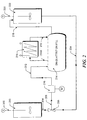
- the process illustrated in the above examples can be scaled to produce large volumes of ferrofluid using the apparatus shown in Figure 2.
- the materials used in the grinding process are directly poured into the vessel one by one through an opening.
- the shaft is first rotated at a slow speed to mix the materials and then it is increased for colloid formation.
- the process can be continuous or batched. In either case, a slurry of carrier oil, surfactant and red iron oxide is first pre-mixed in a large drum, such as a 55 gallon drum. The beneficial agent can also be added to the slurry at this time. Then the slurry is pumped into the attrition mill.
- FIG. 2 is a process diagram of an illustrative apparatus for either batch or continuous production of ferrofluid in accordance with the inventive process.
- the oil, surfactant, red iron oxide and beneficial agent are added to the premix vessel 200 in the proper proportions as described below.
- An agitator 202 maintains the iron oxide suspended in the slurry.
- the slurry passes through outlet piping 204 to a valve 206 which directs the slurry, via piping 208, to a peristaltic pump 210.
- the slurry passes, via piping 212, to the DM-20 attrition mill 214 where the slurry is ground in order to produce a stable colloid and to convert the non-magnetic iron oxide to its magnetic form.
- the mill 214 is connected, via piping 215 and 215A, to heat exchanger/cooler 216 which regulates the temperature of the mixture.
- the mixture then passes, via piping 218, to collection vessel 222.
- a second agitator 220 maintains the mixture in suspension.
- the mixture can be returned, via piping 224, to valve 206 and pump 210 for a second pass in the attrition mill 214 in case the desired magnetization has not been attained in a first pass through the attrition mill 214.
- the finished ferrofluid can be removed from collection vessel 222.
- the pre-mixed slurry in vessel 200 is fed into the attrition mill 214 and ground.
- the resulting colloid is collected in the collection vessel 222.
- the entire contents of vessel 222 are transferred back , via piping 224, to vessel 200 and the grinding process is repeated.
- the shearing force of the grinding media converts the starting slurry into a stable magnetic colloid with the attachment of the surfactant to the bare surfaces of the particle.
- the attrition process can also be used to coat the already-coated particles with a second surfactant and then suspend them in a different carrier.
- oleic acid coated particles may first be prepared in a suitable hydrocarbon solvent such as heptane, xylene or toluene using either the attritor process described above or the well-known co-precipitation technique of iron salt solutions. The coated particles are then dried in a closed evaporator in order to reclaim the solvent for later use.
- the coated particles are then mixed with a second surfactant and a compatible oil carrier in the attritor to convert this mixture into a stable colloid by grinding.
- the first surfactant could be a polymeric succinic anhydride, or amine, or these materials could also be used as a second surfactant for oleic acid coated particles.
- the coated particles may be suspended in a wide range of carrier oils such as hydrocarbon oils, esters, fluorocarbons and silicones, etc. For this process both red iron oxide converted into magnetic iron oxide by attrition as well as traditional magnetite particles coated with first surfactant may be employed.
- the advantage of this approach is that the colloid can be prepared in a minimum time and, when the particles are dried, the solvent can be recycled.
- the conventional method of preparing such a colloid is to heat the solvent-based ferrofluid, consisting of the magnetic particles coated with the first surfactant and suspended in the solvent, in the presence of the carrier oil and second surfactant under constant agitation. This known process is very time consuming. Further, after the final doubly-coated colloid has been created, the solvent is typically removed by evaporation into the atmosphere, thereby adding to the cost. With the known techniques, it is not possible to first dry the magnetic particles in the solvent-based ferrofluid because the dried particles, when mixed with second surfactant and carrier oil, cannot form a complete colloid under agitation and heat. These particles must be milled in an attritor or a ball mill to impart sufficient energy to form the desired colloid.
Landscapes
- Engineering & Computer Science (AREA)
- Power Engineering (AREA)
- Soft Magnetic Materials (AREA)
Applications Claiming Priority (2)
| Application Number | Priority Date | Filing Date | Title |
|---|---|---|---|
| US21229 | 1987-03-03 | ||
| US09/021,229 US6068785A (en) | 1998-02-10 | 1998-02-10 | Method for manufacturing oil-based ferrofluid |
Publications (1)
| Publication Number | Publication Date |
|---|---|
| EP0936635A1 true EP0936635A1 (de) | 1999-08-18 |
Family
ID=21803088
Family Applications (1)
| Application Number | Title | Priority Date | Filing Date |
|---|---|---|---|
| EP98102780A Withdrawn EP0936635A1 (de) | 1998-02-10 | 1998-02-18 | Verfahren zur Herstellung von magnetischer Flüssigkeit |
Country Status (3)
| Country | Link |
|---|---|
| US (1) | US6068785A (de) |
| EP (1) | EP0936635A1 (de) |
| JP (1) | JPH11260620A (de) |
Cited By (1)
| Publication number | Priority date | Publication date | Assignee | Title |
|---|---|---|---|---|
| DE10191871B4 (de) * | 2000-05-10 | 2007-05-31 | Korea Advanced Institute Of Science And Technology | Ein magnetorheologisches Fluid und ein Verfahren zur Herstellung desselben |
Families Citing this family (11)
| Publication number | Priority date | Publication date | Assignee | Title |
|---|---|---|---|---|
| US20060003163A1 (en) * | 1996-11-16 | 2006-01-05 | Nanomagnetics Limited | Magnetic fluid |
| US6815063B1 (en) | 1996-11-16 | 2004-11-09 | Nanomagnetics, Ltd. | Magnetic fluid |
| US6427970B1 (en) * | 2001-03-16 | 2002-08-06 | Young & Franklin, Inc. | Heat dissipating voice coil activated valves |
| KR100994353B1 (ko) * | 2002-12-13 | 2010-11-16 | 다우 코닝 도레이 캄파니 리미티드 | 복합 경화 실리콘 분말, 이의 제조방법 및 수성 조성물 |
| TWI292916B (en) * | 2006-02-16 | 2008-01-21 | Iner Aec Executive Yuan | Lipiodol-ferrofluid, and a process for preparation thereof |
| US7682265B2 (en) * | 2006-08-21 | 2010-03-23 | Vandelden Jay | Adaptive golf ball |
| KR20080073934A (ko) | 2007-02-07 | 2008-08-12 | 삼성전자주식회사 | 밸브 충전물 및 이를 구비한 밸브 유닛 |
| ES2347300T3 (es) | 2008-02-13 | 2010-10-27 | Inve Technologies Nv | Metodo para tratar quistes de artemia. |
| TWI394585B (zh) * | 2008-07-25 | 2013-05-01 | 行政院原子能委員會核能研究所 | The magnetic fluid used for the development or treatment of peptides |
| US9177917B2 (en) | 2010-08-20 | 2015-11-03 | Micron Technology, Inc. | Semiconductor constructions |
| US20120275929A1 (en) * | 2011-04-27 | 2012-11-01 | Aptina Imaging Corporation | Ferrofluid control and sample collection for microfluidic application |
Citations (6)
| Publication number | Priority date | Publication date | Assignee | Title |
|---|---|---|---|---|
| US3764540A (en) * | 1971-05-28 | 1973-10-09 | Us Interior | Magnetofluids and their manufacture |
| FR2498587A1 (fr) * | 1980-12-16 | 1982-07-30 | Aimants Ugimag Sa | Procede de preparation de composes magnetiques par mecano-chimie |
| SU947052A1 (ru) * | 1975-04-28 | 1982-07-30 | Всесоюзный Научно-Исследовательский И Проектный Институт По Переработке Газа | Ферромагнитна жидкость и способ ее получени |
| SU1074826A1 (ru) * | 1982-06-11 | 1984-02-23 | Всесоюзный Научно-Исследовательский И Проектный Институт По Переработке Газа | Способ получени магнитной жидкости на водной основе |
| US4834898A (en) * | 1988-03-14 | 1989-05-30 | Board Of Control Of Michigan Technological University | Reagents for magnetizing nonmagnetic materials |
| JPH04335502A (ja) * | 1991-05-10 | 1992-11-24 | Nok Corp | 黒色顔料用磁性流体 |
Family Cites Families (4)
| Publication number | Priority date | Publication date | Assignee | Title |
|---|---|---|---|---|
| US3215572A (en) * | 1963-10-09 | 1965-11-02 | Papell Solomon Stephen | Low viscosity magnetic fluid obtained by the colloidal suspension of magnetic particles |
| US3531413A (en) * | 1967-09-22 | 1970-09-29 | Avco Corp | Method of substituting one ferrofluid solvent for another |
| FR2461521A1 (fr) * | 1979-07-20 | 1981-02-06 | Anvar | Fluides magnetiques, notamment ferrofluides, et procede pour leur obtention |
| JP2725015B2 (ja) * | 1988-03-11 | 1998-03-09 | エヌオーケー株式会社 | 磁性流体の製造方法 |
-
1998
- 1998-02-10 US US09/021,229 patent/US6068785A/en not_active Expired - Fee Related
- 1998-02-18 EP EP98102780A patent/EP0936635A1/de not_active Withdrawn
- 1998-03-20 JP JP10092709A patent/JPH11260620A/ja not_active Withdrawn
Patent Citations (6)
| Publication number | Priority date | Publication date | Assignee | Title |
|---|---|---|---|---|
| US3764540A (en) * | 1971-05-28 | 1973-10-09 | Us Interior | Magnetofluids and their manufacture |
| SU947052A1 (ru) * | 1975-04-28 | 1982-07-30 | Всесоюзный Научно-Исследовательский И Проектный Институт По Переработке Газа | Ферромагнитна жидкость и способ ее получени |
| FR2498587A1 (fr) * | 1980-12-16 | 1982-07-30 | Aimants Ugimag Sa | Procede de preparation de composes magnetiques par mecano-chimie |
| SU1074826A1 (ru) * | 1982-06-11 | 1984-02-23 | Всесоюзный Научно-Исследовательский И Проектный Институт По Переработке Газа | Способ получени магнитной жидкости на водной основе |
| US4834898A (en) * | 1988-03-14 | 1989-05-30 | Board Of Control Of Michigan Technological University | Reagents for magnetizing nonmagnetic materials |
| JPH04335502A (ja) * | 1991-05-10 | 1992-11-24 | Nok Corp | 黒色顔料用磁性流体 |
Non-Patent Citations (3)
| Title |
|---|
| CHEMICAL ABSTRACTS, vol. 100, no. 26, June 1984, Columbus, Ohio, US; abstract no. 220471c, GRABOVSKII: "Water-base magnetic liquid" page 672; column 1; XP002072837 * |
| CHEMICAL ABSTRACTS, vol. 97, no. 20, November 1982, Columbus, Ohio, US; abstract no. 173809b, M.A BERLIN: "Ferromagnetic liquid and method for preparing it" page 754; column 1; XP002072838 * |
| PATENT ABSTRACTS OF JAPAN vol. 017, no. 183 (E - 1348) 9 April 1993 (1993-04-09) * |
Cited By (1)
| Publication number | Priority date | Publication date | Assignee | Title |
|---|---|---|---|---|
| DE10191871B4 (de) * | 2000-05-10 | 2007-05-31 | Korea Advanced Institute Of Science And Technology | Ein magnetorheologisches Fluid und ein Verfahren zur Herstellung desselben |
Also Published As
| Publication number | Publication date |
|---|---|
| JPH11260620A (ja) | 1999-09-24 |
| US6068785A (en) | 2000-05-30 |
Similar Documents
| Publication | Publication Date | Title |
|---|---|---|
| EP1017067B1 (de) | Magnetflüssigkeit und verfahren zu ihrer herstellung | |
| EP0856189B1 (de) | Wasserhaltige magnetorheologische materialen | |
| US4280918A (en) | Magnetic particle dispersions | |
| US6068785A (en) | Method for manufacturing oil-based ferrofluid | |
| JP3866331B2 (ja) | 磁性伝熱組成物、その製造方法、およびそれを用いた磁化方法 | |
| US4329241A (en) | Magnetic fluids and process for obtaining them | |
| JPH08503009A (ja) | 表面改質粒子使用の磁気レオロジー材料 | |
| US5085789A (en) | Ferrofluid compositions | |
| JPS63122107A (ja) | 導電性磁性流体組成物 | |
| JP3862768B2 (ja) | Pfpeマイクロエマルションからの混合超微小粒子の製造方法 | |
| JP2003524293A (ja) | 改善された化学的安定性を有する磁性流体組成物及び製造方法 | |
| US4416751A (en) | Process for producing a ferrofluid | |
| JPH0413842B2 (de) | ||
| EP0880149B1 (de) | Verfahren zur Herstellung von magnetischer Flüssigkeit | |
| US20030190471A1 (en) | Nanoparticle manganese zinc ferrites synthesized using reverse micelles | |
| JP3710935B2 (ja) | 磁性流体を用いた制動部材 | |
| JPH11294598A (ja) | 磁性流体シール | |
| JPS63280403A (ja) | 導電性磁性流体組成物とその製造方法 | |
| KR100203025B1 (ko) | 자성유체 제조방법 | |
| JP3341344B2 (ja) | 磁性流体の製造方法 | |
| JPS58180596A (ja) | 合成油を分散媒とする磁性流体の製造方法 | |
| KR100203024B1 (ko) | 자성유체 제조방법 | |
| JPH01315103A (ja) | 磁性流体組成物の製造方法 | |
| JPH10241928A (ja) | 磁性流体の低コスト製造方法 | |
| JPS62128103A (ja) | 磁性流体の製造方法 |
Legal Events
| Date | Code | Title | Description |
|---|---|---|---|
| PUAI | Public reference made under article 153(3) epc to a published international application that has entered the european phase |
Free format text: ORIGINAL CODE: 0009012 |
|
| AK | Designated contracting states |
Kind code of ref document: A1 Designated state(s): DE GB SE |
|
| AX | Request for extension of the european patent |
Free format text: AL;LT;LV;MK;RO;SI |
|
| 17P | Request for examination filed |
Effective date: 20000218 |
|
| AKX | Designation fees paid |
Free format text: DE GB SE |
|
| 17Q | First examination report despatched |
Effective date: 20010319 |
|
| GRAP | Despatch of communication of intention to grant a patent |
Free format text: ORIGINAL CODE: EPIDOSNIGR1 |
|
| STAA | Information on the status of an ep patent application or granted ep patent |
Free format text: STATUS: THE APPLICATION IS DEEMED TO BE WITHDRAWN |
|
| 18D | Application deemed to be withdrawn |
Effective date: 20031120 |