EP0937076B1 - Substitierte oxime, hydrazone und olefine als neurokinin antagonisten - Google Patents
Substitierte oxime, hydrazone und olefine als neurokinin antagonisten Download PDFInfo
- Publication number
- EP0937076B1 EP0937076B1 EP97913743A EP97913743A EP0937076B1 EP 0937076 B1 EP0937076 B1 EP 0937076B1 EP 97913743 A EP97913743 A EP 97913743A EP 97913743 A EP97913743 A EP 97913743A EP 0937076 B1 EP0937076 B1 EP 0937076B1
- Authority
- EP
- European Patent Office
- Prior art keywords
- alkyl
- group
- phenyl
- independently selected
- halogeno
- Prior art date
- Legal status (The legal status is an assumption and is not a legal conclusion. Google has not performed a legal analysis and makes no representation as to the accuracy of the status listed.)
- Expired - Lifetime
Links
- 0 CN(CC1)CCC1(C1)c(cccc2)c2N1S(*)(=O)=O Chemical compound CN(CC1)CCC1(C1)c(cccc2)c2N1S(*)(=O)=O 0.000 description 2
- YEXCKOAWFQHQAH-OBHRZRQUSA-N C/C=C\C=C(/C)\C(N(C)C/C(/C(CCN)c(cc1Cl)ccc1Cl)=N\OC)=O Chemical compound C/C=C\C=C(/C)\C(N(C)C/C(/C(CCN)c(cc1Cl)ccc1Cl)=N\OC)=O YEXCKOAWFQHQAH-OBHRZRQUSA-N 0.000 description 1
- OGPONQBYDYOFLC-UHFFFAOYSA-N CCC1(CC)c2ccccc2N(C)C1 Chemical compound CCC1(CC)c2ccccc2N(C)C1 OGPONQBYDYOFLC-UHFFFAOYSA-N 0.000 description 1
- VSAJILQTDDOIET-UHFFFAOYSA-N CCC1(CC)c2ccccc2NC1 Chemical compound CCC1(CC)c2ccccc2NC1 VSAJILQTDDOIET-UHFFFAOYSA-N 0.000 description 1
- QIMOQJVTVOSXOH-UHFFFAOYSA-N CN(CC1)CCC1(C1)c(cccc2)c2N1C=O Chemical compound CN(CC1)CCC1(C1)c(cccc2)c2N1C=O QIMOQJVTVOSXOH-UHFFFAOYSA-N 0.000 description 1
- LNUHMDMJETZIJI-GGFUHWEBSA-N Cc1cc(C(NC/C(/C(CCN(CC2)CC22c(cccc3)c3N(C)C2)c(cc2Cl)ccc2Cl)=N\OC)=O)cc(C)c1 Chemical compound Cc1cc(C(NC/C(/C(CCN(CC2)CC22c(cccc3)c3N(C)C2)c(cc2Cl)ccc2Cl)=N\OC)=O)cc(C)c1 LNUHMDMJETZIJI-GGFUHWEBSA-N 0.000 description 1
Classifications
-
- C—CHEMISTRY; METALLURGY
- C07—ORGANIC CHEMISTRY
- C07D—HETEROCYCLIC COMPOUNDS
- C07D471/00—Heterocyclic compounds containing nitrogen atoms as the only ring hetero atoms in the condensed system, at least one ring being a six-membered ring with one nitrogen atom, not provided for by groups C07D451/00 - C07D463/00
- C07D471/02—Heterocyclic compounds containing nitrogen atoms as the only ring hetero atoms in the condensed system, at least one ring being a six-membered ring with one nitrogen atom, not provided for by groups C07D451/00 - C07D463/00 in which the condensed system contains two hetero rings
- C07D471/10—Spiro-condensed systems
-
- A—HUMAN NECESSITIES
- A61—MEDICAL OR VETERINARY SCIENCE; HYGIENE
- A61P—SPECIFIC THERAPEUTIC ACTIVITY OF CHEMICAL COMPOUNDS OR MEDICINAL PREPARATIONS
- A61P1/00—Drugs for disorders of the alimentary tract or the digestive system
- A61P1/04—Drugs for disorders of the alimentary tract or the digestive system for ulcers, gastritis or reflux esophagitis, e.g. antacids, inhibitors of acid secretion, mucosal protectants
-
- A—HUMAN NECESSITIES
- A61—MEDICAL OR VETERINARY SCIENCE; HYGIENE
- A61P—SPECIFIC THERAPEUTIC ACTIVITY OF CHEMICAL COMPOUNDS OR MEDICINAL PREPARATIONS
- A61P11/00—Drugs for disorders of the respiratory system
- A61P11/06—Antiasthmatics
-
- A—HUMAN NECESSITIES
- A61—MEDICAL OR VETERINARY SCIENCE; HYGIENE
- A61P—SPECIFIC THERAPEUTIC ACTIVITY OF CHEMICAL COMPOUNDS OR MEDICINAL PREPARATIONS
- A61P11/00—Drugs for disorders of the respiratory system
- A61P11/08—Bronchodilators
-
- A—HUMAN NECESSITIES
- A61—MEDICAL OR VETERINARY SCIENCE; HYGIENE
- A61P—SPECIFIC THERAPEUTIC ACTIVITY OF CHEMICAL COMPOUNDS OR MEDICINAL PREPARATIONS
- A61P11/00—Drugs for disorders of the respiratory system
- A61P11/14—Antitussive agents
-
- A—HUMAN NECESSITIES
- A61—MEDICAL OR VETERINARY SCIENCE; HYGIENE
- A61P—SPECIFIC THERAPEUTIC ACTIVITY OF CHEMICAL COMPOUNDS OR MEDICINAL PREPARATIONS
- A61P19/00—Drugs for skeletal disorders
- A61P19/02—Drugs for skeletal disorders for joint disorders, e.g. arthritis, arthrosis
-
- A—HUMAN NECESSITIES
- A61—MEDICAL OR VETERINARY SCIENCE; HYGIENE
- A61P—SPECIFIC THERAPEUTIC ACTIVITY OF CHEMICAL COMPOUNDS OR MEDICINAL PREPARATIONS
- A61P25/00—Drugs for disorders of the nervous system
- A61P25/04—Centrally acting analgesics, e.g. opioids
-
- A—HUMAN NECESSITIES
- A61—MEDICAL OR VETERINARY SCIENCE; HYGIENE
- A61P—SPECIFIC THERAPEUTIC ACTIVITY OF CHEMICAL COMPOUNDS OR MEDICINAL PREPARATIONS
- A61P25/00—Drugs for disorders of the nervous system
- A61P25/08—Antiepileptics; Anticonvulsants
Definitions
- the present invention relates to a genus of substituted oximes, hydrazones and olefins useful as antagonists of tachykinin receptors, in particular as antagonists of the neuropeptides neurokinin-1 receptor (NK 1 ) and/or neurokinin-2 receptor (NK 2 ) and/or neurokinin-3 receptor (NK 3 ).
- NK 1 neurokinin-1 receptor
- NK 2 neurokinin-2 receptor
- NK 3 neurokinin-3 receptor
- Neurokinin receptors are found in the nervous system and the circulatory system and peripheral tissues of mammals, and therefore are involved in a variety of biological processes. Neurokinin receptor antagonists are consequently expected to be useful in the treatment or prevention of various mammalian disease states, for example asthma, cough, bronchospasm, inflammatory diseases such as arthritis, central nervous system conditions such as migraine and epilepsy, nociception, and various gastrointestinal disorders such as Crohn's disease.
- various mammalian disease states for example asthma, cough, bronchospasm, inflammatory diseases such as arthritis, central nervous system conditions such as migraine and epilepsy, nociception, and various gastrointestinal disorders such as Crohn's disease.
- NK 1 receptors have been reported to be involved in microvascular leakage and mucus secretion
- NK 2 receptors have been associated with smooth muscle contraction, making NK 1 and NK 2 receptor antagonists especially useful in the treatment and prevention of asthma.
- NK 1 and NK 2 receptor antagonists have previously been disclosed: arylalkylamines were disclosed in U.S. Patent 5,350,852, issued September 27, 1994, spiro-substituted azacycles were disclosed in WO 94/29309, published December 22, 1994, and in WO 94/17045, published August 4, 1994; substituted aryl piperazines were disclosed in WO 96/10568, published April 11, 1996.
- Preferred compounds are of the formula I wherein X is -O-, -NR 6 -, -N(R 6 )C(O)-or -OC(O)NR 6 . Additional preferred definitions are: b is 1 or 2 when X is -O- or -NR 6 -; b is 0 when X is -N(R 6 )C(O)-; and d is 1 or 2. Compounds wherein R 6a , R 7a , R 8a and R 9a are hydrogen are also preferred.
- R 8a and R 9a are each hydrogen, d and b are each 1, X is -O-, -NR 6 -, -N(R 6 )C(O)- or -OC(O)NR 6 , T is R 4 -aryl and R 4 is two substituents selected from C 1 -C 6 alkyl, halogeno, -CF 3 and C 1 -C 6 alkoxy.
- a preferred definition for Q is R 5 -phenyl, wherein R 5 is preferably two halogeno substituents.
- This invention also relates to the use of a compound of formula I in the treatment of asthma, cough, bronchospasm, inflammatory diseases such as arthritis, central nervous system conditions such as migraine and epilepsy, nociception, and various gastrointestinal disorders such as Crohn's disease.
- the invention in another aspect, relates to a pharmaceutical composition
- a pharmaceutical composition comprising a compound of formula I in a pharmaceutically acceptable carrier.
- the invention also relates to the use of said pharmaceutical composition in the treatment of asthma, cough, bronchospasm, inflammatory diseases such as arthritis, migraine, nociception, and various gastrointestinal disorders such as Crohn's disease.
- alkyl means straight or branched alkyl chains.
- Lower alkyl refers to alkyl chains of 1-6 carbon atoms and, similarly, lower alkoxy refers to alkoxy chains of 1-6 carbon atoms.
- Cycloalkyl means cyclic alkyl groups having 3 to 6 carbon atoms.
- “Bridged cycloalkyl” refers to C 7 -C 10 saturated rings comprised of a cycloalkyl ring or a fused bicycloalkyl ring and an alkylene chain joined at each end to non-adjacent carbon atoms of the ring or rings.
- bridged bicycloalkyl rings examples include adamantyl, myrtanyl, noradamantyl, norbornyl, bicyclo[2.2.1]heptyl, 6,6-dimethylbicyclo[3.1.1]heptyl, bicyclo[3.2.1]octyl, and bicyclo[2.2.2]octyl.
- Aryl means phenyl, naphthyl, indenyl, tetrahydronaphthyl, indanyl, anthracenyl or fluorenyl.
- Halogeno refers to fluoro, chloro, bromo or iodo atoms.
- Heterocycloalkyl refers to 4- to 6-membered saturated rings comprising 1 to 3 heteroatoms independently selected from the group consisting of -O-, -S- and -N(R 19 )-, with the remaining ring members being carbon.
- heterocycloalkyl rings are tetrahydrofuranyl, pyrrolidinyl, piperidinyl, morpholinyl, thiomorpholinyl and piperazinyl.
- R 4 -heterocycloalkyl refers to such groups wherein substitutable ring carbon atoms have an R 4 substituent.
- heteroaryl groups examples include pyridyl, isoxazolyl, oxazolyl, oxadiazolyl, furanyl, pyrrolyl, thienyl, imidazolyl, pyrazolyl, tetrazolyl, thiazolyl, isothiazolyl, thiadiazolyl, pyrazinyl, pyrimidyl, pyridazinyl and triazolyl.
- benzofused heteroaryl groups are indolyl, quinolyl, thianaphthenyl (i.e., benzothienyl) benzimidazolyl, benzoxazolyl, and benzofurazanyl.
- N-oxides of nitrogen-containing heteroaryl groups are also included. All positional isomers are contemplated, e.g., 1-pyridyl, 2-pyridyl, 3-pyridyl and 4-pyridyl.
- R 4 -heteroaryl refers to such groups wherein substitutable ring carbon atoms have an R 4 substituent.
- R 6 and R 7 substituents on a nitrogen atom form a ring and additional heteroatoms are present, the rings do not include adjacent oxygen and/or sulfur atoms or three adjacent heteroatoms.
- Typical rings so formed are morpholinyl, piperazinyl and piperidinyl.
- variables R 6 , R 7 , R 8 , R 9 , R 10 , and R 15 are said to be independently selected from a group of substituents, we mean that R 6 , R 7 , R 8 , R 9 , R 10 , and R 15 are independently selected, but also that where an R 6 , R 7 , R 8 , R 9 , R 10 , or R 15 variable occurs more than once in a molecule, those occurrences are independently selected.
- R 4 and R 5 can be independently selected from a group of substituents, and where more than one R 4 and R 5 are present, the substitutents are independently selected; those skilled in the art will recognize that the size and nature of the substituent(s) will affect the number of substituents which can be present.
- Compounds of formula I can have at least one asymmetrical carbon atom and all isomers, including diastereomers, enantiomers and rotational isomers, as well as E and Z isomers of the oxime, hydrazone and olefin groups, are contemplated as being part of this invention.
- the invention includes d and I isomers in both pure form and in admixture, including racemic mixtures. Isomers can be prepared using conventional techniques, either by reacting optically pure or optically enriched starting materials or by separating isomers of a compound of formula I.
- Compounds of the invention have at least one amino group which can form pharmaceutically acceptable salts with organic and inorganic acids.
- suitable acids for salt formation are hydrochloric, sulfuric, phosphoric, acetic, citric, oxalic, malonic, salicylic, malic, fumaric, succinic, ascorbic, maleic, methanesulfonic and other mineral and carboxylic acids well known to those in the art.
- the salt is prepared by contacting the free base form with a sufficient amount of the desired acid to produce a salt.
- the free base form may be regenerated by treating the salt with a suitable dilute aqueous base solution such as dilute aqueous sodium bicarbonate.
- the free base form differs from its respective salt form somewhat in certain physical properties, such as solubility in polar solvents, but the salt is otherwise equivalent to its respective free base forms for purposes of the invention.
- Certain compounds of the invention are acidic (e.g., those compounds which possess a carboxyl group). These compounds form pharmaceutically acceptable salts with inorganic and organic bases. Examples of such salts are the sodium, potassium, calcium, aluminum, gold and silver salts. Also included are salts formed with pharmaceutically acceptable amines such as ammonia, alkyl amines, hydroxyalkylamines, N-methylglucamine and the like.
- step 1 the ester (preferably methyl) of the substituted aryl acetic acid of formula 1 , wherein R 19 is a lower alkyl group, preferably methyl, is reacted with a compound of formula 2 , wherein R 17' is a leaving group such as Br, I or triflate, and Pg is a suitable protecting group such as tetrahydropyranyl, and a base to prepare a compound of formula 3 .
- the base can be chosen from any strong base including LDA or lithium bis(trimethylsilyl)amide.
- the reaction is carried out in an inert organic solvent such as THF at temperatures of -15 to about 65°C.
- step 2 a compound of formula 3 is reacted with an acid in a solvent such as CH 3 OH, at temperatures ranging from -10 to 65°C.
- the acid need not to be used in stochiometric amount.
- a compound of formula 4 can be prepared directly from step 1 without isolating the compound of formula 3 : the reaction mixture obtained after the work up of the reaction described in step 1 can be dissolved in the solvent and reacted with the acid.
- step 3 a compound of formula 4 is reacted with an acid such hydrobromic acid (HBr) dissolved in a suitable solvent such as acetic acid.
- HBr hydrobromic acid
- a suitable solvent such as acetic acid.
- step 4 the carboxylic acid of formula 5 is reacted with a halogenating agent such as SOCl 2 or (COCl) 2 in an appropriate solvent such CH 2 Cl 2 to form the acid halide of formula 6 .
- a halogenating agent such as SOCl 2 or (COCl) 2 in an appropriate solvent such CH 2 Cl 2 to form the acid halide of formula 6 .
- step 5 the compound of formula 6 is reacted with an alkylating agent such as diazomethane to obtain the compound of formula 7 .
- This reaction may be performed at temperatures lower than ambient using an appropriate solvent such as Et 2 O.
- step 6 a compound of formula 7 is reacted with a compound of formula 8 to obtain a compound of formula 9 .
- the reaction is carried out in a suitable solvent, e.g. EtOAc, at temperatures below 85°C. Bases such as Et 3 N may be beneficial to the reaction.
- step 7 a compound of formula 9 is reacted with a compound of formula 10 , wherein X is -O- or -S-, T is H, R 4 -aryl, R 4 -cycloalkyl, R 4 -alkyl, R 4 -bicyclo or tricycloalkyl, and R 8a , R 9a , b and R 4 are as defined above in an appropriate solvent, e.g. CH 2 Cl 2 , with a Lewis acid, e.g. BF 3 , at temperatures lower than 50°C.
- an appropriate solvent e.g. CH 2 Cl 2
- a Lewis acid e.g. BF 3
- step 8 a compound of formula 11 is reacted with a compound of formula 12 , wherein A is as defined above, in a solvent such as pyridine, to obtain the desired product.
- step 1 a compound of formula 14A, wherein Q is as defined above, is reacted with a base such as lithium disopropylamide (LDA) or KH in an inert organic solvent such at THF or DME to generate a dianion.
- a base such as lithium disopropylamide (LDA) or KH
- LDA lithium disopropylamide
- step 2 An acid chloride, ester or amide of formula 13A , 13B , or 13C is added to give a ketone of formula 15 .
- Preferable reaction temperatures ranges from -78°C to 30°C.
- compounds of formula 15 can be generated by the reaction of a compound of formula 13 , preferably 13C , with a metallated species of formula QCH 2 Mt where Mt is a metal, such as MgHal, wherein "Hal" is halogen, or lithium.
- the metallated species QCH 2 Mt can be generated by conventional procedures, such as treatment compounds of formula QCH 2 Hal with Mg or by treating QCH 3 with an organolithium base.
- step 2 for compounds of formula I wherein R is not hydrogen, the ketone 15 is reacted with a suitable base, such as LDA or KH in an inert organic solvent such as THF.
- a suitable base such as LDA or KH
- an inert organic solvent such as THF.
- R-R 17' wherein R 17' (as defined above) is added.
- R 17' an appropriate oxidizing agent such as dimethyldioxirane or Davis reagent is added.
- Preferable reaction temperatures range from -78° to 50°C.
- step 3 ketone 16 is reacted with a base such as LDA in a solvent such as THF, then an olefin of formula 17 is added, wherein R 18 and R 18' are independently H or lower alkyl and R 17' is as defined above, to give the adduct 18 .
- Preferable reaction temperatures range from -78 to 60°C.
- step 4 ketone 18 is reacted with HA', wherein A' is NH-OR 1 , NH-N(R 2 )(R 3 ) or NHR 26 , in an organic solvent such as pyridine at a temperature from 25°C to 150°C to give a compound of formula 19 .
- step 5 a compound of formula 19 is oxidized by ozonolysis to give an aldehyde of formula 20 .
- Suitable organic solvents include EtOAc, ethanol or the like.
- Preferable reaction temperatures are from -78 to 0°C.
- step 6 an aldehyde of formula 20 is reacted with a compound of formula Z-H, wherein Z is a suitably substituted amine (as its acid salt e.g. HCI or maleate or as its free base) and a hydride source such as NaBH 3 CN or sodium triacetoxyborohydride in a protic solvent (e.g. CH 3 OH, CH 3 CH 2 OH, or CF 3 CH 2 OH) with 3A sieves.
- a protic solvent e.g. CH 3 OH, CH 3 CH 2 OH, or CF 3 CH 2 OH
- Any suitable temperature can be used with preferable temperatures being between 0°C and 25°C.
- a compound of formula I can be prepared from 18 by the following reaction scheme:
- an appropriate base such as NaH
- step 2 compounds of formula 23 can be converted to the corresponding oxime of formula 24 in a manner similar to that described in Procedure B, Step 4.
- step 3 compounds of formula 24 (or 23 , i.e., wherein A' is O) are converted to the corresponding aldehyde 25 (or lactol from the keto-ester 23 ) by treatment with a suitable reducing agent such as DIBAL, in an suitable inert organic solvent such as THF, at a temperature from about -100 to -20°C.
- a suitable reducing agent such as DIBAL
- THF inert organic solvent
- step 4 compound 25 is reacted with an amine ZH in a manner similar to that of Procedure B, Step 6, to obtain the compound of formula I.
- T and Q generally are exemplified as R 5 -phenyl and R 4 -phenyl, respectively, but those skilled in the art will recognize that in many cases, similar procedures can be used to prepare compounds wherein T and Q are other than substituted-phenyl.
- Reactive groups not involved in the above processes can be protected during the reactions with conventional protecting groups which can be removed by standard procedures after the reaction.
- Table 1 shows some typical protecting groups:
- Compounds of formula I have been found to be antagonists of NK 1 and/or NK 2 and/or NK 3 receptors, and are therefore useful in treating conditions caused or aggravated by the activity of said receptors.
- the present invention also relates to a pharmaceutical composition
- a pharmaceutical composition comprising a compound of formula I and a pharmaceutically acceptable carrier.
- Compounds of this invention can be administered in conventional oral dosage forms such as capsules, tablets, powders, cachets, suspensions or solutions, or in injectable dosage forms such as solutions, suspensions, or powders for reconstitution
- the pharmaceutical compositions can be prepared with conventional excipients and additives, using well known pharmaceutical formulation techniques.
- Pharmaceutically acceptable excipients and additives include non-toxic and chemically compatibile fillers, binders, disintegrants, buffers, preservatives, anti-oxidants, lubricants, flavorings, thickeners, coloring agents, emulsifiers and the like.
- the daily dose of a compound of formula I for treating asthma, cough, bronchspasm, inflammatory diseases, migraine, nociception and gastrointestinal disorders is about 0.1 mg to about 20 mg/kg of body weight per day, preferably about 0.5 to about 15 mg/kg.
- the dosage range is therefore from about 1 to about 1500 mg of drug per day, preferably about 50 to about 200 mg, more preferably about 50 to about 500 mg/kg per day, given in a single dose or 2-4 divided doses.
- the exact dose is determined by the attending clinician and is dependent on the potency of the compound administered, the age, weight, condition and response of the patient.
- Me is methyl
- Ac is acetyl
- Et is ethyl
- Ph is phenyl
- Step 2
- active compound refers to a compound of formula I.
- Sterile Powder for Injection Ingredient mg/vial mg/vial Active sterile powder 100 500
- Test compounds are evaluated for their ability to inhibit the activity of the NK 1 agonist Substance P on the isolated guinea pig vas deferens.
- Freshly cut vas deferens are removed from male Hartley guinea pigs (230-350g) and suspended in 25 ml tissue baths containing Kreb's Henseleit solution warmed to 37°C and constantly aerated with 95% O 2 and 5% CO 2 . Tissues are adjusted to 0.5 g and allowed to equilibrate for a period of 30 minutes.
- the vas deferens are exposed to an electrical field stimulation (Grass S48 Stimulator) every 60 seconds at an intensity that will cause the tissue to contract 80% of its maximum capacity.
- Substance P potentiates the electrical field stimulated-induced contractions of the guinea pig vas deferens.
- all tissues control or drug treated are exposed to cumulative concentations of Substance P (1X10 -10 M - 7X10 -7 M).
- Single log-concentations of the test compounds are given to separate tissues and allowed to equilibrate for 30 minutes before a Substance P concentation-response curve is generated. At least 5 separate tissues are used for each control and individual drug-concentation for every drug assay.
- Inhibition of the Substance P is demonstrated by a rightward shift of its concentration-response curve. These shifts are used to determine the pA 2 value, which is defined as the negative log of the molar concentration of the inhibitor which would require that twice as much agonist be used to elicit a chosen response. This value is used to determine relative antagonist potency.
- Tissue responses to NKA are recorded as positive pen displacements over baseline and converted to grams tension by comparison to standard weights. Responses are normalized as a % of the maximal tissue tension.
- ED 50 's are calculated for NKA from the control and treated NKA dose responses and compared.
- Test compounds resulting in an agonist dose ratio ⁇ 2 at a screening concentration of 1 ⁇ M are considered actives. Further dose response data is obtained for actives so that an apparent pA 2 estimate can be calculated.
- mice Studies are performed on male Hartley guinea pigs ranging in weight from 400-650 g.
- the animals are given food and water ad libitum .
- the animals are anesthetized by intraperitoneal injection of dialurethane (containing 0.1 g/ml diallylbarbituric acid, 0.4 g/ml ethylurea and 0.4 g/ml urethane).
- dialurethane containing 0.1 g/ml diallylbarbituric acid, 0.4 g/ml ethylurea and 0.4 g/ml urethane.
- the jugular vein is cannulated for the injection of drugs.
- the Evans blue dye technique (Danko, G. et al., Pharmacol. Commun. , 1, 203-209, 1992) is used to measure airway microvascular leakage (AML). Evans blue (30 mg/kg) is injected intravenously, followed 1 min later by i.v. injection of substance P (10 ⁇ g/kg). Five min later, the thorax is opended and a blunt-ended 13-guage needle passed into the aorta. An incision is made in the right atrium and blood is expelled by flushing 100 ml of saline through the aortic catheter. The lungs and trachea are removed en-bloc and the trachea and bronchi are then blotted dry with filter paper and weighed.
- Evans blue is extracted by incubation of the tissue at 37°C for 18 hr in 2 ml of formamide in stoppered tubes. The absorbance of the formamide extracts of dye is measured at 620 nm. The amount of dye is calculated by interpolation from a standard curve of Evans blue in the range 0.5-10 ⁇ g/ml in formamide. The dye concentration is expressed as ng dye per mg tissue wet weight. Test compounds were suspended in cyclodextran vehicle and given i.v. 5 min before substance P.
- the guinea pigs are placed inside a whole body plethysmograph and the catheters connected to outlet ports in the plethysmograph wall.
- Airflow is measured using a differential pressure transducer (Validyne, Northridge CA, model MP45-1, range ⁇ 2 cmH 2 O) which measures the pressure across a wire mesh screen that covers a 1 inch hole in the wall of the plethysmograph.
- the airflow signal is electrically integrated to a signal proportional to volume.
- Transpulmonary pressure is measured as the pressure difference between the trachea and the esophagus using a differential pressure transducer (Validyne, Northridge, CA, model MP45-1, range ⁇ 20 cm H 2 O).
- the volume, airflow and transpulmonary pressure signals are monitored by means of a pulmonary analysis computer (Buxco Electronics, Sharon, CT, model 6) and used for the derivation of pulmonary resistance (R L ) and dynamic lung compliance (C Dyn ).
- NKA Sodium EDTA
- Increasing iv doses of NKA are administered at half log (0.01-3 ⁇ g/kg) intervals allowing recovery to baseline pulmonary mechanics between each dose. Peak bronchoconstriction occurs within 30 seconds after each dose of agonist. The dose response is stopped when C Dyn is reduced 80-90% from baseline.
- One dose-response to NKA is performed in each animal. Test compounds are suspended in cyclodextran vehicle and given i.v. 5 min before the initiation of the NKA dose response.
- dose response curves to NKA are constructed by plotting the percent increase in R L or decrease in C Dyn against log dose of agonist.
- the doses of NKA that increased R L by 100% (R L 100) or decreased C Dyn by 40% (C Dyn 40) from baseline values are obtained by log-linear interpolation of the dose response curves.
- CHO cells transfected with the coding regions for the human neurokinin 1 (NK1) of the human neurokinin 2 (NK2) receptors are grown in Dulbecco's minimal essential medium supplemented with 10% fetal calf serum, 0.1 mM non-essential amino acids, 2 mM glutamine, 100units/ml of penicillin and streptomycin, and 0.8 mg of G418/ml at 37°C in a humidified atmosphere containing 5% CO 2 .
- Cells are detached from T-175 flasks with a sterile solution containing 5mM EDTA in phosphate buffered saline. Cells are harvested by centrifugation and washed in RPMI media at 40°C for 5 minutes. The pellet is resuspended inTris-HCI (pH7.4) containing 1 uM phsphoramidon and 4 ug/ml of chymostatin at a cell density of 30 x 10 6 cells/ml. The suspension is then homogenized in a Brinkman Polytron (setting 5) for 30-45 seconds. The homogenate is centrifuged at 800 x g for 5 min at 4°C to collect unbroken cells and nuclei.
- the supernatant is centrifuged in a Sorvall RC5C at 19,000 rpm (44,00 x g) for 30 min at 4°C.
- the pellet is resuspended, an aliquot is removed for a protein determination (BCA) and washed again.
- the resulting pellet is stored at -80°C.
- Binding is initiated by the addition of 100 ⁇ l of membrane (10-20 ⁇ g) containing the human NK-1 or NK-2 receptor in a final volume of 200 ⁇ l. After 40 minutes at room temperature, the reaction is stopped by rapid filtration onto Whatman GF/C filters which have been presoaked in 0.3% polyethylenimine. Filters are washed 2 times with 3 ml of 50 mM Tris-HCI (pH7.4). Filters are added to 6 mls of Ready-Safe liquid scintillation cocktail and quantified by liquid scintillation spectrometry in a LKB 1219 RackBeta counter.
- Non-specific binding is determined by the addition of either 1 ⁇ M of CP-99994 (NK-1) or 1 ⁇ M SR-48968 (NK-2) (both synthesized by the chemistry department of Schering-Plough Research Institute).
- IC 50 values are determined from competition binding curves and Ki values are determined according to Cheng and Prusoff using the experimentally determined value of 0.8 nM for the NK-1 receptor and 2.4 nM for the NK-2 receptor.
- NK 3 activity is determined by following a procedure similar to that described in the literature, e.g., Molecular Pharmacol., 48 (1995), p. 711-716.
- % Inhibition is the difference between the percent of maximum specific binding (MSB) and 100%.
- compounds of formula I exhibit NK 1 , NK 2 and/or NK 3 antagonist activity to varying degrees, e.g., certain compounds have strong NK 1 antagonist activity, but weaker NK 2 and NK 3 antagonist activity, while others are strong NK 2 antagonists, but weaker NK 1 and NK 3 antagonists. While compounds with approximate equipotency are preferred, it is also within the scope of this invention to use compounds of with unequal NK 1 /NK 2 /NK 3 antagonist activity when clinically appropriate.
- compounds of the present invention are found to exhibit a range of activity: percent inhibition at a dosage of 1 ⁇ M ranges from about 0 to about 100% inhibition of NK 1 and/or about 0 to about 100% inhibition of NK 2 .
- Preferred are compounds having a Ki ⁇ 100nM for the NK 1 receptor.
- compounds having a Ki ⁇ 100nM for the NK 2 receptor are also preferred.
- Another group of preferred compounds are those having a Ki ⁇ 100nM for each of the NK 1 and NK 2 receptors.
Landscapes
- Health & Medical Sciences (AREA)
- Chemical & Material Sciences (AREA)
- Organic Chemistry (AREA)
- Life Sciences & Earth Sciences (AREA)
- General Health & Medical Sciences (AREA)
- Veterinary Medicine (AREA)
- Public Health (AREA)
- Bioinformatics & Cheminformatics (AREA)
- Chemical Kinetics & Catalysis (AREA)
- General Chemical & Material Sciences (AREA)
- Medicinal Chemistry (AREA)
- Nuclear Medicine, Radiotherapy & Molecular Imaging (AREA)
- Engineering & Computer Science (AREA)
- Pharmacology & Pharmacy (AREA)
- Animal Behavior & Ethology (AREA)
- Pulmonology (AREA)
- Pain & Pain Management (AREA)
- Biomedical Technology (AREA)
- Neurosurgery (AREA)
- Neurology (AREA)
- Orthopedic Medicine & Surgery (AREA)
- Immunology (AREA)
- Rheumatology (AREA)
- Physical Education & Sports Medicine (AREA)
- Pharmaceuticals Containing Other Organic And Inorganic Compounds (AREA)
- Acyclic And Carbocyclic Compounds In Medicinal Compositions (AREA)
- Nitrogen Condensed Heterocyclic Rings (AREA)
- Nitrogen And Oxygen Or Sulfur-Condensed Heterocyclic Ring Systems (AREA)
- Plural Heterocyclic Compounds (AREA)
Claims (5)
- Verbindung dargestellt durch die Strukturformeloder ein pharmazeutisch akzeptables Salz davon, wobei:
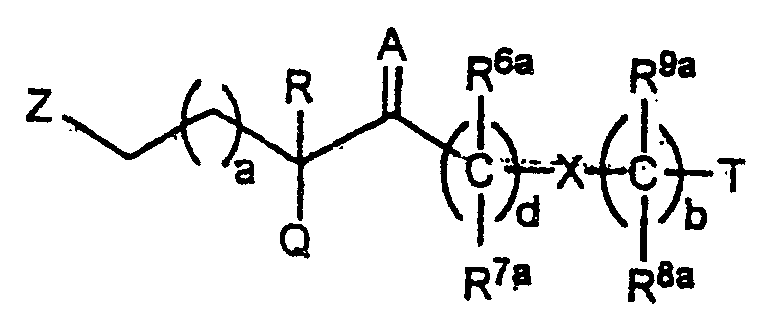 a 0, 1, 2 oder 3 ist,b und d unabhängig voneinander 0, 1 oder 2 sind;R H ist;A =N-OR1 ist;X eine Bindung, -C(O)-, -O-, -NR6-, -S(O)e-, -N(R6)C(O)-, -OC(O)NR6-, -C(=NOR1)- ist, vorausgesetzt dass, wenn d 0 ist, X eine Bindung, -C(O)-, -NR6-, -N(R6)C(O)-, -OC(O)NR6-, -C(= NOR1)- ist;T R4-Phenyl ist;Q R5-Phenyl ist;R1 H, C1-6-Alkyl, -(CH2)n-G, -(CH2)p-M-(CH2)n-G oder -C(O)N(R6) (R7) ist;R4 und R5 sind unabhängig voneinander 1-3 Substituenten unabhängig ausgewählt aus der Gruppe bestehend aus H, Halogen, -OR6, C1-6-Alkyl, -CF3;R6, R7 und R8 unabhängig ausgewählt aus der Gruppe bestehend aus H, C1-6-Alkyl, C2- bis C6-Hydroxyalkyl, C1- bis C6-Alkoxy-C1- bis C6-alkyl, R15-Phenyl und R15-Benzyl sind; oder R6 und R7 zusammen mit dem Stickstoff, an den sie gebunden sind, einen 5- bis 6-gliedrigen Ring bilden, wobei 0, 1 oder 2 Ringglieder aus der Gruppe bestehend aus -O-, -S- und -N(R19)- ausgewählt sind,R6a, R7a und R8a unabhängig voneinander ausgewählt sind aus der Gruppe bestehend aus H, C2- bis C6-Hydroxyalkyl und C1bis C6-Alkoxy-C1- bis C6-alkyl;R9 und R9a unabhängig voneinander ausgewählt sind aus der Gruppe bestehend aus R6;R10 und R10a unabhängig voneinander ausgewählt sind aus der Gruppe bestehend aus H und C1-6-Alkyl;R15 für 1 bis 3 Substituenten steht, die unabhängig voneinander ausgewählt sind aus der Gruppe bestehend aus H, C1bis C6-Alkyl, C1- bis C6-Alkoxy, C1- bis C6-Alkylthio, Halogen, -CF3, -C2F5, -COR10, -CO2R10, -C(O)N(R10)2, -S(O)eR10a, -CN, -N (R10)COR10, -N(R10)CON(R10)2 und -NO2;R19 H, C1- bis C6-Alkyl, -C(O)N(R10)2, -CO2R10, -(C(R8)(R9))f-CO2R10 oder -(C(R8)(R9))u-C(O)N(R10)2 ist,f, n und p unabhängig voneinander 1 bis 6 sind;u 0 bis 6 ist,G ausgewählt ist aus der Gruppe bestehend aus R4-Heteroaryl, -OR6, -CO2R6, -CON(R7) (R9), -C(=NOR8)N(R6) (R7) und -C(O)N(R9)-(R4-Heteroaryl), vorausgesetzt dass, wenn n 1 und u 0 ist, G nicht OH ist;M ausgewählt ist aus der Gruppe bestehend aus -O- und -C(O)N(R9)-, vorausgesetzt dass, wenn n 1 ist, G nicht OH ist;e 0, 1 oder 2 ist, vorausgesetzt dass, wenn e 1 oder 2 ist, R10a nicht H ist;Zist; R37 ausgewählt ist aus der Gruppe bestehend aus:
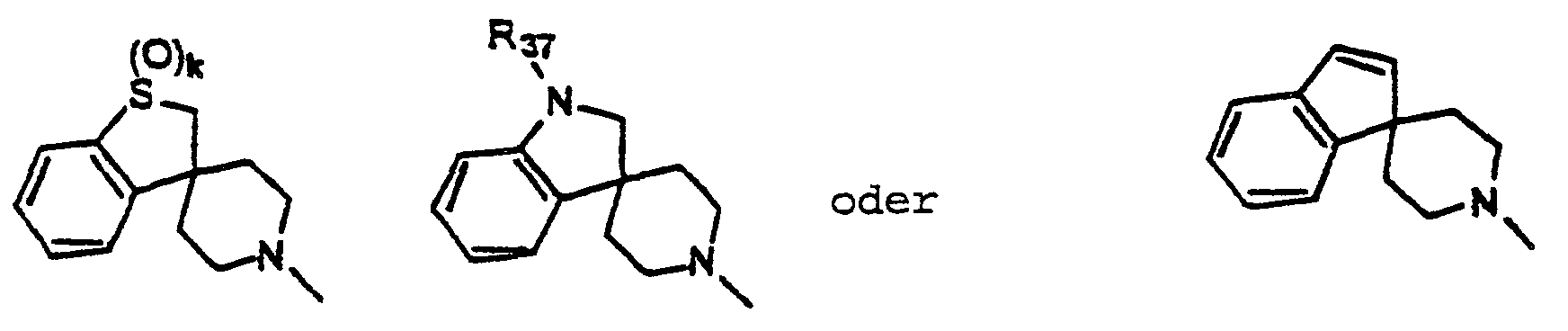 (1) H,(2) Lineares oder verzweigtes C1-8- Alkyl, unsubstituiert, monosubstituiert oder mehrfachsubstituiert mit -OR35, =O, -NHCOR35, -NR35R36, -CN, -Halogen, -CF3, -Phenyl oder substituiertem Phenyl, wobei die Substituenten am Phenyl ausgewählt sind aus der Gruppe bestehend aus -OH, -CN, Halogen oder -CF3;(3) S(O)R38, wobei R38 ein lineares oder verzweigtes C1-6-Alkyl ist, unsubstituiert, mono, di- oder trisubstituiert mit einem Substituenten ausgewählt aus der Gruppe bestehend aus =O, -CN, -OR35, -NR35R36, -NR 36OR36, -Halogen, -CF3, -Phenyl oder mono-, di oder trisubstituiertem Phenyl, wobei die Substituenten an dem Phenyl unabhängig ausgewählt sind aus der Gruppe bestehend aus -OH, =O, -CN, -NR35R36, -NR35COR36, Halogen, -CF3 und C1-3-Alkyl;(4) SO2R38;(5) COR38;(6) CO2R38;(7) CONR36R38;R35 und R36 unabhängig voneinander ausgewählt sind aus:oder(a) H,(b) C1-6-Alkyl oder mono- oder disubstituiertem C1-6-Alkyl, wobei die Substituenten unabhängig ausgewählt sind aus der Gruppe bestehend aus Phenyl, welches unsubstituiert oder substituiert mit -OH, C1-3-Alkyl, -CN, Halogen, -CF3 oder C1-4-Alkoxy ist; -OH; =O; -CN; Halogen oder -CF3;(c) Phenyl, Pyridinyl oder Thiophen, oder mono-, dioder trisubstituiertes Phenyl, Pyridinyl oder Thiophen, wobei die Substituenten unabhängig ausgewählt sind aus der Gruppe bestehend aus -OH, C1-4-Alkyl, -CN, Halogen und -CF3;(d) C1-3-Alkoxy,R35 und R36 miteinander verbunden sind, um einen 5-, 6-, oder 7-gliedrigen monocyclischen gesättigten Ring zu bilden, welcher ein oder zwei Heteroatome enthält, die unabhängig ausgewählt sind aus Stickstoff, Sauerstoff und Schwefel, und wobei der Ring unsubstituiert oder mono- oder disubstituiert ist, wobei die Substituenten unabhängig ausgewählt sind aus der Gruppe bestehend aus -OH, =O, -CN, Halogen und -CF3.
 - Verbindung nach Anspruch 1 dargestellt durch die Formelwobei G und R4 wie in Anspruch 1 definiert sind.

- Verbindung nach Anspruch 2, die durch die Strukturformeldargestellt ist.

- Pharmazeutische Zusammensetzung, die eine wirksame Menge einer Verbindung nach einem der Ansprüche 1 bis 3 und einen pharmazeutisch akzeptablen Träger enthält.
- Verwendung einer Verbindung nach einem der Ansprüche 1 bis 3 für die Herstellung eines Medikaments zur Behandlung von Asthma, Husten, Bronchospasmen, Krankheiten des zentralen Nervensystems, Entzündungskrankheiten und gastrointestinalen Störungen.
Applications Claiming Priority (3)
| Application Number | Priority Date | Filing Date | Title |
|---|---|---|---|
| US74253896A | 1996-11-01 | 1996-11-01 | |
| US742538 | 1996-11-01 | ||
| PCT/US1997/019164 WO1998020010A1 (en) | 1996-11-01 | 1997-10-30 | Substituted oximes, hydrazones and olefins as neurokinin antagonists |
Publications (2)
| Publication Number | Publication Date |
|---|---|
| EP0937076A1 EP0937076A1 (de) | 1999-08-25 |
| EP0937076B1 true EP0937076B1 (de) | 2002-08-14 |
Family
ID=24985225
Family Applications (1)
| Application Number | Title | Priority Date | Filing Date |
|---|---|---|---|
| EP97913743A Expired - Lifetime EP0937076B1 (de) | 1996-11-01 | 1997-10-30 | Substitierte oxime, hydrazone und olefine als neurokinin antagonisten |
Country Status (8)
| Country | Link |
|---|---|
| EP (1) | EP0937076B1 (de) |
| JP (1) | JP2001510455A (de) |
| AT (1) | ATE222252T1 (de) |
| AU (1) | AU5086298A (de) |
| CA (1) | CA2269858A1 (de) |
| DE (1) | DE69714758T2 (de) |
| ES (1) | ES2180956T3 (de) |
| WO (1) | WO1998020010A1 (de) |
Families Citing this family (2)
| Publication number | Priority date | Publication date | Assignee | Title |
|---|---|---|---|---|
| ID29137A (id) * | 1998-07-27 | 2001-08-02 | Schering Corp | Ligan-ligan afinitas tinggi untuk reseptor nosiseptin orl-1 |
| EP2117538A1 (de) | 2007-01-24 | 2009-11-18 | Glaxo Group Limited | Pharmazeutische zusammensetzungen mit 2-methoxy-5- (5-trifluoromethyl-tetrazol-i-yl-benzyl) - (2s-phenyl-piperidin-3s-yl-) |
Family Cites Families (1)
| Publication number | Priority date | Publication date | Assignee | Title |
|---|---|---|---|---|
| US5434158A (en) * | 1994-04-26 | 1995-07-18 | Merck & Co., Inc. | Spiro-substituted azacycles as neurokinin-3 antagonists |
-
1997
- 1997-10-30 CA CA002269858A patent/CA2269858A1/en not_active Abandoned
- 1997-10-30 JP JP52147298A patent/JP2001510455A/ja active Pending
- 1997-10-30 DE DE69714758T patent/DE69714758T2/de not_active Expired - Fee Related
- 1997-10-30 EP EP97913743A patent/EP0937076B1/de not_active Expired - Lifetime
- 1997-10-30 AU AU50862/98A patent/AU5086298A/en not_active Abandoned
- 1997-10-30 WO PCT/US1997/019164 patent/WO1998020010A1/en not_active Ceased
- 1997-10-30 ES ES97913743T patent/ES2180956T3/es not_active Expired - Lifetime
- 1997-10-30 AT AT97913743T patent/ATE222252T1/de not_active IP Right Cessation
Also Published As
| Publication number | Publication date |
|---|---|
| AU5086298A (en) | 1998-05-29 |
| ATE222252T1 (de) | 2002-08-15 |
| EP0937076A1 (de) | 1999-08-25 |
| DE69714758D1 (de) | 2002-09-19 |
| CA2269858A1 (en) | 1998-05-14 |
| ES2180956T3 (es) | 2003-02-16 |
| DE69714758T2 (de) | 2003-01-02 |
| WO1998020010A1 (en) | 1998-05-14 |
| JP2001510455A (ja) | 2001-07-31 |
Similar Documents
| Publication | Publication Date | Title |
|---|---|---|
| US5688960A (en) | Substituted oximes, hydrazones and olefins useful as neurokinin antagonists | |
| EP0773929B1 (de) | Piperidinderivate als neurokininantagonisten | |
| US5789422A (en) | Substituted arylalkylamines as neurokinin antagonists | |
| US5691362A (en) | Substituted benzene-fused hetero- and carbocyclics as nuerokinin antagonists | |
| EP0823896B1 (de) | Substituierte oxime, hydrazone und olefine als neurokinin-antagonisten | |
| US8003669B2 (en) | Remedy for sleep disturbance | |
| JP2002521436A (ja) | 置換アニリド化合物および方法 | |
| EP0927170B1 (de) | Piperazinderivate als neurokinin-antagonisten | |
| US5945428A (en) | Substituted oximes, hydrazones and olefins as neurokinin antagonists | |
| EP0934271B1 (de) | Substituierte arylalkylamine als neurokinin-antagonisten | |
| EP0937076B1 (de) | Substitierte oxime, hydrazone und olefine als neurokinin antagonisten | |
| US5063239A (en) | Amino-esters of dihydropyridines useful for improving circulation in patients | |
| EP0848706B1 (de) | Substituierte benzokondensierte heterocyclen als neurokinin antagonisten | |
| MXPA99003938A (en) | Substituted oximes, hydrazones and olefins as neurokinin antagonists | |
| HK1008819B (en) | Piperidine derivatives as neurokinin antagonists | |
| CN101014570A (zh) | 吡啶衍生物或其药学上可接受的盐 | |
| HK1018265B (en) | Piperazino derivatives as neurokinin antagonists | |
| HK1008221B (en) | Substituted oximes, hydrazones and olefins as neurokinin antagonists |
Legal Events
| Date | Code | Title | Description |
|---|---|---|---|
| PUAI | Public reference made under article 153(3) epc to a published international application that has entered the european phase |
Free format text: ORIGINAL CODE: 0009012 |
|
| 17P | Request for examination filed |
Effective date: 19990503 |
|
| AK | Designated contracting states |
Kind code of ref document: A1 Designated state(s): AT BE CH DE DK ES FI FR GB GR IE IT LI LU NL PT SE |
|
| AX | Request for extension of the european patent |
Free format text: LT PAYMENT 19990503;LV PAYMENT 19990503;RO PAYMENT 19990503 |
|
| 17Q | First examination report despatched |
Effective date: 20001228 |
|
| GRAG | Despatch of communication of intention to grant |
Free format text: ORIGINAL CODE: EPIDOS AGRA |
|
| GRAG | Despatch of communication of intention to grant |
Free format text: ORIGINAL CODE: EPIDOS AGRA |
|
| GRAG | Despatch of communication of intention to grant |
Free format text: ORIGINAL CODE: EPIDOS AGRA |
|
| GRAH | Despatch of communication of intention to grant a patent |
Free format text: ORIGINAL CODE: EPIDOS IGRA |
|
| GRAH | Despatch of communication of intention to grant a patent |
Free format text: ORIGINAL CODE: EPIDOS IGRA |
|
| GRAA | (expected) grant |
Free format text: ORIGINAL CODE: 0009210 |
|
| AK | Designated contracting states |
Kind code of ref document: B1 Designated state(s): AT BE CH DE DK ES FI FR GB GR IE IT LI LU NL PT SE |
|
| AX | Request for extension of the european patent |
Free format text: LT PAYMENT 19990503;LV PAYMENT 19990503;RO PAYMENT 19990503 |
|
| PG25 | Lapsed in a contracting state [announced via postgrant information from national office to epo] |
Ref country code: NL Free format text: LAPSE BECAUSE OF FAILURE TO SUBMIT A TRANSLATION OF THE DESCRIPTION OR TO PAY THE FEE WITHIN THE PRESCRIBED TIME-LIMIT Effective date: 20020814 Ref country code: LI Free format text: LAPSE BECAUSE OF FAILURE TO SUBMIT A TRANSLATION OF THE DESCRIPTION OR TO PAY THE FEE WITHIN THE PRESCRIBED TIME-LIMIT Effective date: 20020814 Ref country code: GR Free format text: LAPSE BECAUSE OF FAILURE TO SUBMIT A TRANSLATION OF THE DESCRIPTION OR TO PAY THE FEE WITHIN THE PRESCRIBED TIME-LIMIT Effective date: 20020814 Ref country code: FI Free format text: LAPSE BECAUSE OF FAILURE TO SUBMIT A TRANSLATION OF THE DESCRIPTION OR TO PAY THE FEE WITHIN THE PRESCRIBED TIME-LIMIT Effective date: 20020814 Ref country code: CH Free format text: LAPSE BECAUSE OF FAILURE TO SUBMIT A TRANSLATION OF THE DESCRIPTION OR TO PAY THE FEE WITHIN THE PRESCRIBED TIME-LIMIT Effective date: 20020814 Ref country code: BE Free format text: LAPSE BECAUSE OF FAILURE TO SUBMIT A TRANSLATION OF THE DESCRIPTION OR TO PAY THE FEE WITHIN THE PRESCRIBED TIME-LIMIT Effective date: 20020814 Ref country code: AT Free format text: LAPSE BECAUSE OF FAILURE TO SUBMIT A TRANSLATION OF THE DESCRIPTION OR TO PAY THE FEE WITHIN THE PRESCRIBED TIME-LIMIT Effective date: 20020814 |
|
| REF | Corresponds to: |
Ref document number: 222252 Country of ref document: AT Date of ref document: 20020815 Kind code of ref document: T |
|
| REG | Reference to a national code |
Ref country code: GB Ref legal event code: FG4D |
|
| REG | Reference to a national code |
Ref country code: CH Ref legal event code: EP |
|
| REG | Reference to a national code |
Ref country code: IE Ref legal event code: FG4D |
|
| REF | Corresponds to: |
Ref document number: 69714758 Country of ref document: DE Date of ref document: 20020919 |
|
| PG25 | Lapsed in a contracting state [announced via postgrant information from national office to epo] |
Ref country code: LU Free format text: LAPSE BECAUSE OF NON-PAYMENT OF DUE FEES Effective date: 20021030 Ref country code: IE Free format text: LAPSE BECAUSE OF NON-PAYMENT OF DUE FEES Effective date: 20021030 |
|
| PG25 | Lapsed in a contracting state [announced via postgrant information from national office to epo] |
Ref country code: SE Free format text: LAPSE BECAUSE OF FAILURE TO SUBMIT A TRANSLATION OF THE DESCRIPTION OR TO PAY THE FEE WITHIN THE PRESCRIBED TIME-LIMIT Effective date: 20021114 Ref country code: DK Free format text: LAPSE BECAUSE OF FAILURE TO SUBMIT A TRANSLATION OF THE DESCRIPTION OR TO PAY THE FEE WITHIN THE PRESCRIBED TIME-LIMIT Effective date: 20021114 |
|
| PG25 | Lapsed in a contracting state [announced via postgrant information from national office to epo] |
Ref country code: PT Free format text: LAPSE BECAUSE OF FAILURE TO SUBMIT A TRANSLATION OF THE DESCRIPTION OR TO PAY THE FEE WITHIN THE PRESCRIBED TIME-LIMIT Effective date: 20021129 |
|
| LTIE | Lt: invalidation of european patent or patent extension |
Effective date: 20020814 |
|
| NLV1 | Nl: lapsed or annulled due to failure to fulfill the requirements of art. 29p and 29m of the patents act | ||
| REG | Reference to a national code |
Ref country code: ES Ref legal event code: FG2A Ref document number: 2180956 Country of ref document: ES Kind code of ref document: T3 |
|
| REG | Reference to a national code |
Ref country code: CH Ref legal event code: PL |
|
| ET | Fr: translation filed | ||
| PLBE | No opposition filed within time limit |
Free format text: ORIGINAL CODE: 0009261 |
|
| STAA | Information on the status of an ep patent application or granted ep patent |
Free format text: STATUS: NO OPPOSITION FILED WITHIN TIME LIMIT |
|
| 26N | No opposition filed |
Effective date: 20030515 |
|
| REG | Reference to a national code |
Ref country code: IE Ref legal event code: MM4A |
|
| PGFP | Annual fee paid to national office [announced via postgrant information from national office to epo] |
Ref country code: GB Payment date: 20040915 Year of fee payment: 8 |
|
| PGFP | Annual fee paid to national office [announced via postgrant information from national office to epo] |
Ref country code: FR Payment date: 20041004 Year of fee payment: 8 |
|
| PGFP | Annual fee paid to national office [announced via postgrant information from national office to epo] |
Ref country code: ES Payment date: 20041026 Year of fee payment: 8 |
|
| PGFP | Annual fee paid to national office [announced via postgrant information from national office to epo] |
Ref country code: DE Payment date: 20041029 Year of fee payment: 8 |
|
| PG25 | Lapsed in a contracting state [announced via postgrant information from national office to epo] |
Ref country code: IT Free format text: LAPSE BECAUSE OF NON-PAYMENT OF DUE FEES Effective date: 20051030 Ref country code: GB Free format text: LAPSE BECAUSE OF NON-PAYMENT OF DUE FEES Effective date: 20051030 |
|
| PG25 | Lapsed in a contracting state [announced via postgrant information from national office to epo] |
Ref country code: ES Free format text: LAPSE BECAUSE OF NON-PAYMENT OF DUE FEES Effective date: 20051031 |
|
| PG25 | Lapsed in a contracting state [announced via postgrant information from national office to epo] |
Ref country code: DE Free format text: LAPSE BECAUSE OF NON-PAYMENT OF DUE FEES Effective date: 20060503 |
|
| GBPC | Gb: european patent ceased through non-payment of renewal fee |
Effective date: 20051030 |
|
| PG25 | Lapsed in a contracting state [announced via postgrant information from national office to epo] |
Ref country code: FR Free format text: LAPSE BECAUSE OF NON-PAYMENT OF DUE FEES Effective date: 20060630 |
|
| REG | Reference to a national code |
Ref country code: FR Ref legal event code: ST Effective date: 20060630 |
|
| REG | Reference to a national code |
Ref country code: ES Ref legal event code: FD2A Effective date: 20051031 |