EP0937110B1 - Verwendung von polyolen für isocyanat-giessharze und -beschichtungsmassen - Google Patents
Verwendung von polyolen für isocyanat-giessharze und -beschichtungsmassen Download PDFInfo
- Publication number
- EP0937110B1 EP0937110B1 EP97950076A EP97950076A EP0937110B1 EP 0937110 B1 EP0937110 B1 EP 0937110B1 EP 97950076 A EP97950076 A EP 97950076A EP 97950076 A EP97950076 A EP 97950076A EP 0937110 B1 EP0937110 B1 EP 0937110B1
- Authority
- EP
- European Patent Office
- Prior art keywords
- fatty acid
- polyols
- epoxidized
- casting resins
- mixtures
- Prior art date
- Legal status (The legal status is an assumption and is not a legal conclusion. Google has not performed a legal analysis and makes no representation as to the accuracy of the status listed.)
- Expired - Lifetime
Links
Classifications
-
- C—CHEMISTRY; METALLURGY
- C08—ORGANIC MACROMOLECULAR COMPOUNDS; THEIR PREPARATION OR CHEMICAL WORKING-UP; COMPOSITIONS BASED THEREON
- C08G—MACROMOLECULAR COMPOUNDS OBTAINED OTHERWISE THAN BY REACTIONS ONLY INVOLVING UNSATURATED CARBON-TO-CARBON BONDS
- C08G18/00—Polymeric products of isocyanates or isothiocyanates
- C08G18/06—Polymeric products of isocyanates or isothiocyanates with compounds having active hydrogen
- C08G18/28—Polymeric products of isocyanates or isothiocyanates with compounds having active hydrogen characterised by the compounds used containing active hydrogen
- C08G18/30—Low-molecular-weight compounds
- C08G18/36—Hydroxylated esters of higher fatty acids
Definitions
- the invention relates to the use of special polyols for the production of isocyanate casting resins and coating compositions.
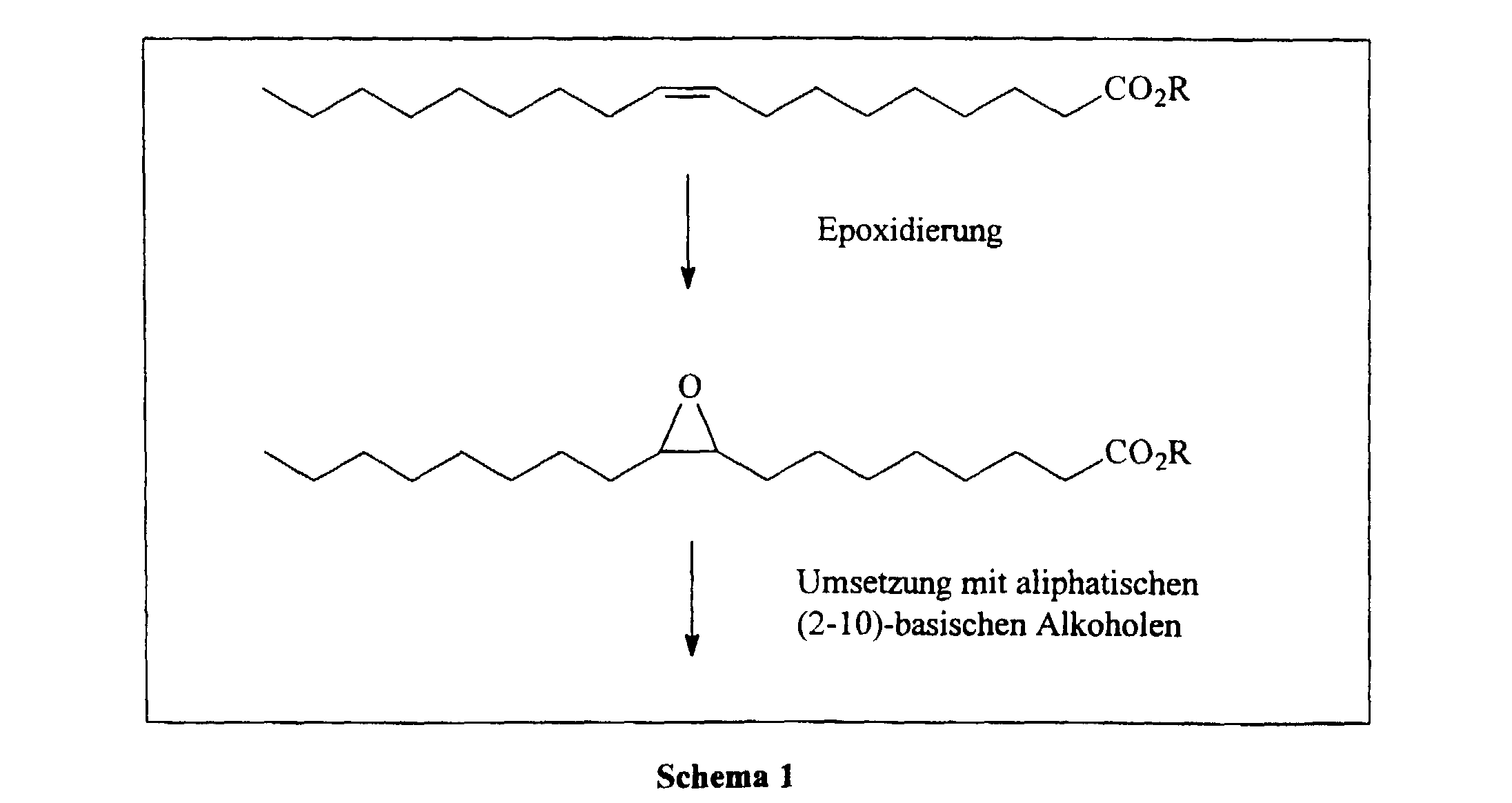
- the polyols to be used according to the invention are obtainable by reacting epoxidized fatty acid esters of monofunctional C 1-8 alcohols with alcohols having a functionality in the range from 2 to 10. According to the invention, such epoxidized fatty acid esters are used which are based on fatty acid mixtures as the fatty acid component and which essentially have 18 carbon atoms, the oleic acid content of the fatty acid mixtures being at least 80% by weight.
- Casting resins are liquid synthetic or can be liquefied by moderate heating Resins that are poured into open molds and harden there.
- To the Casting resins also include isocyanate casting resins. This includes according to DIN 55958 Understood synthetic resins based on aliphatic, cycloaliphatic or aromatic Isocyanates are based and still contain free isocyanate end groups. Your Curing can take place under various conditions. So there is for example a one-component casting resin made of a polyurethane prepolymer with terminal free or blocked isocyanate groups, which at Cure exposure to moisture, which can be heated to z. B. to accelerate the reaction or to increase the strength.
- Two-component casting resin is based, for example, on polyhydroxy compounds of branched polyesters or polyethers as the first component and on Polyisocyanates as a second component. After mixing both components cure at room temperature or slightly elevated temperature. Such two-component casting resins are used, for example, for the casting of Cable fittings used.
- isocyanate casting resins or coating compositions which are largely insensitive to moisture and chemicals can be prepared by using ring opening and transesterification products of epoxidized fatty acid esters of monofunctional C 1-8 alcohols as polyols starts. These products are accessible by reacting the epoxidized fatty acid esters with alcohols with a functionality which is preferably in the range from 2 to 4. According to the preparation examples 1 to 5 of DE-A-43 08 097 mentioned, a technical quality epoxystearic acid methyl ester is used as the starting material.
- fatty acid component on which the methyl epoxystearate is based is a mixture of essentially palmitic acid, stearic acid, oleic acid and linoleic acid, the proportion of oleic acid - based on the total fatty acid mixture - at approx. 70 wt .-% is.
- Such a fatty acid mixture has long been commercially available under the name Edenor R TiO5 (manufacturer: Henkel KGaA).
- the polyols according to DE-A-43 08 097 now have a number of application-related advantages, but are generally liquids which are slightly yellow in color.
- the yellow color of these products is unproblematic in applications in the field of casting resins, topcoats or coatings, provided that the polyols are reacted with aromatic diisocyanates.
- it is disruptive when reacting with colorless aliphatic diisocyanates.
- DE-A-44 46 877 it is proposed to carry out the ring opening of epoxides in the presence of fluoroalkanesulfonic acids as a catalyst. In this way, an improvement in the color quality of the polyols thus produced is achieved.
- the object of the present invention was to provide polyols which are used in the Use for the production of isocyanate casting resins and Coating materials on the one hand already have good color quality, on the other hand, improved color stability when storing the corresponding Have isocyanate casting resins and coating compositions.
- polyols which can be obtained by reacting epoxidized fatty acid esters of monofunctional C 1-8 alcohols with aliphatic alcohols having a functionality in the range from 2 to 10, the fatty acid mixtures being based on the epoxidized fatty acid esters as fatty acid component, which essentially have 18 carbon atoms and the content of oleic acid in these fatty acid mixtures, based on the total fatty acid mixture, is at least 80% by weight.
- R is C 1-8 alkyl.
- the present invention therefore relates to the use of polyols which are obtainable by reacting epoxidized fatty acid esters of monofunctional C 1-8 alcohols with aliphatic alcohols with a functionality in the range from 2 to 10, the epoxidized fatty acid esters as the fatty acid component being based on fatty acid mixtures which are based on have essentially 18 carbon atoms and the content of oleic acid in these fatty acid mixtures, based on the total fatty acid mixture, is at least 80% by weight for the production of isocyanate casting resins and coating compositions.
- epoxidized fatty acid esters with aliphatic alcohols of functionality implemented in the range of 2 to 10. This implementation takes place according to the Teaching of DE-A-43 08 097 in the sense of a ring opening and transesterification.
- the ring opening and transesterification products with alcohols are preferred here functionality in the range of 2 to 7, especially the implementation products with ethylene glycol, propylene glycol, oligomeric ethylene glycols, oligomeric Propylene glycols, also the reaction products with glycerol, diglycerol, Polyglycerol, trimethylolpropane, di-trimethylolpropane and / or pentaerythritol.
- Such products can be produced by known processes, the transesterification being carried out during or after the ring opening step Removed the lower alcohol from the reaction equilibrium can be.
- Ring opening and transesterification products are preferred in which a ratio between the epoxidized fatty acid ester and that used for the reaction Alcohol from 1: 1 to 1:10 is used.
- epoxidized fatty alcohols can also be produced here 1: 1 or 1: 2 adducts.
- Basis of the epoxidized fatty acid esters as a fatty acid component of fatty acid mixtures from new breed sunflower oil is as follows: 80 to 95% by weight oleic acid, 2 to 12% Linoleic acid, 1 to 5% stearic acid, 2 to 5% palmitic acid. All percentages are included to be understood as% by weight based on the total fatty acid mixture. According to the invention those epoxidized fatty acid esters are particularly preferred to those as a fatty acid component fatty acid mixtures from sunflower oil new breed are based and in which the content of these fatty acid mixtures of oleic acid is at least 85% by weight.
- Such an oil is commercial, for example under the name "Trisun®” from Special Vegetable Oils (SVO), Eastlake, Ohio, USA.
- the basis is set the epoxidized fatty acid ester is a so-called "high-oleic, low stearic" sunflower oil - abbreviated as HOLS sunflower oil - a.
- the fatty acid composition HOLS sunflower oil is as follows: 85 to 95% Oleic acid, 2 to 8% linoleic acid, 0.5 to 2.5% stearic acid and 2 to 5% palmitic acid.
- all percentages are as% by weight based on the total fatty acid mixture to understand.
- the invention further relates to isocyanate casting resins and coating compositions, which are obtainable by implementing the described inventive Polyols with isocyanates having a functionality in the range from 2 to 4.
- aromatic and aliphatic, monocyclic are suitable polycyclic isocycanate compounds of the functionality mentioned.
- Diphenylmethane diisocyanate can be used.
- Diphenylmethane diisocyanate containing higher functional diisocyanates and a functionality on isocyanate groups greater than 2.
- Another suitable one aromatic diisocyanate is xylylene diisocyanate.
- a A large number of aliphatic isocyanates have a functionality of 2 or more become.
- Examples here are isophorone diisocyanate, tris (6-isocyanatohexyl) isocyanate and dicyclohexylmethane diisocyanate as cyclic aliphatic diisocyanates. Further examples are aliphatic, straight-chain diisocyanates, as described by Phosgenization of diamines can be obtained, for example Tetramethylene diisocyanate or hexamethylene diisocyanate.
- the casting resins or coatings as isocyanate component hexamethylene diisocyanate to use.
- prepolymers can also be used be used as an isocyanate component in the two-component casting resins according to the invention.
- Adducts are more multifunctional here under prepolymers Isocyanates on polyfunctional alcohols, such as the reaction products one of the aforementioned aromatic or aliphatic diisocyanates Ethylene glycol, propylene glycol, glycerin, trimethylolpropane or pentaerythritol Roger that.
- reaction products of diisocyanates with polyether polyols e.g. B. polyether polyols based on polyethylene oxide or based Polypropylene oxide can be used as prepolymers.
- the two-component casting resins and coating compositions can continue contain various auxiliaries, preferably mixed with the polyol become.
- the two-component casting resins or coating compositions according to the invention may still contain accelerators.
- tertiary bases are suitable such as bis (N, N-dimethylamino) diethyl ether, dimethylaminocyclohexane, N, N-dimethylbenzylamine, N-methylmorpholine and the reaction products of Dialkyl- ( ⁇ -hydroxyethyl) amine with monoisocyanates and esterification products of dialkyl- ( ⁇ -hydroxyethyl) amine and dicarboxylic acids.
- Another accelerator is 1,4-diamino-bicyclo- (2.2.2) octane.
- non-basic substances can be used as accelerators.
- Metal compounds are mentioned here, for example iron pentacarbonyl, nickel tetracarbonyl, Iron acetylacetonate and tin (II) - (2-ethylhexoate), dibutyltin dilaurate or Molybdenum glycolate.
- the casting resins and coating compositions contain other auxiliary substances.
- Solvents should be mentioned here. Solvents which in turn do not react with isocyanate groups are suitable, for example halogenated hydrocarbons, esters, ketones, aromatic hydrocarbons and other. Plasticizers, flame retardants, Retarders, dyes and anti-aging agents, such as those in the corresponding Casting resins are known to be incorporated.
- the polyols according to the invention can be replaced by other polyols to an extent can be replaced by up to 80%. However, it is preferred that the invention polyols to be used unmixed.
- Edenor MeTi05 fatty acid methyl ester mixture based on a fatty acid mixture of the composition: 5% palmitic acid, 1% stearic acid, 67% oleic acid, 11% linolenic acid (from Henkel KGaA).
- Edenor MeTi05 is a raw material for the production of a polyol for comparison purposes.
- Priolube 1400 fatty acid methyl ester mixture based on a fatty acid mixture of the composition: 5% palmitic acid, 2% stearic acid, 67% oleic acid, 9% linoleic acid (from Unichema). Priolube 1400 is a raw material for the production of a polyol for comparison purposes.
- NSb-Me-Ester fatty acid methyl ester mixture based on a fatty acid mixture (ex sunflower oil from new breeding) of the composition: 5% palmitic acid, 5% stearic acid, 85% oleic acid, 4% linoleic acid.
- NSb-Me ester is a raw material for the production of a polyol according to the invention.
- casting compounds were prepared with 1,6-hexamethylene diisocyanate (HDI) and with 1,6-hexamethylene diisocyanate trimer (HDT).
- HDI 1,6-hexamethylene diisocyanate
- HDT 1,6-hexamethylene diisocyanate trimer
- Tables II and III show that the casting resins based on the invention Polyols have significantly better color values than that corresponding products based on the polyols not according to the invention.
Landscapes
- Chemical & Material Sciences (AREA)
- Health & Medical Sciences (AREA)
- Chemical Kinetics & Catalysis (AREA)
- Medicinal Chemistry (AREA)
- Polymers & Plastics (AREA)
- Organic Chemistry (AREA)
- Polyurethanes Or Polyureas (AREA)
Description
Edenor MeTi05 ist Rohstoff zur Herstellung eines Polyols für Vergleichszwecke.
Priolube 1400 ist Rohstoff zur Herstellung eines Polyols für Vergleichszwecke.
NSb-Me-Ester ist Rohstoff zur Herstellung eines erfindungsgemäßen Polyols.
| Rohstoff | Epoxid | Polyol |
| MeTiO5 | EpO = 4,76 | OHZ = 313 |
| VZ = 185 | SZ = 0,8 | |
| IZ = 1,6 | COZ = 4,1 | |
| SZ = 0,6 | Farbe: 3 gelb | |
| 0,2 rot | ||
| 0,1 neutral | ||
| NSB-Me-Ester | EPO = 4,48 | OHZ = 294 |
| VZ = 188 | SZ = 0,6 | |
| IZ = 2,2 | COZ = 5,2 | |
| SZ = 0,6 | Farbe: 0,3 gelb | |
| 0 rot | ||
| 0 neutral | ||
| Priolube 1400 | EpO = 4,45 | OHZ = 315 |
| VZ = 190 | SZ = 0,9 | |
| IZ = 5,1 | COZ = 5,6 | |
| SZ = 0,9 | Farbe: 9 gelb | |
| 0,9 rot | ||
| 0,1 neutral |
- EpO =
- Epoxidzahl
- VZ =
- Verseifungszahl
- IZ =
- Jodzahl
- SZ =
- Säurezahl
- OHZ =
- OH-Zahl
- COZ =
- Carbonyl-Zahl
- Farbe =
- Farbwert nach Lovibond (5,25-Zoll-Küvette
| Vergußmassen auf Basis Polyol / HDI (Lagerung bei 80 °C) | |||
| Polyol auf Basis | Farbe | ||
| zu Beginn | nach 1 Woche | nach 2 Wochen | |
| MeTiO5 | 2 | 3 | 6 |
| Priolube 1400 | 3 | 5 | 9 |
| NSb-Me-Ester | 1 | 3 | 5 |
| Vergußmassen auf Basis Polyol HDT (Lagerung bei 80 °C) | |||
| Polyol auf Basis | Farbe | ||
| zu Beginn | nach 1 Woche | nach 2 Wochen | |
| MeTiO5 | 4 | 6 | 8 |
| Priolube 1400 | 5 | 9 | 10 |
| NSb-Me-Ester | 3 | 5 | 7 |
Claims (5)
- Verwendung von Polyolen, die erhältlich sind durch Umsetzung von epoxidierten Fettsäureestern monofunktioneller C1-8-Alkohole mit aliphatischen Alkoholen einer Funktionalität im Bereich von 2 bis 10, wobei den epoxidierten Fettsäureestern als Fettsäurekomponente Fettsäuregemische zugrunde liegen, die im wesentlichen 18 C-Atome aufweisen und wobei der Gehalt dieser Fettsäuregemische an Ölsäure - bezogen auf die gesamte Fettsäuremischung - mindestens 80 Gew.-% beträgt, zur Herstellung von Isocyanat-Gießharzen und -Beschichtungsmassen.
- Verwendung nach Anspruch 1, wobei den epoxidierten Fettsäureestern als Fettkomponente Fettsäuregemische aus Sonnenblumenöl neuer Züchtung zugrunde liegen.
- Verwendung nach Anspruch 1 oder 2, wobei der Gehalt der den epoxidierten Fettsäureestern als Fettsäurekomponente zugrunde liegenden Fettsäuregemische an Ölsäure - bezogen auf die gesamte Fettsäuremischung - mindestens 85 Gew.-% beträgt.
- Verwendung nach einem der Ansprüche 1 bis 3, wobei die zur Umsetzung mit den epoxidierten Fettsäureestern eingesetzten aliphatischen Alkohole ausgewählt sind aus der Gruppe Ethylenglykol, Propylenglykol, Glycerin, Trimethylolpropan und Pentaerythrit.
- Isocyanat-Gießharze und -Beschichtungsmassen, erhältlich durch Umsetzung von Polyolen, die erhältlich sind durch Umsetzung von epoxidierten Fettsäureestern monofunktioneller C1-8-Alkohole mit aliphatischen Alkoholen einer Funktionalität im Bereich von 2 bis 10, wobei den epoxidierten Fettsäureestern als Fettsäurekomponente Fettsäuregemische zugrunde liegen, die im wesentlichen 18 C-Atome aufweisen und wobei der Gehalt dieser Fettsäuregemische an Ölsäure - bezogen auf die gesamte Fettsäuremischung - mindestens 80 Gew.-% beträgt, mit Isocyanaten einer Funktionalität im Bereich von 2 bis 4.
Applications Claiming Priority (3)
| Application Number | Priority Date | Filing Date | Title |
|---|---|---|---|
| DE19646424 | 1996-11-11 | ||
| DE19646424A DE19646424A1 (de) | 1996-11-11 | 1996-11-11 | Verwendung von Polyolen für Isocyanat-Gießharze und -Beschichtungsmassen |
| PCT/EP1997/006054 WO1998021255A1 (de) | 1996-11-11 | 1997-11-03 | Verwendung von polyolen für isocyanat-giessharze und -beschichtungsmassen |
Publications (2)
| Publication Number | Publication Date |
|---|---|
| EP0937110A1 EP0937110A1 (de) | 1999-08-25 |
| EP0937110B1 true EP0937110B1 (de) | 2001-01-24 |
Family
ID=7811231
Family Applications (1)
| Application Number | Title | Priority Date | Filing Date |
|---|---|---|---|
| EP97950076A Expired - Lifetime EP0937110B1 (de) | 1996-11-11 | 1997-11-03 | Verwendung von polyolen für isocyanat-giessharze und -beschichtungsmassen |
Country Status (5)
| Country | Link |
|---|---|
| US (1) | US6730768B2 (de) |
| EP (1) | EP0937110B1 (de) |
| CA (1) | CA2271289A1 (de) |
| DE (2) | DE19646424A1 (de) |
| WO (1) | WO1998021255A1 (de) |
Families Citing this family (31)
| Publication number | Priority date | Publication date | Assignee | Title |
|---|---|---|---|---|
| US8293808B2 (en) * | 2003-09-30 | 2012-10-23 | Cargill, Incorporated | Flexible polyurethane foams prepared using modified vegetable oil-based polyols |
| JP4527060B2 (ja) * | 2003-12-12 | 2010-08-18 | 日本合成化工株式会社 | 二液硬化型高耐久性ポリウレタンエラストマー組成物 |
| MX2007000022A (es) | 2004-06-25 | 2007-05-23 | Pittsburg State University | Polioles basados en aceite vegetal modificado. |
| DE102004031787A1 (de) * | 2004-07-01 | 2006-01-26 | Cognis Deutschland Gmbh & Co. Kg | Viskositätssenker für hochviskose Polyole |
| JP2008506016A (ja) * | 2004-07-08 | 2008-02-28 | アーチャー・ダニエルズ・ミッドランド カンパニー | 反応性希釈剤としての植物油脂肪酸のエポキシ化エステル |
| JP2008539314A (ja) | 2005-04-25 | 2008-11-13 | カーギル インコーポレイテッド | オリゴマーポリオールを含むポリウレタン発泡体 |
| DE102007027372A1 (de) * | 2007-06-11 | 2008-12-18 | Cognis Oleochemicals Gmbh | Verfahren zur Hydrierung von Glycerin |
| DE102007027371A1 (de) * | 2007-06-11 | 2008-12-18 | Cognis Oleochemicals Gmbh | Verfahren zur Herstellung einer Verbindung aufweisend mindestens eine Ester-Gruppe |
| US20090287007A1 (en) * | 2008-05-13 | 2009-11-19 | Cargill, Incorporated | Partially-hydrogenated, fully-epoxidized vegetable oil derivative |
| DE102009005711A1 (de) | 2009-01-22 | 2010-07-29 | Bayer Materialscience Ag | Polyurethanvergussmassen |
| DE102009005712A1 (de) | 2009-01-22 | 2010-07-29 | Bayer Materialscience Ag | Polyurethanvergussmassen |
| JP2013506050A (ja) * | 2009-09-28 | 2013-02-21 | トレッドストーン テクノロジーズ インク. | 電気化学分野の製品のための高い電気伝導性を有する表面の形成方法 |
| DE102010031681A1 (de) | 2010-07-20 | 2012-01-26 | Bayer Materialscience Ag | Polyurethane mit geringem Volumenschrumpf |
| DE102010031684A1 (de) | 2010-07-20 | 2012-01-26 | Bayer Materialscience Ag | Polyurethane mit hoher Lichtbrechung |
| DE102010031683A1 (de) | 2010-07-20 | 2012-01-26 | Bayer Materialscience Ag | Polyisocyanatgemische |
| JP5634351B2 (ja) | 2010-09-07 | 2014-12-03 | ダウ グローバル テクノロジーズ エルエルシー | コーティング組成物 |
| CN104583191B (zh) | 2012-08-28 | 2017-07-25 | 科思创德国股份有限公司 | 具有环状碳酸酯结构的粘合剂 |
| CN104583260B (zh) | 2012-09-04 | 2017-10-20 | 科思创德国股份有限公司 | 具有硫代氨基甲酸酯结构的硅烷官能的粘合剂 |
| US9637607B2 (en) | 2012-11-21 | 2017-05-02 | Sealed Air Corporation (Us) | Method of making foam |
| CN106414463B (zh) | 2014-01-31 | 2020-02-14 | 科思创德国股份有限公司 | 硅烷改性的甲酰胺 |
| CN105934437B (zh) | 2014-01-31 | 2019-03-01 | 科思创德国股份有限公司 | 硅烷改性的甲酰胺 |
| US10252988B2 (en) | 2014-04-11 | 2019-04-09 | Covestro Deutschland Ag | Composition for producing transparent polythiourethane bodies |
| CN107636096B (zh) | 2015-05-21 | 2020-06-05 | 科思创德国股份有限公司 | 聚氨酯涂料组合物 |
| EP3497146B1 (de) | 2016-08-09 | 2022-08-31 | Covestro Intellectual Property GmbH & Co. KG | Silanfunktionelle polymere polyurethane |
| US20220251280A1 (en) | 2019-07-11 | 2022-08-11 | Covestro Intellectual Property Gmbh & Co. Kg | Process of preparing allophanate- and/or thioallophanate group-containing compounds |
| EP3763792A1 (de) | 2019-07-11 | 2021-01-13 | Covestro Deutschland AG | Verfahren zur herstellung von isocyanuraten aus uretdionen |
| EP3822297A1 (de) | 2019-11-15 | 2021-05-19 | Covestro Deutschland AG | Polysiloxan-funktionalisierte polyurethane zur steigerung der hydrophobie von oberflächen |
| EP3872108A1 (de) | 2020-02-28 | 2021-09-01 | Covestro Intellectual Property GmbH & Co. KG | Uretdiongruppen enthaltende zusammensetzungen |
| EP3916032A1 (de) | 2020-05-29 | 2021-12-01 | Covestro Deutschland AG | Bei niedrigen temperaturen vernetzende uretdiongruppen enthaltende zusammensetzungen |
| EP4029892A1 (de) | 2021-01-13 | 2022-07-20 | Covestro Deutschland AG | Uretdiongruppen enthaltende zusammensetzungen |
| WO2024017938A1 (en) | 2022-07-20 | 2024-01-25 | Basf Se | Laminate comprising a layer of a layered mineralic material and a polyurethane layer |
Family Cites Families (21)
| Publication number | Priority date | Publication date | Assignee | Title |
|---|---|---|---|---|
| FR1281243A (fr) | 1960-04-27 | 1962-01-12 | Gen Mills Inc | Procédé pour la préparation de polymères à bas poids moléculaire comportant des hydroxyles, convenant à la préparation des polyuréthanes |
| DE1520448C3 (de) | 1964-05-29 | 1974-06-06 | Noury & Van Der Lande Oelwerke | Verfahren zur Herstellung von Polyurethanen |
| DE1645539C3 (de) | 1965-02-17 | 1973-10-25 | Unilever N.V., Rotterdam (Niederlande) | Verfahren zur Herstellung von wasserverdunnbaren oder emulgier baren Bindemitteln |
| CA1013743A (en) | 1972-01-05 | 1977-07-12 | George W. Borden | Acrylated epoxidized soybean oil compositions |
| US4021385A (en) * | 1974-12-30 | 1977-05-03 | Basf Wyandotte Corporation | Polyurethane foams resistant to discoloration |
| US4010211A (en) * | 1975-05-12 | 1977-03-01 | Olin Corporation | Stabilization of polyether polyols |
| US4124609A (en) | 1976-12-13 | 1978-11-07 | The United States Of America As Represented By The Secretary Of Agriculture | Polyols from epoxidized tallow trimethylolpropane and propylene oxide |
| DE3246612A1 (de) | 1982-12-16 | 1984-06-20 | Henkel KGaA, 4000 Düsseldorf | Verfahren zur herstellung modifizierter triglyceride mit im mittel epoxid- und hydroxyl- sowie ethergruppen |
| DE3317194A1 (de) | 1983-05-11 | 1984-11-15 | Henkel KGaA, 4000 Düsseldorf | Polyurethan-prepolymere auf basis oleochemischer polyole, ihre herstellung und verwendung |
| DE3347045A1 (de) | 1983-12-24 | 1985-07-04 | Henkel KGaA, 4000 Düsseldorf | Zweikomponentenpolyurethanklebstoff |
| US4942228A (en) * | 1986-05-06 | 1990-07-17 | The Procter & Gamble Company | Production of polyol polyesters having reduced color content |
| DE3626223A1 (de) | 1986-08-02 | 1988-02-04 | Henkel Kgaa | Polyurethan-praepolymere auf basis oleochemischer polyole, ihre herstellung und verwendung |
| DE3630264A1 (de) | 1986-09-05 | 1988-03-17 | Henkel Kgaa | Verfahren zur herstellung neuer, massiver polyurethanwerkstoffe im giessverfahren |
| DE3630422A1 (de) | 1986-09-06 | 1988-03-10 | Henkel Kgaa | Verwendung von fettpolyolen fuer die herstellung waessriger polyurethan-dispersionen |
| US4855383A (en) | 1988-09-23 | 1989-08-08 | Ashland Oil, Inc. | In situ quaternary ammonium catalyst formation for curing polymeric isocyanates |
| DE4024364A1 (de) | 1989-08-09 | 1991-02-14 | Battelle Institut E V | Verfahren zur herstellung von kunststoffen aus rohen fetten und oelen |
| DE4041119A1 (de) | 1990-12-21 | 1992-06-25 | Henkel Kgaa | Verwendung von mehrfunktionellen alkoholen zur verbesserung der hydrolysestabilitaet von polyurethanen |
| DE4120432A1 (de) | 1991-06-20 | 1992-12-24 | Henkel Kgaa | Dihydroxyfettsaeuren als polyurethanbausteine |
| DE4122530A1 (de) | 1991-07-08 | 1993-01-14 | Henkel Kgaa | Verfahren zur herstellung von fettsaeureniedrigalkylestern |
| DE4308097A1 (de) | 1993-03-15 | 1994-09-22 | Henkel Kgaa | Polyol für ein Isocyanat-Gießharz und Beschichtungen |
| DE4446877A1 (de) | 1994-12-27 | 1996-07-04 | Henkel Kgaa | Verfahren zur Ringöffnung von Epoxiden |
-
1996
- 1996-11-11 DE DE19646424A patent/DE19646424A1/de not_active Withdrawn
-
1997
- 1997-11-03 US US09/297,956 patent/US6730768B2/en not_active Expired - Lifetime
- 1997-11-03 DE DE59702960T patent/DE59702960D1/de not_active Expired - Lifetime
- 1997-11-03 CA CA002271289A patent/CA2271289A1/en not_active Abandoned
- 1997-11-03 WO PCT/EP1997/006054 patent/WO1998021255A1/de not_active Ceased
- 1997-11-03 EP EP97950076A patent/EP0937110B1/de not_active Expired - Lifetime
Also Published As
| Publication number | Publication date |
|---|---|
| EP0937110A1 (de) | 1999-08-25 |
| CA2271289A1 (en) | 1998-05-22 |
| US6730768B2 (en) | 2004-05-04 |
| DE19646424A1 (de) | 1998-05-14 |
| DE59702960D1 (de) | 2001-03-01 |
| WO1998021255A1 (de) | 1998-05-22 |
| US20020161161A1 (en) | 2002-10-31 |
Similar Documents
| Publication | Publication Date | Title |
|---|---|---|
| EP0937110A1 (de) | Verwendung von polyolen für isocyanat-giessharze und -beschichtungsmassen | |
| EP0152585B1 (de) | Zweikomponentenpolyurethanklebstoff | |
| EP0764178B1 (de) | Verwendung von dimerdiol in polyurethan-formkörpern | |
| EP1178060B1 (de) | Polyhydroxylverbindungen aus Ricinusöl mit erhöhter Reaktivität geeignet zur Polyurethan-Synthese | |
| DE3943080A1 (de) | Verwendung von polyesterpolyolen enthaltenden reaktionsmischungen bei der herstellung von massiven polyurethanwerkstoffen nach dem giessverfahren | |
| DE4308097A1 (de) | Polyol für ein Isocyanat-Gießharz und Beschichtungen | |
| EP0740675B1 (de) | Zweikomponenten-polyurethanklebstoff mit verbessertem klebevermögen | |
| DE69707244T2 (de) | Stabilisierung von Polymethylenpolyphenylisocyanaten | |
| EP0776343B1 (de) | Verwendung von polyurethanen mit verbessertem weiterreiss-widerstand als dichtungsmassen | |
| DE3526790A1 (de) | Ether- und ethergruppen aufweisende polyhydroxylverbindungen und ihre verwendung als aufbaukomponente bei der herstellung von polyurethankunststoffen, insbesondere als polyolkomponente in polyurethan-beschichtungsmitteln oder -vergussmassen | |
| WO2018202564A1 (de) | Lagerstabile polyurethanvergussmasse zur einbettung von hohlfasern bei der herstellung von filterelementen | |
| EP3619249A1 (de) | Lagerstabile polyurethanvergussmasse zur einbettung von hohlfasern bei der herstellung von filterelementen | |
| EP2081973A1 (de) | Vergussmassen auf basis von polyurethan | |
| WO1991001980A2 (de) | Verfahren zur herstellung von kunststoffen aus rohen fetten und ölen | |
| EP0550901A2 (de) | Flüssige, helle Polyisocyanatgemische, ein Verfahren zu ihrer Herstellung und ihre Verwendung bei der Herstellung von hellen, harten Polyurethan-Schaumstoffen | |
| DE1520448A1 (de) | Verfahren zur Herstellung von zur Polyurethanbildung befaehigten Polyolen | |
| DE4308100C2 (de) | Dimerdiol für Polyurethan-Gießharze und -Beschichtungsmassen | |
| EP0148344B1 (de) | Verwendung von zu Polyurethanenkunststoffen ausreagierenden Reaktionsgemischen als GieBmassen | |
| WO1997021748A1 (de) | Estergruppenhaltige, langzeithydrolysestabile polyurethane | |
| EP0371294B1 (de) | Verwendung von Polyurethanmassen zur Herstellung von glasfaserhaltigen Laminaten | |
| DD132018B1 (de) | Verfahren zur herstellung hydroxylgruppenhaltiger ester von fettsaeuren | |
| DE2713776C2 (de) | ||
| DE1495664A1 (de) | Verfahren zur Herstellung von Urthangruppen enthaltenden Schaumstoffen |
Legal Events
| Date | Code | Title | Description |
|---|---|---|---|
| PUAI | Public reference made under article 153(3) epc to a published international application that has entered the european phase |
Free format text: ORIGINAL CODE: 0009012 |
|
| 17P | Request for examination filed |
Effective date: 19990504 |
|
| AK | Designated contracting states |
Kind code of ref document: A1 Designated state(s): BE DE GB IT NL |
|
| RAP1 | Party data changed (applicant data changed or rights of an application transferred) |
Owner name: COGNIS DEUTSCHLAND GMBH |
|
| GRAG | Despatch of communication of intention to grant |
Free format text: ORIGINAL CODE: EPIDOS AGRA |
|
| 17Q | First examination report despatched |
Effective date: 20000414 |
|
| GRAG | Despatch of communication of intention to grant |
Free format text: ORIGINAL CODE: EPIDOS AGRA |
|
| GRAH | Despatch of communication of intention to grant a patent |
Free format text: ORIGINAL CODE: EPIDOS IGRA |
|
| GRAH | Despatch of communication of intention to grant a patent |
Free format text: ORIGINAL CODE: EPIDOS IGRA |
|
| GRAH | Despatch of communication of intention to grant a patent |
Free format text: ORIGINAL CODE: EPIDOS IGRA |
|
| GRAA | (expected) grant |
Free format text: ORIGINAL CODE: 0009210 |
|
| AK | Designated contracting states |
Kind code of ref document: B1 Designated state(s): BE DE GB IT NL |
|
| REF | Corresponds to: |
Ref document number: 59702960 Country of ref document: DE Date of ref document: 20010301 |
|
| ITF | It: translation for a ep patent filed | ||
| GBT | Gb: translation of ep patent filed (gb section 77(6)(a)/1977) |
Effective date: 20010426 |
|
| EN | Fr: translation not filed | ||
| PLBE | No opposition filed within time limit |
Free format text: ORIGINAL CODE: 0009261 |
|
| STAA | Information on the status of an ep patent application or granted ep patent |
Free format text: STATUS: NO OPPOSITION FILED WITHIN TIME LIMIT |
|
| REG | Reference to a national code |
Ref country code: GB Ref legal event code: IF02 |
|
| 26N | No opposition filed | ||
| BECA | Be: change of holder's address |
Owner name: *COGNIS DEUTSCHLAND G.M.B.H. & CO. K.G.HENKELSTRAS |
|
| BECH | Be: change of holder |
Owner name: *COGNIS DEUTSCHLAND G.M.B.H. & CO. K.G. |
|
| BECN | Be: change of holder's name |
Owner name: *COGNIS DEUTSCHLAND G.M.B.H. & CO. K.G.HENKELSTRAS |
|
| NLS | Nl: assignments of ep-patents |
Owner name: COGNIS DEUTSCHLAND II GMBH & CO. KG Owner name: COGNIS CHEMIE GMBH & CO. KG |
|
| NLT1 | Nl: modifications of names registered in virtue of documents presented to the patent office pursuant to art. 16 a, paragraph 1 |
Owner name: COGNIS DEUTSCHLAND GMBH & CO. KG |
|
| PGFP | Annual fee paid to national office [announced via postgrant information from national office to epo] |
Ref country code: GB Payment date: 20061101 Year of fee payment: 10 |
|
| PGFP | Annual fee paid to national office [announced via postgrant information from national office to epo] |
Ref country code: NL Payment date: 20061105 Year of fee payment: 10 |
|
| PGFP | Annual fee paid to national office [announced via postgrant information from national office to epo] |
Ref country code: IT Payment date: 20061130 Year of fee payment: 10 |
|
| PGFP | Annual fee paid to national office [announced via postgrant information from national office to epo] |
Ref country code: BE Payment date: 20070126 Year of fee payment: 10 |
|
| BERE | Be: lapsed |
Owner name: *COGNIS DEUTSCHLAND G.M.B.H. & CO. K.G. Effective date: 20071130 |
|
| GBPC | Gb: european patent ceased through non-payment of renewal fee |
Effective date: 20071103 |
|
| NLV4 | Nl: lapsed or anulled due to non-payment of the annual fee |
Effective date: 20080601 |
|
| PG25 | Lapsed in a contracting state [announced via postgrant information from national office to epo] |
Ref country code: BE Free format text: LAPSE BECAUSE OF NON-PAYMENT OF DUE FEES Effective date: 20071130 |
|
| PG25 | Lapsed in a contracting state [announced via postgrant information from national office to epo] |
Ref country code: NL Free format text: LAPSE BECAUSE OF NON-PAYMENT OF DUE FEES Effective date: 20080601 |
|
| PG25 | Lapsed in a contracting state [announced via postgrant information from national office to epo] |
Ref country code: GB Free format text: LAPSE BECAUSE OF NON-PAYMENT OF DUE FEES Effective date: 20071103 |
|
| PG25 | Lapsed in a contracting state [announced via postgrant information from national office to epo] |
Ref country code: IT Free format text: LAPSE BECAUSE OF NON-PAYMENT OF DUE FEES Effective date: 20071103 |
|
| PGFP | Annual fee paid to national office [announced via postgrant information from national office to epo] |
Ref country code: DE Payment date: 20170131 Year of fee payment: 20 |
|
| REG | Reference to a national code |
Ref country code: DE Ref legal event code: R071 Ref document number: 59702960 Country of ref document: DE |