EP0937468A2 - Klebstoffzusammensetzung für chirurgische Zwecke - Google Patents
Klebstoffzusammensetzung für chirurgische Zwecke Download PDFInfo
- Publication number
- EP0937468A2 EP0937468A2 EP98116437A EP98116437A EP0937468A2 EP 0937468 A2 EP0937468 A2 EP 0937468A2 EP 98116437 A EP98116437 A EP 98116437A EP 98116437 A EP98116437 A EP 98116437A EP 0937468 A2 EP0937468 A2 EP 0937468A2
- Authority
- EP
- European Patent Office
- Prior art keywords
- polymer
- caprolactone
- lactic acid
- weight
- adhesive
- Prior art date
- Legal status (The legal status is an assumption and is not a legal conclusion. Google has not performed a legal analysis and makes no representation as to the accuracy of the status listed.)
- Granted
Links
Images

Classifications
-
- A—HUMAN NECESSITIES
- A61—MEDICAL OR VETERINARY SCIENCE; HYGIENE
- A61L—METHODS OR APPARATUS FOR STERILISING MATERIALS OR OBJECTS IN GENERAL; DISINFECTION, STERILISATION OR DEODORISATION OF AIR; CHEMICAL ASPECTS OF BANDAGES, DRESSINGS, ABSORBENT PADS OR SURGICAL ARTICLES; MATERIALS FOR BANDAGES, DRESSINGS, ABSORBENT PADS OR SURGICAL ARTICLES
- A61L24/00—Surgical adhesives or cements; Adhesives for colostomy devices
- A61L24/04—Surgical adhesives or cements; Adhesives for colostomy devices containing macromolecular materials
- A61L24/043—Mixtures of macromolecular materials
Definitions
- the present invention relates to adhesive compositions for surgical use application, more particularly novel compositions for adjusting a suitable viscosity, reducing a cytotoxicity, having a softness similar to a soft tissue of a living body organism, easily biodegrading and bioabsorbing into the living body organism at a moderate velocity after healing by improving ⁇ -cyanoacrylate adhesive composition.
- Suturing and anastomosis of the wound is one of most important operating techniques in any surgical operation. Therefore, the healing velocity of the wound largely makes the difference between a good or a poor operation.
- the material compositions and operating methods for improving healing velocity are continuously improving, including methods for suturing the wound, and many good sutures have become readily available as a result.
- special techniques are still necessary in operations involving microvascular anastomosis and nerve sutures. Therefore, new invention systems concerning adhesive methods in the living body system are needed in order to proceed the surgical operations in a short time.
- ⁇ -cyanoacrylate adhesive compositions are already and widely sold in the market as adhesive compositions for surgical use application, but they still remain in limited use in special clinical applications because they often flood to unnecessary or unexpected parts because of the low viscosity of the composition, sometimes damaging the soft tissue and especially showing an excellent cytotoxicity for the living cell in addition.
- Weight-average molecular weights of the homo-polymer of DL-lactic acid and the co-polymer of the lactic acid and ⁇ -caprolactone are about 140,000 and 220,000 respectively, which is in a relative high molecular weight category and so can be employed as the thickening agent. They also fail to disclose the molecular weight effects on plasticizing after hardening, and the hydrolyzing velocity of co-polymer compositions of lactic acid and ⁇ -caprolactone when employed as a thickening agent.
- the present invention proposes a novel adhesive composition for surgical use application adding a polymer characteristic to be biodegraded and bioabsorbed into the living body organism to an ⁇ -cyanoacrylate adhesive composition.
- the polymer is a co-polymer of DL-lactic acid and an ⁇ -caprolactone, or a co-polymer of DL-lactic acid, ethylene glycol and ⁇ -caprolactone, or a co-polymer of ethylene glycol and ⁇ -caprolactone.
- the ratio of composition and the weight-average molecular weight of the co-polymer of DL-lactic acid and ⁇ -caprolactone are in the ranges of 70:30 to 30:70 and of 10,000 to 120,000, respectively, and a concentration of the co-polymer is in the range of 1 to 50 weight by weight percent. It is also preferred that the glass transition temperature of the said polymer is in the range from 0 to -30°C.
- novel adhesive compositions for surgical use application of the invention can be easily adjusted to any degree of thickening agent as a result of the possibility to control viscosity.
- the hardened polymer after a polymerization shows a softness and has an affinity with the living body organism such as blood vessels, skin and viscera. It is possible that wider applications can be added to former uses of the application of ⁇ -cyanoacrylate because the composition is widely applied to a hemostasis, and possibly certificated a part and a volume of the wound by staining dyes.
- Fig.1 is a schematic view illustrating the adhesion properties between swine skin and n-butyl-cyanoacrylate (NBCA) specimen by adding polymers of various weight-average molecular weights of DL-lactic acid and ⁇ -caprolactone (mole ratio of 50:50 by DL-lactic acid and ⁇ -caprolactone), and also illustrating adhesion strengths of "Biobond” (fabricated by Yoshitomi Ph.) and "Fibrin Glue” (fabricated by Fujisawa Ph.) in comparison with adhesives sold in the market.
- NBCA n-butyl-cyanoacrylate
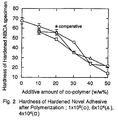
- Fig.2 is a schematic view illustrating the hardness of a hardened NBCA specimen after the polymerization according to the addition of various weight-average molecular weights of DL-lactic acid and ⁇ -caprolactone (mole ratio of 50:50 by DL-lactic acid and ⁇ -caprolactone).
- a vertical axis shows Shore Hardness of D-type.
- the present invention relates to adhesive compositions for surgical use application, more particularly new compositions for adjusting a suitable viscosity, reducing cytotoxicity of a cell, having a softness similar to the soft tissue of a living body organism, being easily biodegradable and bioabsorbable into the living body organism at a moderate velocity after healing by improving ⁇ -cyanoacrylate adhesive composition.
- the wound of the living body organism completes via a hyperplasia of the connective tissue by a renaturation ability in the living body organism. Therefore, it is preferable to apply an adhesive rather than a suture to fix and support the connective tissue in order not to prevent the restoration ability of the living body organism during the week or 10 days necessary to finally heal the wound.
- the role of the preferred adhesive is to fix and adhere the wound in the period needed to complete the healing, and which is then easily biodegraded, and bioabsorbed into the living body organism after healing and which disappears soon thereafter.
- biodegraded products of the adhesive are not poisonous or dangerous.
- the present invention relates to novel compositions for surgical use application satisfying the above conditions for adjusting a suitable viscosity, reducing cytotoxicity for the living cell, having a softness similar to the soft tissue of the living body organism, being easily biodegradable and bioabsorbable into the living body organism at moderate velocity after healing by improving ⁇ -cyanoacrylate adhesive composition.
- the present application is based on the fact that the novel adhesive compositions for surgical use application are fabricated by adding polymers which are easily biodegradable and bioabsorbable into the living body organism to an ⁇ -cyanoacrylate adhesive composition, said polymers including the co-polymer of DL-lactic acid and ⁇ -caprolactone, or the co-polymer of DL-lactic acid, an ethylene glycol and ⁇ -caprolactone, or the co-polymer of the ethylene glycol and ⁇ -caprolactone.
- a most important factor for the surgical use application of the adhesive concerns the cytotoxicity of the living cell, namely safety for the living cell. Therefore, every adhesive has to be reduced to the level of cytotoxicity of the living cell when applied as a surgical adhesive. Moreover, it is difficult to increase the additive amount and adjust to a suitable degree the thickening agent by adding polymers, characterized by being easily biodegraded and bioabsorbed into the living body organism, when the polymers have a weight-average molecular weight of more than 140,000, because the additive amount depends on the molecular weight. Therefore, it is preferred that a co-polymer of DL-lactic acid and ⁇ -caprolactone has a weight-average molecular weight within a range from 10,000 to 120,000.
- a co-polymer having the weight-average molecular weight of less than 10,000 shows poor properties as a polymer such as an adhesive while the additive amount is possible to increase. Furthermore, it is difficult to get a soft hardened polymer with a high velocity of biodecomposition and bioabsorption into the living body organism when employing high weight-average molecular weight polymer. As mentioned above, velocity largely depends upon the molecular weight and crystallinity. It is preferable to employ a polymer having low molecular weight and crystallinity in order to improve the properties of biodecomposition and bioabsorption. In the case of a co-polymer of DL-lactic acid and ⁇ -caprolactone, the glass transition temperature largely depends on the composed ratio of the co-polymer.
- the glass transition temperature of the co-polymer shows therefore a higher value than 0°C.
- the glass transition temperature of the co-polymer shows a temperature lower than 0°C, but the co-polymer changes hardness according to the crystallinity degree.
- the preferable ratio of the co-polymer composition is a range from 70:30 to 30:70 from the view of the crystallinity and the softness of the co-polymer.
- the co-polymer of DL-lactic acid, ethylene glycol and ⁇ -caprolactone, and the co-polymer of ethylene glycol and ⁇ -caprolactone are possibly employed to improve the ⁇ -cyanoacrylate surgical adhesive. It is preferred that the molecular weight and the composed ratio are within a range from 10,000 to 200,000 and the range for preventing the crystallization of the co-polymer respectively.
- the co-polymers employed to improve the viscosity and the softness after hardening ⁇ -cyanoacrylate are synthesized from lactic acid as a raw material which widely disperses not only in the living body but also in nature, and ⁇ -caprolactone which is widely used as a raw material for polyurethane, available in both household and industry. Those raw materials are ordinarily eliminated in the metabolism of the living body and show no poisonous qualities. Furthermore, co-polymers of DL-lactic acid and ⁇ -caprolactone are already employed as sutures in medical use applications. Polyethylene glycol shows no poisonous qualities and can possibly be eliminated from the body when the polymer has a molecular weight of less than several ten thousands in spite of having poor biodecomposability.
- the co-polymer of DL-lactic acid and ⁇ -caprolactone employed in the invention is soft even at room temperature and looks like rubber because the weight-average molecular weight is in a relatively low range of 10,000 to 120,000. Not only is the hardened co-polymer soft, but also the adhesive viscosity can be changed to any level by adding ⁇ -cyanoacrylate. It is possible to reduce the usage of poisonous ⁇ -cyanoacrylate when adjusting to an intensive softness and viscosity by employing as thickening agent a relative low molecular co-polymer having a weight-average molecular weight of less than 120,000 and thereby reducing the cytotoxicity of the living cell to the level of the co-polymer of polyethylene glycol.
- Fig.1 is a schematic view illustrating the adhesion properties between swine skin (about 1x3 cm) and an NBCA specimen by adding polymers of various weight-average molecular weights of DL-lactic acid and ⁇ -caprolactone (a molecular ratio of 50:50 of DL-lactic acid and ⁇ -caprolactone at a transition temperature of about -8°C).
- the adhesion property was measured as follows.
- Fig.1 also illustrates adhesion strengths of "Biobond” (fabricated by Yoshitomi Ph.) and “Fibrin Glue” (fabricated by Fujisawa Ph.) in comparison with adhesives sold in the market.
- the adhesion strengths gradually decrease in accordance with an increase of additive amounts of co-polymer and a decrease in molecular weight, but even so results are excellent in comparison with those of the adhesives sold in the market.
- Table 1 shows the initial viscosity (CP, centipoise) of an NBCA specimen after addition of a co-polymer of about 100,000 weight-average molecular weight of DL-lactic acid and ⁇ -caprolactone (a mole ratio of 50:50 by DL-lactic acid and ⁇ -caprolactone).
- Viscosity of Novel adhesive Viscosity (CP) Aron-Alpha 59 Biobond 3,560 NBCA + co-polymer co-polymer 10% 843 15% 7,560 20% 30,000
- the viscosity was measured at 25°C by a B-type rotating viscometer (fabricated by Tokyo Keiki).
- the viscosity of the adhesives shows excellent value in comparison with those of "Biobond” or "Aron-alpha” (fabricated by Sankyo Ph.).
- Fig.2 is a schematic view illustrating the hardness of a hardened NBCA specimen after polymerization after addition of various weight-average molecular weights of DL-lactic acid and ⁇ -caprolactone (a mole ratio of 50:50 DL-lactic acid and ⁇ -caprolactone). The hardness was measured as follows.
- the adhesives remain suitably flexible even after hardening.
- Table 2 shows test data concerning the cytotoxicity for the living cell of an NBCA specimen after adding co-polymers of DL-lactic acid of about 60,000 weight-average molecular weights and ⁇ -caprolactone (a mole ratio of 50:50 DL-lactic acid and ⁇ -caprolactone at a glass transition temperature of about -9°C).
- NR50 was defined as reagent concentration value when dropping to a half of the original cytoactivity value, and therefore high toxicity means low NR50 value.
- the hardened adhesives prepared by the method described in Example 1 were implanted on the back subcutaneous tissue of 20-week-old rabbits. When the implanted part was observed after 3 months, the adhesives were perfectly biodegraded and bioabsorbed and there was no tissue reaction in the ambient parts owing to the adhesive composition.
- Co-polymers of DL-lactic acid and ⁇ -caprolactone (a mole ratio of 80:20 DL-lactic acid and ⁇ -caprolactone of about 220,000 weight-average molecular weights at a transition temperature of about -8°C) were added to an NBCA as a thickening agent to fabricate the hardened adhesives as described in Example 3.
- the Shore Hardness was measured and it showed a high value of about 63 as described in Fig. 2.
- the NR50 of the adhesive showed a high cytotoxicity value of 998+-13 (ppm) as shown in Table 2 following the test method described in Example 4.
- a co-polymer of ⁇ -caprolactone of about 140,000 weight-average molecular weights and polyethylene glycol (mole ratio of 50:50 by ⁇ -caprolactone and polyethylene glycol at a glass transition temperature of about -22°C) was prepared.
- An adhesive was fabricated from NBCA and a co-polymer of about 20 weight by weight percent as an additive, and was tested for peering strength of adhesion properties in the same manner as Example 1.
- the peering strength, the hardness, and NR50 of the hardened adhesive were about 420 gf, about 56, and about 1,000 respectively.
Landscapes
- Health & Medical Sciences (AREA)
- Surgery (AREA)
- Epidemiology (AREA)
- Life Sciences & Earth Sciences (AREA)
- Animal Behavior & Ethology (AREA)
- General Health & Medical Sciences (AREA)
- Public Health (AREA)
- Veterinary Medicine (AREA)
- Materials For Medical Uses (AREA)
- Adhesives Or Adhesive Processes (AREA)
Applications Claiming Priority (2)
| Application Number | Priority Date | Filing Date | Title |
|---|---|---|---|
| JP6920398 | 1998-02-12 | ||
| JP06920398A JP3412039B2 (ja) | 1998-02-12 | 1998-02-12 | 外科用接着剤組成物 |
Publications (3)
| Publication Number | Publication Date |
|---|---|
| EP0937468A2 true EP0937468A2 (de) | 1999-08-25 |
| EP0937468A3 EP0937468A3 (de) | 2000-11-02 |
| EP0937468B1 EP0937468B1 (de) | 2009-09-30 |
Family
ID=13395946
Family Applications (1)
| Application Number | Title | Priority Date | Filing Date |
|---|---|---|---|
| EP98116437A Expired - Lifetime EP0937468B1 (de) | 1998-02-12 | 1998-08-31 | Klebstoffzusammensetzung für chirurgische Zwecke |
Country Status (4)
| Country | Link |
|---|---|
| US (2) | US6103778A (de) |
| EP (1) | EP0937468B1 (de) |
| JP (1) | JP3412039B2 (de) |
| DE (1) | DE69841198D1 (de) |
Cited By (3)
| Publication number | Priority date | Publication date | Assignee | Title |
|---|---|---|---|---|
| WO2000072761A1 (en) | 1999-05-29 | 2000-12-07 | Tyco Health Care Group, Lp | Bioabsorbable blends and surgical articles therefrom |
| GB2357774A (en) * | 1999-09-29 | 2001-07-04 | Chemence Inc | Bioabsorbable cyanoacrylate tissue adhesives |
| GB2383584A (en) * | 1999-09-29 | 2003-07-02 | Chemence Inc | Bioabsorbable cyanoacrylate tissue adhesives |
Families Citing this family (29)
| Publication number | Priority date | Publication date | Assignee | Title |
|---|---|---|---|---|
| AU2007221760B2 (en) * | 1999-05-29 | 2010-07-29 | Covidien Lp | Bioabsorbable blends and surgical articles therefrom |
| US6310166B1 (en) | 1999-08-12 | 2001-10-30 | Closure Medical Corporation | Sterilized cyanoacrylate solutions containing thickeners |
| KR100451910B1 (ko) * | 2000-10-05 | 2004-10-08 | 주식회사 바이오폴리테크 | 수용성 생체분해성 고분자 겔 및 그의 제조방법 |
| US6666870B2 (en) | 2001-01-05 | 2003-12-23 | Robert A Dixon | Method utilizing chemical bonding to improve the bone screw fixation interface |
| US7700819B2 (en) | 2001-02-16 | 2010-04-20 | Kci Licensing, Inc. | Biocompatible wound dressing |
| US7763769B2 (en) | 2001-02-16 | 2010-07-27 | Kci Licensing, Inc. | Biocompatible wound dressing |
| US20030032735A1 (en) * | 2001-06-29 | 2003-02-13 | Kotzev Dimiter L. | Solid cyanoacrylate adhesive composition and method for its use |
| JP2006175153A (ja) * | 2004-12-24 | 2006-07-06 | Goodman Co Ltd | 医療用生分解性生体吸収材料 |
| GB0227043D0 (en) * | 2002-11-20 | 2002-12-24 | Smith & Nephew | Angiogenic medical cyanoacrylate |
| US7393339B2 (en) | 2003-02-21 | 2008-07-01 | C. R. Bard, Inc. | Multi-lumen catheter with separate distal tips |
| US20040243095A1 (en) | 2003-05-27 | 2004-12-02 | Shekhar Nimkar | Methods and apparatus for inserting multi-lumen spit-tip catheters into a blood vessel |
| US8083499B1 (en) | 2003-12-01 | 2011-12-27 | QuaLift Corporation | Regenerative hydraulic lift system |
| US8992454B2 (en) * | 2004-06-09 | 2015-03-31 | Bard Access Systems, Inc. | Splitable tip catheter with bioresorbable adhesive |
| US20060251612A1 (en) * | 2005-05-09 | 2006-11-09 | Dimiter Kotzev | Bioresorbable cyanoacrylate adhesives |
| US20070237803A1 (en) | 2006-04-11 | 2007-10-11 | Medtronic Vascular, Inc. | Biodegradable Biocompatible Amphiphilic Copolymers for Coating and Manufacturing Medical Devices |
| US7897168B2 (en) * | 2007-04-13 | 2011-03-01 | Medtronic Vascular, Inc. | Degradable polymers incorporating gamma-butyrolactone |
| US8729121B2 (en) | 2007-06-25 | 2014-05-20 | Adhezion Biomedical, Llc | Curing accelerator and method of making |
| EP2214765A4 (de) | 2007-10-17 | 2011-08-10 | Bard Access Systems Inc | Herstellung von kathetern mit spaltspitze |
| US8066660B2 (en) | 2007-10-26 | 2011-11-29 | C. R. Bard, Inc. | Split-tip catheter including lateral distal openings |
| US8292841B2 (en) | 2007-10-26 | 2012-10-23 | C. R. Bard, Inc. | Solid-body catheter including lateral distal openings |
| US9579485B2 (en) | 2007-11-01 | 2017-02-28 | C. R. Bard, Inc. | Catheter assembly including a multi-lumen configuration |
| JP5452498B2 (ja) | 2007-11-01 | 2014-03-26 | シー・アール・バード・インコーポレーテッド | 三重管腔端を含むカテーテル組立体 |
| US20110117047A1 (en) * | 2008-06-23 | 2011-05-19 | Adhezion Biomedical, Llc | Cyanoacrylate tissue adhesives with desirable permeability and tensile strength |
| EP2334345B1 (de) * | 2008-09-04 | 2014-07-23 | Yissum Research Development Company of the Hebrew University of Jerusalem, Ltd. | Neue biologisch abbaubare klebstoffzusammensetzungen |
| US8287901B2 (en) | 2010-08-11 | 2012-10-16 | Adhezion Biomedical, Llc | Wound healing compositions based on cyanoacrylates and 5,5-disubstitutedhydantoins, including phenytoin |
| USD748252S1 (en) | 2013-02-08 | 2016-01-26 | C. R. Bard, Inc. | Multi-lumen catheter tip |
| WO2016011091A1 (en) | 2014-07-14 | 2016-01-21 | C. R. Bard, Inc. | Apparatuses, systems, and methods for inserting split tip catheters having enhanced stiffening and guiding features |
| CN110699027A (zh) * | 2019-11-06 | 2020-01-17 | 蔡思韵 | 一种高粘耐久免钉胶 |
| CN112451736B (zh) * | 2020-12-02 | 2022-05-31 | 浙江派菲特新材料科技有限公司 | 一种增韧型氰基丙烯酸酯医用胶及其制备方法 |
Family Cites Families (7)
| Publication number | Priority date | Publication date | Assignee | Title |
|---|---|---|---|---|
| US3527841A (en) * | 1968-04-10 | 1970-09-08 | Eastman Kodak Co | Alpha-cyanoacrylate adhesive compositions |
| US4804691A (en) * | 1987-08-28 | 1989-02-14 | Richards Medical Company | Method for making a biodegradable adhesive for soft living tissue |
| JPH03273679A (ja) * | 1990-03-23 | 1991-12-04 | Matsushita Electron Corp | 固体撮像装置 |
| CA2704197C (en) * | 1990-12-13 | 2011-01-04 | United States Surgical Corporation | Method and apparatus for tipping sutures |
| US5328687A (en) * | 1993-03-31 | 1994-07-12 | Tri-Point Medical L.P. | Biocompatible monomer and polymer compositions |
| GB2282977B (en) * | 1993-10-25 | 1997-04-09 | D & C Ltd | Filter press apparatus |
| US5550172A (en) * | 1995-02-07 | 1996-08-27 | Ethicon, Inc. | Utilization of biocompatible adhesive/sealant materials for securing surgical devices |
-
1998
- 1998-02-12 JP JP06920398A patent/JP3412039B2/ja not_active Expired - Fee Related
- 1998-08-31 EP EP98116437A patent/EP0937468B1/de not_active Expired - Lifetime
- 1998-08-31 DE DE69841198T patent/DE69841198D1/de not_active Expired - Lifetime
- 1998-09-28 US US09/162,491 patent/US6103778A/en not_active Expired - Fee Related
-
1999
- 1999-03-31 US US09/282,964 patent/US6316523B1/en not_active Expired - Fee Related
Cited By (6)
| Publication number | Priority date | Publication date | Assignee | Title |
|---|---|---|---|---|
| WO2000072761A1 (en) | 1999-05-29 | 2000-12-07 | Tyco Health Care Group, Lp | Bioabsorbable blends and surgical articles therefrom |
| EP1100380A4 (de) * | 1999-05-29 | 2008-07-30 | Tyco Healthcare | Bioabsorbierbare mischungen und daraus hergestellte chirurgische artikel |
| GB2357774A (en) * | 1999-09-29 | 2001-07-04 | Chemence Inc | Bioabsorbable cyanoacrylate tissue adhesives |
| GB2383584A (en) * | 1999-09-29 | 2003-07-02 | Chemence Inc | Bioabsorbable cyanoacrylate tissue adhesives |
| GB2383584B (en) * | 1999-09-29 | 2003-08-27 | Chemence Inc | Bioabsorbable cyanoacrylate tissue adhesives |
| GB2357774B (en) * | 1999-09-29 | 2004-01-14 | Chemence Inc | Biioabsorbable cyanoacrylate tissue adhesives |
Also Published As
| Publication number | Publication date |
|---|---|
| EP0937468B1 (de) | 2009-09-30 |
| US6103778A (en) | 2000-08-15 |
| JP3412039B2 (ja) | 2003-06-03 |
| EP0937468A3 (de) | 2000-11-02 |
| JPH11226110A (ja) | 1999-08-24 |
| US6316523B1 (en) | 2001-11-13 |
| DE69841198D1 (de) | 2009-11-12 |
Similar Documents
| Publication | Publication Date | Title |
|---|---|---|
| EP0937468B1 (de) | Klebstoffzusammensetzung für chirurgische Zwecke | |
| Mehdizadeh et al. | Design strategies and applications of tissue bioadhesives | |
| US8501165B2 (en) | In situ bonds | |
| Zhang et al. | Mussel-inspired hyperbranched poly (amino ester) polymer as strong wet tissue adhesive | |
| Otani et al. | Hemostatic capability of rapidly curable glues from gelatin, poly (L-glutamic acid), and carbodiimide | |
| EP3050579B1 (de) | Neue klebstoffe für medizinische anwendungen | |
| KR20010104341A (ko) | 메틸리덴 말로네이트를 기재로 한 상처 봉합 물질 | |
| Greco et al. | Fibrin–antibiotic mixtures: An in vitro study assessing the possibility of using a biologic carrier for local drug delivery | |
| US20130323291A1 (en) | Hydrophilic and non-thrombogenic polymer for coating of medical devices | |
| Ikada | Tissue adhesives | |
| CN109355057A (zh) | 一种聚氨基酸基贻贝仿生组织胶粘剂及其制备方法 | |
| US20260061090A1 (en) | Medical tissue adhesive for pancreatic plugging and preparation method and use thereof | |
| Jayabalan et al. | Studies on poly (propylene fumarate‐co‐ethylene glycol) based bone cement | |
| JPS63273679A (ja) | 外科用接着剤組成物 | |
| KR102188290B1 (ko) | 접착력 및 응집력이 향상된 수화젤형 조직접착제의 제조방법 및 이에 의해 제조된 조직접착제 | |
| CN110755677B (zh) | 一种聚氨基酸水凝胶敷料及其制备方法与应用 | |
| Torres et al. | Biomimetic adhesives for clinical applications | |
| KR101823054B1 (ko) | 폴리갈산 중합체를 포함하는 생체접착제용 첨가제 조성물 | |
| Shalaby et al. | Cyanoacrylate-based systems as tissue adhesives | |
| KR102817601B1 (ko) | 과산화아연을 이용한 젤라틴 기반 아연이온 방출 생체활성 조직접착 하이드로젤의 제조방법 및 이의 생의학적 용도 | |
| JP2583173B2 (ja) | 創傷被覆材 | |
| Ikada | Study on bioadhesion of polymeric biomaterials to tissues | |
| EP1589088B1 (de) | Neue bioadhäsive Zusammensetzung enthaltend ein bioadhäsives polyphenolisches Protein, ein Polymer mit Kohlenhydratgruppen, pharmazeutisch akzeptierbare feine Filamente und deren Verwendung | |
| Mun et al. | Biomedical Adhesives | |
| Alsadoun | Polymers with Potential for Industrial and Medical Application as Ocular Adhesives |
Legal Events
| Date | Code | Title | Description |
|---|---|---|---|
| PUAI | Public reference made under article 153(3) epc to a published international application that has entered the european phase |
Free format text: ORIGINAL CODE: 0009012 |
|
| AK | Designated contracting states |
Kind code of ref document: A2 Designated state(s): CH DE FR GB IT LI |
|
| AX | Request for extension of the european patent |
Free format text: AL;LT;LV;MK;RO;SI |
|
| PUAL | Search report despatched |
Free format text: ORIGINAL CODE: 0009013 |
|
| AK | Designated contracting states |
Kind code of ref document: A3 Designated state(s): AT BE CH CY DE DK ES FI FR GB GR IE IT LI LU MC NL PT SE |
|
| AX | Request for extension of the european patent |
Free format text: AL;LT;LV;MK;RO;SI |
|
| 17P | Request for examination filed |
Effective date: 20010205 |
|
| 17Q | First examination report despatched |
Effective date: 20010511 |
|
| AKX | Designation fees paid |
Free format text: CH DE FR GB IT LI |
|
| APBN | Date of receipt of notice of appeal recorded |
Free format text: ORIGINAL CODE: EPIDOSNNOA2E |
|
| APBR | Date of receipt of statement of grounds of appeal recorded |
Free format text: ORIGINAL CODE: EPIDOSNNOA3E |
|
| APAF | Appeal reference modified |
Free format text: ORIGINAL CODE: EPIDOSCREFNE |
|
| APAF | Appeal reference modified |
Free format text: ORIGINAL CODE: EPIDOSCREFNE |
|
| APBT | Appeal procedure closed |
Free format text: ORIGINAL CODE: EPIDOSNNOA9E |
|
| GRAP | Despatch of communication of intention to grant a patent |
Free format text: ORIGINAL CODE: EPIDOSNIGR1 |
|
| RIC1 | Information provided on ipc code assigned before grant |
Ipc: A61L 24/04 20060101AFI20090313BHEP |
|
| GRAS | Grant fee paid |
Free format text: ORIGINAL CODE: EPIDOSNIGR3 |
|
| GRAA | (expected) grant |
Free format text: ORIGINAL CODE: 0009210 |
|
| AK | Designated contracting states |
Kind code of ref document: B1 Designated state(s): CH DE FR GB IT LI |
|
| REG | Reference to a national code |
Ref country code: GB Ref legal event code: FG4D Ref country code: CH Ref legal event code: EP |
|
| REF | Corresponds to: |
Ref document number: 69841198 Country of ref document: DE Date of ref document: 20091112 Kind code of ref document: P |
|
| PLBE | No opposition filed within time limit |
Free format text: ORIGINAL CODE: 0009261 |
|
| STAA | Information on the status of an ep patent application or granted ep patent |
Free format text: STATUS: NO OPPOSITION FILED WITHIN TIME LIMIT |
|
| 26N | No opposition filed |
Effective date: 20100701 |
|
| PG25 | Lapsed in a contracting state [announced via postgrant information from national office to epo] |
Ref country code: IT Free format text: LAPSE BECAUSE OF FAILURE TO SUBMIT A TRANSLATION OF THE DESCRIPTION OR TO PAY THE FEE WITHIN THE PRESCRIBED TIME-LIMIT Effective date: 20090930 |
|
| REG | Reference to a national code |
Ref country code: CH Ref legal event code: PL |
|
| GBPC | Gb: european patent ceased through non-payment of renewal fee |
Effective date: 20100831 |
|
| PG25 | Lapsed in a contracting state [announced via postgrant information from national office to epo] |
Ref country code: LI Free format text: LAPSE BECAUSE OF NON-PAYMENT OF DUE FEES Effective date: 20100831 Ref country code: CH Free format text: LAPSE BECAUSE OF NON-PAYMENT OF DUE FEES Effective date: 20100831 |
|
| REG | Reference to a national code |
Ref country code: FR Ref legal event code: ST Effective date: 20110502 |
|
| REG | Reference to a national code |
Ref country code: DE Ref legal event code: R119 Ref document number: 69841198 Country of ref document: DE Effective date: 20110301 |
|
| PG25 | Lapsed in a contracting state [announced via postgrant information from national office to epo] |
Ref country code: FR Free format text: LAPSE BECAUSE OF NON-PAYMENT OF DUE FEES Effective date: 20100831 Ref country code: DE Free format text: LAPSE BECAUSE OF NON-PAYMENT OF DUE FEES Effective date: 20110301 |
|
| PG25 | Lapsed in a contracting state [announced via postgrant information from national office to epo] |
Ref country code: GB Free format text: LAPSE BECAUSE OF NON-PAYMENT OF DUE FEES Effective date: 20100831 |