EP0938231B1 - Verfahren und Anordnung zur Aufnahme und Auswertung von Bildern eines Gegenstandes - Google Patents
Verfahren und Anordnung zur Aufnahme und Auswertung von Bildern eines Gegenstandes Download PDFInfo
- Publication number
- EP0938231B1 EP0938231B1 EP99890036A EP99890036A EP0938231B1 EP 0938231 B1 EP0938231 B1 EP 0938231B1 EP 99890036 A EP99890036 A EP 99890036A EP 99890036 A EP99890036 A EP 99890036A EP 0938231 B1 EP0938231 B1 EP 0938231B1
- Authority
- EP
- European Patent Office
- Prior art keywords
- image
- images
- points
- image signals
- recorded
- Prior art date
- Legal status (The legal status is an assumption and is not a legal conclusion. Google has not performed a legal analysis and makes no representation as to the accuracy of the status listed.)
- Expired - Lifetime
Links
- 238000000034 method Methods 0.000 title claims description 25
- 230000003595 spectral effect Effects 0.000 claims description 29
- 230000009466 transformation Effects 0.000 claims description 29
- 238000011156 evaluation Methods 0.000 claims description 27
- 230000009467 reduction Effects 0.000 claims description 17
- 238000001228 spectrum Methods 0.000 claims description 6
- 238000001454 recorded image Methods 0.000 claims description 4
- 238000005286 illumination Methods 0.000 claims description 3
- 238000012545 processing Methods 0.000 claims description 2
- 238000001914 filtration Methods 0.000 claims 3
- 230000015572 biosynthetic process Effects 0.000 claims 2
- 235000019646 color tone Nutrition 0.000 claims 2
- 238000003384 imaging method Methods 0.000 claims 1
- 238000000844 transformation Methods 0.000 claims 1
- 238000005259 measurement Methods 0.000 description 4
- 230000008901 benefit Effects 0.000 description 2
- 230000005540 biological transmission Effects 0.000 description 2
- 238000013459 approach Methods 0.000 description 1
- 230000009286 beneficial effect Effects 0.000 description 1
- 230000008859 change Effects 0.000 description 1
- 235000019504 cigarettes Nutrition 0.000 description 1
- 230000002596 correlated effect Effects 0.000 description 1
- 230000000875 corresponding effect Effects 0.000 description 1
- 239000005022 packaging material Substances 0.000 description 1
- 238000002360 preparation method Methods 0.000 description 1
- 230000008569 process Effects 0.000 description 1
- 238000003908 quality control method Methods 0.000 description 1
- 239000002689 soil Substances 0.000 description 1
- 238000012546 transfer Methods 0.000 description 1
Images
Classifications
-
- H—ELECTRICITY
- H04—ELECTRIC COMMUNICATION TECHNIQUE
- H04N—PICTORIAL COMMUNICATION, e.g. TELEVISION
- H04N25/00—Circuitry of solid-state image sensors [SSIS]; Control thereof
Definitions
- the invention relates to a method according to the preamble of patent claim 1. Furthermore, the invention relates to an arrangement, in particular for carrying it out Method according to the preamble of claim 11.
- an intensity image of high resolution and further at least one color characteristic image with low resolution is provided.
- more than one color characteristic image can be recorded and available be put; it turned out that it was sufficient to use only one high-resolution intensity image for to have the evaluation available, since we know from experience that deviations in the color can be perceived with lower resolution than deviations in the intensity.
- the number of cameras with which the pictures can be taken can be added as needed to increase the diversity of the Evaluation options can be selected.
- the filters are in front of the camera lenses arranged and easily replaceable. The adjustment of the cameras is done with a Filter exchange not changed.
- An arrangement according to claim 16 is advantageous, with which the mutual Assignment of identical, imaged on the sensor chips of the individual cameras Item points can be made.
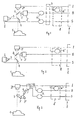
- an object 1 with a number of Cameras 2,2 'and 2 each have at least one picture taken.
- the cameras are concerned deal with grayscale cameras with common sensor chips, with which one area of the Item 1 takes a picture. It does not necessarily have to be exactly act the same area of the object, but the individual recorded Images should include at least one common subject area that is common to all Pictures appear; this common subject area can be evaluated be subjected.
- the number of cameras depends on the desired number of cameras Evaluation provided, recorded in different wavelength ranges Images selected. Usually images of the subject area are divided into two or more different wavelength or spectral ranges are recorded or one Grayscale image, comprising the entire color spectrum, and at least one additional image in a predetermined wavelength or spectral range. advantageously, a black-and-white or grayscale image and a color image in a certain Wavelength or spectral range recorded.
- the main aim of the invention is providing an intensity image I with high resolution and the creation of at least one color characteristic image in reduced resolution, in particular one Hue image B and / or a saturation image S. For taking the intensity image an arrangement of a filter is not, as long as it is a grayscale image necessary.
- the cameras 2,2 'or their sensor chips are in each case one or a common reduction unit 6 is connected downstream.
- Such Reduction unit 6 could, for example, only the image signal of every second pixel in Feed the evaluation to the horizontal and vertical direction of the sensor chip, whereby the number of image signals that can be evaluated is reduced to a quarter.
- the image signals of the individual images subjected to an electronic position transformation in the positioning unit 7.
- the position of the subject points of the images, which are associated with a reduced number of image signals are present at the position of the object points of the Adjusted intensity image, which is available with high resolution.
- the image signals of the intensity image are combined in one Reduction unit 6 'also reduced and with the reduced image signals of the others Images linked to color characteristic images; in particular takes place in the Transformation unit 8 links the reduced image signals to hue images B and / or saturation images S.
- Memory for temporary storage of the reduced number of image signals further images and memory in the evaluation unit 5 for storing the intensity image I, the hue image B and the saturation image S are not shown.
- a positioning unit 7 is not present because in principle it is possible to adjust the cameras 2, 2 'and 2 "in such a way that the sensor chips the individual cameras are clearly aligned to the same image section; a such positioning is mechanically possible, but expensive; one is preferable electronic positioning unit 7.
- Fig. 3 shows an arrangement in which images of the object 1 with only one single camera 2 "can be recorded.
- the successively recorded images of the same subject area or overlapping subject areas become Times recorded in which filters 3,3 ', 3 "of different wavelengths or. spectral transmission are in the light path. In this way, images of the Obtained object range in different wavelength or spectral ranges.
- an illumination device 9 indicated in FIG. 3 could also be used be provided that the object 1 by itself in front of the lighting device 9 located filter 3,3 ', 3 "illuminated with light of different wavelength ranges, so that also in this way with the camera 2 "images in different wavelengths or Spectral ranges can be recorded one after the other.
- this image is in particular a black and white or gray value image recorded and there is no filter in the light path between the object 1 and the Camera 2 "arranged or an illumination of the object 1 is with white light performed.
- the image signals of the other images that are used with low or reduced resolution Should be available, are passed through the reducing units 6 and the Linking or transformation unit 8 supplied in the according to a predetermined Algorithm a link to the reduced image signals of the intensity image Hue and / or saturation images.
- the two reducing units 6, the switching unit 10 are connected downstream, and the reduction of the image signals in the reducing unit 6 'in the linking unit 8 take place. It would only be necessary to ensure that those of the Camera 2 "delivered image signals depending on their belonging to an intensity image or to one with a certain wavelength or in a certain spectral range recorded further image saved separately and if necessary after each other Assignment in a positioning unit 7 according to its affiliation with and linked to the same item point.
- An electronic positioning unit 7 is not required in the case of FIG. 3 if the camera 2 "can take pictures of one and the same subject area, i.e. when the object 1 is at rest relative to the camera 2 ".
- the use of electronic positioning devices 7 is advantageous if the images are recorded with several cameras 2, 2 ', 2 "and / or if, as it is e.g. 3 could be the case, the object 1 during the Taking the pictures moved relative to the taking camera (s); in these cases Care must be taken to ensure that an evaluation is only made for the subject area at most or only for that area of the recording field that is in each of the Evaluation of the images used is included.
- filters 3, 3 ' which are arranged directly in front of the cameras 2, 2', consists in the easy interchangeability of these filters and the fact that one Replacing the filter does not change the position of the camera.
- a division of the light rays gives the advantage that in front of the object of the camera commercially available standard filters, e.g. high quality selective interference filters, can be arranged interchangeably. Changing the filter is mechanical Filter changer possible and standard lenses can be used for the cameras.
- a position calibration is also possible to a fraction of Compensate pixel positions by an image transformation and interpolation in the Sub-pixel area.
- the image signals of the intensity image must also be included, the image signals of the intensity image are also reduced for the transformation and the reduced, i.e. those electronically reduced or those using lower Resolving sensor chips in fewer numbers, image signals of the recorded Images linked in the transformation unit 8.
- the procedure according to the invention is also suitable for TDI cameras, even if these cameras are operated at different clock rates. In principle it would be necessary that all TDI cameras with the same image scale and with the same Clock rate work; however, this can be done by the electronic positioning unit 8 be balanced and it is only important to ensure that the three TDI cameras are on are aligned with the same recording field.
- Images of object 1 are usually recorded with three cameras; in principle, the procedure according to the invention is also with only two or with more than three Cameras that take pictures of different wavelengths or different spectral ranges record, realizable.
- a black and white or gray-scale image in particular as an intensity image with high resolution, and only one color image, e.g. an ultraviolet or infrared image, because we know from experience that deviations in color are lower resolution can be perceived than deviations in brightness (Intensity).
- the procedure according to the invention is particularly suitable for Quality control of printing units, e.g. Securities, banknotes, checks, check cards, Stamps and postage stamps or packaging material, e.g. cigarette, Can lid etc.
- printing units e.g. Securities, banknotes, checks, check cards, Stamps and postage stamps or packaging material, e.g. cigarette, Can lid etc.
- the intensity image is high resolution
- the second image is a color image of a specific wavelength or spectral range, this image is shown in low resolution.
- the high resolution image advantageously comprises the entire color spectrum, i.e. it is a gray scale image; however, it could also be provided that the high-resolution Image depending on a special application for increasing contrast also recorded a certain selective color spectrum.
- Another purpose of the invention can be identification, classification and Measurement of objects, e.g. in aerial photography, or an analysis of medical Be preparations.
- Multispectral recordings i.e. Recordings in two or more spectral ranges is usually done for different purposes Image resolution required.
- For a classification of objects in aerial photography e.g. with different types of soil plantings, pictures are of different wavelengths or in different spectral ranges, possibly also in the infrared.
- On the other hand requires the determination of boundaries or the measurement of positions of distinctive Dots a high resolution image, e.g. a grayscale image or possibly also a certain color selective image.
- One and the same reducing unit can be used for all those in a row Images are provided and the reduced image signals are before they are linked cached or saved. Even the reduced image signals of the intensity image, the can advantageously be recorded after the further images, can be temporarily stored become.
- the further images taken first are advantageously stored, which are linked to the intensity image recorded later.
- the object record directly with the camera also possible for image transmission and Light path division between the object 1 and the cameras 2, 2 ', 2 "used Light guides are used, 1 images of the same area of the object record and direct to the cameras 2, 2 ', 2 "used, with between the Camera-side end of at least one of the light guides and the lens of the associated one Camera at least one, possibly interchangeable, for a given one Wavelength or spectral range transmissive color filter 3, 3 'is arranged.
Landscapes
- Engineering & Computer Science (AREA)
- Multimedia (AREA)
- Signal Processing (AREA)
- Color Television Image Signal Generators (AREA)
- Image Input (AREA)
- Studio Devices (AREA)
Description
Claims (17)
- Verfahren zur Aufnahme und Auswertung von Bildern eines Gegenstandes, wobei die Bilder von einander zumindest überdeckenden Bereichen des Gegenstandes, vorzugsweise von jeweils dem selben Bereich des Gegenstandes, mit zumindest einer Grauwert-Kamera aufgenommen und vorzugsweise nach Durchführung einer Farbraumtransformation zur Auswertung zur Verfügung gestellt werden, dadurch gekennzeichnet,daß die Bilder in unterschiedlichen Wellenlängen- oder Spektralbereichen aufgenommen werden,daß zumindest ein Bild mit hoher Auflösung aufgenommen wird und die von diesem Bild abgeleiteten Bildsignale zur Auswertung als Intensitätsbild hoher Auflösung zur Verfügung gestellt werden,daß zumindest ein weiteres Bild mit geringerer Auflösung aufgenommen wird oder die Bildsignale zumindest eines weiteren Bildes einer Reduktion unterzogen werden,daß die Bildsignale des Intensitätsbildes ebenfalls in reduziertem Umfang zur Verfügung gestellt werden,daß die reduzierten Bildsignale des Intensitätsbildes und die reduzierten Bildsignale oder die Bildsignale mit geringerer Auflösung des zumindest einen weiteren Bildes durch eine Transformation, vorzugsweise eine Farbraumtransformation, verknüpft und zu zumindest einem Farbcharakteristikbild, vorzugsweise Buntton- und/oder Sättigungsbild, niederiger Auflösung transformiert bzw. zusammengesetzt werden, unddaß das zumindest eine Farbcharakteristik-Bild zusätzlich zum Intensitätsbild zur Weiterverarbeitung, Auswertung und/oder Speicherung, zur Verfügung gestellt wird.
- Verfahren nach Anspruch 1, dadurch gekennzeichnet, daß die einzelnen Bilder des Gegenstandes, vorzugsweise hintereinander oder aufeinander folgend, mit derselben Grauwert-Kamera aufgenommen werden, oder daß vom Gegenstand Bilder mit zumindest zwei, vorzugsweise drei, Grauwert-Kameras aufgenommen werden, wobei mit jeder der Grauwert-Kameras, vorzugsweise gleichzeitig, ein Bild des Gegenstandes in einem verschiedenen Wellenlängen- bzw. Spektralbereich aufgenommen wird.
- Verfahren nach Anspruch 1 oder 2, dadurch gekennzeichnet, daß für die einzelnen Aufnahmen das vom Gegenstand ausgehende Licht jeweils bezüglich Wellenlänge und/oder Spektralbereich unterschiedlich gefiltert wird oder daß der Gegenstand für die einzelnen Aufnahmen jeweils mit Licht unterschiedlicher Wellenlänge oder Spektralbereiche beleuchtet wird.
- Verfahren nach Anspruch 2, dadurch gekennzeichnet, daß zur Aufnahme von Bildern in verschiedenen Wellenlängen- bzw. Spektralbereichen die vom Gegenstand abgehenden Lichtstrahlen in Lichtwege aufgeteilt werden und in allen Lichtwegen oder in allen bis auf einen der Lichtwege eine Filterung vorgenommen wird, wobei die Filterung in den einzelnen Lichtwegen unterschiedlich erfolgt, und daß am Ende jedes Lichtweges eine Kamera angeordnet wird, mit der die Bilder in unterschiedlichen Wellen- bzw. Spektralbereichen aufgenommen werden, wobei gegebenenfalls die Filterung nach der Aufteilung der Lichtstrahlen in die einzelnen Lichtwege und vor dem Eintreffen der Lichtstrahlen im Objektiv der jeweiligen Kamera vorgenommen wird.
- Verfahren nach einem der Ansprüche 1 bis 4, dadurch gekennzeichnet, daß die reduzierten Bildsignale zumindest der weiteren Bilder zwischengespeichert werden und/oder daß die reduzierten Bildsignale der weiteren Bilder mit den reduzierten Bildsignalen des nach den weiteren Bildern aufgenommenen Intensitätsbildes verknüpft werden.
- Verfahren nach einem der Ansprüche 1 bis 5, dadurch gekennzeichnet, daß die Bildsignale der weiteren Bilder reduziert werden, indem die von zumindest zwei, vorzugsweise nebeneinanderliegenden, Bildpunkten des Sensorchips erhaltenen Bildsignale gemittelt werden oder nur Bildsignale von einer reduzierten Anzahl von Bildpunkten des Sensorchips abgeleitet werden und/oder daß zur Aufnahme von weiteren Bildern mit reduzierter Anzahl von Bildsignalen Kameras mit Sensorchips eingesetzt werden, die im Vergleich mit dem Sensorchip der Kamera, mit der das Intensitätsbild mit hoher Auflösung aufgenommen wird, einen Sensorchip aufweisen, der eine geringere Anzahl von Bildpunkten, vorzugsweise ein Viertel der Bildpunkte, aufweist.
- Verfahren nach einem der Ansprüche 1 bis 6, dadurch gekennzeichnet, daß bei der Reduktion die Bildsignale bzw. die Bildpunkte auf etwa 25 % gegenüber den für die Aufnahme des Intensitätsbildes zur Verfügung stehenden bzw. auswertbaren Bildsignalen bzw. Bildpunkten reduziert werden.
- Verfahren nach einem der Ansprüche 1 bis 7, dadurch gekennzeichnet, daß die Bildsignale der weiteren Bilder und die Bildsignale des Intensitätsbildes nach demselben vorgegebenen Algorithmus reduziert werden und/oder daß für das Intensitätsbild ein das gesamte Farbspektrum erfassendes Schwarz-Weißbild oder Grauwertbild aufgenommen und in hoher Auflösung zur Verfügung gestellt wird.
- Verfahren nach einem der Ansprüche 1 bis 8, dadurch gekennzeichnet, daß die reduzierten Bildsignale der weiteren Bilder und des Intensitätsbildes zur Gewinnung der Farbcharakteristik-Bilder durch Quotienten- oder Differenzbildung, insbesondere Bildung einer gewichteten Differenz, verknüpft werden.
- Verfahren nach einem der Ansprüche 1 bis 9, dadurch gekennzeichnet,daß die Kameras und/oder die Sensorchips der Kameras in bezug auf den Gegenstand mechanisch derart einjustiert werden, daß gleichen Gegenstandspunkten gleiche Bildpunkte auf den Sensorchips der einzelnen Kameras zugeordnet sind und/oderdaß die auf die Sensorchips der einzelnen Kameras abgebildeten Gegenstandspunkte lagemäßig einander zugeordnet werden, indem denselben Gegenstandspunkten einander entsprechende oder die gleichen Bildpunkte auf den einzelnen Sensorchips zugeordnet werden und/oderdaß bei einer Abbildung derselben Gegenstandspunkte auf unterschiedlich auf den Sensorchips der einzelnen Kameras positionierte Bildpunkte eine Zuordnung der Gegenstandspunkte und der von denselben Gegenstandspunkten stammenden Bildpunktsignale mit einer elektronisch- geometrischen Positionstransformation erfolgt, und/oderdaß die Position der abgebildeten Gegenstandspunkte der weiteren, mit reduzierten Bildsignalen zur Verfügung stehenden Bilder elektronisch an die Position der zur Aufnahme des lntensitätsbildes abgebildeten Gegenstandspunkte angepaßt wird und/oderdaß die elektronische Positionstransformation der Gegenstandspunkte bzw. der Bildsignale der weiteren Bilder nach der Reduktion der Bildsignale oder mit Bildsignalen geringerer Auflösung erfolgt, wobei gegebenenfalls im Fall von in bezug auf die Bildpunkte nicht ganzzahligen Positionstransformationen eine elektronische Interpolation im Sub-Pixel-Bereich erfolgt.
- Anordnung zur Aufnahme und Auswertung von Bildern eines Gegenstandes, wobei zur Aufnahme von Bildern von einander zumindest überdeckenden Bereichen des Gegenstandes, vorzugsweise von jeweils demselben Bereich des Gegenstandes, zumindest eine Grauwert-Kamera vorgesehen ist, die an eine Auswerteeinheit angeschlossen ist, insbesondere zur Durchführung des Verfahrens nach einem der Ansprüche 1 bis 10, dadurch gekennzeichnet,daß mit der zumindest einen Kamera (2, 2', 2") Bilder des Gegenstandes (1) in unterschiedlichen Wellenlängen- bzw. Spektralbereichen aufnehmbar sind,daß zur Erstellung eines Intensitätsbildes die Bildsignale eines mit hoher Auflösung aufgenommenen Bildes, vorzugsweise eines das gesamte Farbspektrum erfassenden Bildes oder eines Schwarz-Weißbildes oder eines Grauwertbildes, der Auswerteeinrichtung (5) zugeführt sind,daß die Bildsignale zumindest eines weiteren, mit gegenüber dem Intensitätsbild mit einer geringeren Auflösung aufgenommenen Bildes des Gegenstandes oder die in einer Reduktionseinheit (6) reduzierten Bildsignale zumindest eines weiteren Bildes einer Verknüpfungs- und Transformationseinheit (8) zugeführt sind,daß die Bildsignale des Intensitätsbildes über eine Reduktionseinheit (6') der Verknüpfungs- und Transformationseinheit (8) zugeführt sind, in der die reduzierten Bildsignale des Intensitätsbildes und des zumindest einen weiteren Bildes im Zuge einer Transformation, vorzugsweise einer Farbraumtransformation, verknüpfbar und zu zumindest einem Farbcharakteristik-Bild, vorzugsweise Bunttonoder Sättigungsbild, niedriger Auflösung transformierbar bzw. zusammensetzbar sindund daß in der an die Verknüpfungs- und Transformationseinheit (8) angeschlossenen Auswerteeinheit (5) das Intensitätsbild in hoher Auflösung und zumindest ein Farbcharakteristikbild in geringer Auflösung zur weiteren Verwendung, insbesondere gespeichert, vorliegen.
- Anordnung nach Anspruch 11, dadurch gekennzeichnet, daß zur Aufnahme der Bilder des Gegenstandes (1) zumindest zwei, vorzugsweise drei Grauwert-Kameras (2, 2', 2") vorgesehen sind, wobei mit jeder der Kameras (2, 2', 2"), vorzugsweise gleichzeitig, ein Bild des Gegenstandes (1) in einem anderen Wellenlängen- bzw. Spektralbereich aufnehmbar ist.
- Anordnung nach Anspruch 11 oder 12, dadurch gekennzeichnet,daß zwischen dem Gegenstand (1) und dem Objektiv zumindest einer Kamera (2, 2', 2"), vorzugsweise unmittelbar vor dem Objektiv, zumindest ein, vorzugsweise austauschbarer, Farbfilter (3, 3') angeordnet ist und/oderdaß insbesondere zur Aufnahme von Bildern des Gegenstandes (1) unter etwa dem selben Winkel im Lichtweg der vom Gegenstand (1) abgehenden Lichtstrahlen zumindest ein Strahlenteiler (4) vorgesehen ist, z.B. ein halbdurchlässiger Spiegel, mit dem die vom Gegenstand abgehenden Lichtstrahlen auf die einzelnen Kameras (2, 2') aufgeteilt sind.
- Anordnung nach Anspruch 11, dadurch gekennzeichnet, daß für die Aufnahme von Bildern mit einer einzigen Kamera (2") in den Lichtweg zwischen dem Gegenstand (1) und der Kamera (2") zumindest ein Filter, vorzugsweise eine Anzahl von für Licht unterschiedlicher Wellenlänge bzw. spektraler Zusammensetzung durchlässigen, Filtern (3, 3', 3") einschaltbar ist, wobei gegebenenfalls der (die) Filter (3, 3', 3") in einem Träger auswechselbar gehalten und mit diesem in den Lichtweg einschwenkbar ist (sind) oder eine Beleuchtungseinrichtung (9) vorgesehen ist, mit der der Gegenstand (1) für die Aufnahme einzelner Bilder jeweils mit Licht unterschiedlicher Wellenlängen bzw. Spektralbereiche beleuchtbar ist, wobei gegebenenfalls der einzigen Kamera (2") eine Umschalteinrichtung (10) nachgeschaltet ist, mit der die Bildsignale eines aufgenommenen Bildes der Auswerteeinheit (5) und/oder einer Reduktionseinheit (6) zuführbar sind.
- Anordnung nach einem der Ansprüche 11 bis 13, dadurch gekennzeichnet,daß zumindest eine Kamera (2, 2') einen Sensorchip aufweist, der gegenüber der Bildpunktanzahl des Sensorchips der für die Aufnahme des Intensitätsbildes vorgesehenen Kamera (2") eine verringerte Anzahl von Bildpunkten besitzt und/oderdaß an den Sensorchip der für die Aufnahme der weiteren Bilder vorgesehenen Kamera (2,2') eine Reduktionseinheit (6, 6') für die Bildsignale angeschlossen ist, deren Ausgang mit der Verknüpfungs- bzw. Transformationseinheit (8) verbunden ist.
- Anordnung nach einem der Ansprüche 11 bis 15, dadurch gekennzeichnet, daß den Sensorchips der Kameras (2, 2', 2") oder den einzelnen Reduktionseinheiten (6,6') eine elektronische Positionierungseinheit (7) nachgeschaltet ist, mit der mittels einer elektronisch-geometrischen Bildtransformation die mit den einzelnen Kameras (2, 2', 2") aufgenommenen Bilder bzw. die auf dem Sensorchip abgebildeten Gegenstandspunkte zur Deckung oder in eine vorgegebene gegenseitige Position gebracht werden bzw. mit der bei einer Abbildung derselben Gegenstandspunkte auf unterschiedliche Bildpunkte der Sensorchips der einzelnen Kameras (2, 2', 2") eine Zuordnung einander entsprechender Gegenstandspunkte und Bildpunkte im Zuge einer elektronisch-geometrischen Positionstransformation erfolgt.
- Anordnung nach einem der Ansprüche 11 bis 16, dadurch gekennzeichnet, daß zur Bildübertragung und Lichtwegaufteilung zwischen dem Gegenstand (1) und den eingesetzten Kameras (2, 2', 2") Lichtleiter eingesetzt sind, die von ein und demselben Bereich des Gegenstandes (1) Bilder aufnehmen und zu den eingesetzten Kameras (2,2',2") leiten, wobei zwischen dem kameraseitigen Ende zumindest eines der Lichtleiter und dem Objektiv der zugehörigen Kamera zumindest ein, gegebenenfalls austauschbarer, für einen vorgegebenen Wellenlängen- bzw. Spektralbereich durchlässiger Farbfilter (3, 3') angeordnet ist.
Applications Claiming Priority (2)
| Application Number | Priority Date | Filing Date | Title |
|---|---|---|---|
| AT0021898A AT406724B (de) | 1998-02-06 | 1998-02-06 | Verfahren und anordnung zur aufnahme und auswertung von bildern eines gegenstandes |
| AT21898 | 1998-02-06 |
Publications (3)
| Publication Number | Publication Date |
|---|---|
| EP0938231A2 EP0938231A2 (de) | 1999-08-25 |
| EP0938231A3 EP0938231A3 (de) | 2002-06-12 |
| EP0938231B1 true EP0938231B1 (de) | 2003-12-17 |
Family
ID=3484668
Family Applications (1)
| Application Number | Title | Priority Date | Filing Date |
|---|---|---|---|
| EP99890036A Expired - Lifetime EP0938231B1 (de) | 1998-02-06 | 1999-02-02 | Verfahren und Anordnung zur Aufnahme und Auswertung von Bildern eines Gegenstandes |
Country Status (3)
| Country | Link |
|---|---|
| EP (1) | EP0938231B1 (de) |
| AT (1) | AT406724B (de) |
| DE (1) | DE59908048D1 (de) |
Families Citing this family (1)
| Publication number | Priority date | Publication date | Assignee | Title |
|---|---|---|---|---|
| DE102022001553B4 (de) | 2022-05-04 | 2024-07-18 | Bundesrepublik Deutschland, vertr. durch das Bundesministerium der Verteidigung, vertr. durch das Bundesamt für Ausrüstung, Informationstechnik und Nutzung der Bundeswehr | Messverfahren und -vorrichtung zur Kontrolle des sicheren Einsatzes von Flugkörpern an Hubschraubern |
Family Cites Families (4)
| Publication number | Priority date | Publication date | Assignee | Title |
|---|---|---|---|---|
| DE2942181C2 (de) * | 1979-10-18 | 1987-11-12 | Elektro-Optik GmbH & Co KG, 2392 Glücksburg | Optisch-elektronische Anordnung für ein thermografisches Bild- und Trackergerät |
| US4876590A (en) * | 1988-06-17 | 1989-10-24 | Eastman Kodak Company | Low resolution verifier for a still video image |
| US5325449A (en) * | 1992-05-15 | 1994-06-28 | David Sarnoff Research Center, Inc. | Method for fusing images and apparatus therefor |
| EP0858208A1 (de) * | 1997-02-07 | 1998-08-12 | Eastman Kodak Company | Verfahren zur Herstellung digitaler Bilder mit verbesserten Leistungseigenschaften |
-
1998
- 1998-02-06 AT AT0021898A patent/AT406724B/de not_active IP Right Cessation
-
1999
- 1999-02-02 DE DE59908048T patent/DE59908048D1/de not_active Expired - Lifetime
- 1999-02-02 EP EP99890036A patent/EP0938231B1/de not_active Expired - Lifetime
Also Published As
| Publication number | Publication date |
|---|---|
| ATA21898A (de) | 1999-12-15 |
| EP0938231A3 (de) | 2002-06-12 |
| DE59908048D1 (de) | 2004-01-29 |
| EP0938231A2 (de) | 1999-08-25 |
| AT406724B (de) | 2000-08-25 |
Similar Documents
| Publication | Publication Date | Title |
|---|---|---|
| DE10314071B3 (de) | Verfahren zur qualitativen Beurteilung eines Materials mit mindestens einem Erkennungsmerkmal | |
| DE69909997T2 (de) | Individualisierter fingerabdruckabtaster | |
| EP0452700B1 (de) | Verfahren und Vorrichtung zur Bestimmung von Passerdifferenzen an Druckbildstellen eines Mehrfarbenoffsetdruckes | |
| DE69225303T2 (de) | Abbildungsvorrichtung | |
| AT402861B (de) | Verfahren und anordnung zum erkennen bzw. zur kontrolle von flächenstrukturen bzw. der oberflächenbeschaffenheit | |
| EP0884182A1 (de) | Verfahren zur Regelung von Betriebsvorgängen einer drucktechnischen Maschine | |
| DE4202579A1 (de) | Vorrichtung und verfahren zur bearbeitung von dokumenten | |
| DE102009019545B4 (de) | Verfahren und Vorrichtung zur Durchführung eines optischen Vergleiches zwischen zumindest zwei Mustern, vorzugsweise durch Vergleich von auswählbaren Ausschnitten | |
| EP0384009A2 (de) | Vorrichtung zur Gewinnung kontrastreicher Bilder | |
| WO2004056570A1 (de) | Verfahren und vorrichtung zur echzeitkontrolle von druckbildern | |
| EP0938231B1 (de) | Verfahren und Anordnung zur Aufnahme und Auswertung von Bildern eines Gegenstandes | |
| DE102008020505A1 (de) | Bildaufnahem- und Farbmesssystem | |
| EP3948649B1 (de) | Maskierung von in einem bild enthaltenen objekten | |
| DE69626928T2 (de) | Vorrichtung zur Kontrolle der Farbe von Druckerzeugnissen | |
| EP4217785B1 (de) | Abbildungssystem, insbesondere für eine kamera | |
| DE102004021047B3 (de) | Verfahren zum Vergleich eines Bildes mit mindestens einem Referenzbild | |
| AT408377B (de) | Verfahren und vorrichtung zur prüfung bzw. untersuchung von gegenständen | |
| DE69906198T2 (de) | Verfahren zur Steuerung von einem Druckerzeugnis | |
| WO2004105380A1 (de) | Einrichtung und verfahren zur multispektralen abtastung einer farbbildvorlage | |
| DE69736029T2 (de) | Farbdrucker und Farbdruckverfahren | |
| EP4217958B1 (de) | Verfahren zur erstellung einer bildaufzeichnung | |
| DE10208289C1 (de) | Elektronischer Bildsensor und ein Verfahren zur Auswertung | |
| EP0827015B1 (de) | Verfahren zur Erzeugung von Indexprints | |
| WO2010043443A1 (de) | Verfahren und vorrichtung für die überprüfung von linsenstrukturen | |
| LU102086B1 (de) | Verfahren zur Erstellung einer Bildaufzeichnung |
Legal Events
| Date | Code | Title | Description |
|---|---|---|---|
| PUAI | Public reference made under article 153(3) epc to a published international application that has entered the european phase |
Free format text: ORIGINAL CODE: 0009012 |
|
| AK | Designated contracting states |
Kind code of ref document: A2 Designated state(s): AT BE CH CY DE DK ES FI FR GB GR IE IT LI LU MC NL PT SE |
|
| AX | Request for extension of the european patent |
Free format text: AL;LT;LV;MK;RO;SI |
|
| PUAL | Search report despatched |
Free format text: ORIGINAL CODE: 0009013 |
|
| AK | Designated contracting states |
Kind code of ref document: A3 Designated state(s): AT BE CH CY DE DK ES FI FR GB GR IE IT LI LU MC NL PT SE |
|
| AX | Request for extension of the european patent |
Free format text: AL;LT;LV;MK;RO;SI |
|
| 17P | Request for examination filed |
Effective date: 20021203 |
|
| AKX | Designation fees paid |
Designated state(s): AT BE CH CY DE DK ES FI FR GB GR IE IT LI LU MC NL PT SE |
|
| RBV | Designated contracting states (corrected) |
Designated state(s): AT BE CH CY DE DK ES FI FR GB LI |
|
| RBV | Designated contracting states (corrected) |
Designated state(s): BE CH DE ES FR GB IE IT LI NL PT SE |
|
| GRAH | Despatch of communication of intention to grant a patent |
Free format text: ORIGINAL CODE: EPIDOS IGRA |
|
| GRAS | Grant fee paid |
Free format text: ORIGINAL CODE: EPIDOSNIGR3 |
|
| GRAA | (expected) grant |
Free format text: ORIGINAL CODE: 0009210 |
|
| AK | Designated contracting states |
Kind code of ref document: B1 Designated state(s): BE CH DE ES FR GB IE IT LI NL PT SE |
|
| PG25 | Lapsed in a contracting state [announced via postgrant information from national office to epo] |
Ref country code: NL Free format text: LAPSE BECAUSE OF FAILURE TO SUBMIT A TRANSLATION OF THE DESCRIPTION OR TO PAY THE FEE WITHIN THE PRESCRIBED TIME-LIMIT Effective date: 20031217 Ref country code: IT Free format text: LAPSE BECAUSE OF FAILURE TO SUBMIT A TRANSLATION OF THE DESCRIPTION OR TO PAY THE FEE WITHIN THE PRESCRIBED TIME-LIMIT;WARNING: LAPSES OF ITALIAN PATENTS WITH EFFECTIVE DATE BEFORE 2007 MAY HAVE OCCURRED AT ANY TIME BEFORE 2007. THE CORRECT EFFECTIVE DATE MAY BE DIFFERENT FROM THE ONE RECORDED. Effective date: 20031217 Ref country code: IE Free format text: LAPSE BECAUSE OF FAILURE TO SUBMIT A TRANSLATION OF THE DESCRIPTION OR TO PAY THE FEE WITHIN THE PRESCRIBED TIME-LIMIT Effective date: 20031217 |
|
| REG | Reference to a national code |
Ref country code: GB Ref legal event code: FG4D Free format text: NOT ENGLISH |
|
| RIN1 | Information on inventor provided before grant (corrected) |
Inventor name: RUBIK, MICHAEL DIPL.ING. Inventor name: KRATTENTHALER, WERNER DR. Inventor name: MAYER, KONRAD DIPL.ING. |
|
| REG | Reference to a national code |
Ref country code: CH Ref legal event code: EP |
|
| REG | Reference to a national code |
Ref country code: IE Ref legal event code: FG4D Free format text: GERMAN |
|
| REF | Corresponds to: |
Ref document number: 59908048 Country of ref document: DE Date of ref document: 20040129 Kind code of ref document: P |
|
| GBT | Gb: translation of ep patent filed (gb section 77(6)(a)/1977) |
Effective date: 20040115 |
|
| PG25 | Lapsed in a contracting state [announced via postgrant information from national office to epo] |
Ref country code: BE Free format text: LAPSE BECAUSE OF NON-PAYMENT OF DUE FEES Effective date: 20040228 |
|
| PG25 | Lapsed in a contracting state [announced via postgrant information from national office to epo] |
Ref country code: LI Free format text: LAPSE BECAUSE OF NON-PAYMENT OF DUE FEES Effective date: 20040229 Ref country code: CH Free format text: LAPSE BECAUSE OF NON-PAYMENT OF DUE FEES Effective date: 20040229 |
|
| PG25 | Lapsed in a contracting state [announced via postgrant information from national office to epo] |
Ref country code: SE Free format text: LAPSE BECAUSE OF FAILURE TO SUBMIT A TRANSLATION OF THE DESCRIPTION OR TO PAY THE FEE WITHIN THE PRESCRIBED TIME-LIMIT Effective date: 20040317 |
|
| PG25 | Lapsed in a contracting state [announced via postgrant information from national office to epo] |
Ref country code: ES Free format text: LAPSE BECAUSE OF FAILURE TO SUBMIT A TRANSLATION OF THE DESCRIPTION OR TO PAY THE FEE WITHIN THE PRESCRIBED TIME-LIMIT Effective date: 20040328 |
|
| NLV1 | Nl: lapsed or annulled due to failure to fulfill the requirements of art. 29p and 29m of the patents act | ||
| REG | Reference to a national code |
Ref country code: IE Ref legal event code: FD4D |
|
| BERE | Be: lapsed |
Owner name: OSTERREICHISCHES FORSCHUNGSZENTRUM SEIBERSDORF GES Effective date: 20040228 |
|
| ET | Fr: translation filed | ||
| REG | Reference to a national code |
Ref country code: CH Ref legal event code: PL |
|
| PLBE | No opposition filed within time limit |
Free format text: ORIGINAL CODE: 0009261 |
|
| STAA | Information on the status of an ep patent application or granted ep patent |
Free format text: STATUS: NO OPPOSITION FILED WITHIN TIME LIMIT |
|
| 26N | No opposition filed |
Effective date: 20040920 |
|
| PGFP | Annual fee paid to national office [announced via postgrant information from national office to epo] |
Ref country code: FR Payment date: 20060216 Year of fee payment: 8 |
|
| GBPC | Gb: european patent ceased through non-payment of renewal fee |
Effective date: 20070202 |
|
| REG | Reference to a national code |
Ref country code: FR Ref legal event code: ST Effective date: 20071030 |
|
| PG25 | Lapsed in a contracting state [announced via postgrant information from national office to epo] |
Ref country code: PT Free format text: LAPSE BECAUSE OF NON-PAYMENT OF DUE FEES Effective date: 20040517 |
|
| PG25 | Lapsed in a contracting state [announced via postgrant information from national office to epo] |
Ref country code: GB Free format text: LAPSE BECAUSE OF NON-PAYMENT OF DUE FEES Effective date: 20070202 Ref country code: FR Free format text: LAPSE BECAUSE OF NON-PAYMENT OF DUE FEES Effective date: 20070228 |
|
| PGFP | Annual fee paid to national office [announced via postgrant information from national office to epo] |
Ref country code: GB Payment date: 20060221 Year of fee payment: 8 |
|
| PGFP | Annual fee paid to national office [announced via postgrant information from national office to epo] |
Ref country code: DE Payment date: 20160218 Year of fee payment: 18 |
|
| REG | Reference to a national code |
Ref country code: DE Ref legal event code: R119 Ref document number: 59908048 Country of ref document: DE |
|
| PG25 | Lapsed in a contracting state [announced via postgrant information from national office to epo] |
Ref country code: DE Free format text: LAPSE BECAUSE OF NON-PAYMENT OF DUE FEES Effective date: 20170901 |