EP0938509B1 - Constituants et catalyseurs pour la polymerisation d'olefines - Google Patents
Constituants et catalyseurs pour la polymerisation d'olefines Download PDFInfo
- Publication number
- EP0938509B1 EP0938509B1 EP98945242A EP98945242A EP0938509B1 EP 0938509 B1 EP0938509 B1 EP 0938509B1 EP 98945242 A EP98945242 A EP 98945242A EP 98945242 A EP98945242 A EP 98945242A EP 0938509 B1 EP0938509 B1 EP 0938509B1
- Authority
- EP
- European Patent Office
- Prior art keywords
- ethyl
- catalyst component
- compound
- cyanoacetate
- solid catalyst
- Prior art date
- Legal status (The legal status is an assumption and is not a legal conclusion. Google has not performed a legal analysis and makes no representation as to the accuracy of the status listed.)
- Expired - Lifetime
Links
- 239000003054 catalyst Substances 0.000 title claims description 40
- 238000006116 polymerization reaction Methods 0.000 title claims description 31
- 150000001336 alkenes Chemical class 0.000 title claims description 9
- 150000001875 compounds Chemical class 0.000 claims description 43
- 239000011949 solid catalyst Substances 0.000 claims description 27
- 229910052739 hydrogen Inorganic materials 0.000 claims description 25
- 239000001257 hydrogen Substances 0.000 claims description 25
- 125000000217 alkyl group Chemical group 0.000 claims description 24
- 238000000034 method Methods 0.000 claims description 24
- -1 hydrocarbyl radical Chemical group 0.000 claims description 22
- 125000000753 cycloalkyl group Chemical group 0.000 claims description 18
- 125000003118 aryl group Chemical group 0.000 claims description 16
- UFHFLCQGNIYNRP-UHFFFAOYSA-N Hydrogen Chemical compound [H][H] UFHFLCQGNIYNRP-UHFFFAOYSA-N 0.000 claims description 15
- 229910003074 TiCl4 Inorganic materials 0.000 claims description 15
- XJDNKRIXUMDJCW-UHFFFAOYSA-J titanium tetrachloride Chemical compound Cl[Ti](Cl)(Cl)Cl XJDNKRIXUMDJCW-UHFFFAOYSA-J 0.000 claims description 15
- 125000004432 carbon atom Chemical group C* 0.000 claims description 14
- 239000010936 titanium Substances 0.000 claims description 14
- 125000003342 alkenyl group Chemical group 0.000 claims description 12
- 125000002877 alkyl aryl group Chemical group 0.000 claims description 12
- 125000005119 alkyl cycloalkyl group Chemical group 0.000 claims description 12
- 125000003710 aryl alkyl group Chemical group 0.000 claims description 12
- 125000001316 cycloalkyl alkyl group Chemical group 0.000 claims description 12
- 229910052749 magnesium Inorganic materials 0.000 claims description 10
- 150000003377 silicon compounds Chemical class 0.000 claims description 10
- 150000001916 cyano esters Chemical class 0.000 claims description 9
- 125000004435 hydrogen atom Chemical group [H]* 0.000 claims description 9
- 229910052736 halogen Inorganic materials 0.000 claims description 8
- 229910052719 titanium Inorganic materials 0.000 claims description 8
- 239000004215 Carbon black (E152) Substances 0.000 claims description 7
- 238000006243 chemical reaction Methods 0.000 claims description 7
- 229930195733 hydrocarbon Natural products 0.000 claims description 7
- 150000003609 titanium compounds Chemical class 0.000 claims description 7
- WLLOYTIHTJTCCF-UHFFFAOYSA-N ethyl 2-butyl-2-cyanohexanoate Chemical compound CCCCC(CCCC)(C#N)C(=O)OCC WLLOYTIHTJTCCF-UHFFFAOYSA-N 0.000 claims description 6
- 150000002367 halogens Chemical class 0.000 claims description 6
- 125000005842 heteroatom Chemical group 0.000 claims description 6
- 125000002496 methyl group Chemical group [H]C([H])([H])* 0.000 claims description 5
- JWCYDYZLEAQGJJ-UHFFFAOYSA-N dicyclopentyl(dimethoxy)silane Chemical compound C1CCCC1[Si](OC)(OC)C1CCCC1 JWCYDYZLEAQGJJ-UHFFFAOYSA-N 0.000 claims description 4
- 125000001495 ethyl group Chemical group [H]C([H])([H])C([H])([H])* 0.000 claims description 3
- 150000004820 halides Chemical class 0.000 claims description 3
- YONPGGFAJWQGJC-UHFFFAOYSA-K titanium(iii) chloride Chemical compound Cl[Ti](Cl)Cl YONPGGFAJWQGJC-UHFFFAOYSA-K 0.000 claims description 3
- VOITXYVAKOUIBA-UHFFFAOYSA-N triethylaluminium Chemical compound CC[Al](CC)CC VOITXYVAKOUIBA-UHFFFAOYSA-N 0.000 claims description 3
- 125000000008 (C1-C10) alkyl group Chemical group 0.000 claims description 2
- UVGKQRAGAYVWQV-UHFFFAOYSA-N 2,3-dimethylbutan-2-yl(trimethoxy)silane Chemical compound CO[Si](OC)(OC)C(C)(C)C(C)C UVGKQRAGAYVWQV-UHFFFAOYSA-N 0.000 claims description 2
- 229910010062 TiCl3 Inorganic materials 0.000 claims description 2
- 150000005840 aryl radicals Chemical class 0.000 claims description 2
- MEWFSXFFGFDHGV-UHFFFAOYSA-N cyclohexyl(trimethoxy)silane Chemical compound CO[Si](OC)(OC)C1CCCCC1 MEWFSXFFGFDHGV-UHFFFAOYSA-N 0.000 claims description 2
- SJJCABYOVIHNPZ-UHFFFAOYSA-N cyclohexyl-dimethoxy-methylsilane Chemical compound CO[Si](C)(OC)C1CCCCC1 SJJCABYOVIHNPZ-UHFFFAOYSA-N 0.000 claims description 2
- AHUXYBVKTIBBJW-UHFFFAOYSA-N dimethoxy(diphenyl)silane Chemical compound C=1C=CC=CC=1[Si](OC)(OC)C1=CC=CC=C1 AHUXYBVKTIBBJW-UHFFFAOYSA-N 0.000 claims description 2
- LIZVRUQPJHLYDY-UHFFFAOYSA-N ethyl 2-cyano-2-propylhexanoate Chemical compound C(C)OC(C(CCC)(CCCC)C#N)=O LIZVRUQPJHLYDY-UHFFFAOYSA-N 0.000 claims description 2
- CVMXOHNPQYTUOZ-UHFFFAOYSA-N ethyl 2-cyano-2-propylpentanoate Chemical compound CCCC(CCC)(C#N)C(=O)OCC CVMXOHNPQYTUOZ-UHFFFAOYSA-N 0.000 claims description 2
- GCUYMKANURBHLF-UHFFFAOYSA-N ethyl 2-cyano-3,3-dimethylbutanoate Chemical compound CCOC(=O)C(C#N)C(C)(C)C GCUYMKANURBHLF-UHFFFAOYSA-N 0.000 claims description 2
- RGPIBWIKEXZOQO-UHFFFAOYSA-N ethyl 2-cyano-3,4-dimethylpentanoate Chemical compound CCOC(=O)C(C#N)C(C)C(C)C RGPIBWIKEXZOQO-UHFFFAOYSA-N 0.000 claims description 2
- YMUSKLAPOQSFAH-UHFFFAOYSA-N ethyl 2-cyanohexanoate Chemical compound CCCCC(C#N)C(=O)OCC YMUSKLAPOQSFAH-UHFFFAOYSA-N 0.000 claims description 2
- MLVRCZPSHCVRHN-UHFFFAOYSA-N ethyl 2-cyanopentanoate Chemical compound CCCC(C#N)C(=O)OCC MLVRCZPSHCVRHN-UHFFFAOYSA-N 0.000 claims description 2
- HNIMUKWIOXPQIL-UHFFFAOYSA-N methyl 2-cyanohexanoate Chemical compound CCCCC(C#N)C(=O)OC HNIMUKWIOXPQIL-UHFFFAOYSA-N 0.000 claims description 2
- HXLWJGIPGJFBEZ-UHFFFAOYSA-N tert-butyl(trimethoxy)silane Chemical compound CO[Si](OC)(OC)C(C)(C)C HXLWJGIPGJFBEZ-UHFFFAOYSA-N 0.000 claims description 2
- NETBVGNWMHLXRP-UHFFFAOYSA-N tert-butyl-dimethoxy-methylsilane Chemical compound CO[Si](C)(OC)C(C)(C)C NETBVGNWMHLXRP-UHFFFAOYSA-N 0.000 claims description 2
- SQBBHCOIQXKPHL-UHFFFAOYSA-N tributylalumane Chemical compound CCCC[Al](CCCC)CCCC SQBBHCOIQXKPHL-UHFFFAOYSA-N 0.000 claims description 2
- ORYGRKHDLWYTKX-UHFFFAOYSA-N trihexylalumane Chemical compound CCCCCC[Al](CCCCCC)CCCCCC ORYGRKHDLWYTKX-UHFFFAOYSA-N 0.000 claims description 2
- MCULRUJILOGHCJ-UHFFFAOYSA-N triisobutylaluminium Chemical compound CC(C)C[Al](CC(C)C)CC(C)C MCULRUJILOGHCJ-UHFFFAOYSA-N 0.000 claims description 2
- LFXVBWRMVZPLFK-UHFFFAOYSA-N trioctylalumane Chemical compound CCCCCCCC[Al](CCCCCCCC)CCCCCCCC LFXVBWRMVZPLFK-UHFFFAOYSA-N 0.000 claims description 2
- 229910052782 aluminium Inorganic materials 0.000 claims 2
- TWRXJAOTZQYOKJ-UHFFFAOYSA-L Magnesium chloride Chemical compound [Mg+2].[Cl-].[Cl-] TWRXJAOTZQYOKJ-UHFFFAOYSA-L 0.000 description 22
- 229920000642 polymer Polymers 0.000 description 13
- VLKZOEOYAKHREP-UHFFFAOYSA-N n-Hexane Chemical compound CCCCCC VLKZOEOYAKHREP-UHFFFAOYSA-N 0.000 description 12
- 239000011777 magnesium Substances 0.000 description 11
- QQONPFPTGQHPMA-UHFFFAOYSA-N propylene Natural products CC=C QQONPFPTGQHPMA-UHFFFAOYSA-N 0.000 description 8
- 125000004805 propylene group Chemical group [H]C([H])([H])C([H])([*:1])C([H])([H])[*:2] 0.000 description 8
- 238000011282 treatment Methods 0.000 description 8
- CTQNGGLPUBDAKN-UHFFFAOYSA-N O-Xylene Chemical compound CC1=CC=CC=C1C CTQNGGLPUBDAKN-UHFFFAOYSA-N 0.000 description 7
- 229910001629 magnesium chloride Inorganic materials 0.000 description 7
- 235000011147 magnesium chloride Nutrition 0.000 description 7
- IJGRMHOSHXDMSA-UHFFFAOYSA-N Atomic nitrogen Chemical compound N#N IJGRMHOSHXDMSA-UHFFFAOYSA-N 0.000 description 6
- 239000000047 product Substances 0.000 description 6
- 238000002360 preparation method Methods 0.000 description 5
- 238000000926 separation method Methods 0.000 description 5
- 238000003756 stirring Methods 0.000 description 5
- FYYHWMGAXLPEAU-UHFFFAOYSA-N Magnesium Chemical compound [Mg] FYYHWMGAXLPEAU-UHFFFAOYSA-N 0.000 description 4
- 238000009826 distribution Methods 0.000 description 4
- 150000002430 hydrocarbons Chemical class 0.000 description 4
- 239000007788 liquid Substances 0.000 description 4
- YMWUJEATGCHHMB-UHFFFAOYSA-N Dichloromethane Chemical compound ClCCl YMWUJEATGCHHMB-UHFFFAOYSA-N 0.000 description 3
- RTAQQCXQSZGOHL-UHFFFAOYSA-N Titanium Chemical compound [Ti] RTAQQCXQSZGOHL-UHFFFAOYSA-N 0.000 description 3
- YXFVVABEGXRONW-UHFFFAOYSA-N Toluene Chemical compound CC1=CC=CC=C1 YXFVVABEGXRONW-UHFFFAOYSA-N 0.000 description 3
- 238000012662 bulk polymerization Methods 0.000 description 3
- MLIREBYILWEBDM-UHFFFAOYSA-N cyanoacetic acid Chemical class OC(=O)CC#N MLIREBYILWEBDM-UHFFFAOYSA-N 0.000 description 3
- 239000000203 mixture Substances 0.000 description 3
- 229910052757 nitrogen Inorganic materials 0.000 description 3
- 229920001155 polypropylene Polymers 0.000 description 3
- 239000002904 solvent Substances 0.000 description 3
- 239000008096 xylene Substances 0.000 description 3
- RKMGAJGJIURJSJ-UHFFFAOYSA-N 2,2,6,6-tetramethylpiperidine Chemical compound CC1(C)CCCC(C)(C)N1 RKMGAJGJIURJSJ-UHFFFAOYSA-N 0.000 description 2
- HRAQMGWTPNOILP-UHFFFAOYSA-N 4-Ethoxy ethylbenzoate Chemical compound CCOC(=O)C1=CC=C(OCC)C=C1 HRAQMGWTPNOILP-UHFFFAOYSA-N 0.000 description 2
- LFQSCWFLJHTTHZ-UHFFFAOYSA-N Ethanol Chemical compound CCO LFQSCWFLJHTTHZ-UHFFFAOYSA-N 0.000 description 2
- 150000004945 aromatic hydrocarbons Chemical class 0.000 description 2
- MVPPADPHJFYWMZ-UHFFFAOYSA-N chlorobenzene Chemical compound ClC1=CC=CC=C1 MVPPADPHJFYWMZ-UHFFFAOYSA-N 0.000 description 2
- 230000000052 comparative effect Effects 0.000 description 2
- 150000002148 esters Chemical class 0.000 description 2
- ZIUSEGSNTOUIPT-UHFFFAOYSA-N ethyl 2-cyanoacetate Chemical compound CCOC(=O)CC#N ZIUSEGSNTOUIPT-UHFFFAOYSA-N 0.000 description 2
- 150000008282 halocarbons Chemical class 0.000 description 2
- QWPPOHNGKGFGJK-UHFFFAOYSA-N hypochlorous acid Chemical class ClO QWPPOHNGKGFGJK-UHFFFAOYSA-N 0.000 description 2
- 150000002576 ketones Chemical class 0.000 description 2
- 229940078552 o-xylene Drugs 0.000 description 2
- XNGIFLGASWRNHJ-UHFFFAOYSA-N phthalic acid Chemical compound OC(=O)C1=CC=CC=C1C(O)=O XNGIFLGASWRNHJ-UHFFFAOYSA-N 0.000 description 2
- 239000002685 polymerization catalyst Substances 0.000 description 2
- 239000007787 solid Substances 0.000 description 2
- 239000006228 supernatant Substances 0.000 description 2
- WSLDOOZREJYCGB-UHFFFAOYSA-N 1,2-Dichloroethane Chemical compound ClCCCl WSLDOOZREJYCGB-UHFFFAOYSA-N 0.000 description 1
- VEXZGXHMUGYJMC-UHFFFAOYSA-M Chloride anion Chemical compound [Cl-] VEXZGXHMUGYJMC-UHFFFAOYSA-M 0.000 description 1
- 229910021591 Copper(I) chloride Inorganic materials 0.000 description 1
- 238000006000 Knoevenagel condensation reaction Methods 0.000 description 1
- 239000011865 Pt-based catalyst Substances 0.000 description 1
- 238000002083 X-ray spectrum Methods 0.000 description 1
- 238000006653 Ziegler-Natta catalysis Methods 0.000 description 1
- 230000004913 activation Effects 0.000 description 1
- 150000001299 aldehydes Chemical class 0.000 description 1
- 125000005234 alkyl aluminium group Chemical group 0.000 description 1
- 150000001350 alkyl halides Chemical class 0.000 description 1
- AZDRQVAHHNSJOQ-UHFFFAOYSA-N alumane Chemical class [AlH3] AZDRQVAHHNSJOQ-UHFFFAOYSA-N 0.000 description 1
- 150000001412 amines Chemical class 0.000 description 1
- 238000013459 approach Methods 0.000 description 1
- 230000015572 biosynthetic process Effects 0.000 description 1
- 238000009835 boiling Methods 0.000 description 1
- OXBLHERUFWYNTN-UHFFFAOYSA-M copper(I) chloride Chemical compound [Cu]Cl OXBLHERUFWYNTN-UHFFFAOYSA-M 0.000 description 1
- 239000003085 diluting agent Substances 0.000 description 1
- 230000003292 diminished effect Effects 0.000 description 1
- 239000000386 donor Substances 0.000 description 1
- 239000000839 emulsion Substances 0.000 description 1
- 230000032050 esterification Effects 0.000 description 1
- 238000005886 esterification reaction Methods 0.000 description 1
- 150000002170 ethers Chemical class 0.000 description 1
- 150000004795 grignard reagents Chemical class 0.000 description 1
- 125000005843 halogen group Chemical group 0.000 description 1
- 230000002140 halogenating effect Effects 0.000 description 1
- 150000002391 heterocyclic compounds Chemical class 0.000 description 1
- 229920006158 high molecular weight polymer Polymers 0.000 description 1
- 150000002431 hydrogen Chemical class 0.000 description 1
- 238000011065 in-situ storage Methods 0.000 description 1
- 238000004519 manufacturing process Methods 0.000 description 1
- 238000002844 melting Methods 0.000 description 1
- 230000008018 melting Effects 0.000 description 1
- 238000003801 milling Methods 0.000 description 1
- 238000002156 mixing Methods 0.000 description 1
- 239000000178 monomer Substances 0.000 description 1
- 238000000465 moulding Methods 0.000 description 1
- 239000004745 nonwoven fabric Substances 0.000 description 1
- 150000001451 organic peroxides Chemical class 0.000 description 1
- 230000010355 oscillation Effects 0.000 description 1
- 229920000098 polyolefin Polymers 0.000 description 1
- 239000002243 precursor Substances 0.000 description 1
- 150000003254 radicals Chemical class 0.000 description 1
- 239000012429 reaction media Substances 0.000 description 1
- 239000002002 slurry Substances 0.000 description 1
- QDRKDTQENPPHOJ-UHFFFAOYSA-N sodium ethoxide Chemical compound [Na+].CC[O-] QDRKDTQENPPHOJ-UHFFFAOYSA-N 0.000 description 1
- 239000012265 solid product Substances 0.000 description 1
- 238000007711 solidification Methods 0.000 description 1
- 230000008023 solidification Effects 0.000 description 1
- 238000001228 spectrum Methods 0.000 description 1
- 239000012798 spherical particle Substances 0.000 description 1
- 238000012721 stereospecific polymerization Methods 0.000 description 1
- 238000003860 storage Methods 0.000 description 1
- 238000003786 synthesis reaction Methods 0.000 description 1
- 238000003856 thermoforming Methods 0.000 description 1
- 238000005809 transesterification reaction Methods 0.000 description 1
- 238000005406 washing Methods 0.000 description 1
Classifications
-
- C—CHEMISTRY; METALLURGY
- C08—ORGANIC MACROMOLECULAR COMPOUNDS; THEIR PREPARATION OR CHEMICAL WORKING-UP; COMPOSITIONS BASED THEREON
- C08F—MACROMOLECULAR COMPOUNDS OBTAINED BY REACTIONS ONLY INVOLVING CARBON-TO-CARBON UNSATURATED BONDS
- C08F4/00—Polymerisation catalysts
- C08F4/42—Metals; Metal hydrides; Metallo-organic compounds; Use thereof as catalyst precursors
- C08F4/44—Metals; Metal hydrides; Metallo-organic compounds; Use thereof as catalyst precursors selected from light metals, zinc, cadmium, mercury, copper, silver, gold, boron, gallium, indium, thallium, rare earths or actinides
- C08F4/60—Metals; Metal hydrides; Metallo-organic compounds; Use thereof as catalyst precursors selected from light metals, zinc, cadmium, mercury, copper, silver, gold, boron, gallium, indium, thallium, rare earths or actinides together with refractory metals, iron group metals, platinum group metals, manganese, rhenium technetium or compounds thereof
- C08F4/62—Refractory metals or compounds thereof
- C08F4/64—Titanium, zirconium, hafnium or compounds thereof
-
- C—CHEMISTRY; METALLURGY
- C08—ORGANIC MACROMOLECULAR COMPOUNDS; THEIR PREPARATION OR CHEMICAL WORKING-UP; COMPOSITIONS BASED THEREON
- C08F—MACROMOLECULAR COMPOUNDS OBTAINED BY REACTIONS ONLY INVOLVING CARBON-TO-CARBON UNSATURATED BONDS
- C08F10/00—Homopolymers and copolymers of unsaturated aliphatic hydrocarbons having only one carbon-to-carbon double bond
Definitions
- the present invention relates to catalyst components, suitable for the stereospecific polymerization of olefins, comprising titanium, Mg, halogen and an electron donor compound selected from cyanoesters having a particular formula.
- Said catalyst components when used in the polymerization of olefins, and in particular of propylene, are characterized by an excellent response to hydrogen and are also capable to give polymers with very broad molecular weight distribution.
- said catalysts comprise a solid catalyst component, constituted by a magnesium dichloride on which are supported a titanium compound and an internal electron donor compound (usually an ester of a phthalic acid), an Al-alkyl compound and an external donor (usually a silicon compound).
- an internal electron donor compound usually an ester of a phthalic acid
- an Al-alkyl compound usually an organic compound
- an external donor usually a silicon compound.
- the above catalyst systems although capable of providing propylene polymers with high stereoregularity and in high yields , are also characterized by a poor capability of response to hydrogen. In other words, very high concentrations of hydrogen, used as molecular weight regulator, are necessary in order to obtain polymers with low molecular weight.
- the low molecular weight polymers are requested in applications where high fluidity in the molten state and good mechanical properties are necessary.
- the production of webs for non-woven fabrics. which is carried out by melt blown or spun bonded processes. is an example of such applications.
- the molecular weights required for the propylene polymers are so low that, to produce them, the prior art catalyst systems would require a pressure of hydrogen well above the operative limit of conventional bulk polymerization plants.
- such low molecular weight polymers are obtained by visbreaking of the high molecular weight polymers at high temperatures (200°-300°C) and in the presence of free radical generators such as organic peroxides.
- the propylene polymers obtained with the above mentioned catalyst systems usually have a narrow molecular weight distribution (MWD) as compared for example with polyolefins prepared by using the conventional catalysts comprising a titanium trichloride based catalyst component.
- the narrow MWD causes a worsening of the processability of the polymers which involves a decrease of the quality of the products in applications such as molding or thermoforming.
- One of the approaches that have been tried to broaden the MWD comprises carrying out the polymerization in at least two steps under different polymerization conditions. However, these multisteps processes require a more complicated and sophisticated polymerization operation which increases the cost of the polymerization process.
- R is hydrogen or a hydrocarbyl radical with 1 - 12 carbon atoms, comprising Ti, Mg, halogen and an electron donor compound selected from cyanoesters of formula (I): wherein R 1 is a C 1 -C 20 linear or branched alkyl, alkenyl, cycloalkyl, cycloalkylalkyl, alkylcycloalkyl, aryl, arylalkyl or alkylaryl group; n is 0, 1, 2 or 3; R 2 , R 3 , R 4 and R 5 are independently selected from hydrogen or C 1 -C 20 linear or branched alkyl, alkenyl, cycloalkyl, cycloalkylalkyl, alkylcycloalkyl, aryl, arylalkyl or alkylaryl groups; two or more of R 2 and R 3
- R 1 is a C 1 -C 4 linear alkyl group.
- R 1 is preferably selected from methyl or ethyl.
- one particularly preferred class is that in which one of R 2 or R 3 is hydrogen and the other is selected from C 1 -C 20 linear or branched alkyl, alkenyl, cycloalkyl, cycloalkylalkyl, alkylcycloalkyl, aryl, arylalkyl or alkylaryl group and in particular from C 1 -C 8 branched alkyl groups.
- preferred compounds of this latter class are methyl 2-i-butyl-cyanoacetate, ethyl 2-i-butyl-cyanoacetate, ethyl 2-i-propyl-cyanoacetate, ethyl 2-(1,2-dimethyl-propyl)-cyanoacetate, ethyl 2-t-butyl-cyanoacetate.
- both R 2 and R 3 are selected from C 1 -C 20 linear or branched alkyl, alkenyl, cycloalkyl, cycloalkylalkyl, alkylcycloalkyl, aryl, arylalkyl or alkylaryl groups in which R 2 and R 3 can also form a cycle.
- R 2 and R 3 are selected from C 1 -C 8 linear or branched alkyl or aryl groups.
- preferred compounds of this class are ethyl 2,2-di-n-butyl-cyanoacetate, ethyl 2-i-butyl-2-n-butyl-cyanoacetate, ethyl 2,2-di-i-butyl-cyanoacetate, ethyl 2-i-butyl-2-i-propylcyanoacetate, ethyl 2,2-di-i-propyl-cyanoacetate, ethyl 2,2-di-benzyl ethyl-cyanoacetate.
- the catalyst component comprises, in addition to the above electron donor, Ti, Mg and halogen.
- the catalyst component comprises a titanium compound, having at least a Ti-halogen bond, and the above mentioned electron donor compound supported on a Mg halide.
- the magnesium halide is preferably MgCl 2 in active form that is widely known from the patent literature as a support for Ziegler-Natta catalysts. Patents USP 4,298,718 and USP 4,495,338 were the first to describe the use of these compounds in Ziegler-Natta catalysis.
- magnesium dihalides in active form used as support or co-support in components of catalysts for the polymerization of olefins are characterized by X-ray spectra in which the most intense diffraction line that appears in the spectrum of the non-active halide is diminished in intensity and is replaced by a halo whose maximum intensity is displaced towards lower angles relative to that of the more intense line.
- the preferred titanium compounds used in the catalyst component of the present invention are TiCl 4 and TiCl 3 , furthermore, also Ti-haloalcoholates of formula Ti(OR) n-y X y . where n is the valence of titanium and y is a number between 1 and n, can be used.
- the preparation of the solid catalyst component can be carried out according to several methods.
- the magnesium dichloride in an anhydrous state and the electron donor compound of formula (I) are milled together under conditions in which activation of the magnesium dichloride occurs.
- the so obtained product can be treated one or more times with an excess of TiCl 4 at a temperature between 80 and 135°C. This treatment is followed by washings with hydrocarbon solvents until chloride ions disappeared.
- the product obtained by co-milling the magnesium chloride in an anhydrous state, the titanium compound and the electron donor compound of formula (I) is treated with halogenated hydrocarbons such as 1,2-dichloroethane, chlorobenzene, dichloromethane etc. The treatment is carried out for a time between 1 and 4 hours and at temperature of from 40°C to the boiling point of the halogenated hydrocarbon.
- the product obtained is then generally washed with inert hydrocarbon solvents such as hexane.
- magnesium dichloride is preactivated according to well known methods and then treated with an excess of TiCl 4 at a temperature of about 80 to 135°C which contains, in solution, an electron donor compound of formula (I).
- the treatment with TiCl 4 is repeated and the solid is washed with hexane in order to eliminate any non-reacted TiCl 4 .
- a further method comprises the reaction between magnesium alcoholates or chloroalcoholates (in particular chloroalcoholates prepared according to U.S. 4,220,554) and an excess of TiCl 4 comprising the electron donor compound of formula (I) in solution at a temperature of about 80 to 120°C.
- the solid catalyst component can be prepared by reacting a titanium compound of formula Ti(OR) n-y X y , where n is the valence of titanium and y is a number between 1 and n, preferably TiCl 4 , with a magnesium chloride deriving from an adduct of formula MgCl 2 •pROH, where p is a number between 0,1 and 6 , preferably from 2 to 4, and R is a hydrocarbon radical having 1-18 carbon atoms.
- the adduct can be suitably prepared in spherical form by mixing alcohol and magnesium chloride in the presence of an inert hydrocarbon immiscible with the adduct, operating under stirring conditions at the melting temperature of the adduct (100-130°C). Then, the emulsion is quickly quenched, thereby causing the solidification of the adduct in form of spherical particles. Examples of spherical adducts prepared according to this procedure are described in USP 4,399,054.
- the so obtained adduct can be directly reacted with the Ti compound or it can be previously subjected to thermal controlled dealcoholation (80-130°C) so as to obtain an adduct in which the number of moles of alcohol is generally lower than 2.8 preferably between 0,1 and 2,5.
- the reaction with the Ti compound can be carried out by suspending the adduct (dealcoholated or as such) in cold TiCl 4 (generally 0°C); the mixture is heated up to 80-130°C and kept at this temperature for 0,5-2 hours.
- the treatment with TiCl 4 can be carried out one or more times.
- the electron donor compound of formula (I) can be added during the treatment with TiCl 4 .
- the treatment with the electron donor compound can be repeated one or more times.
- the solid catalyst components obtained according to the above method show a surface area (by B.E.T. method) generally between 20 and 500 m 2 /g and preferably between 50 and 400 m 2 /g, and a total porosity (by B.E.T. method) higher than 0,2 cm 3 /g preferably between 0.2 and 0,6 cm 3 /g.
- a further method to prepare the solid catalyst component of the invention comprises halogenating magnesium dihydrocarbyloxide compounds, such as magnesium dialkoxide or diaryloxide, with solution of TiCl 4 in aromatic hydrocarbon (such as toluene, xylene etc.) at temperatures between 80 and 130°C.
- the treatment with TiCl 4 in aromatic hydrocarbon solution can be repeated one or more times, and the electron donor compound of formula (I) is added during one or more of these treatments.
- the desired electron donor compound of formula (I) can be added as such or, in an alternative way, it can be obtained in situ by using an appropriate precursor capable to be transformed in the desired electron donor compound by means, for example, of known chemical reactions such as esterification, transesterification etc.
- the electron donor compound of formula (I) is used in molar ratio with respect to the MgCl 2 of from 00.1 to 1 preferably from 0,05 to 0,5.
- the solid catalyst component according to the present invention are converted into catalysts for the polymerization of olefins by reacting them with organoaluminum compounds according to known methods.
- a catalyst for the polymerization of olefins CH 2 CHR, in which R is hydrogen or a hydrocarbyl radical with 1-12 carbon atoms, comprising the product of the reaction between:
- the alkyl-Al compound (ii) is preferably chosen among the trialkyl aluminum compounds such as for example triethylaluminum, triisobutylaluminum, tri-n-butylaluminum, tri-n-hexylaluminum, tri-n-octylaluminum. It is also possible to use mixtures of trialkylaluminum compounds with alkylaluminum halides, alkylaluminum hydrides or alkylaluminum sesquichlorides such as AlEt 2 Cl and Al 2 Et 3 Cl 3 .
- the external donor (iii) can be of the same type or it can be different from the internal donor of formula (I).
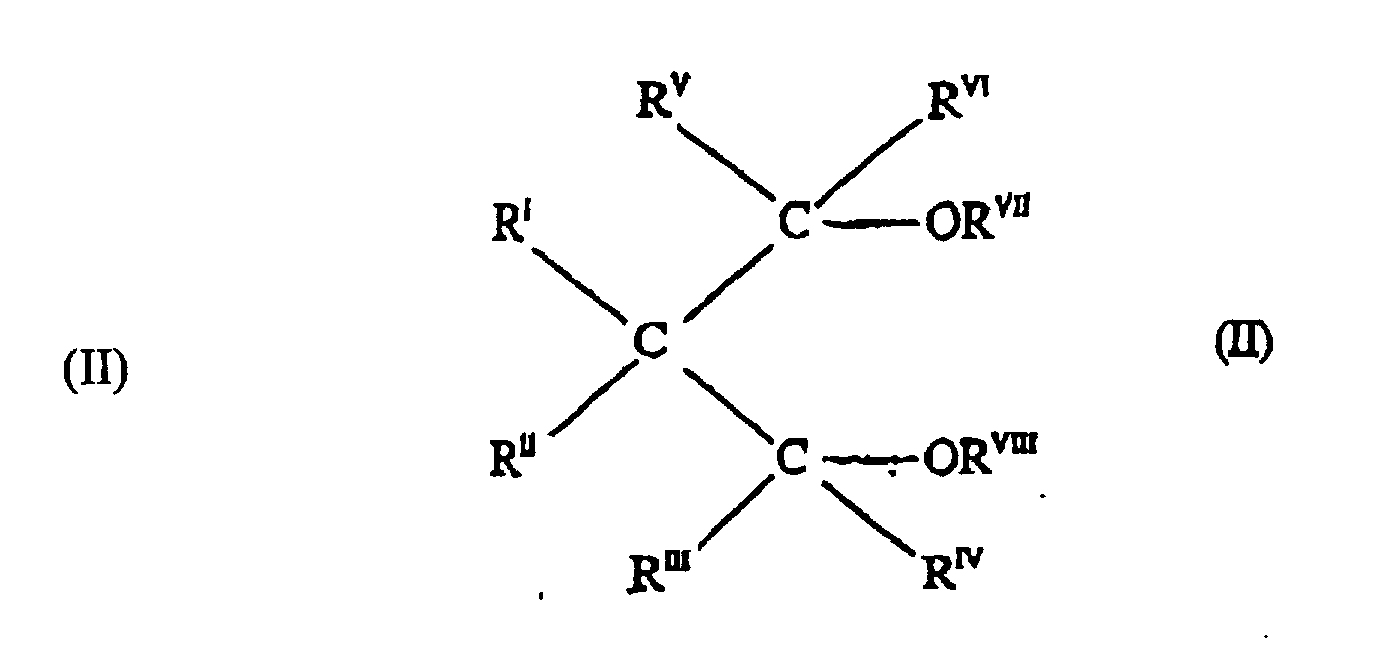
- Suitable external electron-donor compounds include silicon compounds, ethers, esters such as ethyl 4-ethoxybenzoate, amines, heterocyclic compounds and particularly 2,2,6,6-tetramethyl piperidine, ketones and the 1,3-diethers of the general formula (II): wherein R I , R II , R III , R IV , R V and R VI equal or different to each other, are hydrogen or hydrocarbon radicals having from 1 to 18 carbon atoms, and R VII and R VIII , equal or different from each other, have the same meaning of R I -R VI except that they cannot be hydrogen; one or more of the R I -R VIII groups can be linked to form a cycle.
- Particularly preferred are the 1.3-diethers in which R VII and R VIII are selected from C 1 -C 4 alkyl radicals.
- Another class of preferred external donor compounds is that of silicon compounds of formula R a 6 R b 7 Si(OR 8 ) c , where a and b are integer from 0 to 2, c is an integer from 1 to 3 and the sum (a+b+c) is 4; R 6 , R 7 , and R 8 , are alkyl, cycloalkyl or aryl radicals with 1-18 carbon atoms optionally containing heteroatoms.
- Examples of such preferred silicon compounds are methylcyclohexyldimethoxysilane, diphenyldimethoxysilane, methyl-t-butyldimethoxysilane, dicyclopentyldimethoxysilane, 2-ethylpiperidinyl-2-t-butyldimethoxysilane and 1,1,1,trifluoropropyl-2-ethylpiperidinyl-dimethoxysilane.
- a is 0, c is 3
- R 7 is a branched alkyl or cycloalkyl group, optionally containing heteroatoms
- R 8 is methyl.
- Examples of such preferred silicon compounds are cyclohexyltrimethoxysilane, t-butyltrimethoxysilane and thexyltrimethoxysilane.
- the electron donor compound (iii) is used in such an amount to give a molar ratio between the organoaluminum compound and said electron donor compound (iii) of from 0.1 to 500, preferably from 1 to 300 and more preferably from 3 to 100.
- the catalysts of the invention allow to obtain, with acceptable yields and isotactic indexes (expressed by xylene insolubility X.I.), a response to hydrogen concentrations (expressed by the high values of Melt Index "L”) and a MWD (expressed by the values of the Polydispersity Index "PI”) higher than those of the catalysts of the prior art.
- the polymerization process can be carried out according to known techniques for example slurry polymerization using as diluent an inert hydrocarbon solvent, or bulk polymerization using the liquid monomer (for example propylene) as a reaction medium. Moreover, it is possible to carry out the polymerization process in gas-phase operating in one or more fluidized or mechanically agitated bed reactors.
- the polymerization is generally carried out at temperature of from 20 to 150°C, preferably of from 40 to 80°C.
- the operating pressure is generally between 0.5 and 5 MPa, preferably between 1 and 4 MPa.
- the operating pressure is generally between 1 and 8 MPa preferably between 1.5 and 5 MPa.
- the cyanoacetates according to formula (I) used in the present invention can be prepared, for example, by reaction of ethyl cyanoacetate with alkyl halides in the presence of a base such as sodium ethoxide.
- a base such as sodium ethoxide.
- monosubstituted cyanoacetates are obtained by reacting ethyl cyanoacetate with a ketone or with an aldehyde (Knoevenagel condensation) to give unsaturated cyanoacetates that can be reduced with H 2 in the presence of Pd or Pt based catalysts.
- the unsaturated cyanoacetate can be reacted with Grignard reagents in the presence of CuCl.
- the unreacted propylene was removed, the polymer was recovered and dried at 70°C under vacuum for three hours, and then it was weighed and fractionated with o-xylene to determine the amount of the xylene insoluble (X.I.) fraction at 25°C.
- This property is strictly connected with the molecular weight distribution of the polymer under examination. In particular it is inversely proportional to the creep resistance of the polymer in the molten state. Said resistance called modulus separation at low modulus value (500 Pa), was determined at a temperature of 200°C by using a parallel plates rheometer model RMS-800 marketed by RHEOMETRICS (USA), operating at an oscillation frequency which increases from 0.1 rad/sec to 100 rad/second. From the modulus separation value, one can derive the P.I.
- the catalyst components have been prepared according to the same procedure of the examples 1-12 except for the fact that donors different from cyanoesters of formula (I) were used.
- the donors used, the amount of Ti (wt%) and of donors (wt%) contained in the solid catalyst component are reported in table 1.
- the polymerization results are reported in table 2.
Landscapes
- Chemical & Material Sciences (AREA)
- Health & Medical Sciences (AREA)
- Chemical Kinetics & Catalysis (AREA)
- Medicinal Chemistry (AREA)
- Polymers & Plastics (AREA)
- Organic Chemistry (AREA)
- Engineering & Computer Science (AREA)
- Materials Engineering (AREA)
- Transition And Organic Metals Composition Catalysts For Addition Polymerization (AREA)
- Addition Polymer Or Copolymer, Post-Treatments, Or Chemical Modifications (AREA)
Claims (23)
- Composant catalytique solide pour la polymérisation d'oléfines de formule CH2=CHR dans laquelle R est un atome d'hydrogène ou un groupe hydrocarboné ayant 1 à 12 atomes de carbone, comprenant un atome de Ti, Mg, halogène et un composé électrodonneur choisi parmi les cyanoesters de formule (I):dans laquelle R1 est un groupe en C1-20 à chaíne linéaire ou ramifiée, alkyle, alcényle, cycloalkyle, cycloalkylalkyle, alkylcycloalkyle, aryle, arylalkyle ou alkylaryle; n est 0, 1, 2 ou 3; R2, R3, R4 et R5 sont choisis indépendamment parmi un atome d'hydrogène ou des groupes en C1-20 à chaíne linéaire ou ramifiée, alkyle, alcényle, cycloalkyle, cycloalkylalkyle, alkylcycloalkyle, aryle, arylalkyle ou alkylaryle; deux ou plusieurs des R2 et R3, et R4 et R5, peuvent être réunis pour former un cycle.

- Composant catalytique solide suivant la revendication 1, dans lequel R1 est un groupe alkyle linéaire en C1-4.
- Composant catalytique solide suivant les revendications 1 ou 2, dans lequel n est 0.
- Composant catalytique solide suivant la revendication 3, dans lequel l'un des R2 ou R3 est un atome d'hydrogène et l'autre est choisi parmi un groupe en C1-20 à chaíne linéaire ou ramifiée, alkyle, alcényle, cycloalkyle, cycloalkylalkyle, alkylcycloalkyle, aryle, arylalkyle ou alkylaryle et en particulier parmi des groupes alkyle ramifiés en C1-8.
- Composant catalytique solide suivant la revendication 4, dans lequel le composé de formule (I) est choisi dans le groupe consistant en 2-isobutyl-cyanoacétate de méthyle, le 2-isobutyl-cyanoacétate d'éthyle, le 2-isopropylcyanoacétate d'éthyle, le 2-(1,2-diméthylpropyl)-cyanoacétate d'éthyle, le 2-t-butylcyanoacétate d'éthyle.
- Composant catalytique solide suivant la revendication 3, dans lequel les groupes R2 et R3 sont tous les deux choisis parmi un groupe en C1-20 à chaíne linéaire ou ramifiée, alkyle, alcényle, cycloalkyle, cycloalkylalkyle, alkylcycloalkyle, aryle, arylalkyle ou alkylaryle, dans lequel R2 et R3 peuvent aussi former un cycle.
- Composant catalytique solide suivant la revendication 6, dans lequel les deux groupes R2 et R3, qui sont identiques ou différents l'un de l'autre, sont choisis parmi des groupes alkyle à chaíne linéaire ou ramifiée en C1-8 ou aryle.
- Composant catalytique solide suivant la revendication 7, dans lequel le composé de formule (I) est choisi dans le groupe consistant en 2,2-di-n-butylcyanoacétate d'éthyle, 2-isobutyl-2-n-butylcyanoacétate d'éthyle, 2,2-di-isobutylcyanoacétate d'éthyle, 2-isobutyl-2-isopropylcyanoacétate d'éthyle, 2,2-di-isopropylcyanoacétate d'éthyle, 2,2-di-benzyle-éthyle-cyanoacétate d'éthyle.
- Composant catalytique solide suivant la revendication 1 comprenant un composé du titane, ayant au moins une liaison Ti-halogène, et le composé électrodonneur de formule (I) supporté sur un halogénure de Mg sous forme active.
- Composant catalytique solide suivant la revendication 1, dans lequel le composé du titane est TiCl4 ou TiCl3.
- Composant catalytique solide suivant la revendication 1, ayant une forme sphérique, une aire spécifique (par la méthode B.E.T.) comprise entre 20 et 400 m2/g, de préférence entre 50 et 300 m2/g, et une porosité totale (par la méthode B.E.T.) supérieure à 0,2 cm3/g, de préférence comprise entre 0,2 et 0,6 cm3/g.
- Catalyseur pour la polymérisation d'oléfines de formule CH2=CHR, dans laquelle R est un atome d'hydrogène ou un groupe hydrocarboné ayant 1 à 12 atomes de carbone, comprenant le produit de réaction entre:(i) le composant catalytique solide suivant l'une des revendications 1 à 12;(ii) un composé alkylaluminium et, éventuellement(iii) un composé électrodonneur (donneur externe).
- Catalyseur suivant la revendication 12, dans lequel le composé alkylaluminium (ii) est un composé trialkyl aluminium.
- Catalyseur suivant la revendication 13, dans lequel le composé trialkyl aluminium est choisi dans le groupe consistant en triéthylaluminium, triisobutylaluminium, tri-n-butylaluminium, tri-n-hexylaluminium, tri-n-octylaluminium.
- Catalyseur suivant la revendication 12, dans lequel le donneur externe (iii) est un composé du silicium de formule Ra 6Rb 7Si(OR8)c, dans laquelle a et b sont des entiers de 0 à 2, c est un entier de 1 à 3 et la somme (a+b+c) est 4, R6, R7 et R8 sont des groupes alkyle, cycloalkyle ou aryle ayant 1 à 18 atomes de carbone contenant éventuellement des hétéroatomes.
- Catalyseur suivant la revendication 15, dans lequel a est 1, b est 1, c est 2, au moins l'un de R6 et R7 est choisi parmi les groupes ramifiés alkyle, cycloalkyle ou aryle ayant 3 à 10 atomes de carbone, contenant éventuellement des hétéroatomes, et R8 est un groupe alkyle en C1-10, de préférence un groupe méthyle.
- Catalyseur suivant la revendication 15, dans lequel a est 0, c est 3, R7 est groupe ramifié alkyle ou cycloalkyle, contenant éventuellement des hétéroatomes, et R8 est un groupe méthyle.
- Catalyseur suivant la revendication 16, dans lequel le composé du silicium est choisi dans le groupe consistant en méthylcyclohexyldiméthoxysilane, diphényldiméthoxysilane,méthyl-t-butyldiméthoxysilane, dicyclopentyldiméthoxysilane, 2-éthylpipéridinyl-2-t-butyldiméthoxysilane et 1,1,1-trifluoropropyl-2-éthylpipéridinyldiméthoxysilane.
- Catalyseur suivant la revendication 17, dans lequel le composé du silicium est choisi dans le groupe consistant en cyclohexyltriméthoxysilane, t-butyltriméthoxysilane et hexyltriméthoxysilane.
- Catalyseur suivant la revendication 12, dans lequel le donneur externe (iii) est choisi parmi les 1,3-diéthers de la formule générale (II):dans laquelle RI, RII, RIII, RIV, RV et RVI, identiques ou différents les uns des autres, sont un atome d'hydrogène ou des groupes hydrocarbonés ayant de 1 à 18 atomes de carbone, et RVII et RVIII, identiques ou différents l'un de l'autre, ont la même signification que RI à RVI, sauf qu'ils ne peuvent pas être un atome d'hydrogène; un ou plusieurs des groupes RI à RVIII peuvent être liés pour former un cycle.
- Procédé pour la (co)polymérisation d'oléfines de formule CH2=CHR, dans laquelle R est un atome d'hydrogène ou un groupe hydrocarboné ayant 1 à 12 atomes de carbone, effectué en présence du catalyseur suivant l'une quelconque des revendications 12 à 20.
- Utilisation des composés de formule (I) suivant la revendication 1, en tant qu'agents électrodonneurs dans un catalyseur pour la polymérisation d'oléfines.
- Utilisation des composés de formule (I) suivant la revendication 1, en tant qu'agents électrodonneurs internes dans un composant catalytique pour la polymérisation d'oléfines.
Priority Applications (1)
| Application Number | Priority Date | Filing Date | Title |
|---|---|---|---|
| EP98945242A EP0938509B1 (fr) | 1997-09-03 | 1998-08-14 | Constituants et catalyseurs pour la polymerisation d'olefines |
Applications Claiming Priority (4)
| Application Number | Priority Date | Filing Date | Title |
|---|---|---|---|
| EP97202707 | 1997-09-03 | ||
| EP97202707 | 1997-09-03 | ||
| PCT/EP1998/005160 WO1999011677A1 (fr) | 1997-09-03 | 1998-08-14 | Constituants et catalyseurs pour la polymerisation d'olefines |
| EP98945242A EP0938509B1 (fr) | 1997-09-03 | 1998-08-14 | Constituants et catalyseurs pour la polymerisation d'olefines |
Publications (2)
| Publication Number | Publication Date |
|---|---|
| EP0938509A1 EP0938509A1 (fr) | 1999-09-01 |
| EP0938509B1 true EP0938509B1 (fr) | 2002-11-20 |
Family
ID=8228698
Family Applications (1)
| Application Number | Title | Priority Date | Filing Date |
|---|---|---|---|
| EP98945242A Expired - Lifetime EP0938509B1 (fr) | 1997-09-03 | 1998-08-14 | Constituants et catalyseurs pour la polymerisation d'olefines |
Country Status (12)
| Country | Link |
|---|---|
| US (2) | US6143684A (fr) |
| EP (1) | EP0938509B1 (fr) |
| JP (1) | JP2001505249A (fr) |
| KR (1) | KR20000068886A (fr) |
| CN (1) | CN1242780A (fr) |
| AR (1) | AR017037A1 (fr) |
| AU (1) | AU9262498A (fr) |
| BR (1) | BR9806141A (fr) |
| CA (1) | CA2270239A1 (fr) |
| DE (1) | DE69809531T2 (fr) |
| ES (1) | ES2186224T3 (fr) |
| WO (1) | WO1999011677A1 (fr) |
Cited By (1)
| Publication number | Priority date | Publication date | Assignee | Title |
|---|---|---|---|---|
| CN104558292A (zh) * | 2013-10-28 | 2015-04-29 | 中国石油化工股份有限公司 | 一种用于烯烃聚合催化剂制备方法 |
Families Citing this family (22)
| Publication number | Priority date | Publication date | Assignee | Title |
|---|---|---|---|---|
| EP0938509B1 (fr) * | 1997-09-03 | 2002-11-20 | Basell Poliolefine Italia S.p.A. | Constituants et catalyseurs pour la polymerisation d'olefines |
| US6436864B1 (en) * | 1999-10-06 | 2002-08-20 | Sri International | Unsaturated nitrogenous compounds as electron donors for use with ziegler-natta catalysts |
| WO2002038628A2 (fr) | 2000-11-07 | 2002-05-16 | Symyx Technologies, Inc. | Ligands de pyridylamine substitues, complexes, catalyseurs et procedes pour la polymerisation, et polymeres |
| US7060848B2 (en) * | 2002-04-24 | 2006-06-13 | Symyx Technologies, Inc. | Bridged bi-aromatic catalysts, complexes, and methods of using the same |
| US6841502B2 (en) * | 2002-04-24 | 2005-01-11 | Symyx Technologies, Inc. | Bridged bi-aromatic ligands, catalysts, processes for polymerizing and polymers therefrom |
| US7091292B2 (en) | 2002-04-24 | 2006-08-15 | Symyx Technologies, Inc. | Bridged bi-aromatic catalysts, complexes, and methods of using the same |
| CN1310967C (zh) * | 2004-07-01 | 2007-04-18 | 中国石油化工股份有限公司 | 用于烯烃聚合反应的催化剂组分及其催化剂 |
| CN1318457C (zh) * | 2004-09-02 | 2007-05-30 | 中国石油化工股份有限公司 | 用于烯烃聚合反应的催化剂组分和催化剂 |
| US7256296B2 (en) * | 2004-09-22 | 2007-08-14 | Symyx Technologies, Inc. | Heterocycle-amine ligands, compositions, complexes, and catalysts |
| US7387980B2 (en) * | 2004-09-22 | 2008-06-17 | Symyx Technologies, Inc. | Methods of using heterocycle-amine ligands, compositions, complexes, and catalysts |
| US7705157B2 (en) * | 2004-12-16 | 2010-04-27 | Symyx Solutions, Inc. | Phenol-heterocyclic ligands, metal complexes, and their uses as catalysts |
| US8281332B2 (en) * | 2007-05-02 | 2012-10-02 | Google Inc. | Animated video overlays |
| US20090286944A1 (en) * | 2008-05-15 | 2009-11-19 | Symyx Technologies, Inc. | Select phenol-heterocycle ligands, metal complexes formed therefrom, and their uses as catalysts |
| CN101735346B (zh) | 2008-11-07 | 2012-05-30 | 中国石油天然气股份有限公司 | 一种丙烯均聚和共聚的催化剂及其制备方法和应用 |
| MY148239A (en) | 2009-08-13 | 2013-03-29 | China Petroleum & Chemical | A catalyst component for olefin polymerization and a catalyst comprising the same |
| CN102146145B (zh) * | 2010-02-10 | 2012-11-21 | 中国石油化工股份有限公司 | 一种用于烯烃聚合的催化剂组分及催化剂 |
| CN101993507B (zh) * | 2009-08-13 | 2012-10-24 | 中国石油化工股份有限公司 | 一种用于烯烃聚合的催化剂组分及其催化剂 |
| CN107915796B (zh) * | 2016-10-09 | 2021-03-16 | 中国石油化工股份有限公司 | 用于烯烃聚合的催化剂组分及其应用和用于烯烃聚合的催化剂及其应用以及烯烃聚合方法 |
| WO2018161854A1 (fr) | 2017-03-10 | 2018-09-13 | 北京利和知信科技有限公司 | Constituant de catalyseur solide destiné à être utilisé dans une polymérisation d'oléfines, catalyseur, et application associée |
| US10300460B1 (en) | 2017-11-17 | 2019-05-28 | Chevron Phillips Chemical Company L.P. | Aqueous methods for titanating a chromium/silica catalyst |
| CN116041577B (zh) | 2021-10-28 | 2024-12-06 | 中国石油化工股份有限公司 | 烯烃聚合催化剂组分、催化剂体系及应用和烯烃聚合方法 |
| WO2023235799A1 (fr) | 2022-06-02 | 2023-12-07 | Chevron Phillips Chemical Company Lp | Supports d'activateur d'alumine revêtus de silice fluorée à porosité élevée et leurs utilisations dans des systèmes de catalyseur à base de métallocène pour la polymérisation d'oléfines |
Family Cites Families (14)
| Publication number | Priority date | Publication date | Assignee | Title |
|---|---|---|---|---|
| DK133012C (da) * | 1968-11-21 | 1976-08-09 | Montedison Spa | Katalysator til polymerisation af alkener |
| YU35844B (en) * | 1968-11-25 | 1981-08-31 | Montedison Spa | Process for obtaining catalysts for the polymerization of olefines |
| US4507450A (en) * | 1976-08-18 | 1985-03-26 | Mitsubishi Chemical Industries Limited | Process for preparing polyolefin |
| IT1098272B (it) * | 1978-08-22 | 1985-09-07 | Montedison Spa | Componenti,di catalizzatori e catalizzatori per la polimerizzazione delle alfa-olefine |
| JPS55116710A (en) * | 1979-03-02 | 1980-09-08 | Mitsui Petrochem Ind Ltd | Preparation of polymer or copolymer |
| JPS5630407A (en) * | 1979-08-22 | 1981-03-27 | Sumitomo Chem Co Ltd | Preparation of highly stereoregular alpha-olefin polymer |
| US4297465A (en) * | 1980-10-29 | 1981-10-27 | Eastman Kodak Company | Catalysts for polymerizing propylene in a high temperature solution process |
| JPS59129210A (ja) * | 1983-01-14 | 1984-07-25 | Mitsui Toatsu Chem Inc | エチレン−α−オレフイン共重合体の製造方法 |
| IT1230134B (it) * | 1989-04-28 | 1991-10-14 | Himont Inc | Componenti e catalizzatori per la polimerizzazione di olefine. |
| IT1241093B (it) * | 1990-03-30 | 1993-12-29 | Himont Inc | Componenti e catalizzatori per la polimerizzazione di olefine |
| IT1262934B (it) * | 1992-01-31 | 1996-07-22 | Montecatini Tecnologie Srl | Componenti e catalizzatori per la polimerizzazione di olefine |
| IT1262935B (it) * | 1992-01-31 | 1996-07-22 | Montecatini Tecnologie Srl | Componenti e catalizzatori per la polimerizzazione di olefine |
| EP0704424B1 (fr) * | 1994-09-28 | 1998-12-30 | Showa Denko Kabushiki Kaisha | Dérivé d'ester d'acide 3-alcoxy propionique, catalyseur de polymérisation d'oléfine et procédé de préparation de polyoléfine |
| EP0938509B1 (fr) * | 1997-09-03 | 2002-11-20 | Basell Poliolefine Italia S.p.A. | Constituants et catalyseurs pour la polymerisation d'olefines |
-
1998
- 1998-08-14 EP EP98945242A patent/EP0938509B1/fr not_active Expired - Lifetime
- 1998-08-14 WO PCT/EP1998/005160 patent/WO1999011677A1/fr not_active Ceased
- 1998-08-14 AU AU92624/98A patent/AU9262498A/en not_active Abandoned
- 1998-08-14 KR KR1019997003898A patent/KR20000068886A/ko not_active Withdrawn
- 1998-08-14 DE DE69809531T patent/DE69809531T2/de not_active Expired - Fee Related
- 1998-08-14 JP JP51623699A patent/JP2001505249A/ja active Pending
- 1998-08-14 CA CA002270239A patent/CA2270239A1/fr not_active Abandoned
- 1998-08-14 CN CN98801606A patent/CN1242780A/zh active Pending
- 1998-08-14 BR BR9806141-0A patent/BR9806141A/pt not_active Application Discontinuation
- 1998-08-14 ES ES98945242T patent/ES2186224T3/es not_active Expired - Lifetime
- 1998-09-01 AR ARP980104350A patent/AR017037A1/es unknown
- 1998-09-03 US US09/146,368 patent/US6143684A/en not_active Expired - Fee Related
-
2000
- 2000-09-18 US US09/663,335 patent/US6239236B1/en not_active Expired - Fee Related
Cited By (2)
| Publication number | Priority date | Publication date | Assignee | Title |
|---|---|---|---|---|
| CN104558292A (zh) * | 2013-10-28 | 2015-04-29 | 中国石油化工股份有限公司 | 一种用于烯烃聚合催化剂制备方法 |
| CN104558292B (zh) * | 2013-10-28 | 2017-05-31 | 中国石油化工股份有限公司 | 一种用于烯烃聚合催化剂制备方法 |
Also Published As
| Publication number | Publication date |
|---|---|
| AU9262498A (en) | 1999-03-22 |
| ES2186224T3 (es) | 2003-05-01 |
| AR017037A1 (es) | 2001-08-22 |
| EP0938509A1 (fr) | 1999-09-01 |
| DE69809531D1 (de) | 2003-01-02 |
| CA2270239A1 (fr) | 1999-03-11 |
| KR20000068886A (ko) | 2000-11-25 |
| JP2001505249A (ja) | 2001-04-17 |
| US6239236B1 (en) | 2001-05-29 |
| BR9806141A (pt) | 1999-10-26 |
| WO1999011677A1 (fr) | 1999-03-11 |
| CN1242780A (zh) | 2000-01-26 |
| DE69809531T2 (de) | 2003-07-10 |
| US6143684A (en) | 2000-11-07 |
Similar Documents
| Publication | Publication Date | Title |
|---|---|---|
| US6239236B1 (en) | Components and catalysts for the polymerization of olefins | |
| US6294497B1 (en) | Components and catalysts for the polymerization of olefins | |
| US6313238B1 (en) | Components and catalysts for the polymerization of olefins | |
| US7169871B2 (en) | Propylene polymers | |
| US6468938B1 (en) | Prepolymerized catalyst components for the polymerization of olefins | |
| US6281301B1 (en) | Components and catalysts for the polymerization of olefins | |
| US6716939B2 (en) | Components and catalysts for the polymerization of olefins | |
| US6605562B1 (en) | Components and catalysts for the polymerization of olefins | |
| EP1082359B1 (fr) | Composants et catalyseurs pour la polymerisation d'olefines | |
| US7015170B2 (en) | Components and catalysts for the polymerization of olefins | |
| US20090118446A1 (en) | Components and catalysts for the polymerization of olefins | |
| US10167349B2 (en) | Catalyst system for the polymerization of olefins |
Legal Events
| Date | Code | Title | Description |
|---|---|---|---|
| PUAI | Public reference made under article 153(3) epc to a published international application that has entered the european phase |
Free format text: ORIGINAL CODE: 0009012 |
|
| AK | Designated contracting states |
Kind code of ref document: A1 Designated state(s): AT BE DE DK ES FR GB IT NL SE Kind code of ref document: A1 Designated state(s): DE ES FR GB IT |
|
| 17P | Request for examination filed |
Effective date: 19990809 |
|
| RAP1 | Party data changed (applicant data changed or rights of an application transferred) |
Owner name: BASELL TECHNOLOGY COMPANY B.V. |
|
| GRAG | Despatch of communication of intention to grant |
Free format text: ORIGINAL CODE: EPIDOS AGRA |
|
| 17Q | First examination report despatched |
Effective date: 20020417 |
|
| GRAG | Despatch of communication of intention to grant |
Free format text: ORIGINAL CODE: EPIDOS AGRA |
|
| GRAH | Despatch of communication of intention to grant a patent |
Free format text: ORIGINAL CODE: EPIDOS IGRA |
|
| RAP1 | Party data changed (applicant data changed or rights of an application transferred) |
Owner name: BASELL POLIOLEFINE ITALIA S.P.A. |
|
| RBV | Designated contracting states (corrected) |
Designated state(s): DE ES FR GB IT |
|
| GRAH | Despatch of communication of intention to grant a patent |
Free format text: ORIGINAL CODE: EPIDOS IGRA |
|
| GRAA | (expected) grant |
Free format text: ORIGINAL CODE: 0009210 |
|
| AK | Designated contracting states |
Kind code of ref document: B1 Designated state(s): DE ES FR GB IT |
|
| REG | Reference to a national code |
Ref country code: GB Ref legal event code: FG4D |
|
| REF | Corresponds to: |
Ref document number: 69809531 Country of ref document: DE Date of ref document: 20030102 |
|
| REG | Reference to a national code |
Ref country code: ES Ref legal event code: FG2A Ref document number: 2186224 Country of ref document: ES Kind code of ref document: T3 |
|
| ET | Fr: translation filed | ||
| PG25 | Lapsed in a contracting state [announced via postgrant information from national office to epo] |
Ref country code: GB Free format text: LAPSE BECAUSE OF NON-PAYMENT OF DUE FEES Effective date: 20030814 |
|
| PG25 | Lapsed in a contracting state [announced via postgrant information from national office to epo] |
Ref country code: ES Free format text: LAPSE BECAUSE OF NON-PAYMENT OF DUE FEES Effective date: 20030816 |
|
| PGFP | Annual fee paid to national office [announced via postgrant information from national office to epo] |
Ref country code: DE Payment date: 20030816 Year of fee payment: 6 |
|
| PLBE | No opposition filed within time limit |
Free format text: ORIGINAL CODE: 0009261 |
|
| STAA | Information on the status of an ep patent application or granted ep patent |
Free format text: STATUS: NO OPPOSITION FILED WITHIN TIME LIMIT |
|
| 26N | No opposition filed |
Effective date: 20030821 |
|
| GBPC | Gb: european patent ceased through non-payment of renewal fee |
Effective date: 20030814 |
|
| PG25 | Lapsed in a contracting state [announced via postgrant information from national office to epo] |
Ref country code: FR Free format text: LAPSE BECAUSE OF NON-PAYMENT OF DUE FEES Effective date: 20040430 |
|
| REG | Reference to a national code |
Ref country code: FR Ref legal event code: ST |
|
| REG | Reference to a national code |
Ref country code: ES Ref legal event code: FD2A Effective date: 20030816 |
|
| PG25 | Lapsed in a contracting state [announced via postgrant information from national office to epo] |
Ref country code: DE Free format text: LAPSE BECAUSE OF NON-PAYMENT OF DUE FEES Effective date: 20050301 |
|
| PG25 | Lapsed in a contracting state [announced via postgrant information from national office to epo] |
Ref country code: IT Free format text: LAPSE BECAUSE OF NON-PAYMENT OF DUE FEES;WARNING: LAPSES OF ITALIAN PATENTS WITH EFFECTIVE DATE BEFORE 2007 MAY HAVE OCCURRED AT ANY TIME BEFORE 2007. THE CORRECT EFFECTIVE DATE MAY BE DIFFERENT FROM THE ONE RECORDED. Effective date: 20050814 |