EP0939363B1 - Verfahren zur Ausführung der modularen Multiplikation nach der Montgomery-Methode - Google Patents
Verfahren zur Ausführung der modularen Multiplikation nach der Montgomery-Methode Download PDFInfo
- Publication number
- EP0939363B1 EP0939363B1 EP99470005A EP99470005A EP0939363B1 EP 0939363 B1 EP0939363 B1 EP 0939363B1 EP 99470005 A EP99470005 A EP 99470005A EP 99470005 A EP99470005 A EP 99470005A EP 0939363 B1 EP0939363 B1 EP 0939363B1
- Authority
- EP
- European Patent Office
- Prior art keywords
- register
- circuit
- word
- bits
- multiplication
- Prior art date
- Legal status (The legal status is an assumption and is not a legal conclusion. Google has not performed a legal analysis and makes no representation as to the accuracy of the status listed.)
- Expired - Lifetime
Links
Images


Classifications
-
- G—PHYSICS
- G06—COMPUTING OR CALCULATING; COUNTING
- G06F—ELECTRIC DIGITAL DATA PROCESSING
- G06F7/00—Methods or arrangements for processing data by operating upon the order or content of the data handled
- G06F7/38—Methods or arrangements for performing computations using exclusively denominational number representation, e.g. using binary, ternary, decimal representation
- G06F7/48—Methods or arrangements for performing computations using exclusively denominational number representation, e.g. using binary, ternary, decimal representation using non-contact-making devices, e.g. tube, solid state device; using unspecified devices
- G06F7/52—Multiplying; Dividing
- G06F7/523—Multiplying only
- G06F7/53—Multiplying only in parallel-parallel fashion, i.e. both operands being entered in parallel
- G06F7/5324—Multiplying only in parallel-parallel fashion, i.e. both operands being entered in parallel partitioned, i.e. using repetitively a smaller parallel parallel multiplier or using an array of such smaller multipliers
-
- G—PHYSICS
- G06—COMPUTING OR CALCULATING; COUNTING
- G06F—ELECTRIC DIGITAL DATA PROCESSING
- G06F7/00—Methods or arrangements for processing data by operating upon the order or content of the data handled
- G06F7/60—Methods or arrangements for performing computations using a digital non-denominational number representation, i.e. number representation without radix; Computing devices using combinations of denominational and non-denominational quantity representations, e.g. using difunction pulse trains, STEELE computers, phase computers
- G06F7/72—Methods or arrangements for performing computations using a digital non-denominational number representation, i.e. number representation without radix; Computing devices using combinations of denominational and non-denominational quantity representations, e.g. using difunction pulse trains, STEELE computers, phase computers using residue arithmetic
- G06F7/727—Modulo N arithmetic, with N being either (2**n)-1,2**n or (2**n)+1, e.g. mod 3, mod 4 or mod 5
-
- G—PHYSICS
- G06—COMPUTING OR CALCULATING; COUNTING
- G06F—ELECTRIC DIGITAL DATA PROCESSING
- G06F7/00—Methods or arrangements for processing data by operating upon the order or content of the data handled
- G06F7/38—Methods or arrangements for performing computations using exclusively denominational number representation, e.g. using binary, ternary, decimal representation
- G06F7/48—Methods or arrangements for performing computations using exclusively denominational number representation, e.g. using binary, ternary, decimal representation using non-contact-making devices, e.g. tube, solid state device; using unspecified devices
- G06F7/499—Denomination or exception handling, e.g. rounding or overflow
- G06F7/49931—Modulo N reduction of final result
-
- G—PHYSICS
- G06—COMPUTING OR CALCULATING; COUNTING
- G06F—ELECTRIC DIGITAL DATA PROCESSING
- G06F7/00—Methods or arrangements for processing data by operating upon the order or content of the data handled
- G06F7/60—Methods or arrangements for performing computations using a digital non-denominational number representation, i.e. number representation without radix; Computing devices using combinations of denominational and non-denominational quantity representations, e.g. using difunction pulse trains, STEELE computers, phase computers
- G06F7/72—Methods or arrangements for performing computations using a digital non-denominational number representation, i.e. number representation without radix; Computing devices using combinations of denominational and non-denominational quantity representations, e.g. using difunction pulse trains, STEELE computers, phase computers using residue arithmetic
- G06F7/722—Modular multiplication
-
- G—PHYSICS
- G06—COMPUTING OR CALCULATING; COUNTING
- G06F—ELECTRIC DIGITAL DATA PROCESSING
- G06F7/00—Methods or arrangements for processing data by operating upon the order or content of the data handled
- G06F7/60—Methods or arrangements for performing computations using a digital non-denominational number representation, i.e. number representation without radix; Computing devices using combinations of denominational and non-denominational quantity representations, e.g. using difunction pulse trains, STEELE computers, phase computers
- G06F7/72—Methods or arrangements for performing computations using a digital non-denominational number representation, i.e. number representation without radix; Computing devices using combinations of denominational and non-denominational quantity representations, e.g. using difunction pulse trains, STEELE computers, phase computers using residue arithmetic
- G06F7/728—Methods or arrangements for performing computations using a digital non-denominational number representation, i.e. number representation without radix; Computing devices using combinations of denominational and non-denominational quantity representations, e.g. using difunction pulse trains, STEELE computers, phase computers using residue arithmetic using Montgomery reduction
Definitions
- the invention relates to an implementation method a specific modular multiplication relating to the Montgomery method. More specifically, the invention concerns the improvement of the sequencing of a coprocessor modular arithmetic allowing to perform modular operations according to the Montgomery method, in order to extend the possibilities of a device having such a processor.
- the Montgomery method allows to perform modular calculations in a finite field GF (2 n ) (Galois field) without performing a division.
- D2 coprocessor allows optimize (in terms of calculation time, size memory, etc.) processing modular operations using a fixed data size, in this case 256 or 512 bits.
- a fixed data size in this case 256 or 512 bits.
- Cryptography requires machines more and more efficient, working more and more quickly and using increasingly complex keys. We is thus moving towards the manipulation of coded data on 768, 1024, 1536 and even 2048 bits.
- To deal with such data we can consider carrying out larger circuits by adapting the circuit elements at data sizes. This solution can cause problems in applications such as smart cards for which the size circuits is physically limited due to differences in mechanical bending stress between silicon card and substrate.
- circuit 1 can be used shown in Figure 1 which includes a processor classic 2 (8, 16, or 32 bit), a memory 3, a coprocessor 4, and a communication bus 5 used to connect the different elements 2, 3 and 4 together and / or outside circuit 1.
- the coprocessor 4 is then used as a multiplier working on m * k bits (conventionally 256 or 512 bits).
- Processor 2 is used to supervise in particular the operations to be performed using an encryption algorithm particular and data exchanges between memory 3 and the coprocessor 4.
- the invention also relates to a coprocessor modular arithmetic as defined in claim 7.
- the invention relates to a circuit integrated implementing modular operations according to Montgomery's method which includes a processor, a memory and the coprocessor of the invention.
- the method previously stated intelligently uses the register 111 so as to memorize simultaneously an intermediate result R i and the i + 1 words of the final result S (indeed, the word R i, 0 also coorespond to the word S i ) , the intermediate result corresponding to the m - i words of k least significant bits of the multiplication of B by A i .
- step A) is not a necessary step if the coprocessor 4 is in the state corresponding to the end of this step A) before starting the calculation.
- steps B1 and C2 depending on whether you want to shunt or not the delay cell 134.
- this process with a coprocessor with four registers of m * k bits in order to memorize fully A in coprocessor 4.
- a first improvement consists in using registers of m * k bits of variable size by words of k bits so as to reduce the number of shifts to perform during each iteration.
- the use of variable size registers can, for example, delete steps B2, C3 and C4 by varying the size of the registers during each execution of step C2.
- a second improvement consists in using the two multiplication circuits 119 and 120 simultaneously so as to reduce the calculation time.
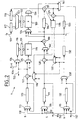
- FIG. 3 shows a coprocessor according to the invention which makes it possible to carry out the invention with the improvements mentioned above. It is however possible to make a coprocessor according to the invention which only uses part of these improvements in depending on the different speed constraints, calculation and occupation of silicon surface and possible compromises resulting from these constraints.
- Figure 3 shows an example of a coprocessor 4b according to the invention.
- terminals can also be one or more input / output terminals common to several elements of the coprocessor.
- multiplexers can be grouped together and then include a number of inputs, outputs, and larger selection entries.
- multiplexers 225, 236, 237, 240, 250, 252 and 253 which have an input receiving a fixed signal ("0" or "1" logic)
- the register 240 makes it possible to store in the coprocessor an operand A of n bits, which allows to limit exchanges between the coprocessor and the outside and therefore save time.
- the multiplexer 246 allows to load register 217 with bits supplied by register 240, which allows to use addition circuits 219 in parallel and 220 without requiring successive loading of registers 216 and 217 with words provided to the coprocessor.
- the 241 multiplexer allows, by looping the output of register 240 on its entry, to keep permanently intact the contents of this register, when providing by shifting the words at the output of this register.
- the fourth input of multiplexer 248 can be connected directly to the output of register 210 (which is equivalent, from a functional point of view, to the connect to the output of the subtraction circuit 227, if this last receives a logical zero on its second input permanently).
- the addition circuit 251 and the multiplexer 252 allow the implementation of type A * operations B + C + D, data C and D being provided by registers 211 and 212.
- the addition circuit 251 becomes transparent when positioning the multiplexer 252 to permanently supply the logical "0" on its output.
- Multiplexer 253 is used to connect the output of the addition circuit 251 directly at the first input of the addition circuit 231, without delaying the transfer of data between these circuits through the cell to delay 234. It also provides logical zeros to the addition circuit 231.
- the delay cell 254 makes it possible to delay by k cycle time the flow of bits produced by the circuit multiplication 220.
- the delay cell 234 is not short-circuited via multiplexer 253, the cell 254 in order to obtain a delay of 2 * k time of cycle.
- the multiplexer 256 makes it possible to store in one registers 210 to 212 the bits produced by the circuit addition 230.
- Multiplexer 256 can also be deleted at condition of neutralizing the addition circuit 231 in sending "0" on its second entry via the multiplexer 255 and the multiplication circuit 248.
- shift registers 210, 211, 212 and 240 of variable size registers arranged in bank of registers as shown in Figure 3 for the register 240.
- Register 240 is made up of m sub-registers 240-1 to 240-m which are k bit shift registers each having a serial input and a serial output. The inputs are connected together to form the input of the register 240.
- a MUX multiplexer with m inputs series and a serial output at each of its inputs respectively connected to each output of the sub-registers 240-1 to 240-m.
- registers 210, 211 and 212 have been represented in a single block although they are of the same structure as the register 240, i.e. each divided into m sub-registers respectively 210-1 to 210-m, 211-1 to 211-m, 212-1 to 212-m.
- register bank allows addition to having at most 2 * k register cells which work simultaneously either a divided consumption by m / 2 when working with words of m * K bits.
- step C ' by varying i from 1 to (m-1) / 2 + 1 and adding step C "2 just before l 'stage D': C "2) an offset of k bits is carried out at the content of the sub-register 210-1 to produce A m-1 *.
- an offset of k bits is effected simultaneously at the content of the sub-register register 211-m to add in the addition circuit 230 R (m-1) / 2-1.2 to the result leaving the multiplication circuit 219 to obtain A m-1 * B 0 + R (m-1) / 2-1,2 the first word this k bits leaving the addition circuit 230 corresponding to S m-1 is stored in the sub-register 211-m.
- Variable size registers used reduce the duration of each iteration by function of the number of k-bit words of S obtained during each iteration of the process. For the effect to be obtained, it suffices that registers 210 and 211 are of variable size.
- Register 240 makes it possible to store A in full in order to suppress the exchanges between memory 3 and the coprocessor 4 during the course of the calculation. Through elsewhere, the data contained in the register 240 can be reused if the register has been looped back to itself. The use of register 240 is partially compensated in terms of area insofar as this reduces the size of the memory 3.
Landscapes
- Physics & Mathematics (AREA)
- General Physics & Mathematics (AREA)
- Engineering & Computer Science (AREA)
- Mathematical Analysis (AREA)
- Mathematical Optimization (AREA)
- Pure & Applied Mathematics (AREA)
- Computational Mathematics (AREA)
- Theoretical Computer Science (AREA)
- Computing Systems (AREA)
- General Engineering & Computer Science (AREA)
- Mathematical Physics (AREA)
- Logic Circuits (AREA)
- Complex Calculations (AREA)
Claims (11)
- Verfahren zum Ausführen einer Modulo-Operation vom Typ S = A B mod 2m·k, wobei A, B und S durch m Worte von k Bits dargestellt sind und m und k ganze Zahlen größer 1 sind, wobei im Verlauf des Verfahrens B in einem ersten Register (110, 210) mit m k Bits abgespeichert wird, wobei das Verfahren dadurch gekennzeichnet ist, daß man anschließend sukzessive einen Rechenschritt wiederholt, der vier Teilschritte umfaßt:man speichert ein Wort (Ai, A2·i) von k Bits aus A in einem zweiten Register (121, 221) ä k Bits,man führt in einem ersten Multiplikatorschaltkreis (119, 219), der mit dem ersten und zweiten Register (110, 121, 210, 221) verbunden ist, eine erste Multiplikation von B mit dem Wort (Ai, A2·i) aus A, abgespeichert in dem zweiten Register (121, 221), durch, wobei das Wort aus A in dem zweiten Register (121, 221) bei jeder Multiplikation geändert wird,man berechnet ein Zwischenergebnis (Ri) durch Addition in einem ersten Additionsschaltkreis (130, 230) von Worten mit hohem Gewicht (Ri-1, m-i ... Ri-1,1, Ri-1,m-2·i+1 ... Ri-1,2) eines vorausgehenden Zwischenergebnisses (Ri-1) zu Worten niedrigen Gewichts des Ergebnisses der ersten Multiplikation von B mit dem Wort A undman speichert das Zwischenergebnis (Ri) in einem dritten Register (111, 211) à m k Bits ab, das die Worte aus S enthält, die vorher abgespeichert wurden, wobei das Wort mit dem geringsten Gewicht (Ri,0) des Zwischenergebnisses (Ri) einem Wort (Si) des Ergebnisses S entspricht.
- Verfahren nach Anspruch 1, dadurch gekennzeichnet, daß der Rechenschritt m-mal durchgeführt wird, daß das Zwischenergebnis Ri gleich (m-i) Worten mit geringem Gewicht des Ergebnisses der Operation Ai · Bm-l-i ... B0 + (Ri-l \ 2k) ist, wobei i ein ganzzahliger Index zwischen 0 und m-l ist und Ai die Worte mit k Bits mit dem Gewicht i aus A sind und Bm-i-l ... B0 den m-i Worten mit niedrigem Gewicht aus B entsprechen und R-1 gleich Null ist, und daß bei Beginn der i-ten Ausführung des Rechenschritts das dritte Register (111, 211) einerseits die i+1 Worte ä k Bits mit niedrigem Gewicht (Si, ... S0) des Ergebnisses S und andererseits die m-i Worte (Ri,m-i-1, ... Ri,0) des Zwischenergebnisses (Ri) enthält, wobei die Worte Si und Ri,0 ein und dasselbe Wort sind.
- Verfahren nach Anspruch 1, dadurch gekennzeichnet, daß der Rechenschritt außerdem die folgenden Teilschritte umfaßt:man speichert in einem vierten Register (222) ä k Bits ein Wort (A2·i+1) aus A ab, dessen Gewicht unmittelbar größer als das Gewicht des Wortes (A2·i) aus A ist, das in dem zweiten Register (221) abgespeichert wurde;man führt in einem zweiten Multiplikatorschaltkreis (220), der mit dem zweiten und vierten Register (210, 222) verbunden ist, eine zweite Multiplikation von B mit dem Wort (A2·i+1) aus A durch, das in dem vierten Register (222) abgespeichert wurde, wobei das Wort aus A in dem vierten Register (222) bei jeder zweiten Multiplikation geändert wird;man addiert in einem zweiten Additionsschaltkreis (231) das Ergebnis, das von dem zweiten Multiplikatorschaltkreis (220) ausgegeben wird, welches um k Taktzyklen verzögert ist, zu dem Ergebnis, daß von dem ersten Additionsschaltkreis (230) ausgegeben wurde, um das Zwischenergebnis (Ri) vor dem Abspeichern dieses Zwischenergebnisses in dem dritten Register (211) zu erhalten.
- Verfahren nach einem der Ansprüche 1 bis 3, dadurch gekennzeichnet, daß man die Größe des zweiten und dritten Registers (110, 111, 210, 211) zwischen jeder neuen Multiplikation variieren läßt, die durch den ersten Multiplikatorschaltkreis (119, 219) durchgeführt wird.
- Verfahren nach einem der Ansprüche 3 oder 4, dadurch gekennzeichnet, daß man den Rechenschritt m/2-mal durchführt, wobei so m/2 aufeinanderfolgende Multiplikationen sowohl in dem ersten als auch in dem zweiten Multiplikatorschaltkreis (219, 220) durchgeführt werden,daß das Zwischenergebnis (Ri) gleich m - 2 i Worte niedrigen Gewichtes des Ergebnisses der Operation A2·i+1A2·i · Bm-1-2·i ... B0 + (Ri-1 \ 22·k) ist, wobei i ein ganzzahliger Index zwischen Null und m/2 ist und A2·i und A2·i+1 die Worte ä k Bits mit dem Gewicht 2 · i und 2 · i + 1 aus A sind und Bm-1-2·i ... B0 den m - 2 · i Worten niedrigen Gewichts aus B entsprechen und R-l gleich Null ist,und daß am Beginn der i-ten Durchführung des Rechenschritts das dritte Register (211) einerseits die x · i + 2 Worte ä k Bits niedrigen Gewichts aus S und andererseits die m - 2 · i Worte des Zwischenergebnisses (Ri) beinhalten, wobei die Worte S2·i+1 und Ri,1 ein und dasselbe Wort sind und die Worte S2·i und Ri,0 ein und dasselbe Worte sind.
- Verfahren nach einem der Ansprüche 1 bis 5, dadurch gekennzeichnet, daß man vorher A vorab in einem fünften Schieberegister (240) ä m · k Bits abspeichert, um an das erste oder an das vierte Register (221, 222) die Worte ä k Bits aus A auszugeben, damit sie in das erste oder vierte Register (221, 222) geladen werden.
- Modulo-arithmetischer Koprozessor (4, 4b) mit einem Schaltkreis für das Ausführen einer Modulo-Operation vom Typ S = A · B mod 2m·k, wobei A, B und S durch höchstens m Worte ä k Bits dargestellt werden und m und k ganze Zahlen größer 1 sind, wobei der Ausführungsschaltkreis umfaßt:ein erstes Register (110, 210) mit m · k Bits zum Abspeichern von B,wobei der Koprozessor dadurch gekennzeichnet ist, daß der Ausführungsschaltkreis außerdem umfaßt:ein zweites Register (121, 221) von k Bits für das Abspeichern eines Wortes aus A von k Bits,einen ersten Multiplikatorschaltkreis (119, 219), der mit dem ersten und zweiten Register (110, 121, 210, 221) verbunden ist, um eine erste Multiplikation von B mit dem Wort aus A durchzuführen, das in dem zweiten Register (121, 221) abgespeichert ist,Vorrichtungen (116, 124, 154, 216, 224) für das Laden des Wortes aus A in dem zweiten Register (121, 221) bei der Multiplikation,einen ersten Additionsschaltkreis (130, 230) für das Berechnen eines Zwischenergebnisses (Ri) durch Addition von Worten großen Gewichts eines vorangehenden Zwischenergebnisses (Ri-1) zu den Worten geringen Gewichtes des Ergebnisses der ersten Multiplikation von B mit dem Wort aus A, undein drittes Register (111, 211) mit m k Bits für das Abspeichern des Zwischenergebnisses (R1) mit Worten des Ergebnisses S, die vorher abgespeichert wurden, wobei das Wort mit dem geringsten Gewicht (Ri,0) des Zwischenergebnisses (Ri) einem Wort (Si) des Ergebnisses S entspricht.
- Koprozessor nach Anspruch 7, dadurch gekennzeichnet, daß der Ausführungsschaltkreis außerdem umfaßt:ein viertes Register (222) ä k Bits für das Abspeichern eines Wortes ä k Bits aus A,einen zweiten Multiplikatorschaltkreis (220), der mit dem zweiten und vierten Register (210, 222) verbunden ist, um eine zweite Multiplikation von B mit dem Wort aus A durchzuführen, das in dem vierten Register (222) abgespeichert wurde,Vorrichtungen (217, 223, 246) für das Laden des Wortes aus A in dem vierten Register (222) bei der zweiten Multiplikation,einen zweiten Additionsschaltkreis (231) für das Addieren des Ergebnisses, das von dem zweiten Multiplikatorschaltkreis (220) ausgegeben wurde, verzögert um k Taktzyklen, zu dem Ergebnis, das von dem ersten Additionsschaltkreis (230) ausgegeben wurde, vor dem Abspeichern in dem dritten Register (210).
- Koprozessor nach einem der Ansprüche 7 oder 8, dadurch gekennzeichnet, daß das zweite und dritte Register (110, 111, 210, 211) eine variable Größe hat und daß ihre Größe beim Ausführen einer Modulo-Operation vom Typ S = A B mod 2m·k variiert.
- Koprozessor nach einem der Ansprüche 7 bis 9, dadurch gekennzeichnet, daß der Ausführungsschaltkreis außerdem ein fünftes Schieberegister (240) mit m k Bits umfaßt, um an das erste oder das vierte Register (221, 222) die Worte ä k Bits aus A für das Laden in das erste oder vierte Register (221, 222) auszugeben.
- Integrierter Schaltkreis (1) für die Ausführung von Modulo-Operationen nach dem Verfahren von Montgomery mit einem Prozessor (2), einem Speicher (3) und dadurch gekennzeichnet, daß er den Koprozessor (4, 4b) nach einem der Ansprüche 7 bis 10 umfaßt.
Applications Claiming Priority (2)
| Application Number | Priority Date | Filing Date | Title |
|---|---|---|---|
| FR9802500 | 1998-02-26 | ||
| FR9802500A FR2775369B1 (fr) | 1998-02-26 | 1998-02-26 | Procede de mise en oeuvre d'une multiplication modulaire specifique relative a la methode de montgomery |
Publications (2)
| Publication Number | Publication Date |
|---|---|
| EP0939363A1 EP0939363A1 (de) | 1999-09-01 |
| EP0939363B1 true EP0939363B1 (de) | 2001-06-13 |
Family
ID=9523538
Family Applications (1)
| Application Number | Title | Priority Date | Filing Date |
|---|---|---|---|
| EP99470005A Expired - Lifetime EP0939363B1 (de) | 1998-02-26 | 1999-02-17 | Verfahren zur Ausführung der modularen Multiplikation nach der Montgomery-Methode |
Country Status (4)
| Country | Link |
|---|---|
| US (1) | US6424987B1 (de) |
| EP (1) | EP0939363B1 (de) |
| DE (1) | DE69900142T2 (de) |
| FR (1) | FR2775369B1 (de) |
Families Citing this family (10)
| Publication number | Priority date | Publication date | Assignee | Title |
|---|---|---|---|---|
| ES2340370T3 (es) * | 1998-10-10 | 2010-06-02 | International Business Machines Corporation | Conversion de codigo de programa con traduccion reducida. |
| FR2791155B1 (fr) * | 1999-03-17 | 2001-05-11 | St Microelectronics Sa | Dispositif et procede de mise en oeuvre d'une operation modulaire elementaire selon la methode de montgomery |
| FR2791156B1 (fr) * | 1999-03-17 | 2001-05-11 | St Microelectronics Sa | Dispositif et procede de mise en oeuvre d'une operation modulaire elementaire selon la methode de montgomery |
| GB2352309B (en) * | 1999-07-21 | 2004-02-11 | Advanced Risc Mach Ltd | A system and method for performing modular multiplication |
| US6963977B2 (en) * | 2000-12-19 | 2005-11-08 | International Business Machines Corporation | Circuits and methods for modular exponentiation |
| US20020116429A1 (en) * | 2000-12-19 | 2002-08-22 | International Business Machines Corporation | System and method for modular multiplication |
| US7248585B2 (en) * | 2001-10-22 | 2007-07-24 | Sun Microsystems, Inc. | Method and apparatus for a packet classifier |
| US7392399B2 (en) | 2003-05-05 | 2008-06-24 | Sun Microsystems, Inc. | Methods and systems for efficiently integrating a cryptographic co-processor |
| US7805479B2 (en) * | 2006-03-28 | 2010-09-28 | Michael Andrew Moshier | Scalable, faster method and apparatus for montgomery multiplication |
| EP2276194B1 (de) * | 2009-07-17 | 2014-11-26 | Certicom Corp. | System und Verfahren zur Verringerung der Berechnungs- und Speicheranforderungen für eine Montgomery-Reduktion |
Family Cites Families (9)
| Publication number | Priority date | Publication date | Assignee | Title |
|---|---|---|---|---|
| JPH0831025B2 (ja) * | 1986-03-29 | 1996-03-27 | 株式会社東芝 | 乗算回路 |
| US5121431A (en) * | 1990-07-02 | 1992-06-09 | Northern Telecom Limited | Processor method of multiplying large numbers |
| US5446909A (en) * | 1992-12-11 | 1995-08-29 | National Semiconductor Corporation | Binary multiplication implemented by existing hardware with minor modifications to sequentially designate bits of the operand |
| FR2741973B1 (fr) * | 1995-12-04 | 1998-01-02 | Sgs Thomson Microelectronics | Procede de production d'un parametre jo associe a la mise en oeuvre d'operation modulaire selon la methode de montgomery |
| FR2743645B1 (fr) * | 1996-01-15 | 1998-02-27 | Sgs Thomson Microelectronics | Dispositif ameliorant la vitesse de traitement d'un coprocesseur d'arithmetique modulaire |
| FR2743908B1 (fr) * | 1996-01-18 | 1998-02-27 | Sgs Thomson Microelectronics | Procede de production d'un parametre de correction d'erreur associe a la mise en oeuvre d'operation modulaire selon la methode de montgomery |
| FR2745647B3 (fr) * | 1996-03-01 | 1998-05-29 | Sgs Thomson Microelectronics | Coprocesseur d'arithmetique modulaire permettant de realiser des operations non modulaires rapidement |
| FR2758195B1 (fr) * | 1997-01-09 | 1999-02-26 | Sgs Thomson Microelectronics | Coprocesseur d'arithmetique modulaire comprenant deux circuits de multiplication operant en parallele |
| FR2773231B1 (fr) * | 1997-12-31 | 2000-02-25 | Sgs Thomson Microelectronics | Procede de production ameliore d'un parametre jo associe a la mise en oeuvre d'operations modulaires selon la methode de montgomery |
-
1998
- 1998-02-26 FR FR9802500A patent/FR2775369B1/fr not_active Expired - Fee Related
-
1999
- 1999-02-17 DE DE69900142T patent/DE69900142T2/de not_active Expired - Lifetime
- 1999-02-17 EP EP99470005A patent/EP0939363B1/de not_active Expired - Lifetime
- 1999-02-19 US US09/256,334 patent/US6424987B1/en not_active Expired - Lifetime
Also Published As
| Publication number | Publication date |
|---|---|
| FR2775369B1 (fr) | 2001-08-03 |
| FR2775369A1 (fr) | 1999-08-27 |
| DE69900142T2 (de) | 2001-09-27 |
| US6424987B1 (en) | 2002-07-23 |
| DE69900142D1 (de) | 2001-07-19 |
| EP0939363A1 (de) | 1999-09-01 |
Similar Documents
| Publication | Publication Date | Title |
|---|---|---|
| EP0853275B1 (de) | Koprozessor mit zwei parallel arbeitenden Multiplizierschaltungen | |
| EP0712071B1 (de) | Verfahren zur Verwendung der modularen Multiplikation nach der Montgomery-Methode | |
| EP0712072B1 (de) | Verfahren zur Ausführung von modularen Reduktion nach der Montgomery-Methode | |
| EP0443679B1 (de) | Verfahren zur Berechnung einer Operation des Typus A.X modulo N, in einem Kodierverfahren gemäss der RSA-Methode | |
| FR2867579A1 (fr) | Multiplieur modulaire de montgomery | |
| EP0939362B1 (de) | Koprozessor für moduläre Arithmetik mit einer schnellen Ausführung von nicht-modulären Operationen | |
| EP0939363B1 (de) | Verfahren zur Ausführung der modularen Multiplikation nach der Montgomery-Methode | |
| EP0703528B1 (de) | Elektronische Schaltung zur Modularberechnung in einem endlichen Körper | |
| EP0793165B1 (de) | Koprozessor für moduläre Arithmetik mit einer schnellen Ausführung von nicht-modulären Operationen | |
| EP0712070A1 (de) | Verfahren zum Erzeugen eines Fehlerkorrekturparameters in Verbindung mit der Verwendung von modularen Operationen nach der Montgomery-Methode | |
| EP0785503B1 (de) | Verfahren zum Erzeugen eines Fehlerkorrekturparameters bezüglich der Verwendung von modularen Operationen nach der Montgomery-Methode | |
| EP0947913B1 (de) | Verbessertes Verfahren zur Ausführung ganzzahliger Division | |
| EP0927928B1 (de) | Verbessertes Verfahren zum Erzeugen eines Parameters J0 bezüglich der Verwendung von modularen Operationen nach der Montgomery-Methode | |
| EP0785502B1 (de) | Verfahren zum Erzeugen eines Fehlerkorrekturparameters bezüglich der Verwendung von modularen Operationen nach der Montgomery-Methode | |
| EP0778518B1 (de) | Verfahren zum Erzeugen eines Parameters J0 bezüglich der Verwendung von modularen Operationen nach der Montgomery-Methode | |
| EP0784262B1 (de) | Einrichtung und Verfahren zur Verbesserung der Verarbeitungsgeschwindigkeit eines Koprozessors für moduläre Arithmetik | |
| WO1997025668A1 (fr) | Coprocesseur d'arithmetique modulaire comportant un circuit de division entiere | |
| EP0902359B1 (de) | Verfahren und Anordnung zur Durchführung ganzzahliger Divisionsoperationen mit einem modulo-arithmetischen Koprozessor | |
| FR2774783A1 (fr) | Procede de mise en oeuvre d'une operation modulaire elementaire selon la methode de montgomery | |
| EP1660989A2 (de) | Modulare reduktion für einen kryptographischen prozess und coprozessor zur ausführung der reduktion | |
| FR2745646A1 (fr) | Coprocesseur d'arithmetique modulaire permettant de realiser des operations non modulaires rapidement | |
| WO2003093973A1 (fr) | Multiplication au sens de montgomery | |
| FR2738365A1 (fr) | Procede et circuits pour la multiplication modulo un nombre binaire n de deux nombres binaires et leurs utilisations aux calculs d'exponentiations |
Legal Events
| Date | Code | Title | Description |
|---|---|---|---|
| PUAI | Public reference made under article 153(3) epc to a published international application that has entered the european phase |
Free format text: ORIGINAL CODE: 0009012 |
|
| AK | Designated contracting states |
Kind code of ref document: A1 Designated state(s): DE FR GB IT |
|
| AX | Request for extension of the european patent |
Free format text: AL;LT;LV;MK;RO;SI |
|
| 17P | Request for examination filed |
Effective date: 19990907 |
|
| 17Q | First examination report despatched |
Effective date: 20000127 |
|
| AKX | Designation fees paid |
Free format text: DE FR GB IT |
|
| GRAG | Despatch of communication of intention to grant |
Free format text: ORIGINAL CODE: EPIDOS AGRA |
|
| K1C3 | Correction of patent application (complete document) published |
Effective date: 19990901 |
|
| GRAG | Despatch of communication of intention to grant |
Free format text: ORIGINAL CODE: EPIDOS AGRA |
|
| GRAH | Despatch of communication of intention to grant a patent |
Free format text: ORIGINAL CODE: EPIDOS IGRA |
|
| GRAH | Despatch of communication of intention to grant a patent |
Free format text: ORIGINAL CODE: EPIDOS IGRA |
|
| GRAH | Despatch of communication of intention to grant a patent |
Free format text: ORIGINAL CODE: EPIDOS IGRA |
|
| GRAH | Despatch of communication of intention to grant a patent |
Free format text: ORIGINAL CODE: EPIDOS IGRA |
|
| GRAA | (expected) grant |
Free format text: ORIGINAL CODE: 0009210 |
|
| AK | Designated contracting states |
Kind code of ref document: B1 Designated state(s): DE FR GB IT |
|
| PG25 | Lapsed in a contracting state [announced via postgrant information from national office to epo] |
Ref country code: IT Free format text: LAPSE BECAUSE OF FAILURE TO SUBMIT A TRANSLATION OF THE DESCRIPTION OR TO PAY THE FEE WITHIN THE PRE;WARNING: LAPSES OF ITALIAN PATENTS WITH EFFECTIVE DATE BEFORE 2007 MAY HAVE OCCURRED AT ANY TIME BEFORE 2007. THE CORRECT EFFECTIVE DATE MAY BE DIFFERENT FROM THE ONE RECORDED.SCRIBED TIME-LIMIT Effective date: 20010613 |
|
| GBT | Gb: translation of ep patent filed (gb section 77(6)(a)/1977) |
Effective date: 20010614 |
|
| REF | Corresponds to: |
Ref document number: 69900142 Country of ref document: DE Date of ref document: 20010719 |
|
| RAP2 | Party data changed (patent owner data changed or rights of a patent transferred) |
Owner name: STMICROELECTRONICS S.A. |
|
| REG | Reference to a national code |
Ref country code: GB Ref legal event code: IF02 |
|
| PLBE | No opposition filed within time limit |
Free format text: ORIGINAL CODE: 0009261 |
|
| STAA | Information on the status of an ep patent application or granted ep patent |
Free format text: STATUS: NO OPPOSITION FILED WITHIN TIME LIMIT |
|
| 26N | No opposition filed | ||
| GBPC | Gb: european patent ceased through non-payment of renewal fee |
Effective date: 20070217 |
|
| PG25 | Lapsed in a contracting state [announced via postgrant information from national office to epo] |
Ref country code: GB Free format text: LAPSE BECAUSE OF NON-PAYMENT OF DUE FEES Effective date: 20070217 |
|
| PGFP | Annual fee paid to national office [announced via postgrant information from national office to epo] |
Ref country code: FR Payment date: 20080228 Year of fee payment: 10 |
|
| PGFP | Annual fee paid to national office [announced via postgrant information from national office to epo] |
Ref country code: GB Payment date: 20060215 Year of fee payment: 8 |
|
| REG | Reference to a national code |
Ref country code: FR Ref legal event code: ST Effective date: 20091030 |
|
| PG25 | Lapsed in a contracting state [announced via postgrant information from national office to epo] |
Ref country code: FR Free format text: LAPSE BECAUSE OF NON-PAYMENT OF DUE FEES Effective date: 20090302 |
|
| PGFP | Annual fee paid to national office [announced via postgrant information from national office to epo] |
Ref country code: DE Payment date: 20110207 Year of fee payment: 13 |
|
| REG | Reference to a national code |
Ref country code: DE Ref legal event code: R119 Ref document number: 69900142 Country of ref document: DE Effective date: 20120901 |
|
| PG25 | Lapsed in a contracting state [announced via postgrant information from national office to epo] |
Ref country code: DE Free format text: LAPSE BECAUSE OF NON-PAYMENT OF DUE FEES Effective date: 20120901 |