EP0940341B1 - Arrangement de machines de traitment, spécialement de machines de cerclage en croix, et procédé pour la mise en oeuvre de l'arrangement - Google Patents
Arrangement de machines de traitment, spécialement de machines de cerclage en croix, et procédé pour la mise en oeuvre de l'arrangement Download PDFInfo
- Publication number
- EP0940341B1 EP0940341B1 EP99103644A EP99103644A EP0940341B1 EP 0940341 B1 EP0940341 B1 EP 0940341B1 EP 99103644 A EP99103644 A EP 99103644A EP 99103644 A EP99103644 A EP 99103644A EP 0940341 B1 EP0940341 B1 EP 0940341B1
- Authority
- EP
- European Patent Office
- Prior art keywords
- strapping
- machines
- conveying
- processing
- arrangement
- Prior art date
- Legal status (The legal status is an assumption and is not a legal conclusion. Google has not performed a legal analysis and makes no representation as to the accuracy of the status listed.)
- Expired - Lifetime
Links
- 238000000034 method Methods 0.000 title claims description 11
- 238000011017 operating method Methods 0.000 description 9
- 208000012886 Vertigo Diseases 0.000 description 2
- 238000010586 diagram Methods 0.000 description 2
- 238000009826 distribution Methods 0.000 description 2
- 238000003754 machining Methods 0.000 description 2
- 238000011144 upstream manufacturing Methods 0.000 description 2
- 230000002950 deficient Effects 0.000 description 1
- 230000000694 effects Effects 0.000 description 1
- 238000004519 manufacturing process Methods 0.000 description 1
Images

Classifications
-
- B—PERFORMING OPERATIONS; TRANSPORTING
- B65—CONVEYING; PACKING; STORING; HANDLING THIN OR FILAMENTARY MATERIAL
- B65B—MACHINES, APPARATUS OR DEVICES FOR, OR METHODS OF, PACKAGING ARTICLES OR MATERIALS; UNPACKING
- B65B27/00—Bundling particular articles presenting special problems using string, wire, or narrow tape or band; Baling fibrous material, e.g. peat, not otherwise provided for
- B65B27/08—Bundling paper sheets, envelopes, bags, newspapers, or other thin flat articles
- B65B27/086—Bundling paper sheets, envelopes, bags, newspapers, or other thin flat articles using more than one tie, e.g. cross-ties
Definitions
- the invention relates to an arrangement of processing machines, in particular of cross strapping machines according to the generic term of the independent Claim and a method for operating this arrangement the preamble of the corresponding independent claim.
- processing machine is to be understood as a machine the serial individual objects are fed on one side, in which one object after another is subjected to processing and transported away from the processed objects on the opposite side become.
- processing machines are usually with Sub-devices for processing the objects and with sub-devices equipped for conveying the objects by the machine and the Machines are controlled in such a way that they work alternately and promote.
- the processing can be done from just one processing step or from a plurality of successive processing substeps consist.
- An example of such processing machines are strapping machines, those for the crosswise strapping of essentially cuboid Serve packages or bundles.
- cross strapping machines are also known. in which a package or bundle in consecutive or essentially simultaneous strapping is strapped at least twice, wherein at least one strapping across and at least one strapping parallel to Direction of funding is created (cross strapping).
- the packages or bundles are, for example, transverse to the feed direction strapped, then rotated by 90 ° and strapped again transversely (e.g. described in the publication DE-3248788).
- the packages can also be diagonal conveyed to the conveying direction in a strapping device in which they overlap at least partially in time Strapping steps (strapping direction oblique to conveying direction) crosswise are strapped without being moved in between (described for example in publication DE-3303956).
- cross strapping machines have opposite the simple devices that only created cross strapping the advantage that they take up significantly less space as an arrangement of two transverse strapping machines with a deflection or rotating device in between.
- the performance of such cross strapping machines is in the in most cases less than the performance of an arrangement of two cross strapping machines, because in these the strapping steps are absolutely simultaneous can do what is not possible in any of the cross strapping machines mentioned is. But if a single cross strapping machine fails, too strapping is not possible with the use of operating personnel, that is, the packages or bundles to be strapped must then be stored temporarily or processing operations prior to strapping must also be shut down become.
- the object of the invention is now an arrangement of itself known processing machines, especially cross strapping machines to create and a method for operating such an arrangement specify, with the help of the arrangement and the operating method of a single, same machine, an increase in performance and one increased production security should be achieved, but for the arrangement compared to a single such machine only a minimum of additional space and a minimum of additional necessary funding should be necessary.
- the arrangement according to the invention consists, for example, of two cross strapping machines. These are arranged one after the other, i.e. in series and are operated in a "tandem" operation, such that they at the same time a package or bundle is fed, that it is then simultaneously Create strapping and then simultaneously from both machines Completely strapped package or bundle carried away and also new, packages or bundles to be strapped are fed. With two such connected in series Cross strapping machines is opposed to a single one Cross strapping machine a little less than double the power (in cross-strapped packages per unit of time).
- the machine other than Single machine continued to operate. So the arrangement has at least two Control modes and corresponding control means, in one, common Control mode the two machines are controlled together (tandem operation) and in the other, individual control mode an operational machine as Single machine is operated and advantageously in the other machine due to an automatic, corresponding switching only the conveying function is in operation.
- common Control mode the two machines are controlled together (tandem operation) and in the other, individual control mode an operational machine as Single machine is operated and advantageously in the other machine due to an automatic, corresponding switching only the conveying function is in operation.
- it is automatic switched from common to individual control mode.
- FIG. 1 shows very schematically the arrangement according to the invention and the operating method according to the invention for two cross strapping machines 10 and 11.
- the two cross strapping machines are known machines, as are described, for example, in the publications mentioned at the beginning.
- the packages or bundles (1, 2 ... 5) to be strapped are conveyed to such a machine in a conveying direction F through an inlet and are conveyed away from the machine in the same conveying direction F by an outlet opposite the inlet.
- the cross strapping machines usually have a conveyor element (e.g.
- the machines also have a positioning means, for example a correspondingly controlled stop, which is positioned in the conveying path for feeding and is removed from the conveying path for conveying away.
- the cross strapping machines are shown very schematically in FIG Rectangles are shown, the funding bodies and necessary for the funding the positioning means necessary for the positioning are not shown.
- the two cross strapping machines are in the device according to the invention arranged such that the first machine 10 in the conveying direction F directly connects the second machine 11 such that the output of the first Machine 10 essentially represents the entrance to the second machine 11.
- Two packages 1 and 2 located in the two machines 10 and 11 are strapped simultaneously crosswise in a strapping step a).
- This Strapping step a which takes place simultaneously in both machines, can be one combined longitudinal / transverse strapping or it can be a strapping sequence (Cross strapping / turning / cross strapping). In any case, one in one the machine positioned package is strapped and only then further conveyed.
- a funding step b the two cross-strapped packages 1 and 2 ejected from the machines, being compared to the single machine operation a double conveying stroke 2h is necessary.
- the two cross-strapped packs 1 and 2 are ejected with the same double conveyor stroke 2h two more packages 3 and 4 den to be strapped Conveyed to machines.
- the strapping step a) needs such Tandem operation as much time as in single machine operation.
- the funding step b) takes more time than in single machine operation because of the larger Delivery stroke. For this reason, the performance of the tandem is not quite twice the output of two independently operated, same cross strapping machines.
- the cross strapping machines are used for tandem operation to control for a double stroke compared to single machine operation.
- the positioning means are to be controlled in such a way that they are in each Funding step b) allow two packets to pass, e.g. from the Funding route are removed and that they are active for a third package, by that they e.g. be moved into the conveyor path. In comparison lets a positioning device in single machine operation in every conveying step pass a package and becomes active for every second package.
- FIG. 2 illustrates, again shown as strapping step a) and conveying step b), the operation of the tandem arrangement according to FIG. 1, in the case in which the strapping function of one of the two machines 10 or 11, for example the second machine 11, is not operational, for example defective , In such a case, it makes sense to go back to a smaller, simple conveying stroke h and to operate the positioning means of the operative machine as in single machine operation. In such an operating mode, the same performance is possible as can be achieved by an independent machine.
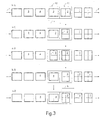
- FIG. 3 shows successive substeps of a further operating mode for controlling a tandem arrangement of two cross strapping machines, each of which is equipped with a dividing device for transverse strapping (strapping transverse to the conveying direction) and a dividing device for rotating a package or bundle.
- cross strapping machines of this type are described, for example, in publication DE-3248788.
- Two cross strapping machines of this type connected in series can be operated in strapping steps and conveying steps, as shown in FIG. 1. However, they can also be operated in an operating mode with partial strapping steps and intermediate conveying steps, as shown in FIG. 3.
- the conveying stroke which for the cross strapping of two packages or bundles in a tandem operation is necessary, and which is twice as large as the conveying stroke h in single machine operation, performed in two partial strokes h, which correspond to the stroke h of individual machine operation correspond.
- the funding steps are carried out in the same way as in single machine operation (stroke h).
- the processing is in processing sub-steps divided and alternating with the funding steps carried out.
- the operating method according to FIG. 3 (in contrast to the operating method according to FIG. 1) only possible for processing machines, in which successive machining sub-steps are feasible.
Landscapes
- Engineering & Computer Science (AREA)
- Mechanical Engineering (AREA)
- Basic Packing Technique (AREA)
Claims (8)
- Arrangement de machines de traitement (10, 11), comportant des moyens de traitement, des moyens de transport et des moyens de commande individuels pour le fonctionnement des machines de traitement dans un premier mode de commande, et à l'aide desquels des objets (1, 2, ... 5) sont amenés à la machine par une course de transport (h) dans un sens de transport (F), traités dans la machine, et à nouveau évacués de la machine par une course de transport (h) dans le sens de transport (F), caractérisé en ce que plusieurs machines de traitement (10, 11) identiques sont disposées directement les unes derrière les autres, de telle sorte que les objets (1, 2, ... 5) puissent être transportés dans le sens de transport (F) d'une machine (10) vers la machine suivante (11), et en ce que l'arrangement comporte d'autres moyens de commande qui sont hiérarchiquement supérieurs aux moyens de commande individuels, qui sont équipés pour un fonctionnement de l'arrangement dans un deuxième mode de commande commun dans lequel toutes les machines de l'arrangement sont commandées en commun, et dans lequel des phases de traitement (a, a.1/2, a.3) sont effectuées en alternance avec des phases de transport (b, b.1, b.2), des courses de transport (2h), qui par rapport à la course de transport (h) du premier mode de commande sont majorées d'un coefficient correspondant au nombre de machines prévues dans l'arrangement, étant effectuées pendant les phases de transport (b), ou des parties du traitement étant effectuées durant les phases de traitement (a.1/2, a.3).
- Arrangement selon la revendication 1, caractérisé en ce qu'il comporte deux machines de traitement.
- Arrangement selon l'une des revendications 1 ou 2, caractérisé en ce que les machines de traitement sont des machines de cerclage en croix.
- Arrangement selon l'une quelconque des revendications 1 à 3, caractérisé en ce qu'il comporte un moyen destiné à la commutation d'un mode de fonctionnement, commandé essentiellement par les autres moyens de commande, sur un mode de fonctionnement commandé par au moins un moyen de commande individuel.
- Procédé destiné au fonctionnement d'un arrangement de machines de traitement selon l'une quelconque des revendications 1 à 4, caractérisé en ce que l'arrangement comporte au moins deux modes de commande : un premier mode de commande individuel dans lequel des phases de traitement (a) sont effectuées en alternance avec des phases de transport (b), comportant chacune une course de transport (h), et un deuxième mode de commande commun dans lequel toutes les machines de l'arrangement sont commandées en commun, et dans lequel des phases de traitement (a, a.1/2, a.3) sont effectuées en alternance avec des phases de transport (b, b.1, b.2), des courses de transport (2h), qui par rapport à la course de transport (h) du premier mode de commande sont majorées d'un coefficient correspondant au nombre de machines prévues dans l'arrangement, étant effectuées dans le deuxième mode de commande pendant les phases de transport (b), ou des parties du traitement étant effectuées dans le deuxième mode de commande durant les phases de traitement (a.1/2, a.3).
- Procédé selon la revendication 5, caractérisé en ce que, lors d'une défaillance de l'une des machines de traitement (10, 11), il est commuté automatiquement du mode de commande commun sur le mode de commande individuel.
- Procédé selon l'une des revendications 5 ou 6, caractérisé en ce que les machines de traitement (10, 11) sont des machines de cerclage en croix dans lesquelles des paquets ou bottes de forme sensiblement parallélépipédique sont cerclés en croix.
- Procédé selon la revendication 7, caractérisé en ce que le cerclage en croix est effectué par le fait que les paquets ou bottes sont cerclés transversalement au sens de transport (F), tournés de 90°, et à nouveau cerclés transversalement au sens de transport, et en ce que, dans le mode de commande commun, le cerclage en croix est réparti dans les phases partielles cerclage/rotation (a. 1), rotation/cerclage (a.2) et cerclage/cerclage (a.3).
Applications Claiming Priority (2)
| Application Number | Priority Date | Filing Date | Title |
|---|---|---|---|
| CH50498 | 1998-03-03 | ||
| CH50498 | 1998-03-03 |
Publications (2)
| Publication Number | Publication Date |
|---|---|
| EP0940341A1 EP0940341A1 (fr) | 1999-09-08 |
| EP0940341B1 true EP0940341B1 (fr) | 2003-08-06 |
Family
ID=4188520
Family Applications (1)
| Application Number | Title | Priority Date | Filing Date |
|---|---|---|---|
| EP99103644A Expired - Lifetime EP0940341B1 (fr) | 1998-03-03 | 1999-02-25 | Arrangement de machines de traitment, spécialement de machines de cerclage en croix, et procédé pour la mise en oeuvre de l'arrangement |
Country Status (5)
| Country | Link |
|---|---|
| US (1) | US6209449B1 (fr) |
| EP (1) | EP0940341B1 (fr) |
| CA (1) | CA2264092A1 (fr) |
| DE (1) | DE59906468D1 (fr) |
| DK (1) | DK0940341T3 (fr) |
Families Citing this family (4)
| Publication number | Priority date | Publication date | Assignee | Title |
|---|---|---|---|---|
| US6230473B1 (en) | 1997-07-04 | 2001-05-15 | Ferag Verpakkingstechniek B.V. | Method and apparatus for packing stacks of flat articles |
| JP2008512321A (ja) * | 2004-09-13 | 2008-04-24 | ミードウエストベコ・コーポレーション | 封筒束および封筒束のパッケージの組立方法 |
| US7789226B2 (en) | 2004-09-13 | 2010-09-07 | Meadwestvaco Corporation | Packaged banded envelopes |
| US8182045B2 (en) | 2010-07-08 | 2012-05-22 | Rogers Ralph R | Cover for a side-dump trailer or truck |
Family Cites Families (14)
| Publication number | Priority date | Publication date | Assignee | Title |
|---|---|---|---|---|
| CH163199A (de) | 1932-06-08 | 1933-07-31 | Hanselmann Graf Johann | Tabakpfeife. |
| US3085501A (en) * | 1960-10-06 | 1963-04-16 | Bunn Co B | System for automatically tying bundles |
| US3350998A (en) * | 1965-11-15 | 1967-11-07 | Bunn Co B | Tilted bundle tying machine and conveyor feed therefor |
| FR1498021A (fr) * | 1966-10-28 | 1967-10-13 | Bunn Co B | Appareil pour lier automatiquement, plus particulièrement des articles sensiblement plats |
| NL6815438A (fr) | 1968-10-29 | 1970-05-04 | ||
| US3568591A (en) * | 1969-01-10 | 1971-03-09 | Ambassador College | Automatic tying apparatus |
| NL144882B (nl) | 1969-12-10 | 1975-02-17 | Metaverpa Nv | Draad- of bandomsnoeringsinrichting. |
| US3901138A (en) | 1972-09-06 | 1975-08-26 | D Bilt Pieter Arnoldus V | Turn table device |
| DE3140291A1 (de) * | 1981-10-10 | 1983-04-28 | Peter P. 6930 Eberbach Lüdtke | Vorrichtung zum umhuellen und verschnueren von gestapelten druckereierzeugnissen |
| NL8105908A (nl) | 1981-12-30 | 1983-07-18 | Metaverpa Nv | Mechanisme voor het over een bepaalde hoek draaien van een voorwerp om een vertikale as. |
| DE3303956C2 (de) | 1983-02-05 | 1987-08-20 | Berthold 7902 Blaubeuren Bührle | Vorrichtung zum Umreifen eines quaderförmigen Packgutes |
| US4977827A (en) * | 1989-01-17 | 1990-12-18 | Am International Incorporated | Signature handling apparatus |
| US5078057A (en) | 1990-01-05 | 1992-01-07 | Illinois Tool Works Inc. | Binding machine, such as strapping machine |
| EP0894721B1 (fr) | 1997-07-04 | 2003-01-29 | Ferag AG | Proçédé et dispositif pour cercler des objets unitaires ou des piles d'objets |
-
1999
- 1999-02-25 DE DE59906468T patent/DE59906468D1/de not_active Expired - Fee Related
- 1999-02-25 DK DK99103644T patent/DK0940341T3/da active
- 1999-02-25 EP EP99103644A patent/EP0940341B1/fr not_active Expired - Lifetime
- 1999-03-01 US US09/258,958 patent/US6209449B1/en not_active Expired - Fee Related
- 1999-03-02 CA CA002264092A patent/CA2264092A1/fr not_active Abandoned
Also Published As
| Publication number | Publication date |
|---|---|
| CA2264092A1 (fr) | 1999-09-03 |
| DK0940341T3 (da) | 2003-11-17 |
| EP0940341A1 (fr) | 1999-09-08 |
| DE59906468D1 (de) | 2003-09-11 |
| US6209449B1 (en) | 2001-04-03 |
Similar Documents
| Publication | Publication Date | Title |
|---|---|---|
| DE69900188T2 (de) | Verfahren zur Steuerung des Betriebes einer Maschine zum Bearbeiten von Gegenständen, z. B. zum Verpacken von Nahrungsmitteln, und Maschine dafür | |
| DE69502734T2 (de) | Montagewerkstatt für bleche | |
| DE69305606T2 (de) | Vorrichtung zur Gruppierung von Gegenständen | |
| EP0752971A1 (fr) | Installation modulaire de production en continu | |
| DE3124032C1 (de) | Behandlungsmaschine fuer Gegenstaende,insbesondere Etikettiermaschine oder Fueller fuer Behaelter,wie Flaschen | |
| CH469618A (de) | Verfahren zur Einfügung von Einlagen in gefaltete Druckerzeugnisse wie Zeitungen, Zeitschriften od. dgl. und Vorrichtung zur Durchführung des Verfahrens | |
| EP3356265B1 (fr) | Table d'accumulation, procédé d'operation d'une table d'accumulation et machine d'emballage avec une table d'accumulation | |
| EP0413098B1 (fr) | Procédé pour le traitement d'articles dans une installation en continu et dispositif pour la mise en oeuvre de ce procédé | |
| EP3326925A2 (fr) | Installation d'emballage | |
| EP0344102B1 (fr) | Dispositif d'assemblage de produits imprimés | |
| DE102007059303A1 (de) | Verarbeitungsanlage | |
| DE3805649C2 (de) | Transportvorrichtung und -verfahren mit integrierter Wärmebehandlungseinrichtung für Kopse | |
| DE69201043T2 (de) | Übereinander montierte Druckverschliessvorrichtung. | |
| EP0940341B1 (fr) | Arrangement de machines de traitment, spécialement de machines de cerclage en croix, et procédé pour la mise en oeuvre de l'arrangement | |
| DE19601664A1 (de) | Verfahren und Vorrichtung zum richtungsorientierten Sortieren von Hygieneartikeln zum nachfolgenden Verpacken | |
| DE19920531C2 (de) | Verpackungsstraße für Zeitschriften, Magazine und dergleichen Druckprodukte | |
| DE202009006536U1 (de) | Bearbeitungsanlage | |
| WO2000048932A2 (fr) | Procede pour decouper des feuilles de tole en bandes de tole, et dispositif de coupe permettant la mise en oeuvre de ce procede | |
| DE102021128817A1 (de) | Zuführeinrichtung und Zuführverfahren für die Zuführung und die Übergabe von Behältern in eine Behälterreinigungsmaschine | |
| DE10142432C1 (de) | Anlage zum maschinellen Bearbeiten von plattenförmigen Werkstücken aus Holz und/oder Holzersatzstoffen | |
| EP0329602A2 (fr) | Procédé et dispositif pour emmagasiner et convertir des produits plats de préférence arrivant dans une formation en écailles | |
| AT398547B (de) | Plattenaufteilanlage | |
| DE2657795A1 (de) | Fliessbandanlage zur durchfuehrung von arbeiten nacheinander an einer serie gleichartiger apparate | |
| DE602005004668T2 (de) | Stabpackungsanlage und entsprechendes verfahren | |
| DE19849375C2 (de) | Verfahren zum Einstellen des Werkstückflusses |
Legal Events
| Date | Code | Title | Description |
|---|---|---|---|
| PUAI | Public reference made under article 153(3) epc to a published international application that has entered the european phase |
Free format text: ORIGINAL CODE: 0009012 |
|
| AK | Designated contracting states |
Kind code of ref document: A1 Designated state(s): BE CH DE DK ES FI FR GB IT LI NL SE |
|
| AX | Request for extension of the european patent |
Free format text: AL;LT;LV;MK;RO;SI |
|
| 17P | Request for examination filed |
Effective date: 20000121 |
|
| AKX | Designation fees paid |
Free format text: BE CH DE DK ES FI FR GB IT LI NL SE |
|
| 17Q | First examination report despatched |
Effective date: 20010621 |
|
| RTI1 | Title (correction) |
Free format text: ARRANGEMENTS OF PROCESSING MACHINES, ESPECIALLY OF CROSS-TYING MACHINES, AND METHOD FOR PUTTING THE ARRANGEMENT INTO OPERATION |
|
| GRAG | Despatch of communication of intention to grant |
Free format text: ORIGINAL CODE: EPIDOS AGRA |
|
| RTI1 | Title (correction) |
Free format text: ARRANGEMENTS OF PROCESSING MACHINES, ESPECIALLY OF CROSS-TYING MACHINES, AND METHOD FOR PUTTING THE ARRANGEMENT INTO OPERATION |
|
| GRAG | Despatch of communication of intention to grant |
Free format text: ORIGINAL CODE: EPIDOS AGRA |
|
| GRAH | Despatch of communication of intention to grant a patent |
Free format text: ORIGINAL CODE: EPIDOS IGRA |
|
| GRAH | Despatch of communication of intention to grant a patent |
Free format text: ORIGINAL CODE: EPIDOS IGRA |
|
| GRAA | (expected) grant |
Free format text: ORIGINAL CODE: 0009210 |
|
| AK | Designated contracting states |
Designated state(s): BE CH DE DK ES FI FR GB IT LI NL SE |
|
| PG25 | Lapsed in a contracting state [announced via postgrant information from national office to epo] |
Ref country code: FI Free format text: LAPSE BECAUSE OF FAILURE TO SUBMIT A TRANSLATION OF THE DESCRIPTION OR TO PAY THE FEE WITHIN THE PRESCRIBED TIME-LIMIT Effective date: 20030806 |
|
| REG | Reference to a national code |
Ref country code: GB Ref legal event code: FG4D Free format text: NOT ENGLISH |
|
| REG | Reference to a national code |
Ref country code: CH Ref legal event code: EP |
|
| REF | Corresponds to: |
Ref document number: 59906468 Country of ref document: DE Date of ref document: 20030911 Kind code of ref document: P |
|
| REG | Reference to a national code |
Ref country code: CH Ref legal event code: NV Representative=s name: FREI PATENTANWALTSBUERO |
|
| GBT | Gb: translation of ep patent filed (gb section 77(6)(a)/1977) |
Effective date: 20031018 |
|
| PG25 | Lapsed in a contracting state [announced via postgrant information from national office to epo] |
Ref country code: ES Free format text: LAPSE BECAUSE OF FAILURE TO SUBMIT A TRANSLATION OF THE DESCRIPTION OR TO PAY THE FEE WITHIN THE PRESCRIBED TIME-LIMIT Effective date: 20031117 |
|
| REG | Reference to a national code |
Ref country code: DK Ref legal event code: T3 |
|
| REG | Reference to a national code |
Ref country code: SE Ref legal event code: TRGR |
|
| PGFP | Annual fee paid to national office [announced via postgrant information from national office to epo] |
Ref country code: DK Payment date: 20040123 Year of fee payment: 6 |
|
| PGFP | Annual fee paid to national office [announced via postgrant information from national office to epo] |
Ref country code: CH Payment date: 20040210 Year of fee payment: 6 |
|
| PGFP | Annual fee paid to national office [announced via postgrant information from national office to epo] |
Ref country code: DE Payment date: 20040213 Year of fee payment: 6 |
|
| PGFP | Annual fee paid to national office [announced via postgrant information from national office to epo] |
Ref country code: SE Payment date: 20040217 Year of fee payment: 6 |
|
| PG25 | Lapsed in a contracting state [announced via postgrant information from national office to epo] |
Ref country code: GB Free format text: LAPSE BECAUSE OF NON-PAYMENT OF DUE FEES Effective date: 20040225 |
|
| PG25 | Lapsed in a contracting state [announced via postgrant information from national office to epo] |
Ref country code: BE Free format text: LAPSE BECAUSE OF NON-PAYMENT OF DUE FEES Effective date: 20040228 |
|
| ET | Fr: translation filed | ||
| PLBE | No opposition filed within time limit |
Free format text: ORIGINAL CODE: 0009261 |
|
| STAA | Information on the status of an ep patent application or granted ep patent |
Free format text: STATUS: NO OPPOSITION FILED WITHIN TIME LIMIT |
|
| 26N | No opposition filed |
Effective date: 20040507 |
|
| BERE | Be: lapsed |
Owner name: *FERAG VERPAKKINGSTECHNIEK B.V. Effective date: 20040228 |
|
| PG25 | Lapsed in a contracting state [announced via postgrant information from national office to epo] |
Ref country code: NL Free format text: LAPSE BECAUSE OF NON-PAYMENT OF DUE FEES Effective date: 20040901 |
|
| GBPC | Gb: european patent ceased through non-payment of renewal fee |
Effective date: 20040225 |
|
| NLV4 | Nl: lapsed or anulled due to non-payment of the annual fee |
Effective date: 20040901 |
|
| PG25 | Lapsed in a contracting state [announced via postgrant information from national office to epo] |
Ref country code: IT Free format text: LAPSE BECAUSE OF NON-PAYMENT OF DUE FEES Effective date: 20050225 |
|
| PG25 | Lapsed in a contracting state [announced via postgrant information from national office to epo] |
Ref country code: SE Free format text: LAPSE BECAUSE OF NON-PAYMENT OF DUE FEES Effective date: 20050226 |
|
| PG25 | Lapsed in a contracting state [announced via postgrant information from national office to epo] |
Ref country code: LI Free format text: LAPSE BECAUSE OF NON-PAYMENT OF DUE FEES Effective date: 20050228 Ref country code: DK Free format text: LAPSE BECAUSE OF NON-PAYMENT OF DUE FEES Effective date: 20050228 Ref country code: CH Free format text: LAPSE BECAUSE OF NON-PAYMENT OF DUE FEES Effective date: 20050228 |
|
| REG | Reference to a national code |
Ref country code: CH Ref legal event code: NV Representative=s name: FERAG AG |
|
| PG25 | Lapsed in a contracting state [announced via postgrant information from national office to epo] |
Ref country code: DE Free format text: LAPSE BECAUSE OF NON-PAYMENT OF DUE FEES Effective date: 20050901 |
|
| REG | Reference to a national code |
Ref country code: DK Ref legal event code: EBP |
|
| EUG | Se: european patent has lapsed | ||
| REG | Reference to a national code |
Ref country code: CH Ref legal event code: PL |
|
| PG25 | Lapsed in a contracting state [announced via postgrant information from national office to epo] |
Ref country code: FR Free format text: LAPSE BECAUSE OF NON-PAYMENT OF DUE FEES Effective date: 20040229 |
|
| REG | Reference to a national code |
Ref country code: FR Ref legal event code: ST Effective date: 20110218 |