EP0940406A2 - Phosphorsäureester und ihre Verwendung als Dispergiermittel - Google Patents
Phosphorsäureester und ihre Verwendung als Dispergiermittel Download PDFInfo
- Publication number
- EP0940406A2 EP0940406A2 EP99102347A EP99102347A EP0940406A2 EP 0940406 A2 EP0940406 A2 EP 0940406A2 EP 99102347 A EP99102347 A EP 99102347A EP 99102347 A EP99102347 A EP 99102347A EP 0940406 A2 EP0940406 A2 EP 0940406A2
- Authority
- EP
- European Patent Office
- Prior art keywords
- phosphoric acid
- acid esters
- alkyl
- styrene
- pigments
- Prior art date
- Legal status (The legal status is an assumption and is not a legal conclusion. Google has not performed a legal analysis and makes no representation as to the accuracy of the status listed.)
- Granted
Links
- 0 C1C2C1CCC*2 Chemical compound C1C2C1CCC*2 0.000 description 2
- CJGXJKVMUHXVHL-UHFFFAOYSA-N CC(C)(C)Cc1ccccc1 Chemical compound CC(C)(C)Cc1ccccc1 CJGXJKVMUHXVHL-UHFFFAOYSA-N 0.000 description 1
Classifications
-
- C—CHEMISTRY; METALLURGY
- C09—DYES; PAINTS; POLISHES; NATURAL RESINS; ADHESIVES; COMPOSITIONS NOT OTHERWISE PROVIDED FOR; APPLICATIONS OF MATERIALS NOT OTHERWISE PROVIDED FOR
- C09B—ORGANIC DYES OR CLOSELY-RELATED COMPOUNDS FOR PRODUCING DYES, e.g. PIGMENTS; MORDANTS; LAKES
- C09B67/00—Influencing the physical, e.g. the dyeing or printing properties of dyestuffs without chemical reactions, e.g. by treating with solvents grinding or grinding assistants, coating of pigments or dyes; Process features in the making of dyestuff preparations; Dyestuff preparations of a special physical nature, e.g. tablets, films
- C09B67/0071—Process features in the making of dyestuff preparations; Dehydrating agents; Dispersing agents; Dustfree compositions
- C09B67/0084—Dispersions of dyes
- C09B67/0085—Non common dispersing agents
- C09B67/0089—Non common dispersing agents non ionic dispersing agent, e.g. EO or PO addition products
-
- C—CHEMISTRY; METALLURGY
- C07—ORGANIC CHEMISTRY
- C07F—ACYCLIC, CARBOCYCLIC OR HETEROCYCLIC COMPOUNDS CONTAINING ELEMENTS OTHER THAN CARBON, HYDROGEN, HALOGEN, OXYGEN, NITROGEN, SULFUR, SELENIUM OR TELLURIUM
- C07F9/00—Compounds containing elements of Groups 5 or 15 of the Periodic Table
- C07F9/02—Phosphorus compounds
- C07F9/06—Phosphorus compounds without P—C bonds
- C07F9/08—Esters of oxyacids of phosphorus
- C07F9/09—Esters of phosphoric acids
- C07F9/091—Esters of phosphoric acids with hydroxyalkyl compounds with further substituents on alkyl
-
- C—CHEMISTRY; METALLURGY
- C08—ORGANIC MACROMOLECULAR COMPOUNDS; THEIR PREPARATION OR CHEMICAL WORKING-UP; COMPOSITIONS BASED THEREON
- C08G—MACROMOLECULAR COMPOUNDS OBTAINED OTHERWISE THAN BY REACTIONS ONLY INVOLVING UNSATURATED CARBON-TO-CARBON BONDS
- C08G18/00—Polymeric products of isocyanates or isothiocyanates
- C08G18/06—Polymeric products of isocyanates or isothiocyanates with compounds having active hydrogen
- C08G18/28—Polymeric products of isocyanates or isothiocyanates with compounds having active hydrogen characterised by the compounds used containing active hydrogen
- C08G18/30—Low-molecular-weight compounds
- C08G18/38—Low-molecular-weight compounds having heteroatoms other than oxygen
- C08G18/3878—Low-molecular-weight compounds having heteroatoms other than oxygen having phosphorus
- C08G18/3882—Low-molecular-weight compounds having heteroatoms other than oxygen having phosphorus having phosphorus bound to oxygen only
- C08G18/3885—Phosphate compounds
-
- C—CHEMISTRY; METALLURGY
- C09—DYES; PAINTS; POLISHES; NATURAL RESINS; ADHESIVES; COMPOSITIONS NOT OTHERWISE PROVIDED FOR; APPLICATIONS OF MATERIALS NOT OTHERWISE PROVIDED FOR
- C09K—MATERIALS FOR MISCELLANEOUS APPLICATIONS, NOT PROVIDED FOR ELSEWHERE
- C09K23/00—Use of substances as emulsifying, wetting, dispersing, or foam-producing agents
- C09K23/14—Derivatives of phosphoric acid
-
- Y—GENERAL TAGGING OF NEW TECHNOLOGICAL DEVELOPMENTS; GENERAL TAGGING OF CROSS-SECTIONAL TECHNOLOGIES SPANNING OVER SEVERAL SECTIONS OF THE IPC; TECHNICAL SUBJECTS COVERED BY FORMER USPC CROSS-REFERENCE ART COLLECTIONS [XRACs] AND DIGESTS
- Y10—TECHNICAL SUBJECTS COVERED BY FORMER USPC
- Y10S—TECHNICAL SUBJECTS COVERED BY FORMER USPC CROSS-REFERENCE ART COLLECTIONS [XRACs] AND DIGESTS
- Y10S516/00—Colloid systems and wetting agents; subcombinations thereof; processes of
- Y10S516/905—Agent composition per se for colloid system making or stabilizing, e.g. foaming, emulsifying, dispersing, or gelling
- Y10S516/907—The agent contains organic compound containing phosphorus, e.g. lecithin
- Y10S516/908—The compound contains repeating -OCnH2n-, i.e. repeating unsubstituted oxyalkylene
-
- Y—GENERAL TAGGING OF NEW TECHNOLOGICAL DEVELOPMENTS; GENERAL TAGGING OF CROSS-SECTIONAL TECHNOLOGIES SPANNING OVER SEVERAL SECTIONS OF THE IPC; TECHNICAL SUBJECTS COVERED BY FORMER USPC CROSS-REFERENCE ART COLLECTIONS [XRACs] AND DIGESTS
- Y10—TECHNICAL SUBJECTS COVERED BY FORMER USPC
- Y10S—TECHNICAL SUBJECTS COVERED BY FORMER USPC CROSS-REFERENCE ART COLLECTIONS [XRACs] AND DIGESTS
- Y10S526/00—Synthetic resins or natural rubbers -- part of the class 520 series
- Y10S526/932—Thickener or dispersant for aqueous system
Definitions
- the invention relates to the production of these Phosphoric acid esters and their use as dispersing agents for Pigments and fillers.
- Dispersants For the dispersion of fillers and pigments in liquid Media is usually made use of Dispersants, so as to ensure effective dispersion the mechanical shear forces required to reduce the solids and at the same time to achieve the highest possible filling levels.
- the dispersants help break up agglomerates, wet or cover as surface-active materials the surface of the particles to be dispersed and stabilize this against unwanted reagglomeration.
- Dispersants have become indispensable. B. for manufacturing of highly concentrated color pastes for paint and Paint industry, for the representation of pigment concentrates (Masterbatch) for coloring plastic articles and for the processing of unsaturated polyester resins (UP resins), the large amounts of calcium carbonate or aluminum hydroxide (ATH) included as fillers.
- UP resins unsaturated polyester resins
- ATH aluminum hydroxide
- Phosphoric acid esters and their use as dispersants are known and can be found in the prior art.
- US Pat. No. 4,720,514 describes phosphoric acid esters of a number of alkylphenol ethoxylates which can advantageously be used for the formulation of aqueous pigment dispersions.
- EP-A-0 256 427 describes phosphoric acid esters for a similar application.
- SMC sheet molding compounds
- BMC bulk molding compounds
- the known phosphoric acid esters have the disadvantage that they are usually not universally applicable as there are many sufficient compatibility of dispersing additive and binder or dispersing additive and surrounding medium (aqueous or solvent-containing formulations) is lacking.
- the chemical structure of the phosphoric acid esters also plays a role a major role: In aqueous formulations are preferred only those phosphoric acid esters are used that have no additional hydrolyzable functional groups such as esters or Have urethane groups in the molecule.
- the present invention is therefore based on the object to overcome a large number of the disadvantages mentioned, in addition to the viscosity reduction important for processability of highly filled dispersions an improved compatibility to be achieved with the surrounding medium.
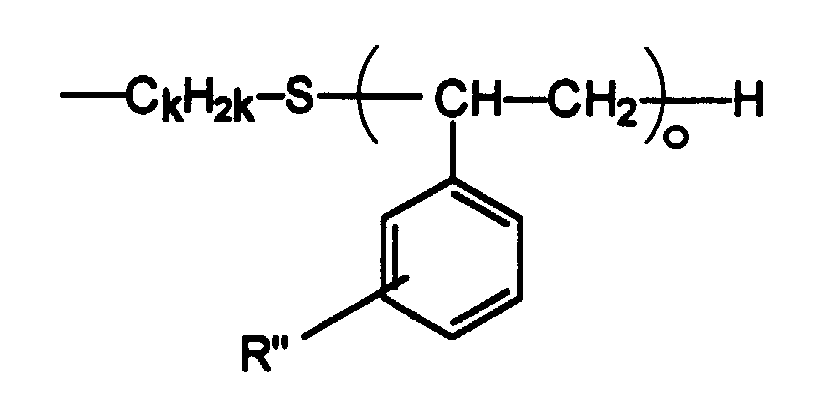
- R '' H is preferred.
- R ' is usually derived from an alcohol R'OH, which as Starting alcohol for the polymerization of styrene oxide and alkylene oxide acts.
- radicals R ' are the methyl, butyl, stearyl, Allyl, hexenyl, nonylphenyl or oleyl radical.
- Methyl and butyl radicals are preferred for R '.
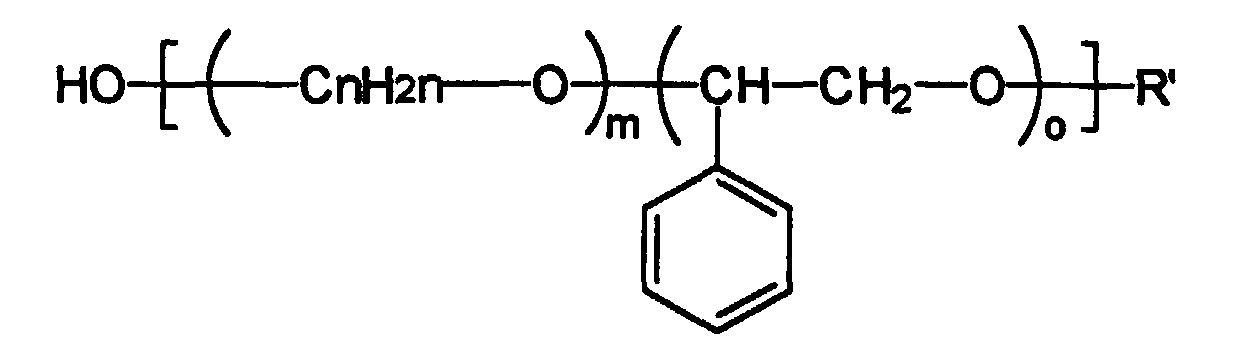
- the polyether radical contains only ethylene oxide units. If the value for n is> 2, the polyether residue exists from ethylene oxide units and partly from oxyalkylene units, whose carbon number is between 3 and 18. Here n can take the value of a fractional number between 2 and 18.
- the oxyalkylene block preferably consists of ethylene oxide units, where appropriate in addition to the oxyropylene Oxybutylene units can be present. Oxyalkylene units with a carbon number of 4 to 18 are then preferred if additional oleophilic properties of the product are sought become.
- the average molecular weight of the phosphoric acid esters according to the invention is in the range of 300 to about 15,000 g / mol, preferred at 500 to 5000 g / mol. It is very easy to use the common methods of polymer analysis, both for the phosphoric acid esters as well as for the amphiphilic block copolymers, determine.
- the ratio of m to o is 1 in 50 to 50 in 1, preferably 1 to 10 to 10 to 1 and particularly preferably 1 to 2 up to 10 to 1.
- Suitable phosphoric acid esters are:
- amphiphilic block copolymers of the general structures serve as starting materials for the preparation of the phosphoric acid esters according to the invention respectively.
- the radicals R ′′ and R ′ and the indices m, k and n and o have the meaning given above.
- block copolymers are made by reaction of the terminal Hydroxy group with a phosphoric acid ester-forming phosphorus compound implemented to the phosphoric acid esters according to the invention.
- Such block copolymers are e.g. B. described in DE-A-41 34 967.
- styrene becomes more adequate in the presence Amounts of an initiator and the desired chain length corresponding amount of a chain regulator, which next to a mercapto group yet another, an active hydrogen residue functional group, usually one Hydroxyl group, carries, radically polymerized and attached to the obtained Polymer at temperatures from 20 to 180 ° C alkylene oxide until the desired molecular weight of the Blocks B added.
- the conversion to the phosphoric acid esters according to the invention takes place by reaction of the terminal (terminal) hydroxyl groups with a phosphorus ester-forming phosphorus compound in a manner known per se.
- Suitable phosphorus compounds are, for example, phosphorus pentoxide, phosphoric acid chloride or polyphosphoric acids of the general formula H n + 2 P n O 3n + 1 .
- a commercially available polyphosphoric acid (Merck) with a content of about 85% P 4 O 10 is particularly preferably used for the preparation of the phosphoric acid esters.
- the reaction is usually carried out without a solvent at temperatures of around 80 to 100 ° C.
- residues of water can first be removed from the system with an inert solvent, such as, for example, toluene or xylene, before the reaction with the polyphosphoric acid takes place.
- an inert solvent such as, for example, toluene or xylene
- the reaction can also take place in the presence of solvents or solvent mixtures. This is always advantageous if the phosphoric acid esters according to the invention have to be formulated in accordance with their later use in inert solvents or solvent mixtures.
- the terminal hydroxyl group of the amphiphiles to be esterified Block copolymers are preferred in the esterification reaction 50 to 100%, particularly preferably quantitatively esterified.
- the phosphoric acid esters according to the invention also in partial or fully neutralized form.
- the dispersing agents can both be applied directly to the dispersing agent Solids are applied or the aqueous or organic medium are added. You can in pure Form or as a masterbatch in higher concentration in an organic Medium to be distributed. It goes without saying also possible, the dispersants to be used according to the invention together with other auxiliaries or dispersants, such as B. the stearates known as dispersants, to use.
- Mineral fillers such as talc, Calcium carbonate, dolomite, mica, wollastonite, kaolin, as well mineral flame retardants, such as aluminum hydroxide or magnesium hydroxide, in question.
- Suitable pigments are carbon black or titanium dioxide, the latter also in finely divided form as UV protection can be used in cosmetic formulations.
- Other dispersible solids are chemical blowing agents, such as azodicarbonamide or mixtures of solid acids and carbonates.
- the dispersants to be used according to the invention can also for the dispersion of ceramic materials in organic Media such as B. finely divided aluminum oxide, silicon carbide or silicon nitride can be used.
- organic media come u. a. Polyethylene, polypropylene, Polystyrene, polyamides, polyesters, poly (meth) acrylates, polyvinyl chloride, unsaturated polyesters and paraffin oils in question.
- the dispersants of the invention are particularly suitable to improve the distribution of finely divided solids in Elastomers, thermoplastics, thermosets and polymer blends.
- SMC sheet molding compounds
- BMC bulk molding compounds
- the unsaturated polyester resin and the thermoplastic component (often polystyrene is used as a thermoplastic component are usually dissolved in monomeric styrene, which when processing by pressing or injection molding hardens and with the unsaturated polyester resin a three-dimensional Network structure.
- the addition of glass fibers leads to high tensile strength and rigidity; the Fillers guarantee high compressive strength and are above also for good dimensional stability and low thermal expansion responsible.
- the phosphoric acid esters according to the invention are also used for very high filling levels achieved a very low viscosity.
- the formulations are characterized by absolute freedom from specks and a high storage stability.
- the phosphoric acid esters according to the invention use for the production of aqueous pigment pastes.
- 0.1 to 200% by weight of the phosphoric acid esters are preferred 0.5 to 100 wt .-%, (based on the weight of the pigments) used.
- the phosphoric acid esters in the invention Use either in advance with the pigments to be dispersed are mixed or directly in the aqueous or solvent-based Dispersing medium before or simultaneously with the Addition of the pigments and any solids can be solved.
- inorganic pigments can be used or organic pigments and carbon blacks.
- Titanium dioxides may be mentioned as examples of inorganic pigments and iron oxides.
- Organic pigments to be considered are, for example, azo pigments, metal complex pigments, anthraquinone pigments, phthalocyanine pigments, polycyclic Pigments, especially those of thioindigo, quinacridone, Dioxazine, pyrrolo-pyrrole, naphthalenetetracarboxylic acid, perylene, Isoamidolin (on), flavanthron, pyranthron or isoviolanthrone series.
- Those according to the invention are particularly preferred Dispersing additives for the production of aqueous (gas) Soot pastes.
- Fillers for example dispersed in aqueous paints can be z. B. those based on kaolin, talc, other silicates, chalk, glass fibers, glass beads or metal powders.
- aqueous 1-pack or 2-pack varnishes can be applied into consideration.
- aqueous 1-component paints such as those based on alkyl, acrylate, epoxy, polyvinyl acetate, Polyester or polyurethane resins, or aqueous 2-component paints, for example those based on hydroxyl groups
- Polyacrylate or polyester resins with melamine resins or optionally blocked polyisocyanate resins as crosslinkers Polyepoxide systems may also be mentioned in the same way.
- xylene 100 g are mixed in a nitrogen atmosphere heated to 120 ° C with a stirrer reactor. To is within 3 h while maintaining the temperature of 120 ° C a mixture of 1350 g (about 13 mol), 78.1 g (1 mol) of 2-mercaptoethanol, 4.1 g azodiisobutyronitrile and 310 g Given xylene. After the addition has ended, an after-reaction takes place of about 15 minutes; then 0.16 g of methyl hydroquinone admitted.
- a molecular weight results from the hydroxyl number determination Mn of 700 g / mol. From vapor pressure osmometric molecular weight determination a value of 720 g / mol is obtained.
- the molecular weight determined from the determination of the hydroxyl number assuming functionality of 1 is 2650; the gel permeation chromatogram shows only a maximum and gives for Mn (calibration against PS) a value of 3100, for the The ratio Mw / Mn is 1.14.
- the reaction is complete after 2 hours.
- the acid number of the material obtained is 41 mg KOH / g. No aliphatic hydroxyl group can be detected in the 1 H-NMR spectrum.
- Table 1 shows examples of some phosphoric acid esters based on some polystyrene-b-polyalkylene oxide copolymers, as they are obtained by the above production process.
- the table shows the molecular weights of the polystyrene segment and the chemical nature and molecular weight of the corresponding alkylene oxide.
- the product obtained is neutralized with the aid of phosphoric acid and the water by distillation, the resulting potassium phosphate by filtration together with a filter aid away.
- the molecular weight from the determination of the Hydroxyl number (Mn / OH number) with an assumed functionality of 1 is 1950.
- the phosphoric acid ester is prepared as in 1b) described.
- Table 2 shows examples of some phosphoric acid esters based on polystyrene oxide-b-polyalkylene oxide copolymers, as are obtained by the above production process.
- the table shows the molecular weights of the polystyrene segment and the chemical nature and molecular weight of the corresponding alkylene oxide.
- Dispersants are used according to different methods, the typical applications in the plastics or paint sector describe.
- Viscosity / mPas - ATH / CaCO 3 45 1A CaCO 3 55 720 3A CaCO 3 55 410 3A ATH 65 660 6A CaCO 3 55 520 Stearic acid CaCO 3 55 6900 1B CaCO 3 55 560 3B CaCO 3 55 820
- the fillers are in a pre-determined mix, in addition to the other ingredients of the recipe also the dispersant contains, using a stirring motor with dispersing disc ( ⁇ 50 mm) added at a speed of about 1000 (rpm).
- the viscosities are measured using a Brookfield spindle viscometer (model DV-I) at 23 ° C and a speed of 50 rpm with a RVT-7 spindle. The viscosities are measured after a storage time of 10 minutes. Tables 4 to 7 show the viscosities for the different formulations, in accordance with the above recipe variants. In all cases, the extent of the viscosity reduction which can be achieved with the dispersants according to the invention is significant.
- the dispersion additives are used to manufacture the pigment pastes 40% pre-dissolved in water, with water and possibly anti-foaming agents mixed and then added the pigments.
- the Dispersion takes place after adding grinding media (glass balls 2 up to 3 mm, same volume as the pigment paste) (Titanium dioxide) or two hours (other pigments) in one Skandex vibrator with air cooling.
- gray pigmented lacquers 40.0 g clear lacquer are used submitted, 14.2 g of white paste and 2.65 g of black paste added and homogenized at 1500 rpm for 5 min.
- the samples will be with 100 .mu.m wet film thickness on aluminum sheets and either baked at 150 ° C for 15 min after 20 min exhaust air time (Stove enamel) or dried at room temperature (dispersion lacquer).
Landscapes
- Chemical & Material Sciences (AREA)
- Organic Chemistry (AREA)
- Health & Medical Sciences (AREA)
- Chemical Kinetics & Catalysis (AREA)
- Medicinal Chemistry (AREA)
- Molecular Biology (AREA)
- General Health & Medical Sciences (AREA)
- Biochemistry (AREA)
- Life Sciences & Earth Sciences (AREA)
- Polymers & Plastics (AREA)
- Dispersion Chemistry (AREA)
- Engineering & Computer Science (AREA)
- Materials Engineering (AREA)
- Pigments, Carbon Blacks, Or Wood Stains (AREA)
- Compositions Of Macromolecular Compounds (AREA)
- Emulsifying, Dispersing, Foam-Producing Or Wetting Agents (AREA)
Abstract
Description
oder

- R =
- oder
 ist,
ist,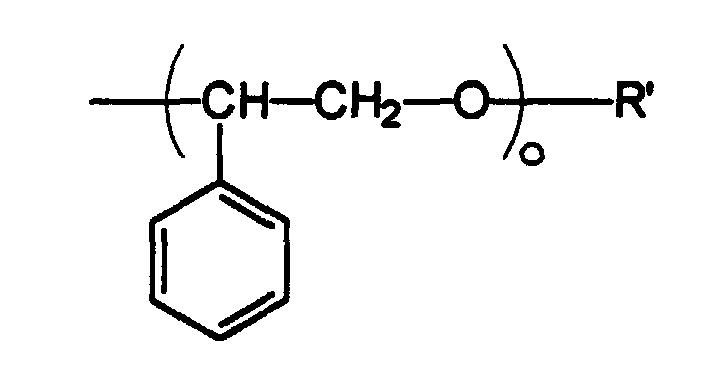
- x
- gleich 1 oder 2,
- n
- eine Zahl von 2 bis 18,
- m
- und
- o
- eine Zahl von 2 bis 100,
- k
- eine Zahl von 2 bis 4,
- R''
- H oder einen linearen oder verzweigten Alkylrest, der gegebenenfalls mit zusätzlichen funktionellen Gruppen substituiert sein kann, und
- R'
- einen Alkyl-, Alkaryl-, Alkenyl- oder Sulfopropylrest


| Phosphorsäureester | Mn (Polystyrol-Segment) | Mn (Polyalkylenoxid-Segment) | Alkylenoxid |
| 1A | 700 | 2000 | EO |
| 2A | 700 | 1000 | EO |
| 3A | 1000 | 1000 | EO |
| 4A | 1000 | 1000 | EO/PO (1:1) |
| 5A | 1000 | 4000 | EO |
| 6A | 400 | 1000 | EO |
| 7A | 400 | 1800 | EO |
| Phosphorsäureester | Mn (Polystyroloxid-Segment) | Mn (Polyalkylenoxid-Segment) | Alkylenoxid |
| 1B | 450 | 1500 | EO |
| 2B | 450 | 1500 | EO |
| 3B | 630 | 1100 | EO/BO (3:1) |
| Phosphorsäure<->-ester | Füllstoff | Füllmenge [ % ] | Viskosität/mPas |
| - | ATH/CaCO3 | 45 | |
| 1A | CaCO3 | 55 | 720 |
| 3A | CaCO3 | 55 | 410 |
| 3A | ATH | 65 | 660 |
| 6A | CaCO3 | 55 | 520 |
| Stearinsäure | CaCO3 | 55 | 6900 |
| 1B | CaCO3 | 55 | 560 |
| 3B | CaCO3 | 55 | 820 |
- 60 Teile
- ungesättigtes Polyesterharz (Palapreg P 17-02 bzw. Palapreg P 14-01; Hersteller: BASF)
- 40 Teile
- Thermoplastkomponente (Palapreg H 814-01: Polystyrol, gelöst in Styrol oder Palapreg H 850-01: Polymethylmethacrylat, gelöst in Styrol; Hersteller: BASF)
- 4,5 Teile
- Zinkstearat
- 1,5 Teile
- t-Butylperbenzoat
- 180 Teile
- Füllstoff (Calciumcarbonat/Millicarb OG, Hersteller: Omya oder Aluminiumhydroxid/Martinal ON 310; Hersteller: Martinswerke) sowie
- X Teile
- erfindungsgemäßer Phosphorsäureester
| (UP-Harz: Palapreg P 17-02/Thermoplastkomponente: Polystyrol/Füllstoff: Calciumcarbonat) | ||
| Phosphorsäureester | Menge/X Teile | Viskosität (mPas) |
| - | - | 81 000 |
| 2A | 1,8 | 29 000 |
| 3A | 1,8 | 44 500 |
| 5A | 1,8 | 51 500 |
| 6A | 1,8 | 21 000 |
| 7A | 0,9 | 28 500 |
| 7A | 1,8 | 18 000 |
| 7A | 2,7 | 16 000 |
| 1B | 1,8 | 18 500 |
| (UP-Harz: Palapreg P 14-01/Thermoplastkomponente: Polystyrol/Füllstoff: Calciumcarbonat) | ||
| Phosphorsäureester | Menge/X Teile | Viskosität (mPas) |
| - | - | 120 000 |
| 4A | 1,8 | 28 500 |
| 7A | 1,8 | 21 000 |
| 7A | 2,7 | 18 000 |
| 1B | 1,8 | 19 500 |
| 2B | 1,8 | 19 000 |
| (UP-Harz: Palapreg P 17-02/Thermoplastkomponente: Polystyrol/Füllstoff: ATH) | ||
| Phosphorsäureester | Menge/X Teile | Viskosität (mPas/10 UPM) |
| - | - | 240 000 |
| 4A | 1,8 | 50 500 |
| 7A | 1,8 | 33 000 |
| 7A | 5,2 | 255 000 |
| 1B | 2,7 | 19 000 |
| 3B | 1,8 | 21 000 |
| (UP-Harz: Palapreg P 17-02/Thermoplastkomponente: Polymethylmethacrylat/Füllstoff: ATH) | ||
| Phosphorsäureester | Menge/X Teile | Viskosität (mPas) |
| - | - | 54 000 |
| 1A | 1,8 | 30 000 |
| 7A | 1,8 | 27 000 |
| 2B | 1,8 | 19 000 |
- 16,4
- Wasser
- 12,3
- Additiv-Lösung, 40 %ig
- 1,0
- Entschäumer (z. B. Tego Foamex 810, Tego Chemie Service GmbH)
- 70,0
- Titandioxid 2160 (Kronos)
- 0,3
- Aerosil A 200 (Degussa)
- 60,3
- Wasser
- 22,3
- (Dispergier-)Additiv-Lösung, 40 %ig
- 1,0
- Entschäumer (z. B. Tego Foamex 810, Tego Chemie Service GmbH)
- 1,4
- 2-Amino-2-methylpropanol (Angus)
- 15,0
- Farbruß FW 200 (Degussa)
- 70,88
- Alkydharz Resydrol VWA 5477, 40 %ig (Hoechst)
- 0,14
- Entschäumer (z. B. Byk 020, Byk-Chemie)
- 0,68
- Verdicker Bentone SD 1 (Rheox)
- 8,24
- Melaminharz Maprenal MF 900 (Hoechst)
- 0,14
- Triethanolamin
- 19,10
- Wasser
- 0,68
- Entschäumer Additol XW 395 (Hoechst)
- 0,14
- Verlaufmittel Additiol XW 329 (Hoechst)
- 97,0
- Acrylatdispersion Neocryl XK 90 (Zeneca)
- 3,0
- Texanol
| Weißpasten | ||||
| Probe | Viskosität/Pas sofort bei 20 1/s | Viskosität/Pas sofort bei 1000 1/s | Viskosität/Pas nach 4 Wo 50°C bei 20 1/s | Viskosität/Pas nach 4 Wo 50°C bei 1000 1/s |
| 1A | 3,0 | 0,6 | 3,4 | 0,7 |
| 2A | 3,1 | 0,5 | 3,3 | 0,4 |
| 3A | 3,3 | 0,7 | 3,5 | 0,7 |
| 4A | 3,0 | 0,5 | 3,2 | 0,5 |
| 5A | 3,6 | 0,6 | 3,8 | 0,7 |
| 6A | 3,1 | 0,4 | 3,2 | 0,4 |
| 7A | 3,3 | 0,5 | 3,4 | 0,6 |
| 1B | 3,6 | 0,5 | 3,8 | 0,5 |
| 2B | 3,5 | 0,6 | 3,6 | 0,6 |
| 3B | 3,4 | 0,4 | 3,3 | 0,5 |
| Polystyrol-b-Polyalkylenoxid-Copolymer Vorprodukt zu 1A | 3,3 | 0,4 | 3,7 | 0,4 |
| Polystyrol-b-Polyalkylenoxid-Copolymer Vorprodukt zu 3A | 3,5 | 0,6 | 3,8 | 0,7 |
| Fettsäure-Alkoxylat | 2,8 | 0,5 | 5,5 | 1,0 |
| mod. Acrylatpolymer | 4,2 | 1,3 | 6,8 | 1,9 |
| Schwarzpasten | ||||
| Probe | Viskosität/dPas sofort bei 20 1/s | Viskosität/dPas sofort bei 1000 1/s | Viskosität/dPas nach 4 Wo 50°C bei 20 1/s | Viskosität/dPas nach 4 Wo 50°C bei 1000 1/s |
| 1A | 2,2 | 0,6 | 2,3 | 0,6 |
| 2A | 2,3 | 0,6 | 2,5 | 0,7 |
| 3A | 2,0 | 0,5 | 2,1 | 0,6 |
| 4A | 2,4 | 0,7 | 2,4 | 0,7 |
| 5A | 2,3 | 0,5 | 2,5 | 0,6 |
| 6A | 1,9 | 0,5 | 2,0 | 0,6 |
| 7A | 2,0 | 0,6 | 2,1 | 0,6 |
| 1B | 2,3 | 0,7 | 2,4 | 0,7 |
| 2B | 2,2 | 0,6 | 2,3 | 0,7 |
| 3B | 2,0 | 0,6 | 2,2 | 0,7 |
| Polystyrol-b-Polyalkylenoxid-Copolymer Vorprodukt zu 1A | 2,0 | 0,6 | 2,2 | 0,7 |
| Polystyrol-b-Polyalkylenoxid-Copolymer Vorprodukt zu 3A | 2,1 | 0,5 | 2,3 | 0,6 |
| Fettsäure-Alkoxylat | 1,8 | 0,4 | 2,5 | 0,6 |
| mod. Acrylatpolymer | 3,7 | 0,8 | 4,4 | 1,0 |
| Einbrennlack auf Basis Resydrol VWA 5477 | |||
| Probe | Helligkeit L | Delta E nach Rub-Out | Glanzgrad (60°-Winkel) |
| 1A | 41,5 | 0,4 | 53 |
| 2A | 42,3 | 0,3 | 51 |
| 3A | 41,8 | 0,4 | 55 |
| 4A | 43,2 | 0,4 | 53 |
| 5A | 41,7 | 0,3 | 55 |
| 6A | 40,9 | 0,5 | 54 |
| 7A | 41,2 | 0,3 | 56 |
| 1B | 42,2 | 0,3 | 54 |
| 2B | 43,0 | 0,4 | 53 |
| 3B | 42,8 | 0,3 | 53 |
| Polystyrol-b-Polyalkylenoxid-Copolymer Vorprodukt zu 1A | 44,0 | 0,6 | 51 |
| Polystyrol-b-Polyalkylenoxid-Copolymer Vorprodukt zu 3A | 44,2 | 0,5 | 52 |
| Fettsäure-Alkoxylat | 44,6 | 0,7 | 49 |
| mod. Acrylatpolymer | 44,9 | 0,4 | 55 |
| Dispersionslack auf Basis Neocryl XK 90 | ||||
| Probe | Helligkeit L | Delta E nach Rub-Out | Glanzgrad (60°-Winkel) | Haze |
| 1A | 47,5 | 0,3 | 40,5 | 110 |
| 2A | 47,6 | 0,4 | 42,0 | 115 |
| 3A | 47,3 | 0,5 | 41,0 | 110 |
| 4A | 47,9 | 0,3 | 39,0 | 120 |
| 5A | 47,6 | 0,4 | 42,0 | 125 |
| 6A | 47,7 | 0,5 | 41,5 | 115 |
| 7A | 47,5 | 0,4 | 42,0 | 110 |
| 1B | 48,0 | 0,4 | 40,5 | 120 |
| 2B | 48,2 | 0,5 | 39,0 | 110 |
| 3B | 48,1 | 0,4 | 42,5 | 125 |
| Polystyrol-b-Polyalkylenoxid-Copolymer Vorprodukt zu 1A | 48,3 | 0,7 | 39,0 | 120 |
| Polystyrol-b-Polyalkylenoxid-Copolymer Vorprodukt zu 3A | 48,4 | 0,8 | 39,5 | 125 |
| Fettsäure-Alkoxylat | 48,3 | 0,9 | 40,0 | 120 |
| mod. Acrylatpolymer | 49,0 | 0,4 | 40,5 | 130 |
Claims (10)
- Phosphorsäureester der allgemeinen Formel Iwobei

- R =
- oder
 ist,
ist,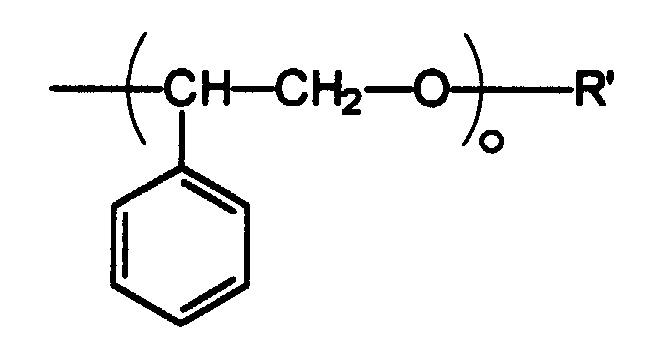
- x
- gleich 1 oder 2,
- n
- eine Zahl von 2 bis 18,
- m
- und
- o
- eine Zahl von 2 bis 100,
- k
- eine Zahl von 2 bis 4,
- R''
- H oder einen linearen oder verzweigten Alkylrest, der gegebenenfalls mit zusätzlichen funktionellen Gruppen substituiert sein kann, und
- R'
- einen Alkyl-, Alkaryl-, Alkenyl- oder Sulfopropylrest
- Phosphorsäureester gemäß Anspruch 1, dadurch gekennzeichnet, daß das Verhältnis m/o 1 zu 10 bis 10 zu 1, insbesondere 1 zu 2 bis 10 zu 1 beträgt.
- Phosphorsäureester gemäß den Ansprüchen 1 und 2, dadurch gekennzeichnet, daß das mittlere Molekulargewicht 300 bis 15 000 g/Mol, insbesondere 500 bis 5000 g/Mol, beträgt.
- Phosphorsäureester gemäß den Ansprüchen 1 bis 3, dadurch gekennzeichnet, daß R'' = H ist.
- Verfahren zur Herstellung von Phosphorsäureestern gemäß den Ansprüchen 1 bis 4a) durch Umsetzung eines ω-hydroxyfunktionellen Oligo- oder Poly(alkyl)styrols mit einem Alkylenoxid zu einem Poly(alkyl)styrol-block(b)-Polyalkylenoxid-Copolymeren und anschließender Überführung in die entsprechenden Phosphorsäureester mit einer phosphorsäureesterbildenden Phosphorverbindung, wobei bis zu 100 % der terminalen Hydroxylgruppen dieser Poly(alkyl)styrol-block(b)-Polyalkylenoxid-Copolymeren zu Phosphorsäureestergruppen umgesetzt werden und die Phosphoratome, abhängig von den gewählten stöchiometrischen Verhältnissen, ein- und/oder zweifach verestert werden,
oderb) durch Umsetzung von Polystyroloxid-block(b)-Polyalkylenoxid-Copolymeren, welche ausgehend von einem monofunktionellen Startalkohol durch sequentielle Anlagerung von Styroloxid und einem Alkylenoxid gemäß der gewünschten Abfolge und Kettenlänge der einzelnen Segmente erhältlich sind, mit einer phosphorsäureesterbildenden Phosphorverbindung in der in a) beschriebenen Weise. - Verwendung der Phosphorsäureester nach den Ansprüchen 1 bis 4 als Dispergiermittel für Pigmente und Füllstoffe in wäßrigen oder organischen Medien.
- Verwendung der Phosphorsäureester nach den Ansprüchen 1 bis 4 als Dispergiermittel für die Herstellung hochgefüllter SMC- und BMC-Formmassen.
- Pigmentzubereitung aus anorganischen oder organischen Pigmenten, enthaltend 1 bis 100 Gew. -%, bezogen auf Pigmente, an Dispergieradditiven gemäß den Ansprüchen 1 bis 4.
- Wäßrige Paste aus anorganischen oder organischen Farbmitteln, enthaltend 1 bis 100 Gew.-%, bezogen auf Farbmittel, an Dispergieradditiven gemäß den Ansprüchen 1 bis 4.
- Wäßrige Rußpasten, enthaltend 10 bis 100 Gew.-% an Dispergieradditiven gemäß den Ansprüchen 1 bis 4.
Applications Claiming Priority (2)
| Application Number | Priority Date | Filing Date | Title |
|---|---|---|---|
| DE19806964 | 1998-02-19 | ||
| DE19806964 | 1998-02-19 |
Publications (3)
| Publication Number | Publication Date |
|---|---|
| EP0940406A2 true EP0940406A2 (de) | 1999-09-08 |
| EP0940406A3 EP0940406A3 (de) | 2000-02-23 |
| EP0940406B1 EP0940406B1 (de) | 2002-11-13 |
Family
ID=7858296
Family Applications (1)
| Application Number | Title | Priority Date | Filing Date |
|---|---|---|---|
| EP99102347A Expired - Lifetime EP0940406B1 (de) | 1998-02-19 | 1999-02-06 | Phosphorsäureester und ihre Verwendung als Dispergiermittel |
Country Status (4)
| Country | Link |
|---|---|
| US (3) | US6310123B1 (de) |
| EP (1) | EP0940406B1 (de) |
| DE (1) | DE59903364D1 (de) |
| ES (1) | ES2187083T3 (de) |
Cited By (14)
| Publication number | Priority date | Publication date | Assignee | Title |
|---|---|---|---|---|
| US6552091B1 (en) | 1999-08-27 | 2003-04-22 | Goldschmidt Ag | Block-copolymeric polyalkylene oxides containing styrene oxide, obtained by alkoxylation, and their use |
| EP1167452A3 (de) * | 2000-06-15 | 2003-05-14 | Goldschmidt AG | Phosphorsäureester als Emulgatoren und Dispergiermittel |
| DE10252452A1 (de) * | 2002-11-12 | 2004-05-27 | Clariant Gmbh | Styroloxidhaltige Copolymere und deren Verwendung als Emulgatoren und Dispergiermittel |
| EP1757664A2 (de) | 2005-08-25 | 2007-02-28 | Degussa AG | Paste aus nanoskaligem Pulver und Dispergiermittel |
| WO2008116932A1 (en) * | 2007-03-28 | 2008-10-02 | Lubrizol Limited | Dispersant composition |
| DE102007018431A1 (de) | 2007-04-19 | 2008-10-30 | Evonik Degussa Gmbh | Pyrogenes Zinkoxid enthaltender Verbund von Schichten und diesen Verbund aufweisender Feldeffekttransistor |
| DE102008058040A1 (de) | 2008-11-18 | 2010-05-27 | Evonik Degussa Gmbh | Formulierungen enthaltend ein Gemisch von ZnO-Cubanen und sie einsetzendes Verfahren zur Herstellung halbleitender ZnO-Schichten |
| EP2418234A1 (de) | 2010-08-10 | 2012-02-15 | Evonik Goldschmidt GmbH | Dispergiermittel und Verfahren zu deren Herstellung |
| CN103214634A (zh) * | 2013-04-01 | 2013-07-24 | 北京化工大学 | 一种三嵌段两亲性共聚物的制备方法 |
| DE102012206234A1 (de) | 2012-04-17 | 2013-10-17 | Evonik Industries Ag | Formulierungen enthaltend ammoniakalische Hydroxo-Zink-Verbindungen |
| EP2778170A1 (de) | 2013-03-15 | 2014-09-17 | Evonik Industries AG | Phosphorsäureester, ihre Herstellung und Verwendung |
| DE102013204824A1 (de) | 2013-03-15 | 2014-09-18 | Henkel Ag & Co. Kgaa | Reinigungsmittel für harte Oberflächen enthaltend Phosphorsäureester eines Polyether-modifizierten Alkylalkohols |
| EP3266834A1 (de) | 2016-07-08 | 2018-01-10 | Evonik Degussa GmbH | Universalpigmentpräparation |
| WO2020151973A1 (de) | 2019-01-23 | 2020-07-30 | Clariant International Ltd | Dispergiermittel |
Families Citing this family (16)
| Publication number | Priority date | Publication date | Assignee | Title |
|---|---|---|---|---|
| US20050245937A1 (en) * | 2004-04-28 | 2005-11-03 | St. Francis Medical Technologies, Inc. | System and method for insertion of an interspinous process implant that is rotatable in order to retain the implant relative to the spinous processes |
| DE59903364D1 (de) * | 1998-02-19 | 2002-12-19 | Goldschmidt Ag Th | Phosphorsäureester und ihre Verwendung als Dispergiermittel |
| FR2789602B1 (fr) * | 1999-02-17 | 2001-05-11 | Rhodia Chimie Sa | Sol organique et compose solide a base d'oxyde de titane et d'un compose amphiphile et procedes de preparation |
| TWI643884B (zh) | 2013-09-06 | 2018-12-11 | 盧伯利索先進材料有限公司 | 多元酸多元鹼接枝共聚物分散劑 |
| WO2016094026A1 (en) | 2014-12-09 | 2016-06-16 | Lubrizol Advanced Materials, Inc. | Additive to prevent phase separation of low profile additive in unsaturated thermoset polyester compositions |
| ES2925507T3 (es) | 2017-09-19 | 2022-10-18 | Lubrizol Advanced Mat Inc | Dispersante de poliéster multiamínico fabricado a través de un anhídrido intermedio |
| ES3061994T3 (en) | 2018-02-08 | 2026-04-08 | Evonik Operations Gmbh | Aqueous polyorganosiloxane hybrid resin dispersion |
| KR102763205B1 (ko) | 2018-09-10 | 2025-02-04 | 루브리졸 어드밴스드 머티어리얼스, 인코포레이티드 | 다중-아민 폴리에스테르 분산제 및 제조 방법 |
| JP6857640B2 (ja) * | 2018-12-03 | 2021-04-14 | 第一工業製薬株式会社 | 水分散体 |
| JP7638887B2 (ja) | 2019-03-14 | 2025-03-04 | ルブリゾル アドバンスド マテリアルズ, インコーポレイテッド | 無水物中間体を介して作製されたマルチアミン分散剤 |
| CN113795535B (zh) | 2019-03-14 | 2024-07-26 | 路博润先进材料公司 | 经由酸酐中间体制备的多胺聚酯分散剂 |
| EP3719076A1 (de) | 2019-04-01 | 2020-10-07 | Evonik Operations GmbH | Wässrige polyorganosiloxanhybridharz-dispersion |
| JP7543691B2 (ja) * | 2020-04-20 | 2024-09-03 | Hdマイクロシステムズ株式会社 | 感光性樹脂組成物、パターン硬化膜の製造方法、硬化膜、層間絶縁膜、カバーコート層、表面保護膜及び電子部品 |
| US20220154037A1 (en) | 2020-11-19 | 2022-05-19 | Covestro Llc | Polyaspartic coatings with recoat and stable initial gloss |
| WO2022132469A2 (en) | 2020-12-18 | 2022-06-23 | Lubrizol Advanced Materials, Inc. | Stable pigment dispersion composition |
| CN116568724A (zh) | 2020-12-18 | 2023-08-08 | 路博润先进材料公司 | 使用颜料分散体来制备聚合物的方法 |
Family Cites Families (20)
| Publication number | Priority date | Publication date | Assignee | Title |
|---|---|---|---|---|
| US3076011A (en) * | 1960-04-08 | 1963-01-29 | Interchem Corp | Phosphorus containing monomers |
| US3112335A (en) * | 1961-09-13 | 1963-11-26 | Richardson Co | Phosphoric acid styrene oxide ester |
| DE2237954C3 (de) * | 1972-08-02 | 1981-08-13 | Basf Ag, 6700 Ludwigshafen | Verfahren zur Herstellung von niedermolekularen Blockcopolymerisaten aus Vinyl- oder Dienmonomeren undAlkylenoxiden |
| JPS58100194A (ja) | 1981-12-10 | 1983-06-14 | 富士通株式会社 | 音声応答システムの会話記録再生方式 |
| JPS59100194A (ja) * | 1982-12-01 | 1984-06-09 | Kao Corp | 石油コ−クスの水スラリ−用分散安定剤 |
| CA1208850A (en) * | 1983-12-12 | 1986-07-29 | Fiberglas Canada Inc. | Blowing agents and their use in preparations of polyester foams |
| US4720514A (en) | 1985-03-11 | 1988-01-19 | Phillips Petroleum Company | Pigment concentrates for resins |
| DE3627023A1 (de) | 1986-08-09 | 1988-02-11 | Hoechst Ag | Pigmentdispersionen, verfahren zu ihrer herstellung und ihre verwendung |
| EP0360736B1 (de) * | 1988-09-01 | 1994-09-28 | Ciba-Geigy Ag | Wässriges, hartwasserbeständiges Netz- und Waschmittel, seine Herstellung und Verwendung in der Textilvorbehandlung |
| DE3927090A1 (de) * | 1989-08-17 | 1991-02-21 | Freudenberg Carl Fa | Faerbbare polyester-bmc-masse |
| US5151218A (en) | 1989-09-14 | 1992-09-29 | Byk-Chemie Gmbh | Phosphoric acid esters, method of producing them, and use thereof as dispersants |
| DE3930687A1 (de) | 1989-09-14 | 1991-04-11 | Byk Chemie Gmbh | Phosphorsaeureester, verfahren zu deren herstellung und deren verwendung als dispergiermittel |
| EP0420807A1 (de) * | 1989-09-27 | 1991-04-03 | Ciba-Geigy Ag | Anlagerungsprodukte von Alkylenoxid und Styroloxid an Arylalkanole |
| DE4134967C1 (de) | 1991-10-23 | 1992-12-10 | Th. Goldschmidt Ag, 4300 Essen, De | |
| FR2729964B1 (fr) * | 1995-01-31 | 2003-02-28 | Omya Sa | Charges minerales traitees. suspensions de ces charges dans des polyols et leurs utilisations dans les mousses polyurethannes |
| DE19529242A1 (de) * | 1995-08-09 | 1997-02-13 | Basf Ag | Phosphorsäureester |
| DE19535246A1 (de) * | 1995-09-22 | 1997-03-27 | Bayer Ag | Tensidgemische |
| DE19731572A1 (de) * | 1997-07-23 | 1999-01-28 | Bayer Ag | Pigmentpräparationen |
| DE59903364D1 (de) * | 1998-02-19 | 2002-12-19 | Goldschmidt Ag Th | Phosphorsäureester und ihre Verwendung als Dispergiermittel |
| DE10029648C1 (de) * | 2000-06-15 | 2002-02-07 | Goldschmidt Ag Th | Blockcopolymere Phosphorsäureester, deren Salze und deren Verwendung als Emulgatoren und Dispergiermittel |
-
1999
- 1999-02-06 DE DE59903364T patent/DE59903364D1/de not_active Expired - Lifetime
- 1999-02-06 ES ES99102347T patent/ES2187083T3/es not_active Expired - Lifetime
- 1999-02-06 EP EP99102347A patent/EP0940406B1/de not_active Expired - Lifetime
- 1999-02-17 US US09/251,966 patent/US6310123B1/en not_active Expired - Lifetime
-
2001
- 2001-04-10 US US09/829,799 patent/US6423130B2/en not_active Ceased
-
2004
- 2004-05-25 US US10/853,763 patent/USRE39746E1/en not_active Expired - Lifetime
Cited By (23)
| Publication number | Priority date | Publication date | Assignee | Title |
|---|---|---|---|---|
| US6552091B1 (en) | 1999-08-27 | 2003-04-22 | Goldschmidt Ag | Block-copolymeric polyalkylene oxides containing styrene oxide, obtained by alkoxylation, and their use |
| EP1167452A3 (de) * | 2000-06-15 | 2003-05-14 | Goldschmidt AG | Phosphorsäureester als Emulgatoren und Dispergiermittel |
| DE10252452A1 (de) * | 2002-11-12 | 2004-05-27 | Clariant Gmbh | Styroloxidhaltige Copolymere und deren Verwendung als Emulgatoren und Dispergiermittel |
| WO2004044035A1 (de) | 2002-11-12 | 2004-05-27 | Clariant Gmbh | Styroloxidhaltige copolymere und deren verwendung als emulgatoren und dispergiermittel |
| DE10252452B4 (de) * | 2002-11-12 | 2006-07-06 | Clariant Gmbh | Styroloxidhaltige Copolymere und deren Verwendung als Emulgatoren und Dispergiermittel |
| EP1757664A2 (de) | 2005-08-25 | 2007-02-28 | Degussa AG | Paste aus nanoskaligem Pulver und Dispergiermittel |
| EP1757664A3 (de) * | 2005-08-25 | 2009-02-25 | Degussa AG | Paste aus nanoskaligem Pulver und Dispergiermittel |
| WO2008116932A1 (en) * | 2007-03-28 | 2008-10-02 | Lubrizol Limited | Dispersant composition |
| DE102007018431A1 (de) | 2007-04-19 | 2008-10-30 | Evonik Degussa Gmbh | Pyrogenes Zinkoxid enthaltender Verbund von Schichten und diesen Verbund aufweisender Feldeffekttransistor |
| DE102008058040A1 (de) | 2008-11-18 | 2010-05-27 | Evonik Degussa Gmbh | Formulierungen enthaltend ein Gemisch von ZnO-Cubanen und sie einsetzendes Verfahren zur Herstellung halbleitender ZnO-Schichten |
| EP2418234A1 (de) | 2010-08-10 | 2012-02-15 | Evonik Goldschmidt GmbH | Dispergiermittel und Verfahren zu deren Herstellung |
| DE102010039140A1 (de) | 2010-08-10 | 2012-02-16 | Evonik Goldschmidt Gmbh | Dispergiermittel und Verfahren zu deren Herstellung |
| DE102012206234A1 (de) | 2012-04-17 | 2013-10-17 | Evonik Industries Ag | Formulierungen enthaltend ammoniakalische Hydroxo-Zink-Verbindungen |
| WO2013156274A1 (de) | 2012-04-17 | 2013-10-24 | Evonik Industries Ag | Formulierungen enthaltend ammoniakalische hydroxo-zink-verbindungen |
| EP2778170A1 (de) | 2013-03-15 | 2014-09-17 | Evonik Industries AG | Phosphorsäureester, ihre Herstellung und Verwendung |
| DE102013204605A1 (de) | 2013-03-15 | 2014-09-18 | Evonik Industries Ag | Phosphorsäureester, ihre Herstellung und Verwendung |
| DE102013204824A1 (de) | 2013-03-15 | 2014-09-18 | Henkel Ag & Co. Kgaa | Reinigungsmittel für harte Oberflächen enthaltend Phosphorsäureester eines Polyether-modifizierten Alkylalkohols |
| WO2014139984A1 (de) * | 2013-03-15 | 2014-09-18 | Henkel Ag & Co. Kgaa | Reinigungsmittel für harte oberflächen enthaltend phosphorsäureester eines polyether-modifizierten alkylalkohols |
| CN103214634A (zh) * | 2013-04-01 | 2013-07-24 | 北京化工大学 | 一种三嵌段两亲性共聚物的制备方法 |
| EP3266834A1 (de) | 2016-07-08 | 2018-01-10 | Evonik Degussa GmbH | Universalpigmentpräparation |
| US10287448B2 (en) | 2016-07-08 | 2019-05-14 | Evonik Degussa Gmbh | Universal pigment preparation |
| WO2020151973A1 (de) | 2019-01-23 | 2020-07-30 | Clariant International Ltd | Dispergiermittel |
| US11753541B2 (en) | 2019-01-23 | 2023-09-12 | Clariant International Ltd | Dispersing agent |
Also Published As
| Publication number | Publication date |
|---|---|
| ES2187083T3 (es) | 2003-05-16 |
| USRE39746E1 (en) | 2007-07-31 |
| EP0940406A3 (de) | 2000-02-23 |
| US20010025070A1 (en) | 2001-09-27 |
| DE59903364D1 (de) | 2002-12-19 |
| US6310123B1 (en) | 2001-10-30 |
| EP0940406B1 (de) | 2002-11-13 |
| US6423130B2 (en) | 2002-07-23 |
Similar Documents
| Publication | Publication Date | Title |
|---|---|---|
| EP0940406B1 (de) | Phosphorsäureester und ihre Verwendung als Dispergiermittel | |
| DE10029648C1 (de) | Blockcopolymere Phosphorsäureester, deren Salze und deren Verwendung als Emulgatoren und Dispergiermittel | |
| EP2125910B1 (de) | Modifizierte styrol / maleinsäureanhydrid basierte kammcopolymere | |
| EP1142972B1 (de) | Dispergiermittel zur Herstellung wässriger Pigmentpasten | |
| EP2125909B1 (de) | Kamm(block)copolymere | |
| EP0979844B1 (de) | Dispergiermittel zur Herstellung wässriger Pigmentpasten | |
| EP2106412B1 (de) | Polymermischung umfassend ein kammcopolymeres | |
| EP2668240B1 (de) | Netz- und dispergiermittel, verfahren zur herstellung und verwendung | |
| EP2367865B1 (de) | Zusammensetzungen umfassend glycidylether-copolymere | |
| EP1026178B1 (de) | Aminoxidgruppen enthaltende Maleinsäureanhydrid-Copolymere und ihre Verwendung als Dispergiermittel für Pigmente oder Füllstoffe | |
| EP1685895B1 (de) | Polyether/Polyester enthaltende Dispergierharze | |
| EP2091984B1 (de) | Netz- und dispergiermittel basierend auf mischungen von strukturierten copolymeren | |
| EP1529821A2 (de) | Dispergiermittel zur Herstellung wässriger Pigmentpasten | |
| EP2147062B1 (de) | Anionische wasserlösliche additive | |
| EP1078946A1 (de) | Durch Alkoxylierung erhaltene blockcopolymere, styrenoxidhaltige Polyalkylenoxide und deren Verwendung | |
| EP1081169A1 (de) | Verzweigte, Imidazolgruppen enthaltende Polymere, sowie deren Herstellung und Verwendung | |
| EP2723779B1 (de) | Oberflächenaktive kammcopolymere | |
| EP2676974A1 (de) | Ionische Haftgruppen enthaltende Kammcopolymere | |
| EP2780390A1 (de) | Aminaddukte herstellbar durch michael-addition | |
| EP3541861B1 (de) | Polyether auf basis von oxetanen zur verwendung als netz- und dispergiermittel sowie deren herstellung | |
| EP1458777A1 (de) | Aminoplasteinheiten enthaltende copolymere und ihre verwendung als dispergier-oder stabilisiermittel | |
| EP0931806A1 (de) | Dispergiermittel zur Herstellung wässriger Pigmentpasten |
Legal Events
| Date | Code | Title | Description |
|---|---|---|---|
| PUAI | Public reference made under article 153(3) epc to a published international application that has entered the european phase |
Free format text: ORIGINAL CODE: 0009012 |
|
| 17P | Request for examination filed |
Effective date: 19990216 |
|
| AK | Designated contracting states |
Kind code of ref document: A2 Designated state(s): DE ES FR GB IT NL SE |
|
| AX | Request for extension of the european patent |
Free format text: AL;LT;LV;MK;RO;SI |
|
| PUAL | Search report despatched |
Free format text: ORIGINAL CODE: 0009013 |
|
| AK | Designated contracting states |
Kind code of ref document: A3 Designated state(s): AT BE CH CY DE DK ES FI FR GB GR IE IT LI LU MC NL PT SE |
|
| AX | Request for extension of the european patent |
Free format text: AL;LT;LV;MK;RO;SI |
|
| RAP1 | Party data changed (applicant data changed or rights of an application transferred) |
Owner name: GOLDSCHMIDT AG |
|
| AKX | Designation fees paid |
Free format text: DE ES FR GB IT NL SE |
|
| 17Q | First examination report despatched |
Effective date: 20011211 |
|
| GRAG | Despatch of communication of intention to grant |
Free format text: ORIGINAL CODE: EPIDOS AGRA |
|
| GRAG | Despatch of communication of intention to grant |
Free format text: ORIGINAL CODE: EPIDOS AGRA |
|
| GRAH | Despatch of communication of intention to grant a patent |
Free format text: ORIGINAL CODE: EPIDOS IGRA |
|
| GRAH | Despatch of communication of intention to grant a patent |
Free format text: ORIGINAL CODE: EPIDOS IGRA |
|
| GRAA | (expected) grant |
Free format text: ORIGINAL CODE: 0009210 |
|
| AK | Designated contracting states |
Kind code of ref document: B1 Designated state(s): DE ES FR GB IT NL SE |
|
| REG | Reference to a national code |
Ref country code: GB Ref legal event code: FG4D Free format text: NOT ENGLISH |
|
| REF | Corresponds to: |
Ref document number: 59903364 Country of ref document: DE Date of ref document: 20021219 |
|
| GBT | Gb: translation of ep patent filed (gb section 77(6)(a)/1977) |
Effective date: 20030315 |
|
| REG | Reference to a national code |
Ref country code: ES Ref legal event code: FG2A Ref document number: 2187083 Country of ref document: ES Kind code of ref document: T3 |
|
| ET | Fr: translation filed | ||
| PLBE | No opposition filed within time limit |
Free format text: ORIGINAL CODE: 0009261 |
|
| STAA | Information on the status of an ep patent application or granted ep patent |
Free format text: STATUS: NO OPPOSITION FILED WITHIN TIME LIMIT |
|
| 26N | No opposition filed |
Effective date: 20030814 |
|
| REG | Reference to a national code |
Ref country code: FR Ref legal event code: CJ Ref country code: FR Ref legal event code: CD |
|
| REG | Reference to a national code |
Ref country code: FR Ref legal event code: CD |
|
| REG | Reference to a national code |
Ref country code: NL Ref legal event code: TD Effective date: 20100223 Ref country code: NL Ref legal event code: SD Effective date: 20100223 |
|
| REG | Reference to a national code |
Ref country code: DE Ref legal event code: R081 Ref document number: 59903364 Country of ref document: DE Owner name: EVONIK DEGUSSA GMBH, DE Free format text: FORMER OWNER: EVONIK GOLDSCHMIDT GMBH, 45127 ESSEN, DE Effective date: 20131024 |
|
| REG | Reference to a national code |
Ref country code: GB Ref legal event code: 732E Free format text: REGISTERED BETWEEN 20140320 AND 20140326 |
|
| REG | Reference to a national code |
Ref country code: ES Ref legal event code: PC2A Owner name: EVONIK DEGUSSA GMBH Effective date: 20140424 |
|
| REG | Reference to a national code |
Ref country code: NL Ref legal event code: SD Effective date: 20140502 |
|
| REG | Reference to a national code |
Ref country code: FR Ref legal event code: TP Owner name: EVONIK DEGUSSA GMBH, DE Effective date: 20140411 |
|
| PGFP | Annual fee paid to national office [announced via postgrant information from national office to epo] |
Ref country code: ES Payment date: 20150225 Year of fee payment: 17 |
|
| PGFP | Annual fee paid to national office [announced via postgrant information from national office to epo] |
Ref country code: SE Payment date: 20150218 Year of fee payment: 17 |
|
| REG | Reference to a national code |
Ref country code: FR Ref legal event code: PLFP Year of fee payment: 18 |
|
| REG | Reference to a national code |
Ref country code: SE Ref legal event code: EUG |
|
| PG25 | Lapsed in a contracting state [announced via postgrant information from national office to epo] |
Ref country code: SE Free format text: LAPSE BECAUSE OF NON-PAYMENT OF DUE FEES Effective date: 20160207 |
|
| REG | Reference to a national code |
Ref country code: FR Ref legal event code: PLFP Year of fee payment: 19 |
|
| PG25 | Lapsed in a contracting state [announced via postgrant information from national office to epo] |
Ref country code: ES Free format text: LAPSE BECAUSE OF NON-PAYMENT OF DUE FEES Effective date: 20160207 |
|
| REG | Reference to a national code |
Ref country code: FR Ref legal event code: PLFP Year of fee payment: 20 |
|
| PGFP | Annual fee paid to national office [announced via postgrant information from national office to epo] |
Ref country code: NL Payment date: 20180216 Year of fee payment: 20 |
|
| PGFP | Annual fee paid to national office [announced via postgrant information from national office to epo] |
Ref country code: GB Payment date: 20180216 Year of fee payment: 20 Ref country code: DE Payment date: 20180219 Year of fee payment: 20 |
|
| PGFP | Annual fee paid to national office [announced via postgrant information from national office to epo] |
Ref country code: FR Payment date: 20180222 Year of fee payment: 20 Ref country code: IT Payment date: 20180227 Year of fee payment: 20 |
|
| REG | Reference to a national code |
Ref country code: DE Ref legal event code: R071 Ref document number: 59903364 Country of ref document: DE Ref country code: NL Ref legal event code: MK Effective date: 20190205 |
|
| REG | Reference to a national code |
Ref country code: GB Ref legal event code: PE20 Expiry date: 20190205 |
|
| PG25 | Lapsed in a contracting state [announced via postgrant information from national office to epo] |
Ref country code: GB Free format text: LAPSE BECAUSE OF EXPIRATION OF PROTECTION Effective date: 20190205 |