EP0940499B1 - Zusatz von strömungsverringerndem Material zur Doppelnahtverbindung von Gewebene - Google Patents
Zusatz von strömungsverringerndem Material zur Doppelnahtverbindung von Gewebene Download PDFInfo
- Publication number
- EP0940499B1 EP0940499B1 EP19990200611 EP99200611A EP0940499B1 EP 0940499 B1 EP0940499 B1 EP 0940499B1 EP 19990200611 EP19990200611 EP 19990200611 EP 99200611 A EP99200611 A EP 99200611A EP 0940499 B1 EP0940499 B1 EP 0940499B1
- Authority
- EP
- European Patent Office
- Prior art keywords
- fabric
- machine
- yarns
- base fabric
- base
- Prior art date
- Legal status (The legal status is an assumption and is not a legal conclusion. Google has not performed a legal analysis and makes no representation as to the accuracy of the status listed.)
- Expired - Lifetime
Links
- 239000004744 fabric Substances 0.000 title claims abstract description 333
- 239000000463 material Substances 0.000 title claims abstract description 47
- 238000007792 addition Methods 0.000 title 1
- 238000004826 seaming Methods 0.000 claims abstract description 75
- 239000000835 fiber Substances 0.000 claims abstract description 34
- XLYOFNOQVPJJNP-UHFFFAOYSA-N water Substances O XLYOFNOQVPJJNP-UHFFFAOYSA-N 0.000 claims abstract description 14
- 230000035699 permeability Effects 0.000 claims abstract description 9
- 239000010410 layer Substances 0.000 claims description 20
- 238000009941 weaving Methods 0.000 claims description 11
- 239000000853 adhesive Substances 0.000 claims description 7
- 230000001070 adhesive effect Effects 0.000 claims description 7
- 229920005989 resin Polymers 0.000 claims description 4
- 239000011347 resin Substances 0.000 claims description 4
- 239000006260 foam Substances 0.000 claims description 3
- 239000007788 liquid Substances 0.000 claims description 3
- 239000002356 single layer Substances 0.000 claims description 2
- 238000009958 sewing Methods 0.000 claims 6
- 238000000034 method Methods 0.000 description 11
- 238000004519 manufacturing process Methods 0.000 description 7
- 238000013459 approach Methods 0.000 description 6
- 239000002759 woven fabric Substances 0.000 description 4
- 239000002952 polymeric resin Substances 0.000 description 3
- 239000002002 slurry Substances 0.000 description 3
- 229920003002 synthetic resin Polymers 0.000 description 3
- 239000004952 Polyamide Substances 0.000 description 2
- 238000009434 installation Methods 0.000 description 2
- 238000012986 modification Methods 0.000 description 2
- 230000004048 modification Effects 0.000 description 2
- 229920002647 polyamide Polymers 0.000 description 2
- 229920000139 polyethylene terephthalate Polymers 0.000 description 2
- 239000005020 polyethylene terephthalate Substances 0.000 description 2
- -1 polypropylene Polymers 0.000 description 2
- 238000000926 separation method Methods 0.000 description 2
- 229920003043 Cellulose fiber Polymers 0.000 description 1
- 239000004743 Polypropylene Substances 0.000 description 1
- 229920003235 aromatic polyamide Polymers 0.000 description 1
- 230000000052 comparative effect Effects 0.000 description 1
- 230000006835 compression Effects 0.000 description 1
- 238000007906 compression Methods 0.000 description 1
- 238000010924 continuous production Methods 0.000 description 1
- 238000000151 deposition Methods 0.000 description 1
- 238000011161 development Methods 0.000 description 1
- 239000006185 dispersion Substances 0.000 description 1
- 238000001704 evaporation Methods 0.000 description 1
- 230000008020 evaporation Effects 0.000 description 1
- 230000000737 periodic effect Effects 0.000 description 1
- 229920001643 poly(ether ketone) Polymers 0.000 description 1
- 229920000728 polyester Polymers 0.000 description 1
- 229920000098 polyolefin Polymers 0.000 description 1
- 229920001155 polypropylene Polymers 0.000 description 1
- 238000012545 processing Methods 0.000 description 1
- 239000004753 textile Substances 0.000 description 1
- 239000011800 void material Substances 0.000 description 1
Images

Classifications
-
- D—TEXTILES; PAPER
- D06—TREATMENT OF TEXTILES OR THE LIKE; LAUNDERING; FLEXIBLE MATERIALS NOT OTHERWISE PROVIDED FOR
- D06M—TREATMENT, NOT PROVIDED FOR ELSEWHERE IN CLASS D06, OF FIBRES, THREADS, YARNS, FABRICS, FEATHERS OR FIBROUS GOODS MADE FROM SUCH MATERIALS
- D06M11/00—Treating fibres, threads, yarns, fabrics or fibrous goods made from such materials, with inorganic substances or complexes thereof; Such treatment combined with mechanical treatment, e.g. mercerising
- D06M11/84—Treating fibres, threads, yarns, fabrics or fibrous goods made from such materials, with inorganic substances or complexes thereof; Such treatment combined with mechanical treatment, e.g. mercerising combined with mechanical treatment
-
- D—TEXTILES; PAPER
- D21—PAPER-MAKING; PRODUCTION OF CELLULOSE
- D21F—PAPER-MAKING MACHINES; METHODS OF PRODUCING PAPER THEREON
- D21F7/00—Other details of machines for making continuous webs of paper
- D21F7/08—Felts
- D21F7/10—Seams thereof
-
- D—TEXTILES; PAPER
- D06—TREATMENT OF TEXTILES OR THE LIKE; LAUNDERING; FLEXIBLE MATERIALS NOT OTHERWISE PROVIDED FOR
- D06M—TREATMENT, NOT PROVIDED FOR ELSEWHERE IN CLASS D06, OF FIBRES, THREADS, YARNS, FABRICS, FEATHERS OR FIBROUS GOODS MADE FROM SUCH MATERIALS
- D06M11/00—Treating fibres, threads, yarns, fabrics or fibrous goods made from such materials, with inorganic substances or complexes thereof; Such treatment combined with mechanical treatment, e.g. mercerising
- D06M11/83—Treating fibres, threads, yarns, fabrics or fibrous goods made from such materials, with inorganic substances or complexes thereof; Such treatment combined with mechanical treatment, e.g. mercerising with metals; with metal-generating compounds, e.g. metal carbonyls; Reduction of metal compounds on textiles
-
- D—TEXTILES; PAPER
- D21—PAPER-MAKING; PRODUCTION OF CELLULOSE
- D21F—PAPER-MAKING MACHINES; METHODS OF PRODUCING PAPER THEREON
- D21F7/00—Other details of machines for making continuous webs of paper
- D21F7/08—Felts
- D21F7/083—Multi-layer felts
-
- Y—GENERAL TAGGING OF NEW TECHNOLOGICAL DEVELOPMENTS; GENERAL TAGGING OF CROSS-SECTIONAL TECHNOLOGIES SPANNING OVER SEVERAL SECTIONS OF THE IPC; TECHNICAL SUBJECTS COVERED BY FORMER USPC CROSS-REFERENCE ART COLLECTIONS [XRACs] AND DIGESTS
- Y10—TECHNICAL SUBJECTS COVERED BY FORMER USPC
- Y10S—TECHNICAL SUBJECTS COVERED BY FORMER USPC CROSS-REFERENCE ART COLLECTIONS [XRACs] AND DIGESTS
- Y10S162/00—Paper making and fiber liberation
- Y10S162/904—Paper making and fiber liberation with specified seam structure of papermaking belt
-
- Y—GENERAL TAGGING OF NEW TECHNOLOGICAL DEVELOPMENTS; GENERAL TAGGING OF CROSS-SECTIONAL TECHNOLOGIES SPANNING OVER SEVERAL SECTIONS OF THE IPC; TECHNICAL SUBJECTS COVERED BY FORMER USPC CROSS-REFERENCE ART COLLECTIONS [XRACs] AND DIGESTS
- Y10—TECHNICAL SUBJECTS COVERED BY FORMER USPC
- Y10T—TECHNICAL SUBJECTS COVERED BY FORMER US CLASSIFICATION
- Y10T428/00—Stock material or miscellaneous articles
- Y10T428/24—Structurally defined web or sheet [e.g., overall dimension, etc.]
- Y10T428/24777—Edge feature
- Y10T428/24785—Edge feature including layer embodying mechanically interengaged strands, strand portions or strand-like strips [e.g., weave, knit, etc.]
-
- Y—GENERAL TAGGING OF NEW TECHNOLOGICAL DEVELOPMENTS; GENERAL TAGGING OF CROSS-SECTIONAL TECHNOLOGIES SPANNING OVER SEVERAL SECTIONS OF THE IPC; TECHNICAL SUBJECTS COVERED BY FORMER USPC CROSS-REFERENCE ART COLLECTIONS [XRACs] AND DIGESTS
- Y10—TECHNICAL SUBJECTS COVERED BY FORMER USPC
- Y10T—TECHNICAL SUBJECTS COVERED BY FORMER US CLASSIFICATION
- Y10T442/00—Fabric [woven, knitted, or nonwoven textile or cloth, etc.]
- Y10T442/30—Woven fabric [i.e., woven strand or strip material]
- Y10T442/3325—Including a foamed layer or component
- Y10T442/335—Plural fabric layers
- Y10T442/3358—Including a nonwoven fabric layer
-
- Y—GENERAL TAGGING OF NEW TECHNOLOGICAL DEVELOPMENTS; GENERAL TAGGING OF CROSS-SECTIONAL TECHNOLOGIES SPANNING OVER SEVERAL SECTIONS OF THE IPC; TECHNICAL SUBJECTS COVERED BY FORMER USPC CROSS-REFERENCE ART COLLECTIONS [XRACs] AND DIGESTS
- Y10—TECHNICAL SUBJECTS COVERED BY FORMER USPC
- Y10T—TECHNICAL SUBJECTS COVERED BY FORMER US CLASSIFICATION
- Y10T442/00—Fabric [woven, knitted, or nonwoven textile or cloth, etc.]
- Y10T442/30—Woven fabric [i.e., woven strand or strip material]
- Y10T442/3707—Woven fabric including a nonwoven fabric layer other than paper
- Y10T442/3724—Needled
Definitions
- the present invention relates to the papermaking arts. More specifically, the present invention is a papermaker's fabric of the on-machine-seamable (OMS®) variety, such as an OMS® press fabric for the press section of a papermachine.
- OMS® on-machine-seamable
- a fibrous web is formed by depositing a fibrous slurry, that is, an aqueous dispersion of cellulose fibers, on a moving forming fabric in the forming section of a papermachine. A large amount of water is drained from the slurry through the forming fabric during this process, leaving the fibrous web on the surface of the forming fabric.
- a fibrous slurry that is, an aqueous dispersion of cellulose fibers
- the newly formed web proceeds from the forming section to a press section, which includes a series of press nips.
- the fibrous web passes through the press nips supported by a press fabric, or, as is often the case, between two press fabrics.
- the press nips the fibrous web is subjected to compressive forces which squeeze water therefrom, and which adhere the fibers in the web to one another to turn the fibrous web into a sheet.
- the water is accepted by the press fabric or fabrics and, ideally, does not return to the web.
- the web finally proceeds to a dryer section, which includes at least one series of rotatable dryer drums or cylinders, which are internally heated by steam.
- the web, or newly formed paper sheet, itself is directed in a sinuous path sequentially around each in the series of drums by a dryer fabric, which holds the web closely against the surfaces of the drums.
- the heated drums reduce the water content of the web to a desirable level through evaporation.
- the forming, press and dryer fabrics all take the form of endless loops on the papermachine and function in the manner of conveyors. It should further be appreciated that paper manufacture is a continuous process which proceeds at considerable speed. That is to say, the fibrous slurry is continuously deposited onto the forming fabric in the forming section, while a newly manufactured paper sheet is continuously wound onto rolls after it exits from the dryer section.
- press fabrics were supplied only in endless form. This is because a newly formed paper sheet is extremely susceptible to marking in the press nip by any nonuniformity in the press fabric or fabrics.
- An endless, seamless fabric such as one produced by the process known as endless weaving, has a uniform structure in both its longitudinal (machine) and transverse (cross-machine) directions.
- a seam such as a seam which may be used to close the press fabric into endless form during installation on a papermachine, represents a discontinuity in the uniform structure of the press fabric. The use of a seam, then, greatly increases the likelihood that the paper sheet will be marked in the press nip.
- any workable on-machine-seamable (OMS®) press fabric must behave under load, that is, under compression in the press nip or nips, like the rest of the press fabric, and must have the same permeability to water and to air as the rest of the press fabric, in order to prevent the periodic marking of the paper product being manufactured by the seam region.
- OMS® is a registered trademark of Albany International Corp.
- a press fabric that can be joined on the papermachine with such a seam.
- One method is to flat-weave the fabric, in which case the warp yarns are the machine-direction (MD) yarns of the press fabric.
- MD machine-direction
- the warp ends are woven some distance back into the fabric body in a direction parallel to the warp yarns.
- Another technique far more preferable, is a modified form of endless weaving, which normally is used to produce an endless loop of fabric.
- modified endless weaving the weft, or filling, yarns are continuously woven back and forth across the loom, in each passage forming a loop on one of the edges of the fabric being woven by passing around a loop-forming pin.
- the seaming loops obtained in this manner are stronger than any that can be produced by weaving the warp ends back into the ends of a flat-woven fabric.
- a fabric is woven endless, and the endless loop of fabric thereby obtained is flattened and given the form of two fabric layers joined to one another at two widthwise ends of the flattened loop.
- One or more widthwise yarns are then removed from each of the two widthwise ends to produce a short gap defined by the freed, that is, the newly unwoven portions of, lengthwise yarns at each end.
- These unwoven portions of the lengthwise yarns are then used as seaming loops when the two widthwise ends are brought together as described above.
- the manufacture of an on-machine-seamable (OMS®) press fabric includes the attachment of a staple fiber batt to one or both sides thereof.
- the attachment may be effected by a process called needling (fiber locking) or hydroentangling, while the OMS® fabric is joined into endless form.
- needling fiber locking
- hydroentangling hydroentangling
- the loop forming pin or pintle is removed to place the OMS® press fabric into flat form for shipment and eventual installation on a papermachine.
- the staple fiber batt must be cut in the vicinity of the seam to completely separate the two ends of the OMS® press fabric from one another.
- the staple fiber batt is cut in a manner that enables it to form a flap over the seaming loops when the OMS® press fabric is rejoined into endless form. In this way, the seam region is practically indistinguishable from the rest of the paper-supporting side of the press fabric.
- One approach involves the use of stuffer yarns with the pintle when the OMS® press fabric is being joined into endless form on the papermachine.
- an OMS® press fabric comprises two separate on-machine-seamable base fabrics, one fitting inside the loop of the other, laminated to one another during the needling process.
- the seam regions of the inner and outer base fabrics are offset slightly with respect to one another, so that the seam region of each will coincide with a non-seam region of the other.
- the staple fiber batt After the needling process, the staple fiber batt must be cut in the vicinity of the faceside (paperside) seam to facilitate the separation of the two ends of the OMS® fabric from one another. On the other side of the faceside seam, some staple fiber must be removed from the seaming loops to facilitate the passage of a pintle therethrough when the seaming loops are meshed together.
- some staple fiber must also be removed from the backside of the bottom (rollside) seaming loops to facilitate the passage of a pintle through the seam formed when those seaming loops are meshed together.
- a papermaker's wet press felt is known that is formed from a flat woven base fabric having the crimped warp yarns of the fabric weave oriented in the lengthwise machine running direction.
- the warp yarns are formed into seaming loops at the ends of the base fabric which are joined so as to form an endless felt.
- At least one layer of non-woven batt material is affixed to the base fabric, typically by needling.
- the felt includes a woven backing cloth comprising a plurality of layers of threads extending in the travel direction of the felt and is woven with threads extending in a direction transverse to the travel direction.
- the threads extending in the felt travel direction are terminated by loops at each end interpenetrating to define a plurality of distinct channels situated beneath one another in a plane perpendicular to the travel direction. Rods are arranged in these channels.
- a woven fabric designed for a papermaking machine or the like is known.
- the fabric has along each one of two end edges a plurality of seam loops to be included in a loop seam to form an endless woven fabric.
- At least at one of the end edges at least one string of material is provided extending substantially parallel to the above-mentioned one end edge adjacent the regular thread system of the fabric.
- the extra thread or threads are woven to only such portions of the seam loops that are facing a first side of the fabric, preferably the paper side thereof.
- a woven fabric intended for the papermaking industry having in each end a number of loops to be used for interconnecting the two ends by means of a rod.
- the loops are preferably in the form of a spiral.
- the present invention represents an alternative approach toward solving this problem.
- the present invention is an on-machine-seamable papermakers' fabric which comprises a first base fabric and a second base fabric.
- the first base fabric has a system of first machine-direction (MD) yarns and a system of first cross-machine-direction (CD) yarns, the first MD yarns being interwoven with the first CD yarns.
- the first base fabric has a rectangular shape with a length, a width, two lengthwise edges and two widthwise edges.
- the first MD yarns form first seaming loops along each of the two widthwise edges of the first base fabric.
- the second base fabric similarly, has a system of second MD yarns and a system of second CD yarns, the second MD yarns being interwoven with the second CD yarns.
- the second base fabric likewise has a rectangular shape with a length, a width, two lengthwise edges and two widthwise edges.
- the second MD yarns form second seaming loops along each of the two widthwise edges of the second base fabric.
- the first and the second base fabrics have substantially equivalent lengths and widths, and are joined to one another by at least one layer of staple fiber batt entangled therethrough by needling. When so joined, the first and second base fabrics are offset with respect to one another in a lengthwise direction. As a consequence, the first seaming loops at one widthwise edge of the first base fabric coincide with a non-seam region of the second base fabric, and the second seaming loops at one widthwise edge of the second base fabric coincide with a non-seam region of the first base fabric.
- these coincident non-seam regions of the first and second base fabrics have additional flow-resistant material included therein.
- the on-machine-seamable papermakers' fabric is joined into endless form by interdigitating the first seaming loops at the two widthwise edges of the first base fabric and by directing a first pintle through the passage defined by the interdigitated first seaming loops to form a first seam, and by interdigitating the second seaming loops at the two widthwise edges of the second base fabric and by directing a second pintle through the passage defined by the interdigitated second seaming loops to form a second seam.
- the coincident non-seam regions, having additional flow-resistant material included therein, line up with the first and second seams and give their vicinities permeabilities to air and water substantially identical to the remainder of the on-machine-seamable papermakers' fabric.
- the present on-machine-seamable papermakers' fabric comprises a base fabric which has a system of first machine-direction (MD) yarns, a system of second machine-direction (MD) yarns, and at least one system of cross-machine-direction (CD) yarns.
- the at least one system of CD yarns is interwoven with the systems of first and second MD yarns to form an integrally woven multi-layered structure in a rectangular shape with a length, a width, two lengthwise edges and two widthwise edges.
- the first and second MD yarns form first and second seaming loops, respectively, in two distinct rows separated from one another in a thicknesswise direction of the fabric along each of said two widthwise edges.
- the two distinct rows are also offset with respect to one another in a lengthwise direction of said base fabric.
- the coincident non-seam regions again have additional flow-resistant material included therein so that, when the on-machine-seamable papermakers' fabric is joined into the form of an endless loop by interdigitating the first seaming loops at the two widthwise edges of the base fabric with one another and by directing a first pintle through the passage defined by the interdigitated first seaming loops to form a first seam, and by interdigitated the second seaming loops at the two widthwise edges of the base fabric with one another and by directing a second pintle through the passage defined by the interdigitated second seaming loops to form a second seam, the coincident non-seam regions line up with the first and second seams and give their vicinities permeabilities to air and water substantially identical to those of the remainder of the on-machine-seamable fabric.
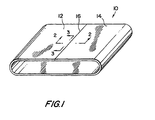
- FIG 1 is a schematic perspective view of an on-machine-seamable (OMS®) papermakers' fabric 10.
- OMS® on-machine-seamable papermakers' fabric 10.
- the fabric takes the form of an endless loop once its two ends 12,14 have been joined to one another at seam 16.
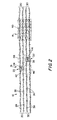
- FIG 2 is a cross-sectional view taken as indicated by line 2-2 in Figure 1.
- Papermakers' fabric 10 is of the variety having two on-machine-seamable (OMS®) base fabrics 20,30.
- Outer base fabric 20 surrounds inner base fabric 30, the latter being joined into endless-loop form within the endless-loop form of the former.
- Inner base fabric 30 is of substantially the same length as outer base fabric 20, so that seam 32 is closed by directing pintle 34 therethrough at the same time as, or immediately before or after, seam 22 is closed by directing pintle 24 therethrough.
- Inner base fabric 30 and outer base fabric 20 are joined to one another by needling one or more layers of staple fiber batt into at least one of the base fabrics 20,30 to join the two base fabrics 20,30 to one another.
- staple fiber batt 40 is shown in only a portion of Figure 2, but it should be understood that it joins the inner and outer base fabrics 30,20 to one another at all points except the immediate region of the seam 16, from which batt 40 is removed during processing to facilitate the meshing of the seaming loops 42,44.
- Batt 40 may comprise staple fibers of any of the polymeric resins used in the production of papermachine clothing, but preferably of polyamide.
- Outer base fabric 20 is woven from longitudinal, or machine-direction (MD), yarns 26 and transverse, or cross-machine direction (CD), yarns 28.
- MD yarns 26 form seaming loops 42 which are interdigitated and joined to one another by directing pintle 24 through the passage defined by the interdigitated seaming loops 42 to form seam 22.
- inner base fabric 30 is woven from longitudinal, or machine-direction (MD), yarns 36 and transverse, or cross-machine-direction (CD), yarns 38.
- MD yarns 36 form seaming loops 44 which are interdigitated and joined to one another by directing pintle 34 through the passage defined by the interdigitated seaming loops 44 to form seam 32.
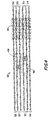
- Figure 3 is a cross-sectional view taken as indicated by line 3-3 in Figure 1.
- Outer base fabric 20 is shown as being entirely separate from inner base . fabric 30, the distance of separation being exaggerated for the sake of clarity.
- Staple fiber batt 40 which joins the outer base fabric 20 to the inner base fabric 30, is also omitted for the sake of clarity.
- Figure 2 shows a fabric 10 comprising two double-layer base fabrics 20, 30, whose seams 22, 32 are offset longitudinally from one another
- the double-layer base fabrics 20, 30 may have MD yarns 26, 36 and/or CD yarns 28, 38 which are different from one another.
- the two double-layer base fabrics 20, 30 may each be woven in a different weave pattern.
- One of the two base fabrics 20, 30, or both, may be a single-layer fabric.
- an endless woven base fabric may be laminated to the top of any combination of two on-machine-seamable base fabrics having longitudinally offset seams.
- the endless base fabric may be of any weave pattern and include yarns of any variety.
- a non-woven mesh such as that disclosed in commonly assigned U.S. Patent "No. 4,427,734, or a spirally wound base fabric produced in accordance with the teachings of commonly assigned U.S. Patent No. 5,360,656 may be laminated to the top of any combination of two on-machine-seamable base fabrics having longitudinally offset seams.
- an endless woven base fabric, a non-woven mesh as disclosed in U.S. Patent No. 4,427,734, or a spirally wound base fabric produced in accordance with the teachings of U.S. Patent No. 5,360,656 may be laminated to the backside of any combination of two on-machine-seamable base fabrics having longitudinally offset seams.
- Figure 4 is a cross-sectional view, analogous to that provided in Figure 2, for an embodiment of the present invention having an endless woven base fabric laminated to both sides of two on-machine-seamable base fabrics having longitudinally offset seams.
- On-machine-seamable papermakers' fabric 50 includes an endless base fabric 52 outside of outer base fabric 20 and an endless base fabric 54 within inner base fabric 30. Endless base fabric 52, outer and inner base fabrics 20,30, and endless base fabric 54 are all joined together by batt 40 of staple fibers needled through the laminated structure. As above, batt 40 is shown in only a portion of Figure 4 for the sake of clarity.
- the present invention may also be practiced by using more than two on-machine-seamable base fabrics, whose seams are longitudinally offset from one another, to produce fabric 10.
- the plurality (greater than two) of on-machine-seamable base fabrics are bonded or laminated together by applying staple fiber batt to one or both sides of the structure by needling.
- MD yarns 26, CD yarns 28, MD yarns 36 and CD yarns 38 may each be of any of the yarn types used to weave papermachine clothing. That is to say, monofilament yarns, which are monofilament strands used singly, or plied/twisted yarns, in the form of plied monofilament or plied multifilament yarns may be used as any of these yarns.
- the filaments comprising MD yarns 26, CD yarns 28, MD yarns 36 and CD yarns 38 are extruded from synthetic polymeric resin materials, such as polyamide, polyester, polyetherketone, polypropylene, polyaramid, polyolefin and polyethylene terephthalate (PET) resins, and incorporated into yarns according to techniques well-known in the textile industry and particularly in the papermachine clothing industry.
- synthetic polymeric resin materials such as polyamide, polyester, polyetherketone, polypropylene, polyaramid, polyolefin and polyethylene terephthalate (PET) resins
- Pintles 24,34 may be single strands of monofilament; multiple strands of monofilament; multiple strands of monofilament untwisted about one another, or plied, twisted, braided or knitted together; or of any of the other pintle types used to join seams in papermachine clothing.
- the pintles 24,34 may be extruded from synthetic polymeric resin materials, such as those listed in the preceding paragraph.
- seam 22 in outer base fabric 20 is offset longitudinally from seam 32 in inner base fabric 30.
- the region of seam 22 in outer base fabric 20 coincides with a non-seam region 46 of the inner base fabric 30.
- the region of seam 32 in inner base fabric 30 coincides with a non-seam region 48 of the outer base fabric 20.
- non-seam regions 46,48 below and above seams 22,32, respectively include additional flow-resistant material to compensate for the flow resistance that is lost from the seams 22,32 both in the manufacturing process and throughout life on the papermachine.
- flow resistance is lost because batt fiber is lost from the vicinities of the seams 22,32.
- batt fiber is removed from the non-paper or bottomside of the seaming loops in the papermakers' fabric to facilitate the changing of pintles used in the manufacturing process. Batt fiber is also cleaned out of the seaming loops 42,44 to enable pintles to be directed therethrough more readily during seaming on the papermachine.
- the staple fiber batt 40 is cut in the vicinity of seam 16 to create a flap thereover, some fiber is inevitably lost, resulting in lower flow resistance.
- the flow resistance in the non-seam regions 46,48 adjacent to seams 22,32, respectively is increased by the addition of flow-resistant material to compensate for any inadequate flow resistance in seams 22,32 due to loss of batt fiber.
- non-seam regions 46,48 may be provided with additional CD yarns during the weaving of the inner and outer base fabrics 30,20, or thereafter.
- the additional CD yarns may be monofilament, multifilament, texturized, braided, knitted or spun yarns of appropriate weight and size to provide the required level of flow resistance. They may have cross sections of circular, oval, rectangular, lobed or other shapes.
- the additional CD yarns may be of the same type as or different from the functional CD yarns 28,38. Further, the additional CD yarns may be woven in the same weave pattern and/or count (number per inch) or in a different weave pattern and/or count as functional CD yarns 28,38.
- monofilament, multifilament, texturized, braided, knitted or spun yarns may be sewn into the non-seam regions 46,48 to accomplish the same result as above. Again, they may have cross sections of circular, oval, rectangular, lobed or other shapes.
- a ribbon of woven or non-woven material or of polymeric film may be applied to non-seam regions 46,48 and sewn or attached thereto by an adhesive.
- polymeric foams or liquid resins may be applied to non-seam regions 46,48 and cured to provide a desired additional flow resistance.
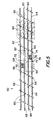
- Figure 5 is a cross-sectional view of another embodiment of the present invention.
- On-machine-seamable papermakers' fabric 60 is an integrally woven multi-layered structure comprising a system of first MD yarns 62 and a system of second MD yarns 64.
- the system of first MD yarns 62 and the system of second MD yarns 64 are interwoven with at least one system of CD yarns 66.
- first MD yarns 62 form first seaming loops 68 at the two ends of the fabric 60.
- First seaming loops 68 form first seam 70 which is closed by directing pintle 72 therethrough in the previously described and well-known manner.
- second MD yarns 64 form second seaming loops 74 at the two ends of the fabric 60.
- Second seaming loops 74 form second seam 76 which is closed by directing pintle 78 therethrough.
- first seaming loops 68 and the second seaming loops 74 are separated from one another in a thichnesswise direction of the fabric 60, and are offset from one another in a longitudinal direction.
- first seam 70 coincides with non-seam region 80
- second seam 76 coincides with non-seam region 82.
- Batt 84 is entangled through the entire structure of fabric 60, but, for the sake of clarity, is shown in only a portion of Figure 5.
- Non-seam regions 80,82 include additional flow-resistant material of the varieties described above to compensate for the flow resistance that is lost from seam 70, 76 both in the manufacturing process and throughout life on the papermachine.
- Figure 6 is a cross-sectional view, like that given in Figure 3, for the embodiment shown in Figure 5, showing the integrally woven multi-layered structure of fabric 60.
- the weave pattern shown is only an example of the many which may be used for this purpose.
Landscapes
- Engineering & Computer Science (AREA)
- Textile Engineering (AREA)
- Paper (AREA)
- Sewing Machines And Sewing (AREA)
- Treatments For Attaching Organic Compounds To Fibrous Goods (AREA)
- Physical Or Chemical Processes And Apparatus (AREA)
- Treatment Of Fiber Materials (AREA)
- Prostheses (AREA)
- Sealing Material Composition (AREA)
Claims (58)
- Auf der Maschine vernähbares Papiermaschinentuch (10), das umfasst:wobei in dem ersten und dem zweiten zusammentreffenden Nichtvemähbereich (46, 48) des ersten bzw. des zweiten Grundgewebes (20, 30) zusätzliches Strömungswiderstandsmaterial enthalten ist, so dass, wenn das auf der Maschine vernähbare Papiermaschinentuch in der Form einer Endlosschlaufe verbunden wird, indem die ersten Vemähschlaufen (42) an den zwei Breitenkanten des ersten Grundgewebes (20) miteinander in Eingriff gebracht werden und indem ein erster Gelenkstift (24) durch den Durchlass geführt wird, der von den miteinander in Eingriff befindlichen ersten Vemähschlaufen (42) gebildet wird, um eine erste Vernähung (22) zu bilden, und indem die zweiten Vernähschlaufen (44) an den zwei Breitenkanten des zweiten Grundgewebes (30) miteinander in Eingriff gebracht werden und indem ein zweiter Gelenkstift (34) durch den Durchlass geführt wird, der von den miteinander in Eingriff befindlichen zweiten Vernähschlaufen (44) gebildet wird, um eine zweite Vemähung (32) zu bilden, die erste und die zweite Vernähung (22, 32) mit dem ersten und dem zweiten zusammentreffenden Nichtvemähbereich (46, 48) zusammentreffen, die zusätzliches Strömungswiderstandsmaterial darin aufweisen, so dass das auf der Maschine vemähbare Papiermaschinentuch in der Nähe der ersten und der zweiten Vemähung (22, 32) Durchlässigkeiten für Luft und Wasser aufweist, die im Wesentlichen identisch mit dem Rest desselben sind.ein erstes Grundgewebe (20), wobei das erste Grundgewebe (20) ein System erster Garne (26) in Maschinenrichtung und ein System erster Garne (28) quer zur Maschinenrichtung aufweist, wobei die Garne des Systems erster Garne (26) in Maschinenrichtung mit den Garnen des Systems erster Garne (28) quer zur Maschinenrichtung verwebt sind, um das Grundgewebe (20) in einer rechteckigen Form mit einer Länge, einer Breite, zwei Längskanten und zwei Breitenkanten zu bilden, wobei die ersten Garne (26) in Maschinenrichtung erste Vernähschlaufen (42) an jeder der zwei Breitenkanten bilden;ein zweites Grundgewebe (30), wobei das zweite Grundgewebe (30) ein System zweiter Garne (36) in Maschinenrichtung und ein System zweiter Garne (38) quer zur Maschinenrichtung aufweist und die Garne des Systems zweiter Garne (36) in Maschinenrichtung mit den Gamen des Systems zweiter Garne (38) quer zur Maschinenrichtung verwebt sind, um das zweite Grundgewebe (30) in einer rechteckigen Form mit einer Länge, einer Breite, zwei Seitenkanten und zwei Breitenkanten zu bilden, wobei die zweiten Gärne in Maschinenrichtung zweite Vernähschlaufen (34) an jeder der zwei Breitenkanten bilden; und wobeidas erste Grundgewebe (20) und das zweite Grundgewebe (30) im Wesentlichen äquivalente Längen und Breiten haben und miteinander durch wenigstens eine Schicht von Stapelfaserflor (40) verbunden sind, die damit verwickelt ist, dadurch gekennzeichnet, dass das erste Grundgewebe (20) und das zweite Grundgewebe (30) in Bezug zueinander in einer Längsrichtung versetzt sind, wenn sie so verbunden sind, so dass die ersten und die zweiten Vernähschlaufen (42, 44) an beiden der zwei Breitenkanten des ersten und des zweiten Grundgewebes (20, 30) desgleichen in einer Längsrichtung zueinander versetzt sind, so dass die ersten Vernähschlaufen (42) an einer Breitenkante des ersten Grundgewebes (20) mit einem Nichtvemähbereich (46) des zweiten Grundgewebes (30) zusammentreffen und so dass die zweiten Vernähschlaufen (44) an einer Breitenkante des zweiten Grundgewebes (30) mit einem Nichtvemähbereich (48) des ersten Grundgewebes (20) zusammentreffen, wobei der Nichtvemähbereich (48) des ersten Grundgewebes (20) ein erster zusammentreffender Nichtvemähbereich (48) ist und der Nichtvernähbereich (46) des zweiten Grundgewebes (309 ein zweiter zusammentreffender Nichtvemähbereich (46) ist;
- Auf der Maschine vernähbares Papiermaschinentuch nach Anspruch 1, wobei es sich bei dem zusätzlichen Strömungswiderstandsmaterial um zusätzliche Garne quer zur Maschinenrichtung in den zusammentreffenden Nichtvernähbereichen (46, 48) des ersten und des zweiten Grundgewebes (20, 30) handelt.
- Auf der Maschine vernähbares Papiermaschinentuch nach Anspruch 2, wobei die zusätzlichen Garne quer zur Maschinenrichtung in die zusammentreffenden Nichtvemähbereiche (46, 48) des ersten und des zweiten Grundgewebes (20, 30) während des Webens derselben integriert werden.
- Auf der Maschine vernähbares Papiermaschinentuch nach Anspruch 2, wobei die zusätzlichen Garne quer zur Maschinenrichtung in die zusammentreffenden Nichtvemähbereiche (46, 48) des ersten und des zweiten Grundgewebes (20, 30) nach dem Weben derselben eingefügt werden.
- Auf der Maschine vernähbares Papiermaschinentuch nach Anspruch 2, wobei die zusätzlichen Game quer zur Maschinenrichtung in die zusammentreffenden Nichtvemähbereiche (46, 48) des ersten und des zweiten Grundgewebes (20, 30) nach dem Weben derselben genäht werden.
- Auf der Maschine vernähbares Papiermaschinentuch nach Anspruch 2, wobei die zusätzlichen Garne quer zur Maschinenrichtung aus der Gruppe von Garnarten ausgewählt werden, die aus Monofil-, Multifil-, texturierten, geflochtenen, gewirkten und gesponnenen Gamen besteht.
- Auf der Maschine vernähbares Papiermaschinentuch nach Anspruch 2, wobei die zusätzlichen Garne quer zur Maschinenrichtung Garne einschließen, die. Querschnittsformen haben, die aus der Gruppe ausgewählt werden, die aus Kreis-, Oval-, Rechteck- und Keulenformen bestehen.
- Auf der Maschine vernähbares Papiermaschinentuch nach Anspruch 2, wobei die zusätzlichen Garne quer zur Maschinenrichtung von dem gleichen Typ Garn sind wie wenigstens die ersten oder die zweiten Garne (28, 38) quer zur Maschinenrichtung.
- Auf der Maschine vernähbares Papiermaschinentuch nach Anspruch 2, wobei die zusätzlichen Garne quer zur Maschinenrichtung von einem Typ Garn sind, der sich wenigstens von den ersten oder den zweiten Gamen (28, 38) quer zur Maschinenrichtung unterscheidet.
- Auf der Maschine vemähbares Papiermaschinentuch nach Anspruch 3, wobei die zusätzlichen Garne quer zur Maschinenrichtung mit den ersten und den zweiten Garnen (26, 36) in Maschinenrichtung in einer Bindungsstruktur verwebt sind, die identisch mit der ist, in der die ersten Garne (28, 38) quer zur Maschinenrichtung mit den ersten Garnen (26, 36) in Maschinenrichtung verwebt sind.
- Auf der Maschine vemähbares Papiermaschinentuch nach Anspruch 3, wobei die zusätzlichen Garne quer zur Maschinenrichtung mit den ersten und den zweiten Gamen (26, 36) in Maschinenrichtung in einer Bindungsstruktur verwebt sind, die identisch mit der ist, in der die zweiten Garne (38) quer zur Maschinenrichtung mit den zweiten Gamen (36) in Maschinenrichtung verwebt sind.
- Auf der Maschine vernähbares Papiermaschinentuch nach Anspruch 3, wobei die zusätzlichen Garne quer zur Maschinenrichtung mit den ersten und den zweiten Garnen (26, 36) in Maschinenrichtung in einer Bindungsstruktur verwebt sind, die sich von der unterscheidet, in der die ersten Garne (28) quer zur Maschinenrichtung mit den ersten Garnen (26) in Maschinenrichtung verwebt sind.
- Auf der Maschine vemähbares Papiermaschinentuch nach Anspruch 3, wobei die zusätzlichen Garne quer zur Maschinenrichtung mit den ersten und den zweiten Garnen (26, 36) in Maschinenrichtung in einer Bindungsstruktur verwebt sind, die sich von der unterscheidet, in der die zweiten Garne (38) quer zur Maschinenrichtung mit den zweiten Garnen, (36) in Maschinenrichtung verwebt sind.
- Auf der Maschine vernähbares Papiermaschinentuch nach Anspruch 1, wobei es sich bei dem zusätzlichen Strömungswiderstandsmaterial um Bänder aus gewebtem Material handelt, die an den zusammentreffenden Nichtvernähbereichen (46, 48) des ersten und des zweiten Gewebes (20, 30) angebracht sind.
- Auf der Maschine vemähbares Papiermaschinentuch nach Anspruch 14, wobei die Bänder aus gewebten Material durch Nähen angebracht werden.
- Auf der Maschine vemähbares Papiermaschinentuch nach Anspruch 14, wobei die Bänder aus gewebten Material mit einem Klebstoff angebracht werden.
- Auf der Maschine vemähbares Papiermaschinentuch nach Anspruch 1, wobei es sich bei dem zusätzlichen Strömungswiderstandsmaterial um Bänder aus nichtgewebten Material handelt, die an den zusammentreffenden Nichtvernähbereichen (46, 48) des ersten und des zweiten Grundgewebes (20, 30) angebracht sind.
- Auf der Maschine vemähbares Papiermaschinentuch nach Anspruch 17, wobei die Bänder aus nichtgewebtem Material durch Nähen angebracht werden.
- Auf der Maschine vemähbares Papiermaschinentuch nach Anspruch 17, wobei die Bänder aus nichtgewebtem Material mit einem Klebstoff angebracht werden.
- Auf der Maschine vemähbares Papiermaschinentuch nach Anspruch 1, wobei es sich bei dem zusätzlichen Strömungswiderstandsmaterial um Bänder aus Polymerfilm handelt, die an den zusammentreffenden Nichtvemähbereichen (46, 48) des ersten und des zweiten Grundgewebes (20, 30) angebracht sind.
- Auf der Maschine vemähbares Papiermaschinentuch nach Anspruch 20, wobei die Bänder aus Polymerfilm durch Nähen angebracht werden.
- Auf der Maschine vemähbares Papiermaschinentuch nach Anspruch 20, wobei die Bänder aus Polymerfilm mit einem Klebstoff angebracht werden.
- Auf der Maschine vemähbares Papiermaschinentuch nach Anspruch 1, wobei es sich bei dem zusätzlichen Strömungswiderstandsmaterial um einen Polymerschaumstoff in den zusammentreffenden Nichtvemähbereichen (46, 48) des ersten und des zweiten Grundgewebes (20, 30) handelt.
- Auf der Maschine vernähbares Papiermaschinentuch nach Anspruch 1, wobei es sich bei dem zusätzlichen Strömungswiderstandsmaterial um ein ausgehärtetes flüssiges Harz in den zusammentreffenden Nichtvemähbereichen (46, 48) des ersten und des zweiten Grundgewebes (20, 30) handelt.
- Auf der Maschine vernähbares Papiermaschinentuch nach Anspruch 1, wobei wenigstens das erste oder das zweite Grundgewebe (20, 30) ein doppelschichtiges Grundgewebe ist.
- Auf der Maschine vernähbares Papiermaschinentuch nach Anspruch 1, wobei das erste und das zweite Grundgewebe (20, 30) doppelschichtige Grundgewebe sind.
- Auf der Maschine vernähbares Papiermaschinentuch nach Anspruch 26, wobei die ersten Garne (26) in Maschinenrichtung des ersten Grundgewebes (20) sich von den zweiten Gamen (36) in Maschinenrichtung des zweiten Grundgewebes unterscheiden.
- Auf der Maschine vernähbares Papiermaschinentuch nach Anspruch 26, wobei die ersten Garne (28) quer zur Maschinenrichtung des ersten Grundgewebes (20) sich von den zweiten Gamen (38) quer zur Maschinenrichtung des zweiten Grundgewebes (30) unterscheiden.
- Auf der Maschine vernähbares Papiermaschinentuch nach Anspruch 26, wobei das erste Grundgewebe (20) in der gleichen Bindungsstruktur gewebt ist wie das zweite Grundgewebe (30).
- Auf der Maschine vernähbares Papiermaschinentuch nach Anspruch 26, wobei das erste Grundgewebe (20) in einer anderen Bindungsstruktur gewebt ist als das zweite Grundgewebe (30).
- Auf der Maschine vernähbares Papiermaschinentuch nach Anspruch 1, wobei wenigstens das erste oder das zweite Grundgewebe (20, 30) ein einschichtiges Grundgewebe ist.
- Auf der Maschine vernähbares Papiermaschinentuch nach Anspruch 1, wobei das auf der Maschine vemähbare Papiermaschinentuch (10, 50) in Form einer Endlosschlaufe mit einer Innenseite und einer Außenseite verbunden ist und es des Weiteren ein endlos gewebtes Grundgewebe (52, 54) umfasst, das wenigstens auf die Innenseite oder die Außenseite mit wenigstens einer Schicht Stapelfaserflor (40) laminiert ist, die damit verwickelt ist.
- Auf der Maschine vernähbares Papiermaschinentuch nach Anspruch 1, wobei das auf der Maschine vernähbare Papiermaschinentuch in Form einer Endlosschlaufe mit einer Innenseite und einer Außenseite verbunden ist und es des Weiteren ein nichtgewebtes Netz (52, 54) umfasst, das wenigstens auf die Innenseite oder die Außenseite mit wenigstens einer Schicht Stapelfaserflor (40) laminiert ist, die damit verwickelt ist.
- Auf der Maschine vernähbares Papiermaschinentuch nach Anspruch 1, wobei das auf der Maschine vemähbare Papiermaschinentuch in Form einer Endlosschlaufe mit einer Innenseite und einer Außenseite verbunden ist und es des Weiteren ein spiralförmig gewickeltes Grundgewebe (52, 54) umfasst, das wenigstens auf die Innenseite oder die Außenseite mit wenigstens einer Schicht Stapelfaserflor (40) laminiert ist, die damit verwickelt ist.
- Auf der Maschine vernähbares Papiermaschinentuch nach Anspruch 1, das des Weiteren ein drittes Grundgewebe umfasst, wobei das dritte Grundgewebe ein System von dritten Gamen in Maschinenrichtung und ein System von dritten Garnen quer zur Maschinenrichtung aufweist und die Garne des Systems dritter Game in Maschinenrichtung mit den Gamen des Systems dritter Garne quer zur Maschinenrichtung verwebt sind, um das dritte Grundgewebe in einer rechteckigen Form mit einer Länge, einer Breite, zwei Längskanten und zwei Querkanten zu bilden, wobei die dritten Garne in Maschinenrichtung dritte Vemähschlaufen an jeder der zwei Breitenkanten bilden;
wobei das dritte Grundgewebe eine Länge und eine Breite hat, die im Wesentlichen denen des ersten und des zweiten Grundgewebes (20, 30) äquivalent ist, und es mit dem ersten und dem zweiten Grundgewebe (20, 30) durch wenigstens eine Schicht Stapelfaserflor (40) verbunden ist, die damit verwickelt ist, wobei das dritte Grundgewebe in Bezug auf das erste und das zweite Grundgewebe (20, 30) in einer Längsrichtung versetzt ist, wenn sie so verbunden sind, so dass die dritten Vernähschlaufen an beiden der zwei Breitenkanten des dritten Grundgewebes desgleichen in einer Längsrichtung in Bezug auf die erste und die zweite Vernähschlaufe (42, 44) an beiden der zwei Breitenkanten des ersten und des zweiten Grundgewebes (20, 30) versetzt sind, so dass die dritten Vernähschlaufen an einer Breitenkante des dritten Grundgewebes mit Nichtvernähbereichen (46, 48) des ersten und des zweiten Grundgewebes zusammentreffen und die ersten Vernähschlaufen (42) an einer Breitenkante des ersten Grundgewebes (20) mit einem Nichtvernähbereich des dritten Grundgewebes zusammentreffen und die zweiten Vernähschlaufen (44) an einer Breitenkante des zweiten Grundgewebes (30) mit einem Nichtvernähbereich des dritten Grundgewebes zusammentreffen;
wobei in den zusammentreffenden Nichtvemähbereichen (46, 48) des ersten, des zweiten und des dritten Grundgewebes zusätzliches Strömungswiderstandsmaterial enthalten ist, so dass, wenn das auf der Maschine vemähbare Papiermaschinentuch in Form einer Endlosschlaufe verbunden wird, indem die ersten Vernähschlaufen (42) an den zwei Breitenkanten des ersten Grundgewebes (20) miteinander in Eingriff gebracht werden und indem ein erster Gelenkstift (24) durch den Durchlass geführt wird, der von den miteinander in Eingriff befindlichen ersten Vemähschlaufen (42) gebildet wird, um eine erste Vemähung (22) zu bilden, und.indem die zweiten Vernähschlaufen (44) an den zwei Breitenkanten des zweiten Grundgewebes (30) miteinander in Eingriff gebracht werden und indem ein zweiter Gelenkstift (34) durch den Durchlass geführt wird, der von den miteinander in Eingriff befindlichen zweiten Vernähschlaufen (44) gebildet wird, um eine zweite Vemähung (32) zu bilden, und indem die dritte Vemähschlaufen an den zwei Breitenkanten des dritten Grundgewebes miteinander in Eingriff gebracht werden und indem ein dritter Gelenkstift durch den Durchlass geführt wird, der von den miteinander in Eingriff. befindlichen dritten Vernähschlaufen gebildet wird, um eine dritte Vemähung zu bilden, die erste Vernähung (22) mit den Nichtvernähbereichen (46) mit zusätzlichem Strömungsverhinderungsmaterial darin in dem zweiten und dem dritten Grundgewebe (30) zusammentrifft, die zweite Vemähung (32) mit Nichtvemähbereichen (48) mit zusätzlichem Strömungsverhinderungsmaterial darin in dem ersten und dem dritten Grundgewebe (20) zusammentrifft und die dritte Vemähung mit Nichtvernähbereichen (46, 48) mit zusätzlichem Strömungsverhinderungsmaterial darin in dem ersten und dem zweiten Grundgewebe (20, 30) zusammentrifft, so dass das auf der Maschine vernähbare Papiermaschinentuch in der Nähe der ersten, der zweiten und der dritten Vemähung (22, 32) Durchlässigkeiten für Luft und Wasser aufweist, die im Wesentlichen identisch mit dem Rest desselben sind. - Auf der Maschine vemähbares Papiermaschinentuch (60), das umfasst:ein Grundgewebe (60), wobei das Grundgewebe ein System erster Garne (62) in Maschinenrichtung, ein System zweiter Garne (64) in Maschinenrichtung und wenigstens ein System von Gamen (66) quer zur Maschinenrichtung ausweist, wobei das wenigstens eine System von Gamen (66) quer zur Maschinenrichtung mit den Systemen erster und zweiter Garne (62, 64) in Maschinenrichtung verwebt ist, um eine integral gewebte mehrschichtige Struktur in einer rechteckigen Form mit einer Länge, einer Breite, zwei Längskanten und zwei Breitkanten herzustellen, wobei die ersten und die zweiten Game (62, 64) in Maschinenrichtung erste bzw. zweite Vernähschlaufen (68, 74) in zwei getrennten Reihen bilden, die voneinander in einer Dickenrichtung des Gewebes (60) entlang jeder der zwei Breitenkanten desselben getrennt sind, dadurch gekennzeichnet, dass die zwei getrennten Reihen in Bezug zueinander in einer Längsrichtung des Grundgewebes (60) versetzt sind, so dass die ersten Vernähschlaufen (68) an einer Breitenkante des Grundgewebes (60) mit einem Nichtvemähbereich (80) desselben zusammentreffen und die zweiten Vernähschlaufen (74) an der anderen Breitenkante des Grundgewebes (60) mit einem anderen Nichtvemähbereich (82) desselben zusammentreffen, und dadurch, dass in den zusammentreffenden Nichtvemähbereichen (80, 82) zusätzliches Strömungswiderstandsmaterial enthalten ist, so dass, wenn das auf der Maschine vemähbare Papiermaschinentuch (60) in Form einer Endlosschlaufe verbunden wird, indem die ersten Vernähschlaufen (68) an den zwei Breitenkanten des Grundgewebes (60) miteinander in Eingriff gebracht werden und indem ein erster Gelenkstift (72) durch den Durchlass geführt wird, der von den miteinander in Eingriff befindlichen ersten Vemähschlaufen (68) gebildet wird, um eine erste Vernähung (70) zu bilden, und indem die zweiten Vernähschlaufen (74) an den zwei Breitenkanten des Grundgewebes (60) miteinander in Eingriff gebracht werden und indem ein zweiter Gelenkstift (78) durch den Durchlass hindurchgeführt wird, der durch die miteinander in Eingriff befindlichen zweiten Vernähschlaufen (74) gebildet wird, um eine zweite Vemähung (76) zu bilden, die erste und die zweite Vernähung (70, 76) jeweils mit einem der zusammentreffenden Nichtvemähbereiche (80, 82) zusammentreffen, die zusätzliches Strömungsverhinderungsmaterial darin aufweisen, so dass das auf der Maschine vemähbare Papiermaschinentuch in der Nähe der ersten und der zweiten Vernähung (70, 76) Durchlässigkeiten für Luft und Wasser aufweist, die im Wesentlichen identisch mit dem Rest desselben sind.
- Auf der Maschine vemähbares Papiermaschinentuch nach Anspruch 36, wobei es sich bei dem zusätzlichen Strömungsverhinderungsmaterial um zusätzliche Garne quer zur Maschinenrichtung in den zusammentreffenden Nichtvemähbereichen (80, 82) des Grundgewebes (60) handelt.
- Auf der Maschine vernähbares Papiermaschinentuch nach Anspruch 37, wobei die zusätzlichen Garne quer zur Maschinenrichtung in die zusammentreffenden Nichtvemähbereiche (80, 82) des Grundgewebes (60) während des Webens desselben integriert werden.
- Auf der Maschine vernähbares Papiermaschinentuch nach Anspruch 37, wobei die zusätzlichen Garne quer zur Maschinenrichtung in die zusammentreffenden Nichtvernähbereiche (80, 82) des Grundgewebes (60) nach dem Weben desselben eingefügt werden.
- Auf der Maschine vernähbares Papiermaschinentuch nach Anspruch 37, wobei die zusätzlichen Garne quer zur Maschinenrichtung in die zusammentreffenden Nichtvernähbereiche (80, 82) des Grundgewebes (60) nach dem Weben desselben genäht werden.
- Auf der Maschine vernähbares Papiermaschinentuch nach Anspruch 37, wobei die zusätzlichen Garne quer zur Maschinenrichtung aus der Gruppe von Garnarten ausgewählt werden, die aus Monofil-, Multifil-, texturierten, geflochtenen, gewirkten und gesponnenen Garnen bestehen.
- Auf der Maschine vernähbares Papiermaschinentuch nach Anspruch 37, wobei die zusätzlichen Garne quer zur Maschinenrichtung Garne einschließen, die Querschnittsformen haben, die aus der Gruppe ausgewählt werden, die aus Kreis-, Oval-, Rechteck- und Keulenformen besteht.
- Auf der Maschine vernähbares Papiermaschinentuch nach Anspruch 37, wobei die zusätzlichen Garne quer zur Maschinenrichtung von dem gleichen Typ Garn sind wie die Garne (66) quer zur Maschinenrichtung.
- Auf der Maschine vernähbares Papiermaschinentuch nach Anspruch 37, wobei die zusätzlichen Garne quer zur Maschinenrichtung von einem Typ Garn sind, der sich von den Gamen (60) quer zur Maschinenrichtung unterscheidet.
- Auf der Maschine vernähbares Papiermaschinentuch nach Anspruch 36, wobei es sich bei dem zusätzlichen Strömungsverhinderungsmaterial um Bänder aus gewebtem Material handelt, die an den zusammentreffenden Nichtvemähbereichen (80, 82) des Grundgewebes (60) angebracht sind.
- Auf der Maschine vernähbares Papiermaschinentuch nach Anspruch 45, wobei die Bänder aus gewebtem Material durch Nähen angebracht werden.
- Auf der Maschine vernähbares Papiermaschinentuch nach Anspruch 45, wobei die Bänder aus gewebtem Material mit einem Klebstoff angebracht werden.
- Auf der Maschine vernähbares Papiermaschinentuch nach Anspruch 36, wobei es sich bei dem zusätzlichen Strömungsverhinderungsmaterial um Bänder aus nichtgewebtem Material handelt, die an den zusammentreffenden Nichtvemähbereichen (80, 82) des Grundgewebes (60) angebracht werden.
- Auf der Maschine vernähbares Papiermaschinentuch nach Anspruch 48, wobei die Bänder aus nichtgewebtem Material durch Nähen angebracht werden.
- Auf der Maschine vernähbares Papiermaschinentuch nach Anspruch 48, wobei die Bänder aus nichtgewebtem Material mit einem Klebstoff angebracht werden.
- Auf der Maschine vernähbares Papiermaschinentuch nach Anspruch 36, wobei es sich bei dem zusätzlichen Strömungsverhinderungsmaterial um Bänder aus Polymerfilm handelt, die an den zusammentreffenden Nichtvernähbereichen (80, 82) des Grundgewebes (60) angebracht sind.
- Auf der Maschine vernähbares Papiermaschinentuch nach Anspruch 51, wobei die Bänder aus Polymerfilm durch Nähen angebracht werden.
- Auf der Maschine vernähbares Papiermaschinentuch nach Anspruch 51, wobei die Bänder aus Polymerfilm mit einem Klebstoff angebracht werden.
- Auf der Maschine vernähbares Papiermaschinentuch nach Anspruch 36, wobei es sich bei dem zusätzlichen Strömungswiderstandsmaterial um einen Polymerschaumstoff in den zusammentreffenden Nichtvemähbereichen (80, 82) des Grundgewebes (60) handelt.
- Auf der Maschine venähbares Papiermaschinentuch nach Anspruch 36, wobei es sich bei dem zusätzlichen Strömungsverhinderungsmaterial um ein ausgehärtetes flüssiges Harz in den zusammentreffenden Nichtvemähbereichen (80, 82) des Grundgewebes (60) handelt.
- Auf der Maschine vernähbares Papiermaschinentuch nach Anspruch 36, wobei das auf der Maschine vernähbare Papiermaschinentuch in Form einer Endlosschlaufe mit einer Innenseite und einer Außenseite verbunden ist und es des Weiteren ein endlos gewebtes Grundgewebe (52, 54) umfasst, das wenigstens auf die Innenseite oder die Außenseite mit wenigstens einer Schicht Stapelfaserflor (40, 84) laminiert ist, die damit verwickelt ist.
- Auf der Maschine venähbares Papiermaschinentuch nach Anspruch 36, wobei das auf der Maschine vernähbare Papiermaschinentuch in Form einer Endlosschlaufe mit einer Innenseite und einer Außenseite verbunden ist und es des Weiteren ein nichtgewebtes Netz (52, 54) umfasst, das wenigstens auf die Innenseite oder die Außenseite mit wenigstens einer Schicht Stapelfaserflor (40, 84) laminiert ist, die damit verwickelt ist.
- Auf der Maschine vernähbares Papiermaschinentuch nach Anspruch 36, wobei das auf der Maschine vernähbare Papiermaschinentuch in Form einer Endlosschlaufe mit einer Innenseite und einer Außenseite verbunden ist und es des Weiteren ein spiralförmig gewickeltes Grundgewebe (52, 54) umfasst, das wenigstens auf eine Innenseite oder eine Außenseite mit wenigstens einer Schicht Stapelfaserflor (40, 84) laminiert ist, die damit verwickelt ist.
Applications Claiming Priority (2)
| Application Number | Priority Date | Filing Date | Title |
|---|---|---|---|
| US09/035,479 US6194331B1 (en) | 1998-03-05 | 1998-03-05 | Flow-resistant material additions to double-seam on machine-seamable fabrics |
| US35479 | 1998-03-05 |
Publications (4)
| Publication Number | Publication Date |
|---|---|
| EP0940499A2 EP0940499A2 (de) | 1999-09-08 |
| EP0940499A3 EP0940499A3 (de) | 2000-04-05 |
| EP0940499B1 true EP0940499B1 (de) | 2003-05-21 |
| EP0940499B8 EP0940499B8 (de) | 2010-06-16 |
Family
ID=21882947
Family Applications (1)
| Application Number | Title | Priority Date | Filing Date |
|---|---|---|---|
| EP19990200611 Expired - Lifetime EP0940499B8 (de) | 1998-03-05 | 1999-03-04 | Zusatz von strömungsverringerndem Material zur Doppelnahtverbindung von Gewebene |
Country Status (15)
| Country | Link |
|---|---|
| US (1) | US6194331B1 (de) |
| EP (1) | EP0940499B8 (de) |
| JP (1) | JP3615413B2 (de) |
| KR (1) | KR100476831B1 (de) |
| CN (1) | CN1101873C (de) |
| AT (1) | ATE241035T1 (de) |
| AU (1) | AU729916B2 (de) |
| BR (1) | BR9900834B1 (de) |
| CA (1) | CA2260708C (de) |
| DE (1) | DE69907995T2 (de) |
| ES (1) | ES2194417T3 (de) |
| ID (1) | ID23223A (de) |
| NO (1) | NO314413B1 (de) |
| TW (1) | TW554120B (de) |
| ZA (1) | ZA991104B (de) |
Families Citing this family (20)
| Publication number | Priority date | Publication date | Assignee | Title |
|---|---|---|---|---|
| US6213164B1 (en) * | 1999-03-11 | 2001-04-10 | Geschmay Corporation | Pintle seamed press felt |
| DE10040828B4 (de) * | 2000-08-21 | 2006-06-14 | Huyck-Austria Ges.M.B.H. | Filz |
| AU2598102A (en) * | 2000-10-23 | 2002-05-06 | Albany Int Corp | Improvements for seamed papermaker's fabrics |
| FI110135B (fi) * | 2000-12-18 | 2002-11-29 | Tamfelt Oyj Abp | Menetelmä puristinhuovan valmistamiseksi ja puristinhuopa |
| US7195814B2 (en) | 2001-05-15 | 2007-03-27 | 3M Innovative Properties Company | Microfiber-entangled products and related methods |
| US7141144B2 (en) * | 2002-12-04 | 2006-11-28 | Albany International Corp. | Multi-layer woven seam baseweave having different sized seam attachments |
| US7086128B2 (en) * | 2002-12-27 | 2006-08-08 | Albany International Corp. | Seam assist attachment device |
| US7032625B2 (en) * | 2003-06-24 | 2006-04-25 | Albany International Corp. | Multi-layer papermaking fabrics having a single or double layer weave over the seam |
| CA2548397C (en) * | 2003-12-11 | 2009-02-03 | Albany International Corp. | Passive sensor system for detection or wear problems in paper machine clothing |
| ZA200604959B (en) * | 2003-12-15 | 2008-02-27 | Albany Int Corp | Pintle for spiral fabrics |
| US7229531B2 (en) * | 2004-05-12 | 2007-06-12 | Albany International Corp. | Method of seaming a multiaxial papermaking fabric to prevent yarn migration |
| US7093621B2 (en) * | 2004-12-15 | 2006-08-22 | Albany International Corp. | Multi-pin pin seam for an industrial fabric |
| US20070141928A1 (en) * | 2005-12-20 | 2007-06-21 | CROOK Robert | Scrim for seams and joins of papermaking fabric |
| US8640862B2 (en) * | 2006-04-10 | 2014-02-04 | Albany International Corp. | Seam-on laminated belt |
| FI7901U1 (fi) * | 2007-03-20 | 2008-06-25 | Tamfelt Pmc Oy | Kuivatusviira ja kuivatusviiran sauma-alue |
| JP4897564B2 (ja) * | 2007-05-11 | 2012-03-14 | 日本フエルト株式会社 | 製紙用シーム付きフェルト |
| JP2011038212A (ja) * | 2009-08-12 | 2011-02-24 | Ichikawa Co Ltd | 製紙用シームフェルト |
| US8252145B2 (en) * | 2010-02-09 | 2012-08-28 | Huyck Licensco, Inc. | Method and device for installing seamed industrial fabric |
| US11098450B2 (en) | 2017-10-27 | 2021-08-24 | Albany International Corp. | Methods for making improved cellulosic products using novel press felts and products made therefrom |
| JP7398043B2 (ja) * | 2019-09-27 | 2023-12-14 | イチカワ株式会社 | 抄紙用フェルトおよびその製造方法 |
Family Cites Families (14)
| Publication number | Priority date | Publication date | Assignee | Title |
|---|---|---|---|---|
| DE2731754C2 (de) * | 1977-07-14 | 1982-08-26 | Fertex Textilmaschinen-Service GmbH, 6072 Dreieich | Verbindngsnaht für einen aus einem Gewebe bestehenden Trockenfilz oder -sieb für Papiermaschinen |
| US4186780A (en) * | 1978-12-15 | 1980-02-05 | Albany International Corp. | Seam construction for multi-layer felts |
| US4418726A (en) * | 1981-01-12 | 1983-12-06 | Albany International Corp. | Double loop seam for corrugator belts |
| FR2600683B1 (fr) * | 1986-06-26 | 1988-12-23 | Feutres Papeteries Tissus Indl | Feutre ouvert pour partie humide |
| US4764417A (en) * | 1987-06-08 | 1988-08-16 | Appleton Mills | Pin seamed papermakers felt having a reinforced batt flap |
| JP2537631B2 (ja) * | 1987-08-14 | 1996-09-25 | 日本フエルト株式会社 | 製紙用シ−ム付フェルトヒ−トセット方法 |
| US4824525A (en) * | 1987-10-14 | 1989-04-25 | Asten Group, Inc. | Papermaking apparatus having a seamed wet press felt |
| US4896702A (en) * | 1988-12-01 | 1990-01-30 | Niagara Lockport Industries Inc. | Seam construction for papermaking fabrics |
| SE467696B (sv) * | 1990-12-21 | 1992-08-31 | Nordiskafilt Ab | Vaev foer en pappersmaskin eller liknande samt saett att tillverka en dylik vaev |
| US5274930A (en) * | 1992-06-30 | 1994-01-04 | The Procter & Gamble Company | Limiting orifice drying of cellulosic fibrous structures, apparatus therefor, and cellulosic fibrous structures produced thereby |
| CN1153543A (zh) * | 1994-05-26 | 1997-07-02 | 斯卡帕集团有限公司 | 叠层织物 |
| US5601877A (en) * | 1994-06-09 | 1997-02-11 | Albany International Corp. | Method of seam closure for sheet transfer and other paper processing belts |
| NZ272169A (en) * | 1994-06-09 | 1997-06-24 | Albany Int Corp | Transfer belt for papermaking machine: seam construction: pintles passed through seaming loops |
| US5904187A (en) * | 1997-10-22 | 1999-05-18 | Albany International Corp. | Seam integrity in multiple layer/multiple seam press fabrics |
-
1998
- 1998-03-05 US US09/035,479 patent/US6194331B1/en not_active Expired - Lifetime
-
1999
- 1999-02-04 CA CA 2260708 patent/CA2260708C/en not_active Expired - Lifetime
- 1999-02-05 ID ID990183D patent/ID23223A/id unknown
- 1999-02-11 AU AU16403/99A patent/AU729916B2/en not_active Ceased
- 1999-02-11 ZA ZA9901104A patent/ZA991104B/xx unknown
- 1999-02-25 BR BRPI9900834-3A patent/BR9900834B1/pt not_active IP Right Cessation
- 1999-02-26 TW TW88102986A patent/TW554120B/zh not_active IP Right Cessation
- 1999-02-26 KR KR10-1999-0006417A patent/KR100476831B1/ko not_active Expired - Fee Related
- 1999-03-04 JP JP5668599A patent/JP3615413B2/ja not_active Expired - Fee Related
- 1999-03-04 ES ES99200611T patent/ES2194417T3/es not_active Expired - Lifetime
- 1999-03-04 EP EP19990200611 patent/EP0940499B8/de not_active Expired - Lifetime
- 1999-03-04 AT AT99200611T patent/ATE241035T1/de active
- 1999-03-04 NO NO19991080A patent/NO314413B1/no unknown
- 1999-03-04 DE DE1999607995 patent/DE69907995T2/de not_active Expired - Lifetime
- 1999-03-05 CN CN99102071A patent/CN1101873C/zh not_active Expired - Fee Related
Also Published As
| Publication number | Publication date |
|---|---|
| CN1101873C (zh) | 2003-02-19 |
| JP3615413B2 (ja) | 2005-02-02 |
| DE69907995D1 (de) | 2003-06-26 |
| DE69907995T2 (de) | 2004-01-22 |
| TW554120B (en) | 2003-09-21 |
| US6194331B1 (en) | 2001-02-27 |
| AU1640399A (en) | 1999-09-16 |
| NO991080L (no) | 1999-09-06 |
| AU729916B2 (en) | 2001-02-15 |
| CA2260708C (en) | 2006-07-18 |
| EP0940499A2 (de) | 1999-09-08 |
| NO314413B1 (no) | 2003-03-17 |
| ES2194417T3 (es) | 2003-11-16 |
| ID23223A (id) | 2000-03-30 |
| KR100476831B1 (ko) | 2005-03-17 |
| BR9900834B1 (pt) | 2009-01-13 |
| CA2260708A1 (en) | 1999-09-05 |
| CN1243179A (zh) | 2000-02-02 |
| EP0940499A3 (de) | 2000-04-05 |
| JPH11323763A (ja) | 1999-11-26 |
| EP0940499B8 (de) | 2010-06-16 |
| BR9900834A (pt) | 2000-01-11 |
| ZA991104B (en) | 1999-09-03 |
| KR19990077484A (ko) | 1999-10-25 |
| NO991080D0 (no) | 1999-03-04 |
| ATE241035T1 (de) | 2003-06-15 |
Similar Documents
| Publication | Publication Date | Title |
|---|---|---|
| US5732749A (en) | Pin seam for laminated integrally woven papermaker's fabric | |
| EP0940499B1 (de) | Zusatz von strömungsverringerndem Material zur Doppelnahtverbindung von Gewebene | |
| US5904187A (en) | Seam integrity in multiple layer/multiple seam press fabrics | |
| AU771612B2 (en) | Four-layer seamed press fabric | |
| EP0816559B1 (de) | Schraubenförmige Naht aus Polyamid für Geweben mit Stecknaht | |
| US6719014B2 (en) | Enhancements for seams in on-machine-seamable papermaker's fabrics | |
| AU2002225981B2 (en) | Seamed papermaker's fabrics | |
| EP1314814B1 (de) | Verbesserte Naht für Papiermachergewebe mit Naht | |
| EP1255892B1 (de) | Technisches gewebe mit stecknaht | |
| AU2004255727A1 (en) | On-machine-seamable papermaking fabric | |
| CA2251659C (en) | Laminated integrally woven papermaker's fabric | |
| MXPA99002200A (en) | Additions of flow resistant material to double stitched fabrics that can be stitched on the machine |
Legal Events
| Date | Code | Title | Description |
|---|---|---|---|
| PUAI | Public reference made under article 153(3) epc to a published international application that has entered the european phase |
Free format text: ORIGINAL CODE: 0009012 |
|
| AK | Designated contracting states |
Kind code of ref document: A2 Designated state(s): AT BE DE ES FI FR GB IT NL SE |
|
| AX | Request for extension of the european patent |
Free format text: AL;LT;LV;MK;RO;SI |
|
| PUAL | Search report despatched |
Free format text: ORIGINAL CODE: 0009013 |
|
| AK | Designated contracting states |
Kind code of ref document: A3 Designated state(s): AT BE CH CY DE DK ES FI FR GB GR IE IT LI LU MC NL PT SE |
|
| AX | Request for extension of the european patent |
Free format text: AL;LT;LV;MK;RO;SI |
|
| 17P | Request for examination filed |
Effective date: 20000513 |
|
| AKX | Designation fees paid |
Free format text: AT BE DE ES FI FR GB IT NL SE |
|
| 17Q | First examination report despatched |
Effective date: 20020403 |
|
| GRAH | Despatch of communication of intention to grant a patent |
Free format text: ORIGINAL CODE: EPIDOS IGRA |
|
| GRAH | Despatch of communication of intention to grant a patent |
Free format text: ORIGINAL CODE: EPIDOS IGRA |
|
| GRAA | (expected) grant |
Free format text: ORIGINAL CODE: 0009210 |
|
| AK | Designated contracting states |
Designated state(s): AT BE DE ES FI FR GB IT NL SE |
|
| REG | Reference to a national code |
Ref country code: GB Ref legal event code: FG4D |
|
| REF | Corresponds to: |
Ref document number: 69907995 Country of ref document: DE Date of ref document: 20030626 Kind code of ref document: P |
|
| REG | Reference to a national code |
Ref country code: SE Ref legal event code: TRGR |
|
| REG | Reference to a national code |
Ref country code: ES Ref legal event code: FG2A Ref document number: 2194417 Country of ref document: ES Kind code of ref document: T3 |
|
| ET | Fr: translation filed | ||
| PLBE | No opposition filed within time limit |
Free format text: ORIGINAL CODE: 0009261 |
|
| STAA | Information on the status of an ep patent application or granted ep patent |
Free format text: STATUS: NO OPPOSITION FILED WITHIN TIME LIMIT |
|
| PG25 | Lapsed in a contracting state [announced via postgrant information from national office to epo] |
Ref country code: BE Free format text: LAPSE BECAUSE OF NON-PAYMENT OF DUE FEES Effective date: 20040331 |
|
| 26N | No opposition filed |
Effective date: 20040224 |
|
| BERE | Be: lapsed |
Owner name: *ALBANY INTERNATIONAL CORP. Effective date: 20040331 |
|
| PGFP | Annual fee paid to national office [announced via postgrant information from national office to epo] |
Ref country code: NL Payment date: 20050216 Year of fee payment: 7 |
|
| PG25 | Lapsed in a contracting state [announced via postgrant information from national office to epo] |
Ref country code: NL Free format text: LAPSE BECAUSE OF NON-PAYMENT OF DUE FEES Effective date: 20061001 |
|
| NLV4 | Nl: lapsed or anulled due to non-payment of the annual fee |
Effective date: 20061001 |
|
| PGFP | Annual fee paid to national office [announced via postgrant information from national office to epo] |
Ref country code: GB Payment date: 20090403 Year of fee payment: 11 |
|
| GBPC | Gb: european patent ceased through non-payment of renewal fee |
Effective date: 20100304 |
|
| PG25 | Lapsed in a contracting state [announced via postgrant information from national office to epo] |
Ref country code: GB Free format text: LAPSE BECAUSE OF NON-PAYMENT OF DUE FEES Effective date: 20100304 |
|
| PGFP | Annual fee paid to national office [announced via postgrant information from national office to epo] |
Ref country code: ES Payment date: 20110328 Year of fee payment: 13 |
|
| PGFP | Annual fee paid to national office [announced via postgrant information from national office to epo] |
Ref country code: FR Payment date: 20120406 Year of fee payment: 14 |
|
| PGFP | Annual fee paid to national office [announced via postgrant information from national office to epo] |
Ref country code: SE Payment date: 20130327 Year of fee payment: 15 |
|
| REG | Reference to a national code |
Ref country code: ES Ref legal event code: FD2A Effective date: 20130710 |
|
| PG25 | Lapsed in a contracting state [announced via postgrant information from national office to epo] |
Ref country code: ES Free format text: LAPSE BECAUSE OF NON-PAYMENT OF DUE FEES Effective date: 20120305 |
|
| REG | Reference to a national code |
Ref country code: FR Ref legal event code: ST Effective date: 20131129 |
|
| PG25 | Lapsed in a contracting state [announced via postgrant information from national office to epo] |
Ref country code: FR Free format text: LAPSE BECAUSE OF NON-PAYMENT OF DUE FEES Effective date: 20130402 |
|
| REG | Reference to a national code |
Ref country code: SE Ref legal event code: EUG |
|
| PG25 | Lapsed in a contracting state [announced via postgrant information from national office to epo] |
Ref country code: SE Free format text: LAPSE BECAUSE OF NON-PAYMENT OF DUE FEES Effective date: 20140305 |
|
| PGFP | Annual fee paid to national office [announced via postgrant information from national office to epo] |
Ref country code: FI Payment date: 20160325 Year of fee payment: 18 Ref country code: AT Payment date: 20160219 Year of fee payment: 18 |
|
| PGFP | Annual fee paid to national office [announced via postgrant information from national office to epo] |
Ref country code: DE Payment date: 20160331 Year of fee payment: 18 |
|
| PGFP | Annual fee paid to national office [announced via postgrant information from national office to epo] |
Ref country code: IT Payment date: 20160323 Year of fee payment: 18 |
|
| REG | Reference to a national code |
Ref country code: DE Ref legal event code: R119 Ref document number: 69907995 Country of ref document: DE |
|
| PG25 | Lapsed in a contracting state [announced via postgrant information from national office to epo] |
Ref country code: FI Free format text: LAPSE BECAUSE OF NON-PAYMENT OF DUE FEES Effective date: 20170304 |
|
| REG | Reference to a national code |
Ref country code: AT Ref legal event code: MM01 Ref document number: 241035 Country of ref document: AT Kind code of ref document: T Effective date: 20170304 |
|
| PG25 | Lapsed in a contracting state [announced via postgrant information from national office to epo] |
Ref country code: AT Free format text: LAPSE BECAUSE OF NON-PAYMENT OF DUE FEES Effective date: 20170304 Ref country code: DE Free format text: LAPSE BECAUSE OF NON-PAYMENT OF DUE FEES Effective date: 20171003 |
|
| PG25 | Lapsed in a contracting state [announced via postgrant information from national office to epo] |
Ref country code: IT Free format text: LAPSE BECAUSE OF NON-PAYMENT OF DUE FEES Effective date: 20170304 |