EP0943661A2 - Chromophore Verbindungen und Verfahren zu ihrer Herstellung - Google Patents
Chromophore Verbindungen und Verfahren zu ihrer Herstellung Download PDFInfo
- Publication number
- EP0943661A2 EP0943661A2 EP99103890A EP99103890A EP0943661A2 EP 0943661 A2 EP0943661 A2 EP 0943661A2 EP 99103890 A EP99103890 A EP 99103890A EP 99103890 A EP99103890 A EP 99103890A EP 0943661 A2 EP0943661 A2 EP 0943661A2
- Authority
- EP
- European Patent Office
- Prior art keywords
- compound according
- radicals
- group
- radical
- general formula
- Prior art date
- Legal status (The legal status is an assumption and is not a legal conclusion. Google has not performed a legal analysis and makes no representation as to the accuracy of the status listed.)
- Granted
Links
Classifications
-
- G—PHYSICS
- G02—OPTICS
- G02F—OPTICAL DEVICES OR ARRANGEMENTS FOR THE CONTROL OF LIGHT BY MODIFICATION OF THE OPTICAL PROPERTIES OF THE MEDIA OF THE ELEMENTS INVOLVED THEREIN; NON-LINEAR OPTICS; FREQUENCY-CHANGING OF LIGHT; OPTICAL LOGIC ELEMENTS; OPTICAL ANALOGUE/DIGITAL CONVERTERS
- G02F1/00—Devices or arrangements for the control of the intensity, colour, phase, polarisation or direction of light arriving from an independent light source, e.g. switching, gating or modulating; Non-linear optics
- G02F1/35—Non-linear optics
- G02F1/355—Non-linear optics characterised by the materials used
- G02F1/361—Organic materials
- G02F1/3613—Organic materials containing Sulfur
- G02F1/3614—Heterocycles having S as heteroatom
-
- C—CHEMISTRY; METALLURGY
- C09—DYES; PAINTS; POLISHES; NATURAL RESINS; ADHESIVES; COMPOSITIONS NOT OTHERWISE PROVIDED FOR; APPLICATIONS OF MATERIALS NOT OTHERWISE PROVIDED FOR
- C09B—ORGANIC DYES OR CLOSELY-RELATED COMPOUNDS FOR PRODUCING DYES, e.g. PIGMENTS; MORDANTS; LAKES
- C09B19/00—Oxazine dyes
-
- C—CHEMISTRY; METALLURGY
- C09—DYES; PAINTS; POLISHES; NATURAL RESINS; ADHESIVES; COMPOSITIONS NOT OTHERWISE PROVIDED FOR; APPLICATIONS OF MATERIALS NOT OTHERWISE PROVIDED FOR
- C09B—ORGANIC DYES OR CLOSELY-RELATED COMPOUNDS FOR PRODUCING DYES, e.g. PIGMENTS; MORDANTS; LAKES
- C09B57/00—Other synthetic dyes of known constitution
-
- G—PHYSICS
- G02—OPTICS
- G02F—OPTICAL DEVICES OR ARRANGEMENTS FOR THE CONTROL OF LIGHT BY MODIFICATION OF THE OPTICAL PROPERTIES OF THE MEDIA OF THE ELEMENTS INVOLVED THEREIN; NON-LINEAR OPTICS; FREQUENCY-CHANGING OF LIGHT; OPTICAL LOGIC ELEMENTS; OPTICAL ANALOGUE/DIGITAL CONVERTERS
- G02F1/00—Devices or arrangements for the control of the intensity, colour, phase, polarisation or direction of light arriving from an independent light source, e.g. switching, gating or modulating; Non-linear optics
- G02F1/35—Non-linear optics
- G02F1/355—Non-linear optics characterised by the materials used
- G02F1/361—Organic materials
- G02F1/3611—Organic materials containing Nitrogen
- G02F1/3612—Heterocycles having N as heteroatom
Definitions
- the present invention relates to new chromophoric compounds and a process for their manufacture.
- Chromophore compounds especially nonlinear-optical Chromophores represent the essential component for so-called organic conductor materials, i.e. for electric conductive materials.
- organic conductor materials i.e. for electric conductive materials.
- electro-optical and photonic components in particular switches, as well as in the areas of information processing and the integrated optics, such as optical chip-to-chip connections, waveguiding in electro-optical Layers in optical signal processing in the Sensors and the like.
- chromophore systems have conjugated ones ⁇ electron systems in the molecule and carry on suitable Positions of the ⁇ electron system electron donors or acceptors.
- NLO-active chromophores are those with high Dipole moment ⁇ , high hyperpolarizability ⁇ and suitable Absorption properties ⁇ and with a high nonlinear optical Activity of great interest. For the different Areas of application should also include high thermal stability exhibit.
- the systems known from the prior art are very sensitive to high temperatures.
- the object of the present invention is therefore to create new ones non-linear optical chromophores with the aforementioned properties to provide which is easier Made from easily accessible raw materials and in high Have purity made.
- the radicals R 1 , R 4 and R 5 each represent a hydrogen atom.
- the radicals R 2 and R 3 are - independently of one another - preferably a C 2 - to C 7 -alkyl radical, most preferably an ethyl, butyl or heptyl group.
- One of the radicals R 2 and R 3 advantageously has a functional group in the form of a hydroxyalkyl or carboxyalkyl group (with a terminal OH or COOH group), for example a hydroxyethyl group.
- radicals R 1 , R 2 , R 3 , R 4 and / or R 5 represent a heteroaryl radical
- this is preferably selected from the group formed by the thiophenes, thiazoles and pyridines, ie it is a Thienyl, thiazolyl or pyridyl radical before;
- Aryl residues are preferably phenyl or naphthyl residues.
- those compounds of the general formula 1 given above are preferred compounds in which the radicals R 1 and R 2 have suitable functional groups for the joint formation of a 5- or 6-membered ring.
- radicals R 3 and R 4 of the general formula 1 can also have suitable functional groups for the joint formation of a 5- or 6-membered ring.
- the radicals R 1 and R 2 and R 3 and R 4 together can each represent such a saturated or unsaturated, substituted or unsubstituted 5- or 6-ring.
- the radicals R 2 and R 3 according to the general formula 1 given above also comprise functional groups which are suitable for the joint formation of a 5- or 6-membered ring; this ring optionally has an OH or COOH group bonded directly or via an aliphatic hydrocarbon radical.
- R 1 and R 2 and R 3 and R 4 5- or 6-rings can be formed, which can be substituted or unsubstituted and saturated or unsaturated.
- the ring system is preferably saturated and, in a further preferred embodiment, has at least one further nitrogen or oxygen atom in the ring in addition to the original nitrogen atom. This ring can also be substituted or unsubstituted.
- substituents are present on the ring, in a further preferred embodiment these are further functional groups, such as, for example, hydroxyalkyl or carboxyalkyl groups.
- a suitable selection of the functionalities of the radicals R 2 and R 3 can give these ring groups of the morpholine or piperazine type.
- Preferred are morpholin-4-yl, piperazin-1-yl and 4- (C 1 - to C 4 -alkyl) -piperazin-1-yl groups, for example the 4-methyl-piperazin-1-yl and the 4- (2-hydroxyethyl) piperazin-1-yl group.
- the compounds of the invention can therefore be the broadest Senses are considered as oxazine derivatives, but especially as benzoxazines and phenoxazines.
- the compounds specified above are so-called nonlinear-optical chromophores with a high ⁇ value and at the same time high ⁇ and suitable ⁇ max values.
- Suitable ⁇ max values are greater than 600 nm and are preferably about 700 nm.
- the chromophores can be obtained in a simple and economical manner from easily accessible starting materials in high purity.
- the present invention accordingly also relates to a process for the preparation of chromophoric compounds of the general formula 1 by a corresponding 5-amino-2-nitroso-phenol or a mineral acid salt thereof of the general formula 2 with a methylene-active compound of the general formula 3A or the tautomeric form 3B condensed at elevated temperature in a polar solvent and in the presence of a base.
- the base is, for example, triethylamine.
- Both the compounds of formula 2 and the methylene-active Compounds of formula 3A or their tautomeric form 3B are easily accessible starting materials so that the Preparation of the compounds of formula 1 in an economical manner Yield can be carried out.
- the 5-amino-2-nitroso-phenols Formula 2 can be done in a simple manner Prepare nitrosation of the corresponding 3-amino-phenols.
- the 5-amino-2-nitroso-phenols obtained in this way can preferably in an equimolar ratio with the corresponding methylene-active compounds are implemented.
- An - is the anion of any mineral acid such as a chloride, bromide or iodide and perchlorate, tetrafluoroborate or tetraphenylborate anion.
- Particularly preferred anions in compound type 2 are the anions of such acids which give well crystallizing salts. These are preferably the chloride or perchlorate anion.
- Dimethylformamide, dimethylacetamide or N-methyl-pyrrolidone is preferably used as the polar solvent. Suitable and therefore preferred reaction temperatures are between 120 and 150 ° C.
- the starting materials mentioned are preferably in the equimolar Relationship implemented.
- the products made are made by diluting the reaction solution with a less polar solvents such as diethyl ether or a lower one Alkanol, precipitated and isolated by suction and, if appropriate purified by recrystallization or chromatography.
- the method according to the invention is preferably such performed that the condensation of the compound of general formula 2 with the compound of general Formula 3A or 3B - in an equimolar ratio - in dimethylformamide, Dimethylacetamide or N-methyl-pyrrolidone at one Temperature between 120 and 150 ° C.
- the compounds according to the invention are particularly suitable as chromophoric components for non-linear-optically active Polymers or electro-optical and photonic ones made from them Components.
Landscapes
- Physics & Mathematics (AREA)
- Nonlinear Science (AREA)
- General Physics & Mathematics (AREA)
- Optics & Photonics (AREA)
- Chemical & Material Sciences (AREA)
- Organic Chemistry (AREA)
- Heterocyclic Carbon Compounds Containing A Hetero Ring Having Nitrogen And Oxygen As The Only Ring Hetero Atoms (AREA)
- Photoreceptors In Electrophotography (AREA)
- Nitrogen And Oxygen Or Sulfur-Condensed Heterocyclic Ring Systems (AREA)
- Nitrogen Condensed Heterocyclic Rings (AREA)
- Heterocyclic Carbon Compounds Containing A Hetero Ring Having Oxygen Or Sulfur (AREA)
Abstract

Description

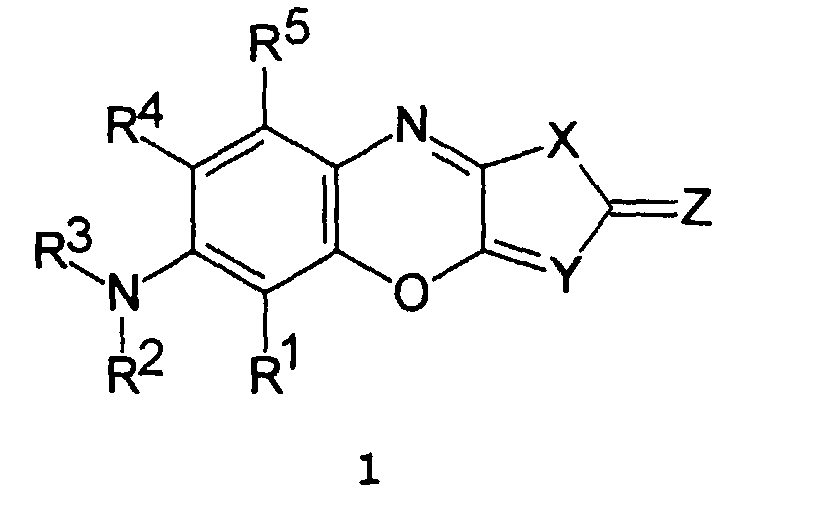
- R1, R4, R5
- jeweils ein Wasserstoffatom, ein linearer oder verzweigter C1- bis C20-Alkylrest, welcher gegebenenfalls durch 1 bis 5 Sauerstoffatome in Etherfunktion unterbrochen ist, oder ein Aryl- oder Heteroarylrest sind;
- R2, R3
- jeweils ein Wasserstoffatom, ein linearer oder verzweigter C1- bis C20-Alkylrest, welcher gegebenenfalls durch 1 bis 5 Sauerstoffatome in Etherfunktion unterbrochen ist, ein Benzylrest oder ein Aryl- oder Heteroarylrest sind, wobei gegebenenfalls einer der Reste R2 und R3 eine Hydroxyl- oder Carboxylgruppe aufweist;
- Z
- eine Elektronenakzeptor-substituierte Methylen-oder Iminogruppe ist;
- X
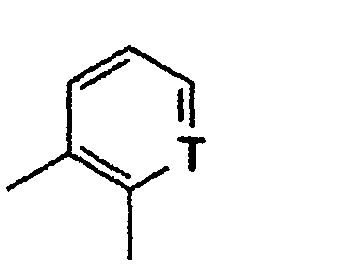
- für S, O, NR6 oder eine Ringdoppelbindung oder
für
steht, wobei R6 ein Wasserstoffatom, ein linearer oder verzweigter C1- bis C20-Alkylrest oder ein Phenyl- oder Naphthylrest ist und T für CH oder N steht oder gegebenenfalls Z und T zusammen eine Struktur vom Typ =N-SO2-C≡, =N-CS-C≡ oder =N-CO-C≡ bilden; und
- Y
- eine CH- oder CR7-Gruppe oder N ist, wobei R7 ein linearer oder verzweigter C1- bis C20-Alkylrest oder ein Phenyl- oder ein Naphthylrest ist.
Das sind:


Analog Beispiel 5 wird aus 0,1 mol 2-Thienyl-acetonitril, 0,3 mol Lithium-diisopropylamid und 0,2 mol 2-Chlor-benzyl-rhodanid die Titelverbindung erhalten.
0,13 mol Malonsäuredinitril werden in 100 ml wasserfreiem Tetrahydrofuran unter Rühren und Kühlen portionsweise mit 0,15 mol Natriumhydrid versetzt. Anschließend werden 0,0015 mol Palladiumchlorid-Triphenylphosphin-Komplex zugegeben und 25 g 2-Iod-thiophen tropfenweise zugesetzt, dann wird die Mischung 3 h unter Rückfluß erhitzt. Nach dem Erkalten wird mit Salzsäure neutralisiert und mit Diethylether extrahiert. Nach Abtrennen und Trocknen der etherischen Lösung wird der Ether verdampft und das verbleibende ölige Reaktionsprodukt für die weiteren Umsetzungen eingesetzt.
0,01 mol des nach Beispiel 1 hergestellten Hydrochlorids von 5-Diethylamino-2-nitroso-phenol werden mit 0,01 mol des nach Beispiel 5 hergestellten 1-Naphthyl-malonsäuredinitrils und mit 0,02 mol Triethylamin in 15 ml Dimethylformamid (DMF) kurzzeitig zum Sieden erhitzt. Nach dem Abkühlen wird die Reaktionsmischung mit Wasser verrührt und vom ausfallenden Festprodukt dekantiert. Das Festprodukt wird in Dichlorethan gelöst und nach dem Trocknen und Einengen säulenchromatographisch an Kieselgel unter Verwendung von Essigsäureethylester als mobile Phase gereinigt.
Es wird analog Variante a gearbeitet. Anstelle des Hydrochlorids von 5-Diethylamino-2-nitroso-phenol wird jedoch die freie Base eingesetzt, und es wird auf die Verwendung von Triethylamin verzichtet.

Claims (16)
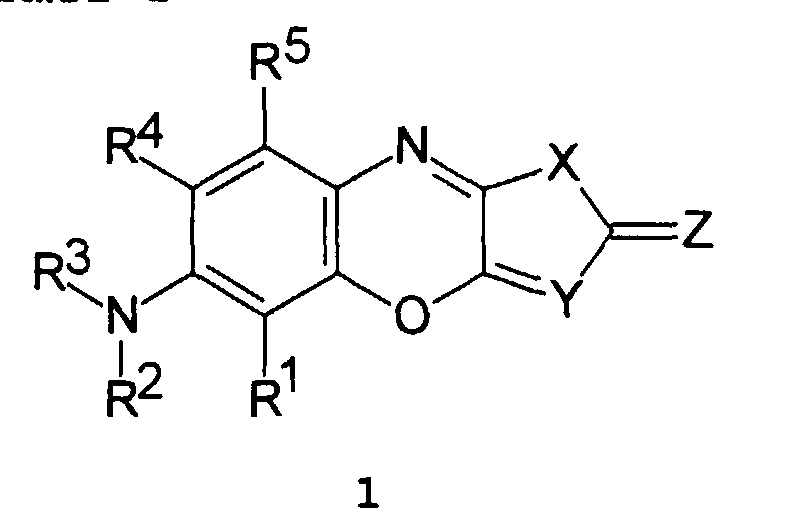
- Chromophore Verbindung der allgemeinen Formel 1wobei
- R1, R4, R5
- jeweils ein Wasserstoffatom, ein linearer oder verzweigter C1- bis C20-Alkylrest, welcher gegebenenfalls durch 1 bis 5 Sauerstoffatome in Etherfunktion unterbrochen ist, oder ein Aryl- oder Heteroarylrest sind;
- R2, R3
- jeweils ein Wasserstoffatom, ein linearer oder verzweigter C1- bis C20-Alkylrest, welcher gegebenenfalls durch 1 bis 5 Sauerstoffatome in Etherfunktion unterbrochen ist, ein Benzylrest oder ein Aryl- oder Heteroarylrest sind, wobei gegebenenfalls einer der Reste R2 und R3 eine Hydroxyl- oder Carboxylgruppe aufweist;
- Z
- eine Elektronenakzeptor-substituierte Methylen-oder Iminogruppe ist;
- X
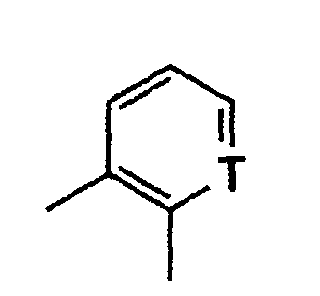
- für S, O, NR6 oder eine Ringdoppelbindung oder
für
steht, wobei R6 ein Wasserstoffatom, ein linearer oder verzweigter C1- bis C20-Alkylrest oder ein Phenyl- oder Naphthylrest ist und T für CH oder N steht oder gegebenenfalls Z und T zusammen eine Struktur vom Typ =N-SO2-C≡, =N-CS-C≡ oder =N-CO-C≡ bilden; und
- Y
- eine CH- oder CR7-Gruppe oder N ist, wobei R7 ein linearer oder verzweigter C1- bis C20-Alkylrest oder ein Phenyl- oder ein Naphthylrest ist.
- Verbindung nach Anspruch 1, dadurch gekennzeichnet, daß die Reste R1, R4 und R5 jeweils ein Wasserstoffatom bedeuten.
- Verbindung nach Anspruch 1 oder 2, dadurch gekennzeichnet, daß die Reste R2 und R3, gleich oder verschieden voneinander, einen C2- bis C7-Alkyl-rest aufweisen.
- Verbindung nach Anspruch 1, dadurch gekennzeichnet, daß für den Fall, daß R1, R2, R3, R4 und/oder R5 ein Heteroarylrest ist, dieser aus der Gruppe ausgewählt ist, welche durch die Thiophene, Thiazole und Pyridine gebildet ist, und bei einem Arylrest durch die Benzole und Naphthaline.
- Verbindung nach Anspruch 1, dadurch gekennzeichnet, daß die Reste R1 und R2 und/oder R3 und R4 eine zur gemeinsamen Ausbildung eines 5- oder 6-gliedrigen Ringes geeignete funktionelle Gruppe umfassen.
- Verbindung nach Anspruch 1 oder 3, dadurch gekennzeichnet, daß einer der Reste R2 und R3 eine Hydroxyalkyl- oder Carboxyalkylgruppe aufweist.
- Verbindung nach Anspruch 1, dadurch gekennzeichnet, daß die Reste R2 und R3 eine zur gemeinsamen Ausbildung eines 5- oder 6-gliedrigen Ringes geeignete funktionelle Gruppe umfassen.
- Verbindung nach Anspruch 7, dadurch gekennzeichnet, daß das gebildete Ringsystem gesättigt ist.
- Verbindung nach Anspruch 7 oder 8, dadurch gekennzeichnet, daß das Ringsystem neben dem Stickstoffatom wenigstens ein weiteres Heteroatom enthält und gegebenenfalls durch Hydroxyalkyl- oder Carboxyalkylgruppen substituiert ist.
- Verbindung nach einem der Ansprüche 1 bis 9, dadurch gekennzeichnet, daß X Schwefel oder ein unsubstituierter 1,2-anellierter Benzolring ist.
- Verbindung nach einem der Ansprüche 1 bis 10, dadurch gekennzeichnet, daß Y eine CH-Gruppe ist.
- Verbindung nach einem der Ansprüche 1 bis 11, dadurch gekennzeichnet, daß Z eine Dicyanomethylen-, Alkoxycarbonyl-cyanomethylen-, Cyanimino-oder Alkoxycarbonyliminogruppe ist.
- Verbindung nach einem der Ansprüche 1 bis 11, dadurch gekennzeichnet, daß Z und T zusammen =N-SO2-C≡ bedeuten.
- Verfahren zur Herstellung einer chromophoren Verbindung der allgemeinen Formel 1dadurch gekennzeichnet, daß ein 5-Amino-2-nitroso-phenol oder ein mineralsaures Salz davon der allgemeinen Formel 2 mit einer methylenaktiven Verbindung der allgemeinen Formel 3A bzw. 3B
 bei erhöhter Temperatur in einem polaren Lösungsmittel und in Gegenwart einer Base kondensiert wird, wobei die Reste R1, R2, R3, R4 und R5 sowie X, Y und Z die im Anspruch 1 angegebene Bedeutung besitzen.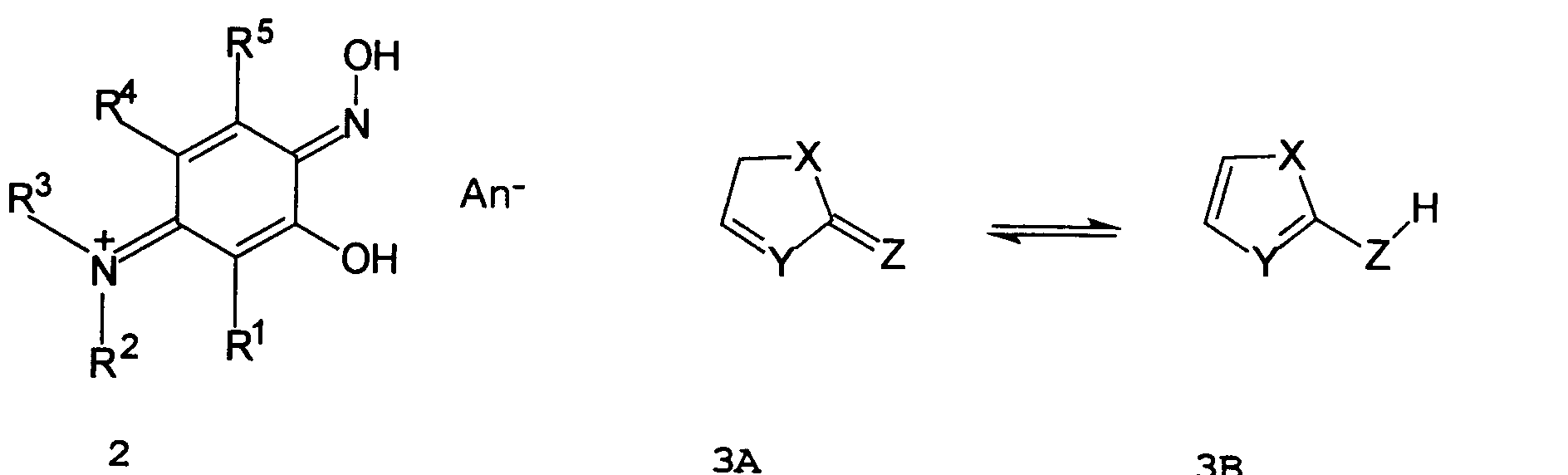
- Verfahren nach Anspruch 14, dadurch gekennzeichnet, daß die Kondensation der Edukte 2 und 3A bzw. 3B im äquimolaren Verhältnis in Dimethylformamid, Dimethylacetamid oder N-Methyl-pyrrolidon bei einer Temperatur zwischen 120 und 150°C durchgeführt wird.
- Verwendung einer chromophoren Verbindung der allgemeinen Formel 1 entsprechend Anspruch 1, worin R1, R2, R3, R4 und R5 sowie X, Y und Z die angegebene Bedeutung besitzen, zur Herstellung von elektrooptischen und photonischen Bauelementen.
Applications Claiming Priority (2)
| Application Number | Priority Date | Filing Date | Title |
|---|---|---|---|
| DE19810030 | 1998-03-09 | ||
| DE19810030 | 1998-03-09 |
Publications (3)
| Publication Number | Publication Date |
|---|---|
| EP0943661A2 true EP0943661A2 (de) | 1999-09-22 |
| EP0943661A3 EP0943661A3 (de) | 2000-01-19 |
| EP0943661B1 EP0943661B1 (de) | 2002-10-23 |
Family
ID=7860204
Family Applications (1)
| Application Number | Title | Priority Date | Filing Date |
|---|---|---|---|
| EP99103890A Expired - Lifetime EP0943661B1 (de) | 1998-03-09 | 1999-03-01 | Chromophore Verbindungen und Verfahren zu ihrer Herstellung |
Country Status (4)
| Country | Link |
|---|---|
| US (1) | US6284889B1 (de) |
| EP (1) | EP0943661B1 (de) |
| JP (1) | JPH11315218A (de) |
| DE (1) | DE59903136D1 (de) |
Families Citing this family (1)
| Publication number | Priority date | Publication date | Assignee | Title |
|---|---|---|---|---|
| US20070260062A1 (en) * | 2005-03-31 | 2007-11-08 | Goetz Frederick J | Heterocyclical Chromophore Architectures with Novel Electronic Acceptor Systems |
Family Cites Families (6)
| Publication number | Priority date | Publication date | Assignee | Title |
|---|---|---|---|---|
| CH619476A5 (en) * | 1976-01-26 | 1980-09-30 | Sandoz Ag | Process for preparing new basic oxazine compounds |
| GB8424709D0 (en) * | 1984-10-01 | 1984-11-07 | Minnesota Mining & Mfg | Azine redox dyes and leuco azine dyes |
| US4962197A (en) * | 1988-02-12 | 1990-10-09 | Rowland Institute For Science | Photo-inactivation of cancer cells |
| FR2713234B1 (fr) * | 1993-12-06 | 1996-03-22 | Sandoz Sa | Nouveaux dérivés de la triphénodioxazine, leur préparation et leur utilisation comme pigments. |
| US5529864A (en) * | 1993-12-16 | 1996-06-25 | Canon Kabushiki Kaisha | Optical recording medium having mask layer |
| JPH0820614A (ja) | 1994-07-07 | 1996-01-23 | Chisso Corp | 共重合体、その製造法及びそれを用いた発光素子 |
-
1999
- 1999-03-01 EP EP99103890A patent/EP0943661B1/de not_active Expired - Lifetime
- 1999-03-01 DE DE59903136T patent/DE59903136D1/de not_active Expired - Fee Related
- 1999-03-09 JP JP11062255A patent/JPH11315218A/ja not_active Withdrawn
- 1999-03-09 US US09/265,157 patent/US6284889B1/en not_active Expired - Fee Related
Also Published As
| Publication number | Publication date |
|---|---|
| DE59903136D1 (de) | 2002-11-28 |
| EP0943661B1 (de) | 2002-10-23 |
| EP0943661A3 (de) | 2000-01-19 |
| JPH11315218A (ja) | 1999-11-16 |
| US6284889B1 (en) | 2001-09-04 |
Similar Documents
| Publication | Publication Date | Title |
|---|---|---|
| AT343666B (de) | Verfahren zur herstellung von neuen piperazinderivaten | |
| EP0010063A2 (de) | Verfahren zur Herstellung von Furanyl-benzazolen | |
| DE4119767A1 (de) | Verfahren zur herstellung von (pyrimid-2-yl-thio- bzw. seleno)-essigsaeurederivaten | |
| DE68905407T2 (de) | Analgetische carbonsaeureamid-derivate. | |
| DE2744423A1 (de) | Verfahren zur herstellung von benzothiazolylsulfenamiden | |
| DE2655009A1 (de) | Isoxazolderivate, verfahren zu ihrer herstellung und diese verbindungen enthaltende mittel | |
| EP0943661B1 (de) | Chromophore Verbindungen und Verfahren zu ihrer Herstellung | |
| DE2541346A1 (de) | Verfahren zur herstellung von 3,4- dihydro-2h-1,2-benzothiazin-1,1-dioxiden | |
| DE3407505A1 (de) | Neue benzothiazin-carbonsaeureamide mit antiarthritischer wirksamkeit | |
| CH626080A5 (de) | ||
| DE2412598C2 (de) | Verfahren zur Herstellung von 7-Alkoxycephalosporinen bzw. 6-Alkoxypenicillinen | |
| EP0116827B1 (de) | Verfahren zur Herstellung von Benzthiazolen | |
| DE4122563C2 (de) | Neue thiazolsubstituierte Quadratsäurefarbstoffe und Verfahren zu ihrer Herstellung | |
| DD153690A1 (de) | Verfahren zur herstellung von photochromen 1,4-2h-oxazinen und spirophenanthro-1,4-2h-oxazinen | |
| AT364824B (de) | Verfahren zur herstellung neuer n-(1-(3-benzoylpropyl)-4-piperidyl)-sulfonsaeureamide und von deren saeureadditionssalzen | |
| EP0941990A2 (de) | Verfahren zur Herstellung von Azamethinen sowie Azamethine selbst | |
| CH619236A5 (en) | Process for the preparation of thienothiazine derivatives | |
| EP0385515B1 (de) | 2-Aminothiophenverbindungen | |
| CH614944A5 (en) | Process for the preparation of novel pyrimidine derivatives | |
| AT369745B (de) | Verfahren zur herstellung von cephemverbindungen | |
| AT268323B (de) | Verfahren zur Herstellung von neuen 3,1-Benzothiazin-Derivaten und ihren Salzen | |
| AT349484B (de) | Verfahren zur herstellung von neuen thieno- thiazinderivaten | |
| DE4215826A1 (de) | Selenazol- und selenophensubstituierte Quadratsäurefarbstoffe und Verfahren zu ihrer Herstellung | |
| EP0583561B1 (de) | Verfahren zur Herstellung von 1-unsubstituierten 3-Aminopyrrolen | |
| AT379806B (de) | Verfahren zur herstellung einer neuen thiadiazolverbindung |
Legal Events
| Date | Code | Title | Description |
|---|---|---|---|
| PUAI | Public reference made under article 153(3) epc to a published international application that has entered the european phase |
Free format text: ORIGINAL CODE: 0009012 |
|
| AK | Designated contracting states |
Kind code of ref document: A2 Designated state(s): DE FR GB |
|
| AX | Request for extension of the european patent |
Free format text: AL;LT;LV;MK;RO;SI |
|
| PUAL | Search report despatched |
Free format text: ORIGINAL CODE: 0009013 |
|
| AK | Designated contracting states |
Kind code of ref document: A3 Designated state(s): AT BE CH CY DE DK ES FI FR GB GR IE IT LI LU MC NL PT SE |
|
| AX | Request for extension of the european patent |
Free format text: AL;LT;LV;MK;RO;SI |
|
| 17P | Request for examination filed |
Effective date: 20000503 |
|
| AKX | Designation fees paid |
Free format text: DE FR GB |
|
| 17Q | First examination report despatched |
Effective date: 20001116 |
|
| GRAG | Despatch of communication of intention to grant |
Free format text: ORIGINAL CODE: EPIDOS AGRA |
|
| GRAG | Despatch of communication of intention to grant |
Free format text: ORIGINAL CODE: EPIDOS AGRA |
|
| GRAH | Despatch of communication of intention to grant a patent |
Free format text: ORIGINAL CODE: EPIDOS IGRA |
|
| GRAH | Despatch of communication of intention to grant a patent |
Free format text: ORIGINAL CODE: EPIDOS IGRA |
|
| GRAA | (expected) grant |
Free format text: ORIGINAL CODE: 0009210 |
|
| AK | Designated contracting states |
Kind code of ref document: B1 Designated state(s): DE FR GB |
|
| REG | Reference to a national code |
Ref country code: GB Ref legal event code: FG4D Free format text: NOT ENGLISH |
|
| REF | Corresponds to: |
Ref document number: 59903136 Country of ref document: DE Date of ref document: 20021128 |
|
| PGFP | Annual fee paid to national office [announced via postgrant information from national office to epo] |
Ref country code: GB Payment date: 20030307 Year of fee payment: 5 |
|
| GBT | Gb: translation of ep patent filed (gb section 77(6)(a)/1977) |
Effective date: 20030214 |
|
| PGFP | Annual fee paid to national office [announced via postgrant information from national office to epo] |
Ref country code: FR Payment date: 20030328 Year of fee payment: 5 |
|
| ET | Fr: translation filed | ||
| PLBE | No opposition filed within time limit |
Free format text: ORIGINAL CODE: 0009261 |
|
| STAA | Information on the status of an ep patent application or granted ep patent |
Free format text: STATUS: NO OPPOSITION FILED WITHIN TIME LIMIT |
|
| PG25 | Lapsed in a contracting state [announced via postgrant information from national office to epo] |
Ref country code: DE Free format text: LAPSE BECAUSE OF NON-PAYMENT OF DUE FEES Effective date: 20031001 |
|
| 26N | No opposition filed |
Effective date: 20030724 |
|
| PG25 | Lapsed in a contracting state [announced via postgrant information from national office to epo] |
Ref country code: GB Free format text: LAPSE BECAUSE OF NON-PAYMENT OF DUE FEES Effective date: 20040301 |
|
| GBPC | Gb: european patent ceased through non-payment of renewal fee | ||
| PG25 | Lapsed in a contracting state [announced via postgrant information from national office to epo] |
Ref country code: FR Free format text: LAPSE BECAUSE OF NON-PAYMENT OF DUE FEES Effective date: 20041130 |
|
| REG | Reference to a national code |
Ref country code: FR Ref legal event code: ST |