EP0944028A2 - Procédé pour une machine d'affranchissement et d'adressage - Google Patents
Procédé pour une machine d'affranchissement et d'adressage Download PDFInfo
- Publication number
- EP0944028A2 EP0944028A2 EP99250058A EP99250058A EP0944028A2 EP 0944028 A2 EP0944028 A2 EP 0944028A2 EP 99250058 A EP99250058 A EP 99250058A EP 99250058 A EP99250058 A EP 99250058A EP 0944028 A2 EP0944028 A2 EP 0944028A2
- Authority
- EP
- European Patent Office
- Prior art keywords
- franking
- printing
- address
- letter
- Prior art date
- Legal status (The legal status is an assumption and is not a legal conclusion. Google has not performed a legal analysis and makes no representation as to the accuracy of the status listed.)
- Granted
Links
- 238000007639 printing Methods 0.000 title claims abstract description 74
- 238000000034 method Methods 0.000 title claims abstract description 37
- 230000033001 locomotion Effects 0.000 claims abstract description 31
- 230000008569 process Effects 0.000 claims abstract description 19
- 238000012545 processing Methods 0.000 claims abstract description 14
- 230000006870 function Effects 0.000 claims description 4
- 230000004886 head movement Effects 0.000 abstract description 2
- 238000004422 calculation algorithm Methods 0.000 description 16
- 230000007246 mechanism Effects 0.000 description 10
- 230000008901 benefit Effects 0.000 description 4
- 238000005516 engineering process Methods 0.000 description 4
- 238000009826 distribution Methods 0.000 description 3
- 238000011156 evaluation Methods 0.000 description 3
- 238000012360 testing method Methods 0.000 description 3
- 230000007723 transport mechanism Effects 0.000 description 3
- 241001530812 Goupia glabra Species 0.000 description 2
- 238000004364 calculation method Methods 0.000 description 2
- 239000000969 carrier Substances 0.000 description 2
- 238000006243 chemical reaction Methods 0.000 description 2
- 238000012790 confirmation Methods 0.000 description 2
- 238000013461 design Methods 0.000 description 2
- 230000009467 reduction Effects 0.000 description 2
- 230000001960 triggered effect Effects 0.000 description 2
- 238000012795 verification Methods 0.000 description 2
- BXESZVNFNSBGGR-UHFFFAOYSA-N 3-(2,3-dimethoxyphenyl)-1-(9-methyl-2-phenyl-9H-imidazo[1,2-a]benzimidazol-3-yl)prop-2-en-1-one Chemical compound COC1=CC=CC(C=CC(=O)C=2N3C4=CC=CC=C4N(C)C3=NC=2C=2C=CC=CC=2)=C1OC BXESZVNFNSBGGR-UHFFFAOYSA-N 0.000 description 1
- 230000001133 acceleration Effects 0.000 description 1
- 230000009471 action Effects 0.000 description 1
- 238000004458 analytical method Methods 0.000 description 1
- 230000001174 ascending effect Effects 0.000 description 1
- 230000004888 barrier function Effects 0.000 description 1
- 230000005540 biological transmission Effects 0.000 description 1
- 230000008859 change Effects 0.000 description 1
- 238000004140 cleaning Methods 0.000 description 1
- 238000010276 construction Methods 0.000 description 1
- 230000001419 dependent effect Effects 0.000 description 1
- 238000011161 development Methods 0.000 description 1
- 230000018109 developmental process Effects 0.000 description 1
- 230000002349 favourable effect Effects 0.000 description 1
- 230000005484 gravity Effects 0.000 description 1
- 230000001939 inductive effect Effects 0.000 description 1
- 238000002372 labelling Methods 0.000 description 1
- 238000012423 maintenance Methods 0.000 description 1
- 238000004519 manufacturing process Methods 0.000 description 1
- 239000000463 material Substances 0.000 description 1
- 238000007620 mathematical function Methods 0.000 description 1
- 238000005259 measurement Methods 0.000 description 1
- 230000003287 optical effect Effects 0.000 description 1
- 238000003825 pressing Methods 0.000 description 1
- 238000007789 sealing Methods 0.000 description 1
- 210000002023 somite Anatomy 0.000 description 1
- 230000029305 taxis Effects 0.000 description 1
Images
Classifications
-
- G—PHYSICS
- G07—CHECKING-DEVICES
- G07B—TICKET-ISSUING APPARATUS; FARE-REGISTERING APPARATUS; FRANKING APPARATUS
- G07B17/00—Franking apparatus
- G07B17/00459—Details relating to mailpieces in a franking system
- G07B17/00508—Printing or attaching on mailpieces
-
- G—PHYSICS
- G07—CHECKING-DEVICES
- G07B—TICKET-ISSUING APPARATUS; FARE-REGISTERING APPARATUS; FRANKING APPARATUS
- G07B17/00—Franking apparatus
- G07B17/00459—Details relating to mailpieces in a franking system
- G07B17/00467—Transporting mailpieces
-
- G—PHYSICS
- G07—CHECKING-DEVICES
- G07B—TICKET-ISSUING APPARATUS; FARE-REGISTERING APPARATUS; FRANKING APPARATUS
- G07B17/00—Franking apparatus
- G07B17/00459—Details relating to mailpieces in a franking system
- G07B17/00508—Printing or attaching on mailpieces
- G07B2017/00516—Details of printing apparatus
- G07B2017/00524—Printheads
- G07B2017/00532—Inkjet
-
- G—PHYSICS
- G07—CHECKING-DEVICES
- G07B—TICKET-ISSUING APPARATUS; FARE-REGISTERING APPARATUS; FRANKING APPARATUS
- G07B17/00—Franking apparatus
- G07B17/00459—Details relating to mailpieces in a franking system
- G07B17/00508—Printing or attaching on mailpieces
- G07B2017/00572—Details of printed item
- G07B2017/00596—Printing of address
-
- G—PHYSICS
- G07—CHECKING-DEVICES
- G07B—TICKET-ISSUING APPARATUS; FARE-REGISTERING APPARATUS; FRANKING APPARATUS
- G07B17/00—Franking apparatus
- G07B17/00459—Details relating to mailpieces in a franking system
- G07B17/00508—Printing or attaching on mailpieces
- G07B2017/00637—Special printing techniques, e.g. interlacing
-
- G—PHYSICS
- G07—CHECKING-DEVICES
- G07B—TICKET-ISSUING APPARATUS; FARE-REGISTERING APPARATUS; FRANKING APPARATUS
- G07B17/00—Franking apparatus
- G07B17/00733—Cryptography or similar special procedures in a franking system
- G07B2017/00741—Cryptography or similar special procedures in a franking system using specific cryptographic algorithms or functions
- G07B2017/00758—Asymmetric, public-key algorithms, e.g. RSA, Elgamal
- G07B2017/00766—Digital signature, e.g. DSA, DSS, ECDSA, ESIGN
Definitions
- the invention relates to a method for a franking and addressing machine according to the preamble of claim 1 or Claim 7.
- the method is suitable for a closed system, especially for users of franking machines.
- Newer franking machines use digital printing units.
- the franking machines T1000 or JetMail des Worldwide for the first time ever Inkjet printer.
- Most countries' postal regulations close namely, that the address information in the amount of the franking imprint can be done.
- a print in the address area of the envelope for the Mail recipient address is not possible with such machines, because the print width of the print head is not sufficient.
- a franking device is disclosed in US Pat. No. 5,200,903 (EP 298 775), that prints both the franking stamp and the address.
- Mail volume is the effort for letter transport relative to that stationary print head disadvantageous.
- Another shortcoming is that the printing of both images in only one Movement phase of the letter should be carried out. That requires a printhead that is as wide as the width of the two images Franking stamp and address field and the distance in between corresponds. That is 10 cm for a standard letter, for others Letter formats up to 20 cm.
- a correspondingly wide thermal print head is Although it can be produced in principle, it would be disproportionately more expensive than one Standard head of approx. 3-6 cm.
- Such widths are used as ink jet print heads in the foreseeable future for manufacturing reasons (yield) not executable. It is also not recognizable, like that for an ink jet print head required constant distance to uneven letter surfaces should be guaranteed.
- DE 196 05 015 describes a device for printing on described an edge of the standing print carrier, in which in a Guide plate two recesses are included, one for the Franking and one for address printing.
- the printhead can between the two recesses. Even if that Adjustment of the print head is initiated immediately after that first print image was generated, it takes a certain time until the Printhead has taken its second position. Moved during this time but the letter continues, so that for the second reprint only one very limited letter length is available. In the vertical direction Overlapping print images are generally excluded from this solution.
- US 4,868,757 is also a solution for printing Franking stamp and address field with a printing unit revealed.
- the letter is automatically drawn into the printing station. After taking his Print position, the print head is automatically on the letter surface lowered until physical contact is made.
- the printhead is movably arranged in one direction around the entire pressure field to be able to achieve.
- a disadvantage compared to the inventive solution the effort for automatic mail collection.
- the stake is also an ink jet printhead because it is almost a constant distance of the print head nozzles to the letter surface is required, even if the latter has significant bumps.
- the franking imprint is not tamper-proof.
- a franking module for a personal computer proposed the franking module in the slot of a drive module is arranged, which both the franking and the Envelopes allowed.
- a franking module is surrounded by a secured housing and has circuitry the same structure as a franking machine, in which the Letter transport device is saved.
- the Address data is managed by a personal computer Read the memory and the internal information network Franking module supplied.
- Such a franking module is only in connection Can be operated with the personal computer, but as a standalone machine not suitable. In addition, only standard curve fits in the feed slot.
- the printing mechanism itself has not been disclosed there. At a digital printing process, it is not certain to determine whether that printed franking stamp image is not just an unpaid copy of an earlier impression and with a desired other address was combined.
- the object of the invention is an inexpensive standalone machine for smaller volumes of mail so that the functions Franking and addressing of outgoing mail combined in one machine and enables the use of a cheap ink jet print head. Both Imprints should be made directly on the surface of the letter. The solution should be a consistently good one even for filled letters with an uneven surface Ensure print quality. The way the machine works should be like this can be controlled so that the processing time is minimized.
- the invention there is a request to enter a Shipping destination address, generation of the print image for the address field, starting printing of the address and controlling the Information processes for generating a security imprint parallel to certain movements of the print head.
- the Movements of the print head close the processes during Print out the address and / or the processes when positioning before the Printing one.
- the information processes relate in particular to one Generation of a digital signature. The latter is before printing the Franking stamp image parallel to the first task of printing the address and corresponding movements of a print head carried out, so that overall a time-optimal process when printing the address and franking stamp image is achieved.
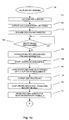
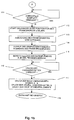
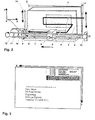
- FIGs 1a and b show a flow chart for a time-optimal Control of a franking machine printing mechanism, which is shown in FIG was basically shown as a front view.
- a letter on the edge - not shown - can be written into a Holding device 2 are inserted.
- the holding device 2 is in the Angle ⁇ inclined to the vertical and at an angle ⁇ to the horizontal.
- FIG Top view of the printed side of an envelope This letter shows a franking imprint in a franking field and one Shipping address imprint in an address field.
- For addressing and Franking is rotated by 180 ° in the aforementioned Feed position inserted into the aforementioned feed slot 1.
- sensors e.g. Photoelectric switches, arranged to indicate the presence of a letter detect.
- the guide plate 3 In the guide plate 3 are windows 4, 5 for on the Fields to be printed on the envelope (address field, Frankierfeld) incorporated.
- One sliding on a guide rod 8 Ink jet print head 6 is connected to a belt 7.
- the strap 7 runs over a drive roller 12 and a deflection roller 13. With the a drive motor 11 driven drive roller 12 can thus Inkjet printhead 6 in a known manner in the X direction and be moved in the opposite direction.
- a holding plate 9, which on a second guide rod 14 runs with a second drive 10 connected. The details have not been shown since the second Drive 10 can be designed in a manner known per se.
- the latter includes, for example, an engine with a gearbox and with a Gear, which is formed in the teeth of a rack Guide rod 14 engages. So that's a second mechanism created which including the first mechanism Ink jet print head 6 in the Y direction and opposite to it in one alternative printing position can move.
- the first print position and the alternative print position may overlap in the X direction.
- An overlap in the Y direction is not provided, as this is due to the applicable postal regulations is excluded.
- Inkjet printhead 6 is approximately in the example shown moved in a meandering manner in order to carry out the printing in an optimized manner.
- the franking field again run against the X direction and printed.
- the a further offset can also be a movement against the X direction be carried out to a starting position in window 5 to be controlled before going through the franking field.
- the control of the franking machine printing mechanism and the inkjet print head 6 is carried out using electronics known per se Microprocessor control.
- the microprocessor is corresponding programmed that starting from a starting position in which the Inkjet printhead 6 is positionable to with a - not shown - Cleaning and sealing device to engage, a time-optimized Movement sequence is made.
- the flow chart for a time-optimal control according to Fig. 1a shows the Process while printing a shipping address.
- the flow plan for a time-optimal control according to Fig. 1b shows the sequence during the Printing a franking imprint. This will be time consuming Data processing operations time-interleaved by the microprocessor certain movement phases of the print head.
- On corresponding control program according to which the microprocessor is programmed is stored in a read-only memory.
- the microprocessor is programmed by the control program so that the information processes for generating a security imprint parallel to certain movements of the print head 6 be processed.
- step 101 After a first step 100, in which the creation of a Letter has been detected, follow steps 101, 102, 103, to enter an address (step 101) with automatic call of the associated ZIP codes or a comparable transport destination code (Step 102) and for entering the franking value (step 103).
- the request steps and the automatically determined ZIP code can be displayed on a display device, not shown.
- the microprocessor is with the read-only memory, the display device and an input device and determines in step 104 whether the entries have been confirmed using the input device.
- step 104 changes to one Step 105 for generating the print image for the address field branches.
- step 106 the printing of the Address field. Printing out the address field is a first task JOB1.
- further time-consuming tasks JOB2, JOB3, ... JOBx processed nested for the first task.
- Such further tasks JOB2, JOB3, JOB4, JOB5 show the steps 107, 108, 109, 110.
- Step 107 relates to the application of a hash algorithm, for example a SHA (Security Hash Algorithm), to which Data elements or a reduction of the data set according to a comparable one mathematical function.
- the data set includes those with the Postal carriers generally agreed data elements. This record is reduced in the reduction such that the individual data elements are not reproducible. But only to the extent that Always distinguish changed data records from different letters.
- a secret key is called, which follows "private key" is called.
- the latter is in a security module Franking and addressing device stored unreadable.
- the Security module is also a well-known asymmetrical Encryption algorithm saved.
- the encryption is in the Step 109 executed.
- a suitable known asymmetric encryption algorithm is, for example, the Digital Signature Algorithm (DSA), one of the Elliptic Curve Digital Signature Algorithms (ECDSA) or the ELGamal Algorithm (ELGA).
- DSA Digital Signature Algorithm
- EDSA Elliptic Curve Digital Signature Algorithms
- ELGA ELGamal Algorithm
- a program-based processing of such an asymmetrical Encryption algorithm for example the DSA (Digital Signature Algorithm)
- DSA Digital Signature Algorithm
- DSA Digital Signature Algorithm
- An alternative way is to use the Processing during the adjustment of the inkjet printhead 6 perform against the Y direction when the franking machine printing mechanism works relatively slowly. However, preferably started with this processing before this adjustment.
- step 110 also a conversion into a special machine-readable symbolism, such as Barcode, 2-D barcode or PDF 417 symbols.
- Barcode 2-D barcode
- PDF 417 symbols The latter is from from Symbol Technologies, inc. described in more detail in EP 439 682 B1 been.
- Such two-dimensional barcodes are relatively space-saving compared to one-dimensional barcodes and continue to reduce the Printing time.
- step 110 a branch is made to the query step 111 shown in FIG. 1b. You will be asked whether the address field has been printed completely. Between the steps 110 and 111 there can be further query steps in which the completion of the other tasks (JOBs) is queried.
- the timing of the print head movement for address printing is generally such that all JOBs are processed at the latest until the mechanics for moving the ink jet print head in the direction of the franking field are activated.
- step 112 the start of a repositioning is triggered in order to control the ink jet print head into the position for the franking imprint.
- the next JOB, ie step 113 is processed according to the invention in a time-interleaved manner with the aforementioned positioning.
- step 113 the franking value is debited from the credit which is stored in the postal registers of the security module.
- the graphical standard elements of the franking imprint are called up and in a further step 115 the data elements are made available for the franking imprint.
- query step 116 an inquiry is made as to whether the franking position has been reached. If this is not yet the case, the system branches into a waiting loop. Otherwise, in step 117, the machine-readable symbols and the visually readable data are printed, and the graphic standard elements are printed.
- step 118 the end of the processing is signaled via a display unit or beeper and the removal of the fully addressed and franked envelope is requested.
- FIG. 3 An example of an impression on a piece of mail is shown in FIG. 3 explained.
- the address field is arranged centrally.
- the Postempftuleradersse is in plain text and an associated ZIP code is printed as an unencrypted barcode.
- the franking imprint is arranged in the upper right corner.
- a sender information in the Periphery located at the top left is optional.
- an approx. 1 Inch wide franking imprint with a machine readable area generated.
- Certain clear data and the signature are e.g. into a PDF 417 symbols implemented and printed.
- Above the machine readable Area is the visually (human) readable area and an area for the FIM code arranged according to US postal regulations. Because of the FIM code for an approx. 1 inch wide franking imprint there is an approx. 11 up to 14 mm wide visually (human) readable area. Thus, the remaining width can be used for the machine-readable area.
- the invention is not limited to a franking machine printing mechanism according to FIG. 2. Versions are also suitable in which a lying piece of mail is provided with an address and franking imprint.
- An alternative embodiment of the machine according to the invention has a letter feeder. This consists of a slot that is as wide as the widest letter to be processed and has an opening width that corresponds to the maximum letter thickness to be processed.
- sensors for example light barriers, which detect the presence of a letter.
- a receiving plate for receiving the letter which can be raised in the vertical direction by means of a motor drive.
- a rigid plate with two recesses or recesses is arranged above the letter receiving plate.
- the size of these cutouts corresponds at least to the franking imprint or the addressing imprint and are arranged within the plate in such a way that it corresponds to the arrangement of the two printing fields on the letter to be processed.
- the print head is located directly above the plate.
- the motor-driven movement of the printhead is measured, for example by means of an inductive travel meter. Other path measurements in the drive motor or in the transmission, which measure the rotation, can also be used.
- the measured path signals are fed to control electronics which synchronize these signals with the print control signals which are sent to the print head.
- the print head is a single color system with preferably black color executed.
- a particularly favorable one in terms of consumption costs Solution is achieved by using an ink jet print head according to the Patent of the applicant US 5, 592.203 achieved.
- the name of the recipient or parts used the same.
- the name is in the form of alphabetical characters shown.
- the first letter of the Recipient personal name or company name
- filtered out and given it a number corresponding to the position of the Assigned to the letter in the Latin alphabet.
- the far too widespread ASCII code can be used for this. That number will now appended to the address code (5-digit postcode) and expanded this by two digits.
- the address code is extended by two digits.
- the recipient name does not become an extension of the address code, but the street name.
- a special form would be the use of the house number because in this case the conversion can be omitted into a numeric character.
- the print head is narrower than the field to be printed. This makes it necessary to split the printing process into several phases. Only one stripe of the entire printed image is printed in each phase. The procedure corresponds in principle to the first variant. Between the phases, the print head is one by the respective width Printing strip shifted. For this purpose, there is a second on the letter level first movement device orthogonally arranged movement device intended. In order to cover the free space between Frankierfeld and Adreßfeld will save time switched both movement devices in a special mode. At the second movement device is continuously activated until the Print position for the address field is reached. The first movement device is stopped for as long.
- Duration of the special mode to the letter format chosen by the customer knotted is Duration of the special mode to the letter format chosen by the customer knotted. Automatic recording of the letter format by means of Optical sensors are provided in a sub-variant. Any format in this case is a certain width of the free median assigned what is stored in a memory of the machine. The Special mode is then saved using this format-specific Values controlled.
- the existence x-offset exists is a combined movement against the X / Y direction particularly time-saving.
- the two independent drives are done according to known trigonometric relationships from Microprocessor controlled.
- the printing phase can be used to further accelerate the printing process be divided into two sub-phases.
- the print head moves along the letter and prints the letter upper half of the strip to be printed.
- the print head is orthogonally cut by half the width of the Printstrip shifted and the direction of movement of the print head along the letter is rotated by 180 °.
- the lower part of the printing strip is printed in the lower phase.
- the machine according to the invention is used in the following way.
- the too franking letter is manually inserted into the slot provided up to one Stop introduced.
- the said sensors detect this Presence.
- the machine is switched to a first mode. This can be the franking mode, but also the address mode (hereinafter the address mode is assumed).
- the customer is asked the Enter address. This address can be entered using a keyboard that can device according to the invention is equipped, entered, or via one connected to the device via a serial interface PC. After completing this entry, the customer will be asked to Enter franking value.
- the machine is also in a comfort variant able to postage from other data such as weight, size and Calculate shipping method in a known manner.
- the address data will be together with other security-relevant data, such as franking value, Date, machine number cryptographically encrypted and for printing processed in the franking field.
- the receiving plate with the one lying on it Letter raised and the letter pressed against said plate.
- the print head standing above the recesses is thus preserved an almost constant distance to the one to be printed Letter surface regardless of the thickness and shape of the contents of the Letter.
- the letter can also be sent immediately brought into the printing position after feeding and before entering data become. After the letter has taken up the printing position, the actual printing process triggered.
- the printhead can do so first print the franking field or the address field first. To When the printing is finished, the receiving plate is lowered and the Letter can be removed manually.
- the printhead is in the starting position for printing the address field.
- a letter is created by the Sensors reported.
- the operator is asked to enter the destination address of the To enter the letter.
- the entered address is shown on the display displayed.
- the operator validates the entry by pressing confirmed with an ENTER key. After this confirmation the Processor to automatically search an address file.
- This file can, for example, in a chip card inserted into the machine be saved.
- the entered address is entered using this file Address code e.g. Zip code or zip code assigned.
- the user is asked to enter the franking value. In a comfort version, the Franking value determined automatically.
- the operator must do this Specify data determining the franking value, such as letter format, letter weight and shipping method if applicable.
- the franking value entered or determined is is displayed and confirmed by the operator with the ENTER key. Without No further processing takes place to confirm the entries.
- the print image for the address print is generated next.
- the print image is prepared according to the wysiwyg principle, i.e. the Print corresponds to the address entry shown on the display.
- the start command for immediately follows the print image generation the expression.
- the print will match one of the height of the address field accordingly wide printhead is carried out for reprint only a movement phase is required.
- the time required for this is from Print speed of the print head and the length of the address field dependent. This time is at a printing speed of 100 mm / s and an address field length of 80 mm at about 1 second. While During this time, the franking value is debited from the credit of the Carried out by the user and updated accordingly Registers ascending, descending and accont performed.
- the print head opens immediately afterwards controlled the position for the franking imprint.
- the address pressure on the left side of the Address field started and thus ended on the right side.
- the print head is now on the right side of the printing franking field moved.
- Including franking imprint the printhead performs a movement that mirror-inverted Z corresponds.
- the angle of the diagonal is included depending on the length of the address field to be printed and the Length of the franking field to be printed, as well as the selected one Letter format.
- the machine has everyone Information about simple trigonometric functions Printhead away and thus optimally in time to its second print position Taxes.
- the digital signature is shared with the one that generates it Data record converted into a machine-readable code. Because the place for such an imprint, the common with the visually evaluable Information to be printed is limited, preferably comes 2-dimensional barcode for use. Such a code is for example PDF 417, described in Technical Report Monograph 8, Symbol Technologies, April 1992.
- the printhead has its second When the print position is reached, the printout of the franking field begins. are due to the limited width of the printhead Movement phases of the printhead required to cover the entire Frankierfeld to print with the in the lower half arranged 2-dimensional bar code started. That follows the printout of the visually evaluable part of the franking field. Is the entire franking field is printed, the letter is free for removal given and the operator receives the request to the letter remove.
- the two parts of the key pair, the private key and the public keys, are provided by the manufacturer of the franking and Addressing machine generated.
- the private key that is used for education the digital signature used for each franking imprint is in a secure memory, preferably in the security module Machine kept.
- the public key, which is used for the verification of the digital signature by a testing facility of the mail carrier in one Evaluation point is used, is stored in a database. This can operated by the manufacturer and the test facility loads itself Need the public key down there. Alternatively, the Manufacturer the public key directly to a database, which under administration of the test facility.
- the assignment of the matching key of the key pair can for example via a machine serial number or device identification data (Device ID).
- each key pair consisting of a private key and a public key in time is valid for a limited time and suddenly at a specific date and time can be changed from the data center.
- the time intervals of the change result in accordance with the currently achieved Advances in modern analytical methods, such as the differential cryptanalysis, and are sized to attack the security of the system is likely to fail.
Landscapes
- Engineering & Computer Science (AREA)
- Computer Security & Cryptography (AREA)
- Physics & Mathematics (AREA)
- General Physics & Mathematics (AREA)
- Record Information Processing For Printing (AREA)
- Devices For Checking Fares Or Tickets At Control Points (AREA)
- Storing Facsimile Image Data (AREA)
Applications Claiming Priority (2)
| Application Number | Priority Date | Filing Date | Title |
|---|---|---|---|
| DE19812902A DE19812902A1 (de) | 1998-03-18 | 1998-03-18 | Verfahren für eine Frankier- und Adressiermaschine |
| DE19812902 | 1998-03-18 |
Publications (3)
| Publication Number | Publication Date |
|---|---|
| EP0944028A2 true EP0944028A2 (fr) | 1999-09-22 |
| EP0944028A3 EP0944028A3 (fr) | 2000-11-22 |
| EP0944028B1 EP0944028B1 (fr) | 2006-12-13 |
Family
ID=7862122
Family Applications (1)
| Application Number | Title | Priority Date | Filing Date |
|---|---|---|---|
| EP99250058A Expired - Lifetime EP0944028B1 (fr) | 1998-03-18 | 1999-03-02 | Procédé pour une machine d'affranchissement et d'adressage |
Country Status (3)
| Country | Link |
|---|---|
| US (1) | US6438529B1 (fr) |
| EP (1) | EP0944028B1 (fr) |
| DE (2) | DE19812902A1 (fr) |
Cited By (1)
| Publication number | Priority date | Publication date | Assignee | Title |
|---|---|---|---|---|
| EP1533755A1 (fr) * | 2003-11-20 | 2005-05-25 | Neopost Industrie | Procédé d'impression pour machine à affranchir compacte et machine à affranchir associée |
Families Citing this family (18)
| Publication number | Priority date | Publication date | Assignee | Title |
|---|---|---|---|---|
| JP3803518B2 (ja) * | 1999-11-10 | 2006-08-02 | 日本電気株式会社 | 電子印紙発行装置 |
| US7162035B1 (en) | 2000-05-24 | 2007-01-09 | Tracer Detection Technology Corp. | Authentication method and system |
| DE10051768A1 (de) * | 2000-10-19 | 2002-05-02 | Francotyp Postalia Gmbh | Verfahren und Anordnung zum Bedrucken eines Poststückes |
| DE10131254A1 (de) * | 2001-07-01 | 2003-01-23 | Deutsche Post Ag | Verfahren zum Überprüfen der Gültigkeit von digitalen Freimachungsvermerken |
| US6550994B2 (en) | 2001-07-20 | 2003-04-22 | Pitney Bowes Inc. | System for printing information on a mailing medium |
| DE10153116C2 (de) * | 2001-10-23 | 2003-08-14 | Francotyp Postalia Ag | Postverarbeitungsmaschine |
| US7203317B2 (en) * | 2001-10-31 | 2007-04-10 | Hewlett-Packard Development Company, L.P. | System for enabling lazy-revocation through recursive key generation |
| US7200747B2 (en) * | 2001-10-31 | 2007-04-03 | Hewlett-Packard Development Company, L.P. | System for ensuring data privacy and user differentiation in a distributed file system |
| US8171567B1 (en) | 2002-09-04 | 2012-05-01 | Tracer Detection Technology Corp. | Authentication method and system |
| WO2004092917A2 (fr) * | 2003-04-11 | 2004-10-28 | United States Postal Service | Procedes et systemes d'etablissement d'un nouveau code de point de distribution |
| JP4391217B2 (ja) * | 2003-12-16 | 2009-12-24 | 株式会社トプコン | 表面検査装置 |
| US20060023023A1 (en) * | 2004-07-27 | 2006-02-02 | Mattern James M | Printing using traveling printheads |
| US20060112024A1 (en) * | 2004-11-19 | 2006-05-25 | Russell Wadd | Use of machine readable code to print the return address |
| FR2896447B1 (fr) * | 2006-01-23 | 2008-04-18 | Neopost Technologies Sa | Machine a affranchir a chemin vertical |
| FR2907945B1 (fr) * | 2006-10-31 | 2009-02-27 | Neopost Technologies Sa | Procede d'affranchissement permettant une anticipation de signature |
| FR2916885B1 (fr) * | 2007-05-28 | 2009-11-27 | Neopost Technologies | Dispositif de determination automatique du format d'un article de courrier |
| US7995196B1 (en) | 2008-04-23 | 2011-08-09 | Tracer Detection Technology Corp. | Authentication method and system |
| DE102008059009A1 (de) | 2008-11-26 | 2010-05-27 | Francotyp-Postalia Gmbh | Universell einsetzbares elektronisches Handstempelgerät |
Citations (6)
| Publication number | Priority date | Publication date | Assignee | Title |
|---|---|---|---|---|
| US4868757A (en) | 1983-12-16 | 1989-09-19 | Pi Electronics Corporation | Computerized integrated electronic mailing/addressing apparatus |
| US5025386A (en) | 1988-08-01 | 1991-06-18 | Pavo Pusic | Automated mail collecting and telecommunication machine II |
| US5200903A (en) | 1987-07-09 | 1993-04-06 | Alcatel Business Systems Ltd. | Franking machine |
| US5467709A (en) | 1994-12-22 | 1995-11-21 | Pitney Bowes Inc. | Mailing machine utilizing ink jet printer |
| DE19605015C1 (de) | 1996-01-31 | 1997-03-06 | Francotyp Postalia Gmbh | Vorrichtung zum Bedrucken eines auf einer Kante stehenden Druckträgers |
| US5611630A (en) | 1995-12-27 | 1997-03-18 | Pitney Bowes Inc. | Method and apparatus for securely printing a postal indicia image having a different dot density in two dimensions thereof |
Family Cites Families (23)
| Publication number | Priority date | Publication date | Assignee | Title |
|---|---|---|---|---|
| SE324993B (fr) | 1968-12-02 | 1970-06-15 | Sikob Ab | |
| US4710883A (en) * | 1985-03-12 | 1987-12-01 | Pitney Bowes Inc. | Electronic postage meter having a status monitor |
| GB2173741B (en) * | 1985-04-17 | 1989-07-05 | Pitney Bowes Inc | Unsecured postage applying system and method |
| US4831555A (en) | 1985-08-06 | 1989-05-16 | Pitney Bowes Inc. | Unsecured postage applying system |
| US4757537A (en) | 1985-04-17 | 1988-07-12 | Pitney Bowes Inc. | System for detecting unaccounted for printing in a value printing system |
| US4725718A (en) * | 1985-08-06 | 1988-02-16 | Pitney Bowes Inc. | Postage and mailing information applying system |
| US4900905A (en) * | 1988-08-01 | 1990-02-13 | Pavo Pusic | Automated mail collecting and telecommunication machine |
| US4949381A (en) * | 1988-09-19 | 1990-08-14 | Pitney Bowes Inc. | Electronic indicia in bit-mapped form |
| DE4018166C2 (de) | 1990-06-01 | 1994-12-01 | Francotyp Postalia Gmbh | Frankiermodul |
| US5384886A (en) * | 1991-04-01 | 1995-01-24 | Xerox Corporation | Process for electronically printing envelopes |
| US5319562A (en) * | 1991-08-22 | 1994-06-07 | Whitehouse Harry T | System and method for purchase and application of postage using personal computer |
| US6209920B1 (en) * | 1993-04-20 | 2001-04-03 | Laser Substrates, Inc. | Meter tape and address labels for non-impact printer |
| US5905232A (en) * | 1993-10-14 | 1999-05-18 | Ascom Hasler Mailing Systems, Inc. | Electronic postage scale system and method |
| US5606507A (en) * | 1994-01-03 | 1997-02-25 | E-Stamp Corporation | System and method for storing, retrieving and automatically printing postage on mail |
| US5812991A (en) * | 1994-01-03 | 1998-09-22 | E-Stamp Corporation | System and method for retrieving postage credit contained within a portable memory over a computer network |
| US5682427A (en) * | 1994-12-15 | 1997-10-28 | Pitney Bowes Inc. | Postage metering system with dedicated and non-dedicated postage printing means |
| US5612888A (en) * | 1995-04-13 | 1997-03-18 | Pitney Bowes Inc. | Method and apparatus for generating a mailpiece |
| US5801944A (en) * | 1995-10-11 | 1998-09-01 | E-Stamp Corporation | System and method for printing postage indicia directly on documents |
| US6157919A (en) * | 1995-12-19 | 2000-12-05 | Pitney Bowes Inc. | PC-based open metering system and method |
| JP3409615B2 (ja) * | 1996-11-27 | 2003-05-26 | 株式会社ニコン | 情報記録再生装置 |
| US6005945A (en) * | 1997-03-20 | 1999-12-21 | Psi Systems, Inc. | System and method for dispensing postage based on telephonic or web milli-transactions |
| DE19740396A1 (de) * | 1997-09-05 | 1999-03-11 | Francotyp Postalia Gmbh | Druckeinrichtung und Verfahren für den Druck auf einen Druckträger |
| US6233565B1 (en) * | 1998-02-13 | 2001-05-15 | Saranac Software, Inc. | Methods and apparatus for internet based financial transactions with evidence of payment |
-
1998
- 1998-03-18 DE DE19812902A patent/DE19812902A1/de not_active Withdrawn
-
1999
- 1999-03-02 EP EP99250058A patent/EP0944028B1/fr not_active Expired - Lifetime
- 1999-03-02 DE DE59914043T patent/DE59914043D1/de not_active Expired - Lifetime
- 1999-03-12 US US09/266,824 patent/US6438529B1/en not_active Expired - Fee Related
Patent Citations (6)
| Publication number | Priority date | Publication date | Assignee | Title |
|---|---|---|---|---|
| US4868757A (en) | 1983-12-16 | 1989-09-19 | Pi Electronics Corporation | Computerized integrated electronic mailing/addressing apparatus |
| US5200903A (en) | 1987-07-09 | 1993-04-06 | Alcatel Business Systems Ltd. | Franking machine |
| US5025386A (en) | 1988-08-01 | 1991-06-18 | Pavo Pusic | Automated mail collecting and telecommunication machine II |
| US5467709A (en) | 1994-12-22 | 1995-11-21 | Pitney Bowes Inc. | Mailing machine utilizing ink jet printer |
| US5611630A (en) | 1995-12-27 | 1997-03-18 | Pitney Bowes Inc. | Method and apparatus for securely printing a postal indicia image having a different dot density in two dimensions thereof |
| DE19605015C1 (de) | 1996-01-31 | 1997-03-06 | Francotyp Postalia Gmbh | Vorrichtung zum Bedrucken eines auf einer Kante stehenden Druckträgers |
Cited By (3)
| Publication number | Priority date | Publication date | Assignee | Title |
|---|---|---|---|---|
| EP1533755A1 (fr) * | 2003-11-20 | 2005-05-25 | Neopost Industrie | Procédé d'impression pour machine à affranchir compacte et machine à affranchir associée |
| FR2862564A1 (fr) * | 2003-11-20 | 2005-05-27 | Neopost Ind | Procede d'impression pour machine compacte et machine associee |
| US7580902B2 (en) | 2003-11-20 | 2009-08-25 | Neopost Technologies | Printing method for a compact machine and an associated machine |
Also Published As
| Publication number | Publication date |
|---|---|
| EP0944028B1 (fr) | 2006-12-13 |
| DE59914043D1 (de) | 2007-01-25 |
| EP0944028A3 (fr) | 2000-11-22 |
| US6438529B1 (en) | 2002-08-20 |
| DE19812902A1 (de) | 1999-09-23 |
Similar Documents
| Publication | Publication Date | Title |
|---|---|---|
| EP0944028B1 (fr) | Procédé pour une machine d'affranchissement et d'adressage | |
| EP0660270B1 (fr) | Procédé et dispositif pour générer et vérifier un motif destiné à la sécurité | |
| DE68915816T3 (de) | Frankiersystem. | |
| EP0902400B1 (fr) | Procédé pour vérifier un motif destiné à la sécurité | |
| CH674098A5 (fr) | ||
| DE19748954A1 (de) | Verfahren für eine digital druckende Frankiermaschine zur Erzeugung und Überprüfung eines Sicherheitsabdruckes | |
| EP0944027B1 (fr) | Machine à affranchir et un procédé pour générer des données valables pour affranchir | |
| DE69923408T2 (de) | Verfahren und Vorrichtung zur dynamischen Bestimmung der Druckposition für ein Postwertzeichen in einen Dokument | |
| EP0440021B1 (fr) | Procédé d'identification de machines à affranchir et à tamponner | |
| DE69636617T2 (de) | Verfahren und System zum Nachweisen von Transaktionen mit hinterherigem Drucken und Verarbeiten des Postens | |
| EP1438145A2 (fr) | Procede et dispositif pour traiter des envois postaux | |
| EP0805420A2 (fr) | Procédé et arrangement pour le traitement de l'information dans un système de traitement de courrier avec une machine d'affranchissement | |
| EP0805421A2 (fr) | Procédé et arrangement pour le traitement de l'information dans un système de traitement de courrier avec une machine d'affranchissement | |
| DE69619950T2 (de) | Verfahren zum Bilden von Zieladressen zur Berechnung digitaler Wertmarken | |
| DE3850592T3 (de) | Apparat zur Vorbereitung von Briefen. | |
| DE69927959T2 (de) | System und verfahren zur verwaltung von korrespondenz | |
| EP2058769A1 (fr) | Procédé d'affranchissement et système d'expédition de courrier avec augmentation de frais de port centrale | |
| DE69836051T2 (de) | Pixelteilung zur Verbesserung der Lesbarkeit von Streifenkoden | |
| DE60313424T2 (de) | Methode und System für eine automatisierte Dokumentverarbeitung | |
| DE69822113T2 (de) | Registrierung von Dokumenten | |
| DE102008059009A1 (de) | Universell einsetzbares elektronisches Handstempelgerät | |
| EP1433143B1 (fr) | Procede et dispositif pour imprimer des envois postaux ; utilisation du dispositif | |
| EP0901109A2 (fr) | Système de traitement de courrier avec une machine d'affranchissement et d'adressage et procédé pour combiner l'affranchissement et l'adressage | |
| DE69924946T2 (de) | Verfahren und Vorrichtung zum dynamischen Anordnen und Drucken von einer Vielzahl von Postwertzeichen auf einem Poststück | |
| EP1061479A2 (fr) | Dispositif et procédé pour générer un motif destiné à la sécurité |
Legal Events
| Date | Code | Title | Description |
|---|---|---|---|
| PUAI | Public reference made under article 153(3) epc to a published international application that has entered the european phase |
Free format text: ORIGINAL CODE: 0009012 |
|
| AK | Designated contracting states |
Kind code of ref document: A2 Designated state(s): CH DE FR GB IT LI |
|
| AX | Request for extension of the european patent |
Free format text: AL;LT;LV;MK;RO;SI |
|
| PUAL | Search report despatched |
Free format text: ORIGINAL CODE: 0009013 |
|
| AK | Designated contracting states |
Kind code of ref document: A3 Designated state(s): AT BE CH CY DE DK ES FI FR GB GR IE IT LI LU MC NL PT SE |
|
| AX | Request for extension of the european patent |
Free format text: AL;LT;LV;MK;RO;SI |
|
| RIC1 | Information provided on ipc code assigned before grant |
Free format text: 7G 07B 17/02 A, 7G 07B 17/00 B |
|
| 17P | Request for examination filed |
Effective date: 20010315 |
|
| AKX | Designation fees paid |
Free format text: CH DE FR GB IT LI |
|
| RAP1 | Party data changed (applicant data changed or rights of an application transferred) |
Owner name: FRANCOTYP-POSTALIA AG & CO. KG |
|
| RAP1 | Party data changed (applicant data changed or rights of an application transferred) |
Owner name: FRANCOTYP-POSTALIA GMBH |
|
| GRAP | Despatch of communication of intention to grant a patent |
Free format text: ORIGINAL CODE: EPIDOSNIGR1 |
|
| GRAS | Grant fee paid |
Free format text: ORIGINAL CODE: EPIDOSNIGR3 |
|
| GRAA | (expected) grant |
Free format text: ORIGINAL CODE: 0009210 |
|
| AK | Designated contracting states |
Kind code of ref document: B1 Designated state(s): CH DE FR GB IT LI |
|
| REG | Reference to a national code |
Ref country code: GB Ref legal event code: FG4D Free format text: NOT ENGLISH |
|
| REG | Reference to a national code |
Ref country code: CH Ref legal event code: EP |
|
| REF | Corresponds to: |
Ref document number: 59914043 Country of ref document: DE Date of ref document: 20070125 Kind code of ref document: P |
|
| GBT | Gb: translation of ep patent filed (gb section 77(6)(a)/1977) |
Effective date: 20070228 |
|
| ET | Fr: translation filed | ||
| PLBE | No opposition filed within time limit |
Free format text: ORIGINAL CODE: 0009261 |
|
| STAA | Information on the status of an ep patent application or granted ep patent |
Free format text: STATUS: NO OPPOSITION FILED WITHIN TIME LIMIT |
|
| 26N | No opposition filed |
Effective date: 20070914 |
|
| PGFP | Annual fee paid to national office [announced via postgrant information from national office to epo] |
Ref country code: CH Payment date: 20100325 Year of fee payment: 12 |
|
| PGFP | Annual fee paid to national office [announced via postgrant information from national office to epo] |
Ref country code: FR Payment date: 20100402 Year of fee payment: 12 |
|
| PGFP | Annual fee paid to national office [announced via postgrant information from national office to epo] |
Ref country code: GB Payment date: 20100322 Year of fee payment: 12 |
|
| PGFP | Annual fee paid to national office [announced via postgrant information from national office to epo] |
Ref country code: IT Payment date: 20100329 Year of fee payment: 12 Ref country code: DE Payment date: 20100112 Year of fee payment: 12 |
|
| REG | Reference to a national code |
Ref country code: CH Ref legal event code: PL |
|
| GBPC | Gb: european patent ceased through non-payment of renewal fee |
Effective date: 20110302 |
|
| REG | Reference to a national code |
Ref country code: FR Ref legal event code: ST Effective date: 20111130 |
|
| PG25 | Lapsed in a contracting state [announced via postgrant information from national office to epo] |
Ref country code: LI Free format text: LAPSE BECAUSE OF NON-PAYMENT OF DUE FEES Effective date: 20110331 Ref country code: CH Free format text: LAPSE BECAUSE OF NON-PAYMENT OF DUE FEES Effective date: 20110331 Ref country code: DE Free format text: LAPSE BECAUSE OF NON-PAYMENT OF DUE FEES Effective date: 20111001 Ref country code: FR Free format text: LAPSE BECAUSE OF NON-PAYMENT OF DUE FEES Effective date: 20110331 |
|
| REG | Reference to a national code |
Ref country code: DE Ref legal event code: R119 Ref document number: 59914043 Country of ref document: DE Effective date: 20111001 |
|
| PG25 | Lapsed in a contracting state [announced via postgrant information from national office to epo] |
Ref country code: IT Free format text: LAPSE BECAUSE OF NON-PAYMENT OF DUE FEES Effective date: 20110302 Ref country code: GB Free format text: LAPSE BECAUSE OF NON-PAYMENT OF DUE FEES Effective date: 20110302 |