EP0944232A2 - Equipement local d'abonné avec consommation d'énergie réduite - Google Patents
Equipement local d'abonné avec consommation d'énergie réduite Download PDFInfo
- Publication number
- EP0944232A2 EP0944232A2 EP99302037A EP99302037A EP0944232A2 EP 0944232 A2 EP0944232 A2 EP 0944232A2 EP 99302037 A EP99302037 A EP 99302037A EP 99302037 A EP99302037 A EP 99302037A EP 0944232 A2 EP0944232 A2 EP 0944232A2
- Authority
- EP
- European Patent Office
- Prior art keywords
- broadband network
- customer premises
- premises equipment
- network interface
- data
- Prior art date
- Legal status (The legal status is an assumption and is not a legal conclusion. Google has not performed a legal analysis and makes no representation as to the accuracy of the status listed.)
- Withdrawn
Links
- 238000000034 method Methods 0.000 claims description 12
- 230000004044 response Effects 0.000 claims description 5
- 230000009471 action Effects 0.000 description 17
- 238000010586 diagram Methods 0.000 description 5
- 230000008569 process Effects 0.000 description 4
- 230000008859 change Effects 0.000 description 1
- 238000004891 communication Methods 0.000 description 1
- 230000003247 decreasing effect Effects 0.000 description 1
- 238000005516 engineering process Methods 0.000 description 1
- 239000000835 fiber Substances 0.000 description 1
- 230000006870 function Effects 0.000 description 1
- 238000002955 isolation Methods 0.000 description 1
- 230000035755 proliferation Effects 0.000 description 1
- 238000009987 spinning Methods 0.000 description 1
Images


Classifications
-
- H—ELECTRICITY
- H04—ELECTRIC COMMUNICATION TECHNIQUE
- H04M—TELEPHONIC COMMUNICATION
- H04M19/00—Current supply arrangements for telephone systems
- H04M19/08—Current supply arrangements for telephone systems with current supply sources at the substations
-
- Y—GENERAL TAGGING OF NEW TECHNOLOGICAL DEVELOPMENTS; GENERAL TAGGING OF CROSS-SECTIONAL TECHNOLOGIES SPANNING OVER SEVERAL SECTIONS OF THE IPC; TECHNICAL SUBJECTS COVERED BY FORMER USPC CROSS-REFERENCE ART COLLECTIONS [XRACs] AND DIGESTS
- Y02—TECHNOLOGIES OR APPLICATIONS FOR MITIGATION OR ADAPTATION AGAINST CLIMATE CHANGE
- Y02D—CLIMATE CHANGE MITIGATION TECHNOLOGIES IN INFORMATION AND COMMUNICATION TECHNOLOGIES [ICT], I.E. INFORMATION AND COMMUNICATION TECHNOLOGIES AIMING AT THE REDUCTION OF THEIR OWN ENERGY USE
- Y02D30/00—Reducing energy consumption in communication networks
- Y02D30/70—Reducing energy consumption in communication networks in wireless communication networks
Definitions
- This invention relates to customer premises equipment and, more particularly, to improving the ability of customer premises equipment to access broadband networks.
- PSTN public switched telecommunications network
- Applicant has recognized that there is a need in the art for reliable, efficient and inexpensive around-the-clock operation of customer premises equipment interconnected to a broadband network. More generally, there is a need to save power and to spare the spindle bearing of the computer hard disks.
- the broadband network interface includes a non-volatile memory designated for receiving and sending data when the customer premises equipment is in an "OFF" state. After a user shuts off the equipment, the broadband network interface continues to operate at a greatly decreased power level while emulating a system capable of receiving electronic mail or servicing requests such as web page retrieval for data from the broadband network.
- the broadband network interface is an intelligent modem interconnected to a personal computer.
- the modem operates in two distinct modes.
- a first "normal" mode of operation occurs only when the personal computer is in an "ON" or powered-up state.
- a second operating mode of the modem is defined as the “perpetual" or “always ON' state.
- the perpetual mode has its own power source and includes storage for receiving incoming data and handling outgoing data requests from the broadband network to which it is interconnected.
- the storage area is initialized to accept all (or some subset) of incoming data. To ensure data integrity and security, all outgoing data updates are received from a designated personal computer port.
- operating the modem in perpetual portion enables an around-the-clock presence of the personal computer to the broadband network while using a minimal amount of power and also provides 24 hour access to the telephone line.
- FIG. 1 is a simplified block diagram of a system (logical endpoint) 100 in which the preferred embodiment of the present invention may be practiced.
- System 100 comprises customer premises equipment 102, such as a personal computer (PC), interconnected via data link 113 to broadband line network interface 104.
- broadband network interface 104 is a modem interconnected to a broadband network via data link 107, and to a power source (not shown) via link 109.
- broadband network interconnection link 107 is a high speed link such as a local access network (LAN) connection, high frequency cable, Asymmetric Digital Subscriber line (ADSL) or fiber.
- Telephone link 115 is maintained to interconnect broadband network interface 104 to a telephone on the customer premises.
- LAN local access network
- ADSL Asymmetric Digital Subscriber line
- At least a portion of broadband network interface 104 is powered by wall transformer 110 which includes a regulator and a battery charger circuit for charging optional back-up battery pack 112.
- the battery charger circuit may be disposed within the broadband network interface.
- Transformer 110 or back-up battery pack 112 supply power to at least a portion of broadband network interface 104 when customer premises equipment 102 is in a powered-down state (that is, when broadband network interface 104 is operating in perpetual mode).
- Non-volatile memory 152 (described in detail below) is accessed by a user of customer premises equipment 102 in normal operating mode. Non-volatile memory 152 also stores predetermined outgoing data (e.g., worldwide web pages) which may be accessed by the broadband network while the customer premises equipment is powered down (or while broadband network interface 104 is operating in perpetual mode). To preserve outgoing data integrity, broadband network interface 104 overwrites its non-volatile memory only when a request is received from the customer premises equipment over data link 113. In other words, there are protected portions of the non-volatile memory contained within the broadband network interface. In this manner, only users of customer premiscs equipment 102 can change outgoing data stored in the broadband network interface and thereby, ensure the integrity of the outgoing data by eliminating the threat of intrusion by the broadband network.
- predetermined outgoing data e.g., worldwide web pages
- a program stored within the customer premises equipment When a user powers up customer premises equipment 102 (that is, when the customer premises equipment is operating in nonnal mode), a program stored within the customer premises equipment rapidly downloads any accumulated incoming data from non-volatile memory 152. The incoming data is then extended to a mail application within customer premises equipment 102 so that the user may read the data. Similarly, when the user makes updates to outgoing data for storage in non-volatile memory 152 of broadband network interface 104, authorizing software stored within the customer premises equipment invokes a routine which writes the updated outgoing data into non-volatile memory 152 as part of the "powering down" process.
- broadband network interface 104 includes link 115 to a telephone interface.
- Broadband network interface 104 is equipped with digital signal processor 154 (described below) for receiving data from the broadband network via link 107 and substantially instantaneously accessing a telephone via link 115 so that a voice call can be received or originated by the user associated with the customer premises equipment 102 while broadband network interface 104 is operating in perpetual mode.
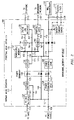
- FIG. 2 is a more detailed block diagram of broadband network interface 104 shown in FIG. 1.
- customer premises equipment 102 is a personal computer (PC) and is interconnected to broadband network via broadband network interface 104.
- broadband network interface 104 is divided into "normal” and “perpetual” portions which operate in corresponding "normal” or “perpetual” modes.
- broadband network interface 104 is divided into two logical portions by power boundary 140.
- First logical portion (hereinafter, normal mode portion) 122 comprises PC bus interface 124 interconnected to buffer 126 via link 127.
- Power control logic 128 is interconnected to a PC power source, PC bus 124 and buffer 126 via links 129, 131 and 133, respectively.
- Power boundary 140 comprises parallel resistors R1 and R2 and diode D1 and is interconnected to buffer 126 and power control logic 128 via links 135 and 137, respectively. Power boundary 140 is also interconnected to link 131 via link 143. In the preferred embodiment, the value of each resistor is approximately 100 ohms. Resistor R1, R2 and diode D1 serve as the logical boundary dividing the "normal" and “perpetual" portions of modem 108. Nonnal mode portion 122 is powered by the PC power source only when the personal computer associated with broadband network interface 104 is in an "ON" or normal operating state.
- Second logical portion (hereinafter, perpetual mode portion) 150 of broadband network interface 104 is continuously powered by wall transformer 110 and/or back-up battery pack 112.
- Wall transformer 110 includes a power regulator (not shown) and, along with battery pack 112, is interconnected to perpetual mode portion 150 of broadband network interface 104 via link 109 as shown in FIG. 1.
- Perpetual mode portion 150 also includes non-volatile memory 152 interconnected to digital signal processor 154, buffer 156 and framer 160 via internal bus 155. More particularly, digital signal processor 154, buffer 156 and framer 160 are interconnected to internal bus 155 via links 151, 159 and 163, respectively. Also sbown are telephone interface 158 and physical layer 162.
- phone interface 158 is interconnected via link 115 to a standard telephone maintained on the premises.
- Telephone line interface 158 is also interconnected to digital signal processor 154 via link 153 and to interval bus 155 via link 157.
- Digital signal processor 154 interconnects the local bus 155 with the phone line interface 158.
- Physical layer 162 is interconnected to framer 160 via link 165 and maintains link 175 to power bus 171. Framer 160 also maintains link 167 to power bus 171.
- Power bus 171 interconnects power control logic 168 to buffer 156 and internal bus 155.
- battery charger circuit 174 is shown interconnected to power bus 171 via link 173 and diodes D2, D3.
- Diodes D2 and D3 serve to isolate the battery pack power source from the PC power source. Isolation of battery pack 112 from the PC power source is required to keep the relatively low capacity battery from attempting to power the entire PC.
- perpetual mode portion 150 continues to receive power from wall transformer 110 or battery pack 112 to maintain a PC presence on the broadband network.
- incoming data from the broadband network is received via link 107 in physical layer 162 which extends the data to framer 160 for processing before delivery to non-volatile memory 152 via internal bus 155.
- the incoming data is stored in non-volatile memory 152 until the personal computer returns to normal mode operation.
- the non-volatile memory may be initialized to accept all incoming data or some subset thereof if memory space is an issue.
- Non-volatile memory 152 also stores predetermined outgoing data which is available to all who request the data via the broadband network. More particularly, requests for outgoing data are received in pbysical layer 162 from the broadband network. The data is extended by physical layer 162 to framer 160 wbere it is processed before forwarding to digital signal processor 154. Digital signal processor 154 processes the request and retrieves appropriate information from non-volatile memory 152. This information is then extended back to the broadband network via link 107. In this manner, predefined outgoing data and incoming data may be processed by customer premises equipment 102 even when it is not operating in a "powered-up" state.
- non-volatile memory 152 When the PC operates in a normal mode, all incoming data stored in non-volatile memory 152 is rapidly downloaded and extended to PC bus interface 124 for delivery to the PC via link 113. Also, updates to outgoing data are automatically written to non-volatile memory 152.
- power is conserved by operating the customer premises equipment in perpetual mode while twenty-four (24) hour access to the customer premises equipment by the broadband network is guaranteed.
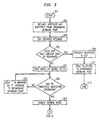
- Figures 3 and 4 are flow chart of an arrangement for allowing the interface board to control powering up of the PC, thus allowing the PC to respond automatically when incoming requests demand the services of the PC.
- the PC has been assumed that only the users of the PC can physically turn the PC on.
- Such an arrangement has the disadvantage that if the PC is not on and the incoming request cannot be properly responded to by the interface unit with its DSP, then the incoming request cannot be responded to at that time.
- such a website would have to be serviced either by a PC that is on all the time or by a PC that is only for appropriate times (for example, 9 a.m. to 5 p.m.), and is usually off at other times, thus disappointing potential surfers who would like to access that website.
- the object of the arrangement described in Figures 3 and 4 is to permit the PC to be turned off unless a user turns the PC on or unless an incoming request which can only be processed by the PC, is recognized by the DSP.
- Action Block 301 The process starts at initialization time (Action Block 301). At any time thereafter, a message is received from the broadband network port of the system and buffered (Action Block 303). The DSP decodes this message (Action Block 305). The TDSP then tests whether it has enough data to respond to the input message. If so, it processes the response (Action Block 309), sends the response to the broadband network port (Action Block 311), and terminates its functions (End Block 313). If the DSP does not have enough data to respond (negative results of Test 307), then the DSP sends a wake-up signal to the PC (Action Block 321). This wake-up signal turns on power, causes the PC to boot, and turns on the bard disk in the P.
- Test 325 is then used to determine whether the PC has completed it boot operation; if not, the DSP sends a message to the broadband network port indicating that the request is being worked on (Action Block 323).
- the normal mode of the PC is enabled (Action Block 327). In this normal mode, messages are passed from the network port to the PC (Action Block 401), and the PC responds.
- Test 403 is used to determine whether the PC has completed generating its response; when it has, then a response is read from the PC (Action Block 405), and sent to the broadband network port by the DSP (Action Block 407).
- Test 409 is then used to determined if there are more messages of the buffer of the DSP.
- Action Block 401 is re-entered and the loop is re-traversed. If no more messages are in the receive buffer of the line card, then the DSP times for a reasonable interval (perhaps one minute), in order to avoid excessive turn-off and shut-down of the PC. Effective during this timing interval, the buffer is checked to see if there are any more messages (Test 409). Test 411 indicates that the time-out has elapsed, then 413 is used to determine whether any changes have been made by users to the outgoing messages. If so, then new outgoing messages are sent the DSP and stored in the electrically erasable programmable read only memory (EEPROM of the DSP (Action Block 415). If there have been no changes, then Action Block 415 is by-passed. Thereafter, the perpetual mode previously described of the DSP is entered, (Action Block 417), and a sleep signal is sent to the PC (Action Block 419). This terminates the actions of the PC until it is re-awakened (End Block 421).
Landscapes
- Engineering & Computer Science (AREA)
- Signal Processing (AREA)
- Telephonic Communication Services (AREA)
- Data Exchanges In Wide-Area Networks (AREA)
- Communication Control (AREA)
Applications Claiming Priority (4)
| Application Number | Priority Date | Filing Date | Title |
|---|---|---|---|
| US103020 | 1993-11-18 | ||
| US4526798A | 1998-03-20 | 1998-03-20 | |
| US45267 | 1998-03-20 | ||
| US10302098A | 1998-06-23 | 1998-06-23 |
Publications (1)
| Publication Number | Publication Date |
|---|---|
| EP0944232A2 true EP0944232A2 (fr) | 1999-09-22 |
Family
ID=26722573
Family Applications (1)
| Application Number | Title | Priority Date | Filing Date |
|---|---|---|---|
| EP99302037A Withdrawn EP0944232A2 (fr) | 1998-03-20 | 1999-03-16 | Equipement local d'abonné avec consommation d'énergie réduite |
Country Status (2)
| Country | Link |
|---|---|
| EP (1) | EP0944232A2 (fr) |
| JP (1) | JPH11331302A (fr) |
Cited By (4)
| Publication number | Priority date | Publication date | Assignee | Title |
|---|---|---|---|---|
| WO2008065341A2 (fr) | 2006-12-01 | 2008-06-05 | David Irvine | Maidsafe.net |
| GB2448798A (en) * | 2007-04-23 | 2008-10-29 | Lenovo | Selective engagement in peer to peer software distribution |
| US8498229B2 (en) | 2008-12-30 | 2013-07-30 | Intel Corporation | Reduced power state network processing |
| CN112134774A (zh) * | 2020-09-22 | 2020-12-25 | Oppo广东移动通信有限公司 | 客户前置设备、客户前置设备的通信控制方法及存储介质 |
-
1999
- 1999-03-16 EP EP99302037A patent/EP0944232A2/fr not_active Withdrawn
- 1999-03-17 JP JP11072682A patent/JPH11331302A/ja active Pending
Cited By (8)
| Publication number | Priority date | Publication date | Assignee | Title |
|---|---|---|---|---|
| WO2008065341A2 (fr) | 2006-12-01 | 2008-06-05 | David Irvine | Maidsafe.net |
| EP2472430A1 (fr) | 2006-12-01 | 2012-07-04 | David Irvine | Cryptage automatique |
| GB2448798A (en) * | 2007-04-23 | 2008-10-29 | Lenovo | Selective engagement in peer to peer software distribution |
| US8296385B2 (en) | 2007-04-23 | 2012-10-23 | Lenovo (Singapore) Pte. Ltd. | Apparatus and method for selective engagement in software distribution |
| US8498229B2 (en) | 2008-12-30 | 2013-07-30 | Intel Corporation | Reduced power state network processing |
| US9223392B2 (en) | 2008-12-30 | 2015-12-29 | Intel Corporation | Reduced power state network processing |
| CN112134774A (zh) * | 2020-09-22 | 2020-12-25 | Oppo广东移动通信有限公司 | 客户前置设备、客户前置设备的通信控制方法及存储介质 |
| CN112134774B (zh) * | 2020-09-22 | 2022-04-22 | Oppo广东移动通信有限公司 | 客户前置设备、客户前置设备的通信控制方法及存储介质 |
Also Published As
| Publication number | Publication date |
|---|---|
| JPH11331302A (ja) | 1999-11-30 |
Similar Documents
| Publication | Publication Date | Title |
|---|---|---|
| US11200101B2 (en) | Managing applications for power conservation | |
| US6658576B1 (en) | Energy-conserving communication apparatus selectively switching between a main processor with main operating instructions and keep-alive processor with keep-alive operating instruction | |
| US6324651B2 (en) | Method and apparatus for saving device state while a computer system is in sleep mode | |
| US10853329B2 (en) | Distributed file system | |
| US6631469B1 (en) | Method and apparatus for periodic low power data exchange | |
| US6470358B1 (en) | Remote synchronization with intelligent power management | |
| EP0910016A2 (fr) | Appareil et dispositif pour suspendre et reprendre du logiciel sur un ordinateur | |
| CN101404665A (zh) | 用于数据处理的方法和装置 | |
| CN101488928A (zh) | 一种互联企业群通信设备及互联企业群通信方法 | |
| JP2012533832A (ja) | ストレージ・クラスタにおける適応的な電力節約の方法 | |
| CN102084317A (zh) | 具有低功率媒体呈现子系统的移动电话 | |
| WO2019136963A1 (fr) | Procédé et dispositif de récupération de mémoire | |
| CN105511985A (zh) | 一种数据备份的方法及终端 | |
| US20100125726A1 (en) | Thin client host wakeup method and thin client host | |
| CN101989121B (zh) | 计算机系统、混合存储器及控制计算机存储器电源的方法 | |
| CN101770382A (zh) | 系统启动方法及计算机系统 | |
| CN112198949A (zh) | 一种硬盘管理方法、装置、电子设备及存储介质 | |
| EP0944232A2 (fr) | Equipement local d'abonné avec consommation d'énergie réduite | |
| US8972508B1 (en) | Methods and systems for managing email configuration | |
| CN101022346A (zh) | 一种电子文件协同下载系统及方法 | |
| US20080091783A1 (en) | Method and apparatus for real-time receiving of mails | |
| CN101453513A (zh) | 手机开机后短信功能快速使用系统及方法 | |
| US7243249B1 (en) | Method and apparatus for facilitating power state control and awareness of an autonomous subsystem in a computer based system | |
| US5557735A (en) | Communication system for a network and method for configuring a controller in a communication network | |
| US20030088797A1 (en) | Adapting link speed of a network controller to available power supply |
Legal Events
| Date | Code | Title | Description |
|---|---|---|---|
| PUAI | Public reference made under article 153(3) epc to a published international application that has entered the european phase |
Free format text: ORIGINAL CODE: 0009012 |
|
| AK | Designated contracting states |
Kind code of ref document: A2 Designated state(s): AT BE CH CY DE DK ES FI FR GB GR IE IT LI LU MC NL PT SE |
|
| AX | Request for extension of the european patent |
Free format text: AL;LT;LV;MK;RO;SI |
|
| STAA | Information on the status of an ep patent application or granted ep patent |
Free format text: STATUS: THE APPLICATION HAS BEEN WITHDRAWN |
|
| 18W | Application withdrawn |
Withdrawal date: 20021001 |