EP2472430A1 - Cryptage automatique - Google Patents
Cryptage automatique Download PDFInfo
- Publication number
- EP2472430A1 EP2472430A1 EP12155329A EP12155329A EP2472430A1 EP 2472430 A1 EP2472430 A1 EP 2472430A1 EP 12155329 A EP12155329 A EP 12155329A EP 12155329 A EP12155329 A EP 12155329A EP 2472430 A1 EP2472430 A1 EP 2472430A1
- Authority
- EP
- European Patent Office
- Prior art keywords
- data
- user
- chunk
- node
- file
- Prior art date
- Legal status (The legal status is an assumption and is not a legal conclusion. Google has not performed a legal analysis and makes no representation as to the accuracy of the status listed.)
- Withdrawn
Links
Images












Classifications
-
- H—ELECTRICITY
- H04—ELECTRIC COMMUNICATION TECHNIQUE
- H04L—TRANSMISSION OF DIGITAL INFORMATION, e.g. TELEGRAPHIC COMMUNICATION
- H04L67/00—Network arrangements or protocols for supporting network services or applications
- H04L67/01—Protocols
- H04L67/10—Protocols in which an application is distributed across nodes in the network
- H04L67/104—Peer-to-peer [P2P] networks
-
- H—ELECTRICITY
- H04—ELECTRIC COMMUNICATION TECHNIQUE
- H04L—TRANSMISSION OF DIGITAL INFORMATION, e.g. TELEGRAPHIC COMMUNICATION
- H04L63/00—Network architectures or network communication protocols for network security
- H04L63/08—Network architectures or network communication protocols for network security for authentication of entities
-
- G—PHYSICS
- G06—COMPUTING OR CALCULATING; COUNTING
- G06F—ELECTRIC DIGITAL DATA PROCESSING
- G06F21/00—Security arrangements for protecting computers, components thereof, programs or data against unauthorised activity
- G06F21/60—Protecting data
- G06F21/62—Protecting access to data via a platform, e.g. using keys or access control rules
- G06F21/6218—Protecting access to data via a platform, e.g. using keys or access control rules to a system of files or objects, e.g. local or distributed file system or database
-
- H—ELECTRICITY
- H04—ELECTRIC COMMUNICATION TECHNIQUE
- H04L—TRANSMISSION OF DIGITAL INFORMATION, e.g. TELEGRAPHIC COMMUNICATION
- H04L63/00—Network architectures or network communication protocols for network security
- H04L63/04—Network architectures or network communication protocols for network security for providing a confidential data exchange among entities communicating through data packet networks
- H04L63/0407—Network architectures or network communication protocols for network security for providing a confidential data exchange among entities communicating through data packet networks wherein the identity of one or more communicating identities is hidden
- H04L63/0421—Anonymous communication, i.e. the party's identifiers are hidden from the other party or parties, e.g. using an anonymizer
-
- H—ELECTRICITY
- H04—ELECTRIC COMMUNICATION TECHNIQUE
- H04L—TRANSMISSION OF DIGITAL INFORMATION, e.g. TELEGRAPHIC COMMUNICATION
- H04L67/00—Network arrangements or protocols for supporting network services or applications
- H04L67/01—Protocols
- H04L67/10—Protocols in which an application is distributed across nodes in the network
- H04L67/1095—Replication or mirroring of data, e.g. scheduling or transport for data synchronisation between network nodes
-
- H—ELECTRICITY
- H04—ELECTRIC COMMUNICATION TECHNIQUE
- H04L—TRANSMISSION OF DIGITAL INFORMATION, e.g. TELEGRAPHIC COMMUNICATION
- H04L9/00—Cryptographic mechanisms or cryptographic arrangements for secret or secure communications; Network security protocols
-
- H—ELECTRICITY
- H04—ELECTRIC COMMUNICATION TECHNIQUE
- H04L—TRANSMISSION OF DIGITAL INFORMATION, e.g. TELEGRAPHIC COMMUNICATION
- H04L41/00—Arrangements for maintenance, administration or management of data switching networks, e.g. of packet switching networks
- H04L41/30—Decision processes by autonomous network management units using voting and bidding
Definitions
- the present invention allows users to take charge of a new global network in a manner that will maintain effectiveness and promote the setting and attaining of common goals.
- this invention allows a secure private and free network where users can enjoy an efficiently managed working environment that presents a guaranteed level of private and securely protected activity.
- Digital data is often stored on the hard disks of individual PCs which invariably have memory and operational overhead restrictions. Storage on distributed systems such as the internet is also possible but requires specific storage servers to be available. In addition to these physical systems, data management elements such as security, repair, encryption, authentication, anonymity and mapping etc. are required to ensure successful data transactions and management via the Internet.
- Patents W09637837 , TW223167B , US6760756 and US7099898 describe methods of data replication and retention of data during failure.
- Patent W0200505060625 discloses method of secure interconnection when failure occurs.
- Authentication servers are for user and data transaction authentication e.g. JP2005311545 which describe a system wherein the application of 'a digital seal' to electronic documents conforms to the Electronic Signature Act. This is similar to the case of signing paper documents but uses the application of an electronic signature through an electronic seal authentication system.
- the system includes: client computers, to each of which a graphics tablet is connected; an electronic seal authentication server and a PKI authentication server, plus the electronic seal authentication server.
- US2004254894 discloses an automated system for the confirmed efficient authentication of an anonymous subscriber's profile data in this case.
- JP2005339247 describes a server based one time ID system and uses a portable terminal.
- US2006136317 discloses bank drop down boxes and suggests stronger protection by not transmitting any passwords or IDs.
- Patent US2006126848 discloses a server centric and deals with a one time password or authentication phrase and is not for use on a distributed network.
- Patent US2002194484 discloses a distributed networks where all chunks are not individually verified and where the manifest is only re-computed after updates to files and hashes are applied and are for validation only.
- hashing for authentication can be implemented step-by-step and empirical authentication of devices upon digital authentication among a plurality of devices.
- Each of a plurality of authentication devices can unidirectionally generate a hash value of a low experience rank from a hash value of a high experience rank, and receive a set of high experience rank and hash value in accordance with an experience.
- the authentication devices authenticate each other's experience ranks ( US2004019788 ).
- This is a system of hashing access against known identities and providing a mechanism of effort based access. This present invention does not rely or use such mechanisms.
- Self-verifying certificate for computer system uses private and public keys - no chunking but for trusted hardware subsystems ( US2002080973 ) this is a mechanism of self signing certificates for authentication, again useful for effort based computing but not used in this present invention.
- Other authentication modes are, device for exchanging packets of information ( JP2001186186 ), open key certificate management data ( JP10285156 ), and certification for authentication ( W096139210 ).
- Authentication for Peer to Peer system is demonstrated by digital rights management ( US2003120928 ).
- Digital rights management and CSC (part of that patent s a DRM container) issues which are based on ability to use rather than gaining access to network or resources and therefore not prior art.
- Known self-healing techniques are divided broadly into two classes.
- One is a centralized control system that provides overall rerouting control from the central location of a network.
- the rerouting algorithm and the establishing of alarm collection times become increasingly complex as the number of failed channels increases, and a substantial amount of time will be taken to collect alarm signals and to transfer rerouting information should a large number of channels of a multiplexed transmission system fail.
- the other is a distributed approach in which the rerouting functions are provided by distributed points of the network.
- the following papers on distributed rerouting approach have been published: (these are all related to self healing but from a network pathway perspective and therefore are not prior art for this invention which deals with data or data chunks self healing mechanisms.
- Document 1 is concerned with a restoration technique for failures in a single transmission system
- Document 2 relates to a "multiple-wave" approach in which route-finding packets are broadcast in multiple wave fashion in search of a maximum bandwidth until alternate routes having the necessary bandwidth are established.
- One shortcoming of this multiple wave approach is that it takes a long recovery time.
- Document 3 also relates to fault recovery for single transmission systems and has a disadvantage in that route-finding packets tend to form a loop and hence a delay is likely to be encountered.
- Self-repairing is conducted by data overlay is built as a data structure on top of a logical space defined by a distributed hash table (DHT) in a peer-to-peer (P2P) network environment ( US2005187946 )
- DHT distributed hash table
- P2P peer-to-peer
- This Microsoft patent is a patent to DT networks which is peculiar as these exist in some quantity and have done for many years, however there is no claim made to self repair data as is in this present invention but to self repair data storage locations (i.e. in p2p terms find nearest node).
- This is not self healing data but merely a description of a typical DHT and the availability of routes to data and providing multiple routes.
- This is not prior art for this present inventions but very likely not enforceable as there are many cases of prior art against this Microsoft patent.
- Identical communicating node elements are used for power delivery network for self-repairing ( US2005043858 ).
- Self-healing also relates to distributed data systems and, in particular, to providing high availability during performance of a cluster topology self-healing process within a distributed data system cluster.
- a cluster topology self-healing process may be performed in response to a node failure in order to replicate a data set stored on a failed node from a first node storing another copy of the data set to a second non-failed node ( US2004066741 ).
- An apparatus and method for self-healing of software may rely on a distribution object in a directory services of a network to provide data for controlling distribution of software and installation of files associated therewith ( US6023586 ).
- a technique for the substantially instantaneous self-healing of digital communications networks Digital data streams from each of N nearby sources are combined and encoded to produce N+M coded data streams using a coding algorithm. The N+M coded data streams are then each transmitted over a separate long haul communications link to a decoder where any N of the N+M coded data streams can be decoded uniquely to produce the original N data steams ( EP0420648 .
- a self-healing communications network which can be recovered from a failure in a short period of time even if the failure has occurred in a multiplexed transmission line ( US5235599 )
- the above patents and inventions are based on clustering technology and not distributed computing or Internet based computing.
- the cluster is simply many machines connected to create a larger machine. It is treated as a single machine with known user access etc. and not prior art to this present invention.
- the N + M coding schemes discussed are patents based on digital communications and reception links and are not related to this present invention although at first glance they appear to have the same language in areas.
- a range of limited methods for self-encryption have been developed e.g. system for radomisation-encryption of digital data sequence with freely selectable ( EP1182777 ) (this is a key generating patent and not self encryption as this current invention shows), use of code key calculation encryption mode but using server ( CN1658553 ), uses self-test mode ( US6028527 ), encryption system for randomising data signal for transmission (not storing) and reproducing information at a receiver ( US4760598 ), uses private encryption keys into components and sending them to trusted agents (rather than self encryption as per this present invention) ( JP2005328574 ), cryptographic system with key escrow feature, rather than self encryption as described in this present invention ( US6009177 ), steps of first encoding one set of message signal with first keyed transformation ( US6385316 ), self-modifying fail-safe password system ( US6370649 ), time-based encrypting method involves splitting voice signal into time intervals, random permutations etc.
- RU2120700 uses hardware decryption module (HDM) ( US2003046568 ), realizing data security storage and algorithm storage by means of semiconductor memory device ( US2006149972 ), use certificate from certificate server ( US20020428080 ), use certificates for encryption of communications ( EP1422865 ), use self-service terminal for encryption and transmission of data ( US2006020788 ), method for implementing security communication by encryption algorithm ( US2005047597 ), method of data encryption - block encryption variable length (BEVL) encoding, overcomes weakness of CMEA algorithm) ( US2004190712 ), encrypted cipher code for secure data transmission ( CN1627681 ) method and system for encrypting streamed data employing fast set-up single use key and self-synchronising ( US2005232424 ) and for security, generate MAC for data integrity, placing electronic signature, use TREM software module ( US2004199768 )
- None of the above systems utilise self encryption as per the present invention and are related to voice and data transmissions, or include hardware controllers or servers.
- US6859812 discloses a system and method for differentiating private and shared files, where clustered computers share a common storage resource, Network-Attached Storage (NAS) and Storage Area Network (SAN), therefore not distributed as in this present invention.
- NAS Network-Attached Storage
- SAN Storage Area Network
- US5313646 has a system which provides a copy-on-write feature which protects the integrity of the shared files by automatically copying a shared file into user's private layer when the user attempts to modify a shared file in a back layer, this is a different technology again and relies on user knowledge - not anonymous.
- WO02095545 discloses a system using a server for private file sharing which is not anonymous.
- a computer system having plural nodes interconnected by a common broadcast bus is disclosed by US5117350 .
- US5423034 shows how each file and level in the directory structure has network access privileges.
- the file directory structure generator and retrieval tool have a document locator module that maps the directory structure of the files stored in the memory to a real world hierarchical file structure of files. Therefore not distributed across public networks or anonymous or self encrypting, the present inventions does not use broadcasting in this manner.
- Network firewalls are typically based on packet filtering which is limited in principle, since the rules that judge which packets to accept or reject are based on subjective decisions.
- VPNs Virtual Private Networks
- other forms of data encryption, including digital signatures are not really safe because the information can be stolen before the encryption process, as default programs are allowed to do whatever they like to other programs or to their data files or to critical files of the operating system.
- This is done by ( CA247150 ) automatically creating an unlimited number of Virtual Environments (VEs) with virtual sharing of resources, so that the programs in each VE think that they are alone on the computer.
- the present invention takes a totally different approach to security and obviates the requirement of much of the above particularly CA2471505 .
- US6185316 discloses security via fingerprint imaging testing bit of code using close false images to deter fraudulent copying, this is different from the present invention in that we store no images at all and certainly not in a database.
- a server-tethered storage system that communicates with the end users over a local area network, or LAN.
- the end users send requests for the storage and retrieval of files over the LAN to a file server, which responds by controlling the storage and/or retrieval operations to provide or store the requested files.
- a file server which responds by controlling the storage and/or retrieval operations to provide or store the requested files. While such a system works well for smaller networks, there is a potential bottleneck at the interface between the LAN and the file storage system.
- a storage area network which is a shared, dedicated high-speed network for connecting storage resources to the servers. While the storage area networks are generally more flexible and scalable in terms of providing end user connectivity to different server-storage environments, the systems are also more complex. The systems require hardware, such as gateways, routers, switches, and are thus costly in terms of hardware and associated software acquisition.
- Yet another type of storage system is a network attached storage system in which one or more special-purpose servers handle file storage over the LAN.
- Another file storage system utilizes distributed storage resources resident on various nodes, or computers, operating on the system, rather than a dedicated centralised storage system. These are distributed systems, with the clients communicating peer-to-peer to determine which storage resources to allocate to particular files, directories and so forth. These systems are organized as global file stores that are physically distributed over the computers on the system.
- a global file store is a monolithic file system that is indexed over the system as, for example, a hierarchical directory.
- the nodes in the systems use Byzantine agreements to manage file replications, which are used to promote file availability and/or reliability. The Byzantine agreements require rather lengthy exchanges of messages and thus are inefficient and even impractical for use in a system in which many modifications to files are anticipated.
- US200211434 shows a peer-to-peer storage system which describes a storage coordinator that centrally manages distributed storage resources. The difference here is the requirement of a storage broker, making this not fully distributed.
- the present invention also differs in that the present invention has no central resources for any of the system and we also encrypt data for security as well as the self healing aspect of our system which is again distributed.
- US7010532 discloses improved access to information stored on a storage device.
- a plurality of first nodes and a second node are coupled to one another over a communications pathway, the second node being coupled to the storage device for determining meta data including block address maps to file data in the storage device.
- JP2003273860 discloses a method of enhancing the security level during access of an encrypted document including encrypted content.
- a document access key for decrypting an encrypted content within an encrypted document is stored in a management device, and a user device wishing to access the encrypted document transmits its user ID and a document identification key for the encrypted document, which are encrypted by a private key, together with a public key to the management device to request transmission of the document access key. Differing from this invention in that it never transmit user id or login in the network at all. Also it does not require management devices of any form.
- JP2002185444 discloses improves security in networks and the certainty for satisfying processing requests.
- a print server forms a secret key and a public key, and delivers the public key to a user terminal, which forms a user ID, a secret key and a public key, encrypts the user ID and the public key by using the public key, and delivers them to the print server.
- This is not linked at all to this invention and is a system for a PKI infrastructure for certificate access to network nodes.
- the private and public keys of users are used in US6925182 , and are encrypted with a symmetric algorithm by using individual user identifying keys and are stored on a network server making it a different proposition from a distributed network
- US2005091234 describes data chunking system which divides data into predominantly fixed-sized chunks such that duplicate data may be identified. This is associated with storing and transmitting data for distributed network.
- US2006206547 discloses a centralised storage system, whilst US2005004947 discloses a new PC based file system.
- US2005256881 discloses data storage in a place defined by a path algorithm. This is a server based duplicate removal and not necessarily encrypting data, unlike the present invention which does both and requires no servers.
- Hardware system which consists of a processor module, a redundant non-volatile memory system, such as dual disk drives, and multiple communications interfaces. This type of security system must be unlocked by a pass phrase to access data, and all data is transparently encrypted, stored, archived and available for encrypted backup.
- a system for maintaining secure communications, file transfer and document signing with PKI, and a system for intrusion monitoring and system integrity checks are provided, logged and selectively alarmed in a tamper-proof, time-certain manner.
- WO2005093582 discloses method of encryption where data is secured in the receiving node via private tag for anonymous network browsing.
- other numerous encryption methods are also available such as (i) implantation of Reed Solomon algorithm (WO02052787 ), which ensures data is coded in parabolic fashion for self-repairing and storage, (ii) storage involves incremental backup ( WO02052787 ), (ii) uses stenographic ( US2006177094 ), (iv) use cipher keys ( CN1620005 ), encryption for non text ( US2006107048 ) and US2005108240 discloses user keys and randomly generated leaf node keys.
- the present invention uses none of these methods of encryption and in particular ensures all chunks are unique and do not point to another for security (an issue with Reed Solomon and N + K implementations of parabolic coding)
- WO2005060152 discloses a digital watermark representing the one-way hash is embedded in a signature document is used for electronic signing. Usually encrypted document signing is associated with legal documents, e.g. on-line notary etc. e.g. US2006161781 , signature verification ( US6381344 ).
- WO0182036 discloses a system and method for signing, storing, and authenticating electronic documents using public key cryptography. The system comprises a document service computer cluster connected to user computers, document owner server computers, and registration computers via a network such as for example, the internet or the world wide web.
- WO0013368 discloses both the data object and the signature data are encrypted. None of these systems are designed or allow for distributed signing networks unlike the present invention.
- US6912660 discloses a method for parallel approval of an electronic document.
- a document authentication code (DAC 0) is generated, linked to the original document.
- Subsequent approvals of the document generate a DAC x related to that specific approval.
- This is not linked to the present invention as it's a document approval system - i.e. one which allows a document to have multiple signatories to authenticate approval, the present invention does not do this at all.
- US6098056 discloses a system and method for controlling access rights to and security of digital content in a distributed information system, e.g., Internet.
- the network includes at least one server coupled to a storage device for storing the limited access digital content encrypted using a random-generated key, known as a Document Encryption Key (DEK).
- DEK Document Encryption Key
- the DEK is further encrypted with the server's public key, using a public/private key pair algorithm and placed in a digital container stored in a storage device and including as a part of the meta-information which is in the container.
- the client's workstation is coupled to the server (one of the many difference's from the present invention) for acquiring the limited access digital content under the authorized condition.
- a Trusted Information Handler is validated by the server after the handler provides a data signature and type of signing algorithm to transaction data descriptive of the purchase agreement between the client and the owner.
- the server decrypts the encrypted DEK with its private key and re-encrypts the DEK with the handler's public key ensuring that only the information handler can process the information.
- the encrypted DEK is further encrypted with the client's public key personalizing the digital content to the client.
- the client's program decrypts the DEK with his private key and passes it along with the encrypted content to the handler which decrypts the DEK with his private key and proceeds to decrypt the content for displaying to the client.
- US5436972 discloses a method for preventing inadvertent betrayal by a trustee of escrowed digital secrets. After unique identification data describing a user has been entered into a computer system, the user is asked to select a password to protect the system.
- US5557518 discloses a system to open electronic commerce using trusted agents.
- US5557765 discloses a system and method for data recovery. An encrypting user encrypts a method using a secret storage key (KS) and attaches a Data Recovery Field (DRF), including an Access Rule Index (ARI) and the KS to the encrypted message.
- KS secret storage key
- DRF Data Recovery Field
- ARI Access Rule Index
- US5590199 discloses a system for authenticating and authorizing a user to access services on a heterogeneous computer network.
- the system includes at least one workstation and one authorization server connected to each other through a network.
- US2004117303 discloses an anonymous payment system and is designed to enable users of the Internet and other networks to exchange cash for electronic currency that may be used to conduct commercial transactions world-wide through public networks.
- US2005289086 discloses an anonymity for web registration which allows payment system.
- US2002073318 describe use of servers where the system is effort based trust on combination of anonymous keys to transact and public key to buy non anonymous credits. Each of these is a centrally controlled system and do not provide a mechanism to transfer credits or cash to anonymous accounts. Many of these actually require user registration on a web site.
- US2003163413 discloses a method of conducting anonymous transactions over the Internet to protect consumers from identity fraud.
- the process involves the formation of a Secure Anonymous Transaction Engine to enable any consumer operating over an open network, such as the Internet to browse, collect information, research, shop, and purchase anonymously.
- the Secure Anonymous Transaction Engine components provide a highly secure connection between the consumer and the provider of goods or services over the Internet by emulating an in store anonymous cash transaction although conducted over the Internet. This again is server based and requires user registration.
- WO0203293 discloses methods, systems, and devices for performing transactions via a communications network such as the Internet while preserving the anonymity of at least one of the parties.
- a transaction device is linked to an anonymous account to allow a party to preserve an equivalent level of anonymity as the use of cash when making a transaction at a traditional brick-and-mortar business as well as in the virtual world of electronic commerce.
- the transaction device may be considered equivalent to a flexible and versatile cash wallet.
- This like the next invention requires a hardware based device unlike the present invention.
- EP0924667 is based on a distributed payment system for cash-free payment with purse chip cards using the Net.
- the system consists of a client system which is, for example, installed at the customer site and a server system which is, for example, installed at the dealer.
- US6299062 discloses an electronic cash system for performing an electronic transaction using an electronic cash, comprises at least one user apparatus each capable of using the electronic cash; an authentication centre apparatus, for receiving a user identity information, a corresponding public key along with a certificate issue request from one of the user apparatus and for issuing a certificate for the user apparatus's public key after confirming the identity of the corresponding user. This again requires hardware and user registration to the system
- US2004172539 discloses method for generating an electronic receipt in a communication system providing a public key infrastructure, comprising the steps of receiving by a second party a request message from a first party, the request message comprising a transaction request and a first public key based on a secret owned by the first party and wherein the secret is associated with at least the secret of a further public key of the first party. (server based)
- WO0219075 discloses publicly-accessible, independent, and secure host internet site that provides a downloadable agent program to any anonymous client PC, with the agent program generating within the client PC a registration checksum based upon the document to be registered.
- US2003159032 discloses automatically generating unique, one-way compact and mnemonic voter credentials that support privacy and security services. Discloses any voting system, voting organization, or voting game wherein participants need to be anonymous and/or must exchange secrets and/or make collective decisions.
- US2002077887 (requires registration and initial knowledge of the person who receives the ballot, and requires a server) discloses an architecture that enables anonymous electronic voting over the Internet using public key technologies. Using a separate public key/private key pair, the voting mediator validates the voting ballot request.
- (Hardware device) DE10325491 discloses that the voting method has an electronic ballot box for collecting encoded electronic voting slips and an electronic box for collecting the decoded voting slips. The voter fills out his voting slip at a computer and authenticates his vote with an anonymous signature setting unit.
- US2004024635 (hardware based, requiring servers) discloses a distributed network voting system; a server for processing votes cast over a distributed computing network.
- the server includes memory storage, data identification, an interested party and a processor in communication with the memory.
- the processor operates to present an issue to a user of a client computer, receive a vote on the issue from the user, and transmit data relating to the vote to the interested party based upon the data identifying the interested party stored in the memory.
- the processor further operates to generate a vote status cookie when the user submits the vote, transmit the vote status cookie to the client for storage, and transmit data to the user that prompts the user to provide authentication data relating to the user, who then receives authentication data relating to the user and authenticate the user based on the authentication data.
- WO03098172 discloses modular monitoring and protection system with distributed voting logic.
- US2006112243 discloses a hard disk mapping where the data is copied locally and then the machine decides it can use either copy and whether or not update the other one.
- EP1049291 discloses a remote device monitoring using pre-calculated maps of equipment locations. These are hardware based data mapping systems and not related.
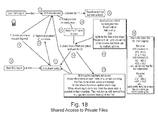
- a system of sharing access to private files which has the functional elements of:
- a distributed network system and product which provides:
- a method to allow anonymous authentication of users on a network is a method to allow anonymous authentication of users on a network.
- a method where a person's computer operating system and related computer program may be held on a removable disk (such as a USB stick optionally with biometric recognition to evade keyloggers) and used to boot any compatible computer with a known virus / trojan horse free system to access their data remotely and securely without worrying about the integrity of host machine they are using.
- a removable disk such as a USB stick optionally with biometric recognition to evade keyloggers
- At least one computer program comprising instructions for causing at least one computer to perform the method, system and product according to any of above.
- Anonymous authentication relates to system authentication and, in particular, authentication of users for accessing resources stored on a distributed or peer-to-peer file system. Its aim is to preserve the anonymity of the users and to provide secure and private storage of data and shared resources for users on a distributed system. It is a method of authenticating access to a distributed system comprising the steps of;
- Receiving, retrieving and authenticating may be performed on a node in the distributed system preferably separate from a node performing the step of decrypting.
- the method further comprises the step of generating the user identifier using a hash. Therefore, the user identifier may be considered unique (and altered if a collision occurs) and suitable for identifying unique validation records.
- the step of authenticating access may preferably further comprise the step of digitally signing the user identifier. This provides authentication that can be validated against trusted authorities.
- the method further comprises the step of using the signed user identifier as a session passport to authenticate a plurality of accesses to the distributed system. This allows persistence of the authentication for an extended session.
- the step of decrypting preferably comprises decrypting an address in the distributed system of a first chunk of data and the step of authenticating access further comprises the step of determining the existence of the first chunk at the address, or providing the location and names of specific data elements in the network in the form of a data map as previously describe. This efficiently combines the tasks of authentication and starting to retrieve the data from the system.
- the method preferably further comprises the step of using the content of the first chunk to obtain further chunks from the distributed system. Additionally the decrypted data from the additional chunks may contain a key pair allowing the user at that stage to sign a packet sent to the network to validate them or additionally may preferable self sign their own id.
- the client node is further adapted to generate the user identifier using a hash.
- the authentication module is further adapted to authenticate access by digitally sign the user identifier.
- the signed user identifier is used as a session passport to authenticate a plurality of accesses by the client node to the distributed system.
- the decryption module is further adapted to decrypt an address in the distributed system of a first chunk of data from the validation record and the authentication module is further adapted to authenticate access by determining the existence of the first chunk at the address.
- the client node is further adapted to use the content of the first chunk to obtain further authentication chunks from the distributed system.
- At least one computer program comprising program instructions for causing at least one computer to perform.
- One computer program is embodied on a recording medium or read-only memory, stored in at least one computer memory, or carried on an electrical carrier signal.
- node software package
- This will preferably include the ability of the system to check validity of the running maidsafe.net software by running content hashing or preferably certificate checking of the node and also the code itself.
- the maidsafe.net product invention consists of 8 individual inventions, which collectively have 28 inter-linked functional elements, these are:.
- the individual inventions are:
- the inter-linked functional elements are:
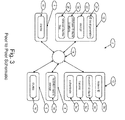
- Figure 3 illustrates, in schematic form, a peer-to-peer network in accordance with an embodiment of the invention.
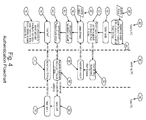
- Figure 4 illustrates a flow chart of the authentication, in accordance with a preferred embodiment of the present invention.
- a peer-to-peer network 2 is shown with nodes 4 to 12 connected by a communication network 14.
- the nodes may be Personal Computers (PCs) or any other device that can perform the processing, communication and/or storage operations required to operate the invention.
- the file system will typically have many more nodes of all types than shown in Figure 3 and a PC may act as one or many types of node described herein.
- Data nodes 4 and 6 store chunks 16 of files in the distributed system.
- the validation record node 8 has a storage module 18 for storing encrypted validation records identified by a user identifier.
- the client node 10 has a module 20 for input and generation of user identifiers. It also has a decryption module 22 for decrypting an encrypted validation record so as to provide decrypted information, a database or data map of chunk locations 24 and storage 26 for retrieved chunks and files assembled from the retrieved chunks.
- the verifying node 12 has a receiving module 28 for receiving a user identifier from the client node.
- the retrieving module 30 is configured to retrieve from the data node an encrypted validation record identified by the user identifier.
- the validation record node 8 is the same node as the verifying node 12, i.e. the storage module 18 is part of the verifying node 12 (not as shown in Figure 3 ).
- the transmitting module 32 sends the encrypted validation record to the client node.
- the authentication module 34 authenticates access to chunks of data distributed across the data nodes using the decrypted information.
- a login box is presented 46 that requires the user's name or other detail Preferably email address (the same one used in the client node software installation and registration process) or simply name (i.e. nickname) and the user's unique number, preferably PIN number. If the user is a 'main user' then some details may already be stored on the PC. If the user is a visitor, then the login box appears.
- This 'hash' is now known as the 'User ID Key' (MID), which at this point is classed as 'unverified' within the system.
- MID 'User ID Key
- This is stored on the network as the MAID and is simply the hash of the public key containing an unencrypted version of the public key for later validation by any other node. This obviates the requirement for a validation authority
- the software on the user's PC then combines this MID with a standard 'hello' code element 50, to create 52 a 'hello.packet'.
- This hello.packet is then transmitted with a timed validity on the Internet.
- the hello.packet will be picked up by the first node (for this description, now called the 'verifying node') that recognises 54 the User ID Key element of the hello.packet as matching a stored, encrypted validation record file 56 that it has in its storage area.
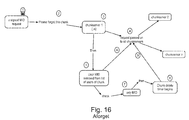
- a login attempt monitoring system ensures a maximum of three responses.
- the verifying PC creates a 'black list' for transmission to peers.
- an alert is returned to the user if a 'black list' entry is found and the user may be asked to proceed or perform a virus check.
- the verifying node then returns this encrypted validation record file to the user via the internet.
- the user's pass phrase 58 is requested by a dialog box 60, which then will allow decryption of this validation record file.
- the validation record file is decrypted 62
- the first data chunk details including a 'decrypted address'
- the user PC sends back a request 66 to the verifying node for it to initiate a query for the first 'file-chunk ID' at the 'decrypted address' that it has extracted from the decrypted validation record file, or preferably the data map of the database chunks to recreate the database and provide access to the key pair associated with this MID.
- the verifying node then acts as a 'relay node' and initiates a 'notify only' query for this 'file-chunk ID' at the 'decrypted address'.
- the verifying node Given that some other node (for this embodiment, called the 'data node') has recognised 68 this request and has sent back a valid 'notification only' message 70 that a 'file-chunk ID' corresponding to the request sent by the verifying node does indeed exist, the verifying node then digitally signs 72 the initial User ID Key, which is then sent back to the user.
- this verified User ID Key is used as the user's session passport.
- the user's PC proceeds to construct 76 the database of the file system as backed up by the user onto the network. This database describes the location of all chunks that make up the user's file system.
- the ID Key will contain irrefutable evidence such as a public/private key pair to allow signing onto the network as authorised users, preferably this is a case of self signing his or her own ID - in which case the ID Key is decrypted and user is valid - self validating.
- a 'proxy-controlled' handshake routine is employed through an encrypted point-to-point channel, to ensure only authorised access by the legal owner to the system, then to the user's file storage database, then to the files therein.
- the handshaking check is initiated from the PC that a user logs on to (the 'User PC'), by generating the 'unverified encrypted hash' known as the 'User ID Key', this preferably being created from the user's information preferably email address and their PIN number.
- This 'hash' is transmitted as a 'hello.packet' on the Internet, to be picked up by any system that recognises the User ID as being associated with specific data that it holds.
- This PC then becomes the 'verifying PC' and will initially act as the User PC's 'gateway' into the system during the authentication process.
- the encrypted item of data held by the verifying PC will temporarily be used as a 'validation record', it being directly associated with the user's identity and holding the specific address of a number of data chunks belonging to the user and which are located elsewhere in the peer-to-peer distributed file system.
- This 'validation record' is returned to the User PC for decryption, with the expectation that only the legal user can supply the specific information that will allow its accurate decryption.
- this data may be a signed response being given back to the validating node which is possible as the id chunk when decrypted (preferably symmetrically) contains the users public and private keys allowing non refutable signing of data packets.
- the machine will now have access to the data map of the database and public/private key pair allowing unfettered access to the system.
- no communication is carried out via any nodes without an encrypted channel such as TLS (Transport Layer Security) or SSL (Secure Sockets Layer) being set up first.
- a peer talks to another peer via an encrypted channel and the other peer (proxy) requests the information (e.g. for some space to save information on or for the retrieval of a file).
- An encrypted link is formed between all peers at each end of communications and also through the proxy during the authentication process. This effectively bans snoopers from detecting who is talking to whom and also what is being sent or retrieved.
- the initial handshake for self authentication is also over an encrypted link.
- Secure connection is provided via certificate passing nodes, in a manner that does not require intervention, with each node being validated by another, where any invalid event or data, for whatever reason (fraud detection, snooping from node or any invalid algorithms that catch the node) will invalidate the chain created by the node. This is all transparent to the user.
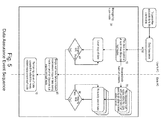
- Figure 5 illustrates a flow chart of data assurance event sequence in accordance with first embodiment of this invention
- Figure 6 illustrates a flow chart of file chunking event sequence in accordance with second embodiment of this invention
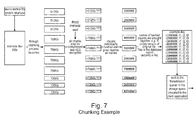
- Figure 7 illustrates a schematic diagram of file chunking example
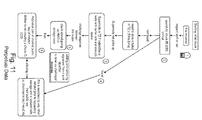
- Figure 8 illustrates a flow chart of self healing event sequence
- Figure 9 illustrates a flow chart of peer ranking event sequence
- Figure 10 illustrates a flow chart of duplicate removal event sequence
- the data is copied to at least three disparate locations at step (10).
- the disparate locations store data with an appendix pointing to the other two locations by step (20) and is renamed with hash of contents.
- this action is managed by another node i.e. super node acting as an intermediary by step (30).
- step (40) Each local copy at user's PC is checked for validity by integrity test by step (40) and in addition validity checks by integrity test are made that the other 2 copies are also still ok by step (50).
- any single node failure initiates a replacement copy of equivalent leaf node being made in another disparate location by step (60) and the other remaining copies are updated to reflect this change to reflect the newly added replacement leaf node by step (70).
- the steps of storing and retrieving are carried out via other network nodes to mask the initiator (30).
- the method further comprises the step of renaming all files with a hash of their contents.
- each file can be checked for validity or tampering by running a content hashing algorithm such as (for example) MD5 or an SHA variant, the result of this being compared with the name of the file.
- a content hashing algorithm such as (for example) MD5 or an SHA variant
- step (100) provides a methodology to manageable sized data elements and to enable a complimentary data structure for and compression and encryption and the step is to file chunking.
- the nominated data elements files are passed to chunking process.
- Each data element (file) is split into small chunks by step (80) and the data chunks are encrypted by step (90) to provide security for the data.
- the data chunks are stored locally at step (100) ready for network transfer of copies. Only the person or the group, to whom the overall data belongs, will know the location of these (100) or the other related but dissimilar chunks of data. All operations are conducted within the user's local system. No data is presented externally.
- Each of the above chunks does not contain location information for any other dissimilar chunks. This provides for, security of data content, a basis for integrity checking and redundancy.
- the method further comprises the step of only allowing the person (or group) to whom the data belongs, to have access to it, preferably via a shared encryption technique. This allows persistence of data.
- the checking of data or chunks of data between machines is carried out via any presence type protocol such as a distributed hash table network.
- a redirection record is created and stored in the super node network, (a three copy process - similar to data) therefore when a user requests a check, the redirection record is given to the user to update their database.
- FIG. 7 illustrates flow chart example of file chunking.
- User's normal file has 5Mb document, which is chunked into smaller variable sizes e.g. 135kb, 512kb, 768kb in any order. All chunks may be compressed and encrypted by using Pass phrase.
- Next step is to individually hash chunks and given hashes as names.
- database record as a file is made from names of hashed chunks brought together e.g. in empty version of original file (C1########,t1,t2,t3: C2########,t1,t2,t3 etc), this file is then sent to transmission queue in storage space allocated to client application.
- Self healing is required to guarantee availability of accurate data.
- the location of failing data chunks is assessed as unreliable and further data from the leaf node is ignored from that location by step (120).
- a 'Good Copy' from the 'known good' data chunk is recreated in a new and equivalent leaf node.
- Data or chunks are recreated in a new and safer location by step (130).
- the leaf node with failing data chunks is marked as unreliable and the data therein as 'dirty' by step (140).
- Peer leaf nodes become aware of this unreliable leaf node and add its location to watch list by step (150). All operations conducted within the user's local system. No data is presented externally.
- the network will use SSL or TLS type encryption to prevent unauthorised access or snooping.
- Peer Ranking id required to ensure consistent response and performance for the level of guaranteed interaction recorded for the user.
- each node (leaf node) monitors its own peer node's resources and availability in a scaleable manner, each leaf node is constantly monitored.
- Each data store (whether a network service, physical drive etc.) is monitored for availability.
- a qualified availability ranking is appended to the (leaf) storage node address by consensus of a monitoring super node group by step (160).
- a ranking figure will be appended by step (160) and signed by the supply of a key from the monitoring super node; this would preferably be agreed by more super nodes to establish a consensus for altering the ranking of the node.
- the new rank will preferably be appended to the node address or by a similar mechanism to allow the node to be managed preferably in terms of what is stored there and how many copies there has to be of the data for it to be seen as perpetual.
- Each piece of data is checked via a content hashing mechanism for data integrity, which is carried out by the storage node itself by step (170) or by its partner nodes via super nodes by step (180) or by instigating node via super nodes by step (190) by retrieval and running the hashing algorithm against that piece of data.
- the data checking cycle repeats itself.
- the super node querying the storage peer will respond with the result of the integrity check and update this status on the storage peer.
- the instigating node or partner peer will decide to forget this data and will replicate it in a more suitable location.
- step (200) If data fails the integrity check the node itself will be marked as 'dirty' by step (200) and 'dirty' status appended to leaf node address to mark it as requiring further checks on the integrity of the data it holds by step (210). Additional checks are carried out on data stored on the leaf node marked as 'dirty' by step (220). If pre-determined percentage of data found to be 'dirty' node is removed from the network except for message traffic by step (230). A certain percentage of dirty data being established may conclude that this node is compromised or otherwise damaged and the network would be informed of this. At that point the node will be removed from the network except for the purpose of sending it warning messages by step (230).
- duplicate data is removed to maximise the efficient use of the disk space.
- internally generated content hash may be checked for a match against hashes stored on the internet by step (250) or a list of previously backed up data (250). This will allow only one backed up copy of data to be kept. This reduces the network wide requirement to backup data which has the exact same contents.
- Notification of shared key existence is passed back to instigating node by step (260) to access authority check requested, which has to pass for signed result is to be passed back to storage node.
- the storage node passes shared key and database back to instigating node by step (270)
- Such data is backed up via a shared key which after proof of the file existing (260) on the instigating node, the shared key (270) is shared with this instigating node. The location of the data is then passed to the node for later retrieval if required.
- This data may be marked as protected or not protected by step (280) which has check carried out for protected or non-protected data content.
- the protected data ignores sharing process.
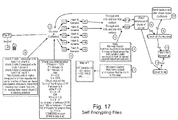
- a file is chunked or split into constituent parts (1) this process involves calculating the chunk size, preferably from known data such as the first few bytes of the hash of the file itself and preferably using a modulo division technique to resolve a figure between the optimum minimum and optimum maximum chunk sizes for network transmission and storage.
- each chunk is then encrypted and obfuscated in some manner to protect the data.
- a search of the network is carried out looking for values relating to the content hash of each of the chunks (2).
- failure to identify all chunks may mean there is a collision on the network of file names or some other machine is in the process of backing up the same file.
- a back-off time is calculated to check again for the other chunks. If all chunks are on the network the file is considered backed up and the user will add their MID signature to the file after preferably a challenge response to ensure there a valid user and have enough resources to do this.
- the user preferably via another node (3) will request the saving of the first copy (preferably in distinct time zones or other geographically dispersing method).
- the chunk will be stored (5) on a storage node allowing us to see the PMID of the storing node and store this.
- the data is stored in multiple locations.
- Each location stores the locations of its peers that hold identical chunks (at least identical in content) and they all communicate regularly to ascertain the health of the data.
- the preferable method is as follows:
- the data is copied to at least three disparate locations.
- each copy is performed via many nodes to mask the initiator.
- each local copy is checked for validity and checks are made that the preferably other 2 copies are also still valid.
- any single node failure initiates a replacement copy being made in another disparate location and the other associated copies are updated to reflect this change.
- steps of storing and retrieving are carried out via other network nodes to mask the initiator.
- the method further comprises the step of renaming all files with a hash of their contents.
- each chunk may alter its name by a known process such as a binary shift left of a section of the data. This allows the same content to exist but also allows the chunks to appear as three different bits of data for the sake of not colliding on the network.
- each chunk has a counter attached to it that allows the network to understand easily just how many users are attached to the chunk - either by sharing or otherwise.
- a user requesting a 'chunk forget' will initiate a system question if they are the only user using the chunk and if so the chunk will be deleted and the user's required disk space reduced accordingly. This allows users to remove files no longer required and free up local disk space. Any file also being shared is preferably removed from the user's quota and the user's database record or data map (see later) is deleted.
- this counter is digitally signed by each node sharing the data and therefore will require a signed 'forget' or 'delete' command.
- 'store', 'put', 'retrieve' and 'get' commands should also be either digitally signed or preferably go through a PKI challenge response mechanism.
- this method will be monitored by a supernode or similar to ensure the user has not simply copied the data map for later use without giving up the disk space for it. Therefore the user's private ID public key will be used to request the forget chunk statement. This will be used to indicate the user's acceptance of the 'chunk forget' command and allow the user to recover the disk space. Any requests against the chunk will preferably be signed with this key and consequently rejected unless the user's system gives up the space required to access this file.
- each user storing a chunk will append their signed request to the end of the chunk in an identifiable manner i.e. prefixed with 80 - or similar.
- Forgetting the chunk means the signature is removed from the file. This again is done via a signed request from the storage node as with the original backup request.
- this signed request is another small chunk stored at the same location as the data chunk with an appended postfix to the chunk identifier to show a private ID is storing this chunk. Any attempt by somebody else to download the file is rejected unless they first subscribe to it, i.e. a chunk is called 12345 so a file is saved called 12345 ⁇ signed store request>. This will allow files to be forgotten when all signatories to the chunk are gone.
- a user will send a signed 'no store' or 'forget' and their ID chunk will be removed, and in addition if they are the last user storing that chunk, the chunk is removed. Preferably this will allow a private anonymous message to be sent upon chunk failure or damage allowing a proactive approach to maintaining clean data.
- the other nodes can preferably send a message to all sharers of the chunk to identify the new location of the replacement chunk.
- any node attaching to a file then downloading immediately should be considered an alert and the system may take steps to slow down this node's activity or even halt it to protect data theft.
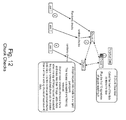
- Chunk Checks ( Figure 1- P9 and Figure 12)
- each file is split into small chunks and encrypted to provide security for the data. Only the person or the group, to whom the overall data belongs, will know the location of the other related but dissimilar chunks of data.
- each of the above chunks does not contain location information for any other dissimilar chunks; which provides for security of data content, a basis for integrity checking and redundancy.
- the method further comprises the step of only allowing the person (or group) to whom the data belongs to have access to it, preferably via a shared encryption technique which allows persistence of data.
- the checking of data or chunks of data between machines is carried out via any presence type protocol such as a distributed hash table network.
- a redirection record is created and stored in the super node network, (a three copy process - similar to data) therefore when a user requests a check, the redirection record is given to the user to update their database, which provides efficiency that in turn allows data resilience in cases where network churn is a problem as in peer to peer or distributed networks.
- This system message can be preferably passed via the messenger system described herein.
- the system may simply allow a user to search for his chunks and through a challenge response mechanism, locate and authenticate himself to have authority to get/forget this chunk.
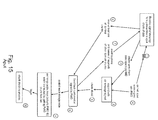
- a self healing network method is provided via the following process
- the network layer will use SSL or TLS channel encryption to prevent unauthorised access or snooping.
- each node (leaf node) monitors its own peer node's resources and availability in a scalable manner. Nodes constantly perform this monitoring function.
- Each data store (whether a network service, physical drive etc.) is monitored for availability.
- a ranking figure is appended and signed by the supply of a key from the monitoring super node, this being preferably agreed by more super nodes to establish a consensus before altering the ranking of the node.
- the new rank will be appended to the node address or by a similar mechanism to allow the node to be managed in terms of what is stored there and how many copies there has to be of the data for it to be seen as perpetual.
- Each piece of data is checked via a content hashing mechanism. This is preferably carried out by the storage node itself or by its partner nodes via super nodes or by an instigating node via super nodes by retrieving and running the hashing algorithm against that piece of data.
- the super node querying the storage peer will respond with the result of the integrity check and update this status on the storage peer.
- the instigating node or partner peer will decide to forget this data and will replicate it in a more suitable location.
- the node itself will be marked as 'dirty' and this status will preferably be appended to the node's address for further checks on other data to take this into account.
- a certain percentage of dirty data being established may conclude that this node is compromised or otherwise damaged and the network would be informed of this. At that point the node will be removed from the network except for the purpose of sending it warning messages.
- the node ranking figure will take into account at least; availability of the network connection, availability of resources, time on the network with a rank (later useful for effort based trust model), amount of resource (including network resources) and also the connectivity capabilities of any node (i.e. directly or indirectly contactable)
- the MID is the MID of the machine saving data to the net and the PMID is the ID of the storage node chunk server.
- the communication is therefore between a maidsafe.net application with a logged in user (to provide MID) and a chunking system on the net somewhere (storage node).
- the content hash may be checked against a list of previously backed up data. This will allow only one backed up copy of data to be kept, thereby reducing the network wide requirement to backup data that has the exact same content. Preferably this will be done via a simple search for existence on the net of all chunks of a particular file.
- such data is backed up via a shared key or mechanism of appending keys to chunks of data.
- the shared key is shared with the instigating node and the storing node issues a challenge response to add their ID to the pool if it is capable of carrying out actions on the file such as get/ forget (delete).
- the location of the data is then passed to the node for later retrieval if required.
- data may be marked as protected or not protected.
- protected data ignores sharing process.
- files are split preferably using an algorithm to work out the chunk size into several component parts.
- the size of the parts is preferably worked out from known information about the file as a whole, preferably the hash of the complete file. This information is run through an algorithm such as adding together the first x bits of the known information and using modulo division to give a chunk size that allows the file to preferably split into at least three parts.
- Preferably known information from each chunk is used as an encryption key. This is preferably done by taking a hash of each chunk and using this as the input to an encryption algorithm to encrypt another chunk in the file. Preferably this is a symmetrical algorithm such as AES256.
- this key is input into a password creating algorithm such as pbkdf and an initial vector and key calculated from that.
- a password creating algorithm such as pbkdf
- an initial vector and key calculated from that.
- the iteration count for the pbkdf is calculated from another piece of known information, preferably the sum of bits of another chunk or similar.
- each initial chunk hash and the final hash after encryption are stored somewhere for later decryption.
- data chunked and ready for storing can be stored on a distributed network but a search should preferably be carried out for the existence of all associated chunks created.
- the locations of the chunks Preferably have the same ranking (From earlier ranking system) as user or better, otherwise the existing chunks on the net are promoted to a location of equivalent rank at least. If all chunks exist then the file is considered as already backed up. If less than all chunks exist then this will preferably be considered as a collision (after a time period) and the file will be re chunked using the secondary algorithms (preferably just adjusted file sizes). This allows duplicate files on any 2 or more machines to be only backed up once, although through perpetual data several copies will exist of each file, this is limited to an amount that will maintain perpetual data.
- the actual encrypting and decrypting is carried out via knowledge of the file's content and this is somehow maintained (see next).
- Keys will be generated and preferably stored for decrypting.
- Actually encrypting the file will preferably include a compression process and further obfuscation methods.
- the chunk will be stored with a known hash preferably based on the contents of that chunk.
- Decrypting the file will preferably require the collation of all chunks and rebuilding of the file itself.
- the file may preferably have its content mixed up by an obfuscation technique rendering each chunk useless on its own.
- every file will go through a process of byte (or preferably bit) swapping between its chunks to ensure the original file is rendered useless without all chunks.
- This process will preferably involve running an algorithm which preferably takes the chunk size and then distributes the bytes in a pseudo random manner preferably taking the number of chunks and using this as an iteration count for the process. This will preferably protect data even in event of somebody getting hold of the encryption keys - as the chunks data is rendered useless even if transmitted in the open without encryption.
- a chunk's original hash or other calculable unique identifier will be stored. This will be stored with preferably the final chunk name.
- This aspect defines that each file will have a separate map preferably a file or database entry to identify the file and the name of its constituent parts. Preferably this will include local information to users such as original location and rights (such as a read only system etc.). Preferably some of this information can be considered shareable with others such as filename, content hash and chunks names.
- these data maps may be very small in relation to the original data itself allowing transmission of files across networks such as the internet with extreme simplicity, security and bandwidth efficiency.
- the transmission of maps will be carried out in a very secure manner, but failure to do this is akin to currently emailing a file in its entirety.
- this will preferably not require the deletion or removal of existing chunks, but instead allow the existing chunks to remain and the map appended to with an indication of a new revision existing.
- Preferably further access to the file will automatically open the last revision unless requested to open an earlier revision.
- revisions of any file can be forgotten or deleted (preferably after checking the file counter or access list of sharers as above). This will allow users to recover space from no longer required revisions.
- data identifiers can be appended to each other in a way that preferably allows a single file or database record to identify several files in one map.
- This is known as a share.
- Such a share can be private to the individual, thereby replacing the directory structure of files that users are normally used to, and replacing this with a new structure of shares very similar to volumes or filing cabinets as this is more in line with normal human nature and should make things simpler.
- this map of maps will preferably identify the users connected to it via some public ID that is known to each other user, with the map itself will being passed to users who agree to join the share. This will preferably be via an encrypted channel such as ms messenger or similar. This map may then be accessed at whatever rank level users have been assigned. Preferably there will be access rights such as read / delete / add / edit as is typically used today. As a map is altered, the user instigating this is checked against the user list in the map to see if this is allowed. If not, the request is ignored but preferably the users may then save the data themselves to their own database or data maps as a private file or even copy the file to a share they have access rights for. These shares will preferably also exhibit the revision control mechanism described above.
- joining the share will mean that the users subscribe to a shared amount of space and reduce the other subscription, i.e. a 10Gb share is created then the individual gives up 10Gb (or equivalent dependent on system requirements which may be a multiple or divisor of 10Gb).
- Another user joining means they both have a 5Gb space to give up and 5 users would mean they all have a 2Gb or equivalent space to give up. So with more people sharing, requirements on all users reduce.
- Non-logged in users will have a message buffered for them - if the file is closed the buffered message is deleted (as there is no point in sending it to the user now) and logged in users are updated also.
- a public and Private key pair is created for a network where preferably the user is anonymously logged on, and preferably has a changeable pseudo random private id which is only used for transmission and retrieval of ID blocks giving access to that network.
- this public private key pair will be associated with a public ID.
- This ID will be transmittable in a relatively harmless way using almost any method including in the open (email, ftp, www etc.) but preferably in an encrypted form.
- this ID should be simple enough to remember such as a phone number type length.
- this ID will be long enough however, to cope with all the world's population and more, therefore it would be preferably approx 11 characters long.
- This ID can be printed on business cards or stationary like a phone number or email address and cannot be linked to the users private ID by external sources. However the user's own private information makes this link by storing the data in the ID bit the user retrieves when logging in to the network or via another equally valid method of secure network authentication.
- This ID can then be used in data or resource sharing with others in a more open manner than with the private id. This keeps the private ID private and allows much improved inter-node or inter-person communications.
- the communications between nodes should be both private and validated. This is preferably irrefutable but there should be options for refutable communications if required.
- irrefutable communications the user logs on to the network and retrieves their key pair and ID. This is then used to start communications.
- the user's system will seek another node to transmit and receive from randomly - this adds to the masking of the user's private ID as the private ID is not used in any handshake with network resources apart from logging in to the network.
- a key may be passed.
- this is a code passed between users over another communications mechanism in a form such as a pin number known only to the users involved or it may be as simple as appending the user's name and other info to a communication request packet such as exists in some instant messaging clients today - i.e. David wants to communicate with you allow / deny / block.
- the random ID bit is preferably used as the first part of the identified buffer file name and when more messages are stored then another file is saved with the random id and a number appended to it representing the next sequential available number. Therefore a user will log on and retrieve the messages sequentially. This allows buffered secured and distributed messaging to exist.
- a by-product of securing communications between nodes using asymmetric encryption is as previously stated, introducing a non-refutable link. This allows for not only messages between nodes to be non-refutable but also for documents signed in the same manner as messages to be non refutable.
- This invention provides a great deal of anonymity and backs this up with access to resources.
- Documents may be signed and passed as legally enforceable between parties as a contract in many countries.
- a conversation or topic can be requested under various contracted conditions.
- the system may have a non disclosure agreement as an example and both parties digitally sign this agreement automatically on acceptance of a contract conversation.
- a non disclosure conversation This will preferably speed up and protect commercial entities entering into agreements or where merely investigating a relationship.
- other conditions can be applied here such as preferably full disclosure conversations, Purchase order conversations, contract signing conversations etc.
- This is all carried out via a system preferably having ready made enforceable contracts for automatic signing.
- These contracts may preferably be country or legal domain specific and will require to be enforceable under the law of the countries where the conversation is happening. This will require the users to preferably automatically use a combination of geographic IP status and by selecting which is their home country and where are they are at that time located and having that conversation.
- a very clear intent statement for a conversation that both parties agree to will form the basis of a contract in the event of any debate. The clearer the intent statement is; the better for enforceability.
- These conversations are potentially not enforceable but should lead to simplifying any resolution required at a later date. Preferably this can be added together with an actual contract conversation such as a non disclosure agreement to form a pack of contracts per conversation. Contract conversations will be clearly identified as such with copies of the contracts easily viewable by both parties at any time, these contracts will preferably be data maps and be very small in terms of storage space required.
- This system allows the ability for automatic system messages to be sent, i.e... in the case of sharing the share, data maps can exist on everyone's database and never be transmitted or stored in the open. File locks and changes to the maps can automatically be routed between users using the messenger system as described above. This is due to the distributed nature of maidsafe.net and is a great, positive differentiator from other messenger systems. These system commands will be strictly limited for security reasons and will initially be used to send alerts from trusted nodes and updates to share information by other shares of a private file share (whether they are speaking with them or not).
- the ability to transact in a global digital medium is made available with this invention. This is achieved by passing signed credits to sellers in return for goods.
- the credits are data chunks with a given worth preferably 1, 5, 10, 20, 50, 100 etc. units (called cybers in this case).
- cybers are a digital representation of a monetary value and can be purchased as described below or earned for giving up machine resources such as disk space of cpu time etc. There should be preferably many ways to earn cybers.
- a cyber is actually a digitally signed piece of data containing the value statement i.e. 10 cybers and preferably a serial number.
- the seller's serial number database is checked for validity of the cyber alone.
- the record of the ID used to transact is preferably not transmitted or recorded.
- This cyber will have been signed by the issuing authority as having a value. This value will have been proven and preferably initially will actually equate to a single currency for instance linked to a Euro. This will preferably alter through time as the system increases in capability.
- Some sellers may request non anonymous transactions and if the user agrees he will then use the public ID creation process to authenticate the transaction and may have to supply more data. However there may be other sellers who will sell anonymously. This has a dramatic effect on marketing and demographic analysis etc. as some goods will sell anywhere and some will not. It is assumed this system allows privacy and freedom to purchase goods without being analysed.
- the process of transacting the cybers will preferably involve a signing system such that two people in a transaction will actually pass the cyber from the buyer to the seller. This process will preferably alter the signature on the cyber to the seller's signature. This new signature is reported back to the issuing authority.
- people may purchase digital cash or credits from any seller of the cash.
- the seller will preferably create actual cash data chunks which are signed and serialised to prevent forgery. This is preferably accountable as with today's actual cash to prevent fraud and counterfeiting. Sellers will preferably be registered centrally in some cases.
- the users can then purchase cybers for cash and store these in their database of files in a system preferably such as maidsafe.net.
- a cyber As a cyber is purchased it is preferably unusable and in fact simply a reference number used to claim the cyber's monetary value by the purchaser's system. This reference number will preferably be valid for a period of time.
- the purchaser logs in to their system such as maidsafe.net and inputs the reference number in a secure communications medium as a cyber request.
- This request is analysed by the issuing authority and the transaction process begins.
- the cyber is signed by the issuing authority that then preferably encrypts it with the purchaser's public key and issues a signing request.
- the cyber is not valid at this point. Only when a signed copy of the cyber is received by the issuing authority is the serial number made valid and the cyber is live.
- this process is preferably carried out again i.e. the seller asks for payment and a cyber signed by the buyer is presented - this is validated by checking with the issuer that the serial code is valid and that the buyer is the actual owner of the cyber.
- the buyer issues a digitally signed transaction record to the issuing authority to state he is about to alter that cyber's owner.
- This is then passed to the seller who is requested to sign it.
- the seller signs the cyber and requests the issuing authority to accept him as new owner via a signed request.
- the authority then simply updates the current owner of the cyber in their records.
- These transactions are preferably anonymous, as users should be using a private id to accomplish this process.
- This private ID can be altered at any time but the old id should be saved to allow cyber transactions to take place with the old id.
- a system of voting which is non refutable and also anonymous is to be considered. This is a requirement to allow free speech and thinking to take place on a global scale without recrimination and negative feedback as is often the case.
- the user will have to be authenticated as above then preferably be presented with the issue to be voted on.
- the user will then use a private ID key to sign their vote anonymously.
- non anonymous irrefutable voting may also take place in the system by simply switching from a private ID to a public one. This will preferably form the basis of a petition based system as an add-on to the voting system.
- the system will require that a block of data can be published (preferably broadcast to each user via messenger) and picked up by each user of the system and presented as a poll. This poll will then be signed by the user and sent back to the poll issuer whose system will count the votes and preferably show a constant indication of the votes to date.
- each vote will require preferably only ONE ID to be used to prevent double voting.
- geographic IP may be used to establish geographic analysis of the voting community, particularly on local issues.
- the first stage is partially complete and individual accounts are authentic but this does not answer the question of anonymous individuals, this is described here.
- Access to a system can be made with information that we possess (passwords etc.) or something that we physically have (iris/ fingerprint or other biometric test).
- passwords etc. information that we possess
- iris/ fingerprint or other biometric test iris/ fingerprint or other biometric test
- the system will preferably use a biometric test. This is a key to the voting system as it becomes more broadly adopted. It is inherent in this system that any personally identifying data must be kept secret, and also that any passwords or access control information is never transmitted.
- the system can recognise if they have done so biometrically.
- the account is regarded as a unique individual rather than an individual account. This is possible as maidsafe.net can authenticate without accessing servers or database records of a biometric nature for example.
- to further manage the system there has to be a level of control as well as distribution to enable all users to access it at any time.
- the distribution of the votes is controlled as system messages and stored for users using the messenger system described earlier.
- This voting system will preferably always have a 'not enough information' selection to provide a route by which users are able to access information so that they are well informed before making any decision.
- the system will require a group of individuals, who are preferably voted into office by the public as the policyholders/ trustees of the voting system. This group will be known by their public ID and use their public ID to authenticate and publish a poll. This group will preferably be voted into office for a term and may be removed at any time via a consensus of the voting public. For this reason there will be continual polls on line which reflect how well the policyholders are doing as a group and preferably individually as well.
- users of the system will input to the larger issues on the system.
- Macro management should be carried out via the policyholders of the system, whom as mentioned previously may be voted in or out at any time, however larger issues should be left to the users.
- These issues can preferably be what licenses are used, costs of systems, dissemination of charitable contributions, provision to humanitarian and scientific projects of virtual computing resources on large scales etc.
- a system message will be sent out, where it is not presented as a message but as a vote. This should show up in the users voting section of the system. User private IDs will be required to act on this vote and they can make their decision.
- this system does not have a block vote or any other system which rates one individual over another at any time or provides an advantage in any other way. This requires no ability to allow veto on any decision or casting of votes by proxy so that the authenticated user's decision is seen as properly recorded and final.
- a system of perpetual data, self encrypting files and data mapping will allow a global anonymous backup and restore system for data to exist.
- This system can be constructed from the previous discussions where data may be made perpetual on a network and anonymously shared to prevent duplication. This together with the ability to check, manipulate and maintain revision control over files adds the capability of a 'time machine' type environment where data may be time stamped on backup.
- the system can add to this the ability for granular access controls.
- a node entering the network will request an authenticator to authorise its access.
- the authenticator will be a manager or equivalent in an organisation (whether matrix managed or traditional pyramid).
- This authorisation will tie the public ID of the authoriser to the system as having access to this node's data and any other authorisations they make (in an authorisation chain).
- adding the ability of non refutable messaging allows users to not only communicate genuinely and securely but also the ability to communicate under contracted terms. This allows for the implementation of legally kept trade secrets (as implied with NDA agreements etc.) plus many more contracted communications. This will hopefully lessen the burden on legal issues such as litigation etc.
- adding the ability to create two voting systems, anonymous and non-anonymous allows the system to provide a mechanism for instant democracy. This is achieved by allowing a voting panel in a user's account that is constantly updated with issues regarding the system and it's improvements initially. These votes will be anonymous.
- users may continually vote on certain subjects (as in a running poll) these subjects could be the leaders of boards etc.
- a non anonymous voting scenario it may be there's groups of identified people (via their MPID) who have a common grouping such as a charity or similar and they may require certain people to vote on certain matters and be recognised. This is where the MPID is used for voting.
- adding to this the ability to collect and trade credits anonymously allows users to sell machine resources they are not using, trade on a network with a cash equivalent and go about there business on a network as they do in real life.
Landscapes
- Engineering & Computer Science (AREA)
- Computer Security & Cryptography (AREA)
- Computer Networks & Wireless Communication (AREA)
- Signal Processing (AREA)
- Computer Hardware Design (AREA)
- General Engineering & Computer Science (AREA)
- Computing Systems (AREA)
- Theoretical Computer Science (AREA)
- Health & Medical Sciences (AREA)
- Bioethics (AREA)
- General Health & Medical Sciences (AREA)
- Software Systems (AREA)
- Physics & Mathematics (AREA)
- General Physics & Mathematics (AREA)
- Databases & Information Systems (AREA)
- Storage Device Security (AREA)
- Information Transfer Between Computers (AREA)
- Computer And Data Communications (AREA)
- Data Exchanges In Wide-Area Networks (AREA)
Applications Claiming Priority (3)
| Application Number | Priority Date | Filing Date | Title |
|---|---|---|---|
| GB0624053A GB2446199A (en) | 2006-12-01 | 2006-12-01 | Secure, decentralised and anonymous peer-to-peer network |
| GB0709759A GB2444342A (en) | 2006-12-01 | 2007-05-22 | A distributed system with anonymity and perpetual data |
| EP07824635A EP2118808A2 (fr) | 2006-12-01 | 2007-11-21 | Maidsafe.net |
Related Parent Applications (1)
| Application Number | Title | Priority Date | Filing Date |
|---|---|---|---|
| EP07824635.2 Division | 2007-11-21 |
Publications (1)
| Publication Number | Publication Date |
|---|---|
| EP2472430A1 true EP2472430A1 (fr) | 2012-07-04 |
Family
ID=37671708
Family Applications (2)
| Application Number | Title | Priority Date | Filing Date |
|---|---|---|---|
| EP07824635A Ceased EP2118808A2 (fr) | 2006-12-01 | 2007-11-21 | Maidsafe.net |
| EP12155329A Withdrawn EP2472430A1 (fr) | 2006-12-01 | 2007-11-21 | Cryptage automatique |
Family Applications Before (1)
| Application Number | Title | Priority Date | Filing Date |
|---|---|---|---|
| EP07824635A Ceased EP2118808A2 (fr) | 2006-12-01 | 2007-11-21 | Maidsafe.net |
Country Status (8)
| Country | Link |
|---|---|
| US (3) | US20100064354A1 (fr) |
| EP (2) | EP2118808A2 (fr) |
| CN (2) | CN101627395A (fr) |
| AU (1) | AU2007327389A1 (fr) |
| CA (2) | CA2768014A1 (fr) |
| GB (2) | GB2446199A (fr) |
| IN (1) | IN2009KN02415A (fr) |
| WO (1) | WO2008065341A2 (fr) |
Cited By (7)
| Publication number | Priority date | Publication date | Assignee | Title |
|---|---|---|---|---|
| CN105162760A (zh) * | 2015-07-28 | 2015-12-16 | 郝孟一 | 随机抽取方法、装置以及系统 |
| CN105468974A (zh) * | 2015-11-19 | 2016-04-06 | 广东欧珀移动通信有限公司 | 一种文件访问方法、装置及移动终端 |
| CN108470075A (zh) * | 2018-04-12 | 2018-08-31 | 重庆邮电大学 | 一种面向排序预测的社会化推荐方法 |
| US10333908B2 (en) | 2015-02-03 | 2019-06-25 | SecuritiNet Inc. | Transaction-based secure information delivery and assessment |
| AU2019201103A1 (en) * | 2019-02-15 | 2020-09-03 | Robert N. Barrett | Cryptography Method and System for Securing Data Via Electronic Transmission |
| US11018858B2 (en) * | 2015-12-08 | 2021-05-25 | Nec Corporation | Method for re-keying an encrypted data file |
| US12506614B2 (en) | 2019-08-07 | 2025-12-23 | Siemens Aktiengesellschaft | Detecting manipulated clients in a control system |
Families Citing this family (203)
| Publication number | Priority date | Publication date | Assignee | Title |
|---|---|---|---|---|
| US7162035B1 (en) | 2000-05-24 | 2007-01-09 | Tracer Detection Technology Corp. | Authentication method and system |
| US8171567B1 (en) | 2002-09-04 | 2012-05-01 | Tracer Detection Technology Corp. | Authentication method and system |
| JP4329656B2 (ja) * | 2004-09-13 | 2009-09-09 | 沖電気工業株式会社 | メッセージ受信確認方法、通信端末装置及びメッセージ受信確認システム |
| US8266438B2 (en) * | 2004-10-25 | 2012-09-11 | Security First Corp. | Secure data parser method and system |
| CN103384196A (zh) | 2005-11-18 | 2013-11-06 | 安全第一公司 | 安全数据解析方法和系统 |
| US20090048977A1 (en) * | 2007-07-07 | 2009-02-19 | Qualcomm Incorporated | User profile generation architecture for targeted content distribution using external processes |
| US9497286B2 (en) * | 2007-07-07 | 2016-11-15 | Qualcomm Incorporated | Method and system for providing targeted information based on a user profile in a mobile environment |
| US9392074B2 (en) * | 2007-07-07 | 2016-07-12 | Qualcomm Incorporated | User profile generation architecture for mobile content-message targeting |
| WO2009065045A1 (fr) * | 2007-11-14 | 2009-05-22 | Qualcomm Incorporated | Procédés et systèmes pour déterminer un profil utilisateur géographique afin de déterminer la pertinence de messages de contenu ciblés d'après le profil |
| US9203912B2 (en) * | 2007-11-14 | 2015-12-01 | Qualcomm Incorporated | Method and system for message value calculation in a mobile environment |
| US9391789B2 (en) * | 2007-12-14 | 2016-07-12 | Qualcomm Incorporated | Method and system for multi-level distribution information cache management in a mobile environment |
| US7995196B1 (en) | 2008-04-23 | 2011-08-09 | Tracer Detection Technology Corp. | Authentication method and system |
| US8175265B2 (en) * | 2008-09-02 | 2012-05-08 | Apple Inc. | Systems and methods for implementing block cipher algorithms on attacker-controlled systems |
| US9792384B2 (en) * | 2009-02-26 | 2017-10-17 | Red Hat, Inc. | Remote retreival of data files |
| US20110078779A1 (en) * | 2009-09-25 | 2011-03-31 | Song Liu | Anonymous Preservation of a Relationship and Its Application in Account System Management |
| US8983074B2 (en) * | 2009-12-22 | 2015-03-17 | Quad, Inc. | Input content data managing system and method of managing input content data |
| JP4835886B2 (ja) * | 2009-12-22 | 2011-12-14 | クオード株式会社 | 電子投票システム |
| CN101834853B (zh) * | 2010-04-02 | 2012-11-21 | 中国科学院软件研究所 | 匿名资源共享方法和系统 |
| WO2012017612A1 (fr) * | 2010-08-06 | 2012-02-09 | パナソニック株式会社 | Dispositif de partage d'informations anonymisées et procédé de partage d'informations anonymisées |
| US8776190B1 (en) * | 2010-11-29 | 2014-07-08 | Amazon Technologies, Inc. | Multifactor authentication for programmatic interfaces |
| IL210169A0 (en) | 2010-12-22 | 2011-03-31 | Yehuda Binder | System and method for routing-based internet security |
| US8938534B2 (en) | 2010-12-30 | 2015-01-20 | Ss8 Networks, Inc. | Automatic provisioning of new users of interest for capture on a communication network |
| US9058323B2 (en) | 2010-12-30 | 2015-06-16 | Ss8 Networks, Inc. | System for accessing a set of communication and transaction data associated with a user of interest sourced from multiple different network carriers and for enabling multiple analysts to independently and confidentially access the set of communication and transaction data |
| US9432342B1 (en) * | 2011-03-08 | 2016-08-30 | Ciphercloud, Inc. | System and method to anonymize data transmitted to a destination computing device |
| GB2489676A (en) * | 2011-03-29 | 2012-10-10 | Sigmoid Solutions Ltd | Overlay network comprising management node controlling access of subordinate nodes |
| US8972612B2 (en) | 2011-04-05 | 2015-03-03 | SSB Networks, Inc. | Collecting asymmetric data and proxy data on a communication network |
| US9754130B2 (en) * | 2011-05-02 | 2017-09-05 | Architecture Technology Corporation | Peer integrity checking system |
| US8869244B1 (en) * | 2011-05-03 | 2014-10-21 | Symantec Corporation | Techniques for providing role-based access control using dynamic shared accounts |
| US9147195B2 (en) * | 2011-06-14 | 2015-09-29 | Microsoft Technology Licensing, Llc | Data custodian and curation system |
| US9244956B2 (en) | 2011-06-14 | 2016-01-26 | Microsoft Technology Licensing, Llc | Recommending data enrichments |
| CN102866995B (zh) * | 2011-07-05 | 2017-05-24 | 中兴通讯股份有限公司 | 对等网络的文件访问方法、管理方法及分布式文件系统 |
| US9280377B2 (en) | 2013-03-29 | 2016-03-08 | Citrix Systems, Inc. | Application with multiple operation modes |
| US9183380B2 (en) | 2011-10-11 | 2015-11-10 | Citrix Systems, Inc. | Secure execution of enterprise applications on mobile devices |
| US8631209B2 (en) * | 2012-01-26 | 2014-01-14 | Upthere, Inc. | Reusable content addressable stores as building blocks for creating large scale storage infrastructures |
| US9075834B2 (en) | 2012-01-26 | 2015-07-07 | Upthere, Inc. | Detecting deviation between replicas using bloom filters |
| US9052824B2 (en) | 2012-01-26 | 2015-06-09 | Upthere, Inc. | Content addressable stores based on sibling groups |
| US9183212B2 (en) | 2012-01-26 | 2015-11-10 | Upthere, Inc. | Representing directory structure in content-addressable storage systems |
| US10404615B2 (en) | 2012-02-14 | 2019-09-03 | Airwatch, Llc | Controlling distribution of resources on a network |
| US9680763B2 (en) | 2012-02-14 | 2017-06-13 | Airwatch, Llc | Controlling distribution of resources in a network |
| US9253176B2 (en) | 2012-04-27 | 2016-02-02 | Intralinks, Inc. | Computerized method and system for managing secure content sharing in a networked secure collaborative exchange environment |
| US9251360B2 (en) | 2012-04-27 | 2016-02-02 | Intralinks, Inc. | Computerized method and system for managing secure mobile device content viewing in a networked secure collaborative exchange environment |
| US9355384B2 (en) | 2012-03-19 | 2016-05-31 | David W. Victor | Providing access to documents requiring a non-disclosure agreement (NDA) in an online document sharing community |
| US9594767B2 (en) | 2012-03-19 | 2017-03-14 | David W. Victor | Providing access to documents of friends in an online document sharing community based on whether the friends' documents are public or private |
| US9280794B2 (en) | 2012-03-19 | 2016-03-08 | David W. Victor | Providing access to documents in an online document sharing community |
| US9875239B2 (en) | 2012-03-19 | 2018-01-23 | David W. Victor | Providing different access to documents in an online document sharing community depending on whether the document is public or private |
| EP2842070B1 (fr) | 2012-04-27 | 2020-08-05 | Intralinks, Inc. | Procédé et système informatisés de gestion d'échanges participatifs sécurisés en réseau |
| US9553860B2 (en) | 2012-04-27 | 2017-01-24 | Intralinks, Inc. | Email effectivity facility in a networked secure collaborative exchange environment |
| US20140067668A1 (en) * | 2012-08-29 | 2014-03-06 | Bank Of America Corporation | Remote Safe Locking and Control |
| US8910239B2 (en) | 2012-10-15 | 2014-12-09 | Citrix Systems, Inc. | Providing virtualized private network tunnels |
| WO2014062804A1 (fr) | 2012-10-16 | 2014-04-24 | Citrix Systems, Inc. | Enveloppement d'application pour infrastructure de gestion d'application |
| US9971585B2 (en) | 2012-10-16 | 2018-05-15 | Citrix Systems, Inc. | Wrapping unmanaged applications on a mobile device |
| US9483657B2 (en) * | 2013-01-14 | 2016-11-01 | Accenture Global Services Limited | Secure online distributed data storage services |
| EP2946524A2 (fr) * | 2013-01-19 | 2015-11-25 | Trondert OÜ | Procédé de diffusion en flux sécurisé dans un système de fabrication à commande numérique, et système de fabrication à commande numérique sécurisé |
| WO2014127147A1 (fr) | 2013-02-13 | 2014-08-21 | Security First Corp. | Systèmes et procédés pour une couche de système de fichier cryptographique |
| US9853979B1 (en) | 2013-03-11 | 2017-12-26 | Amazon Technologies, Inc. | Immediate policy effectiveness in eventually consistent systems |
| US20140280955A1 (en) | 2013-03-14 | 2014-09-18 | Sky Socket, Llc | Controlling Electronically Communicated Resources |
| US9401915B2 (en) * | 2013-03-15 | 2016-07-26 | Airwatch Llc | Secondary device as key for authorizing access to resources |
| US10284627B2 (en) | 2013-03-29 | 2019-05-07 | Citrix Systems, Inc. | Data management for an application with multiple operation modes |
| US9985850B2 (en) | 2013-03-29 | 2018-05-29 | Citrix Systems, Inc. | Providing mobile device management functionalities |
| US9355223B2 (en) | 2013-03-29 | 2016-05-31 | Citrix Systems, Inc. | Providing a managed browser |
| TW201447613A (zh) * | 2013-06-06 | 2014-12-16 | Hon Hai Prec Ind Co Ltd | 資料處理系統及方法 |
| US9304815B1 (en) * | 2013-06-13 | 2016-04-05 | Amazon Technologies, Inc. | Dynamic replica failure detection and healing |
| US9886585B2 (en) | 2013-06-14 | 2018-02-06 | Sap Se | Multi-layer data security |
| US10354325B1 (en) | 2013-06-28 | 2019-07-16 | Winklevoss Ip, Llc | Computer-generated graphical user interface |
| US10269009B1 (en) | 2013-06-28 | 2019-04-23 | Winklevoss Ip, Llc | Systems, methods, and program products for a digital math-based asset exchange |
| US9043613B2 (en) | 2013-06-28 | 2015-05-26 | International Business Machines Corporation | Multiple volume encryption of storage devices using self encrypting drive (SED) |
| US10068228B1 (en) | 2013-06-28 | 2018-09-04 | Winklevoss Ip, Llc | Systems and methods for storing digital math-based assets using a secure portal |
| US11282139B1 (en) | 2013-06-28 | 2022-03-22 | Gemini Ip, Llc | Systems, methods, and program products for verifying digital assets held in a custodial digital asset wallet |
| US9898782B1 (en) | 2013-06-28 | 2018-02-20 | Winklevoss Ip, Llc | Systems, methods, and program products for operating exchange traded products holding digital math-based assets |
| US9369289B1 (en) | 2013-07-17 | 2016-06-14 | Google Inc. | Methods and systems for performing secure authenticated updates of authentication credentials |
| WO2015020575A1 (fr) * | 2013-08-09 | 2015-02-12 | Telefonaktiebolaget L M Ericsson (Publ) | Nœud de réseau de communication |
| JP6040313B2 (ja) * | 2013-08-22 | 2016-12-07 | 日本電信電話株式会社 | マルチパーティセキュア認証システム、認証サーバ、マルチパーティセキュア認証方法及びプログラム |
| US20160267065A1 (en) * | 2013-10-25 | 2016-09-15 | Leonard L. Drey | Method of Governing Content Presentation of Multi-Page Electronic Documents |
| US9514327B2 (en) | 2013-11-14 | 2016-12-06 | Intralinks, Inc. | Litigation support in cloud-hosted file sharing and collaboration |
| US9363264B2 (en) | 2013-11-25 | 2016-06-07 | At&T Intellectual Property I, L.P. | Networked device access control |
| US9367562B2 (en) | 2013-12-05 | 2016-06-14 | Google Inc. | Distributing data on distributed storage systems |
| KR20150070477A (ko) * | 2013-12-16 | 2015-06-25 | 삼성전자주식회사 | 결제 서비스를 제공하는 방법 및 이를 이용한 메신저 서버 |
| WO2015094278A1 (fr) * | 2013-12-19 | 2015-06-25 | Empire Technology Development, Llc | Facilitation d'échange de code poste-à-poste (p2p) dans un service en ligne géré de manière centralisée |
| KR102144509B1 (ko) * | 2014-03-06 | 2020-08-14 | 삼성전자주식회사 | 근접 통신 방법 및 장치 |
| FR3018378A1 (fr) * | 2014-03-12 | 2015-09-11 | Enrico Maim | Systeme et procede transactionnels a architecture repartie fondees sur des transactions de transferts d'unites de compte entre adresses |
| WO2015144971A1 (fr) * | 2014-03-27 | 2015-10-01 | Nokia Technologies Oy | Procédé et appareil pour une autorisation automatique entre dispositifs |
| WO2015161284A1 (fr) | 2014-04-18 | 2015-10-22 | Personally, Inc. | Communication de répertoire dynamique et de contenu |
| GB2530685A (en) | 2014-04-23 | 2016-03-30 | Intralinks Inc | Systems and methods of secure data exchange |
| US9830593B2 (en) | 2014-04-26 | 2017-11-28 | Ss8 Networks, Inc. | Cryptographic currency user directory data and enhanced peer-verification ledger synthesis through multi-modal cryptographic key-address mapping |
| US8978153B1 (en) | 2014-08-01 | 2015-03-10 | Datalogix, Inc. | Apparatus and method for data matching and anonymization |
| WO2016022864A2 (fr) * | 2014-08-06 | 2016-02-11 | Blockchain Technologies Corporation | Système et procédé permettant de recevoir et compter soigneusement des votes lors d'une élection |
| WO2016033208A1 (fr) * | 2014-08-26 | 2016-03-03 | Hoyos Labs Ip Ltd. | Système et procédés de partage sécurisé de fichiers et de gestion d'accès |
| US9733849B2 (en) | 2014-11-21 | 2017-08-15 | Security First Corp. | Gateway for cloud-based secure storage |
| US9584964B2 (en) | 2014-12-22 | 2017-02-28 | Airwatch Llc | Enforcement of proximity based policies |
| US9413754B2 (en) | 2014-12-23 | 2016-08-09 | Airwatch Llc | Authenticator device facilitating file security |
| US9853977B1 (en) | 2015-01-26 | 2017-12-26 | Winklevoss Ip, Llc | System, method, and program product for processing secure transactions within a cloud computing system |
| GB2534913B (en) * | 2015-02-05 | 2021-08-11 | Fujitsu Ltd | System, method, and program for storing and controlling access to data representing personal behaviour |
| US20160275294A1 (en) * | 2015-03-16 | 2016-09-22 | The MaidSafe Foundation | Data system and method |
| US10915891B1 (en) | 2015-03-16 | 2021-02-09 | Winklevoss Ip, Llc | Autonomous devices |
| US10158480B1 (en) | 2015-03-16 | 2018-12-18 | Winklevoss Ip, Llc | Autonomous devices |
| SG10201502401XA (en) * | 2015-03-26 | 2016-10-28 | Huawei Internat Pte Ltd | Method of obfuscating data |
| US10558996B2 (en) * | 2015-06-09 | 2020-02-11 | Fidelity National Information Services, Llc | Methods and systems for regulating operation of units using encryption techniques associated with a blockchain |
| CN107924389B (zh) * | 2015-07-02 | 2020-11-13 | 纳斯达克公司 | 对分布式交易数据库的安全溯源的系统和方法 |
| US10033702B2 (en) | 2015-08-05 | 2018-07-24 | Intralinks, Inc. | Systems and methods of secure data exchange |
| US10747753B2 (en) | 2015-08-28 | 2020-08-18 | Swirlds, Inc. | Methods and apparatus for a distributed database within a network |
| US9390154B1 (en) | 2015-08-28 | 2016-07-12 | Swirlds, Inc. | Methods and apparatus for a distributed database within a network |
| JP2017069617A (ja) * | 2015-09-28 | 2017-04-06 | ルネサスエレクトロニクス株式会社 | 半導体装置および画像符号化方法 |
| FR3046274B1 (fr) * | 2015-12-24 | 2018-11-16 | Ingenico Group | Procede de transmission de donnees, procede de reception de donnees, dispositifs et programmes correspondants |
| US10108812B2 (en) | 2016-01-28 | 2018-10-23 | Nasdaq, Inc. | Systems and methods for securing and disseminating time sensitive information using a blockchain |
| WO2017134281A1 (fr) | 2016-02-04 | 2017-08-10 | Nasdaq Technology Ab | Systèmes et procédés de stockage et de partage de données transactionnelles utilisant des systèmes informatiques distribués |
| WO2017140358A1 (fr) | 2016-02-17 | 2017-08-24 | Nec Europe Ltd. | Procédé destiné à stocker des données sur une entité de stockage |
| US9922199B2 (en) * | 2016-02-18 | 2018-03-20 | Bank Of America Corporation | Document security tool |
| SG11201806781SA (en) | 2016-02-23 | 2018-09-27 | Nchain Holdings Ltd | Registry and automated management method for blockchain-enforced smart contracts |
| JP6528008B2 (ja) | 2016-02-23 | 2019-06-12 | エヌチェーン ホールディングス リミテッドNchain Holdings Limited | 秘密共有のための楕円曲線暗号化を利用したパーソナルデバイスセキュリティ |
| EP3748903A1 (fr) | 2016-02-23 | 2020-12-09 | Nchain Holdings Limited | Système de tokénisation universel pour cryptomonnaies basées sur chaîne de blocs |
| KR102890466B1 (ko) | 2016-02-23 | 2025-11-21 | 엔체인 라이센싱 아게 | 블록체인으로부터 데이터의 안전한 추출을 위한 암호화 방법 및 시스템 |
| CN109314637B (zh) | 2016-02-23 | 2021-09-10 | 区块链控股有限公司 | 区块链上高效转移加密货币的方法和设备 |
| KR102777896B1 (ko) | 2016-02-23 | 2025-03-10 | 엔체인 홀딩스 리미티드 | 토큰화를 이용한 블록체인 기반 교환 방법 |
| KR102753027B1 (ko) | 2016-02-23 | 2025-01-14 | 엔체인 홀딩스 리미티드 | 블록체인상의 개체의 안전한 전송을 위한 방법 및 시스템 |
| US11347838B2 (en) | 2016-02-23 | 2022-05-31 | Nchain Holdings Ltd. | Blockchain implemented counting system and method for use in secure voting and distribution |
| EP4209983A1 (fr) * | 2016-02-23 | 2023-07-12 | nChain Licensing AG | Procédés et systèmes pour le transfert efficace d'entités sur une chaîne de blocs |
| JP6799061B2 (ja) | 2016-02-23 | 2020-12-09 | エヌチェーン ホールディングス リミテッドNchain Holdings Limited | ウォレット管理システムと併せたブロックチェーンベースのシステムのための暗号鍵のセキュアなマルチパーティ損失耐性のある記憶及び転送 |
| KR102871871B1 (ko) | 2016-02-23 | 2025-10-15 | 엔체인 라이센싱 아게 | 분산형 해시 테이블 및 블록체인을 사용하여 컴퓨터 소프트웨어를 보호하기 위한 방법 및 시스템 |
| EP3420674B1 (fr) | 2016-02-23 | 2021-03-24 | Nchain Holdings Limited | Procédé mis en oeuvre par chaîne de blocs pour le contrôle et la distribution de contenu numérique |
| EP3268914B1 (fr) | 2016-02-23 | 2018-06-20 | Nchain Holdings Limited | Détermination d'un secret commun pour l'échange sécurisé d'informations et de clés cryptographiques déterministes et hiérarchiques |
| JP6869250B2 (ja) | 2016-02-23 | 2021-05-12 | エヌチェーン ホールディングス リミテッドNchain Holdings Limited | ブロックチェーンを使用してピアツーピア分散型台帳におけるエンティティを効率的な移転のための方法およびシステム |
| BR112018016782A2 (pt) | 2016-02-23 | 2018-12-26 | Nchain Holdings Ltd | sistema e método implementado por computador configurado para controlar uma transferência feita através de um blockchain |
| GB2571367A (en) | 2016-02-23 | 2019-08-28 | Nchain Holdings Ltd | Tokenisation method and system for implementing exchanges on a blockchain |
| CN106255197B (zh) * | 2016-08-10 | 2019-12-31 | 北京邮电大学 | 一种分布式软交换系统的用户接入方法 |
| US20180063238A1 (en) * | 2016-08-25 | 2018-03-01 | Jiangang Zhang | Massively Scalable, Low Latency, High Concurrency and High Throughput Decentralized Consensus Algorithm |
| US20180083772A1 (en) * | 2016-09-20 | 2018-03-22 | Daniel Patrick Mullarkey | Perpetual encryption system, method, and software program product |
| RU2746446C2 (ru) * | 2016-11-10 | 2021-04-14 | Свирлдз, Инк. | Способы и устройство для распределенной базы данных, содержащей анонимные входные данные |
| WO2018089843A1 (fr) * | 2016-11-10 | 2018-05-17 | Saavha, Inc. | Système de vérification sécurisé basé sur un algorithme de hachage vérifié |
| KR102454779B1 (ko) | 2016-12-19 | 2022-10-13 | 스월즈, 인크. | 이벤트들의 삭제를 가능하게 하는 분산 데이터베이스를 위한 방법 및 장치 |
| US10645086B1 (en) * | 2016-12-30 | 2020-05-05 | Charles Schwab & Co., Inc. | System and method for handling user requests for web services |
| US12111944B2 (en) * | 2017-03-16 | 2024-10-08 | Jun Yu | Method and system for policy based real time data file access control |
| US11321680B2 (en) * | 2017-04-26 | 2022-05-03 | Ashish Kumar | System and method for processing and management of transactions using electronic currency |
| WO2018213672A1 (fr) * | 2017-05-18 | 2018-11-22 | Codex Llc | Procédé et système de distribution décentralisé de contenu numérique utilisant des chaînes de blocs |
| US11343245B2 (en) | 2017-06-14 | 2022-05-24 | Harman International Industries, Incorporated | Systems and methods for security of network connected devices |
| SG10202103402RA (en) | 2017-07-11 | 2021-05-28 | Swirlds Inc | Methods and apparatus for efficiently implementing a distributed database within a network |
| WO2019027445A1 (fr) | 2017-08-01 | 2019-02-07 | Visa International Service Association | Traitement de données privées |
| AU2018345387A1 (en) * | 2017-09-20 | 2020-04-09 | James Fournier | Internet data usage control system |
| US10297106B1 (en) | 2017-10-31 | 2019-05-21 | Jordan Simons | Distributed multi-ledger gambling architecture |
| CN107948161B (zh) * | 2017-11-28 | 2020-08-07 | 中国地质大学(武汉) | 一种文件匿名审批方法 |
| US12141871B1 (en) | 2018-02-12 | 2024-11-12 | Gemini Ip, Llc | System, method and program product for generating and utilizing stable value digital assets |
| US11909860B1 (en) | 2018-02-12 | 2024-02-20 | Gemini Ip, Llc | Systems, methods, and program products for loaning digital assets and for depositing, holding and/or distributing collateral as a token in the form of digital assets on an underlying blockchain |
| US10373158B1 (en) | 2018-02-12 | 2019-08-06 | Winklevoss Ip, Llc | System, method and program product for modifying a supply of stable value digital asset tokens |
| US11522700B1 (en) | 2018-02-12 | 2022-12-06 | Gemini Ip, Llc | Systems, methods, and program products for depositing, holding and/or distributing collateral as a token in the form of digital assets on an underlying blockchain |
| US10929842B1 (en) | 2018-03-05 | 2021-02-23 | Winklevoss Ip, Llc | System, method and program product for depositing and withdrawing stable value digital assets in exchange for fiat |
| US11139955B1 (en) | 2018-02-12 | 2021-10-05 | Winklevoss Ip, Llc | Systems, methods, and program products for loaning digital assets and for depositing, holding and/or distributing collateral as a token in the form of digital assets on an underlying blockchain |
| US10438290B1 (en) | 2018-03-05 | 2019-10-08 | Winklevoss Ip, Llc | System, method and program product for generating and utilizing stable value digital assets |
| US11334883B1 (en) | 2018-03-05 | 2022-05-17 | Gemini Ip, Llc | Systems, methods, and program products for modifying the supply, depositing, holding and/or distributing collateral as a stable value token in the form of digital assets |
| US12271898B1 (en) | 2018-03-05 | 2025-04-08 | Gemini Ip, Llc | System, method and program product for modifying a supply of stable value digital asset tokens |
| US11308487B1 (en) | 2018-02-12 | 2022-04-19 | Gemini Ip, Llc | System, method and program product for obtaining digital assets |
| US10373129B1 (en) | 2018-03-05 | 2019-08-06 | Winklevoss Ip, Llc | System, method and program product for generating and utilizing stable value digital assets |
| US10540654B1 (en) | 2018-02-12 | 2020-01-21 | Winklevoss Ip, Llc | System, method and program product for generating and utilizing stable value digital assets |
| US11200569B1 (en) | 2018-02-12 | 2021-12-14 | Winklevoss Ip, Llc | System, method and program product for making payments using fiat-backed digital assets |
| US11475442B1 (en) | 2018-02-12 | 2022-10-18 | Gemini Ip, Llc | System, method and program product for modifying a supply of stable value digital asset tokens |
| US11108857B2 (en) | 2018-02-27 | 2021-08-31 | Elasticsearch B.V. | Self-replicating management services for distributed computing architectures |
| US11019166B2 (en) | 2018-02-27 | 2021-05-25 | Elasticsearch B.V. | Management services for distributed computing architectures using rolling changes |
| CN108494764B (zh) * | 2018-03-20 | 2020-07-10 | 海信集团有限公司 | 一种身份认证方法及装置 |
| CN108494790B (zh) * | 2018-04-08 | 2020-01-21 | 南京大学 | 一种在分布式网络中检测持续型网络攻击的方法 |
| WO2019237126A1 (fr) * | 2018-06-08 | 2019-12-12 | Gcp Ip Holdings I, Llc | Protection de chaîne de blocs |
| ES2930575T3 (es) | 2018-06-15 | 2022-12-19 | Circularise Bv | Estructuras de bases de datos distribuidas para el intercambio anónimo de información |
| US11064323B2 (en) * | 2018-08-23 | 2021-07-13 | Ford Global Technologies, Llc | Method and apparatus for peer to peer distribution strategy for updates |
| US11140177B2 (en) * | 2018-08-31 | 2021-10-05 | Cisco Technology, Inc. | Distributed data authentication and validation using blockchain |
| CN109491965A (zh) * | 2018-09-13 | 2019-03-19 | 远光软件股份有限公司 | 购售电合同的存储方法及其网络和电子设备 |
| CN109493225B (zh) * | 2018-11-12 | 2022-02-18 | 夸克链科技(深圳)有限公司 | 一种区块链的分域验证机制 |
| US11005825B2 (en) * | 2018-11-13 | 2021-05-11 | Seagate Technology Llc | Sensor nodes and host forming a tiered ecosystem that uses public and private data for duplication |
| US10841153B2 (en) | 2018-12-04 | 2020-11-17 | Bank Of America Corporation | Distributed ledger technology network provisioner |
| US11070449B2 (en) | 2018-12-04 | 2021-07-20 | Bank Of America Corporation | Intelligent application deployment to distributed ledger technology nodes |
| US11636220B2 (en) * | 2019-02-01 | 2023-04-25 | Intertrust Technologies Corporation | Data management systems and methods |
| US12093942B1 (en) | 2019-02-22 | 2024-09-17 | Gemini Ip, Llc | Systems, methods, and program products for modifying the supply, depositing, holding, and/or distributing collateral as a stable value token in the form of digital assets |
| US11490256B2 (en) * | 2019-03-11 | 2022-11-01 | Hewlett Packard Enterprise Development Lp | Secure zero-touch provisioning of network devices in an offline deployment |
| CN110035121B (zh) * | 2019-03-29 | 2021-02-19 | 联想(北京)有限公司 | 一种信息处理方法及电子设备 |
| US11394789B2 (en) | 2019-05-08 | 2022-07-19 | Hewlett Packard Enterprise Development Lp | Seamless migration of a network management system deployment to cloud-based deployment |
| US11501370B1 (en) | 2019-06-17 | 2022-11-15 | Gemini Ip, Llc | Systems, methods, and program products for non-custodial trading of digital assets on a digital asset exchange |
| TWI738023B (zh) * | 2019-07-09 | 2021-09-01 | 中華電信股份有限公司 | 基於金鑰分持之網路匿名身分還原方法及伺服器 |
| KR102455758B1 (ko) * | 2020-01-30 | 2022-10-17 | 가부시키가이샤 스크린 홀딩스 | 데이터 처리 방법, 데이터 처리 장치 및 기억 매체 |
| CN111338574B (zh) * | 2020-02-20 | 2022-07-08 | 平安科技(深圳)有限公司 | 基于区块链的数据自修复方法、装置、介质及电子设备 |
| RU2748966C1 (ru) * | 2020-02-26 | 2021-06-02 | Акционерное общество "Лаборатория Касперского" | Способ синхронизации анонимных идентификаторов |
| CN111414415A (zh) * | 2020-02-26 | 2020-07-14 | 北斗(天津)科学技术应用研究院(有限合伙) | 一种去中心化的信息存储节点通信网络系统和方法 |
| US11276258B2 (en) | 2020-06-15 | 2022-03-15 | Delphian Systems, LLC | Enhanced security for contactless access card system |
| CN111817914B (zh) * | 2020-06-30 | 2022-03-11 | 晨边高地(无锡)科技有限公司 | 一种中高频算法交易接口智能系统 |
| US11829452B2 (en) | 2020-08-24 | 2023-11-28 | Leonard L. Drey | System and method of governing content presentation of multi-page electronic documents |
| EP4226257A4 (fr) | 2020-10-06 | 2024-11-06 | Hedera Hashgraph, LLC | Procédés et appareil destinés à une base de données distribuée dans un réseau |
| GB2602349B (en) * | 2020-12-24 | 2024-01-31 | Klarytee Ltd | Data security methods |
| US11784798B2 (en) | 2021-03-30 | 2023-10-10 | Visa International Service Association | System, method, and computer program product for data security |
| CN113644915B (zh) * | 2021-07-01 | 2022-06-07 | 中国科学院空天信息创新研究院 | 一种数据压缩方法、数据压缩装置、电子设备 |
| US11949795B2 (en) | 2021-08-27 | 2024-04-02 | Bank Of America Corporation | System for tracking resources using non-fungible tokens |
| US11882219B2 (en) | 2021-09-02 | 2024-01-23 | Bank Of America Corporation | System for dynamically tracking resources using non-fungible tokens |
| US11902443B2 (en) | 2021-09-08 | 2024-02-13 | Bank Of America Corporation | System for linking and partitioning non-fungible tokens |
| US11811931B2 (en) | 2021-09-15 | 2023-11-07 | Bank Of America Corporation | System for real-time assessment of authenticity of a resource using non-fungible tokens |
| ES2904423B2 (es) | 2021-09-22 | 2023-01-09 | Univ Valencia Politecnica | Metodo de registro distribuido para el control de acceso anonimo |
| US11902444B2 (en) | 2021-10-18 | 2024-02-13 | Bank Of America Corporation | System for virtualization of non-fungible tokens |
| CN114189526A (zh) * | 2021-11-01 | 2022-03-15 | 北京中合谷投资有限公司 | 一种分布式网络的中心化调度算法 |
| US12112356B2 (en) | 2021-12-09 | 2024-10-08 | Bank Of America Corporation | System for intelligent assessment models for non-fungible electronic resources |
| US11893587B2 (en) | 2021-12-10 | 2024-02-06 | Bank Of America Corporation | System for enhanced authentication using non-fungible tokens (NFTs) |
| US11983529B2 (en) | 2022-01-18 | 2024-05-14 | Bank Of America Corporation | System for detection and recordation of functional code logic components on a distributed development platform |
| US11966915B2 (en) | 2022-02-03 | 2024-04-23 | Bank Of America Corporation | System for tracking and tagging communication using electronic non-fungible resources within a distributed network |
| US11860862B2 (en) | 2022-02-09 | 2024-01-02 | Bank Of America Corporation | System for identification and recordation of base components of a resource within a virtual medium |
| US20230334482A1 (en) * | 2022-04-15 | 2023-10-19 | Bank Of America Corporation | Dynamic Quantum Enabled Method for Large Currency Transaction Exemption using Distributed Hash Chain |
| US20230334489A1 (en) * | 2022-04-15 | 2023-10-19 | Bank Of America Corporation | Dynamic Quantum Enabled Method for Large Currency Transaction Exemption Using Distributed Hash Chain |
| US12609843B2 (en) | 2022-05-18 | 2026-04-21 | Bank Of America Corporation | System for dynamic data aggregation and prediction for assessment of electronic non-fungible resources |
| US12572640B2 (en) | 2023-03-08 | 2026-03-10 | Bank Of America Corporation | System for validation and authentication of resources in a virtual environment |
| CN117473483B (zh) * | 2023-12-27 | 2024-04-02 | 四川省数字证书认证管理中心有限公司 | 电子印章及其离线授权方法 |
| CN117874789B (zh) * | 2024-01-05 | 2024-09-03 | 张渴欣 | 一种动态的隐私数据加密方法和系统 |
| CN119892425B (zh) * | 2024-12-27 | 2025-11-21 | 公安部第一研究所 | 一种便捷的跨域身份认证系统及方法 |
Citations (114)
| Publication number | Priority date | Publication date | Assignee | Title |
|---|---|---|---|---|
| US4760598A (en) | 1981-07-23 | 1988-07-26 | Racal Data Communications Inc. | Coded data transmission system |
| EP0420648A2 (fr) | 1989-09-29 | 1991-04-03 | AT&T Corp. | Codage à diversité pour réseaux de communications auto-régénérables transparents |
| US5117350A (en) | 1988-12-15 | 1992-05-26 | Flashpoint Computer Corporation | Memory address mechanism in a distributed memory architecture |
| US5235599A (en) | 1989-07-26 | 1993-08-10 | Nec Corporation | Self-healing network with distributed failure restoration capabilities |
| TW223167B (fr) | 1990-02-06 | 1994-05-01 | Canon Kk | |
| US5313646A (en) | 1989-02-24 | 1994-05-17 | Sun Microsystems, Inc. | Method and apparatus for translucent file system |
| US5423034A (en) | 1992-06-10 | 1995-06-06 | Cohen-Levy; Leon | Network file management with user determined hierarchical file structures and means for intercepting application program open and save commands for inputting and displaying user inputted descriptions of the location and content of files |
| US5436972A (en) | 1993-10-04 | 1995-07-25 | Fischer; Addison M. | Method for preventing inadvertent betrayal by a trustee of escrowed digital secrets |
| US5557765A (en) | 1994-08-11 | 1996-09-17 | Trusted Information Systems, Inc. | System and method for data recovery |
| US5557518A (en) | 1994-04-28 | 1996-09-17 | Citibank, N.A. | Trusted agents for open electronic commerce |
| WO1996037837A2 (fr) | 1995-05-26 | 1996-11-28 | Telenor As | Serveur de base de donnees continuellement disponible, presentant plusieurs groupes de noeuds avec un minimum d'ensembles de duplications de fragments de bases de donnees se recoupant |
| WO1996039210A1 (fr) | 1995-06-06 | 1996-12-12 | Tsukada Medical Research Co., Ltd. | Dispositif analgesique portable |
| US5590199A (en) | 1993-10-12 | 1996-12-31 | The Mitre Corporation | Electronic information network user authentication and authorization system |
| RU2120700C1 (ru) | 1993-11-01 | 1998-10-20 | Омский научно-исследовательский институт приборостроения | Способ кодирования речевых сигналов |
| JPH10285156A (ja) | 1997-04-10 | 1998-10-23 | Nippon Telegr & Teleph Corp <Ntt> | 認証システムにおける利用者情報管理装置 |
| EP0924667A2 (fr) | 1997-12-16 | 1999-06-23 | International Business Machines Corporation | Système de paiement distribué pour transferts de paiement sans argent liquide utilisant un porte-monnaie électronique |
| EP0944232A2 (fr) | 1998-03-20 | 1999-09-22 | Lucent Technologies Inc. | Equipement local d'abonné avec consommation d'énergie réduite |
| US6009177A (en) | 1994-01-13 | 1999-12-28 | Certco Llc | Enhanced cryptographic system and method with key escrow feature |
| US6023586A (en) | 1998-02-10 | 2000-02-08 | Novell, Inc. | Integrity verifying and correcting software |
| US6028527A (en) | 1996-11-25 | 2000-02-22 | Texas Instruments Incorporated | Decryption and encryption transmitter/receiver with self-test, learn and rolling code |
| WO2000013368A1 (fr) | 1998-08-31 | 2000-03-09 | Borgers Frederick J | Authentification ou signature numerisee d'objets de donnees numeriques |
| US6098056A (en) | 1997-11-24 | 2000-08-01 | International Business Machines Corporation | System and method for controlling access rights to and security of digital content in a distributed information system, e.g., Internet |
| EP1049291A2 (fr) | 1999-04-29 | 2000-11-02 | Mitsubishi Denki Kabushiki Kaisha | Télésurveillance et commande |
| US6185316B1 (en) | 1997-11-12 | 2001-02-06 | Unisys Corporation | Self-authentication apparatus and method |
| US6192129B1 (en) * | 1998-02-04 | 2001-02-20 | International Business Machines Corporation | Method and apparatus for advanced byte-oriented symmetric key block cipher with variable length key and block |
| US6205533B1 (en) * | 1999-08-12 | 2001-03-20 | Norman H. Margolus | Mechanism for efficient data access and communication in parallel computations on an emulated spatial lattice |
| JP2001100633A (ja) | 1999-09-30 | 2001-04-13 | Kosaburo Sato | 環境にやさしい万年カレンダー |
| JP2001186186A (ja) | 1999-12-27 | 2001-07-06 | Toshiba Corp | パケット交換装置、ネットワークシステム、およびパケット交換方法 |
| US6269563B1 (en) | 1999-06-03 | 2001-08-07 | Gideon Dagan | Perpetual calendar |
| US6299062B1 (en) | 1998-08-18 | 2001-10-09 | Electronics And Telecommunications Research Institute | Electronic cash system based on a blind certificate |
| WO2001082036A2 (fr) | 2000-04-26 | 2001-11-01 | Netcertainty, Inc. | Procede et systeme pour signer et authentifier des documents electroniques |
| JP2001308845A (ja) | 1999-04-28 | 2001-11-02 | Fuji Soft Abc Inc | 多重アファイン鍵を用いる暗号化・復号化方法、認証方法、及びこれを用いる各装置 |
| WO2002003293A1 (fr) | 2000-06-29 | 2002-01-10 | Resneck James D | Procede et dispositif pour transactions monetaires electroniques |
| US20020011434A1 (en) | 1999-06-21 | 2002-01-31 | Amway Corporation | Point-of use water treatment system |
| EP1182777A2 (fr) | 1999-05-18 | 2002-02-27 | Angel José Ferre Herrero | Systeme et methode de randomisation-chiffrement autocorrecteur |
| WO2002019075A2 (fr) | 2000-08-30 | 2002-03-07 | Spectros Corporation | Systeme et procede pour la certification et la validation de documents de clients par un serveur distant |
| WO2002021409A1 (fr) | 2000-09-08 | 2002-03-14 | Tallent Guy S | Systeme et procede pour fournir de maniere transparente une validation de certificats et d'autres services dans une transaction electronique |
| US20020038296A1 (en) * | 2000-02-18 | 2002-03-28 | Margolus Norman H. | Data repository and method for promoting network storage of data |
| US6370649B1 (en) | 1998-03-02 | 2002-04-09 | Compaq Computer Corporation | Computer access via a single-use password |
| US20020042808A1 (en) | 2000-09-29 | 2002-04-11 | Smith Joshua R. | Method and apparatus for linking data and objects |
| US6381344B1 (en) | 1994-08-31 | 2002-04-30 | Communication Intelligence Corp. | Method and system for the capture, storage, transport and authentication of handwritten signatures |
| US6385316B1 (en) | 1997-03-11 | 2002-05-07 | Qualcomm Incorporated | Method and apparatus for encrypting data in a wireless communication system |
| US20020073318A1 (en) | 2000-12-11 | 2002-06-13 | Rosario Gennaro | Electronic cash controlled by non-homomorphic signatures |
| US20020077887A1 (en) | 2000-12-15 | 2002-06-20 | Ibm Corporation | Architecture for anonymous electronic voting using public key technologies |
| US20020080973A1 (en) | 2000-12-22 | 2002-06-27 | Cromer Daryl Carvis | Computer system and method for generating a self-verifying certificate |
| JP2002185444A (ja) | 2000-12-14 | 2002-06-28 | Fuji Xerox Co Ltd | ネットワークシステム |
| WO2002052787A2 (fr) | 2000-12-22 | 2002-07-04 | The Charles Stark Draper Laboratory, Inc. | Repartition de messages et routage de messages diversifie au niveau de l'espace aux fins d'accroissement de l'assurance de transmission et de la securite des donnees sur des reseaux distribues |
| WO2002056133A2 (fr) | 2000-12-18 | 2002-07-18 | Bionetrix Systems Corporation | Systeme et procede de detection automatique et fichiers deteriores autoreparables, non existants ou modifies, via un support de communication |
| US20020099666A1 (en) | 2000-11-22 | 2002-07-25 | Dryer Joseph E. | System for maintaining the security of client files |
| WO2002095545A2 (fr) | 2001-04-20 | 2002-11-28 | Ponoi Corp. | Systeme permettant une confidentialite reseau basee sur une session, une mise en memoire privee, permanente et un controle d'acces discretionnaire pour le partage de donnees privees |
| US20020184485A1 (en) | 1999-12-20 | 2002-12-05 | Dray James F. | Method for electronic communication providing self-encrypting and self-verification capabilities |
| US20020194209A1 (en) * | 2001-03-21 | 2002-12-19 | Bolosky William J. | On-disk file format for a serverless distributed file system |
| US20020194484A1 (en) | 2001-03-21 | 2002-12-19 | Bolosky William J. | On-disk file format for serverless distributed file system with signed manifest of file modifications |
| US20030046568A1 (en) | 2001-09-06 | 2003-03-06 | Riddick Christopher J. | Media protection system and method and hardware decryption module used therein |
| US20030053625A1 (en) | 2001-09-10 | 2003-03-20 | The Titan Corporation | Self-synchronizing, stream-oriented data encryption technique |
| US20030120928A1 (en) | 2001-12-21 | 2003-06-26 | Miles Cato | Methods for rights enabled peer-to-peer networking |
| US20030159032A1 (en) | 2000-08-16 | 2003-08-21 | Edgardo Gerck | Automatically generating unique, one-way compact and mnemonic voter credentials that support privacy and security services |
| US20030163413A1 (en) | 2002-02-28 | 2003-08-28 | Wiczkowski Frank T. | Method of conducting anonymous transactions over the internet |
| JP2003273860A (ja) | 2002-03-19 | 2003-09-26 | Ricoh Co Ltd | 暗号化文書閲覧方法、暗号化文書閲覧システム、暗号化文書閲覧プログラム、暗号化文書閲覧プログラムを格納する記憶媒体、暗号化文書閲覧システムに用いられる管理装置、暗号化文書のデータ構造、暗号化文書のデータ構造生成装置、及び暗号化文書のデータ構造生成プログラム |
| WO2003098172A1 (fr) | 2002-05-13 | 2003-11-27 | Rockwell Automation Technologies, Inc. | Systeme modulaire de surveillance et de protection a logique de vote repartie |
| US20040019788A1 (en) | 2002-02-28 | 2004-01-29 | Shingo Miyazaki | System of authentication, apparatus, program and method |
| US20040024635A1 (en) | 2000-02-17 | 2004-02-05 | Mcclure Neil L. | Distributed network voting system |
| US20040066741A1 (en) | 2002-09-23 | 2004-04-08 | Darpan Dinker | System and method for performing a cluster topology self-healing process in a distributed data system cluster |
| EP1422865A2 (fr) | 2002-11-20 | 2004-05-26 | Microsoft Corporation | Système et procédé de transmission d'une information réduite d'un certificat pour effectuer des opérations cryptographiques |
| US20040117303A1 (en) | 2002-12-16 | 2004-06-17 | Hermogenes Gamboa | Apparatus and anonymous payment system (ASAP) for the internet and other networks |
| US6760756B1 (en) | 1999-06-23 | 2004-07-06 | Mangosoft Corporation | Distributed virtual web cache implemented entirely in software |
| US20040131181A1 (en) * | 2002-04-03 | 2004-07-08 | Rhoads Steven Charles | Method and apparatus for encrypting content |
| US20040172539A1 (en) | 2001-04-23 | 2004-09-02 | Herrewegen Elsie Van | Non-transferable anonymous digital receipts |
| US20040177156A1 (en) | 2000-11-01 | 2004-09-09 | Digital Integrator, Inc. | Information distribution method and system |
| US20040199768A1 (en) | 2003-04-04 | 2004-10-07 | Nail Robert A. | System and method for enabling enterprise application security |
| JP2004355358A (ja) | 2003-05-29 | 2004-12-16 | Nippon Telegr & Teleph Corp <Ntt> | 参加者認証型の情報交換システム及び方法と該システムに使用する通信端末 |
| US20040255037A1 (en) | 2002-11-27 | 2004-12-16 | Corvari Lawrence J. | System and method for authentication and security in a communication system |
| US20040254894A1 (en) | 1999-04-19 | 2004-12-16 | First Data Corporation | Anonymous transaction authentication |
| CA2471505A1 (fr) | 2003-06-19 | 2004-12-19 | Yaron Mayer | Systeme et methode pour la protection de base, etendue et generale d'ordinateurs contre les programmes malveillants susceptibles de voler de l'information et/ou de causer des dommages |
| DE10325491A1 (de) | 2003-06-04 | 2004-12-30 | Sc-Info+Inno Gmbh + Co. | Wahlverfahren mit Abgabe und Kontrolle der Stimmzettel von geografisch verteilten Computern aus |
| US20050004947A1 (en) | 2003-06-30 | 2005-01-06 | Emlet James L. | Integrated tool set for generating custom reports |
| US6859812B1 (en) | 2001-10-31 | 2005-02-22 | Hewlett-Packard Development Company, L.P. | System and method for differentiating private and shared files within a computer cluster |
| US20050043858A1 (en) | 2002-07-16 | 2005-02-24 | Alexander Gelman | Atomic self-healing architecture |
| US20050047597A1 (en) | 2001-12-13 | 2005-03-03 | Zhibin Zheng | Method of selecting encrypting arithmetric for realizing communication of secrecy |
| JP2005057392A (ja) | 2003-07-31 | 2005-03-03 | Matsushita Electric Ind Co Ltd | 移動体通信端末装置、その制御方法、通信システム及びそのローミング方法 |
| WO2005034009A2 (fr) | 2003-09-30 | 2005-04-14 | Everbee Networks | Procede et systeme pour securiser les acces d'un utilisateur a un reseau de communication |
| US20050091234A1 (en) | 2003-10-23 | 2005-04-28 | International Business Machines Corporation | System and method for dividing data into predominantly fixed-sized chunks so that duplicate data chunks may be identified |
| CN1620005A (zh) | 2003-11-18 | 2005-05-25 | 华为技术有限公司 | 一种安全发送传输密钥的方法 |
| WO2005050625A2 (fr) | 2003-11-14 | 2005-06-02 | Senvid, Inc. | Applications, systemes et procedes d'egal a egal geres, permettant un acces aux donnees et un stockage de donnees repartis |
| CN1627681A (zh) | 2003-12-10 | 2005-06-15 | 联想(北京)有限公司 | 一种安全的数据传输方法 |
| WO2005055162A1 (fr) | 2003-11-26 | 2005-06-16 | Splat Thief, Incorporated | Systeme d'authentification automatique d'utilisateur et procede de televerification de carte de credit |
| US6912660B1 (en) | 1998-08-07 | 2005-06-28 | Silanis Technology Inc. | Method for parallel approval of an electronic document |
| EP1548979A1 (fr) | 2003-12-23 | 2005-06-29 | Alcatel | Etablissement automatisé des éléments de réseau avec des information de police, d'authentification et des données spécifiques d'un élément |
| WO2005060152A1 (fr) | 2003-12-16 | 2005-06-30 | Sap Aktiengesellschaft | Procedes et appareil de signature electronique |
| US6925182B1 (en) | 1997-12-19 | 2005-08-02 | Koninklijke Philips Electronics N.V. | Administration and utilization of private keys in a networked environment |
| CN1658553A (zh) | 2004-02-20 | 2005-08-24 | 中国电子科技集团公司第三十研究所 | 一种采用公开密钥密码算法加密模式的强鉴别方法 |
| US20050187946A1 (en) | 2004-02-19 | 2005-08-25 | Microsoft Corporation | Data overlay, self-organized metadata overlay, and associated methods |
| WO2005093582A2 (fr) | 2004-03-26 | 2005-10-06 | Genonyme Gmbh | Procede et systeme de stockage de donnees |
| US20050232424A1 (en) | 2003-10-09 | 2005-10-20 | Dobranski Lawrence G | Method and system for encryption of streamed data |
| JP2005311545A (ja) | 2004-04-19 | 2005-11-04 | Nextage:Kk | 電子署名付印鑑認証システム及び電子署名付印鑑認証方法 |
| US20050256881A1 (en) | 2004-05-14 | 2005-11-17 | Pixar | Method and system for distributed serverless file management |
| JP2005339247A (ja) | 2004-05-27 | 2005-12-08 | Secured Communications:Kk | 双方向ワンタイムid認証システム及び認証方法 |
| US20050273603A1 (en) | 2001-10-30 | 2005-12-08 | Girard Luke E | Mechanism to improve authentication for remote management of a computer system |
| US20050289086A1 (en) | 2004-06-28 | 2005-12-29 | Afariogun Abdul A O | Anonymous payment system |
| US20060020788A1 (en) | 2004-07-02 | 2006-01-26 | Ncr Corporation | Self-service terminal |
| US20060023887A1 (en) | 2004-04-02 | 2006-02-02 | Agrawal Dharma P | Threshold and identity-based key management and authentication for wireless ad hoc networks |
| US7010532B1 (en) | 1997-12-31 | 2006-03-07 | International Business Machines Corporation | Low overhead methods and apparatus for shared access storage devices |
| JP2006107316A (ja) | 2004-10-08 | 2006-04-20 | Kunihiko Kachi | 認証システム及び認証方法 |
| US20060107048A1 (en) | 2001-01-17 | 2006-05-18 | Microsoft Corporation | Exclusive Encryption |
| US20060112243A1 (en) | 2004-11-19 | 2006-05-25 | Mcbride Gregory E | Application transparent autonomic availability on a storage area network aware file system |
| US20060126848A1 (en) | 2004-12-15 | 2006-06-15 | Electronics And Telecommunications Research Institute | Key authentication/service system and method using one-time authentication code |
| US20060136317A1 (en) | 2000-11-03 | 2006-06-22 | Authernative, Inc. | Method of one time authentication response to a session-specific challenge indicating a random subset of password or PIN character positions |
| US20060136514A1 (en) | 1998-09-01 | 2006-06-22 | Kryloff Sergey A | Software patch generator |
| WO2006069158A2 (fr) | 2004-12-22 | 2006-06-29 | Merkatum Corporation | Procede d'authentification biometrique multimodale auto-adaptative et systeme pour sa mise en oeuvre |
| US20060149972A1 (en) | 2002-11-13 | 2006-07-06 | Guoshun Deng | Method for realizing security storage and algorithm storage by means of semiconductor memory device |
| US20060161781A1 (en) | 2005-01-18 | 2006-07-20 | Robert Rice | Automated notary acknowledgement |
| US20060177094A1 (en) | 2005-01-21 | 2006-08-10 | Mr. Robert Smith | A system for embedding, extracting, and executing self-governing behavior and use controls within digital medium content |
| US7099898B1 (en) | 1999-08-12 | 2006-08-29 | International Business Machines Corporation | Data access system |
| US20060206547A1 (en) | 2005-02-08 | 2006-09-14 | Raghavendra Kulkarni | Storing and retrieving computer data files using an encrypted network drive file system |
Family Cites Families (29)
| Publication number | Priority date | Publication date | Assignee | Title |
|---|---|---|---|---|
| CA2203779C (fr) | 1994-10-28 | 2001-11-20 | Stuart A. Haber | Systeme numerique d'authentification de document servant a produire un certificat qui authentifie et identifie uniquement un document |
| US5850442A (en) * | 1996-03-26 | 1998-12-15 | Entegrity Solutions Corporation | Secure world wide electronic commerce over an open network |
| GB2349964B (en) * | 1998-01-16 | 2002-07-24 | Kent Ridge Digital Labs | A method of data storage and apparatus therefor |
| CN1281023C (zh) * | 1998-02-24 | 2006-10-18 | 莫斯科戈罗德电话设备公开股份公司 | 离散数据分块加密方法 |
| US6230269B1 (en) * | 1998-03-04 | 2001-05-08 | Microsoft Corporation | Distributed authentication system and method |
| DE19830618A1 (de) * | 1998-07-09 | 2000-01-13 | Aventis Res & Tech Gmbh & Co | alpha-Amylase resistente Polysaccharide, Herstellungsverfahren, Verwendung und Lebensmittel mit diesen Polysacchariden |
| AU5756000A (en) | 1999-06-23 | 2001-01-09 | Mangosoft Corporation | Distributed virtual web cache implemented entirely in software |
| WO2001093106A2 (fr) * | 2000-05-26 | 2001-12-06 | Infolibria, Inc. | Sous-systeme a haute performance efficace de stockage d'objets de donnees |
| JP2002057997A (ja) * | 2000-06-01 | 2002-02-22 | Sony Corp | コンテンツデータ、データ記録媒体、データ記録方法及び装置、データ再生方法及び装置、データ送信方法及び装置、データ受信方法及び装置 |
| CA2320514A1 (fr) * | 2000-09-19 | 2002-03-19 | Payplease.Com | Systeme et methode de paiement en ligne et hors ligne |
| US7884954B2 (en) | 2000-10-02 | 2011-02-08 | Canon Kabushiki Kaisha | Peripheral equipment and management method thereof |
| US7191252B2 (en) * | 2000-11-13 | 2007-03-13 | Digital Doors, Inc. | Data security system and method adjunct to e-mail, browser or telecom program |
| US7069295B2 (en) | 2001-02-14 | 2006-06-27 | The Escher Group, Ltd. | Peer-to-peer enterprise storage |
| US20030006282A1 (en) * | 2001-07-06 | 2003-01-09 | Dennis Vadura | Systems and methods for electronic voting |
| US20030187853A1 (en) * | 2002-01-24 | 2003-10-02 | Hensley Roy Austin | Distributed data storage system and method |
| FR2845501A1 (fr) * | 2002-10-02 | 2004-04-09 | Benoit Chenon | Systeme et procede de vote en ligne mis en oeuvre par un tel systeme |
| US7441108B2 (en) * | 2002-11-19 | 2008-10-21 | Ken Scott Fisher | Portable memory drive with portable applications and cross-computer system management application |
| US7447735B2 (en) | 2003-07-01 | 2008-11-04 | Motorola, Inc. | Interprocessor communication protocol |
| US20050076109A1 (en) * | 2003-07-11 | 2005-04-07 | Boban Mathew | Multimedia notification system and method |
| US7076622B2 (en) * | 2003-09-30 | 2006-07-11 | International Business Machines Corporation | System and method for detecting and sharing common blocks in an object storage system |
| US7949996B2 (en) * | 2003-10-23 | 2011-05-24 | Microsoft Corporation | Peer-to-peer identity management managed interfaces and methods |
| WO2005060625A2 (fr) | 2003-12-11 | 2005-07-07 | The Trustees Of Columbia University In The City Of New York | Methodes apparentees au recepteur grp servant a traiter ou a prevenir des troubles associes a la peur |
| JP2006526215A (ja) * | 2004-03-22 | 2006-11-16 | ニトゲン・テクノロジーズ・インコーポレーテッド | ストリーミング基盤のコンテンツ分散形ネットワークシステムとファイル分割、併合及び再生方法 |
| US20060047944A1 (en) * | 2004-09-01 | 2006-03-02 | Roger Kilian-Kehr | Secure booting of a computing device |
| US7778984B2 (en) * | 2004-11-19 | 2010-08-17 | Microsoft Corporation | System and method for a distributed object store |
| US7849303B2 (en) * | 2005-02-22 | 2010-12-07 | Microsoft Corporation | Peer-to-peer network information storage |
| ATE422131T1 (de) | 2005-02-22 | 2009-02-15 | Microsoft Corp | Netzwerkinformationen in einem peer-to-peer netzwerk |
| US20070136604A1 (en) * | 2005-12-06 | 2007-06-14 | Motorola, Inc. | Method and system for managing secure access to data in a network |
| US8086842B2 (en) * | 2006-04-21 | 2011-12-27 | Microsoft Corporation | Peer-to-peer contact exchange |
-
2006
- 2006-12-01 GB GB0624053A patent/GB2446199A/en not_active Withdrawn
-
2007
- 2007-05-22 GB GB0709759A patent/GB2444342A/en not_active Withdrawn
- 2007-11-21 CN CN200780050864A patent/CN101627395A/zh active Pending
- 2007-11-21 AU AU2007327389A patent/AU2007327389A1/en not_active Abandoned
- 2007-11-21 CA CA2768014A patent/CA2768014A1/fr not_active Abandoned
- 2007-11-21 EP EP07824635A patent/EP2118808A2/fr not_active Ceased
- 2007-11-21 EP EP12155329A patent/EP2472430A1/fr not_active Withdrawn
- 2007-11-21 CA CA2707531A patent/CA2707531A1/fr not_active Abandoned
- 2007-11-21 WO PCT/GB2007/004421 patent/WO2008065341A2/fr not_active Ceased
- 2007-11-21 CN CN201210068755.6A patent/CN102750494B/zh not_active Expired - Fee Related
-
2009
- 2009-06-01 US US12/476,229 patent/US20100064354A1/en not_active Abandoned
- 2009-06-30 IN IN2415KON2009 patent/IN2009KN02415A/en unknown
-
2012
- 2012-01-31 US US13/362,384 patent/US8788803B2/en active Active
- 2012-10-22 US US13/656,826 patent/US20130061049A1/en not_active Abandoned
Patent Citations (118)
| Publication number | Priority date | Publication date | Assignee | Title |
|---|---|---|---|---|
| US4760598A (en) | 1981-07-23 | 1988-07-26 | Racal Data Communications Inc. | Coded data transmission system |
| US5117350A (en) | 1988-12-15 | 1992-05-26 | Flashpoint Computer Corporation | Memory address mechanism in a distributed memory architecture |
| US5313646A (en) | 1989-02-24 | 1994-05-17 | Sun Microsystems, Inc. | Method and apparatus for translucent file system |
| US5235599A (en) | 1989-07-26 | 1993-08-10 | Nec Corporation | Self-healing network with distributed failure restoration capabilities |
| EP0420648A2 (fr) | 1989-09-29 | 1991-04-03 | AT&T Corp. | Codage à diversité pour réseaux de communications auto-régénérables transparents |
| TW223167B (fr) | 1990-02-06 | 1994-05-01 | Canon Kk | |
| US5423034A (en) | 1992-06-10 | 1995-06-06 | Cohen-Levy; Leon | Network file management with user determined hierarchical file structures and means for intercepting application program open and save commands for inputting and displaying user inputted descriptions of the location and content of files |
| US5436972A (en) | 1993-10-04 | 1995-07-25 | Fischer; Addison M. | Method for preventing inadvertent betrayal by a trustee of escrowed digital secrets |
| US5590199A (en) | 1993-10-12 | 1996-12-31 | The Mitre Corporation | Electronic information network user authentication and authorization system |
| RU2120700C1 (ru) | 1993-11-01 | 1998-10-20 | Омский научно-исследовательский институт приборостроения | Способ кодирования речевых сигналов |
| JP2005328574A (ja) | 1994-01-13 | 2005-11-24 | Certco Inc | キー寄託機能付き暗号システムおよび方法 |
| US6009177A (en) | 1994-01-13 | 1999-12-28 | Certco Llc | Enhanced cryptographic system and method with key escrow feature |
| US5557518A (en) | 1994-04-28 | 1996-09-17 | Citibank, N.A. | Trusted agents for open electronic commerce |
| US5557765A (en) | 1994-08-11 | 1996-09-17 | Trusted Information Systems, Inc. | System and method for data recovery |
| US6381344B1 (en) | 1994-08-31 | 2002-04-30 | Communication Intelligence Corp. | Method and system for the capture, storage, transport and authentication of handwritten signatures |
| WO1996037837A2 (fr) | 1995-05-26 | 1996-11-28 | Telenor As | Serveur de base de donnees continuellement disponible, presentant plusieurs groupes de noeuds avec un minimum d'ensembles de duplications de fragments de bases de donnees se recoupant |
| WO1996039210A1 (fr) | 1995-06-06 | 1996-12-12 | Tsukada Medical Research Co., Ltd. | Dispositif analgesique portable |
| US6028527A (en) | 1996-11-25 | 2000-02-22 | Texas Instruments Incorporated | Decryption and encryption transmitter/receiver with self-test, learn and rolling code |
| US6385316B1 (en) | 1997-03-11 | 2002-05-07 | Qualcomm Incorporated | Method and apparatus for encrypting data in a wireless communication system |
| US20040190712A1 (en) | 1997-03-11 | 2004-09-30 | Rose Gregory G. | Method and apparatus for encrypting data in a wireless communication system |
| JPH10285156A (ja) | 1997-04-10 | 1998-10-23 | Nippon Telegr & Teleph Corp <Ntt> | 認証システムにおける利用者情報管理装置 |
| US6185316B1 (en) | 1997-11-12 | 2001-02-06 | Unisys Corporation | Self-authentication apparatus and method |
| US6098056A (en) | 1997-11-24 | 2000-08-01 | International Business Machines Corporation | System and method for controlling access rights to and security of digital content in a distributed information system, e.g., Internet |
| EP0924667A2 (fr) | 1997-12-16 | 1999-06-23 | International Business Machines Corporation | Système de paiement distribué pour transferts de paiement sans argent liquide utilisant un porte-monnaie électronique |
| US6925182B1 (en) | 1997-12-19 | 2005-08-02 | Koninklijke Philips Electronics N.V. | Administration and utilization of private keys in a networked environment |
| US7010532B1 (en) | 1997-12-31 | 2006-03-07 | International Business Machines Corporation | Low overhead methods and apparatus for shared access storage devices |
| US6192129B1 (en) * | 1998-02-04 | 2001-02-20 | International Business Machines Corporation | Method and apparatus for advanced byte-oriented symmetric key block cipher with variable length key and block |
| US6023586A (en) | 1998-02-10 | 2000-02-08 | Novell, Inc. | Integrity verifying and correcting software |
| US6370649B1 (en) | 1998-03-02 | 2002-04-09 | Compaq Computer Corporation | Computer access via a single-use password |
| EP0944232A2 (fr) | 1998-03-20 | 1999-09-22 | Lucent Technologies Inc. | Equipement local d'abonné avec consommation d'énergie réduite |
| US6912660B1 (en) | 1998-08-07 | 2005-06-28 | Silanis Technology Inc. | Method for parallel approval of an electronic document |
| US6299062B1 (en) | 1998-08-18 | 2001-10-09 | Electronics And Telecommunications Research Institute | Electronic cash system based on a blind certificate |
| WO2000013368A1 (fr) | 1998-08-31 | 2000-03-09 | Borgers Frederick J | Authentification ou signature numerisee d'objets de donnees numeriques |
| US20060136514A1 (en) | 1998-09-01 | 2006-06-22 | Kryloff Sergey A | Software patch generator |
| US20040254894A1 (en) | 1999-04-19 | 2004-12-16 | First Data Corporation | Anonymous transaction authentication |
| JP2001308845A (ja) | 1999-04-28 | 2001-11-02 | Fuji Soft Abc Inc | 多重アファイン鍵を用いる暗号化・復号化方法、認証方法、及びこれを用いる各装置 |
| EP1049291A2 (fr) | 1999-04-29 | 2000-11-02 | Mitsubishi Denki Kabushiki Kaisha | Télésurveillance et commande |
| EP1182777A2 (fr) | 1999-05-18 | 2002-02-27 | Angel José Ferre Herrero | Systeme et methode de randomisation-chiffrement autocorrecteur |
| US6269563B1 (en) | 1999-06-03 | 2001-08-07 | Gideon Dagan | Perpetual calendar |
| US20020011434A1 (en) | 1999-06-21 | 2002-01-31 | Amway Corporation | Point-of use water treatment system |
| US6760756B1 (en) | 1999-06-23 | 2004-07-06 | Mangosoft Corporation | Distributed virtual web cache implemented entirely in software |
| US6205533B1 (en) * | 1999-08-12 | 2001-03-20 | Norman H. Margolus | Mechanism for efficient data access and communication in parallel computations on an emulated spatial lattice |
| US7099898B1 (en) | 1999-08-12 | 2006-08-29 | International Business Machines Corporation | Data access system |
| JP2001100633A (ja) | 1999-09-30 | 2001-04-13 | Kosaburo Sato | 環境にやさしい万年カレンダー |
| US20020184485A1 (en) | 1999-12-20 | 2002-12-05 | Dray James F. | Method for electronic communication providing self-encrypting and self-verification capabilities |
| JP2001186186A (ja) | 1999-12-27 | 2001-07-06 | Toshiba Corp | パケット交換装置、ネットワークシステム、およびパケット交換方法 |
| US20040024635A1 (en) | 2000-02-17 | 2004-02-05 | Mcclure Neil L. | Distributed network voting system |
| US20020038296A1 (en) * | 2000-02-18 | 2002-03-28 | Margolus Norman H. | Data repository and method for promoting network storage of data |
| WO2001082036A2 (fr) | 2000-04-26 | 2001-11-01 | Netcertainty, Inc. | Procede et systeme pour signer et authentifier des documents electroniques |
| WO2002003293A1 (fr) | 2000-06-29 | 2002-01-10 | Resneck James D | Procede et dispositif pour transactions monetaires electroniques |
| US20030159032A1 (en) | 2000-08-16 | 2003-08-21 | Edgardo Gerck | Automatically generating unique, one-way compact and mnemonic voter credentials that support privacy and security services |
| WO2002019075A2 (fr) | 2000-08-30 | 2002-03-07 | Spectros Corporation | Systeme et procede pour la certification et la validation de documents de clients par un serveur distant |
| WO2002021409A1 (fr) | 2000-09-08 | 2002-03-14 | Tallent Guy S | Systeme et procede pour fournir de maniere transparente une validation de certificats et d'autres services dans une transaction electronique |
| US20060123227A1 (en) | 2000-09-08 | 2006-06-08 | Miller Lawrence R | System and method for transparently providing certificate validation and other services within an electronic transaction |
| US20020042808A1 (en) | 2000-09-29 | 2002-04-11 | Smith Joshua R. | Method and apparatus for linking data and objects |
| US20040177156A1 (en) | 2000-11-01 | 2004-09-09 | Digital Integrator, Inc. | Information distribution method and system |
| US20060136317A1 (en) | 2000-11-03 | 2006-06-22 | Authernative, Inc. | Method of one time authentication response to a session-specific challenge indicating a random subset of password or PIN character positions |
| US20020099666A1 (en) | 2000-11-22 | 2002-07-25 | Dryer Joseph E. | System for maintaining the security of client files |
| US20020073318A1 (en) | 2000-12-11 | 2002-06-13 | Rosario Gennaro | Electronic cash controlled by non-homomorphic signatures |
| JP2002185444A (ja) | 2000-12-14 | 2002-06-28 | Fuji Xerox Co Ltd | ネットワークシステム |
| US20020077887A1 (en) | 2000-12-15 | 2002-06-20 | Ibm Corporation | Architecture for anonymous electronic voting using public key technologies |
| WO2002056133A2 (fr) | 2000-12-18 | 2002-07-18 | Bionetrix Systems Corporation | Systeme et procede de detection automatique et fichiers deteriores autoreparables, non existants ou modifies, via un support de communication |
| WO2002052787A2 (fr) | 2000-12-22 | 2002-07-04 | The Charles Stark Draper Laboratory, Inc. | Repartition de messages et routage de messages diversifie au niveau de l'espace aux fins d'accroissement de l'assurance de transmission et de la securite des donnees sur des reseaux distribues |
| US20020080973A1 (en) | 2000-12-22 | 2002-06-27 | Cromer Daryl Carvis | Computer system and method for generating a self-verifying certificate |
| US20060107048A1 (en) | 2001-01-17 | 2006-05-18 | Microsoft Corporation | Exclusive Encryption |
| US20020194484A1 (en) | 2001-03-21 | 2002-12-19 | Bolosky William J. | On-disk file format for serverless distributed file system with signed manifest of file modifications |
| US20050108240A1 (en) | 2001-03-21 | 2005-05-19 | Microsoft Corporation | On-disk file format for a serverless distributed file system |
| US20020194209A1 (en) * | 2001-03-21 | 2002-12-19 | Bolosky William J. | On-disk file format for a serverless distributed file system |
| WO2002095545A2 (fr) | 2001-04-20 | 2002-11-28 | Ponoi Corp. | Systeme permettant une confidentialite reseau basee sur une session, une mise en memoire privee, permanente et un controle d'acces discretionnaire pour le partage de donnees privees |
| US20040172539A1 (en) | 2001-04-23 | 2004-09-02 | Herrewegen Elsie Van | Non-transferable anonymous digital receipts |
| US20030046568A1 (en) | 2001-09-06 | 2003-03-06 | Riddick Christopher J. | Media protection system and method and hardware decryption module used therein |
| US20030053625A1 (en) | 2001-09-10 | 2003-03-20 | The Titan Corporation | Self-synchronizing, stream-oriented data encryption technique |
| US20050273603A1 (en) | 2001-10-30 | 2005-12-08 | Girard Luke E | Mechanism to improve authentication for remote management of a computer system |
| US6859812B1 (en) | 2001-10-31 | 2005-02-22 | Hewlett-Packard Development Company, L.P. | System and method for differentiating private and shared files within a computer cluster |
| US20050047597A1 (en) | 2001-12-13 | 2005-03-03 | Zhibin Zheng | Method of selecting encrypting arithmetric for realizing communication of secrecy |
| US20030120928A1 (en) | 2001-12-21 | 2003-06-26 | Miles Cato | Methods for rights enabled peer-to-peer networking |
| US20030163413A1 (en) | 2002-02-28 | 2003-08-28 | Wiczkowski Frank T. | Method of conducting anonymous transactions over the internet |
| US20040019788A1 (en) | 2002-02-28 | 2004-01-29 | Shingo Miyazaki | System of authentication, apparatus, program and method |
| JP2003273860A (ja) | 2002-03-19 | 2003-09-26 | Ricoh Co Ltd | 暗号化文書閲覧方法、暗号化文書閲覧システム、暗号化文書閲覧プログラム、暗号化文書閲覧プログラムを格納する記憶媒体、暗号化文書閲覧システムに用いられる管理装置、暗号化文書のデータ構造、暗号化文書のデータ構造生成装置、及び暗号化文書のデータ構造生成プログラム |
| US20040131181A1 (en) * | 2002-04-03 | 2004-07-08 | Rhoads Steven Charles | Method and apparatus for encrypting content |
| WO2003098172A1 (fr) | 2002-05-13 | 2003-11-27 | Rockwell Automation Technologies, Inc. | Systeme modulaire de surveillance et de protection a logique de vote repartie |
| US20050043858A1 (en) | 2002-07-16 | 2005-02-24 | Alexander Gelman | Atomic self-healing architecture |
| US20040066741A1 (en) | 2002-09-23 | 2004-04-08 | Darpan Dinker | System and method for performing a cluster topology self-healing process in a distributed data system cluster |
| US20060149972A1 (en) | 2002-11-13 | 2006-07-06 | Guoshun Deng | Method for realizing security storage and algorithm storage by means of semiconductor memory device |
| EP1422865A2 (fr) | 2002-11-20 | 2004-05-26 | Microsoft Corporation | Système et procédé de transmission d'une information réduite d'un certificat pour effectuer des opérations cryptographiques |
| US20040255037A1 (en) | 2002-11-27 | 2004-12-16 | Corvari Lawrence J. | System and method for authentication and security in a communication system |
| US20040117303A1 (en) | 2002-12-16 | 2004-06-17 | Hermogenes Gamboa | Apparatus and anonymous payment system (ASAP) for the internet and other networks |
| US20040199768A1 (en) | 2003-04-04 | 2004-10-07 | Nail Robert A. | System and method for enabling enterprise application security |
| JP2004355358A (ja) | 2003-05-29 | 2004-12-16 | Nippon Telegr & Teleph Corp <Ntt> | 参加者認証型の情報交換システム及び方法と該システムに使用する通信端末 |
| DE10325491A1 (de) | 2003-06-04 | 2004-12-30 | Sc-Info+Inno Gmbh + Co. | Wahlverfahren mit Abgabe und Kontrolle der Stimmzettel von geografisch verteilten Computern aus |
| CA2471505A1 (fr) | 2003-06-19 | 2004-12-19 | Yaron Mayer | Systeme et methode pour la protection de base, etendue et generale d'ordinateurs contre les programmes malveillants susceptibles de voler de l'information et/ou de causer des dommages |
| US20050004947A1 (en) | 2003-06-30 | 2005-01-06 | Emlet James L. | Integrated tool set for generating custom reports |
| JP2005057392A (ja) | 2003-07-31 | 2005-03-03 | Matsushita Electric Ind Co Ltd | 移動体通信端末装置、その制御方法、通信システム及びそのローミング方法 |
| WO2005034009A2 (fr) | 2003-09-30 | 2005-04-14 | Everbee Networks | Procede et systeme pour securiser les acces d'un utilisateur a un reseau de communication |
| US20050232424A1 (en) | 2003-10-09 | 2005-10-20 | Dobranski Lawrence G | Method and system for encryption of streamed data |
| US20050091234A1 (en) | 2003-10-23 | 2005-04-28 | International Business Machines Corporation | System and method for dividing data into predominantly fixed-sized chunks so that duplicate data chunks may be identified |
| WO2005050625A2 (fr) | 2003-11-14 | 2005-06-02 | Senvid, Inc. | Applications, systemes et procedes d'egal a egal geres, permettant un acces aux donnees et un stockage de donnees repartis |
| CN1620005A (zh) | 2003-11-18 | 2005-05-25 | 华为技术有限公司 | 一种安全发送传输密钥的方法 |
| WO2005055162A1 (fr) | 2003-11-26 | 2005-06-16 | Splat Thief, Incorporated | Systeme d'authentification automatique d'utilisateur et procede de televerification de carte de credit |
| CN1627681A (zh) | 2003-12-10 | 2005-06-15 | 联想(北京)有限公司 | 一种安全的数据传输方法 |
| WO2005060152A1 (fr) | 2003-12-16 | 2005-06-30 | Sap Aktiengesellschaft | Procedes et appareil de signature electronique |
| EP1548979A1 (fr) | 2003-12-23 | 2005-06-29 | Alcatel | Etablissement automatisé des éléments de réseau avec des information de police, d'authentification et des données spécifiques d'un élément |
| US20050187946A1 (en) | 2004-02-19 | 2005-08-25 | Microsoft Corporation | Data overlay, self-organized metadata overlay, and associated methods |
| CN1658553A (zh) | 2004-02-20 | 2005-08-24 | 中国电子科技集团公司第三十研究所 | 一种采用公开密钥密码算法加密模式的强鉴别方法 |
| WO2005093582A2 (fr) | 2004-03-26 | 2005-10-06 | Genonyme Gmbh | Procede et systeme de stockage de donnees |
| US20060023887A1 (en) | 2004-04-02 | 2006-02-02 | Agrawal Dharma P | Threshold and identity-based key management and authentication for wireless ad hoc networks |
| JP2005311545A (ja) | 2004-04-19 | 2005-11-04 | Nextage:Kk | 電子署名付印鑑認証システム及び電子署名付印鑑認証方法 |
| US20050256881A1 (en) | 2004-05-14 | 2005-11-17 | Pixar | Method and system for distributed serverless file management |
| JP2005339247A (ja) | 2004-05-27 | 2005-12-08 | Secured Communications:Kk | 双方向ワンタイムid認証システム及び認証方法 |
| US20050289086A1 (en) | 2004-06-28 | 2005-12-29 | Afariogun Abdul A O | Anonymous payment system |
| US20060020788A1 (en) | 2004-07-02 | 2006-01-26 | Ncr Corporation | Self-service terminal |
| JP2006107316A (ja) | 2004-10-08 | 2006-04-20 | Kunihiko Kachi | 認証システム及び認証方法 |
| US20060112243A1 (en) | 2004-11-19 | 2006-05-25 | Mcbride Gregory E | Application transparent autonomic availability on a storage area network aware file system |
| US20060126848A1 (en) | 2004-12-15 | 2006-06-15 | Electronics And Telecommunications Research Institute | Key authentication/service system and method using one-time authentication code |
| WO2006069158A2 (fr) | 2004-12-22 | 2006-06-29 | Merkatum Corporation | Procede d'authentification biometrique multimodale auto-adaptative et systeme pour sa mise en oeuvre |
| US20060161781A1 (en) | 2005-01-18 | 2006-07-20 | Robert Rice | Automated notary acknowledgement |
| US20060177094A1 (en) | 2005-01-21 | 2006-08-10 | Mr. Robert Smith | A system for embedding, extracting, and executing self-governing behavior and use controls within digital medium content |
| US20060206547A1 (en) | 2005-02-08 | 2006-09-14 | Raghavendra Kulkarni | Storing and retrieving computer data files using an encrypted network drive file system |
Non-Patent Citations (1)
| Title |
|---|
| H. R. AMIRAZIZI: "Controlling Synchronous Networks With Digital CrossConnect Systems", PROCEEDINGS OF GLOBECOM '88, December 1988 (1988-12-01) |
Cited By (10)
| Publication number | Priority date | Publication date | Assignee | Title |
|---|---|---|---|---|
| US10333908B2 (en) | 2015-02-03 | 2019-06-25 | SecuritiNet Inc. | Transaction-based secure information delivery and assessment |
| CN105162760A (zh) * | 2015-07-28 | 2015-12-16 | 郝孟一 | 随机抽取方法、装置以及系统 |
| CN105162760B (zh) * | 2015-07-28 | 2018-08-14 | 郝孟一 | 随机抽取方法、装置以及系统 |
| CN105468974A (zh) * | 2015-11-19 | 2016-04-06 | 广东欧珀移动通信有限公司 | 一种文件访问方法、装置及移动终端 |
| CN105468974B (zh) * | 2015-11-19 | 2018-05-29 | 广东欧珀移动通信有限公司 | 一种文件访问方法、装置及移动终端 |
| US11018858B2 (en) * | 2015-12-08 | 2021-05-25 | Nec Corporation | Method for re-keying an encrypted data file |
| US11381398B2 (en) | 2015-12-08 | 2022-07-05 | Nec Corporation | Method for re-keying an encrypted data file |
| CN108470075A (zh) * | 2018-04-12 | 2018-08-31 | 重庆邮电大学 | 一种面向排序预测的社会化推荐方法 |
| AU2019201103A1 (en) * | 2019-02-15 | 2020-09-03 | Robert N. Barrett | Cryptography Method and System for Securing Data Via Electronic Transmission |
| US12506614B2 (en) | 2019-08-07 | 2025-12-23 | Siemens Aktiengesellschaft | Detecting manipulated clients in a control system |
Also Published As
| Publication number | Publication date |
|---|---|
| US8788803B2 (en) | 2014-07-22 |
| CA2707531A1 (fr) | 2008-06-05 |
| US20130061049A1 (en) | 2013-03-07 |
| CA2768014A1 (fr) | 2008-06-05 |
| CN101627395A (zh) | 2010-01-13 |
| AU2007327389A1 (en) | 2008-06-05 |
| WO2008065341A2 (fr) | 2008-06-05 |
| CN102750494A (zh) | 2012-10-24 |
| WO2008065341A3 (fr) | 2008-07-17 |
| CN102750494B (zh) | 2016-01-20 |
| GB0624053D0 (en) | 2007-01-10 |
| US20120210120A1 (en) | 2012-08-16 |
| GB2446199A (en) | 2008-08-06 |
| GB0709759D0 (en) | 2007-06-27 |
| EP2118808A2 (fr) | 2009-11-18 |
| US20100064354A1 (en) | 2010-03-11 |
| GB2444342A (en) | 2008-06-04 |
| IN2009KN02415A (fr) | 2015-08-07 |
Similar Documents
| Publication | Publication Date | Title |
|---|---|---|
| US8788803B2 (en) | Self-encryption process | |
| US9411976B2 (en) | Communication system and method | |
| US20150006895A1 (en) | Distributed network system | |
| US20100058054A1 (en) | Mssan | |
| AU2004248616B2 (en) | Secure data parser method and system | |
| CN102932136B (zh) | 用于管理加密密钥的系统和方法 | |
| US20040255137A1 (en) | Defending the name space | |
| WO2008065345A1 (fr) | Cyberargent | |
| CN104079573A (zh) | 用于安全保护云中的数据的系统和方法 | |
| WO2001022650A9 (fr) | Installation cote serveur d'un systeme cryptographique | |
| GB2444339A (en) | Shared access to private files in a distributed network | |
| WO2008065343A1 (fr) | Accès partagé à des fichiers privés | |
| WO2008065349A1 (fr) | Système de vote mondial | |
| AU2012202853B2 (en) | Self encryption | |
| WO2008065346A2 (fr) | Messager ms | |
| WO2008065348A2 (fr) | Données perpétuelles | |
| WO2008065347A2 (fr) | Mssan | |
| WO2008065344A1 (fr) | Authentification anonyme | |
| GB2444344A (en) | File storage and recovery in a Peer to Peer network | |
| GB2444341A (en) | Distributed network messenger system with SPAM filtering, encryption, digital signing and digital contract generation | |
| GB2439969A (en) | Perpetual data on a peer to peer network | |
| HK1186605A (en) | Secure data parser method and system | |
| HK1186595A (en) | Secure data parser method and system | |
| HK1186596A (en) | Secure data parser method and system |
Legal Events
| Date | Code | Title | Description |
|---|---|---|---|
| AC | Divisional application: reference to earlier application |
Ref document number: 2118808 Country of ref document: EP Kind code of ref document: P |
|
| AK | Designated contracting states |
Kind code of ref document: A1 Designated state(s): AT BE BG CH CY CZ DE DK EE ES FI FR GB GR HU IE IS IT LI LT LU LV MC MT NL PL PT RO SE SI SK TR |
|
| PUAI | Public reference made under article 153(3) epc to a published international application that has entered the european phase |
Free format text: ORIGINAL CODE: 0009012 |
|
| 17P | Request for examination filed |
Effective date: 20121109 |
|
| 17Q | First examination report despatched |
Effective date: 20130128 |
|
| RAP1 | Party data changed (applicant data changed or rights of an application transferred) |
Owner name: MAIDSAFE FOUNDATION |
|
| RIN1 | Information on inventor provided before grant (corrected) |
Inventor name: MAIDSAFE FOUNDATION |
|
| RAP1 | Party data changed (applicant data changed or rights of an application transferred) |
Owner name: THE MAIDSAFE FOUNDATION |
|
| RIN1 | Information on inventor provided before grant (corrected) |
Inventor name: IRVINE, DAVID |
|
| STAA | Information on the status of an ep patent application or granted ep patent |
Free format text: STATUS: THE APPLICATION IS DEEMED TO BE WITHDRAWN |
|
| 18D | Application deemed to be withdrawn |
Effective date: 20200603 |