EP0944668B1 - VERFAHREN ZUR HERSTELLUNG VON STABILEN SILIKONÖLEN DIE SiH-UND HYDROSILYLIERBARE GRUPPEN ENTHALTEN - Google Patents
VERFAHREN ZUR HERSTELLUNG VON STABILEN SILIKONÖLEN DIE SiH-UND HYDROSILYLIERBARE GRUPPEN ENTHALTEN Download PDFInfo
- Publication number
- EP0944668B1 EP0944668B1 EP97951295A EP97951295A EP0944668B1 EP 0944668 B1 EP0944668 B1 EP 0944668B1 EP 97951295 A EP97951295 A EP 97951295A EP 97951295 A EP97951295 A EP 97951295A EP 0944668 B1 EP0944668 B1 EP 0944668B1
- Authority
- EP
- European Patent Office
- Prior art keywords
- radical
- silicone oil
- linear
- carbon atoms
- branched alkyl
- Prior art date
- Legal status (The legal status is an assumption and is not a legal conclusion. Google has not performed a legal analysis and makes no representation as to the accuracy of the status listed.)
- Expired - Lifetime
Links
- 238000000034 method Methods 0.000 title claims description 25
- XUIMIQQOPSSXEZ-UHFFFAOYSA-N Silicon Chemical compound [Si] XUIMIQQOPSSXEZ-UHFFFAOYSA-N 0.000 title 1
- 239000012530 fluid Substances 0.000 title 1
- 229910052710 silicon Inorganic materials 0.000 title 1
- 239000010703 silicon Substances 0.000 title 1
- 229920002545 silicone oil Polymers 0.000 claims description 58
- BASFCYQUMIYNBI-UHFFFAOYSA-N platinum Chemical compound [Pt] BASFCYQUMIYNBI-UHFFFAOYSA-N 0.000 claims description 51
- 239000000203 mixture Substances 0.000 claims description 47
- 230000003197 catalytic effect Effects 0.000 claims description 37
- 239000003921 oil Substances 0.000 claims description 34
- 239000000178 monomer Substances 0.000 claims description 32
- 229910052697 platinum Inorganic materials 0.000 claims description 28
- 125000004432 carbon atom Chemical group C* 0.000 claims description 24
- 230000008569 process Effects 0.000 claims description 19
- 229930195733 hydrocarbon Natural products 0.000 claims description 17
- 239000004215 Carbon black (E152) Substances 0.000 claims description 16
- 125000000217 alkyl group Chemical group 0.000 claims description 16
- 238000002360 preparation method Methods 0.000 claims description 15
- CIUQDSCDWFSTQR-UHFFFAOYSA-N [C]1=CC=CC=C1 Chemical compound [C]1=CC=CC=C1 CIUQDSCDWFSTQR-UHFFFAOYSA-N 0.000 claims description 14
- 150000002430 hydrocarbons Chemical class 0.000 claims description 9
- 229910052751 metal Inorganic materials 0.000 claims description 9
- 239000002184 metal Substances 0.000 claims description 9
- 125000004435 hydrogen atom Chemical group [H]* 0.000 claims description 8
- 239000012429 reaction media Substances 0.000 claims description 8
- 239000006229 carbon black Substances 0.000 claims description 5
- 239000000123 paper Substances 0.000 claims description 5
- 229910052703 rhodium Inorganic materials 0.000 claims description 5
- 239000010948 rhodium Substances 0.000 claims description 5
- PXHVJJICTQNCMI-UHFFFAOYSA-N Nickel Chemical compound [Ni] PXHVJJICTQNCMI-UHFFFAOYSA-N 0.000 claims description 4
- VYPSYNLAJGMNEJ-UHFFFAOYSA-N Silicium dioxide Chemical compound O=[Si]=O VYPSYNLAJGMNEJ-UHFFFAOYSA-N 0.000 claims description 4
- PNEYBMLMFCGWSK-UHFFFAOYSA-N aluminium oxide Inorganic materials [O-2].[O-2].[O-2].[Al+3].[Al+3] PNEYBMLMFCGWSK-UHFFFAOYSA-N 0.000 claims description 4
- TZCXTZWJZNENPQ-UHFFFAOYSA-L barium sulfate Chemical compound [Ba+2].[O-]S([O-])(=O)=O TZCXTZWJZNENPQ-UHFFFAOYSA-L 0.000 claims description 4
- 238000001914 filtration Methods 0.000 claims description 4
- 238000004519 manufacturing process Methods 0.000 claims description 4
- 239000004033 plastic Substances 0.000 claims description 4
- 229920003023 plastic Polymers 0.000 claims description 4
- 229910017052 cobalt Inorganic materials 0.000 claims description 3
- 239000010941 cobalt Substances 0.000 claims description 3
- GUTLYIVDDKVIGB-UHFFFAOYSA-N cobalt atom Chemical compound [Co] GUTLYIVDDKVIGB-UHFFFAOYSA-N 0.000 claims description 3
- 239000011521 glass Substances 0.000 claims description 3
- MHOVAHRLVXNVSD-UHFFFAOYSA-N rhodium atom Chemical compound [Rh] MHOVAHRLVXNVSD-UHFFFAOYSA-N 0.000 claims description 3
- VOLGAXAGEUPBDM-UHFFFAOYSA-N $l^{1}-oxidanylethane Chemical compound CC[O] VOLGAXAGEUPBDM-UHFFFAOYSA-N 0.000 claims description 2
- YZCKVEUIGOORGS-IGMARMGPSA-N Protium Chemical compound [1H] YZCKVEUIGOORGS-IGMARMGPSA-N 0.000 claims description 2
- KJTLSVCANCCWHF-UHFFFAOYSA-N Ruthenium Chemical compound [Ru] KJTLSVCANCCWHF-UHFFFAOYSA-N 0.000 claims description 2
- 239000003153 chemical reaction reagent Substances 0.000 claims description 2
- 125000004122 cyclic group Chemical group 0.000 claims description 2
- GRVDJDISBSALJP-UHFFFAOYSA-N methyloxidanyl Chemical compound [O]C GRVDJDISBSALJP-UHFFFAOYSA-N 0.000 claims description 2
- 229910052759 nickel Inorganic materials 0.000 claims description 2
- 229910052707 ruthenium Inorganic materials 0.000 claims description 2
- 239000000377 silicon dioxide Substances 0.000 claims description 2
- 230000000181 anti-adherent effect Effects 0.000 claims 2
- 150000001412 amines Chemical class 0.000 claims 1
- 229910052916 barium silicate Inorganic materials 0.000 claims 1
- HMOQPOVBDRFNIU-UHFFFAOYSA-N barium(2+);dioxido(oxo)silane Chemical compound [Ba+2].[O-][Si]([O-])=O HMOQPOVBDRFNIU-UHFFFAOYSA-N 0.000 claims 1
- 239000003610 charcoal Substances 0.000 claims 1
- 150000002118 epoxides Chemical class 0.000 claims 1
- 150000003254 radicals Chemical class 0.000 description 40
- -1 platinum halides Chemical class 0.000 description 23
- 125000004429 atom Chemical group 0.000 description 13
- 238000006243 chemical reaction Methods 0.000 description 13
- XKRFYHLGVUSROY-UHFFFAOYSA-N Argon Chemical compound [Ar] XKRFYHLGVUSROY-UHFFFAOYSA-N 0.000 description 12
- SLJFKNONPLNAPF-UHFFFAOYSA-N 3-Vinyl-7-oxabicyclo[4.1.0]heptane Chemical compound C1C(C=C)CCC2OC21 SLJFKNONPLNAPF-UHFFFAOYSA-N 0.000 description 9
- 230000009466 transformation Effects 0.000 description 9
- 239000004593 Epoxy Substances 0.000 description 8
- 229920001296 polysiloxane Polymers 0.000 description 7
- LRHPLDYGYMQRHN-UHFFFAOYSA-N N-Butanol Chemical compound CCCCO LRHPLDYGYMQRHN-UHFFFAOYSA-N 0.000 description 6
- KWYUFKZDYYNOTN-UHFFFAOYSA-M Potassium hydroxide Chemical compound [OH-].[K+] KWYUFKZDYYNOTN-UHFFFAOYSA-M 0.000 description 6
- 229910052786 argon Inorganic materials 0.000 description 6
- 238000005266 casting Methods 0.000 description 6
- 238000006459 hydrosilylation reaction Methods 0.000 description 6
- 239000003054 catalyst Substances 0.000 description 5
- WECIKJKLCDCIMY-UHFFFAOYSA-N 2-chloro-n-(2-cyanoethyl)acetamide Chemical compound ClCC(=O)NCCC#N WECIKJKLCDCIMY-UHFFFAOYSA-N 0.000 description 4
- 230000015572 biosynthetic process Effects 0.000 description 4
- 210000004534 cecum Anatomy 0.000 description 4
- 238000004132 cross linking Methods 0.000 description 4
- OKTJSMMVPCPJKN-UHFFFAOYSA-N Carbon Chemical compound [C] OKTJSMMVPCPJKN-UHFFFAOYSA-N 0.000 description 3
- YXFVVABEGXRONW-UHFFFAOYSA-N Toluene Chemical compound CC1=CC=CC=C1 YXFVVABEGXRONW-UHFFFAOYSA-N 0.000 description 3
- 150000001336 alkenes Chemical class 0.000 description 3
- 239000003738 black carbon Substances 0.000 description 3
- 229910052799 carbon Inorganic materials 0.000 description 3
- WCYWZMWISLQXQU-UHFFFAOYSA-N methyl Chemical compound [CH3] WCYWZMWISLQXQU-UHFFFAOYSA-N 0.000 description 3
- VLKZOEOYAKHREP-UHFFFAOYSA-N n-Hexane Chemical compound CCCCCC VLKZOEOYAKHREP-UHFFFAOYSA-N 0.000 description 3
- 230000009257 reactivity Effects 0.000 description 3
- 238000003786 synthesis reaction Methods 0.000 description 3
- WUMMIJWEUDHZCL-UHFFFAOYSA-N 3-prop-2-enyloxolane-2,5-dione Chemical compound C=CCC1CC(=O)OC1=O WUMMIJWEUDHZCL-UHFFFAOYSA-N 0.000 description 2
- VEXZGXHMUGYJMC-UHFFFAOYSA-N Hydrochloric acid Chemical compound Cl VEXZGXHMUGYJMC-UHFFFAOYSA-N 0.000 description 2
- KDLHZDBZIXYQEI-UHFFFAOYSA-N Palladium Chemical compound [Pd] KDLHZDBZIXYQEI-UHFFFAOYSA-N 0.000 description 2
- QAOWNCQODCNURD-UHFFFAOYSA-N Sulfuric acid Chemical compound OS(O)(=O)=O QAOWNCQODCNURD-UHFFFAOYSA-N 0.000 description 2
- 239000002253 acid Substances 0.000 description 2
- 239000003245 coal Substances 0.000 description 2
- 238000006317 isomerization reaction Methods 0.000 description 2
- 238000005259 measurement Methods 0.000 description 2
- 125000004430 oxygen atom Chemical group O* 0.000 description 2
- 238000006116 polymerization reaction Methods 0.000 description 2
- 238000000746 purification Methods 0.000 description 2
- 239000002904 solvent Substances 0.000 description 2
- XDTMQSROBMDMFD-UHFFFAOYSA-N Cyclohexane Chemical compound C1CCCCC1 XDTMQSROBMDMFD-UHFFFAOYSA-N 0.000 description 1
- 101000635761 Homo sapiens Receptor-transporting protein 3 Proteins 0.000 description 1
- CTQNGGLPUBDAKN-UHFFFAOYSA-N O-Xylene Chemical compound CC1=CC=CC=C1C CTQNGGLPUBDAKN-UHFFFAOYSA-N 0.000 description 1
- BPQQTUXANYXVAA-UHFFFAOYSA-N Orthosilicate Chemical compound [O-][Si]([O-])([O-])[O-] BPQQTUXANYXVAA-UHFFFAOYSA-N 0.000 description 1
- 102100030849 Receptor-transporting protein 3 Human genes 0.000 description 1
- 241001274197 Scatophagus argus Species 0.000 description 1
- DHXVGJBLRPWPCS-UHFFFAOYSA-N Tetrahydropyran Chemical compound C1CCOCC1 DHXVGJBLRPWPCS-UHFFFAOYSA-N 0.000 description 1
- NRTJGTSOTDBPDE-UHFFFAOYSA-N [dimethyl(methylsilyloxy)silyl]oxy-dimethyl-trimethylsilyloxysilane Chemical compound C[SiH2]O[Si](C)(C)O[Si](C)(C)O[Si](C)(C)C NRTJGTSOTDBPDE-UHFFFAOYSA-N 0.000 description 1
- 239000003377 acid catalyst Substances 0.000 description 1
- 125000002877 alkyl aryl group Chemical group 0.000 description 1
- 150000004808 allyl alcohols Chemical class 0.000 description 1
- 238000000149 argon plasma sintering Methods 0.000 description 1
- QVGXLLKOCUKJST-UHFFFAOYSA-N atomic oxygen Chemical compound [O] QVGXLLKOCUKJST-UHFFFAOYSA-N 0.000 description 1
- 230000005540 biological transmission Effects 0.000 description 1
- 238000004061 bleaching Methods 0.000 description 1
- 239000011203 carbon fibre reinforced carbon Substances 0.000 description 1
- 125000002091 cationic group Chemical group 0.000 description 1
- 239000012952 cationic photoinitiator Substances 0.000 description 1
- 238000000576 coating method Methods 0.000 description 1
- 238000004040 coloring Methods 0.000 description 1
- 239000012230 colorless oil Substances 0.000 description 1
- 239000002826 coolant Substances 0.000 description 1
- 230000008021 deposition Effects 0.000 description 1
- 230000000694 effects Effects 0.000 description 1
- 125000003700 epoxy group Chemical group 0.000 description 1
- 238000007172 homogeneous catalysis Methods 0.000 description 1
- YKLIKGKUANLGSB-HNNXBMFYSA-N idelalisib Chemical compound C1([C@@H](NC=2[C]3N=CN=C3N=CN=2)CC)=NC2=CC=CC(F)=C2C(=O)N1C1=CC=CC=C1 YKLIKGKUANLGSB-HNNXBMFYSA-N 0.000 description 1
- 229960003445 idelalisib Drugs 0.000 description 1
- 238000001095 inductively coupled plasma mass spectrometry Methods 0.000 description 1
- 239000003446 ligand Substances 0.000 description 1
- 238000005461 lubrication Methods 0.000 description 1
- 150000002739 metals Chemical class 0.000 description 1
- 238000006386 neutralization reaction Methods 0.000 description 1
- 150000002825 nitriles Chemical class 0.000 description 1
- 239000001301 oxygen Substances 0.000 description 1
- 229910052760 oxygen Inorganic materials 0.000 description 1
- 229910052763 palladium Inorganic materials 0.000 description 1
- 150000003057 platinum Chemical class 0.000 description 1
- 229920000647 polyepoxide Polymers 0.000 description 1
- 229920000728 polyester Polymers 0.000 description 1
- 239000000376 reactant Substances 0.000 description 1
- 230000009467 reduction Effects 0.000 description 1
- 230000008929 regeneration Effects 0.000 description 1
- 238000011069 regeneration method Methods 0.000 description 1
- 239000011347 resin Substances 0.000 description 1
- 229920005989 resin Polymers 0.000 description 1
- 238000000926 separation method Methods 0.000 description 1
- 238000010008 shearing Methods 0.000 description 1
- 239000007787 solid Substances 0.000 description 1
- 238000003860 storage Methods 0.000 description 1
- 125000003011 styrenyl group Chemical class [H]\C(*)=C(/[H])C1=C([H])C([H])=C([H])C([H])=C1[H] 0.000 description 1
- 125000000391 vinyl group Chemical group [H]C([*])=C([H])[H] 0.000 description 1
- 229920002554 vinyl polymer Polymers 0.000 description 1
- 238000005406 washing Methods 0.000 description 1
- 239000008096 xylene Substances 0.000 description 1
Classifications
-
- C—CHEMISTRY; METALLURGY
- C03—GLASS; MINERAL OR SLAG WOOL
- C03C—CHEMICAL COMPOSITION OF GLASSES, GLAZES OR VITREOUS ENAMELS; SURFACE TREATMENT OF GLASS; SURFACE TREATMENT OF FIBRES OR FILAMENTS MADE FROM GLASS, MINERALS OR SLAGS; JOINING GLASS TO GLASS OR OTHER MATERIALS
- C03C17/00—Surface treatment of glass, not in the form of fibres or filaments, by coating
- C03C17/28—Surface treatment of glass, not in the form of fibres or filaments, by coating with organic material
- C03C17/30—Surface treatment of glass, not in the form of fibres or filaments, by coating with organic material with silicon-containing compounds
-
- C—CHEMISTRY; METALLURGY
- C08—ORGANIC MACROMOLECULAR COMPOUNDS; THEIR PREPARATION OR CHEMICAL WORKING-UP; COMPOSITIONS BASED THEREON
- C08G—MACROMOLECULAR COMPOUNDS OBTAINED OTHERWISE THAN BY REACTIONS ONLY INVOLVING UNSATURATED CARBON-TO-CARBON BONDS
- C08G77/00—Macromolecular compounds obtained by reactions forming a linkage containing silicon with or without sulfur, nitrogen, oxygen or carbon in the main chain of the macromolecule
- C08G77/04—Polysiloxanes
- C08G77/38—Polysiloxanes modified by chemical after-treatment
-
- C—CHEMISTRY; METALLURGY
- C08—ORGANIC MACROMOLECULAR COMPOUNDS; THEIR PREPARATION OR CHEMICAL WORKING-UP; COMPOSITIONS BASED THEREON
- C08G—MACROMOLECULAR COMPOUNDS OBTAINED OTHERWISE THAN BY REACTIONS ONLY INVOLVING UNSATURATED CARBON-TO-CARBON BONDS
- C08G77/00—Macromolecular compounds obtained by reactions forming a linkage containing silicon with or without sulfur, nitrogen, oxygen or carbon in the main chain of the macromolecule
- C08G77/04—Polysiloxanes
- C08G77/38—Polysiloxanes modified by chemical after-treatment
- C08G77/382—Polysiloxanes modified by chemical after-treatment containing atoms other than carbon, hydrogen, oxygen or silicon
- C08G77/388—Polysiloxanes modified by chemical after-treatment containing atoms other than carbon, hydrogen, oxygen or silicon containing nitrogen
Definitions
- the present invention relates to a new process for preparing silicone oil stable containing ⁇ SiH groups and hydrosilylable functions.
- the subject of the invention is a hydrosilylation process between silicone oils containing ⁇ SiH groups and monomers with two hydrosilylatable units.
- silicone oils for example, alkenes, styrenes, allyl alcohols, allyloxyethers or allylamines.
- oils functionalized with monomers of 1,2-epoxy-4-vinylcyclohexane are then crosslinked thermally in the presence of an acid catalyst such as acid hydrochloric or sulfuric acid, or photochemically in the presence, for example, of cationic photoinitiator for the preparation of non-stick films for paper and / or plastics.
- an acid catalyst such as acid hydrochloric or sulfuric acid
- catalytic compositions A very large number of catalytic compositions are used in hydrosilylation reactions.
- the most well-known catalytic compositions contain metals such as platinum, rhodium, cobalt or palladium.
- metals such as platinum, rhodium, cobalt or palladium.
- specific examples of such catalytic compositions are platinum halides and rhodium halides, for example H 2 PtCl 6 , PtCl 2 , (RhCl 3 , xH 2 O) platinum complexes with siloxanes having unsaturated groups, complexes of platinum with olefins and cationic complexes of platinum with nitriles as ligands.
- the catalyst compositions used in the reaction hydrosilylation are homogeneous catalytic compositions, i.e. said compositions are dissolved in the reaction medium.
- One of the most used is Karstedt catalytic composition described in particular in US Pat. No. 3,775,452.
- silicone oils comprising within of the structure of both ⁇ SiH groups and water-soluble functions
- the methods of the prior art are inapplicable and not suitable; the silicone oils obtained not being not stable to allow their later use.
- the hydrosilylable functions grafted onto the structure of the silicone oil tend to react with each other, as in the case of totally silicone oils functionalized, and / or with the ⁇ SiH groups of the silicone oil obtained; what causes uncontrolled polymerization and crosslinking reactions and results in by the formation of gum and / or resin.
- These reactions can in particular be initiated by the presence of traces of the usual catalytic compositions such as homogeneous catalytic compositions.
- the functionalized silicone oils obtained from processes using homogeneous catalysis are generally colored, of the order of 80 to 300 hazen; which therefore limits their possible areas of use, especially in the field of transparent and non-stick films for paper or for transparent films (for example of polyester type).
- the silicone oil requires additional purification steps to be able to be used after crosslinking in the field of transparent films; these additional steps make industrial implementation expensive and therefore not economically viable.
- the Applicant has developed a new oil preparation process stable silicone, containing both ⁇ SiH groups and water-soluble functions, and which significantly reduces the drawbacks mentioned above, especially uncontrolled reactions during the devolatilization step.
- This new process for the preparation of stable silicone oil containing groups ⁇ SiH and hydrosilylable functions is carried out using a first silicone oil containing ⁇ SiH groups and monomers with two hydrosilylatable units.
- the silicone oils obtained from the process according to the invention comprise, at the times ⁇ SiH groups and hydrosilylable functions and are stable during the devolatilization and stable in storage; which allows the oils to be used later silicones according to the invention in applications requiring both the presence of ⁇ SiH groups and hydrosilylable monomers.
- the process according to the invention makes it possible to obtain colorless oils and transparent, with a very weak coloring of the order of 3 to 100 Hazen, without require bleaching and / or purification steps which are not very viable economically and industrially.
- the starting monomers are colorless and transparent.
- silicone oils obtained from the process of the invention are usable after crosslinking in the field of transparent films and coatings and non-stick for papers, glasses and plastics.
- the separation step (e) makes it possible, if necessary, to eliminate any trace of turbidity of the functionalized silicone oil obtained.
- the catalytic composition heterogeneous can be recovered and reused again, without requiring regeneration, with or without washing, and without any noticeable decrease in activity of its performance.
- devolatilization (f) the stability of the oils silicone is not affected during this stage.
- the process according to the invention can advantageously be carried out in bulk, which means that the reaction between the silicone oil and the monomer (s) takes place in the absence of solvent.
- solvents such as toluene, xylene, octamethyltetrasiloxane, cyclohexane or hexane can be used.
- the monomers used can be identical and / or different.
- the monomers used to prepare the silicones according to the invention are the monomers of formulas:
- the monomers contain a hydrosilylable function under the form of a ring including an oxygen atom
- a hydrosilylable function under the form of a ring including an oxygen atom
- an oxygen atom for example 1,2-epoxy-4-vinyl-cyclohexane [formula (IV)]
- the implementation of the new method of preparation of stable silicone oils containing both ⁇ SiH groups and this type of hydrosilylable functions can significantly reduce reactions of isomerization within the unsaturated monomer and, moreover, to reduce very substantially the opening of the cycle including an oxygen atom present on the unsaturated monomer during hydrosilylation and during the devolatilization stage.
- silicone oils are obtained. over time containing both ⁇ SiH groups and water-soluble functions (epoxy, vinyl, etc.), which allows them to be used in demanding applications in a firstly the stability of the silicone oils, i.e. the non-reactivity of the ⁇ SiH groups and hydrosilylable functions, then in a second step, during their use, the reactivity (for example: crosslinking) of the hydrosilylable functions together and simultaneously or not the reactivity of said hydrosilylable functions with the groups ⁇ SiH.
- reactivity for example: crosslinking
- the heterogeneous catalytic composition used comprises at least one metal chosen from the group consisting of cobalt, rhodium, ruthenium, platinum and nickel deposited on an inert support, the metal preferably being the platinum.
- the inert support is selected from the group consisting of carbon black, carbon, alumina, silica, silicate and barium sulphate, the inert support being preferably carbon black.
- the amount of metal in the composition catalytic is between 0.1% and 5% relative to the weight of the inert support. In besides this quantity of metal of the catalytic composition is such that it is included between 1 and 1000 ppm relative to the weight of the silicone oil.
- catalytic compositions it is possible to use platinum on carbon black or carbon such as the catalytic composition containing 2.5% platinum by weight deposited on the CECA 2S support developed by the company CECA, the catalytic composition SCAT 20 (1% Pt) from the company Engelhard or the catalytic composition 88 231 (1% Pt) from the company Heraeus.
- platinum can be deposited on this type of support by deposition of chlcroplatinic acid followed by a neutralization and reduction.
- platinum on alumina type ⁇ preference such as the catalytic composition CAL 101 (0.3% Pt, SCS9 support consisting of ⁇ -alumina) sold by the company Procatalyse or the catalytic composition 88 823 from the company Heraeus (0.5% Pt on ⁇ -alumina) gives good results.
- other catalytic compositions from the company Engelhard are suitable for being implemented in the process according to the invention: the catalyst 8006 (5% Rh / black carbon); the catalyst 7025 (3% Pt / black carbon) and the catalyst 40968 (1% Pt / granular carbon).
- the method according to the invention can be implemented according to various variants.
- This type of implementation is particularly advantageous in the case where the grain size of the inert support of the catalytic composition is greater than 100 ⁇ m.
- reaction scheme is as follows:
- Examples 1, 2 and 5 relate to the synthesis of silicone oils functionalized with monomers M of 1,2-epoxy-4-vinyl-cyclohexane [formula (IV) above] or of allyloxypiperidine [formula (VI) ci above] with a silicone oil of formula (XI) whose number of milliequivalents as a function ⁇ SiH is 119 per 100 g of oil.
- the reaction scheme is as follows:
- Examples 3, 4 and 6 relate to the synthesis of silicone oils functionalized with monomers M of 1,2-epoxy-4-vinyl-cyclohexane [formula (IV) above] or of allyloxypiperidine [formula (VI) ci above] with a silicone oil of formula (XII) whose number of milliequivalents as a function ⁇ SiH is 724 per 100 g.
- the reaction scheme is as follows:
- Examples 1 to 3 relate to preparations according to the prior art and the Examples 4 to 6 relate to preparations in accordance with the object of our invention.
- oils functionalized with 1,2-epoxy-4-vinyl-cyclohexane obtained in accordance with our process, is around 200 to 290 mPa.s; this viscosity is lower than that of oils obtained by the processes of the prior art; which translates in particular the absence of opening of the cycles containing an atom oxygen and therefore the absence of polymerization reactions, including during the devolatilization, due to the opening of these cycles.
- the epoxy rate ratio dosage / theoretical epoxy rate is higher for oils prepared in accordance with the process according to our invention.
- the dosage of ⁇ SiH present on the functionalized oils obtained is measured by gasometry.
- the quantity of H 2 released during the reaction between the functionalized silicone oil obtained and 1-butanol in the presence of potassium hydroxide as catalyst is measured (2 g of KOH in 50 ml of 1-butanol).
- the coloration of the functionalized oils obtained is measured using a "liquid-tester LTM1" device from Dr. Lange using two rays for measurement in transmission.
- the turbidity of the functionalized oils obtained is measured using a Hack turbidimeter by light scattering (measurement by ratio).
- the platinum content of the functionalized oils obtained is measured by ICP-MS.
- the viscosity of the functionalized oils obtained is measured using a device Brookfield according to the dynamic method (by shearing).
- the dosage of the epoxies on the functionalized oils obtained is measured using of a potentiometric device type 716 DMS Titrino from Metrohin according to the
- a functionalized oil is recovered, after devolatilization at 90 ° C for 1 h, having a viscosity of 1096 mPa.s.
- the oil color is 163 hazen and the platinum content is 11.6 ppm.
- the ratio of metered epoxy rate / theoretical epoxy rate is 0.84.
- the functionalized oil obtained is crosslinked and is in solid form.
- the functionalized oil is recovered after devolatilization at 120 ° C for 1 h.
- the oil color is 966 hazen and the platinum content is 11.6 ppm.
- the functionalized oil is recovered after devolatilization at 120 ° C for 3 h.
- the oil color is 12 hazen and the platinum content is 0.11 ppm.
- the functionalized oil is recovered after devolatilization at 140 ° C. under "stripping" with hot air for 3 h (vacuum: 1.33 10 2 Pa).
- the oil color is 24 hazen and the platinum content is 0.09 ppm.
- the functionalized oil is recovered after filtration and devolatilization at 120 ° C under vacuum of 1.33 10 2 Pa for 3 h.
- the oil color is 18 hazen and the platinum content is 0.12 ppm.
- the ratio of metered epoxy rate / theoretical epoxy rate is 0.98.
Landscapes
- Chemical & Material Sciences (AREA)
- General Chemical & Material Sciences (AREA)
- Chemical Kinetics & Catalysis (AREA)
- Organic Chemistry (AREA)
- Health & Medical Sciences (AREA)
- Medicinal Chemistry (AREA)
- Polymers & Plastics (AREA)
- Life Sciences & Earth Sciences (AREA)
- Engineering & Computer Science (AREA)
- Geochemistry & Mineralogy (AREA)
- Materials Engineering (AREA)
- Silicon Polymers (AREA)
Claims (13)
- Verfahren zur Herstellung von stabilem Siliconöl, das ≡SiH-Gruppen und weitere Funktionen enthält, aus einem ersten Siliconöl, das ≡SiH-Gruppen enthält, und Monomeren, die im Folgenden definiert sind, und in Gegenwart einer Menge von 5 bis 5000 ppm heterogener katalytischer Zusammensetzung, bezogen auf die Gesamtmasse der Reaktanten, dadurch gekennzeichnet, dass es die folgenden Schritte umfasst:und wobei die Monomere den unten definierten folgenden Formeln (I), (II), (III), (IV), (V) und (VI) entsprechen:(a) die heterogene katalytische Zusammensetzung wird in das Reaktionsmedium eingeführt,(b) das erste Siliconöl wird in das Reaktionsmedium eingeführt,(c) besagtes Reaktionsmedium wird auf eine Temperatur zwischen 25°C und 200°C erhitzt,(d) die Monomere werden dann über eine Dauer von 0 bis 24 h eingeführt, wobei das Molverhältnis Monomer / ≡SiH besagten Öls zwischen 0,0001 und 1 liegt,(e) wahlweise wird das erhaltene Siliconöl dann von der heterogenen katalytischen Zusammensetzung beispielsweise durch Filtration abgetrennt und(f) das Siliconöl wird schließlich entgast;(1)worin:
 die Symbole R1 und R2, die gleich und/oder verschieden sind, einem Wasserstoffatom und/oder einem einwertigen Kohlenwasserstoffrest entsprechen, der ausgewählt ist unter dem Phenylrest und den linearen oder verzweigten Alkylresten mit 1 bis 12 Kohlenstoffatomen,das Symbol Y Y'-Y"-Y' entspricht, worin:das Symbol Y" einem zweiwertigen Rest entspricht, der ausgewählt ist unter -(C=O)-, -(NH)-, -O-, -(C=O)-O-, -NH-(C=O)- und einer freien Valenz,die Symbole Y', die gleich und/oder verschieden sind, einem zweiwertigen Kohlenwasserstoffrest entsprechen, der ausgewählt ist unter den linearen oder verzweigten Alkylresten mit 1 bis 6 Kohlenstoffatomen und einer freien Valenz, wobei einer der Reste Y' ein Phenylrest oder ein Alkylarylrest, dessen linearer oder verzweigter Atkylteil 1 bis 6 Kohlenstoffatome umfasst, sein kann,(2)worin:
 das Symbol Z einem einwertigen Rest -NHR4 oder OH entspricht,die Symbole R3 und R4, die gleich und/oder verschieden sind, einem Wasserstoffatom und/oder einem einwertigen Kohlenwasserstoffrest entsprechen, der ausgewählt ist unter dem Phenylrest und den linearen oder verzweigten Alkylresten mit 1 bis 12 Kohlenstoffatomen,das Symbol Y Y-Y"-Y' entspricht, worin:· das Symbol Y" einem zweiwertigen Rest entspricht, der ausgewählt ist unter -(C=O)-, -(NH)-, -O-, -(C=O)-O-, -NH-(C=O)- und einer freien Valenz,· die Symbole Y', die gleich und/oder verschieden sind, einem zweiwertigen Kohlenwasserstoffrest entsprechen, der ausgewählt ist unter den linearen oder verzweigten Alkylresten mit 1 bis 6 Kohlenstoffatomen und einer freien Valenz, wobei einer der Reste Y' ein Phenylrest oder ein Alkylarylrest, dessen linearer oder verzweigter Alkylteil 1 bis 6 Köhlenstoffatome umfasst, sein kann,(3)worin:
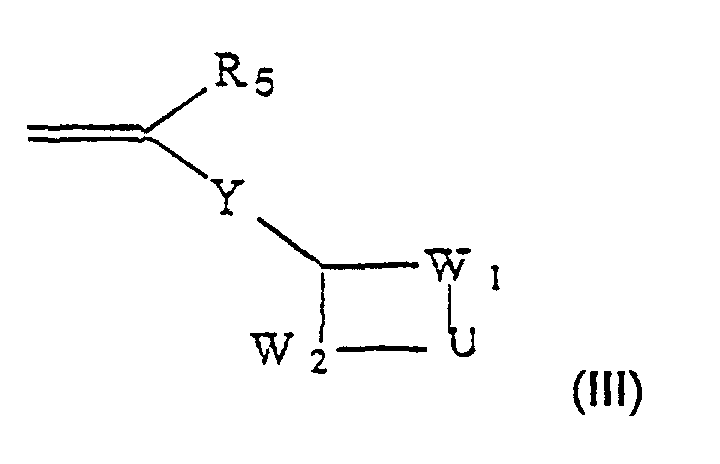 das Symbol U einem zweiwertigen Rest entspricht, der ausgewählt ist unter -(NH)-, -(C=O)-, -(C=O)-NH- und -(C=O)-O-(C=O)-,das Symbol R5 einem Wasserstoffatom und/oder einem einwertigen Kohlenwasserstoffrest entspricht, der ausgewählt ist unter dem Phenylrest und den linearen oder verzweigten Alkylresten mit 1 bis 12 Kohlen stoffatomen,die Symbole W1 und W2, die gleich und/oder verschieden sind, einem zweiwertigen Kohlenwasserstoffrest entsprechen, der ausgewählt ist unter dem Phenylrest, den linearen oder verzweigten Alkylresten mit 1 bis 12 Kohlenstoffatomen, den Alkylaryfresten, deren linearer oder verzweigter Alkylteil 1 bis 6 Kohlenstoffatome umfasst, und einer freien Valenz,das Symbol Y Y'-Y"-Y' entspricht, worin:· das Symbol Y" einem zweiwertigen Rest entspricht, der ausgewählt ist unter -(C=O)-, -(NH)-, -O-, -(C=O)-O-, -NH-(C=O)- und einer freien Valenz,· die Symbole Y', die gleich und/oder verschieden sind, einem zweiwertigen Kohlenwasserstoffrest entsprechen, der ausgewählt ist unter den linearen oder verzweigten Alkylresten mit 1 bis 6 Kohlenstoffatomen und einer freien Valenz, wobei einer der Reste Y' ein Phenylrest oder ein Alkylarylrest, dessen linearer oder verzweigter Alkylteil 1 bis 6 Kohlenstoffatome umfasst, sein kann,und (4)
- Herstellungsverfahren gemäß Anspruch 1, dadurch gekennzeichnet, dass die Monomere gleich sind.
- Herstellungsverfahren gemäß einem der Ansprüche 1 bis 2, dadurch gekennzeichnet, dass die heterogene katalytische Zusammensetzung ein Metall umfasst, das ausgewählt ist aus der Gruppe, die aus Köbalt, Rhodium, Ruthenium, Platin und Nickel besteht, abgeschieden auf einem inerten Träger, wobei das Metall vorzugsweise Platin ist.
- Herstellungsverfahren gemäß Anspruch 3, dadurch gekennzeichnet, dass der inerte Träger ausgewählt ist aus der Gruppe, die aus Ruß, Kohle, Aluminiumoxid, Siliciumdioxid, Bariumsilikat und -sultat besteht, wobei der inerte Träger vortagsweise Ruß ist.
- Herstellungsverfahren gemäß einem der Ansprüche 3 oder 4, dadurch gekennzeichnet, dass die Menge an Metall zwischen 0,1% und 5% liegt, bezogen auf das Gewicht des inerten Trägers.
- Herstellungsverfahren gemäß einem der vorhergehenden Ansprüche, dadurch gekennzeichnet, dass die Menge an Metall der katalytischen Zusammensetzung zwischen 1 und 1000 ppm liegt, bezogen auf das Gewicht des Siliconöls.
- Verfahren zur Herstellung von stabilem Siliconöl, das ≡SiH-Gruppen und weitere Funktionen enthält, gemäß einem der vorhergehenden Ansprüche, dadurch gekennzeichnet, dass das erste Siliconöl linear oder cyclisch ist und die mittlere(n) Formel(n) (VII) und/oder (VIII):und/oder
 nat, worin:
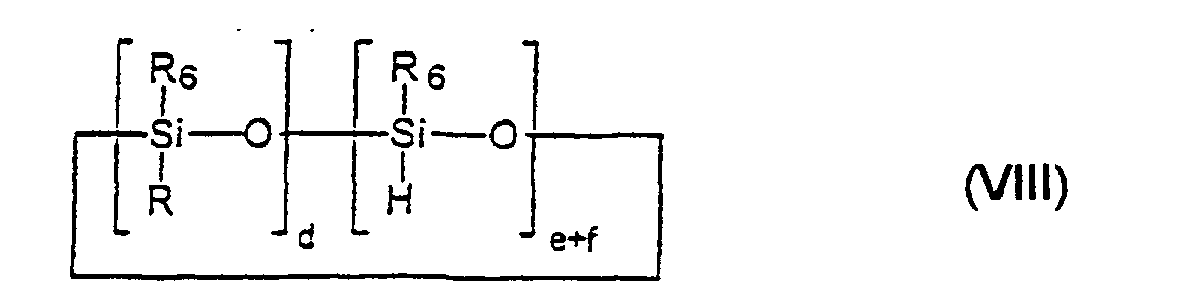 die Symbole R6 gleich oder verschieden sind und einem einwertigen Kohlenwasserstoffrest entsprechen, der ausgewählt ist unter dem Phenylrest und den linearen oder verzweigten Alkylresten mit 1 bis 6 Kohlenstoffatomen;die Symbole X gleich oder verschieden sind und einem einwertigen Rest entsprechen, der unter R6, einem Wasserstoffatom, einem Methoxyrest und einem Ethoxyrest ausgewählt ist;a, b und c ganze Zahlen oder Brüche sind, so dass:0 < a ≤ 1000, vorzugsweise 0 < a ≤ 100,0 ≤ b+c ≤ 200, vorzugsweise 1 < b+c ≤ 100, und wenigstens eines der beiden X dem Wasserstoffrest entspricht, wenn b+c = 0,1 < a+b+c ≤ 1000, vorzugsweise 1 < a+b+c ≤ 100;d, e und f ganze Zahlen oder Brüche sind, so dass:0 < d < 10, vorzugsweise 0 < d < 51 < e+f < 10, vorzugsweise 1 < e+f < 5.
 - Herstellungsverfahren gemäß einem der vorhergehenden Ansprüche, dadurch gekennzeichnet, dass das Siliconöl und das Monomer über oder durch ein Festbett der katalytischen Zusammensetzung strömen.
- Stabiles Siliconöl, das ≡SiH-Gruppen und weitere Funktionen enthält, das durch das Verfahren gemäß einem der Ansprüche 1 bis 8 erhalten werden kann.
- Stabiles Siliconöl gemäß Anspruch 9, dadurch gekennzeichnet, dass wenigstens eine der Funktionen des Siliconöls ein Epoxid enthält.
- Stabiles Siliconöl gemäß Anspruch 9, dadurch gekennzeichnet, dass wenigstens eine der Funktionen des Siliconöls ein Amin mit sterischer Hinderung ist.
- Verwendung der stabilen Siliconöle gemäß einem der Ansprüche 9 bis 11 bei der Herstellung von Antihaftprodukten für Papier, Glas oder Kunststoff.
- Verwendung der stabilen Siliconöle, die durch das Verfahren gemäß einem der Ansprüche 1 bis 8 erhalten werden können, für die Herstellung von Antihaftprodukten für Papier, Glas oder Kunststoff.
Applications Claiming Priority (3)
| Application Number | Priority Date | Filing Date | Title |
|---|---|---|---|
| FR9615519 | 1996-12-11 | ||
| FR9615519A FR2756831B1 (fr) | 1996-12-11 | 1996-12-11 | Procede de preparation d'huile silicone stable contenant des groupes sih et des fonctions hydrosilylables |
| PCT/FR1997/002256 WO1998025994A1 (fr) | 1996-12-11 | 1997-12-10 | PROCEDE DE PREPARATION D'HUILE SILICONE STABLE CONTENANT DES GROUPES SiH ET DES FONCTIONS HYDROSILYLABLES |
Publications (2)
| Publication Number | Publication Date |
|---|---|
| EP0944668A1 EP0944668A1 (de) | 1999-09-29 |
| EP0944668B1 true EP0944668B1 (de) | 2002-06-12 |
Family
ID=9498770
Family Applications (1)
| Application Number | Title | Priority Date | Filing Date |
|---|---|---|---|
| EP97951295A Expired - Lifetime EP0944668B1 (de) | 1996-12-11 | 1997-12-10 | VERFAHREN ZUR HERSTELLUNG VON STABILEN SILIKONÖLEN DIE SiH-UND HYDROSILYLIERBARE GRUPPEN ENTHALTEN |
Country Status (5)
| Country | Link |
|---|---|
| EP (1) | EP0944668B1 (de) |
| AU (1) | AU5487898A (de) |
| DE (1) | DE69713384T2 (de) |
| FR (1) | FR2756831B1 (de) |
| WO (1) | WO1998025994A1 (de) |
Family Cites Families (2)
| Publication number | Priority date | Publication date | Assignee | Title |
|---|---|---|---|---|
| DE4023556A1 (de) * | 1990-07-25 | 1992-01-30 | Goldschmidt Ag Th | Haertbare epoxygruppen aufweisende organopolysiloxane, verfahren zu ihrer herstellung und ihre verwendung als haertbare beschichtungsmittel mit abhaesiven eigenschaften |
| JP3406646B2 (ja) * | 1993-06-29 | 2003-05-12 | 東レ・ダウコーニング・シリコーン株式会社 | オルガノポリシロキサンおよびその製造方法 |
-
1996
- 1996-12-11 FR FR9615519A patent/FR2756831B1/fr not_active Expired - Fee Related
-
1997
- 1997-12-10 AU AU54878/98A patent/AU5487898A/en not_active Abandoned
- 1997-12-10 EP EP97951295A patent/EP0944668B1/de not_active Expired - Lifetime
- 1997-12-10 DE DE69713384T patent/DE69713384T2/de not_active Expired - Fee Related
- 1997-12-10 WO PCT/FR1997/002256 patent/WO1998025994A1/fr not_active Ceased
Also Published As
| Publication number | Publication date |
|---|---|
| DE69713384D1 (de) | 2002-07-18 |
| EP0944668A1 (de) | 1999-09-29 |
| FR2756831B1 (fr) | 1999-03-05 |
| FR2756831A1 (fr) | 1998-06-12 |
| AU5487898A (en) | 1998-07-03 |
| DE69713384T2 (de) | 2003-01-02 |
| WO1998025994A1 (fr) | 1998-06-18 |
Similar Documents
| Publication | Publication Date | Title |
|---|---|---|
| EP0792322B2 (de) | Funktionalisierte polyorganosiloxane und verfahren zu deren herstellung | |
| EP0147323B1 (de) | Elastomere härtbare Silikonzusammensetzungen, die einen Zinnchelatkatalysator enthalten | |
| CA1334604C (fr) | Diorganopolysiloxane a fonction benzotriazole | |
| FR2611729A1 (fr) | Procede de preparation d'un organopolysiloxane a fonction acrylate et/ou methacrylate | |
| EP0904315B1 (de) | Verfahren zur herstellung von siliconölen durch hydrosilylierung von polyorganohydrogensiloxanen und sauerstoff- enthaltenden cylischen verbindungen in anwesenheit eines heterogenes katalysator | |
| EP0792323A1 (de) | Modifizierte polyorganosiloxanen und ein verfahren zur ihrer herstellung | |
| EP1309647B1 (de) | Verfahren zur herstellung von silikonölen durch hydrosilylierung von sauerstoff-enthaltenden zyclischen kohlenwaserstoffen in anwesenheit von metallkomplexen | |
| EP4396266A1 (de) | Durch einen kobaltkomplex katalysiertes hydrosilylierungsverfahren | |
| FR2726564A1 (fr) | Pullulan contenant du siloxane et un procede pour la preparation de celui-ci | |
| EP1250379A1 (de) | Verfahren zur herstellung von polyorganosiloxane durch polymerisation in anwesenheit von trifluormethansulfonsäure oder derivate davon | |
| FR2735135A1 (fr) | Fluides silicone substitues par des groupes aryle presentant des indices de refraction eleves et leur procede de fabrication | |
| US6545115B2 (en) | Process for preparing a stable silicone oil containing SiH groups and hydrosilylable functions | |
| EP1448675B1 (de) | Verfahren zur herstellung von sauerstoff-enthaltende cyclische kohlenwasserstoffgruppen enthaltenden silikonölen | |
| FR2616152A1 (fr) | Nouveaux polysilanes, polysilanes modifies correspondants, leur preparation et leur application dans des compositions reticulables | |
| EP1660563B1 (de) | Funktionalisierung (epoxidierung) von silikonen und deren anwendung für antihaftbeschichtungen | |
| EP0944668A1 (de) | VERFAHREN ZUR HERSTELLUNG VON STABILEN SILIKONÖLEN DIE SiH-UND HYDROSILYLIERBARE GRUPPEN ENTHALTEN | |
| JPH04169589A (ja) | ハイドロジェンポリシロキサンの製造方法 | |
| EP0287478B1 (de) | Verfahren zur Herstellung von Polydiorganosiloxangruppen enthaltenden aromatischen Diaminen | |
| FR2837825A1 (fr) | Procede de preparation de resines polyorganosiloxane fonctionnalisees par redistribution en presence d'acide triflique et/ou d'au moins l'un de ses derives et de charge inerte non basique | |
| EP1487901A1 (de) | Verfahren zur herstellung von funktionalisierten polyorganosiloxanharzen durch redistribution in anwesenheit mindestens eines derivates einer trifluormethansulfonsäure | |
| FR2565234A1 (fr) | Nouveaux polysilanes non ramifies, leur preparation et leur application | |
| WO1999000445A1 (fr) | Procede de decoloration d'un produit, notamment d'une huile silicone, comprenant des residus catalytiques colores | |
| WO2004031200A1 (fr) | Phosphates de silanoxyle, leur preparation et leur utilisation dans la synthese de polyorganosiloxanes lineaires | |
| EP1440112A1 (de) | Anwendung einer katalysatorzusammensetzung auf basis einer metallverbindung aus der platinumgruppe und einer organischen heterocyclischen verbindung für die hydrosilylierung von ungesättigten verbindungen | |
| FR2842204A1 (fr) | Fonctionnalisation (epoxydation) de silicones et utilisation de ces silicones comme revetements anti-adherents |
Legal Events
| Date | Code | Title | Description |
|---|---|---|---|
| PUAI | Public reference made under article 153(3) epc to a published international application that has entered the european phase |
Free format text: ORIGINAL CODE: 0009012 |
|
| 17P | Request for examination filed |
Effective date: 19990602 |
|
| AK | Designated contracting states |
Kind code of ref document: A1 Designated state(s): BE DE FR NL |
|
| 17Q | First examination report despatched |
Effective date: 19991105 |
|
| GRAG | Despatch of communication of intention to grant |
Free format text: ORIGINAL CODE: EPIDOS AGRA |
|
| GRAG | Despatch of communication of intention to grant |
Free format text: ORIGINAL CODE: EPIDOS AGRA |
|
| GRAH | Despatch of communication of intention to grant a patent |
Free format text: ORIGINAL CODE: EPIDOS IGRA |
|
| GRAH | Despatch of communication of intention to grant a patent |
Free format text: ORIGINAL CODE: EPIDOS IGRA |
|
| GRAA | (expected) grant |
Free format text: ORIGINAL CODE: 0009210 |
|
| AK | Designated contracting states |
Kind code of ref document: B1 Designated state(s): BE DE FR NL |
|
| REF | Corresponds to: |
Ref document number: 69713384 Country of ref document: DE Date of ref document: 20020718 |
|
| PGFP | Annual fee paid to national office [announced via postgrant information from national office to epo] |
Ref country code: FR Payment date: 20021210 Year of fee payment: 6 |
|
| PGFP | Annual fee paid to national office [announced via postgrant information from national office to epo] |
Ref country code: DE Payment date: 20021212 Year of fee payment: 6 |
|
| PGFP | Annual fee paid to national office [announced via postgrant information from national office to epo] |
Ref country code: NL Payment date: 20021227 Year of fee payment: 6 |
|
| PGFP | Annual fee paid to national office [announced via postgrant information from national office to epo] |
Ref country code: BE Payment date: 20030214 Year of fee payment: 6 |
|
| PLBE | No opposition filed within time limit |
Free format text: ORIGINAL CODE: 0009261 |
|
| STAA | Information on the status of an ep patent application or granted ep patent |
Free format text: STATUS: NO OPPOSITION FILED WITHIN TIME LIMIT |
|
| 26N | No opposition filed |
Effective date: 20030313 |
|
| PG25 | Lapsed in a contracting state [announced via postgrant information from national office to epo] |
Ref country code: BE Free format text: LAPSE BECAUSE OF NON-PAYMENT OF DUE FEES Effective date: 20031231 |
|
| BERE | Be: lapsed |
Owner name: *RHODIA CHIMIE Effective date: 20031231 |
|
| PG25 | Lapsed in a contracting state [announced via postgrant information from national office to epo] |
Ref country code: NL Free format text: LAPSE BECAUSE OF NON-PAYMENT OF DUE FEES Effective date: 20040701 Ref country code: DE Free format text: LAPSE BECAUSE OF NON-PAYMENT OF DUE FEES Effective date: 20040701 |
|
| PG25 | Lapsed in a contracting state [announced via postgrant information from national office to epo] |
Ref country code: FR Free format text: LAPSE BECAUSE OF NON-PAYMENT OF DUE FEES Effective date: 20040831 |
|
| NLV4 | Nl: lapsed or anulled due to non-payment of the annual fee |
Effective date: 20040701 |
|
| REG | Reference to a national code |
Ref country code: FR Ref legal event code: ST |