EP0945486A1 - Celluloseesterzusammensetzung - Google Patents
Celluloseesterzusammensetzung Download PDFInfo
- Publication number
- EP0945486A1 EP0945486A1 EP99105470A EP99105470A EP0945486A1 EP 0945486 A1 EP0945486 A1 EP 0945486A1 EP 99105470 A EP99105470 A EP 99105470A EP 99105470 A EP99105470 A EP 99105470A EP 0945486 A1 EP0945486 A1 EP 0945486A1
- Authority
- EP
- European Patent Office
- Prior art keywords
- weight
- cellulose
- cellulose ester
- composition
- dsace
- Prior art date
- Legal status (The legal status is an assumption and is not a legal conclusion. Google has not performed a legal analysis and makes no representation as to the accuracy of the status listed.)
- Granted
Links
- 239000000203 mixture Substances 0.000 title claims abstract description 110
- 229920002678 cellulose Polymers 0.000 title claims abstract description 105
- 239000001913 cellulose Substances 0.000 claims abstract description 27
- 238000006467 substitution reaction Methods 0.000 claims abstract description 20
- 125000004432 carbon atom Chemical group C* 0.000 claims abstract description 17
- 229920002284 Cellulose triacetate Polymers 0.000 claims abstract description 15
- NNLVGZFZQQXQNW-ADJNRHBOSA-N [(2r,3r,4s,5r,6s)-4,5-diacetyloxy-3-[(2s,3r,4s,5r,6r)-3,4,5-triacetyloxy-6-(acetyloxymethyl)oxan-2-yl]oxy-6-[(2r,3r,4s,5r,6s)-4,5,6-triacetyloxy-2-(acetyloxymethyl)oxan-3-yl]oxyoxan-2-yl]methyl acetate Chemical compound O([C@@H]1O[C@@H]([C@H]([C@H](OC(C)=O)[C@H]1OC(C)=O)O[C@H]1[C@@H]([C@@H](OC(C)=O)[C@H](OC(C)=O)[C@@H](COC(C)=O)O1)OC(C)=O)COC(=O)C)[C@@H]1[C@@H](COC(C)=O)O[C@@H](OC(C)=O)[C@H](OC(C)=O)[C@H]1OC(C)=O NNLVGZFZQQXQNW-ADJNRHBOSA-N 0.000 claims abstract description 15
- 125000002252 acyl group Chemical group 0.000 claims abstract description 14
- 235000014113 dietary fatty acids Nutrition 0.000 claims abstract description 14
- 229930195729 fatty acid Natural products 0.000 claims abstract description 14
- 239000000194 fatty acid Substances 0.000 claims abstract description 14
- -1 fatty acid ester Chemical class 0.000 claims abstract description 14
- 125000002887 hydroxy group Chemical group [H]O* 0.000 claims abstract description 9
- 239000007788 liquid Substances 0.000 claims description 55
- 238000000034 method Methods 0.000 claims description 21
- 239000003960 organic solvent Substances 0.000 claims description 18
- 125000002777 acetyl group Chemical group [H]C([H])([H])C(*)=O 0.000 claims description 16
- 150000002148 esters Chemical class 0.000 claims description 11
- 238000004519 manufacturing process Methods 0.000 claims description 11
- 238000005266 casting Methods 0.000 claims description 10
- RTZKZFJDLAIYFH-UHFFFAOYSA-N Diethyl ether Chemical compound CCOCC RTZKZFJDLAIYFH-UHFFFAOYSA-N 0.000 claims description 8
- 239000004014 plasticizer Substances 0.000 claims description 6
- 125000001501 propionyl group Chemical group O=C([*])C([H])([H])C([H])([H])[H] 0.000 claims description 5
- 229910052736 halogen Inorganic materials 0.000 claims description 4
- 150000002367 halogens Chemical class 0.000 claims description 4
- 239000000758 substrate Substances 0.000 claims description 4
- 125000004063 butyryl group Chemical group O=C([*])C([H])([H])C([H])([H])C([H])([H])[H] 0.000 claims description 2
- 239000006185 dispersion Substances 0.000 claims 3
- 125000000468 ketone group Chemical group 0.000 claims 2
- 230000008020 evaporation Effects 0.000 claims 1
- 238000001704 evaporation Methods 0.000 claims 1
- 230000003287 optical effect Effects 0.000 abstract description 20
- 238000000807 solvent casting Methods 0.000 abstract description 9
- 239000002994 raw material Substances 0.000 abstract description 4
- 125000000218 acetic acid group Chemical group C(C)(=O)* 0.000 abstract 4
- 239000002002 slurry Substances 0.000 description 66
- 239000010408 film Substances 0.000 description 64
- OKKJLVBELUTLKV-UHFFFAOYSA-N Methanol Chemical compound OC OKKJLVBELUTLKV-UHFFFAOYSA-N 0.000 description 39
- 239000002904 solvent Substances 0.000 description 25
- XBDQKXXYIPTUBI-UHFFFAOYSA-M Propionate Chemical compound CCC([O-])=O XBDQKXXYIPTUBI-UHFFFAOYSA-M 0.000 description 19
- KXKVLQRXCPHEJC-UHFFFAOYSA-N acetic acid trimethyl ester Natural products COC(C)=O KXKVLQRXCPHEJC-UHFFFAOYSA-N 0.000 description 18
- CSCPPACGZOOCGX-UHFFFAOYSA-N Acetone Chemical compound CC(C)=O CSCPPACGZOOCGX-UHFFFAOYSA-N 0.000 description 17
- 229920000642 polymer Polymers 0.000 description 17
- YMWUJEATGCHHMB-UHFFFAOYSA-N Dichloromethane Chemical compound ClCCl YMWUJEATGCHHMB-UHFFFAOYSA-N 0.000 description 15
- XLYOFNOQVPJJNP-UHFFFAOYSA-N water Substances O XLYOFNOQVPJJNP-UHFFFAOYSA-N 0.000 description 14
- CURLTUGMZLYLDI-UHFFFAOYSA-N Carbon dioxide Chemical compound O=C=O CURLTUGMZLYLDI-UHFFFAOYSA-N 0.000 description 12
- 235000011089 carbon dioxide Nutrition 0.000 description 12
- 239000011521 glass Substances 0.000 description 12
- 230000000052 comparative effect Effects 0.000 description 11
- 239000000243 solution Substances 0.000 description 11
- QAOWNCQODCNURD-UHFFFAOYSA-N Sulfuric acid Chemical compound OS(O)(=O)=O QAOWNCQODCNURD-UHFFFAOYSA-N 0.000 description 10
- ZIWNJZLXPXFNGN-GXTQQWMXSA-N (z)-7-[(3r,4s)-3-[(e,3s)-3-hydroxyoct-1-enyl]-4-bicyclo[3.1.1]heptanyl]hept-5-enoic acid Chemical compound OC(=O)CCC\C=C/C[C@@H]1[C@@H](/C=C/[C@@H](O)CCCCC)CC2CC1C2 ZIWNJZLXPXFNGN-GXTQQWMXSA-N 0.000 description 9
- QTBSBXVTEAMEQO-UHFFFAOYSA-N Acetic acid Chemical compound CC(O)=O QTBSBXVTEAMEQO-UHFFFAOYSA-N 0.000 description 9
- 230000035515 penetration Effects 0.000 description 9
- 102100021879 Adenylyl cyclase-associated protein 2 Human genes 0.000 description 8
- 101710137132 Adenylyl cyclase-associated protein 2 Proteins 0.000 description 8
- 239000000463 material Substances 0.000 description 8
- 238000005191 phase separation Methods 0.000 description 8
- WEYNBWVKOYCCQT-UHFFFAOYSA-N 1-(3-chloro-4-methylphenyl)-3-{2-[({5-[(dimethylamino)methyl]-2-furyl}methyl)thio]ethyl}urea Chemical compound O1C(CN(C)C)=CC=C1CSCCNC(=O)NC1=CC=C(C)C(Cl)=C1 WEYNBWVKOYCCQT-UHFFFAOYSA-N 0.000 description 7
- 102100027241 Adenylyl cyclase-associated protein 1 Human genes 0.000 description 7
- 101710137115 Adenylyl cyclase-associated protein 1 Proteins 0.000 description 7
- 239000002253 acid Substances 0.000 description 7
- 150000002576 ketones Chemical class 0.000 description 7
- 229920008347 Cellulose acetate propionate Polymers 0.000 description 6
- 229920002301 cellulose acetate Polymers 0.000 description 6
- FLKPEMZONWLCSK-UHFFFAOYSA-N diethyl phthalate Chemical compound CCOC(=O)C1=CC=CC=C1C(=O)OCC FLKPEMZONWLCSK-UHFFFAOYSA-N 0.000 description 6
- 239000000835 fiber Substances 0.000 description 6
- 238000006116 polymerization reaction Methods 0.000 description 6
- 239000003795 chemical substances by application Substances 0.000 description 5
- 238000000113 differential scanning calorimetry Methods 0.000 description 5
- 238000001035 drying Methods 0.000 description 5
- 125000000524 functional group Chemical group 0.000 description 5
- 239000007791 liquid phase Substances 0.000 description 5
- 238000005259 measurement Methods 0.000 description 5
- 150000007524 organic acids Chemical class 0.000 description 5
- NIQCNGHVCWTJSM-UHFFFAOYSA-N Dimethyl phthalate Chemical compound COC(=O)C1=CC=CC=C1C(=O)OC NIQCNGHVCWTJSM-UHFFFAOYSA-N 0.000 description 4
- LFQSCWFLJHTTHZ-UHFFFAOYSA-N Ethanol Chemical compound CCO LFQSCWFLJHTTHZ-UHFFFAOYSA-N 0.000 description 4
- WYURNTSHIVDZCO-UHFFFAOYSA-N Tetrahydrofuran Chemical compound C1CCOC1 WYURNTSHIVDZCO-UHFFFAOYSA-N 0.000 description 4
- 230000006399 behavior Effects 0.000 description 4
- BJQHLKABXJIVAM-UHFFFAOYSA-N bis(2-ethylhexyl) phthalate Chemical compound CCCCC(CC)COC(=O)C1=CC=CC=C1C(=O)OCC(CC)CCCC BJQHLKABXJIVAM-UHFFFAOYSA-N 0.000 description 4
- DOIRQSBPFJWKBE-UHFFFAOYSA-N dibutyl phthalate Chemical compound CCCCOC(=O)C1=CC=CC=C1C(=O)OCCCC DOIRQSBPFJWKBE-UHFFFAOYSA-N 0.000 description 4
- XBDQKXXYIPTUBI-UHFFFAOYSA-N dimethylselenoniopropionate Natural products CCC(O)=O XBDQKXXYIPTUBI-UHFFFAOYSA-N 0.000 description 4
- 150000002170 ethers Chemical class 0.000 description 4
- 230000009477 glass transition Effects 0.000 description 4
- ZWEHNKRNPOVVGH-UHFFFAOYSA-N 2-Butanone Chemical compound CCC(C)=O ZWEHNKRNPOVVGH-UHFFFAOYSA-N 0.000 description 3
- MZZYGYNZAOVRTG-UHFFFAOYSA-N 2-hydroxy-n-(1h-1,2,4-triazol-5-yl)benzamide Chemical compound OC1=CC=CC=C1C(=O)NC1=NC=NN1 MZZYGYNZAOVRTG-UHFFFAOYSA-N 0.000 description 3
- MSXVEPNJUHWQHW-UHFFFAOYSA-N 2-methylbutan-2-ol Chemical compound CCC(C)(C)O MSXVEPNJUHWQHW-UHFFFAOYSA-N 0.000 description 3
- WFDIJRYMOXRFFG-UHFFFAOYSA-N Acetic anhydride Chemical compound CC(=O)OC(C)=O WFDIJRYMOXRFFG-UHFFFAOYSA-N 0.000 description 3
- IJGRMHOSHXDMSA-UHFFFAOYSA-N Atomic nitrogen Chemical compound N#N IJGRMHOSHXDMSA-UHFFFAOYSA-N 0.000 description 3
- 101800004711 CAP-3 Proteins 0.000 description 3
- DQEFEBPAPFSJLV-UHFFFAOYSA-N Cellulose propionate Chemical compound CCC(=O)OCC1OC(OC(=O)CC)C(OC(=O)CC)C(OC(=O)CC)C1OC1C(OC(=O)CC)C(OC(=O)CC)C(OC(=O)CC)C(COC(=O)CC)O1 DQEFEBPAPFSJLV-UHFFFAOYSA-N 0.000 description 3
- XEKOWRVHYACXOJ-UHFFFAOYSA-N Ethyl acetate Chemical compound CCOC(C)=O XEKOWRVHYACXOJ-UHFFFAOYSA-N 0.000 description 3
- LRHPLDYGYMQRHN-UHFFFAOYSA-N N-Butanol Chemical compound CCCCO LRHPLDYGYMQRHN-UHFFFAOYSA-N 0.000 description 3
- 102100025517 Serpin B9 Human genes 0.000 description 3
- HEMHJVSKTPXQMS-UHFFFAOYSA-M Sodium hydroxide Chemical compound [OH-].[Na+] HEMHJVSKTPXQMS-UHFFFAOYSA-M 0.000 description 3
- 238000009835 boiling Methods 0.000 description 3
- 150000001733 carboxylic acid esters Chemical class 0.000 description 3
- 229920001727 cellulose butyrate Polymers 0.000 description 3
- 229920006218 cellulose propionate Polymers 0.000 description 3
- 230000002708 enhancing effect Effects 0.000 description 3
- 238000004255 ion exchange chromatography Methods 0.000 description 3
- BJQHLKABXJIVAM-BGYRXZFFSA-N 1-o-[(2r)-2-ethylhexyl] 2-o-[(2s)-2-ethylhexyl] benzene-1,2-dicarboxylate Chemical compound CCCC[C@H](CC)COC(=O)C1=CC=CC=C1C(=O)OC[C@H](CC)CCCC BJQHLKABXJIVAM-BGYRXZFFSA-N 0.000 description 2
- QZCLKYGREBVARF-UHFFFAOYSA-N Acetyl tributyl citrate Chemical compound CCCCOC(=O)CC(C(=O)OCCCC)(OC(C)=O)CC(=O)OCCCC QZCLKYGREBVARF-UHFFFAOYSA-N 0.000 description 2
- MQIUGAXCHLFZKX-UHFFFAOYSA-N Di-n-octyl phthalate Natural products CCCCCCCCOC(=O)C1=CC=CC=C1C(=O)OCCCCCCCC MQIUGAXCHLFZKX-UHFFFAOYSA-N 0.000 description 2
- IAZDPXIOMUYVGZ-UHFFFAOYSA-N Dimethylsulphoxide Chemical compound CS(C)=O IAZDPXIOMUYVGZ-UHFFFAOYSA-N 0.000 description 2
- KFZMGEQAYNKOFK-UHFFFAOYSA-N Isopropanol Chemical compound CC(C)O KFZMGEQAYNKOFK-UHFFFAOYSA-N 0.000 description 2
- YSMRWXYRXBRSND-UHFFFAOYSA-N TOTP Chemical compound CC1=CC=CC=C1OP(=O)(OC=1C(=CC=CC=1)C)OC1=CC=CC=C1C YSMRWXYRXBRSND-UHFFFAOYSA-N 0.000 description 2
- DKGAVHZHDRPRBM-UHFFFAOYSA-N Tert-Butanol Chemical compound CC(C)(C)O DKGAVHZHDRPRBM-UHFFFAOYSA-N 0.000 description 2
- 239000012345 acetylating agent Substances 0.000 description 2
- 230000021736 acetylation Effects 0.000 description 2
- 238000006640 acetylation reaction Methods 0.000 description 2
- 150000008065 acid anhydrides Chemical class 0.000 description 2
- 238000007605 air drying Methods 0.000 description 2
- RDOXTESZEPMUJZ-UHFFFAOYSA-N anisole Chemical compound COC1=CC=CC=C1 RDOXTESZEPMUJZ-UHFFFAOYSA-N 0.000 description 2
- 239000012298 atmosphere Substances 0.000 description 2
- 239000003054 catalyst Substances 0.000 description 2
- 238000006243 chemical reaction Methods 0.000 description 2
- 238000001816 cooling Methods 0.000 description 2
- JHIVVAPYMSGYDF-UHFFFAOYSA-N cyclohexanone Chemical compound O=C1CCCCC1 JHIVVAPYMSGYDF-UHFFFAOYSA-N 0.000 description 2
- FBSAITBEAPNWJG-UHFFFAOYSA-N dimethyl phthalate Natural products CC(=O)OC1=CC=CC=C1OC(C)=O FBSAITBEAPNWJG-UHFFFAOYSA-N 0.000 description 2
- 229960001826 dimethylphthalate Drugs 0.000 description 2
- 230000032050 esterification Effects 0.000 description 2
- 238000005886 esterification reaction Methods 0.000 description 2
- 239000003112 inhibitor Substances 0.000 description 2
- 238000002844 melting Methods 0.000 description 2
- 230000008018 melting Effects 0.000 description 2
- 238000006386 neutralization reaction Methods 0.000 description 2
- 235000005985 organic acids Nutrition 0.000 description 2
- FDPIMTJIUBPUKL-UHFFFAOYSA-N pentan-3-one Chemical compound CCC(=O)CC FDPIMTJIUBPUKL-UHFFFAOYSA-N 0.000 description 2
- PGMYKACGEOXYJE-UHFFFAOYSA-N pentyl acetate Chemical compound CCCCCOC(C)=O PGMYKACGEOXYJE-UHFFFAOYSA-N 0.000 description 2
- KJFMBFZCATUALV-UHFFFAOYSA-N phenolphthalein Chemical compound C1=CC(O)=CC=C1C1(C=2C=CC(O)=CC=2)C2=CC=CC=C2C(=O)O1 KJFMBFZCATUALV-UHFFFAOYSA-N 0.000 description 2
- 150000003014 phosphoric acid esters Chemical class 0.000 description 2
- 125000005498 phthalate group Chemical class 0.000 description 2
- 239000000047 product Substances 0.000 description 2
- 235000019260 propionic acid Nutrition 0.000 description 2
- IUVKMZGDUIUOCP-BTNSXGMBSA-N quinbolone Chemical compound O([C@H]1CC[C@H]2[C@H]3[C@@H]([C@]4(C=CC(=O)C=C4CC3)C)CC[C@@]21C)C1=CCCC1 IUVKMZGDUIUOCP-BTNSXGMBSA-N 0.000 description 2
- 238000007127 saponification reaction Methods 0.000 description 2
- 238000000926 separation method Methods 0.000 description 2
- 238000001374 small-angle light scattering Methods 0.000 description 2
- 238000003756 stirring Methods 0.000 description 2
- YLQBMQCUIZJEEH-UHFFFAOYSA-N tetrahydrofuran Natural products C=1C=COC=1 YLQBMQCUIZJEEH-UHFFFAOYSA-N 0.000 description 2
- 238000002076 thermal analysis method Methods 0.000 description 2
- 238000004448 titration Methods 0.000 description 2
- WEAPVABOECTMGR-UHFFFAOYSA-N triethyl 2-acetyloxypropane-1,2,3-tricarboxylate Chemical compound CCOC(=O)CC(C(=O)OCC)(OC(C)=O)CC(=O)OCC WEAPVABOECTMGR-UHFFFAOYSA-N 0.000 description 2
- 230000000007 visual effect Effects 0.000 description 2
- WNXJIVFYUVYPPR-UHFFFAOYSA-N 1,3-dioxolane Chemical compound C1COCO1 WNXJIVFYUVYPPR-UHFFFAOYSA-N 0.000 description 1
- RYHBNJHYFVUHQT-UHFFFAOYSA-N 1,4-Dioxane Chemical compound C1COCCO1 RYHBNJHYFVUHQT-UHFFFAOYSA-N 0.000 description 1
- XNWFRZJHXBZDAG-UHFFFAOYSA-N 2-METHOXYETHANOL Chemical compound COCCO XNWFRZJHXBZDAG-UHFFFAOYSA-N 0.000 description 1
- PTTPXKJBFFKCEK-UHFFFAOYSA-N 2-Methyl-4-heptanone Chemical compound CC(C)CC(=O)CC(C)C PTTPXKJBFFKCEK-UHFFFAOYSA-N 0.000 description 1
- POAOYUHQDCAZBD-UHFFFAOYSA-N 2-butoxyethanol Chemical compound CCCCOCCO POAOYUHQDCAZBD-UHFFFAOYSA-N 0.000 description 1
- SVONRAPFKPVNKG-UHFFFAOYSA-N 2-ethoxyethyl acetate Chemical compound CCOCCOC(C)=O SVONRAPFKPVNKG-UHFFFAOYSA-N 0.000 description 1
- VGVHNLRUAMRIEW-UHFFFAOYSA-N 4-methylcyclohexan-1-one Chemical compound CC1CCC(=O)CC1 VGVHNLRUAMRIEW-UHFFFAOYSA-N 0.000 description 1
- FERIUCNNQQJTOY-UHFFFAOYSA-M Butyrate Chemical compound CCCC([O-])=O FERIUCNNQQJTOY-UHFFFAOYSA-M 0.000 description 1
- PYGXAGIECVVIOZ-UHFFFAOYSA-N Dibutyl decanedioate Chemical compound CCCCOC(=O)CCCCCCCCC(=O)OCCCC PYGXAGIECVVIOZ-UHFFFAOYSA-N 0.000 description 1
- ZAFNJMIOTHYJRJ-UHFFFAOYSA-N Diisopropyl ether Chemical compound CC(C)OC(C)C ZAFNJMIOTHYJRJ-UHFFFAOYSA-N 0.000 description 1
- XTHFKEDIFFGKHM-UHFFFAOYSA-N Dimethoxyethane Chemical compound COCCOC XTHFKEDIFFGKHM-UHFFFAOYSA-N 0.000 description 1
- 239000003377 acid catalyst Substances 0.000 description 1
- 230000002411 adverse Effects 0.000 description 1
- 230000001476 alcoholic effect Effects 0.000 description 1
- 150000001298 alcohols Chemical class 0.000 description 1
- 239000007864 aqueous solution Substances 0.000 description 1
- 150000007514 bases Chemical class 0.000 description 1
- 230000015572 biosynthetic process Effects 0.000 description 1
- 229920006217 cellulose acetate butyrate Polymers 0.000 description 1
- 150000001805 chlorine compounds Chemical class 0.000 description 1
- 150000001860 citric acid derivatives Chemical class 0.000 description 1
- 239000011248 coating agent Substances 0.000 description 1
- 238000000576 coating method Methods 0.000 description 1
- 239000003086 colorant Substances 0.000 description 1
- 238000009833 condensation Methods 0.000 description 1
- 230000005494 condensation Effects 0.000 description 1
- 238000011109 contamination Methods 0.000 description 1
- HPXRVTGHNJAIIH-UHFFFAOYSA-N cyclohexanol Chemical compound OC1CCCCC1 HPXRVTGHNJAIIH-UHFFFAOYSA-N 0.000 description 1
- 230000006866 deterioration Effects 0.000 description 1
- NKDDWNXOKDWJAK-UHFFFAOYSA-N dimethoxymethane Chemical compound COCOC NKDDWNXOKDWJAK-UHFFFAOYSA-N 0.000 description 1
- 229910001873 dinitrogen Inorganic materials 0.000 description 1
- 238000000578 dry spinning Methods 0.000 description 1
- 230000000694 effects Effects 0.000 description 1
- 230000007613 environmental effect Effects 0.000 description 1
- WBJINCZRORDGAQ-UHFFFAOYSA-N formic acid ethyl ester Natural products CCOC=O WBJINCZRORDGAQ-UHFFFAOYSA-N 0.000 description 1
- 230000004927 fusion Effects 0.000 description 1
- 238000001879 gelation Methods 0.000 description 1
- 238000002523 gelfiltration Methods 0.000 description 1
- 230000005484 gravity Effects 0.000 description 1
- 150000008282 halocarbons Chemical class 0.000 description 1
- 238000010438 heat treatment Methods 0.000 description 1
- FUZZWVXGSFPDMH-UHFFFAOYSA-M hexanoate Chemical compound CCCCCC([O-])=O FUZZWVXGSFPDMH-UHFFFAOYSA-M 0.000 description 1
- 238000004128 high performance liquid chromatography Methods 0.000 description 1
- 230000007062 hydrolysis Effects 0.000 description 1
- 238000006460 hydrolysis reaction Methods 0.000 description 1
- 230000001771 impaired effect Effects 0.000 description 1
- 230000001788 irregular Effects 0.000 description 1
- 239000004973 liquid crystal related substance Substances 0.000 description 1
- UZKWTJUDCOPSNM-UHFFFAOYSA-N methoxybenzene Substances CCCCOC=C UZKWTJUDCOPSNM-UHFFFAOYSA-N 0.000 description 1
- SFSRMWVCKNCASA-JSUSWRHTSA-N methyl (z,12r)-2-acetyl-12-hydroxyoctadec-9-enoate Chemical compound CCCCCC[C@@H](O)C\C=C/CCCCCCC(C(C)=O)C(=O)OC SFSRMWVCKNCASA-JSUSWRHTSA-N 0.000 description 1
- 230000004048 modification Effects 0.000 description 1
- 238000012986 modification Methods 0.000 description 1
- WIBFFTLQMKKBLZ-SEYXRHQNSA-N n-butyl oleate Chemical compound CCCCCCCC\C=C/CCCCCCCC(=O)OCCCC WIBFFTLQMKKBLZ-SEYXRHQNSA-N 0.000 description 1
- 229910052757 nitrogen Inorganic materials 0.000 description 1
- LYGJENNIWJXYER-UHFFFAOYSA-N nitromethane Chemical compound C[N+]([O-])=O LYGJENNIWJXYER-UHFFFAOYSA-N 0.000 description 1
- 239000012071 phase Substances 0.000 description 1
- DLRJIFUOBPOJNS-UHFFFAOYSA-N phenetole Chemical compound CCOC1=CC=CC=C1 DLRJIFUOBPOJNS-UHFFFAOYSA-N 0.000 description 1
- 239000000049 pigment Substances 0.000 description 1
- 229920003229 poly(methyl methacrylate) Polymers 0.000 description 1
- 239000004926 polymethyl methacrylate Substances 0.000 description 1
- 238000001556 precipitation Methods 0.000 description 1
- 238000002360 preparation method Methods 0.000 description 1
- BDERNNFJNOPAEC-UHFFFAOYSA-N propan-1-ol Chemical compound CCCO BDERNNFJNOPAEC-UHFFFAOYSA-N 0.000 description 1
- WYVAMUWZEOHJOQ-UHFFFAOYSA-N propionic anhydride Chemical compound CCC(=O)OC(=O)CC WYVAMUWZEOHJOQ-UHFFFAOYSA-N 0.000 description 1
- 230000001681 protective effect Effects 0.000 description 1
- 239000011541 reaction mixture Substances 0.000 description 1
- 238000012827 research and development Methods 0.000 description 1
- 230000001932 seasonal effect Effects 0.000 description 1
- 239000007787 solid Substances 0.000 description 1
- 238000003860 storage Methods 0.000 description 1
- 239000006228 supernatant Substances 0.000 description 1
- 238000012360 testing method Methods 0.000 description 1
- 239000010409 thin film Substances 0.000 description 1
- 125000005591 trimellitate group Chemical group 0.000 description 1
- XZZNDPSIHUTMOC-UHFFFAOYSA-N triphenyl phosphate Chemical compound C=1C=CC=CC=1OP(OC=1C=CC=CC=1)(=O)OC1=CC=CC=C1 XZZNDPSIHUTMOC-UHFFFAOYSA-N 0.000 description 1
- 238000005406 washing Methods 0.000 description 1
- 238000002166 wet spinning Methods 0.000 description 1
Images
Classifications
-
- C—CHEMISTRY; METALLURGY
- C08—ORGANIC MACROMOLECULAR COMPOUNDS; THEIR PREPARATION OR CHEMICAL WORKING-UP; COMPOSITIONS BASED THEREON
- C08J—WORKING-UP; GENERAL PROCESSES OF COMPOUNDING; AFTER-TREATMENT NOT COVERED BY SUBCLASSES C08B, C08C, C08F, C08G or C08H
- C08J3/00—Processes of treating or compounding macromolecular substances
- C08J3/02—Making solutions, dispersions, lattices or gels by other methods than by solution, emulsion or suspension polymerisation techniques
- C08J3/09—Making solutions, dispersions, lattices or gels by other methods than by solution, emulsion or suspension polymerisation techniques in organic liquids
- C08J3/091—Making solutions, dispersions, lattices or gels by other methods than by solution, emulsion or suspension polymerisation techniques in organic liquids characterised by the chemical constitution of the organic liquid
- C08J3/095—Oxygen containing compounds
-
- C—CHEMISTRY; METALLURGY
- C08—ORGANIC MACROMOLECULAR COMPOUNDS; THEIR PREPARATION OR CHEMICAL WORKING-UP; COMPOSITIONS BASED THEREON
- C08J—WORKING-UP; GENERAL PROCESSES OF COMPOUNDING; AFTER-TREATMENT NOT COVERED BY SUBCLASSES C08B, C08C, C08F, C08G or C08H
- C08J5/00—Manufacture of articles or shaped materials containing macromolecular substances
- C08J5/18—Manufacture of films or sheets
-
- C—CHEMISTRY; METALLURGY
- C08—ORGANIC MACROMOLECULAR COMPOUNDS; THEIR PREPARATION OR CHEMICAL WORKING-UP; COMPOSITIONS BASED THEREON
- C08L—COMPOSITIONS OF MACROMOLECULAR COMPOUNDS
- C08L1/00—Compositions of cellulose, modified cellulose or cellulose derivatives
- C08L1/08—Cellulose derivatives
- C08L1/10—Esters of organic acids, i.e. acylates
-
- C—CHEMISTRY; METALLURGY
- C08—ORGANIC MACROMOLECULAR COMPOUNDS; THEIR PREPARATION OR CHEMICAL WORKING-UP; COMPOSITIONS BASED THEREON
- C08L—COMPOSITIONS OF MACROMOLECULAR COMPOUNDS
- C08L1/00—Compositions of cellulose, modified cellulose or cellulose derivatives
- C08L1/08—Cellulose derivatives
- C08L1/10—Esters of organic acids, i.e. acylates
- C08L1/12—Cellulose acetate
-
- C—CHEMISTRY; METALLURGY
- C08—ORGANIC MACROMOLECULAR COMPOUNDS; THEIR PREPARATION OR CHEMICAL WORKING-UP; COMPOSITIONS BASED THEREON
- C08J—WORKING-UP; GENERAL PROCESSES OF COMPOUNDING; AFTER-TREATMENT NOT COVERED BY SUBCLASSES C08B, C08C, C08F, C08G or C08H
- C08J2301/00—Characterised by the use of cellulose, modified cellulose or cellulose derivatives
- C08J2301/08—Cellulose derivatives
- C08J2301/10—Esters of organic acids
Definitions
- the present invention relates to a cellulose ester composition useful as a raw material for producing a film excellent in optical characteristics and mechanical strengths.
- the present invention relates also to a liquid cellulose ester composition and a process for preparing the same. Additionally, the present invention also relates to a process for producing a cellulose ester film.
- Cellulose acetate films are generally used as supports of photographic sensitive materials by virtue of their excellent toughness and flame retardance, or as protective films for polarizing plates for liquid crystal displays or color filters by virtue of their high optical isotropy.
- Such cellulose acetate films are generally produced by the solvent-casting or the melt-casting, and the former can give films having a better flatness than the latter.
- the flatness of a film can be improved by biaxial stretching, such stretching is causative of orienting the molecules to give a film having enhanced optical anisotropy.
- the employment of the solvent-casting is desirable, because films to be used in the fields of photographic materials and optical materials are required except special ones to exhibit optical isotropy.
- mixed fatty acid esters of cellulose such as cellulose acetate propionate and cellulose acetate butyrate are commercially available from, e.g., Eastman Chemical Co., and these cellulose esters are soluble even in general-purpose solvents such as acetone and methyl acetate.
- films made of these mixed fatty acid esters of cellulose are poor in mechanical strengths and endurance, so that they are actually sold for the purpose of use of coating only.
- a mixed fatty acid ester of cellulose may be made approximate to those of cellulose triacetate by enhancing the degree of acetylation of the ester with a lowering in the degree of substitution with acyl other than acetyl.
- these mixed fatty acid esters of cellulose are also insoluble in general-purpose solvents at room temperature, so that the application of the solvent-casting thereto is impossible.
- it is also conceivable to blend cellulose triacetate with another polymer for modification no polymer compatible with cellulose triacetate has been reported as yet.
- the present invention aims at providing a cellulose ester composition which is easily soluble in general-purpose organic solvents and can give a film excellent in mechanical characteristics and optical characteristics by the solvent-casting.
- the present invention aims also at providing a liquid cellulose ester composition suitable for producing the above film and a process for preparing the composition.
- the present invention aims also at providing a process for producing a cellulose ester film, by which films suitably usable for photographic materials or optical materials can be produced.
- the inventors of the present invention have made many studies with their attention directed to the point that when a mixture of cellulose triacetate with other component is used as the raw material for producing a film excellent in optical characteristics and mechanical strengths, the components constituting the raw material must be not only easily soluble but also excellent in compatibility with each other.
- studies they have found out a specific combination of cellulose triacetate with a mixed fatty acid ester of cellulose which is easily soluble in general-purpose solvents and excellent in the compatibility, and the present invention has been accomplished on the basis of this finding.
- the present invention relates to a cellulose ester composition, comprising 1 to 99 % by weight of (a) cellulose triacetate prepared by substituting hydroxyl groups of cellulose with acetyl, having a degree of substitution with acetyl, DSace, which satisfies the relationship: 2.7 ⁇ DSace ⁇ 3.0, and 99 to 1 % by weight of (b) a mixed fatty acid ester of cellulose, prepared by substituting hydroxyl groups of cellulose with acetyl and acyl having three or more carbon atoms, having degrees of substitution with acetyl and the acyl having three or more carbon atoms, DSace and DSacyl, respectively, which satisfy the relationships: (I) 2.20 ⁇ DSace ⁇ 2.95, (II) 0.05 ⁇ DSacyl ⁇ 0.80 and (III) 2.60 ⁇ DSace + DSacyl ⁇ 3.00.
- the component (a) constituting the cellulose ester composition is cellulose triacetate prepared by substituting hydroxyl groups of cellulose with acetyl.
- the cellulose triacetate is further required to have a degree of substitution with acetyl, DSace, which satisfies the relationship: 2.7 ⁇ DSace ⁇ 3.0, preferably 2.72 ⁇ DSace ⁇ 2.95.
- the content of the component (a) in the cellulose ester composition is limited to 1 to 99 % by weight, preferably 10 to 99 % by weight, particularly preferably 30 to 95 % by weight, still preferably 40 to 95 % by weight.
- the component (b) constituting the cellulose ester composition is a mixed fatty acid ester of cellulose prepared by substituting hydroxyl groups of cellulose with acetyl and acyl having three or more carbon atoms.
- the mixed fatty acid ester is further required to have degrees of substitution with acetyl and the acyl having three or more carbon atoms, DSace and DSacyl, which satisfy the relationships: (I) 2.20 ⁇ DSace ⁇ 2.95, (II) 0.05 ⁇ DSacyl ⁇ 0.80 and (III) 2.60 ⁇ DSace + DSacyl ⁇ 3.00.
- the acyl having three or more carbon atoms be propionyl or butyryl.
- the relationship (I) is preferably 2.25 ⁇ DSace ⁇ 2.95, the relationship (II) is preferably 0.05 ⁇ DSacyl ⁇ 0.75, and the relationship (III) is preferably 2.70 ⁇ DSace + DSacyl ⁇ 3.00.
- the mixed fatty acid ester of cellulose to be used as the component (b) can be prepared by known processes. For example, it can be prepared by esterifying cellulose with a mixed organic acid comprising organic acids corresponding to acetyl and propionyl groups (i.e., acetic acid and propionic acid), or acid anhydrides thereof (i.e., acetic anhydride and propionic anhydride). After the completion of the substitution, if necessary, it may be subjected to hydrolysis (saponification) to regulate the degrees of substitution.
- a mixed organic acid comprising organic acids corresponding to acetyl and propionyl groups (i.e., acetic acid and propionic acid), or acid anhydrides thereof (i.e., acetic anhydride and propionic anhydride).
- the amounts of the acetylating agent and propionylating agent to be used may be so selected that the degrees of substitution satisfy the relationships (I) to (III).
- acid anhydrides used as the acylating agents (in the above example, both an acetylating agent and a propionylating agent)
- an organic acid such as acetic acid is used as the solvent for the esterification and an acid such as sulfuric acid is used as the catalyst.
- acid chlorides are used as the acylating agents, a basic compound is used as the catalyst.
- the amount of the solvent to be used in the esterification is preferably 100 to 1000 parts by weight, particularly preferably 200 to 600 parts by weight per 100 parts by weight of cellulose.
- the amount of the acid catalyst to be used is preferably 0.1 to 20 parts by weight, particularly preferably 0.4 to 10 parts by weight per 100 parts by weight of cellulose.
- the reaction temperature is preferably 10 to 120 °C, particularly preferably 20 to 80 °C.
- reaction mixture is subjected to separation by precipitation or other conventional means, washing and drying successively to give a mixed fatty acid ester of cellulose such as cellulose acetate propionate.
- the content of the component (b) in the cellulose ester composition is limited to 99 to 1 % by weight, preferably 90 to 1 % by weight, particularly preferably 70 to 5 % by weight, still preferably 60 to 5 % by weight.
- the cellulose ester composition of the present invention may further contain a plasticizer for the purposes of improving the mechanical characteristics and enhancing the drying rate.
- a plasticizer includes phosphoric acid esters and carboxylic acid esters.
- the phosphoric acid esters include triphenyl phosphate (TPP) and tricresyl phosphate (TCP)
- those of the carboxylic acid esters include phthalates such as dimethyl phthalate (DMP), diethyl phthalate (DEP), dibutyl phthalate (DBP), dioctyl phthalate (DOP) and diethylhexyl phthalate (DEHP); citrates such as O-acetylcitric acid triethyl ester (OACTE) and O-acetylcitric acid tributyl ester (OACTB); and other carboxylic acid esters such as butyl oleate, acetylricinoleic acid methyl ester, dibutyl se
- the amount of the plasticizer to be used is preferably 0.1 to 40 % by weight, particularly preferably 0.5 to 25 % by weight based on the total amount of the components (a) and (b).
- the cellulose ester composition of the present invention may further contain other components, as far as the object of the present invention is not impaired.
- Such components include deterioration inhibitors, ultraviolet inhibitors, colorants such as pigments, inorganic fines for enhancing the bulk specific gravity, and so on.
- the liquid cellulose ester composition is one prepared by dissolving the above cellulose ester composition in an organic solvent.
- the organic solvent to be used includes ketones, esters and ethers being substantially free from halogen, among which ketones having 3 to 12 carbon atoms, esters having 3 to 12 carbon atoms and ethers having 3 to 12 carbon atoms are preferable.
- the ketones, esters or ethers may each have two or more functional groups (i.e., -CO, -COO- or -O-), or alternatively they may have other functional groups such as alcoholic hydroxyl. with respect to such a solvent having two or more functional groups, it is preferable that the number of carbon atoms fall within the range as specified above for a solvent having either of the functional groups.
- substantially halogen-free used in this specification refers to having a halogen content of less than 5 % by weight, preferably less than 2 % by weight.
- ketones having 3 to 12 carbon atoms include acetone, methyl ethyl ketone, diethyl ketone, diisobutyl ketone, cyclohexanone and methylcyclo-hexanone.
- esters having 3 to 12 carbon atoms include ethyl formate, propyl formate, pentyl formate, methyl acetate, ethyl acetate and pentyl acetate.
- Examples of the ethers having 3 to 12 carbon atoms include diisopropyl ether, dimethoxymethane, dimethoxyethane, 1,4-dioxane, 1,3-dioxolane, tetrahydrofuran, anisole and phenetole.
- Examples of the organic solvents having two or more functional groups include 2-ethoxyethyl acetate, 2-methoxyethanol and 2-butoxyethanol.
- Another solvent may be used simultaneously with the above organic solvent, including nitromethane, and C 1 -C 6 alcohols such as methanol, ethanol, propanol, isopropanol, 1-butanol, t-butanol, 2-methyl-2-butanol and cyclohexanol.
- C 1 -C 6 alcohols such as methanol, ethanol, propanol, isopropanol, 1-butanol, t-butanol, 2-methyl-2-butanol and cyclohexanol.
- the other solvent is used simultaneously with the ketone, ester or ether, it is desirable that the ketone, ester, or ether accounts for 10 to 99. 5 % by weight, particularly desirably 20 to 99 % by weight, more desirably 40 to 98.5 % by weight, most preferably 60 to 98 % by weight of the total amount of the organic solvents.
- the concentration of the components (a) and (b) in the liquid cellulose ester composition be 5 to 50 % by weight, particularly preferably 7 to 40 % by weight.
- the process for preparing the liquid cellulose ester composition according to the present invention will be explained by referring to an example.
- the above cellulose ester composition is added to an organic solvent at room temperature under stirring in portions to form a slurry.
- the concentration of the cellulose ester composition in the slurry is adjusted to 10 to 40 % by weight, preferably 10 to 30 % by weight.
- a plasticizer or other component it may be added in this step.
- the slurry is kept at -110 to 20 °C. In this stage, the solvent penetrates translucent-white insolubles to form bubbles, and then the slurry turns colorless transparent.
- the resulting slurry is kept at a temperature which is higher than the temperature employed in the preceding step and falls within the range of 0 to 120 °C to dissolve the slurry.
- a liquid cellulose ester composition according to the present invention is obtained.
- the use of a closed vessel as the reactor is preferable to avoid the contamination with water due to moisture condensation occurring in the cooling step. Further, the preparation time may be shortened by using a pressure vessel and pressuring the vessel in the cooling step and/or evacuating it in the heating step.
- a cellulose ester film according to the present invention.
- Conventional solvent casting processes can be employed in the production. Examples of such processes include a process which comprises casting a liquid cellulose ester composition on a glass plate, subjecting the resulting glass plate to air drying and peeling the formed film from the glass plate; and a process which comprises casting a liquid cellulose ester composition on a substrate such as a planished drum or band, subjecting the resulting substrate to drying to evaporate away the organic solvent and peeling the formed film from the substrate.
- the production may be conducted also by a process as described in JP-B 5-17844, column 4, line 19 to column 5, line 20, which comprises casting a high-concentration dope on a cooled drum to thereby shorten the time interval between the casting and the peeling.
- the liquid cellulose ester composition is excellent in formability into film, so that the production of a film from the composition can be conducted at ordinary room temperature of factories, e.g., at about 10 to 30 °C, without particular consideration to seasonal and regional temperature changes.
- the drying method is not particularly limited but may be any means which can remove the organic solvent. For example, it may be conducted at 20 to 250 °C, preferably 30 to 200 °C under a normal or reduced pressure.
- the thickness of the film can be properly changed in accordance with the purpose of use, though it is generally about 0.1 to 250 ⁇ m.
- the thickness may be adjusted to about 0.1 to 3 ⁇ m for optical thin films for protecting IC masks, while it may be adjusted to about 10 to 50 ⁇ m for wrapping films. Further, it may be adjusted to about 50 to 250 ⁇ m for photographic or optical materials.
- cellulose ester fibers can be also produced by using the liquid cellulose ester composition.
- the production of such cellulose ester fibers can be conducted known dry or wet spinning processes.
- the drying of such fibers may be conducted by the methods as described above for the film.
- the fineness of the cellulose ester fibers is preferably 1 to 16 denier, particularly preferably 1 to 10 denier, still preferably 2 to 8 denier.
- the crosssectional contour of the fibers is not particularly limited, but may be selected from among circle, ellipse, and modified shapes (such as shapes of "Y", “X”, “I” and “R”). Alternatively, the fibers may have irregular cross sections or be hollow ones.
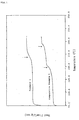
- Fig. 1 shows the results of DSC.
- TA (B-A) x F / (1000 x W)
- DSace (162.14 x TA)/[1-42.14 x TA + (1-56.06 x TA) x (AL/AC)]
- DSpro DSace x (AL/AC)
- the number-average molecular weight of each cellulose ester was determined by the use of a high-performance liquid chromatography system provided with a gel filtration column to which a detector for refractive index and low angle laser light scattering was connected (i.e., GPC-LALLS).
- the conditions of measurement are as follows:
- a solution of a cellulose ester composition in an organic solvent i.e., a liquid cellulose ester composition
- a cellulose ester composition in an organic solvent i.e., a liquid cellulose ester composition
- a solution of a cellulose ester composition in an organic solvent i.e., a liquid cellulose ester composition
- an organic solvent i.e., a liquid cellulose ester composition
- DSC differential scanning calorimetry
- the Re value can be obtained by incident Light along a perpendicular direction to the film surface, by using an ellipsometer (AEP-100, mfd. by Shimadzu Corp.)
- the dynamic viscoelasticity of a film was determined by using automatic dynamic viscoelasticity measuring equipment for solid (RSA-II; mfd. by Rheometrics).
- a sample film (thickness: about 100 ⁇ m) was cut into strips 2 mm in width and 35 mm in length. The strip was fixed at both its ends and a forced vibration was applied to the strip thus fixed to determine the stress-strain characteristics.
- the dynamic viscoelasticity of the sample was evaluated on the basis of the characteristics.
- the temperature of measurement was 26 °C, and the frequency thereof was 10 Hz.
- the measurement was conducted in nitrogen gas.
- methyl acetate 90 parts by weight was mixed with 5 parts by weight of cellulose triacetate (DSace: 2.87, number-average degree of polymerization: 407, number-average molecular weight: 115,000)(hereinafter abbreviated to "CTA-1") and 5 parts by weight of cellulose acetate propionate (DSace: 2.60, DSpro: 0.30, number-average degree of polymerization: 439, number-average molecular weight: 126,000)(hereinafter abbreviated to "CAP-1”) at room temperature (25 °C) to prepare a slurry having a polymer concentration (which refers to a total concentration of cellulose triacetate and cellulose acetate propionate, the same applies hereinafter) of 10 % by weight.
- CTA-1 cellulose triacetate
- CAP-1 cellulose acetate propionate
- This slurry contained white insolubles.
- the slurry was cooled for one hour in a methanol bath adjusted to -20 °C with dry ice. No white insolubles were observed in the slurry taken out of the bath, while many bubbles formed by the penetration of the solvent were observed.
- the slurry was allowed to stand at room temperature for 10 minutes and then kept in a hot water bath set at 40 °C for 10 minutes to give a liquid cellulose ester composition.
- the composition exhibited fluidity and was free from an undissolved lump.
- the liquid cellulose ester composition was allowed to stand at room temperature for one week. No change was observed in the appearance of the composition.
- the liquid cellulose ester composition was cast on a glass plate and air-dried at 25 °C to give a film. This film could be easily peeled from the glass plate after the lapse of 30 minutes from the casting. The film was subjected to the above DSC. Fig. 1 shows the result.
- the slurry was allowed to stand at room temperature for 10 minutes and then kept in a hot water bath set at 40 °C for 10 minutes to give a liquid cellulose ester composition.
- the composition exhibited fluidity and was free from an undissolved lump.
- the liquid cellulose ester composition was allowed to stand at room temperature for one week. No change was observed in the appearance of the composition.
- methyl acetate 90 parts by weight was mixed with 5 parts by weight of cellulose triacetate (DSace: 2.75, number-average degree of polymerization: 389, number-average molecular weight: 108,000) (hereinafter abbreviated to "CTA-2") and 5 parts by weight of CAP-1 at room temperature (25 °C) to prepare a slurry having a polymer concentration of 10 % by weight.
- This slurry contained white insolubles.
- the slurry was cooled for one hour in a methanol bath adjusted to 0 °C with dry ice. No white insolubles were observed in the slurry taken out of the bath, while many bubbles formed by the penetration of the solvent were observed.
- the slurry was allowed to stand at room temperature for 10 minutes and then kept in a hot water bath set at 40 °C for 10 minutes to give a liquid cellulose ester composition.
- the composition exhibited fluidity and was free from an undissolved lump.
- the liquid cellulose ester composition was allowed to stand at room temperature for one week. No change was observed in the appearance of the composition.
- a slurry having a polymer concentration of 10 % by weight 90 parts by weight of methyl acetate was mixed with 5 parts by weight of CTA-2 and 5 parts by weight of CAP-2 at room temperature (25 °C) to prepare a slurry having a polymer concentration of 10 % by weight.
- This slurry contained white insolubles.
- the slurry was cooled for one hour in a methanol bath adjusted to 0 °C with dry ice. No white insolubles were observed in the slurry taken out of the bath, while many bubbles formed by the penetration of the solvent were observed.
- the slurry was allowed to stand at room temperature for 10 minutes and then kept in a hot water bath set at 40 °C for 10 minutes to give a liquid cellulose ester composition.
- the composition exhibited fluidity and was free from an undissolved lump.
- the liquid cellulose ester composition was allowed to stand at room temperature for one week. No change was observed in the appearance of the composition.
- methyl acetate 90 parts by weight was mixed with 5 parts by weight of cellulose acetate (DSace: 2.45, number-average degree of polymerization: 1434, number-average molecular weight: 380,000)(hereinafter abbreviated to "CDA-1") and 5 parts by weight of CAP-1 at room temperature (25 °C) to prepare a slurry having a polymer concentration of 10 % by weight.
- This slurry contained white insolubles.
- the slurry was cooled for one hour in a methanol bath adjusted to 0 °C with dry ice. No white insolubles were observed in the slurry taken out of the bath, while many bubbles formed by the penetration of the solvent were observed.
- the slurry was allowed to stand at room temperature for 10 minutes and then kept in a hot water bath set at 40 °C for 10 minutes to give a liquid cellulose ester composition.
- the composition exhibited fluidity and was free from an undissolved lump.
- the liquid cellulose ester composition was allowed to stand at room temperature for one week. The composition suffered liquid/liquid phase separation.
- the liquid cellulose ester compositions of Examples 1 to 4 were excellent in the compatibility of the components (a) and (b) with each other and therefore did not suffer phase separation.
- the film made from the liquid composition of Example 1 took a uniform one-phase state and therefore exhibited only one glass transition behavior (corresponding to the position marked by an arrow in the figure).
- the film made from the solution of Comparative Example 5 suffered phase separation and therefore exhibited two glass transition behaviors (corresponding to the positions marked by arrows in the figure).
- these results of the Examples are due to the degrees of substitution (e.g., DSace) of the components (a) and (b) falling in their respective specific ranges.
- Example 5 made from the liquid cellulose ester composition was superior to the cellulose triacetate film of Comparative Example 6 in optical characteristics.
- Example 5 In a similar manner to that of Example 5, a film was made from a liquid cellulose ester composition prepared in a similar manner to that of Example 5. This film was examined for dynamic viscoelasticity according to the above method. The results are given in Table 3.
- Example 6 made from the liquid cellulose ester composition was superior to the film of Comparative Example 7 made from a mixed ester of cellulose in mechanical characteristics.
- acetone 90 parts by weight of acetone was mixed with 5 parts by weight of CTA-1 and 5 parts by weight of CAP-1 at room temperature (25 °C) to prepare a slurry having a polymer concentration of 10 % by weight.
- This slurry contained white insolubles.
- the slurry was cooled for one hour in a methanol bath adjusted to -20 °C with dry ice. No white insolubles were observed in the slurry taken out of the bath, while many bubbles formed by the penetration of the solvent were observed.
- the slurry was allowed to stand at room temperature for 10 minutes and then kept in a hot water bath set at 40 °C for 10 minutes to give a liquid cellulose ester composition.
- the composition exhibited fluidity and was free from an undissolved lump.
- the liquid cellulose ester composition was allowed to stand at room temperature for one week. No change was observed in the appearance of the composition.
- tetrahydrofuran 90 parts by weight of tetrahydrofuran was mixed with 5 parts by weight of CTA-1 and 5 parts by weight of CAP-1 at room temperature (25 °C) to prepare a slurry having a polymer concentration of 10 % by weight.
- This slurry contained white or lumpish insolubles.
- the slurry was cooled for one hour in a methanol bath adjusted to -25 °C with dry ice. No white or lumpish insolubles were observed in the slurry taken out of the bath, while many bubbles formed by the penetration of the solvent were observed.
- the slurry was allowed to stand at room temperature for 10 minutes and then kept in a hot water bath set at 40 °C for 10 minutes to give a liquid cellulose ester composition.
- the composition exhibited fluidity and was free from an undissolved lump.
- the liquid cellulose ester composition was allowed to stand at room temperature for one week. No change was observed in the appearance of the composition.
- the cellulose ester compositions of the present invention are easily soluble in general-purpose organic solvents and excellent in the compatibility of the cellulose components with each other, so that a liquid cellulose composition, prepared by dissolving the composition in an organic solvent can be easily solvent-cast into films. Further, the compositions are excellent also in formability into film, so that the production of films from the compositions by the solvent-casting can be conducted at ordinary room temperature of factories without particular consideration given to casting temperature, and that the time required for film forming can be shortened. Additionally, the obtained films are free from phase separation and therefore excellent in optical and mechanical characteristics.
Landscapes
- Chemical & Material Sciences (AREA)
- Polymers & Plastics (AREA)
- Health & Medical Sciences (AREA)
- Chemical Kinetics & Catalysis (AREA)
- Medicinal Chemistry (AREA)
- Organic Chemistry (AREA)
- Engineering & Computer Science (AREA)
- Manufacturing & Machinery (AREA)
- Dispersion Chemistry (AREA)
- General Chemical & Material Sciences (AREA)
- Materials Engineering (AREA)
- Manufacture Of Macromolecular Shaped Articles (AREA)
- Compositions Of Macromolecular Compounds (AREA)
- Moulding By Coating Moulds (AREA)
Applications Claiming Priority (2)
| Application Number | Priority Date | Filing Date | Title |
|---|---|---|---|
| JP7420498 | 1998-03-23 | ||
| JP07420498A JP3931210B2 (ja) | 1998-03-23 | 1998-03-23 | セルロースエステル組成物 |
Publications (2)
| Publication Number | Publication Date |
|---|---|
| EP0945486A1 true EP0945486A1 (de) | 1999-09-29 |
| EP0945486B1 EP0945486B1 (de) | 2001-06-13 |
Family
ID=13540432
Family Applications (1)
| Application Number | Title | Priority Date | Filing Date |
|---|---|---|---|
| EP99105470A Expired - Lifetime EP0945486B1 (de) | 1998-03-23 | 1999-03-17 | Celluloseesterzusammensetzung |
Country Status (4)
| Country | Link |
|---|---|
| US (1) | US6139785A (de) |
| EP (1) | EP0945486B1 (de) |
| JP (1) | JP3931210B2 (de) |
| DE (1) | DE69900144T2 (de) |
Cited By (4)
| Publication number | Priority date | Publication date | Assignee | Title |
|---|---|---|---|---|
| EP1279696A1 (de) * | 2001-07-26 | 2003-01-29 | Fuji Photo Film Co., Ltd. | Folie aus acylierter Cellulose und Verfahren zu ihrer Herstellung |
| EP1174737A3 (de) * | 2000-07-21 | 2004-04-28 | Konica Corporation | Optische Kompensationsfolie und Flüssigkristallanzeige |
| EP1792918A4 (de) * | 2004-09-22 | 2008-07-30 | Daicel Chem | Celluloseester und herstellungsverfahren dafür |
| EP2343337A4 (de) * | 2008-10-29 | 2012-07-11 | Toray Industries | Thermoplastische zelluloseesterzusammensetzung und daraus hergestellte fasern |
Families Citing this family (25)
| Publication number | Priority date | Publication date | Assignee | Title |
|---|---|---|---|---|
| US6731357B1 (en) * | 1999-01-27 | 2004-05-04 | Konica Corporation | Cellulose ester film, production method of the same, film employed in liquid crystal display member, and polarizing plate |
| TW200806451A (en) * | 1999-10-21 | 2008-02-01 | Konica Minolta Opto Inc | Optical film, its manufacturing method and liquid crystal display device using it |
| JP2001225337A (ja) * | 2000-02-18 | 2001-08-21 | Konica Corp | セルロースエステルフィルムの製造方法、セルロースエステルフィルム、偏光板及びバーティカルアラインメント(va)型液晶表示装置 |
| TW539678B (en) * | 2000-03-27 | 2003-07-01 | Daicel Chem | Acetyl cellulose and method for producing same |
| JP4626044B2 (ja) * | 2000-10-24 | 2011-02-02 | コニカミノルタホールディングス株式会社 | セルロースエステル溶液の調製方法、セルロースエステルフィルムの製造方法及びセルロースエステル造粒粒子 |
| US6984730B2 (en) * | 2001-01-17 | 2006-01-10 | Fuji Photo Film Co., Ltd. | Cellulose acylate and solution thereof |
| JP2002265639A (ja) * | 2001-03-14 | 2002-09-18 | Fuji Photo Film Co Ltd | セルロースアシレートフイルム |
| JP2002265638A (ja) * | 2001-03-14 | 2002-09-18 | Fuji Photo Film Co Ltd | セルロースアシレートフイルム |
| US6814914B2 (en) * | 2001-05-30 | 2004-11-09 | Konica Corporation | Cellulose ester film, its manufacturing method, optical retardation film, optical compensation sheet, elliptic polarizing plate, and image display |
| JP2003001074A (ja) * | 2001-06-25 | 2003-01-07 | Daicel Chem Ind Ltd | セルロース誘導体多孔質膜及びその製造法 |
| JP4528471B2 (ja) * | 2001-09-27 | 2010-08-18 | 富士フイルム株式会社 | セルロースアシレートフイルム |
| JP2003145563A (ja) * | 2001-11-16 | 2003-05-20 | Fuji Photo Film Co Ltd | セルロースアシレートフィルム及びそれを用いた偏光板 |
| CN1954023B (zh) * | 2004-05-14 | 2010-06-16 | 富士胶片株式会社 | 光学纤维素酰化物膜、起偏振板和液晶显示装置 |
| JP2006113175A (ja) * | 2004-10-13 | 2006-04-27 | Konica Minolta Opto Inc | 光学フィルム、偏光板及び表示装置 |
| US20060222786A1 (en) * | 2005-02-01 | 2006-10-05 | Fuji Photo Film Co., Ltd. | Cellulose acylate, cellulose acylate film, and method for production and use thereof |
| JP2008260919A (ja) * | 2007-03-16 | 2008-10-30 | Fujifilm Corp | セルロースアセテートプロピオネートフィルム、セルロースアセテートプロピオネートフィルムの製造方法、光学補償シート、偏光板および液晶表示装置 |
| US20080241430A1 (en) * | 2007-03-28 | 2008-10-02 | Fujifilm Corporation | Cellulose compound composition, cellulose compound film, optically compensatory sheet, polarizing plate and liquid crystal display device |
| JP4840475B2 (ja) * | 2009-06-18 | 2011-12-21 | コニカミノルタホールディングス株式会社 | セルロースエステルフィルム及びその製造方法、並びに偏光板用保護フィルム |
| US20110200809A1 (en) * | 2010-02-12 | 2011-08-18 | Eastman Chemical Company | Sulfite softwood based cellulose triacetate for lcd films |
| US9068063B2 (en) | 2010-06-29 | 2015-06-30 | Eastman Chemical Company | Cellulose ester/elastomer compositions |
| US9273195B2 (en) | 2010-06-29 | 2016-03-01 | Eastman Chemical Company | Tires comprising cellulose ester/elastomer compositions |
| JP5593237B2 (ja) * | 2011-01-11 | 2014-09-17 | 富士フイルム株式会社 | セルロースアシレートフィルム、偏光板、及び液晶表示装置 |
| JP5970781B2 (ja) * | 2011-11-09 | 2016-08-17 | コニカミノルタ株式会社 | 有機エレクトロルミネッセンス表示装置 |
| US9708474B2 (en) | 2011-12-07 | 2017-07-18 | Eastman Chemical Company | Cellulose esters in pneumatic tires |
| US10077342B2 (en) | 2016-01-21 | 2018-09-18 | Eastman Chemical Company | Elastomeric compositions comprising cellulose ester additives |
Citations (4)
| Publication number | Priority date | Publication date | Assignee | Title |
|---|---|---|---|---|
| JPH08231761A (ja) * | 1994-12-05 | 1996-09-10 | Fuji Photo Film Co Ltd | セルロースエステル溶液およびセルロースエステルフイルムの製造方法 |
| US5594068A (en) * | 1993-05-28 | 1997-01-14 | Eastman Chemical Company | Cellulose ester blends |
| JPH1045804A (ja) * | 1996-07-30 | 1998-02-17 | Daicel Chem Ind Ltd | セルロースの混合脂肪酸エステルの製造方法 |
| JPH1060170A (ja) * | 1996-08-20 | 1998-03-03 | Fuji Photo Film Co Ltd | セルロースエステル溶液の調製方法およびセルロースエステルフイルムの製造方法 |
Family Cites Families (5)
| Publication number | Priority date | Publication date | Assignee | Title |
|---|---|---|---|---|
| JP3078607B2 (ja) * | 1991-07-10 | 2000-08-21 | スカイアルミニウム株式会社 | 陽極酸化処理用アルミニウム合金板の製造方法 |
| US5314647A (en) * | 1992-07-20 | 1994-05-24 | Eastman Kodak Company | Method of making cellulose ester photographic film base |
| DE69434062T2 (de) * | 1993-02-16 | 2006-02-23 | Mitsubishi Rayon Co., Ltd. | Verfahren zur Herstellung von geformten Gegenständen aus einer Cellulose-Lösung |
| US5695694A (en) * | 1993-10-08 | 1997-12-09 | Teijin Limited | Method of producing an acylated cellulose film |
| US5686036A (en) * | 1996-01-11 | 1997-11-11 | Eastman Kodak Company | Process for making a cellulose triacetate photographic film base |
-
1998
- 1998-03-23 JP JP07420498A patent/JP3931210B2/ja not_active Expired - Lifetime
-
1999
- 1999-03-17 EP EP99105470A patent/EP0945486B1/de not_active Expired - Lifetime
- 1999-03-17 DE DE69900144T patent/DE69900144T2/de not_active Expired - Lifetime
- 1999-03-19 US US09/273,054 patent/US6139785A/en not_active Expired - Lifetime
Patent Citations (4)
| Publication number | Priority date | Publication date | Assignee | Title |
|---|---|---|---|---|
| US5594068A (en) * | 1993-05-28 | 1997-01-14 | Eastman Chemical Company | Cellulose ester blends |
| JPH08231761A (ja) * | 1994-12-05 | 1996-09-10 | Fuji Photo Film Co Ltd | セルロースエステル溶液およびセルロースエステルフイルムの製造方法 |
| JPH1045804A (ja) * | 1996-07-30 | 1998-02-17 | Daicel Chem Ind Ltd | セルロースの混合脂肪酸エステルの製造方法 |
| JPH1060170A (ja) * | 1996-08-20 | 1998-03-03 | Fuji Photo Film Co Ltd | セルロースエステル溶液の調製方法およびセルロースエステルフイルムの製造方法 |
Non-Patent Citations (3)
| Title |
|---|
| PATENT ABSTRACTS OF JAPAN vol. 097, no. 001 31 January 1997 (1997-01-31) * |
| PATENT ABSTRACTS OF JAPAN vol. 098, no. 006 30 April 1998 (1998-04-30) * |
| PATENT ABSTRACTS OF JAPAN vol. 098, no. 008 30 June 1998 (1998-06-30) * |
Cited By (6)
| Publication number | Priority date | Publication date | Assignee | Title |
|---|---|---|---|---|
| EP1174737A3 (de) * | 2000-07-21 | 2004-04-28 | Konica Corporation | Optische Kompensationsfolie und Flüssigkristallanzeige |
| US7158200B2 (en) | 2000-07-21 | 2007-01-02 | Konica Corporation | Optical compensation sheet and liquid crystal display |
| US7199848B2 (en) | 2000-07-21 | 2007-04-03 | Konica Corporation | Optical compensation sheet and liquid crystal display |
| EP1279696A1 (de) * | 2001-07-26 | 2003-01-29 | Fuji Photo Film Co., Ltd. | Folie aus acylierter Cellulose und Verfahren zu ihrer Herstellung |
| EP1792918A4 (de) * | 2004-09-22 | 2008-07-30 | Daicel Chem | Celluloseester und herstellungsverfahren dafür |
| EP2343337A4 (de) * | 2008-10-29 | 2012-07-11 | Toray Industries | Thermoplastische zelluloseesterzusammensetzung und daraus hergestellte fasern |
Also Published As
| Publication number | Publication date |
|---|---|
| JPH11269304A (ja) | 1999-10-05 |
| DE69900144D1 (de) | 2001-07-19 |
| US6139785A (en) | 2000-10-31 |
| DE69900144T2 (de) | 2001-09-27 |
| EP0945486B1 (de) | 2001-06-13 |
| JP3931210B2 (ja) | 2007-06-13 |
Similar Documents
| Publication | Publication Date | Title |
|---|---|---|
| EP0945486B1 (de) | Celluloseesterzusammensetzung | |
| US12006375B2 (en) | Regioselectively substituted cellulose esters | |
| EP1134259B1 (de) | Celluloseacetatlösung und Verfahren zu ihrer Herstellung | |
| US6958394B2 (en) | Cellulose ester film | |
| US7863439B2 (en) | Cellulose ester having improved stability to wet heat | |
| JPH1045804A (ja) | セルロースの混合脂肪酸エステルの製造方法 | |
| JP3758836B2 (ja) | セルロースエステルフイルム及びセルロースエステル溶液 | |
| JP3619592B2 (ja) | セルロースアセテート溶液およびその調製方法 | |
| JP3655960B2 (ja) | セルロースエステル溶液およびセルロースエステルフイルムの製造方法 | |
| JP3712215B2 (ja) | セルロースアセテート溶液、その調製方法およびセルロースアセテートフイルムの製造方法 | |
| WO2019190756A1 (en) | Regioselectively substituted cellulose esters | |
| JP4073524B2 (ja) | セルロース混合エステル溶液及びその調製法 | |
| JP4240799B2 (ja) | 光学用セルロースエステルフィルム、その製造方法及び偏光板 | |
| JP2003246801A (ja) | セルロースの混合脂肪酸エステル溶液の調製方法およびセルロースの混合脂肪酸エステルフイルムの製造方法 | |
| JPWO2002022720A1 (ja) | セルロースアシレートフイルムの製造方法 | |
| JP2004002883A (ja) | セルロースエステルフイルムおよびその製造方法 | |
| JP2002003644A (ja) | セルロースアセテート溶液、その調製方法、セルロースアセテートフイルム、およびその製造方法 | |
| JP2005060711A (ja) | セルロースアセテート溶液の調製方法およびセルロースアセテートフイルムの製造方法 | |
| JP2003262733A (ja) | 偏光板保護フイルムおよび偏光板 |
Legal Events
| Date | Code | Title | Description |
|---|---|---|---|
| PUAI | Public reference made under article 153(3) epc to a published international application that has entered the european phase |
Free format text: ORIGINAL CODE: 0009012 |
|
| AK | Designated contracting states |
Kind code of ref document: A1 Designated state(s): DE FR GB |
|
| AX | Request for extension of the european patent |
Free format text: AL;LT;LV;MK;RO;SI |
|
| 17P | Request for examination filed |
Effective date: 20000302 |
|
| AKX | Designation fees paid |
Free format text: DE FR GB |
|
| GRAG | Despatch of communication of intention to grant |
Free format text: ORIGINAL CODE: EPIDOS AGRA |
|
| 17Q | First examination report despatched |
Effective date: 20000807 |
|
| GRAG | Despatch of communication of intention to grant |
Free format text: ORIGINAL CODE: EPIDOS AGRA |
|
| GRAH | Despatch of communication of intention to grant a patent |
Free format text: ORIGINAL CODE: EPIDOS IGRA |
|
| GRAH | Despatch of communication of intention to grant a patent |
Free format text: ORIGINAL CODE: EPIDOS IGRA |
|
| GRAA | (expected) grant |
Free format text: ORIGINAL CODE: 0009210 |
|
| AK | Designated contracting states |
Kind code of ref document: B1 Designated state(s): DE FR GB |
|
| REF | Corresponds to: |
Ref document number: 69900144 Country of ref document: DE Date of ref document: 20010719 |
|
| ET | Fr: translation filed | ||
| REG | Reference to a national code |
Ref country code: GB Ref legal event code: IF02 |
|
| PLBE | No opposition filed within time limit |
Free format text: ORIGINAL CODE: 0009261 |
|
| STAA | Information on the status of an ep patent application or granted ep patent |
Free format text: STATUS: NO OPPOSITION FILED WITHIN TIME LIMIT |
|
| 26N | No opposition filed | ||
| REG | Reference to a national code |
Ref country code: FR Ref legal event code: PLFP Year of fee payment: 18 |
|
| REG | Reference to a national code |
Ref country code: FR Ref legal event code: PLFP Year of fee payment: 19 |
|
| REG | Reference to a national code |
Ref country code: FR Ref legal event code: PLFP Year of fee payment: 20 |
|
| PGFP | Annual fee paid to national office [announced via postgrant information from national office to epo] |
Ref country code: GB Payment date: 20180314 Year of fee payment: 20 Ref country code: DE Payment date: 20180306 Year of fee payment: 20 |
|
| PGFP | Annual fee paid to national office [announced via postgrant information from national office to epo] |
Ref country code: FR Payment date: 20180223 Year of fee payment: 20 |
|
| REG | Reference to a national code |
Ref country code: DE Ref legal event code: R071 Ref document number: 69900144 Country of ref document: DE |
|
| REG | Reference to a national code |
Ref country code: GB Ref legal event code: PE20 Expiry date: 20190316 |
|
| PG25 | Lapsed in a contracting state [announced via postgrant information from national office to epo] |
Ref country code: GB Free format text: LAPSE BECAUSE OF EXPIRATION OF PROTECTION Effective date: 20190316 |