EP0945741A2 - Méthode et système pour la detection d'objets en mouvement - Google Patents
Méthode et système pour la detection d'objets en mouvement Download PDFInfo
- Publication number
- EP0945741A2 EP0945741A2 EP98306448A EP98306448A EP0945741A2 EP 0945741 A2 EP0945741 A2 EP 0945741A2 EP 98306448 A EP98306448 A EP 98306448A EP 98306448 A EP98306448 A EP 98306448A EP 0945741 A2 EP0945741 A2 EP 0945741A2
- Authority
- EP
- European Patent Office
- Prior art keywords
- azimuth
- streak
- amplitude
- spatial frequency
- power
- Prior art date
- Legal status (The legal status is an assumption and is not a legal conclusion. Google has not performed a legal analysis and makes no representation as to the accuracy of the status listed.)
- Withdrawn
Links
Images





Classifications
-
- G—PHYSICS
- G01—MEASURING; TESTING
- G01S—RADIO DIRECTION-FINDING; RADIO NAVIGATION; DETERMINING DISTANCE OR VELOCITY BY USE OF RADIO WAVES; LOCATING OR PRESENCE-DETECTING BY USE OF THE REFLECTION OR RERADIATION OF RADIO WAVES; ANALOGOUS ARRANGEMENTS USING OTHER WAVES
- G01S13/00—Systems using the reflection or reradiation of radio waves, e.g. radar systems; Analogous systems using reflection or reradiation of waves whose nature or wavelength is irrelevant or unspecified
- G01S13/88—Radar or analogous systems specially adapted for specific applications
- G01S13/89—Radar or analogous systems specially adapted for specific applications for mapping or imaging
- G01S13/90—Radar or analogous systems specially adapted for specific applications for mapping or imaging using synthetic aperture techniques, e.g. synthetic aperture radar [SAR] techniques
- G01S13/9021—SAR image post-processing techniques
- G01S13/9029—SAR image post-processing techniques specially adapted for moving target detection within a single SAR image or within multiple SAR images taken at the same time
Definitions
- the present invention relates to a method and system for detecting moving objects.
- Embodiments of the present invention relate to a method and system for processing image data from a synthetic aperture radar system and, in particular, to a method and system for detecting moving objects by processing image data from a synthetic aperture radar system.
- Radio detection and ranging (radar) devices generally include a transmitter for illuminating an object with radio frequency energy "pulses" and a receiver for receiving energy reflected from the object. For instance, a single radio frequency pulse transmitted toward an object from the radar device will provide the distance from the radar transmitter to the object which reflected the energy. Resolution of images using conventional radar systems can be low, however.
- SAR synthetic aperture radar
- Conventional synthetic aperture radar (SAR) systems are capable of providing a higher degree of resolution since SAR systems have a relatively large effective aperture size.
- a synthetic aperture is created by putting a transmitter on a moving vehicle (e.g., airplane). As the vehicle moves a known distance at a constant velocity, the transmitter on board the vehicle transmits toward a designated object or area to be illuminated pulses of radio frequency energy over a period of time.
- the resulting aperture effectively corresponds to the distance the vehicle moved during the period of time the transmitter was pulsing energy toward the designated object or area, which is significantly larger than the aperture of the typical radar systems.
- the radar antenna transmits a series of periodic radio frequency energy pulses to image a strip, and various stationary objects within the strip (e.g., on the ground) reflect radio frequency energy back to the SAR.
- the radar antenna pulses periodically as it flies along in the azimuth direction, the distance between a given stationary radio frequency reflector or scatterer and the antenna/transmitter varies, whereby the distance is at a minimum at the point where the antenna/transmitter is broadside the stationary scatterer.
- Such distances can be processed to provide the location of the stationary object or objects reflecting or scattering the radio frequency energy within the strip being imaged.
- the range resolution (e.g., degree of accuracy of stationary scatterer's position in the range direction) is typically dependent upon the width of the radio frequency pulses which are transmitted.
- Azimuth resolution (e.g., degree of accuracy of scattering object's position in the azimuth direction) is dependent upon the length of the synthetic aperture, which generally corresponds to the distance flown by the antenna of the SAR system.
- the azimuth position is dependent upon a scattering object's Doppler frequency of the reflected energy, which corresponds to the position of the SAR system relative to the scattering object. Processing of Doppler frequency shifts or offsets provides a location of scatterers in a scene being illuminated.
- An embodiment of the present invention seeks to provide a method and system for detecting at least a first azimuth streak corresponding to a first moving object (e.g., scatterer) using data from a synthetic aperture radar system.
- a first moving object e.g., scatterer
- Another embodiment of the present invention seeks to provide a method and system for detecting at least a first azimuth streak corresponding to at least a first moving object using data from a space-based synthetic aperture radar system.
- Still another embodiment of the present invention seeks to provide a method and system for detecting at least a first azimuth streak corresponding to at least a first low signal-to-background object moving at a constant linear velocity using data from a single or multiple channel synthetic aperture radar system.
- Yet another embodiment of the present invention seeks to provide a method and system for obtaining at least an estimate of the velocity of at least a first moving object using data from a synthetic aperture radar system.
- One aspect of the present invention provides
- the method and system are directed to receiving at least first amplitude data in an amplitude image domain of at least a first image from a SAR system (e.g., side looking SAR system), the first amplitude data including first and second indications corresponding to at least a first moving object (e.g., scatterer moving at a constant linear velocity) and clutter or background (e.g., object(s), such as air, sea or land-based vehicles, moving nonlinearly or at nonconstant linear velocity, stationary or wind-blown trees and foliage, roads, buildings, etc.), respectively, processing at least the first indication to concentrate a spatial frequency of at least a first azimuth streak power of at least a first azimuth streak corresponding to the first moving object within an amplitude spatial frequency domain, whitening, in the amplitude spatial frequency
- the method and system of the present invention are especially useful for detecting azimuth streaks from low signal-to-background objects or targets since the whitening step defeats or suppresses the clutter for low signal-to-background targets or movers by significantly reducing the clutter, which would otherwise result in azimuth streaks for false (e.g., nonexistent, no-interest) movers.
- Whitening, in the amplitude spatial frequency domain, of at least a portion of the second indication corresponding to clutter or background may be performed before or after filtering of the amplitude spatial frequency domain, so long as the whitening is performed prior to processing the spatial frequency of at least the first azimuth streak power to disperse the spatial frequency of at least the first azimuth streak power into the amplitude image domain.
- the method and system are directed to receiving at least first amplitude data in an amplitude image domain of at least a first image from a SAR system (e.g., side looking SAR system), the first amplitude data including first and second indications corresponding to at least a first moving object (e.g., scatterer moving at a constant linear velocity) and clutter or background (e.g., object moving nonlinearly or at nonconstant linear velocity, stationary or wind-blown trees and foliage, etc.), respectively, whitening, in the amplitude image domain, at least one of the first and second indications of the first amplitude data (e.g., first azimuth amplitude of the first azimuth streak and clutter amplitude), such that the spatial frequency power of the clutter is altered or reduced relative to at least the first azimuth streak power, processing at least the
- whitening is accomplished in the amplitude image domain by convolving with a first weighted matrix the first and second indications to alter the spatial frequency power of the clutter, such that the spatial frequency power of the clutter is less than the first azimuth streak power.
- Such convolution of the amplitude image data may be performed before or after the separating/filtering of the data in the amplitude spatial frequency domain.
- the values in the first weighted matrix may be synthesized by standard Fourier techniques so that the response in the spatial frequency domain is approximately constant amplitude.
- the method and system are especially useful for detecting azimuth streaks caused by low signal-to-background objects or targets as whitening the clutter defeats or suppresses the clutter for low signal-to-background targets or movers by significantly reducing the clutter, which would otherwise result in azimuth streaks corresponding to false (e.g., nonexistent or no-interest) movers.
- Processing to separate/filter the first and second indications in either of the above-summarized embodiments may be accomplished utilizing either a discrete Fourier transformation or an optical Fourier transformation, depending, for example, upon whether the SAR system amplitude data is digital or analog in nature.
- a discrete Fourier transformation or an optical Fourier transformation, depending, for example, upon whether the SAR system amplitude data is digital or analog in nature.
- two dimension Fourier transforms are central to the method and system of the present invention since Fourier transforms by their very definition are frequency, rather than spatially, oriented.
- the processing step for concentrating the spatial frequency of at least the first azimuth streak power of at least the first azimuth streak may include performing a two-dimensional discrete Fourier transform (e.g., for digital amplitude data) or a two-dimensional optical Fourier transform (e.g., for analog amplitude data) on at least the first indication in the amplitude image domain to arrange at least the spatial frequency of at least the first azimuth streak power of at least the first azimuth streak within the amplitude spatial frequency domain.
- a two-dimensional discrete Fourier transform e.g., for digital amplitude data
- a two-dimensional optical Fourier transform e.g., for analog amplitude data
- the processing step for dispersing the spatial frequency of at least the first azimuth streak power into the amplitude image domain may include performing an inverse two-dimensional discrete Fourier transform (e.g., for digital amplitude data) or an inverse two-dimensional optical Fourier transform (e.g., for analog amplitude data) on at least the spatial frequency of at least the first azimuth streak power in the spatial frequency domain to obtain at least the first azimuth amplitude of the first azimuth streak in the amplitude image domain.
- an inverse two-dimensional discrete Fourier transform e.g., for digital amplitude data
- an inverse two-dimensional optical Fourier transform e.g., for analog amplitude data
- Another aspect of the present invention provides a method and system for detecting at least a first azimuth streak corresponding to at least a first object moving at a substantially constant linear velocity.
- the method and system are directed to convolving a weighted matrix with first and second indications of the first amplitude data corresponding to a first image from a SAR system, the first and second indications corresponding to at least the first object or target moving at a substantially constant linear velocity, and clutter or background, respectively, to alter and filter out a spatial frequency power of the clutter relative to a first azimuth streak power of at least a first azimuth streak corresponding to the first object moving at least substantially constant linear velocity.
- the processing steps described hereinabove which utilized two-dimensional Fourier transforms and inverse two-dimension Fourier transforms to manipulate at least the first amplitude data out of the amplitude image domain and into amplitude spatial frequency domain, and vice versa, and filtering step may be incorporated into the convolving step via the weighted matrix.
- the method may further include the step of thresholding at least a first azimuth amplitude of at least the first azimuth streak with a first selected amplitude level, wherein the first azimuth streak is detectable if the first azimuth amplitude of the first azimuth streak is greater than the first selected amplitude level.
- the method and system are especially useful in detecting low signal-to-background targets or objects moving at a substantially constant linear velocity since the method and system reduce the azimuth streaks relating to false movers, which would otherwise result from the clutter.
- the value of the azimuth streak detection method and system of the present invention is likely to be as a detection process which precedes more sophisticated, but possibly more ill-conditioned classification, or identification type statistical processes.
- the method and system of the present invention provide a robust detector which would improve the performance of any following classifier, or identifier according to the laws of conditional probability. Specifically, ill-conditioned classification, or identification type statistical processes are typically plagued by high false alarm rates. False movers are precisely what the method and system of the present invention are designed to avoid.
- the method and system of the present invention may be utilized for second amplitude data relating to second image data taken a known period of time after the first image was collected, assuming that the first moving object is included in the first and second image collections.
- the method of the present invention may be repeated for the second amplitude data corresponding to the second image of at least the first moving object. Repeating the above-summarized method may result in detection of a second azimuth streak corresponding to the first moving object.
- the first and second azimuths streaks of the first and second images, respectively correspond to the first moving object in first and second positions, respectively.
- a rough estimate of the velocity of the first moving object may be determined using the first and second positions of the first and second azimuth streaks corresponding to the first moving object and the period of time elapsed between collection of the first and second image data relating to first and second images collected by the SAR system.
- Figs. 1 to 9 illustrate the various features of illustrative embodiments of the method and system of the present invention.
- the illustrative method and system are directed to processing image data relating to images collected by synthetic aperture radar systems to detect moving objects.
- the method and system of the present invention are especially useful for detecting low signal-to-background objects or targets moving at a substantially constant linear velocity.
- the illustrative method generally includes the steps of processing at least first amplitude data corresponding to a first image collected by a synthetic aperture radar system, the first amplitude data having at least first and second indications which correspond to at least a first moving object and clutter or background, to separate/filter the first and second indications, reducing the clutter relative to a first azimuth streak corresponding to the first moving object, and detecting at least the first azimuth streak.
- the first image from the synthetic aperture radar system may be a complex image.
- the method of the present invention initially involves the step of transforming at least a first complex image into first amplitude data.
- the first complex image is a 32-bit floating point for each of the in-phase (e.g., real part) and for the quadrature (e.g., imaginary part).
- , of the first complex image may be obtained by taking the square root of the in-phase component, squared (i.e., x 2 ) plus the quadrature component, squared (i.e., y 2 ).
- the phase of the complex image is the standard four quadrant inverse tangent of the ratio "y/x” ranging from -180° to +180°, for "x" non-zero.
- the illustrative method and system for detecting azimuth streaks corresponding to scatterers or objects moving at a substantially constant linear velocity utilizes primarily the amplitude of the image data from a SAR system, and does not utilize the phase in the basic detection process.
- phase characteristics can be investigated as a discriminator of wind-blown vegetation azimuth streaking which is detected by the method of the present invention, as well as for the rejection of other false movers.
- the illustrative method and system of the present invention assumes that the format of the image data from a SAR system is consistent. Specifically, for the below-described embodiments of the method and system. It is assumed that azimuth streaking is always oriented horizontally. However, any other, known, consistent, determinable orientation of azimuth streaking would work equally well.
- the Shuttle Imaging Radar SIR-B
- ASARS-2 has azimuth streaking, if any, oriented vertically.
- digital amplitude imagery is transformed to the tangent plane of the earth's surface and is rotated to north to be used in conjunction with standard maps, in which case azimuth streaking, if any, could occur at any orientation angle.
- the first image may be a complex image having a 32-bit floating point for each of the in-phase, or real part, and for the quadrature, or imaginary part, and may be transformed into amplitude data (e.g., first amplitude data).
- the method initially includes the step of receiving first amplitude data in an amplitude image domain, the first amplitude data corresponding to a first image collected by a SAR system (e.g, single or multiple channel SAR on spacecraft or aircraft), and including first and second indications corresponding to at least a first moving object or scatterer and clutter, respectively.
- a SAR system e.g, single or multiple channel SAR on spacecraft or aircraft
- first and second indications corresponding to at least a first moving object or scatterer and clutter, respectively.
- the spatial frequency of azimuth streaking power of an "N by N" amplitude image (e.g., first image) is concentratable within the total spatial frequency domain, illustrated as the unshaded region in Fig. 3.
- the standard convention of representing the cardinal axes rotated 90° is employed so that the horizontal azimuth streaking (e.g., related to the first object moving at a substantially constant linear velocity) is oriented vertically in the spatial frequency domain, and the center of the diagram of Fig. 3 is 0 Hz, 0 Hz.
- Ninety percent (90%) of the azimuth streaking power due to azimuth streaking occurs in one percent (1%) of the spatial frequency domain.
- any azimuth streaking corresponding to objects or targets moving at a substantially constant linear velocity which occurs in the first image from the SAR system is very compactly contained within the spatial frequency of the amplitude SAR image, which makes it easier to manipulate for detection of azimuth streaking in accordance with the system and method of the present invention.
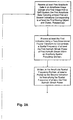
- the method of the present invention illustrated in Figs. 2A-2B, further includes the step of processing at least the first indication of the first amplitude data in the amplitude image domain to concentrate a spatial frequency of at least a first azimuth streak power of a first azimuth streak, if any, within an amplitude spatial frequency domain.
- the processing step to concentrate the first amplitude data from the amplitude image domain into the amplitude spatial frequency domain is performed using a two-dimensional discrete Fourier transforms since Fourier transforms are frequency oriented.
- the azimuth streak power of at least the first azimuth streak corresponding to the first moving object is concentrated into less than one percent (1%) of the spatial frequency domain, as noted in Fig. 3.
- the processing step is performed using a two-dimensional optical Fourier transform.
- the method illustrated in Figs. 2A-2B further includes the step of whitening at least a portion of the second indication corresponding to the clutter.
- whitening is accomplished by normalizing the spatial frequency of at least the first azimuth streak power, which is the complex output of the two dimensional Fourier transform described hereinabove.
- every complex value "z" output from the two-dimensional Fourier transform is transformed to "z/
- normalization is used to defeat/reduce clutter by virtue of the whitening effect the normalization has on the clutter.
- this embodiment of the method of the present invention further includes the step of filtering the amplitude spatial frequency domain to zero out the clutter.
- the filtering step includes deleting or rejecting that part of the spatial frequency that does not contain azimuth streaking.
- the shaded region is set to zero and the unshaded region, which is passed (e.g., unmodified), contains over ninety percent (90%) of the azimuth streaking from all sources which exist in the input SAR image (e.g., first image) as in described hereinabove.
- the filtering step functions to pass azimuth streaking power for later processing to detect moving targets using a statistical thresholding method (which will be described in more detail hereinbelow).
- a statistical thresholding method which will be described in more detail hereinbelow.
- the notch can be rotated to pass azimuth streaking from SAR imagery which has azimuth streaking at any orientation angle by virtue of the Fourier Rotation Theorem.
- a notch filter is used for the filtering step.
- the method of the present invention further includes the step of processing the spatial frequency of at least the first azimuth streak power to disperse the spatial frequency of at least the first azimuth streak power of the first azimuth streak back into the amplitude image domain.
- a first amplitude of the first azimuth streak e.g., first azimuth amplitude
- the processing step is performed utilizing an inverse two-dimensional discrete Fourier transform.
- the processing step is performed utilizing an inverse two-dimensional optical Fourier transform.
- this embodiment of the method of the present invention further includes the step of thresholding at least the first amplitude of the first azimuth streak, if any, with a first selected amplitude level.
- the first azimuth amplitude corresponding to the first moving object is thresholded in accord with standard statistical thresholding techniques with azimuth streaking in the image revealed to cue detection of moving targets.
- the first azimuth amplitude is greater than the first selected amplitude level, then the first azimuth streak, and therefore the first object moving at a substantially constant linear velocity corresponding thereto, is detectable. Thereafter, the first azimuth streak may be displayed in a first image with the background for perspective.
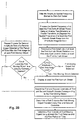
- the step of whitening is performed in the amplitude image domain, as opposed to in the amplitude spatial frequency domain, illustrated in Figs. 2A-2B. More specifically, and as illustrated in Figs. 4A-4B, the step of whitening is performed on the input amplitude data (e.g., the first amplitude data) of the first image from a SAR system.
- the whitening function includes convolving with a first weighted matrix the first and second indications of the first amplitude data corresponding to at least the first object moving at a substantially constant linear velocity and the clutter or background, respectively, to alter or reduce the spatial frequency power of the clutter relative to the first azimuth streak power.
- the values in the first weighted matrix are synthesized by standard Fourier techniques so that the response in the spatial frequency domain is approximately constant amplitude. Such convolving may be accomplished by a convolution filter. Thereafter, the amplitude data is manipulatable into, within and out of the amplitude spatial frequency domain since the azimuth streaking which occurs in the SAR image (e.g., first image) is very compactly contained in the spatial frequency of the amplitude of the SAR image, substantially as described hereinabove with respect to the methodology described hereinabove with respect to Figs. 2A-2B.
- the method further includes the step of processing the amplitude data (e.g., first and second indications of first image data corresponding to at least the first moving object and clutter) to concentrate a spatial frequency of the first azimuth streak power of at least a first azimuth streak, if any, within the amplitude spatial frequency domain, filtering the amplitude spatial frequency domain to delete everything but that part of the spatial frequency that does not contain azimuth streaking, if any, such that substantially only azimuth streak power (e.g., first azimuth streak power of the first azimuth streak) remains in the amplitude spatial frequency domain, and processing the spatial frequency of at least the first azimuth streak power of the first azimuth streak to disperse the spatial frequency of the first azimuth streak power into the amplitude image domain and obtain an amplitude (e.g., first azimuth amplitude) of the azimuth streak.
- the amplitude data e.g., first and second indications of first image data corresponding to at least the first moving object and clutter
- the above-noted processing steps for concentrating and dispersing may be accomplished using a two-dimensional Fourier transform and an inverse two-dimensional Fourier transform, respectively.
- the filtering step includes deleting or rejecting that part of the spatial frequency that does not contain azimuth streaking.
- the shaded region is set to zero and the unshaded region, which is passed (e.g., unmodified), contains over ninety percent (90%) of the azimuth streaking from all sources which exist in the input SAR image (e.g., first image) as in described hereinabove.
- the steps of reducing/altering and separating/filtering the spatial frequency power of the clutter relative to at least the first azimuth streak power may be accomplished in a single step. More specifically, and referring to Fig. 5, the method of the present invention comprises the step of convolving with a weighted matrix the first amplitude data in the amplitude image domain to whiten and filter the spatial frequency power of the clutter relative to the first azimuth streak power of the first azimuth streak which corresponds to a first object moving at a substantially constant linear velocity.
- the values in the weighted matrix are synthesized by standard Fourier techniques so that the response in the spatial frequency domain is approximately as depicted in Fig. 3.
- the method further includes the step of thresholding a first azimuth amplitude corresponding to the first azimuth streak with a first selected amplitude level, in accord with standard statistical thresholding techniques, to detect at least the first azimuth streak. At least the first azimuth streak may thereafter be displayed alone or against the background in the image.
- a rough estimate of the velocity of the first moving object or target may be made using a split aperture technique.
- image data from a SAR system may be split in half and the method of the present invention, described hereinabove, may be applied to each half of the image data.
- the velocity estimate is based upon the supposition that a first moving object detected in each half will have moved approximately from the centroid of the detected first azimuth streak in the first aperture to the centroid of the detected second azimuth streak in the second aperture in one-half the integration time, the first and second azimuth streaks corresponding to the first moving object.
- the method of the present invention may be repeated for second image data from the SAR system, the second image collected a period of time after the first image data was collected.
- the centroids of the first and second azimuth streaks is determined (e.g., by examining the brightest portion of the first and second azimuth streaks), a distance between the first and second azimuth streaks is measured to determine the first distance the first moving object traveled during the period of time between collection of the first and second images, and the first velocity is determined using the first distance and period of time.
- the decomposition of the phase history into several sub-apertures, each of which will have the method of the present invention applied to it, and the detected first and second azimuth streaks tracked over several sub-apertures, may be examined.
- an embodiment of the present invention is directed to a system for detecting azimuth streaking due to objects moving at a substantially constant linear velocity.
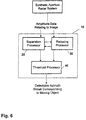
- the system 10 is capable of receiving amplitude image data (e.g., first amplitude image data) from a SAR system, the amplitude image data include first and second indications corresponding to at least the first object or target moving at a substantially constant linear velocity and clutter.
- the system 10 generally includes a processor 20 for separating/filtering the first and second indications of the first amplitude data, and a processor 30 for altering/reducing the spatial frequency power of the clutter relative to a first azimuth streak power of a first azimuth streak corresponding to the first moving object.
- the first amplitude data may be processed initially by either the separation processor 20 or the reducing/altering processor 30, depending upon whether the reduction of the clutter is desired within the amplitude spatial frequency domain or the amplitude image domain.
- the system 10 also includes a processor 40 for thresholding a first amplitude of the first azimuth streak relative to a first selected amplitude level, whereby the first azimuth streak indicative of a first object moving at a constant linear velocity is detectable if the first amplitude is greater than the first selected amplitude level.
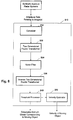
- the system 110 is designed to reduce the spatial frequency power of the clutter relative to the first azimuth streak power within the amplitude spatial frequency domain.
- the system 110 includes a two-dimensional Fourier transformer 122 for concentrating a spatial frequency of at least the first azimuth streak power of the first azimuth streak, if any, corresponding to the first moving object into the amplitude spatial frequency domain.
- transformer 122 may be a discrete or optical transformer, depending upon whether the image data is digital or analog in nature.
- the system 110 further includes a normalizer 132, which is capable of whitening, in the amplitude spatial frequency domain, the clutter by normalizing the spatial frequency of at least the first azimuth streak power.
- the normalizer 132 alters/reduces the clutter relative to the first azimuth streak.
- the system 110 further includes a notch filter 124 for deleting or rejecting within the amplitude spatial frequency domain everything except azimuth streaking.
- the notch filter 124 is capable of zeroing out the clutter since, as illustrated in Fig. 3, less than one percent (1%) of the amplitude spatial frequency domain contains about ninety percent (90%) of power due to azimuth streaking.
- the system 110 further includes an inverse two-dimensional Fourier transformer 126, which is capable of dispersing the spatial frequency of at least the first azimuth streak power into the amplitude image domain to obtain at least the first amplitude of at least the first azimuth streak.
- At least the first azimuth amplitude may then be communicated to a threshold processor 140, which utilizes standard thresholding techniques to detect at least the first azimuth streak.
- the processor 140 is capable of comparing at least the first azimuth amplitude corresponding to the first azimuth streak, if any, with a first selected amplitude level. If the first azimuth amplitude is greater than the first selected amplitude level, the first azimuth streak is detectable, and may then be displayed alone or against the background in the image.
- the system 210 includes an altering/reducing processor 232 which is capable of whitening, in the amplitude image domain, the spatial frequency of the clutter by convolving with a first weighted matrix the first and second indications of the first amplitude data relating to the first image, the first and second indications corresponding to at least the first moving object and clutter, respectively.
- the values in this weighted matrix are synthesized by standard Fourier techniques so that the response in the spatial frequency domain is approximately constant amplitude.
- the processor 232 comprises a convolution filter which functions to alter the spatial frequency power of the clutter.
- the system 210 further includes a two-dimensional Fourier transformer 222 for processing the amplitude data (e.g., first and second indications of first image data corresponding to at least the first moving object and clutter) to concentrate a spatial frequency of the first azimuth streak power of at least a first azimuth streak, if any, within the amplitude spatial frequency domain, a processor 224 for filtering the amplitude spatial frequency domain to delete everything but that part of the spatial frequency that does not contain azimuth streaking, if any, such that substantially only azimuth streak power (e.g., first azimuth streak power of the first azimuth streak) remains in the amplitude spatial frequency domain, and an inverse two-dimensional Fourier transformer 226 for processing the spatial frequency of at least the first azimuth streak power of the first azimuth streak to disperse the spatial frequency of the first azimuth streak power back into the amplitude image domain.
- amplitude data
- the output from the transformer 226 is the amplitude (e.g., first azimuth amplitude) of the azimuth streak(s).
- the filtering processor 224 functions to delete or reject that part of the spatial frequency that does not contain azimuth streaking.
- the filtering processor 224 comprises a notch filter, which is capable of zeroing out the clutter since, as illustrated in Fig. 3, less than one percent (1%) of the amplitude spatial frequency domain contains about ninety percent (90%) of power due to azimuth streaking.
- both reduction/alteration and filtering/separation of the spatial frequency power of the clutter relative to the first azimuth streak power is accomplished within the amplitude image domain.
- the system 310 includes a processor 332 which is capable of whitening, in the amplitude image domain, the spatial frequency of the clutter and filtering the spatial frequency power of the clutter relative to at least the first azimuth streak power of the first azimuth streak by convolving with a first weighted matrix with the first and second indications of the first amplitude data relating to the first image, the first and second indications corresponding to at least the first moving object and clutter, respectively.
- the values in the weighted matrix are synthesized by standard Fourier techniques so that the response in the spatial frequency domain is approximately as depicted in Fig. 3.
- the output of the processor 332 e.g., amplitude data relating to at least the first azimuth streak
- the threshold processor 340 which is capable of detecting at least the first azimuth streak by comparing at least the first azimuth amplitude corresponding to the first azimuth streak with a first selected amplitude level using standard thresholding techniques.
- the first azimuth amplitude is greater than the first selected amplitude level, the first azimuth streak is detectable, and may further be displayed alone or against the background in the image.
- the systems of the present invention may further include a velocity estimator 150, 250, 350.
- the systems 110, 210, 310 may be utilized to examine second image data from the SAR system, the second image collected a period of time after the first image data was collected.
- the velocity estimators 150, 250, 350 may be used to determine the centroids of the first and second azimuth streaks (e.g., by examining the brightest portion of the first and second azimuth streaks), determine a distance between the first and second azimuth streaks, which is correlatable to the first distance the first moving object traveled during the period of time between collection of the first and second images, and to determine the first velocity using the first distance and period of time.
Landscapes
- Engineering & Computer Science (AREA)
- Remote Sensing (AREA)
- Radar, Positioning & Navigation (AREA)
- Physics & Mathematics (AREA)
- Electromagnetism (AREA)
- Computer Networks & Wireless Communication (AREA)
- General Physics & Mathematics (AREA)
- Radar Systems Or Details Thereof (AREA)
Applications Claiming Priority (2)
| Application Number | Priority Date | Filing Date | Title |
|---|---|---|---|
| US09/049,499 US5959566A (en) | 1998-03-27 | 1998-03-27 | Method and system for detecting moving objects using a synthetic aperture radar system |
| US49499 | 1998-03-27 |
Publications (2)
| Publication Number | Publication Date |
|---|---|
| EP0945741A2 true EP0945741A2 (fr) | 1999-09-29 |
| EP0945741A3 EP0945741A3 (fr) | 2000-07-19 |
Family
ID=21960146
Family Applications (1)
| Application Number | Title | Priority Date | Filing Date |
|---|---|---|---|
| EP98306448A Withdrawn EP0945741A3 (fr) | 1998-03-27 | 1998-08-13 | Méthode et système pour la detection d'objets en mouvement |
Country Status (5)
| Country | Link |
|---|---|
| US (1) | US5959566A (fr) |
| EP (1) | EP0945741A3 (fr) |
| JP (1) | JPH11326509A (fr) |
| AU (1) | AU1731099A (fr) |
| CA (1) | CA2245270C (fr) |
Cited By (1)
| Publication number | Priority date | Publication date | Assignee | Title |
|---|---|---|---|---|
| JP2014139581A (ja) * | 2014-03-26 | 2014-07-31 | Mitsubishi Space Software Co Ltd | 目標物速度特定装置及び目標物速度特定プログラム |
Families Citing this family (15)
| Publication number | Priority date | Publication date | Assignee | Title |
|---|---|---|---|---|
| SE9900692L (sv) * | 1999-02-26 | 2000-03-27 | Foersvarets Forskningsanstalt | Sätt att med en SAR-radar detektera objekt som förändrar sig med tiden |
| US6466155B2 (en) | 2001-03-30 | 2002-10-15 | Ensco, Inc. | Method and apparatus for detecting a moving object through a barrier |
| US6633253B2 (en) | 2001-04-02 | 2003-10-14 | Thomas J. Cataldo | Dual synthetic aperture radar system |
| US7109911B1 (en) | 2002-04-01 | 2006-09-19 | Cataldo Thomas J | Dual synthetic aperture radar system |
| US6650273B1 (en) * | 2002-05-06 | 2003-11-18 | Lockheed Martin Corporation | Change subtraction of synthetic aperture radar data |
| US6943724B1 (en) | 2002-10-30 | 2005-09-13 | Lockheed Martin Corporation | Identification and tracking of moving objects in detected synthetic aperture imagery |
| US6864828B1 (en) | 2003-02-18 | 2005-03-08 | Lockheed Martin Corporation | Method and apparatus for collection and processing of interferometric synthetic aperture radar data |
| JP4791137B2 (ja) * | 2005-10-21 | 2011-10-12 | 三菱スペース・ソフトウエア株式会社 | 位置特定装置、画像再生装置、位置特定方法および位置特定プログラム |
| US9268008B1 (en) * | 2010-10-07 | 2016-02-23 | Vista Research, Inc. | Detection of low observable objects in clutter using non-coherent radars |
| US9274219B2 (en) * | 2011-07-07 | 2016-03-01 | Brian M. Lamb | Apparatus and method for short dwell inverse synthetic aperture radar (ISAR) imaging of turning moving vehicles |
| US8686892B2 (en) * | 2011-08-05 | 2014-04-01 | Raytheon Company | Synthetic aperture radar chip level cross-range streak detector |
| US9261593B1 (en) * | 2013-03-13 | 2016-02-16 | Lockheed Martin Corporation | Higher order processing for synthetic aperture radar (SAR) |
| US10989793B2 (en) | 2017-12-01 | 2021-04-27 | Electromagnetic Systems, Inc. | Adaptive correction of radar channel-to-channel time-dependent errors |
| CN108872982B (zh) * | 2018-05-10 | 2022-05-17 | 北京航空航天大学 | 雷达目标rcs近远场转换中多次散射特征的提取与校正处理方法 |
| GB2608851B (en) * | 2021-07-14 | 2024-04-10 | Iceye Oy | Satellite with spot light mode for extended duration target imaging |
Family Cites Families (13)
| Publication number | Priority date | Publication date | Assignee | Title |
|---|---|---|---|---|
| US3735400A (en) * | 1971-11-23 | 1973-05-22 | Us Air Force | Amti radar clutter cancelling method and apparatus |
| US3787840A (en) * | 1972-04-17 | 1974-01-22 | Goodyear Aerospace Corp | Radar moving target processing method and apparatus |
| US3787849A (en) * | 1972-11-07 | 1974-01-22 | Us Air Force | Airborne digital moving target detector |
| GB1481414A (en) * | 1973-08-21 | 1977-07-27 | Emi Ltd | Radar apparatus |
| US4086590A (en) * | 1975-03-27 | 1978-04-25 | The United States Of America As Represented By The Secretary Of The Air Force | Method and apparatus for improving the slowly moving target detection capability of an AMTI synthetic aperture radar |
| FR2306453A1 (fr) * | 1975-04-03 | 1976-10-29 | Nippon Electric Co | Radar d'indication de cibles mobiles |
| US4217583A (en) * | 1975-05-30 | 1980-08-12 | Raytheon Company | Moving target indicator (MTI) radar systems |
| US4559537A (en) * | 1982-12-10 | 1985-12-17 | Raytheon Company | Method of tracking target in presence of clutter |
| US5563601A (en) * | 1985-08-16 | 1996-10-08 | Northrop Grumman Corporation. | Two-port synthetic aperature radar system for radar detection of targets |
| US4855747A (en) * | 1987-08-17 | 1989-08-08 | Trustees Of The University Of Pennsylvania | Method of target imaging and identification |
| US5122803A (en) * | 1991-11-06 | 1992-06-16 | The United States Of America As Represented By The Secretary Of The Army | Moving target imaging synthetic aperture radar |
| DE4423899C1 (de) * | 1994-07-08 | 1995-11-02 | Deutsche Forsch Luft Raumfahrt | Verfahren zur Detektion, Lokalisierung und Geschwindigkeitsbestimmung von Bewegtzielen aus Radar-Rohdaten eines von einem Träger mitgeführten, kohärenten, ein- oder mehrkanaligen Abbildungssystems |
| GB2299909B (en) * | 1995-04-11 | 1999-11-24 | Commw Of Australia | Improved radar target detection |
-
1998
- 1998-03-27 US US09/049,499 patent/US5959566A/en not_active Expired - Lifetime
- 1998-08-07 CA CA002245270A patent/CA2245270C/fr not_active Expired - Fee Related
- 1998-08-13 EP EP98306448A patent/EP0945741A3/fr not_active Withdrawn
-
1999
- 1999-02-15 AU AU17310/99A patent/AU1731099A/en not_active Abandoned
- 1999-03-25 JP JP11082348A patent/JPH11326509A/ja active Pending
Cited By (1)
| Publication number | Priority date | Publication date | Assignee | Title |
|---|---|---|---|---|
| JP2014139581A (ja) * | 2014-03-26 | 2014-07-31 | Mitsubishi Space Software Co Ltd | 目標物速度特定装置及び目標物速度特定プログラム |
Also Published As
| Publication number | Publication date |
|---|---|
| JPH11326509A (ja) | 1999-11-26 |
| US5959566A (en) | 1999-09-28 |
| AU1731099A (en) | 1999-10-07 |
| CA2245270C (fr) | 2000-12-26 |
| EP0945741A3 (fr) | 2000-07-19 |
Similar Documents
| Publication | Publication Date | Title |
|---|---|---|
| US5959566A (en) | Method and system for detecting moving objects using a synthetic aperture radar system | |
| Oliver et al. | Understanding synthetic aperture radar images | |
| Martorella et al. | Spaceborne radar imaging of maritime moving targets with the Cosmo-SkyMed SAR system | |
| US8125370B1 (en) | Polarimetric synthetic aperture radar signature detector | |
| US6943724B1 (en) | Identification and tracking of moving objects in detected synthetic aperture imagery | |
| Sjogren et al. | Moving target relative speed estimation and refocusing in synthetic aperture radar images | |
| US20020057216A1 (en) | A-Scan ISAR classification system and method therefor | |
| Ruegg et al. | Capabilities of dual-frequency millimeter wave SAR with monopulse processing for ground moving target indication | |
| Sadjadi | Improved target classification using optimum polarimetric SAR signatures | |
| US5539408A (en) | Method for the detection, localization and velocity determination of moving targets from raw radar data from a coherent, single- or multi-channel image system carried along in a vehicle | |
| Iervolino et al. | A model for the backscattering from a canonical ship in SAR imagery | |
| Vivone et al. | Converted measurements Bayesian extended target tracking applied to X-band marine radar data | |
| Ranney et al. | Signal subspace change detection in averaged multilook SAR imagery | |
| Yang | Study on ground moving target indication and imaging technique of airborne SAR | |
| Askari et al. | An automatic approach to ship detection in spaceborne synthetic aperture radar imagery: an assessment of ship detection capability using RADARSAT | |
| Benitz | Adaptive high-definition imaging | |
| Salazar II | Detection schemes for synthetic-aperture radar imagery based on a beta prime statistical model | |
| Dasari et al. | Importance of Speckle filter window Size and its impact on Speckle reduction in SAR images | |
| ALEXANDROV et al. | Sentinel–1 SAR Image Processing for Target Detection and Evaluation by using Bulgarian VTMIS | |
| Yamamoto et al. | Obstacle detection for helicopter flights by infrared images | |
| Wojaczek et al. | First results of polarimetric passive SAR imaging | |
| CN115267777A (zh) | 一种基于被动合成孔径的单星斜视定位方法 | |
| Chiu | SAR along-track interferometry with application to RADARSAT-2 ground moving target indication | |
| Iervolino | Ship detection with SAR: modelling, designing and real data validation | |
| Di Martino et al. | Link Budget Analysis for the Modeling of GNSS-R Sea Surface Returns in Far-from-Specular Acquisition Geometries |
Legal Events
| Date | Code | Title | Description |
|---|---|---|---|
| PUAI | Public reference made under article 153(3) epc to a published international application that has entered the european phase |
Free format text: ORIGINAL CODE: 0009012 |
|
| AK | Designated contracting states |
Kind code of ref document: A2 Designated state(s): AT BE CH CY DE DK ES FI FR GB GR IE IT LI LU MC NL PT SE |
|
| AX | Request for extension of the european patent |
Free format text: AL;LT;LV;MK;RO;SI |
|
| PUAL | Search report despatched |
Free format text: ORIGINAL CODE: 0009013 |
|
| AK | Designated contracting states |
Kind code of ref document: A3 Designated state(s): AT BE CH CY DE DK ES FI FR GB GR IE IT LI LU MC NL PT SE |
|
| AX | Request for extension of the european patent |
Free format text: AL;LT;LV;MK;RO;SI |
|
| AKX | Designation fees paid | ||
| STAA | Information on the status of an ep patent application or granted ep patent |
Free format text: STATUS: THE APPLICATION IS DEEMED TO BE WITHDRAWN |
|
| 18D | Application deemed to be withdrawn |
Effective date: 20010122 |
|
| REG | Reference to a national code |
Ref country code: DE Ref legal event code: 8566 |