EP0945762A1 - Optisches Erzeugnis und Verfahren zu seiner Herstellung - Google Patents
Optisches Erzeugnis und Verfahren zu seiner Herstellung Download PDFInfo
- Publication number
- EP0945762A1 EP0945762A1 EP99302010A EP99302010A EP0945762A1 EP 0945762 A1 EP0945762 A1 EP 0945762A1 EP 99302010 A EP99302010 A EP 99302010A EP 99302010 A EP99302010 A EP 99302010A EP 0945762 A1 EP0945762 A1 EP 0945762A1
- Authority
- EP
- European Patent Office
- Prior art keywords
- matrix
- polymerization
- photoactive
- monomer
- polymer
- Prior art date
- Legal status (The legal status is an assumption and is not a legal conclusion. Google has not performed a legal analysis and makes no representation as to the accuracy of the status listed.)
- Granted
Links
Images
Classifications
-
- G—PHYSICS
- G03—PHOTOGRAPHY; CINEMATOGRAPHY; ANALOGOUS TECHNIQUES USING WAVES OTHER THAN OPTICAL WAVES; ELECTROGRAPHY; HOLOGRAPHY
- G03H—HOLOGRAPHIC PROCESSES OR APPARATUS
- G03H1/00—Holographic processes or apparatus using light, infrared or ultraviolet waves for obtaining holograms or for obtaining an image from them; Details peculiar thereto
- G03H1/04—Processes or apparatus for producing holograms
- G03H1/10—Processes or apparatus for producing holograms using modulated reference beam
- G03H1/12—Spatial modulation, e.g. ghost imaging
-
- G—PHYSICS
- G03—PHOTOGRAPHY; CINEMATOGRAPHY; ANALOGOUS TECHNIQUES USING WAVES OTHER THAN OPTICAL WAVES; ELECTROGRAPHY; HOLOGRAPHY
- G03F—PHOTOMECHANICAL PRODUCTION OF TEXTURED OR PATTERNED SURFACES, e.g. FOR PRINTING, FOR PROCESSING OF SEMICONDUCTOR DEVICES; MATERIALS THEREFOR; ORIGINALS THEREFOR; APPARATUS SPECIALLY ADAPTED THEREFOR
- G03F7/00—Photomechanical, e.g. photolithographic, production of textured or patterned surfaces, e.g. printing surfaces; Materials therefor, e.g. comprising photoresists; Apparatus specially adapted therefor
- G03F7/0005—Production of optical devices or components in so far as characterised by the lithographic processes or materials used therefor
- G03F7/001—Phase modulating patterns, e.g. refractive index patterns
-
- G—PHYSICS
- G03—PHOTOGRAPHY; CINEMATOGRAPHY; ANALOGOUS TECHNIQUES USING WAVES OTHER THAN OPTICAL WAVES; ELECTROGRAPHY; HOLOGRAPHY
- G03F—PHOTOMECHANICAL PRODUCTION OF TEXTURED OR PATTERNED SURFACES, e.g. FOR PRINTING, FOR PROCESSING OF SEMICONDUCTOR DEVICES; MATERIALS THEREFOR; ORIGINALS THEREFOR; APPARATUS SPECIALLY ADAPTED THEREFOR
- G03F7/00—Photomechanical, e.g. photolithographic, production of textured or patterned surfaces, e.g. printing surfaces; Materials therefor, e.g. comprising photoresists; Apparatus specially adapted therefor
- G03F7/004—Photosensitive materials
- G03F7/027—Non-macromolecular photopolymerisable compounds having carbon-to-carbon double bonds, e.g. ethylenic compounds
- G03F7/032—Non-macromolecular photopolymerisable compounds having carbon-to-carbon double bonds, e.g. ethylenic compounds with binders
- G03F7/035—Non-macromolecular photopolymerisable compounds having carbon-to-carbon double bonds, e.g. ethylenic compounds with binders the binders being polyurethanes
Definitions
- the invention relates to optical articles including holographic recording media, in particular media useful either with holographic storage systems or as components such as optical filters or beam steerers.
- Page-wise systems involve the storage and readout of an entire two-dimensional representation, e.g., a page, of data.
- recording light passes through a two-dimensional array of dark and transparent areas representing data, and the holographic system stores, in three dimensions, holographic representations of the pages as patterns of varying refractive index imprinted into a storage medium.
- Holographic systems are discussed generally in D. Psaltis et al., "Holographic Memories,” Scientific American, November 1995, the disclosure of which is hereby incorporated by reference.
- phase correlation multiplex holography is described in U.S. Patent No. 5,719,691 issued February 17, 1998, the disclosure of which is hereby incorporated by reference.
- a reference light beam is passed through a phase mask, and intersected in the recording medium with a signal beam that has passed through an array representing data, thereby forming a hologram in the medium.
- the spatial relation of the phase mask and the reference beam is adjusted for each successive page of data, thereby modulating the phase of the reference beam and allowing the data to be stored at overlapping areas in the medium.
- the data is later reconstructed by passing a reference beam through the original storage location with the same phase modulation used during data storage.
- volume holograms as passive optical components to control or modify light directed at the medium, e.g., filters or beam steerers.
- Writing processes that provide refractive index changes are also capable of forming articles such as waveguides.
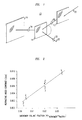
- Fig. 1 illustrates the basic components of a holographic system 10.
- System 10 contains a modulating device 12, a photorecording medium 14, and a sensor 16.
- Modulating device 12 is any device capable of optically representing data in two-dimensions.
- Device 12 is typically a spatial light modulator that is attached to an encoding unit which encodes data onto the modulator. Based on the encoding, device 12 selectively passes or blocks portions of a signal beam 20 passing through device 12. In this manner, beam 20 is encoded with a data image. The image is stored by interfering the encoded signal beam 20 with a reference beam 22 at a location on or within photorecording medium 14.
- the interference creates an interference pattern (or hologram) that is captured within medium 14 as a pattern of, for example, varying refractive index. It is possible for more than one holographic image to be stored at a single location, or for holograms to be stored in overlapping positions, by, for example, varying the angle, the wavelength, or the phase of the reference beam 22, depending on the particular reference beam employed.
- Signal beam 20 typically passes through lens 30 before being intersected with reference beam 22 in the medium 14. It is possible for reference beam 22 to pass through lens 32 before this intersection.
- the reconstructed data passes through lens 34 and is detected by sensor 16.
- Sensor 16 is, for example, a charged coupled device or an active pixel sensor. Sensor 16 typically is attached to a unit that decodes the data.
- the material described in this article contains a photoimageable system containing a liquid monomer material (the photoactive monomer) and a photoinitiator (which promotes the polymerization of the monomer upon exposure to light), where the photoimageable system is in an organic polymer host matrix that is substantially inert to the exposure light.
- the photoimageable system is in an organic polymer host matrix that is substantially inert to the exposure light.
- the invention constitutes an improvement over prior recording media.
- the invention's use of a matrix precursor (i.e., the one or more compounds from which the matrix is formed) and a photoactive monomer that polymerize by independent reactions substantially prevents both cross-reaction between the photoactive monomer and the matrix precursor during the cure, and inhibition of subsequent monomer polymerization.
- Use of a matrix precursor and photoactive monomer that form compatible polymers substantially avoids phase separation. And in situ formation allows fabrication of media with desirable thicknesses.
- independent reactions indicate: (a) the reactions proceed by different types of reaction intermediates, e.g., ionic vs. free radical, (b) neither the intermediate nor the conditions by which the matrix is polymerized will induce substantial polymerization of the photoactive monomer functional groups, i.e., the group or groups on a photoactive monomer that are the reaction sites for polymerization during the pattern (e.g., hologram) writing process (substantial polymerization indicates polymerization of more than 20% of the monomer functional groups), and (c) neither the intermediate nor the conditions by which the matrix is polymerized will induce a non-polymerization reaction of the monomer functional groups that either causes cross-reaction between monomer functional groups and the matrix or inhibits later polymerization of the monomer functional groups.
- reaction intermediates e.g., ionic vs. free radical
- substantial polymerization of the photoactive monomer functional groups i.e., the group or groups on a photoactive monomer that are the reaction sites for polymerization during
- Polymers are considered to be compatible if a blend of the polymers is characterized, in 90° light scattering of a wavelength used for hologram formation, by a Rayleigh ratio (R 90 °) less than 7 ⁇ 10 -3 cm -1 .
- the Rayleigh ratio (R ⁇ ) is a conventionally known property, and is defined as the energy scattered by a unit volume in the direction ⁇ , per steradian, when a medium is illuminated with a unit intensity of unpolarized light, as discussed in M. Kerker, The Scattering of Light and Other Electromagnetic Radiation, Academic Press, San Diego, 1969, at 38.
- the Rayleigh ratio is typically obtained by comparison to the energy scatter of a reference material having a known Rayleigh ratio.
- a useful photorecording material i.e., the matrix material plus the photoactive monomer, photoinitiator, and/or other additives, is attained, the material capable of being formed in thicknesses greater than 200 ⁇ m, advantageously greater than 500 ⁇ m, and, upon flood exposure, exhibiting light scattering properties such that the Rayleigh ratio, R 90 , is less than 7 ⁇ 10 -3 .
- Flood exposure is exposure of the entire photorecording material by incoherent light at wavelengths suitable to induce substantially complete polymerization of the photoactive monomer throughout the material.
- the optical article of the invention is formed by steps including mixing a matrix precursor and a photoactive monomer, and curing the mixture to form the matrix in situ.
- the reaction by which the matrix precursor is polymerized during the cure is independent from the reaction by which the photoactive monomer is later polymerized during writing of a pattern, e.g., data or waveguide form, and, in addition, the matrix polymer and the polymer resulting from polymerization of the photoactive monomer (hereafter referred to as the photopolymer) are compatible with each other.
- the matrix is considered to be formed when the photorecording material exhibits an elastic modulus of at least about 10 5 Pa.
- Curing indicates reacting the matrix precursor such that the matrix provides this elastic modulus in the photorecording material.
- the optical article of the invention contains a three-dimensional crosslinked polymer matrix and one or more photoactive monomers. At least one photoactive monomer contains one or more moieties, excluding the monomer functional groups, that are substantially absent from the polymer matrix.
- media which utilize a matrix precursor and photoactive monomer that polymerize by non-independent reactions often experience substantial cross-reaction between the precursor and the photoactive monomer during the matrix cure (e.g., greater than 20% of the monomer is attached to the matrix after cure), or other reactions that inhibit polymerization of the photoactive monomer.
- Cross-reaction tends to undesirably reduce the refractive index contrast between the matrix and the photoactive monomer and is capable of affecting the subsequent polymerization of the photoactive monomer, and inhibition of monomer polymerization clearly affects the process of writing holograms.
- phase separation typically occurs during hologram formation. It is possible for such phase separation to lead to increased light scattering, reflected in haziness or opacity, thereby degrading the quality of the medium, and the fidelity with which stored data is capable of being recovered
- Fig. 1 shows a basic holographic storage system.
- Fig. 2 shows the effect of several different photoactive monomers on a recording medium's refractive index contrast.
- the optical article, e.g., holographic recording medium, of the invention is formed by steps including mixing a matrix precursor and a photoactive monomer, and curing the mixture to form the matrix in situ.
- the matrix precursor and photoactive monomer are selected such that (a) the reaction by which the matrix precursor is polymerized during the cure is independent from the reaction by which the photoactive monomer will be polymerized during writing of a pattern, e.g., data, and (b) the matrix polymer and the polymer resulting from polymerization of the photoactive monomer (the photopolymer) are compatible with each other.
- the matrix is considered to be formed when the photorecording material, i.e., the matrix material plus the photoactive monomer, photoinitiator, and/or other additives, exhibits an elastic modulus of at least about 10 5 Pa, generally about 10 5 Pa to about 10 9 Pa, advantageously about 10 6 Pa to about 10 8 Pa.
- the compatibility of the matrix polymer and photopolymer tends to prevent large-scale (>100 nm) phase separation of the components, such large-scale phase separation typically leading to undesirable haziness or opacity.
- Utilization of a photoactive monomer and a matrix precursor that polymerize by independent reactions provides a cured matrix substantially free of cross-reaction, i.e., the photoactive monomer remains substantially inert during the matrix cure. In addition, due to the independent reactions, there is no inhibition of subsequent polymerization of the photoactive monomer.
- At least one photoactive monomer contains one or more moieties, excluding the monomer functional groups, that are substantially absent from the polymer matrix, i.e., it is possible to find a moiety in the photoactive monomer such that no more than 20% of all such moieties in the photorecording material are present, i.e., covalently bonded, in the matrix.
- the resulting optical article is capable of exhibiting desirable refractive index contrast due to the independence of the matrix from the photoactive monomer.
- a refractive index contrast ( ⁇ n) between exposed and unexposed regions of a medium, this contrast at least partly due to monomer diffusion to exposed regions.
- High index contrast is desired because it provides improved signal strength when reading a hologram, and provides efficient confinement of an optical wave in a waveguide.
- One way to provide high index contrast in the invention is to use a photoactive monomer having moieties (referred to as index-contrasting moieties) that are substantially absent from the matrix, and that exhibit a refractive index substantially different from the index exhibited by the bulk of the matrix.
- high contrast would be obtained by using a matrix that contains primarily aliphatic or saturated alicyclic moieties with a low concentration of heavy atoms and conjugated double bonds (providing low index) and a photoactive monomer made up primarily of aromatic or similar high-index moieties.
- the matrix is a solid polymer formed in situ from a matrix precursor by a curing step (curing indicating a step of inducing reaction of the precursor to form the polymeric matrix).
- the precursor it is possible for the precursor to be one or more monomers, one or more oligomers, or a mixture of monomer and oligomer.
- there it is possible for there to be greater than one type of precursor functional group, either on a single precursor molecule or in a group of precursor molecules.
- Precursor functional groups are the group or groups on a precursor molecule that are the reaction sites for polymerization during matrix cure.
- the precursor is advantageously liquid at some temperature between about -50°C and about 80°C.
- the matrix polymerization is capable of being performed at room temperature. Also advantageously, the polymerization is capable of being performed in a time period less than 300 minutes, advantageously 5 to 200 minutes.
- the glass transition temperature (T g ) of the photorecording material is advantageously low enough to permit sufficient diffusion and chemical reaction of the photoactive monomer during a holographic recording process.
- the T g is not more than 50°C above the temperature at which holographic recording is performed, which, for typical holographic recording, means a T g between about 80°C and about -130°C (as measured by conventional methods). It is also advantageous for the matrix to exhibit a three-dimensional network structure, as opposed to a linear structure, to provide the desired modulus discussed previously.
- Examples of polymerization reactions contemplated for forming matrix polymers in the invention include cationic epoxy polymerization, cationic vinyl ether polymerization, cationic alkenyl ether polymerization, cationic allene ether polymerization, cationic ketene acetal polymerization, epoxy-amine step polymerization, epoxy-mercaptan step polymerization, unsaturated ester-amine step polymerization (via Michael addition), unsaturated ester-mercaptan step polymerization (via Michael addition), vinyl-silicon hydride step polymerization (hydrosilylation), isocyanate-hydroxyl step polymerization (urethane formation), and isocyanate-amine step polymerization (urea formation).
- cationic epoxy polymerization takes place rapidly at room temperature by use of BF 3 -based catalysts
- other cationic polymerizations proceed in the presence of protons
- epoxy-mercaptan reactions and Michael additions are accelerated by bases such as amines
- hydrosilylation proceeds rapidly in the presence of transition metal catalysts such as platinum
- urethane and urea formation proceed rapidly when tin catalysts are employed.
- photogenerated catalysts for matrix formation, provided that steps are taken to prevent polymerization of the photoactive monomer during the photogeneration.
- the photoactive monomer is any monomer or monomers capable of undergoing photoinitiated polymerization, and which, in combination with a matrix material, meets the polymerization reaction and compatibility requirements of the invention.
- Suitable photoactive monomers include those which polymerize by a free-radical reaction, e.g., molecules containing ethylenic unsaturation such as acrylates, methacrylates, acrylamides, methacrylamides, styrene, substituted styrenes, vinyl naphthalene, substituted vinyl naphthalenes, and other vinyl derivatives.
- Free-radical copolymerizable pair systems such as vinyl ether mixed with maleate and thiol mixed with olefin are also suitable.
- cationically polymerizable systems such as vinyl ethers, alkenyl ethers, allene ethers, ketene acetals, and epoxies. It is also possible for a single photoactive monomer molecule to contain more than one monomer functional group. As mentioned previously, relatively high index contrast is desired in the article of the invention, whether for improved readout in a recording media or efficient light confinement in a waveguide. In addition, it is advantageous to induce this relatively large index change with a small number of monomer functional groups, because polymerization of the monomer generally induces shrinkage in a material. (For instance, in Examples 2 and 3 below, the writing-induced shrinkage due to hologram recording was approximately 0.7%.
- Example 4 reflects a reduced concentration of photoactive monomer, and an associated reduction in writing-induced shrinkage (0.30 to 0.35%).) Such shrinkage has a detrimental effect on the retrieval of data from stored holograms, and also degrades the performance of waveguide devices such as by increased transmission losses or other performance deviations. Lowering the number of monomer functional groups that must be polymerized to attain the necessary index contrast is therefore desirable. This lowering is possible by increasing the ratio of the molecular volume of the monomers to the number of monomer functional groups on the monomers. This increase is attainable by incorporating into a monomer larger index-contrasting moieties and/or a larger number of index-contrasting moieties.
- the molecular volume could be increased relative to the number of monomer functional groups by incorporating a naphthalene ring instead of a benzene ring (the naphthalene having a larger volume), or by incorporating one or more additional benzene rings, without increasing the number of monomer functional groups.
- polymerization of a given volume fraction of the monomers with the larger molecular volume/monomer functional group ratio would require polymerization of less monomer functional groups, thereby inducing less shrinkage. But the requisite volume fraction of monomer would still diffuse from the unexposed region to the exposed region, providing the desired refractive index.
- the molecular volume of the monomer should not be so large as to slow diffusion below an acceptable rate. Diffusion rates are controlled by factors including size of diffusing species, viscosity of the medium, and intermolecular interactions. Larger species tend to diffuse more slowly, but it would be possible in some situations to lower the viscosity or make adjustments to the other molecules present in order to raise diffusion to an acceptable level. Also, in accord with the discussion herein, it is important to ensure that larger molecules maintain compatibility with the matrix.
- index-contrasting moieties are possible for monomers containing multiple index-contrasting moieties.
- the moieties it is possible for the moieties to be in the main chain of a linear oligomer, or to be substituents along an oligomer chain.
- the index-contrasting moieties it is possible for the index-contrasting moieties to be the subunits of a branched or dendritic low molecular weight polymer.
- the optical article typically contains a photoinitiator (the photoinitiator and photoactive monomer being part of the overall photoimageable system).
- the photoinitiator upon exposure to relatively low levels of the recording light, chemically initiates the polymerization of the monomer, avoiding the need for direct light-induced polymerization of the monomer.
- the photoinitiator generally should offer a source of species that initiate polymerization of the particular photoactive monomer. Typically, 0.1 to 20 wt.% photoinitiator, based on the weight of the photoimageable system, provides desirable results.
- photoinitiators known to those skilled in the art and available commercially are suitable for use in the invention. It is advantageous to use a photoinitiator that is sensitive to light in the visible part of the spectrum, particularly at wavelengths available from conventional laser sources, e.g., the blue and green lines of Ar + (458, 488, 514 nm) and He-Cd lasers (442 nm), the green line of frequency doubled YAG lasers (532 nm), and the red lines of He-Ne (633 nm) and Kr + lasers (647 and 676 nm).
- the blue and green lines of Ar + (458, 488, 514 nm) and He-Cd lasers (442 nm) the green line of frequency doubled YAG lasers (532 nm)
- the red lines of He-Ne (633 nm) and Kr + lasers (647 and 676 nm).
- One advantageous free radical photoinitiator is bis( ⁇ -5-2,4-cyclopentadien-1-yl)bis[2,6-difluoro-3-(1H-pyrrol-1-yl)phenyl]titanium, available commercially from Ciba as CGI-784.
- Another visible free-radical photoinitiator (which requires a co-initiator) is 5,7,diiodo-3-butoxy-6-fluorone, commercially available from Spectra Group Limited as H-Nu 470. Free-radical photoinitiators of dye-hydrogen donor systems are also possible.
- Suitable dyes include eosin, rose bengal, erythrosine, and methylene blue
- suitable hydrogen donors include tertiary amines such as n-methyl diethanol amine.
- a cationic photoinitiator is used, such as a sulfonium salt or an iodonium salt. These cationic photoinitiator salts absorb predominantly in the UV portion of the spectrum, and are therefore typically sensitized with a dye to allow use of the visible portion of the spectrum.
- An example of an alternative visible cationic photoinitiator is ( ⁇ 5 -2,4-cyclopentadien-1-yl) ( ⁇ 6 -isopropylbenzene)-iron(II) hexafluorophosphate, available commercial from Ciba as Irgacure 261. It is also conceivable to use other additives in the photoimageable system, e.g., inert diffusing agents having relatively high or low refractive indices.
- the matrix is a polymer formed by mercaptan-epoxy step polymerization, more advantageously a polymer formed by mercaptan-epoxy step polymerization having a polyether backbone.
- the polyether backbone offers desirable compatibility with several useful photoactive monomers, particularly vinyl aromatic compounds. Specifically, photoactive monomers selected from styrene, bromostyrene, divinyl benzene, and 4-methylthio-1-vinylnaphthalene (MTVN) have been found to be useful with matrix polymers formed by mercaptan-epoxy step polymerization and having a polyether backbone.
- a monomer that has more than one index-contrasting moiety and that is also useful with these polyether matrix polymers is 1-(3-(naphth-1-ylthio)propylthio)-4-vinylnaphthalene.
- the polymerization reactions for the matrix precursor and the photoactive monomer are selected such that: (a) the reactions proceed by different types of reaction intermediates, (b) neither the intermediate nor the conditions by which the matrix is polymerized will induce substantial polymerization of the photoactive monomer functional groups, and (c) neither the intermediate nor the conditions by which the matrix is polymerized will induce a non-polymerization reaction of the monomer functional groups that causes cross-reaction (between the monomer functional groups and the matrix polymer) or inhibits later polymerization of the monomer functional groups.
- item (a) if a matrix is polymerized by use of an ionic intermediate, it would be suitable to polymerize the photoactive monomer by use of a free radical reaction.
- the ionic intermediate should not induce substantial polymerization of the photoactive monomer functional groups.
- a photoinitiated free radical matrix polymerization will typically induce a photoinitiated cationic polymerization of a photoactive monomer functional group.
- two otherwise independent reactions are not independent for purposes of the invention if both are driven by a single reaction condition.
- base-catalyzed matrix polymerization should not be performed when the photoactive monomer functional group undergoes a non-polymerization reaction in response to the base, even if polymerization of the monomer functional group is performed by an independent reaction.
- a specific example is that a base-catalyzed epoxy-mercaptan polymerization should not be used with an acrylate monomer because, although the acrylate is polymerized by a free radical reaction, the acrylate will react with the mercaptans under base catalysis, resulting in a cross-reaction.
- Table I below illustrates some examples of matrix/photoactive monomer combinations where the matrix polymerization reaction and photoactive monomer polymerization are capable of being independent, and examples where the polymerizations interfere with each other.
- Photoactive monomers are horizontal, and matrix polymers are vertical.
- X indicates cross-reaction or monomer polymerization during matrix polymerization.
- O indicates independent reactions.
- I indicates that the photoactive monomer polymerization is inhibited by the reagents or reaction that form the polymeric matrix, e.g., the photoactive monomer functional group is converted to a non-polymerizing group, or chemical species are present after the matrix cure that substantially slow the rate or yield of polymerization of the monomer functional groups.
- polymers are considered to be compatible if a blend of the polymers is characterized, in 90° light scattering, by a Rayleigh ratio (R 90 °) less than 7 ⁇ 10 -3 cm -1 .
- the Rayleigh ratio, R ⁇ is a conventionally known property, and is defined as the energy scattered by a unit volume in the direction ⁇ , per steradian, when a medium is illuminated with a unit intensity of unpolarized light, as discussed in M. Kerker, The Scattering of Light and Other Electromagnetic Radiation, Academic Press, San Diego, 1969.
- the light source used for the measurement is generally a laser having a wavelength in the visible part of the spectrum. Normally, the wavelength intended for use in writing holograms is used.
- the scattering measurements are made upon a photorecording material that has been flood exposed.
- the scattered light is collected at an angle of 90° from the incident light, typically by a photodetector. It is possible to place a narrowband filter, centered at the laser wavelength, in front of such a photodetector to block fluorescent light, although such a step is not required.
- the Rayleigh ratio is typically obtained by comparison to the energy scatter of a reference material having a known Rayleigh ratio.
- Polymer blends which are considered to be miscible e.g., according to conventional tests such as exhibition of a single glass transition temperature, will typically be compatible as well, i.e., miscibility is a subset of compatibility. Standard miscibility guidelines and tables are therefore useful in selecting a compatible blend.
- polymer blends that are immiscible to be compatible according to the light scattering test above.
- a polymer blend is generally considered to be miscible if the blend exhibits a single glass transition temperature, T g , as measured by conventional methods.
- An immiscible blend will typically exhibit two glass transition temperatures corresponding to the T g values of the individual polymers.
- T g testing is most commonly performed by differential scanning calorimetry (DSC), which shows the T g as a step change in the heat flow (typically the ordinate).
- the reported T g is typically the temperature at which the ordinate reaches the mid-point between extrapolated baselines before and after the transition.
- DMA Dynamic Mechanical Analysis
- DMA Dynamic Mechanical Analysis
- the polymers of a blend it is possible in certain cases for the polymers of a blend to have individual T g values that are close to each other. In such cases, conventional methods for resolving such overlapping T g should be used, such as discussed in Brinke et al., "The thermal characterization of multi-component systems by enthalpy relaxation,” Thermochimica Acta. , 238 (1994), at 75.
- Matrix polymer and photopolymer that exhibit miscibility are capable of being selected in several ways.
- miscible polymers such as O. Olabisi et al., Polymer-Polymer Miscibility, Academic Press, New York, 1979; L.M. Robeson, MMI. Press Symp. Ser., 2 , 177, 1982; L.A. Utracki, Polymer Alloys and Blends: Thermodynamics and Rheology, Hanser Publishers, Kunststoff, 1989; and S. Krause in Polymer Handbook, J. Brandrup and E.H. Immergut, Eds., 3rd Ed., Wiley Interscience, New York, 1989, pp. VI 347-370, the disclosures of which are hereby incorporated by reference. Even if a particular polymer of interest is not found in such references, the approach specified allows determination of a compatible photorecording material by employing a control sample.
- miscible or compatible blends are further aided by intermolecular interaction considerations that typically drive miscibility.
- intermolecular interaction considerations that typically drive miscibility.
- polystyrene and poly(methylvinylether) are miscible because of an attractive interaction between the methyl ether group and the phenyl ring. It is therefore possible to promote miscibility, or at least compatibility, of two polymers by using a methyl ether group in one polymer and a phenyl group in the other polymer.
- immiscible polymers are capable of being made miscible by the incorporation of appropriate functional groups that can provide ionic interactions. (See Z.L. Zhou and A. Eisenberg. J. Polym. Sci., Polym. Phys.
- polyisoprene and polystyrene are immiscible.
- polyisoprene is partially sulfonated (5%)
- 4-vinyl pyridine is copolymerized with the polystyrene, the blend of these two functionalized polymers is miscible.
- Poly(methyl methacrylate) and polystyrene are also capable of being made miscible using the corresponding donor-acceptor co-monomers (See M.C. Piton and A. Natansohn, Macromolecules, 28 , 1605, 1995).
- Compatibility has also been promoted in otherwise incompatible polymers by incorporating reactive groups into the polymer matrix, where such groups are capable of reacting with the photoactive monomer during the holographic recording step. Some of the photoactive monomer will thereby be grafted onto the matrix during recording. If there are enough of these grafts, it is possible to prevent or reduce phase separation during recording. However, if the refractive index of the grafted moiety and of the monomer are relatively similar, too many grafts, e.g., more than 30% of monomers grafted to the matrix, will tend to undesirably reduce refractive index contrast.
- a holographic recording medium of the invention is formed by adequately supporting the photorecording material, such that holographic writing and reading is possible.
- fabrication of the medium involves depositing the matrix precursor/photoimageable system mixture between two plates using, for example, a gasket to contain the mixture.
- the plates are typically glass, but it is also possible to use other materials transparent to the radiation used to write data, e.g., a plastic such as polycarbonate or poly(methyl methacrylate). It is possible to use spacers between the plates to maintain a desired thickness for the recording medium.
- shrinkage in the material it is possible for shrinkage in the material to create stress in the plates, such stress altering the parallelism and/or spacing of the plates and thereby detrimentally affecting the medium's optical properties.
- a substrate e.g., a nanoporous glass material such as Vycor
- More conventional polymer processing is also envisioned, e.g., closed mold formation or sheet extrusion.
- a stratified medium is also contemplated, i.e., a medium containing multiple substrates, e.g., glass, with layers of photorecording material disposed between the substrates.
- the medium of the invention is then capable of being used in a holographic system such as discussed previously.
- the amount of information capable of being stored in a holographic medium is proportional to the product of: the refractive index contrast, ⁇ n, of the photorecording material, and the thickness, d, of the photorecording material.
- the refractive index contrast, ⁇ n is conventionally known, and is defined as the amplitude of the sinusoidal variations in the refractive index of a material in which a plane-wave, volume hologram has been written.
- the ⁇ n of a material is typically calculated from the diffraction efficiency or efficiencies of a single volume hologram or a multiplexed set of volume holograms recorded in a medium.
- the ⁇ n is associated with a medium before writing, but is observed by measurement performed after recording.
- the photorecording material of the invention exhibits a ⁇ n of 3 ⁇ 10 -3 or higher.
- optical articles examples include beam filters, beam steerers or deflectors, and optical couplers.
- a beam filter separates part of an incident laser beam that is traveling along a particular angle from the rest of the beam.
- the Bragg selectivity of a thick transmission hologram is able to selectively diffract light along a particular angle of incidence, while light along other angle travels undeflected through the hologram.
- a beam steerer is a hologram that deflects light incident at the Bragg angle.
- An optical coupler is typically a combination of beam deflectors that steer light from a source to a target.
- holographic optical elements are fabricated by imaging a particular optical interference pattern within a recording medium, as discussed previously with respect to data storage. Medium for these holographic optical elements are capable of being formed by the techniques discussed herein for recording media or waveguides.
- the materials principles discussed herein are applicable not only to hologram formation, but also to formation of optical transmission devices such as waveguides.
- Polymeric optical waveguides are discussed for example in B.L. Booth, "Optical Interconnection Polymers,” in Polymers for Lightwave and Integrated Optics, Technology and Applications, L.A. Hornak, ed., Marcel Dekker, Inc. (1992); U.S. Patent No. 5,292,620; and U.S. Patent No. 5,219,710, the disclosures of which are hereby incorporated by reference.
- the recording material of the invention is irradiated in a desired waveguide pattern to provide refractive index contrast between the waveguide pattern and the surrounding (cladding) material.
- a benefit of the invention is that by using conventional molding techniques, it is possible to mold the matrix/photoimageable system mixture into a variety of shapes prior to matrix cure. For example, the matrix/photoimageable system mixture is able to be molded into ridge waveguides, wherein refractive index patterns are then written into the molded structures. It is thereby possible to easily form structures such as Bragg gratings. This feature of the invention increases the breadth of applications in which such polymeric waveguides would be useful.
- the mixture was thoroughly mixed and allowed to polymerize overnight at room temperature, while protected from light.
- the polymerization was a step polymerization of the isocyanate groups with the hydroxyl groups to form a polyurethane with dissolved acrylate monomers.
- the mixture appeared clear and transparent to the naked eye.
- Example 1 reflects a system made using this information.
- the polymerization was a step polymerization of the isocyanate groups with the hydroxyl groups to form a polyurethane with dissolved chlorophenyl acrylate monomer.
- the mixture appeared clear and transparent to the naked eye.
- Upon exposure to an intense tungsten light, which initiated polymerization of the acrylate monomer the sample remained clear and transparent, indicating the compatibility of the monomer and the matrix polymer.
- PPGDGE polypropyleneglycol diglycidyl ether
- PETMP pentaerythritoltetrakis(mercaptopropionate)
- TDMAMP tris(2,4,6-dimethylaminomethyl)phenol
- bromostyrene monomer was used as the photoactive monomer.
- 0.01262 g Ciba CGI-784 was dissolved in 0.2194 g 4-bromostyrene (photoactive monomer).
- the solution was mixed with 0.9597 g PPGDGE, 0.6042 g PETMP, and 0.084 g TDMAMP.
- Samples were prepared and holograms recorded as in Example 2. An average ⁇ n of 4.2 ⁇ 10 -3 was attained. Again, no abnormal light scattering was detected after holographic recording, and, in addition, DSC showed only one glass transition temperature, suggesting a compatible system.
- Ciba CGI-784 was dissolved in 0.46 g 4-bromostyrene.
- the solution was mixed with 3.8 g PPGDGE, 2.44 g PETMP, and 0.3 g TDMAMP. This corresponds to half the concentration of bromostyrene used in Example 3.
- Samples were prepared and holograms recorded as in Example 2. A ⁇ n of 2.5 ⁇ 10 -3 was attained. The decrease in thickness (shrinkage) induced by polymerization of the bromostyrene was about 0.3%.
- the elastic modulus of the photorecording material was about 5.7 ⁇ 10 6 Pa.
- MTVN 4-methylthio-1-vinylnaphthalene
- 1-methylthionaphthalene preparation 63 g (0.25 mol) of 1-iodonaphthalene was dissolved in 1 L of anhydrous ether under nitrogen. The solution was cooled to -70°C, and 109 mL of 2.5 M butyllithium (BuLi) in hexane (0.27 mol) was added over 30 min. with stirring. 25 g (0.27 mol) of dimethyl disulfide was added and the solution was allowed to warm to room temperature over 4 hours.
- BuLi butyllithium
- 4-methylthio-1-naphthaldehyde preparation 14.5 g of 1-methylthionaphthalene (0.083 mol) was mixed with 12.4 g (0.17 mol) of anhydrous N,N-dimethylformamide and the solution cooled with an ice bath. 23.9 g (0.095 mol) of diphosphoryl tetrachloride was added dropwise with stirring, keeping the temperature below 15°C. The mixture was slowly heated to 100°C and continually stirred at that temperature for 2 hours. The mixture was allowed to cool and was then chilled with an ice bath.
- 4-methylthio-1-vinylnaphthalene preparation A suspension of 19.9 g (0.058 mol) of methyltriphenylphosphonium bromide powder in 150 mL of anhydrous tetrahydrofuran was cooled to 0°C with stirring under nitrogen. 19 mL of 2.5 M BuLi in hexane (0.48 mol) was added over 30 minutes, keeping the color as light as possible and avoiding a dark orange coloration. The mixture was allowed to warm to 25°C, stirred 1 hour at that temperature, and cooled to O°C.
- Ciba CGI-784 was dissolved in 0.1 g 4-bromostyrene and 0.4 g MTVN under gentle heating. The solution was mixed with 2.4 g PPGDGE, 1.508 g PETMP, and 0.2 g TDMAMP. Samples were prepared and holograms recorded as in Examples 2 and 3. ⁇ n values as high as 6.2 ⁇ 10 -3 were attained for thicknesses of 200 ⁇ m.
- CGI-784 photoinitiator was dissolved in 2.225 g of 4-bromostyrene. This solution was mixed with 19 g PPGDGE, 12.2 g PETMP, and 0.34 g 1,8-diazobicyclo[5.4.0]undec-7-ene (DBU). The mixture gelled in 7 minutes, and matrix polymerization was completed after 15 minutes. Multiplexed holograms were successfully recorded in this medium.
- a sample having a material thickness of 940 ⁇ m (not including the glass slides) was prepared as follows. 0.75 g Ciba CGI-784 was dissolved in 1.50 g MTVN under gentle heating. The solution was mixed with 9.04 g PPGDGE, 5.64 g PETMP, and 0.56 g TDMAMP. Media up to 1 mm thick were prepared using vacuum holders, as mentioned previously and holograms were recorded as in Example 2. A ⁇ n of 7.3 x 10 -3 was measured for the sample, demonstrating that it is possible to increase the sample thickness while substantially maintaining ⁇ n.
- the media had material thicknesses of 250 ⁇ m, and were prepared as follows:
- Fig. 2 shows that from medium 1 to medium 5, an increase in refractive index contrast from about 1.6 ⁇ 10 -3 to about 9 ⁇ 10 -3 was realized, while maintaining a relatively constant level of dimensional stability (a decrease of ⁇ 0.3% in the thickness of the medium).
- the NTPVN was prepared as follows:
- the extract was partially concentrated to about 10 mL, diluted with CH 2 Cl 2 to homogeneity, and chromatographed on 20 g of silica gel, eluting with 1:1 hexane:CH 2 Cl 2 .
- the yield was 1.1 g (84%) of a viscous yellow oil, indicated to be pure by NMR. After drying 30 min. at vacuum, the material was immediately blended into the mixture for medium preparation.
Landscapes
- Physics & Mathematics (AREA)
- General Physics & Mathematics (AREA)
- Holo Graphy (AREA)
- Manufacture Of Macromolecular Shaped Articles (AREA)
- Compositions Of Macromolecular Compounds (AREA)
- Optical Integrated Circuits (AREA)
- Optical Fibers, Optical Fiber Cores, And Optical Fiber Bundles (AREA)
Applications Claiming Priority (4)
| Application Number | Priority Date | Filing Date | Title |
|---|---|---|---|
| US46822 | 1987-05-05 | ||
| US09/046,822 US6103454A (en) | 1998-03-24 | 1998-03-24 | Recording medium and process for forming medium |
| US208557 | 1998-12-09 | ||
| US09/208,557 US6482551B1 (en) | 1998-03-24 | 1998-12-09 | Optical article and process for forming article |
Publications (2)
| Publication Number | Publication Date |
|---|---|
| EP0945762A1 true EP0945762A1 (de) | 1999-09-29 |
| EP0945762B1 EP0945762B1 (de) | 2013-04-24 |
Family
ID=26724330
Family Applications (1)
| Application Number | Title | Priority Date | Filing Date |
|---|---|---|---|
| EP99302010.6A Expired - Lifetime EP0945762B1 (de) | 1998-03-24 | 1999-03-16 | Verfahren zur herstellung eines optischen Elements |
Country Status (4)
| Country | Link |
|---|---|
| US (2) | US6482551B1 (de) |
| EP (1) | EP0945762B1 (de) |
| JP (1) | JP3737306B2 (de) |
| KR (1) | KR100343202B1 (de) |
Cited By (12)
| Publication number | Priority date | Publication date | Assignee | Title |
|---|---|---|---|---|
| EP1033623A3 (de) * | 1999-03-01 | 2002-10-23 | Lucent Technologies Inc. | Fotoempfindliches Aufzeichnungsmaterial, Verfahren zu dessen Herstellung, sowie ein dieses Aufzeichnungsmaterial benutzendes holographisches Verfahren |
| WO2003021358A1 (en) * | 2001-08-30 | 2003-03-13 | Inphase Technologies, Inc. | Blue-sensitized holographic media |
| WO2003023519A1 (en) * | 2001-09-13 | 2003-03-20 | Inphase Technologies, Inc. | Environmentally durable, self-sealing optical articles |
| WO2003023520A3 (en) * | 2001-06-27 | 2003-07-03 | Imation Corp | Holographic photopolymer data recording media and meth of holographically reading and storing data |
| WO2003102693A1 (en) * | 2002-05-29 | 2003-12-11 | Inphase Technologies, Inc. | High reflective index photoactive compound for optical applications |
| US6743552B2 (en) * | 2001-08-07 | 2004-06-01 | Inphase Technologies, Inc. | Process and composition for rapid mass production of holographic recording article |
| US7018744B2 (en) * | 2001-08-27 | 2006-03-28 | Dai Nippon Printing Co, Ltd | Volume type hologram recording photosensitive composition, volume type hologram recording medium using the same and method of producing volume type hologram |
| EP1550677A4 (de) * | 2002-07-30 | 2006-05-17 | Toagosei Co Ltd | Zusammensetzung für die holographie, verfahren zu ihrer härtung und gehärteter gegenstand |
| US7282322B2 (en) * | 2002-05-29 | 2007-10-16 | Songvit Setthachayanon | Long-term high temperature and humidity stable holographic optical data storage media compositions with exceptional high dynamic range |
| WO2009096081A1 (en) * | 2008-02-01 | 2009-08-06 | Kabushiki Kaisha Toshiba | Holographic recording medium |
| EP2172504A1 (de) * | 2008-10-01 | 2010-04-07 | Bayer MaterialScience AG | Photopolymerformulierungen mit niedriger Vernetzungsdichte |
| US8284234B2 (en) | 2009-03-20 | 2012-10-09 | Absolute Imaging LLC | Endoscopic imaging using reflection holographic optical element for autostereoscopic 3-D viewing |
Families Citing this family (159)
| Publication number | Priority date | Publication date | Assignee | Title |
|---|---|---|---|---|
| US6482551B1 (en) * | 1998-03-24 | 2002-11-19 | Inphase Technologies | Optical article and process for forming article |
| US6788443B2 (en) * | 2001-08-30 | 2004-09-07 | Inphase Technologies, Inc. | Associative write verify |
| US7001541B2 (en) * | 2001-09-14 | 2006-02-21 | Inphase Technologies, Inc. | Method for forming multiply patterned optical articles |
| US6825960B2 (en) * | 2002-01-15 | 2004-11-30 | Inphase Technologies, Inc. | System and method for bitwise readout holographic ROM |
| US20030206320A1 (en) * | 2002-04-11 | 2003-11-06 | Inphase Technologies, Inc. | Holographic media with a photo-active material for media protection and inhibitor removal |
| JP4436688B2 (ja) | 2002-04-11 | 2010-03-24 | インフェイズ テクノロジーズ インコーポレイテッド | ホログラフィー記憶媒体 |
| FR2840269B1 (fr) * | 2002-05-30 | 2005-01-28 | Plastic Omnium Cie | Piece de style et vehicule automobile comportant une telle piece de style |
| US6905904B2 (en) * | 2002-06-24 | 2005-06-14 | Dow Corning Corporation | Planar optical waveguide assembly and method of preparing same |
| US8199388B2 (en) * | 2002-11-22 | 2012-06-12 | Inphase Technologies, Inc. | Holographic recording system having a relay system |
| US20050036182A1 (en) * | 2002-11-22 | 2005-02-17 | Curtis Kevin R. | Methods for implementing page based holographic ROM recording and reading |
| US8786923B2 (en) * | 2002-11-22 | 2014-07-22 | Akonia Holographics, Llc | Methods and systems for recording to holographic storage media |
| WO2004059389A2 (en) * | 2002-12-23 | 2004-07-15 | Aprilis, Inc. | Sensitizer dyes for photoacid generating systems |
| US7092133B2 (en) * | 2003-03-10 | 2006-08-15 | Inphase Technologies, Inc. | Polytopic multiplex holography |
| JP2004287138A (ja) * | 2003-03-24 | 2004-10-14 | Konica Minolta Holdings Inc | ホログラフィック記録用組成物、ホログラフィック記録メディア及びその記録方法 |
| JP2004309683A (ja) * | 2003-04-04 | 2004-11-04 | Kanegafuchi Chem Ind Co Ltd | 光導波路およびグレーテイング、レンズ、フォトニック結晶およびこれらの作製方法。 |
| EP1612623A4 (de) * | 2003-04-09 | 2007-04-04 | Konica Minolta Med & Graphic | Holographisches aufzeichnungsmedium und aufzeichnungsverfahren damit |
| JP2005043862A (ja) * | 2003-04-09 | 2005-02-17 | Konica Minolta Medical & Graphic Inc | ホログラフィック記録用組成物、ホログラフィック記録メディア及びその記録方法 |
| US20050058911A1 (en) * | 2003-09-17 | 2005-03-17 | Konica Minolta Medical & Graphic, Inc. | Holographic recording medium, holographic recording method and holographic information medium |
| JP2005181953A (ja) * | 2003-11-27 | 2005-07-07 | Konica Minolta Medical & Graphic Inc | ホログラフィック記録メディア、ホログラフィック記録方法およびホログラフィック情報メディア |
| JP4525042B2 (ja) * | 2003-10-01 | 2010-08-18 | コニカミノルタエムジー株式会社 | ホログラフィック記録用組成物、ホログラフィック記録メディア、およびホログラフィック記録方法 |
| KR20060110365A (ko) * | 2004-02-13 | 2006-10-24 | 도아고세이가부시키가이샤 | 체적형 홀로그램 기록 재료 및 체적형 홀로그램 기록 매체 |
| US20070172742A1 (en) * | 2004-02-13 | 2007-07-26 | Kentarou Yachi | Volume hologram recording material and volume hologram recording medium |
| JP3914211B2 (ja) * | 2004-03-03 | 2007-05-16 | 株式会社東芝 | ホログラム記録媒体 |
| JP2005275273A (ja) * | 2004-03-26 | 2005-10-06 | Fuji Photo Film Co Ltd | ホログラム記録材料、ホログラム記録方法及び光記録媒体 |
| JP4461901B2 (ja) * | 2004-05-11 | 2010-05-12 | Tdk株式会社 | ホログラム記録材料及びホログラム記録媒体 |
| US7739577B2 (en) * | 2004-06-03 | 2010-06-15 | Inphase Technologies | Data protection system |
| US20050270856A1 (en) * | 2004-06-03 | 2005-12-08 | Inphase Technologies, Inc. | Multi-level format for information storage |
| US7122290B2 (en) * | 2004-06-15 | 2006-10-17 | General Electric Company | Holographic storage medium |
| US8071260B1 (en) | 2004-06-15 | 2011-12-06 | Inphase Technologies, Inc. | Thermoplastic holographic media |
| EP1780610A1 (de) * | 2004-08-18 | 2007-05-02 | Konica Minolta Medical & Graphic, Inc. | Holographisches aufzeichnungsmedium, holographisches aufzeichnungsverfahren und holographisches informationsmedium |
| US8000013B2 (en) | 2004-09-07 | 2011-08-16 | Ophthonix, Inc. | Tinted lenses that correct for high order aberrations |
| US7371804B2 (en) * | 2004-09-07 | 2008-05-13 | Ophthonix, Inc. | Monomers and polymers for optical elements |
| US7897296B2 (en) * | 2004-09-30 | 2011-03-01 | General Electric Company | Method for holographic storage |
| JP4649158B2 (ja) * | 2004-09-30 | 2011-03-09 | 富士フイルム株式会社 | ホログラム記録方法 |
| US20060078802A1 (en) * | 2004-10-13 | 2006-04-13 | Chan Kwok P | Holographic storage medium |
| JP2006154083A (ja) * | 2004-11-26 | 2006-06-15 | Toshiba Corp | ホログラム記録媒体 |
| US7704643B2 (en) * | 2005-02-28 | 2010-04-27 | Inphase Technologies, Inc. | Holographic recording medium with control of photopolymerization and dark reactions |
| US7623279B1 (en) * | 2005-11-22 | 2009-11-24 | Inphase Technologies, Inc. | Method for holographic data retrieval by quadrature homodyne detection |
| US20060199081A1 (en) * | 2005-03-04 | 2006-09-07 | General Electric Company | Holographic storage medium, article and method |
| US8305700B2 (en) * | 2005-05-26 | 2012-11-06 | Inphase Technologies, Inc. | Holographic drive head and component alignment |
| US7466411B2 (en) * | 2005-05-26 | 2008-12-16 | Inphase Technologies, Inc. | Replacement and alignment of laser |
| US20060280096A1 (en) * | 2005-05-26 | 2006-12-14 | Inphase Technologies, Inc. | Erasing holographic media |
| US7480085B2 (en) * | 2005-05-26 | 2009-01-20 | Inphase Technologies, Inc. | Operational mode performance of a holographic memory system |
| US7742211B2 (en) | 2005-05-26 | 2010-06-22 | Inphase Technologies, Inc. | Sensing and correcting angular orientation of holographic media in a holographic memory system by partial reflection, the system including a galvano mirror |
| US7710624B2 (en) * | 2005-05-26 | 2010-05-04 | Inphase Technologies, Inc. | Controlling the transmission amplitude profile of a coherent light beam in a holographic memory system |
| US20060279819A1 (en) * | 2005-05-26 | 2006-12-14 | Inphase Technologies, Inc. | Laser mode stabilization using an etalon |
| US7675025B2 (en) | 2005-05-26 | 2010-03-09 | Inphase Technologies, Inc. | Sensing absolute position of an encoded object |
| US20060275670A1 (en) * | 2005-05-26 | 2006-12-07 | Inphase Technologies, Inc. | Post-curing of holographic media |
| US7548358B2 (en) * | 2005-05-26 | 2009-06-16 | Inphase Technologies, Inc. | Phase conjugate reconstruction of a hologram |
| US7397571B2 (en) * | 2005-05-26 | 2008-07-08 | Inphase Technologies, Inc. | Methods and systems for laser mode stabilization |
| US7633662B2 (en) * | 2005-05-26 | 2009-12-15 | Inphase Technologies, Inc. | Holographic drive head alignments |
| JP4633562B2 (ja) * | 2005-07-06 | 2011-02-16 | 大日本印刷株式会社 | 体積型ホログラム感光性組成物 |
| TW200702954A (en) | 2005-07-11 | 2007-01-16 | Toagosei Co Ltd | Volume hologram recording material, the method of processing thereof and the recording medium |
| US7649661B2 (en) * | 2005-07-13 | 2010-01-19 | Inphase Technologies, Inc. | Holographic storage device having a reflective layer on one side of a recording layer |
| JP2007047302A (ja) | 2005-08-08 | 2007-02-22 | Toshiba Corp | ホログラム記録媒体 |
| JP2007057572A (ja) * | 2005-08-22 | 2007-03-08 | Fujifilm Corp | 光記録用組成物、光記録媒体及びその製造方法 |
| JP4675196B2 (ja) * | 2005-09-20 | 2011-04-20 | 富士フイルム株式会社 | ホログラム記録媒体用組成物、ホログラム記録媒体及びその製造方法、並びに、ホログラム記録方法及びホログラム再生方法 |
| JP2007093688A (ja) * | 2005-09-27 | 2007-04-12 | Toshiba Corp | ホログラム記録媒体、マスターホログラムの製造方法およびコピーホログラムの製造方法 |
| US20070077498A1 (en) * | 2005-09-30 | 2007-04-05 | Fuji Photo Film Co., Ltd. | Optical recording composition, optical recording medium and production method thereof, optical recording method and optical recording apparatus |
| US7813017B2 (en) * | 2005-10-21 | 2010-10-12 | Inphase Technologies, Inc. | Method and system for increasing holographic data storage capacity using irradiance-tailoring element |
| JP4807049B2 (ja) * | 2005-11-21 | 2011-11-02 | 富士ゼロックス株式会社 | ホログラム記録媒体およびこれを用いたホログラム記録方法 |
| US7173744B1 (en) | 2005-12-02 | 2007-02-06 | Inphase Technologies, Inc. | Article comprising holographic medium between substrates having environmental barrier seal and process for preparing same |
| US7589877B2 (en) * | 2005-12-02 | 2009-09-15 | Inphase Technologies, Inc. | Short stack recording in holographic memory systems |
| US20070160106A1 (en) * | 2006-01-06 | 2007-07-12 | Inphase Technologies | External cavity laser with a tunable holographic element |
| US7336409B2 (en) * | 2006-03-06 | 2008-02-26 | Inphase Technologies, Inc. | Miniature flexure based scanners for angle multiplexing |
| US7773276B2 (en) * | 2006-03-07 | 2010-08-10 | Inphase Technologies, Inc. | Method for determining media orientation and required temperature compensation in page-based holographic data storage systems using data page Bragg detuning measurements |
| JP2009529786A (ja) * | 2006-03-09 | 2009-08-20 | インフェイズ テクノロジーズ インコーポレイテッド | 外部キャビティレーザ |
| JP4874689B2 (ja) * | 2006-03-31 | 2012-02-15 | 富士フイルム株式会社 | ホログラフィック記録用組成物及びこれを用いた光記録媒体 |
| US20070248890A1 (en) * | 2006-04-20 | 2007-10-25 | Inphase Technologies, Inc. | Index Contrasting-Photoactive Polymerizable Materials, and Articles and Methods Using Same |
| JP4765791B2 (ja) * | 2006-04-28 | 2011-09-07 | 三菱化学株式会社 | 体積ホログラム記録材料用組成物、並びにそれを用いた体積ホログラム記録材料、体積ホログラム光記録媒体及び体積ホログラム光記録方法 |
| US8120832B2 (en) | 2006-05-23 | 2012-02-21 | Inphase Technologies, Inc. | High speed electromechanical shutter |
| US7405853B2 (en) * | 2006-08-03 | 2008-07-29 | Inphase Technologies, Inc. | Miniature single actuator scanner for angle multiplexing with circularizing and pitch correction capability |
| CA2662272A1 (en) * | 2006-08-28 | 2008-03-06 | Inphase Technologies, Inc. | Shift tolerant lens optimized for phase conjugating holographic systems |
| US20080059144A1 (en) * | 2006-09-01 | 2008-03-06 | Inphase Technologies | Emulation of dissimilar removable medium storage device types assisted by information embedded in the logical format |
| US20100039685A1 (en) * | 2006-09-05 | 2010-02-18 | Mitsubishi Chemical Corporation | Volume hologram optical recording medium, composition for forming volume hologram recording layer, volume hologram recording material, and volume hologram optical recording method |
| EP2074467A4 (de) * | 2006-09-29 | 2011-09-07 | Inphase Tech Inc | Magnetfeld-positionsrückmeldung für einen holografischen speicher-scanner |
| JP2008096503A (ja) * | 2006-10-06 | 2008-04-24 | Toshiba Corp | 粉末状感光性組成物の製造方法、感光性組成物およびこの感光性組成物から形成された光記録媒体 |
| WO2008050835A1 (fr) | 2006-10-25 | 2008-05-02 | Mitsubishi Chemical Corporation | Support d'enregistrement optique d'hologramme volumique, composition pour une formation de couche d'enregistrement d'hologramme volumique et matériau d'enregistrement d'hologramme volumique |
| EP2390731B1 (de) | 2006-11-01 | 2012-10-24 | InPhase Technologies, Inc. | Monokulare Architektur für holografisches Datenspeichersystem |
| CN102394071A (zh) * | 2006-11-01 | 2012-03-28 | 英法塞技术公司 | 单目全息数据存储系统结构 |
| JP4197721B2 (ja) * | 2006-12-18 | 2008-12-17 | 株式会社東芝 | ホログラム記録媒体およびその製造方法 |
| EP2110718B1 (de) * | 2007-02-05 | 2012-10-10 | Nippon Steel Chemical Co., Ltd. | Volumenphasenhologramm-aufzeichnungsmaterial und optisches informationsaufzeichnungsmedium |
| JPWO2008123302A1 (ja) * | 2007-03-30 | 2010-07-15 | ダイキン工業株式会社 | 含フッ素体積型ホログラム記録用感光性組成物ならびにそれを用いた含フッ素体積型ホログラム記録用感光性媒体および含フッ素体積型ホログラム |
| WO2008123303A1 (ja) * | 2007-03-30 | 2008-10-16 | Daikin Industries, Ltd. | 含フッ素体積型ホログラム光情報記録材料用組成物およびそれを用いた含フッ素体積型ホログラム光情報記録媒体 |
| US20080239428A1 (en) * | 2007-04-02 | 2008-10-02 | Inphase Technologies, Inc. | Non-ft plane angular filters |
| JP4874854B2 (ja) * | 2007-04-10 | 2012-02-15 | 富士フイルム株式会社 | ホログラフィック記録用組成物およびホログラフィック記録媒体 |
| RU2009141372A (ru) | 2007-04-11 | 2011-05-20 | Байер МатириальСайенс АГ (DE) | Предпочтительные запоминающие среды для голографических применений |
| JP4918393B2 (ja) * | 2007-04-19 | 2012-04-18 | 富士フイルム株式会社 | 光記録用組成物およびホログラフィック記録媒体 |
| US8031580B1 (en) | 2007-05-25 | 2011-10-04 | Cinram International Inc. | Recording media with features to render media unreadable and method and apparatus for replication of said media |
| TW200912515A (en) * | 2007-05-29 | 2009-03-16 | Advanced Polymerik Pty Ltd | Holographic recording medium |
| JP2008304807A (ja) | 2007-06-11 | 2008-12-18 | Fujifilm Corp | 光記録用組成物、ホログラフィック記録媒体および情報記録再生方法 |
| WO2009009182A1 (en) * | 2007-07-10 | 2009-01-15 | Inphase Technologies, Inc. | Enabling holographic media backwards compatibility with dual-use media card connector |
| US8141782B2 (en) * | 2007-07-10 | 2012-03-27 | Inphase Technologies, Inc. | Dual-use media card connector for backwards compatible holographic media card |
| US8383295B2 (en) * | 2007-07-24 | 2013-02-26 | Kyoeisha Chemical Co., Ltd. | Composition for holographic recording medium |
| WO2009014112A1 (ja) | 2007-07-26 | 2009-01-29 | Nippon Steel Chemical Co., Ltd. | 体積位相型ホログラム記録材料及びそれを用いた光情報記録媒体 |
| EP2179308A4 (de) * | 2007-08-17 | 2010-09-08 | Inphase Tech Inc | Hrom-replikationsverfahren, -einrichtungen oder -systeme, dabei verwendete artikel und dadurch erzeugte artikel |
| JP5115125B2 (ja) * | 2007-10-05 | 2013-01-09 | Tdk株式会社 | ホログラム記録材料及びホログラム記録媒体 |
| JP5115126B2 (ja) * | 2007-10-05 | 2013-01-09 | Tdk株式会社 | ホログラム記録媒体 |
| JP5115137B2 (ja) * | 2007-10-16 | 2013-01-09 | Tdk株式会社 | ホログラム記録媒体 |
| US20090103416A1 (en) * | 2007-10-17 | 2009-04-23 | Inphase Technologies, Inc. | Layout method for multiplexed holograms |
| US8446808B2 (en) * | 2008-02-14 | 2013-05-21 | Akonia Holographics, Llc | Use of feedback error and/or feed-forward signals to adjust control axes to optimal recovery position of hologram in holographic data storage system or device |
| DE102008009332A1 (de) * | 2008-02-14 | 2009-08-20 | Leibniz-Institut Für Neue Materialien Gemeinnützige Gmbh | Optische Elemente mit Gradientenstruktur |
| US20110117477A1 (en) * | 2008-04-16 | 2011-05-19 | Smart Holograms Limited | Photopolymerizable Compositions |
| US8311067B2 (en) * | 2008-06-12 | 2012-11-13 | Akonia Holographics, Llc | System and devices for improving external cavity diode lasers using wavelength and mode sensors and compact optical paths |
| US20100014133A1 (en) * | 2008-07-21 | 2010-01-21 | Inphase Technologies, Inc. | Method to modify and apply edge seal materials in laminated media |
| WO2010011899A1 (en) * | 2008-07-24 | 2010-01-28 | Inphase Technologies, Inc. | Holographic storage medium and method for gated diffusion of photoactive monomer |
| JP2010026450A (ja) * | 2008-07-24 | 2010-02-04 | Toshiba Corp | ホログラム記録媒体および光情報記録再生装置 |
| US8254418B2 (en) | 2008-09-19 | 2012-08-28 | Inphase Technologies, Inc. | Method for finding and tracking single-mode operation point of external cavity diode lasers |
| CN102171267B (zh) * | 2008-10-01 | 2014-09-03 | 拜尔材料科学股份公司 | 基于自显影聚合物的体全息记录用介质 |
| JP2010230911A (ja) * | 2009-03-26 | 2010-10-14 | Tdk Corp | 光学デバイス |
| US8323854B2 (en) * | 2009-04-23 | 2012-12-04 | Akonia Holographics, Llc | Photopolymer media with enhanced dynamic range |
| EP2497085B1 (de) * | 2009-11-03 | 2014-02-12 | Bayer Intellectual Property GmbH | Verfahren zur herstellung eines holographischen films |
| KR101782182B1 (ko) * | 2009-11-03 | 2017-09-26 | 코베스트로 도이칠란드 아게 | 상이한 기록 공단량체를 갖는 광중합체 제제 |
| ES2381808T3 (es) | 2009-11-03 | 2012-05-31 | Bayer Materialscience Ag | Formulaciones de fotopolímeros con módulo mecánico ajustable Guv |
| CN102741925B (zh) * | 2009-11-03 | 2015-12-16 | 拜尔材料科学股份公司 | 生产全息膜的方法 |
| GB2476275A (en) | 2009-12-17 | 2011-06-22 | Dublin Inst Of Technology | Photosensitive holographic recording medium comprising glycerol |
| CN102754026B (zh) * | 2010-02-02 | 2015-10-07 | 拜耳知识产权有限责任公司 | 具有酯基书写单体的光聚合物制剂 |
| EP2372454A1 (de) * | 2010-03-29 | 2011-10-05 | Bayer MaterialScience AG | Photopolymer-Formulierung zur Herstellung sichtbarer Hologramme |
| KR20130099932A (ko) * | 2010-08-11 | 2013-09-06 | 바이엘 인텔렉쳐 프로퍼티 게엠베하 | 이관능성 (메트)아크릴레이트 기록 단량체 |
| EP2613318B1 (de) * | 2012-01-05 | 2014-07-30 | Bayer Intellectual Property GmbH | Schichtaufbau mit einer Schutzschicht und einer belichteten Photopolymerschicht |
| JP6028455B2 (ja) * | 2012-08-24 | 2016-11-16 | 大日本印刷株式会社 | 体積型ホログラム記録用感光性組成物、体積型ホログラム記録用感光性基板、及び、体積型ホログラム記録体 |
| JP6497850B2 (ja) | 2013-05-08 | 2019-04-10 | コベストロ、ドイチュラント、アクチエンゲゼルシャフトCovestro Deutschland Ag | ハロー防止層を有するホログラフィック記録媒体およびその製造 |
| WO2015091427A1 (de) * | 2013-12-20 | 2015-06-25 | Bayer Materialscience Ag | Holographische medien mit verbesserter lichtempfindlichkeit |
| JP6787312B2 (ja) * | 2015-04-27 | 2020-11-18 | ソニー株式会社 | ホログラム記録用組成物、ホログラム記録媒体および画像表示装置、並びにホログラム記録媒体の製造方法 |
| US11535713B2 (en) | 2016-08-23 | 2022-12-27 | The Regents Of The University Of Colorado, A Body Corporate | Network polymers and methods of making and using same |
| DE102017104433A1 (de) * | 2017-03-03 | 2018-09-06 | HELLA GmbH & Co. KGaA | Verfahren zur Herstellung eines Kunststoffbauteils mit einem Schichtverbund und einem angespritzten Kunststoffkörper |
| CN107544207B (zh) * | 2017-08-30 | 2020-06-02 | 华中科技大学 | 一种基于硫醇烯烃点击反应的全息光聚合物 |
| US12071515B2 (en) | 2018-06-08 | 2024-08-27 | The Regents Of The University Of Colorado, A Body Corporate | High dynamic range two-stage photopolymers |
| JP7347444B2 (ja) | 2018-12-11 | 2023-09-20 | ソニーグループ株式会社 | ホログラム記録用組成物、ホログラム記録媒体、回折光学素子、及びこれを用いた光学装置、光学部品、画像表示装置 |
| US12391780B2 (en) | 2019-02-18 | 2025-08-19 | The Regents Of The University Of Colorado, A Body Corporate | Network polymers and methods of making and using same |
| US11718580B2 (en) * | 2019-05-08 | 2023-08-08 | Meta Platforms Technologies, Llc | Fluorene derivatized monomers and polymers for volume Bragg gratings |
| US20200355997A1 (en) | 2019-05-08 | 2020-11-12 | Facebook Technologies, Llc | Thianthrene derivatized monomers and polymers for volume bragg gratings |
| US20200354594A1 (en) | 2019-05-08 | 2020-11-12 | Facebook Technologies, Llc | Thermally reversible and reorganizable crosslinking polymers for volume bragg gratings |
| US11634528B2 (en) | 2019-05-08 | 2023-04-25 | Meta Platforms Technologies, Llc | Latent imaging for volume Bragg gratings |
| EP3772671A1 (de) | 2019-08-06 | 2021-02-10 | Covestro Deutschland AG | Schichtaufbau für die belichtung von hologrammen |
| JP7371699B2 (ja) | 2019-11-19 | 2023-10-31 | 三菱ケミカル株式会社 | 化合物、重合性組成物、重合体、ホログラム記録媒体、光学材料、及び光学部品 |
| US11780819B2 (en) | 2019-11-27 | 2023-10-10 | Meta Platforms Technologies, Llc | Aromatic substituted alkane-core monomers and polymers thereof for volume Bragg gratings |
| US20210155581A1 (en) | 2019-11-27 | 2021-05-27 | Facebook Technologies, Llc | Aromatic substituted ethane-core monomers and polymers thereof for volume bragg gratings |
| US20210155584A1 (en) | 2019-11-27 | 2021-05-27 | Facebook Technologies, Llc | Aromatic substituted methane-core monomers and polymers thereof for volume bragg gratings |
| US20210155585A1 (en) | 2019-11-27 | 2021-05-27 | Facebook Technologies, Llc | Anthraquinone derivatized monomers and polymers for volume bragg gratings |
| US20210155639A1 (en) | 2019-11-27 | 2021-05-27 | Facebook Technologies, Llc | Thiophosphate and phosphine sulfide derivatized monomers and polymers for volume bragg gratings |
| US11879024B1 (en) | 2020-07-14 | 2024-01-23 | Meta Platforms Technologies, Llc | Soft mold formulations for surface relief grating fabrication with imprinting lithography |
| US20220153693A1 (en) | 2020-11-13 | 2022-05-19 | Facebook Technologies, Llc | Substituted mono- and poly-phenyl-core monomers and polymers thereof for volume bragg gratings |
| US20220153895A1 (en) | 2020-11-13 | 2022-05-19 | Facebook Technologies, Llc | Substituted propane-core monomers and polymers thereof for volume bragg gratings |
| US12405409B2 (en) | 2020-11-16 | 2025-09-02 | Meta Platforms Technologies, Llc | Chemical diffusion treated volume holograms and methods for making the same |
| ES2969163T3 (es) | 2021-02-11 | 2024-05-16 | Xetos Ag | Composición HOE fotopolimerizable |
| ES2963992T3 (es) | 2021-02-11 | 2024-04-03 | Xetos Ag | Sistema 2K |
| EP4043962B1 (de) | 2021-02-11 | 2023-06-07 | Xetos AG | Photopolymerisierbare zusammensetzung |
| TW202239016A (zh) | 2021-03-19 | 2022-10-01 | 美商元平台技術有限公司 | 全訊光柵中的空間變化動態範圍 |
| TW202240285A (zh) | 2021-03-19 | 2022-10-16 | 美商元平台技術有限公司 | 潛在全訊光柵的紀錄及其動態範圍的放大 |
| TW202240286A (zh) | 2021-03-19 | 2022-10-16 | 美商元平台技術有限公司 | 記錄潛在的全像光柵及其動態範圍之擴大 |
| WO2022202538A1 (ja) | 2021-03-23 | 2022-09-29 | 三菱ケミカル株式会社 | 化合物、及びその製造方法、重合性組成物、重合物、ホログラム記録媒体、光学材料、並びに光学部品 |
| US20220332896A1 (en) | 2021-03-31 | 2022-10-20 | Facebook Technologies, Llc | Halogenated monomers and polymers for volume bragg gratings |
| CN115840347B (zh) * | 2021-09-18 | 2025-11-04 | 杭州光粒科技有限公司 | 含有巯基化合物、丙烯酸酯化合物与环氧化合物的光致聚合物全息记录材料及光栅 |
| CN119403785A (zh) | 2022-06-30 | 2025-02-07 | 三菱化学株式会社 | 化合物、聚合性组合物、聚合物、全息图像记录介质、光学材料、及光学零件 |
| TW202432519A (zh) | 2022-10-19 | 2024-08-16 | 日商三菱化學股份有限公司 | 化合物、聚合性組合物、聚合物、全像記錄媒體、光學材料、及光學零件 |
| CN121195304A (zh) | 2023-03-29 | 2025-12-23 | 三菱化学株式会社 | 全息记录用感光性组合物、全息记录介质、聚合物、大容量存储器、光学元件、ar导光板以及ar眼镜 |
| EP4692042A4 (de) | 2023-03-29 | 2026-07-01 | Mitsubishi Chem Corp | Verbindung, polymerisierbare zusammensetzung, hologrammaufzeichnungsmedium, polymer, optisches material und optische komponente |
| JPWO2025009543A1 (de) * | 2023-07-06 | 2025-01-09 |
Citations (7)
| Publication number | Priority date | Publication date | Assignee | Title |
|---|---|---|---|---|
| JPS58163903A (ja) * | 1982-03-25 | 1983-09-28 | Nippon Sheet Glass Co Ltd | 合成樹脂光伝送体を製造する方法 |
| JPS5971004A (ja) * | 1982-10-18 | 1984-04-21 | Nippon Sheet Glass Co Ltd | 合成樹脂光回路の製造方法 |
| JPS6072927A (ja) * | 1983-09-30 | 1985-04-25 | Omron Tateisi Electronics Co | 高分子マイクロレンズの製造方法 |
| EP0407773A2 (de) * | 1989-07-14 | 1991-01-16 | E.I. Du Pont De Nemours And Company | Verbesserte holographische Kerbfilter |
| FR2667073A1 (fr) * | 1990-09-25 | 1992-03-27 | Essilor Int | Procede de marquage d'articles en materiau organique transparent tels que des lentilles de contact. |
| US5665494A (en) * | 1991-04-17 | 1997-09-09 | Nippon Paint Company, Ltd. | Photosensitive composition for volume hologram recording |
| EP0824222A1 (de) * | 1996-08-15 | 1998-02-18 | Lucent Technologies Inc. | Optisches Aufzeichnungsmittel |
Family Cites Families (40)
| Publication number | Priority date | Publication date | Assignee | Title |
|---|---|---|---|---|
| DE1595062C2 (de) | 1964-05-27 | 1982-11-25 | Owens-Illinois, Inc., 43666 Toledo, Ohio | Verfahren zur Herstellung fester Polysiloxanharze |
| US3428599A (en) | 1965-05-24 | 1969-02-18 | Owens Illinois Inc | Method for preparing,without premature gelation,organopolysiloxane |
| US3479316A (en) | 1968-12-09 | 1969-11-18 | Owens Illinois Inc | Methods for preparing organopolysiloxanes at neutral conditions |
| US3474070A (en) | 1969-01-10 | 1969-10-21 | Owens Illinois Inc | Methods for preparing organopolysiloxanes using ferric-containing catalysts |
| US3957497A (en) | 1969-03-11 | 1976-05-18 | Owens-Illinois, Inc. | Polymeric based composition |
| US3953620A (en) * | 1974-12-06 | 1976-04-27 | Bell Telephone Laboratories, Incorporated | Producing integrated optical circuits |
| JPS52138146A (en) * | 1976-05-14 | 1977-11-18 | Nippon Telegr & Teleph Corp <Ntt> | High molecular optical-guide pass production |
| JPS547940A (en) * | 1977-06-20 | 1979-01-20 | Mitsubishi Electric Corp | Production of optical transmission mdedium |
| JPS5488144A (en) * | 1977-12-26 | 1979-07-13 | Nippon Telegr & Teleph Corp <Ntt> | Production of high polymer sheet containing optical guides |
| US4223121A (en) | 1978-12-04 | 1980-09-16 | Owens-Illinois, Inc. | Organopolysiloxane resins of increased hardness |
| US4242252A (en) | 1979-03-26 | 1980-12-30 | Owens-Illinois, Inc. | Preparation of organopolysiloxane resins with weak organic bases |
| DE3134123A1 (de) * | 1981-08-28 | 1983-03-17 | Hoechst Ag, 6000 Frankfurt | Durch strahlung polymerisierbares gemisch und daraushergestelltes photopolymerisierbares kopiermaterial |
| US4539232A (en) | 1982-06-03 | 1985-09-03 | Owens-Illinois, Inc. | Solventless liquid organopolysiloxanes |
| JPS59152406A (ja) * | 1983-02-18 | 1984-08-31 | Nippon Sheet Glass Co Ltd | プラスチツク光伝送体を製造する方法 |
| US4587065A (en) * | 1983-07-02 | 1986-05-06 | Nippon Sheet Glass Co., Ltd. | Method for producing light transmitting article of synthetic resin |
| US4551361A (en) | 1984-11-15 | 1985-11-05 | Owens-Illinois, Inc. | Tintable scratch resistant coating |
| JPH0690589B2 (ja) | 1984-12-14 | 1994-11-14 | ソニー株式会社 | ホログラム記録媒体 |
| ES2091955T5 (es) | 1986-10-03 | 2000-11-01 | Ppg Ind Ohio Inc | Polimero hibrido organico-inorganico. |
| US4970129A (en) * | 1986-12-19 | 1990-11-13 | Polaroid Corporation | Holograms |
| US4913990A (en) * | 1987-10-20 | 1990-04-03 | Rallison Richard D | Method of tuning a volume phase recording |
| US5116703A (en) | 1989-12-15 | 1992-05-26 | Xerox Corporation | Functional hybrid compounds and thin films by sol-gel process |
| EP0487086B2 (de) * | 1990-11-22 | 2008-08-13 | Canon Kabushiki Kaisha | Verfahren zum Herstellen von einem Volumen-Phasenhologram mit einem photoempfindlichen Aufzeichnungsmedium |
| US5254638A (en) | 1991-03-25 | 1993-10-19 | The Reagents Of The University Of California | Composite materials of interpenetrating inorganic and organic polymer networks |
| JPH0643797A (ja) * | 1991-05-09 | 1994-02-18 | Nissan Motor Co Ltd | ホログラム形成方法 |
| JPH05108000A (ja) * | 1991-10-14 | 1993-04-30 | Dainippon Printing Co Ltd | ホログラム形成方法 |
| JPH05188843A (ja) * | 1992-01-10 | 1993-07-30 | Nissan Motor Co Ltd | ホログラム形成方法 |
| JP2953200B2 (ja) * | 1992-06-30 | 1999-09-27 | 日本板硝子株式会社 | 光記録用組成物、光記録用膜及び光記録方法 |
| JP3039165B2 (ja) * | 1992-11-10 | 2000-05-08 | 日本板硝子株式会社 | 光記録膜及びその製造方法 |
| JP3269505B2 (ja) * | 1992-11-19 | 2002-03-25 | 三菱瓦斯化学株式会社 | 高分子光導波路型光スターカプラ |
| US5384376A (en) | 1992-12-23 | 1995-01-24 | Eastman Kodak Company | Organic/inorganic hybrid materials |
| US5527871A (en) | 1992-12-28 | 1996-06-18 | Kabushiki Kaisha Toyota Chuo Kenkyusho | Layered inorganic-organic polymer shaped article thereof and process for producing the same |
| JP2849021B2 (ja) * | 1993-04-12 | 1999-01-20 | 日本ペイント株式会社 | 体積ホログラム記録用感光性組成物 |
| US5496670A (en) | 1993-08-30 | 1996-03-05 | Riso National Laboratory | Optical storage medium |
| AU684891B2 (en) * | 1994-03-17 | 1998-01-08 | Toppan Printing Co. Ltd. | Photosensitive recording material, photosensitive recording medium, and process for producing hologram using this photosensitive recording medium |
| US5607799A (en) | 1994-04-21 | 1997-03-04 | International Business Machines Corporation | Optical photorefractive article |
| US5719690A (en) * | 1996-05-31 | 1998-02-17 | International Business Machines Corporation | Photorefractive glass article |
| JPH10111633A (ja) * | 1996-10-04 | 1998-04-28 | Denso Corp | ホログラム感光剤,ホログラム感光材料及びホログラム,並びにこれらの製造方法 |
| US6103454A (en) * | 1998-03-24 | 2000-08-15 | Lucent Technologies Inc. | Recording medium and process for forming medium |
| US6482551B1 (en) * | 1998-03-24 | 2002-11-19 | Inphase Technologies | Optical article and process for forming article |
| US7001541B2 (en) * | 2001-09-14 | 2006-02-21 | Inphase Technologies, Inc. | Method for forming multiply patterned optical articles |
-
1998
- 1998-12-09 US US09/208,557 patent/US6482551B1/en not_active Expired - Lifetime
-
1999
- 1999-03-16 EP EP99302010.6A patent/EP0945762B1/de not_active Expired - Lifetime
- 1999-03-24 KR KR1019990010004A patent/KR100343202B1/ko not_active Expired - Fee Related
- 1999-03-24 JP JP07904399A patent/JP3737306B2/ja not_active Expired - Fee Related
-
2002
- 2002-04-03 US US10/115,392 patent/US6939648B2/en not_active Expired - Fee Related
Patent Citations (7)
| Publication number | Priority date | Publication date | Assignee | Title |
|---|---|---|---|---|
| JPS58163903A (ja) * | 1982-03-25 | 1983-09-28 | Nippon Sheet Glass Co Ltd | 合成樹脂光伝送体を製造する方法 |
| JPS5971004A (ja) * | 1982-10-18 | 1984-04-21 | Nippon Sheet Glass Co Ltd | 合成樹脂光回路の製造方法 |
| JPS6072927A (ja) * | 1983-09-30 | 1985-04-25 | Omron Tateisi Electronics Co | 高分子マイクロレンズの製造方法 |
| EP0407773A2 (de) * | 1989-07-14 | 1991-01-16 | E.I. Du Pont De Nemours And Company | Verbesserte holographische Kerbfilter |
| FR2667073A1 (fr) * | 1990-09-25 | 1992-03-27 | Essilor Int | Procede de marquage d'articles en materiau organique transparent tels que des lentilles de contact. |
| US5665494A (en) * | 1991-04-17 | 1997-09-09 | Nippon Paint Company, Ltd. | Photosensitive composition for volume hologram recording |
| EP0824222A1 (de) * | 1996-08-15 | 1998-02-18 | Lucent Technologies Inc. | Optisches Aufzeichnungsmittel |
Non-Patent Citations (4)
| Title |
|---|
| L. SOLYMAR; D. COOKE: "Volume Holography and Volume Gratings", 1981, ACADEMIC PRESS, pages: 315 - 327 |
| PATENT ABSTRACTS OF JAPAN vol. 007, no. 290 (P - 245) 24 December 1983 (1983-12-24) * |
| PATENT ABSTRACTS OF JAPAN vol. 008, no. 175 (P - 294) 11 August 1984 (1984-08-11) * |
| PATENT ABSTRACTS OF JAPAN vol. 009, no. 205 (C - 299) 22 August 1985 (1985-08-22) * |
Cited By (22)
| Publication number | Priority date | Publication date | Assignee | Title |
|---|---|---|---|---|
| EP1033623A3 (de) * | 1999-03-01 | 2002-10-23 | Lucent Technologies Inc. | Fotoempfindliches Aufzeichnungsmaterial, Verfahren zu dessen Herstellung, sowie ein dieses Aufzeichnungsmaterial benutzendes holographisches Verfahren |
| US6627354B1 (en) * | 1999-03-01 | 2003-09-30 | Lucent Technologies Inc. | Photorecording medium, process for fabricating medium, and process for holography using medium |
| WO2003023520A3 (en) * | 2001-06-27 | 2003-07-03 | Imation Corp | Holographic photopolymer data recording media and meth of holographically reading and storing data |
| US6743552B2 (en) * | 2001-08-07 | 2004-06-01 | Inphase Technologies, Inc. | Process and composition for rapid mass production of holographic recording article |
| US7018744B2 (en) * | 2001-08-27 | 2006-03-28 | Dai Nippon Printing Co, Ltd | Volume type hologram recording photosensitive composition, volume type hologram recording medium using the same and method of producing volume type hologram |
| KR100920261B1 (ko) * | 2001-08-30 | 2009-10-05 | 인페이즈 테크놀로지스 인코포레이티드 | 청색 감광 홀로그래프 매체 |
| US6780546B2 (en) | 2001-08-30 | 2004-08-24 | Inphase Technologies, Inc. | Blue-sensitized holographic media |
| WO2003021358A1 (en) * | 2001-08-30 | 2003-03-13 | Inphase Technologies, Inc. | Blue-sensitized holographic media |
| WO2003023519A1 (en) * | 2001-09-13 | 2003-03-20 | Inphase Technologies, Inc. | Environmentally durable, self-sealing optical articles |
| US6765061B2 (en) | 2001-09-13 | 2004-07-20 | Inphase Technologies, Inc. | Environmentally durable, self-sealing optical articles |
| WO2003102693A1 (en) * | 2002-05-29 | 2003-12-11 | Inphase Technologies, Inc. | High reflective index photoactive compound for optical applications |
| US7229741B2 (en) * | 2002-05-29 | 2007-06-12 | Inphase Technologies, Inc. | Exceptional high reflective index photoactive compound for optical applications |
| US7282322B2 (en) * | 2002-05-29 | 2007-10-16 | Songvit Setthachayanon | Long-term high temperature and humidity stable holographic optical data storage media compositions with exceptional high dynamic range |
| EP1550677A4 (de) * | 2002-07-30 | 2006-05-17 | Toagosei Co Ltd | Zusammensetzung für die holographie, verfahren zu ihrer härtung und gehärteter gegenstand |
| WO2009096081A1 (en) * | 2008-02-01 | 2009-08-06 | Kabushiki Kaisha Toshiba | Holographic recording medium |
| EP2172504A1 (de) * | 2008-10-01 | 2010-04-07 | Bayer MaterialScience AG | Photopolymerformulierungen mit niedriger Vernetzungsdichte |
| CN101713923B (zh) * | 2008-10-01 | 2014-05-07 | 拜尔材料科学股份公司 | 具有低交联密度的光聚合物配制剂 |
| RU2515991C2 (ru) * | 2008-10-01 | 2014-05-20 | Байер Матириальсайенс Аг | Фотополимерная композиция и ее применение для изготовления голографических сред |
| RU2515991C9 (ru) * | 2008-10-01 | 2015-02-20 | Байер Матириальсайенс Аг | Фотополимерная композиция и ее применение для изготовления голографических сред |
| TWI477525B (zh) * | 2008-10-01 | 2015-03-21 | Bayer Materialscience Ag | 具有低交聯密度之光聚合物調配物 |
| US9505873B2 (en) | 2008-10-01 | 2016-11-29 | Covestro Deutschland Ag | Photopolymer formulations having a low crosslinking density |
| US8284234B2 (en) | 2009-03-20 | 2012-10-09 | Absolute Imaging LLC | Endoscopic imaging using reflection holographic optical element for autostereoscopic 3-D viewing |
Also Published As
| Publication number | Publication date |
|---|---|
| EP0945762B1 (de) | 2013-04-24 |
| KR19990078200A (ko) | 1999-10-25 |
| US6482551B1 (en) | 2002-11-19 |
| JP3737306B2 (ja) | 2006-01-18 |
| US20020142227A1 (en) | 2002-10-03 |
| US6939648B2 (en) | 2005-09-06 |
| JPH11352303A (ja) | 1999-12-24 |
| KR100343202B1 (ko) | 2002-07-05 |
Similar Documents
| Publication | Publication Date | Title |
|---|---|---|
| EP0945762B1 (de) | Verfahren zur herstellung eines optischen Elements | |
| US6103454A (en) | Recording medium and process for forming medium | |
| US6743552B2 (en) | Process and composition for rapid mass production of holographic recording article | |
| US6780546B2 (en) | Blue-sensitized holographic media | |
| US7229741B2 (en) | Exceptional high reflective index photoactive compound for optical applications | |
| US7282322B2 (en) | Long-term high temperature and humidity stable holographic optical data storage media compositions with exceptional high dynamic range | |
| US6765061B2 (en) | Environmentally durable, self-sealing optical articles | |
| US7678507B2 (en) | Latent holographic media and method | |
| US7295356B2 (en) | Method for improved holographic recording using beam apodization | |
| US6788443B2 (en) | Associative write verify | |
| US20030206320A1 (en) | Holographic media with a photo-active material for media protection and inhibitor removal | |
| CN114728894A (zh) | 用于体布拉格光栅的蒽醌衍生单体及聚合物 | |
| US20200354496A1 (en) | Latent imaging for volume bragg gratings | |
| US7736818B2 (en) | Holographic recording medium and method of making it |
Legal Events
| Date | Code | Title | Description |
|---|---|---|---|
| PUAI | Public reference made under article 153(3) epc to a published international application that has entered the european phase |
Free format text: ORIGINAL CODE: 0009012 |
|
| 17P | Request for examination filed |
Effective date: 19990324 |
|
| AK | Designated contracting states |
Kind code of ref document: A1 Designated state(s): DE FR GB |
|
| AX | Request for extension of the european patent |
Free format text: AL;LT;LV;MK;RO;SI |
|
| 17Q | First examination report despatched |
Effective date: 20000128 |
|
| AKX | Designation fees paid |
Free format text: DE FR GB |
|
| RAP1 | Party data changed (applicant data changed or rights of an application transferred) |
Owner name: INPHASE TECHNOLOGIES, INC. |
|
| GRAC | Information related to communication of intention to grant a patent modified |
Free format text: ORIGINAL CODE: EPIDOSCIGR1 |
|
| GRAP | Despatch of communication of intention to grant a patent |
Free format text: ORIGINAL CODE: EPIDOSNIGR1 |
|
| GRAS | Grant fee paid |
Free format text: ORIGINAL CODE: EPIDOSNIGR3 |
|
| RAP1 | Party data changed (applicant data changed or rights of an application transferred) |
Owner name: AKONIA HOLOGRAPHICS, LLC |
|
| GRAA | (expected) grant |
Free format text: ORIGINAL CODE: 0009210 |
|
| AK | Designated contracting states |
Kind code of ref document: B1 Designated state(s): DE FR GB |
|
| REG | Reference to a national code |
Ref country code: GB Ref legal event code: FG4D |
|
| REG | Reference to a national code |
Ref country code: DE Ref legal event code: R081 Ref document number: 69944720 Country of ref document: DE Owner name: AKONIA HOLOGRAPHICS, LLC, LONGMONT, US Free format text: FORMER OWNER: LUCENT TECHNOLOGIES INC., MURRAY HILL, N.J., US |
|
| REG | Reference to a national code |
Ref country code: DE Ref legal event code: R096 Ref document number: 69944720 Country of ref document: DE Effective date: 20130613 |
|
| PLBE | No opposition filed within time limit |
Free format text: ORIGINAL CODE: 0009261 |
|
| STAA | Information on the status of an ep patent application or granted ep patent |
Free format text: STATUS: NO OPPOSITION FILED WITHIN TIME LIMIT |
|
| 26N | No opposition filed |
Effective date: 20140127 |
|
| REG | Reference to a national code |
Ref country code: DE Ref legal event code: R097 Ref document number: 69944720 Country of ref document: DE Effective date: 20140127 |
|
| REG | Reference to a national code |
Ref country code: FR Ref legal event code: PLFP Year of fee payment: 18 |
|
| REG | Reference to a national code |
Ref country code: FR Ref legal event code: PLFP Year of fee payment: 19 |
|
| REG | Reference to a national code |
Ref country code: DE Ref legal event code: R082 Ref document number: 69944720 Country of ref document: DE Representative=s name: BARDEHLE PAGENBERG PARTNERSCHAFT MBB PATENTANW, DE Ref country code: DE Ref legal event code: R082 Ref document number: 69944720 Country of ref document: DE Representative=s name: KRAUS & WEISERT PATENTANWAELTE PARTGMBB, DE Ref country code: DE Ref legal event code: R081 Ref document number: 69944720 Country of ref document: DE Owner name: AKONIA HOLOGRAPHICS, LLC, LONGMONT, US Free format text: FORMER OWNER: AKONIA HOLOGRAPHICS, LLC, BOULDER, US |
|
| REG | Reference to a national code |
Ref country code: FR Ref legal event code: CA Effective date: 20170802 |
|
| REG | Reference to a national code |
Ref country code: FR Ref legal event code: PLFP Year of fee payment: 20 |
|
| REG | Reference to a national code |
Ref country code: DE Ref legal event code: R082 Ref document number: 69944720 Country of ref document: DE Representative=s name: BARDEHLE PAGENBERG PARTNERSCHAFT MBB PATENTANW, DE |
|
| PGFP | Annual fee paid to national office [announced via postgrant information from national office to epo] |
Ref country code: DE Payment date: 20180508 Year of fee payment: 20 |
|
| PGFP | Annual fee paid to national office [announced via postgrant information from national office to epo] |
Ref country code: FR Payment date: 20180511 Year of fee payment: 20 |
|
| PGFP | Annual fee paid to national office [announced via postgrant information from national office to epo] |
Ref country code: GB Payment date: 20180509 Year of fee payment: 20 |
|
| REG | Reference to a national code |
Ref country code: DE Ref legal event code: R071 Ref document number: 69944720 Country of ref document: DE |
|
| REG | Reference to a national code |
Ref country code: GB Ref legal event code: PE20 Expiry date: 20190315 |
|
| PG25 | Lapsed in a contracting state [announced via postgrant information from national office to epo] |
Ref country code: GB Free format text: LAPSE BECAUSE OF EXPIRATION OF PROTECTION Effective date: 20190315 |