EP0945849B1 - Vorrichtung zur Ton- und Bilderzeugung - Google Patents
Vorrichtung zur Ton- und Bilderzeugung Download PDFInfo
- Publication number
- EP0945849B1 EP0945849B1 EP99105560A EP99105560A EP0945849B1 EP 0945849 B1 EP0945849 B1 EP 0945849B1 EP 99105560 A EP99105560 A EP 99105560A EP 99105560 A EP99105560 A EP 99105560A EP 0945849 B1 EP0945849 B1 EP 0945849B1
- Authority
- EP
- European Patent Office
- Prior art keywords
- performance
- tone
- motion
- information
- picture
- Prior art date
- Legal status (The legal status is an assumption and is not a legal conclusion. Google has not performed a legal analysis and makes no representation as to the accuracy of the status listed.)
- Expired - Lifetime
Links
- 230000033001 locomotion Effects 0.000 claims description 127
- 238000000034 method Methods 0.000 claims description 31
- 230000008859 change Effects 0.000 claims description 19
- 239000003550 marker Substances 0.000 claims description 8
- 230000008569 process Effects 0.000 description 24
- 238000010586 diagram Methods 0.000 description 13
- 230000000994 depressogenic effect Effects 0.000 description 8
- 230000000694 effects Effects 0.000 description 5
- 230000003993 interaction Effects 0.000 description 5
- 230000033764 rhythmic process Effects 0.000 description 5
- 230000007704 transition Effects 0.000 description 5
- 230000006870 function Effects 0.000 description 3
- 238000003780 insertion Methods 0.000 description 3
- 230000037431 insertion Effects 0.000 description 3
- 230000004044 response Effects 0.000 description 3
- 230000015572 biosynthetic process Effects 0.000 description 2
- 239000003086 colorant Substances 0.000 description 2
- 238000004891 communication Methods 0.000 description 2
- 230000004048 modification Effects 0.000 description 2
- 238000012986 modification Methods 0.000 description 2
- 230000008520 organization Effects 0.000 description 2
- 238000012545 processing Methods 0.000 description 2
- 230000009467 reduction Effects 0.000 description 2
- 230000001360 synchronised effect Effects 0.000 description 2
- 238000003786 synthesis reaction Methods 0.000 description 2
- 230000000007 visual effect Effects 0.000 description 2
- 230000001133 acceleration Effects 0.000 description 1
- 238000013459 approach Methods 0.000 description 1
- 238000005284 basis set Methods 0.000 description 1
- 238000004364 calculation method Methods 0.000 description 1
- 238000006243 chemical reaction Methods 0.000 description 1
- 239000012636 effector Substances 0.000 description 1
- 238000013507 mapping Methods 0.000 description 1
- 230000003287 optical effect Effects 0.000 description 1
- 238000009877 rendering Methods 0.000 description 1
- 230000001850 reproductive effect Effects 0.000 description 1
- 238000012546 transfer Methods 0.000 description 1
Images





Classifications
-
- G—PHYSICS
- G10—MUSICAL INSTRUMENTS; ACOUSTICS
- G10H—ELECTROPHONIC MUSICAL INSTRUMENTS; INSTRUMENTS IN WHICH THE TONES ARE GENERATED BY ELECTROMECHANICAL MEANS OR ELECTRONIC GENERATORS, OR IN WHICH THE TONES ARE SYNTHESISED FROM A DATA STORE
- G10H1/00—Details of electrophonic musical instruments
- G10H1/0008—Associated control or indicating means
-
- G—PHYSICS
- G10—MUSICAL INSTRUMENTS; ACOUSTICS
- G10H—ELECTROPHONIC MUSICAL INSTRUMENTS; INSTRUMENTS IN WHICH THE TONES ARE GENERATED BY ELECTROMECHANICAL MEANS OR ELECTRONIC GENERATORS, OR IN WHICH THE TONES ARE SYNTHESISED FROM A DATA STORE
- G10H1/00—Details of electrophonic musical instruments
- G10H1/36—Accompaniment arrangements
- G10H1/361—Recording/reproducing of accompaniment for use with an external source, e.g. karaoke systems
- G10H1/368—Recording/reproducing of accompaniment for use with an external source, e.g. karaoke systems displaying animated or moving pictures synchronized with the music or audio part
Definitions
- the present invention relates to a tone and picture generator device which can generate tones and visually display a performance scene of the generated tones in three-dimensional pictures.
- chord-backing and bass parts chord-backing and bass tones are automatically performed in accordance with predetermined automatic performance patterns on the basis of chords that are sequentially designated by a human player as a music piece progresses.
- normal and variation patterns are arranged in advance so that an automatic performance can be executed by selecting any of these patterns (styles).
- the number of the arranged variation pattern is not always one, and in some cases two or more variation patterns are arranged previously.
- each of these performance patterns has a length or duration corresponding to one to several measures, and a successive automatic rhythm performance is carried out by repeating any of these previously-arranged performance patterns.
- Fig. 11 is a block diagram showing exemplary transitions of various performance patterns (styles) in an automatic performance.
- the performance patterns in the illustrated example include first and second main patterns A and B (i.e., a normal pattern and a variation pattern), and two sets of first and second fill-in patterns corresponding to the main patterns A and B; that is, the two sets are a "A ⁇ A" fill-in pattern ("FILL AA” pattern) to be inserted during performance of the first main pattern A and a "A ⁇ B" fill-in pattern (“FILL AB” pattern) to be inserted for transition from the first main pattern A to the second main pattern B, and a "B ⁇ B" fill-in pattern ("FILL BB” pattern) to be inserted during performance of the second main pattern B and a "B ⁇ A” fill-in pattern (“FILL BA” pattern) to be inserted for transition from the second main pattern B to the first main pattern A.
- the performance patterns of Fig. 11 further include two pairs of intro patterns (“INTRO A” and "INT
- the "INTRO A” pattern is first performed and then a performance of the first main pattern A is initiated upon termination of the "INTRO A” pattern performance. If the "FILL A” switch is depressed during the course of the performance of the first main pattern A, the "FILL AA” pattern is inserted and then the performance of the first main pattern A is resumed. Then, when the "FILL B” switch is depressed, the "FILL AB” pattern is inserted and then the main pattern B is performed. Once the "ENDING A” switch is depressed, the "ENDING A” pattern is performed to stop the performance of the entire music piece in question.
- the "INTRO B” switch is activated, the "INTRO B” pattern is first performed and then a performance of the second main pattern B is initiated upon termination of the "INTRO B” pattern performance. If the "FILL A” switch is depressed during the course of the performance of the second main pattern B, the "FILL BA” pattern is inserted and then the first main pattern A is performed. Then, when the "FILL B” switch is depressed, the "FILL BB” pattern is inserted and then the second main pattern B is resumed. Once the "ENDING B” switch is depressed, the "ENDING B” pattern is performed to stop the performance of the entire music piece in question.
- a fill-in pattern is selected, depending on the performance state when any one of the switches is depressed, corresponding to the currently-performed main pattern and destination (shifted-to or replacing) main pattern, and the thus-selected fill-in pattern is inserted.
- Such fill-in pattern insertion can effectively avoid unwanted monotonous of the music piece performance.
- Fig. 11 shows a case where two main patterns A and B are used
- the number of the main patterns is of course not so limited and may be more than two.
- the fill-in pattern insertion may be applied only to a selected musical instrument of a single performance part.
- Some of the known electronic musical instruments are provided with a display section for visually showing a title of an automatically-performed or automatically-accompanied music piece and/or changing measures and tempo during the performance. Also known is a technique by which each key to be next depressed by the player is visually indicated on the display section.
- the present invention provides a tone and picture generator device as defined in claims 1 and 10, a method as defined in claim 7 and a machine readable recording medium as defined in claim 9.
- each of the motion components includes not only the motion information representative of a trajectory of performance motions of a subdivided performance pattern but also a sounded point marker indicative of each tone-generation timing in the motion information.
- common motion components can be used for different performance tempos, which thereby permits a significant reduction in the size of the database.
- the tone and picture can be synchronized with each other with high accuracy.
- the present invention allows a human operator or player to change a "character" playing in the performance scene to be displayed and viewpoint of the 3-D animated picture data, so that the human operator can enjoy a variety of 3-D animated pictures and also can cause a model performance to be displayed on a magnified scale.
- the tone and picture generator device of the present invention may further comprise a section for modifying the motion information in response to a change in the playing (player-representing) character and/or viewpoint.
- This modifying section common motion information can be used for different player-representing characters and viewpoints, which can even further reduce the size of the database.
- Fig. 1 is a block diagram showing an exemplary organization of a tone and picture generator device in accordance with an embodiment of the present invention.
- the tone and picture generator device includes a central processor unit (CPU) 1 for controlling various operations to be performed in the entire device, a program storage 2 for storing a control program to control this tone and picture generator device, and a storage unit 3, such as a ROM and RAM, which contains a style database storing various automatic performance patterns such as rhythm patterns and automatic bass-chord patterns, motion-component and scene-component databases for generation of a three-dimensional (hereinafter "3-D") picture indicative of a current scene or situation of a performance and which is also used for storing various other data and as working areas for the CPU.
- CPU central processor unit
- program storage 2 for storing a control program to control this tone and picture generator device
- a storage unit 3 such as a ROM and RAM, which contains a style database storing various automatic performance patterns such as rhythm patterns and automatic bass-chord patterns, motion-component and
- the tone and picture generator device includes a keyboard/operation switch group provided on an operation panel, which includes a keyboard and various operators such as button switches to be described later.
- Reference numeral 5 denotes a tone generator section that generates signals of scale tones and rhythm tones for a plurality of channels using any one of the known tone generation schemes such as the waveform memory scheme, FM scheme, physical model scheme, harmonics synthesis scheme, formant synthesis scheme and analog synthesizer scheme based on a well-known combination of VCO, VCF and VCA.
- the tone generator section is not necessarily limited to a circuit based on dedicated hardware; it may be a tone generator circuit based on a combination of a DSP and microprograms or a combination of a CPU and software program.
- the tone generator section 5 also includes an effect processing (effector) section that imparts various effects, such as a vibrato and reverberation, to the generated tone signals, although not specifically shown here.
- effect processing effector
- reference numeral 6 denotes a sound system that audibly reproduces or sounds the tone signals output from the tone generator section 5.
- the tone and picture generator device in the illustrated embodiment further includes a graphic display unit 7, which visually shows operating states of the tone and picture generator device as well as operational states of the operation switches and which also shows, in a 3-D animated picture, a performance scene or situation of a selected musical instrument or part.
- reference numeral 8 denotes an external storage device such as a hard disk drive, floppy disk drive, CD-ROM drive, MO drive and/or DVD drive
- reference numeral 9 denotes a MIDI communication interface (I/F) circuit for communication with an external MIDI instrument.
- the tone generator section 5 is further provided with a video interface circuit 10 for displaying the picture indicative of a performance scene on an external monitor 11, and a bus 12 for data transfer between the various components mentioned above.
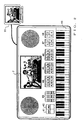
- Fig. 2 is a diagram showing an exemplary outward appearance of the tone and picture generator device shown in Fig. 1.
- the operation switch group 4 includes the keyboard 40; a start switch 41 for instructing a start of an automatic performance, a stop switch 42 instructing a stop of an automatic performance, and a style selection switch set 43 for selecting performance patterns, such as rhythm, main and variation patterns, to be automatically performed.
- the operation switch group 4 also includes an instrument change switch set 44 for selecting a musical instrument or part whose current performance scene is to be visually displayed, a player change switch set 45 for selecting a playing (player-representing) character that is to be used for displaying the performance scene, a fill-in switch set 46 for selecting a musical instrument for which a fill-in pattern performance is to be executed, a stage change switch set 47 for selecting a background to be used when the performance scene is to be displayed, and a viewpoint change switch set 48 for setting a viewpoint when the performance scene is to be displayed.
- an instrument change switch set 44 for selecting a musical instrument or part whose current performance scene is to be visually displayed
- a player change switch set 45 for selecting a playing (player-representing) character that is to be used for displaying the performance scene
- a fill-in switch set 46 for selecting a musical instrument for which a fill-in pattern performance is to be executed
- a stage change switch set 47 for selecting a background to be used when the performance scene is to be displayed
- performance scenes or situations of a plurality of the parts are being visually displayed on the graphic display unit 7 (or on the external monitor 11) in a 3-D animated picture.
- the motion-component database 20 Before describing processing for displaying such a 3-D animated picture, the motion-component database 20 will be described first.
- various performance patterns are subdivided for each one of the various musical instruments or parts, and performance motions corresponding to the subdivided performance patterns are each acquired as motion capture data, developed in the x-, y- and x-axis directions and then stored along with data indicative of their respective tone-generation timing (e.g., striking points in the case of a drum).
- the data indicative of each of the subdivided performance patterns will hereinafter be called a "motion component", and the data indicative of the respective tone-generation timing will be called “sounded point marker" data.
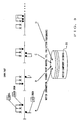
- Fig. 3 is a diagram illustrating motion components for the drum part.
- each of the motion components stored in the database 20 is made up of motion information that is, for one of the subdivided drum-part performance patterns corresponding to short phrases A, B, C, D, ..., indicative of a motional trajectory of a human player during the pattern performance and the sounded point marker data corresponding thereto.
- a single motion component is shown here as being composed of the motion information of a set of three musical instruments, i.e., cymbal, snare drum and bass drum, such a motion component is normally created per musical instrument in the case of piano, saxophone and the like.
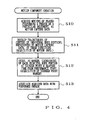
- First step S10 of this motion component creation process is directed to acquiring, as "motion capture data", a motional state of the player performing a particular subdivided phrase on a particular musical instrument.
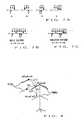
- Fig. 5A is a diagram explanatory of how the player's motional state is acquired as the motion capture data. As shown, the player is asked to perform the particular subdivided phrase with 3-D digitizers attached to principal portions of the player's body and, if necessary, to the musical instrument as well, and motions of the player during the performance are recorded in a sequential manner.
- the 3-D digitizers employed here may be of a known magnetic or optical type.
- trajectories of the respective centers of the individual body portions are developed in the x, y z coordinates so as to acquire motion information indicative of movements and positions of the individual body portions.
- time data may also be recorded in association with the motion information.
- step S12 the motion creation process moves on to step S12, where the coordinates of each of the principal body portions at a point where a tone has been generated (sounded point) and the elapsed time from the start of the performance to the sounded point are stored as a sounded point marker in any desired distinguishable form.
- the performance is of a phrase shown in Fig. 5B, three points labeled "X" in the figure are sounded points and the respective elapsed times of these sounded points t, t' and t" are stored in distinguishable form.
- these sounded point markers may be in any suitable format as long as they can properly identify the sounded points from among the acquired motion capture data.
- step S13 the data acquired in the above-mentioned manner are associated with the phrase performed by the player and then stored into the database as data in such a format which can appropriately deal with any positional changes (e.g.,changes in the shape and size of the player and musical instrument) and/or time changes (e.g., tempo change) that may take place in subsequent reproduction of the acquired data.
- positional changes e.g.,changes in the shape and size of the player and musical instrument
- time changes e.g., tempo change
- motion component data may contain other data, such as those indicative of respective moving velocity and acceleration of the individual body portions, in addition to the x, y and z coordinates, time data and sounded point markers.
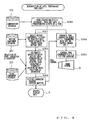
- Fig. 6 is a flow chart illustrating operational sequences of a picture generation/display process and a tone generation process during automatic accompaniment reproduction; in particular, Fig. 6 illustrates an exemplary operational flow for reproducing a 3-D animated picture visually showing a tone of one part and a performance scene corresponding thereto. If performance scenes of a plurality of parts are to be displayed, it is only necessary that the same process as shown in Fig. 6 be carried out for each of the parts and then the processed results be displayed in a combined format.
- a performance style data is selected from among those stored in the above-mentioned style database 21, similarly to the conventionally-known automatic accompaniment function.
- the thus-selected performance style data is then delivered to operations of steps S21 and S25.
- Step S25 is directed to the operation similar to the conventional automatic accompaniment process; more specifically, this step generates tone generation event data, such as a MIDI key-on event and control change, and tone generator controlling parameters ("T.G. parameters") on the basis of performance information included in the selected performance style data.
- the tone generator controlling parameters, etc. generated in this manner are then passed to the tone generator section 5, which, in turn, generates a corresponding tone signal (step S26) to be audibly reproduced through the sound system 26.
- the motion components corresponding to the selected performance style data are selected from among those stored in the above-mentioned motion component database 20, to thereby generate basic motion information to be described below. Because the motion components corresponding to the individual performance styles can be known previously, it is possible to include, in the selected performance style data, such data indicative of the corresponding motion components.
- Fig. 7A shows example phrases corresponding to various motion components stored in the motion component database 20.
- this motion component database 20 there are prestored motion components in association with phrases A, B, C, D, ... shown in Fig. 7A.
- a performance pattern corresponding to the selected performance style is the one shown in Fig. 7B, the motion components corresponding to the performance pattern are read out from the motion component database 20.
- every adjacent motion components thus read out from the database 20 are joined together by causing a trailing end portion of the preceding motion component and a leading end portion of the succeeding motion component to overlap each other, so as to create the basic motion information.
- the motion components associated with the phrases A, B, C, B will be sequentially joined together in the mentioned order (A ⁇ B ⁇ C ⁇ B).
- step S22 of Fig. 6 the motion information corresponding to the fill-in pattern is caused to overlap or replace the basic motion information generated at step S21.
- the style pattern to be performed is a variation pattern as shown in Fig. 7C, i.e., if a fill-in operation is to be effected for the cymbal and snare drum in the drum part
- the last portion of the basic motion information (A ⁇ B ⁇ C ⁇ B) generated at step S21 and the data immediately preceding the same are replaced by the data of the motion component D, to thereby provide motion information corresponding to the variation pattern.
- step S23 in order to selectively read out, from the scene component database 22, the information corresponding to displayed-part selection data entered via the above-mentioned instrument change switch set 44, playing-character selection data entered via the player change switch set 45, viewpoint change operation data entered via the viewpoint change switch set 48 and stage change operation data entered via the stage change switch set 47.
- Step S23 also modifies the coordinates data included in the motion component information. Namely, step S23 reads out, from the scene component database 22, the scene components corresponding to the part or musical instrument whose performance scene is to be displayed, i.e., a player-representing character who is performing, selected stage and designated viewpoint (camera position). Note that when an instruction is given to simultaneously display a plurality of parts and musical instruments, the scene components corresponding to the positional arrangement of these parts or instruments are read out from the database 22.
- the above-mentioned motion information is modified at step S23 to achieve a trajectory as denoted by "(2)".
- the above-mentioned motion information is modified to achieve a trajectory as denoted by "(3)".
- the above-mentioned motion information is modified to achieve a trajectory as denoted by "(4).
- step S23 sets model positions and animated picture corresponding to the model positions.
- step S24 a picture generation (rendering) process is carried out on the basis of the information having been set at step S23.
- the scene is visualized in a video form on the basis of the above-mentioned scene information and motion information. More specifically, on the basis of the scene information and motion information, there are performed coordinates conversion, hidden scene erasure, calculation of intersecting points, lines, planes and the like, shading, texture mapping, etc. to compute the luminance of each pixel and pass it to the graphic display unit 7.
- each of the motion components stored in the motion component database 20 contains the sounded point marker as well as the coordinates data along the time axis, so that, in this embodiment, each picture and a corresponding tone can be accurately synchronized with each other on the basis of the sounded point marker.
- the time values t, t', t" at the basic tempo, up to each sounded point can be acquired from the motion component. Therefore, if a performance tempo has been increased by a factor of k from the basic tempo with which the motion component was created, it is sufficient that control be performed for thinning out the motion-information reading operations or repeatedly reading the same motion position so as to make shorter or longer the reproduction intervals of the motion information in such a manner that the desired sounded point can be reached from the start of reproduction of the motion information within only 1/k of the original time (or at k times the original speed).
- a moving time or speed is prepared for each coordinates position, i.e., where information indicative of a time or speed for each body portion to move from one coordinates position to a next one is contained in the motion information, and if such information is representative of time, then the control may be executed to modify the time to 1/k of the original, or if the information is representative of speed, then the control may be executed for modifying the speed to k times the original.
- the picture generating step S24 is arranged to inform the tone generator control parameter generating step S25 of the arrival at the picture generating process for the sounded point.
- the performance scene of any selected part can be displayed, in a 3-D picture, in accurate synchronism with the automatic accompaniment data.
- composition data composition data of the music piece to be performed is prestored in a composition database 23.
- the composition data of the selected music piece are sequentially read out at step S30 from the composition database 23, a predetermined data length at a time.
- the read-out data are then given to steps S31 and S34, which, similarly to steps S25 and S26 of the automatic accompaniment process, generates a tone signal based on the read-out data and audibly reproduces the tone signal through the sound system 6.
- Steps S31 to S33 are directed to generating a 3-D animated picture corresponding to the read-out data.
- step S31 some of the motion components closest to the predetermined length of the read-out data are selectively read out.
- every adjacent motion components thus read out are joined together by causing a trailing end portion of the preceding motion component and a leading end portion of the succeeding motion component to overlap each other, so as to create basic motion information.
- a length of data corresponding to the subdivided phrase hereinafter called a "first segment” is extracted from the beginning of the performance data, and the motion component corresponding to the phrase closest to the extracted first segment is read out from the database 20.
- a second segment is extracted with the end of the first segment set at the beginning of the second segment, and the motion component corresponding to the phrase closest to the second segment is read out from the motion component database 20 and joined to the first read-out motion component.
- the aforementioned procedures are repeated to join together every subsequent components, to thereby create the basic motion information.
- the motion components may be arranged in standardized basic sets (e.g., such that basic tone colors are automatically associated by tone color numbers as with "GM" basic tone colors), motion component designating information, corresponding to the motion components of the basis set to be used in the composition data may be included in accordance with the progression of the music piece.
- step S32 model positions and animated picture corresponding thereto are set at step S32 in a similar manner to step S23, and then the routine moves on to step S33 where, similarly to step S24 above, a 3-D animated picture is generated and visually shown on the graphic display unit 7.
- Fig. 10 there is shown another example of the external appearance of the tone and picture generator device in accordance with the present invention.
- various operators are disposed to the left and right of the graphic display unit 7, and a current performance scene of a single part (drum part in this case) is being demonstrated in a 3-D animated picture on the display screen.
- the operator 51 is an automatic-performance start button
- the operator 52 is an automatic-performance stop button
- 53 is a tempo-up button for making the performance tempo faster
- 54 is a tempo-down button for making the performance tempo slower
- 55 is a player selection button for selecting a player-representing character to be used in showing a current performance scene on the graphic display unit 7
- 56 is a musical instrument selection button for selecting a particular musical instrument whose current performance scene is to be shown on the graphic display unit 7.
- the operators 57 and 58 are buttons for selecting a desired main pattern (main style) of an automatic performance; specifically, 57 is a main-A button for selecting the A main pattern while 58 is a main-B button for selecting the B main pattern.
- 59 is an intro button for selecting an intro pattern
- 60 is a fill-in button for selecting a fill-in pattern
- 61 is an ending button for selecting an ending pattern.
- the operator 62 is a viewpoint moving button for moving a viewpoint when a three-dimensional performance scene is to be shown on the above-mentioned graphic display unit 7.
- the effect to be imparted in the tone generator section 5 may be changed in accordance with a stage selected via the above-mentioned stage change switch set 47.
- the effect may be varied depending on a situation of the picture to be displayed; that is, if a "concert hall stage” is selected, a delay effect may be made greater, or if an "outdoor stage” is selected, the delay may be made smaller.
- motion information may be created by any other schemes than the motion capture scheme.
- the present invention can display a 3-D animated pictures in synchronism with composition data, so that the human operator or player can enjoy visual interaction, based on the 3-D animated picture, as well as interaction by sound.
- each of the motion components includes sounded point markers in association with motion information
- common motion components can be used for different performance tempos, which permits a significant reduction in the size of the database.
- the human operator can select a character, suiting his or her preference, from among a plurality of player-representing characters.
- model performance scene in any desired position, and the thus-shown model performance scene can be used for teaching purposes as well.
Landscapes
- Physics & Mathematics (AREA)
- Engineering & Computer Science (AREA)
- Acoustics & Sound (AREA)
- Multimedia (AREA)
- Electrophonic Musical Instruments (AREA)
- Processing Or Creating Images (AREA)
Claims (9)
- Ton- und Bild-Erzeugungsvorrichtung, die folgendes aufweist:Tongeneratormittel (5), die einen Ton auf der Grundlage einer Spielinformation (MIDI) erzeugen;Speichermittel (20), die eine Vielzahl von Bewegungskomponenten speichern, von den jede eine Bewegungsinformation enthält, die für eine Bewegungsbahn ((1), (2), (3), (4)) von Spielbewegungen eines Spielmusters repräsentativ ist; undBildgeneratormittel, die auf der Grundlage der Spielinformation aus den Speichermitteln eine der Bewegungskomponenten, die der Spielinformation entspricht, auslesen und synchron mit der Spielinformation und auf der Grundlage der aus den Speichermitteln ausgelesenen Bewegungskomponente Bilddaten erzeugen, die eine Spielszene eines ausgewählten Musikinstruments oder eines Parts, die der Spielinformation entsprechen, veranschaulichen.
- Ton- und Bild-Erzeugungsvorrichtung nach Anspruch 1, bei der die Bewegungskomponente eine Bewegungsbahn von Spielbewegungen eines subunterteilten Spielmusters für jedes Musikinstrument oder jeden Spielpart repräsentiert und bei dem die Bildgeneratormittel aus den Speichermitteln (20) eine der Bewegungskomponenten, die der Spielinformation entspricht, auslesen und animierte Bilddaten, die der Spielinformation entsprechen, auf der Grundlage einer Information erzeugen, die durch sequentielles Aneinanderfügen der aus den Speichermitteln (20) ausgelesenen Bewegungskomponenten erstellt wird.
- Ton- und Bild-Erzeugungsvorrichtung nach Anspruch 1, bei der die Bewegungskomponente eine Bewegungsinformation, die für eine Bewegungsbahn ((1), (2), (3), (4)) von Spielbewegungen eines subunterteilten Spielmusters repräsentativ ist, und ein Ertönungspunkt-Markierungszeichen enthält, das für einen Tonerzeugungszeitpunkt in der Bewegungsinformation kennzeichnend ist.
- Ton- und Bild-Erzeugungsvorrichtung nach Anspruch 1, bei der die Bilddaten animierte dreidimensionale Bilddaten sind.
- Ton- und Bild-Erzeugungsvorrichtung nach Anspruch 4, bei der ein einen Spieler repräsentierendes Zeichen und ein Betrachtungspunkt, die durch die animierten dreidimensionalen Bilddaten dargestellt werden, durch eine Bedienperson geändert werden können.
- Ton- und Bild-Erzeugungsvorrichtung nach Anspruch 5, die außerdem Mittel aufweist, die die Bewegungsinformation in Entsprechung zu einer Änderung des einen Spieler repräsentierenden Zeichens und des Betrachtungspunkts modifizieren.
- Ton- und Bild-Erzeugungsverfahren, das die folgenden Schritte aufweist:Bereitstellen einer Spielinformation (MIDI);Erzeugen eines Tons auf der Grundlage der bereitgestellten Spielinformation;Speichern einer Vielzahl von Bewegungskomponenten, die jeweils eine Bewegungsinformation enthalten, die für eine Bewegungsbahn ((1), (2), (3), (4)) von Spielbewegungen eines Spielmusters repräsentativ ist;Auslesen einer der gespeicherten Bewegungskomponenten, die der bereitgestellten Spielinformation entspricht, auf der Grundlage der bereitgestellten Spielinformation; undErzeugen von Bilddaten, die eine Spielszene eines ausgewählten Musikinstruments oder Parts, die der Spielinformation entsprechen, synchron zu der bereitgestellten Spielinformation und auf der Grundlage der ausgelesenen Bewegungskomponenten.
- Ton- und Bild-Erzeugungsverfahren nach Anspruch 7, das ferner den Schritt des Erzeugens von animierten Bilddaten aufweist, die der Spielinformation (MIDI) entsprechen, auf der Grundlage einer Information, die durch sequentielles Aneinanderfügen der ausgelesenen Bewegungskomponenten erstellt wird, wobei die Vielzahl der Bewegungskomponenten eine Bewegungsbahn von Spielbewegungen eines subunterteilten Spielmusters für jedes Musikinstrument oder jeden Spielpart repräsentieren.
- Maschinenlesbares Aufzeichnungsmedium, das eine Gruppe von Befehlen eines von einem Prozessor auszuführenden Ton- und Bild-Erzeugungsverfahrens enthält, wobei das Ton- und Bild-Erzeugungsverfahren die folgenden Schritte aufweist:Empfangen einer Spielinformation (MIDI);Erzeugen eines Tons auf der Grundlage der Spielinformation, die durch einen Empfangsschritt empfangen wurde;Speichern einer Vielzahl von Bewegungskomponenten, die jeweils eine Bewegungsinformation enthalten, die für eine Bewegungsbahn ((1), (2), (3), (4)) von Spielbewegungen eines Spielmusters repräsentativ ist;Auslesen einer der gespeicherten Bewegungskomponenten, die der empfangenen Spielinformation entspricht, auf der Grundlage der bereitgestellten Spielinformation; undErzeugen von Bilddaten, die eine Spielszene eines ausgewählten Musikinstruments oder Parts, die der Spielinformation entsprechen, synchron zu der empfangenen Spielinformation und auf der Grundlage der ausgelesenen Bewegungskomponenten.
Applications Claiming Priority (2)
| Application Number | Priority Date | Filing Date | Title |
|---|---|---|---|
| JP9386798 | 1998-03-24 | ||
| JP9386798 | 1998-03-24 |
Publications (2)
| Publication Number | Publication Date |
|---|---|
| EP0945849A1 EP0945849A1 (de) | 1999-09-29 |
| EP0945849B1 true EP0945849B1 (de) | 2003-06-18 |
Family
ID=14094411
Family Applications (1)
| Application Number | Title | Priority Date | Filing Date |
|---|---|---|---|
| EP99105560A Expired - Lifetime EP0945849B1 (de) | 1998-03-24 | 1999-03-18 | Vorrichtung zur Ton- und Bilderzeugung |
Country Status (6)
| Country | Link |
|---|---|
| US (1) | US6646644B1 (de) |
| EP (1) | EP0945849B1 (de) |
| JP (1) | JP3728942B2 (de) |
| DE (1) | DE69908846T2 (de) |
| SG (1) | SG72937A1 (de) |
| TW (1) | TW558715B (de) |
Families Citing this family (21)
| Publication number | Priority date | Publication date | Assignee | Title |
|---|---|---|---|---|
| US6968004B1 (en) * | 1999-08-04 | 2005-11-22 | Kabushiki Kaisha Toshiba | Method of describing object region data, apparatus for generating object region data, video processing method, and video processing apparatus |
| US6429863B1 (en) * | 2000-02-22 | 2002-08-06 | Harmonix Music Systems, Inc. | Method and apparatus for displaying musical data in a three dimensional environment |
| DE10145360B4 (de) * | 2001-09-14 | 2007-02-22 | Jan Henrik Hansen | Verfahren zur Umsetzung oder Aufzeichnung von Musik, Anwendung des Verfahrens und Anlagen hierfür |
| JP3849540B2 (ja) | 2002-02-19 | 2006-11-22 | ヤマハ株式会社 | 画像制御装置 |
| US7339589B2 (en) * | 2002-10-24 | 2008-03-04 | Sony Computer Entertainment America Inc. | System and method for video choreography |
| FR2847174A1 (fr) * | 2002-11-14 | 2004-05-21 | Makina I | Installation ludique interactive |
| JP4259153B2 (ja) | 2003-03-24 | 2009-04-30 | ヤマハ株式会社 | 画像処理装置および画像処理方法を実現するためのプログラム |
| JP2005044297A (ja) * | 2003-07-25 | 2005-02-17 | Sony Corp | オーディオ再生方法及び装置 |
| JP2005241877A (ja) * | 2004-02-25 | 2005-09-08 | Yamaha Corp | 運指指示装置およびプログラム |
| JP4513644B2 (ja) * | 2005-05-13 | 2010-07-28 | ヤマハ株式会社 | コンテンツ配信サーバ |
| US7601904B2 (en) * | 2005-08-03 | 2009-10-13 | Richard Dreyfuss | Interactive tool and appertaining method for creating a graphical music display |
| WO2008152644A2 (en) * | 2007-06-12 | 2008-12-18 | Eyecue Vision Technologies Ltd. | System and method for physically interactive music games |
| US8136041B2 (en) * | 2007-12-22 | 2012-03-13 | Bernard Minarik | Systems and methods for playing a musical composition in an audible and visual manner |
| JP2010165169A (ja) * | 2009-01-15 | 2010-07-29 | Kddi Corp | モーションキャプチャデータの楽曲同期システムにおけるリズムマッチング並列処理装置およびそのコンピュータプログラム |
| KR101640458B1 (ko) * | 2009-06-25 | 2016-07-18 | 삼성전자주식회사 | 영상 장치 및 컴퓨터 판독 기록매체 |
| US8917277B2 (en) | 2010-07-15 | 2014-12-23 | Panasonic Intellectual Property Corporation Of America | Animation control device, animation control method, program, and integrated circuit |
| JP5348173B2 (ja) * | 2011-05-16 | 2013-11-20 | ヤマハ株式会社 | 電子情報処理装置及びプログラム |
| US9443498B2 (en) * | 2013-04-04 | 2016-09-13 | Golden Wish Llc | Puppetmaster hands-free controlled music system |
| JP6684556B2 (ja) * | 2015-08-28 | 2020-04-22 | 株式会社電通 | データ変換装置、ロボット、プログラム及び情報処理方法 |
| JP6809112B2 (ja) * | 2016-10-12 | 2021-01-06 | ヤマハ株式会社 | 演奏システム、自動演奏方法およびプログラム |
| JP2022149157A (ja) * | 2021-03-25 | 2022-10-06 | ヤマハ株式会社 | 演奏解析方法、演奏解析システムおよびプログラム |
Family Cites Families (14)
| Publication number | Priority date | Publication date | Assignee | Title |
|---|---|---|---|---|
| US5005459A (en) * | 1987-08-14 | 1991-04-09 | Yamaha Corporation | Musical tone visualizing apparatus which displays an image of an animated object in accordance with a musical performance |
| JP2943201B2 (ja) | 1990-01-21 | 1999-08-30 | ソニー株式会社 | 画像作成装置及び方法 |
| US5391828A (en) | 1990-10-18 | 1995-02-21 | Casio Computer Co., Ltd. | Image display, automatic performance apparatus and automatic accompaniment apparatus |
| JP2518464B2 (ja) * | 1990-11-20 | 1996-07-24 | ヤマハ株式会社 | 楽音合成装置 |
| JP3241372B2 (ja) * | 1990-11-27 | 2001-12-25 | パイオニア株式会社 | カラオケ演奏方法 |
| US5286908A (en) | 1991-04-30 | 1994-02-15 | Stanley Jungleib | Multi-media system including bi-directional music-to-graphic display interface |
| US5287347A (en) | 1992-06-11 | 1994-02-15 | At&T Bell Laboratories | Arrangement for bounding jitter in a priority-based switching system |
| US5621538A (en) * | 1993-01-07 | 1997-04-15 | Sirius Publishing, Inc. | Method for synchronizing computerized audio output with visual output |
| JPH0830807A (ja) | 1994-07-18 | 1996-02-02 | Fuji Television:Kk | 演奏連動型動画生成装置、音声連動型動画生成装置及びこれを利用したカラオケ装置 |
| JP3216767B2 (ja) | 1995-02-28 | 2001-10-09 | 富士電機株式会社 | レベル変動補正可能な画像処理装置 |
| DE69621982T2 (de) * | 1995-04-14 | 2003-02-06 | Kabushiki Kaisha Toshiba, Kawasaki | Aufnahmeträger und Wiedergabevorrichtung für Playbackdaten |
| JPH08293039A (ja) | 1995-04-24 | 1996-11-05 | Matsushita Electric Ind Co Ltd | 音楽画像変換装置 |
| US6160907A (en) * | 1997-04-07 | 2000-12-12 | Synapix, Inc. | Iterative three-dimensional process for creating finished media content |
| JP3454100B2 (ja) * | 1997-08-21 | 2003-10-06 | ヤマハ株式会社 | 演奏パラメータ表示装置 |
-
1998
- 1998-09-28 JP JP27280898A patent/JP3728942B2/ja not_active Expired - Fee Related
-
1999
- 1999-03-18 SG SG1999001374A patent/SG72937A1/en unknown
- 1999-03-18 DE DE69908846T patent/DE69908846T2/de not_active Expired - Lifetime
- 1999-03-18 EP EP99105560A patent/EP0945849B1/de not_active Expired - Lifetime
- 1999-03-19 US US09/271,724 patent/US6646644B1/en not_active Expired - Fee Related
- 1999-03-19 TW TW088104379A patent/TW558715B/zh not_active IP Right Cessation
Also Published As
| Publication number | Publication date |
|---|---|
| US6646644B1 (en) | 2003-11-11 |
| JP3728942B2 (ja) | 2005-12-21 |
| SG72937A1 (en) | 2000-05-23 |
| DE69908846T2 (de) | 2004-05-13 |
| DE69908846D1 (de) | 2003-07-24 |
| TW558715B (en) | 2003-10-21 |
| JPH11339060A (ja) | 1999-12-10 |
| EP0945849A1 (de) | 1999-09-29 |
Similar Documents
| Publication | Publication Date | Title |
|---|---|---|
| EP0945849B1 (de) | Vorrichtung zur Ton- und Bilderzeugung | |
| US6245982B1 (en) | Performance image information creating and reproducing apparatus and method | |
| EP1575027B1 (de) | Musiktonwiedergabegerät und musiktonwiedergabeprogramm | |
| US5890116A (en) | Conduct-along system | |
| US7589727B2 (en) | Method and apparatus for generating visual images based on musical compositions | |
| JPH09204163A (ja) | カラオケの表示装置 | |
| WO1997002558A1 (en) | Music generating system and method | |
| US6489549B2 (en) | Electronic device with multiple sequences and methods to synchronize them | |
| JP2000099012A (ja) | 演奏情報編集方法および演奏情報編集プログラムを記録した記録媒体 | |
| CN110322861A (zh) | 运指显示装置以及存储介质 | |
| JP3770293B2 (ja) | 演奏状態の視覚的表示方法および演奏状態の視覚的表示プログラムが記録された記録媒体 | |
| JP3541686B2 (ja) | 演奏練習装置と記録媒体 | |
| JP3829780B2 (ja) | 奏法決定装置及びプログラム | |
| JP3603599B2 (ja) | 演奏システムの視覚的表示方法および演奏システムの視覚的表示プログラムが記録されたコンピュータ読み取り可能な記録媒体 | |
| JP3259367B2 (ja) | カラオケ装置 | |
| JP3333990B2 (ja) | 音楽ゲームの制御方法及び記録媒体 | |
| JP3896609B2 (ja) | カラオケ装置 | |
| JP4270102B2 (ja) | 自動演奏装置及びプログラム | |
| JP3700442B2 (ja) | 奏法対応入力システム及びその記録媒体 | |
| JP3921817B2 (ja) | 自動演奏装置およびフィンガリング記録装置 | |
| JP3085615B2 (ja) | カラオケ装置 | |
| JP4685226B2 (ja) | 波形再生用自動演奏装置 | |
| JP3654026B2 (ja) | 奏法対応入力システム及びその記録媒体 | |
| JP3096221B2 (ja) | オルゴール・シミュレータ | |
| JPH11184482A (ja) | カラオケ装置 |
Legal Events
| Date | Code | Title | Description |
|---|---|---|---|
| PUAI | Public reference made under article 153(3) epc to a published international application that has entered the european phase |
Free format text: ORIGINAL CODE: 0009012 |
|
| 17P | Request for examination filed |
Effective date: 19990318 |
|
| AK | Designated contracting states |
Kind code of ref document: A1 Designated state(s): DE GB IT |
|
| AX | Request for extension of the european patent |
Free format text: AL;LT;LV;MK;RO;SI |
|
| AKX | Designation fees paid |
Free format text: DE GB IT |
|
| 17Q | First examination report despatched |
Effective date: 20020617 |
|
| GRAH | Despatch of communication of intention to grant a patent |
Free format text: ORIGINAL CODE: EPIDOS IGRA |
|
| GRAH | Despatch of communication of intention to grant a patent |
Free format text: ORIGINAL CODE: EPIDOS IGRA |
|
| GRAA | (expected) grant |
Free format text: ORIGINAL CODE: 0009210 |
|
| AK | Designated contracting states |
Designated state(s): DE GB IT |
|
| PG25 | Lapsed in a contracting state [announced via postgrant information from national office to epo] |
Ref country code: IT Free format text: LAPSE BECAUSE OF FAILURE TO SUBMIT A TRANSLATION OF THE DESCRIPTION OR TO PAY THE FEE WITHIN THE PRE;WARNING: LAPSES OF ITALIAN PATENTS WITH EFFECTIVE DATE BEFORE 2007 MAY HAVE OCCURRED AT ANY TIME BEFORE 2007. THE CORRECT EFFECTIVE DATE MAY BE DIFFERENT FROM THE ONE RECORDED.SCRIBED TIME-LIMIT Effective date: 20030618 |
|
| REG | Reference to a national code |
Ref country code: GB Ref legal event code: FG4D |
|
| REF | Corresponds to: |
Ref document number: 69908846 Country of ref document: DE Date of ref document: 20030724 Kind code of ref document: P |
|
| PLBE | No opposition filed within time limit |
Free format text: ORIGINAL CODE: 0009261 |
|
| STAA | Information on the status of an ep patent application or granted ep patent |
Free format text: STATUS: NO OPPOSITION FILED WITHIN TIME LIMIT |
|
| 26N | No opposition filed |
Effective date: 20040319 |
|
| PGFP | Annual fee paid to national office [announced via postgrant information from national office to epo] |
Ref country code: GB Payment date: 20120314 Year of fee payment: 14 |
|
| PGFP | Annual fee paid to national office [announced via postgrant information from national office to epo] |
Ref country code: DE Payment date: 20120411 Year of fee payment: 14 |
|
| GBPC | Gb: european patent ceased through non-payment of renewal fee |
Effective date: 20130318 |
|
| REG | Reference to a national code |
Ref country code: DE Ref legal event code: R119 Ref document number: 69908846 Country of ref document: DE Effective date: 20131001 |
|
| PG25 | Lapsed in a contracting state [announced via postgrant information from national office to epo] |
Ref country code: GB Free format text: LAPSE BECAUSE OF NON-PAYMENT OF DUE FEES Effective date: 20130318 Ref country code: DE Free format text: LAPSE BECAUSE OF NON-PAYMENT OF DUE FEES Effective date: 20131001 |