EP0945893A2 - Méthode d'analyse de fluides corporels par détermination de la masse et dispositif associé - Google Patents
Méthode d'analyse de fluides corporels par détermination de la masse et dispositif associé Download PDFInfo
- Publication number
- EP0945893A2 EP0945893A2 EP99105800A EP99105800A EP0945893A2 EP 0945893 A2 EP0945893 A2 EP 0945893A2 EP 99105800 A EP99105800 A EP 99105800A EP 99105800 A EP99105800 A EP 99105800A EP 0945893 A2 EP0945893 A2 EP 0945893A2
- Authority
- EP
- European Patent Office
- Prior art keywords
- mass
- living body
- body fluid
- analyte solution
- analyzing
- Prior art date
- Legal status (The legal status is an assumption and is not a legal conclusion. Google has not performed a legal analysis and makes no representation as to the accuracy of the status listed.)
- Withdrawn
Links
Images



Classifications
-
- H—ELECTRICITY
- H01—ELECTRIC ELEMENTS
- H01J—ELECTRIC DISCHARGE TUBES OR DISCHARGE LAMPS
- H01J49/00—Particle spectrometers or separator tubes
- H01J49/02—Details
- H01J49/04—Arrangements for introducing or extracting samples to be analysed, e.g. vacuum locks; Arrangements for external adjustment of electron- or ion-optical components
- H01J49/0431—Arrangements for introducing or extracting samples to be analysed, e.g. vacuum locks; Arrangements for external adjustment of electron- or ion-optical components for liquid samples
-
- A—HUMAN NECESSITIES
- A61—MEDICAL OR VETERINARY SCIENCE; HYGIENE
- A61B—DIAGNOSIS; SURGERY; IDENTIFICATION
- A61B5/00—Measuring for diagnostic purposes; Identification of persons
- A61B5/145—Measuring characteristics of blood in vivo, e.g. gas concentration or pH-value ; Measuring characteristics of body fluids or tissues, e.g. interstitial fluid or cerebral tissue
-
- A—HUMAN NECESSITIES
- A61—MEDICAL OR VETERINARY SCIENCE; HYGIENE
- A61B—DIAGNOSIS; SURGERY; IDENTIFICATION
- A61B5/00—Measuring for diagnostic purposes; Identification of persons
- A61B5/145—Measuring characteristics of blood in vivo, e.g. gas concentration or pH-value ; Measuring characteristics of body fluids or tissues, e.g. interstitial fluid or cerebral tissue
- A61B5/14525—Measuring characteristics of blood in vivo, e.g. gas concentration or pH-value ; Measuring characteristics of body fluids or tissues, e.g. interstitial fluid or cerebral tissue using microdialysis
- A61B5/14528—Measuring characteristics of blood in vivo, e.g. gas concentration or pH-value ; Measuring characteristics of body fluids or tissues, e.g. interstitial fluid or cerebral tissue using microdialysis invasively
-
- A—HUMAN NECESSITIES
- A61—MEDICAL OR VETERINARY SCIENCE; HYGIENE
- A61B—DIAGNOSIS; SURGERY; IDENTIFICATION
- A61B5/00—Measuring for diagnostic purposes; Identification of persons
- A61B5/145—Measuring characteristics of blood in vivo, e.g. gas concentration or pH-value ; Measuring characteristics of body fluids or tissues, e.g. interstitial fluid or cerebral tissue
- A61B5/1455—Measuring characteristics of blood in vivo, e.g. gas concentration or pH-value ; Measuring characteristics of body fluids or tissues, e.g. interstitial fluid or cerebral tissue using optical sensors, e.g. spectral photometrical oximeters
- A61B5/14551—Measuring characteristics of blood in vivo, e.g. gas concentration or pH-value ; Measuring characteristics of body fluids or tissues, e.g. interstitial fluid or cerebral tissue using optical sensors, e.g. spectral photometrical oximeters for measuring blood gases
- A61B5/14557—Measuring characteristics of blood in vivo, e.g. gas concentration or pH-value ; Measuring characteristics of body fluids or tissues, e.g. interstitial fluid or cerebral tissue using optical sensors, e.g. spectral photometrical oximeters for measuring blood gases specially adapted to extracorporeal circuits
-
- A—HUMAN NECESSITIES
- A61—MEDICAL OR VETERINARY SCIENCE; HYGIENE
- A61B—DIAGNOSIS; SURGERY; IDENTIFICATION
- A61B5/00—Measuring for diagnostic purposes; Identification of persons
- A61B5/145—Measuring characteristics of blood in vivo, e.g. gas concentration or pH-value ; Measuring characteristics of body fluids or tissues, e.g. interstitial fluid or cerebral tissue
- A61B5/1455—Measuring characteristics of blood in vivo, e.g. gas concentration or pH-value ; Measuring characteristics of body fluids or tissues, e.g. interstitial fluid or cerebral tissue using optical sensors, e.g. spectral photometrical oximeters
- A61B5/1459—Measuring characteristics of blood in vivo, e.g. gas concentration or pH-value ; Measuring characteristics of body fluids or tissues, e.g. interstitial fluid or cerebral tissue using optical sensors, e.g. spectral photometrical oximeters invasive, e.g. introduced into the body by a catheter
-
- A—HUMAN NECESSITIES
- A61—MEDICAL OR VETERINARY SCIENCE; HYGIENE
- A61B—DIAGNOSIS; SURGERY; IDENTIFICATION
- A61B5/00—Measuring for diagnostic purposes; Identification of persons
- A61B5/40—Detecting, measuring or recording for evaluating the nervous system
- A61B5/4058—Detecting, measuring or recording for evaluating the nervous system for evaluating the central nervous system
- A61B5/4064—Evaluating the brain
-
- A—HUMAN NECESSITIES
- A61—MEDICAL OR VETERINARY SCIENCE; HYGIENE
- A61B—DIAGNOSIS; SURGERY; IDENTIFICATION
- A61B10/00—Instruments for taking body samples for diagnostic purposes; Other methods or instruments for diagnosis, e.g. for vaccination diagnosis, sex determination or ovulation-period determination; Throat striking implements
- A61B10/0045—Devices for taking samples of body liquids
- A61B2010/0077—Cerebrospinal fluid
Definitions
- the present invention relates to a method of mass-analyzing a body fluid and an apparatus therefor. More particularly, it relates to a method of mass-analyzing a body fluid and an apparatus therefor which, by mass-analyzing each kind of substances contained in a body fluid of an extremely high or low electrical conductivity, allow component analysis of the body fluid to be performed and can be preferably used for identifying each kind of the substances contained in the body fluid.
- an analyte solution such as the body fluid, after being ionized, is introduced into a mass spectrometer so as to detect mass of each kind of the substances contained in the analyte solution.
- a technique disclosed in literatures such as USP-5130538 This conventional technique is referred to as an electrospray ionization method.
- 2.5kV or more of high voltage is applied between a metal capillary into which the solution is introduced and a counter electrode, namely, with the high voltage applied to the solution, the solution is sprayed toward the counter electrode over a space to which the electric field is applied.
- an electrospray phenomenon occurs, forming a Taylor corn between the metal capillary and the counter electrode.
- charged droplets are sprayed from a tip of the Taylor corn.
- a technique disclosed in literatures such as JP-A-7-306193 As another conventional technique regarding the ionization method for the analyte solution, there is known, for example, a technique disclosed in literatures such as JP-A-7-306193.
- the ionization method according to this conventional technique is referred to as a sonic spray ionization method.
- gas is caused to flow outside the capillary coaxially therewith and thus the analyte solution is forced to be sprayed from a tip of the capillary, thereby generating the charged droplets.
- quantities of the positive and negative ions thus generated become maximum when velocity of the gas flow at the tip of the capillary is substantially equal to the sonic velocity.
- the mass spectrometry in which, after the analyte solution such as the body fluid has been ionized, the ionized particles are introduced into the mass spectrometer so as to perform the mass analysis, in the case of mass-analyzing a mixture solution in which many kinds of substances are mixed, it is a common practice to employ the following technique: The substances contained in the mixture solution are separated from each other using a member such as a liquid chromatograph or a capillary electrophoresis system, and after that, the mass analysis is performed using the mass spectrometer.
- a member such as a liquid chromatograph or a capillary electrophoresis system
- the conventional technique according to the above-described electrochemical detection method is a method in which the measurement is performed employing as the criterion the oxidation-reduction potential characteristic of a substance.
- the conventional technique has a problem that an accurate measurement is impossible regarding a living body and, in particular, regarding a substance such as a neurotransmitter the oxidation-reduction potential of which varies with a lapse of time.
- the conventional technique accordingly, necessitates a considerable time for this separation and, as a result, has a problem that mass analysis cannot be performed accurately toward the analyte solution such as the body fluid in which the substances contained vary with a lapse of time and thus values of the corresponding masses also vary with a lapse of time.
- an ionization source according to the sonic spray ionization method is employed as an ionization source, and an ion trap three dimensional quadrupole mass spectrometer is employed as a mass spectrometer, and after an analyte solution containing a mixture of living body substances is ionized directly by the above-mentioned ionization source without being separated for each of the substances, the ions are introduced into the mass spectrometer, thereby accomplishing the above-described object.
- the above-described living body substances are collected as the analyte solution from a living body with a microdialysis probe, and the mass analysis is performed in real time by immediately introducing the analyte solution into the ionization source from the microdialysis probe through a flowing passage, and also a volatile organic solvent is added to the above-described analyte solution in order to promote the ionization even further, thereby accomplishing the above-described object.
- an ionization source using the sonic spray ionization method and an ion trap three dimensional quadrupole mass spectrometer are provided, and after an analyte solution containing a mixture of living body substances is ionized by the above-mentioned ionization source without being separated for each of the substances, the ions are introduced into the mass spectrometer, thereby accomplishing the above-described object.
- a microdialysis probe for collecting a body fluid from a living body is provided, and the mass analysis is performed in real time by immediately introducing an analyte solution containing the collected body fluid into the ionization source from the microdialysis probe through a flowing passage, thereby accomplishing the above-described object.
- a configuration for promoting the ionization of the analyte solution is provided by applying a voltage between an electrode, which is provided in the proximity of a capillary constituting the above-mentioned ionization source, and the analyte solution so that an electric field is applied to the analyte solution, and also a member for eliminating contaminants contained in the solution to be analyzed is provided at the front of an ion-introducing orifice of the above-mentioned mass spectrometer, thereby accomplishing the above-described object.
- Fig. 1 is a diagram explaining a mass-analyzing method for detecting substances contained in a cerebral spinal fluid by means of a mass-analyzing apparatus according to an embodiment of the present invention.
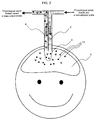
- Fig. 2 is a diagram explaining a detailed structure of a microdialysis probe and its operation.
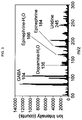
- Fig. 3 is a diagram showing a mass spectrum of the cerebral spinal fluid measured by the mass-analyzing apparatus according to the embodiment of the present invention.
- Fig. 4 is a diagram showing a mass spectrum of a dopamine standard measured by the mass-analyzing apparatus according to the embodiment of the present invention.
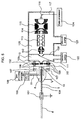
- Fig. 5 is a block diagram explaining a configuration of the mass-analyzing apparatus according to the embodiment of the present invention.
- Fig. 1 is a diagram explaining a mass-analyzing method for detecting substances contained in a cerebral spinal fluid by means of a mass-analyzing apparatus according to an embodiment of the present invention.
- Fig. 2 is a diagram explaining a detailed structure of a microdialysis probe and its operation.
- FIG. 6 is a diagram explaining a time sequence of a measurement performed by a three dimensional quadrupole mass-analyzing apparatus and a quadrupole mass-analyzing apparatus.
- the reference numerals denote the components as designated below: 1, 7 pump, 2, 6 flowing passage, 3 microdialysis probe, 4 dialysis membrane, 5 brain, 8 ionization source housing, 9 capillary, 10 orifice, 11 gas-flowing passage 12 mass spectrometer, 13 in-brain substances, 101 metallic tube, 102 plate-like member, 103, 111 orifice, 104 fluoroplastic tube, 105 gas flow controller, 106 gas-providing member, 107 screw, 108 insulator, 109, 109' flange, 110 intermediate pressure region, 112 einzel lens, 113 electrostatic ion-guide, 114 gate electrode, 115 three dimensional quadrupole mass analyser, 116 detector, 117 cable, 122, 123 vacuum pump, 124 data processor,
- the mass analysis according to the embodiment of the present invention illustrated in Fig. 1 is based on a mass-analyzing method that makes it possible to perform component analysis of in-brain substances in real times while collecting the in-brain substances in the cerebral spinal fluid within the brain 5 of an animal to be inspected.
- This mass-analyzing method is carried out by an apparatus that includes an sonic spray ionization source and the mass spectrometer 12 having the orifice 103.
- the sonic spray ionization source includes the pump 1 for sending out a physiological saline, a Ringer or an artificial cerebral spinal fluid into the flowing passage 2, the microdialysis probe 3 connected with the flowing passage 2 and inserted into the brain 5 for sending out the cerebral spinal fluid containing the in-brain substances into the flowing passage 6, the pump 7 for injecting a high volatile organic solvent into the cerebral spinal fluid at a middle point of the flowing passage 6, the ionization source housing 8, the capillary 9, the orifice 10, and the gas-flowing passage 11.
- the mass spectrometer 12 used in the embodiment of the present invention is an ion trap three dimensional quadrupole mass spectrometer (3DQMS).
- the plate-like member 102 is located just in front of the orifice 103 of the mass spectrometer 12.
- the metallic tube 101 connects the flowing passage 6 with the capillary 9.
- a voltage for promoting ionization of the cerebral spinal fluid as a sample is applied between the metallic tube 101 and the ionization source housing 8.
- Electric potential of the metallic tube 101 is ground potential as shown in Fig. 5.
- gas such as nitrogen gas is introduced from the gas-flowing passage 11 of the ionization source housing 8.
- velocity of the gas flow is adjusted so that, at the orifice 10, it becomes substantially equal to the sonic velocity.
- the pump 1 sends out a solution such as the physiological saline, the Ringer or the artificial cerebral spinal fluid, the osmotic pressure of which is close to that of the body fluid, into the flowing passage 2, then sending the solution into the microdialysis probe 3.
- the physiological saline which is 0.9% sodium chloride (NaCl)-water solution (w/w)
- the Ringer and the artificial cerebral spinal fluid exhibit substantially the same osmotic pressure as that of the physiological saline, and in addition to the sodium chloride, they contain salts of substances such as magnesium or potassium.
- the dialysis membrane 4 is provided in the proximity of a tip of the microdialysis probe 3.
- the microdialysis probe 3 is inserted into the brain 5 so that a portion of the dialysis membrane 4 comes into contact with the brain 5.
- the in-brain substances existing within the brain 5 pass through the dialysis membrane 4, then entering the solution which is sent into the microdialysis probe 3 by the pump 1 and the osmotic pressure of which is close to that of the body fluid.
- substances having a large molecular weight, for example, a protein cannot pass through the dialysis membrane 4, and accordingly do not enter the solution the osmotic pressure of which is close to that of the body fluid.
- the solution, into which the in-brain substances have been dissolved and the osmotic pressure of which is close to that of the body fluid, is introduced into the flowing passage 6.
- the flowing passage 6 is branched at a middle point thereof.
- the pump 7, which is provided at the end of a flowing passage branched from the flowing passage 6, introduces a high volatile organic solvent, for example, methanol, into the flowing passage 6.
- the solution the osmotic pressure of which is close to that of the body fluid is mixed with the methanol, thus being formed as an analyte solution.
- the methanol assists vaporization of the analyte solution, thus promoting the ionization thereof.
- a branched portion is further provided at the above-mentioned branched portion of the flowing passage 6 with a valve provided therebetween, and a minute quantity of acid is introduced from here simultaneously while adjusting the quantity to be mixed.
- the acid assists ionization of the in-brain substances.
- the analyte solution formed by the mixture with the organic solvent is introduced into the fused-silica capillary 9 which is provided in the ionization source housing 8 and the tip of which is inserted in the orifice 10.
- the gas for causing the analyte solution to be sprayed is introduced into the ionization source housing 8 through the gas-flowing passage 11, and then the gas flows along an outside periphery of the capillary 9. Moreover, when the gas flows out into the atmosphere from the orifice 10 substantially at the sonic velocity, it sprays the analyte solution that flows out of the capillary 9.
- the metallic tube 101 is provided between the flowing passage 6 and the capillary 9 so as to apply the voltage between the metallic tube 101 and the ionization source housing 8.
- the application of this voltage after the analyte solution has been sprayed, allows the ionization to be promoted. However, this ionization itself is possible without the application of the voltage.
- Ions of the in-brain substances which are generated in the sprayed gas, are introduced into the mass spectrometer 12 through the orifice 103 of the mass spectrometer 12, thereby performing the mass analysis thereof.
- nonvolatile contaminants are contained in the analyte solution sprayed from the capillary 9.
- the plate-like member 102 is provided at the front of the orifice 103 in order to prevent the nonvolatile contaminants from adhering to the surroundings of the orifice 103.
- an aperture the central axis of which is shifted from that of the orifice 103 is bored in the plate-like member 102.
- the above-mentioned embodiment of the present invention makes it possible to, directly and without using any separation tool, send the analyte solution containing the cerebral spinal fluid, i.e. a sample extracted from a living body, into the ionization source and to ionize and mass-analyze it. Consequently, the embodiment makes it possible to carry out the mass analysis in real time and with a high time resolution. Namely, the method presented in the embodiment of the present invention, in which the mass analysis is carried out directly without using any separation tool, is extremely effective in the use for monitoring living body information that is changing from moment to moment.
- the sample is collected from the living body with a certain fixed time interval and is injected into a separation tool so as to be separated, and then the separated substances are measured. Accordingly, it was impossible to carry out the mass analysis in real time. Also, a result obtained is an average value within a certain fixed time, and thus the time resolution was found to be no good.
- the flowing passage 2 and the flowing passage 6 are connected with each other at a tip portion of the microdialysis probe 3.
- the dialysis membrane 4 is provided in the proximity of this connection portion.
- the solution the osmotic pressure of which is close to that of the body fluid flows from the flowing passage 2 to the flowing passage 6 through a portion at which the dialysis membrane 4 is provided.
- the vicinity of the dialysis membrane 4 is inserted into the brain 5.
- the embodiment of the present invention makes it possible to perform measurements of cerebral functions in real time. Furthermore, the embodiment allows the dissolved substances to be extracted without collecting the body fluid from the living body, thus making it possible to reduce a burden on the body to be inspected.
- a spectrum illustrated in Fig. 3 is a mass spectrum of a cerebral spinal fluid.
- the spectrum results from an example in the case where an analyte solution is formed by adding 45% of methanol and 5% of acetic acid.
- peaks corresponding to masses of GABA, epinephrine and uridine i.e. neurotransmitters within the brain, are observed.
- These other peaks judging from values of its m/z, can be considered as a peak for a substance that remains when the dopamine is oxidized and thus a hydrogen molecule comes off therefrom and as a peak for a substance that remains when the dopamine is dehydrated and thus a water molecule comes off therefrom.
- the above-mentioned reason is the same concerning the epinephrine, too.
- the use of the mass-analyzing apparatus makes it possible to recognize an existence of the original substance and, what is more, to recognize relative quantities of a plurality of original substances contained in an analyte solution such as a body fluid. Also, the use of mass-analyzing apparatus makes it possible to judge the degree of the oxidation or the dehydration.
- This embodiment is configured by combining the sonic spray ionization source with the 3DQMS.
- the sonic spray ionization source includes the ionization source housing 8, the capillary 9, the orifice 10, and the gas-flowing passage 11.
- Fig. 5 shows that the sonic spray ionization source further includes the gas flow controller 105 provided at a middle point of the gas-flowing passage 11 and the gas-providing member 106.
- the screw 107 fixes the sonic spray ionization source and the plate-like member 102, which is illustrated in Fig. 1 as well, to the first flange 109 in which the orifice 103 of the 3DQMS 12 is provided.
- the insulator 108 which is located among the ionization source housing 8, the plate-like member 102 and the first flange 109, insulates the three components to each other.
- the 3DQMS 12 includes the intermediate pressure region 110, which is evacuated by the vacuum pump 122 and formed between the first flange 109 and the second flange 109' having the second orifice 111, and the high vacuum region 125 which is evacuated by the second vacuum pump 123 and in which members such as the mass analyzer are located. Furthermore, the einzel lens 112, the electrostatic ion-guide 113, the gate electrode 114, the three dimensional quadrupole mass analyzer 115 and the detector 116 are provided within the high vacuum region 125. An output of the detector 116, through the cable 117, is sent to the data processor 124 such as a personal computer and is processed, thereby being displayed as a graph or the like representing the spectral distribution or being printed out.
- the data processor 124 such as a personal computer and is processed, thereby being displayed as a graph or the like representing the spectral distribution or being printed out.
- the analyte solution containing the in-brain substances is introduced into the ionization source housing 8 through the flowing passage 6 and the metallic tube 101.
- the ionization source housing 8 formed of a metal and the metallic tube 101, it is allowed to apply a high voltage of about - 1.2kV on the side of the ionization source housing 8.
- This is intended to generate an electric field between the ionization source housing 8 and the metallic tube 101 so that the analyte solution is positioned in the electric field, as a result, positive ions can be extracted more effectively.
- it is not necessarily required to ground the metallic tube 101. It is sufficient to apply the voltage so that the electric field is applied to the sample solution.
- a voltage of + 150V is applied to the first flange 109.
- a configuration of the first flange 109 may be a configuration in which a portion of the orifice 103 is projected on the side of the plate-like member 102, or may be a plane-like configuration.
- the insulator 108 insulates the ionization source housing 8, the plate-like member 102 and the first flange 109 to each other, it is allowable to apply a different voltage to them each. Also, it is allowable to locate a heater on the plate-like member 102 and heat it.
- the sample solution which have passed through the metallic tube 101, is introduced into the capillary 9 extending through the fluoroplastic tube 104.
- the tip portion of the capillary 9 is inserted in the orifice 10.
- Gas such as nitrogen gas or the air is introduced from the gas-providing member 106 into the ionization source housing 8 through the gas flow controller 105 and the gas-flowing passage 11.
- Flow quantity of the gas is adjusted by the gas flow controller 105 provided at the middle point of the gas-flowing passage 11. Then, the gas flows out into the atmosphere from the orifice 10 substantially at the sonic velocity and sprays the sample solution that flows out of the capillary 9, thereby ionizing under the atmospheric pressure the in-brain substances contained in the sample solution.
- the generated ions pass through the aperture in the plate-like member 102 and the orifice 103, and are introduced into the intermediate pressure region 110 evacuated by the vacuum pump 122, then being introduced through the second orifice 111 into the high vacuum region 125 evacuated by the vacuum pump 123.
- the ions having passed through the second orifice 111 pass through the einzel lens 112, the electrostatic ion-guide 113 and the gate electrode 114, then being introduced into the three dimensional quadrupole mass analyzer 115.
- the gate electrode 114 using a voltage applied thereto, permits incidence of the ions into an ion trap portion from the outside while accumulating the ions, and, while measuring the ions, permits emission of the ions from the ion trap portion to the outside, thus introducing the ions into the three dimensional quadrupole mass analyzer 115.
- the ions introduced into the three dimensional quadrupole mass analyzer 115 are exhausted while being mass-separated in a direction opposite to the direction in which the ions had been introduced. Then, the exhausted ions collide with the detector 116, thereby being detected. At this time, it is allowable to configure the embodiment by equating the ion-introduced direction with the ion-exhausted direction.
- the output signal of the detector 116 is sent through the cable 117 to the data processor 124 such as a personal computer and is processed, thereby being displayed as a graph or the like representing the spectral distribution or being printed out.
- the mass spectrometer that includes the three dimensional quadrupole mass analyzer having the ion trap portion, it is possible to perform the mass analysis concerning a small quantity of sample solution in a short while and with a high sensitivity.
- the 3DQMS is an ion trap mass spectrometer, in which a single measurement (1 scan) of a mass spectrum consists of a process of accumulating the ions (accumulation) and a process of performing the measurement.
- range width of the mass spectrum can be set freely within a specified range.
- Accumulation time can also be set freely within a specified range. As the accumulation time is set to be longer, quantity of accumulated ions can be increased and intensity of measured ions can be heightened. Also, measurement time changes, depending on the set range width of the mass spectrum.
- the 3DQMS stores ions the masses of which are within a specified range within the set accumulation time.
- the 3DQMS expels the stored ions from an ion accumulation unit in the order of increasing or decreasing masses, then sending them into the detector and performing the mass measurement.
- a time for the one scan thereof is short, falling in the range of a few milliseconds to a few hundred milliseconds.
- the QMS in the conventional techniques which does not necessitate the process of storing the ions, can perform the single measurement (1 scan) only with the process of the measurement.
- the QMS permits only an ion having a specific mass to pass through and sends it into the detector, thereby separating the ion.
- the QMS changes, in the order of increasing or decreasing masses, masses of the ions that can pass through the QMS, thereby obtaining the mass spectrum.
- Range width of the mass spectrum in the QMS can be set freely within a specified range. Also, a time for the one scan depends on the set range width of the mass spectrum, falling in the range of a few hundred milliseconds to a few seconds.
- the QMS does not store the ions, and accordingly the ion quantity in the one scan (signal quantity) is smaller as compared with the case of the 3DQMS. This condition forces the QMS to performs the measurement for a longer time interval as compared with the case of the 3DQMS, thus making it necessary to integrate the mass spectrum over so many scans.
- the QMS in the conventional techniques requires the measurement for a longer time interval, and what is more, necessitates an even larger quantity of the sample in comparison with the case of using the 3DQMS.
- the living body fluid such as the cerebral spinal fluid, i.e. an object of the measurement performed by the embodiment of the present invention, cannot be collected in large amounts, and thus there exists a limit to the quantity of the sample. This situation makes it difficult to perform the measurement with the use of the QMS.
- the embodiment of the present inventions makes it possible to perform the mass analysis in a short while, using a minute quantity of sample.
- functions of the brain are embodied by mutual operations among a plurality of substances. Accordingly, in order to realize the cerebral functions, it is necessary to know ratio of concentrations among respective substances secreted within the brain.
- the above-mentioned embodiment of the present invention makes it possible to recognize the ratio of concentrations among the in-brain substances in real time. Consequently, the embodiment of the present invention makes it possible to perform analysis of the in-brain substances in response to a change of the living body.
- the present invention is able to measure the in-brain substances in the cerebral spinal fluid in real time.
- the present invention is able to identify in real time various kinds of substances that are contained in living body fluids other than the cerebral spinal fluid, such as a spinal fluid, and that vary with a lapse of time.
- the present invention makes it possible not only to perform the real time measurement but also to perform measurement of collected samples using a batch processing.
- the present invention allows the ionization thereof to be performed in a short while, thus making it possible to mass-analyze the analyte solution in a short while.
Landscapes
- Health & Medical Sciences (AREA)
- Life Sciences & Earth Sciences (AREA)
- Physics & Mathematics (AREA)
- Animal Behavior & Ethology (AREA)
- Public Health (AREA)
- Pathology (AREA)
- Engineering & Computer Science (AREA)
- Biomedical Technology (AREA)
- Heart & Thoracic Surgery (AREA)
- Medical Informatics (AREA)
- Molecular Biology (AREA)
- Surgery (AREA)
- Veterinary Medicine (AREA)
- General Health & Medical Sciences (AREA)
- Biophysics (AREA)
- Optics & Photonics (AREA)
- Neurology (AREA)
- Spectroscopy & Molecular Physics (AREA)
- Psychology (AREA)
- Neurosurgery (AREA)
- Physiology (AREA)
- Chemical & Material Sciences (AREA)
- Analytical Chemistry (AREA)
- Other Investigation Or Analysis Of Materials By Electrical Means (AREA)
- Sampling And Sample Adjustment (AREA)
- Measuring And Recording Apparatus For Diagnosis (AREA)
- Electron Tubes For Measurement (AREA)
Applications Claiming Priority (2)
| Application Number | Priority Date | Filing Date | Title |
|---|---|---|---|
| JP7760498 | 1998-03-25 | ||
| JP07760498A JP3372862B2 (ja) | 1998-03-25 | 1998-03-25 | 生体液の質量分析装置 |
Publications (2)
| Publication Number | Publication Date |
|---|---|
| EP0945893A2 true EP0945893A2 (fr) | 1999-09-29 |
| EP0945893A3 EP0945893A3 (fr) | 2006-04-12 |
Family
ID=13638546
Family Applications (1)
| Application Number | Title | Priority Date | Filing Date |
|---|---|---|---|
| EP99105800A Withdrawn EP0945893A3 (fr) | 1998-03-25 | 1999-03-22 | Méthode d'analyse de fluides corporels par détermination de la masse et dispositif associé |
Country Status (3)
| Country | Link |
|---|---|
| US (2) | US6190316B1 (fr) |
| EP (1) | EP0945893A3 (fr) |
| JP (1) | JP3372862B2 (fr) |
Cited By (4)
| Publication number | Priority date | Publication date | Assignee | Title |
|---|---|---|---|---|
| CN101113969B (zh) * | 2006-07-27 | 2010-05-12 | 中国科学院大连化学物理研究所 | 一种固体、液体样品的进样装置 |
| US8569071B2 (en) | 2005-02-09 | 2013-10-29 | Dh Technologies Development Pte. Ltd. | Amine-containing compound analysis methods |
| WO2017174557A3 (fr) * | 2016-04-04 | 2018-02-22 | Brains Online Holding B.V. | Microdialyse par traction/propulsion associée à une protéomique de dispersion pour analyser le protéome dans l'espace extracellulaire du cerveau |
| CN108802250A (zh) * | 2018-08-28 | 2018-11-13 | 上海中医药大学 | 超高效液质联用检测脑微透析液中11种神经递质的方法 |
Families Citing this family (30)
| Publication number | Priority date | Publication date | Assignee | Title |
|---|---|---|---|---|
| JP3372862B2 (ja) * | 1998-03-25 | 2003-02-04 | 株式会社日立製作所 | 生体液の質量分析装置 |
| DE10038835B4 (de) * | 2000-08-04 | 2005-07-07 | Roche Diagnostics Gmbh | Mikrodialyseanordnung |
| US6864487B1 (en) | 2002-01-21 | 2005-03-08 | Mcmurtry Gary M | Environmental sampler for mass spectrometer |
| US7078276B1 (en) * | 2003-01-08 | 2006-07-18 | Kovio, Inc. | Nanoparticles and method for making the same |
| US7015466B2 (en) * | 2003-07-24 | 2006-03-21 | Purdue Research Foundation | Electrosonic spray ionization method and device for the atmospheric ionization of molecules |
| GB0402131D0 (en) | 2004-01-30 | 2004-03-03 | Isis Innovation | Delivery method |
| US20070037286A1 (en) * | 2005-02-09 | 2007-02-15 | Subhasish Purkayastha | Thyroxine-containing compound analysis methods |
| JP4710005B2 (ja) * | 2005-03-18 | 2011-06-29 | 国立大学法人山口大学 | 生体液中のイオン濃度測定装置 |
| US20070287952A1 (en) * | 2006-04-27 | 2007-12-13 | Shah Jay P | Microdialysis probe |
| GB2442209B (en) * | 2006-09-28 | 2012-01-18 | Probe Scient Ltd | Molecular exchange device |
| US8334506B2 (en) | 2007-12-10 | 2012-12-18 | 1St Detect Corporation | End cap voltage control of ion traps |
| CA2745339C (fr) | 2007-12-24 | 2016-06-28 | The University Of Queensland | Procede d'application |
| AU2009212106B9 (en) * | 2008-02-07 | 2014-05-22 | Vaxxas Pty Limited | Patch production |
| WO2009140735A1 (fr) * | 2008-05-23 | 2009-11-26 | The University Of Queensland | Détection de substances à analyser par un timbre à micro-aiguilles avec des réactifs sélectifs |
| US7973277B2 (en) * | 2008-05-27 | 2011-07-05 | 1St Detect Corporation | Driving a mass spectrometer ion trap or mass filter |
| US20110290008A1 (en) * | 2010-05-28 | 2011-12-01 | Ebstein Steven M | Novel technique for uniformly applying analyte to a structured surface |
| CA2805249A1 (fr) * | 2010-07-14 | 2012-01-19 | The Regents Of The University Of Colorado, A Body Corporate | Procedes et systemes pour la mesure de donnees cliniques in vivo d'analytes |
| WO2012006677A1 (fr) | 2010-07-14 | 2012-01-19 | The University Of Queensland | Appareil d'application de timbre transdermique |
| AU2012323782B2 (en) | 2011-10-12 | 2017-04-06 | Vaxxas Pty Limited | Delivery device |
| EP2783387B1 (fr) * | 2011-11-21 | 2018-05-23 | DH Technologies Development Pte. Ltd. | Système de spectromètre de masse avec flux de gaz faisant rideau |
| WO2016123665A1 (fr) | 2015-02-02 | 2016-08-11 | Vaxxas Pty Limited | Applicateur à réseau de microprojections et procédé |
| CA2977900A1 (fr) * | 2015-03-06 | 2016-09-15 | Micromass Uk Limited | Surface de collision pour ionisation amelioree |
| WO2017045031A1 (fr) | 2015-09-18 | 2017-03-23 | Vaxxas Pty Limited | Réseaux de micro-saillies comportant des micro-saillies ayant des profils à surface élevée |
| CA2999538A1 (fr) | 2015-09-28 | 2017-04-06 | Vaxxas Pty Limited | Reseau de microsaillies ayant des proprietes de penetration de la peau ameliorees et procedes associes |
| ES2960937T3 (es) | 2017-03-31 | 2024-03-07 | Vaxxas Pty Ltd | Dispositivo y método para recubrir superficies |
| KR20180124470A (ko) * | 2017-05-12 | 2018-11-21 | 이진규 | 광 발광분자 소강 기반 인공 신경세포 |
| US11175128B2 (en) | 2017-06-13 | 2021-11-16 | Vaxxas Pty Limited | Quality control of substrate coatings |
| EP4473998A3 (fr) | 2017-08-04 | 2025-02-26 | Vaxxas Pty Limited | Actionneur à stockage d'énergie mécanique élevé compact et à force de déclenchement faible pour l'administration de patchs à réseaux de microprojections (prm) |
| JP7282324B2 (ja) * | 2018-12-11 | 2023-05-29 | 株式会社島津製作所 | イオン化装置、質量分析装置および流体試料の分析方法 |
| CN112885702B (zh) * | 2021-04-12 | 2022-09-16 | 杭州安誉科技有限公司 | 一种质谱仪进样装置 |
Citations (1)
| Publication number | Priority date | Publication date | Assignee | Title |
|---|---|---|---|---|
| JPH07306193A (ja) | 1994-03-15 | 1995-11-21 | Hitachi Ltd | イオン源及びこれを用いる質量分析装置 |
Family Cites Families (7)
| Publication number | Priority date | Publication date | Assignee | Title |
|---|---|---|---|---|
| US5130538A (en) * | 1989-05-19 | 1992-07-14 | John B. Fenn | Method of producing multiply charged ions and for determining molecular weights of molecules by use of the multiply charged ions of molecules |
| US5078135A (en) * | 1989-05-31 | 1992-01-07 | Board Of Regents, The University Of Texas System | Apparatus for in vivo analysis of biological compounds in blood or tissue by microdialysis and mass spectrometry |
| US5015845A (en) * | 1990-06-01 | 1991-05-14 | Vestec Corporation | Electrospray method for mass spectrometry |
| US5572023A (en) * | 1995-05-30 | 1996-11-05 | Board Of Regents, The University Of Texas System | Electrospray methods and apparatus for trace analysis |
| JP3353561B2 (ja) * | 1995-09-07 | 2002-12-03 | 株式会社日立製作所 | 溶液の質量分析に関する方法と装置 |
| JPH1012182A (ja) * | 1996-04-23 | 1998-01-16 | Hitachi Ltd | イオン源および質量分析装置 |
| JP3372862B2 (ja) * | 1998-03-25 | 2003-02-04 | 株式会社日立製作所 | 生体液の質量分析装置 |
-
1998
- 1998-03-25 JP JP07760498A patent/JP3372862B2/ja not_active Expired - Fee Related
-
1999
- 1999-03-22 EP EP99105800A patent/EP0945893A3/fr not_active Withdrawn
- 1999-03-22 US US09/273,554 patent/US6190316B1/en not_active Expired - Lifetime
-
2000
- 2000-10-25 US US09/695,019 patent/US6478738B1/en not_active Expired - Lifetime
Patent Citations (1)
| Publication number | Priority date | Publication date | Assignee | Title |
|---|---|---|---|---|
| JPH07306193A (ja) | 1994-03-15 | 1995-11-21 | Hitachi Ltd | イオン源及びこれを用いる質量分析装置 |
Cited By (4)
| Publication number | Priority date | Publication date | Assignee | Title |
|---|---|---|---|---|
| US8569071B2 (en) | 2005-02-09 | 2013-10-29 | Dh Technologies Development Pte. Ltd. | Amine-containing compound analysis methods |
| CN101113969B (zh) * | 2006-07-27 | 2010-05-12 | 中国科学院大连化学物理研究所 | 一种固体、液体样品的进样装置 |
| WO2017174557A3 (fr) * | 2016-04-04 | 2018-02-22 | Brains Online Holding B.V. | Microdialyse par traction/propulsion associée à une protéomique de dispersion pour analyser le protéome dans l'espace extracellulaire du cerveau |
| CN108802250A (zh) * | 2018-08-28 | 2018-11-13 | 上海中医药大学 | 超高效液质联用检测脑微透析液中11种神经递质的方法 |
Also Published As
| Publication number | Publication date |
|---|---|
| JP3372862B2 (ja) | 2003-02-04 |
| JPH11271277A (ja) | 1999-10-05 |
| EP0945893A3 (fr) | 2006-04-12 |
| US6190316B1 (en) | 2001-02-20 |
| US6478738B1 (en) | 2002-11-12 |
Similar Documents
| Publication | Publication Date | Title |
|---|---|---|
| US6190316B1 (en) | Method of mass-analyzing body fluid and apparatus therefor | |
| US11075066B2 (en) | Automated detection of nanoparticles using single-particle inductively coupled plasma mass spectrometry (SP-ICP-MS) | |
| Cech et al. | Practical implications of some recent studies in electrospray ionization fundamentals | |
| El-Faramawy et al. | Efficiency of nano-electrospray ionization | |
| US6410915B1 (en) | Multi-inlet mass spectrometer for analysis of liquid samples by electrospray or atmospheric pressure ionization | |
| US5869832A (en) | Device and method for forming ions | |
| US5245186A (en) | Electrospray ion source for mass spectrometry | |
| US20060219891A1 (en) | High speed combination multi-mode ionization source for mass spectrometers | |
| US20170236699A1 (en) | Mass spectrometer | |
| Takada et al. | Atmospheric pressure chemical ionization interface for capillary electrophoresis/mass spectrometry | |
| EP0511961A1 (fr) | Source ionique a electro-atomisation pour spectrometrie de masse. | |
| US20070023631A1 (en) | Parallel sample handling for high-throughput mass spectrometric analysis | |
| Palmblad et al. | A 9.4 T Fourier transform ion cyclotron resonance mass spectrometer: description and performance | |
| JP4184960B2 (ja) | エレクトロスプレイイオン化質量分析装置とそのシステム及びその方法 | |
| JPH10318983A (ja) | 質量分析方法及び質量分析装置 | |
| JP2003215101A (ja) | 液体クロマトグラフ質量分析計 | |
| Nielen | Industrial applications of capillary zone electrophoresis-mass spectrometry | |
| US9768005B1 (en) | Electrospray ionizer for mass spectrometry of aerosol particles | |
| US20240290595A1 (en) | MS Calibration for OPI-MS | |
| JPH0582080A (ja) | 質量分析計 | |
| CN211785307U (zh) | 一种用于挥发性有机物实时在线监测的离子迁移谱仪 | |
| Moini | Capillary electrophoresis-electrospray ionization mass spectrometry of amino acids, peptides, and proteins | |
| JP2000009693A (ja) | 唾液の分析方法及び装置 | |
| US20250362279A1 (en) | Electrochemical corrosion-resistant connector for a liquid chromatography system | |
| JP4512745B2 (ja) | 細胞の分離、同定装置及び方法 |
Legal Events
| Date | Code | Title | Description |
|---|---|---|---|
| PUAI | Public reference made under article 153(3) epc to a published international application that has entered the european phase |
Free format text: ORIGINAL CODE: 0009012 |
|
| AK | Designated contracting states |
Kind code of ref document: A2 Designated state(s): AT BE CH CY DE DK ES FI FR GB GR IE IT LI LU MC NL PT SE |
|
| AX | Request for extension of the european patent |
Free format text: AL;LT;LV;MK;RO;SI |
|
| PUAL | Search report despatched |
Free format text: ORIGINAL CODE: 0009013 |
|
| AK | Designated contracting states |
Kind code of ref document: A3 Designated state(s): AT BE CH CY DE DK ES FI FR GB GR IE IT LI LU MC NL PT SE |
|
| AX | Request for extension of the european patent |
Extension state: AL LT LV MK RO SI |
|
| 17P | Request for examination filed |
Effective date: 20060331 |
|
| AKX | Designation fees paid |
Designated state(s): DE FR GB |
|
| 17Q | First examination report despatched |
Effective date: 20070913 |
|
| STAA | Information on the status of an ep patent application or granted ep patent |
Free format text: STATUS: THE APPLICATION IS DEEMED TO BE WITHDRAWN |
|
| 18D | Application deemed to be withdrawn |
Effective date: 20151001 |