EP0947337A2 - Druckvorrichtung - Google Patents
Druckvorrichtung Download PDFInfo
- Publication number
- EP0947337A2 EP0947337A2 EP99105119A EP99105119A EP0947337A2 EP 0947337 A2 EP0947337 A2 EP 0947337A2 EP 99105119 A EP99105119 A EP 99105119A EP 99105119 A EP99105119 A EP 99105119A EP 0947337 A2 EP0947337 A2 EP 0947337A2
- Authority
- EP
- European Patent Office
- Prior art keywords
- currency
- symbol
- conversion rate
- value
- Prior art date
- Legal status (The legal status is an assumption and is not a legal conclusion. Google has not performed a legal analysis and makes no representation as to the accuracy of the status listed.)
- Withdrawn
Links
Images





Classifications
-
- G—PHYSICS
- G06—COMPUTING OR CALCULATING; COUNTING
- G06F—ELECTRIC DIGITAL DATA PROCESSING
- G06F15/00—Digital computers in general; Data processing equipment in general
- G06F15/02—Digital computers in general; Data processing equipment in general manually operated with input through keyboard and computation using a built-in program, e.g. pocket calculators
- G06F15/025—Digital computers in general; Data processing equipment in general manually operated with input through keyboard and computation using a built-in program, e.g. pocket calculators adapted to a specific application
- G06F15/0258—Digital computers in general; Data processing equipment in general manually operated with input through keyboard and computation using a built-in program, e.g. pocket calculators adapted to a specific application for unit conversion
-
- B—PERFORMING OPERATIONS; TRANSPORTING
- B41—PRINTING; LINING MACHINES; TYPEWRITERS; STAMPS
- B41J—TYPEWRITERS; SELECTIVE PRINTING MECHANISMS, i.e. MECHANISMS PRINTING OTHERWISE THAN FROM A FORME; CORRECTION OF TYPOGRAPHICAL ERRORS
- B41J3/00—Typewriters or selective printing or marking mechanisms characterised by the purpose for which they are constructed
- B41J3/407—Typewriters or selective printing or marking mechanisms characterised by the purpose for which they are constructed for marking on special material
- B41J3/4075—Tape printers; Label printers
Definitions
- the present invention relates to a printing device for printing characters, figures, and the like on a recording medium, such as a tape to be attached to products and the like as a price tag, for example.
- a conventional tape printing device has a keyboard, a display, a printing mechanism, and the like, and is capable of printing inputted characters and symbols on a film-like tape serving as a printing medium.
- the tape has a width of 12 or 24 mm, for example.
- various editing functions are added to such conventional tape printers. These functions include a line modification setting function for determining, when performing printing on a tape, line modification such as leftward and rightward justification.
- This tape printing device is suitable for producing a variety of labels such as a file name label.
- the conventional tape printing device is further capable of printing characters and the like on a transparent tape, the printed surface of the transparent tape being covered with a double-sided adhesive tape. Characters printed on a tape in this manner will not pale or fade away from rubbing, because the printed surface is inside the transparent tape. Accordingly, it is very suitable for a label to be portable or attached to an object which constantly contacts other objects.
- an object of the present invention to provide a printing device capable of converting an amount or a product price of one currency into an amount or a product price of another currency on a basis of an initially inputted exchange rate and capable of immediately printing on a tape like image carrying medium the converted amount with a style appropriate for the currency to produce a price tag and the like which display the converted amount.
- a printing device including input means for inputting data of characters, symbols, and figures, data storing means, for storing the data inputted by the input means, display means for displaying the inputted data, print means for printing the characters, symbols, and figures on a recording medium, and the improvement characterized by conversion rate storing means, calculation means, and control means.
- the conversion rate storing means is adapted for storing at least one currency and a conversion rate of the at least one currency with respect to a standard currency. The at least one currency and the conversion rate are stored in a related fashion.
- the calculation means is adapted for calculating, based on the conversion rate stored in the conversion rate storing means, a value in the at least one currency when a standard currency value is inputted in the input means.
- the control means is adapted for controlling the print means to print on the recording medium the value calculated by the calculation means.
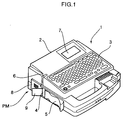
- a tape printing device 1 has a generally box shaped body frame 2.
- a keyboard 3 is disposed to a front portion of an upper wall of the body frame 2.
- the keyboard 3 serves as an input means and includes character keys for inputting alphabet letters, figures, symbols, and the like, a space key, a return key, cursor movement keys for moving a cursor leftward and rightward, a pause symbol registration key for providing a pause symbol registration mode, a tape length setting key for setting a tape length in a print region to be printed in a print tape 9, a currency rate setting key for setting a currency rate setting mode, a currency calculation process key for setting a currency calculation process mode, a currency invalidation setting key for setting a currency invalidation setting mode, an invalidation key for invalidating a currency symbol, a size setting key for setting the size of characters to be printed, an execution key for executing various processes, an end key for commanding ending of various setting processes, a print key for commanding printing, a delete key for deleting data from a memory,
- a printing mechanism PM is provided in the tape printing device 1, and a cover frame 8 is provided at a side wall of the body frame 2 and spanning to the rear surface thereof.
- the cover frame 8 enables attachment and detachment of a tape cassette CS (Fig. 2) to be mounted in the printing mechanism PM.
- the side wall is formed with a tape discharge port 4, and a cutter lever 5 is pivotally movably supported to the side wall of the body frame 2.
- the cutter lever 5 has a cutter (not shown) for manually cutting a print tape 9 taken out of the tape discharge port 4.
- a print lamp 6 is provided at the upper wall for indicating that printing is being performed.
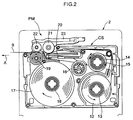
- the tape cassette CS and the printing mechanism PM are best shown in Fig. 2.
- the tape cassette CS has a rectangular-shape and is detachably mounted in the printing mechanism PM.
- the tape cassette CS is provided with a tape spool 13 wounded with a tape 12, such as a transparent laminate film tape 12 serving as a recording medium, a ribbon supply spool 15 wounded with a print ribbon 14, a take-up spool 16 for taking up the print ribbon 14, a supply spool 18 wounded with a double-sided adhesive tape 17, and an adhering roller 19 for adhering together the laminate film tape 12 and the double-sided adhesive tape 17. All the above-described spools and the roller are rotatably provided to the tape cassette CS.
- the double-sided adhesive tape 17 has a width the same as the laminate film tape 12 and is attached to its outer peripheral side with an exfoliation sheet. Further, the tape 12 is formed from a base tape. Both sides of the base tape are formed with an adhesive layer and one side of the base tape is attached with the exfoliation sheet.
- a thermal head 20 is provided in an upright posture to a position where the laminate film tape 12 and the print ribbon 14 overlap.
- the thermal head 20 is provided with a plurality of heat emitting elements vertically arrayed in line.
- a platen roller 21 is provided for pressing the laminate film tape 12 and the print ribbon 14 onto the thermal head 20.
- a feed roller 22 is provided to produce the print tape 9 by pressing the laminate film tape 12 and the double-sided adhesive tape 17 onto the adhering roller 19.
- the platen roller 21 and the feed roller 22 are rotatably supported by a support body 23 which is pivotally movably attached to the body frame 2.
- a tape feed motor 47 (Fig. 3) is drivingly connected to the adhering roller 19 and the tape-up spool 16.
- the adhering roller 19 and the take-up spool 16 are synchronously rotated in a predetermined direction.
- electrical current is supplied to the heat emitting elements, so that characters and symbols are formed on the laminate film tape 12 with a dot line basis.
- the laminate film tape 12 is adhered to the double-sided adhesive tape 17 to form the print tape 9, which is fed in a tape feed direction A and is discharged out of the body frame 2 as shown in Figs. 1 and 2.
- the printing mechanism PM per se is described in detail in Japanese Patent Application Publication (Kokai) HEI-2-106555.
- Each tape has a width of 6 mm, 9 mm, 12 mm, 18 mm, or 24 mm.
- a plurality of types of tape cassettes CS are available for each tape width.
- a color of the base tape forming the double-sided tape 17 and an ink color of the print ribbon 14 are selected from "black”, “red”, “blue”, “yellow", “white”, etc.
- the color of the base tape is a base color of the double-sided tape 17 and the color will be simply referred to as a color of the double-sided tape 17, hereinafter.
- the plurality of types of tape cassettes CS are prepared by freely combining a color of the double-sided tape 17 and an ink color of the print ribbon 14.
- a plurality of protrusions protrude from a bottom wall portion of the tape cassette CS.
- the protrusions are indicative of a tape width of five different kinds of tapes and a combination of color of double-sided tape 17 and the print ribbon 14.
- a tape width sensor 43 and a tape color sensor 44 are provided to the body frame 2 (see Fig. 3).
- the tape width sensor 43 is adapted for detecting a tape width based on a protruding fashion of the protrusions.
- the tape color sensor 44 is adapted for detecting a combined color of double-sided tape 17 and the print ribbon 14.
- a cassette switch 42 is also provided to the body frame 2 (see Fig. 3) for detecting whether a tape cassette CS selected from the plurality of tape cassettes CS is mounted in the body frame 2.
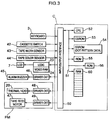
- a control system C of the tape printing device 1 includes an input/output interface 50 which is connected to the keyboard 3, the cassette switch 42, the tape width sensor 43, the tape color sensor 44, a display controller (LCDC) 23 having a video RAM 24 for outputting display data to the liquid crystal display (LCD) 7, a driver circuit 46 for an alarm buzzer 45, a driver circuit 48 for driving the thermal head 20, and a driver circuit 49 for driving the tape feed motor 47.
- LCDC display controller
- the control device C also includes a CPU 52, CGROMs 53 and 54, ROMs 55 and 56, and a RAM 60, those being connected to the input/output interface 50 via a data bus 51.
- the CGROM 53 stores therein dot pattern data corresponding to code data for displaying numerals, alphabet letters, and symbols.
- the CGROM (dot pattern data memory) 54 stores therein dot pattern data corresponding to code data for printing characters and the like.
- the dot pattern data include various type faces such as Gothic, Italic, and the like, and each type face has seven print character sizes (dot sizes of 16, 24, 32, 48, 64, 96, and 128). The various type faces and the size are all stored in the CGROM 54 for printing.
- the ROM 55 stores a variety of control programs including a display drive control program for controlling the display controller 23 in correspondence with code data for characters, such as letters, figures, and symbols, those inputted from the keyboard 3, a print drive control program for retrieving one data after another stored in a print data buffer 67 of the RAM 60 (Fig. 4) and driving the thermal head 20 or the tape feed motor 47, and a control program for tape printing control to be described later.
- a display drive control program for controlling the display controller 23 in correspondence with code data for characters, such as letters, figures, and symbols, those inputted from the keyboard 3, a print drive control program for retrieving one data after another stored in a print data buffer 67 of the RAM 60 (Fig. 4) and driving the thermal head 20 or the tape feed motor 47, and a control program for tape printing control to be described later.
- the ROM 55 also prestores, in terms of the number of dots, printable width data corresponding to each of five different tape widths of print tape 9.
- the ROM 56 serves as a currency symbol data memory and stores currency symbols corresponding to currencies of each country.
- the RAM 60 has a work buffer 61, a text memory 62, a currency symbol memory 63, an amount memory 64, a pause symbol memory 65, a tape length memory 66, the print data buffer 67, a printable width memory 68, and a currency conversion table memory 69.
- the work buffer 61 of the RAM 60 temporarily stores data inputted from the keyboard 3, calculation results, and the like.
- the text memory 62 stores data which has undergone various processes in the work buffer 61, and the stored data in the text memory 62 are used for ultimate printing.
- the currency symbol memory 63 stores currency symbol data affixed with a determination result of whether or not a currency symbol is valid, the currency symbol data having been retrieved from the ROM 56.
- the amount memory 64 stores an amount of an inputted standard currency.
- the pause symbol memory 65 stores therein an inputted pause symbol.
- the tape length memory 66 stores set tape length data SL in terms of the number of dots.
- the print data buffer 67 has a memory capacity consisting of 128 bits (16 bits) in a vertical direction and about 50 characters' worth of predetermined bits in a horizontal direction.
- the print data buffer 67 stores, as print data, dot image data for printing documents including characters and symbols.
- the printable width memory 68 stores printable width data TW corresponding to a tape width of the tape cassette CS mounted in the tape printing device 1.
- the currency conversion table memory 69 is provided with a currency conversion table.
- the currency conversion table stores an inputted currency symbol and a conversion rate of the inputted currency with respect to a standard currency.
- the inputted currency symbol and its conversion rate are stored after added with a number based on inputted order.
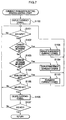
- the tape printing control routine shown in Fig. 5 is executed. First, each of memories 61, 62, and 64 through 68 of the RAM 60 are cleared and an initial setting process such as setting of a document input mode is performed in S1. Then in S10, a document input screen is displayed on the LCD 7. Incidentally, currency data and its conversion rate data those inputted in a previous process remain in the currency conversion table memory 69, and it is possible to use this currency conversion table for a currency calculation process. Also, the currency symbol memory 63 stores data for a currency symbol and data for indicating whether or not the currency symbol is valid.
- the above-described currency rate setting process control includes the step for determining whether or not a currency symbol is valid. This step is used for checking purpose when a currency becomes invalidated by the European currency integration or the like.
- the currency invalidation setting key is operated (S18:YES)
- the currency invalidation setting process control shown in S99 of Fig. 7 is executed, thereby storing in the currency symbol memory 63 currency symbol data and data as to whether or not the currency symbol is valid.
- the currency invalidation setting mode is provided by operating the currency invalidation setting key (S18:YES).
- the LCD 7 displays a first currency symbol retrieved to the work buffer 61 from currency symbol data stored in the ROM 56 (S100).
- the currency symbol data includes a currency symbol, a positional notation mark, a decimal point, a number given to each currency symbol, and a mark "E", for example, indicating that a currency symbol is valid.
- This currency invalidation setting process control ends when the end key is operated (S107:YES).
- currency symbol data stored in the work buffer 61 is transmitted to the currency symbol memory 63. If a user does not wish to print an amount in a standard currency, the standard currency can be invalidated in the above steps S104 and S110. The currency symbol memory 63 will not be cleared unless the currency determination key or the currency invalidation setting key is operated.
- a currency symbol registration mode is set by operating the currency symbol registration key and characters and symbols are inputted by operating the character keys, the inputted characters and the like can be stored in the RAM 60 as new currency symbols, decimal points and positional notation marks.
- an initial value setting process including clearance of the work buffer 61 is performed in S21 and a message reading "Amount?" is displayed on the LCD 7.
- an amount input process is ended and the inputted amount is stored in the amount memory 64 (S23).
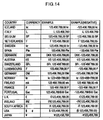
- This process is performed using currency symbol data (shown in Fig. 13) stored in the ROM 56.
- the resultant amount is stored in the text memory 62 after added with a currency symbol and its corresponding decimal point and positional notation mark stored in the ROM 56.
- a standard currency and all resultant amounts go through this process one after another before being stored in the text memory 62.
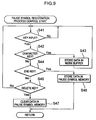
- pause symbol registration process control is started. First, a determination is made as to whether or not the key inputting operation has performed (S41). If input of the character keys such as "/", ".”, “:”, “*", "X", and the space key is performed (S41:YES, S42:YES), the inputted data is stored in the work buffer 61 (S43), and the routine returns to S41.
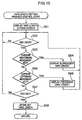
- a tape length setting screen showing that a set tape length is a minimum length of 2cm, for example, is displayed on the display 7 (S51).
- the cursor rightward movement key is operated (S52:YES, S53:YES)
- a subsequent set tape length is displayed in S54 and the program returns to S52.
- a set tape length is displayed while increasing by 1cm in order of "2cm", "3cm", “4cm”, "5cm ... "20cm”.
- "Auto” or "None” is displayed after "20cm", for example.
- the tape length setting process mode is turned off.
- the cursor leftward movement key is operated (S52:YES, S53:NO, S55:YES)
- a set tape length is displayed in the reverse order while decreasing by 1cm (S56) and the program returns to S52.
- the print process control (S60) shown in Fig. 11 will be started.
- a tape width signal from the tape width sensor 43 is read in S70.
- printable width data TW (the number of dots) corresponding to the tape width signal is retrieved from the ROM 55 and stored in the printable width memory 68.
- dot image data for printing concerning an amount or normal characters and the like added to the amount (hereinafter simply referred to as "text data"), those stored in the text memory 62 are produced and stored in the print data buffer 67.
- the number of dots data LL regarding the length of the text data and the number of dots MH regarding a maximum character height of the text data are determined.
- it is determined whether or not the dot image can be within a print region defined by the set tape length data (lengthwise length data) SL and the printable width data (widthwise length data) TW.
- the text data length data LL is smaller than the set tape length data SL (S74:YES) and the maximum character height data MH of the text data is smaller than the printable width data TW (S75:YES), the text data will fit in the print region. Consequently in S76, dot image data in the print data buffer 67 is outputted to the printing mechanism PM and the text data, for example, "1.500,00DM/$1,000.00" is printed on the print tape 9 (S76).
- a value (product price) in one currency can be converted to a value (product price) in another currency based on a conversion rate of the inputted currency with respect to a standard currency, and the converted value with an appropriate display style can be immediately printed on a recording medium, such as a tape, thereby easily producing a price tag and the like.
- a recording medium such as a tape
- the keyboard 3 is provided as the input means.
- a scanner or other transmission devices can be used as the input means.
- the recording medium is not limited to the above described tape medium, but can be any kind of medium as long as it is suitable for producing a price tag and the like.
- ROM 55 and 56 are provided.
- the ROM 55 and the ROM 56 can be configured from a single ROM.
- the currency rate setting key is provided for setting currency rate in S17 and S80.
- the currency rate setting key can be dispensed with.
- the currency rate setting mode can be set by pressing the execution key after inputting any character train indicating the currency rate.
- the a plurality of currency symbols and their conversion rates are stored in the currency conversion table memory 69 after repeating the steps S82 through S88. Instead, each time a currency and its conversion rate are inputted, they can be transmitted from the work buffer 61 to the currency conversion table memory 69. Also, a currency symbol for a standard currency and its conversion rate of "1" can be inputted at first.
- the currency symbol is inputted by operating keys.
- the ROM 56 can store currency symbols data, and a desired currency symbol can be inputted by retrieving currency symbols data stored in the ROM 56, displaying them in a chart, and selecting the desired currency symbol by operating a selection key.
- the inputted characters and the like can be supplemented as new currency symbols and positional notation marks, when a space is displayed on the LCD 7 by operating the cursor rightward movement key and characters and symbols are inputted by operating the character keys.
- step S26 all of a currency symbol, a decimal point, and positional notation marks do not have to be added. Some of them can be selected by operating a predetermined key for setting a proper mode and the desired symbol can be added as needed. For example, if a currency symbol and the amount are to be simply shown, a currency symbol addition mode will be set by operating a predetermined key. Thus, only the currency symbol can be added.
- an amount is inputted in a standard currency having a conversion rate of 1.00.
- a specific currency it is possible to set the designated currency as a standard currency and to input an amount in the designated currency.
- a process is performed for recalculating the currency conversion table stored in the currency conversion table memory 69 so as to change the conversion rate of the designated currency to 1.00. Then, based on the recalculated currency conversion table, the process control from S21 to S33 is performed.
- a plurality of pause symbols can be stored in the pause symbol memory 65 as a group of pause symbols.
- a plurality of groups of pause symbols can also be stored in the pause symbol memory 65. In the latter case, prior to printing operation, a desired one of the groups is selected and a desired one of the pause symbols can be selected from the selected group.
- the above described tape length setting process control (Fig. 10) can incorporate a character distance equalization process control for printing characters with an equal distance in a manner described in Japanese Patent Application Publication (Kokai) No. HEI-4-18508.
- a character input mode can be a default mode over the currency calculation mode, pause symbol registration mode, tape length setting mode, currency rate setting mode, and currency invalidation setting mode.
- a step S19 other key processing performs the character input process control like the step S35, so that code data corresponding to the input character data or space data is stored in the text memory 62 and the input character or space is displayed on LCD 7 in the step S19.
- a print selection mode is set by operating a currency print selection key, and currency symbols stored in the currency conversion table are displayed on the LCD 7 one after another.
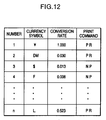
- letters "PR” for commanding print are inputted while a desired currency is displayed, this letters "PR” are stored in the currency conversion table memory 69.
- letters "NP" which is indicative of unwanted printing, are inputted, this letters "NP” are stored in the currency conversion table memory 69 (see Fig. 12, rightmost column).
- the print order of currencies can be selected. Then, by operating the print key, with respect to a currency symbol for which print has been commanded, it is determined whether or not data in the text memory 62 fits in the set tape length, and then, printing is performed.
Landscapes
- Engineering & Computer Science (AREA)
- Theoretical Computer Science (AREA)
- Computing Systems (AREA)
- Computer Hardware Design (AREA)
- Physics & Mathematics (AREA)
- General Engineering & Computer Science (AREA)
- General Physics & Mathematics (AREA)
- Record Information Processing For Printing (AREA)
- Printers Characterized By Their Purpose (AREA)
Applications Claiming Priority (6)
| Application Number | Priority Date | Filing Date | Title |
|---|---|---|---|
| JP10545898 | 1998-03-31 | ||
| JP10545698 | 1998-03-31 | ||
| JP10545698A JPH11277815A (ja) | 1998-03-31 | 1998-03-31 | 印刷装置 |
| JP10545798 | 1998-03-31 | ||
| JP10545798A JPH11277836A (ja) | 1998-03-31 | 1998-03-31 | 印刷装置 |
| JP10545898A JPH11277816A (ja) | 1998-03-31 | 1998-03-31 | 印刷装置 |
Publications (2)
| Publication Number | Publication Date |
|---|---|
| EP0947337A2 true EP0947337A2 (de) | 1999-10-06 |
| EP0947337A3 EP0947337A3 (de) | 2000-04-26 |
Family
ID=27310492
Family Applications (1)
| Application Number | Title | Priority Date | Filing Date |
|---|---|---|---|
| EP99105119A Withdrawn EP0947337A3 (de) | 1998-03-31 | 1999-03-25 | Druckvorrichtung |
Country Status (1)
| Country | Link |
|---|---|
| EP (1) | EP0947337A3 (de) |
Cited By (2)
| Publication number | Priority date | Publication date | Assignee | Title |
|---|---|---|---|---|
| WO2004081704A3 (en) * | 2003-03-12 | 2005-09-01 | Telecom Italia Spa | Electronic terminal having an upper cover with a display screen |
| US7960453B2 (en) | 2003-06-06 | 2011-06-14 | The Procter & Gamble Company | Crosslinking systems for hydroxyl polymers |
Family Cites Families (6)
| Publication number | Priority date | Publication date | Assignee | Title |
|---|---|---|---|---|
| US4192006A (en) * | 1978-08-07 | 1980-03-04 | Hausdorff Harry H | Portable travel expense tabulator |
| JPS60143971A (ja) * | 1983-12-30 | 1985-07-30 | Sato :Kk | ドツト式値札印字装置 |
| JPH04501028A (ja) * | 1988-07-28 | 1992-02-20 | ブリティッシュ エアウェイズ パブリック リミテッド カンパニー | 取引き記録装置 |
| GB9212439D0 (en) * | 1992-06-11 | 1992-07-22 | Esselte Dymo Nv | Label printing apparatus |
| DE29721337U1 (de) * | 1997-12-03 | 1998-02-19 | Meto International GmbH, 69434 Hirschhorn | Handetikettiergerät mit Rechnerfunktion |
| GB9806717D0 (en) * | 1998-03-27 | 1998-05-27 | Esselte Nv | Tape printing apparatus |
-
1999
- 1999-03-25 EP EP99105119A patent/EP0947337A3/de not_active Withdrawn
Cited By (9)
| Publication number | Priority date | Publication date | Assignee | Title |
|---|---|---|---|---|
| WO2004081704A3 (en) * | 2003-03-12 | 2005-09-01 | Telecom Italia Spa | Electronic terminal having an upper cover with a display screen |
| US8550923B2 (en) | 2003-03-12 | 2013-10-08 | Telecom Italia S.P.A. | Electronic terminal having an upper cover with a display screen |
| US7960453B2 (en) | 2003-06-06 | 2011-06-14 | The Procter & Gamble Company | Crosslinking systems for hydroxyl polymers |
| US8088843B2 (en) | 2003-06-06 | 2012-01-03 | The Procter & Gamble Company | Crosslinking systems for hydroxyl polymers |
| US8129449B2 (en) | 2003-06-06 | 2012-03-06 | The Procter & Gabmle Company | Crosslinking systems for hydroxyl polymers |
| US8357237B2 (en) | 2003-06-06 | 2013-01-22 | The Procter & Gamble Company | Crosslinking systems for hydroxyl polymers |
| US8617303B2 (en) | 2003-06-06 | 2013-12-31 | The Procter & Gamble Company | Crosslinking systems for hydroxyl polymers |
| US8815003B2 (en) | 2003-06-06 | 2014-08-26 | The Procter & Gamble Company | Crosslinking systems for hydroxyl polymers |
| US9340657B2 (en) | 2003-06-06 | 2016-05-17 | The Procter & Gamble Company | Crosslinking systems for hydroxyl polymers |
Also Published As
| Publication number | Publication date |
|---|---|
| EP0947337A3 (de) | 2000-04-26 |
Similar Documents
| Publication | Publication Date | Title |
|---|---|---|
| EP0652110B1 (de) | Banddruckgerät mit manueller Bandschneidevorrichtung | |
| EP0577247B1 (de) | Streifendrucker | |
| EP0661656B1 (de) | Streifendrucker | |
| US5393147A (en) | Tape printing device for printing characters and frames | |
| EP0862517B1 (de) | Streifendrucker | |
| US5857789A (en) | Tape printer for bar code printing | |
| EP0841177B1 (de) | Banddruckgerät | |
| US6247860B1 (en) | Image-printing method and device | |
| US6293717B1 (en) | Tape printing apparatus and tape printing method | |
| US6276851B1 (en) | Tape printing apparatus and tape length-setting method | |
| EP0947337A2 (de) | Druckvorrichtung | |
| US6587216B1 (en) | Image-forming method and device | |
| JPH11277817A (ja) | 印刷装置 | |
| JPH07137377A (ja) | テープ印刷装置 | |
| JPH07125312A (ja) | バーコード印刷装置 | |
| US5924106A (en) | Tape printing device and method | |
| JP3050344B2 (ja) | 印字装置 | |
| US20010035964A1 (en) | Tape cartridge, tape printing method, tape printing apparatus, and label-producing method | |
| JPH11277815A (ja) | 印刷装置 | |
| EP0660248B1 (de) | Textverarbeitungsgerät | |
| JPH11277836A (ja) | 印刷装置 | |
| JPH11277816A (ja) | 印刷装置 | |
| JP2000033742A (ja) | テープ印刷装置 | |
| JPH07205482A (ja) | テープ印刷装置 | |
| JP3189924B2 (ja) | テープ印刷装置 |
Legal Events
| Date | Code | Title | Description |
|---|---|---|---|
| PUAI | Public reference made under article 153(3) epc to a published international application that has entered the european phase |
Free format text: ORIGINAL CODE: 0009012 |
|
| AK | Designated contracting states |
Kind code of ref document: A2 Designated state(s): BE CH DE DK FR GB LI LU NL |
|
| AX | Request for extension of the european patent |
Free format text: AL;LT;LV;MK;RO;SI |
|
| PUAL | Search report despatched |
Free format text: ORIGINAL CODE: 0009013 |
|
| AK | Designated contracting states |
Kind code of ref document: A3 Designated state(s): AT BE CH CY DE DK ES FI FR GB GR IE IT LI LU MC NL PT SE |
|
| AX | Request for extension of the european patent |
Free format text: AL;LT;LV;MK;RO;SI |
|
| RIC1 | Information provided on ipc code assigned before grant |
Free format text: 7B 41J 3/407 A, 7G 06F 15/02 B |
|
| 17P | Request for examination filed |
Effective date: 20000929 |
|
| AKX | Designation fees paid |
Free format text: BE CH DE DK FR GB LI LU NL |
|
| 17Q | First examination report despatched |
Effective date: 20040924 |
|
| STAA | Information on the status of an ep patent application or granted ep patent |
Free format text: STATUS: THE APPLICATION IS DEEMED TO BE WITHDRAWN |
|
| 18D | Application deemed to be withdrawn |
Effective date: 20050205 |