EP0948158A2 - Verfahren zur sicheren Schlüsselverteilung - Google Patents
Verfahren zur sicheren Schlüsselverteilung Download PDFInfo
- Publication number
- EP0948158A2 EP0948158A2 EP99250080A EP99250080A EP0948158A2 EP 0948158 A2 EP0948158 A2 EP 0948158A2 EP 99250080 A EP99250080 A EP 99250080A EP 99250080 A EP99250080 A EP 99250080A EP 0948158 A2 EP0948158 A2 EP 0948158A2
- Authority
- EP
- European Patent Office
- Prior art keywords
- key
- message
- kek
- devices
- server
- Prior art date
- Legal status (The legal status is an assumption and is not a legal conclusion. Google has not performed a legal analysis and makes no representation as to the accuracy of the status listed.)
- Withdrawn
Links
Images


Classifications
-
- H—ELECTRICITY
- H04—ELECTRIC COMMUNICATION TECHNIQUE
- H04L—TRANSMISSION OF DIGITAL INFORMATION, e.g. TELEGRAPHIC COMMUNICATION
- H04L9/00—Cryptographic mechanisms or cryptographic arrangements for secret or secure communications; Network security protocols
- H04L9/08—Key distribution or management, e.g. generation, sharing or updating, of cryptographic keys or passwords
- H04L9/0816—Key establishment, i.e. cryptographic processes or cryptographic protocols whereby a shared secret becomes available to two or more parties, for subsequent use
- H04L9/0819—Key transport or distribution, i.e. key establishment techniques where one party creates or otherwise obtains a secret value, and securely transfers it to the other(s)
- H04L9/083—Key transport or distribution, i.e. key establishment techniques where one party creates or otherwise obtains a secret value, and securely transfers it to the other(s) involving central third party, e.g. key distribution center [KDC] or trusted third party [TTP]
-
- G—PHYSICS
- G07—CHECKING-DEVICES
- G07B—TICKET-ISSUING APPARATUS; FARE-REGISTERING APPARATUS; FRANKING APPARATUS
- G07B17/00—Franking apparatus
- G07B17/00016—Relations between apparatus, e.g. franking machine at customer or apparatus at post office, in a franking system
- G07B17/0008—Communication details outside or between apparatus
-
- G—PHYSICS
- G07—CHECKING-DEVICES
- G07B—TICKET-ISSUING APPARATUS; FARE-REGISTERING APPARATUS; FRANKING APPARATUS
- G07B17/00—Franking apparatus
- G07B17/00733—Cryptography or similar special procedures in a franking system
-
- G—PHYSICS
- G07—CHECKING-DEVICES
- G07B—TICKET-ISSUING APPARATUS; FARE-REGISTERING APPARATUS; FRANKING APPARATUS
- G07B17/00—Franking apparatus
- G07B17/00016—Relations between apparatus, e.g. franking machine at customer or apparatus at post office, in a franking system
- G07B17/0008—Communication details outside or between apparatus
- G07B2017/00145—Communication details outside or between apparatus via the Internet
-
- G—PHYSICS
- G07—CHECKING-DEVICES
- G07B—TICKET-ISSUING APPARATUS; FARE-REGISTERING APPARATUS; FRANKING APPARATUS
- G07B17/00—Franking apparatus
- G07B17/00016—Relations between apparatus, e.g. franking machine at customer or apparatus at post office, in a franking system
- G07B17/0008—Communication details outside or between apparatus
- G07B2017/00153—Communication details outside or between apparatus for sending information
- G07B2017/00161—Communication details outside or between apparatus for sending information from a central, non-user location, e.g. for updating rates or software, or for refilling funds
-
- G—PHYSICS
- G07—CHECKING-DEVICES
- G07B—TICKET-ISSUING APPARATUS; FARE-REGISTERING APPARATUS; FRANKING APPARATUS
- G07B17/00—Franking apparatus
- G07B17/00733—Cryptography or similar special procedures in a franking system
- G07B2017/00846—Key management
- G07B2017/00854—Key generation
-
- G—PHYSICS
- G07—CHECKING-DEVICES
- G07B—TICKET-ISSUING APPARATUS; FARE-REGISTERING APPARATUS; FRANKING APPARATUS
- G07B17/00—Franking apparatus
- G07B17/00733—Cryptography or similar special procedures in a franking system
- G07B2017/00846—Key management
- G07B2017/0087—Key distribution
-
- G—PHYSICS
- G07—CHECKING-DEVICES
- G07B—TICKET-ISSUING APPARATUS; FARE-REGISTERING APPARATUS; FRANKING APPARATUS
- G07B17/00—Franking apparatus
- G07B17/00733—Cryptography or similar special procedures in a franking system
- G07B2017/00959—Cryptographic modules, e.g. a PC encryption board
- G07B2017/00967—PSD [Postal Security Device] as defined by the USPS [US Postal Service]
Definitions
- the invention relates to a method for secure key distribution a secure key distribution center according to the generic term of Claim 1.
- the invention is for the manufacture and initialization of Franking devices consisting of at least two devices are suitable, which together form an open system but are forgery-proof Can exchange data.
- Data transferred over an insecure channel must have the data on it another appropriate way against tampering with Intention to forgery are protected. For example, may recorded data transfer signals do not become one unpredictable reprints if they are Printhead are transmitted.
- EP 716 398 A2 discloses a franking machine with an extended one Print head hardware and with a special print data control in known to an ASIC.
- the ASIC allows communication with the sensors and actuators and on the other hand the transmission of a Activation codes and receipt of an acknowledgment code followed by Comparison.
- Both, the special print data control as well that of an advanced printhead hardware, are with a code generator equipped with a unique code for each print image transfer generated.
- the ASIC is used for communication with the print head as a security module.
- the printhead itself is extended Printhead hardware equipped to check a Received unlock codes is designed to the print head for unlock exactly one impression.
- a mail processing system with a computer-controlled one printing machine base station has an in a personal computer built-in security module, which with the printhead electronics communicate via a serial interface. It is also provided that the printhead electronics Authenticity of at least some of those from the security module supplied print data is checked. Prerequisite for generation code or encryption is a suitable algorithm or encryption algorithm with corresponding keys.
- the invention has for its object one for franking machines to develop a suitable procedure for secure key distribution in order to to equip a number of devices with a common key, without the key falling into the hands of an unauthorized party.
- the invention is based on a server, which acts as a third device the first and second devices with the one for key exchange required shared secret encryption key equips when requested. Likewise, several Devices of a system in pairs with a shared secret Encryption key.
- the server holds a number of related device-specific Master keys stored in the event that a common secret encryption key is requested.
- One of device-specific master key is identical to one at the Manufacture, preferably before assembling the first device, in first device saved master key.
- the other device-specific Master key is identical to one in the second device Master key.
- Each of the two devices is thus able to decrypt only one message intended for the device. It it is provided that the message has a secret first encryption key contains in encrypted form and after the first Commissioning of a system consisting of both devices is requested by one of the two devices. Preferably only that Meter equipped with a modem. Thus, the request from Meter to the server to send such a message to the meter.
- the Message is in two parts according to the two devices that interface are connected and should communicate.
- the meter forwards a message part intended for the base.
- a further two devices in a system can also be used with one shared secret key by forwarding the message and their device-specific decryption, if the Devices are connected to one another in terms of interfaces.
- the server receives the request, generates the required one common encryption key and forms the two parts of the Message corresponding to the identity of the devices to be notified.
- a two-part system consisting of meter and base
- the two-part message with the identity data of the meter and the base requested.
- Each of the message parts is formed with that of the device-specific master key assigned to each identity, which is also stored in the corresponding device so that it cannot be read for which the message part is intended.
- the Message part forwarded After receiving the message in the requesting device, the Message part forwarded, which is not for the requesting device is determined. The part of the message that is not forwarded is in the requesting device and the forwarded message part is in the decrypted another device.
- the shared encryption key is saved in every device and is now available for a secret key exchange of a session key Available.
- the device-specific master keys are read-out and the identity data is stored in a forgery-proof manner. Which Devices in a system are considered to belong together, depends on which device-specific identity data are assigned to each other. Such affiliations can be entered into by an authorized person Meters can be entered or generated and saved as required. she are available in the event that one of the devices is replaced or the system should be supplemented with a suitable device.
- a delivered device contains in its through a security housing secured non-volatile memory only identification data and the specific master key secured against external readout saved. Such a device would normally have to be destroyed to get the specific master key, which but does not match any other device.
- An advantage of the invention is that the shared secret Encryption key changed via insecure channels or can be replaced. So the encryption keys not during the manufacture of the device in one associated memory of the device can be stored in a non-volatile manner.
- Encryption key Due to a limited validity of the shared secret Encryption key becomes a possible misuse of one compromised system limited to short periods. Even if by researching the shared secret encryption key a whole system is compromised, but then it would be a other whole system is not yet compromised.
- FIG. 1 shows an arrangement for equipping two stores Devices of a system for equipping them with a master key through a third device.
- the memory will be a first and form second parties A and B.
- the stores are in themselves known - not shown - used device for equipping of storage with data is formed and with a server 34 in Connection is established.
- the server 34 is part of a secure Key distribution center 30 and forms a third party involved.
- On programmable non-volatile memory device is, for example EEPROM.
- the equipment takes place in a secure environment 50, 60 at the manufacturer of the devices of the system or the franking device, for example by loading the unencrypted master key and Identification data and, if applicable, further data in the for this provided memory areas or by programming a Memory module.
- a secure channel 36 for example a secure data line 36 between the secured key distribution center 30 and the secure environments 50 and 60.
- secure environments 50, 60 is preferably a commercially available programming device for programming arranged a memory chip.
- the programming device is with corresponding connected to the secure data line 36 Receiving means or input means equipped. For example, should an EEPROM can be programmed.
- Another variant provides for the programming non-volatile memory module first into the device 10, 20 installed and then programmed, the device 10, 20 itself is trained for programming.
- the first device is, for example, one equipped with a modem 15 Meter 10, which with a modem 33 of the key distribution center via the secure data line 36 in communication connection brought.
- the meter itself has no pressure device but serves in normal operation only as a secure booking facility, which with input and output means together in a safety housing 16 is housed. External printing device can be used for normal operation through an unsecured channel, such as an unsecured one Data line 23 are connected.
- One meter can be one Security module with a security housing included.
- the Security module preferably contains an OTP processor (one time programmable), a hardware accounting circuit and memory for Storage of accounting data in postal registers.
- the OTP processor has a data processing and storage capacity for special Applications or special modes.
- Such a special mode for memory programming can of course only from the manufacturer itself, for example via the keyboard of the meter and / or by means of a special one Master chip card, can be set.
- a block diagram for one meter with a security module to which the printer is connected for example from European patent application EP 789 333 A2 forth.
- a personal computer can be a modem and that Safety module with the safety housing included.
- Such Solution is presented in more detail in the unpublished German Patent application 197 11 998.0 with the title: Mail processing system with a printing machine base station controlled by a personal computer.
- the second device is preferably one in a secure environment 60 arranged commercial programming device for programming an EEPROM, the EEPROM for example for a printhead is provided.
- the second device can also be a printer 20 in which the printhead is inserted, which with the ability for programming an EPROM.
- the memory chip also contains data that identify the Enable device in which it should or should be installed.
- the Memory block can also contain parameter data in order to to enable certain functions of the device,
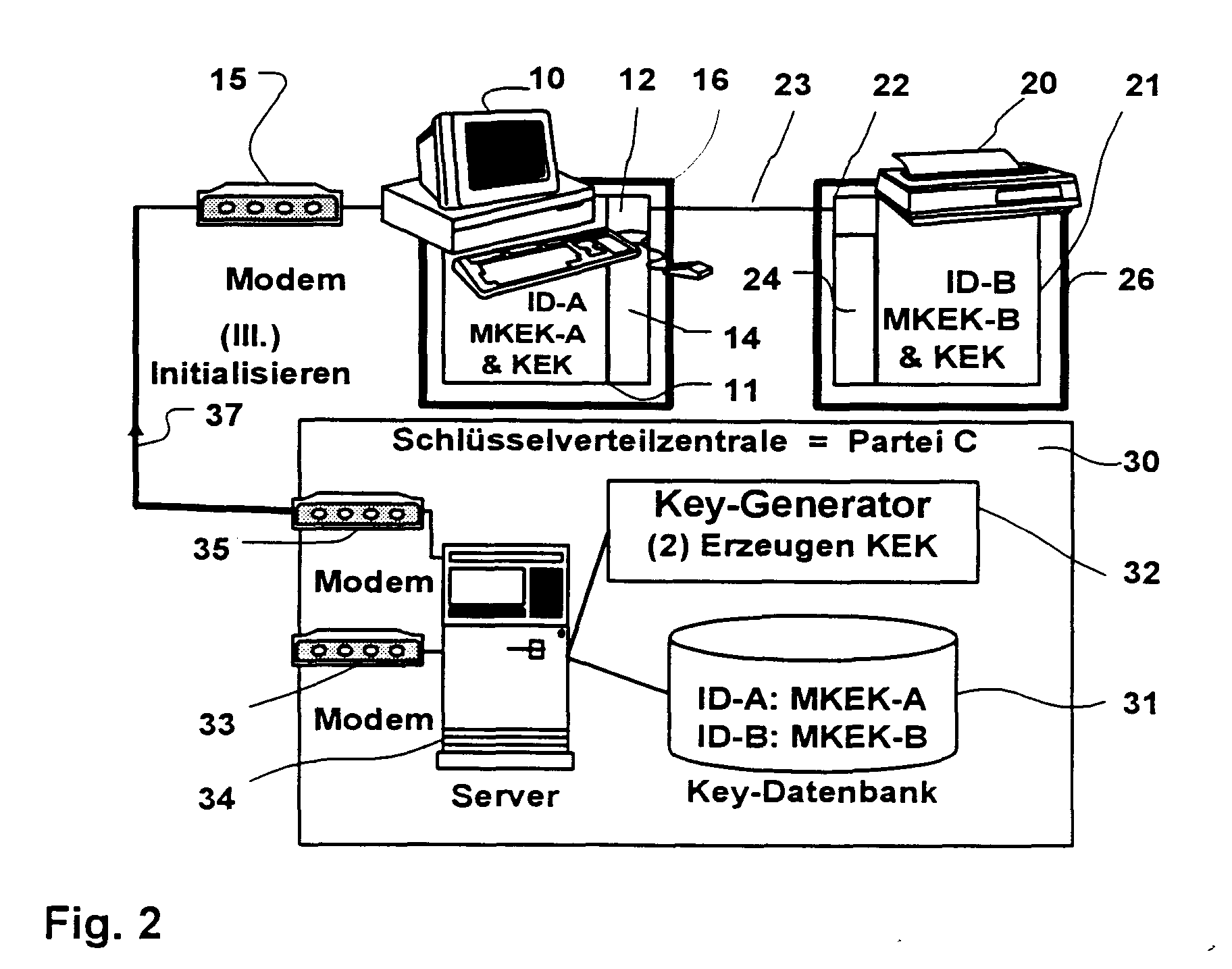
- the second device 2 shows an arrangement of two devices of a system for their initialization by means of a third device.
- the data to be transmitted are encrypted by the server 34 of the key distribution center 30 and sent via modem 35, an unsecured line 37 and via a modem 15 to a first device 10.
- the memory 11 secured by a security housing 16 is installed in the first device 10.
- a data processing unit, preferably an OTP processor 14, and an interface 12 are also arranged in the security housing 16, and are connected to one another in terms of circuitry and to the memory 11.
- the first device 10 is connected to an interface 22 of the second device 20 via the interface 12 and a second unsecured line 23.
- the memory 21 secured by a safety housing 26 is installed in the second device 20.
- a data processing unit, preferably an OTP processor 24, and the interface 22 are also arranged in the security housing 26, and are connected to one another in terms of circuitry and to the memory 21.
- the special data processing and storage capacity is designed for applications such as communication between communication partners and also extends to special functions or special modes. Such a special mode for memory programming is set the first time or when a system is reinitialized with the same or other exchanged devices.
- the secured memories 11, 21 initially contain only identification data and the device-specific master key.
- the data to be transmitted to the second device 20 are encrypted by the server 34 of the key distribution center 30 with the master key and sent via modem 35, the unsecured channel (for example a line 37) and via a modem 15 to a first device 10 and then to the second device 20 forwarded.
- the encrypted transmitted data can be decrypted with the master key and relate to another encryption key KEK generated by the key generator 32.
- FIG. 4 shows a representation of the distribution of session keys on two devices of the system. There are only two in the distribution process Parties A, B involved. As a result of the distribution are in each of the first and second devices then in addition to the encryption key KEK and the device-specific secret master key MKEK-x also a session key SK readout-protected in one Memory stored non-volatile.
- a first device can also be a PSD (Postage Security Device) for one Computer and a second device can have a base, especially one with appropriate electronics equipped printhead or a printer which is not physically connected to the meter or PSD.
- the Data to be transmitted over an unsecured line are sent to the Session key SK encrypted.
- the secret key exchange of session keys SK is in itself out EP 782 111 A2 known.
- the meter generates before each data transfer a session key with which data is to be encrypted. What is new is that the meter is the session key for each involved transmits another device in encrypted form. For encryption and decryption is the common encryption key, which is stored in every device in a secure manner. The respective Device overwrites the saved session key the new valid session key. So one can Session keys are changed with which data is encrypted which can then be transferred.
- the encryption key KEK is changed.
- the encryption key can be changed by the request of the aforementioned message M in Periods from the requesting device is repeated.
- the Common secret encryption keys are valid can thus be limited to a degree so that manipulation in Intention to forgery even when using the latest methods of Cryptanalysis becomes hopeless.
- Encryption for the message M can be linked to transmitting key with a monotonously increasing or precede falling size.
- Linking the to be transmitted Key with the monotonously increasing or decreasing size takes place in the server before encryption to message M and its Transmission.
- the monotonously increasing or decreasing size lies in every device involved in the system also saved before and it a previously recorded message M 'is distinguished from a new message M from the server based on this size.
- the key to be transmitted is XORed with a sequential number before encryption. A possible interception and changing the message or transmitting and forwarding one previously recorded message to the system's devices would be so also an unsuccessful attack.
- the devices involved can do one earlier recorded message based on the monotonously increasing or determine the falling size directly or indirectly.
- a scenario for a fourth party D attack could be in there exist that the attacker is the communication between the parties A and C, i.e. Meters and servers, overheard and the exchanged messages, especially copied the message Mc from Sever to meter.
- the Attackers rent computing time on suitable fast computers and compromises the shared secret encryption key CEC between parties A and B, i.e. Meters and base.
- An XOR operation is suitable as a second mathematical function. It is provided that current for the two communication partners A, B. Master session key MSK-A, MSK-B by XOR linking the determined current counts CA, CB with the respective device-specific master key MKEK-A, MKEK-B can be generated.
- the data encryption standard (DES), for example, is suitable as the encryption algorithm ENCRYPT.
- the function F limits the data length of the message M1, M2 to be encrypted. For example, a truncation rule known per se can be used for the shortening.
- the KEK is the key for DES encryption of the shortened message, whereby the shortened message may only be 64 bits long.
- a modified CBC mode can advantageously be used to shorten the message M1, M2, in contrast to the CBC mode only a last encrypted data word formed being used as the digital signature.
- the message is shortened to 64 bits by dividing the message into groups G1, G2, G3, ..., Gn of 8 bytes each.
- the group G1 is first encrypted with the KEK according to the DES algorithm to a data word S0 of 64 bits in length.
- the data word S0 is linked to the second group G2 using the XOR function and then encrypted with the KEK according to the DES algorithm to form a data word S1 of 64 bits in length.
- the data word S1 is linked to the third group G3 by means of the XOR function and then encrypted with the KEK according to the DES algorithm to a data word S2 of 64 bits in length.
- the last data word Sn-1 that arises according to this educational instruction has a length of 64 bits and serves as a signature.
- a new current one is advantageously generated Master session key (MSK-A 'or MSK-B') and the verification in the two devices involved only after successful evaluation in other device (step 4.2) and if a second feedback message (N2) was formed and transmitted.
- This elaborate generation and the verification thus remains in the case of an error and manipulation-free transmission of the message M limited.
- the transmission is successful terminated and the connection interrupted. Otherwise, in the event of an error, the meter reading is resynchronized by the server opening the meter a counter reading communicated in the feedback message Device sending the feedback message.
- Another way to increase security before an attack is based on the use of the aforementioned secret key distribution method for secret key exchange of a large number (set) shared secret encryption keys. The latter are only for a certain period of time or only for a certain number Key exchange of session keys SK valid.
- the application of the The aforementioned secret key distribution method can then already at the manufacturer or another suitable place, which precludes or at least precludes an attack on key security significantly restricted.
- the multitude of shared secret encryption keys can be assigned in a predetermined order with each Validity criterion advantageous in the form of a list in the relevant Devices.
- a generation is now generated Session key SK in one of the devices of the system removed from the Key distribution center 30 and access to the stored currently valid shared secret encryption key KEK in the case of a secret key exchange of session keys SK between the devices of the system, the aforementioned KEK encryption key only for a certain period of time or for a certain number of key exchanges from Session keys SK is valid.
- a list for several communication partners can also be saved the list for one communication partner for each currently valid shared secret encryption key having.
Landscapes
- Engineering & Computer Science (AREA)
- Physics & Mathematics (AREA)
- General Physics & Mathematics (AREA)
- Theoretical Computer Science (AREA)
- Computer Security & Cryptography (AREA)
- Computer Networks & Wireless Communication (AREA)
- Signal Processing (AREA)
- Storage Device Security (AREA)
Abstract
Description
- Fig. 1,
- Anordung zur Ausstattung von Speichern mit einem Masterschlüssel,
- Fig.2,
- Anordung von zwei Geräten eines Systems zu deren Initialisierung mittels eines dritten Gerätes,
- Fig.3,
- Darstellung einer Initialisierung von zwei Geräten des Systems,
- Fig.4,
- Darstellung der Sitzungsschlüsselverteilung auf zwei Geräte des Systems,
- Fig.5,
- Details der Initialisierung von zwei Geräten des Systems.
Über die Schnittstelle 12 und einer zweiten ungesicherten Leitung 23 ist das erste Gerät 10 mit einer Schnittstelle 22 des zweiten Gerätes 20 verbunden. In das zweite Gerät 20 ist der durch ein Sicherheitsgehäuse 26 gesicherte Speicher 21 eingebaut. Im Sicherheitsgehäuse 26 sind außerdem eine Datenverarbeitungseinheit, vorzugsweise ein OTP-Prozessor 24, und die Schnittstelle 22 angeordnet, und miteinander und mit dem Speicher 21 schaltungsmäßig verbunden. Die spezielle Datenverarbeitungs- und Speicherkapazität ist für solche Anwendungen, wie die Kommunikation zwischen Kommunikationspartner ausgebildet und ersteckt sich auch auf besondere Funktionen bzw. Sondermodi. Ein solcher Sondermodus zur Speicher-Programmierung wird bei der erstmaligen bzw. bei einer erneuten Initialisierung eines Systems mit den selben oder anderen ausgetauschen Geräten eingestellt.
Die gesicherten Speicher 11, 21 enthalten herstellermäßig zunächst nur Identifikationsdaten und den gerätespezifischen Masterschlüssel. Die an das zweite Gerät 20 zu übermittelnden Daten werden vom Server 34 der Schlüsselverteilzentrale 30 mit dem Masterschlüssel verschlüsselt und über Modem 35, den ungesicherten Kanal (z.B. eine Leitung 37) und über ein Modem 15 an ein erstes Gerät 10 gesendet und dann zum zweiten Gerät 20 weitergeleitet. Die verschlüsselt übermittelten Daten können mit dem Masterschlüssel entschlüsselt werden und betreffen einen weiteren vom Schlüsselgenerator 32 erzeugten Verschlüsselungsschlüssel KEK.
Claims (10)
- Verfahren zur sicheren Schlüsselverteilung mit einer sicheren Schlüsselverteilzentrale, gekennzeichnet durch die folgenden Schritte:(I) Erzeugen mindestens zweier gerätespezifischer Masterschlüssel in einer sicheren Schlüsselverteilzentrale (30),(II) Ausstatten von Speichern von Geräten (i0), die zu einem System gehören, mit dem zugehörigem Masterschlüssel (MKEK-i), während der Herstellung der Geräte in einem gesicherten Bereich (50, 60),(III) Verbinden der Geräte (10, 20,.., i0,..., x0) zu einem System und Initialisierung der zum System verbundenen Geräte (10, 20,.., i0,..., x0) über einen ungesicherten Kanal (37) mit Generierung, verschlüsselter Übermittlung von der sicheren Schlüsselverteilzentrale (30) und nichfflüchtiges Speichern eines entschlüsselten gemeinsamen geheimen Verschlüsselungsschlüssels (KEK) auslesesicher in den Speichern der Geräte des Systems, wobei jeweils zwei der Geräte (10, 20,.., i0,..., x0), welche miteinander kommunizieren sollen, mit einem geheimen gemeinsamen Verschlüsselungsschlüssel (KEK) ausgestattet werden.
- Verfahren, nach Anspruch 1, gekennzeichnet durch die folgenden Schritte:(I) Erzeugen mindestens zweier gerätespezifischer Masterschlüssel in einem Schlüsselgenerator (32) einer sicheren Schlüsselverteilzentrale (30) und Speicherung jedes der gerätespezifischen Masterschlüssel zugeordnet zu Identifikationsdaten ID-x des Gerätes in einer vor einem ungesicherten Auslesen geschützten Datenbank (31), so daß für jedes Gerät (10, 20,...,i0,..., x0) eines Systems ein separater Masterschlüssel (MKEK-i) zur Verfügung steht, wobei die Datenbank (31) über einen Server (34) der Schlüsselverteilzentrale (30) mit dem Schlüsselgenerator (32) verbunden ist,(II) Ausstatten von Speichern der zu dem System gehörigen Geräte (10, 20,..,i0,..., x0) mit dem zugehörigem Masterschlüssel (MKEK-i) während der Herstellung der Geräte, wobei das Ausstatten durch ein gesichertes Auslesen der Datenbank (31) des Servers und Laden des Masterschlüssels (MKEK-i) in einen Speicher (11, 21,..., i1,..., x1) des hergestellten über Identifikationsdaten ID-i identifizierbaren Gerätes (10, 20,.., i0,..., x0) bzw. durch Programmieren des Speichers vor dem Zusammenbau des Gerätesystems erfolgt,(III) Verbinden der Geräte (10, 20,.., i0,..., x0) zu einem System und Initialisierung der zum System verbundenen Geräte (10, 20,.., i0,...,x0) mit(1) Anfordern einer Nachricht (M) einschließlich der Übermittlung zweier Identifikationsdaten (ID-A, ID-B) zweier Kommunikationspartner (A, B) an den Server (34), wobei das Anfordern von einem der Geräte (10, 20,.., i0,..., x0) nach dem Zusammenbau des Gerätesystems bei Inbetriebnahme des Systems während einer Kommunikationsverbindung mit dem Server erfolgt,(2) Generieren eines gemeinsamen geheimen Verschlüsselungsschlüssels (KEK) durch einen Key-Generator (32) des Servers (34) und Bilden von Teilen (M1, M2) der Nachricht (M) im Server (34) für die zwei Kommunikationspartner (A, B) entsprechend zweier benachbarter Geräte, wobei das Bilden jedes der Nachrichtenteile mit dem jeweiligen gerätespezifischen Masterschlüssel erfolgt, welcher sowohl in der Datenbank (31) des Servers (34) als auch im entsprechenden Gerät auslesesicher gespeichert vorliegt, für welches der Nachrichtenteil bestimmt ist,(3) Senden der Nachricht (M) an das anfordernde Gerät (10),(4) Empfangen der Nachricht im anforderndem Gerät und Weiterleiten mindestens eines Nachrichtenteils (M2), welcher nicht für das anfordernde Gerät (10) bestimmt ist,(5a) Entschlüsseln eines ersten Nachrichtenteils (M1) im anfordernden Gerät (10) und Speichern des entschlüsselten gemeinsamen geheimen Verschlüsselungsschlüssels (KEK) auslesesicher im Speicher (11) des anfordernden Geräts (10), sowie(5b) Entschlüsseln des weitergeleiteten Nachrichtenteils (M2) mindestens in einem anderen Gerät (20) und Speichern des entschlüsselten gemeinsamen geheimen Verschlüsselungsschlüssels (KEK) auslesesicher im Speicher (21) des anderen Geräts (20).
- Verfahren, nach Anspruch 2, dadurch gekennzeichnet - daß ein gesichertes Auslesen der Datenbank (31) des Servers über eine gesicherte Leitung (36) und ein Laden des Masterschlüssels (MKEK-i) in einen Speicher (11, 21,..., x1) des hergestellten Gerätes (10, 20,.., x0) vor dem Zusammenbau des Gerätesystems in einer vor Manipulation gesicherten Umgebung des Herstelles erfolgt und - daß ein Initialisieren der Geräte des Systems erfolgt, wobei nach einem Senden der Nachricht (M) an das anfordernde Gerät (10, 20 oder x0) über einen ungesicherten Kanal (37) ein Löschen des generierten gemeinsamen Verschlüsselungsschlüssels (KEK) im Arbeitsspeicher des Servers (34) nur dann erfolgt, wenn die Nachricht an das anfordernde Gerät abgesendet wurde
- Verfahren, nach Anspruch 3, gekennzeichnet durch eine Verküpfung des zu übermittelnden gemeinsamen Verschlüsselungsschlüssels (KEK) mit einer monoton stetig steigenden oder fallenden Größe im Server vor einer Verschlüsselung zur Nachricht M und deren Übermittlung, wobei die monoton stetig steigende oder fallende Größe in jedem im System beteiligtem Gerät ebenfalls gespeichert vorliegt und durch ein Unterscheiden einer früher aufgezeichneten Nachricht M' von einer neuen Nachricht M des Servers anhand dieser Größe.
- Verfahren, nach Anspruch 4, gekennzeichnet dadurch, daß die vorgenannte Größe ein Zählstand eines Zählers ist.
- Verfahren, nach Anspruch 4, gekennzeichnet dadurch, daß der Verschlüsselungsschlüssel (KEK) gewechselt wird.
- Verfahren, nach Anspruch 6, gekennzeichnet dadurch, daß der Verschlüsselungsschlüssel gewechselt wird, indem die Anforderung der vorgenannten Nachricht M in Zeitabständen vom anfordernden Gerät wiederholt wird.
- Verfahren, nach Anspruch 2, gekennzeichnet durch eine Generierung eines Sitzungsschlüssels (SK) in einem der Geräte des Systems entfernt von der Schlüsselverteilzentrale (30) und durch einen Zugriff auf den gespeicherten aktuell gültigen gemeinsamen geheimen Verschlüsselungsschlüssels (KEK) im Falle eines geheimen Schlüsseltausches von Sitzungsschlüsseln (SK) zwischen den Geräten des Systems, wobei der vorgenannte Verschlüsselungsschlüssels KEK nur nur einen bestimmten Zeitperiode oder für eine bestimmte Anzahl an Schlüsseltauschen von Sitzungsschlüsseln SK gültig ist.
- Verfahren, nach Anspruch 5, gekennzeichnet durch(6) Erzeugen eines Situngsschlüssels SK zum Datentausch zwischen den Geräten und nichfflüchtiges Speichern des Situngsschlüssels SK im Speicher des jeweils einen Gerätes,(7) Verschlüsselung mit dem geheimen Verschlüsselungsschlüssel KEK zu einer dritten Nachricht M3,(8) Senden der dritten Nachricht M3 an das jeweils andere Gerät,(9) Entschlüsselung der dritten Nachricht M3 mit dem geheimen Verschlüsselungsschlüssel KEK und nichfflüchtiges Speichern des Situngsschlüssels SK im Speicher des jeweils anderen Gerätes.
- Verfahren, nach den Ansprüchen 1 bis 3, gekennzeichnet durch die folgenden Schritte:(I) Erzeugen mindestens zweier gerätespezifischer Masterschlüssel in einem Schlüsselgenerator (32) einer sicheren Schlüsselverteilzentrale (30) und Speicherung jedes der gerätespezifischen Masterschlüssel zugeordnet zu Identifikationsdaten ID-i des Gerätes in einer vor einem ungesicherten Auslesen geschützten Datenbank (31), so daß ein für jedes Gerät (10, 20,...,i0,..., x0) eines Systems ein separater Masterschlüssel (MKEK-i) zur Verfügung steht, wobei die Datenbank (31) über einen Server (34) der Schlüsselverteilzentrale (30) mit dem Schlüsselgenerator (32) verbunden ist,(II) Ausstatten von Speichern der zu dem System gehörigen Geräte (10, 20,..,i0,..., x0) mit dem zugehörigem Masterschlüssel (MKEK-i) während der Herstellung der Geräte, wobei das Ausstatten durch ein gesichertes Auslesen der Datenbank (31) des Servers und Laden des Masterschlüssels (MKEK-i) in einen Speicher (11, 21,..., i1,..., x1) des hergestellten über Identifikationsdaten ID-i identifizierbaren Gerätes (10, 20,.., i0,..., x0) bzw. durch Programmieren des Speichers vor dem Zusammenbau des Gerätesystems erfolgt,(III) Verbinden der Geräte (10, 20,.., i0,..., x0) zu einem System und Initialisierung der zum System verbundenen Geräte (10, 20,.., i0,...,x0) mit(1) Anfordern einer Nachricht (M) einschließlich der Übermittlung zweier Identifikationsdaten (ID-A, ID-B) zweier Kommunikationspartner (A, B) an den Server (34), wobei das Anfordern von einem der Geräte (10, 20,.., i0,..., x0) nach dem Zusammenbau des Gerätesystems bei Inbetriebnahme des Systems während einer Kommunikationsverbindung mit dem Server erfolgt,(2) Generieren eines gemeinsamen geheimen Verschlüsselungsschlüssels (KEK) durch einen Key-Generator (32) des Servers (34) und Bilden von Teilen (SM1, SM2) der Nachricht (M) im Server (34) für die zwei Kommunikationspartner (A, B) entsprechend zweier benachbarter Geräte, wobei für die Schlüsselvergabe des generierten geheimen Verschlüsselungsschlüssels (KEK) höhere aktuelle Zählstände (CA, CB) durch eine erste mathematische Funktion ermittelt werden, wobei für die zwei Kommunikationspartner (A, B) aktuelle Mastersitzungsschlüssel (MSK-A, MSK-B) durch Verknüpfung der ermittelten aktuellen Zählstände (CA, CB) mit dem jeweiligen gerätespezifischen Masterschlüssel (MKEK-A, MKEK-B) gemäß einer zweiten mathematischen Funktion generiert werden, wobei der an die zwei Kommunikationspartner (A, B) zu vergebende Verschlüsselungsschlüssel (KEK) mit dem generierten aktuellen Mastersitzungsschlüssel (MSK-A bzw. MSK-B) verschlüsselt wird und mit dem Zählstand (CA bzw. CB) sowie mit einer Signatur (SIG1 bzw. SIG2) ergänzt den jeweiligen Nachrichtenteil (SM1 bzw. SM2) bildet, wobei die Signatur durch Anwendung einer dritten mathematischen Funktion auf den jeweiligen Nachrichtenteil gebildet wird,(3) Übermitteln von Nachrichten (M,N) zwischen dem anfordernden Gerät und dem Server, wobei die aus den zwei Nachrichtenteilen (SM1 bzw. SM2) bestehende erste Nachricht (M) an das anfordernde Gerät gesendet (3.1) und dort empfangen (3.2) wird oder anderenfalls die die Nachrichtenübermittlung wiederholt wird, wobei im anforderndem Gerät ein erwarteter Zählstand (CA') für den Schlüsseltausch generiert wird und die empfangene erste Nachricht (M) bezüglich des Zählstandes (CA) desjenigen Nachrichtenteils (SM1) ausgewertet wird, der das anfordernde Gerät betrifft, wobei eine erste Rückmeldenachricht (N1) gebildet und zum Server zurückgesendet (3.3) wird, um den Empfang des ersten Nachrichtenteils (SM1) der ersten Nachricht (M) zu bestätigen, falls der ausgewertete Zählstand (CA) nicht kleiner ist, als der im anforderndem Gerät generierte erwartete Zählstand (CA'),(4) Übermitteln mit Weiterleiten (4.1) mindestens eines Nachrichtenteils (SM2), welcher für den Kommunikationspartner (B) des anfordernden Gerätes bestimmt ist, wobei im im anderen Gerät, das der Kommunikationspartner (B) ist, ein erwarteter Zählstand (CB') für den Schlüsseltausch generiert wird und wobei der Nachrichtenteil (SM2) bezüglich des Zählstandes (CB) ausgewertet wird, der den Kommunikationspartner (B) betrifft, wobei im Ergebnis des Auswertens (4.2) eine zweite Rückmeldenachricht (N2) gebildet, zum anfordernden Gerät übermittelt (4.3) und über das anfordemde Gerät zum Server zurückgesendet (4.4) wird, um den Empfang des zweiten Nachrichtenteils (SM2) der ersten Nachricht (M) zu bestätigen, falls der ausgewertete Zählstand (CB) nicht kleiner ist, als der im anderen Gerät generierte erwartete Zählstand (CB'),(5a) Generieren eines neuen aktuellen Mastersitzungsschlüssels (MSK-A') analog des aktuellen Mastersitzungsschlüssels (MSK-A) und Entschlüsseln eines ersten Nachrichtenteils (SM1) im anfordernden Gerät mittels des generierten neuen Mastersitzungsschlüssels (MSK-A'), um den Verschlüsselungsschlüssel (KEK) zu ermitteln, wobei eine Vergleichssignatur (SIG1') zum Verifizieren gebildet wird und das Verifizieren des ersten Nachrichtenteils (SM1) mittels der übermittelten ersten Signatur (SIG1) erfolgt, sowie Speichern des entschlüsselten gemeinsamen geheimen Verschlüsselungsschlüssels (KEK) auslesesicher im Speicher des anfordernden Gerätes, wenn der Verschlüsselungsschlüssel KEK gültig ist oder Abbrechen der Operation, wenn er ungültig ist, und(5b) Generieren eines neuen aktuellen Mastersitzungsschlüssels (MSK-B') analog des aktuellen Mastersitzungsschlüssels (MSK-B) für das andere Gerät und Entschlüsseln eines zweiten Nachrichtenteils (SM2) im anderen Gerät mittels des generierten neuen Mastersitzungsschlüssels (MSK-B'), um den Verschlüsselungsschlüssel (KEK) zu ermitteln, wobei eine Vergleichssignatur (SlG2') zum Verifizieren gebildet wird und das Verifizieren des zweiten Nachrichtenteils (SM2) mittels der übermittelten ersten Signatur (SlG2) erfolgt, sowie Speichern des entschlüsselten gemeinsamen geheimen Verschlüsselungsschlüssels (KEK) auslesesicher im Speicher des anderen Gerätes, wenn der Verschlüsselungsschlüssel KEK gültig ist oder Abbrechen der Operation, wenn er ungültig ist.
Applications Claiming Priority (2)
| Application Number | Priority Date | Filing Date | Title |
|---|---|---|---|
| DE1998116344 DE19816344C2 (de) | 1998-04-01 | 1998-04-01 | Verfahren zur sicheren Schlüsselverteilung |
| DE19816344 | 1998-04-01 |
Publications (2)
| Publication Number | Publication Date |
|---|---|
| EP0948158A2 true EP0948158A2 (de) | 1999-10-06 |
| EP0948158A3 EP0948158A3 (de) | 2002-05-08 |
Family
ID=7864386
Family Applications (1)
| Application Number | Title | Priority Date | Filing Date |
|---|---|---|---|
| EP99250080A Withdrawn EP0948158A3 (de) | 1998-04-01 | 1999-03-17 | Verfahren zur sicheren Schlüsselverteilung |
Country Status (2)
| Country | Link |
|---|---|
| EP (1) | EP0948158A3 (de) |
| DE (1) | DE19816344C2 (de) |
Cited By (14)
| Publication number | Priority date | Publication date | Assignee | Title |
|---|---|---|---|---|
| WO2001029775A1 (en) * | 1999-10-18 | 2001-04-26 | Stamps.Com | Cryptographic module for secure processing of value-bearing items |
| WO2001029779A1 (en) * | 1999-10-18 | 2001-04-26 | Stamps.Com | Secure and recoverable database for on-line value-bearing item system |
| WO2001045051A1 (en) * | 1999-10-18 | 2001-06-21 | Stamps.Com | Postal system intranet and commerce processing for on-line value bearing system |
| EP1150256A1 (de) * | 2000-04-28 | 2001-10-31 | Francotyp-Postalia Aktiengesellschaft & Co. | Verfahren zur sicheren Distribution von Sicherheitsmodulen |
| US6671813B2 (en) | 1995-06-07 | 2003-12-30 | Stamps.Com, Inc. | Secure on-line PC postage metering system |
| US6868406B1 (en) | 1999-10-18 | 2005-03-15 | Stamps.Com | Auditing method and system for an on-line value-bearing item printing system |
| US7149726B1 (en) | 1999-06-01 | 2006-12-12 | Stamps.Com | Online value bearing item printing |
| US7240037B1 (en) | 1999-10-18 | 2007-07-03 | Stamps.Com | Method and apparatus for digitally signing an advertisement area next to a value-bearing item |
| EP1577840A3 (de) * | 2004-03-19 | 2007-07-25 | Francotyp-Postalia GmbH | Verfahren für ein servergesteuertes Sicherheitsmanagement von erbringbaren Dienstleistungen und Anordnung zur Bereitstellung von Daten nach einem Sicherheitsmanagement für ein Frankiersystem |
| US7257542B2 (en) | 2000-02-16 | 2007-08-14 | Stamps.Com | Secure on-line ticketing |
| US7392377B2 (en) | 1999-10-18 | 2008-06-24 | Stamps.Com | Secured centralized public key infrastructure |
| US9779556B1 (en) | 2006-12-27 | 2017-10-03 | Stamps.Com Inc. | System and method for identifying and preventing on-line fraud |
| US11140278B2 (en) | 2006-12-27 | 2021-10-05 | Stamps.Com Inc. | Postage printer |
| US11233632B1 (en) | 2020-07-02 | 2022-01-25 | Cal-Chip Electronics Specialty Products, Inc. | Connected secure key redistribution system and method |
Families Citing this family (3)
| Publication number | Priority date | Publication date | Assignee | Title |
|---|---|---|---|---|
| US7236956B1 (en) | 1999-10-18 | 2007-06-26 | Stamps.Com | Role assignments in a cryptographic module for secure processing of value-bearing items |
| US7233929B1 (en) | 1999-10-18 | 2007-06-19 | Stamps.Com | Postal system intranet and commerce processing for on-line value bearing system |
| DE10305730B4 (de) * | 2003-02-12 | 2005-04-07 | Deutsche Post Ag | Verfahren zum Überprüfen der Gültigkeit von digitalen Freimachungsvermerken |
Family Cites Families (7)
| Publication number | Priority date | Publication date | Assignee | Title |
|---|---|---|---|---|
| US4578531A (en) * | 1982-06-09 | 1986-03-25 | At&T Bell Laboratories | Encryption system key distribution method and apparatus |
| US4731840A (en) * | 1985-05-06 | 1988-03-15 | The United States Of America As Represented By The United States Department Of Energy | Method for encryption and transmission of digital keying data |
| US4881263A (en) * | 1987-09-25 | 1989-11-14 | Digital Equipment Corporation | Apparatus and method for secure transmission of data over an unsecure transmission channel |
| US4853961A (en) * | 1987-12-18 | 1989-08-01 | Pitney Bowes Inc. | Reliable document authentication system |
| JPH08190345A (ja) * | 1995-01-11 | 1996-07-23 | Nippon Telegr & Teleph Corp <Ntt> | 情報の暗号化および復号化システム |
| US5742682A (en) * | 1995-03-31 | 1998-04-21 | Pitney Bowes Inc. | Method of manufacturing secure boxes in a key management system |
| US5661803A (en) * | 1995-03-31 | 1997-08-26 | Pitney Bowes Inc. | Method of token verification in a key management system |
-
1998
- 1998-04-01 DE DE1998116344 patent/DE19816344C2/de not_active Expired - Fee Related
-
1999
- 1999-03-17 EP EP99250080A patent/EP0948158A3/de not_active Withdrawn
Cited By (27)
| Publication number | Priority date | Publication date | Assignee | Title |
|---|---|---|---|---|
| US6671813B2 (en) | 1995-06-07 | 2003-12-30 | Stamps.Com, Inc. | Secure on-line PC postage metering system |
| US7149726B1 (en) | 1999-06-01 | 2006-12-12 | Stamps.Com | Online value bearing item printing |
| WO2001045051A1 (en) * | 1999-10-18 | 2001-06-21 | Stamps.Com | Postal system intranet and commerce processing for on-line value bearing system |
| US7240037B1 (en) | 1999-10-18 | 2007-07-03 | Stamps.Com | Method and apparatus for digitally signing an advertisement area next to a value-bearing item |
| WO2001029777A1 (en) * | 1999-10-18 | 2001-04-26 | Stamps.Com | Role assignments in a cryptographic module for secure processing of value-bearing items |
| US8041644B2 (en) | 1999-10-18 | 2011-10-18 | Stamps.Com | Cryptographic module for secure processing of value-bearing items |
| WO2001029775A1 (en) * | 1999-10-18 | 2001-04-26 | Stamps.Com | Cryptographic module for secure processing of value-bearing items |
| WO2001029778A1 (en) * | 1999-10-18 | 2001-04-26 | Stamps.Com | Method and apparatus for on-line value-bearing item system |
| US8027927B2 (en) | 1999-10-18 | 2011-09-27 | Stamps.Com | Cryptographic module for secure processing of value-bearing items |
| US6868406B1 (en) | 1999-10-18 | 2005-03-15 | Stamps.Com | Auditing method and system for an on-line value-bearing item printing system |
| WO2001029779A1 (en) * | 1999-10-18 | 2001-04-26 | Stamps.Com | Secure and recoverable database for on-line value-bearing item system |
| WO2001029776A1 (en) * | 1999-10-18 | 2001-04-26 | Stamps.Com | Cryptographic module for secure processing of value-bearing items |
| US8498943B2 (en) | 1999-10-18 | 2013-07-30 | Stamps.Com | Secure and recoverable database for on-line value-bearing item system |
| US8027926B2 (en) | 1999-10-18 | 2011-09-27 | Stamps.Com | Secure and recoverable database for on-line value-bearing item system |
| US8301572B2 (en) | 1999-10-18 | 2012-10-30 | Stamps.Com | Cryptographic module for secure processing of value-bearing items |
| US7392377B2 (en) | 1999-10-18 | 2008-06-24 | Stamps.Com | Secured centralized public key infrastructure |
| US7752141B1 (en) | 1999-10-18 | 2010-07-06 | Stamps.Com | Cryptographic module for secure processing of value-bearing items |
| US7299210B2 (en) | 2000-02-16 | 2007-11-20 | Stamps.Com | On-line value-bearing indicium printing using DSA |
| US7257542B2 (en) | 2000-02-16 | 2007-08-14 | Stamps.Com | Secure on-line ticketing |
| US10580222B2 (en) | 2000-02-16 | 2020-03-03 | Stamps.Com Inc. | Secure on-line ticketing |
| EP1150256A1 (de) * | 2000-04-28 | 2001-10-31 | Francotyp-Postalia Aktiengesellschaft & Co. | Verfahren zur sicheren Distribution von Sicherheitsmodulen |
| US6850912B2 (en) | 2000-04-28 | 2005-02-01 | Francotyp-Postalia Ag & Co. Kg | Method for the secure distribution of security modules |
| US7996884B2 (en) | 2004-03-19 | 2011-08-09 | Francotyp-Postalia Ag & Co. Kg | Method and arrangement for server-controlled security management of services to be performed by an electronic system |
| EP1577840A3 (de) * | 2004-03-19 | 2007-07-25 | Francotyp-Postalia GmbH | Verfahren für ein servergesteuertes Sicherheitsmanagement von erbringbaren Dienstleistungen und Anordnung zur Bereitstellung von Daten nach einem Sicherheitsmanagement für ein Frankiersystem |
| US9779556B1 (en) | 2006-12-27 | 2017-10-03 | Stamps.Com Inc. | System and method for identifying and preventing on-line fraud |
| US11140278B2 (en) | 2006-12-27 | 2021-10-05 | Stamps.Com Inc. | Postage printer |
| US11233632B1 (en) | 2020-07-02 | 2022-01-25 | Cal-Chip Electronics Specialty Products, Inc. | Connected secure key redistribution system and method |
Also Published As
| Publication number | Publication date |
|---|---|
| DE19816344A1 (de) | 1999-10-07 |
| EP0948158A3 (de) | 2002-05-08 |
| DE19816344C2 (de) | 2000-08-10 |
Similar Documents
| Publication | Publication Date | Title |
|---|---|---|
| DE19816344C2 (de) | Verfahren zur sicheren Schlüsselverteilung | |
| DE3303846C2 (de) | ||
| DE60023705T2 (de) | Sichere verteilung und schutz einer schlüsselinformation | |
| EP1872512B1 (de) | Verfahren zur schlüsselverwaltung für kryptographiemodule | |
| DE69605627T2 (de) | Anonymes Informationsverwaltungssystem für Statistiken, insbesondere für elektronische Wahlverfahren oder periodische Verbrauchsstücklisten | |
| EP2567501B1 (de) | Verfahren zum kryptographischen schutz einer applikation | |
| DE102018102608A1 (de) | Verfahren zur Benutzerverwaltung eines Feldgeräts | |
| EP1615173A2 (de) | Verfahren und Anordnung zum Generieren eines geheimen Sitzungsschlüssels | |
| DE102013206185A1 (de) | Verfahren zur Erkennung einer Manipulation eines Sensors und/oder von Sensordaten des Sensors | |
| EP2238733A2 (de) | Vorrichtung und verfahren zur sicheren datenübertragung in einem tachographensystem | |
| DE10124800A1 (de) | Prozessautomatisierungssystem und Prozessgerät für ein Prozessautomatisierungssystem | |
| EP3649625B1 (de) | Verfahren zur delegation von zugriffsrechten | |
| DE10136608B4 (de) | Verfahren und System zur Echtzeitaufzeichnung mit Sicherheitsmodul | |
| EP3910875A1 (de) | Konzept zum austausch von kryptographischen schlüsselinformationen | |
| DE19716111A1 (de) | Verfahren zur gegenseitigen Authentifizierung zweier Einheiten | |
| DE10305730B4 (de) | Verfahren zum Überprüfen der Gültigkeit von digitalen Freimachungsvermerken | |
| EP1175750B1 (de) | Signierung und signaturprüfung von nachrichten | |
| EP1784756B1 (de) | Verfahren und sicherheitssystem zur sicheren und eindeutigen kodierung eines sicherheitsmoduls | |
| EP1222512B1 (de) | Sicherungsmodul und verfahren zur erstellung fälschungssicherer dokumente | |
| DE10020561A1 (de) | Sicherungsmodul und Verfahren zur Erstellung fälschungssicherer Dokumente | |
| EP2154625B1 (de) | Sichere personalierung eines einmalpasswort-generators | |
| DE10242673B4 (de) | Verfahren zur Identifikation eines Benutzers | |
| EP4106287B1 (de) | Verfahren zum betreiben eines drucksystems | |
| DE102016122333A1 (de) | Verfahren und Vorrichtung zum Sichern einer elektronischen Datenübertragung | |
| DE102022124552A1 (de) | Verfahren zur sicheren Kommunikation zwischen einem Sender und einem Empfänger in einem Kraftfahrzeug sowie Kommunikationssystem |
Legal Events
| Date | Code | Title | Description |
|---|---|---|---|
| PUAI | Public reference made under article 153(3) epc to a published international application that has entered the european phase |
Free format text: ORIGINAL CODE: 0009012 |
|
| AK | Designated contracting states |
Kind code of ref document: A2 Designated state(s): AT BE CH CY DE DK ES FI FR GB GR IE IT LI LU MC NL PT SE |
|
| AX | Request for extension of the european patent |
Free format text: AL;LT;LV;MK;RO;SI |
|
| PUAL | Search report despatched |
Free format text: ORIGINAL CODE: 0009013 |
|
| RIC1 | Information provided on ipc code assigned before grant |
Free format text: 7H 04L 9/08 A, 7G 07B 17/00 B |
|
| AK | Designated contracting states |
Kind code of ref document: A3 Designated state(s): AT BE CH CY DE DK ES FI FR GB GR IE IT LI LU MC NL PT SE |
|
| AX | Request for extension of the european patent |
Free format text: AL;LT;LV;MK;RO;SI |
|
| 17P | Request for examination filed |
Effective date: 20021002 |
|
| 17Q | First examination report despatched |
Effective date: 20021206 |
|
| AKX | Designation fees paid |
Designated state(s): CH DE FR GB IT LI |
|
| STAA | Information on the status of an ep patent application or granted ep patent |
Free format text: STATUS: THE APPLICATION IS DEEMED TO BE WITHDRAWN |
|
| 18D | Application deemed to be withdrawn |
Effective date: 20030417 |