EP0948211A2 - Procédé et appareil de traitement de signaux d'image, procédé et appareil d'enregistrement de signaux d'image, et supports d'enregistrement - Google Patents
Procédé et appareil de traitement de signaux d'image, procédé et appareil d'enregistrement de signaux d'image, et supports d'enregistrement Download PDFInfo
- Publication number
- EP0948211A2 EP0948211A2 EP19990302637 EP99302637A EP0948211A2 EP 0948211 A2 EP0948211 A2 EP 0948211A2 EP 19990302637 EP19990302637 EP 19990302637 EP 99302637 A EP99302637 A EP 99302637A EP 0948211 A2 EP0948211 A2 EP 0948211A2
- Authority
- EP
- European Patent Office
- Prior art keywords
- recording
- picture
- bitstream
- resolution
- picture signal
- Prior art date
- Legal status (The legal status is an assumption and is not a legal conclusion. Google has not performed a legal analysis and makes no representation as to the accuracy of the status listed.)
- Granted
Links
Images




Classifications
-
- H—ELECTRICITY
- H04—ELECTRIC COMMUNICATION TECHNIQUE
- H04N—PICTORIAL COMMUNICATION, e.g. TELEVISION
- H04N5/00—Details of television systems
- H04N5/76—Television signal recording
- H04N5/91—Television signal processing therefor
- H04N5/92—Transformation of the television signal for recording, e.g. modulation, frequency changing; Inverse transformation for playback
-
- H—ELECTRICITY
- H04—ELECTRIC COMMUNICATION TECHNIQUE
- H04N—PICTORIAL COMMUNICATION, e.g. TELEVISION
- H04N9/00—Details of colour television systems
- H04N9/79—Processing of colour television signals in connection with recording
- H04N9/7921—Processing of colour television signals in connection with recording for more than one processing mode
-
- G—PHYSICS
- G11—INFORMATION STORAGE
- G11B—INFORMATION STORAGE BASED ON RELATIVE MOVEMENT BETWEEN RECORD CARRIER AND TRANSDUCER
- G11B27/00—Editing; Indexing; Addressing; Timing or synchronising; Monitoring; Measuring tape travel
- G11B27/02—Editing, e.g. varying the order of information signals recorded on, or reproduced from, record carriers
- G11B27/031—Electronic editing of digitised analogue information signals, e.g. audio or video signals
- G11B27/034—Electronic editing of digitised analogue information signals, e.g. audio or video signals on discs
-
- G—PHYSICS
- G11—INFORMATION STORAGE
- G11B—INFORMATION STORAGE BASED ON RELATIVE MOVEMENT BETWEEN RECORD CARRIER AND TRANSDUCER
- G11B27/00—Editing; Indexing; Addressing; Timing or synchronising; Monitoring; Measuring tape travel
- G11B27/10—Indexing; Addressing; Timing or synchronising; Measuring tape travel
- G11B27/102—Programmed access in sequence to addressed parts of tracks of operating record carriers
- G11B27/105—Programmed access in sequence to addressed parts of tracks of operating record carriers of operating discs
-
- G—PHYSICS
- G11—INFORMATION STORAGE
- G11B—INFORMATION STORAGE BASED ON RELATIVE MOVEMENT BETWEEN RECORD CARRIER AND TRANSDUCER
- G11B27/00—Editing; Indexing; Addressing; Timing or synchronising; Monitoring; Measuring tape travel
- G11B27/10—Indexing; Addressing; Timing or synchronising; Measuring tape travel
- G11B27/19—Indexing; Addressing; Timing or synchronising; Measuring tape travel by using information detectable on the record carrier
- G11B27/28—Indexing; Addressing; Timing or synchronising; Measuring tape travel by using information detectable on the record carrier by using information signals recorded by the same method as the main recording
- G11B27/30—Indexing; Addressing; Timing or synchronising; Measuring tape travel by using information detectable on the record carrier by using information signals recorded by the same method as the main recording on the same track as the main recording
- G11B27/3027—Indexing; Addressing; Timing or synchronising; Measuring tape travel by using information detectable on the record carrier by using information signals recorded by the same method as the main recording on the same track as the main recording used signal is digitally coded
-
- G—PHYSICS
- G11—INFORMATION STORAGE
- G11B—INFORMATION STORAGE BASED ON RELATIVE MOVEMENT BETWEEN RECORD CARRIER AND TRANSDUCER
- G11B27/00—Editing; Indexing; Addressing; Timing or synchronising; Monitoring; Measuring tape travel
- G11B27/10—Indexing; Addressing; Timing or synchronising; Measuring tape travel
- G11B27/19—Indexing; Addressing; Timing or synchronising; Measuring tape travel by using information detectable on the record carrier
- G11B27/28—Indexing; Addressing; Timing or synchronising; Measuring tape travel by using information detectable on the record carrier by using information signals recorded by the same method as the main recording
- G11B27/32—Indexing; Addressing; Timing or synchronising; Measuring tape travel by using information detectable on the record carrier by using information signals recorded by the same method as the main recording on separate auxiliary tracks of the same or an auxiliary record carrier
- G11B27/327—Table of contents
- G11B27/329—Table of contents on a disc [VTOC]
-
- H—ELECTRICITY
- H04—ELECTRIC COMMUNICATION TECHNIQUE
- H04N—PICTORIAL COMMUNICATION, e.g. TELEVISION
- H04N19/00—Methods or arrangements for coding, decoding, compressing or decompressing digital video signals
- H04N19/10—Methods or arrangements for coding, decoding, compressing or decompressing digital video signals using adaptive coding
- H04N19/134—Methods or arrangements for coding, decoding, compressing or decompressing digital video signals using adaptive coding characterised by the element, parameter or criterion affecting or controlling the adaptive coding
-
- H—ELECTRICITY
- H04—ELECTRIC COMMUNICATION TECHNIQUE
- H04N—PICTORIAL COMMUNICATION, e.g. TELEVISION
- H04N19/00—Methods or arrangements for coding, decoding, compressing or decompressing digital video signals
- H04N19/50—Methods or arrangements for coding, decoding, compressing or decompressing digital video signals using predictive coding
-
- H—ELECTRICITY
- H04—ELECTRIC COMMUNICATION TECHNIQUE
- H04N—PICTORIAL COMMUNICATION, e.g. TELEVISION
- H04N19/00—Methods or arrangements for coding, decoding, compressing or decompressing digital video signals
- H04N19/50—Methods or arrangements for coding, decoding, compressing or decompressing digital video signals using predictive coding
- H04N19/59—Methods or arrangements for coding, decoding, compressing or decompressing digital video signals using predictive coding involving spatial sub-sampling or interpolation, e.g. alteration of picture size or resolution
-
- H—ELECTRICITY
- H04—ELECTRIC COMMUNICATION TECHNIQUE
- H04N—PICTORIAL COMMUNICATION, e.g. TELEVISION
- H04N19/00—Methods or arrangements for coding, decoding, compressing or decompressing digital video signals
- H04N19/80—Details of filtering operations specially adapted for video compression, e.g. for pixel interpolation
-
- H—ELECTRICITY
- H04—ELECTRIC COMMUNICATION TECHNIQUE
- H04N—PICTORIAL COMMUNICATION, e.g. TELEVISION
- H04N21/00—Selective content distribution, e.g. interactive television or video on demand [VOD]
- H04N21/40—Client devices specifically adapted for the reception of or interaction with content, e.g. set-top-box [STB]; Operations thereof
- H04N21/43—Processing of content or additional data, e.g. demultiplexing additional data from a digital video stream; Elementary client operations, e.g. monitoring of home network or synchronising decoder's clock; Client middleware
- H04N21/432—Content retrieval operation from a local storage medium, e.g. hard-disk
- H04N21/4325—Content retrieval operation from a local storage medium, e.g. hard-disk by playing back content from the storage medium
-
- H—ELECTRICITY
- H04—ELECTRIC COMMUNICATION TECHNIQUE
- H04N—PICTORIAL COMMUNICATION, e.g. TELEVISION
- H04N21/00—Selective content distribution, e.g. interactive television or video on demand [VOD]
- H04N21/40—Client devices specifically adapted for the reception of or interaction with content, e.g. set-top-box [STB]; Operations thereof
- H04N21/43—Processing of content or additional data, e.g. demultiplexing additional data from a digital video stream; Elementary client operations, e.g. monitoring of home network or synchronising decoder's clock; Client middleware
- H04N21/433—Content storage operation, e.g. storage operation in response to a pause request, caching operations
- H04N21/4334—Recording operations
-
- H—ELECTRICITY
- H04—ELECTRIC COMMUNICATION TECHNIQUE
- H04N—PICTORIAL COMMUNICATION, e.g. TELEVISION
- H04N21/00—Selective content distribution, e.g. interactive television or video on demand [VOD]
- H04N21/40—Client devices specifically adapted for the reception of or interaction with content, e.g. set-top-box [STB]; Operations thereof
- H04N21/43—Processing of content or additional data, e.g. demultiplexing additional data from a digital video stream; Elementary client operations, e.g. monitoring of home network or synchronising decoder's clock; Client middleware
- H04N21/44—Processing of video elementary streams, e.g. splicing a video clip retrieved from local storage with an incoming video stream or rendering scenes according to encoded video stream scene graphs
- H04N21/4402—Processing of video elementary streams, e.g. splicing a video clip retrieved from local storage with an incoming video stream or rendering scenes according to encoded video stream scene graphs involving reformatting operations of video signals for household redistribution, storage or real-time display
- H04N21/440263—Processing of video elementary streams, e.g. splicing a video clip retrieved from local storage with an incoming video stream or rendering scenes according to encoded video stream scene graphs involving reformatting operations of video signals for household redistribution, storage or real-time display by altering the spatial resolution, e.g. for displaying on a connected PDA
-
- H—ELECTRICITY
- H04—ELECTRIC COMMUNICATION TECHNIQUE
- H04N—PICTORIAL COMMUNICATION, e.g. TELEVISION
- H04N21/00—Selective content distribution, e.g. interactive television or video on demand [VOD]
- H04N21/40—Client devices specifically adapted for the reception of or interaction with content, e.g. set-top-box [STB]; Operations thereof
- H04N21/45—Management operations performed by the client for facilitating the reception of or the interaction with the content or administrating data related to the end-user or to the client device itself, e.g. learning user preferences for recommending movies, resolving scheduling conflicts
- H04N21/462—Content or additional data management e.g. creating a master electronic programme guide from data received from the Internet and a Head-end or controlling the complexity of a video stream by scaling the resolution or bit-rate based on the client capabilities
- H04N21/4621—Controlling the complexity of the content stream or additional data, e.g. lowering the resolution or bit-rate of the video stream for a mobile client with a small screen
-
- G—PHYSICS
- G11—INFORMATION STORAGE
- G11B—INFORMATION STORAGE BASED ON RELATIVE MOVEMENT BETWEEN RECORD CARRIER AND TRANSDUCER
- G11B2220/00—Record carriers by type
- G11B2220/20—Disc-shaped record carriers
- G11B2220/21—Disc-shaped record carriers characterised in that the disc is of read-only, rewritable, or recordable type
- G11B2220/215—Recordable discs
- G11B2220/216—Rewritable discs
-
- G—PHYSICS
- G11—INFORMATION STORAGE
- G11B—INFORMATION STORAGE BASED ON RELATIVE MOVEMENT BETWEEN RECORD CARRIER AND TRANSDUCER
- G11B2220/00—Record carriers by type
- G11B2220/20—Disc-shaped record carriers
- G11B2220/25—Disc-shaped record carriers characterised in that the disc is based on a specific recording technology
- G11B2220/2525—Magneto-optical [MO] discs
- G11B2220/2529—Mini-discs
-
- G—PHYSICS
- G11—INFORMATION STORAGE
- G11B—INFORMATION STORAGE BASED ON RELATIVE MOVEMENT BETWEEN RECORD CARRIER AND TRANSDUCER
- G11B2220/00—Record carriers by type
- G11B2220/20—Disc-shaped record carriers
- G11B2220/25—Disc-shaped record carriers characterised in that the disc is based on a specific recording technology
- G11B2220/2537—Optical discs
- G11B2220/2545—CDs
-
- G—PHYSICS
- G11—INFORMATION STORAGE
- G11B—INFORMATION STORAGE BASED ON RELATIVE MOVEMENT BETWEEN RECORD CARRIER AND TRANSDUCER
- G11B2220/00—Record carriers by type
- G11B2220/20—Disc-shaped record carriers
- G11B2220/25—Disc-shaped record carriers characterised in that the disc is based on a specific recording technology
- G11B2220/2537—Optical discs
- G11B2220/2562—DVDs [digital versatile discs]; Digital video discs; MMCDs; HDCDs
-
- G—PHYSICS
- G11—INFORMATION STORAGE
- G11B—INFORMATION STORAGE BASED ON RELATIVE MOVEMENT BETWEEN RECORD CARRIER AND TRANSDUCER
- G11B2220/00—Record carriers by type
- G11B2220/90—Tape-like record carriers
-
- G—PHYSICS
- G11—INFORMATION STORAGE
- G11B—INFORMATION STORAGE BASED ON RELATIVE MOVEMENT BETWEEN RECORD CARRIER AND TRANSDUCER
- G11B2220/00—Record carriers by type
- G11B2220/90—Tape-like record carriers
- G11B2220/91—Helical scan format, wherein tracks are slightly tilted with respect to tape direction, e.g. VHS, DAT, DVC, AIT or exabyte
- G11B2220/913—Digital audio tape [DAT] format
-
- G—PHYSICS
- G11—INFORMATION STORAGE
- G11B—INFORMATION STORAGE BASED ON RELATIVE MOVEMENT BETWEEN RECORD CARRIER AND TRANSDUCER
- G11B27/00—Editing; Indexing; Addressing; Timing or synchronising; Monitoring; Measuring tape travel
- G11B27/10—Indexing; Addressing; Timing or synchronising; Measuring tape travel
- G11B27/102—Programmed access in sequence to addressed parts of tracks of operating record carriers
- G11B27/107—Programmed access in sequence to addressed parts of tracks of operating record carriers of operating tapes
-
- G—PHYSICS
- G11—INFORMATION STORAGE
- G11B—INFORMATION STORAGE BASED ON RELATIVE MOVEMENT BETWEEN RECORD CARRIER AND TRANSDUCER
- G11B27/00—Editing; Indexing; Addressing; Timing or synchronising; Monitoring; Measuring tape travel
- G11B27/10—Indexing; Addressing; Timing or synchronising; Measuring tape travel
- G11B27/19—Indexing; Addressing; Timing or synchronising; Measuring tape travel by using information detectable on the record carrier
- G11B27/28—Indexing; Addressing; Timing or synchronising; Measuring tape travel by using information detectable on the record carrier by using information signals recorded by the same method as the main recording
- G11B27/32—Indexing; Addressing; Timing or synchronising; Measuring tape travel by using information detectable on the record carrier by using information signals recorded by the same method as the main recording on separate auxiliary tracks of the same or an auxiliary record carrier
- G11B27/327—Table of contents
- G11B27/328—Table of contents on a tape [TTOC]
-
- H—ELECTRICITY
- H04—ELECTRIC COMMUNICATION TECHNIQUE
- H04N—PICTORIAL COMMUNICATION, e.g. TELEVISION
- H04N21/00—Selective content distribution, e.g. interactive television or video on demand [VOD]
- H04N21/40—Client devices specifically adapted for the reception of or interaction with content, e.g. set-top-box [STB]; Operations thereof
- H04N21/41—Structure of client; Structure of client peripherals
- H04N21/426—Internal components of the client ; Characteristics thereof
- H04N21/42646—Internal components of the client ; Characteristics thereof for reading from or writing on a non-volatile solid state storage medium, e.g. DVD, CD-ROM
-
- H—ELECTRICITY
- H04—ELECTRIC COMMUNICATION TECHNIQUE
- H04N—PICTORIAL COMMUNICATION, e.g. TELEVISION
- H04N5/00—Details of television systems
- H04N5/76—Television signal recording
- H04N5/84—Television signal recording using optical recording
- H04N5/85—Television signal recording using optical recording on discs or drums
-
- H—ELECTRICITY
- H04—ELECTRIC COMMUNICATION TECHNIQUE
- H04N—PICTORIAL COMMUNICATION, e.g. TELEVISION
- H04N9/00—Details of colour television systems
- H04N9/79—Processing of colour television signals in connection with recording
- H04N9/80—Transformation of the television signal for recording, e.g. modulation, frequency changing; Inverse transformation for playback
- H04N9/804—Transformation of the television signal for recording, e.g. modulation, frequency changing; Inverse transformation for playback involving pulse code modulation of the colour picture signal components
- H04N9/8042—Transformation of the television signal for recording, e.g. modulation, frequency changing; Inverse transformation for playback involving pulse code modulation of the colour picture signal components involving data reduction
-
- H—ELECTRICITY
- H04—ELECTRIC COMMUNICATION TECHNIQUE
- H04N—PICTORIAL COMMUNICATION, e.g. TELEVISION
- H04N9/00—Details of colour television systems
- H04N9/79—Processing of colour television signals in connection with recording
- H04N9/80—Transformation of the television signal for recording, e.g. modulation, frequency changing; Inverse transformation for playback
- H04N9/82—Transformation of the television signal for recording, e.g. modulation, frequency changing; Inverse transformation for playback the individual colour picture signal components being recorded simultaneously only
- H04N9/8205—Transformation of the television signal for recording, e.g. modulation, frequency changing; Inverse transformation for playback the individual colour picture signal components being recorded simultaneously only involving the multiplexing of an additional signal and the colour video signal
Definitions
- This invention relates to a picture signal processing method and apparatus, a picture signal recording method and apparatus, and a recording medium, such as may, for example, be used in the expression of a bitstream syntax of the MPEG (Moving Pictures Experts Group) 2 standard which provides seamless reproduction of resolution switching.
- MPEG Motion Picture Experts Group
- the MPEG (Moving Pictures Experts Group) 2 is an encoding system used in broadcast or AV equipments, and which has become extremely popular as an information compression technique for pictures/ speech/ data.
- each picture is divided in m n blocks and transformed by orthogonal transform to concentrate the signal power in order to compress the total information volume.
- picture data of the MPEG 2 is made up of a sequence layer of a picture group having a series of the same attributes, a GOP (group-of-picture) layer, representing the minimum unit of a picture group as a randoin-accessing unit, a picture layer of a common attribute to a sole picture, a slice layer of the common information to a small picture obtained on optionally splitting a sole picture, a macro-block layer of the infonnation common to pixel blocks (macro-blocks) obtained on further splitting the slice layer, and a block layer of transfonn coefficients per se.
- GOP group-of-picture
- the picture layer has, as its object, a picture of 704 (H) ⁇ 480 (V), in e.g., television signals of the NTSC system, in accordance with the main level format.
- the respective pictures are classified into an intra-picture (I-picture), as an intra-coded picture, a forward predictive-coded picture or a P-picture, predictively coded in the forward direction in the display sequence, and a bidirectionally predictive-coded picture or a B-picture, predictive-coded in both the forward and backward directions in the display sequence.
- I-picture intra-picture
- P-picture forward predictive-coded picture or a P-picture
- B-picture predictive-coded in both the forward and backward directions in the display sequence.
- the processing of movies in the MPEG 2, such as resolution switching, is usually carried out in a video sequence unit, which is the minimum unit enabling the definition of resolution.
- a sequence as a picture source means no other than the video sequence which is a unit defining the resolution.
- the encoding size that is the resolution, cannot be switched by a control operation in the course of the sequence.
- a preferred embodiment of the present invention provides a picture signal processing method and apparatus, a picture signal recording method and apparatus, and a recording medium in which picture signals are switched in resolution depending n the sorts of the pictures, such as still pictures or movies undergoing vivid motions.
- the preferred technique adopts the concept of a movie sequence and prescribes the movie sequence as being a set of video sequences. To this end, the beginning and the end of the movie sequence are clarified.
- the resolution switching is adapted to be made freely in the movie sequence to improve the compression ratio. Specifically, the same encoding size is used from the beginning to the end of the routine MPEG 2 encoding. The encoding size is switched appropriately to improve the compression ratio.
- This recording/reproducing apparatus records the identification information in an information area proper to a bitstream of the MPEG 2 standard.
- the recording/reproducing apparatus includes a pre-filtering unit 19 for processing input video signals with pre-set filtering, an MPEG 2 encoder 20 for converting signals from the pre-filtering unit 19 into a MPEG 2 bitstream, and an adaptive transform acoustic encoder 18 for processing the input audio signals with speech adaptive transform encoding, such as so-called ATRAC (adaptive transform acoustic coding).
- the recording/reproducing apparatus also includes a MUX (multiplexer) 16 for multiplexing the bitstream encoded by the MPEG 2 encoder 20 and the encoder 18.
- the video signals are modified in filtering characteristics in the pre-filtering unit 19, depending on the resolution, in order to process the video signals with filtering.
- the signals from the pre-filtering unit 19 are encoded by the NIPEG 2 encoder 18.
- the signals are bit-compressed by the adaptive transfonn acoustic encoder 18.
- the recording/reproducing apparatus includes an ECC encoding/decoding unit 15, for encoding/decoding the ECC (error correction code), a memory 14 for storing data under control by the ECC encoding/decoding unit 15, and a data modulation/demodulation unit 13 for modulating/demodulating data.
- the recording/reproducing apparatus also includes a magnetic field modulating driver 11 for applying a modulated magnetic field across an optical disc 101 and an optical pickup 12 for illuminating/receiving the laser light for the optical disc 101.
- the so-called ECC for error correction and synchronization patterns are appended to the data.
- the data modulation/demodulation unit 13 sequentially reads out data stored in the memory 14 and modulates the read-out data in a pre-set fashion to route the modulated data to the magnetic field modulating driver 11.
- the magnetic field modulating driver 11 is responsive to furnished data to drive the coil for the magnetic field to apply the magnetic field across the magnetic region of the optical disc 101.
- the optical pickup 12 illuminates a recording laser light beam or a reproducing laser light beam on the optical disc 101, while photoelectrically converting the reproducing laser light beam reflected from the optical disc 101 into electrical signals which are outputted as playback RF signals.
- the data modulation/demodulation unit 13 demodulates the playback RF signals in a pre-set fashion and stores the demodulated data in the memory 14.
- the ECC encoding/decoding unit 15 corrects the data for errors.
- the recording/reproducing apparatus also includes a DMUX (demultiplexer) 21, an adaptive transform acoustic decoding unit 22 for decoding the audio data from the DMUX 21 by so-called adaptive acoustic transform, a MPEG 2 decoder 23 for decoding video data from the DMUX 21 in accordance with the MPEG 2 and a post-filtering unit 24 for filtering the signals from the MPEG 2 decoder 23 in a pre-set fashion.
- a DMUX demultiplexer
- an adaptive transform acoustic decoding unit 22 for decoding the audio data from the DMUX 21 by so-called adaptive acoustic transform
- MPEG 2 decoder 23 for decoding video data from the DMUX 21 in accordance with the MPEG 2
- a post-filtering unit 24 for filtering the signals from the MPEG 2 decoder 23 in a pre-set fashion.
- Output data ofthe ECC encoding/decoding unit 15 are separated by the DMUX 20 into video data and audio data.
- the audio data are processed by the adaptive transform acoustic decoding unit 22 and subsequently outputted, while the video data are processed by the MPEG 2 decoder 23 and the post-filtering unit 24 and subsequently outputted.
- the recording/reproducing apparatus includes a controller 17 for controlling the respective parts of the present movie compression/expansion device.
- This controller 17 is constituted as a so-called micro-computer, made up of, for example, a CPU, a ROM and a RAM.
- the controller 17 detects the amount of motion of the MPEG 2 encoder 20, determines the resolution in meeting with the amount of motion to prepare resolution data. appends the resolution data to the user data and outputs the resulting data to the MPEG 2 encoder 20.
- the controller 17 is also responsive to the resolution to control the pre-filtering unit 19. For example, the controller 17 performs control so that the resolution of a movie proximate to a still picture is kept at 704 ⁇ 480 while that for a movie exhibiting vivid motion is set to 352 ⁇ 480 and that for a movie exhibiting only limited motion is set to an intermediate value of 528 ⁇ 480.
- the controller 17 retrieved user data from the MPEG 2 decoder 23 to control the post-filtering unit 24 responsive to the resolution.
- the video sequence of the MPEG 2 standard bitstream begins with a sequence header and ends with a sequence end.
- the encoding size in this video sequence that is the resolution, is the uniquely determined recording unit.
- a sole picture source (picture program) is no other than the video sequence defined by the MPEG 2, such that the resolution cannot be switched partway.
- the moving picture sequence is defined as a set of video sequences the resolution of which is detennined uniquely.
- a resolution of 704 ⁇ 480 pixels is used for a movie close to a still picture
- a resolution of 704 ⁇ 480 pixels is used for the video sequence 11 and the video sequence 3, which are movies close to a still picture
- a resolution of 352 ⁇ 480 pixels, which is one-halfthe resolution of 704 ⁇ 480 pixels is used for the video sequence 2 which is a movie with vigorous motion.
- the movie sequence is construed to be the beginning of each video sequence, the beginning and the end of the movie sequence defined as the set of the video sequences cannot be discriminated from each other.
- user data (user_data) of the sequence header (sequence_header) in the video sequence are utilized for specifying the beginning and the end of the movie sequence as shown in Fig.3 and for specifying the resolution.
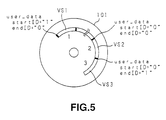
- the movie sequence is recorded at consecutive positions by a disc by a recording/reproducing apparatus.
- IDs which discriminate the first video sequence and the last video sequence of the movie sequence are defined These IDs are set at the time of encoding.
- the beginning and the end points ofthe movie sequence on the disc are clarified by the IDs discriminating the first video sequence and the last video sequence making up the movie sequence.
- the 7th bit b7 is a start ID
- the sixth bit b6 is the end ID
- the fifth and fourth bit b5, b4 are the display size conversion ratio.
- 'b' signifies that the binary notation system is used.
- start ID is '1', it is defined as meaning the first video sequence of the movie sequence. If the end ID is '1', it is defined as the last video sequence of the movie sequence.
- the conversion ratio in the horizontal and vertical directions are defined. For example, if the display conversion ratio is '00'(1:1), the resolution of 704 ⁇ 480 is kept.
- the display conversion ratio of '01'(3:4) means multiplication by 3/4 at the time of encoding so that the size is 528 ⁇ 480, Similarly, the display conversion ratio of '10' (1:2) means multiplication by 1/2 at the time of encoding so that the size is 352 ⁇ 480.
- the resolution is restored by back conversion to the original resolution of 704 ⁇ 480.
- This provision is inherently meant for distinguishing from the case of encoding at the resolution of 351 ⁇ 480 by taking no measures.
- these provisions are used as the format, it is judged which sequence the video sequence has with respect to the movie sequence.
- these provisions are used as a material for judgment at the time of decoding. That is, it can be known from the above user data from which portion to which portion the movie sequence is to be decoded with which resolution.
- the start ID and the end ID are '1' and '0', respectively.
- the start ID and the end ID are both '0', whereas, in the user data of the last video sequence, the start ID is '0' and the end 'ID' is '1'.
- the video sequence VS1 is the first video sequence in the movie sequence and that the video sequence VS3 is the last video sequence in the movie sequence.
- a recording/reproducing apparatus for recording/reproducing picture data for an optical disc is explained.
- the recording/reproducing apparatus of the second embodiment records the identification information on a management file.
- a moving picture compression expansion apparatus includes a pre-filtering unit 19 for performing pre-set filtering on input video signals, an MPEG 2 encoder 20 for converting signals from the pre-filtering unit 19 into a MPEG 2 bitstream.
- the moving picture compression expansion apparatus also includes an ECC encoding/decoding unit 15 for encoding or decoding the so-called ECC (error correction code), a memory 14 for storing data under control by the ECC encoding/decoding unit 15, a data modulation/demodulation unit 13 for modulating or demodulating data, a magnetic field modulating driver 11 for applying a modulated magnetic field across the optical disc 101 and an optical pickup 12 for illuminating/receiving the laser light for the optical disc 101.
- ECC error correction code
- a memory 14 for storing data under control by the ECC encoding/decoding unit 15
- a data modulation/demodulation unit 13 for modulating or demodulating data
- a magnetic field modulating driver 11 for applying a modulated magnetic field across the optical disc 101
- an optical pickup 12 for illuminating/receiving the laser light for the optical disc 101.
- the moving picture compression expansion apparatus also includes a DMUX (demultiplexer) 20, an adaptive transform acoustic decoding unit 22 for audio data from the DMUX 20, a MPEG 2 decoder 23 for decoding the video data in accordance with the MPEG 2 and a post-filtering unit 24 for performing pre-set filtering on the signals from the MPEG 2 decoder 23.
- DMUX demultiplexer
- MPEG 2 decoder 23 for decoding the video data in accordance with the MPEG 2
- post-filtering unit 24 for performing pre-set filtering on the signals from the MPEG 2 decoder 23.
- the moving picture compression expansion apparatus further includes a controller 17 for controlling various parts of the moving picture compression expansion apparatus.
- This controller is constituted as a so-called micro-computer made up of, for example, a CPU, a ROM and a RAM.
- the controller 17 multiplexes a management file, indicating the position of the above-described video sequence, at the time of multiplexing by the MUX 16, to write the multiplexed management file.
- the controller 17 reads out the management file and switches the post-filtering unit 24 depending on the resolution on the video sequence basis.
- the operation of the other circuit portions is the same as that of the above-described first embodiment and hence is not explained specifically.
- a movie sequence is to be recorded on a disc medium
- a hysteresis file or a management file showing the manner in which recording has been made on the disc medium, is necessarily prepared and the recording manner is prescribed by the management file.
- all addresses are recorded from the outset on the disc medium.
- the movie sequence is sequentially recorded in the vacant region on the disc medium.
- the totality of positions on the disc medium are specified by addresses.
- the first-recorded video sequence VS1 is recorded an a nth address on the disc medium 101
- the next-recorded video sequence VS2 is recorded at a mth address and so forth until the last-recorded video sequence VS4 is recorded at the pth address.
- an actual management file there is written in a disc area a file stating that the first-recorded video sequence VS1 is at the nth address, the second-recorded video sequence VS2 is at the mth address, and so forth.
- the addresses on the disc in which have been recorded the video sequences in the movie sequence are recorded as a management file in a region separate from the region for the data of the movie sequence.
- this management file is checked, it can readily be seen in which addresses have been recorded the video sequences in the movie sequence. That is, by utilizing this file, it is possible to identity the beginning and the end of each video sequence in the movie sequence.
- This second embodiment is applied when the management file is used for combining video sequences of different resolutions to a movie sequence.
- a sequence header is appended to a video sequence and, at the next step S12, the amount of motion is detected from the MPEG 2 encoder.
- step S13 it is verified, based on the amount of motion detected by the MPEG 2 encoder at step S12, whether or not the number of pixels is to be increased. If the number of pixels is to be increased, the 'YES' path is followed to step 6 and, if otherwise, the 'NO' path is followed to step S14.
- the resolution is determined. That is, at step S14, the resolution is set to 352 ⁇ 480 and processing transfers to step S15. At step S16, the resolution is set to 704 ⁇ 480 and processing transfers to step S17.
- step S15 it is checked whether or not the resolution as set at step S14 is the same as the current resolution. If the resolution as set at step S14 is the same as the current resolution, the 'YES' path is followed to step S12 and, if otherwise, the 'NO' path is followed to step S18.
- step S17 it is checked whether or not the resolution as set at step S16 is the same as the current resolution. If the resolution as set at step S16 is the same as the current resolution, the 'YES' path is followed to step S12 and, if otherwise, the 'NO' path is followed to step S18.
- step S18 a sequence end is appended to the video sequence and processmg transfers to step S19.
- step S19 user data is formulated and written in a pre-set region. After the end of this step S19, processing reverts to step S11.
- This recording medium has recorded thereon picture signals encoded in accordance with the MPEG 2 standard.
- the minimum unit which permits resolution switching is a video sequence.
- the identification information concerning the relation ofresolution ofplural video sequences is recorded in user data which is the information proper to the bitstream.
- This sort of the recording medium is furnished as, for example, a so-called CD.
- the present invention envisages to improve the compression ratio by performing encoding processing with different encoding sizes in a sole movie sequence.
- the present invention collects plural video sequences, defined by the MPEG 2, to complete a sole movie sequence, and adapts the movie sequence to the recording/reproduction of disc mediums, such as so-called DVDs or MD.
- disc medium has been illustrated as a recording medium in the above-described embodiments, the present invention may also be applied to other media formats, such as a tape-type recording medium, for example a so-called DAT, without being limited to disc mediums.
- a tape-type recording medium for example a so-called DAT
Landscapes
- Engineering & Computer Science (AREA)
- Multimedia (AREA)
- Signal Processing (AREA)
- Databases & Information Systems (AREA)
- Television Signal Processing For Recording (AREA)
- Signal Processing For Digital Recording And Reproducing (AREA)
- Compression Or Coding Systems Of Tv Signals (AREA)
Applications Claiming Priority (2)
| Application Number | Priority Date | Filing Date | Title |
|---|---|---|---|
| JP08910198A JP4366725B2 (ja) | 1998-04-01 | 1998-04-01 | 画像信号処理装置及び方法並びに画像信号記録装置及び方法 |
| JP8910198 | 1998-04-01 |
Publications (3)
| Publication Number | Publication Date |
|---|---|
| EP0948211A2 true EP0948211A2 (fr) | 1999-10-06 |
| EP0948211A3 EP0948211A3 (fr) | 2006-03-22 |
| EP0948211B1 EP0948211B1 (fr) | 2011-12-14 |
Family
ID=13961508
Family Applications (1)
| Application Number | Title | Priority Date | Filing Date |
|---|---|---|---|
| EP19990302637 Expired - Lifetime EP0948211B1 (fr) | 1998-04-01 | 1999-04-01 | Procédé et appareil de traitement de signaux d'image, procédé et appareil d'enregistrement de signaux d'image, et supports d'enregistrement |
Country Status (5)
| Country | Link |
|---|---|
| US (1) | US6549720B1 (fr) |
| EP (1) | EP0948211B1 (fr) |
| JP (1) | JP4366725B2 (fr) |
| KR (1) | KR100556052B1 (fr) |
| CN (1) | CN1147158C (fr) |
Cited By (4)
| Publication number | Priority date | Publication date | Assignee | Title |
|---|---|---|---|---|
| WO2003084233A1 (fr) * | 2002-03-27 | 2003-10-09 | British Telecommunications Public Limited Company | Structure de donnees pour systeme de transmission en continu de donnees |
| US7761901B2 (en) | 2003-03-19 | 2010-07-20 | British Telecommunications Plc | Data transmission |
| US7974200B2 (en) | 2000-11-29 | 2011-07-05 | British Telecommunications Public Limited Company | Transmitting and receiving real-time data |
| US8386631B2 (en) | 2002-03-27 | 2013-02-26 | British Telecommunications Plc | Data streaming system and method |
Families Citing this family (6)
| Publication number | Priority date | Publication date | Assignee | Title |
|---|---|---|---|---|
| CN1174625C (zh) | 1999-09-02 | 2004-11-03 | 松下电器产业株式会社 | 记录装置及编码装置 |
| JP4050578B2 (ja) * | 2002-09-04 | 2008-02-20 | 株式会社リコー | 画像処理装置及び画像処理方法 |
| AU2004250927B2 (en) | 2003-06-16 | 2010-04-08 | Interdigital Vc Holdings, Inc. | Decoding method and apparatus enabling fast channel change of compressed video |
| US8428434B2 (en) * | 2006-10-23 | 2013-04-23 | Pioneer Corporation | Video reproducing apparatus, video display system and record medium |
| KR101572791B1 (ko) * | 2008-02-11 | 2015-12-01 | 코닌클리케 필립스 엔.브이. | 자동 입체영상 이미지 출력 디바이스 |
| CN101562037B (zh) * | 2009-05-27 | 2012-11-21 | 腾讯科技(深圳)有限公司 | 一种多媒体文件播放方法及装置 |
Citations (1)
| Publication number | Priority date | Publication date | Assignee | Title |
|---|---|---|---|---|
| WO1998010593A2 (fr) | 1996-09-09 | 1998-03-12 | Sony Corporation | Codage et decodage d'images |
Family Cites Families (6)
| Publication number | Priority date | Publication date | Assignee | Title |
|---|---|---|---|---|
| NL9002108A (nl) * | 1990-09-19 | 1992-04-16 | Koninkl Philips Electronics Nv | Registratiedrager waarop een hoofddatabestand en een besturingsdatabestand is opgetekend, een werkwijze en inrichting voor het optekenen van het hoofddatabestand en het besturingsbestand alsmede een inrichting voor het uitlezen van de registratiedrager. |
| US5377051A (en) * | 1993-01-13 | 1994-12-27 | Hitachi America, Ltd. | Digital video recorder compatible receiver with trick play image enhancement |
| CN1084107C (zh) * | 1994-08-31 | 2002-05-01 | 索尼公司 | 静止图像系统 |
| GB9421206D0 (en) * | 1994-10-20 | 1994-12-07 | Thomson Consumer Electronics | Digital VCR MPEG- trick play processing |
| KR100215130B1 (ko) * | 1995-04-06 | 1999-08-16 | 니시무로 타이죠 | 재생 데이타와 재생 데이타의 속성 정보를 함께 기록한 기록매체 |
| KR0164183B1 (ko) * | 1995-08-31 | 1999-01-15 | 배순훈 | 비디오컴팩트디스크플레이어의 배경화면 디스플레이제어방법 |
-
1998
- 1998-04-01 JP JP08910198A patent/JP4366725B2/ja not_active Expired - Fee Related
-
1999
- 1999-03-30 US US09/281,664 patent/US6549720B1/en not_active Expired - Lifetime
- 1999-04-01 EP EP19990302637 patent/EP0948211B1/fr not_active Expired - Lifetime
- 1999-04-01 CN CNB991047044A patent/CN1147158C/zh not_active Expired - Lifetime
- 1999-04-01 KR KR1019990011456A patent/KR100556052B1/ko not_active Expired - Fee Related
Patent Citations (1)
| Publication number | Priority date | Publication date | Assignee | Title |
|---|---|---|---|---|
| WO1998010593A2 (fr) | 1996-09-09 | 1998-03-12 | Sony Corporation | Codage et decodage d'images |
Cited By (4)
| Publication number | Priority date | Publication date | Assignee | Title |
|---|---|---|---|---|
| US7974200B2 (en) | 2000-11-29 | 2011-07-05 | British Telecommunications Public Limited Company | Transmitting and receiving real-time data |
| WO2003084233A1 (fr) * | 2002-03-27 | 2003-10-09 | British Telecommunications Public Limited Company | Structure de donnees pour systeme de transmission en continu de donnees |
| US8386631B2 (en) | 2002-03-27 | 2013-02-26 | British Telecommunications Plc | Data streaming system and method |
| US7761901B2 (en) | 2003-03-19 | 2010-07-20 | British Telecommunications Plc | Data transmission |
Also Published As
| Publication number | Publication date |
|---|---|
| KR100556052B1 (ko) | 2006-03-03 |
| CN1231476A (zh) | 1999-10-13 |
| US6549720B1 (en) | 2003-04-15 |
| JP4366725B2 (ja) | 2009-11-18 |
| JPH11289539A (ja) | 1999-10-19 |
| KR19990082840A (ko) | 1999-11-25 |
| EP0948211A3 (fr) | 2006-03-22 |
| CN1147158C (zh) | 2004-04-21 |
| EP0948211B1 (fr) | 2011-12-14 |
Similar Documents
| Publication | Publication Date | Title |
|---|---|---|
| US5737479A (en) | Apparatus and method for inserting rating code into the digital video signal | |
| US6628890B1 (en) | Digital recording/reproduction apparatus | |
| US5949953A (en) | Disk media, and method of and device for recording and playing back information on or from a disk media | |
| JPWO1996031981A1 (ja) | 圧縮映像信号編集装置、編集方法、及び復号化装置 | |
| JPH1013791A (ja) | 映像信号復号化方法,及び映像信号復号化装置 | |
| EP0948211B1 (fr) | Procédé et appareil de traitement de signaux d'image, procédé et appareil d'enregistrement de signaux d'image, et supports d'enregistrement | |
| US6118928A (en) | Video signal compression-encoding apparatus, recording medium and video signal reproducing apparatus | |
| KR20000069436A (ko) | 인코드된 비디오 신호의 포맷화 | |
| WO2001037572A1 (fr) | Reproduction inversee d'un flux video mpeg | |
| JP3253530B2 (ja) | 動画像記録装置 | |
| WO1998004085A1 (fr) | Dispositif d'enregistrement d'images animees et dispositif de lecture associe | |
| JP3604186B2 (ja) | 記録媒体の記録方法及び再生方法 | |
| JP2002010254A (ja) | 特徴点検出方法および記録再生装置 | |
| JPWO1998004085A1 (ja) | 動画像記録装置および動画像再生装置 | |
| JPH11261964A (ja) | 動画像記録方法、再生方法および装置 | |
| EP1311120A2 (fr) | Procédé de mise en oeuvre de la reproduction à basse vitesse d'un programme numérique radiodiffusé | |
| JPH11185317A (ja) | ディジタルデータ記録再生方法および装置、ディジタルデータ記録方法および装置、ディジタルデータ再生方法および装置 | |
| JP4435733B2 (ja) | データ処理装置 | |
| JP3718499B2 (ja) | 動画像記録方法 | |
| JP2001186530A (ja) | 複数チャンネル画像圧縮装置及びその方法 | |
| JP5191294B2 (ja) | 情報処理装置及びプログラム | |
| JP2000253359A (ja) | デジタル放送記録再生装置 | |
| JP4573166B2 (ja) | 情報記録装置、情報再生装置、情報記録方法、及び情報再生方法 | |
| JP2004289876A (ja) | 記録装置 | |
| JP4305392B2 (ja) | オーディオビデオ信号記録装置、オーディオビデオ信号記録方法 |
Legal Events
| Date | Code | Title | Description |
|---|---|---|---|
| PUAI | Public reference made under article 153(3) epc to a published international application that has entered the european phase |
Free format text: ORIGINAL CODE: 0009012 |
|
| AK | Designated contracting states |
Kind code of ref document: A2 Designated state(s): AT BE CH CY DE DK ES FI FR GB GR IE IT LI LU MC NL PT SE |
|
| AX | Request for extension of the european patent |
Free format text: AL;LT;LV;MK;RO;SI |
|
| PUAL | Search report despatched |
Free format text: ORIGINAL CODE: 0009013 |
|
| AK | Designated contracting states |
Kind code of ref document: A3 Designated state(s): AT BE CH CY DE DK ES FI FR GB GR IE IT LI LU MC NL PT SE |
|
| AX | Request for extension of the european patent |
Extension state: AL LT LV MK RO SI |
|
| RIC1 | Information provided on ipc code assigned before grant |
Ipc: G11B 27/32 20060101ALI20060201BHEP Ipc: H04N 7/26 20060101AFI19990723BHEP |
|
| 17P | Request for examination filed |
Effective date: 20060904 |
|
| AKX | Designation fees paid |
Designated state(s): DE FR GB |
|
| 17Q | First examination report despatched |
Effective date: 20061108 |
|
| GRAP | Despatch of communication of intention to grant a patent |
Free format text: ORIGINAL CODE: EPIDOSNIGR1 |
|
| GRAS | Grant fee paid |
Free format text: ORIGINAL CODE: EPIDOSNIGR3 |
|
| GRAA | (expected) grant |
Free format text: ORIGINAL CODE: 0009210 |
|
| AK | Designated contracting states |
Kind code of ref document: B1 Designated state(s): DE FR GB |
|
| REG | Reference to a national code |
Ref country code: GB Ref legal event code: FG4D |
|
| REG | Reference to a national code |
Ref country code: DE Ref legal event code: R096 Ref document number: 69943918 Country of ref document: DE Effective date: 20120308 |
|
| PLBE | No opposition filed within time limit |
Free format text: ORIGINAL CODE: 0009261 |
|
| STAA | Information on the status of an ep patent application or granted ep patent |
Free format text: STATUS: NO OPPOSITION FILED WITHIN TIME LIMIT |
|
| 26N | No opposition filed |
Effective date: 20120917 |
|
| REG | Reference to a national code |
Ref country code: DE Ref legal event code: R097 Ref document number: 69943918 Country of ref document: DE Effective date: 20120917 |
|
| REG | Reference to a national code |
Ref country code: DE Ref legal event code: R084 Ref document number: 69943918 Country of ref document: DE |
|
| REG | Reference to a national code |
Ref country code: GB Ref legal event code: 746 Effective date: 20150424 |
|
| REG | Reference to a national code |
Ref country code: DE Ref legal event code: R084 Ref document number: 69943918 Country of ref document: DE Effective date: 20150410 |
|
| REG | Reference to a national code |
Ref country code: FR Ref legal event code: PLFP Year of fee payment: 18 |
|
| REG | Reference to a national code |
Ref country code: FR Ref legal event code: PLFP Year of fee payment: 19 |
|
| REG | Reference to a national code |
Ref country code: FR Ref legal event code: PLFP Year of fee payment: 20 |
|
| PGFP | Annual fee paid to national office [announced via postgrant information from national office to epo] |
Ref country code: DE Payment date: 20180420 Year of fee payment: 20 |
|
| PGFP | Annual fee paid to national office [announced via postgrant information from national office to epo] |
Ref country code: FR Payment date: 20180420 Year of fee payment: 20 |
|
| PGFP | Annual fee paid to national office [announced via postgrant information from national office to epo] |
Ref country code: GB Payment date: 20180418 Year of fee payment: 20 |
|
| REG | Reference to a national code |
Ref country code: DE Ref legal event code: R071 Ref document number: 69943918 Country of ref document: DE |
|
| REG | Reference to a national code |
Ref country code: GB Ref legal event code: PE20 Expiry date: 20190331 |
|
| PG25 | Lapsed in a contracting state [announced via postgrant information from national office to epo] |
Ref country code: GB Free format text: LAPSE BECAUSE OF EXPIRATION OF PROTECTION Effective date: 20190331 |