EP0948327B1 - Antidiabetische mittel - Google Patents
Antidiabetische mittel Download PDFInfo
- Publication number
- EP0948327B1 EP0948327B1 EP97952573A EP97952573A EP0948327B1 EP 0948327 B1 EP0948327 B1 EP 0948327B1 EP 97952573 A EP97952573 A EP 97952573A EP 97952573 A EP97952573 A EP 97952573A EP 0948327 B1 EP0948327 B1 EP 0948327B1
- Authority
- EP
- European Patent Office
- Prior art keywords
- ethyl
- acetic acid
- yloxy
- indole
- phenyl
- Prior art date
- Legal status (The legal status is an assumption and is not a legal conclusion. Google has not performed a legal analysis and makes no representation as to the accuracy of the status listed.)
- Expired - Lifetime
Links
- 0 CCCc(c1c(cc2)c(-c3ccccc3)n[o]1)c2OCCc1cc2c(CCCC3*)c3ccc2[o]1 Chemical compound CCCc(c1c(cc2)c(-c3ccccc3)n[o]1)c2OCCc1cc2c(CCCC3*)c3ccc2[o]1 0.000 description 9
- GWGRYISDTOTBAH-UHFFFAOYSA-N C=CCc(cc(cc1)Oc2ccccc2)c1O Chemical compound C=CCc(cc(cc1)Oc2ccccc2)c1O GWGRYISDTOTBAH-UHFFFAOYSA-N 0.000 description 1
- CMTQFAFNXXZVTD-UHFFFAOYSA-N CCCc(c1c(cc2)c(CC(C)(C)C)n[o]1)c2OCCc1cc(c(CCCC2C)c2cc2)c2[o]1 Chemical compound CCCc(c1c(cc2)c(CC(C)(C)C)n[o]1)c2OCCc1cc(c(CCCC2C)c2cc2)c2[o]1 CMTQFAFNXXZVTD-UHFFFAOYSA-N 0.000 description 1
- GPXYKSAFIYQQLC-UHFFFAOYSA-N CCCc(cc1)cc2c1[nH]c(CCOc(cc1)c(CCC)c3c1c(-c1ccccc1)n[o]3)c2 Chemical compound CCCc(cc1)cc2c1[nH]c(CCOc(cc1)c(CCC)c3c1c(-c1ccccc1)n[o]3)c2 GPXYKSAFIYQQLC-UHFFFAOYSA-N 0.000 description 1
Classifications
-
- A—HUMAN NECESSITIES
- A61—MEDICAL OR VETERINARY SCIENCE; HYGIENE
- A61K—PREPARATIONS FOR MEDICAL, DENTAL OR TOILETRY PURPOSES
- A61K31/00—Medicinal preparations containing organic active ingredients
- A61K31/13—Amines
- A61K31/135—Amines having aromatic rings, e.g. ketamine, nortriptyline
-
- A—HUMAN NECESSITIES
- A61—MEDICAL OR VETERINARY SCIENCE; HYGIENE
- A61K—PREPARATIONS FOR MEDICAL, DENTAL OR TOILETRY PURPOSES
- A61K31/00—Medicinal preparations containing organic active ingredients
- A61K31/33—Heterocyclic compounds
- A61K31/395—Heterocyclic compounds having nitrogen as a ring hetero atom, e.g. guanethidine or rifamycins
-
- A—HUMAN NECESSITIES
- A61—MEDICAL OR VETERINARY SCIENCE; HYGIENE
- A61K—PREPARATIONS FOR MEDICAL, DENTAL OR TOILETRY PURPOSES
- A61K31/00—Medicinal preparations containing organic active ingredients
- A61K31/33—Heterocyclic compounds
- A61K31/335—Heterocyclic compounds having oxygen as the only ring hetero atom, e.g. fungichromin
- A61K31/34—Heterocyclic compounds having oxygen as the only ring hetero atom, e.g. fungichromin having five-membered rings with one oxygen as the only ring hetero atom, e.g. isosorbide
- A61K31/343—Heterocyclic compounds having oxygen as the only ring hetero atom, e.g. fungichromin having five-membered rings with one oxygen as the only ring hetero atom, e.g. isosorbide condensed with a carbocyclic ring, e.g. coumaran, bufuralol, befunolol, clobenfurol, amiodarone
-
- A—HUMAN NECESSITIES
- A61—MEDICAL OR VETERINARY SCIENCE; HYGIENE
- A61K—PREPARATIONS FOR MEDICAL, DENTAL OR TOILETRY PURPOSES
- A61K31/00—Medicinal preparations containing organic active ingredients
- A61K31/33—Heterocyclic compounds
- A61K31/395—Heterocyclic compounds having nitrogen as a ring hetero atom, e.g. guanethidine or rifamycins
- A61K31/40—Heterocyclic compounds having nitrogen as a ring hetero atom, e.g. guanethidine or rifamycins having five-membered rings with one nitrogen as the only ring hetero atom, e.g. sulpiride, succinimide, tolmetin, buflomedil
-
- A—HUMAN NECESSITIES
- A61—MEDICAL OR VETERINARY SCIENCE; HYGIENE
- A61K—PREPARATIONS FOR MEDICAL, DENTAL OR TOILETRY PURPOSES
- A61K31/00—Medicinal preparations containing organic active ingredients
- A61K31/33—Heterocyclic compounds
- A61K31/395—Heterocyclic compounds having nitrogen as a ring hetero atom, e.g. guanethidine or rifamycins
- A61K31/40—Heterocyclic compounds having nitrogen as a ring hetero atom, e.g. guanethidine or rifamycins having five-membered rings with one nitrogen as the only ring hetero atom, e.g. sulpiride, succinimide, tolmetin, buflomedil
- A61K31/403—Heterocyclic compounds having nitrogen as a ring hetero atom, e.g. guanethidine or rifamycins having five-membered rings with one nitrogen as the only ring hetero atom, e.g. sulpiride, succinimide, tolmetin, buflomedil condensed with carbocyclic rings, e.g. carbazole
- A61K31/404—Indoles, e.g. pindolol
-
- A—HUMAN NECESSITIES
- A61—MEDICAL OR VETERINARY SCIENCE; HYGIENE
- A61K—PREPARATIONS FOR MEDICAL, DENTAL OR TOILETRY PURPOSES
- A61K31/00—Medicinal preparations containing organic active ingredients
- A61K31/33—Heterocyclic compounds
- A61K31/395—Heterocyclic compounds having nitrogen as a ring hetero atom, e.g. guanethidine or rifamycins
- A61K31/41—Heterocyclic compounds having nitrogen as a ring hetero atom, e.g. guanethidine or rifamycins having five-membered rings with two or more ring hetero atoms, at least one of which being nitrogen, e.g. tetrazole
-
- A—HUMAN NECESSITIES
- A61—MEDICAL OR VETERINARY SCIENCE; HYGIENE
- A61K—PREPARATIONS FOR MEDICAL, DENTAL OR TOILETRY PURPOSES
- A61K31/00—Medicinal preparations containing organic active ingredients
- A61K31/33—Heterocyclic compounds
- A61K31/395—Heterocyclic compounds having nitrogen as a ring hetero atom, e.g. guanethidine or rifamycins
- A61K31/41—Heterocyclic compounds having nitrogen as a ring hetero atom, e.g. guanethidine or rifamycins having five-membered rings with two or more ring hetero atoms, at least one of which being nitrogen, e.g. tetrazole
- A61K31/415—1,2-Diazoles
-
- A—HUMAN NECESSITIES
- A61—MEDICAL OR VETERINARY SCIENCE; HYGIENE
- A61K—PREPARATIONS FOR MEDICAL, DENTAL OR TOILETRY PURPOSES
- A61K31/00—Medicinal preparations containing organic active ingredients
- A61K31/33—Heterocyclic compounds
- A61K31/395—Heterocyclic compounds having nitrogen as a ring hetero atom, e.g. guanethidine or rifamycins
- A61K31/41—Heterocyclic compounds having nitrogen as a ring hetero atom, e.g. guanethidine or rifamycins having five-membered rings with two or more ring hetero atoms, at least one of which being nitrogen, e.g. tetrazole
- A61K31/42—Oxazoles
- A61K31/423—Oxazoles condensed with carbocyclic rings
-
- A—HUMAN NECESSITIES
- A61—MEDICAL OR VETERINARY SCIENCE; HYGIENE
- A61K—PREPARATIONS FOR MEDICAL, DENTAL OR TOILETRY PURPOSES
- A61K31/00—Medicinal preparations containing organic active ingredients
- A61K31/33—Heterocyclic compounds
- A61K31/395—Heterocyclic compounds having nitrogen as a ring hetero atom, e.g. guanethidine or rifamycins
- A61K31/435—Heterocyclic compounds having nitrogen as a ring hetero atom, e.g. guanethidine or rifamycins having six-membered rings with one nitrogen as the only ring hetero atom
- A61K31/47—Quinolines; Isoquinolines
-
- A—HUMAN NECESSITIES
- A61—MEDICAL OR VETERINARY SCIENCE; HYGIENE
- A61K—PREPARATIONS FOR MEDICAL, DENTAL OR TOILETRY PURPOSES
- A61K31/00—Medicinal preparations containing organic active ingredients
- A61K31/33—Heterocyclic compounds
- A61K31/395—Heterocyclic compounds having nitrogen as a ring hetero atom, e.g. guanethidine or rifamycins
- A61K31/435—Heterocyclic compounds having nitrogen as a ring hetero atom, e.g. guanethidine or rifamycins having six-membered rings with one nitrogen as the only ring hetero atom
- A61K31/47—Quinolines; Isoquinolines
- A61K31/4709—Non-condensed quinolines and containing further heterocyclic rings
-
- A—HUMAN NECESSITIES
- A61—MEDICAL OR VETERINARY SCIENCE; HYGIENE
- A61K—PREPARATIONS FOR MEDICAL, DENTAL OR TOILETRY PURPOSES
- A61K31/00—Medicinal preparations containing organic active ingredients
- A61K31/33—Heterocyclic compounds
- A61K31/395—Heterocyclic compounds having nitrogen as a ring hetero atom, e.g. guanethidine or rifamycins
- A61K31/495—Heterocyclic compounds having nitrogen as a ring hetero atom, e.g. guanethidine or rifamycins having six-membered rings with two or more nitrogen atoms as the only ring heteroatoms, e.g. piperazine or tetrazines
- A61K31/505—Pyrimidines; Hydrogenated pyrimidines, e.g. trimethoprim
- A61K31/517—Pyrimidines; Hydrogenated pyrimidines, e.g. trimethoprim ortho- or peri-condensed with carbocyclic ring systems, e.g. quinazoline, perimidine
-
- C—CHEMISTRY; METALLURGY
- C07—ORGANIC CHEMISTRY
- C07D—HETEROCYCLIC COMPOUNDS
- C07D209/00—Heterocyclic compounds containing five-membered rings, condensed with other rings, with one nitrogen atom as the only ring hetero atom
- C07D209/02—Heterocyclic compounds containing five-membered rings, condensed with other rings, with one nitrogen atom as the only ring hetero atom condensed with one carbocyclic ring
- C07D209/04—Indoles; Hydrogenated indoles
- C07D209/10—Indoles; Hydrogenated indoles with substituted hydrocarbon radicals attached to carbon atoms of the hetero ring
- C07D209/12—Radicals substituted by oxygen atoms
-
- C—CHEMISTRY; METALLURGY
- C07—ORGANIC CHEMISTRY
- C07D—HETEROCYCLIC COMPOUNDS
- C07D209/00—Heterocyclic compounds containing five-membered rings, condensed with other rings, with one nitrogen atom as the only ring hetero atom
- C07D209/02—Heterocyclic compounds containing five-membered rings, condensed with other rings, with one nitrogen atom as the only ring hetero atom condensed with one carbocyclic ring
- C07D209/04—Indoles; Hydrogenated indoles
- C07D209/10—Indoles; Hydrogenated indoles with substituted hydrocarbon radicals attached to carbon atoms of the hetero ring
- C07D209/18—Radicals substituted by carbon atoms having three bonds to hetero atoms with at the most one bond to halogen, e.g. ester or nitrile radicals
-
- C—CHEMISTRY; METALLURGY
- C07—ORGANIC CHEMISTRY
- C07D—HETEROCYCLIC COMPOUNDS
- C07D213/00—Heterocyclic compounds containing six-membered rings, not condensed with other rings, with one nitrogen atom as the only ring hetero atom and three or more double bonds between ring members or between ring members and non-ring members
- C07D213/02—Heterocyclic compounds containing six-membered rings, not condensed with other rings, with one nitrogen atom as the only ring hetero atom and three or more double bonds between ring members or between ring members and non-ring members having three double bonds between ring members or between ring members and non-ring members
- C07D213/04—Heterocyclic compounds containing six-membered rings, not condensed with other rings, with one nitrogen atom as the only ring hetero atom and three or more double bonds between ring members or between ring members and non-ring members having three double bonds between ring members or between ring members and non-ring members having no bond between the ring nitrogen atom and a non-ring member or having only hydrogen or carbon atoms directly attached to the ring nitrogen atom
- C07D213/24—Heterocyclic compounds containing six-membered rings, not condensed with other rings, with one nitrogen atom as the only ring hetero atom and three or more double bonds between ring members or between ring members and non-ring members having three double bonds between ring members or between ring members and non-ring members having no bond between the ring nitrogen atom and a non-ring member or having only hydrogen or carbon atoms directly attached to the ring nitrogen atom with substituted hydrocarbon radicals attached to ring carbon atoms
- C07D213/54—Radicals substituted by carbon atoms having three bonds to hetero atoms with at the most one bond to halogen, e.g. ester or nitrile radicals
- C07D213/56—Amides
-
- C—CHEMISTRY; METALLURGY
- C07—ORGANIC CHEMISTRY
- C07D—HETEROCYCLIC COMPOUNDS
- C07D307/00—Heterocyclic compounds containing five-membered rings having one oxygen atom as the only ring hetero atom
- C07D307/77—Heterocyclic compounds containing five-membered rings having one oxygen atom as the only ring hetero atom ortho- or peri-condensed with carbocyclic rings or ring systems
- C07D307/78—Benzo [b] furans; Hydrogenated benzo [b] furans
- C07D307/79—Benzo [b] furans; Hydrogenated benzo [b] furans with only hydrogen atoms, hydrocarbon or substituted hydrocarbon radicals, directly attached to carbon atoms of the hetero ring
- C07D307/80—Radicals substituted by oxygen atoms
-
- C—CHEMISTRY; METALLURGY
- C07—ORGANIC CHEMISTRY
- C07D—HETEROCYCLIC COMPOUNDS
- C07D307/00—Heterocyclic compounds containing five-membered rings having one oxygen atom as the only ring hetero atom
- C07D307/77—Heterocyclic compounds containing five-membered rings having one oxygen atom as the only ring hetero atom ortho- or peri-condensed with carbocyclic rings or ring systems
- C07D307/78—Benzo [b] furans; Hydrogenated benzo [b] furans
- C07D307/82—Benzo [b] furans; Hydrogenated benzo [b] furans with hetero atoms or with carbon atoms having three bonds to hetero atoms with at the most one bond to halogen, e.g. ester or nitrile radicals, directly attached to carbon atoms of the hetero ring
- C07D307/83—Oxygen atoms
-
- C—CHEMISTRY; METALLURGY
- C07—ORGANIC CHEMISTRY
- C07D—HETEROCYCLIC COMPOUNDS
- C07D307/00—Heterocyclic compounds containing five-membered rings having one oxygen atom as the only ring hetero atom
- C07D307/77—Heterocyclic compounds containing five-membered rings having one oxygen atom as the only ring hetero atom ortho- or peri-condensed with carbocyclic rings or ring systems
- C07D307/92—Naphthofurans; Hydrogenated naphthofurans
-
- C—CHEMISTRY; METALLURGY
- C07—ORGANIC CHEMISTRY
- C07D—HETEROCYCLIC COMPOUNDS
- C07D403/00—Heterocyclic compounds containing two or more hetero rings, having nitrogen atoms as the only ring hetero atoms, not provided for by group C07D401/00
- C07D403/02—Heterocyclic compounds containing two or more hetero rings, having nitrogen atoms as the only ring hetero atoms, not provided for by group C07D401/00 containing two hetero rings
- C07D403/12—Heterocyclic compounds containing two or more hetero rings, having nitrogen atoms as the only ring hetero atoms, not provided for by group C07D401/00 containing two hetero rings linked by a chain containing hetero atoms as chain links
-
- C—CHEMISTRY; METALLURGY
- C07—ORGANIC CHEMISTRY
- C07D—HETEROCYCLIC COMPOUNDS
- C07D405/00—Heterocyclic compounds containing both one or more hetero rings having oxygen atoms as the only ring hetero atoms, and one or more rings having nitrogen as the only ring hetero atom
- C07D405/02—Heterocyclic compounds containing both one or more hetero rings having oxygen atoms as the only ring hetero atoms, and one or more rings having nitrogen as the only ring hetero atom containing two hetero rings
- C07D405/12—Heterocyclic compounds containing both one or more hetero rings having oxygen atoms as the only ring hetero atoms, and one or more rings having nitrogen as the only ring hetero atom containing two hetero rings linked by a chain containing hetero atoms as chain links
-
- C—CHEMISTRY; METALLURGY
- C07—ORGANIC CHEMISTRY
- C07D—HETEROCYCLIC COMPOUNDS
- C07D407/00—Heterocyclic compounds containing two or more hetero rings, at least one ring having oxygen atoms as the only ring hetero atoms, not provided for by group C07D405/00
- C07D407/02—Heterocyclic compounds containing two or more hetero rings, at least one ring having oxygen atoms as the only ring hetero atoms, not provided for by group C07D405/00 containing two hetero rings
- C07D407/12—Heterocyclic compounds containing two or more hetero rings, at least one ring having oxygen atoms as the only ring hetero atoms, not provided for by group C07D405/00 containing two hetero rings linked by a chain containing hetero atoms as chain links
-
- C—CHEMISTRY; METALLURGY
- C07—ORGANIC CHEMISTRY
- C07D—HETEROCYCLIC COMPOUNDS
- C07D409/00—Heterocyclic compounds containing two or more hetero rings, at least one ring having sulfur atoms as the only ring hetero atoms
- C07D409/02—Heterocyclic compounds containing two or more hetero rings, at least one ring having sulfur atoms as the only ring hetero atoms containing two hetero rings
- C07D409/12—Heterocyclic compounds containing two or more hetero rings, at least one ring having sulfur atoms as the only ring hetero atoms containing two hetero rings linked by a chain containing hetero atoms as chain links
-
- C—CHEMISTRY; METALLURGY
- C07—ORGANIC CHEMISTRY
- C07D—HETEROCYCLIC COMPOUNDS
- C07D411/00—Heterocyclic compounds containing two or more hetero rings, at least one ring having oxygen and sulfur atoms as the only ring hetero atoms
- C07D411/02—Heterocyclic compounds containing two or more hetero rings, at least one ring having oxygen and sulfur atoms as the only ring hetero atoms containing two hetero rings
-
- C—CHEMISTRY; METALLURGY
- C07—ORGANIC CHEMISTRY
- C07D—HETEROCYCLIC COMPOUNDS
- C07D413/00—Heterocyclic compounds containing two or more hetero rings, at least one ring having nitrogen and oxygen atoms as the only ring hetero atoms
- C07D413/02—Heterocyclic compounds containing two or more hetero rings, at least one ring having nitrogen and oxygen atoms as the only ring hetero atoms containing two hetero rings
- C07D413/04—Heterocyclic compounds containing two or more hetero rings, at least one ring having nitrogen and oxygen atoms as the only ring hetero atoms containing two hetero rings directly linked by a ring-member-to-ring-member bond
-
- C—CHEMISTRY; METALLURGY
- C07—ORGANIC CHEMISTRY
- C07D—HETEROCYCLIC COMPOUNDS
- C07D413/00—Heterocyclic compounds containing two or more hetero rings, at least one ring having nitrogen and oxygen atoms as the only ring hetero atoms
- C07D413/02—Heterocyclic compounds containing two or more hetero rings, at least one ring having nitrogen and oxygen atoms as the only ring hetero atoms containing two hetero rings
- C07D413/12—Heterocyclic compounds containing two or more hetero rings, at least one ring having nitrogen and oxygen atoms as the only ring hetero atoms containing two hetero rings linked by a chain containing hetero atoms as chain links
Definitions
- Diabetes refers to a disease process derived from multiple causative factors and characterized by elevated levels of plasma glucose or hyperglycemia. Uncontrolled hyperglycemia is associated with increased and premature mortality due to an increased risk for microvascular and macrovascular disease, including nephropathy, neuropathy, retinopathy, hypertension, stroke, and heart disease. Therefore, glucose homeostasis is critically important for the treatment of diabetes.
- Type I diabetes is associated with a deficiency of insulin.
- Type II, noninsulin dependent diabetes mellitus is associated with a resistance to the stimulating or regulatory effect of insulin on glucose and lipid metabolism in the main insulin-sensitive tissues, namely, the muscle, liver and adipose tissue. This resistance to to the effect of insulin results in insufficient activation of glucose uptake, oxidation and storage in muscle, inadequate repression of lipolysis in adipose tissue and inadequate supression of glucose production and secretion in liver.
- Standard treatments for NIDDM which have not changed substantially in years, are all associated with limitations. Physical exercise and reduction in calorie intake improves the diabetic condition; however compliance is generally poor. Increasing the plasma level of insulin, either by administering an oral hypoglycemic such as a sulfonylurea (e.g. tolbutamide or glipizide) or by injecting insulin results in insulin levels which are sufficient to stimulate insulin-resistant tissues. However, low levels of plasma glucose and a heightened level of insulin resistance can result.
- an oral hypoglycemic such as a sulfonylurea (e.g. tolbutamide or glipizide)
- injecting insulin results in insulin levels which are sufficient to stimulate insulin-resistant tissues.
- low levels of plasma glucose and a heightened level of insulin resistance can result.
- Thiazolidinediones were suggested to ameliorate many symptoms of NIDDM. These agents increase insulin sensitivity in muscle, liver and adipose tissue in several animal models of NIDDM, hopefully resulting in normalized levels of plasma glucose, triglycerides and nonesterified free fatty acids. However, serious undesirable effects have been observed, including cardiac hypertrophy, hemodilution and liver toxicity.
- Hyperlipidemia is a condition that is characterized by an abnormally high level of serum lipids. This includes cholesterol, triglycerides and phospholipids. These lipids do not circulate freely in solution in plasma, but are bound to proteins and transported as macromolecular complexes called lipoproteins. See the Merck Manual, 16th Ed. 1992 (see for example pp. 1039-1040) and "Structure and Metabolism of Plasma Lipoproteins" in Metabolic Basis of Inherited Disease, 6th Ed. 1989, pp. 1129-1138.
- hyperlipidemia is hypercholesterolemia, which is characterized by elevated LDL cholesterol levels. The initial treatment for hypercholesterolemia is often reduced dietary fat and cholesterol. Coupled with an appropriate exercise regimen, this can be an effective means by which to reduce hyperlipidemia. More typically, this means of lowering hyperlipidemia is insufficient, making drug therapy to reduce serum LDL-cholesterol more appropriate.
- HDL cholesterol Although it is desirable to lower elevated levels of LDL cholesterol, it is also desirable to increase levels of HDL cholesterol, since increased levels of HDL are associated with a reduced risk for coronary heart disease (CHD).
- CHD coronary heart disease
- An example of an HDL raising agent is nicotinic acid.
- thiazolidinedione compounds exert their effects by binding to the peroxisome proliferator activated receptor (PPAR) family of receptors, controlling certain transcription elements having to do with the biological entities listed above. See Hulin et al., Current Pharm. Design (1996) 2, 85-102.
- PPAR ⁇ peroxisome proliferator activated receptor
- PPAR ⁇ Three sub-types of PPARs have been discovered and described: PPAR ⁇ , PPAR ⁇ and PPAR ⁇ .
- PPAR ⁇ is activated by a number of medium and long-chain fatty acids. It is involved in stimulating ⁇ -oxidation of fatty acids.
- PPAR ⁇ is also activated by compounds known as fibric acid derivatives.
- fibric acid derivatives such as clofibrate, fenofibrate, bezafibrate, ciprofibrate, beclofibrate and etofibrate, as well as gemfibrozil reduce plasma triglycerides along with LDL cholesterol, and they are primarily used for the treatment of hypertriglyceridemia.
- PPAR ⁇ receptor subtypes are involved in adipocyte differentiation.
- the DNA sequences for the PPAR ⁇ receptors are described in Elbrecht, et al., BBRC 224 ;431-437 (1996).
- peroxisome proliferators including the fibrates and fatty acids, activate the transcriptional activity of PPARs
- prostaglandin J 2 derivatives have been identified as natural ligands of the PFAR ⁇ subtype, which also binds to thiazolidinedione antidiabetic agents with high affinity.
- the glitazones have been shown to bind to the PPAR ⁇ subtype.
- PPAR ⁇ The human nuclear receptor gene PPAR ⁇ (hPPARB ⁇ ) has been cloned from a human osteosarcoma cell cDNA library and is fully described in A. Schmidt et al., Molecular Endocrinology , 6 :1634-1641 (1992), herein incorporated by reference. PPAR ⁇ is also referred as PPAR ⁇ and NUCl.
- the present invention is directed to a compound represented by formula I or Ia: or a pharmaceutically acceptable salt thereof, wherein:
- composition which is comprised of a compound of formula I or Ia in combination with a pharmaceutically acceptable carrier.
- compositions which is comprised of a compound of formula I or Ia in combination with one or more known sulfonylureas, biguanides, ⁇ -glucosidase inhibitors, other insulin secretogogues or insulin.
- Also disclosed is a method for raising high density lipoprotein (HDL) plasma levels in a mammal in need of such treatment comprising administering an effective amount of a compound of formula I or Ia.
- HDL high density lipoprotein
- Also disclosed is a method for preventing, halting, slowing or otherwise treating the progression of atherosclerotic cardiovascular diseases and related conditions and disease events in a mammal in need of such treatment comprising administering an effective amount of a compound of formula I or Ia.
- Also disclosed is a method for preventing. halting or slowing the progression of atherosclerotic cardiovascular diseases and related conditions and disease events in a mammal in need of such treatment comprising administering an effective amount of a compound of formula I or Ia in combination with one or more active agents such as antihyperlipidemic agents, HMG-CoA synthase inhibitors, squalene epoxidase inhibitors and the like.
- alkyl and the alkyl portion of "acyl” refer to a monovalent alkane (hydrocarbon) derived radical containing from 1 to 15 carbon atoms unless otherwise defined. It may be straight, branched or cyclic. Preferred straight or branched alkyl groups include methyl, ethyl, propyl, isopropyl, butyl and t-butyl. Preferred cycloalkyl groups include cyclopentyl and cyclohexyl.
- the carbon chain of "acyl” also includes alkenyl and alkynyl groups as described below, with the double or triple bonds being located in appropriate positions within the chain.
- the alkylene and monovalent alkyl portion(s) of the alkyl group can be attached at any available point of attachment to the cycloalkylene portion.
- substituted alkyl when substituted alkyl is present, this refers to a straight, branched or cyclic alkyl group as defined above, substituted with 1-3 groups as defined with respect to each variable.
- alkenyl refers to a hydrocarbon radical straight, branched or cyclic containing from 2 to 15 carbon atoms and at least one carbon to carbon double bond. Preferably one carbon to carbon double bond is present, and up to four non-aromatic (non-resonating) carbon-carbon double bonds may be present.
- Preferred alkenyl groups include ethenyl, propenyl, butenyl and cyclohexenyl. As described above with respect to alkyl, the straight, branched or cyclic portion of the alkenyl group may contain double bonds and may be substituted when a substituted alkenyl group is provided.
- alkynyl refers to a hydrocarbon radical straight, branched or cyclic, containing from 2 to 15 carbon atoms and at least one carbon to carbon triple bond. Up to three carbon-carbon triple bonds may be present.
- Preferred alkynyl groups include ethynyl, propynyl and butynyl. As described above with respect to alkyl, the straight, branched or cyclic portion of the alkynyl group may contain triple bonds and may be substituted when a substituted alkynyl group is provided.
- alkoxy refers to those groups of the designated carbon length in either a straight or branched configuration attached through an oxygen linkage and if two or more carbon atoms in length, they may include a double or a triple bond.
- alkoxy groups are methoxy, ethoxy, propoxy, isopropoxy, butoxy, isobutoxy, tertiary butoxy, pentoxy, isopentoxy, hexoxy, isohexoxy, allyloxy, propargyloxy, and the like.
- halo represents fluoro, chloro, bromo or iodo.
- Aryl refers to phenyl and naphthyl. Aryl groups may likewise be substituted as defined below. Preferred substituted aryls include phenyl and naphthyl substituted with zero or three groups of R a .
- Heteroaryl is a group containing from 5 to 10 atoms, 1-4 of which are heteroatoms, 0-4 of which heteroatoms are N and 0-1 of which are O or S, said heteroaryl group being unsubstituted or substituted with 0-3 R a groups; examples of heteroaryls are pyridyl, quinolyl, purinyl, imidazolyl, imidazopyridyl and pyrimidinyl.
- Another embodiment of the invention is realized when (Z-W) t or (Z-W) v together with X 1 form a 5 or 6 membered ring, said ring being a carbocycle, aryl or heteroaryl and optionally substituted with 1 to 3 R a groups.
- v is 0 or 1
- t is 0 or 1
- all other variables are described as above.
- Still another embodiment of the novel compounds of the instant invention is realized when R 4 represents R 2 or -D-R 5 .
- Examples of compounds of the invention include the following:
- the compounds of the present invention may have asymmetric centers and occur as racemates, racemic mixtures, and as individual diastereomers, with all possible isomers, including optical isomers, being included in the present invention.
- Compounds of the general Formula I or Ia may be separated into diastereoisomeric pairs of enantiomers by, for example, fractional crystallization from a suitable solvent, for example methanol or ethyl acetate or a mixture thereof.
- a suitable solvent for example methanol or ethyl acetate or a mixture thereof.
- the pair of enantiomers thus obtained may be separated into individual stereoisomers by conventional means, for example by the use of an optically active acid as a resolving agent.
- any enantiomer of a compound of the general Formula I or Ia may be obtained by stereospecific synthesis using optically pure starting materials of known configuration.
- the instant compounds can be isolated in the form of their pharmaceutically acceptable acid addition salts, such as the salts derived from using inorganic and organic acids.
- acids are hydrochloric, nitric, sulfuric, phosphoric, formic, acetic, trifluoroacetic, propionic, maleic, succinic, malonic and the like.
- certain compounds containing an acidic function such as a carboxy or tetrazole, can be isolated in the form of their inorganic salt in which the counterion can be selected from sodium, potassium, lithium, calcium, magnesium and the like, as well as from organic bases.
- the compounds of the present invention have valuable pharmacological properties. They are useful in treating or preventing diabetes and related diseases such as diabetic retinopathy, diabetic nephropathy and the like, treating obesity, lowering triglyceride levels and preventing vascular restenosis, and treating pancreatitis. They are useful in treating other disorders where insulin resistance is a component including ovarian hyperandrogenism (polycyctic ovarian syndrome). They are also useful in raising high density lipoprotein levels, preventing, halting or slowing the progression of atherosclerotic cardiovascular diseases and related conditions and disease events.
- the present invention further provides a compound of the general Formula I or Ia, or a pharmaceutically acceptable salt or ester thereof, for use in the treatment of hyperglycemia (diabetes) in human or non-human animals.
- the present invention further provides a compound of the general Formula I or Ia, or a pharmaceutically acceptable salt or ester thereof, in combination with sulfonylureas, biguanides, a glucosidase inhibitors, other insulin secretogogue or insulin for use in the treatment of diabetes and related diseases such as diabetic retinopathy; diabetic nephropathy and the like; pancreatitis; obesity, lowering triglyceride levels, vascular restenosis, other disorders where insulin resistance is a component, such as ovarian hyperandrogenism (polycyctic ovarian syndrome), raising high density lipoprotein levels, and preventing, halting or slowing the progression of atherosclerotic cardiovascular diseases and related conditions and disease events and hypertension in human or non-human animals.
- sulfonylureas biguanides
- a glucosidase inhibitors other insulin secretogogue or insulin for use in the treatment of diabetes and related diseases
- diabetes and related diseases such
- the present invention provides a compound of Formula I or Ia for use in the treatment of obesity in human or non-human animals.
- Said compound can be effectively used in combination with other known or proposed strategies for the treatment of obesity or obesity-related disorders; for example, fenfluramine, dexfenfluramine, phentermine and ⁇ 3 adrenergic receptor agonist agents.
- Diabetes mellitus is characterized by metabolic defects in production and utilization of glucose which result in the failure to maintain appropriate blood sugar levels. The result of these defects is elevated blood glucose or hyperglycemia.
- Research on the treatment of diabetes has centered on attempts to normalize fasting and postprandial blood glucose levels.
- Treatments have included parenteral administration of exogenous insulin, oral administration of drugs and dietary therapies.
- the instant compounds can be effectively used alone as well as in combination with known therapies for diabetes including insulin, sulfonylureas, biguanides (such as metformin), ⁇ -glucosidase inhibitors (such as acarbose) and others.
- Type I diabetes or insulin-dependent diabetes
- Type II diabetes or non-insulin dependent diabetes
- an aspect the present invention provides a method of lowering triglyceride levels which comprises administering, to a mammal in need thereof, a therapeutically effective amount of a compound of the formula I or Ia or pharmaceutically acceptable salt or ester thereof.
- the compounds of the present invention lower or modulate triglyceride levels and/or cholesterol levels and raise HDL plasma levels and are therefore of use in treating medical conditions wherein such lowering (and raising) is thought to be beneficial.
- they may be used in the treatment of hypertension, obesity, atherosclerotic disease events, diabetes and related conditions by administering to a mammal in need of such treatment, a therapeutically effective amount of a compound of formula I or Ia or a pharmaceutically acceptable salt thereof.
- compositions are comprised of a compound of formula I or Ia in combination with a carrier. They may also contain other active ingredients known for use in the treatment of atherosclerotic disease events, diabetes, hypertension, obesity and related conditions, for example, fibrates such as clofibrate, bezafibrate and gemfibrozil; inhibitors of cholesterol biosynthesis, such as HMG-CoA reductase inhibitors, for example, lovastatin, simvastatin and pravastatin; inhibitors of cholesterol absorption, for example, beta-sitosterol, and (acyl CoA:cholesterol acyltransferase) inhibitors, for example, melinamide; anion exchange resins, for example, cholestyramine, colestipol or a dialkylaminoalkyl derivatives of a cross-linked dextran; nicotinyl alcohol, nicotinic acid or a salt thereof; vitamin E; and thyromimetics.
- active ingredients known for use
- the invention provides methods for preventing or reducing the risk of developing atherosclerosis, comprising the administration of a prophylactically effective amount of a compound of formula I or Ia alone or in combination with one or more additional pharmaceutically active agents, to a mammal, particularly human, who is at risk of developing atherosclerosis.
- Atherosclerosis as used herein encompasses vascular diseases and conditions that are recognized and understood by practicing physicians.
- Atherosclerotic cardiovascular disease, coronary heart disease (also known as coronary artery disease or ischemic heart disease), cerebrovascular disease and peripheral vessel disease are all clinical manifestations of atherosclerosis and are therefore encompassed by the terms "atherosclerosis” and "atherosclerotic disease.”
- the instant invention further provides methods for preventing or reducing the risk of a first or subsequent (where the potential exists for recurrence) atherosclerotic disease event, comprising the administration of a prophylactically effective amount, or more particularly, an anti-atherosclerotic effective amount of cholesterol biosynthesis inhibitor, of a compound of formula I or Ia alone or in combination with one or more additional pharmaceutically active agents, to a mammal, particularly human, who is at risk for having an atherosclerotic disease event.
- a prophylactically effective amount or more particularly, an anti-atherosclerotic effective amount of cholesterol biosynthesis inhibitor, of a compound of formula I or Ia alone or in combination with one or more additional pharmaceutically active agents, to a mammal, particularly human, who is at risk for having an atherosclerotic disease event.
- atherosclerotic disease event as used herein is intended to encompass coronary heart disease events, cerebrovascular events, and intermittent claudication.
- Coronary heart disease events are intended to include CHD death, myocardial infarction (i.e., a heart attack), and coronary revascularization procedures. Cerebrovascular events are intended to include ischemic or hemorrhagic stroke (also known as cerebrovascular accidents) and transient ischemic attacks. Intermittent claudication is a clinical manifestation of peripheral vessel disease. It is intended that persons who have previously experienced one or more non-fatal atherosclerotic disease event are those for whom the potential for recurrence of such an event exists.
- Persons to be treated with the instant therapy include those at risk of developing atherosclerotic disease and of having an atherosclerotic disease event.
- Standard atherosclerotic disease risk factors are known to the average physician practicing in the relevant fields of medicine. Such known risk factors include but are not limited to hypertension, smoking, diabetes, low levels of high density lipoprotein cholesterol, high levels of low density lipoprotein cholesterol, and a family history of atherosclerotic cardiovascular disease.
- the compounds of the present invention may be orally administered as a pharmaceutical composition, for example, with an inert diluent, or with an edible carrier, or they may be enclosed in hard or soft shell capsules, or they may be compressed into tablets, or incorporated directly into food.
- these active compounds may be incorporated with excipients and used in the form of tablets, capsules, ampules, sachets, elixirs, suspensions, syrups and the like.
- Such compositions and preparations may contain,e.g., at least about 0.1 percent of active compound.
- the percentage of active compound in these compositions may, of course, be varied and may conveniently be between about 2 percent to about 90 percent of the weight of the unit.
- the active compounds can also be administered intranasally as, for example, liquid drops or spray.
- the effective dosage of active ingredient employed may vary depending on the particular compound employed, the mode of administration, the condition being treated and the severity of the condition.
- the compounds are administered at a daily dosage of from about 0.1 milligram to about 100 milligrams per kilogram of animal body weight, preferably given as a single daily dose or in divided doses two to six times a day, or in sustained release form.
- the total daily dosage is from about 1.0 milligrams to about 1000 milligrams, preferably from about 1 milligrams to about 50 milligrams. In the case of a 70 kg adult human, the total daily dose will generally be from about 7 milligrams to about 350 milligrams. This dosage regimen may be adjusted to provide the optimal therapeutic response.
- Combination therapy includes administration of a single pharmaceutical dosage formulation which contains a compound of formula I or la and one or more additional active agents, as well as administration of a compound of formula I or Ia and each active agent in its own separate pharmaceutical dosage formulation.
- a compound of formula I or Ia and an HMG-CoA reductase inhibitor can be administered to the patient together in a single oral dosage composition such as a tablet or capsule, or each agent administered in separate oral dosage formulations.
- a compound of formual I or Ia and one or more additional active agents can be administered at essentially the same time, i.e., concurrently, or at staggered times, i.e, sequentially.
- Combination therapy is understood to include all these regimens.
- An example of combination treatment or prevention of atherosclerosis may be wherein a compound of formula I or Ia is administered in combination with one or more of the following active agents: an antihyperlipidemic agent; a plasma HDL-raising agent; an antihypercholesterolemic agent such as a cholesterol biosynthesis inhibitor, for example an HMG-CoA reductase inhibitor, an HMG-CoA synthase inhibitor, a squalene epoxidase inhibitor, or a squalene synthetase inhibitor (also known as squalene synthase inhibitor); an acyl-coenzyme A: cholesterol acyltransferase (ACAT) inhibitor such as melinamide; probucol; nicotinic acid and the salts thereof and niacinamide; a cholesterol absorption inhibitor such as beta-sitosterol; a bile acid sequestrant anion exchange resin such as cholestyramine, colestipol or dialkylaminoalky
- the compounds of formula I or Ia can be administered in combination with more than one additional active agent, for example, a combination of a compound of formula I or Ia with an HMG-CoA reductase inhibitor (e.g. lovastatin, simvastatin and pravastatin) and aspirin, or a compound of formula I or la with an HMG-CoA reductase inhibitor and a beta adrenergic blocking drug.
- an HMG-CoA reductase inhibitor e.g. lovastatin, simvastatin and pravastatin
- combination therapy can be seen in treating obesity or obesity-related disorders, wherein the compounds of formula I or Ia may be effectively used in combination with for example, fenfluramine, dexfenfluramine, phentermine and ⁇ 3 adrenergic receptor agonist agents.
- Still another example of combination therapy can be seen in treating diabetes and related disorders wherein the compounds of formula I or Ia can be effectively used in combination with for example sulfonylureas, biguanides, ⁇ -glucosidase inhibitors, other insulin secretogogues, insulin as well as the active agents discussed above for treating atherosclerosis.
- a pharmaceutically effective amount of a compound of formula I or Ia can be used for the preparation of a medicament useful for treating diabetes, treating obesity, lowering tryglyeride levels, raising the plasma level of high density lipoprotein, and for treating, preventing or reducing the risk of developing atherosclerosis, and for preventing or reducing the risk of having a first or subsequent atherosclerotic disease event in mammals, particularly in humans.
- the tablets, capsules and the like may also contain a binder such as tragacanth, acacia, corn starch or gelatin; excipients such as dicalcium phosphate; a disintegrating agent such as corn starch, potato starch or alginic acid; a lubricant such as magnesium stearate; and a sweetening agent such as sucrose, lactose or saccharin.
- a dosage unit When a dosage unit is in the form of a capsule, it may also contain a liquid carrier, such as a fatty oil.
- tablets may be coated with shellac, sugar or both.
- a syrup or elixir may contain, in addition to the active ingredient, sucrose as a sweetening agent, methyl and propylparabens as preservatives, a dye and a flavoring such as cherry or orange flavor.
- the compounds of the present invention may also be administered parenterally, i.e, intramuscularly, intravenously, transdermally or subcutaneously.
- Solutions or suspensions of these active compounds can be prepared in water suitably mixed with a surfactant such as hydroxy-propylcellulose.
- Dispersions can also be prepared in glycerol, liquid polyethylene glycols and mixtures thereof in oils. Under ordinary conditions of storage and use, these preparations may contain a preservative to prevent the growth of microorganisms.
- the pharmaceutical forms suitable for injectable use include sterile aqueous solutions or dispersions and sterile powders for the extemporaneous preparation of sterile injectable solutions or dispersions.
- the form must be sterile and must be fluid to the extent that easy syringability exists. It must be stable under the conditions of manufacture and storage and must be preserved against the contaminating action of microorganisms such as bacteria and fungi.
- the carrier can be a solvent or dispersion medium containing, for example, water, ethanol, polyol (e.g. glycerol, propylene glycol and liquid polyethylene glycol), suitable mixtures thereof, and vegetable oils.
- formula I or Ia may require the use of protecting groups to enable their successful elaboration into the desired structure.
- Protecting groups may be chosen with reference to Greene, T.W., et al., Protective Groups in Organic Synthesis , John Wiley & Sons, Inc., 1991.
- the blocking groups are readily removable, i.e., they can be removed, if desired, by procedures which will not cause cleavage or other disruption of the remaining portions of the molecule. Such procedures include chemical and enzymatic hydrolysis, treatment with chemical reducing or oxidizing agents under mild conditions, treatment with fluoride ion, treatment with a transition metal catalyst and a nucleophile, and catalytic hydrogenation.
- Non-limiting examples of suitable hydroxyl protecting groups are: trimethylsilyl, triethylsilyl, o-nitrobenzyloxycarbonyl, p-nitrobenzyloxycarbonyl, t-butyldiphenylsilyl, t-butyldimethylsilyl, benzyloxycarbonyl, t-butyloxycarbonyl, 2,2,2-trichloroethyloxycarbonyl, and allyloxycarbonyl.
- Non-limiting examples of suitable carboxyl protecting groups are benzhydryl, o-nitrobenzyl, p-nitrobenzyl, 2-naphthylmethyl, allyl, 2-chloroallyl, benzyl, 2,2,2-trichloroethyl, trimethylsilyl, t-butyldimethylsilyl, t-butyldiphenylsilyl, 2-(trimethylsilyl)ethyl, phenacyl, p-methoxybenzyl, acetonyl, p-methoxyphenyl, 4-pyridylmethyl and t-butyl.
- the oil (5.0 g; 30.3 mmol) was diluted with 300 ml of THF. To this solution was added dropwise over 1 hour, a solution of pyridinium bromide perbromide (9.69 g; 30.3 mmol) in 300 ml of THF at room temperature. The light tan suspension was filtered and the filter cake was washed with ethyl acetate (2 times). The filtrate was treated with solid sodium bisulfite until the color faded, concentrated to an oil and diluted with ethyl acetate (ca. 200 ml). The organic layer was washed, dried (Na 2 SO 4 ) and concentrated to a dark oil.
- Step C Preparation of the Methyl 4-amino-3-(3-t-butyldimethylsilyloxy)-1-butynyl)phenylacetate
- Methyl 4-amino-3-(3-t-butyldimethylsilyloxy)-1-butynyl)phenylacetate (1.0 g, 4.1 mmol), 1-(t-butyldimethylsilyloxy)-3-butyne (840 mg, 4.55 mmol), dichlorobis(triphenylphosphine)-palladium(II) catalyst (57 mg, 2 mol%), copper(I) iodide (31 mg, 4 mol%) and ca. 10 ml of diethylamine were combined and heated at reflux overnight.
- Step D Preparation of the Methyl 2-(2-(t-butyldimethylsilyloxyethyl)indole-5-acetate
- Step F Preparation of Methyl 2-(2-(3-phenyl-7-propylbenzofuran-6-yloxy)-ethyl)-indole-5-acetate
- Step G Preparation of 2-(2-(3-Phenyl-7-propylbenzofuran-6-yloxy)ethyl)indole-5-acetic acid
- Step A 4-Phenoxyphenyl allyl ether
- Step B 2-Allyl-4-phen oxyphenol
- the phenol of Step B (141.4g, 0.62 mole) was taken into 2 liters of ethyl acetate and the reaction vessel charged with 10% Pd/C catalyst (12g). The reaction was stirred under H 2 until the starting material was consumed. The reaction mixture was filtered through Celite and the cake washed with ethyl acetate (total volume ⁇ 6 liters). The filtrate was concentrated to a dark oil which was taken into ether (1500mL) and washed with 2N HCI (200mL) sat'd. sodium bicarbonate and brine. The organic solution was dried over magnesium sufate, filtered and concentrated to give a light brown oil. (125g).
- Step D 2-(2-(4-Phenoxy-2-propylphenoxy)ethyl)indole-5-acetic acid methyl ester
- Step E 2-(2-(4-Phenoxy-2-propylphenoxy)ethyl)indole-5-acetic acid sodium salt
- the ester (9.0g) was taken into methanol (390mL) and treated with 1M LiOH (51mL) and the resulting solution was warmed to 60°C. After heating overnight there was no starting material remaining by TLC.
- the reaction was concentrated and the residue treated with 2N NaOH (26mL) and then extracted with ethyl acetate (x2). The organic extracts were combined washed with water, brine dried and concentrated to give an off-white foam (8.9g).
- This material was then taken into anhydrous methanol (170mL) and treated with 0.5M NaOMe (41.4mL). After stirring at room temperature for 20 min the reaction was concentrated to give a slightly yellow foam. (7.2g).
- Step F Formation of the crystalline salt
- the salt form of the compound can be protonated as shown in the following: wherein X represents a positively charged counterion such as Na + , K + and others known in the art.
- X represents a positively charged counterion such as Na + , K + and others known in the art.
- the salt forms can also be present in the form of a solvate.
- the sodium salt (5.23g) was taken into 52.3mL HPLC grade water and the solids dissolved upon heating to reflux. The dark brown solution was allowed to cool to 20°C and then seeded. After 30 min visible solids are floating in the solution, after 1.25 there is a considerable amout of colorless solids present. After standing 18hrs, the colorless solid is filtered from solution to give a crystalline compound pentahydrate.
- the pentahydrate above is but one crystal form.
- the compounds of the instant invention are intended to include all crystalline forms and are useful in various pharmaceutically acceptable salt forms, for the synthesis of antidiabetic compounds that are in turn useful for the treatment of the diseases disclosed herein in animal and human subjects.
- pharmaceutically acceptable salt refers to those salt forms which would be apparent to the pharmaceutical chemist. i.e., those which are substantially non-toxic and which provide the desired pharmacokinetic properties, palatability, absorption, distribution, metabolism or excretion.
- Other factors, more practical in nature, which are also important in the selection are cost of the raw materials, ease of crystallization, yield, stability, hygroscopicity and flowability of the resulting bulk drug.
- the crystalline forms of the compound are characterized below by virtue of their X-Ray Powder Diffraction (XRPD) patterns.
- the XRPD patterns are collected on a Philips APD 3720 automated powder diffractometer.
- the x-ray generator employes a copper target, an accelerating potential of 45 kV and a filament emission of 40 mA. Diffraction patterns are collected from 2°C to 40°C.
- the sodium salt of the compound was characterized as having an XRPD pattern at 5.5, 5.3, 4.9, 4.3, 4.1, 3.9, 3.8, 3.7, 3.6, 3.3, 3.2, 2.9, 2.6 and 2.3 angstroms. More complete XRPD data pertaining to the compound is shown below in Table 1.
- the TBS derivative (2.09 g) was dissolved in THF (10mL) and chilled to 0°C and treated with 1M HCI (6mL). After stirring 4 hours the reaction was diluted with ethylacetate and washed with water, 1M sodium bicarbonate, water and brine. The solution was dried and concentrated to give an oil.. The desired product was purified by silica gel chromatography to give an amber oil (1.3g).
- the ester (1.05g) was taken into aq. dioxane (5mL) and treated with 5N NaOH (1.3mL) and the resulting solution warmed to 60°C for 4hrs.
- the reaction was acidified with 2N HCl and extracted with ethyl acetate. This solution was dried and concentrated. The residue was taken into dry methanol and treated with 0.5M sodium methoxide (1.0eq) to give the desired compound as a sodium salt.
- Step B Preparation of 4-(3-propyl-4-hydroxy)phenox y phenylbenzoate
- Step C Preparation of 2-(2-(4-(4-benzoyloxy)phcenoxy-2-propy l phenoxy)ethyl)indole-5-acetic acid methyl ester
- step F the title compound was prepared from 2-(2-hydroxyethyl)indole-5-acetic acid methyl ester and 4-(3-propyl-4-hydroxy)phenoxyphenylbenzoate.
- Step D Preparation of 2-(2-(4-(4-hydroxy)phenoxy-2-propyl phenoxy)ethyl)indole-5-acetic acid methyl ester
- Step E Preparation of 2-(2-(4-(4-hydroxy)phenoxy-2-propyl phenoxy)ethyl)indole-5-acetic acid
- Step A Preparation of methyl 2-(2-(4-(4-benzyloxy)phenoxy-2-propylphenoxy)ethyl)indole-5-acetate
- Example 13 To a solution of methyl 2-(2-(4-(4-hydroxy)phenoxy-2-propylphenoxy)ethyl)indole-5-acetate, Example 13, Step D, (21mg) in DMF (1mL) was added sodium hydride (2mg, 60% in oil) and the reaction was stirred for 30 minutes. Benzyl bromide (5.5 ⁇ L) was then added and the reaction was stirred for 12 hours at room temperature. Water was added and the reaction extracted with ethyl acetate, dried and concentrated. The desired compound was purified by silica gel chromatography (hexanes: ethyl acetate 70:30) (17.4mg).
- Step B Preparation of 2-(2-(4-(4-benzyloxy)phenoxy-2-propyl phenoxy)ethyl)indole-5-acetic acid
- Step C Preparation of 4-(4-fluorophengn)phenyl allyl ether
- Step F Preparation of 2-(2-(4-(4-fluorophenoxy)-2-propyl phenoxy)ethyl)-indole-5-acetate
- Step G Preparation of 2-(2-(4-(4-fluorophenoxy)-2-propyl phenoxy)ethyl)-indole-5-acetic acid
- Step B Preparation of 2-(2-(4-(4-trifluoromethylphenoxy)-2-propylphenoxy)ethyl)indole-5-acetic acid
- Step B 2-(2-(4-(4-Chlorophenoxy)-2-propylphenoxy)-ethyl)indole-5-acetic acid
- Step A To a solution of sodium hydride (60%, 254 mg, 6.35 mmol) in 15 mL tetrahydrofuran (THF) was added 5-allyloxyindole (Step A; 1.0 g, 5.77 mmol) in 5 mL THF and the mixture was stirred for 1 hour at ambient temperature. Neopentyl iodide (0.69 mL, 6.35 mmol) was added and the reaction heated to reflux for 21 hours. After cooling, the reaction was quenched with saturated aqueous ammonium chloride and extracted with ethyl acetate.
- Step C 4-Allyl-5-hydroxy-N-neopentylindole (Step C; 1.0 g, 3.54 mmol) was taken up in 25 mL ethyl acetate and hydrogenated (1 atm) at ambient temperature using 5% palladium on charcoal (40 mg) for 2 hours. The reaction was filtered through celite and concentrated in vacuo to provide the title compound which was used without further purification.
- Step E Preparation of 2-(2-(5-(4-propyl-N-neopentyl)indolyloxy) ethyl)indole-5-acetic acid
- Step B Preparation of 2-(2-(5-(4-propyl-N-neophyl)indolyloxy) ethyl)-indole-5-acetic acid
- Step B Preparation of 4-hydroxy-5-propyl-2'-fluorobenzonphenone oxime
- Step D Preparation of 2-(2-((4-benz[4,5]isoxazol-3-yl)-2-propyl phenoxy)ethyl)-indole-5-acetic acid
- WAT white adipose tissue
- This assay measures the efficacy of the instant compounds to enhance the insulin activation of 14 C-glucose incorporation into glycogen in white adipose tissue (WAT) in a 5 hour completely in vitro system. All procedures are performed in medium 199 containing 1% bovine serum albumen, 5 mM HEPES, and antibiotic (100 units/ml penicillin, 100 ⁇ g/ml streptomycin sulfate, 0.25 ⁇ g/ml amphotericin B), hereafter called culture medium. Epididymol fat pads are minced with scissors into small fragments , approximately 1 mm in diameter.
- Minced WAT fragments (100 mg) are incubated in a total volume of 0.9 ml culture medium containing 1 mU/ml insulin and test compound in tissue culture incubator at 37°C with 5% CO 2 with orbital shaking for 3 hours. 14 C-labeled glucose is added and incubation continued for 2 hours. Tubes are centrifuged at low speed, infranatant is removed and 1 M NaOH is added. Incubation of alkali-treated WAT for 10 minutes at 60°C solubilizes tissue. Resulting tissue hydrolyzate is applied to Whatman filter paper strips which are then rinsed in 66% ethanol followed by 100% acetone which removes unincorporated 14 C-glucose from bound 14 C-glycogen.
- EC 50 values were found to be 50 ⁇ M or less, preferably 5.0 to .0001 ⁇ M or less.
- Compounds of the instant invention which are useful for the above discussed treatments can be identified and/or characterized by employing the PPAR ⁇ , and ⁇ binding assays.
- the assays are useful in predicting or quantitating in vivo effects having to do with the control or modulation of glucose, free fatty acid, triglyceride, insulin or cholesterol.
- IC 50 or EC 50 values the compounds were titrated in the appropriate assay using different concentrations of the compound to be tested.
- %Inhibition-IC 50 or %Activation-EC 50
- the data resulting from the assays were then analyzed by determining the best fit of a 4 parameter function to the data using the Levenberg-Marquardt non-linear fitting algorithm in Kaleidagraph (Synergy Software, Reading, PA).
- the human nuclear receptor cDNA for PPAR ⁇ (hPPAR ⁇ ) has been cloned from a human osteosarcoma cell cDNA library and is fully described in A. Schmidt et al., Molecular Endocrinology, 6:1634-1641 (1992), herein incorporated by reference in its entirety. See A. Elbrecht et al., Biochem. and Biophy. Res. Comm. 224:431-437 (1996) and T. Sher et al., Biochem. 32:5598-5604 (1993) for a description of the human nuclear receptor gene PPAR ⁇ and ⁇ .
- HPPAR ⁇ binding assay comprises the steps of:
- hPPAR ⁇ binding assay preferably at least four test samples of varying concentrations of a single test compound are prepared in order to determine the IC 50 .
- gst glutathione-S-transferase
- EDTA ethylenediaminetetraacetic acid
- HEPES N-[2-hydroxyethyl]-piperazine-N'-[2-ethanesulfonic acid]
- FCS fetal calf serum
- Lipofectamine is a 3:1 (w/w) liposome formulation of the polycationic lipid 2,3-dioleyloxy-N-[2(spermine-carboxamido)ethyl]-N,N-dimethyl-1-propanaminium-trifluoroacetate and the neutral lipid dioleoyl phosphatidylethanolamine in water
- G418 is geneticin
- MEM is Minimum Essential Medium
- Opti MEM 1 Reduced-Serum Medium is an aqueous composition containing HEPES buffer, 2400 mg/L sodium bicarbonate, hypoxanthine, thymidine, sodium
- AD-5075 has the following structure:
- Alpha MEM is an aqueous composition having the following components: Component: Inorganic Salts mg/L CaCl 2 (anhyd.) 200.00 CaCl 2 •2H 2 O -- KCI 400.00 MgSO 4 (anhyd.) 97.67 MgSO 4 •7H 2 O -- NaCl 6800.00 NaHCO 3 2200.00 NaH 2 PO 4 •H 2 O 140.00 NaH 2 PO 4 •2H 2 O -- Other Components: mg/L D-Glucose 1000.00 Lipoic Acid 0.20 Phenol Red 10.00 Sodium Pyruvate 110.00 Amino Acids: mg/L L-Alanine 25.00 L-Arginine•HCl 126.00 L-Asparagine•H 2 O 50.00 L-Aspartic Acid 30.00 L-Cystine -- L-Cystine -- L-Cy
- the instant compounds which are useful for treating the above discussed disease states, will preferably have IC 50 values at one, two or all of the PPAR (PPAR ⁇ , PPARS or PPAR ⁇ ) receptor sites of equal to or less than 10 ⁇ M in the binding assay, preferably, an IC 50 of 100 nM in the binding assay, and more preferably, the instant compounds have an IC 50 equal to or less than 50 nM in the binding assay. Most preferably, the instant compounds have an IC 50 equal to or less than 10 nM in the binding assay.
- Human PPAR ⁇ 2 and PPAR ⁇ were prepared as gst-fusion proteins in E. coli.
- the full length human cDNA for PPAR ⁇ 2 and PPAR ⁇ were subcloned into the PGEX-2T and PGEX-KT, respectively, expression vector (Pharmacia).
- E . coli containing the plasmid were grown, induced, and then harvested by centrifugation. The resuspended pellet was broken in a French press and debris was removed by centrifugation at 12,000Xg.
- Receptors were purified from the supernatant by affinity chromatography on glutathione sepharose. After application to the column, and 1 wash, receptor was eluted with glutathione. Glycerol was added to stabilize the receptor and aliquots were frozen at -80 °C for later use.
- TEGM Tris, pH 7.2, 1 mM EDTA, 10% glycerol, 7 ⁇ l/100 ml ⁇ -mercaptoethanol, 10 mM Na molybdate, 1 mM dithiothreitol, 5 ⁇ g/ml aprotinin, 2 ⁇ g/ml leupeptin, 2 ⁇ g/ml benzamide and 0.5 mM PMSF
- TEGM Tris, pH 7.2, 1 mM EDTA, 10% glycerol, 7 ⁇ l/100 ml ⁇ -mercaptoethanol, 10 mM Na molybdate, 1 mM dithiothreitol, 5 ⁇ g/ml aprotinin, 2 ⁇ g/ml leupeptin, 2 ⁇ g/ml benzamide and 0.5 mM PMSF
- TEGM Tris, pH 7.2, 1 mM EDTA, 10% glycerol, 7 ⁇ l/100
- db/db Mice are obese, highly insulin resistant animals.
- the db locus has been shown to code for the leptin receptor. These animals are substantially hypertriglyceridemic and hyperglycemic.
- mice Male db/db mice (10-11 week old C57BI/KFJ, Jackson Labs, Bar Harbor, ME) were housed 5/cage and allowed ad lib. access to ground Purina rodent chow and water. The animals, and their food, were weighed every 2 days and were dosed daily by gavage with vehicle (0.5% carboxymethylcellulose) ⁇ test compound at the indicated dose. Drug suspensions were prepared daily. Plasma glucose, Cholesterol and triglyceride concentrations were determined from blood obtained by tail bleeds at 3-5 day intervals during the study period.
- Glucose, cholesterol and triglyceride, determinations were performed on a Boehringer Mannheim Hitachi 911 automatic analyzer (Boehringer Mannheim, Indianapolis, IN) using heparinized plasma diluted 1:5, or 1:6 (v/v) with normal saline. Lean animals were age-matched heterozygous mice maintained in the same manner. The instant compounds were found to lower triglyceride and glucose levels at a dose of about 100mg/kg, preferably a dose of about 10-50 mg/kg, when administered by oral gavage daily for a period of at least 5 days.
- Lipoprotein analysis was performed on either serum, or EDTA treated plasma obtained by heart puncture from anesthetized animals at the end of the study. Apolipoprotein concentrations were determined by ELISA, and cholesterol particles were analyzed by FPLC, precipitation, or ultracentrifugation. Total liver RNA was prepared from tissue that had been frozen on liquid nitrogen at the time of euthanasia. Apolipoprotein mRNA was analyzed on Northern Blots using specific probes for mouse or rat proteins.
Landscapes
- Chemical & Material Sciences (AREA)
- Organic Chemistry (AREA)
- Health & Medical Sciences (AREA)
- Public Health (AREA)
- Epidemiology (AREA)
- Life Sciences & Earth Sciences (AREA)
- Animal Behavior & Ethology (AREA)
- General Health & Medical Sciences (AREA)
- Pharmacology & Pharmacy (AREA)
- Veterinary Medicine (AREA)
- Medicinal Chemistry (AREA)
- Pharmaceuticals Containing Other Organic And Inorganic Compounds (AREA)
- Medicines That Contain Protein Lipid Enzymes And Other Medicines (AREA)
- Furan Compounds (AREA)
- Plural Heterocyclic Compounds (AREA)
- Indole Compounds (AREA)
Claims (14)
- Eine Verbindung mit der Formel I oder la:

 Y ein Element bedeutet, ausgewählt aus der Gruppe, bestehend aus: -S(O)p-, wobei p 0, 1 oder 2 ist, und -NH,eine der Variablen t und v null ist und die andere 1 ist,W
 Z ausgewählt ist aus der Gruppe, bestehend aus: CO2R3', CONHSO2C1-6-Alkyl, CONH2 und 5-(1H-Tetrazolyl), oder, alternativ,eines von (Z-W)t und (Z-W)v in Verbindung mit X1 genommen wird, um einen 5- oder 6gliedrigen kondensierten Ring darzustellen, wobei der Ring ein Carbocyclus, ein Aryl- oder ein Heteroarylring ist und gegebenenfalls mit 1 bis 3 Ra-Gruppen substituiert ist,wenn (Z-W)t in Verbindung mit X1 genommen wird, v 0 oder 1 ist, und wenn (Z-W)v in Verbindung mit X1 genommen wird, t 0 oder 1 ist,X1 und X2 unabhängig ausgewählt sind aus einer Gruppe, bestehend aus: H, OH, C1-15-Alkyl, C2-15-Alkenyl, C2-15-Alkinyl, Halogen, Aryl, C5-10-Heteroaryl, C1-10-Acyl, C1-5-Alkoxy, Aryloxy, C2-15-Alkenyloxy, C2-15-Alkinyloxy, Heteroaryloxy, C1-10-Acyloxy,wobei das Alkyl, Alkenyl, Alkinyl, Aryl, Acyl und Heteroaryl und die Alkyl-, Alkenyl-, Alkinyl-, Aryl-, Acyl- und Heteroarylteile von Alkoxy, Aryloxy, Alkenyloxy, Alkinyloxy, Heteroaryloxy und Acyloxy gegebenenfalls mit 1 bis 3 Ra-Gruppen substituiert sind,n 2, 3 oder 4 ist,Y1 O, NH, CH2 oder S(O)p bedeutet, wobei p wie oben definiert ist,B einen 5- oder 6gliedrigen kondensierten Ring bedeutet, der 0 bis 2 Doppelbindungen enthält und 1 bis 3 Heteroatome enthält, ausgewählt aus der Gruppe, bestehend aus O, S und N, wobei der Ring gegebenenfalls mit 1 bis 3 Ra-Gruppen substituiert ist,R1 ausgewählt ist aus einer Gruppe, bestehend aus: H, C1-15-Alkyl, C2-15-Alkenyl und C2-15-Alkinyl, wobei das Alkyl, Alkenyl und Alkinyl gegebenenfalls mit 1 bis 3 Ra-Gruppen substituiert sind,R2 ausgewählt ist aus einer Gruppe, bestehend aus: H, OH, C1-15-Alkyl, C2-15 Alkenyl, C2-15-Alkinyl, Aryl, C5-10-Heteroaryl, -C(O)C1-15-Alkyl, CO2C1-6-Alkyl, -OC(O)R3', C1-6-Alkoxy, Aryloxy, C2-15-Alkenyloxy, C2-15-Alkinyloxy, Heteroaryloxy und C1-10-Acyloxy,wobei das Alkyl, Alkenyl, Alkinyl, Aryl und Heteroaryl und die Alkyl-, Aryl-, Alkenyl-, Alkinyl-, Heteroaryl- und Acylteile von Alkoxy, Aryloxy, Alkenyloxy, Alkinyloxy, Heteroaryloxy und Acyloxy gegebenenfalls mit 1 bis 3 Ra-Gruppen substituiert sind,R3 ausgewählt ist aus einer Gruppe, bestehend aus: H, OH, NHR1, NH-Acyl, C1-15-Alkyl, C2-15-Alkenyl, C1-15 Alkoxy, CO2-Alkyl, C2-15-Alkinyl, Aryl und C5-10-Heteroaryl, wobei das Alkyl, Alkenyl, Alkinyl, Aryl und Heteroaryl gegebenenfalls substituiert sind mit 1 bis 3 Ra-Gruppen,jedes Ra unabhängig ein Element bedeutet, ausgewählt aus der Gruppe, bestehend aus: R3', Halogen, CF3, OCF3, CN, NO2, OR3', S(O)pR3', N(R3')2, NR3'COR3', NR3'CO2R3', NR3'CON(R3')2, NR3'SO2R3', C(O)R3', CO2R3', CON(R3')2, SO2N(R3')2, OCON(R3')2, und wenn R3' vorhanden ist und Alkyl, Alkenyl, Alkinyl, Aryl oder Heteroaryl bedeutet, die Alkyl-, Alkenyl-, Alkinyl-, Aryl- oder Heteroarylgruppe gegebenenfalls substituiert ist mit 1 bis 3 Halogen-, Hydroxy-, C1-3-Alkoxy-, Carboxy- oder Aminogruppen, undwenn wenigstens zwei Ra-Gruppen vorhanden sind, sie auch in Kombination mit beliebigen dazwischenliegenden Atomen genommen werden können, um einen 4-6gliedrigen Ring darzustellen, wobei der Ring 0-3 Heteroatome, ausgewählt aus O, S(O)p und N, enthält und der Ring gegebenenfalls unterbrochen ist durch 1-2 -C(O)-Gruppen und gegebenenfalls substituiert ist mit 1-3 Halogen-, Hydroxy-, C1-6-Alkyl- oder Aminogruppen,R3' H, C1-6-Alkyl, C2-6-Alkenyl, C2-6-Alkinyl, Aryl oder C5-10-Heteroaryl bedeutet,R4 R2, -D-R5 oder
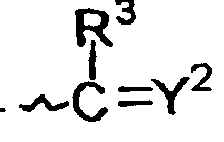 D ausgewählt ist aus O S(O)p, NR1 und CR6R7,R5 ausgewählt ist aus der Gruppe, bestehend aus: Aryl und C5-10-Heteroaryl, wobei das Aryl und Heteroaryl gegebenenfalls substituiert sind mit 1 bis 3 Ra-Gruppen,Y2 ausgewählt ist aus der Gruppe, bestehend aus: 0, N(C1-15)-Alkyl, N-CO2C1-15-Alkyl, N-OC1-15-Alkyl, N-OC(O)C1-15-Alkyl und N-OH, mit der Maßgabe, daß, wenn Y2 O ist und R3 CH3 ist, n dann 2 ist,R8 optional ist und ausgewählt ist aus der Gruppe, bestehend aus CR6R7, O, NR6 und S(O)p,R6 und R7 unabhängig ausgewählt sind aus H und C1-6-Alkyl;und "Aryl" bei jedem Auftreten Phenyl oder Naphthyl bedeutet.
 - Eine Verbindung nach Anspruch 1, wobeiR1 H oder C1-15-Alkyl ist,X1 und X2 unabhängig H oder Halogen sind,Y O, NH oder S ist,Y1 O ist,W -CR6R7- ist,Ra ein Element ist, ausgewählt aus der Gruppe, bestehend aus: Halogen, Aryl, Heteroaryl, CF3, OCF3, CN, NO2, R3', OR3', SR3', S(O)R3', SO2R3', NR3'COR3', COR3', CON(R3')2, SO2N(R3')2, wobei das Aryl und Heteroaryl gegebenenfalls mit 1 bis 3 Halogengruppen substituiert sind,Z CO2R3', CONHSO2Me, CONH2 oder 5-(1H-Tetrazol) ist.
- Eine Verbindung nach Anspruch 1, wobei:R1 C1-15-Alkyl ist,R4 -D-R5 oder
 X2 H oder Halogen ist,Y O, NH oder S ist,Y1 O ist,Ra ein Element ist, ausgewählt aus der Gruppe, bestehend aus: Halogen, Aryl, Heteroaryl, CF3, OCF3, CN, NO2, R3', OR3', SR3', S(O)R3', SO2R3', NR3'CO3', COR3', CON(R3')2, SO2N(R3')2, wobei das Aryl und Heteroaryl gegebenenfalls substituiert sind mit 1 bis 3 Halogengruppen,(Z-W)t oder (Z-W)v zusammen mit X1 einen 5- oder 6gliedrigen Ring bildet, wobei der Ring ein Carbocyclus, Aryl oder Heteroaryl ist und gegebenenfalls substituiert ist mit 1 bis 3 Gruppen Ra, wobei im Falle der Verwendung von (Z-W)t v 0 oder 1 ist, im Falle der Verwendung von (Z-W)v t 0 oder 1 ist und alle anderen Variablen wie in Anspruch 1 definiert sind.
 - Eine Verbindung nach Anspruch 1, ausgewählt aus der Gruppe, bestehend aus:2-(2-(3-Phenyl-7-propylbenzofuran-6-yloxy)ethyl)indol-5-essigsäure,2-(2-(3-(2,2-Dimethylpropyl)-7-propylbenz[4,5]isoxazol-6-yloxy)ethyl)indol-5-essigsäure,2-(2-(3-Phenyl-7-propylbenz[4,5]isoxazol-6-yloxy)ethyl)indol-5-essigsäure,2-(2-(3-Neopentyl-7-propylbenzofuran-6-yloxy)ethyl)indol-5-(2,2-dimethyl)essigsäure,2-(2-(3-Phenyl-7-propylbenz[4,5]isoxazol-6-yloxy)ethyl)indol-5-propan-3-säure,2-(2-(3-Neopentyl-7-propylbenz[4,5]isoxazol-6-yloxy)ethyl)indol-5-propan-3-säure,2-(2-(3-Phenyl-7-propylbenzofuran-6-yloxy)ethyl)indol-5-oxyessigsäure,2-(2-(3-Neopentyl-7-propylbenzofuran-6-yloxy)ethyl)indol-5-oxyessigsäure,N-[2-(2-(3-Phenyl-7-propylbenz[4,5]isoxazol-6-yloxy)ethyl)indol-5-yl]glycin,N-[2-(2-(3-Neopentyl-7-propylbenz[4,5]isoxazol-6-yloxy)ethyl)indol-5-yl]glycin,2-(2-(3-Phenyl-7-propylbenzofuran-6-yloxy)ethyl)indol-6-essigsäure,2-(2-(3-Neopentyl-7-propylbenzofuran-6-yloxy)ethyl)indol-6-essigsäure,2-(2-(3-Phenyl-7-propylbenz[4,5]isoxazol-6-yloxy)ethyl)-4-chlorindol-5-essigsäure,2-(2-(3-Neapentyl-7-propylbenz[4,5]isaxazol-6-yloxy)ethyl)-4-chlorindol-5-essigsäure,2-(2-(3-Phenyl-7-propylbenzofuran-6-yloxy)ethyl)-3-methylindol-5-essigsäure,2-(2-(3-Neopentyl-7-propylbenzofuran-6-yloxy)ethyl)-3-methylindol-5-essigsäure,2-(2-(3-Phenyl-7-propylbenz[4,5]isoxazol-6-yloxy)ethyl)-3-butylindol-5-essigsäure,2-(2-(3-Neopentyl-7-propylbenz[4,5]isoxazol-6-yloxy)ethyl)-3-butylindol-5-essigsäure,2-(2-(3-Phenyl-7-propylbenzofuran-6-yloxy)ethyl)-7-propylindol-5-essigsäure,2-(2-(3-Neopentyl-7-propylbenzofuran-6-yloxy)ethyl)-7-propylindol-5-essigsäure,2-(2-(3-Phenyl-7-propylbenz[4,5]isoxazol-6-yloxy)ethyl)-N-methylindol-5-essigsäure,2-(2-(3-Neopentyl-7-propylbenz[4,5]isoxazol-6-yloxy)ethyl)-N-methylindol-5-essigsäure,2-(3-(3-Phenyl-7-propylbenzofuran-6-yloxy)propyl)indol-5-essigsäure,2-(3-(3-Neopentyl-7-propylbenzofuran-6-yloxy)propyl)indol-5-essigsäure,2-(2-(3-Phenyl-7-propylbenz[4,5]isoxazol-6-yloxy)propyl)indol-5-essigsäure,2-(2-(3-Neapentyl-7-propylbenz[4,5]isoxazol-6-yloxy)propyl)indol-5-essigsäure,2-(2-(3-Phenyl-7-(cyclopropylmethyl)benzofuran-6-yloxy)ethyl)indol-5-essigsäure,2-(2-(3-Neopentyl-7-(cyclopropylmethyl)benzofuran-6-yloxy)ethyl)indol-5-essigsäure,2-(2-(1-Phenyl-4-propylindol-5-yloxy)ethyl)indol-5-essigsäure,2-(2-(1-Phenyl-4-propylindo)-5-yloxy)ethyl)benzofuran-5-essigsäure,2-(2-(1-Phenyl-4-propylindol-5-yloxy)ethyl)indol-5-oxyessigsäure,2-(2-(1-Phenyl-4-propylindol-5-yloxy)ethyl)indol-5-propan-3-säure,2-(2-(4-Phenoxy-3-propylphenoxy)ethyl)indol-5-essigsäure,2-(2-(4-(4-Tolyloxy)-3-propylphenoxy)ethyl)indol-5-essigsäure,2-(2-(4-Valeryl-3-propylphenoxy)ethyl)indol-5-essigsäure,2-(2-(4-Benzoyl-3-propylphenoxy)ethyl)indol-5-essigsäure,2-(2-(4-(N-Hydroxyimino)valeryl-3-propylphenoxy)ethyl)indol-5-essigsäure,2-(2-(4-(N-Hydroxyimino)benzoyl-3-propylphenoxy)ethyl)indol-5-essigsäure,2-(2-(3-(3-Fluorphenyl)-7-propylbenzofuran-6-yloxy)ethyl)indol-5-essigsäure,2-(2-(3-(Phen-2-ethyl)-7-propylbenzofuran-6-yloxy)ethyl)indol-5-essigsäure,2-(2-(3-(4-t-Butytphenyl)-7-propylbenz[4,5]isoxazol-6-yloxy)ethyl)indol-5-essigsäure,2-(2-(3-(2,2-Dimethyl-2-phenylethyl)-7-propylbenzisoxazol-6-yloxy)ethyl)indol-5-essigsäure,2-(2-(4-Phenoxy-2-propylphenoxy)ethyl)indol-5-essigsäure,2-(2-(4-Phenoxy-2-propylphenoxy)ethyl)indol-5-essigsäuremethylester,2-(2-(3-(2-Phenyl)ethyl-7-propylbenz[4,5]isoxazol-6-yloxy)ethyl)indol-5-essigsäure,2-(2-(4-Phenoxy-2-propylphenoxy)ethyl)benzofuran-5-essigsäure,2-(2-(3-(2,2-Dimethylpropyl)-7-propylbenz[4,5]isoxazol-6-yloxy)ethyl)benzofuran-5-essigsäure,2-(2 -(3-Phenyl-7-propylbenz[4 ,5]isoxazol-6-yloxy)ethyl)benzofuran-5-essigsäure,2-(2-(3-Phenyl-7-propylbenzofuran-6-yloxy)ethyl)benzofuran-5-essigsäure,2-(2-(4-Phenoxy-2-propylphenoxy)ethyl-4,5,6,7-tetrahydronaphtho[2,1-b]furan-7-carbonsäure,2-(2-(3-Phenyl-7-propylbenz[4,5]isoxazol-6-yloxy)ethyl)-4, 5,6,7-tetrahydronaphtho[2,1-b]furan-7-carbonsäure,2-(2-(3-(2,2-Dimethylpropyl)-7-propylbenz[4,5]isoxazol-6-yloxy)ethyl)-4,5,6,7-tetrahydronaphtho-[2,1-b]furan-7-carbonsäure,2-(2-(3-Phenyl-7-propylbenzofuran-6-yloxy)ethyl)benzothiophen-5-essigsäure,2-(2-(3-Nentyl-7-propylbenzofuran-6-yloxy)ethyl)benzofuran-5-essigsäure und2-(2-(3-Neopentyl-7-propylbenz[4,5]isoxazol-6-yloxy)ethyl)benzothiophen-5-essigsäure,oder ein Salz oder Hydrat davon.
- Eine Verbindung nach Anspruch 1, dargestellt durch eine der folgenden Strukturformeln:


- Kristalline 2-(2-(4-Phenoxy-2-propylphenoxy)ethyl)indol-5-essigsäure gemäß Anspruch 4 mit einem Röntgenpulverbeugungsmuster gemäß Tabelle 1:
TABELLE 1 Peak Nr. Winkel (Grad) Spitzenbreite (Grad) Peak (cts) Hintergrund (cts) D-Abstand (Ang) l/Imax (%) Typ Sign A1 A2 Ot 1 8,3325 0,48 10. 6. 10,6028 2,34 x x 0,83 2 9,7600 0,12 19. 7. 9,0550 4,43 x x 0,89 3 12,1375 0,36 10. 8. 7,2861 2,34 x x 1,05 4 14,1525 0,15 17. 9. 6,2529 3,85 x x 0,91 5 16,1575 0,15 46. 12. 5,4812 10,59 x x 2,09 6 16,6450 0,15 53. 12. 5,3218 12,20 x x 1,02 7 16,8200 0,15 41. 12. 5,2668 9,38 x x 0,91 8 17,6250 0,24 30. 13. 5,0280 6,93 x x 1,26 9 18,2600 0,07 154. 13. 4,8546 35,20 x x 1,38 10 18,9025 0,18 17. 14. 4,6910 3,85 x x 1,26 11 19,5625 0,12 34. 14. 4,5342 7,70 x x 0,76 12 20,5175 0,09 117. 15 4,3252 26,70 x x 1,07 13 21,6225 0,21 48. 16 4,1066 10,90 x x 2,88 14 22,6875 0,13 437. 17 3,9162 100,00 x x 5,62 15 23,4200 0,09 128. 18 3,7954 29,23 x x 0,78 16 23,8750 0,18 96. 18 3,7241 21,99 x x 3,47 17 24.4900 0,12 72. 18 3,6319 16,54 x x 3,02 18 25,0125 0,18 26. 18 3,5572 5,95 x x 0,89 19 25,7275 0,18 20. 19 3,4599 4,64 x x 0,83 20 26,6250 0,18 114. 20 3,3453 26,21 x x 2,09 21 26,9725 0,09 246. 20 3,3030 56,43 x x 1,74 22 27,9675 0,07 202. 21 3,1877 46,16 x x 1,32 23 28,5925 0,24 30. 22 3,1194 6,93 x x 1,05 24 30,8400 0,07 196. 24 2,8970 44,87 x x 1,55 25 32,1275 0,18 38. 24 2,7838 8,80 x x 1,82 26 32,6325 0,18 58. 25 2,7419 13,22 x x 2,04 27 33,9250 0,18 174. 26 2,6403 39,89 x x 5,13 28 35,1000 0,18 17. 27 2,5546 3,85 x x 1,05 29 35,7950 0,24 32. 27 2,5065 7,44 x x 3,16 30 36,8400 0,36 37. 28 2,4378 8,52 x x 2,45 31 37,3975 0,15 35. 28 2,4027 7,97 x x 1,07 32 37,8050 0,15 35. 28 2,3778 7,97 x x 1,15 33 38,5300 0,12 69. 29 2,3347 15,77 x x 1,15 - Kristalline 2-(2-(4-Phenoxy-2-propylphenoxy)ethyl)indol-5-essigsäure gemäß Anspruch 4 als das Pentahydratsalz.
- Eine pharmazeutische Zusammensetzung, die eine wie in irgendeinem der Ansprüche 1-7 beschriebene Verbindung in Kombination mit einem Träger enthält.
- Eine pharmazeutische Zusammensetzung gemäß Anspruch 8, die ferner wenigstens ein Element enthält, ausgewählt aus der Gruppe, bestehend aus: einem Sulfonylharnstoff, Fibrat, HMG-CoA-Reduktaseinhibitor, Betasitosterolinhibitor, Cholesterinacyltransferaseinhibitor, Biguanid, Cholestyramin, Angiotensin-II-Antagonisten, Melinamid, Nicotinsäure, Fibrinogenrezeptorantagonisten, Aspirin, α-Glucosidaseinhibitor, Insulinsekretagogum und Insulin, Fenfluramin, Dexfenfluramin, Phentermin oder einem β3-adrenergen Rezeptorantagonisten.
- Eine Verbindung gemäß irgendeinem der Ansprüche 1-7 zur Verwendung bei der Behandlung von Diabetes, diabetischer Retinopathie, diabetischer Nephropathie, zur Senkung von Triglyceridspiegeln oder zum Aufhalten, Verhindern oder Verringern des Risikos von Atherosklerose und verwandten Erkrankungsfällen oder zur Erhöhung von High-Density-Lipoprotein-Plasmaspiegeln.
- Eine Zusammensetzung zur Behandlung von Diabetes, diabetischer Retinopathie und diabetischer Nephropathie, die einen inerten Träger und eine wirksame Menge einer Verbindung gemäß irgendeinem der Ansprüche 1-7 in Kombination mit einem Sulfonylharnstoff, Fibrat, HMG-CoA-Reduktaseinhibitor, Betasitosterolinhibitor, Cholesterinacyltransferaseinhibitor, Biguanid, Cholestyramin, Anglotensin-II-Antagonisten, Melinamid, Nicotinsäure, Fibrinogenrezeptorantagonisten, Aspirin, α-Glucosidaseinhibitor, Insulinsekretagogum oder Insulin enthält.
- Eine Zusammensetzung zum Aufhalten, Verhindern oder Verringern des Risikos zur Ausbildung von Atherosklerose und verwandten Erkrankungsfällen oder zur Erhöhung von High-Density-Lipoprotein-Plasmaspiegeln, die einen inerten Träger und eine wirksame Menge einer Verbindung gemäß irgendeinem der Ansprüche 1-7 in Kombination mit einem Sulfonylharnstoff, Fibrat, HMG-CoA-Reduktaseinhibitor, Betasitosterolinhibitor, Cholesterinacyltransferaseinhibitor, Biguanid, Cholestyramin, Angiotensin-II-Antagonisten, Melinamid, Nicotinsäure, Fibrinogenrezeptorantagonisten, Aspirin, α-Glucosidaseinhibitor, Insulinsekretagogum oder Insulin enthält.
- Eine Zusammensetzung zur Behandlung von Fettleibigkeit, die einen inerten Träger und eine wirksame Menge einer Verbindung gemäß irgendeinem der Ansprüche 1-7 in Kombination mit Fenfluramin, Dexfenfluramin, Phentermin oder einem β3-adrenergen Rezeptoragonisten enthält.
- Die Verwendung einer Verbindung gemäß irgendeinem der Ansprüche 1-7 zur Herstellung eines Medikaments zur Behandlung oder Prävention von Diabetes, diabetischer Retinopathie, diabetischer Nephropathie, Atherosklerose und verwandten Erkrankungsfällen oder Fettleibigkeit oder zur Senkung von Triglyceridspiegeln oder zur Erhöhung von High-Density-Lipoprotein-Plasmaspiegeln bei einem Menschen oder einem nichtmenschlichen Tier.
Applications Claiming Priority (7)
| Application Number | Priority Date | Filing Date | Title |
|---|---|---|---|
| US3443296P | 1996-12-23 | 1996-12-23 | |
| US34432P | 1996-12-23 | ||
| GB9705857 | 1997-03-21 | ||
| GBGB9705857.2A GB9705857D0 (en) | 1997-03-21 | 1997-03-21 | Antidiabetic agents |
| US6011397P | 1997-09-26 | 1997-09-26 | |
| US60113P | 1997-09-26 | ||
| PCT/US1997/023646 WO1998027974A1 (en) | 1996-12-23 | 1997-12-19 | Antidiabetic agents |
Publications (3)
| Publication Number | Publication Date |
|---|---|
| EP0948327A1 EP0948327A1 (de) | 1999-10-13 |
| EP0948327A4 EP0948327A4 (de) | 2003-04-02 |
| EP0948327B1 true EP0948327B1 (de) | 2006-03-08 |
Family
ID=27268782
Family Applications (1)
| Application Number | Title | Priority Date | Filing Date |
|---|---|---|---|
| EP97952573A Expired - Lifetime EP0948327B1 (de) | 1996-12-23 | 1997-12-19 | Antidiabetische mittel |
Country Status (8)
| Country | Link |
|---|---|
| EP (1) | EP0948327B1 (de) |
| JP (1) | JP2001511767A (de) |
| AT (1) | ATE319440T1 (de) |
| AU (1) | AU719663B2 (de) |
| CA (1) | CA2275394A1 (de) |
| DE (1) | DE69735442T2 (de) |
| ES (1) | ES2258799T3 (de) |
| WO (1) | WO1998027974A1 (de) |
Families Citing this family (29)
| Publication number | Priority date | Publication date | Assignee | Title |
|---|---|---|---|---|
| WO1999011255A1 (en) * | 1997-08-28 | 1999-03-11 | Ono Pharmaceutical Co., Ltd. | Peroxisome proliferator-activated receptor controllers |
| YU72201A (sh) * | 1999-04-28 | 2005-07-19 | Aventis Pharma Deutschland Gmbh. | Derivati di-aril kiseline kao ppar receptorski ligandi |
| PL351470A1 (en) | 1999-04-28 | 2003-04-22 | Aventis Pharma Gmbh | Tri-aryl acid derivatives as ppar receptor ligands |
| US6414002B1 (en) | 1999-09-22 | 2002-07-02 | Bristol-Myers Squibb Company | Substituted acid derivatives useful as antidiabetic and antiobesity agents and method |
| TWI302149B (en) | 1999-09-22 | 2008-10-21 | Bristol Myers Squibb Co | Substituted acid derivatives useful as antiodiabetic and antiobesity agents and method |
| PE20020323A1 (es) * | 2000-08-22 | 2002-06-13 | Novartis Ag | COMPOSICION FARMACEUTICA QUE COMPRENDE UN POTENCIADOR DE LA SECRESION DE INSULINA E INHIBIDORES DE HMG-Co-A-REDUCTASA O INHIBIDORES DE LA ENZIMA CONVERTIDORA DE ANGIOTENSINA (ACE) |
| US20060089389A1 (en) | 2000-08-22 | 2006-04-27 | Malcolm Allison | Combination |
| AU2003259131A1 (en) | 2002-07-09 | 2004-01-23 | Bristol-Myers Squibb Company | Substituted heterocyclic derivatives useful as antidiabetic and antiobesity agents and method |
| BR0314335A (pt) | 2002-09-05 | 2005-07-26 | Novo Nordisk As | Composto, uso do mesmo, composição farmacêutica, e métodos para o tratamento e/ou prevenção de condições mediadas por receptores nucleares, e de diabetes de tipo i, diabetes de tipo ii, tolerância prejudicada à glicose, resistência à insulina ou obesidade |
| DE60332860D1 (de) | 2002-10-28 | 2010-07-15 | High Point Pharmaceuticals Llc | Neue verbindungen, die sich f r die behandlung von durch ppar vermittelten krankheiten eignen |
| US20050080115A1 (en) | 2002-10-28 | 2005-04-14 | Lone Jeppesen | Novel compounds, their preparation and use |
| DE60333211D1 (de) | 2002-10-28 | 2010-08-12 | High Point Pharmaceuticals Llc | Neue verbindungen und deren verwendung als ppar-modulatoren |
| US7129268B2 (en) | 2002-10-28 | 2006-10-31 | Novo Nordisk A/S | Peroxisome proliferator activated receptor-active arylene acetic acid derivatives |
| CN1886133B (zh) | 2003-12-04 | 2010-12-01 | 财团法人卫生研究院 | 吲哚化合物 |
| GB0403148D0 (en) * | 2004-02-12 | 2004-03-17 | Smithkline Beecham Corp | Chemical compounds |
| ES2352085T3 (es) | 2004-05-05 | 2011-02-15 | High Point Pharmaceuticals, Llc | Nuevos compuestos, su preparación y uso. |
| WO2005105736A1 (en) | 2004-05-05 | 2005-11-10 | Novo Nordisk A/S | Novel compounds, their preparation and use |
| ATE529404T1 (de) | 2005-06-30 | 2011-11-15 | High Point Pharmaceuticals Llc | Phenoxyessigsäuren als ppar-delta-aktivatoren |
| BRPI0620468A2 (pt) | 2005-12-22 | 2011-11-08 | Transtech Pharma, Inc. | ácidos fenóxi acéticos como ativadores de ppar delta |
| WO2007101864A2 (en) | 2006-03-09 | 2007-09-13 | High Point Pharmaceuticals, Llc | Compounds that modulate ppar activity, their preparation and use |
| US20080187928A1 (en) | 2006-12-29 | 2008-08-07 | The Salk Institute For Biological Studies | Methods for enhancing exercise performance |
| EP2588455B1 (de) * | 2010-07-02 | 2018-04-04 | Gilead Sciences, Inc. | 2-quinolinyl-essigsäure derivate als hiv antivirale verbindungen |
| EP2612669A4 (de) | 2010-08-31 | 2014-05-14 | Snu R&Db Foundation | Verwendung der fötalen neuprogrammierung eines ppar-agonisten |
| WO2015035171A1 (en) | 2013-09-09 | 2015-03-12 | High Point Pharmaceuticals, Llc | Use of a ppar-delta agonist for treating muscle atrophy |
| CN104987314A (zh) * | 2015-07-14 | 2015-10-21 | 佛山市赛维斯医药科技有限公司 | 含苯并异恶唑和末端硝基苄基类结构的化合物及其用途 |
| CN105001174A (zh) * | 2015-07-14 | 2015-10-28 | 佛山市赛维斯医药科技有限公司 | 含苯并异恶唑和末端腈基苄基类结构的化合物及其用途 |
| WO2018037254A1 (en) * | 2016-08-24 | 2018-03-01 | Tfchem | Difluorinated compounds as depigmenting or lightening agents |
| JP7462569B2 (ja) | 2017-12-12 | 2024-04-05 | クィーンズ ユニバーシティー アット キングストン | Cyp26酵素を阻害するための化合物および方法 |
| WO2023147309A1 (en) | 2022-01-25 | 2023-08-03 | Reneo Pharmaceuticals, Inc. | Use of ppar-delta agonists in the treatment of disease |
Family Cites Families (4)
| Publication number | Priority date | Publication date | Assignee | Title |
|---|---|---|---|---|
| US4918092A (en) * | 1983-12-21 | 1990-04-17 | Merck Frosst Canada, Inc. | Leukotriene antagonists |
| WO1990005721A1 (en) * | 1988-11-14 | 1990-05-31 | The Upjohn Company | Alpha-amino-indole-3-acetic acids useful as anti-diabetic, anti-obesity and anti-atherosclerotic agents |
| EP0635007A1 (de) * | 1992-04-10 | 1995-01-25 | Smithkline Beecham Plc | Heterocyclische derivate und ihre anwendung in der behandlung von type ii-diabetis |
| US5541208A (en) * | 1994-01-24 | 1996-07-30 | Merck & Co., Inc. | Indole diterpene alkaloid compounds |
-
1997
- 1997-12-19 EP EP97952573A patent/EP0948327B1/de not_active Expired - Lifetime
- 1997-12-19 CA CA002275394A patent/CA2275394A1/en not_active Abandoned
- 1997-12-19 JP JP52901698A patent/JP2001511767A/ja not_active Withdrawn
- 1997-12-19 AT AT97952573T patent/ATE319440T1/de not_active IP Right Cessation
- 1997-12-19 AU AU56152/98A patent/AU719663B2/en not_active Ceased
- 1997-12-19 ES ES97952573T patent/ES2258799T3/es not_active Expired - Lifetime
- 1997-12-19 WO PCT/US1997/023646 patent/WO1998027974A1/en not_active Ceased
- 1997-12-19 DE DE69735442T patent/DE69735442T2/de not_active Expired - Fee Related
Also Published As
| Publication number | Publication date |
|---|---|
| ATE319440T1 (de) | 2006-03-15 |
| EP0948327A4 (de) | 2003-04-02 |
| AU719663B2 (en) | 2000-05-11 |
| EP0948327A1 (de) | 1999-10-13 |
| CA2275394A1 (en) | 1998-07-02 |
| AU5615298A (en) | 1998-07-17 |
| DE69735442D1 (de) | 2006-05-04 |
| WO1998027974A1 (en) | 1998-07-02 |
| DE69735442T2 (de) | 2006-11-16 |
| JP2001511767A (ja) | 2001-08-14 |
| ES2258799T3 (es) | 2006-09-01 |
Similar Documents
| Publication | Publication Date | Title |
|---|---|---|
| EP0948327B1 (de) | Antidiabetische mittel | |
| US6090839A (en) | Antidiabetic agents | |
| EP1011651B1 (de) | Verfahren zur behandlung von diabetes und verwandter krankheitszustände. | |
| US5847008A (en) | Method of treating diabetes and related disease states | |
| EP0888278B1 (de) | Antidiabetische mittel | |
| DE69720429T9 (de) | Heterocyclische verbindungen als antidiabetische mittel und für die behandlung von fettleibigkeit | |
| US5859051A (en) | Antidiabetic agents | |
| AU719146B2 (en) | Antidiabetic agents | |
| EP1305285B1 (de) | N-substituierte indole mit anwendung in der behandlung von diabetes | |
| RU2328483C2 (ru) | Индолы, обладающие противодиабетической активностью | |
| CZ20013833A3 (cs) | Deriváty kyselin se dvěma arylovými zbytky jako ligandy receptorů PPAR a farmaceutické prostředky, které je obsahují | |
| US6160000A (en) | Antidiabetic agents based on aryl and heteroarylacetic acids | |
| US6090836A (en) | Benzisoxazole-derived antidiabetic compounds | |
| US6020382A (en) | Method of treating diabetes and related disease states | |
| US6515015B1 (en) | Antidiabetic agents based on aryl and heteroarylacetic acids | |
| EP1537078B1 (de) | Indole mit antidiabetischer wirkung | |
| CA2244836C (en) | Benzoheterocyclic derivatives as antidiabetic and antiobesity agents | |
| HK1083836B (en) | Indoles having anti-diabetic activity |
Legal Events
| Date | Code | Title | Description |
|---|---|---|---|
| PUAI | Public reference made under article 153(3) epc to a published international application that has entered the european phase |
Free format text: ORIGINAL CODE: 0009012 |
|
| 17P | Request for examination filed |
Effective date: 19990723 |
|
| AK | Designated contracting states |
Kind code of ref document: A1 Designated state(s): AT BE CH DE DK ES FI FR GB GR IE IT LI LU NL PT SE |
|
| RIC1 | Information provided on ipc code assigned before grant |
Ipc: 7C 07D 209/12 B Ipc: 7C 07D 409/12 B Ipc: 7A 61K 31/415 B Ipc: 7A 61K 31/395 B Ipc: 7A 61K 31/40 B Ipc: 7A 61K 31/41 B Ipc: 7A 61K 31/47 B Ipc: 7C 07D 403/12 B Ipc: 7C 07D 307/92 B Ipc: 7C 07D 407/12 B Ipc: 7C 07D 307/80 B Ipc: 7C 07D 209/18 B Ipc: 7C 07D 413/12 B Ipc: 7C 07D 405/12 B Ipc: 7C 07D 213/56 B Ipc: 7C 07D 411/02 B Ipc: 7C 07D 413/04 B Ipc: 7A 61K 31/135 A |
|
| A4 | Supplementary search report drawn up and despatched |
Effective date: 20030219 |
|
| 17Q | First examination report despatched |
Effective date: 20030610 |
|
| GRAP | Despatch of communication of intention to grant a patent |
Free format text: ORIGINAL CODE: EPIDOSNIGR1 |
|
| GRAS | Grant fee paid |
Free format text: ORIGINAL CODE: EPIDOSNIGR3 |
|
| GRAA | (expected) grant |
Free format text: ORIGINAL CODE: 0009210 |
|
| AK | Designated contracting states |
Kind code of ref document: B1 Designated state(s): AT BE CH DE DK ES FI FR GB GR IE IT LI LU NL PT SE |
|
| PG25 | Lapsed in a contracting state [announced via postgrant information from national office to epo] |
Ref country code: NL Free format text: LAPSE BECAUSE OF FAILURE TO SUBMIT A TRANSLATION OF THE DESCRIPTION OR TO PAY THE FEE WITHIN THE PRESCRIBED TIME-LIMIT Effective date: 20060308 Ref country code: FI Free format text: LAPSE BECAUSE OF FAILURE TO SUBMIT A TRANSLATION OF THE DESCRIPTION OR TO PAY THE FEE WITHIN THE PRESCRIBED TIME-LIMIT Effective date: 20060308 Ref country code: BE Free format text: LAPSE BECAUSE OF FAILURE TO SUBMIT A TRANSLATION OF THE DESCRIPTION OR TO PAY THE FEE WITHIN THE PRESCRIBED TIME-LIMIT Effective date: 20060308 Ref country code: AT Free format text: LAPSE BECAUSE OF FAILURE TO SUBMIT A TRANSLATION OF THE DESCRIPTION OR TO PAY THE FEE WITHIN THE PRESCRIBED TIME-LIMIT Effective date: 20060308 |
|
| REG | Reference to a national code |
Ref country code: GB Ref legal event code: FG4D |
|
| REG | Reference to a national code |
Ref country code: CH Ref legal event code: EP |
|
| REG | Reference to a national code |
Ref country code: IE Ref legal event code: FG4D |
|
| REF | Corresponds to: |
Ref document number: 69735442 Country of ref document: DE Date of ref document: 20060504 Kind code of ref document: P |
|
| REG | Reference to a national code |
Ref country code: CH Ref legal event code: NV Representative=s name: E. BLUM & CO. PATENTANWAELTE |
|
| PG25 | Lapsed in a contracting state [announced via postgrant information from national office to epo] |
Ref country code: SE Free format text: LAPSE BECAUSE OF FAILURE TO SUBMIT A TRANSLATION OF THE DESCRIPTION OR TO PAY THE FEE WITHIN THE PRESCRIBED TIME-LIMIT Effective date: 20060608 Ref country code: DK Free format text: LAPSE BECAUSE OF FAILURE TO SUBMIT A TRANSLATION OF THE DESCRIPTION OR TO PAY THE FEE WITHIN THE PRESCRIBED TIME-LIMIT Effective date: 20060608 |
|
| PG25 | Lapsed in a contracting state [announced via postgrant information from national office to epo] |
Ref country code: PT Free format text: LAPSE BECAUSE OF FAILURE TO SUBMIT A TRANSLATION OF THE DESCRIPTION OR TO PAY THE FEE WITHIN THE PRESCRIBED TIME-LIMIT Effective date: 20060808 |
|
| NLV1 | Nl: lapsed or annulled due to failure to fulfill the requirements of art. 29p and 29m of the patents act | ||
| REG | Reference to a national code |
Ref country code: ES Ref legal event code: FG2A Ref document number: 2258799 Country of ref document: ES Kind code of ref document: T3 |
|
| ET | Fr: translation filed | ||
| PG25 | Lapsed in a contracting state [announced via postgrant information from national office to epo] |
Ref country code: IE Free format text: LAPSE BECAUSE OF NON-PAYMENT OF DUE FEES Effective date: 20061219 |
|
| PLBE | No opposition filed within time limit |
Free format text: ORIGINAL CODE: 0009261 |
|
| STAA | Information on the status of an ep patent application or granted ep patent |
Free format text: STATUS: NO OPPOSITION FILED WITHIN TIME LIMIT |
|
| 26N | No opposition filed |
Effective date: 20061211 |
|
| REG | Reference to a national code |
Ref country code: CH Ref legal event code: PFA Owner name: MERCK & CO., INC. Free format text: MERCK & CO., INC.#126 EAST LINCOLN AVENUE#RAHWAY, NEW JERSEY 07065 (US) -TRANSFER TO- MERCK & CO., INC.#126 EAST LINCOLN AVENUE#RAHWAY, NEW JERSEY 07065 (US) |
|
| PGFP | Annual fee paid to national office [announced via postgrant information from national office to epo] |
Ref country code: ES Payment date: 20071219 Year of fee payment: 11 |
|
| PGFP | Annual fee paid to national office [announced via postgrant information from national office to epo] |
Ref country code: IT Payment date: 20071215 Year of fee payment: 11 Ref country code: CH Payment date: 20071009 Year of fee payment: 11 |
|
| PG25 | Lapsed in a contracting state [announced via postgrant information from national office to epo] |
Ref country code: GR Free format text: LAPSE BECAUSE OF FAILURE TO SUBMIT A TRANSLATION OF THE DESCRIPTION OR TO PAY THE FEE WITHIN THE PRESCRIBED TIME-LIMIT Effective date: 20060609 |
|
| PGFP | Annual fee paid to national office [announced via postgrant information from national office to epo] |
Ref country code: GB Payment date: 20071106 Year of fee payment: 11 |
|
| PGFP | Annual fee paid to national office [announced via postgrant information from national office to epo] |
Ref country code: DE Payment date: 20071228 Year of fee payment: 11 |
|
| PG25 | Lapsed in a contracting state [announced via postgrant information from national office to epo] |
Ref country code: LU Free format text: LAPSE BECAUSE OF NON-PAYMENT OF DUE FEES Effective date: 20061219 |
|
| PGFP | Annual fee paid to national office [announced via postgrant information from national office to epo] |
Ref country code: FR Payment date: 20071204 Year of fee payment: 11 |
|
| REG | Reference to a national code |
Ref country code: CH Ref legal event code: PL |
|
| GBPC | Gb: european patent ceased through non-payment of renewal fee |
Effective date: 20081219 |
|
| REG | Reference to a national code |
Ref country code: FR Ref legal event code: ST Effective date: 20090831 |
|
| PG25 | Lapsed in a contracting state [announced via postgrant information from national office to epo] |
Ref country code: LI Free format text: LAPSE BECAUSE OF NON-PAYMENT OF DUE FEES Effective date: 20081231 Ref country code: DE Free format text: LAPSE BECAUSE OF NON-PAYMENT OF DUE FEES Effective date: 20090701 Ref country code: CH Free format text: LAPSE BECAUSE OF NON-PAYMENT OF DUE FEES Effective date: 20081231 |
|
| PG25 | Lapsed in a contracting state [announced via postgrant information from national office to epo] |
Ref country code: GB Free format text: LAPSE BECAUSE OF NON-PAYMENT OF DUE FEES Effective date: 20081219 |
|
| REG | Reference to a national code |
Ref country code: ES Ref legal event code: FD2A Effective date: 20081220 |
|
| PG25 | Lapsed in a contracting state [announced via postgrant information from national office to epo] |
Ref country code: FR Free format text: LAPSE BECAUSE OF NON-PAYMENT OF DUE FEES Effective date: 20081231 Ref country code: ES Free format text: LAPSE BECAUSE OF NON-PAYMENT OF DUE FEES Effective date: 20081220 |
|
| PG25 | Lapsed in a contracting state [announced via postgrant information from national office to epo] |
Ref country code: IT Free format text: LAPSE BECAUSE OF NON-PAYMENT OF DUE FEES Effective date: 20081219 |