EP0948523B1 - Peptidomimetische inhibitoren von der protease des menschlichen cytomegalovirus - Google Patents
Peptidomimetische inhibitoren von der protease des menschlichen cytomegalovirus Download PDFInfo
- Publication number
- EP0948523B1 EP0948523B1 EP97951048A EP97951048A EP0948523B1 EP 0948523 B1 EP0948523 B1 EP 0948523B1 EP 97951048 A EP97951048 A EP 97951048A EP 97951048 A EP97951048 A EP 97951048A EP 0948523 B1 EP0948523 B1 EP 0948523B1
- Authority
- EP
- European Patent Office
- Prior art keywords
- methyl
- dimethyl
- carboxamido
- propyl
- information
- Prior art date
- Legal status (The legal status is an assumption and is not a legal conclusion. Google has not performed a legal analysis and makes no representation as to the accuracy of the status listed.)
- Expired - Lifetime
Links
- 0 CC[C@](c1ccccc1)NC(C(C(*)*(C([C@@](*C([C@](C(C)(C)C)NC([C@](C(C)(C)C)NC(OC(C)(C)C)=O)=O)=O)C1)=O)=C1N(C)C)=O)=O Chemical compound CC[C@](c1ccccc1)NC(C(C(*)*(C([C@@](*C([C@](C(C)(C)C)NC([C@](C(C)(C)C)NC(OC(C)(C)C)=O)=O)=O)C1)=O)=C1N(C)C)=O)=O 0.000 description 7
- LWARKVDKKXHFQF-UHFFFAOYSA-N CC1(C(N)=O)N=C1 Chemical compound CC1(C(N)=O)N=C1 LWARKVDKKXHFQF-UHFFFAOYSA-N 0.000 description 1
- WABGCMJCOGGEFW-GWYFTNRFSA-N CCCCC[C@@H](C)NC(C(C(C)NC([C@H](CC(N(C)C)=O)NC([C@H](C(C)(C)C)NC(CC(C)(C)C)=O)=O)=O)=O)=O Chemical compound CCCCC[C@@H](C)NC(C(C(C)NC([C@H](CC(N(C)C)=O)NC([C@H](C(C)(C)C)NC(CC(C)(C)C)=O)=O)=O)=O)=O WABGCMJCOGGEFW-GWYFTNRFSA-N 0.000 description 1
- QTRWAVCVILTXOS-JSGCOSHPSA-N C[C@@H](C(c1nc(cccc2)c2[o]1)=O)NC([C@H](CC(N1CCCC1)=O)NC)=O Chemical compound C[C@@H](C(c1nc(cccc2)c2[o]1)=O)NC([C@H](CC(N1CCCC1)=O)NC)=O QTRWAVCVILTXOS-JSGCOSHPSA-N 0.000 description 1
Classifications
-
- C—CHEMISTRY; METALLURGY
- C07—ORGANIC CHEMISTRY
- C07K—PEPTIDES
- C07K5/00—Peptides containing up to four amino acids in a fully defined sequence; Derivatives thereof
- C07K5/04—Peptides containing up to four amino acids in a fully defined sequence; Derivatives thereof containing only normal peptide links
- C07K5/10—Tetrapeptides
- C07K5/1027—Tetrapeptides containing heteroatoms different from O, S, or N
-
- A—HUMAN NECESSITIES
- A61—MEDICAL OR VETERINARY SCIENCE; HYGIENE
- A61P—SPECIFIC THERAPEUTIC ACTIVITY OF CHEMICAL COMPOUNDS OR MEDICINAL PREPARATIONS
- A61P31/00—Antiinfectives, i.e. antibiotics, antiseptics, chemotherapeutics
- A61P31/12—Antivirals
- A61P31/20—Antivirals for DNA viruses
- A61P31/22—Antivirals for DNA viruses for herpes viruses
-
- C—CHEMISTRY; METALLURGY
- C07—ORGANIC CHEMISTRY
- C07K—PEPTIDES
- C07K5/00—Peptides containing up to four amino acids in a fully defined sequence; Derivatives thereof
- C07K5/02—Peptides containing up to four amino acids in a fully defined sequence; Derivatives thereof containing at least one abnormal peptide link
- C07K5/0202—Peptides containing up to four amino acids in a fully defined sequence; Derivatives thereof containing at least one abnormal peptide link containing the structure -NH-X-X-C(=0)-, X being an optionally substituted carbon atom or a heteroatom, e.g. beta-amino acids
-
- C—CHEMISTRY; METALLURGY
- C07—ORGANIC CHEMISTRY
- C07K—PEPTIDES
- C07K5/00—Peptides containing up to four amino acids in a fully defined sequence; Derivatives thereof
- C07K5/04—Peptides containing up to four amino acids in a fully defined sequence; Derivatives thereof containing only normal peptide links
- C07K5/06—Dipeptides
- C07K5/06191—Dipeptides containing heteroatoms different from O, S, or N
-
- C—CHEMISTRY; METALLURGY
- C07—ORGANIC CHEMISTRY
- C07K—PEPTIDES
- C07K5/00—Peptides containing up to four amino acids in a fully defined sequence; Derivatives thereof
- C07K5/04—Peptides containing up to four amino acids in a fully defined sequence; Derivatives thereof containing only normal peptide links
- C07K5/08—Tripeptides
- C07K5/0827—Tripeptides containing heteroatoms different from O, S, or N
-
- A—HUMAN NECESSITIES
- A61—MEDICAL OR VETERINARY SCIENCE; HYGIENE
- A61K—PREPARATIONS FOR MEDICAL, DENTAL OR TOILETRY PURPOSES
- A61K38/00—Medicinal preparations containing peptides
Definitions
- the present invention relates to compounds, composition and methods for the treatment of human cytomegalovirus (HCMV) infection.
- HCMV human cytomegalovirus
- the present invention provides novel peptidomimetic inhibitors of the HCMV protease.
- HCMV Human Cytomegalovirus
- the Human Cytomegalovirus is a highly prevalent member of the herpesvirus family infecting up to 80% of the general population. This virus is responsible for opportunistic infections in immunocompromised individuals including organ transplant recipients, cancer patients and AIDS sufferers. Clinical manifestations include disseminated disease, pneumonitis, retinitis and gastro-intestinal infections such as oesophagitis and colitis. Of particular significance are HCMV infections of neonates. This disease is the most common congenitally acquired viral infection in the world. It is estimated that 1% of newborn infants are infected and up to 10% of these are symptomatic and may experience severe complications. Mortality in this latter group approaches 30%.
- All members of the herpesvirus family express a protein late in the virus life cycle which appears to function as a self assembling scaffold during the manufacture of the viral capsid.
- This assembly protein is present in immature B-capsids and must be processed to remove a short segment of the C-terminus in order to permit the entry of viral DNA and produce an infectious virus particle. Recently it has been shown that this processing is mediated by a protease which is encoded by the virus.
- the protease itself is expressed as a precursor protein which is autocatalytically cleaved at least twice (Scheme 1).
- HCMV protease N o shows significant sequence homology with other herpesvirus proteases. Affinity labeling experiments and site-directed mutagenesis indicate that this enzyme is a serine protease. Recent crystallographic results have shown that HCMV protease represents a novel structure of serine proteases and in fact possesses a unique catalytic triad.
- HCMV protease While it has not been demonstrated that HCMV protease is absolutely required for viral replication, it has been shown that HSV-1 mutants lacking the analogous enzyme or expressing defective variations of it are unable to grow.
- the high degree of homology between the proteases of HSV and HCMV support the idea that specific inhibitors of HCMV protease would show antiviral activity and thus have therapeutic value.
- EP 0,410,411 A2 discloses novel peptidase inhibitors. These peptide analogs all contain a pentafluoroethylketone at P1', however none of the peptide disclosed contain the amino acid derivatives at P2 disclosed in the present invention.
- Ogilvie et al. (Peptidometric Inhibitors of the Human Cytomegalovirus Protease, J. Med. Chem. 40, 1997, 4113-4135) describe the development of peptidomimetic inhibitors of the human cytomegalovirus (HCMV) protease.
- the data of the inhibitor potency (IC 50 ) is given for a variety of tri-, tetra- and pentapeptide derivatives.
- cysteine and serine protease inhibitors which contain a ketomethylene group and are represented by the formula wherein Y has the formula and the groups Q, R 1 , R 2 and G are as defined.
- a compound of formula I wherein z is C or P; when z is C, then X is CF 3 ; C 2 F 5 ; benzothiazole; oxazolo[4,5b]pyridine; or benzoxazole- R 7 wherein R 7 is H or methyl; or X is CF 2 CONH- R 6 , C(O)NH- R 6 , wherein R 6 is C 0-10 alkyl optionally substituted with phenyl or cyclohexyl, said phenyl or cyclohexyl ring being optionally substituted with Me, halogen, -CF 3 ,-CH(Me)-C(O)-OBn; -C(O)NH 2 ; or -C(O)-morpholino; said phenyl or cyclohexyl ring optionally fused with a phenyl ring; (CH 2 ) 1-3 -O-(
- the present invention provides a compound of formula I: wherein z is C; X is CF 3 ; C 2 F 5 ; benzothiazole; benzoxazole- R 7 , wherein R 7 is H, 4-Me, 5-Me, 6-Me, or 7-Me; -CF 2 CONH-CH 2 -phenyl; -C(O)NH R 6 wherein R 6 is -CH(Me)(CH 2 ) 4 CH 3 ; cyclohexyl; naphthyl; -CH 2 -phenyl; -CH(CH 3 )-phenyl; or -CH(CH 2 CH 3 )-phenyl; ; -CH 2 -4-iodophenyl; -phenyl-CH 3 ; -phenyl-CF 3 ; -phenyl-C(O)NH 2 ; -phenyl-C(O)-morpholino; -phenyl-CH(Me)-C(O)
- a compound of the following formula wherein X is CF 3 , C 2 F 5 , 2-benzothiazole, CF 2 CONHR 6 , CONHR 6 , wherein R 6 is CH 2 C 6 H 5 , CH 2 (4-iodophenyl), CH 3 , (CH 2 ) 2 OCH 2 C 6 H 5 , CH 2 -2-benzimidazole, CH 2 -(3,4-methylenedioxybenzene) , CH(CH 3 )C 6 H 5 or CH(CH 2 CH 3 )C 6 H 5 ; or X is 2-benzoxazole-R 7 wherein R 7 is H, 4-CH 3 , 5-CH 3 , 6-CH 3 or 7-CH 3 ; R 1 is H, CH 3 or CH 2 CH 3 ; R 2 is CH 2 CONH 2 , CH 2 CH 2 CONH 2 , CH 2 -thiazole, CH 2 CON(CH 3 ) 2 , CH 2 CO-(pyrrolidino
- composition comprising an anticytomegalovirus virally effective amount of a compound of formula I or a therapeutically acceptable salt thereof, in admixture with a pharmaceutically acceptable carrier medium or auxiliary agent.
- An important aspect of the invention involves a method of treating a cytomegalovirus viral infection in a mammal by administering to the mammal an anti-CMV virally effective amount of the compound of formula I or a therapeutically acceptable salt thereof, or a composition as described above.
- Another important aspect involves a method of inhibiting the replication of cytomegalovirus virus by exposing the virus to a CMV protease inhibiting amount of the compound of formula I or a therapeutically acceptable salt thereof, or a composition as described above.
- Preferred compounds of the invention include compounds of formula I: wherein the substituents are defined below.
- z is C.
- X is CF 3 ; C 2 F 5 ; 2-benzothiazole; 2-benzoxazole- R 7 , wherein R 7 is H, 4-Me, 5-Me, 6-Me, or 7-Me; CF 2 CONH R 6 or C(O)NH R 6 wherein R 6 is C 1-7 alkyl, optionally substituted with cyclohexyl, naphthyl, or phenyl optionally substituted with Me, iodo, CF 3 , -CH(Me)-C(O)-OBn; -C(O)NH 2 , or -C(O)-morpholino; (CH 2 ) 2 -O-CH 2 -phenyl; CH 2 -2-benzimidazole; or CH 2 -(3,4-methylenedioxybenzene).
- X is CF 3 ; C 2 F 5 ; benzothiazole; benzoxazole- R 7 , wherein R 7 is H, 4-Me, 5-Me, 6-Me, or 7-Me; -CF 2 CONH-CH 2 -phenyl; -C(O)NH R 6 wherein R 6 is -CH(Me)(CH 2 ) 4 CH 3 ; cyclohexyl; naphthyl; -CH 2 -phenyl; -CH(CH 3 )-phenyl; or -CH(CH 2 CH 3 )-phenyl; ; -CH 2 -4-iodophenyl; -phenyl-CH 3 ; -phenyl-CF 3 ; -phenyl-C(O)NH 2 ; -phenyl-C(O)-morpholino; -phenyl-CH(Me)-C(O)-OBn; -(CH 2 ) 2 -O
- X is C 2 F 5 ; -C(O)NH R 6 wherein R 6 is -CH 2 -phenyl; -CH 2 -4-iodophenyl; -CH(CH 3 )-phenyl; or -CH(CH 2 CH 3 )-phenyl; -CH(Me)-naphthyl; -CH 2 CH(Me)-phenyl; -(CH 2 ) 2 -O-CH 2 -phenyl; -CH 2 -2-benzimidazole; or -CH 2 -(3,4-methylenedioxybenzene);
- R 1 is H, methyl or ethyl. More preferably, R 1 is H or methyl. Most preferably, R 1 is H or methyl;
- R 2 is -CH 2 -(4-thiazolo); -(CH 2 ) 1-4 -NH 2 ; -CH 2 -C(O)- tert -butyl; -CH 2 -C(O)-(N-pyrrolidino); -CH 2 -C(O)-(N-morpholino); -CH 2 SO 2 NH 2 ; -(CH 2 ) 1-2 -amido, the nitrogen of said amido optionally mono- or di-substituted with a substituent selected independently from: CH 3 ; t -Bu; phenyl; or -CH 2 CH 2 -(2-pyridino).
- R 2 is -CH 2 -C(O)-(N-pyrrolidino); -CH 2 -C(O)-(N-morpholino) ; -CH 2 SO 2 NH 2 ; -(CH 2 )C(O)NH 2 ; -(CH 2 ) 2 C(O)N(CH 3 ) 2 ; -CH 2 -C(O)-NH- t -Bu; or -(CH 2 ) 2 -C(O)-N(CH 3 )CH 2 CH 2 (2-pyridino).
- R 2 is -CH 2 -C(O)-(N-pyrrolidino) ; -CH 2 -C(O)-(N-morpholino) ; -(CH 2 ) 2 C(O)N(CH 3 ) 2 ; or -(CH 2 ) 2 -C(O)-N(CH 3 )CH 2 CH 2 (2-pyridino).
- W is NH
- R 3 is ethyl; isopropyl; t -Bu; CH 2 - t -Bu; or adamantyl. More preferably, R 3 is ethyl; isopropyl; or t -Bu. Most preferably, R 3 is isopropyl; or t -Bu.
- n is 0 or 1. More preferably, n is 0. Alternatively, more preferably, n is 1.
- R 4 when n is 1, is isopropyl; or t -Bu. Most preferably, R 4 , when n is 1, is t -Bu;
- n is 0 or 1. More preferably, m is 0.
- R 5 when m is 1, is H.
- Y is H; or an acyl of formula: -C(O)CH 3 ; -C(O)CH 2 -CH(CH 3 ) 2 ; -C(O)CH 2 - t -Bu (DA-Tbg); -C(O)(CH 2 ) 2 -4-hydroxyphenyl; -C(O)-(CH 2 ) 3 -COOH; -C(O)O- t -Bu (Boc); -C(O)(CH 2 ) 5 NH 2 ; or -C(O)(CH 2 ) 5 NH-Boc.
- Y is an acyl of formula: -C(O)CH 2 - t -Bu (DA-Tbg); -C(O)O- t -Bu (Boc); -C(O)(CH 2 ) 5 NH 2 ; or -C(O)(CH 2 ) 5 NH-Boc.
- a preferred compound of the invention is selected from the group consisting of:
- a further aspect of the present invention is a solid phase process for the synthesis of peptidyl activated ketones comprising the steps of:
- the resin is selected from the group consisting of: polystyrene or pegylated polystyrene functionalized with benzydrylamine (BHA); 4-methyl benzydrylamine (MBHA); and aminomethyl (AM).
- BHA benzydrylamine
- MBHA 4-methyl benzydrylamine
- AM aminomethyl
- the in situ activation is carried out with the addition of a coupling agent selected from the group consisting of: 2-( 1H -benzotriazol-1-yl)-1,1,3,3-tetramethyluronium tetrafluoroborate (TBTU); 2-( 1H -benzotriazol-1-yl)-1,1,3,3-tetramethyluronium hexafluorophosphate (HBTU); diisopropyl carbodiimide (DIC), and dicyclohexyl carbodiimide (DCC).
- a coupling agent selected from the group consisting of: 2-( 1H -benzotriazol-1-yl)-1,1,3,3-tetramethyluronium tetrafluoroborate (TBTU); 2-( 1H -benzotriazol-1-yl)-1,1,3,3-tetramethyluronium hexafluorophosphate (HBTU); diisopropyl carbodiimide (DIC), and dicycl
- the amino protecting group is selected from the group consisting of: t -butyloxycarbonyl (Boc); 9-fluorenylmethyloxy carbonyl (Fmoc); and allyloxy carbonyl (Alloc).
- A is cyclohexyl, phenyl or benzyl.
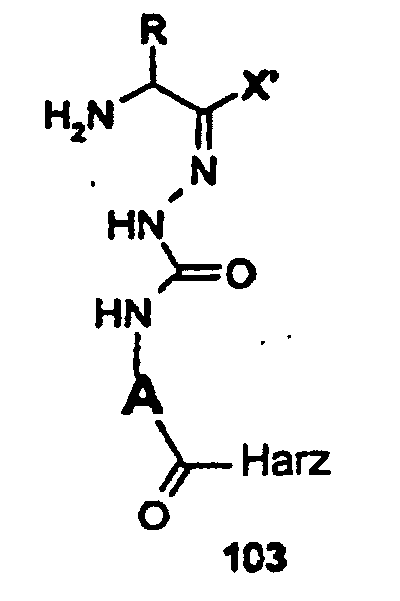
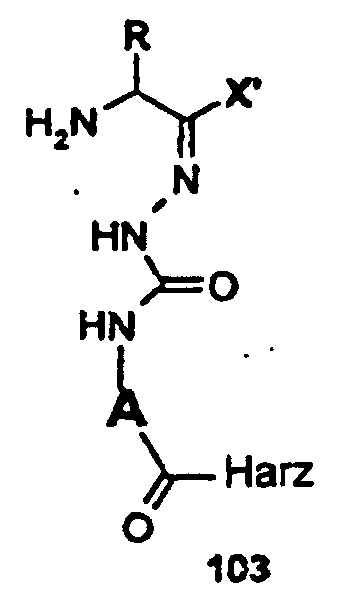
- a further aspect of the present invention is a resin of formula 103 as defined above.
- a further aspect of the present invention is the use of a resin of formula 103 for the solid phase synthesis of peptidyl activated ketones.
- the natural amino acids with exception of glycine, contain a chiral carbon atom. Unless otherwise specifically indicated, the compounds containing natural amino acids with the L-configuration are preferred. However, applicants contemplate that when specified, some amino acids of the formula I can be of either D- or L-C onfiguration or can be mixtures of D-and L-isomers, including 1:1 epimeric mixtures.
- the non-natural amino acids include, but are not limited to, ⁇ -aminoadipic acid, ⁇ - ⁇ -diamino butyric acid, ornithine, pipecolic acid, sarcosine, thyroxine, hydroxylysine, and hydroxyproline.
- tert -butylglycine refers to a compound of formula:
- side chain with reference to an amino acid or amino acid derivative means a residue attached to the ⁇ -carbon atom of the ⁇ -amino acid.
- the R-group side chain for glycine is hydrogen, for alanine it is methyl, for asparagine it is CH 2 -C(O)NH 2 , for glutamine it is CH 2 CH 2 C(O)NH 2 , and tert -butylglycine it is tert -butyl.
- R-group side chain for glycine is hydrogen, for alanine it is methyl, for asparagine it is CH 2 -C(O)NH 2 , for glutamine it is CH 2 CH 2 C(O)NH 2 , and tert -butylglycine it is tert -butyl.
- halo as used herein means a halogen radical selected from bromo, chloro, fluoro or iodo.
- C 1-10 alkyl or “(lower)alkyl” as used herein, either alone or in combination with another radical, means cyclic or acyclic (meaning straight chain or branched) alkyl radicals containing up to ten carbon atoms and includes, for example, methyl, ethyl, propyl, butyl, hexyl, 1-methylethyl, 1-methylpropyl, 2-methylpropyl, 1,1-dimethylethyl.
- the alkyl radical will contain at least 3 carbon atoms.
- C 2-10 alkenyl as used herein, either alone or in combination with another radical, means an alkyl radical as defined above containing from 2 to 10 carbon atoms, and further containing at least one double bond.
- alkenyl includes allyl.
- C 6 or C 10 aryl as used herein, either alone or in combination with another radical, means either an aromatic monocyclic system containing 6 carbon atoms or an aromatic bicyclic system containing 10 carbon atoms.
- aryl includes phenyl or naphthalene.
- C 7-16 aralkyl as used herein, either alone or in combination with another radical, means an aryl as defined above linked through an alkyl group, wherein alkyl is as defined above containing from 1 to 6 carbon atoms.
- Aralkyl includes for example benzyl, and butylphenyl.
- divalent spacer group means a non-reactive divalent hydrocarbyl group from 2 to 15 carbon atoms and includes, but is not limited to, cyclohexane, phenyl and benzyl.
- heterocycle as used herein, either alone or in combination with another radical, means a monovalent radical derived by removal of a hydrogen from a five-, six-, or seven-membered saturated or unsaturated heterocycle containing from one to four heteroatoms selected from nitrogen, oxygen and sulfur.
- suitable heterocycles include pyrrolidine, pyridine, thiazole, thiazolidine, benzothiazole, benzoxazole, benzimidazole, and 3,4-methylenedioxybenzene.
- HCMV protease inhibitors The antiviral activity of the aforementioned peptidomimetic inhibitors of HCMV protease (HCMV protease inhibitors) can be demonstrated by biochemical, microbiological and biological procedures. For example, an assay based on the evaluation of the ability of the test compound to inhibit HCMV protease, an enzyme vital for viral replication.
- the HCMV protease inhibitor When employed as an antiviral agent, it is administered orally, or systemically to humans in a vehicle comprising one or more pharmaceutically acceptable carriers, the proportion of which is determined by the solubility and chemical nature of the compound, chosen route of administration and standard biological practice.
- a vehicle comprising one or more pharmaceutically acceptable carriers, the proportion of which is determined by the solubility and chemical nature of the compound, chosen route of administration and standard biological practice.
- the compound or a therapeutically acceptable salt thereof can be formulated in unit dosage forms such as capsules or tablets each containing a predetermined amount of the active ingredient, ranging from about 50 to 500 mg, in a pharmaceutically acceptable carrier.
- the HCMV protease inhibitor is administered by either intravenous, subcutaneous or intramuscular injection, in compositions with pharmaceutically acceptable vehicles or carriers.
- pharmaceutically acceptable vehicles or carriers for parenteral administration, it is preferred to use the compounds in solution in a sterile aqueous vehicle which may also contain other solutes such as buffers or preservatives as well as sufficient quantities of pharmaceutically acceptable salts or of glucose to make the solution isotonic.
- Suitable vehicles or carriers for the above noted formulations are described in standard pharmaceutical texts, e.g. in "Remington's The Science and Practice of Pharmacy", 19th ed., Mack Publishing Company, Easton, Penn., 1995, or in “Pharmaceutical Dosage Forms And Drugs Delivery Systems", 6th ed., H.C. Ansel et al., Eds., Williams & Wilkins, Baltimore, Maryland, 1995.
- the dosage of the HCMV protease inhibitor will vary with the form of administration and the particular active agent chosen. Furthermore, it will vary with the particular host under treatment. Generally, treatment is initiated with small increments until the optimum effect under the circumstance is reached. In general, the inhibitor compound is most desirably administered at a concentration level that will generally afford antivirally effective results without causing any harmful or deleterious side effects.
- the HCMV protease inhibitor is administered in the range of 20 to 200 mg per kilogram of body weight per day, with a preferred range of 25 to 100 mg per kilogram.
- the HCMV protease inhibitor is administered either topically or intraocularly (injection or implant) in a suitable preparation.
- a suitable preparation for example, an implant containing the compound in a suitable formulation can be surgically placed in the posterior segment of the eye through a small incision.
- the HCMV protease inhibitor is administered at a dosage of 10 mg to 150 mg per kilogram of body weight per day, although the aforementioned variations will occur. However, a dosage level that is in the range of from about 10 mg to 100 mg per kilogram of body weight per day is most desirably employed in order to achieve effective results.
- Inhibitors containing a trifluoromethyl ketone function were obtained in one of three ways: solution chemistry or solid phase synthesis: schemes 2 or 3.
- Inhibitors containing an ⁇ -ketoamide were obtained in one of two ways: solid phase: scheme 3 or solution chemistry: scheme 4.
- Inhibitors containing other activated ketones were obtained by solution chemistry: scheme 5.
- Scheme 2 Inhibitors which incorporate an asparagine residue at P 2 (Scheme 2) could be prepared through solid phase synthesis using the asparagine side chain as an attachment point to the resin (Abraham, N. A.; Fazal, G.; Ferland, J.-M.; Rakhit, S.; Gauthier, J., A new solid phase strategy for the synthesis of mammalian glucagon, Tetrahedron Lett . 1991 , 32 , 577-580).
- Schemes 3A and 3B The synthesis of peptidyl trifluoromethyl ketone or ⁇ -ketoamide is typically performed in solution, by preparing a precursor alcohol and submitting it to a final oxidation step. This oxidation is often problematic (especially when other oxidizable groups are present in the molecule) and sometimes limits the choice of pharmacophore to be incorporated in the inhibitor.
- the precursor for ⁇ -ketoamides ( 108 ) was prepared as follows:
- the trifluoromethyl ketone or ⁇ -ketoamide ( 108 ) were oxidized by a Swern oxidation to give the corresponding trifluoromethyl ketone and ⁇ -ketoamide in 66% yields.
- the protected semicarbazide 110 was deprotected and neutralized.
- the resulting semicarbazide was then condensed in refluxing toluene, with the activated ketone 109 under acid catalysis and azeotropic removal of water, to give the trans semicarbazone 112 in moderate yield (in the case of the ketoamide, a cis / trans mixture was obtained).
- the hydrogenolysis of the benzyl ester proceeded without problem to give the corresponding acid 113 in quantitative yield.
- the acid was then coupled to a polystyrene BHA resin by in situ activation with TBTU followed by the removal of the Boc protecting group to give the desired resin 103.
- the final cleavage from the polymer support was performed by refluxing the dried resin in a THF solution containing aqueous HCl and acetic acid at 65°C. In order to maximize the yields, we found it necessary to filter the resin and repeat this protocol once more. In general, the cleavage from the resin was slightly slower for the valine-derived trifluoromethyl ketones 212-217 (see Example 62) than for their alanine ( 201-207 ) or ethyl glycine ( 208-211 ) counterpart. This difference in rate of hydrolysis could be compensated for by doing one extra cleavage for valine derivatives.
- nucleophilic or oxidizable side chains such as the ones present in serine, methionine, tyrosine, histidine, lysine or aspartic acid.
- the cleavage of inhibitors containing an asparagine residues adjacent to the trifluoromethyl group was more problematic. In this case, it was found necessary to use the N-trityl protected asparagine and to deprotect the trityl group in solution after the cleavage from the resin. The presence of an asparagine residue elsewhere in the sequence did not however necessitate any side chain protection.
- the cleavage conditions were mild enough to be compatible with various acid-sensitive protecting groups such as N-Boc, O-t-Bu ether, O-t-Bu ester and 0-Bn ester. During the cleavage, methyl esters are however hydrolyzed to an extent of 50%. In most cases, the treatment with 75% TFA prior to the cleavage from the resin, was sufficient to completely deprotect the acid-sensitive side chain protecting groups. However, in a few examples the O-t-Bu derivative of threonine and aspartic acid were also isolated indicating that the deprotection was not complete in those cases. ⁇ -ketoamides could also be synthesized by the same process (compounds 218 and 219 from example 62) and in similar overall yields.
- the ⁇ , ⁇ -difluoroamide 13 was prepared from an ultrasonic Reformatsky reaction (Thaisrivongs, S.; Pals, P.T.; Kati, W.M.; Turner, S.R.; Thomasco, L.M.; Watt, W.; Design and synthesis of potent and specific renin inhibitors containing diflurostatine, difluorstatone, and related analogues. J. Med. Chem . 1986, 24 , 2080-2087) between ethyl bromodifluoroacetate and Boc-alaninal followed by treatment with benzylamine.
- Benzothiazole 14 was obtained in a straightforward manner when 2-lithiobenzothiazole was added to this same aldehyde.
- the remaining benzoxazole derivatives 16 to 21 were synthesized as shown from amide 15 .
- Reduction to the aldehyde by the action of LiAlH 4 was followed by cyanohydrin formation, partial hydrolysis and cyclization using procedures previously described [(a) Edwards, P.D.; Meyer, E.F. Jr.; Vijayalakshmi, I.; Tuthill, P.A.; Andisik, D.A.; Gomes, B.; Strimpler, A.
- Route b Alternatively, 23 could be hydrogenated to the corresponding acid and the appropriate P1' amine coupled. Coupling the required amino acids using standard methods gave 25 . The alcohol 25 was readily oxidized to the desired ketones as above.
- oxazolidinone 29 was obtained from acid 27 using procedures described previously (Gage, J.R.; Evans, D.A. Diastereoselective aldol condensation using a chiral oxazolidinone auxiliary: (2S*, 3S*)-3-hydroxy-3-phenyl-2-methylpropanoic acid. Org Syn . 1989, 68 , 83-91). Formation of the enolate followed by treatment with TrisN 3 (Evans, D.A.; Britton, T.C.; Ellman, J.A.; Dorow, R.L. The asymmetric synthesis of ⁇ -amino acids.
- the peptides were assembled on a ACT396 peptide synthesizer sold by Advanced Chemtech (Louisville, KT). Each reaction vessels were charged with the appropriate resins 103 (0.25 mmol) and were successively washed with 3.5 mL portions of CH 2 Cl 2 (2 X), MeOH (2 X) and CH 2 Cl 2 (2 X).
- the amino acids were coupled as their activated HOBt esters, utilizing 4.8 equivalents of the reagents as follows: A 0.5 M solution of a mixture of Fmoc-protected amino acid and HOBt in DMF (2.4 mL, 1.2 mmol of each) was added to the deprotected resin, followed by addition of a 0.5 M DIC solution in CH 2 Cl 2 (2.4 mL, 1.2 mmol). The reaction vessel was shaken for 3.5 h. The reaction vessel was drained and the remaining resin was washed twice with 5 mL of CH 2 Cl 2 . Fresh portions of reagent solutions were added and the coupling step was repeated for 3.5 h.
- the peptides were assembled as above except for the coupling which was done as follow:
- the resin was suspended in NMP (0.35 mL) and was treated with a 0.5 M solution of a mixture of Fmoc-protected amino acid and HOBt in NMP (1.8 mL, 0.9 mmol of each), a 0.5 M solution of TBTU in DMF (1.8 mL, 0.9 mmol) and a 1.0 M solution of DIPEA in NMP (1.8 mL, 1.8 mmol).
- the reaction vessel was shaken for 1.25 h, it was drained and the remaining resin was washed twice with 3.5 mL of DMF. Fresh portions of reagent solutions were added and the coupling step was repeated for 1.25 h.
- the deprotection of the Fmoc group was done by treating the resin with a 25% solution of piperidine in DMF for 25 minutes.
- the peptides were assembled on a COUPLERTM 250 C (VEGA Biotechnologies) or on an ACT 90 (Advanced ChemTech) peptide synthesizer.
- the reaction vessel was charged with the appropriate resins 103 (0.25 mmol) which was successively washed with 15 mL portions of CH 2 Cl 2 (2 X), MeOH (2 X) and CH 2 Cl 2 (2 X).
- the amino acids were coupled as their activated HOBt esters, utilizing 3 equivalents of the reagents as follows: The resin was suspended in DMF (15 mL) and was treated with the Boc-protected amino acid (0.75 mmol), HOBt hydrate (0.75 mmol), DIPEA (1.5 mmol, 0.26 mL) and TBTU (0.75 mmol, 241 mg). The reaction vessel was shaken for 1 h and the completion of the coupling monitored by Kaiser test. In the case of incomplete couplings, the reaction vessel was drained and the resin was washed twice with 15 mL of CH 2 CL 2 . Fresh reagents were added and the coupling step was repeated for an extra hour.
- the reaction vessel was drained and the resin washed as above.
- the Boc protecting group was removed by successive treatment (5 min. then 20 min.) with 15 mL of a 45% solution of TFA in CH 2 Cl 2 .
- the resin was washed with CH 2 CL 2 (2 X), 5% DIPEA in CH 2 CL 2 (1 min. then 5 min.), CH 2 Cl 2 (2 X), MeOH (2 X) and CH 2 Cl 2 (2 x).
- the dried resin ( ⁇ 800 mg) was suspended in THF (9 mL), H 2 O (0.50 mL), AcOH (0.25 mL) and 1M aq. HCl (0.10 mL) and was heated in a bomb at 65 °C for four hours. The solution was cooled down, filtered and treated as above one more time. In the case where the sequence contained a basic residue such as lysine or histidine, an extra 0.05 mL of 1 M HCl was used and the procedure was repeated a third time.
- the HCl salt (12.9 mmol) was combined with EDC (2.6 g, 13.6 mmol, 1.1 equiv.), HOBt (1.8 g, 13.6 mmol, 1.1 equiv.) and Boc-Asn(NMe 2 )-OH (3.4 g, 12.9 mmol, 1.1 equiv.) in DMF (50 mL) under a nitrogen atmosphere.
- the solution was cooled to 0 °C (ice bath) before iPr 2 NEt (7.9 mL, 45.3 mmol, 3.5 equiv.) was added.
- the solution was then stirred at room temperature for 16 h.
- the reaction mixture was partitioned between EtOAc (250 mL) and sat.
- the acid 24 was then obtained from the benzyl ester (1.10 g, 2.0 mmol) by hydrogenation over 10% Pd/C (55 mg) in ethanol (30 mL) at atmospheric pressure over the course of a few hours to afford after filtration through a pad of Celite a white solid (0.95 g, 100% yield).
- Fmoc-Asp(Ot-Bu)-aminotrifluoromethyl alcohol (4) This compound was prepared in solution by coupling Fmoc-Asp(Ot-Bu)-OH and the alanine-derived aminotrifluoromethyl alcohol.
- the resulting solution was stirred for 30 min at -78 °C before the Weinreb amide 10 (10.6, 45.5 mmol) was added in one portion.
- the reaction was stirred at -78 °C for 90 min and then allowed to warm to -30 °C for 2 h.
- the reaction was quenched by the addition of sat. NH 4 Cl (125 mL).
- the organic phase was washed with H 2 O (2 x 50 mL), dried over Na 2 SO 4 , filtered and concentrated to provide an orange oil.
- the oil was redissolved in 20 % MeOH/THF (100 mL) and transferred to a 500 mL round bottom flask.
- amide 10 (14.9 g, 64.3 mmol) was dissolved in THF (230 mL) at 0 °C.
- LiAlH 4 (4.90 g, 129 mmol) was added in several portions over a period of 20 min, and the suspension was then stirred for 2 h at 0 °C.
- This suspension was transferred via cannula into 500 mL of 10% aqueous citric acid and stirred for 1 h.
- the mixture was extracted with Et 2 O (3x) and the combined organic phases washed with water, brine, dried (MgSO 4 ), filtered and concentrated to give the corresponding aldehyde as a white solid (10.7 g, 97%).
- This compound was prepared from 15 and 2-aminophenol using the procedure previously described ((a) Edwards, P.D.; Meyer, E.F. Jr.; Vijayalakshmi, I.; Tuthill, P.A.; Andisik, D.A.; Gomes, B.; Strimpler, A.
- the crude acid chloride 28 (1.09 g, 5.14 mmol) dissolved in THF (1 mL) was added dropwise. The mixture was then stirred magnetically at 0 °C for 1 h. Ethyl acetate was added and the organic phase was washed with 20% aqueous citric acid, saturated aqueous NaHCO 3 , dried (MgSO 4 ), filtered and concentrated.
- 1,8-Diazabicyclo[5.4.0]undec-7-ene (0.59 g, 583 ⁇ L, 3.9 mmol) and benzyl bromide (0.67 g, 463 ⁇ L, 3.9 mmol) were added and the reaction mixture was then stirred at 25 °C for 16 h. Acetonitrile was evaporated in vacuo. The residue was partitioned between EtOAc and 20% aqueous citric acid. The organic phase was washed with water, brine, dried (MgSO 4 ), filtered and concentrated.
- Benzyl 3-azido-2,2-dimethylsuccinic acid (36).
- the oxazolidinone 34 (8.67 g, 24.9 mmol) was dissolved in THF (27 mL) and was added dropwise over 15 min to a solution of potassium bis(trimethylsilyl)amide (36.5 mL, 0.69 M in THF, 25.2 mmol) at -78 °C. After 45 min at -78 °C, 2,4,6-triisopropylbenzenesulfonyl azide (8.89 g, 28.7 mmol) in THF (15 mL) at -78 °C was added in one portion to the enolate.
- Tetrahydrofuran was evaporated and the aqueous phase was extracted with chloroform (continuous liquid-liquid extraction, 24 h). The aqueous phase was then acidified with concentrated HCl at 0 °C, and extracted with EtOAc (3 times). The combined EtOAc extracts were dried (MgSO 4 ), filtered and concentrated.
- N 4 N 4-dimethyl- N 1-(3,3,3-trifluoro-1-methyl-2-oxopropyl)-(2 S )-2-[((1 S )-2-methyl-1-[(1 S )-2-methyl-1-(methylcarboxamido)propyl]carboxamidopropyl) carboxamido]butanediamide (51, Table 2).
- This compound was prepared on solid phase using the activated ketone resin (Example 1). Final purification was performed by preparative HPLC.
- N 4 N 4-dimethyl- N 1-(3,3,3-trifluoro-1-methyl-2-oxopropyl)-(2 S )-2-[((1 S )-1-[(1 S )-2-methyl-1 (methylcarboxamido)propyl]carboxamidopropyl) carboxamido]butanediamide (57, Table 3).
- This compound was prepared on solid phase using the activated ketone resin (Example 1). Final purification was performed by preparative HPLC.
- N 4 N 4-dimethyl- N 1-(3,3,3-trifluoro-1-methyl-2-oxopropyl)-(2 S )-2-[((1 S )-2,2-dimethyl-1-[(1 S )-2-methyl-1-(methylcarboxamido)propyl]carboxamidopropyl)carboxamido]-butanediamide (58, Table 3).
- This compound was prepared on solid phase using the activated ketone resin (Example 1). Final purification was performed by preparative HPLC.
- N 4 N 4-dimethyl- N 1-(3,3,3-trifluoro-1-methyl-2-oxopropyl)-(2 S )-2-[((1 S )-3,3-dimethyl-1-[(1 S )-2-methyl-1-(methylcarboxamido)propyl]carboxamido butyl)carboxamidolbutanediamide (59, Table 3).
- This compound was prepared on solid phase using the activated ketone resin (Example 1). Final purification was performed by preparative HPLC.
- N 4 N 4-dimethyl- N 1-(3,3,3-trifluoro-1-methyl-2-oxopropyl)-(2 S )-2-[(( S )-1-(1-adamantyl)-1-[(1 S )-2-methyl-1-(methylcarboxamido)propyl]carboxamido methyl)carboxamido]butane-diamide (60, Table 3).
- This compound was prepared in solution using standard coupling methods and oxidized with Dess-Martin periodinane. Final purification was performed by preparative HPLC.
- N 4 N 4-dimethyl- N 1-(3,3,3-trifluoro-1-methyl-2-oxopropyl)-(2 S )-2-[(1 S )-2,2-dimethyl-1-(methylcarboxamido)propyl] carboxamidobutanediamide (62, Table 4).
- This compound was prepared in solution using standard coupling methods and the trifluoromethyl alcohol oxidized with the Dess-Martin periodinane. Final purification was performed by preparative HPLC.
- N 4 N 4-dimethyl- N 1-(3,3,3-trifluoro-1-methyl-2-oxopropyl)-(2 S )-2-((1 S )-1-[(4-hydroxyphenethyl)carboxamido]-2,2-dimethylpropylcarboxamido) butanediamide (63, Table 4).
- This compound was prepared on solid phase using the activated ketone resin (Example 1). Final purification was performed on a preparative HPLC.
- N 4 N 4-dimethyl- N 1-(3,3,3-trifluoro-1-methyl-2-oxopropyl)-(2 S )-2-[(1 S )-1-(isobutylcarboxamido)-2,2-dimethylpropyl]carboxamidobutanediamide (64, Table 4).
- This compound was prepared in solution using standard coupling methods. Final purification was performed by preparative HPLC.
- N 4 N 4-dimethyl- N 1-(3,3,3-trifluoro-1-methyl-2-oxopropyl)-(2 S )-2-[(1 S )-2,2-dimethyl-1-(neopentylcarboxamido)propyl]carboxamidobutanediamide (65, Table 4).
- This compound was prepared on solid phase using the activated ketone resin (Example 1). Final purification was performed by preparative HPLC.
- N 4 N 4-dimethyl- N 1-(3,3,3-trifluoro-1-methyl-2-oxopropyl)-(2 S )-2-((1 S )-1-[(3,3-dimethyl-butyl)amino]-2,2-dimethylpropylcarboxamido) butanediamide (66, Table 4).
- This compound was prepared by solid phase using the activated ketone resin (Example 1).
- N4,N4 -Dimethyl-N1-(3,3,3-trifluoro-1-methyl-2-oxopropyl-2-[1-(tert-butylaminocarbonyl-amino)-2,2-dimethyl-(1S)-propylcarboxamido]-(2 S )-butanediamide (68, Table 4).
- This compound was prepared in solution using standard coupling methods and oxidation of the trifluoromethyl alcohol with the Dess-Martin periodinane. Final purification was performed by preparative HPLC.
- N 4 N 4-dimethyl- N 1-(3,3,3-trifluoro-1-methyl-2-oxopropyl)-(2 S )-2-[((1 S )-1-[(dimethylamino)methyl]carboxamido-2,2-dimethylpropyl) carboxamido]butanediamide (69, Table 4).
- This compound was prepared in solution using standard coupling methods and oxidation of the trifluoromethyl alcohol with the Dess-Martin periodinane. Final purification was performed by preparative HPLC.
- N 4 N 4-dimethyl- N 1-(3,3,3-trifluoro-1-methyl-2-oxopropyl)-(2 S )-2-[(1 S )-1-amino-2,2-dimethylpropyl] carboxamidobutanediamide.
- This compound was prepared on solid phase using the activated ketone resin (Example 1). Final purification was performed by preparative HPLC.
- N 4 N 4-dimethyl- N 1-(3,3,3-trifluoro-1-methyl-2-oxopropyl)-(2 S )-2-[(1 S )-1-hydroxy-2,2-dimethylpropyl] carboxamidobutanediamide.
- This compound was prepared in solution using standard coupling methods.
- the 2-hydroxy isobutyric acid moiety was introduced as the acetyl derivative.
- Oxidation of the trifluoromethyl alcohol with the Dess-Martin periodinane was followed by cleavage of the acetate group with aq. NaOH. Final purification was performed by preparative HPLC.
- N 4 N 4-dimethyl- N 1-(3,3,3-trifluoro-1-methyl-2-oxopropyl)-(2 S )-2-(neopentylcarboxamido)-butanediamide.
- This compound was prepared in solution using standard coupling methods and final oxidation of the trifluoromethyl alcohol was accomplished with the Dess-Martin periodinane. Final purification was performed by preparative HPLC.
- the dipeptide (0.43 g, 0.99 mmol) was treated with 4 N HCl/dioxane (10 mL) for 2 h before being concentrated in vacuo .
- the resulting hydrochloride salt (0.99 mmol) was combined with Boc-Tbg-OH (0.254 g, 1.1 mmol), BOP (0.487 g, 1.1 mmol), and i -Pr 2 NEt (0.52 mL, 3.0 mmol) in CH 2 Cl 2 (10 mL). After 2.5 h at rt, the mixture was extracted into EtOAc and washed with 1 N HCl, saturated aqueous NaHCO 3 , and brine.
- This peptide (0.30 g, 0.67 mmol) was then treated with 4 N HCl/dioxane (10 mL) and concentrated in vacuo .
- the hydrochloride salt was combined with tert -butylacetic acid (0.094 ⁇ L, 0.74 mmol), BOP (0.33 g, 0.74 mmol), i -Pr 2 NEt (0.23 mL, 1.34 mmol) in CH 2 Cl 2 (10 mL) and stirred 3.5 h at rt.
- the mixture was diluted with EtOAc and washed with 1 N HCl, saturated aqueous NaHCO 3 , and brine.
- the hydrochloride salt (0.54 mmol) was combined with Boc-Tbg-OH (0.125 g, 0.54 mmol), BOP (0.286 g, 0.65 mmol) and i -Pr 2 NEt (0.23 mL, 1.35 mmol) in CH 2 Cl 2 (3 mL) and stirred for 4 h.
- the mixture was diluted with EtOAc and washed sequentially with 1 N HCl, saturated aqueous NaHCO 3 , and brine before being dried (MgSO 4 ), filtered and concentrated in vacuo .
- the product was purified by flash chromatography using TLC grade silica gel to afford a white solid (0.25 g, 76%).
- This peptide (0.25 g, 0.41 mmol) was treated with 4 N HCl/dioxane (3 mL) and stirred 1 h before being concentrated in vacuo.
- the hydrochloride salt (0.41 mmol) was combined with tert -butylacetic acid (52 ⁇ L, 0.41 mmol), BOP (0.216 g, 0.49 mmol) and i -Pr 2 NEt (0.18 mL, 1.02 mmol) in CH 2 Cl 2 (3 mL) and stirred 4 h.
- the peptide (0.15 g, 0.245 mmol) was dissolved in CH 2 Cl 2 (15 mL) and treated with Dess-Martin periodinane (0.10 g, 0.245 mmol) and stirred at rt for 5 h.
- the mixture was diluted with EtOAc and treated with a 1:1 mixture of 10 % Na 2 S 2 O 3 : saturated NaHCO 3 (15 min).
- the organic phase was washed sequentially with saturated NaHCO 3 , 10% citric acid, and brine before being dried (MgSO 4 ), filtered, and concentrated in vacuo .
- the final product was purified by preparative HPLC to give, after lyophilization, compound 75 as a white solid (0.115 g, 77%).
- N 1-[2-(1,3-benzoxazol-2-yl)-1-methyl-2-oxoethyl]- N 4, N 4-dimethyl-(2 S )-2- ⁇ [(1 S )-2,2-dimethyl-1-(neopentylcarboxamido)propyl]carboxamido ⁇ butanediamide (77, Table 5).
- a mixture of 16 (265 mg, 0.81 mmol) and 10% Pd on carbon (79 mg) in ethanol (20 mL) was stirred under an atmosphere of hydrogen for 1 h. The solution was then filtered through a glass microfiber and concentrated under reduced pressure.
- This product was stirred in a mixture of CH 2 Cl 2 (8 mL) and TFA (2 mL) for 2 h. After removal of the solvent, residual TFA was removed by azeotropic distillation with benzene using a rotary evaporator. The residue was dissolved in CH 2 Cl 2 (6 mL) and Boc-Tbg-OH (188 mg, 0.81 mmol), HOBt (209 mg, 1.55 mmol), i -Pr 2 NEt (0.54 mL, 3.10 mmol) and EDC (161 mg, 0.84 mmol) were added. Additional i -Pr 2 NEt was introduced to bring the pH above 8 and stirring was continued overnight.
- the organic phase was dried (MgSO 4 ), filtered and concentrated in vacuo to give 0.975 g of an amorphous solid.
- the product was purified by flash chromatography (gradient 15-30% i -PrOH/hexane) to yield the coupled phosphonate derivative as an amorphous solid (0.81 g, 81%).
- This material (0.75 g, 1.44 mmol) was treated with 4 N HCl/dioxane (30 min) before being concentrated in vacuo .
- the hydrochloride salt (1.44 mmol) was combined with Boc-Tbg-OH (0.40 g, 1.73 mmol), TBTU (0.555 g, 1.73 mmol) and i -Pr 2 NEt (1.05 mL, 6.05 mmol) in DMF (8 mL) initially at 0 °C (15 min) and then at rt 16 h.
- the reaction mixture was diluted with EtOAc and washed sequentially with 5% aqueous NaHCO 3 , 1 M citric acid, and brine.
- This compound (0.70 g, 1.0 mmol) was treated with 4 N HCl/dioxane (30 min) before being concentrated in vacuo.
- the hydrochloride salt (1.0 mmol) was combined with tert -butylacetic acid (191 ⁇ L, 1.50 mmol), TBTU (0.385 g, 1.20 mmol) and i -Pr 2 NEt (0.52 mL, 3.0 mmol) in DMF (10 mL) for 16 h.
- the reaction mixture was diluted with EtOAc and washed sequentially with 5% aqueous NaHCO 3 , 1 M citric acid, and brine.
- the organic phase was dried (MgSO 4 ), filtered and concentrated in vacuo.
- N 1-[2-(1,3-benzothiazol-2-yl)-1-methyl-2-oxoethyl]- N 4, N 4-dimethyl-(2 S )-2- ⁇ [(1 S )-2,2-di-methyl-1-(neopentylcarboxamido)propyl]carboxamido ⁇ butanediamide (80, Table 5).
- This compound was prepared from 14 using standard coupling methods and oxidation of the heterocyclic alcohol with the Moffatt-Pfitzner method. Final purification was performed by preparative HPLC.
- N 4 N 4-dimethyl- N 1-(1-methyl-2-[1,3]oxazolo[4,5- b ]pyridin-2-yl-2-oxoethyl)-(2 S )-2- ⁇ [(1 S )-2,2-dimethyl-1-(neopentylcarboxamido)propyl]carboxamido ⁇ butanediamide (81, Table 5).
- This compound was prepared from 17 using standard coupling methods and oxidation of the heterocyclic alcohol with the Dess-Martin periodinane. Final purification was performed by preparative HPLC.
- N 4 N 4-dimethyl- N 1-[1-methyl-2-(6-methyl-1,3-benzoxazol-2-yl)-2-oxoethyl]-(2 S )-2- ⁇ [(1 S )-2,2-dimethyl-1-(neopentylcarboxamido)propyl]carboxamido ⁇ butanediamide (82, Table 5).
- This compound was prepared from 20 using standard coupling methods and oxidation of the heterocyclic alcohol with the Dess-Martin periodinane. Final purification was performed by radial chromatography.
- N 4 N 4-dimethyl- N 1-[1-methyl-2-(5-methyl-1,3-benzoxazol-2-yl)-2-oxoethyl]-(2 S )-2- ⁇ [(1 S )-2,2-dimethyl-1-(neopentylcarboxamido)propyl]carboxamido ⁇ butanediamide (83, Table 5).
- This compound was prepared from 19 using standard coupling methods and oxidation of the heterocyclic alcohol with the Dess-Martin periodinane. Final purification was performed by flash chromatography.
- N 4 N 4-dimethyl- N 1-[1-methyl-2-(4-methyl-1,3-benzoxazol-2-yl)-2-oxoethyl]-(2 S )-2- ⁇ [(1 S )-2,2-dimethyl-1-(neopentylcarboxamido)propyl]carboxamido ⁇ butanediamide (84, Table 5).
- This compound was prepared from 18 using standard coupling methods and oxidation of the heterocyclic alcohol with the Dess-Martin periodinane. Final purification was performed by flash chromatography.
- N 4 N 4-dimethyl- N 1-[1-methyl-2-(7-methyl-1,3-benzoxazol-2-yl)-2-oxoethyl]-(2 S )-2- ⁇ [(1 S )-2,2-dimethyl-1-(neopentylcarboxamido)propyl]carboxamido ⁇ butanediamide (85, Table 5).
- This compound was prepared from 21 using standard coupling methods and oxidation of the heterocyclic alcohol with the Dess-Martin periodinane. Final purification was performed by flash chromatography.
- N 4 N 4-dimethyl- N 1-[1-methyl-2-(methylcarbamoyl)-2-oxoethyl]-(2 S )-2- ⁇ [(1 S )-2,2-dimethyl-1-(neopentylcarboxamido)propyl]carboxamido ⁇ butanediamide (86, Table 6).
- This compound was prepared according to the alternative procedure for the preparation of ⁇ -ketoamides (Example 2). Final purification was performed by preparative HPLC.
- N 4 N 4-dimethyl- N 1-(1-methyl-2-oxo-2-[(1 S )-1-phenylethyl]carbamoylethyl)-(2 S )-2- ⁇ [(1 S )-2,2-dimethyl-1-(neopentylcarboxamido)propyl]carboxamido ⁇ butanediamide (91, Table 6).
- This compound was prepared according to the procedure for ⁇ -ketoamides (Example 2). Final purification was performed by preparative HPLC.
- N 4 N 4-dimethyl- N 1-(1-methyl-2-oxo-2-[(1 R )-1-phenylethyl]carbamoylethyl)-(2 S )-2- ⁇ [(1 S )-2,2-dimethyl-1-(neopentylcarboxamido)propyl]carboxamido ⁇ butanediamide (92, Table 6).
- This compound was prepared according to the procedure for ⁇ -ketoamides (Example 2). Final purification was performed by preparative HPLC.
- N 4 N 4-dimethyl- N 1-(1-methyl-2-oxo-2-[(1 R )-1-phenylpropyl]carbamoyl-ethyl)-(2 S )-2- ⁇ [(1 S )-2,2-dimethyl-1-(neopentylcarboxamido)propyl]carboxamido ⁇ butanediamide (93, Table 6).
- This compound was prepared according to the procedure for ⁇ -ketoamides (Example 2). Final purification was performed by preparative HPLC.
- Compound 312 was synthesized in the following manner: N 4 , N 4 -Dimethyl- N 1 -[1-( R / S )-methyl-2-oxo-3,3,4,4,4-pentafluorobutyl]-(2 S )-2- ⁇ 3-[(3,3-dimethyl-1-oxobutyl)-amino]-4,4-dimethyl-2-oxopentyl ⁇ -butanediamide.
- ketomethylene intermediate (2.42g, 5.24 mmol, benzyl 6,6-dimethyl-(2 S )-2-(2-dimethylamino-2-oxoethyl)-(5 S )-5-[( tert -butoxycarbonyl)amino]-4-oxoheptanoate prepared according to Moss et al., (J. Med. Chem., 1996, 39 , 4173-4180) in 4N HCl/dioxane (30 mL) was stirred at ambient temperature for 1.5 h.
- the peptidyl trifluoromethyl ketones and ⁇ -ketoamides of a wide chemical diversity were obtained in 12%-37% overall yield from the corresponding starting resin 103 described in Example 1.
- the crude material which typically showed an homogeneity of 60-80% by reversed phase HPLC could easily be purified by semi-preparative HPLC. Since the trifluoromethyl ketone and ⁇ -ketoamide fragments 109 were racemic, the desired inhibitors were usually isolated as a 1:1 mixture of diastereomers. In some cases each isomer could be separated during the purification but in most cases, the inhibitors were subjected to biological testing as a mixture of isomers at the activated ketone center.
- compound 218 was synthesized in the following manner:
- the IC 50 of compound 218 was found to be 9.4 ⁇ M.
- 125 nM HCMV N o protease was pre-incubated for 5 hr at 30 °C with a range of sequentially diluted inhibitor concentrations (300 to 0.06 ⁇ M depending on the potency of each compound). After this period, enzymatic hydrolysis was initiated by addition of the fluorogenic substrate and the reaction was performed for 2 hr at 30 °C ( ⁇ 30% conversion). No quenching was required before fluorescence measurement since the total scanning time by the plate reader accessory was brief relative to the duration of the reaction.
- the incubation buffer (essentially similar to the pre-incubation buffer) contained 50 mM Tris/HCl pH 8, 0.5M Na 2 SO 4 , 50 mM NaCl, 0.1 mM EDTA, 1 mM TCEP, 3% v/v DMSO and 0.05% w/v Casein.
- the final concentrations of HCMV No protease (expressed in terms of total monomer concentration) and substrate were 100 nM and 5 ⁇ M respectively.
- IC 50 values were obtained through fitting of the inhibition curve to a competitive inhibition model using SAS NLIN procedure.
- the mode of inhibition was determined by measurements of the initial rates (in cuvettes) at various substrate (Abz-Tbg-Tbg-Asn(Me) 2 -Ala-SSRLY(3-NO 2 )R-OH) and inhibitor concentrations using the same conditions as above. Data was plotted according to the Cornish-Bowden method ([S]/v versus [I]) and Dixon method (1/v versus [I]) to visually assess the type of inhibition (Cornish-Bowden, A. A simple graphical method for determining the inhibition constants of mixed, uncompetitive and non-competitive inhibitors. Biochem. J . . 1974, 137 , 143-144).
- Specificity assays The specificity of the compounds was determined against a variety of serine proteases (Human leukocyte and porcine pancreatic elastases (HLE & PPE), bovine pancreas ⁇ -chymotrypsin) and one cysteine protease (Human liver cathepsin B). In all cases a 96-well plate format protocol using a colorimetric p-nitroanilide (pNA) substrate specific for each enzyme was used. Each assay included a 1 hr pre-incubation enzyme-inhibitor at 30 °C followed by addition of substrate and hydrolysis to ⁇ 30% conversion as measured by scanning on a UV Thermomax microplate reader. Substrate concentrations were kept as low as possible compared to K M to reduce substrate competition.
- serine proteases Human leukocyte and porcine pancreatic elastases (HLE & PPE), bovine pancreas ⁇ -chymotrypsin
- pNA colorimetric
- the compound with its incorporated iodine atom has the added benefit of being a useful compound for X-ray crystallographic studies.
- Table 8 illustrates further compounds synthesized according to the present invention:
- Inhibitors 74 and 76 showed increases in potency by factors of ten and five respectively.
- Figure 1 shows a Dixon plot obtained for compound 76 which clearly demonstrates that this compound was a competitive inhibitor of HCMV protease.
- Compound 74 showed slow binding behavior intermediate between that of 76 and 65 , while 77 gave a progress curve comparable to 76 .
- the very slow turnover rate shown by HMCV protease, coupled with slow binding kinetics for the present series of inhibitors has implications for the reliability of the enzymatic data.
- ⁇ -ketobenzoxazole 77 which was actually seven fold more potent against PPE than against HCMV protease.
- Benzothiazole 80 proved to be a potent inhibitor of HCMV (IC 50 1.1 ⁇ M) and also interacted strongly with PPE (IC 50 9 ⁇ M).
- Compound 81 was not an inhibitor of PPE but this specificity improvement was accompanied by an 18 fold loss in activity towards HCMV protease.
- the various methylated benzoxazoles 82-85 were all more potent inhibitors of PPE than of HCMV protease.
- Compound 76 represented one of the most potent inhibitors of HCMV protease described so far. This structure also suggested the possibility of further increasing potency by extending the C-terminal amide moiety of this inhibitor into the S 1 ' binding pocket of the enzyme. The observation that the P 1 ' amino acids are fairly conserved (alanine or serine) prompted us to extend the C-terminus of the ⁇ -ketoamide class of inhibitors in order to try to take advantage of interactions in the S' pocket.
- Table 8 compounds 301 to 312 summarize different substitutions of the P2 side-chain that gave potent inhibitors. These include various asparagine amide substitutions and a novel sulfonamide residue.
Landscapes
- Chemical & Material Sciences (AREA)
- Organic Chemistry (AREA)
- Health & Medical Sciences (AREA)
- Life Sciences & Earth Sciences (AREA)
- General Health & Medical Sciences (AREA)
- Medicinal Chemistry (AREA)
- Molecular Biology (AREA)
- Biophysics (AREA)
- Biochemistry (AREA)
- Genetics & Genomics (AREA)
- Proteomics, Peptides & Aminoacids (AREA)
- Virology (AREA)
- Crystallography & Structural Chemistry (AREA)
- Biotechnology (AREA)
- Pharmacology & Pharmacy (AREA)
- Communicable Diseases (AREA)
- Oncology (AREA)
- Chemical Kinetics & Catalysis (AREA)
- General Chemical & Material Sciences (AREA)
- Nuclear Medicine, Radiotherapy & Molecular Imaging (AREA)
- Engineering & Computer Science (AREA)
- Animal Behavior & Ethology (AREA)
- Public Health (AREA)
- Veterinary Medicine (AREA)
- Pharmaceuticals Containing Other Organic And Inorganic Compounds (AREA)
- Medicines That Contain Protein Lipid Enzymes And Other Medicines (AREA)
- Peptides Or Proteins (AREA)
- Heterocyclic Carbon Compounds Containing A Hetero Ring Having Nitrogen And Oxygen As The Only Ring Hetero Atoms (AREA)
Claims (24)
- Verwendung einer Verbindung der Formel Iworin z C oder P bedeutet;
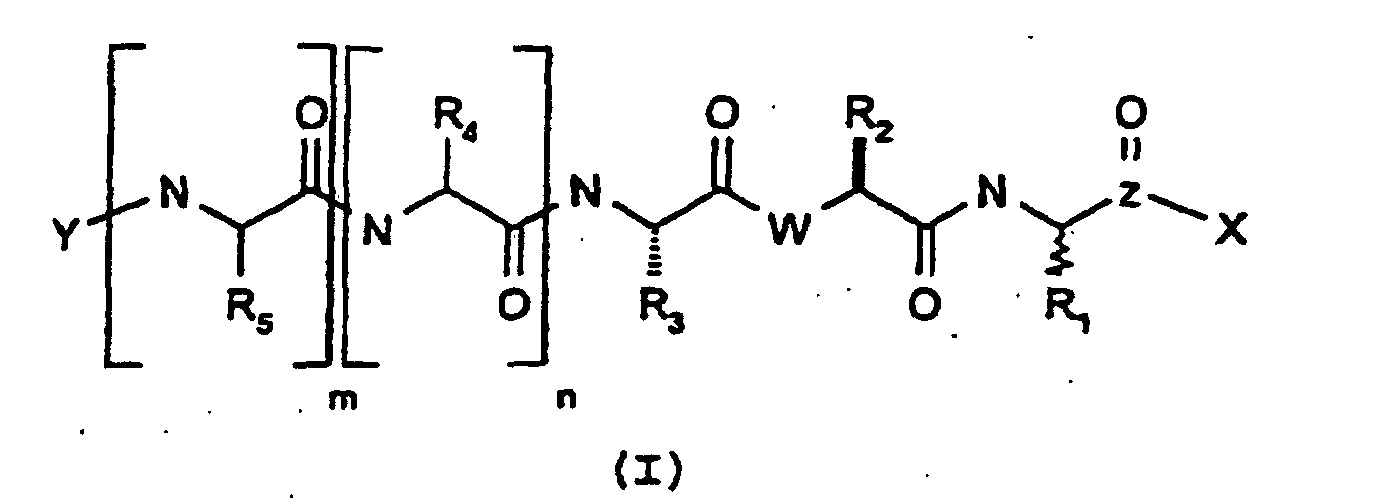
wobei, wenn z C bedeutet, X CF3; C2F5; Benzothiazol; Oxazolo[4,5b]pyridin; oder Benzoxazol-R7 bedeutet, wobei R7 H oder Methyl bedeutet;
oder X folgendes bedeutet: CF2CONH-R6, C(O)NHR6,
wobei R6 C0-10-Alkyl bedeutet, das gegebenenfalls durch Phenyl oder Cyclohexyl substituiert ist, wobei der Phenyl- oder Cyclohexylring gegebenenfalls durch Me, Halogen, -CF3, -CH(Me)-C(O)-OBn; -C(O)NH2; oder -C(O)-Morpholino substituiert ist; wobei der Phenyloder Cyclohexylring gegebenenfalls an einen Phenylring kondensiert ist;
(CH2)1-3-O-(CH2)1-3-Phenyl, wobei der Phenylrest gegebenenfalls durch Halogen substituiert ist;
(CH2)1-3-2-Benzimidazol;
(CH2)1-3-(3,4-Methylendioxybenzol); oder
(CH2)1-3-O-C(O)-OCH2-CH=CH2;
oder, wenn z P bedeutet, X -(OPh)2 bedeutet;
R1 H, Me oder Et bedeutet;
R2 folgendes bedeutet: CH2-SO2NH2; -C1-6-Alkyl; -(C1-6-Alkyl)-aryl, -(C1-6-Alkyl)-thiazolo; -CH2C(O)-(C1-6-Alkyl); -CH2C(O)-Pyrrolidino; -CH2C(O)-Morpholino; -(C1-6-Alkyl)-amino; -(C1-6-Alkyl)-amido, gegebenenfalls mono- oder disubstituiert durch C1-6-Alkyl, wobei der Alkylrest gegebenenfalls durch Pyridino substituiert ist;
W CH2 oder CH(CH3) bedeutet;
R3 folgendes bedeutet: -C1-12-Alkyl; -(C1-6-Alkyl)-C(O)OH oder Adamantyl;
n den Wert 0 oder 1 hat;
R4, wenn n den Wert 1 hat, -C1-6-Alkyl oder -(C1-6-Alkyl)-aryl bedeutet, wobei der Arylrest gegebenenfalls durch OH substituiert ist;
m den Wert 0 oder 1 hat;
R5, wenn m den Wert 1 hat, H oder -CH2OH bedeutet;
und
Y folgendes bedeutet: H; (CH2)2-t-Bu; oder einen Acylrest der Formeln
-C(O)-CH2N(CH3)2;
-C(O)-R9; -C(O)O-R9; oder-C(O)NH-R9, wobei R9 C1-6-Alkyl bedeutet; oder
-C(O)-(CH2)1-6-NH2, wobei die Aminogruppe gegebenenfalls mit einer Aminoschutzgruppe geschützt ist;
zur Herstellung einer pharmazeutischen Zusammensetzung, die eine gegen den Cytomegalovirus viral wirksame Menge einer Verbindung der Formel I oder eines therapeutisch verträglichen Salzes davon im Gemisch mit einem pharmazeutisch verträglichen Trägermedium oder Hilfsstoff enthält, zur Behandlung einer viralen Cytomegalovirus-Infektion bei einem Säugetier. - Verbindung der Formelworin z C bedeutet;
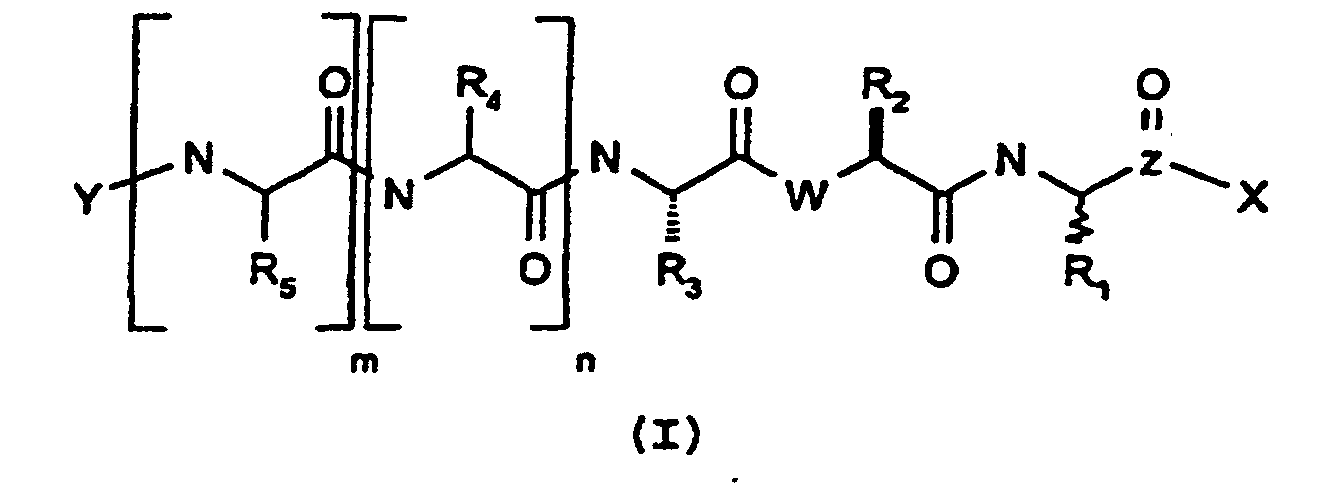
X folgendes bedeutet:
CF3;
C2F5;
Benzothiazol;
Benzoxazol-R7, wobei R7 H, 4-Me, 5-Me, 6-Me oder 7-Me bedeutet;
-CF2CONH-CH2-Phenyl;
-C(O)NHR6, wobei R6 folgende Bedeutungen hat:
-CH(Me)(CH2)4CH3; Cyclohexyl; Naphthyl; -CH2-Phenyl; -CH(CH3)-Phenyl; oder -CH(CH2CH3)-Phenyl; -CH2-4-lodphenyl; -Phenyl-CH3; -Phenyl-CF3; -Phenyl-C(O)NH2; -Phenyl-C(O)-morpholino; -Phenyl-CH(Me)-C(O)-OBn; -(CH2)2-O-CH2-Phenyl; -CH2-2-Benzimidazol; -CH2-(3,4-methylendioxybenzol), oder -(CH2)2-O-C(O)-OCH2CH=CH2;
R1 H oder Methyl bedeutet;
R2 folgendes bedeutet:
-CH2-C(O)-(N-Pyrrolidino);
-CH2-C(O)-(N-Morpholino);
-CH2SO2NH2;
-(CH2)C(O)NH2;
-(CH2)2C(O)N(CH3)2;
-CH2-C(O)-NH-t-Bu; oder
-(CH2)2-C(O)-N(CH3)CH2CH2-(2-Pyridino);
W NH bedeut;
R3 Ethyl; Isopropyl; oder t-Bu bedeutet;
n den Wert 0 oder 1 hat;
R4, wenn n den Wert 1 hat, Isopropyl oder t-Bu bedeutet:
m den Wert 0 oder 1 hat;
R5, wenn m den Wert 1 hat, H bedeutet;
und
Y folgendes bedeutet: H; oder einen Acylrest der folgenden Formeln - Verbindung nach Anspruch 2, wobei
z C bedeutet;
X folgendes bedeutet:
C2F5;
-C(O)NHR6, wobei R6 folgendes bedeutet: -CH2-Phenyl; -CH2-4-Iodphenyl; -CH(CH3)-Phenyl; oder -CH(CH2CH3)-Phenyl; -CH(Me)-Naphthyl; -CH2CH(Me)-Phenyl; -(CH2)2-O-CH2-Phenyl; -CH2-2-Benzimidazol; oder -CH2-(3,4-Methylendioxybenzol);
R1 H oder Methyl bedeutet;
R2 folgendes bedeutet:
-CH2-C(O)-(N-Pyrrolidino);
-CH2-C(O)-(N-Morpholino);
-(CH2)2C(O)N(CH3)2; oder
-(CH2)2-C(O)-N(CH3)CH2CH2-(2-Pyridino);
W NH bedeutet;
R3 Isospropyl; oder t-Bu bedeutet;
n den Wert 0 oder 1 hat;
R4, wenn n den Wert 1 hat, t-Bu bedeutet;
m den Wert 0 hat; und
Y einen Acylrest der folgenden Formeln bedeutet: - Verbindung der Formelworin
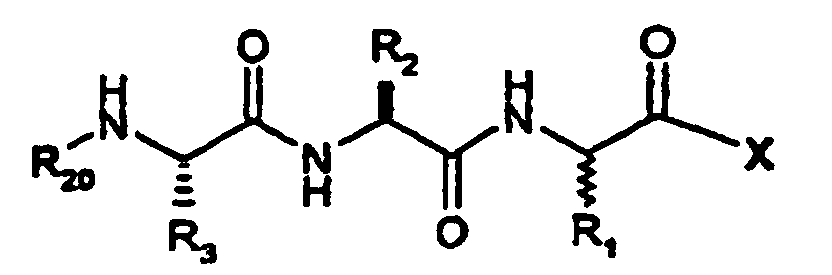
X CF3, C2F5, 2-Benzothiazol, CF2CONHR6, CONHR6, wobei R6 CH2C6H5, CH2-4-lodphenyl), CH3, (CH2)2OCH2C6H5, CH2-2-Benzimidazol, CH2-(3,4-Methylendioxybenzol), CH(CH3)C6H5 oder CH(CH2CH3)C6H5 bedeutet;
oder X 2-Benzoxazol-R7 bedeutet, wobei R7 H, 4-CH3, 5-CH3, 6-CH3 oder 7-CH3 bedeutet;
R1 H, CH3 oder CH2CH3 bedeutet;
R2 CH2CONH2, CH2CH2CONH2, CH2-Thiazol, CH2CON(CH3)2 oder CH2CO-(Pyrrolidino) bedeutet;
R3 Et, CH(CH3)2, C(CH3)3, Adamantyl, CH2C(CH3)3 oder C(CH3)2CO2H bedeutet;
und
R20 folgendes bedeutet: COCH2C(CH3)3, COCH2CH2C6H4OH, COCH2CH(CH3)2, CO2C(CH3)3, CONHC(CH3)3, COCH2N(CH3)2, CO(CH2)3CO2H, CO-(S)-CH(NH2)C(CH3)3, CO-(S)-CH{NHC(O)O-C(CH3)3}C(CH3)3, CO-(S)-CH{NHCO(CH2)5NHC(O)OC(CH3)3}C(CH3)3 oder CO-(S)-CH{NHCO(CH2)5NH2}C(CH3)3. - Verbindung, ausgewählt aus der Gruppe:N1-(3,3,3-Trifluor-1-methyl-2-oxopropyl)-(2S)-2-((1S)-2-methyl-1-[((1S)-2-methyl-1-[(methylcarboxamido)-methyl]-carboxamidopropyl)-carboxamido]-propylcarboxamido)-butandiamid (37);N1-(3,3,3-Trifluor-1-methyl-2-oxopropyl)-(2S)-6-amino-2-((1S)-1-[((S)-1-[(1S)-2-hydroxy-1-(methylcarboxamido)-ethyl]-carboxamido-2-(4-hydroxyphenyl)-ethyl)-carboxamido]-2-methylpropylcarboxamido)-hexanamid (38);N1-(3,3,3-Trifluor-1-methyl-2-oxopropyl)-(2S)-2-[((1S)-2-methyl-1-[(1S)-2-methyl-1-(methylcarboxamido)-propyl]-carboxamidopropyl)-carboxamido]-butandiamid (39);N1-(3,3,3-Trifluor-1-methyl-2-oxopropyl)-(2S)-2-{(1S)-2-methyl-1-[(methylcarboxamido)-propyl]-carboxamido}-butandiamid (40);N1-(3,3,3-Trifluor-(1S)-methyl-2-oxopropyl)-(2S)-2-{(1S)-2-methyl-1-[(methylcarboxamido)-propyl]-carboxamido}-butandiamid (43);N1-(1-Ethyl-3,3,3-trifluor-2-oxopropyl)-(2S)-2-[((1S)-2-methyl-1-[(1S)-2-methyl-1-(methylcarboxamido)-propyl]-carboxamidopropyl)-carboxamido]-butandiamid (44);N1-(1-(3,3,3-Trifluor-1-propyl-2-oxopropyl)-(2S)-2-[((1S)-2-methyl-1-[(1S)-2-methyl-1-(methylcarboxamido)-propyl]-carboxamidopropyl)-carboxamido]-butandiamid (45);.N1-(3,3,3-Trifluor-1-methyl-2-oxopropyl)-(2S)-2-[((1S)-2-methyl-1-[(1S)-2-methyl-1-(methylcarboxamido)-propyl]-carboxamidopropyl)-carboxamido]-pentandiamid (46);(3S)-3-[((1S)-2-Methyl-1-[(1S)-2-methyl-1-(methylcarboxamido)-propyl]-carboxamido-propyl)-carboxamido]-3-[(3,3,3-trifluor-1-methyl-2-oxopropyl)-carbamoyl]-propansäure (47);N1-[(1S)-1-((1S)-2-Hydroxy-1-[(3,3,3-trifluor-1-methyl-2-oxopropyl)-carbamoyl]-ethylcarbamoyl)-2-methylpropyl]-(2S)-3-methyl-2-(methylcarboxamido)-butanamid (48);N1-(3,3,3-Trifluor-1-methyl-2-oxopropyl)-(2S)-6-amino-2-[((1S)-2-methyl-1-[(1S)-2-methyl-1-(methylcarboxamido)-propyl]-carboxamidopropyl)-carboxamido]-hexanamid (49);N1-[(1S)-2-Methyl-1-((1S)-2-(1,3-thiazol-4-yl)-1-[(3,3,3-trifluor-1-methyl-2-oxopropyl)-carbamoyl]-ethylcarbamoyl)-propyl]-(2S)-3-methyl-2-(methylcarboxamido)-butanamid (50);N4,N4-Dimethyl-N1-(3,3,3-trifluor-1-methyl-2-oxopropyl)-(2S)-2-[((1S)-2-methyl-1-[(1S)-2-methyl-1-(methylcarboxamido)-propyl]-carboxamidopropyl)-carboxamido]-butandiamid (51);N1-[(1S)-2-Methyl-1-((1S)-2-phenyl-1-[(3,3,3-trifluor-1-methyl-2-oxopropyl)-carbamoyl]-ethylcarbamoyl)-propyl]-(2S)-3-methyl-2-(methylcarboxamido)-butanamid (53);N4,N4-Dimethyl-N1-(3,3,3-trifluor-1-methyl-2-oxopropyl)-(2S)-2-[((1S)-1-[(1S)-2-methyl-1-(methylcarboxamido)-propyl]-carboxamidopropyl)-carboxamido]-butandiamid (57);N4,N4-Dimethyl-N1-(3,3,3-trifluor-1-methyl-2-oxopropyl)-(2S)-2-[((1S)-2,2-dimethyl-1-[(1S)-2-methyl-1-(methylcarboxamido)-propyl]-carboxamidopropyl)-carboxamido]-butandiamid (58);N4,N4-Dimethyl-N1-(3,3,3-trifluor-1-methyl-2-oxopropyl)-(2S)-2-[((1S)-3,3-dimethyl-1-[(1S)-2-methyl-1-(methylcarboxamido)-propyl]-carboxamidobutyl)-carboxamido]-butandiamid (59);N4,N4-Dimethyl-N1-(3,3,3-trifluor-1-methyl-2-oxopropyl)-(2S)-2-[((S)-1-(1-adamantyl)-1-[(1S)-2-methyl-1-(methylcarboxamido)-propyl]-carboxamidomethyl)-carboxamido]-butandiamid (60);(3S)-3-((1S)-2-(Dimethylcarbamoyl)-1-[(3,3,3-Trifluor-1-methyl-2-oxopropyl)-carbamoyl]-ethylcarbamoyl)-2,2-dimethyl-3-[(1S)-2-methyl-1-(methylcarboxamido)-propyl]-carboxamidopropansäure (61);N4,N4-Dimethyl-N1-(3,3,3-trifluor-1-methyl-2-oxopropyl)-(2S)-2-[(1S)-2,2-dimethyl-1-(methylcarboxamido)-propyl]-carboxamidobutandiamid (62);N4,N4-Dimethyl-N1-(3,3,3-trifluor-1-methyl-2-oxopropyl)-(2S)-2-((1S)-1-[(4-hydroxyphenethyl)-carboxamido]-2,2-dimethylpropylcarboxamido)-butandiamid (63);N4,N4-Dimethyl-N1-(3,3,3-trifluor-1-methyl-2-oxopropyl)-(2S)-2-[(1S)-1-(isobutylcarboxamido)-2,2-dimethylpropyl]-carboxamidobutandiamid (64);N4,N4-Dimethyl-N1-(3,3,3-trifluor-1-methyl-2-oxopropyl)-(2S)-2-[(1S)-2,2-dimethyl-1-(neopentylcarboxamido)-propylcarboxamido]-butandiamid (65);N4,N4-Dimethyl-N1-(3,3,3-trifluor-1-methyl-2-oxopropyl)-(2S)-2-((1S)-1-[(3,3-dimethylbutyl)-amino]-2,2-dimethylpropylcarboxamido]-butandiamid (66);4N,4N-Dimethyl-1N-(3,3,3-trifluor-1-methyl-2-oxopropyl)-2-[1-(tert.butoxycarbonylamino)-2,2-dimethyl-(1S)-propylcarboxamido]-(2S)-butandiamid (67);N4,N4-Dimethyl-N1-(3,3,3-trifluor-1-methyl-2-oxopropyl-2-[1-(tert.butylaminocarbonylamino)-2,2-dimethyl-(1S)-propylcarboxamido]-(2S)-butandiamid (68);N4,N4-Dimethyl-N1-(3,3,3-trifluor-1-methyl-2-oxopropyl)-(2S)-2-[((1S)-1-[(dimethylamino)-methyl]-carboxamido-2,2-dimethylpropyl)-carboxamido]-butandiamid (69);4-[(1S)-1-((1S)-2-(Dimethylcarbamoyl)-1-[(3,3,3-trifluor-1-methyl-2-oxopropyl)-carbamoyl]-ethylcarbamoyl)-2,2-dimethylpropyl]-carbamoylbutansäure (70);N4,N4-Dimethyl-N1-(3,3,4,4,4-pentafluor-1-methyl-2-oxobutyl)-(2S)-2-[(1S)-2,2-dimethyl-1-(neopentylcarboxamido)-propyl]-carboxamidobutandiamid (74);N1-[3-(Benzylcarbamoyl)-3,3-difluor-1-methyl-2-oxopropyl]-N4,N4-dimethyl-(2S)-2-[(1S)-2,2-dimethyl-1-(neopentylcarboxamido)-propyl]-carboxamidobutandiamid (75);3-{2-[2-(3,3-Dimethylbutyrylamino)-3,3-dimethyl-butyrylamino]-3-dimethylcarbamoylpropionylamino}-2-oxo-buttersäure-benzylamid (76);N1-[2-(1,3-Benzoxazol-2-yl)-1-methyl-2-oxoethyl]-N4,N4-dimethyl-(2S)-2-{[(1S)-2,2-dimethyl-1-(neopentylcarboxamido)-propyl]-carboxamido}-butandiamid (77);Diphenyl-N4,N4-dimethyl-N1-(1-aminoethylphosphinat)-(2S)-2-{((1S)-2,2-dimethyl-1-(neopentylcarboxamido)-propyl]-carboxamido}-butandiamid (79);N1-[2-(1,3-Benzothiazol-2-yl)-1-methyl-2-oxoethyl]-N4,N4-dimethyl-(2S)-2-{[(1S)-2,2-dimethyl-1-(neopentylcarboxamido)-propyl]-carboxamido}-butandiamid (80);N4,N4-Dimethyl-N1-(1-methyl-2-[1,3]oxazolo[4,5-b]pyridin-2-yl-2-oxoethyl)-(2S)-2-{[(1S)-2,2-dimethyl-1-(neopentylcarboxamido)-propyl]-carboxamido}butandiamid (81);N4,N4-Dimethyl-N1-[1-methyl-2-(6-methyl-1,3-benzoxazol-2-yl)-2-oxoethyl]-(2S)-2-{[(1S)-2,2-dimethyl-1-neopentylcarboxamido)-propyl]-carboxamido}butandiamid (82);N4,N4-Dimethyl-N1-[1-methyl-2-(5-methyl-1,3-benzoxazol-2-yl)-2-oxoethyl]-(2S)-2-{[(1S)-2,2-dimethyl-1-(neopentylcarboxamido)-propyl]-carboxamido}butandiamid (83);N4,N4-Dimethyl-N1-[1-methyl-2-(4-methyl-1,3-benzoxazol-2-yl)-2-oxoethyl]-(2S)-2-{[(1S)-2,2-dimethyl-1-(neopentylcarboxamido)-propyl]-carboxamido}butandiamid (84);N4,N4-dimethyl-N1-[1-methyl-2-(7-methyl-1,3-benzoxazol-2-yl)-2-oxoethyl]-(2S)-2-{[(1S)-2,2-dimethyl-1-(neopentylcarboxamido)-propyl]-carboxamido} butandiamid (85);N4,N4-Dimethyl-N1-[1-methyl-2-(methylcarbamoyl)-2-oxoethyl]-(2S)-2-{[(1S)-2,2-dimethyl-1-(neopentylcarboxamido)-propyl]-carboxamido}-butandiamid (86);N1-(2-[2-(Benzyloxy)-ethyl]-carbamoyl-1-methyl-2-oxoethyl)-N4,N4-dimethyl-(2S)-2-{[(1S)-2,2-dimethyl-1-(neopentylcarboxamido)-propyl]-carboxamido}butandiamid (88);N1-2-[(1,3-Benzodioxol-5-ylmethyl)-carbamoyl]-1-methyl-2-oxoethyl-N4,N4-dimethyl-(2S)-2-{[(1S)-2,2-dimethyl-1-(neopentylcarboxamido)-propyl]-carboxamido}butandiamid (89);N1-2-[(1H-Benzo[d]-imidazol-2-ylmethyl)-carbamoyl]-1-methyl-2-oxoethyl-N4,N4-dimethyl-(2S)-2-{[(1S)-2,2-dimethyl-1-(neopentylcarboxamido)-propyl]-carboxamido}-butandiamid (90);N4,N4-Dimethyl-N1-(1-methyl-2-oxo-2-[(1S)-1-phenylethyl]-carbamoylethyl)-(2S)-2-{[(1S)-2,2-dimethyl-1-(neopentylcarboxamido)-propyl]-carboxamido}-butandiamid (91);N4,N4-Dimethyl-N1-(1-methyl-2-oxo-2-[(1R)-1-phenylethyl]-carbamoylethyl)-(2S)-2-{[(1S)-2,2-dimethyl-1-(neopentylcarboxamido)-propyl]-carboxamido}butandiamid (92);N4,N4-Dimethyl-N1-(1-methyl-2-oxo-2-[(1R)-1-phenylpropyl]-carbamoyl-ethyl)-(2S)-2-{[(1S)-2,2-dimethyl-1-(neopentylcarboxamido)-propyl]-carboxamido}butandiamid (93);
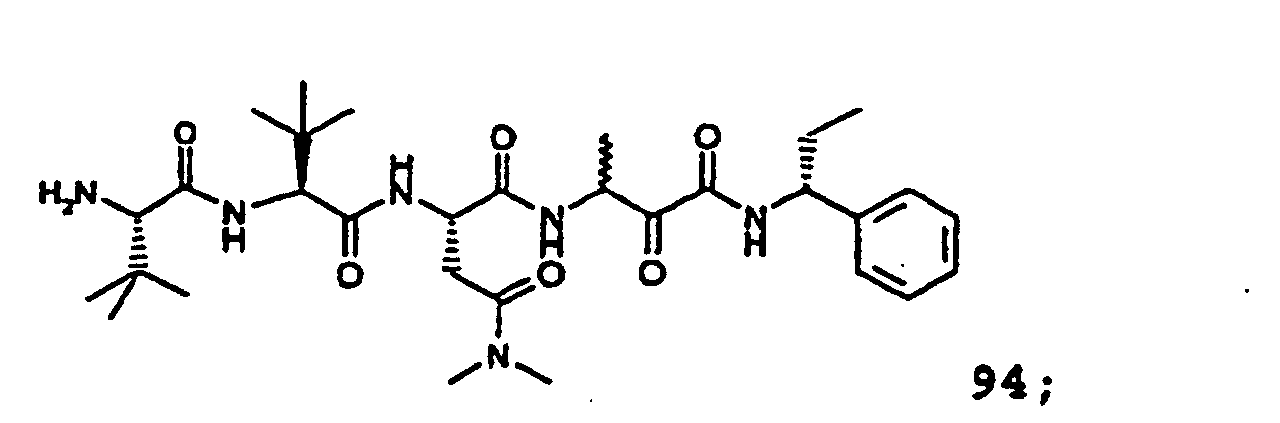


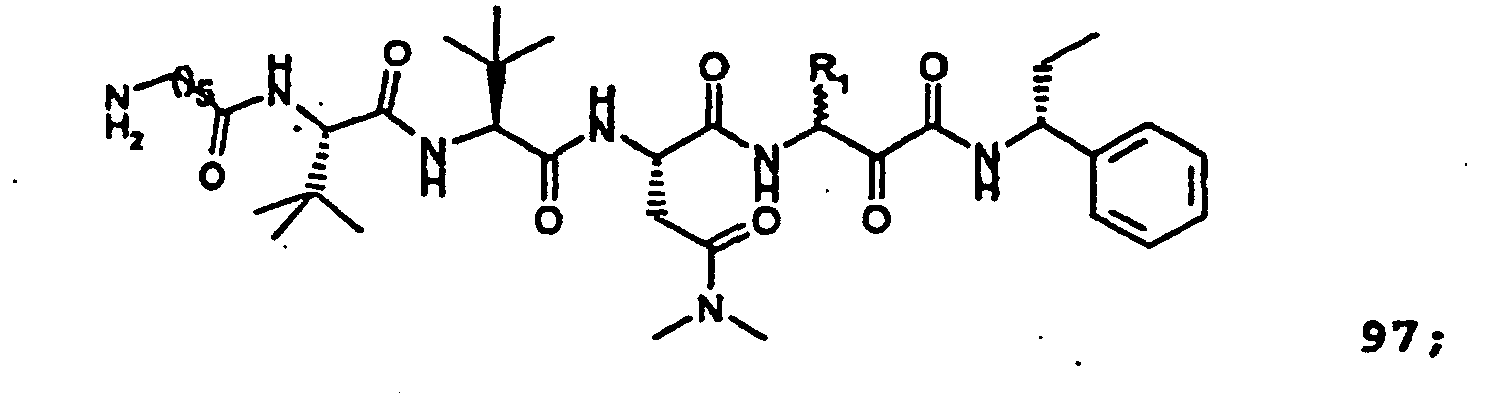
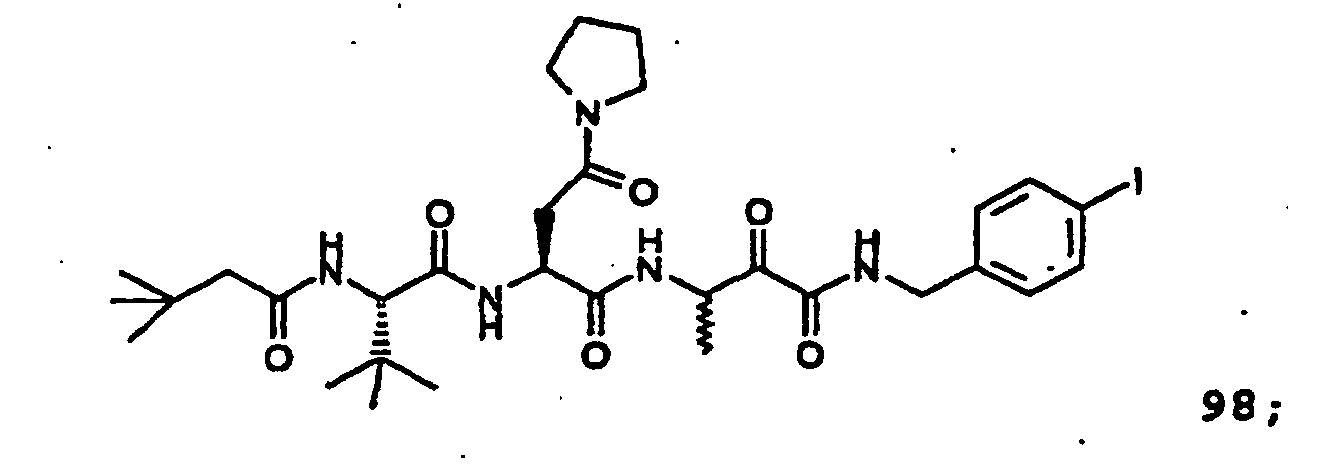


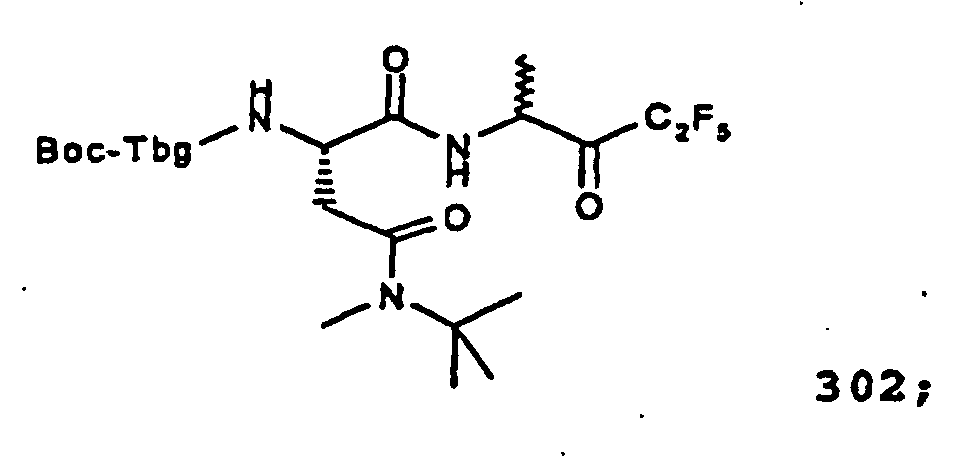

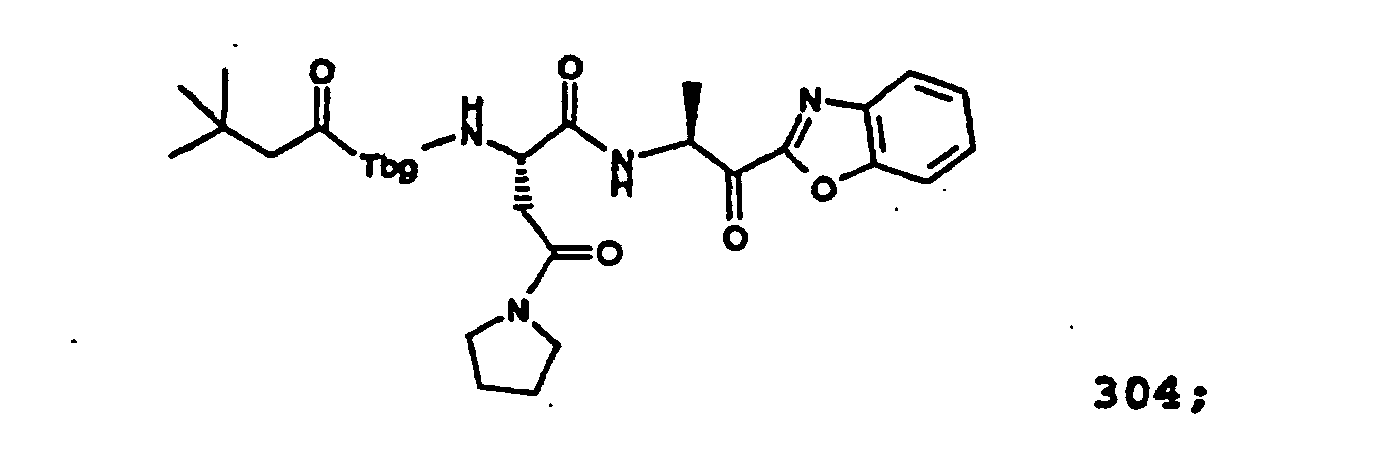
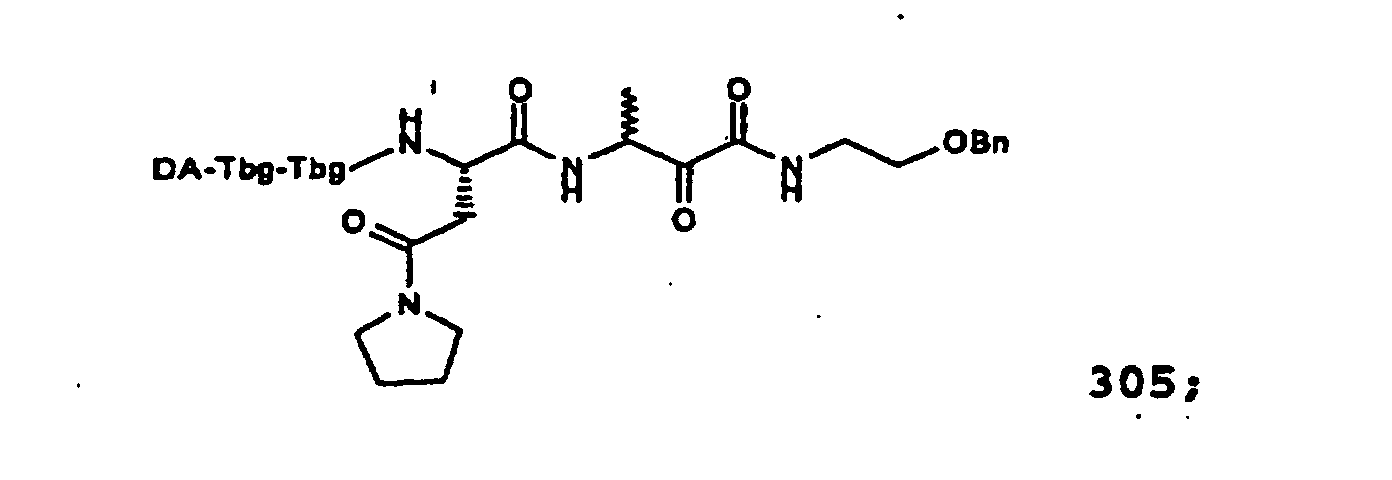

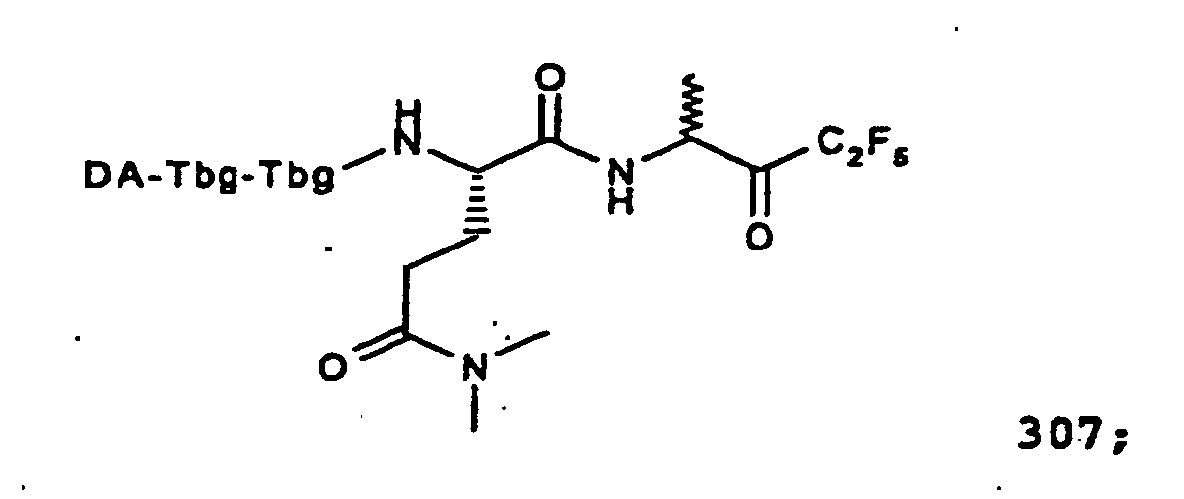
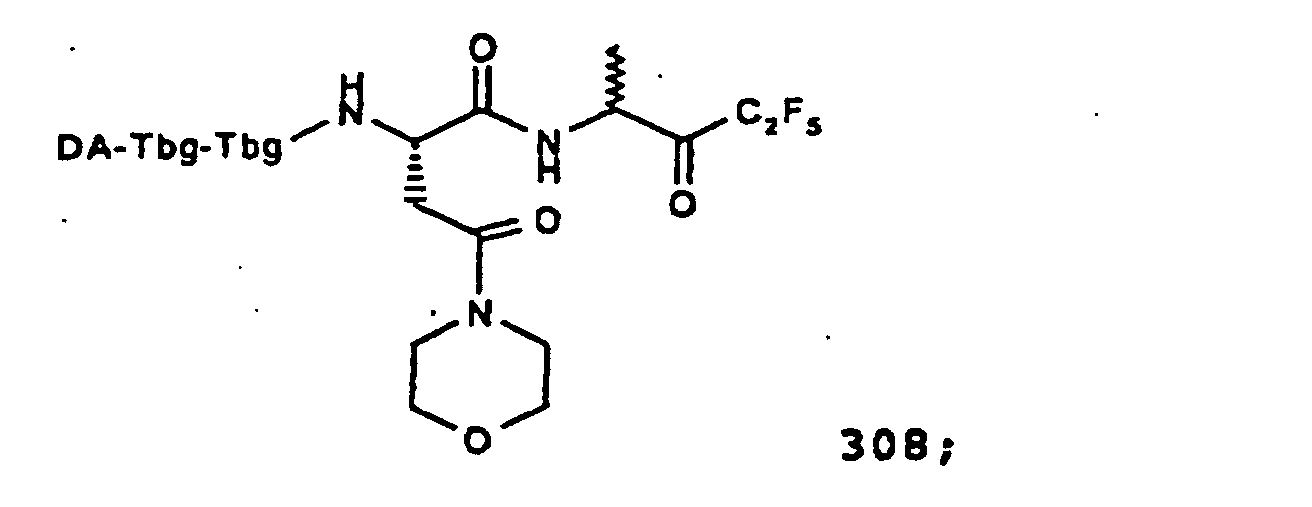
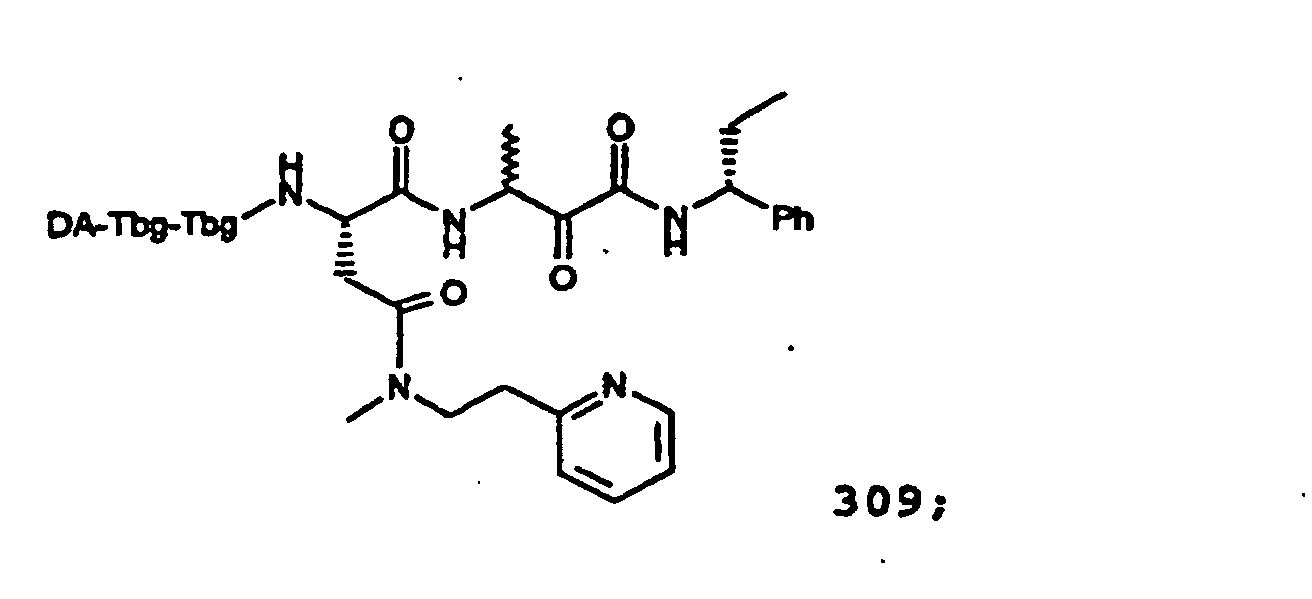
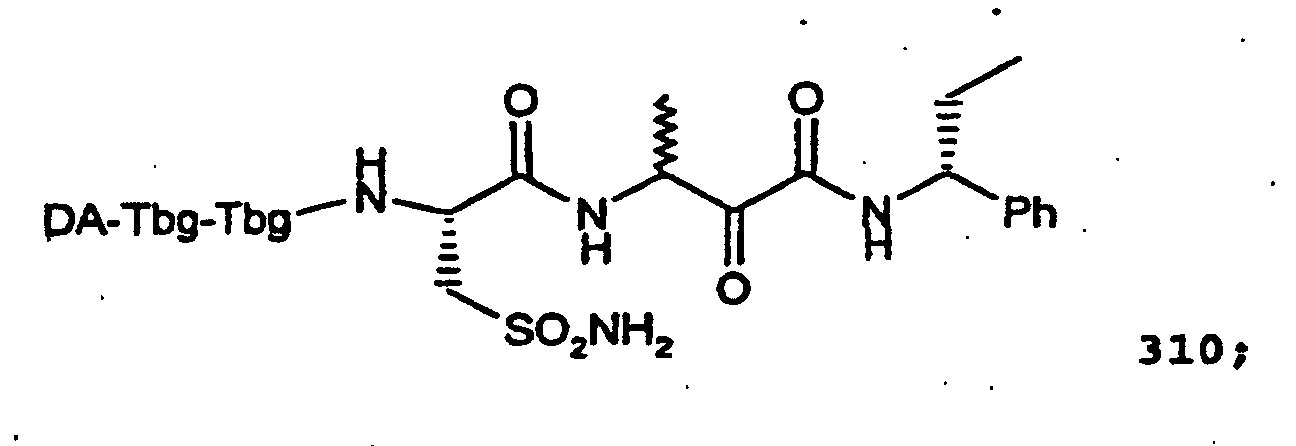
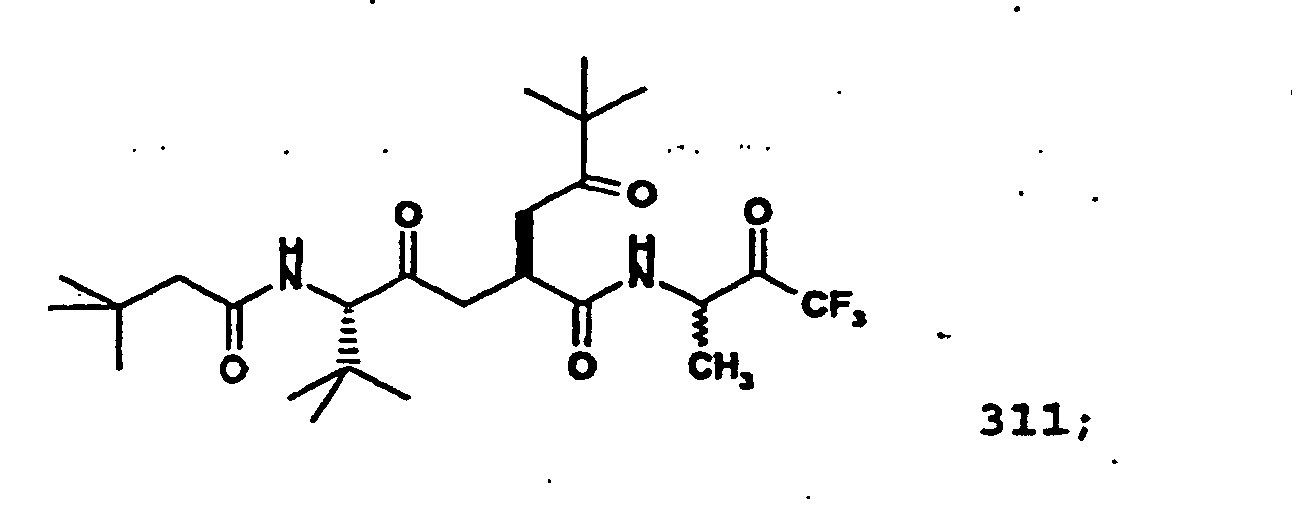
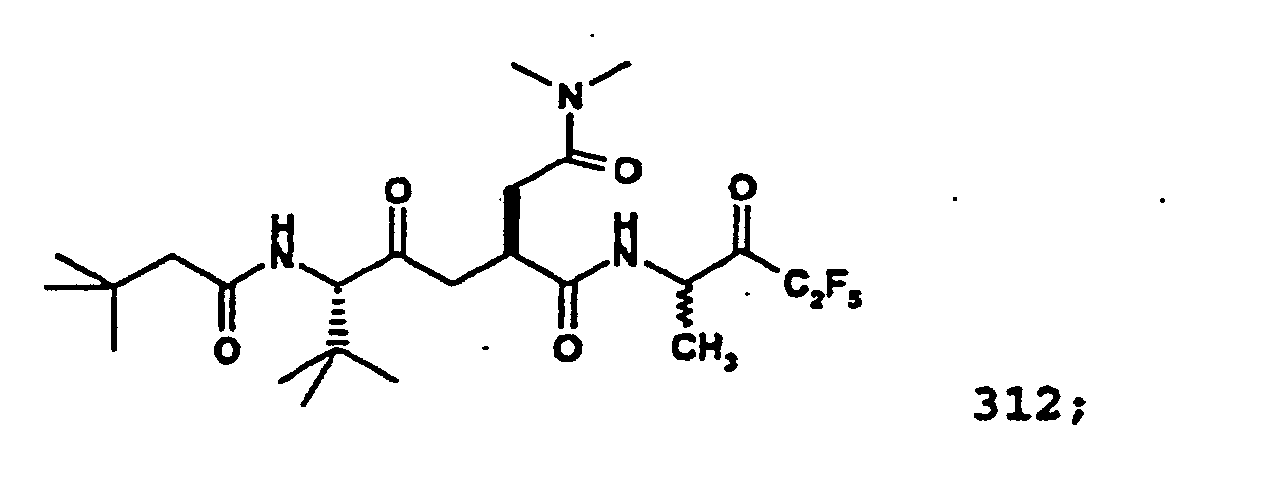


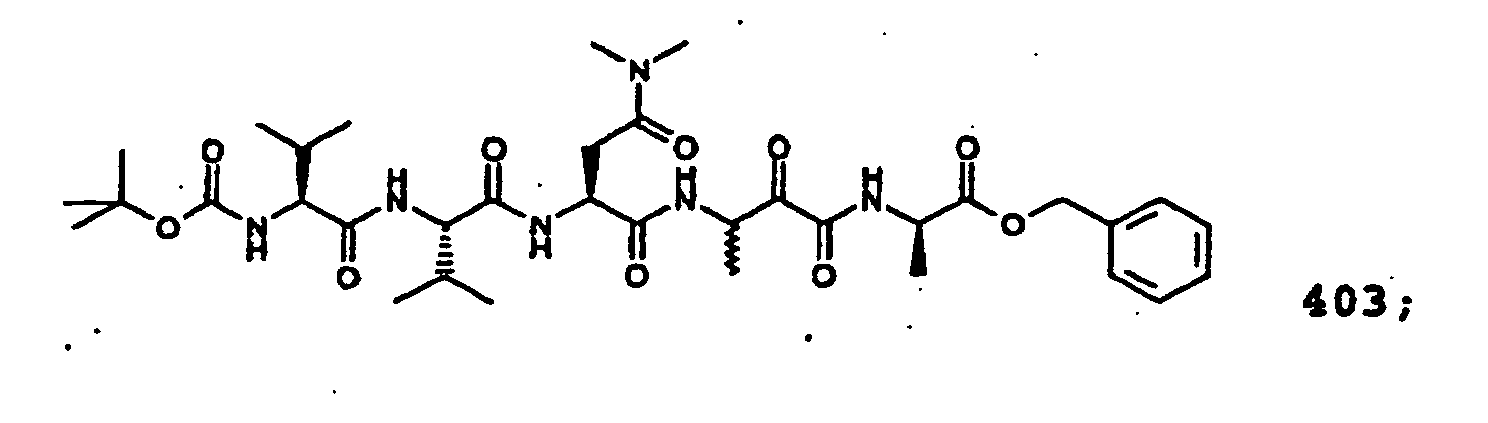


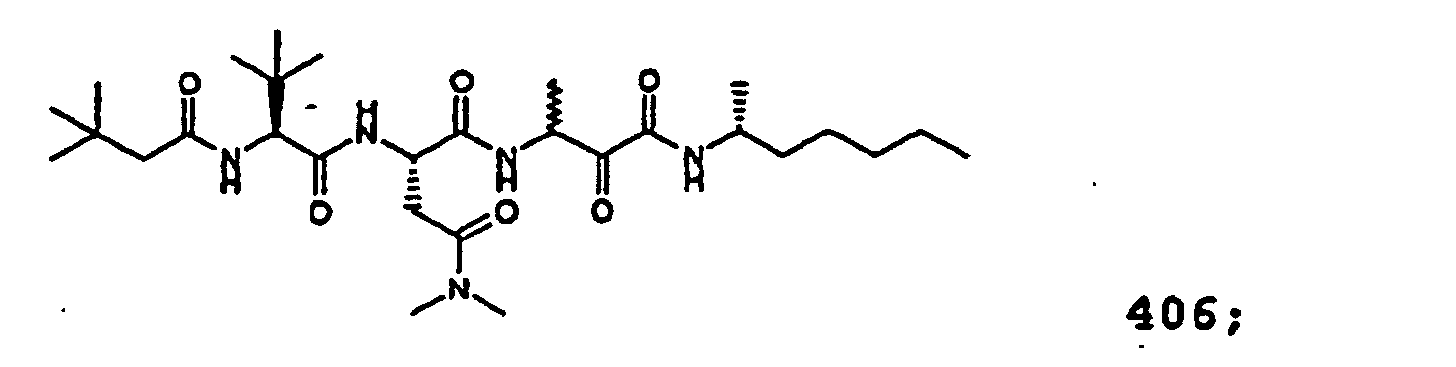

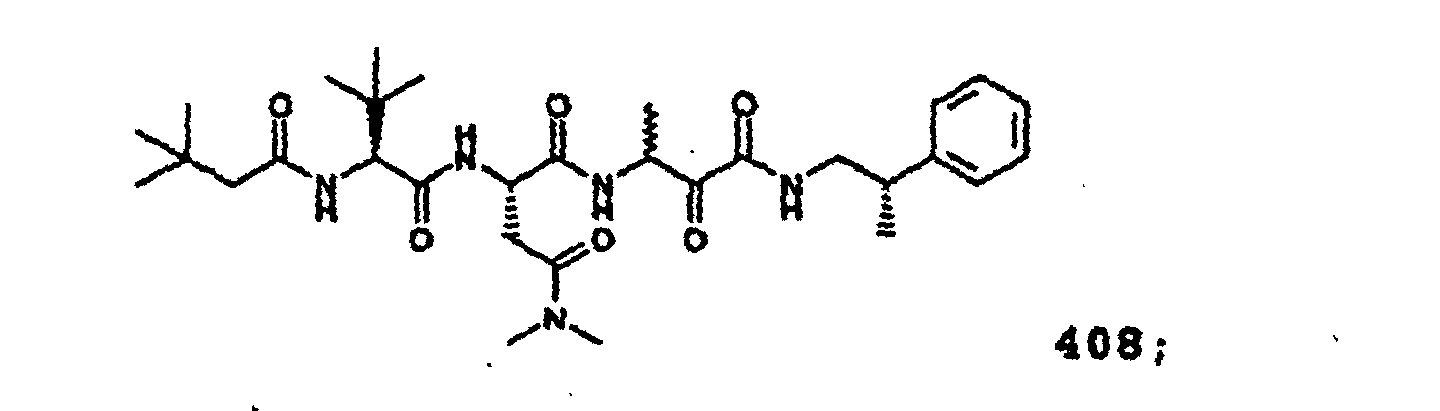

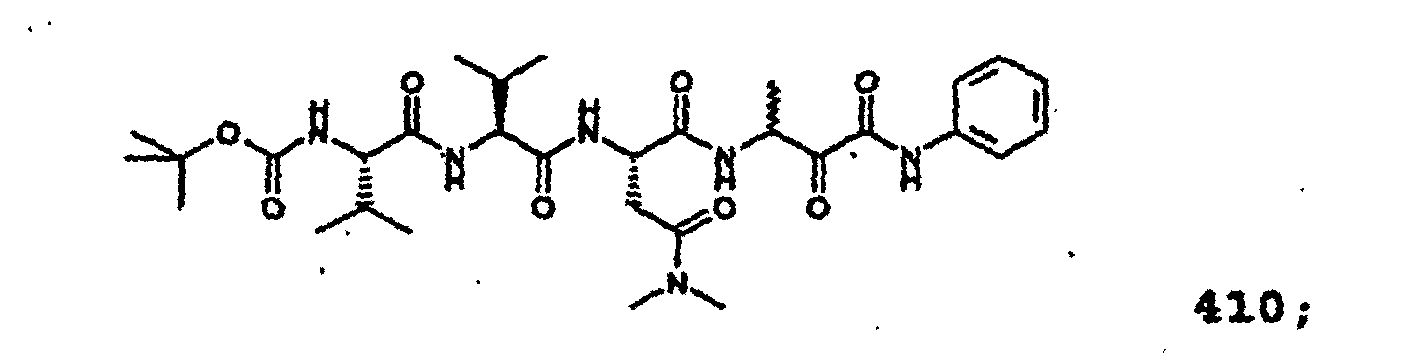

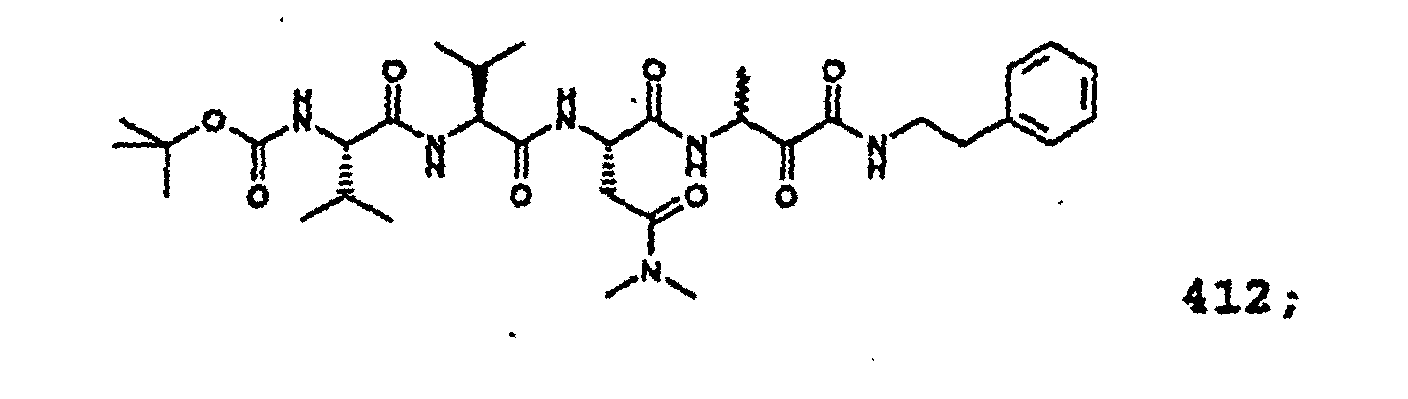 and
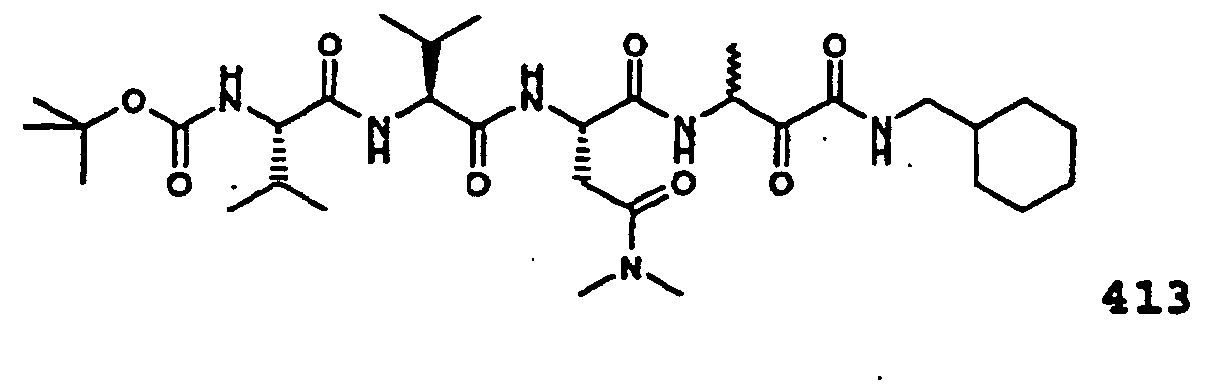
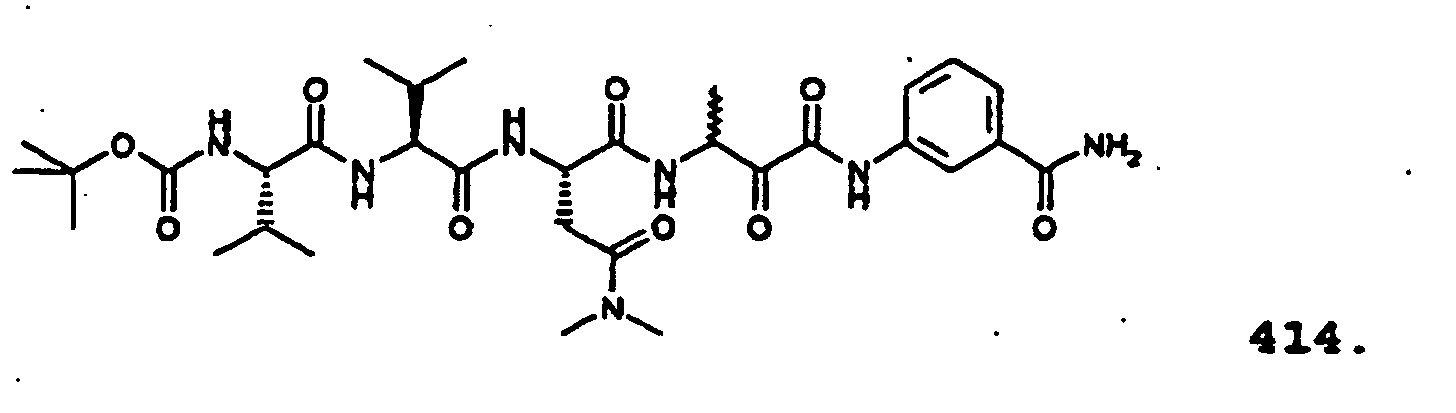
- Verbindung nach Anspruch 5, ausgewählt aus der Gruppe: Verbindungen Nr. 37, 38, 39, 44, 46, 50, 51, 53, 57, 58, 59, 60, 62, 63, 64, 65, 66, 67, 68, 69, 70, 74, 75, 76, 77, 79, 80, 82, 83, 84, 85, 86, 88, 89, 90, 91, 92, 93, 94, 95, 96, 97, 98, 218, 301, 302, 303, 304, 305, 306, 307, 308, 309, 310, 311, 312 und 401 bis 414.
- Verbindung nach Anspruch 6, ausgewählt aus der Gruppe: Verbindungen Nr. 37, 51, 58, 63, 64, 65, 70, 74, 75, 76, 77, 79, 80, 82, 83, 84, 85, 86, 88, 89, 90, 92, 93, 94, 95, 96, 97, 98, 304, 305, 306, 307, 308, 309, 310, 311, 312, 401, 403, 404, 405, 406, 407, 408, 409, 410, 411, 412 und 414.
- Verbindung nach Anspruch 7, ausgewählt aus der Gruppe: Verbindungen Nr. 74, 76, 88, 89, 90, 92, 93, 95, 96, 97, 98, 305, 308, 309, 407 und 408.
- Pharmazeutische Zusammensetzung, enthaltend eine gegen den Cytomegalovirus viral wirksame Menge einer Verbindung nach einem der Ansprüche 2 bis 8 oder eines therapeutisch verträglichen Salzes davon im Gemisch mit einem pharmazeutisch verträglichen Trägermedium oder Hilfsstoff.
- Verwendung einer Verbindung nach einem der Ansprüche 2 bis 8 zur Herstellung einer pharmazeutischen Zusammensetzung, die eine gegen den Cytomegalovirus viral wirksame Menge dieser Verbindung oder eines therapeutisch verträglichen Salzes davon umfasst, oder einer Zusammensetzung nach Anspruch 9 zur Behandlung einer viralen Cytomegalovirus-Infektion bei einem Säugetier.
- Festphasenverfahren zur Herstellung von Peptidyl-aktivierten Ketonen, umfassend die folgenden Stufen:a) Kuppeln einer Semicarbazonsäure der Formel 113 durch eine in situ-Aktivierung an ein Harz;wobei R eine Seitenkette einer natürlichen oder einer nicht-natürlichen Aminosäure bedeutet;
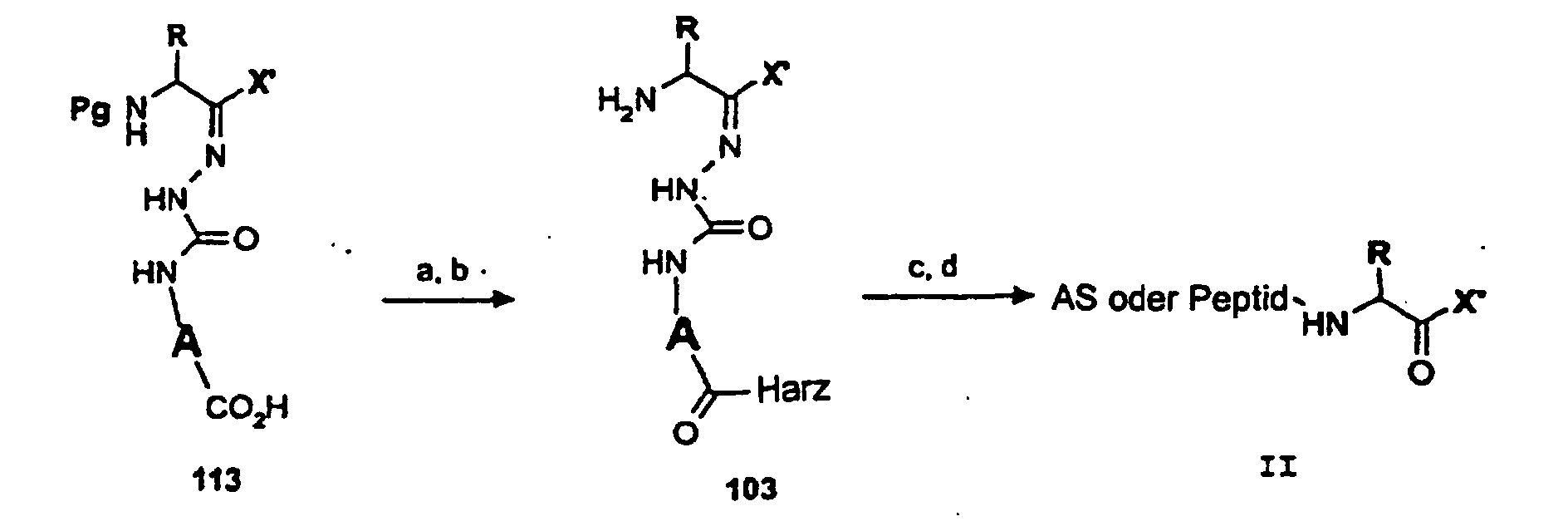
und X' folgendes bedeutet: CF3, CF2CONH-R30, C(O)NH-R30 oder C(O)OR30, wobei R30 cyclisches C3-12-Alkyl oder acyclisches C1-10-Alkyl oder cyclisches C3-12-Alkenyl oder acyclisches C2-12-Alkenyl bedeutet, wobei der Alkyloder Alkenylrest gegebenenfalls durch NH2, OH, SH, Halogen oder Carboxyl substituiert ist; wobei der Alkyl- oder Alkenylrest gegebenenfalls mindestens ein Heteroatom enthält, das unabhängig aus der Gruppe O, S und N ausgewählt ist; oder
R30 C6- oder C10-Aryl oder C7-16-Aralkyl bedeutet, das gegebenenfalls durch C1-6-Alkyl, NH2, OH, SH, Halogen, Carboxyl oder Carboxy-nieder-alkyl substituiert ist; wobei der Aryl- oder Aralkylrest gegebenenfalls mindestens ein Heteroatom enthält, das unabhängig aus der Gruppe O, S und N ausgewählt ist;
A eine zweiwertige Abstandhaltergruppe bedeutet, die eine nicht-reaktive zweiwertige Hydrocarbylgruppe mit 2 bis 15 Kohlenstoffatomen umfasst; und
Pg eine Aminoschutzgruppe bedeutet;b) Entfernen der Aminoschutzgruppe unter Bildung des gewünschten Harzes der Formel 103;c) Kuppeln dieses Harzes mit einer oder mehreren Aminosäuren in sequentieller Weise nach einem üblichen chemischen Verfahren; undd) Abspalten des Peptids vom Harz, wodurch man ein Peptidyl-aktiviertes Keton der Formel II erhält. - Verfahren nach Anspruch 11, wobei die Spaltungsstufe in THF, wässrigem HCl und AcOH bei einer Temperatur von etwa 60 °C etwa 4 Stunden durchgeführt wird und wobei das Harz mindestens einmal filtriert wird.
- Verfahren nach Anspruch 11, wobei das Harz aus folgender Gruppe ausgewählt ist: Polystyrol oder pegyliertes Polystyrol, das mit Benzhydrylamin (BHA), 4-Methylbenzhydrylamin (MBHA) und Aminomethyl (AM) funktionalisiert ist.
- Verfahren nach Anspruch 11, wobei die in situ-Aktivierung unter Zugabe eines Kupplungsmittels durchgeführt wird, das aus folgender Gruppe ausgewählt ist: 2-(1H-Benzotriazol-1-yl)-1,1,3,3-tetramethyluronium-tetrafluoroborat (TBTU); 2-(1H-Benzotriazol-1-yl)-1,1,3,3-tetramethyluronium-hexafluorophosphat (HBTU); Diisopropylcarbodiimid (DIC); und Dicyclohexylcarbodiimid (DCC).
- Verfahren nach Anspruch 11, wobei die Aminoschutzgruppe aus folgender Gruppe ausgewählt ist: tert.-Butyloxycarbonyl (Boc); 9-Fluorenylmethyloxycarbonyl (Fmoc); und Allyloxycarbonyl (Alloc).
- Verfahren nach Anspruch 11, wobei X' C(O)NH2CH2-Phenyl oder C(O)OCH2CH=CH2 bedeutet.
- Verfahren nach Anspruch 11, wobei R aus folgender Gruppe ausgewählt ist: CH3; CH2CH3; CH2CH2CH3; (CH2)4NH2; CH(CH3)2; CH2-Phenyl; und (CH2)3-NH-CH=N(NH2).
- Verfahren nach Anspruch 11, wobei A Cyclohexyl, Phenyl oder Benzyl bedeutet:
- Verbindung der Formel 103worin R, X' und A die in Anspruch 11 definierten Bedeutungen haben.
- Harz nach Anspruch 19, wobei das Harz aus folgender Gruppe ausgewählt ist: Polystyrol oder pegyliertes Polystyrol, das mit Benzhydrylamin (BHA), 4-Methylbenzhydrylamin (MBHA) und Aminomethyl (AM) funktionalisiert ist.
- Harz nach Anspruch 19, wobei A Cyclohexyl, Phenyl oder Benzyl bedeutet.
- Verwendung eines Harzes der Formel 103 für die Festphasensynthese von Peptidyl-aktivierten Ketonenworin R, X' und A die in Anspruch 11 definierten Bedeutungen haben.
- Verwendung des Harzes nach Anspruch 21, wobei das Harz aus folgender Gruppe ausgewählt ist: Polystyrol oder pegyliertes Polystyrol, das mit Benzhydrylamin (BHA), 4-Methylbenzhydrylamin (MBHA) und Aminomethyl (AM) funktionalisiert ist.
- Verwendung nach Anspruch 21, wobei A Cyclohexyl, Phenyl oder Benzyl bedeutet.
Applications Claiming Priority (7)
| Application Number | Priority Date | Filing Date | Title |
|---|---|---|---|
| US3404196P | 1996-12-27 | 1996-12-27 | |
| US34041P | 1996-12-27 | ||
| US5286097P | 1997-07-17 | 1997-07-17 | |
| US52860P | 1997-07-17 | ||
| US5980697P | 1997-09-23 | 1997-09-23 | |
| US59806P | 1997-09-23 | ||
| PCT/CA1997/001004 WO1998029435A1 (en) | 1996-12-27 | 1997-12-23 | Peptidomimetic inhibitors of the human cytomegalovirus protease |
Publications (2)
| Publication Number | Publication Date |
|---|---|
| EP0948523A1 EP0948523A1 (de) | 1999-10-13 |
| EP0948523B1 true EP0948523B1 (de) | 2004-03-17 |
Family
ID=27364549
Family Applications (1)
| Application Number | Title | Priority Date | Filing Date |
|---|---|---|---|
| EP97951048A Expired - Lifetime EP0948523B1 (de) | 1996-12-27 | 1997-12-23 | Peptidomimetische inhibitoren von der protease des menschlichen cytomegalovirus |
Country Status (7)
| Country | Link |
|---|---|
| US (1) | US6291640B1 (de) |
| EP (1) | EP0948523B1 (de) |
| JP (1) | JP2001508418A (de) |
| AT (1) | ATE261988T1 (de) |
| CA (1) | CA2276109C (de) |
| DE (1) | DE69728164D1 (de) |
| WO (1) | WO1998029435A1 (de) |
Families Citing this family (13)
| Publication number | Priority date | Publication date | Assignee | Title |
|---|---|---|---|---|
| TW200404789A (en) * | 1999-03-15 | 2004-04-01 | Axys Pharm Inc | Novel compounds and compositions as protease inhibitors |
| US6649593B1 (en) * | 1999-10-13 | 2003-11-18 | Tularik Inc. | Modulators of SREBP processing |
| AU2055301A (en) * | 1999-12-03 | 2001-06-12 | Bristol-Myers Squibb Pharma Company | Alpha-ketoamide inhibitors of hepatitis c virus ns3 protease |
| US7012066B2 (en) | 2000-07-21 | 2006-03-14 | Schering Corporation | Peptides as NS3-serine protease inhibitors of hepatitis C virus |
| US7244721B2 (en) | 2000-07-21 | 2007-07-17 | Schering Corporation | Peptides as NS3-serine protease inhibitors of hepatitis C virus |
| SK742003A3 (en) | 2000-07-21 | 2003-06-03 | Schering Corp | Novel peptides as NS3-serine protease inhibitors of hepatitis C virus |
| US6599940B2 (en) | 2000-09-13 | 2003-07-29 | Georgetown University | Synthesis of 2-hydroxymethylglutamic acid and congeners thereof |
| CN1939529A (zh) * | 2002-01-29 | 2007-04-04 | Wyeth公司 | 用于调节连接蛋白半通道的组合物和方法 |
| SI3464336T1 (sl) | 2016-06-01 | 2022-06-30 | Athira Pharma, Inc. | Spojine |
| GB2563396B (en) * | 2017-06-12 | 2020-09-23 | Ustav Organicke Chemie A Biochemie Av Cr V V I | Inhibitors of Rhomboid Intramembrane Proteases |
| US12083099B2 (en) | 2020-10-28 | 2024-09-10 | Accencio LLC | Methods of treating symptoms of coronavirus infection with viral protease inhibitors |
| WO2022265577A2 (en) * | 2021-06-15 | 2022-12-22 | Agency For Science, Technology And Research | Coronavirus enzyme modulators, methods of synthesis and uses thereof |
| CN121293287B (zh) * | 2025-12-12 | 2026-04-03 | 杭州信海医药科技有限公司 | 一种依替巴肽的固相合成方法 |
Family Cites Families (2)
| Publication number | Priority date | Publication date | Assignee | Title |
|---|---|---|---|---|
| ZA905737B (en) * | 1989-07-26 | 1991-05-29 | Merrell Dow Pharma | Novel peptidase inhibitors |
| WO1997010231A1 (en) | 1995-09-14 | 1997-03-20 | Cephalon, Inc. | Ketomethylene group-containing cysteine and serine protease inhibitors |
-
1997
- 1997-12-23 US US09/171,554 patent/US6291640B1/en not_active Expired - Fee Related
- 1997-12-23 EP EP97951048A patent/EP0948523B1/de not_active Expired - Lifetime
- 1997-12-23 DE DE69728164T patent/DE69728164D1/de not_active Expired - Lifetime
- 1997-12-23 AT AT97951048T patent/ATE261988T1/de not_active IP Right Cessation
- 1997-12-23 CA CA002276109A patent/CA2276109C/en not_active Expired - Fee Related
- 1997-12-23 WO PCT/CA1997/001004 patent/WO1998029435A1/en not_active Ceased
- 1997-12-23 JP JP52951198A patent/JP2001508418A/ja active Pending
Also Published As
| Publication number | Publication date |
|---|---|
| ATE261988T1 (de) | 2004-04-15 |
| CA2276109A1 (en) | 1998-07-09 |
| JP2001508418A (ja) | 2001-06-26 |
| CA2276109C (en) | 2003-11-18 |
| US6291640B1 (en) | 2001-09-18 |
| WO1998029435A1 (en) | 1998-07-09 |
| DE69728164D1 (de) | 2004-04-22 |
| EP0948523A1 (de) | 1999-10-13 |
Similar Documents
| Publication | Publication Date | Title |
|---|---|---|
| US6767991B1 (en) | Hepatitis C inhibitor peptides | |
| EP1003775B1 (de) | Hepatitis c inhibitor peptide | |
| EP1012180B1 (de) | Peptidanaloga mit inhibitorischer wirkung auf hepatitis c | |
| US6608027B1 (en) | Macrocyclic peptides active against the hepatitis C virus | |
| DE60119968T2 (de) | Hepatitis c tripeptid inhibitoren | |
| EP1169339B1 (de) | Makrozyklische peptide als hepatitis c virus ns3 protease inhibitore | |
| CA2336597C (en) | Hepatitis c inhibitor peptides | |
| JP4688815B2 (ja) | C型肝炎ウイルスインヒビター | |
| FI108113B (fi) | Menetelmä HIV-proteaasi-inhibiittoreiden valmistamiseksi | |
| IE902815A1 (en) | Renin inhibitors, processes for their preparation and their¹use in medicaments | |
| SK287422B6 (sk) | Inhibítory enzýmu konvertujúceho interleukín-1beta, farmaceutická kompozícia s ich obsahom a ich použitie | |
| US6291640B1 (en) | Peptidomimetic inhibitors of the human cytomegalovirus protease | |
| SK14192002A3 (sk) | Makrocyklické zlúčeniny, farmaceutický prostriedok s ich obsahom a ich použitie | |
| CA2117121A1 (en) | Peptides | |
| IE903197A1 (en) | Amino Acid Derivatives | |
| WO1990000399A1 (en) | Retroviral protease binding peptides | |
| US12084476B2 (en) | Tailored cyclodepsipeptides as potent non-covalent serine protease inhibitors | |
| MXPA99005961A (en) | Peptidomimetic inhibitors of the human cytomegalovirus protease | |
| EP0863915A1 (de) | Acylierte enolderivatevon alpha-ketoestern und alpha.ketoamiden | |
| MXPA00001498A (en) | Hepatitis c inhibitor peptides | |
| MXPA00001491A (en) | Hepatitis c inhibitor peptide analogues | |
| JPH0789993A (ja) | 新規環状ペンタペプチド | |
| HK1015797A1 (en) | Polydluoroalkyltryptophan tripeptide thrombin inhibitors |
Legal Events
| Date | Code | Title | Description |
|---|---|---|---|
| PUAI | Public reference made under article 153(3) epc to a published international application that has entered the european phase |
Free format text: ORIGINAL CODE: 0009012 |
|
| 17P | Request for examination filed |
Effective date: 19990727 |
|
| AK | Designated contracting states |
Kind code of ref document: A1 Designated state(s): AT BE CH DE DK ES FI FR GB GR IE IT LI LU MC NL PT SE |
|
| 17Q | First examination report despatched |
Effective date: 20020325 |
|
| GRAP | Despatch of communication of intention to grant a patent |
Free format text: ORIGINAL CODE: EPIDOSNIGR1 |
|
| GRAS | Grant fee paid |
Free format text: ORIGINAL CODE: EPIDOSNIGR3 |
|
| GRAA | (expected) grant |
Free format text: ORIGINAL CODE: 0009210 |
|
| AK | Designated contracting states |
Kind code of ref document: B1 Designated state(s): AT BE CH DE DK ES FI FR GB GR IE IT LI LU MC NL PT SE |
|
| PG25 | Lapsed in a contracting state [announced via postgrant information from national office to epo] |
Ref country code: NL Free format text: LAPSE BECAUSE OF FAILURE TO SUBMIT A TRANSLATION OF THE DESCRIPTION OR TO PAY THE FEE WITHIN THE PRESCRIBED TIME-LIMIT Effective date: 20040317 Ref country code: LI Free format text: LAPSE BECAUSE OF FAILURE TO SUBMIT A TRANSLATION OF THE DESCRIPTION OR TO PAY THE FEE WITHIN THE PRESCRIBED TIME-LIMIT Effective date: 20040317 Ref country code: IT Free format text: LAPSE BECAUSE OF FAILURE TO SUBMIT A TRANSLATION OF THE DESCRIPTION OR TO PAY THE FEE WITHIN THE PRE;WARNING: LAPSES OF ITALIAN PATENTS WITH EFFECTIVE DATE BEFORE 2007 MAY HAVE OCCURRED AT ANY TIME BEFORE 2007. THE CORRECT EFFECTIVE DATE MAY BE DIFFERENT FROM THE ONE RECORDED.SCRIBED TIME-LIMIT Effective date: 20040317 Ref country code: FR Free format text: LAPSE BECAUSE OF FAILURE TO SUBMIT A TRANSLATION OF THE DESCRIPTION OR TO PAY THE FEE WITHIN THE PRESCRIBED TIME-LIMIT Effective date: 20040317 Ref country code: FI Free format text: LAPSE BECAUSE OF FAILURE TO SUBMIT A TRANSLATION OF THE DESCRIPTION OR TO PAY THE FEE WITHIN THE PRESCRIBED TIME-LIMIT Effective date: 20040317 Ref country code: ES Free format text: LAPSE BECAUSE OF FAILURE TO SUBMIT A TRANSLATION OF THE DESCRIPTION OR TO PAY THE FEE WITHIN THE PRESCRIBED TIME-LIMIT Effective date: 20040317 Ref country code: CH Free format text: LAPSE BECAUSE OF FAILURE TO SUBMIT A TRANSLATION OF THE DESCRIPTION OR TO PAY THE FEE WITHIN THE PRESCRIBED TIME-LIMIT Effective date: 20040317 Ref country code: BE Free format text: LAPSE BECAUSE OF FAILURE TO SUBMIT A TRANSLATION OF THE DESCRIPTION OR TO PAY THE FEE WITHIN THE PRESCRIBED TIME-LIMIT Effective date: 20040317 Ref country code: AT Free format text: LAPSE BECAUSE OF FAILURE TO SUBMIT A TRANSLATION OF THE DESCRIPTION OR TO PAY THE FEE WITHIN THE PRESCRIBED TIME-LIMIT Effective date: 20040317 |
|
| REG | Reference to a national code |
Ref country code: GB Ref legal event code: FG4D |
|
| REG | Reference to a national code |
Ref country code: CH Ref legal event code: EP |
|
| REG | Reference to a national code |
Ref country code: IE Ref legal event code: FG4D |
|
| REF | Corresponds to: |
Ref document number: 69728164 Country of ref document: DE Date of ref document: 20040422 Kind code of ref document: P |
|
| PG25 | Lapsed in a contracting state [announced via postgrant information from national office to epo] |
Ref country code: SE Free format text: LAPSE BECAUSE OF FAILURE TO SUBMIT A TRANSLATION OF THE DESCRIPTION OR TO PAY THE FEE WITHIN THE PRESCRIBED TIME-LIMIT Effective date: 20040617 Ref country code: GR Free format text: LAPSE BECAUSE OF FAILURE TO SUBMIT A TRANSLATION OF THE DESCRIPTION OR TO PAY THE FEE WITHIN THE PRESCRIBED TIME-LIMIT Effective date: 20040617 Ref country code: DK Free format text: LAPSE BECAUSE OF FAILURE TO SUBMIT A TRANSLATION OF THE DESCRIPTION OR TO PAY THE FEE WITHIN THE PRESCRIBED TIME-LIMIT Effective date: 20040617 |
|
| PG25 | Lapsed in a contracting state [announced via postgrant information from national office to epo] |
Ref country code: DE Free format text: LAPSE BECAUSE OF FAILURE TO SUBMIT A TRANSLATION OF THE DESCRIPTION OR TO PAY THE FEE WITHIN THE PRESCRIBED TIME-LIMIT Effective date: 20040618 |
|
| NLV1 | Nl: lapsed or annulled due to failure to fulfill the requirements of art. 29p and 29m of the patents act | ||
| REG | Reference to a national code |
Ref country code: CH Ref legal event code: PL |
|
| PG25 | Lapsed in a contracting state [announced via postgrant information from national office to epo] |
Ref country code: LU Free format text: LAPSE BECAUSE OF NON-PAYMENT OF DUE FEES Effective date: 20041223 Ref country code: IE Free format text: LAPSE BECAUSE OF NON-PAYMENT OF DUE FEES Effective date: 20041223 Ref country code: GB Free format text: LAPSE BECAUSE OF NON-PAYMENT OF DUE FEES Effective date: 20041223 |
|
| PG25 | Lapsed in a contracting state [announced via postgrant information from national office to epo] |
Ref country code: MC Free format text: LAPSE BECAUSE OF NON-PAYMENT OF DUE FEES Effective date: 20041231 |
|
| PLBE | No opposition filed within time limit |
Free format text: ORIGINAL CODE: 0009261 |
|
| STAA | Information on the status of an ep patent application or granted ep patent |
Free format text: STATUS: NO OPPOSITION FILED WITHIN TIME LIMIT |
|
| EN | Fr: translation not filed | ||
| 26N | No opposition filed |
Effective date: 20041220 |
|
| GBPC | Gb: european patent ceased through non-payment of renewal fee |
Effective date: 20041223 |
|
| REG | Reference to a national code |
Ref country code: IE Ref legal event code: MM4A |
|
| PG25 | Lapsed in a contracting state [announced via postgrant information from national office to epo] |
Ref country code: PT Free format text: LAPSE BECAUSE OF NON-PAYMENT OF DUE FEES Effective date: 20040817 |